B-Trees

B-Trees

1
Motivation for B-Trees
• Index structures for large datasets cannot be stored in main
memory
• Storing it on disk requires different approach to efficiency
• Assuming that a disk spins at 3600 RPM, one revolution
occurs in 1/60 of a second, or 16.7ms
• Crudely speaking, one disk access takes about the same time
as 200,000 instructions

B-Trees

2
Motivation (cont.)
• Assume that we use an AVL tree to store about 20 million
records
• We end up with a very deep binary tree with lots of different
disk accesses; log2 20,000,000 is about 24, so this takes about
0.2 seconds
• We know we can’t improve on the log n lower bound on
search for a binary tree
• But, the solution is to use more branches and thus reduce the
height of the tree!
– As branching increases, depth decreases
B-Trees

3
Definition of a B-tree
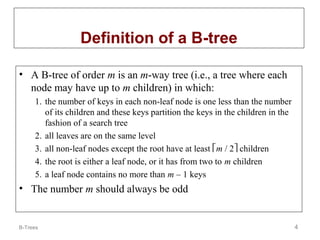
• A B-tree of order m is an m-way tree (i.e., a tree where each
node may have up to m children) in which:
1. the number of keys in each non-leaf node is one less than the number
of its children and these keys partition the keys in the children in the
fashion of a search tree
2. all leaves are on the same level
3. all non-leaf nodes except the root have at least m / 2 children
4. the root is either a leaf node, or it has from two to m children
5. a leaf node contains no more than m – 1 keys

• The number m should always be odd

B-Trees

4
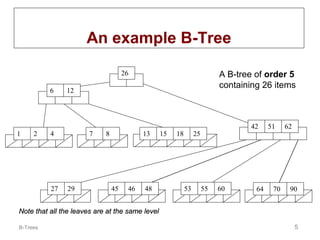
An example B-Tree
26
6

1

2

12

4

27

A B-tree of order 5
containing 26 items

7

29

8

13

45

46

48

15

18

42

25

53

55

60

64

51

70

62

90

Note that all the leaves are at the same level
B-Trees

5
Constructing a B-tree
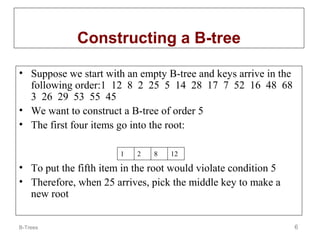
• Suppose we start with an empty B-tree and keys arrive in the
following order:1 12 8 2 25 5 14 28 17 7 52 16 48 68
3 26 29 53 55 45
• We want to construct a B-tree of order 5
• The first four items go into the root:
1

2

8

12

• To put the fifth item in the root would violate condition 5
• Therefore, when 25 arrives, pick the middle key to make a
new root
B-Trees

6
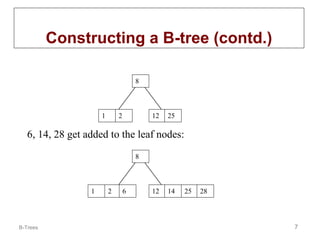
Constructing a B-tree (contd.)
8

1

2

12

25

6, 14, 28 get added to the leaf nodes:
8

1

B-Trees

2

6

12

14

25

28

7
Constructing a B-tree (contd.)
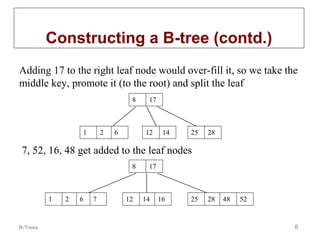
Adding 17 to the right leaf node would over-fill it, so we take the
middle key, promote it (to the root) and split the leaf
8

1

2

6

17

12

14

25

28

7, 52, 16, 48 get added to the leaf nodes
8

1

B-Trees

2

6

7

12

17

14

16

25

28

48

52

8
Constructing a B-tree (contd.)
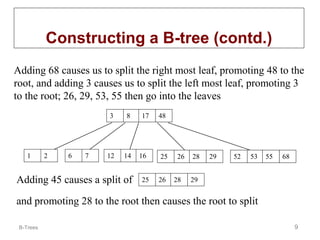
Adding 68 causes us to split the right most leaf, promoting 48 to the
root, and adding 3 causes us to split the left most leaf, promoting 3
to the root; 26, 29, 53, 55 then go into the leaves
3

1

2

6

7

8

12

14

Adding 45 causes a split of

17

16
25

48

25
26

26
28

28

29

52

53

55

68

29

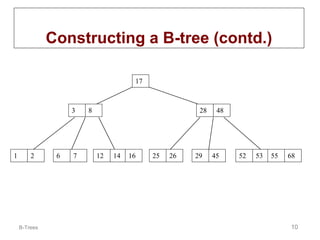
and promoting 28 to the root then causes the root to split
B-Trees

9
Constructing a B-tree (contd.)
17

3

1

2

B-Trees

6

7

8

28

12

14

16

25

26

29

48

45

52

53

55

68

10
Inserting into a B-Tree
• Attempt to insert the new key into a leaf
• If this would result in that leaf becoming too big, split the leaf
into two, promoting the middle key to the leaf’s parent
• If this would result in the parent becoming too big, split the
parent into two, promoting the middle key
• This strategy might have to be repeated all the way to the top
• If necessary, the root is split in two and the middle key is
promoted to a new root, making the tree one level higher

B-Trees

11
Exercise in Inserting a B-Tree
• Insert the following keys to a 5-way B-tree:
• 3, 7, 9, 23, 45, 1, 5, 14, 25, 24, 13, 11, 8, 19, 4, 31, 35, 56
•

B-Trees

12
Removal from a B-tree
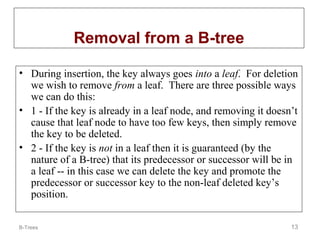
• During insertion, the key always goes into a leaf. For deletion
we wish to remove from a leaf. There are three possible ways
we can do this:
• 1 - If the key is already in a leaf node, and removing it doesn’t
cause that leaf node to have too few keys, then simply remove
the key to be deleted.
• 2 - If the key is not in a leaf then it is guaranteed (by the
nature of a B-tree) that its predecessor or successor will be in
a leaf -- in this case we can delete the key and promote the
predecessor or successor key to the non-leaf deleted key’s
position.
B-Trees

13
Removal from a B-tree (2)
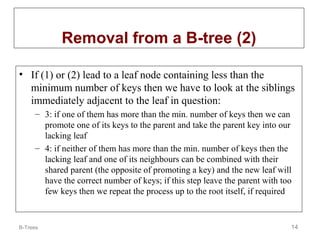
• If (1) or (2) lead to a leaf node containing less than the
minimum number of keys then we have to look at the siblings
immediately adjacent to the leaf in question:
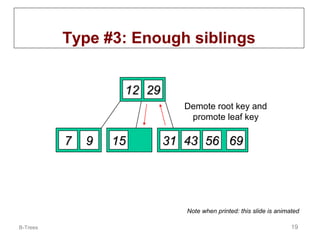
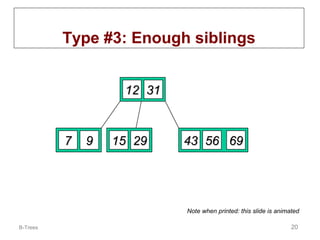
– 3: if one of them has more than the min. number of keys then we can
promote one of its keys to the parent and take the parent key into our
lacking leaf
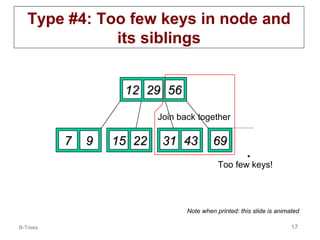
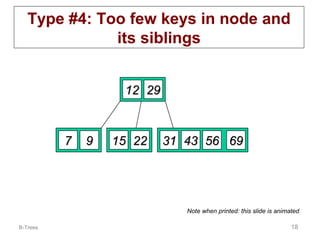
– 4: if neither of them has more than the min. number of keys then the
lacking leaf and one of its neighbours can be combined with their
shared parent (the opposite of promoting a key) and the new leaf will
have the correct number of keys; if this step leave the parent with too
few keys then we repeat the process up to the root itself, if required

B-Trees

14
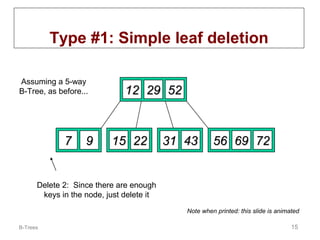
Type #1: Simple leaf deletion
Assuming a 5-way
B-Tree, as before...

2

7

9

12 29 52

15 22

31 43

56 69 72

Delete 2: Since there are enough
keys in the node, just delete it
Note when printed: this slide is animated
B-Trees

15
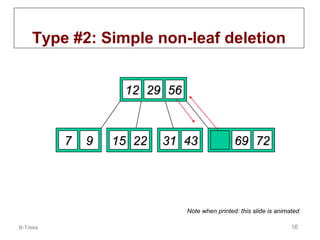
Type #2: Simple non-leaf deletion
Delete 52

12 29 52
56

7

9

15 22

31 43

56 69 72

Borrow the predecessor
or (in this case) successor
Note when printed: this slide is animated
B-Trees

16
Type #4: Too few keys in node and
its siblings
12 29 56
Join back together

7

9

15 22

31 43

69 72
Too few keys!
Delete 72

Note when printed: this slide is animated
B-Trees

17
Type #4: Too few keys in node and
its siblings
12 29

7

9

15 22

31 43 56 69

Note when printed: this slide is animated
B-Trees

18
Type #3: Enough siblings
12 29
Demote root key and
promote leaf key

7

9

15 22

31 43 56 69

Delete 22

Note when printed: this slide is animated
B-Trees

19
Type #3: Enough siblings
12 31

7

9

15 29

43 56 69

Note when printed: this slide is animated
B-Trees

20
Exercise in Removal from a B-Tree
• Given 5-way B-tree created by these data (last exercise):
• 3, 7, 9, 23, 45, 1, 5, 14, 25, 24, 13, 11, 8, 19, 4, 31, 35, 56
• Add these further keys: 2, 6,12
• Delete these keys: 4, 5, 7, 3, 14
•

B-Trees

21
Analysis of B-Trees
•

The maximum number of items in a B-tree of order m and height h:
root
level 1
level 2
. . .
level h

m–1
m(m – 1)
m2(m – 1)
mh(m – 1)

•

So, the total number of items is
(1 + m + m2 + m3 + … + mh)(m – 1) =
[(mh+1 – 1)/ (m – 1)] (m – 1) = mh+1 – 1

•

When m = 5 and h = 2 this gives 53 – 1 = 124

B-Trees

22
Reasons for using B-Trees
• When searching tables held on disc, the cost of each disc
transfer is high but doesn't depend much on the amount of
data transferred, especially if consecutive items are transferred
– If we use a B-tree of order 101, say, we can transfer each node in one
disc read operation
– A B-tree of order 101 and height 3 can hold 101 4 – 1 items
(approximately 100 million) and any item can be accessed with 3 disc
reads (assuming we hold the root in memory)

• If we take m = 3, we get a 2-3 tree, in which non-leaf nodes
have two or three children (i.e., one or two keys)
– B-Trees are always balanced (since the leaves are all at the same
level), so 2-3 trees make a good type of balanced tree

B-Trees

23
Comparing Trees
• Binary trees
– Can become unbalanced and lose their good time complexity (big O)
– AVL trees are strict binary trees that overcome the balance problem
– Heaps remain balanced but only prioritise (not order) the keys

• Multi-way trees
– B-Trees can be m-way, they can have any (odd) number of children
– One B-Tree, the 2-3 (or 3-way) B-Tree, approximates a permanently
balanced binary tree, exchanging the AVL tree’s balancing operations
for insertion and (more complex) deletion operations

B-Trees

24

Btree

  • 1.
  • 2.
    Motivation for B-Trees •Index structures for large datasets cannot be stored in main memory • Storing it on disk requires different approach to efficiency • Assuming that a disk spins at 3600 RPM, one revolution occurs in 1/60 of a second, or 16.7ms • Crudely speaking, one disk access takes about the same time as 200,000 instructions B-Trees 2
  • 3.
    Motivation (cont.) • Assumethat we use an AVL tree to store about 20 million records • We end up with a very deep binary tree with lots of different disk accesses; log2 20,000,000 is about 24, so this takes about 0.2 seconds • We know we can’t improve on the log n lower bound on search for a binary tree • But, the solution is to use more branches and thus reduce the height of the tree! – As branching increases, depth decreases B-Trees 3
  • 4.
    Definition of aB-tree • A B-tree of order m is an m-way tree (i.e., a tree where each node may have up to m children) in which: 1. the number of keys in each non-leaf node is one less than the number of its children and these keys partition the keys in the children in the fashion of a search tree 2. all leaves are on the same level 3. all non-leaf nodes except the root have at least m / 2 children 4. the root is either a leaf node, or it has from two to m children 5. a leaf node contains no more than m – 1 keys • The number m should always be odd B-Trees 4
  • 5.
    An example B-Tree 26 6 1 2 12 4 27 AB-tree of order 5 containing 26 items 7 29 8 13 45 46 48 15 18 42 25 53 55 60 64 51 70 62 90 Note that all the leaves are at the same level B-Trees 5
  • 6.
    Constructing a B-tree •Suppose we start with an empty B-tree and keys arrive in the following order:1 12 8 2 25 5 14 28 17 7 52 16 48 68 3 26 29 53 55 45 • We want to construct a B-tree of order 5 • The first four items go into the root: 1 2 8 12 • To put the fifth item in the root would violate condition 5 • Therefore, when 25 arrives, pick the middle key to make a new root B-Trees 6
  • 7.
    Constructing a B-tree(contd.) 8 1 2 12 25 6, 14, 28 get added to the leaf nodes: 8 1 B-Trees 2 6 12 14 25 28 7
  • 8.
    Constructing a B-tree(contd.) Adding 17 to the right leaf node would over-fill it, so we take the middle key, promote it (to the root) and split the leaf 8 1 2 6 17 12 14 25 28 7, 52, 16, 48 get added to the leaf nodes 8 1 B-Trees 2 6 7 12 17 14 16 25 28 48 52 8
  • 9.
    Constructing a B-tree(contd.) Adding 68 causes us to split the right most leaf, promoting 48 to the root, and adding 3 causes us to split the left most leaf, promoting 3 to the root; 26, 29, 53, 55 then go into the leaves 3 1 2 6 7 8 12 14 Adding 45 causes a split of 17 16 25 48 25 26 26 28 28 29 52 53 55 68 29 and promoting 28 to the root then causes the root to split B-Trees 9
  • 10.
    Constructing a B-tree(contd.) 17 3 1 2 B-Trees 6 7 8 28 12 14 16 25 26 29 48 45 52 53 55 68 10
  • 11.
    Inserting into aB-Tree • Attempt to insert the new key into a leaf • If this would result in that leaf becoming too big, split the leaf into two, promoting the middle key to the leaf’s parent • If this would result in the parent becoming too big, split the parent into two, promoting the middle key • This strategy might have to be repeated all the way to the top • If necessary, the root is split in two and the middle key is promoted to a new root, making the tree one level higher B-Trees 11
  • 12.
    Exercise in Insertinga B-Tree • Insert the following keys to a 5-way B-tree: • 3, 7, 9, 23, 45, 1, 5, 14, 25, 24, 13, 11, 8, 19, 4, 31, 35, 56 • B-Trees 12
  • 13.
    Removal from aB-tree • During insertion, the key always goes into a leaf. For deletion we wish to remove from a leaf. There are three possible ways we can do this: • 1 - If the key is already in a leaf node, and removing it doesn’t cause that leaf node to have too few keys, then simply remove the key to be deleted. • 2 - If the key is not in a leaf then it is guaranteed (by the nature of a B-tree) that its predecessor or successor will be in a leaf -- in this case we can delete the key and promote the predecessor or successor key to the non-leaf deleted key’s position. B-Trees 13
  • 14.
    Removal from aB-tree (2) • If (1) or (2) lead to a leaf node containing less than the minimum number of keys then we have to look at the siblings immediately adjacent to the leaf in question: – 3: if one of them has more than the min. number of keys then we can promote one of its keys to the parent and take the parent key into our lacking leaf – 4: if neither of them has more than the min. number of keys then the lacking leaf and one of its neighbours can be combined with their shared parent (the opposite of promoting a key) and the new leaf will have the correct number of keys; if this step leave the parent with too few keys then we repeat the process up to the root itself, if required B-Trees 14
  • 15.
    Type #1: Simpleleaf deletion Assuming a 5-way B-Tree, as before... 2 7 9 12 29 52 15 22 31 43 56 69 72 Delete 2: Since there are enough keys in the node, just delete it Note when printed: this slide is animated B-Trees 15
  • 16.
    Type #2: Simplenon-leaf deletion Delete 52 12 29 52 56 7 9 15 22 31 43 56 69 72 Borrow the predecessor or (in this case) successor Note when printed: this slide is animated B-Trees 16
  • 17.
    Type #4: Toofew keys in node and its siblings 12 29 56 Join back together 7 9 15 22 31 43 69 72 Too few keys! Delete 72 Note when printed: this slide is animated B-Trees 17
  • 18.
    Type #4: Toofew keys in node and its siblings 12 29 7 9 15 22 31 43 56 69 Note when printed: this slide is animated B-Trees 18
  • 19.
    Type #3: Enoughsiblings 12 29 Demote root key and promote leaf key 7 9 15 22 31 43 56 69 Delete 22 Note when printed: this slide is animated B-Trees 19
  • 20.
    Type #3: Enoughsiblings 12 31 7 9 15 29 43 56 69 Note when printed: this slide is animated B-Trees 20
  • 21.
    Exercise in Removalfrom a B-Tree • Given 5-way B-tree created by these data (last exercise): • 3, 7, 9, 23, 45, 1, 5, 14, 25, 24, 13, 11, 8, 19, 4, 31, 35, 56 • Add these further keys: 2, 6,12 • Delete these keys: 4, 5, 7, 3, 14 • B-Trees 21
  • 22.
    Analysis of B-Trees • Themaximum number of items in a B-tree of order m and height h: root level 1 level 2 . . . level h m–1 m(m – 1) m2(m – 1) mh(m – 1) • So, the total number of items is (1 + m + m2 + m3 + … + mh)(m – 1) = [(mh+1 – 1)/ (m – 1)] (m – 1) = mh+1 – 1 • When m = 5 and h = 2 this gives 53 – 1 = 124 B-Trees 22
  • 23.
    Reasons for usingB-Trees • When searching tables held on disc, the cost of each disc transfer is high but doesn't depend much on the amount of data transferred, especially if consecutive items are transferred – If we use a B-tree of order 101, say, we can transfer each node in one disc read operation – A B-tree of order 101 and height 3 can hold 101 4 – 1 items (approximately 100 million) and any item can be accessed with 3 disc reads (assuming we hold the root in memory) • If we take m = 3, we get a 2-3 tree, in which non-leaf nodes have two or three children (i.e., one or two keys) – B-Trees are always balanced (since the leaves are all at the same level), so 2-3 trees make a good type of balanced tree B-Trees 23
  • 24.
    Comparing Trees • Binarytrees – Can become unbalanced and lose their good time complexity (big O) – AVL trees are strict binary trees that overcome the balance problem – Heaps remain balanced but only prioritise (not order) the keys • Multi-way trees – B-Trees can be m-way, they can have any (odd) number of children – One B-Tree, the 2-3 (or 3-way) B-Tree, approximates a permanently balanced binary tree, exchanging the AVL tree’s balancing operations for insertion and (more complex) deletion operations B-Trees 24