B+-Trees
Preethi B
Department of Computer
Science
Coimbatore -43
B+ TREE
• A B+ tree is an n-array tree with a variable
but often large number of children per node.
• A B+ tree consists of a root, internal nodes
and leaves.
• The root may be either a leaf or a node with
two or more children.
• The primary value of a B+ tree is in storing
data for efficient retrieval in a block-oriented
storage context — in particular, file systems.
Example Tree Index
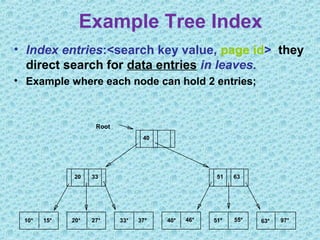
• Index entries:<search key value, page id> they
direct search for data entries in leaves.
• Example where each node can hold 2 entries;
10* 15* 20* 27* 33* 37* 40* 46* 51* 55* 63* 97*
20 33 51 63
40
Root
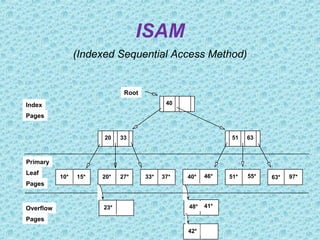
ISAM
(Indexed Sequential Access Method)
48*
10* 15* 20* 27* 33* 37* 40* 46* 51* 55* 63*
20 33 51 63
40
97*
Root
Overflow
Pages
Leaf
Pages
Primary
23* 41*
42*
Index
Pages
Example B+ Tree
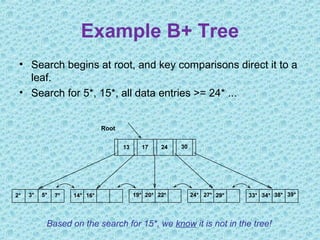
• Search begins at root, and key comparisons direct it to a
leaf.
• Search for 5*, 15*, all data entries >= 24* ...
Based on the search for 15*, we know it is not in the tree!
Root
17 24 30
2* 3* 5* 7* 14* 16* 19* 20* 22* 24* 27* 29* 33* 34* 38* 39*
13
B+ Tree - Properties
• Balanced
• Every node except root must be at least ½ full.
• Order: the minimum number of keys/pointers in
a non-leaf node
• Fanout of a node: the number of pointers out of
the node
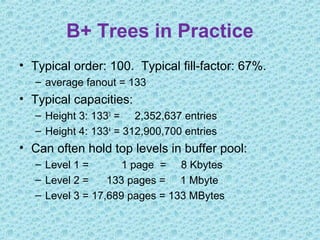
B+ Trees in Practice
• Typical order: 100. Typical fill-factor: 67%.
– average fanout = 133
• Typical capacities:
– Height 3: 1333
= 2,352,637 entries
– Height 4: 1334
= 312,900,700 entries
• Can often hold top levels in buffer pool:
– Level 1 = 1 page = 8 Kbytes
– Level 2 = 133 pages = 1 Mbyte
– Level 3 = 17,689 pages = 133 MBytes
B+ Trees: Summary
• Searching:
– logd(n) – Where d is the order, and n is the number of entries
• Insertion:
– Find the leaf to insert into
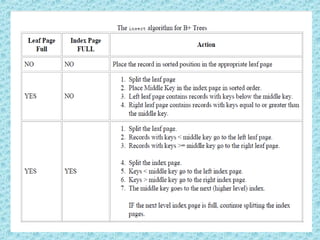
– If full, split the node, and adjust index accordingly
– Similar cost as searching
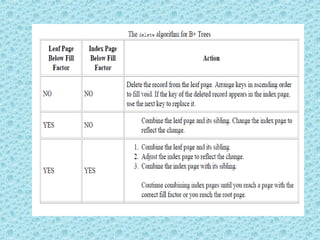
• Deletion
– Find the leaf node
– Delete
– May not remain half-full; must adjust the index accordingly
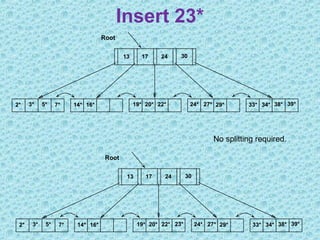
Insert 23*
Root
17 24 30
2* 3* 5* 7* 14* 16* 19* 20* 22* 24* 27* 29* 33* 34* 38* 39*
13
Root
17 24 30
2* 3* 5* 7* 14* 16* 19* 20* 22* 24* 27* 29* 33* 34* 38* 39*
13
23*
No splitting required.
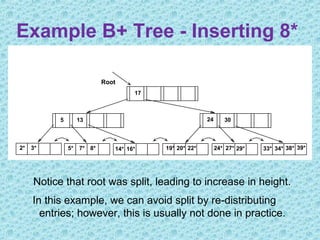
Example B+ Tree - Inserting 8*
Notice that root was split, leading to increase in height.
In this example, we can avoid split by re-distributing
entries; however, this is usually not done in practice.
Root
17 24 30
2* 3* 5* 7* 14* 16* 19* 20* 22* 24* 27* 29* 33* 34* 38* 39*
13
2* 3*
Root
17
24 30
14* 16* 19* 20* 22* 24* 27* 29* 33* 34* 38* 39*
135
7*5* 8*
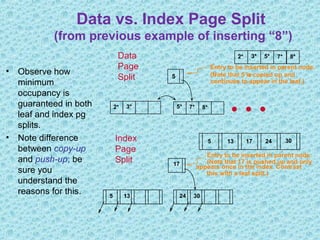
Data vs. Index Page Split
(from previous example of inserting “8”)
• Observe how
minimum
occupancy is
guaranteed in both
leaf and index pg
splits.
• Note difference
between copy-up
and push-up; be
sure you
understand the
reasons for this.
2* 3* 5* 7*
5
Entry to be inserted in parent node.
(Note that 5 is
continues to appear in the leaf.)
s copied up and
2* 3* 5* 7* 8* …
Data
Page
Split
8*
5 24 3013
appears once in the index. Contrast17
Entry to be inserted in parent node.
(Note that 17 is pushed up and only
this with a leaf split.)
17 24 3013Index
Page
Split
5
Root
17 24 30
2* 3* 5* 7* 14* 16* 19* 20* 22* 24* 27* 29* 33* 34* 38* 39*
13
2* 3*
Root
17
24 30
14* 16* 19* 20* 22* 24* 27* 29* 33* 34* 38* 39*
135
7*5* 8*
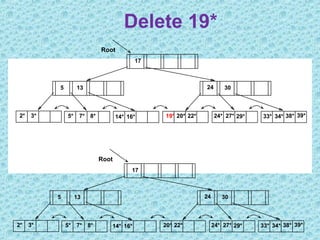
Delete 19*
2* 3*
Root
17
24 30
14* 16* 20* 22* 24* 27* 29* 33* 34* 38* 39*
135
7*5* 8*
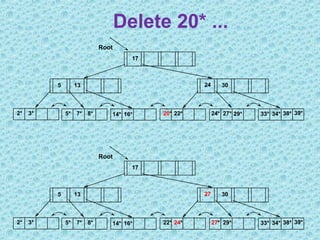
Delete 20* ...
2* 3*
Root
17
24 30
14* 16* 20* 22* 24* 27* 29* 33* 34* 38* 39*
135
7*5* 8*
2* 3*
Root
17
27 30
14* 16* 22* 24* 27* 29* 33* 34* 38* 39*
135
7*5* 8*
Delete 19* and 20* ...
• Deleting 19* is easy.
• Deleting 20* is done with re-distribution. Notice how
middle key is copied up.
• Further deleting 24* results in more drastic changes
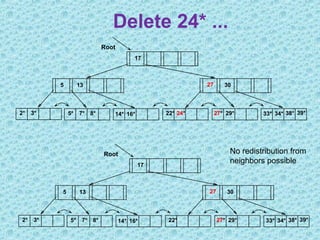
Delete 24* ...
2* 3*
Root
17
27 30
14* 16* 22* 24* 27* 29* 33* 34* 38* 39*
135
7*5* 8*
2* 3*
Root
17
27 30
14* 16* 22* 27* 29* 33* 34* 38* 39*
135
7*5* 8*
No redistribution from
neighbors possible
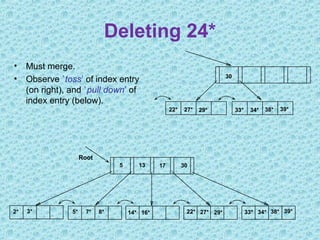
Deleting 24*
• Must merge.
• Observe `toss’ of index entry
(on right), and `pull down’ of
index entry (below).
30
22* 27* 29* 33* 34* 38* 39*
2* 3* 7* 14* 16* 22* 27* 29* 33* 34* 38* 39*5* 8*
Root
30135 17
References:
http://www.di.ufpb.br/lucidio/Btrees.pdf
https://www.sci.unich.it/~acciaro/bpiutrees.pdf

B+ tree

  • 1.
    B+-Trees Preethi B Department ofComputer Science Coimbatore -43
  • 2.
    B+ TREE • AB+ tree is an n-array tree with a variable but often large number of children per node. • A B+ tree consists of a root, internal nodes and leaves. • The root may be either a leaf or a node with two or more children. • The primary value of a B+ tree is in storing data for efficient retrieval in a block-oriented storage context — in particular, file systems.
  • 3.
    Example Tree Index •Index entries:<search key value, page id> they direct search for data entries in leaves. • Example where each node can hold 2 entries; 10* 15* 20* 27* 33* 37* 40* 46* 51* 55* 63* 97* 20 33 51 63 40 Root
  • 4.
    ISAM (Indexed Sequential AccessMethod) 48* 10* 15* 20* 27* 33* 37* 40* 46* 51* 55* 63* 20 33 51 63 40 97* Root Overflow Pages Leaf Pages Primary 23* 41* 42* Index Pages
  • 5.
    Example B+ Tree •Search begins at root, and key comparisons direct it to a leaf. • Search for 5*, 15*, all data entries >= 24* ... Based on the search for 15*, we know it is not in the tree! Root 17 24 30 2* 3* 5* 7* 14* 16* 19* 20* 22* 24* 27* 29* 33* 34* 38* 39* 13
  • 6.
    B+ Tree -Properties • Balanced • Every node except root must be at least ½ full. • Order: the minimum number of keys/pointers in a non-leaf node • Fanout of a node: the number of pointers out of the node
  • 7.
    B+ Trees inPractice • Typical order: 100. Typical fill-factor: 67%. – average fanout = 133 • Typical capacities: – Height 3: 1333 = 2,352,637 entries – Height 4: 1334 = 312,900,700 entries • Can often hold top levels in buffer pool: – Level 1 = 1 page = 8 Kbytes – Level 2 = 133 pages = 1 Mbyte – Level 3 = 17,689 pages = 133 MBytes
  • 8.
    B+ Trees: Summary •Searching: – logd(n) – Where d is the order, and n is the number of entries • Insertion: – Find the leaf to insert into – If full, split the node, and adjust index accordingly – Similar cost as searching • Deletion – Find the leaf node – Delete – May not remain half-full; must adjust the index accordingly
  • 10.
    Insert 23* Root 17 2430 2* 3* 5* 7* 14* 16* 19* 20* 22* 24* 27* 29* 33* 34* 38* 39* 13 Root 17 24 30 2* 3* 5* 7* 14* 16* 19* 20* 22* 24* 27* 29* 33* 34* 38* 39* 13 23* No splitting required.
  • 11.
    Example B+ Tree- Inserting 8* Notice that root was split, leading to increase in height. In this example, we can avoid split by re-distributing entries; however, this is usually not done in practice. Root 17 24 30 2* 3* 5* 7* 14* 16* 19* 20* 22* 24* 27* 29* 33* 34* 38* 39* 13 2* 3* Root 17 24 30 14* 16* 19* 20* 22* 24* 27* 29* 33* 34* 38* 39* 135 7*5* 8*
  • 12.
    Data vs. IndexPage Split (from previous example of inserting “8”) • Observe how minimum occupancy is guaranteed in both leaf and index pg splits. • Note difference between copy-up and push-up; be sure you understand the reasons for this. 2* 3* 5* 7* 5 Entry to be inserted in parent node. (Note that 5 is continues to appear in the leaf.) s copied up and 2* 3* 5* 7* 8* … Data Page Split 8* 5 24 3013 appears once in the index. Contrast17 Entry to be inserted in parent node. (Note that 17 is pushed up and only this with a leaf split.) 17 24 3013Index Page Split 5
  • 14.
    Root 17 24 30 2*3* 5* 7* 14* 16* 19* 20* 22* 24* 27* 29* 33* 34* 38* 39* 13 2* 3* Root 17 24 30 14* 16* 19* 20* 22* 24* 27* 29* 33* 34* 38* 39* 135 7*5* 8* Delete 19* 2* 3* Root 17 24 30 14* 16* 20* 22* 24* 27* 29* 33* 34* 38* 39* 135 7*5* 8*
  • 15.
    Delete 20* ... 2*3* Root 17 24 30 14* 16* 20* 22* 24* 27* 29* 33* 34* 38* 39* 135 7*5* 8* 2* 3* Root 17 27 30 14* 16* 22* 24* 27* 29* 33* 34* 38* 39* 135 7*5* 8*
  • 16.
    Delete 19* and20* ... • Deleting 19* is easy. • Deleting 20* is done with re-distribution. Notice how middle key is copied up. • Further deleting 24* results in more drastic changes
  • 17.
    Delete 24* ... 2*3* Root 17 27 30 14* 16* 22* 24* 27* 29* 33* 34* 38* 39* 135 7*5* 8* 2* 3* Root 17 27 30 14* 16* 22* 27* 29* 33* 34* 38* 39* 135 7*5* 8* No redistribution from neighbors possible
  • 18.
    Deleting 24* • Mustmerge. • Observe `toss’ of index entry (on right), and `pull down’ of index entry (below). 30 22* 27* 29* 33* 34* 38* 39* 2* 3* 7* 14* 16* 22* 27* 29* 33* 34* 38* 39*5* 8* Root 30135 17
  • 19.