1/21
ROBOT KINEMATICS
Václav Hlaváč
Czech Technical University, Faculty of Electrical Engineering
Department of Cybernetics, Center for Machine Perception
121 35 Praha 2, Karlovo nám. 13, Czech Republic
hlavac@fel.cvut.cz, http://cmp.felk.cvut.cz
LECTURE PLAN
1. Kinematics, what is?
2. Open, closed kinematic mechanisms.
3. Sequence of joint transformations (matrix multiplications)
4. Direct vs. inverse kinematic task.
2/21
KINEMATICS

KINEMATICS – the analytical study of the geometry of
motion of a mechanism:
• with respect to a fixed reference co-ordinate system,
• without regard to the forces or moments that cause
the motion.

In order to control and programme a robot we must have
knowledge of both its spatial arrangement and a means of
reference to the environment.
3/21
OPEN CHAIN MANIPULATOR KINEMATICS

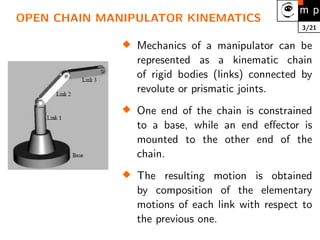
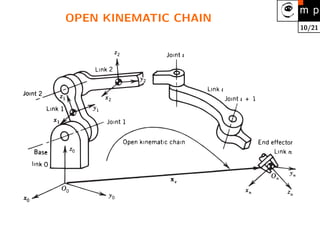
Mechanics of a manipulator can be
represented as a kinematic chain
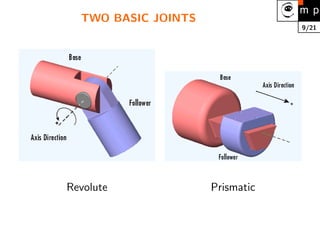
of rigid bodies (links) connected by
revolute or prismatic joints.

One end of the chain is constrained
to a base, while an end effector is
mounted to the other end of the
chain.

The resulting motion is obtained
by composition of the elementary
motions of each link with respect to
the previous one.
4/21
CLOSED KINEMATIC CHAIN

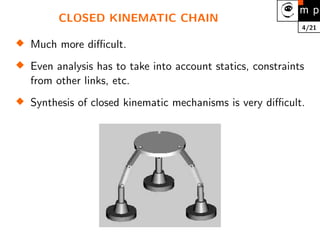
Much more difficult.

Even analysis has to take into account statics, constraints
from other links, etc.

Synthesis of closed kinematic mechanisms is very difficult.
5/21
KINEMATICS vs. DIFFERENTIAL KINEMATICS

Kinematics describes the analytical relationship between
the joint positions and the end-effector position and
orientation.

Differential kinematics describes the analytical relationship
between the joint motion and the end-effector motion in
terms of velocities.
6/21
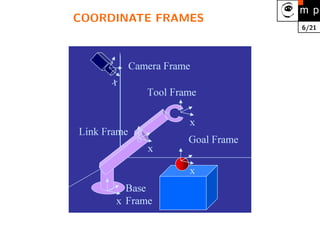
COORDINATE FRAMES
7/21
TWO FRAMES KINEMATIC RELATIONSHIP

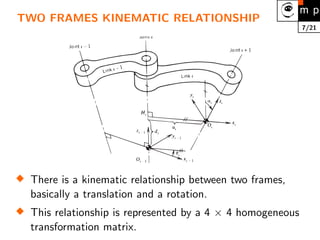
There is a kinematic relationship between two frames,
basically a translation and a rotation.

This relationship is represented by a 4 × 4 homogeneous
transformation matrix.
8/21
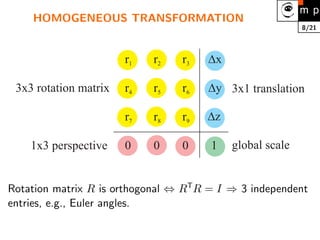
HOMOGENEOUS TRANSFORMATION
r1 r3
r4 r5 r6
r7 r8 r9
r2
0
0
0 1
Dx
Dy
Dz
3x3 rotation matrix 3x1 translation
global scale
1x3 perspective
Rotation matrix R is orthogonal ⇔ RT
R = I ⇒ 3 independent
entries, e.g., Euler angles.
9/21
TWO BASIC JOINTS
Revolute Prismatic
10/21
OPEN KINEMATIC CHAIN
11/21
DIRECT vs. INVERSE KINEMATICS
In manipulator robotics, there are two kinematic tasks:
Direct (also forward) kinematics – Given are joint relations
(rotations, translations) for the robot arm. Task: What is
the orientation and position of the end effector?
Inverse kinematics – Given is desired end effector position and
orientation. Task: What are the joint rotations and
orientations to achieve this?
12/21
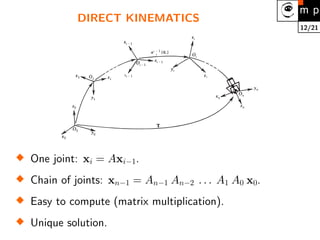
DIRECT KINEMATICS

One joint: xi = Axi−1.

Chain of joints: xn−1 = An−1 An−2 . . . A1 A0 x0.

Easy to compute (matrix multiplication).

Unique solution.
13/21
INVERSE KINEMATICS

For a kinematic mechanism, the inverse kinematic problem
is difficult to solve.

The robot controller must solve a set of non-linear
simultaneous algebraic equations.

Source of problems:
• Non-linear equations (sin, cos in rotation matrices).
• The existence of multiple solutions.
• The possible non-existence of a solution.
• Singularities.
14/21
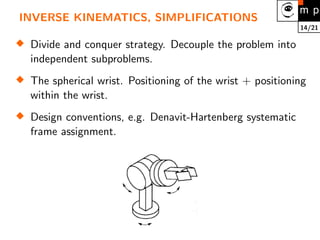
INVERSE KINEMATICS, SIMPLIFICATIONS

Divide and conquer strategy. Decouple the problem into
independent subproblems.

The spherical wrist. Positioning of the wrist + positioning
within the wrist.

Design conventions, e.g. Denavit-Hartenberg systematic
frame assignment.
15/21
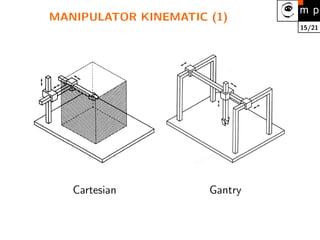
MANIPULATOR KINEMATIC (1)
Cartesian Gantry
16/21
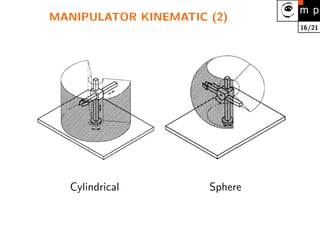
MANIPULATOR KINEMATIC (2)
Cylindrical Sphere
17/21
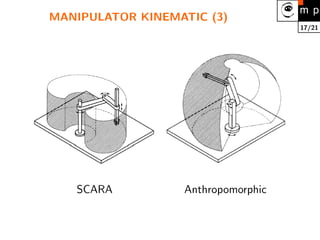
MANIPULATOR KINEMATIC (3)
SCARA Anthropomorphic
18/21
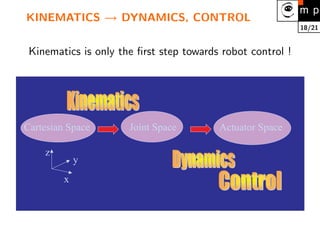
KINEMATICS → DYNAMICS, CONTROL
Kinematics is only the first step towards robot control !
Cartesian Space Joint Space Actuator Space
z
y
x
19/21
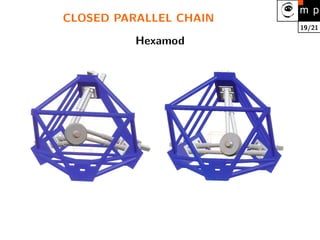
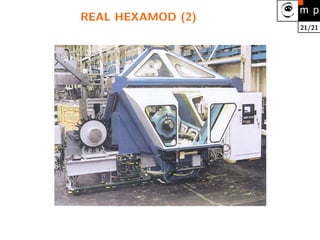
CLOSED PARALLEL CHAIN
Hexamod
20/21
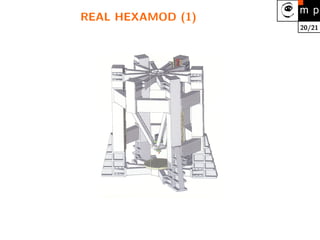
REAL HEXAMOD (1)
21/21
REAL HEXAMOD (2)

11 kinematicsrobot

  • 1.
    1/21 ROBOT KINEMATICS Václav Hlaváč CzechTechnical University, Faculty of Electrical Engineering Department of Cybernetics, Center for Machine Perception 121 35 Praha 2, Karlovo nám. 13, Czech Republic hlavac@fel.cvut.cz, http://cmp.felk.cvut.cz LECTURE PLAN 1. Kinematics, what is? 2. Open, closed kinematic mechanisms. 3. Sequence of joint transformations (matrix multiplications) 4. Direct vs. inverse kinematic task.
  • 2.
    2/21 KINEMATICS KINEMATICS – theanalytical study of the geometry of motion of a mechanism: • with respect to a fixed reference co-ordinate system, • without regard to the forces or moments that cause the motion. In order to control and programme a robot we must have knowledge of both its spatial arrangement and a means of reference to the environment.
  • 3.
    3/21 OPEN CHAIN MANIPULATORKINEMATICS Mechanics of a manipulator can be represented as a kinematic chain of rigid bodies (links) connected by revolute or prismatic joints. One end of the chain is constrained to a base, while an end effector is mounted to the other end of the chain. The resulting motion is obtained by composition of the elementary motions of each link with respect to the previous one.
  • 4.
    4/21 CLOSED KINEMATIC CHAIN Muchmore difficult. Even analysis has to take into account statics, constraints from other links, etc. Synthesis of closed kinematic mechanisms is very difficult.
  • 5.
    5/21 KINEMATICS vs. DIFFERENTIALKINEMATICS Kinematics describes the analytical relationship between the joint positions and the end-effector position and orientation. Differential kinematics describes the analytical relationship between the joint motion and the end-effector motion in terms of velocities.
  • 6.
  • 7.
    7/21 TWO FRAMES KINEMATICRELATIONSHIP There is a kinematic relationship between two frames, basically a translation and a rotation. This relationship is represented by a 4 × 4 homogeneous transformation matrix.
  • 8.
    8/21 HOMOGENEOUS TRANSFORMATION r1 r3 r4r5 r6 r7 r8 r9 r2 0 0 0 1 Dx Dy Dz 3x3 rotation matrix 3x1 translation global scale 1x3 perspective Rotation matrix R is orthogonal ⇔ RT R = I ⇒ 3 independent entries, e.g., Euler angles.
  • 9.
  • 10.
  • 11.
    11/21 DIRECT vs. INVERSEKINEMATICS In manipulator robotics, there are two kinematic tasks: Direct (also forward) kinematics – Given are joint relations (rotations, translations) for the robot arm. Task: What is the orientation and position of the end effector? Inverse kinematics – Given is desired end effector position and orientation. Task: What are the joint rotations and orientations to achieve this?
  • 12.
    12/21 DIRECT KINEMATICS One joint:xi = Axi−1. Chain of joints: xn−1 = An−1 An−2 . . . A1 A0 x0. Easy to compute (matrix multiplication). Unique solution.
  • 13.
    13/21 INVERSE KINEMATICS For akinematic mechanism, the inverse kinematic problem is difficult to solve. The robot controller must solve a set of non-linear simultaneous algebraic equations. Source of problems: • Non-linear equations (sin, cos in rotation matrices). • The existence of multiple solutions. • The possible non-existence of a solution. • Singularities.
  • 14.
    14/21 INVERSE KINEMATICS, SIMPLIFICATIONS Divideand conquer strategy. Decouple the problem into independent subproblems. The spherical wrist. Positioning of the wrist + positioning within the wrist. Design conventions, e.g. Denavit-Hartenberg systematic frame assignment.
  • 15.
  • 16.
  • 17.
  • 18.
    18/21 KINEMATICS → DYNAMICS,CONTROL Kinematics is only the first step towards robot control ! Cartesian Space Joint Space Actuator Space z y x
  • 19.
  • 20.
  • 21.