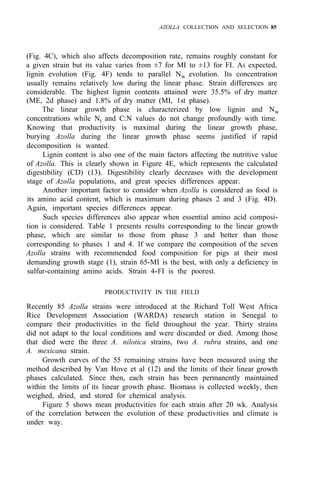
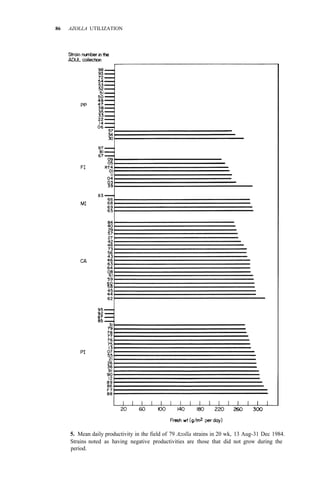
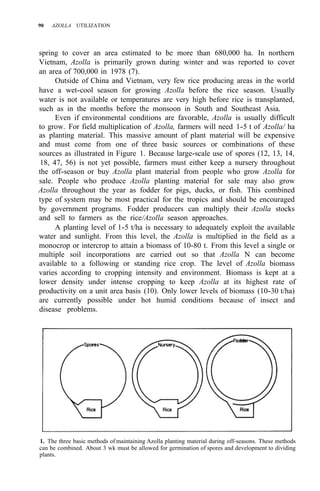
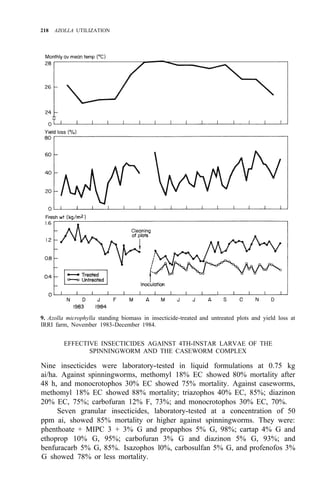
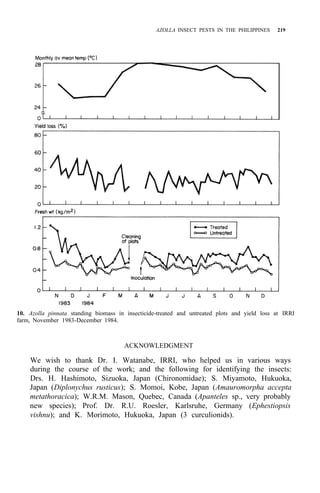
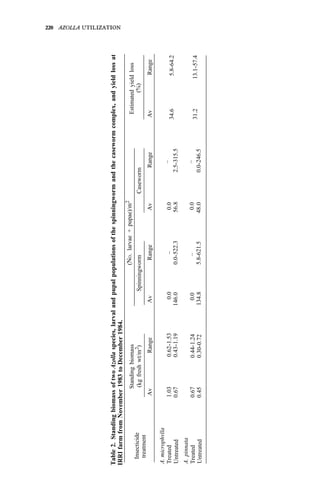
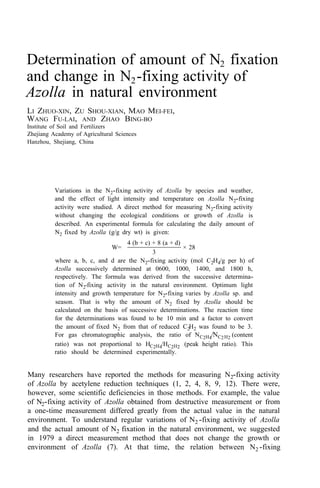
AZOLLA
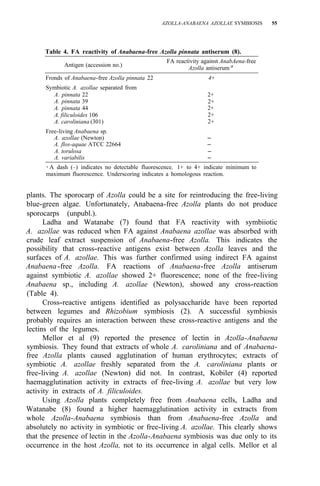
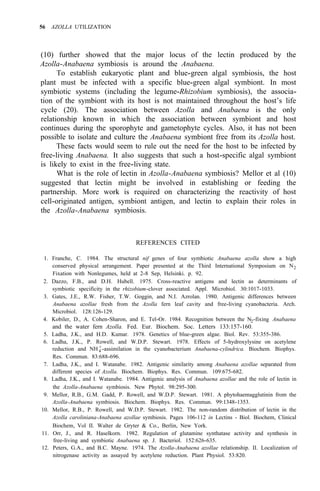
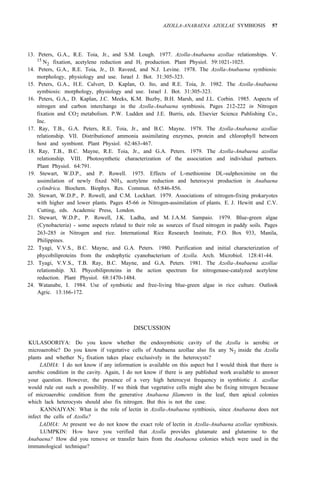
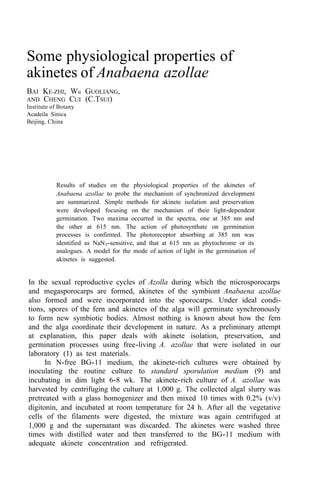
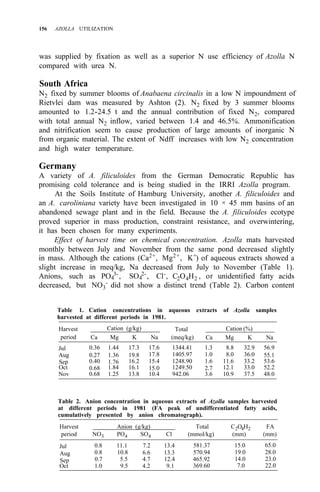
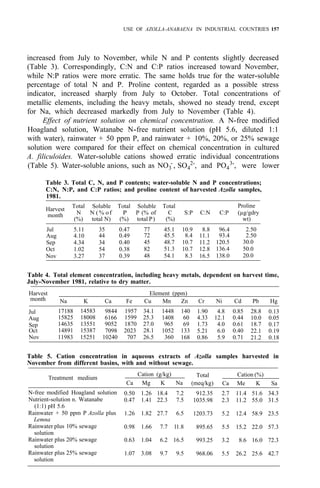
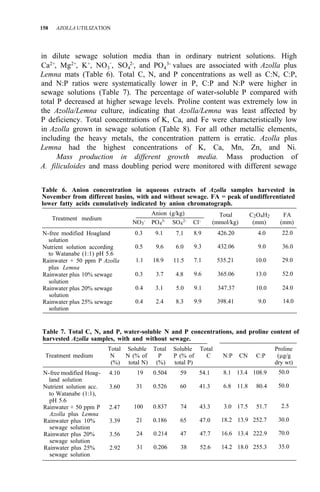
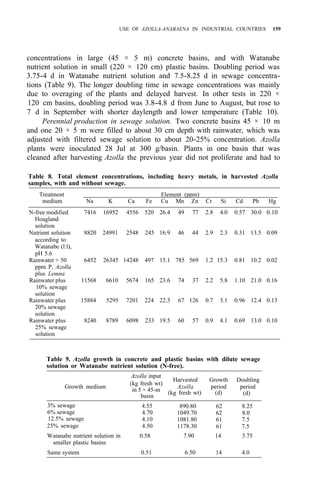
UTILIZATION
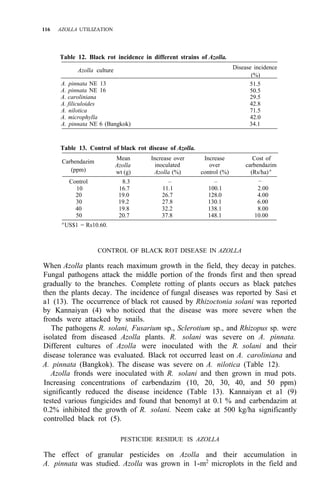
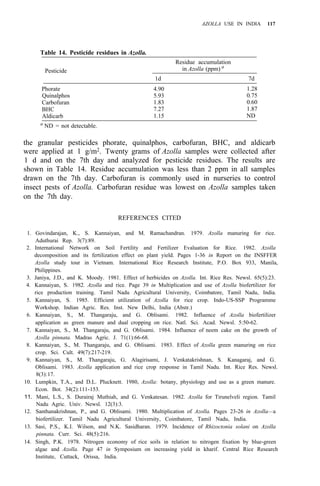
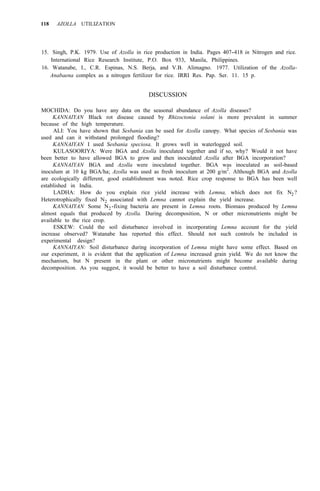
Proceedings of the Workshop
on AzoIla Use
Fuzhou, Fujian, China
31 March-5 April 1985
Sponsored by:
The Fujian Academy of Agricultural Sciences
Fuzhou, Fujian, China
The International Rice Research Institute
Los Baños, Laguna, Philippines
and
1987
International Rice Research Institute
P.O. Box 933, Manila, Philippines
The International Rice Research Institute (IRRI) was established in
1960 by the Ford and Rockefeller Foundations with the help and
approval of the Government of the Philippines. Today IRRI is one of the
13 nonprofit international research and training centers supported by the
Consultative Group on International Agricultural Research (CGIAR).
The CGIAR is sponsored by the Food and Agriculture Organization
(FAO) of the United Nations, the International Bank for Reconstruction
and Development (World Bank), and the United Nations Development
Programme (UNDP). The CGIAR consists of 50 donor countries, inter-
national and regional organizations, and private foundations.
IRRI receives support, through the CGIAR, from a number of
donors including: the Asian Development Bank, the European Economic
Community, the Ford Foundation, the International Development
Research Centre, the International Fund for Agricultural Development,
the OPEC Special Fund, the Rockefeller Foundation, the United
Nations Development Programme, the World Bank, and the inter-
national aid agencies of the following governments: Australia, Belgium,
Canada, China, Denmark, France, Federal Republic of Germany, India,
Italy, Japan, Mexico, Netherlands, New Zealand, Norway, Philippines,
Saudi Arabia, Spain, Sweden, Switzerland, United Kingdom, and
United States.
The responsibility for this publication rests with the International
Rice Research Institute.
Copyright © International Rice Research Institute 1987
All rights reserved. Except for quotations of short passages for the
purpose of criticism and review, no part of this publication may be
reproduced, stored in retrieval systems, or transmitted in any form or by
any means, electronic, mechanical, photocopying, recording, or other-
wise, without prior permission of IRRI. This permission will not be
unreasonably withheld for use for noncommercial purposes. IRRI does
not require payment for the noncommercial use of its published works,
and hopes that this copyright declaration will not diminish the bona fide
use of its research findings in agricultural research and development.
The designations employed and the presentation of the material in
this publication do not imply the expression of any opinion whatsoever on
the part of IRRI concerning the legal status of any country, territory, city,
or area, or of its authorities, or concerning the delimitation of its frontiers
or boundaries.
ISBN 971-104-179-0
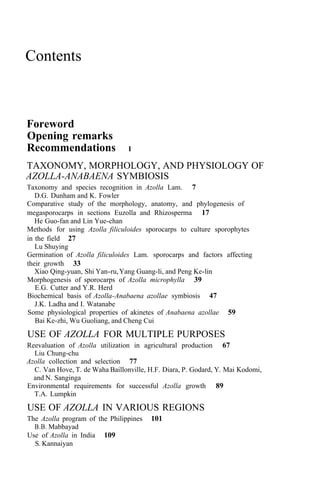
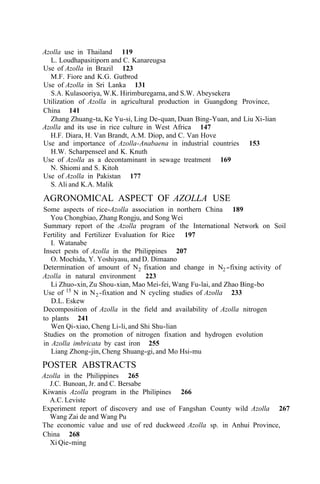
Contents
Foreword
Opening remarks
Recommendations 1
TAXONOMY, MORPHOLOGY, AND PHYSIOLOGY OF
AZOLLA-ANABAENA SYMBIOSIS
Taxonomy and species recognition in Azolla Lam. 7
Comparative study of the morphology, anatomy, and phylogenesis of
megasporocarps in sections Euzolla and Rhizosperma 17
Methods for using Azolla filiculoides sporocarps to culture sporophytes
in the field 27
Lu Shuying
Germination of Azolla filiculoides Lam. sporocarps and factors affecting
their growth 33
Morphogenesis of sporocarps of Azolla microphylla 39
Biochemical basis of Azolla-Anabaena azollae symbiosis 47
Some physiological properties of akinetes of Anabaena azollae 59
D.G. Dunham and K. Fowler
He Guo-fan and Lin Yue-chan
Xiao Qing-yuan, Shi Yan-ru,Yang Guang-li, and Peng Ke-lin
E.G. Cutter and Y.R. Herd
J.K. Ladha and I. Watanabe
Bai Ke-zhi, Wu Guoliang, and Cheng Cui
USE OF AZOLLA FOR MULTIPLE PURPOSES
Reevaluation of Azolla utilization in agricultural production 67
Azolla collection and selection 77
Liu Chung-chu
C. Van Hove, T. de Waha Baillonville, H.F. Diara, P. Godard, Y. Mai Kodomi,
and N. Sanginga
T.A. Lumpkin
Environmental requirements for successful Azolla growth 89
USE OF AZOLLA IN VARIOUS REGIONS
The Azolla program of the Philippines 101
Use of Azolla in India 109
B.B. Mabbayad
S. Kannaiyan
Azolla use in Thailand 119
L. Loudhapasitiporn and C. Kanareugsa
Use of Azolla in Brazil 123
M.F. Fiore and K.G. Gutbrod
Use of Azolla in Sri Lanka 131
Utilization of Azolla in agricultural production in Guangdong Province,
China 141
Azolla and its use in rice culture in West Africa 147
Use and importance of Azolla-Anabaena in industrial countries 153
Use of Azolla as a decontaminant in sewage treatment 169
Use of Azolla in Pakistan 177
S.A. Kulasooriya, W.K. Hirimburegama, and S.W. Abeysekera
Zhang Zhuang-ta, Ke Yu-si, Ling De-quan, Duan Bing-Yuan, and Liu Xi-lian
H.F. Diara, H. Van Brandt, A.M. Diop, and C. Van Hove
H.W. Scharpenseel and K. Knuth
N. Shiomi and S. Kitoh
S. Ali and K.A. Malik
AGRONOMICAL ASPECT OF AZOLLA USE
Some aspects of rice-Azolla association in northern China 189
Summary report of the Azolla program of the International Network on Soil
Fertility and Fertilizer Evaluation for Rice 197
I. Watanabe
Insect pests of Azolla in the Philippines 207
O. Mochida, Y. Yoshiyasu, and D. Dimaano
Determination of amount of N2 fixation and change in N2-fixing activity of
Azolla in natural environment 223
Li Zhuo-xin, Zu Shou-xian, Mao Mei-fei, Wang Fu-lai, and Zhao Bing-bo
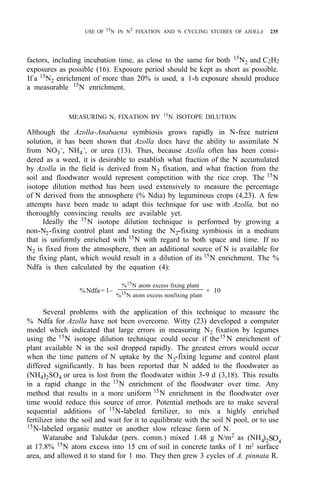
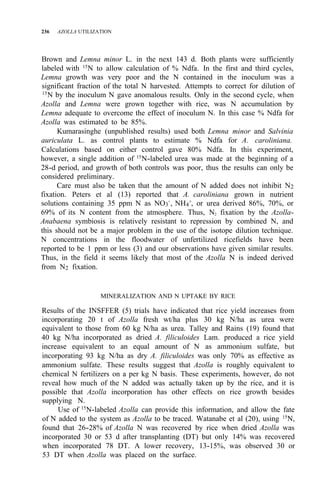
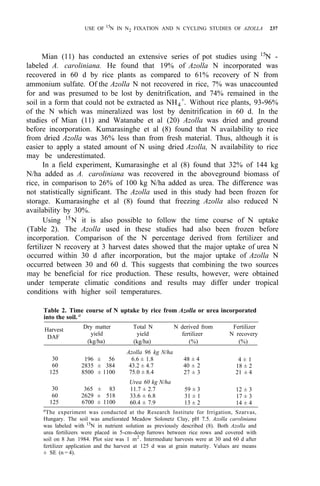
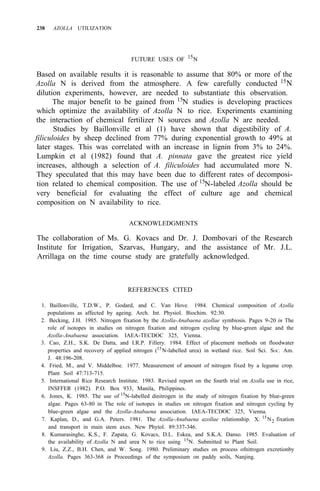
Use of 15
N in N2-fixation and N cycling studies of Azolla 233
D.L. Eskew
Decomposition of Azolla in the field and availability of Azolla nitrogen
to plants 241
Studies on the promotion of nitrogen fixation and hydrogen evolution
in Azolla imbricata by cast iron 255
You Chongbiao, Zhang Rongju, and Song Wei
Wen Qi-xiao, Cheng Li-li, and Shi Shu-lian
Liang Zhong-jin, Cheng Shuang-gi, and Mo Hsi-mu
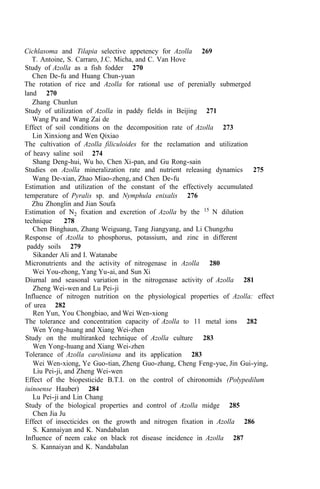
POSTER ABSTRACTS
Azolla in the Philippines 265
J.C. Bunoan, Jr. and C. Bersabe
Kiwanis Azolla program in the Philipines 266
A.C. Leviste
Experiment report of discovery and use of Fangshan County wild Azolla 267
Wang Zai de and Wang Pu
The economic value and use of red duckweed Azolla sp. in Anhui Province,
China 268
Xi Qie-ming
Cichlasoma and Tilapia selective appetency for Azolla 269
T. Antoine, S. Carraro, J.C. Micha, and C. Van Hove
Study of Azolla as a fish fodder 270
Chen De-fu and Huang Chun-yuan
The rotation of rice and Azolla for rational use of perenially submerged
land 270
Study of utilization of Azolla in paddy fields in Beijing 271
Effect of soil conditions on the decomposition rate of Azolla 273
The cultivation of Azolla filiculoides for the reclamation and utilization
of heavy saline soil 274

Studies on Azolla mineralization rate and nutrient releasing dynamics 275
Estimation and utilization of the constant of the effectively accumulated
temperature of Pyralis sp. and Nymphula enixalis 276
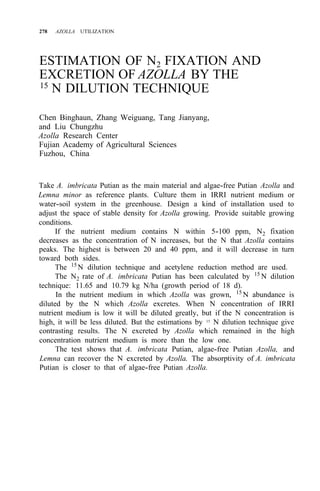
Estimation of N2 fixation and excretion of Azolla by the 15
N dilution
technique 278
Chen Binghaun, Zhang Weiguang, Tang Jiangyang, and Li Chungzhu
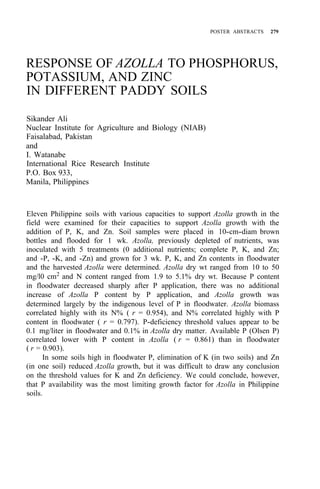
Response of Azolla to phosphorus, potassium, and zinc in different
paddy soils 279
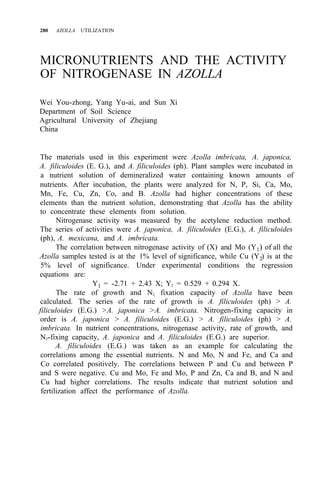
Micronutrients and the activity of nitrogenase in Azolla 280
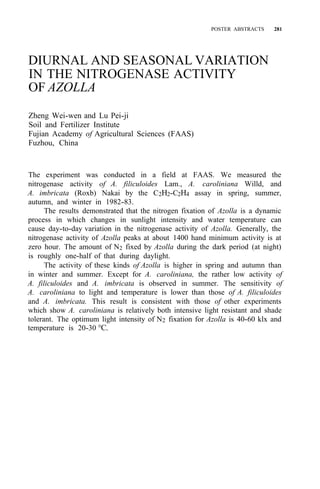
Diurnal and seasonal variation in the nitrogenase activity of Azolla 281
Influence of nitrogen nutrition on the physiological properties of Azolla: effect
of urea 282
The tolerance and concentration capacity of Azolla to 11 metal ions 282
Study on the multiranked technique of Azolla culture 283
Tolerance of Azolla caroliniana and its application 283
Zhang Chunlun
Wang Pu and Wang Zai de
Lin Xinxiong and Wen Qixiao
Shang Deng-hui, Wu ho, Chen Xi-pan, and Gu Rong-sain
Wang De-xian, Zhao Miao-zheng, and Chen De-fu
Zhu Zhonglin and Jian Soufa
Sikander Ali and I. Watanabe
Wei You-zhong, Yang Yu-ai, and Sun Xi
Zheng Wei-wen and Lu Pei-ji
Ren Yun, You Chongbiao, and Wei Wen-xiong
Wen Yong-huang and Xiang Wei-zhen
Wei Wen-xiong, Ye Guo-tian, Zheng Guo-zhang, Cheng Feng-yue, Jin Gui-ying,
Liu Pei-ji, and Zheng Wei-wen
Effect of the biopesticide B.T.I. on the control of chironomids (Polypedilum
iuinoense Hauber) 284
Study of the biological properties and control of Azolla midge 285
Effect of insecticides on the growth and nitrogen fixation in Azolla 286
Influence of neem cake on black rot disease incidence in Azolla 287
Lu Pei-ji and Lin Chang
Chen Jia Ju
S. Kannaiyan and K. Nandabalan
The development of microsporangia and microspores in Azolla filiculoides 288
The fluorescent antibody staining reaction of Anabaena azollae and its cultures
in vitro 289
A fluorescent antibody assay for detecting antibodies to surface antigen on
Anabaena azollae: a preliminary report 290
HeGuo-fan and Lin Yue-chan
Wei Wen-xiong, Jin Gui-ying, Zheng Wei-wen, and Liu Chung-chu
Tang Long-fei, Zhen Qi, Zhen De-ying, Liu Chung-chu, Cheng You-chuang, and
Lin Tian-long
Chen Wan-hua, Xie Ying-xian, and Chen Ting-wei
Preliminary studies on isolation and fusion of Azolla protoplasts 291
Participants 293
Foreword
The first internationally organized Workshop on Azolla Use was held
31 March to 5 April 1985 at the Fujian Academy of Agricultural Sciences
(FAAS). The workshop was held at the invitation of FAAS to coincide with
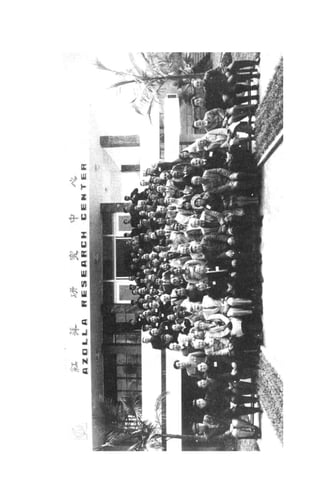
the inauguration of the FAAS National Azolla Research Center.
Thirty-two participants from 10 countries joined with 44 eminent
Chinese scientists to discuss uses of Azolla as a biofertilizer and as a feed for
animals and fish, methods of determining its nitrogen-fixing ability, and
Azolla taxonomy.
Although farmers in Fujian Province, China, have for hundreds of years
routinely grown Azolla as a green manure for their crops, it is only recently
that countries other than China and Vietnam have begun to take advantage of
Azolla as a biofertilizer. Liu Chung-chu, vice president of FAAS, underscored
this fact when, during his opening day address, he called for a new recognition
and evaluation of the role of Azolla. It is hoped that the proceedings of the
workshop will provide a focus for further research on Azolla, and contribute to
its wider use in China and in many developing countries.
I am grateful to the FAAS for cosponsoring the workshop with the
International Rice Research Institute (IRRI), and to Liu Chung-chu of FAAS
and Iwao Watanabe of IRRI, cochairmen of the organizing committee. This
volume was edited by W. H. Smith with the assistance of Emerita P.
Cervantes.
M. S. SWAMINATHAN
Director General
Opening remarks
Mr. Chairman, honored delegates, ladies and gentlemen. I would like to thank
the Fujian Academy of Agricultural Sciences for inviting FAO’s participation
at this international Workshop on Azolla Use, which also marks the
establishment of China’s National Azolla Research Center.
The founding of the center is timely, not only for China’s continued
development in agricultural sciences, but also for prospective technical
cooperation in the field of Azolla between developing countries within the
Asia and Pacific Region and beyond. In this respect it may be noted that one of
the recommendations of the 17th FAO Regional Conference for Asia and the
Pacific, held in Islamabad, Pakistan, last year was a call for increased
development and application of biofertilizers in general and Azolla in
particular as an alternative to, or in combination with, chemical fertilizers.
Also last year, an activity of our Regional Organic Recycling Network was
to undertake a status report on Azolla. Problems encountered were sum-
marized under five headings: organization, cultural management, utilization,
promotion, and research and development of Azolla in the region. It is beyond
the scope of this brief speech to cover all these headings, but I would like to
quote the summary of organizational problems.
Difficulties mentioned included the indifferent attitude toward organic
fertilization, the lack of policy and financial support for organic fertilization
programs, poor coordination among relevant institutions, the lack of recogni-
tion of lead agencies promoting organic fertilization in general and Azolla in
particular, and a lack of organized and trained personnel at the extension level.
The very fact that we are here today to witness the establishment of
China’s National Azolla Research Center for research and development
indicates that at least one country has recognized these difficulties and has
taken firm steps to advance Azolla utilization.
On behalf of FAO, I wish the National Azolla Research Center at the
Fujian Academy of Agricultural Sciences continued success in its activities
and look forward to fruitful collaboration in the future.
F. J. DENT
Regional Soil Management and
FAO Regional Officer for Asia
Fertilizer Use Officer
and the Pacific
Recommendations
Group I
Applied use of Azolla as a green manure
The following were identified as approaches to overcoming constraints to the
use of Azolla as a green manure.
Basic
1. Develop artificial methods to induce sporocarp formation and produc-
tion of a high megasporocarp-to-microsporocarp ratio. The use of
sporocarps as seeding material can reduce labor and input require-
ments by avoiding the need for maintenance nurseries and a certain
portion of multiplication nurseries.
2. Conduct a comparative analysis of decomposition and N release by
different strains of Azolla at different growth stages to improve N
availability to rice plants.
3. Select strains with a low P requirement, a high N-P ratio, and high
growth rate to reduce the need for P fertilization.
4. Screen strains for tolerance for salinity and acid sulfate soils.
5. Test the use of the combination of insecticide and fungicide to
determine the interaction of fungi damage with insect attack and
continue screening for resistance to pests.
Applied
1. Develop methods for improved P uptake efficiency and use, such as P
loading nurseries or foliar application.
2. Investigate integrated management systems, including alternate uses
of Azolla and the selection of rice varieties that complement Azolla use
in the cropping system.
3. Develop recommendations for the complementary use of Azolla and
chemical sources of nitrogen and elucidate their interactions, including
long-term trials.
4. Continue research on Azolla’s contribution to weed control and
herbicide interactions with Azolla.
5. Determine if Azolla can be a useful source of K in K-deficient soils.
6. Develop moist soil culture of Azolla under hot conditions.
7. Modify existing implements and develop new implements to incor-
porate Azolla and reduce labor requirements.
2 AZOLLA UTILIZATION
Group II
Use of Azolla for animal and fish feed and
other purposes
Detailed discussions on the chemical composition of Azolla and its nutritive
value for pigs, chickens, ducks, fish, and ruminants (cattle, goat, and sheep)
were held. In most areas it was agreed that at best, only empirical information
existed and further research to define the potential of Azolla as a source of feed
for animals was urgently needed.
Major research priorities
1. Definition of the chemical composition of Azolla species and strains at
different stages of growth and under different environmental
conditions. This information is needed to predict the potential value of
Azolla as a source of nutrients for animals.
2. Determination of the nutritive value of Azolla for pigs, poultry, fish,
and ruminants, with particular emphasis on the following areas:
a. the relative merits of different species and strains,
b. the optimum proportion of Azolla for use in rations, and
c. the comparative value of fresh, dried, and ensiled Azolla as sources
3. Determination of the management practices required to maximize
4. The use of Azolla in the control of water pollution.
5. The establishment of a communication network between scientists
working on the nutritive value of Azolla to facilitate the free exchange
of publications and information.
of feed.
productivity of Azolla as a source of feed.
Discussion points
1. Chemical composition
Information here will provide predictive value of Azolla as animal feed.
There is a need to measure dry matter content, nitrogen (protein and
nonprotein and amino acids), lipids (amount and composition), cell wall
content (neutral detergent fiber, acid detergent fiber, and lignin), and macro-
and microelement content. In all cases, a clear definition must be given of the
species, strain, stage of growth, and environmental conditions under which
this material has been grown.
2. Nutritional value
For both pigs and poultry, there is lack of specific information on the
levels to which Azolla can be incorporated in rations. This information is
needed before any practical recommendations on nutritive value can be made.
Because Azolla is a heavy metal accumulator, toxicity to animals may be a
RECOMMENDATIONS 3
problem. Alternatively Azolla may be an important source of essential trace
minerals for pig and poultry rations, when incorporated at appropriate levels.
3. Storage techniques
Azolla is most commonly fed in the fresh form harvested daily. It was
proposed that if suitable storage techniques such as sun-drying or ensilaging
were available, the problems of maintaining supply when growth rates are low
could be overcome. Dried Azolla has been found less palatable than fresh
Azolla, and different strains of fresh Azolla vary in palatability. Azolla has
been successfully ensiled with salt in China. The group decided there was a
need to investigate further various techniques of storing Azolla as feed for
animals and fish.
4. Fish nutrition
Some specific problems mentioned for further study were the grazing
habits and Azolla intakes of the different fish species, the variability of the
protein content of Azolla and the need to increase this nutrient for fish growth,
the nutrition of fingerlings in Azolla systems, and the low productivity of the
present Azolla strains in the summer months. There is a need to identify
strains and conditions for optimum growth of Azolla to meet the nutritional
requirements of fish. The value of dried and pelleted Azolla as a fish food
needs to be defined.
A major problem with fish in Azolla-rice systems is the sensitivity of fish
to some insecticides used, and the toxicity of these insecticides in Azolla when
harvested and fed to animals. Alternative programs for insect control need to
be studied to allow the safe use of Azolla as a feed.
5. Ruminants
The only studies available indicate that A. filiculoides grown in over-
crowded conditions has a low digestibility in sheep. More research is needed
on the effects of stage of growth (and chemical composition) on the nutritive
value of Azolla for ruminants. It was proposed that the most valuable use of
Azolla may be as a supplement to rations of high fiber content and low
digestibility (rice straw, wheat straw). The digestibility and degradability of
Azolla proteins in the ruminant digestive tract must also be determined.
6. Water pollution
Azolla may also be used to accumulate macro-and microelements from
sewage effluent and polluted water. For both health and nutritional reasons,
this material cannot be fed to animals but may be an additional source of
digesta in methane production units.
7. Economics of Azolla use
Until a precise description on the nutritive value of the various species
and strains of Azolla is obtained, it is not possible to evaluate the economic
benefits of Azolla as a source of feed for livestock.
4 AZOLLA UTILIZATION
Group III
Taxonomy and sporulation of Azolla
and germplasm collections
Recommendations
1. A sound taxonomic framework for Azolla should be established, using
morphological, cytological, ultrastructural, and chemotaxonomic
methods;
2. Essential basic and applied research on factors inducing sporulation
must be continued, and extended to include development and
germination;
3. Methods for the long-term maintenance of germplasm collections
must be actively sought;
4. A central, coded register of all Azolla culture collections should be
compiled and maintained at IRRI or some other appropriate location;
5. A short information booklet on the taxonomy, morphology, and life
cycle of Azolla should be published by IRRI for training purposes;
6. An Azolla newsletter should be published quarterly and widely
circulated; and
7. An international workshop on Azolla should be held in 1988.
Basic aims
1. To provide vegetative material and sporocarps of accurately named
species and strains of Azolla for work in the field and in the laboratory
on an international basis, and
2. to work toward the development of new and improved strains.
Furtherance of these aims
A. Taxonomy
Work on basic taxonomy must be maintained and strengthened to
determine which species and strains (ecotype) are being used in research work,
and to ensure the material remains unchanged. Taxonomic work should be
continued and extended using scanning electron microscopy, cytological
methods including chromosome analysis, and chemotaxonomic methods
(involving, for example, analysis of phenolics, isoenzyme patterns, use of
DNA probes, etc.). Work should be done to characterize various strains
(ecotypes), as well as species.
TAXONOMY, MORPHOLOGY,
AND PHYSIOLOGY
OF AZOLLA-ANABAENA SYMBIOSIS
Taxonomy and species recognition
in Azolla Lam.
D.G. DUNHAM AND K. FOWLER
Department of Biological Sciences
Portsmouth Polytechnic
Portsmouth PO1 2DY, Hants., United Kingdom
Azolla taxonomy is confused by inadequate recognition and description
of species, which results in difficulties in identification. A critical
reevaluation of vegetative and reproductive features of section Azolla is
being undertaken, using light microscopy, thin-sectioning, scanning
electron microscopy, and transmission electron microscopy. The work
involves examining extensive collections from the world’s major
herbaria, including type specimens and living material. Preliminary
results indicated that, apart from leaf trichomes and possibly root
anatomy, vegetative characters are not useful. Reproductive characters,
particularly glochidial septation, sporoderm structure, and other
characters associated with the megaspore apparatus, provide the most
useful tools for taxonomic separation. Taxonomic changes foreseen
include establishing at least two new species, rejecting A. caroliniana,
and separating A. filiculoides into two subspecies.
The experimental use of Azolla has promoted the maintenance of cultures of
the different species. Difficulties in attributing specimens to certain species in
section Azolla, with subsequent incorrect determination, limit the usefulness
of results obtained. When source material for culturing is not fertile,
identification may rely solely on vegetative features if the culture material
never produces sporocarps. Even with fertile source material, infertility could
result from culture conditions, again providing limited characters for accurate
species determination. Although several identification keys are published,
which include vegetative and reproductive features (5, 11, 12, 13), too much
reliance is placed on characters whose nature and variability have never been
critically evaluated. Type material, on which the identity of all specimens is
based, has been consistently neglected in many morphoanatomical studies, as
has examination of large worldwide collections of specimens from differing
environmental situations (5, 6, 7, 8, 9, 10, 11, 13). This has led to some
taxonomic confusion, inadequate recognition and description of species and,
as a result, difficulties in species identification.
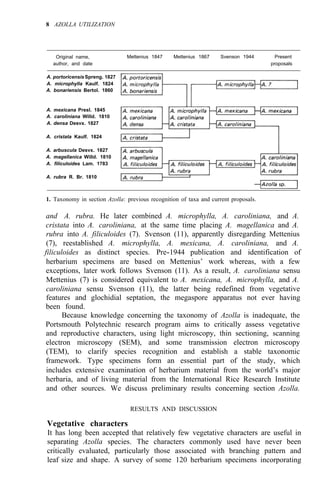
The nature of the taxonomic confusion in section Azolla is summarized in
Figure 1. Early rationalization of described species by Mettenius (6)
recognized only A. microphylla, A. caroliniana, A. cristata, A. magellanica,
8 AZOLLA UTILIZATION
Original name,
author, and date proposals
Mettenius 1847 Mettenius 1867 Svenson 1944 Present
A. portoricensisSpreng. 1827
A. microphylla Kaulf. 1824
A. bonariensis Bertol. 1860
A. mexicana Presl. 1845
A. caroliniana Willd. 1810
A. densa Desvx. 1827
A. cristata Kaulf. 1824
A. arbuscula Desvx. 1827
A. magellanica Willd. 1810
A. filiculoides Lam. 1783
A. rubra R. Br. 1810
1. Taxonomy in section Azolla: previous recognition of taxa and current proposals.
and A. rubra. He later combined A. microphylla, A. caroliniana, and A.
cristata into A. caroliniana, at the same time placing A. magellanica and A.
rubra into A. filiculoides (7). Svenson (11), apparently disregarding Mettenius
(7), reestablished A. microphylla, A. mexicana, A. caroliniana, and A.
filiculoides as distinct species. Pre-1944 publication and identification of
herbarium specimens are based on Mettenius’ work whereas, with a few
exceptions, later work follows Svenson (11). As a result, A. caroliniana sensu
Mettenius (7) is considered equivalent to A. mexicana, A. microphylla, and A.
caroliniana sensu Svenson (11), the latter being redefined from vegetative
features and glochidial septation, the megaspore apparatus not ever having
been found.
Because knowledge concerning the taxonomy of Azolla is inadequate, the
Portsmouth Polytechnic research program aims to critically assess vegetative
and reproductive characters, using light microscopy, thin sectioning, scanning
electron microscopy (SEM), and some transmission electron microscopy
(TEM), to clarify species recognition and establish a stable taxonomic
framework. Type specimens form an essential part of the study, which
includes extensive examination of herbarium material from the world’s major
herbaria, and of living material from the International Rice Research Institute
and other sources. We discuss preliminary results concerning section Azolla.
RESULTS AND DISCUSSION
Vegetative characters
It has long been accepted that relatively few vegetative characters are useful in
separating Azolla species. The characters commonly used have never been
critically evaluated, particularly those associated with branching pattern and
leaf size and shape. A survey of some 120 herbarium specimens incorporating
TAXONOMY AND SPECIES RECOGNITION IN AZOLLA LAM. 9
all known species revealed considerable overlapping of character states and
indicated that certain species of Azolla are vegetatively polymorphic. As a
result, species in section Azolla can possess very similar features and are
difficult to separate using those characters. Cultured material of A. filiculoides
and A. microphylla grown at Portsmouth are separable only when certain
growth stages prevail, these possibly being environmentally controlled.
Previously inferred by Lumpkin and Plucknett (5) with their use of immature
and mature growth morphologies, our studies suggest no unequivocal evidence
that changes in frond and leaf shape and frond orientation are associated with
sporulation. The continuous nature of these changes further decreases the
usefulness of these characters in taxonomic separation. The subjective nature
of leaf color and observed variability render color a most unreliable character.
Root morphology again offers few useful characters. Distribution and
number of root hairs and coiling of the root tip were previously considered
useful. However, observations from the present study suggest that these
characters are environmentally controlled and therefore unreliable. Recent
work by Tan (unpubl.) and this study suggest that root anatomy, particularly
the ratio of epidermal cells to cortical cells, may be the only useful means of
identifying Azolla species by root characters. Promising results have been
obtained from a small sample, but variation may limit the significance of the
character with more extensive examination.
The most useful vegetative character in section Azolla is associated with
the trichomes on the adaxial surface of the dorsal leaf lobe. In section
Rhizosperma (Meyen) Mettenius, which includes A. pinnata R.Br. and A.
nilotica Decaisne ex Mett., these trichomes also extend onto the stem surface.
First noted by Mettenius (7), trichomes were not used in species recognition
until the work of van Ooststroom (13). Of particular importance is the number
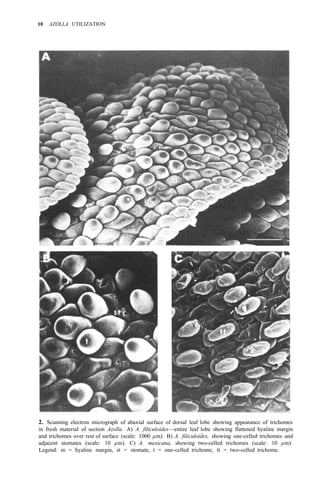
of cells comprising the trichome. In A. filiculoides it is one-celled, with two or
more cells in other species (Fig. 2). Fortunately, trichomes can be examined in
dried herbarium specimens so providing information on Type specimens. The
present work shows that the Type specimens of A. caroliniana and A.
microphylla, although differing in size from the Type of A. filiculoides, possess
similar one-celled trichomes. This, coupled with the considerable vegetative
variation observed in A. filiculoides, indicates that the names A. caroliniana
and A. microphylla may be considered synonymous with A. filiculoides.
Furthermore, our studies of herbarium material reveal that only plants
attributable to A. filiculoides appear to be native to the Type localities. It is also
of interest to note that the fertile Type specimen of A. microphylla shows a
megaspore and glochidial characters of the A. filiculoides type.
REPRODUCTIVE CHARACTERS
Reproductive structures occur in pairs (fours in A. nilotica), a pair of
sporocarps consisting of two megasporocarps, two microsporocarps, or one of
each. There appears to be no taxonomic significance in the ratio of
megasporocarps to microsporocarps. On examination, the sporocarp wall
10 AZOLLA UTILIZATION
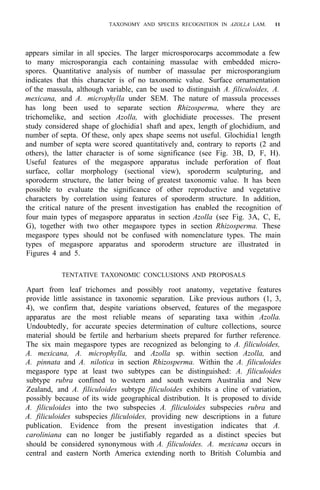
2. Scanning electron micrograph of abaxial surface of dorsal leaf lobe showing appearance of trichomes
in fresh material of section Azolla. A) A. filiculoides—entire leaf lobe showing flattened hyaline margin
and trichomes over rest of surface (scale: 1000 µm). B) A. filiculoides, showing one-celled trichomes and
adjacent stomates (scale: 10 µm). C) A. mexicana, showing two-celled trichomes (scale: 10 µm).
Legend: m = hyaline margin, st = stomate, t = one-celled trichome, tt = two-celled trichome.
TAXONOMY AND SPECIES RECOGNITION IN AZOLLA LAM. 11
appears similar in all species. The larger microsporocarps accommodate a few
to many microsporangia each containing massulae with embedded micro-
spores. Quantitative analysis of number of massulae per microsporangium
indicates that this character is of no taxonomic value. Surface ornamentation
of the massula, although variable, can be used to distinguish A. filiculoides, A.
mexicana, and A. microphylla under SEM. The nature of massula processes
has long been used to separate section Rhizosperma, where they are
trichomelike, and section Azolla, with glochidiate processes. The present
study considered shape of glochidia1 shaft and apex, length of glochidium, and
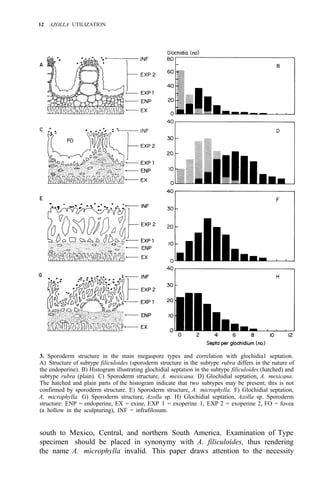
number of septa. Of these, only apex shape seems not useful. Glochidia1 length
and number of septa were scored quantitatively and, contrary to reports (2 and
others), the latter character is of some significance (see Fig. 3B, D, F, H).
Useful features of the megaspore apparatus include perforation of float
surface, collar morphology (sectional view), sporoderm sculpturing, and
sporoderm structure, the latter being of greatest taxonomic value. It has been
possible to evaluate the significance of other reproductive and vegetative
characters by correlation using features of sporoderm structure. In addition,
the critical nature of the present investigation has enabled the recognition of
four main types of megaspore apparatus in section Azolla (see Fig. 3A, C, E,
G), together with two other megaspore types in section Rhizosperma. These
megaspore types should not be confused with nomenclature types. The main
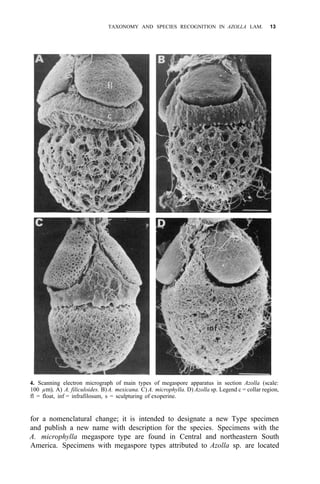
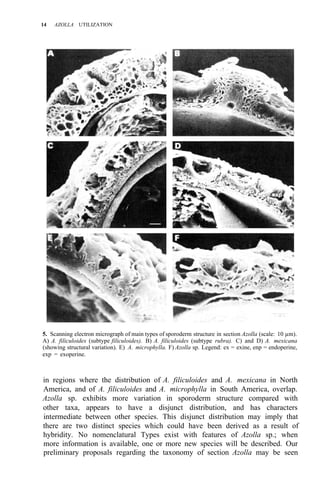
types of megaspore apparatus and sporoderm structure are illustrated in
Figures 4 and 5.
TENTATIVE TAXONOMIC CONCLUSIONS AND PROPOSALS
Apart from leaf trichomes and possibly root anatomy, vegetative features
provide little assistance in taxonomic separation. Like previous authors (1, 3,
4), we confirm that, despite variations observed, features of the megaspore
apparatus are the most reliable means of separating taxa within Azolla.
Undoubtedly, for accurate species determination of culture collections, source
material should be fertile and herbarium sheets prepared for further reference.
The six main megaspore types are recognized as belonging to A. filiculoides,
A. mexicana, A. microphylla, and Azolla sp. within section Azolla, and
A. pinnata and A. nilotica in section Rhizosperma. Within the A. filiculoides
megaspore type at least two subtypes can be distinguished: A. filiculoides
subtype rubra confined to western and south western Australia and New
Zealand, and A. filiculoides subtype filiculoides exhibits a cline of variation,
possibly because of its wide geographical distribution. It is proposed to divide
A. filiculoides into the two subspecies A. filiculoides subspecies rubra and
A. filiculoides subspecies filiculoides, providing new descriptions in a future
publication. Evidence from the present investigation indicates that A.
caroliniana can no longer be justifiably regarded as a distinct species but
should be considered synonymous with A. filiculoides. A. mexicana occurs in
central and eastern North America extending north to British Columbia and
12 AZOLLA UTILIZATION
3. Sporoderm structure in the main megaspore types and correlation with glochidia1 septation.
A) Structure of subtype filiculoides (sporoderm structure in the subtype rubra differs in the nature of
the endoperine). B) Histogram illustrating glochidial septation in the subtype filiculoides (hatched) and
subtype rubra (plain). C) Sporoderm structure, A. mexicana. D) Glochidial septation, A. mexicana.
The hatched and plain parts of the histogram indicate that two subtypes may be present; this is not
confirmed by sporoderm structure. E) Sporoderm structure, A. microphylla. F) Glochidial septation,
A. microphylla. G) Sporoderm structure, Azolla sp. H) Glochidial septation, Azolla sp. Sporoderm
structure: ENP = endoperine, EX = exine, EXP 1 = exoperine 1, EXP 2 = exoperine 2, FO = fovea
(a hollow in the sculpturing), INF = infrafilosum.
south to Mexico, Central, and northern South America. Examination of Type
specimen should be placed in synonymy with A. filiculoides, thus rendering
the name A. microphylla invalid. This paper draws attention to the necessity
TAXONOMY AND SPECIES RECOGNITION IN AZOLLA LAM. 13
4. Scanning electron micrograph of main types of megaspore apparatus in section Azolla (scale:
100 µm). A) A. filiculoides. B)A. mexicana. C) A. microphylla. D) Azolla sp. Legend c = collar region,
fl = float, inf = infrafilosum, s = sculpturing of exoperine.
for a nomenclatural change; it is intended to designate a new Type specimen
and publish a new name with description for the species. Specimens with the
A. microphylla megaspore type are found in Central and northeastern South
America. Specimens with megaspore types attributed to Azolla sp. are located
14 AZOLLA UTILIZATION
5. Scanning electron micrograph of main types of sporoderm structure in section Azolla (scale: 10 µm).
A) A. filiculoides (subtype filiculoides). B) A. filiculoides (subtype rubra). C) and D) A. mexicana
(showing structural variation). E) A. microphylla. F) Azolla sp. Legend: ex = exine, enp = endoperine,
exp = exoperine.
in regions where the distribution of A. filiculoides and A. mexicana in North
America, and of A. filiculoides and A. microphylla in South America, overlap.
Azolla sp. exhibits more variation in sporoderm structure compared with
other taxa, appears to have a disjunct distribution, and has characters
intermediate between other species. This disjunct distribution may imply that
there are two distinct species which could have been derived as a result of
hybridity. No nomenclatural Types exist with features of Azolla sp.; when
more information is available, one or more new species will be described. Our
preliminary proposals regarding the taxonomy of section Azolla may be seen
TAXONOMY AND RECOGNITION IN AZOLLA LA.M. 15
in Figure 1. The present program does not include detailed investigation of A.
pinnata and A. nilotica. However, a preliminary study is being made of the
nomenclatural Types together with a small number of other populations.
Early indications suggest that vegetative variation may be as great as in section
Azolla, supporting the observations in sporoderm structure described in A.
pinnata by Zhou Zhiyan (14).
This paper outlines the preliminary results of this investigation. A stable
taxonomic framework for Azolla with more precise species recognition will
emerge with the publication of descriptions of all known, and any new, species
in section Azolla; this is already in preparation. The current program relies on
herbarium material to furnish specimens collected worldwide and from
differing environmental conditions. We intend to extend this program to
include a detailed study of A. pinnata and A. nilotica in section Rhizosperma,
using both living and herbarium material. Further extension will adopt a more
applied taxonomic approach and will concentrate on cultured material, the
stability of characters being tested by environmental manipulation. In
conjunction with this, chromosome numbers and possibly a phylogenetic
approach using a breeding program can be employed. Such close examination
of living material may eventually provide a suitable key for identification based
on vegetative and reproductive features. Whatever experimental program, the
taxonomist can advise on the correct identity of Azolla species used, and
monitor any morphological or anatomical changes induced by the experi-
mental method or environment.
ACKNOWLEDGMENT
The authors thank Portsmouth Polytechnic for the research assistantship
awarded to D.G. Dunham.
REFERENCES CITED
1. Fowler, K., and J. Stennett-Willson. 1978. Sporoderm architecture in modern Azolla. Fern Gaz.
11(6):405-412.
2. Godfrey, P.K., G.W. Reinert, and R.D. Houk. 1961. Observations on microsporocarpic material
of Azolla caroliniana Willd. Am. Fern J. 51(2):89-92.
3. Kempf, E.K. 1969. Elektronen mikroskopie der Sporodermis van Kanozoischen Megasporen der
Wasserfarn-Gattung Azolla. Palaeontol. A. 43(1/2):95-108.
4. Kempf, E.K. 1969. Elektronen mikroskopie der Megasporen van Azolla tegeliensis aus dem
altpleistozan der Niederlande. Palaeontogr. B. 128:167-179.
5. Lumpkin, T.A., and D.L. Plucknett. 1982. Azolla as agreen manure: use and management in crop
production. Westview Press, Colorado, USA. 230 p.
6. Mettenius, G. 1847. Ueber Azolla. Linnaea 20:259-282.
7. Mettenius, G. 1867. Filicinae. Pages 51-54 in Plantae Tinneanae. Vienna.
8. Meyen, F.J.F. 1836. Beitrage zur kenntniss der Azollen. Nova. Acta (Leop.). 18(1):507-524.
9. Pieterse, A.H., L. de Lange, and J. van Vliet. 1977. A comparative study of Azolla in the
Netherlands. Acta Bot. Neerl. 26(6):433-449.
10. Strasburger, E. 1873. Ueber Azolla. Hermann Dabis. Jena.
11. Svenson, H.K. 1944. The New World species of Azolla. Am. Fern J. 34(3):69-84.
16 AZOLLA UTILIZATION
12. Tryon, R.M., and A.F. Tryon. 1982. Ferns and allied plants: with special reference to Tropical
13. van Ooststroom, S.J. 1948. Azollaceae. Pages 79-80 in Flora Neerlandica. I. Pteridophyta,
14. Zhou Zhiyan. 1983. Quaternary record of Azolla pinnata from China and its sporoderm
America. Springer-Verlag, New York. 857 p.
Gymnospermae. Amsterdam.
ultrastructure. Rev. Palaeobotan. Palynol. 39:109-129.
DISCUSSION
KULASOORIYA: Were, the megasporocarps whose wall structure was compared, of comparable
development stage or maturity?
DUNHAM: Yes, to ensure examination of mature megasporocarps only, the largest ones were
scheduled for examination. Immature megasporocarps are normally easily recognized by the
megaspore apparatus not filling the sporocarp, collapsed floats, and small basal region.
Comparative study of the morphology,
anatomy, and phylogenesis of
megasporocarps in sections Euazolla
and Rhizosperma
HE GUO-FAN AND LIN YUE-CHAN
Department of Biology
Zhongshan University
Guangzhou, Guangdong, China
The morphology, anatomy, and phylogenesis of megasporocarps in
Azolla imbricata Nakai (section Rhizosperma) and A. filiculoides Lam.
(section Euazolla) were compared. Megasporocarps of A. imbricata are
larger than those of A. filiculoides, measuring about 650 µm diam
longitudinally and 400 µm equatorially. On the basis of morphology
and function, the megasporocarp of A. imbricata can be divided into
four parts: 1) funnel, 2) floating group, 3) spore sac, and 4) megaspore.
The megasporocarp of A. filiculoides can be divided into five parts: 1)
funnel (top), 2) floating ring (consisting of three massulae surrounding
the neck), 3) annulus (middle), 4) spore sac (bottom), and 5) megaspore
(inside spore sac). The phylogenetic significance of section Rhizosperma
is also discussed. Our views are contrary to those of Hills, assuming that
section Rhizosperma might give rise to section Euazolla.
MATERIALS AND METHODS
Plants of Azolla imbricata and A. filiculoides were cultured in ponds of
Zhongshan University. Megaspores were collected in August 1981. The
samples were fixed with 3% glutaraldehyde and 2% formaldehyde in 0.2 M
phosphate buffer (pH 7.4). After washing in buffer, the fixed materials were
dehydrated in a graded alcohol-xylene series (50-100%), and embedded in
paraffin medium for sectioning at 30-50 µm with a steel knife on a rotary
microtome. Materials were mounted on copper studs with silver cement. The
paraffin was removed with xylene and the dried materials were coated with a
gold layer of about 30 nm using an Eiko IB-3 ion coater. The studies were
made with a Hitachi S430 scanning electron microscope.
18 AZOLLA UTILIZATION
RESULTS
The megasporocarps of A. imbricata are elliptical. They are about 650 µm
longitudinal diam and 400 µm equatorial diam. The top of the megasporocarp
apparatus is cone-shaped and the bottom is spherical. The megaspore
apparatus of A. imbricata is larger than the megaspore apparatus of A.
filiculoides. They differ in appearance. The A. filiculoides megaspore apparatus
looks like a long pear. The diameters of middle collar and basic sporoderm are
nearly equal. Its longitudinal diameter is about 560 µm, and equatorial diam is
about 304 µm. Before the megasporocarp matures, it is enclosed within the
sporocarp wall. Only one megaspore apparatus develops. At maturity, the
middle part of sporocarp wall splits laterally. The back half-part falls first,
while the dark forward half-part, which looks like a cone, remains tightly
connected to the top of megaspore apparatus (Fig. 1.2, 2.1), until the sporeling
germinates. Sporocarp wall protects the development of the megaspore
apparatus. The forward half-part also protects the young sporeling. When the
back half-part of the indusium falls off, access to the spore sac is provided for
fertilization by the male gametophyte or sperm. It is specially clear in
A. filiculoides (Fig. 2.9). Based on the morphological structure and function, a
naked megaspore apparatus of the megasporocarp of A. imbricata can be
divided into four parts: 1) the suprafilosum at the top, 2) the floating group in
the middle, 3) the sporoderm at the bottom, and 4) the megaspore within it
(Fig. 1.1, 1.4). The megaspore apparatus of A. filiculoides can be divided into
five parts: 1) the suprafilosum at the top, 2) a floating ring at the neck, 3) the
collar at the middle, 4) the sporoderm, and 5) the megaspore at the bottom
(Fig. 2.1, 2.8),
Suprafilosum
The suprafilosum is at the top of megaspore apparatus. Before maturity it
resembles the collar of a shirt (Fig. 1.3,F; 2.6). After maturity, the collar
expands forward (Fig. 2.1). It is the route for the sperm to enter and for the
sporeling to grow. The suprafilosum is formed by several layers of fibers
(1-2 µm in diam). The fibers of the external suprafilosum and floating groups
are connected to form a complex. The inner surface of the suprafilosum is like
a membrane (Fig. 1.3, 2.2). The center of the suprafilosum is filled with
blue-green algae (Fig. 2.6, arrow). The base of suprafilosum is columella
which extends backward to connect with the top of sporoderm (Fig. 1.4,
straight arrow, 2.6). The columella is surrounded by three upper floats. The
wall of the columella is thin and its external surface is lined with several layers
of fibers linked with the floats. The morphological structure of the supra-
filosum in A. imbricata is the same as in A. filiculoides.
Floating group
Most researchers consider that Azolla can be divided into two sections,
Euazolla and Rhizosperma. The megaspore apparatus of Euazolla consists of
MORPHOLOGY OF MEGASPOROCARPS IN EUAZOLLA AND RHIZOSPERMA 19
three floats. Its massulae of microsporocarps are equipped with glochidia. The
Rhizosperma has nine floats, and its massulae are flagella. The numbers and
morphology of the floats are important taxonomic features. The nine floats of
A. imbricata can be divided into three groups of threes arranged as a triangle,
and the three groups of floats surround the top and the middle parts of the
megaspore apparatus (Fig. 1.4). The distance between two floating groups is
about 25 µm, numerous fibers are scattered above it (Fig. 1.1, 1.3). The three
upper floats surrounding the suprafilosum constitute about 1/3 the height of
of the megaspore apparatus; the six lower floats in the middle are also 1/3 the
height of the megaspore apparatus, and are the largest cross section (Fig. 1.1,
1.5). The nine floats are similar in shape and size, but have a different
arrangement. The top of the float is shaped like a tongue, its bottom thicker,
forming a tetrahedron. The external and internal surfaces of each float are
symmetrical, and its left and right sides mirror each other. Three floats in the
same group form a triangle, the upper float is at the top, two lower floats
connect with each other (Fig. 1.1). An upper float, with its inner surface and
side view, is shown in Fig. 1.6. The maximum length of a float is 240 µm and
maximum thickness is 150 µm. Concave spots and stripes are scattered
irregularly on the surface of each float. The center of each float has a 12-µm-
diam hole (Fig. 1-7) which may be the trace of its organ development. The
inner structure of all the floats is like an alveolate. The top of the inner surface
of the float is joined with many fibers, which connect with the suprafilosum
and sporoderm to form a complex. The bottom of the float is not linked with
fiber, so that it can swell upward. The functions of the float are still unknown.
The three upper floats may be involved with expanding and opening of the
suprafilosum. The functions of the six lower floats are swelling, thus causing
the sporocarp wall to explode, and to close the exit of the columella for
sporeling growth.
The floats of A. filiculoides are smaller, with a longitudinal diam of
170 µm and equatorial diam of about 80 µm. The three floats surround the
neck of the megaspore apparatus, their position and arrangement are similar to
those of the upper floats of A. imbricata, but the bottom of the float is attached
to the collar (Fig. 2.1, 2.4). Figure 2.7 shows the cross section and inner
structure of A. filiculoides. The floating surface of Euazolla is smooth with
many small holes of different shapes and sizes scattered on it; some of them
have a regular appearance (Fig. 2.2., 2.3). No holes were seen at the center of
the external surface of the float. Most investigators who have reported fossil
information of floats in Azolla describe the shapes and sizes of floats
differently than ours. Whether to use the characteristics of floating surface to
express the taxon of Azolla is an interesting question.
Collar
The collar is a special structure of the megaspore apparatus in Euazolla. It is
located at the middle of the megaspore apparatus and has a smooth surface
(Fig. 2.4) with an equatorial diam of 250-300 µm. The longitudinal section of
20 AZOLLA UTILIZATION
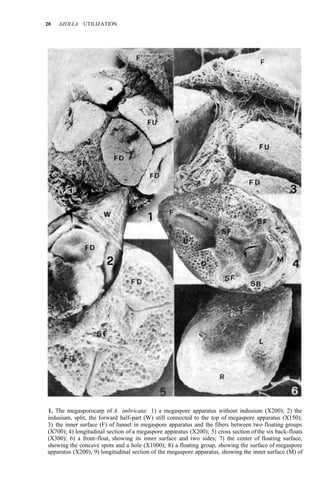
1. The megasporocarp of A. imbricata: 1) a megaspore apparatus without indusium (X200); 2) the
indusium, split, the forward half-part (W) still connected to the top of megaspore apparatus (X150);
3) the inner surface (F) of funnel in megaspore apparatus and the fibers between two floating groups
(X700); 4) longitudinal section of a megaspore apparatus (X200); 5) cross section of the six back-floats
(X300); 6) a front-float, showing its inner surface and two sides; 7) the center of floating surface,
showing the concave spots and a hole (X1000); 8) a floating group, showing the surface of megaspore
apparatus (X200); 9) longitudinal section of the megaspore apparatus, showing the inner surface (M) of
MORPHOLOGY OF MEGASPOROCARPS IN EUAZOLLA AND RHIZOSPERMA 21
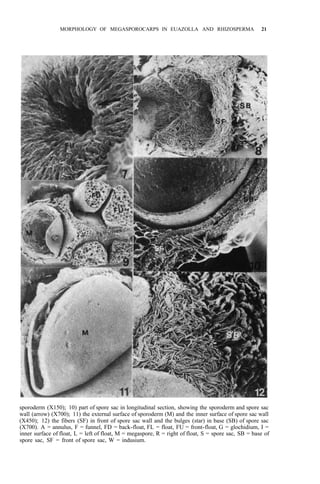
sporoderm (X150); 10) part of spore sac in longitudinal section, showing the sporoderm and spore sac
wall (arrow) (X700); 11) the external surface of sporoderm (M) and the inner surface of spore sac wall
(X450); 12) the fibers (SF) in front of spore sac wall and the bulges (star) in base (SB) of spore sac
(X700). A = annulus, F = funnel, FD = back-float, FL = float, FU = front-float, G = glochidium, I =
inner surface of float, L = left of float, M = megaspore, R = right of float, S = spore sac, SB = base of
spore sac, SF = front of spore sac, W = indusium.
22 AZOLLA UTILIZATION
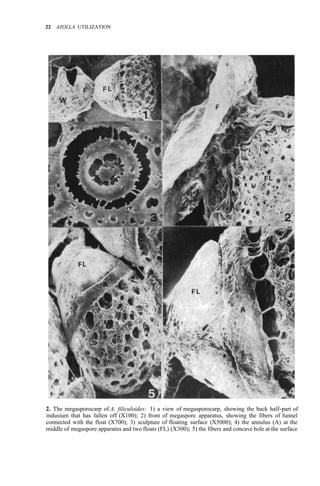
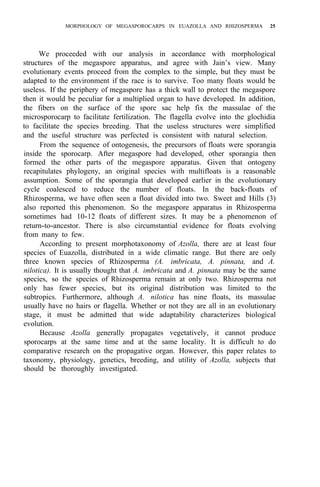
2. The megasporocarp of A. filiculoides: 1) a view of megasporocarp, showing the back half-part of
indusium that has fallen off (X100); 2) front of megaspore apparatus, showing the fibers of funnel
connected with the float (X700); 3) sculpture of floating surface (X5000); 4) the annulus (A) at the
middle of megaspore apparatus and two floats (FL) (X300); 5) the fibers and concave hole at the surface
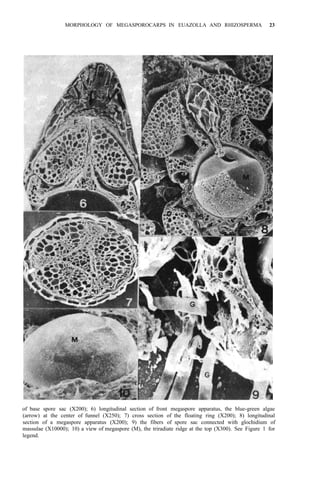
MORPHOLOGY OF MEGASPOROCARPS IN EUAZOLLA AND RHIZOSPERMA 23
of base spore sac (X200); 6) longitudinal section of front megaspore apparatus, the blue-green algae
(arrow) at the center of funnel (X250); 7) cross section of the floating ring (X200); 8) longitudinal
section of a megaspore apparatus (X200); 9) the fibers of spore sac connected with glochidium of
massulae (X10000); 10) a view of megaspore (M), the triradiate ridge at the top (X300). See Figure 1 for
legend.
24 AZOLLA UTILIZATION
the collar appears as a “T”, and its inner structure appears as an alveolate.
Before it matures, the bottom of three floats insert themselves into the collar
(Fig. 2.6), and after maturity the floats swell out from the collar (Fig. 2.8). The
function of the collar may be to swell and split the sporocarp wall.
Sporoderm
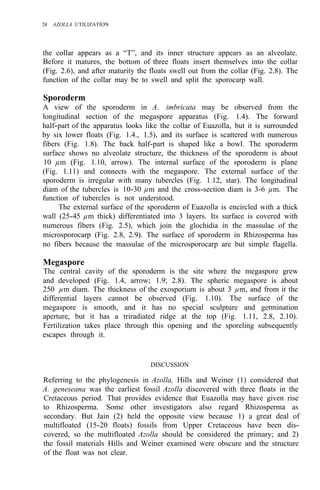
A view of the sporoderm in A. imbricata may be observed from the
longitudinal section of the megaspore apparatus (Fig. 1.4). The forward
half-part of the apparatus looks like the collar of Euazolla, but it is surrounded
by six lower floats (Fig. 1.4., 1.5), and its surface is scattered with numerous
fibers (Fig. 1.8). The back half-part is shaped like a bowl. The sporoderm
surface shows no alveolate structure, the thickness of the sporoderm is about
10 µm (Fig. 1.10, arrow). The internal surface of the sporoderm is plane
(Fig. 1.11) and connects with the megaspore. The external surface of the
sporoderm is irregular with many tubercles (Fig. 1.12, star). The longitudinal
diam of the tubercles is 10-30 µm and the cross-section diam is 3-6 µm. The
function of tubercles is not understood.
The external surface of the sporoderm of Euazolla is encircled with a thick
wall (25-45 µm thick) differentiated into 3 layers. Its surface is covered with
numerous fibers (Fig. 2.5), which join the glochidia in the massulae of the
microsporocarp (Fig. 2.8, 2.9). The surface of sporoderm in Rhizosperma has
no fibers because the massulae of the microsporocarp are but simple flagella.
Megaspore
The central cavity of the sporoderm is the site where the megaspore grew
and developed (Fig. 1.4, arrow; 1.9; 2.8). The spheric megaspore is about
250 µm diam. The thickness of the exosporium is about 3 µm, and from it the
differential layers cannot be observed (Fig. 1.10). The surface of the
megaspore is smooth, and it has no special sculpture and germination
aperture, but it has a triradiated ridge at the top (Fig. 1.11, 2.8, 2.10).
Fertilization takes place through this opening and the sporeling subsequently
escapes through it.
DISCUSSION
Referring to the phylogenesis in Azolla, Hills and Weiner (1) considered that
A. geneseana was the earliest fossil Azolla discovered with three floats in the
Cretaceous period. That provides evidence that Euazolla may have given rise
to Rhizosperma. Some other investigators also regard Rhizosperma as
secondary. But Jain (2) held the opposite view because 1) a great deal of
multifloated (15-20 floats) fossils from Upper Cretaceous have been dis-
covered, so the multifloated Azolla should be considered the primary; and 2)
the fossil materials Hills and Weiner examined were obscure and the structure
of the float was not clear.
MORPHOLOGY OF MEGASPOROCARPS IN EUAZOLLA AND RHIZOSPERMA 25
We proceeded with our analysis in accordance with morphological
structures of the megaspore apparatus, and agree with Jain’s view. Many
evolutionary events proceed from the complex to the simple, but they must be
adapted to the environment if the race is to survive. Too many floats would be
useless. If the periphery of megaspore has a thick wall to protect the megaspore
then it would be peculiar for a multiplied organ to have developed. In addition,
the fibers on the surface of the spore sac help fix the massulae of the
microsporocarp to facilitate fertilization. The flagella evolve into the glochidia
to facilitate the species breeding. That the useless structures were simplified
and the useful structure was perfected is consistent with natural selection.
From the sequence of ontogenesis, the precursors of floats were sporangia
inside the sporocarp. After megaspore had developed, other sporangia then
formed the other parts of the megaspore apparatus. Given that ontogeny
recapitulates phylogeny, an original species with multifloats is a reasonable
assumption. Some of the sporangia that developed earlier in the evolutionary
cycle coalesced to reduce the number of floats. In the back-floats of
Rhizosperma, we have often seen a float divided into two. Sweet and Hills (3)
also reported this phenomenon. So the megaspore apparatus in Rhizosperma
sometimes had 10-12 floats of different sizes. It may be a phenomenon of
return-to-ancestor. There is also circumstantial evidence for floats evolving
from many to few.
According to present morphotaxonomy of Azolla, there are at least four
species of Euazolla, distributed in a wide climatic range. But there are only
three known species of Rhizosperma (A. imbricata, A. pinnata, and A.
nilotica). It is usually thought that A. imbricata and A. pinnata may be the same
species, so the species of Rhizosperma remain at only two. Rhizosperma not
only has fewer species, but its original distribution was limited to the
subtropics. Furthermore, although A. nilotica has nine floats, its massulae
usually have no hairs or flagella. Whether or not they are all in an evolutionary
stage, it must be admitted that wide adaptability characterizes biological
evolution.
Because Azolla generally propagates vegetatively, it cannot produce
sporocarps at the same time and at the same locality. It is difficult to do
comparative research on the propagative organ. However, this paper relates to
taxonomy, physiology, genetics, breeding, and utility of Azolla, subjects that
should be thoroughly investigated.
26 AZOLLA UTILIZATION
REFERENCES CITED
1. Hills, L., and N. Weiner. 1965. Azolla geneseana n. sp. and revision of Azolla primaeva.
2. Jain, R. K. 1971. Pre-tertiary records of Salviniaceae. Am. J. Bot. 58:487-496.
3. Sweet, A., and L. V. Hills. 1971. A study of Azolla pinnata R. Brown. Am. Fern J. 71:l-13.
Micropaleontology 11(2):255-261.
DISCUSSION
KANNAIYAN: Could you get much variation in the morphology and anatomy of Azolla pinnata var.
pinnata and Azolla pinnata var. imbricata?
HE GUO-FAN: I did not conduct a study on this. A. pinnata did not produce sporocarps in
Guangdong Province.
Methods for using Azolla filiculoides
sporocarps to culture sporophytes
in the field
LU SHUYING
Wenzhou Municipal Scientific
and Technological Commission
Wenzhou, Zhejiang, China
Some practical techniques for using Azolla filiculoides sporocarps to
raise seedlings in the ricefield are given. The techniques discussed
include preparing the seedling bed, seeding, mulching, fertilizing, and
floating young seedlings. At a sowing rate of 160 kg sporocarps fresh
wt/ha, sporophyte yield at 52 d will range from 15.8 to 21 t sporophytes
fresh wt/ha.
In recent years there has been a breakthrough in the main technique of using
Azolla filiculoides sporocarps to raise young seedlings in the fields. Through it
we can overcome the difficulties of survival of the sporophytes through winter
in north China, and through summer in the south.
The productivity of A. filiculoides sporocarps is dependent on the
environment. By applying the ZHG method, the collection rate is 80% or
higher, with the highest yield of up to 1 t sporocarps fresh wt/ha. Therefore we
can successfully culture sporocarps artificially by adjusting external conditions
to the requirements of sporocarp germination and growth.
The process of raising seedlings may be divided into three stages:
emergence, nursing, and floating.
1. Emergence stage. It requires 7-10 d from seeding until seedlings
germinate. During this period sporocarps should be protected from
rain, moisture maintained, and light intensity reduced.
2. Nursing stage. From 25 to 35 d are required for the seedlings to develop
11 buds. During this period moisture should be maintained, light
intensity adjusted, and seedlings fertilized.
3. Floating stage. At this stage of development, seedlings may be
transferred from wet soil culture to hydroponic culture to speed
sporophyte multiplication.
Because these three managerial steps are synchronized to the three
growth stages of the seedlings, the status of young seedlings cultured in the
field may also be divided into three stages. In the first stage the young seedling
grows 1 to 8 leaflets, has no side buds nor evidence of them, appears rather
28 AZOLLA UTILIZATION
Table 1. Number of buds at each seedling growth stage in the field culture
process.
Sample Buds/sporophytea
no. 1-10DAS 11-20DAS 25DAS 30 DAS 35 DAS 40 DAS
1 Budssprouting 2.1 4.0 6.8 14.1 35.5
2 Buds sprouting 1.0 2.4 4.0 9.3 22.9
3 Buds sprouting 1.0 2.6 4.6 10.1 32.0
4 Buds sprouting 1.0 2.2 6.9 12.7 28.0
Av 1.3 2.8 5.6 11.6 29.0
a
1-10 d after seedling (DAS) is emergence stage, 11-30 DAS is nursing stage, 35-40
DAS is floating stage.
Table 2. Emergence rate of sporocarps in different culture methods.
Method Seedlings Emergence
(no.)
Remark
(%)
Seeding and culturing in floating
bed
Seeding in flooded bed, draining
water, and culturing in wet
bed
Seeding and culturing in wet
bed
71 4 Sporocarps usually drift about
and gather in large groups.
groups, then are covered with
mud, leading to lower
emergence rate.
evenly.
218 11 Sporocarps first gather slightly in
530 28 Sporocarps can be distributed
tender, and grows slowly at an average rate of 0.6-0.7 leaflets/d. In the second
stage each seedling having 2-11 buds grows at the rate of 4-7 leaflets/d. In the
third stage each sporophyte has more than 11 buds, and multiplies rapidly at
an average rate of 15-18 leaflets/d (Table 1).
PREPARING SEEDLING BED
Tests show that the wet culture method is convenient for the germination of
sporocarps and the early growing of seedlings. Various seedling beds, due to
their different capacities of maintaining moisture and aeration, will produce
differently according to culture method (Table 2).
A seedling bed paved with a layer of coarse sand on the paddy soil gives a
19-20% emergence rate; a bed paved with loess soil gives an emergence rate of
15.7-16.6% (Table 3) because of its poor aeration, water percolation, and
tendency to harden. When the bed is made of paddy soil only, earthworms kill
some seedlings. Therefore, the paddy field used to culture seedlings should
have medium fertility and good drainage and irrigation. Beds should be about
2 m wide and of any convenient length. They should be longitudinally
separated into three wet plots. After leveling the beds, 24.5-33.0 kg
carbofuran/ha may be used to kill underground pests. After insecticide
treatment sand can be spread and the bed seeded with sporocarps.
USING A. FILICULOIDES SPOROCARPS TO CULTURE SPOROPHYTES 29
Table 3. Emergence rate of sporocarps in different surface treatment of
seedbeds.a
Seedbed treatment
Seedlings Emergence
4 Aug 11 Aug 16 Aug rate (%)
-
Paved with loess 80 352 528 16
Paved with fine sand 608 896 704 21
Paddy soil only 112 144 160 5
Coarse sand on paddy soil 400 672 640 19
a
Seeding date, 23 Jul; test period, 25 d; mean moisture, 28.5; temperature, 24-33.5ºC.
Table 4. Effect of seeding rate on number of seedlings in field culture.
Seeding Seeding Emergence
Seedling (no.)/11 dm2
date rate
(kg/ha)
date 4 16 1 7 12 18
Sep Sep Oct Oct Oct Oct
25 Aug 160 1 Sep 309 619
22 Sep 80 1 Oct 255 355
27 Sep 80 5 Oct 109 282
9 Sep 160 16 Sep 255 700
Table 5. Effect of seeding date on number of buds produced.
Seeding Buds/seedling
date 20 DAS 25 DAS 30 DAS 35 DAS 40 DAS
25 Aug
9 Sep 1
11.0
3.1 7.9 13.5
27 Sep 1 2.8 5.6 9.4 29.4
– –
2.3
– –
DAS = days after seeding.
SEEDING SPOROCARPS
Dressing with soil powders. To seed sporocarps evenly and achieve highest
germination, the wet sporocarps should be dressed with dry soil at 15 ratio
(wt/wt) before seeding.
Seeding density. Two seeding rates are used, 160 kg wet sporocarps/ha
and 80 kg wet sporocarps/ha. Emergence is 20% at the higher seeding rate and
23.1 % at the lower rate. The relation between seeding rate and number of
seedlings is given in Table 4.
Seeding time. The effect of seeding rate on seedlings produced was similar
for all seeding dates (Table 4). But the growth rate of seedlings differed; those
planted later grew faster. The lower temperatures associated with later
planting dates are more favorable for seedling growth (Table 5).
MULCHING
After being seeded, the nursery bed must be mulched. A wide range of
materials can be used including nylon sheet, oil paper, bamboo curtain,
30 AZOLLA UTILIZATION
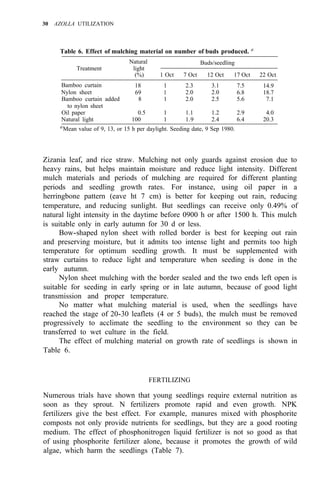
Table 6. Effect of mulching material on number of buds produced. a
Natural
Treatment light
(%) 1 Oct 7 Oct 12 Oct 17 Oct 22 Oct
Buds/seedling
Bamboo curtain 18 1 2.3 3.1 7.5
Nylon sheet 69 1 2.0 2.0 6.8 18.7
14.9
Bamboo curtain added 8 1 2.0 2.5 5.6 7.1
Oil paper 0.5 1 1.1 1.2 2.9 4.0
Natural light 100 1 1.9 2.4 6.4 20.3
a
Mean value of 9, 13, or 15 h per daylight. Seeding date, 9 Sep 1980.
to nylon sheet
Zizania leaf, and rice straw. Mulching not only guards against erosion due to
heavy rains, but helps maintain moisture and reduce light intensity. Different
mulch materials and periods of mulching are required for different planting
periods and seedling growth rates. For instance, using oil paper in a
herringbone pattern (eave ht 7 cm) is better for keeping out rain, reducing
temperature, and reducing sunlight. But seedlings can receive only 0.49% of
natural light intensity in the daytime before 0900 h or after 1500 h. This mulch
is suitable only in early autumn for 30 d or less.
Bow-shaped nylon sheet with rolled border is best for keeping out rain
and preserving moisture, but it admits too intense light and permits too high
temperature for optimum seedling growth. It must be supplemented with
straw curtains to reduce light and temperature when seeding is done in the
early autumn.
Nylon sheet mulching with the border sealed and the two ends left open is
suitable for seeding in early spring or in late autumn, because of good light
transmission and proper temperature.
No matter what mulching material is used, when the seedlings have
reached the stage of 20-30 leaflets (4 or 5 buds), the mulch must be removed
progressively to acclimate the seedling to the environment so they can be
transferred to wet culture in the field.
The effect of mulching material on growth rate of seedlings is shown in
Table 6.
FERTILIZING
Numerous trials have shown that young seedlings require external nutrition as
soon as they sprout. N fertilizers promote rapid and even growth. NPK
fertilizers give the best effect. For example, manures mixed with phosphorite
composts not only provide nutrients for seedlings, but they are a good rooting
medium. The effect of phosphonitrogen liquid fertilizer is not so good as that
of using phosphorite fertilizer alone, because it promotes the growth of wild
algae, which harm the seedlings (Table 7).
USING A. FILICULOIDES SPOROCARPS TO CULTURE SPOROPHYTES 31
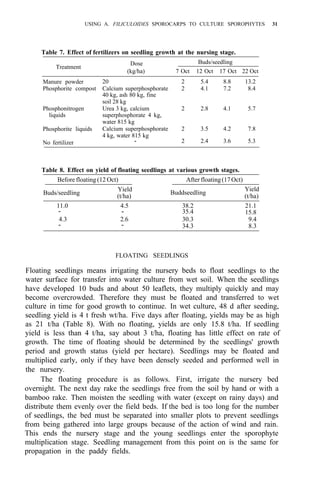
Table 7. Effect of fertilizers on seedling growth at the nursing stage.
Treatment
Manure powder
Phosphorite compost
Phosphonitrogen
liquids
Phosphorite liquids
No fertilizer
Dose Buds/seedling
(kg/ha) 7 Oct 12 Oct 17 Oct 22 Oct
20 2 5.4 8.8 13.2
Calcium superphosphorate 2 4.1 7.2 8.4
40 kg, ash 80 kg, fine
soil 28 kg
Urea 3 kg, calcium 2 2.8 4.1 5.7
superphosphorate 4 kg,
water 815 kg
Calcium superphosphorate 2 3.5 4.2 7.8
4 kg, water 815 kg
- 2 2.4 3.6 5.3
Table 8. Effect on yield of floating seedlings at various growth stages.
Before floating (12 Oct) After floating(17Oct)
Buds/seedling
Yield
Buddseedling
Yield
(t/ha) (t/ha)
11.0 4.5 38.2 21.1
- 35.4 15.8
4.3 2.6 30.3 9.4
34.3 8.3
-
- -
FLOATING SEEDLINGS
Floating seedlings means irrigating the nursery beds to float seedlings to the
water surface for transfer into water culture from wet soil. When the seedlings
have developed 10 buds and about 50 leaflets, they multiply quickly and may
become overcrowded. Therefore they must be floated and transferred to wet
culture in time for good growth to continue. In wet culture, 48 d after seeding,
seedling yield is 4 t fresh wt/ha. Five days after floating, yields may be as high
as 21 t/ha (Table 8). With no floating, yields are only 15.8 t/ha. If seedling
yield is less than 4 t/ha, say about 3 t/ha, floating has little effect on rate of
growth. The time of floating should be determined by the seedlings' growth
period and growth status (yield per hectare). Seedlings may be floated and
multiplied early, only if they have been densely seeded and performed well in
the nursery.
The floating procedure is as follows. First, irrigate the nursery bed
overnight. The next day rake the seedlings free from the soil by hand or with a
bamboo rake. Then moisten the seedling with water (except on rainy days) and
distribute them evenly over the field beds. If the bed is too long for the number
of seedlings, the bed must be separated into smaller plots to prevent seedlings
from being gathered into large groups because of the action of wind and rain.
This ends the nursery stage and the young seedlings enter the sporophyte
multiplication stage. Seedling management from this point on is the same for
propagation in the paddy fields.
32 AZOLLA UTILIZATION
CONCLUSION
Preventing the nursery bed from eroding due to heavy rain is the key to the
success in nursing seedlings in the field. The growth rate of young seedlings
varies with the light, temperature, moisture, and fertilization. The timely
floating of seedlings speeds growth remarkably. Therefore, we have to
integrate these three major techniques in the overall process to effectively use
sporocarps to raise sporophytes in the fields. How to enhance the germination
rate in the field and how to accelerate the growth rate of young seedlings
require further study.
Germination of Azolla filiculoides Lam.
sporocarps and factors affecting their
growth
XIAO QING-YUAN, SHI YAN-RU, YANG GUANG-LI,
AND PENG KE-LIN
Soil and Fertilizer Institute
Academy of Agricultural Sciences
Hunan, China
The study of techniques for the sexual reproduction of Azolla
filiculoides Lam. should include collection, storage, and sprouting of
sporocarps; large-scale cultivation of sporelings, etc. The three proces-
ses of sprouting of A. filiculoides — germination, greening, and shooting
— are described, and the main factors that affect sprouting rate are
analyzed. We conclude that 1) only mixed cultivation of fully mature
megasporocarps and microsporocarps can lead to sprouting,
2) temperature affects sprouting rate, 3) sunlight is an indispensable
condition for sprouting, and 4) cultivation in the dark tends to raise
shooting rate.
China has a history of several centuries of cultivating Azolla for paddy field
green manure (3). For a long time, the Chinese used the clipped lateral
branches of the Azolla plant for reproduction. However, because the Azolla
plant is rather weak, it has difficulty surviving winter and summer.
Azolla is a fern plant. Its life cycle is an obvious digenesis of a sporophyte
stage and a gametophyte stage. How to master the process of sexual
reproduction of Azolla, how to cultivate the sporelings of sporocarps, and how7
to make Azolla survive severe cold and intense heat remain major technical
problems in applying Azolla to production.
To apply the sexual reproduction of Azolla to production, it is necessary
to solve problems of collecting sporocarps, storing sporocarps, sprouting of
sporocarps, and cultivating sporelings on a large scale. Of the four, collecting
sporocarps is basic. This article gives a short account of the process of and the
conditions necessary for the shooting of A. filiculoides sporocarps.
GERMINATION PROCESS
The process of germination of A. filiculoides sporocarps includes the formation
of male and female gametophytes, combination of eggs and sperms into
zygotes, and the growth of embryos.
34 AZOLLA UTILIZATION
According to obvious external changes and internal development, the
sprouting process of A. filiculoides sporocarps may be divided into three
periods: 1) germination, 2) screening, and 3) shooting (1).
Germination period
At 20-30 °C, it takes only 3-5 d for A. filiculoides sporocarps to develop into
female gametophytes. Two or three days after germination begins, the
megasporocarps show no obvious change. Absorption of water makes
sporocarps swell slightly, and the floats are not yet opened. When the
megaspores have grown into mature female gametophytes, the floats at the top
open outward.
Between the floats are the prothallia of grown female gametophytes. They
are colorless and semispherical. Archegonia and eggs grow inside the female
gametophytes.
The whole process of microspores growing into male gametophytes takes
place in massulae. The period in which microspores fully develop into male
gametophytes is almost as long as that of female gametophytes. Upon maturity
of A. filiculoides microsporocarps, the indusia break and all the layers of
sporangia split. The massulae stick to the walls of the megaspores. The sperms
produced by male gametophytes may escape from the massulae, all the sides of
which have gelatinized.
Greening period
At 20-30 ºC, sperms unite with eggs leading to the formation of zygotes, which
develop into embryos. The process lasts only 2-3 d. In this stage, the most
conspicuous external change of megaspores is represented by the presence of
chlorophyll produced by the cells of female gametophytes in sunlight. As a
result, female gametophytes turn light green and swell, stretching out from the
shape of a ball to that of a drum. The embryos develop rapidly. Megasporo-
carps whose female gametophytes do not green nor change color immediately
after greening will fail to germinate. The megasporocarps whose female
gametophytes look dark green will not germinate either.
Shooting period
When the embryos reach a certain stage of development, the indusia of the
megasporocarps are pushed aside and relocated at the top of sporangia, and
cotyledons appear. This process takes only 1 or 2 d. Generally, one
megasporocarp can produce only one young sporeling from the cervical
archegonium at the top of the female gametophyte. But a small number of
megasporocarps, if their floats are fully open, may sometimes germinate even
10-15 d after the maturity of the female gametophytes. The young sporelings
produced in this way are grown from the sides of the female gametophytes.
They are called side sporelings. According to Smith (2), the female gametophyte
of Azolla first develops a cervical archegonium at its top. He says, “If there is
no fertilization of the egg in this archegonium, additional archegonial initials
GERMINATION OF A. FILICULOIDES LAM. SPOROCARPS 35
are differentiated lateral to it. If these fail to function, further archegonia are
produced until a dozen or more have been formed.” Side sporelings come out
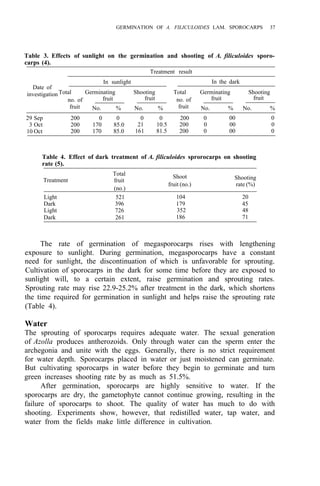
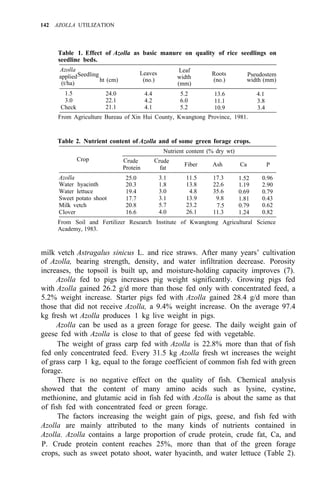
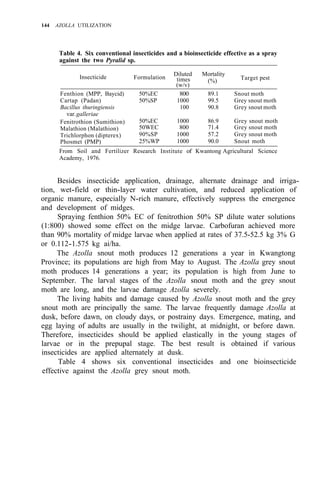
from the additional cervical archegonium at the side. In the work of
cultivation, we have found cases in which one megasporocarp bears two
sporelings (two of the same size, or one large and a small one) or even three
sporelings. But such cases are few.
CONDITIONS FOR SHOOTING
Degree of maturity of sporocarps
According to their external sizes, colors, and morphological changes, the
maturity of A. filiculoides sporocarps is divided into three periods: 1) green
maturity, 2) yellow maturity, and 3) full maturity.
Green maturity. The megasporocarp wall is light green. The fruit tips are
purplish brown or reddish brown. Sporocarps can grow.
Yellow maturity. The megasporocarp wall turns from light green to light
yellow. The fruit tips are brown. The lower part of the fruit is brownish red.
The fruit no longer grows. At the end of the period, the tops and the bottoms of
the megasporocarps turn greenish brown. The floats in the upper and lower
parts are light yellow. The fruit walls are intact. The pits in the middle part are
visible.
Full maturity. The sporocarps reach full maturity. The tops and bottoms
of the megasporocarps are browner. The fruit walls are broken horizontally,
presenting a crack. The base of the sporocarp is ball-shaped. There are notable
protrusions on the surface.
Experiments show that A. filiculoides megasporocarps cannot shoot
during green maturity or yellow maturity. In the course of cultivation, only
50-60% of megasporocarps that have outwardly reached full maturity can
germinate. About 5-10% of the germinated sporocarps do not bud. The
remaining 30-40% do not germinate at all.
The date of collection has much to do with the shooting rate (Table 1).
The maturity rate of the seedlings of sporocarps collected from 30 May to 10
Jun is 15-28% higher than that of the sporocarps collected before 25 May. The
germination rate is 31-60% higher, and shooting rate is 28-56% higher.
Table 1. The relationship between the date of collection of A. filiculoides
sporocarps and shooting rate (1).
Collection
date
Maturity
rate
(%)
Germination
rate
(%)
Shooting
rate (%)
25 May 12.0 22.0 8.0
30 May 27.0 53.0 36.0
10 Jun 40.0 82.0 64.0
36 AZOLLA UTILIZATION
Mixed cultivation of megasporocarps and microsporocarps
By parthenogenetic cultivation, sporocarps will not shoot. With A. filiculoides
no case of parthenogenesis has been found.
Under conditions of parthenogenetic cultivation, most megasporocarps
can germinate. The floats open. Part of the female gametophytes appear green
but they do not shoot. If the male and female gametophytes are cultivated
together, most of the sporocarps can sprout. Sporocarps can sprout only after
the megasporocarps and microsporocarps have germinated and formed male
and female gametophytes.
There is no rigid restriction on the ratio of microsporocarps to
megasporocarps. At maturity, and in the course of collection, A. filiculoides
microsporocarps break. The massulae in the microsporangia attach themselves
to the mature megasporocarps with glochidia. Thus, in cultivation, inoculation
of additional microsporocarps is out of the question.
Temperature
A. filiculoides sporocarps can normally germinate at an average daily
temperature of 20-30ºC. Within this range a rise in temperature will relatively
shorten the period of the germination of sporocarps.
Table 2 shows that at an average daily temperature of 32ºC (ranging from
26 to 38ºC), the period from sporocarp soaking to germination lasts at least 4 d
and at most 26 d. Within 15-20 d, 46.5-78.7% of the sporocarps will begin to
germinate. Upon germination, 80.2% of the sporocarps will turn green in
3-5 d. Of those, 66.6% will germinate in 2-3 d. It can be seen that in the course
of the cultivation of sporocarp sporelings, the period from sporocarp soaking
to germination is long. Sprouts will come out 5-8 d after germination.
Experiments show that at an average daily temperature of 20-30ºC, the
difference in the length of periods for sporocarps to germinate mainly results
from the difference in the length of time required by the spores to develop into
male and female gametophytes at various temperatures. Gametophytes grow
slowly at low temperatures; they develop fast when the temperatures are high.
At a temperature between 18 and 28.5ºC, sporocarps begin to shoot about 7 d
after germination.
Temperatures below 20ºC are unfavorable for A. filiculoides sporocarps
to germinate. Before germination, sporocarps can resist high temperature, but
after germination they become less tolerant of heat.
Sunlight
Sunlight is a prerequisite for sporocarp germination. It is impossible for
sporocarps to germinate without sunlight (Table 3).
Table 2. Germination and shooting of A. filiculoides sporocarps (4).
Days from sporocarp Days from germination Days from greening to
Min Max Normal Min Max Normal Min Max Normal
soaking to germination to greening shooting
4 26 15-20 2 7 3-5 1 4 2-3
GERMINATION OF A. FILICULOIDES LAM. SPOROCARPS 37
Table 3. Effects of sunlight on the germination and shooting of A. filiculoides sporo-
carps (4).
Treatment result
In sunlight
Date of
In the dark
investigation Total Germinating Shooting Total Germinating Shooting
no. of fruit fruit no. of fruit
fruit No. % No. % fruit No. % No. %
29 Sep 200 0 0 0 0 200 0 00 0
3 Oct 200 170 85.0 21 10.5 200 0 00 0
10 Oct 200 170 85.0 161 81.5 200 0 00 0
fruit
Table 4. Effect of dark treatment of A. filiculoides sprorocarps on shooting
rate (5).
Total
fruit
(no.)
Treatment
Shoot Shooting
fruit (no.) rate (%)
Light 521 104 20
Dark 396 179 45
Light 726 352 48
Dark 261 186 71
The rate of germination of megasporocarps rises with lengthening
exposure to sunlight. During germination, megasporocarps have a constant
need for sunlight, the discontinuation of which is unfavorable for sprouting.
Cultivation of sporocarps in the dark for some time before they are exposed to
sunlight will, to a certain extent, raise germination and sprouting rates.
Sprouting rate may rise 22.9-25.2% after treatment in the dark, which shortens
the time required for germination in sunlight and helps raise the sprouting rate
(Table 4).
Water
The sprouting of sporocarps requires adequate water. The sexual generation
of Azolla produces antherozoids. Only through water can the sperm enter the
archegonia and unite with the eggs. Generally, there is no strict requirement
for water depth. Sporocarps placed in water or just moistened can germinate.
But cultivating sporocarps in water before they begin to germinate and turn
green increases shooting rate by as much as 51.5%.
After germination, sporocarps are highly sensitive to water. If the
sporocarps are dry, the gametophyte cannot continue growing, resulting in the
failure of sporocarps to shoot. The quality of water has much to do with
shooting. Experiments show, however, that redistilled water, tap water, and
water from the fields make little difference in cultivation.
38 AZOLLA UTILIZATION
REFERENCES CITED
1. Shi Yan-ru and Peng Ke-li. 1980. A study of the process and shooting of Azolla sporocarps and the
2. Smith, G. M. 1959. Gryptogam. Vol. II. Science Publishing House, p. 276-283.
3. Soil and Fertilizer Institute of the Academy of Agricultural Sciences of Zhejiang Province. 1975.
Cultivation, propagation, and utilization of Azolla [in Chinese]. Agricultural Publishing House,
Beijing. p. 6.
4. Soil and Fertilizer Institute of the Academy of Agricultural Sciences of Hunan Province. 1978.
Preliminary observations of the germination and shooting of Azolla sporocarps [in Chinese].
Changsha, China (mimeo.)
5. Soil and Fertilizer Institute of the Academy of Agricultural Sciences of Hunan Province. 1981.
Nutrient elements of the seedlings of Azolla filiculoides and technique for large-scale cultivation of
Azolla filiculoides sporocarps [in Chinese]. Hunan Agric. Sci. Technol. 4:22-25.
conditions of shooting [in Chinese]. Hunan Agric. Sci. Technol. 1:46-49.
Morphogenesis of sporocarps
of Azolla microphylla
E.G. CUTTER AND Y.R. HERD
Department of Botany
University of Manchester
Manchester M 13 9PL, United Kingdom
Material of Azolla microphylla (IRRI strain 418) was maintained in a
N-free culture medium under controlled conditions in a growth
cabinet. Developing microsporocarps and megasporocarps were fixed
and embedded for observation by light microscopy, scanning electron
microscopy, and transmission electron microscopy. Spore mother cells
were surrounded by a tapetal layer, which became periplasmoidal.
Granular material deposited in large vacuoles aggregated to form the
pseudocells of the massulae and floats. Other electron-dense granular
material from the periplasmodium contributed to wall thickening in
both types of spores. Megaspores had a three-layered sporoderm, with
periplasmodium occurring within the interstices of the outer layer or
exoperine. The periplasmodium showed zonation in the megasporan-
gium; the predominant organelles differed with distance from the
developing megaspore. The principal components of the cytoplasm in
more mature megaspores and microspores were starch-containing
plastids and abundant lipids. Cells of Anabaena azollae were present
near the apex of both types of sporocarps. Attempts to induce
sporulation with added hormones were not successful.
This study examined sporocarp development in Azolla at light and electron
microscope levels, and began to examine the factors controlling sporocarp
formation. Descriptions of sporocarp development in Azolla filiculoides
(1, 3, 6), A. pinnata (11), and A. nilotica (4) exist at the light microscope level.
In addition, mature sporocarps of several species have been observed with
Scanning Electron Microscopy (SEM) and Transmission Electron Micro-
scopy (TEM) (2, 7, 12).
The origin of sporocarps has not been observed. Earlier descriptions
(6, 11) attribute them to the lower lobe of the first leaf of a branch. Previous
authors (1, 2, 4, 6, 11) also agree that initially, several microsporangia and a
single megasporangium are initiated in each sporocarp, but in those destined
to become microsporocarps the megasporangium aborts. A single mega-
sporangium develops in the megasporocarps.
40 AZOLLA UTILIZATION
MATERIALS AND METHODS
Material of Azolla microphylla (No. 418 of the IRRI culture collection) was
grown in a N-free liquid medium in a growth cabinet at 25º/17ºC, 70%
relative humidity, light intensity of 80 W/m2
, and a 12 h photoperiod.
Sporocarps were fixed in 2.5% glutaraldehyde in 0.1 M sodium cacodylate
buffer, pH 7.0, for 3 h under vacuum, postfixed in 2% osmium tetroxide, and
embedded in Spurr’s resin or in ultralow viscosity resin (TAAB). Infiltration
extended over several days. Thin sections were stained with 2% uranyl acetate
and Reynold’s lead citrate.
Experimental material was maintained in the basic nutrient medium to
which various hormones had been added.
RESULTS
Observations on microsporocarps
Figure 1 shows stages in microsporogenesis in A. microphylla. Figure la shows
a young microsporocarp in which the central megasporangium is degenerating.
The two-layered indusium encloses also several developing microsporangia
and cells of the endosymbiont, Anabaena azollae. At a slightly later stage (Fig.
lb) sporangia in which the original apical cell and stalk cell have divided to give
a central sporogenous initial and tapetum, encased in a single-layered wall, can
be seen (Fig. lb, right). The sporogenous initial divides to form 8, then 16,
microspore mother cells. At this stage TEM observations show that the
sporogenous cells have starch-containing plastids and that lipid deposits are
present in all layers. The sporogenous cells are connected to each other and to
the cells of the tapetum by numerous plasmodesmata. The spore mother cells
then acquire a cell wall which resembles callose, and the tapetal cells break
down to form a periplasmodium. The latter, which is electron dense and
contains nuclei and other organelles, infiltrates between the microspore
mother cells.
Synaptonemal complexes are visible in the nuclei of the microspore
mother cells, the walls of which break down. Synchronized meiosis then takes
place, giving rise to tetrads of microspores with callose-like walls. The spore
tetrads contain dictyosomes, microtubules, short lengths of endoplasmic
reticulum, etc., but their cytoplasm is much less electron-dense than the
surrounding periplasmodium, which is also beginning to become vacuolate
(Fig. 1c). The microspores develop a thick exospore, which is probably
derived from granular material in the vacuoles of the periplasmodium. The
periplasmodium also gives rise to three massulae composed of pseudocells and
bearing glochidia (Fig. 1d). The spores become engulfed by the massulae. In
A. filiculoides the walls of the pseudocells consist of sporopollenin (12). A more
complete account of these observations has been published elsewhere (8).
MORPHOGESESIS OF SPOROCARPS OF A. MICROPHYLLA 41
1. Stages in microsporogenesis in Azolla microphylla. a) L.S. Young microsporocarps in which the
central megasporangium (Msp) is still present. Developing microsporangia (msp) occur on either side.
Cells of Anabaena azollae (A) are present in the space above. b) L.S. microsporocarp with
microsporangia in stages of development. ps = primary sporogenous cell, t = tapetum. c) Transmission
electron micrograph of part of a microsporangium showing a tetrad of microspores (m). These have
electron lucent cytoplasm compared to the surrounding periplasmodium (pp). d) T.S. micro-
sporangium showing three pseudocellular massulae (mas) and engulfed microspores (m). Parts of
glochidia (gl) are evident centrally. a, c, and d have been reproduced from Herd et a1 (9), with
permission from the Royal Society of Edinburgh.
42 AZOLLA UTILIZATION
Observations on megasporocarps
Figure 2 shows stages in megasporogenesis in A. microphylla. A mature
megasporocarp consists of a two-layered wall, enclosing a single mega-
sporangium with a cavity above filled with Anabaena cells. Inside the wall of
the megasporangium is the megaspore apparatus, consisting of a single basal
megaspore with a thick wall or sporoderm, a collar, columella, and three floats.
A suprafilosum consisting of filaments derived from the exoperine is present
apically (Fig. 2a).
The earliest stages of megasporangium development were not observed.
Eventually, all megaspores but one abort, leaving a centrally situated spore
with a thin exine and peripheral cytoplasm with the usual organelles. A spiny
excrescence abuts a channel in the dense tapetal periplasmodium which
surrounds the megaspore (Fig. 2b). The periplasmodium is not uniform, but
contains peripheral vacuoles, then a layer containing nuclei, endoplasmic
reticulum associated with amyloplasts, mitochondria, lipid bodies, and
polyribosomes. Immediately around the megaspore are ribosome-coated
vesicles, and numerous microtubules, but no nuclei (Fig. 2b).
At a considerably later stage, the megaspore becomes crescent-shaped. A
thick exine is present, and from this stage fixation of the contents was poor.
Lipid and starch-containing plastids are present. In the upper parts of the
megasporangium large vacuoles are evident in the sites of the future floats.
Later, degenerated megaspores and granular material are deposited in these
vacuoles, and distended cisternae of endoplasmic reticulum containing
electron-dense material are formed around the floats. Granular material is also
deposited in the space between the boundary of the periplasmodium and the
exine of the spore. This material contributes to the endoperine, and the
exoperine is derived from granular material in small vacuoles.
The outlines of the floats, columella, and collar gradually become
distinguishable in the upper part of the sporangium (Fig. 2c), and the
pseudocells of the floats form from granular material. Accumulations of
membrane-bounded electron-dense material form the exoperinal filaments of
the suprafilosum. Cells of Anabaena are evident below the indusium (Fig. 2c).
Eventually the vacuole-derived material forming the pseudocells of the floats
condenses to form electron-dense walls. When these walls are complete, the
periplasmodium disappears. The megaspore itself is filled with reserves,
including abundant lipid, and its wall consists of a thick exine, an endoperine,
and a convoluted exoperine with the remains of the periplasmodium in its
interstices (Fig. 2d). The development of the megasporocarp of Azolla
microphylla is more fully described in Herd et al (9).
Experiments on sporocarp induction
Various growth substances, generally at 1.0, 10.0, and 100.0 mg/liter, added to
the medium have so far failed to induce sporocarp formation. These
substances include gibberellic acid, triiodobenzoic acid, ethrel, and abscisic
acid. Higher concentrations of some of these substances inhibited growth.
The effects of changes in environmental conditions are being investigated.
MORPHOGENESIS OF SPOROCARPS OF A. MICROPHYLLA 43
2. Stages of megasporogenesis in A. microphylla. a) scanning electron micrograph of mature
megaspore apparatus, showing the single megaspore (M) with convoluted exoperine (ex), collar (c),
three floats (f), one of which is not visible, and the suprafilosum (sf). b) transmission electron
micrograph (TEM) of a young megaspore (M) surrounded by periplasmodium (pp), comprising
vacuoles (v) near the periphery, nuclei, plastids and mitochondria in the middle region, and
microtubules, coated vesicles, etc., in the inner region. c) L.S. megasporocarp, showing a crescentic
megaspore (M), floats (f), collar (c), and columella (cm). A = Anabaena; i = indusium; w = wall of
megasporangium. d) TEM of fairly mature megaspore (M), with poorly preserved contents, showing
the wall structure, comprising the exine (e), endoperine (en), and exoperine (ex). Portions of the
peripiasmodium (pp) remain.
44 AZOLLA UTILIZATION
DISCUSSION
In the development of both microsporangia and megasporangia the tapetum
gives rise to a periplasmodium. In the megasporangium, this is not uniform
but contains different combinations of organelles with increasing distance
from the megaspore. This zonation was previously noted with the light
microscope (1, 11). Granular material in vesicles from the periplasmodium
contributes to wall thickening in both types of spore.
Calvert et al (2) have pointed out that the massulae associated with the
microspores are homologous with the floats of the megaspore apparatus. It was
shown previously (12) by cytochemical methods that sporopollenin was a
component both of these structures and of the spore wall, and our observations
lend general support to this and suggest the source of origin. Recent
experiments involving extraction of dried sporocarps of A. mexicana with
solvents, followed by acetolysis, have indicated that sporopollenin forms
30-45% of the dry weight of the spores (14).
The presence of this extremely resistant material both in the spore wall
and in components of the capture mechanism are clearly important in Azolla’s
ability to survive unfavorable conditions before and during sexual
reproduction.
The capacity to induce sporulation at will in Azolla would clearly be
important in the selection of improved strains for use in rice fields. To date,
little success has been attained. The structural complexity of the reproductive
structures, long known at the light microscope level and now further
demonstrated at the ultrastructural level, may provide one reason for this.
Observations that sporulation of natural populations of Azolla was affected by
environmental conditions such as temperature and photoperiod (5, 10, 13)
suggest that experimental modification of environmental conditions may be a
productive line of investigation, but it seems unlikely that any simple
relationship between a single factor and sporulation will be established.
ACKNOWLEDGMENT
We are indebted to the Overseas Development Administration for financial
support, and to Miss J. Howard for technical assistance.
REFERENCES CITED
1. Bonnet, A. L-M. 1957. Contribution a l’etude des Hydropteridees. III. Recherches sur Azolla
2. Calvert, H.E., S.K. Perkins, and G.A. Peters. 1983. Sporocarp structure in the heterosporous
3. Campbell, D.H. 1983. On the development of Azolla filiculoides, Lam. Ann. Bot. 26:155-187.
4. Demalsy, P. 1954. Le sporophyte d’Azolla nilotica. Cellule 56:1-60.
5. Dubyna, D.V., and V.V. Protopopova. 1983. Ecobiological features of Azolla caroliniana and
filiculoides Lam. Rev. Cytol. Biol. Veg. 18:l-86.
water fern Azolla mexicana Presl. Scanning Electron Microscopy 3:1433-1510.
Azolla filiculoides. Rastit. Resur. 19:500-506.
MORPHOGENESIS OF SPOROCARPS OF A. MICROPHYLLA 45
6. Duncan, R.E. 1940. The cytology of sporangium development in Azolla filiculoides. Bull. Torrey
7. Fowler, K., and J. Stennett-Willson. 1978. Sporoderm architecture in modern Azolla. Fern Gaz.
8. Herd, Y.R., E.G. Cutter, and I. Watanabe. 1985. A light and electron microscopic study of
9. Herd, Y.R., E.G. Cutter, and I. Watanabe. 1985. An ultrastructural study of postmeiotic
10. Holst, R.W., and J.H. Yopp. 1979. Studies of the Azolla and Anabaena symbiosis using Azolla
11. Konar, R.N., and R.K. Kapoor. 1974. Embryology of Azolla pinnata. Phytomorphology
12. Lucas, R.C., and J.G. Duckett. 1980. A cytological study of the male and female sporocarps of the
13. Talley, S.N., and D.W. Rains. 1980. Azolla filiculoides as a fallow season green manure for rice in a
14. Toia, R.E., Jr,, B.H. Marsh, J.W. McDonald, and G.A. Peters. 1984. Sporopollenium content in
Bot. C1. 67:391-412.
11:405-412.
microsporogenesis in Azolla microphylla. Proc. R. Soc. Edinb. (in press)
development in the megasporocarp of Azolla microphylla. Submitted to Can. J. Bot.
mexicana. I. Growth in nature and laboratory. Am. Fern J. 69:17-25.
24:228-261.
heterosporous fern Azolla filiculoides Lam. New Phytol. 85:409-418.
temperate climate. Agron. J. 72:11-18.
Azolla mexicana spores. Plant Physiol. 75 (suppl. 1):149.
DISCUSSION
LUMPKIN: Fertile Azolla plants have been observed to produce different ratios of megasporocarps to
microsporocarps. Could you speculate on the possible purpose or ecological advantage that this
variation may impart? it would probably be an advantage to agronomists to cause the plant to produce
more megasporocarps because human intervention should reduce the requirement for larger quantities
of microspores.
CUTTER: The development of a sporocarp as a megasporocarp or microsporocarp must be
determined at an early stage, and presumably must depend on whether the megasporangium aborts. I
suspect that this depends in turn upon environmental conditions at that specific time. There may be no
ecological advantage or disadvantage unless the proportion of megaspororcarps falls below a certain
level; but clearly it would be agronomically advantageous to be able to increase the proportion of
megasporocarps. Unfortunately, we do not yet know how to do this.
LADHA: Do you consistently observe blue-green alga Anabaena cells in microsporocarps and
megasporocarps?
CUTTER. Yes, although we believe they may degenerate in later stages of development of
microsporocarps.
KANNAIYAN: At what stage of sporocarp development do the Anabaena azolla enter into it?
CUTTER. It is present in the earliest stage that we have observed, containing young sporangia.
Biochemical basis ofAzolla-Anabaena
azollaesymbiosis
J.K. LADHA AND I. WATANABE
International Rice Research Institute
P.O. Box 933, Manila, Philippines
Important biochemical processes of Azolla and Anabaena azollae are
reviewed, with special emphasis on the specificity of symbiont to host
and host to symbiont. N2 fixation occurs only in symbiont A. azollae
cells; most of the energy is supplied by photosynthesis in host Azolla.
Characteristically low levels of ammonium-assimilating enzymes in A.
azollae make the N2 fixation process very efficient. N is fixed by the
symbiont and transported to the host; the host incorporates the newly
fixed N into the amino acids. Probably the amino acids, along with
reductant and photosynthate, then are supplied from the host to the
symbiont. Because A. azollae is associated with Azolla throughout its
life cycle, a free-living stage of the symbiont is not needed. Although the
algal symbiont is said to have been isolated and cultured in a free-living
stage, Koch’s postulates have not been satisfied. Through immuno-
fluorescence and DNA probe techniques, the symbiont A. azollae has
been found to be similar across host species and geography. The Azolla
leaf cavity has been shown to produce lectin; lectin may be involved in
establishing or feeding the symbiotic relationship.
Worldwide, distribution of Azolla is represented by six recognizable species:
A. filiculoides, A. caroliniana, A. mexicana, A. microphylla, A. nilotica, and A.
pinnata. Their taxonomies are based primarily on vegetative and reproductive
structures. All known species and strains contain the N2-fixing blue-green alga
Anabaena azollae.
The sporophyte of Azolla consists of a branched floating stem bearing
leaves and true roots. The Anabaena symbiont occupies a specialized cavity in
the aerial dorsal leaf lobes (14). The cavity also contains numerous epidermal
hairs. These hair cells seem to be used to exchange metabolites between host
and symbiont.
A unique feature of the Azolla-Anabaena symbiosis is the presence of
symbiont in the host megasporocarp during its sexual cycle (Fig. 1). This
continuous association between A. azollae and Azolla eliminates the need for a
free-living stage of the symbiont. Although the algal symbiont is said to have
48 AZOLLA UTILIZATION
1. Life cycle of Azolla.
been isolated and cultured in a free-living state, Koch's postulates have not
been satisfied with any of the strains isolated (1 5). Using immunofluorescence,
Ladha and Watanabe (7) provided the first evidence that A. azollae freshly
separated from several geographically remote specimens and species of Azolla
show identical and highly specific antigens.
Because the blue-green algal symbiotic system with Azolla is important in
rice cultivation, the Azolla-Anabaena symbiosis has attracted the attention of
agronomists (24). Peters and his colleagues (16) generated a great deal of
information on the physiology and biochemistry of the Azolla-Anabaena
azollae symbiosis. But basic knowledge of the Azolla-Anabaena azollae
symbiosis is low compared to what is known about other symbiotic systems.
Many aspects of the nature of the algal symbiont and infection process are still
unexplained.
In this review, we highlight important biochemical processes comple-
mentary to both parents, with special emphasis on the specificity of the
symbiont to the host and of the host to the symbiont.
PHOTOSYNTHESIS, N2 FIXATION, AND AMMONIUM ASSIMILATION
The host Azolla contains chlorophyll a and b and carotenoids; the symbiont
Anabaena contains chlorophyll a, phycocyanin, allophycocyanin, and phyco-
erythrocyanin (22). The symbiont accounts for less than 20% of the
association's chlorophyll and about 16% of the total protein. The Azolla-
Anabaena association exhibits Calvin cycle, with phosphoglyceric acid as the
initial product. Sucrose is a primary end product in Azolla, but not in the
isolated symbiont (18).
AZOLLA-ANABAENA AZOLLAE SYMBIOSIS 49
Peters and Mayne (12) suggested that the symbiont A. azollae might
exhibit photoheterotrophic carbon metabolism. Ray et al (18) confirmed this
and suggested the existence of a transition, with increasing differentiation of
the symbiont, from photoautotrophic metabolism in generative filaments to
photoheterotrophic metabolism. Peters et al (16) confirmed that sucrose is
synthesized only by the host, not by the symbiont, and is supplied to the
symbiont.
Acetylene reduction assay and 15
N2 incorporation have shown that N2
fixation occurs only in the symbiont Anabaena cells (12, 13). Photosynthesis is
the ultimate source of all the adenosine triphosphate (ATP) and reductant
needed for N2 fixation. Although Photosystem II (PS II) is required to
provide photosynthate for reducing power, it has been shown that it is not a
principal source of ATP for N2 fixation. The primary source of ATP for N2
fixation in light is Photosystem I (PS I). These results, and other studies,
suggest a strong interaction between photosynthesis and N2 fixation (23).
A. azollae has two kinds of cells: vegetative cells and heterocyst. The
heterocyst is the actual site of N2 fixation. A remarkable feature of symbiotic
A. azollae is very high heterocyst frequency: the distance between 2
heterocysts is about 3-5 vegetative cells. In free-living blue-green algae, that
distance is 15-30 vegetative cells (Fig. 2.1). The high heterocyst frequency in
symbiont A. azollae could be explained by its characteristically low levels of
ammonium-assimilating enzymes.
Diagrammatic representations of heterocysts and vegetative cells illus-
trate the different nitrogen metabolism enzymes (Fig. 3). The enzyme
nitrogenase is present in heterocyst. Energy for N2 fixation is supplied by PS I
or cyclic photophosphorylation; the reductant comes from the oxidative
pentose phosphate pathway. The newly fixed N is incorporated into glutamine
via glutamine synthetase (GS) present in the heterocyst. The enzyme
glutamate synthase (GOGAT) has been found to be active only in the
vegetative cell, so glutamate is supplied from the vegetative cell to the
heterocyst.
A unique feature of heterocysts is that they cannot fix carbon and do not
have PS II. Because nitrogenase is highly oxygen sensitive, the heterocyst
cannot afford to have PS II. Thus, the heterocyst fixes N, which is transported
to a nearby vegetative cell. The Vegetative cell, in turn, fixes carbon and
transports it to the heterocyst. This is a good example of symbiosis at the
cellular level.
The heterocyst formation is believed to be regulated by newly fixed N or
its product (5, 21). Studies of ammonia-assimilating enzymes in the Azolla-
Anabaena symbiosis and the Anabaena symbiont showed that, although both
partners had GS, GOGAT, and glutamic dehydrogenase (GDH) activity, the
host was estimated to account for at least 90% of the association’s GS activities
and 80% of the total GDH (17).
The specific GS activities of symbiont A. azollae were half those obtained
with free-living blue-green algae. Orr and Haselkorn used antiserum to GS
50 AZOLLA UTILIZATION
2. Photomicrographs of 1) symbiotic Anabaena azollae cells under normal microscope; 2) under
fluorescence microscope (red color is due to autofluorescence of chlorophyll); 3) fresh cells stained with
homologous FA showing typical yellow-green fluorescence of the fluorescein isothiocyanate; 4)
Newton’s culture stained with homologous FA; and 5) symbiotic A. azollae cells along with Azolla
plant debris stained with Newton’s Anabaena FA. Symbiotic A. azollae did not show any staining while
the Azolla debris showed nonspecific staining.
from free-living Anabaena 7120 (11). They reported that the symbiont A.
azollae exhibited only 5% of the GS protein exhibited by free-living Anabaena
azollae (Newton). Peters et al (16) analyzed hair cells and symbiont of the leaf
cavity of Azolla (Table 1) and confirmed the low GS activity associated with
A. azollae. However, the GDH activity previously attributed to the symbiont
resulted from the incomplete removal of cavity hairs.
It would be interesting to find out why the symbiont showed half the
specific GS activity of free-living blue-green algae, despite the presence of
only 5-10% of the GS protein. The enzymatic studies of Azolla symbiosis were
AZOLLA-ANABAENA AZOLLAE SYMBIOSIS 51
3. N2 fixation and NH3 assimilation pathways in vegetative cell and heterocyst.
Table 1. Specific activity of ammonia-assimilating enzymes in extracts of the
Azolla-Anabaena association. Anabaena with and without cavity hairs, and
two hair types (15).
Glutamine synthetasea
Enzyme Biosynthetic Transferase
activity activity
GDHb
Association 44 ± 1 921 ± 10 31 ± 4
Anabaena with cavity hairs 14 ± 3 192 ± 11 48 ± 15
Anabaena 10 ± 1 170 ± 39
Simple hairs
2 ± 5
28 ± 7 106 ± 41 469 ± 80
Branched hairs N.D. N.D. 397 ± 67
anmoles y-glutamylhydroxamate formed/mg protein per min. bnmoles NADH
oxidized/mg protein per min. N.D. = not detectable, GDH = glutamic dehydro-
genase, NADH = nicotinamide adenine dinucleotide.
made on individual partners after they were physically separated. The levels of
ammonium-assimilating enzymes actually active in the symbiont and host in
vivo are not known. The possibility that the physical separation of symbiont
from host does not activate detectable GS/GOGAT and GDH enzymes
cannot be ruled out.
The occurrence of low level and low activity GS protein in the symbiont
could be important in explaining high heterocyst frequency and N2-fixing
activity. When GS in free-living N2-fixing blue-green algae is inhibited by
metabolic inhibitors such as L-methionine-DL-sulfoxinine (MSO) (19), or
5-hydroxylysine (HL) (6), the alga continues to produce heterocysts and fix N
52 AZOLLA UTILIZATION
4. Effect of HYL on nitrogenase activity and heterocyst formation in A. cylindrica (6).
in the presence of NH4
+
, probably until the endogenous reserve of reductant,
photosynthate, and amino acids is exhausted (Fig. 4).
A similar mechanism seems to be operating in Azolla-Anabaena sym-
biosis, where N is fixed by the symbiont, then transported to the host. The
host Azolla incorporates this newly fixed N into amino acids. Probably these
amino acids, along with reductant and photosynthate, are then supplied to the
symbiont (Fig. 5). How far the symbiont depends on host for its amino acid
requirement in vivo is not known.
ANTIGENIC CHARACTERISTICS AND LECTIN PRESENCE IN ANABAENA
AZOLLAE-AZOLLAASSOCIATION
Until recently, whether the symbiont A. azollae was similar or different in
species and strains of Azolla was not known (15). The main problem in
resolving this question was the inability to grow the symbiont in a free-living
state, without the host. Although a few reports claimed isolation and culture of
A. azollae free from host, the claims were not supported with appropriate
evidence.
Ladha and Watanabe (7) used an immunofluorescence technique to study
the problem. Several antisera and fluorescent antibodies (FAs) were prepared
against symbiotic A. azollae (Fig. 2) freshly separated from different species of
Azolla, free-living Anabaena sp., and Anabaena-free Azolla (Table 2).
AZOLLA-ANABAENA AZOLLAE SYMBIOSIS 53
5. Exchange of metabolites between host and symbiont in Azolla.
Table 2. Antisera of fluorescent antibodies prepared against symbiotic and
free-living Anabaena and Anabaena-free Azolla and their source.
Sample Species Accession no. and source
1
2
3
4
5
Symbiotic A. azollae separared from
A. pinnata
A. pinnata
A. filiculoides
A. caroliniana
A. microphylla 412, Paraguay
22, Tancheng, China
39, MIA, Australia
106, Hamburg, Germany
301, Ohio, USA
Free-livingAnabaena species
6
7
8
9
A. azollae Newton (USA)
A. azollae Bai Ke-zhi (China)
A. flos-aquae ATCC 22664
Anabaena -free Azolla pinnata 22, Tancheng, China
Immunofluorescence reactions of the FAs against several symbiotic and free-
living blue-green algae are shown in Table 3.
Cells of A. azollae showed red autofluorescence of the chlorophyll when
they were observed unstained under the fluorescent microscope (Fig. 2.2).
However, specifically stained vegetative cells fluoresced with the typical
yellow-green of fluorescein isothiocyanate (FITC). Heterocysts appeared
completely red, indicating that the antibody was produced mostly against
vegetative cells (Fig. 2.3, 2.4). All FAs against symbiotic A. azollae strongly
cross-reacted with symbiotic Anabaena of all species and specimens of Azolla
tested, but not with any of the free-living blue-green algae. This clearly
indicates that the symbiotic Anabaena from all species of Azolla share identical
and highly specific antigens.
54 AZOLLA UTILIZATION
Table 3. FA reaction of Anabaena azollae against selected symbiotic and
free-living blue-green algae (7).
Antigen FA reactionofaccessionsand FAa
(accession no.) 22 39 106 301 412 Newton BaiKe-zhi
Symbiotic A. azollae b separated from
A. pinnata (22) 4+ 4+ 3+ 4+ 4+ – –
A. pinnata (39) 3+ 4+ 3+ 4+ 3+ 1+ –
A. filiculoides (106) 3+ 3+ 4+ 3+ 3+ 1+ –
A. caroliniana (301) 3+ 3+ 3+ 4+ 3+ 1+ –
A. microphylla (412) 4+ 3+ 3+ 3+ 4+ 1+ –
Symbiotic Nosroc sp. separated from the coralloid root of
5 species of Cycas
Free-livingblue-greenalgaec
A. azollae(Newton)
A. azollae(Bai Ke-zhi)
A. flos-aquae (ATCC 22664) – – – – – 4+ –
a
A dash (-) indicates no detectable fluorescence. 1+ to 4+ indicate minimum to
maximum fluorescence. Underscoring indicates a homologous reaction. b Symbiotic
A. azollae separated from following species and strains of Azolla showed 3+ to 4+
fluorescence against FAs of Nos. 22, 39, 106, 301, and 412 and no reaction against FAs
of Newton and Bai: Azolla pinnata from Philippines (accession nos. 1, 15, 24, 36),
Malaysia (2), Indonesia (3), Thailand (5, 6), Bangladesh (11), Nepal (13), Vietnam
(17), China (29), India (23, 44), and Ivory Coast (25); A. filiculoides from E. Germany
(101), USA (107,108); A. mexicana from USA (201) and Guyana (20); A. caroliniana
from Uruguay (304); A. microphylla from Paraguay (401,408); and A. nilotica from
Sudan (501). c These species and strains of free-living blue-green algae showed no
fluorescence against all FAs: A. subcylindrica (CCAP 1403/4b Netherlands),
A. variabilis and A. Rorulosa (India), A. cylindrica (China), Anabaena sp. (PCC 7120
and PCC 7122, France), Anabaena sp. (CA, USA), Nostoc sp. (PCC 73102, France),
Nostoc sp. (Sri Lanka), Gloeotrichia sp. (Philippines), and Oscillatoria sp. (PCC 7515,
France).
Franche (1) used DNA probes to reach similar conclusions. He found
that, regardless of the geographical origin of Azolla, the size of the A. azollae
DNA fragments which hybridized to the Anabaena sp. PCC7120 nif K and nif
D genes was identical in each symbiotic Anabaena.
The FA against free-living A. Azollae that Newton and Bai claimed to
have isolated did not cross-react with any of the symbiotic A. Azollae (Fig. 2.5)
or free-living blue-green algae tested except A. flos-aquae (ATCC 22664).
A. flos-aquae strongly cross-reacted with Newton FA at a similar antibody
dilution. The close identity of these two strains was further confirmed by
absorption of Newton FA. Gates et al (3) reported similar results. They
speculated that during isolation and culturing, the symbiotic A. Azollae either
changed its morphology and surface antigenicity or mutated.
It seems unlikely that highly specific antigens of symbiotic A. Azollae
would change to such an extent that they would become identical to those of
the already existing free-living species A. flos-aquae. Considering the results
obtained by Ladha and Watanabe (7, 8), Gates et al (3) suspected that the
strain isolated by Newton is probably not a true isolate of A. azollae. This
could be clarified by reintroducing this isolate into Anabaena-free Azolla
– – – – –
– – – – – 4+ –
– 4+
AZOLLA-ANABAENA AZOLLAE SYMBIOSIS 55
Table 4. FA reactivity of Anabaena-free Azolla pinnata antiserum (8).
FA reactivity against AnabAena-free
Azolla antiserum a
Antigen (accession no.)
Fronds of Anabaena-free Azolla pinnata 22 4+
Symbiotic A. azollae separated from
A. pinnata 22
A. pinnata 39
A. pinnata 44
A. filiculoides 106
A. caroliniana (301)
2+
2+
2+
2+
2+
Free-living Anabaena sp.
A. azollae (Newton) –
A. flos-aquae ATCC 22664 –
A. torulosa –
A. variabilis –
a
A dash (–) indicates no detectable fluorescence. 1+ to 4+ indicate minimum to
maximum fluorescence. Underscoring indicates a homologous reaction.
plants. The sporocarp of Azolla could be a site for reintroducing the free-living
blue-green algae. Unfortunately, Anabaena-free Azolla plants do not produce
sporocarps (unpubl.).
Ladha and Watanabe (7) found that FA reactivity with symbiiotic
A. azollae was reduced when FA against Anabaena azollae was absorbed with
crude leaf extract suspension of Anabaena-free Azolla. This indicates the
possibility that cross-reactive antigens exist between Azolla leaves and the
surfaces of A. azollae. This was further confirmed using indirect FA against
Anabaena-free Azolla. FA reactions of Anabaena-free Azolla antiserum
against symbiotic A. azollae showed 2+ fluorescence; none of the free-living
Anabaena sp., including A. azollae (Newton), showed any cross-reaction
(Table 4).
Cross-reactive antigens identified as polysaccharide have been reported
between legumes and Rhizobium symbiosis (2). A successful symbiosis
probably requires an interaction between these cross-reactive antigens and the
lectins of the legumes.
Mellor et al (9) reported the presence of lectin in Azolla-Anabaena
symbiosis. They found that extracts of whole A. caroliniana and of Anabaena-
free Azolla plants caused agglutination of human erythrocytes; extracts of
symbiotic A. azollae freshly separated from the A. caroliniana plants or
free-living A. azollae (Newton) did not. In contrast, Kobiler (4) reported
haemagglutination activity in extracts of free-living A. azollae but very low
activity in extracts of A. filiculoides.
Using Azolla plants completely free from Anabaena cells, Ladha and
Watanabe (8) found a higher haemagglutination activity in extracts from
whole Azolla-Anabaena symbiosis than from Anabaena-free Azolla and
absolutely no activity in symbiotic or free-living A. azollae. This clearly shows
that the presence of lectin in the Azolla-Anabaena symbiosis was due only to its
occurrence in the host Azolla, not to its occurrence in algal cells. Mellor et al
56 AZOLLA UTILIZATION
(10) further showed that the major locus of the lectin produced by the
Azolla-Anabaena symbiosis is around the Anabaena.
To establish eukaryotic plant and blue-green algal symbiosis, the host
plant must be infected with a specific blue-green algal symbiont. In most
symbiotic systems (including the legume-Rhizobium symbiosis), the associa-
tion of the symbiont with its host is not maintained throughout the host’s life
cycle (20). The association between Azolla and Anabaena is the only
relationship known in which the association between symbiont and host
continues during the sporophyte and gametophyte cycles. Also, it has not been
possible to isolate and culture the Anabaena symbiont free from its Azolla host.
These facts would seem to rule out the need for the host to be infected by
free-living Anabaena. It also suggests that such a host-specific algal symbiont
is likely to exist in the free-living state.
What is the role of lectin in Azolla-Anabaena symbiosis? Mellor et al (10)
suggested that lectin might be involved in establishing or feeding the
partnership. More work is required on characterizing the reactivity of host
cell-originated antigen, symbiont antigen, and lectin to explain their roles in
the Azolla-Anabaena symbiosis.
REFERENCES CITED
1. Franche, C. 1984. The structural nif genes of four symbiotic Anabaena azolla show a high
conserved physical arrangement. Paper presented at the Third International Symposium on N2
Fixation with Nonlegumes, held at 2-8 Sep, Helsinki. p. 92.
2. Dazzo, F.B., and D.H. Hubell. 1975. Cross-reactive antigens and lectin as determinants of
symbiotic specificity in the rhizobium-clover associated. Appl. Microbiol. 30:1017-1033.
3. Gates, J.E., R.W. Fisher, T.W. Goggin, and N.I. Azrolan. 1980. Antigenic differences between
Anabaena azollae fresh from the Azolla fern leaf cavity and free-living cyanobacteria. Arch.
Microbiol. 128:126-129.
4. Kobiler, D., A. Cohen-Sharon, and E. Tel-Or. 1984. Recognition between the N2-fixing Anabaena
5. Ladha, J.K., and H.D. Kumar. 1978. Genetics of blue-green algae. Biol. Rev. 53:355-386.
6. Ladha, J.K., P. Rowell, and W.D.P. Stewart. 1978. Effects of 5-hydroxylysine on acetylene
reduction and NH4
+
-assimilation in the cyanobacterium Anabaena-cylindrica. Biochem. Biophys.
Res. Commun. 83:688-696.
7. Ladha, J.K., and I. Watanabe. 1982. Antigenic similarity among Anabaena azollae separated from
different species of Azolla. Biochem. Biophys. Res. Commun. 109:675-682.
8. Ladha, J.K., and I. Watanabe. 1984. Antigenic analysis of Anabaena azollae and the role of lectin in
the Azolla-Anabaena symbiosis. New Phytol. 98:295-300.
9. Mellor, R.B., G.M. Gadd, P. Rowell, and W.D.P. Stewart. 1981. A phytohaemagglutinin from the
Azolla-Anabaena symbiosis. Biochem. Biophys. Res. Commun. 99:1348-1353.
10. Mellor, R.B., P. Rowell, and W.D.P. Stewart. 1982. The non-random distribution of lectin in the
Azolla caroliniana-Anabaena azollae symbiosis. Pages 106-112 in Lectins - Biol. Biochem, Clinical
Biochem, Vol II. Walter de Gryter & Co., Berlin, New York.
11. Orr, J., and R. Haselkorn. 1982. Regulation of glutamine synthatase activity and synthesis in
free-living and symbiotic Anabaena sp. J. Bacteriol. 152:626-635.
12. Peters, G.A., and B.C. Mayne. 1974. The Azolla-Anabaena azollae relationship. II. Localization of
nitrogenase activity as assayed by acetylene reduction. Plant Physiol. 53:820.
and the water fern Azolla. Fed. Eur. Biochem. Soc. Letters 133:157-160.
AZOLLA-ANABAENA AZOLLAE SYMBIOSIS 57
13. Peters, G.A., R.E. Toia, Jr., and S.M. Lough. 1977. Azolla-Anabaena azollae relationships. V.
15
N2 fixation, acetylene reduction and H2 production. Plant Physiol. 59:1021-1025.
14. Peters, G.A., R.E. Toia, Jr., D. Raveed, and N.J. Levine. 1978. The Azolla-Anabaena symbiosis:
morphology, physiology and use. Israel J. Bot. 31:305-323.
15. Peters, G.A., H.E. Calvert, D. Kaplan, O. Ito, and R.E. Toia, Jr. 1982. The Azolla-Anabaena
symbiosis: morphology, physiology and use. Israel J. Bot. 31:305-323.
16. Peters, G.A., D. Kaplan, J.C. Meeks, K.M. Buzby, B.H. Marsh, and J.L. Corbin. 1985. Aspects of
nitrogen and carbon interchange in the Azolla-Anabaena symbiosis. Pages 212-222 in Nitrogen
fixation and CO2 metabolism. P.W. Ludden and J.E. Burris, eds. Elsevier Science Publishing Co.,
Inc.
17. Ray, T.B., G.A. Peters, R.E. Toia, Jr., and B.C. Mayne. 1978. The Azolla-Anabaena azollae
relationship. VII. Distributionof ammonia assimilating enzymes, protein and chlorophyll between
host and symbiont. Plant Physiol. 62:463-467.
18. Ray, T.B., B.C. Mayne, R.E. Toia, Jr., and G.A. Peters. 1979. The Azolla-Anabaena azollae
relationship. VIII. Photosynthetic characterization of the association and individual partners.
Plant Physiol. 64:791.
19. Stewart, W.D.P., and P. Rowell. 1975. Effects of L-methionine DL-sulphoximine on the
assimilation of newly fixed NH3, acetylene reduction and heterocyst production in Anabaena
cylindrica. Biochem. Biophys. Res. Commun. 65:846-856.
20. Stewart, W.D.P., P. Rowell, and C.M. Lockhart. 1979. Associations of nitrogen-fixing prokaryotes
with higher and lower plants. Pages 45-66 in Nitrogen-assimilation of plants. E. J. Hewitt and C.V.
Cutting, eds. Academic Press, London.
21. Stewart, W.D.P., P. Rowell, J.K. Ladha, and M. J.A.M. Sampaio. 1979. Blue-green algae
(Cynobacteria) - some aspects related to their role as sources of fixed nitrogen in paddy soils. Pages
263-285 in Nitrogen and rice. International Rice Research Institute, P.O. Box 933, Manila,
Philippines.
22. Tyagi, V.V.S., B.C. Mayne, and G.A. Peters. 1980. Purification and initial characterization of
phycobiliproteins from the endophytic cyanobacterium of Azolla. Arch. Microbiol. 128:41-44.
23. Tyagi, V.V.S., T.B. Ray, B.C. Mayne, and G.A. Peters. 1981. The Azolla-Anabaena azollae
relationship. XI. Phycobiliproteins in the action spectrum for nitrogenase-catalyzed acetylene
reduction. Plant Physiol. 68:1470-1484.
24. Watanabe, I. 1984. Use of symbiotic and free-living blue-green algae in rice culture. Outlook
Agric. 13:166-172.
DISCUSSION
KULASOORIYA: Do you know whether the endosymbiotic cavity of the Azolla is aerobic or
microaerobic? Do you know if vegetative cells of Anabaena azollae also fix any N2 inside the Azolla
plants and whether N2 fixation takes place exclusively in the heterocysts?
LADHA: I do not know if any information is available on this aspect but I would think that there is
aerobic condition in the cavity. Again, I do not know if there is any published work available to answer
your question. However, the presence of a very high heterocyst frequency in symbiotic A. azollae
would rule out such a possibility. If we think that vegetative cells might also be fixing nitrogen because
of microaerobic condition from the generative Anabaena filaments in the leaf, then apical colonies
which lack heterocysts should also fix nitrogen. But this is not the case.
KANNAIYAN: What is the role of lectin in Azolla-Anabaena symbiosis, since Anabaena does not
infect the cells of Azolla?
LADHA: At present we do not know the exact role of lectin in Azolla-Anabaena azollae symbiosis.
LUMPKIN: HOW have you verified that Azolla provides glutamate and glutamine to the
Anabaena? How did you remove or transfer hairs from the Anabaena colonies which were used in the
immunological technique?
58 AZOLLA UTILIZATION
LADHA: I have not verified this, but it could be glutamine, glutamate, and/or other amino acids.
At present it is not clear whether amino acids are transported from Azolla to Anabaena and, if so, which
amino acids are transported. A. azollae cells were separated by the roller method of Peters and Mayne.
We did not remove hair cells. There was Azolla plant debris with the Anabaena preparation, but the
amount was very small compared to the Anabaena fraction. Anyway, the antibody prepared that way
was purified by adsorbing with Anabaena-free Azolla.
LI HI-RU: Does the algal Anabaena get into the cavity of Azolla leaves from irrigation, water or
does it harbor inside the spore before the Azolla plant develops?
LADHA: We do not know if Anabaena cells can enter the Azolla leaf-cavity from outside. That is
unlikely, because Anabaena cells are present throughout the growth cycle of Azolla.
Some physiological properties of
akinetes of Anabaena azollae
BAI KE-ZHI, Wu GUOLIANG,
AND CHENG CUI (C.TSUI)
Institute of Botany
Acadeila Sinica
Beijing, China
Results of studies on the physiological properties of the akinetes of
Anabaena azollae to probe the mechanism of synchronized development
are summarized. Simple methods for akinete isolation and preservation
were developed focusing on the mechanism of their light-dependent
germination. Two maxima occurred in the spectra, one at 385 nm and
the other at 615 nm. The action of photosynthate on germination
processes is confirmed. The photoreceptor absorbing at 385 nm was
identified as NaN3-sensitive, and that at 615 nm as phytochrome or its
analogues. A model for the mode of action of light in the germination of
akinetes is suggested.
In the sexual reproductive cycles of Azolla during which the microsporocarps
and megasporocarps are formed, akinetes of the symbiont Anabaena azollae
also formed and were incorporated into the sporocarps. Under ideal condi-
tions, spores of the fern and akinetes of the alga will germinate synchronously
to form new symbiotic bodies. Almost nothing is known about how the fern
and the alga coordinate their development in nature. As a preliminary attempt
at explanation, this paper deals with akinete isolation, preservation, and
germination processes using free-living A. azollae that were isolated in our
laboratory (1) as test materials.
In N-free BG-11 medium, the akinete-rich cultures were obtained by
inoculating the routine culture to standard sporulation medium (9) and
incubating in dim light 6-8 wk. The akinete-rich culture of A. azollae was
harvested by centrifuging the culture at 1,000 g. The collected algal slurry was
pretreated with a glass homogenizer and then mixed 10 times with 0.2% (v/v)
digitonin, and incubated at room temperature for 24 h. After all the vegetative
cells of the filaments were digested, the mixture was again centrifuged at
1,000 g and the supernatant was discarded. The akinetes were washed three
times with distilled water and then transferred to the BG-11 medium with
adequate akinete concentration and refrigerated.
60 AZOLLA UTILIZATION
By adding a drop of akinete suspension onto an agarose plate and
incubating it under adequate light to 24-84 h, more than 90% akinetes
germinated, a rate equal to or slightly higher than the germination rate of
intact akinetes.
This method has also been used satisfactorily for A. cylindrica and A.
variabilis.
The akinete isolation method described here is simple and safe for the
akinetes. In an experiment, akinetes germinated normally even after treatment
with digitonin for 72 h (3). With some modification, the method can be used to
isolate proheterocysts and heterocysts that exhibit N-fixing activity (5).
The akinetes immersed in BG-11 N-free medium were placed into a
stainless steel vessel without cryoprotectants and immersed in liquid N for
8 wk. At the end of the period, the akinetes were thawed in a 30 ºC water bath
for 5 min and inoculated on the surface of a 1.5% agarose medium for
germination. About half of the akinetes germinated normally, indicating that
cryopreservation is a potentially simple and labor- and space-saving method
for long-term preservation of blue-green algae (2).
It has been reported that akinete germination of some species of blue-
green algae is light-dependent (6). It was confirmed in A. azollae in our
experiments. The influence of light intensities on the germination of A. azollae
akinetes shows that 25,000 erg/cm2 per s had an excellent effect in the 32 h
continuous light regime within the range of 1,000-100,000 erg/cm2
per s.
A group of interference filters with half-band width 2.5-4 nm and
transmittances of 40-60% were used to obtain monochromatic light to observe
1. Effect of wavelength on the germination of akinetes of A.azollae.
PHYSIOLOGICAL PROPERTIES OF A. AZOLLAE AKINETES 61
the effects of light of different wavelengths under uniform light flux rate
(2,000 erg/cm2
per s) on the germination of akinetes. Figure 1 shows that the
effects of 615 nm and 385 nm light irradiations are much stronger.
To ascertain whether the pigment absorbing at 615 nm is reversible, the
red/far-red reversibility experiment was carried out. It shows the typical
phytochrome reaction (Table 1), although the red light absorbing maxima
shifted from 660 to 615 nm.
According to Mohr (7), the crucial test for the existence of functional
phytochrome is dichromatic irradiation. The results of simultaneous irradia-
tion with red/far-red and blue-UV/far-red light show that the morphogenetic
effect of red light is clearly abolished by far-red light (Fig. 2). This result
confirms that the photoreceptor absorbing at 615 nm is phytochrome or its
analogues and that at 385 nm it is a pigment different from phytochrome. The
385 nm absorbing pigment proved to be NaN3 -sensitive (4).
It is not surprising to find the blue-UV photoreceptor in the akinetes of
blue-green algae, although it has not been described in the literature, because
this photoreceptor is detectable in different plants and acts as a sensor pigment
in a number of responses.
Table 1. Effect of the reversible red (R) far-red (FR) control on the germina-
tion of akinetes of Anabaena azollae.a
Treatment
Germination rate
(%)
48 h dark (control)
24 h R
24 h R, 3.5 h FR
24 h R, 3.5 h FR, 3 h R
24 h R, 3.5 h FR, 3 h R, 3.5 h FR
24 h R, 3.5 h FR, 3 h R, 3.5 h FR, 3 h R
0
17.6
8.8
17.8
7.2
18.7
a
R = 615 nm, 600 erg/cm2
per s; FR = 743 nm, 5,500 erg/cm2
per s.
2. Effect of dichromatic irradiation on the germination of akinetes of A. azollae.
62 AZOLLA UTILIZATION
3. A hypothetical model of akinete population consisting of four subpopulations according to the
situation of carbohydrate storage (C) and light trigger action (T)
The action of photosynthate on germination is demonstrated by the CO2
released to the atmosphere in the germination process (4).
The results reported here confirm that both the photosynthetic activity,
which supplies energy for akinete germination, and the triggering action of red
and blue-UV light are involved in germination. A hypothetical model (Fig. 3)
to represent the relation between the two factors in an akinete population is
proposed. It is supposed that any population of akinetes is a mixture of four
subpopulations differing in photosynthate storage (C) and trigger action (T).
Different populations would show different light-dependent reactions because
the ratio of their four subpopulations varies. For instance, the akinetes of
subpopulation III (Fig. 3) could germinate under blue-UV light, while the
akinetes of subpopulation IV must be irradiated by red or white light to
provide the carbohydrate supply and to elicit a triggering action. Using this
model, all of the conflicting results so far reported (6) can be explained
satisfactorily.
PHYSIOLOGICAL PROPERTIES OF A. AZOLLAE AKINETES 63
REFERENCES CITED
1. Bai Ke-zhi, Yu Sailing, Chen Weilun, and Yang Shangying. 1978. Cultivation of alga-free Azolla,
isolation of Anabaena azollae and preliminary attempt at their association. Pages 455-457 in
Proceedings, symposium on plant tissue culture. Science Press, Beijing, China.
2. Bai Ke-zhi and Cui Cheng. 1983. Cryopreservation of the akinetes of blue-green alga Anabaena
azollae. Kexue Tonbao 28:288.
3. Bai Ke-zhi, Wu Guoliang, and Cui Cheng. 1981. A simplified method for akinete isolation in
blue-green algae and preliminary observation on the light-dependent germination of akinetes of
Anabaena azollae. Pages 401-408 in Proceedings of the joint China-U.S. phycology symposium.
Science Press, Beijing, China.
4. Bai Ke-zhi, Wu Guoliang, and Cui Cheng. 1983. Studies on mechanism of light-dependent
germination of akinetes of blue-green algae. Page 8 in Abstracts of 11th international seaweed
symposium. Qingdao, China.
5. Bai Ke-zhi, Zhong Zepu, and Song Lirong. 1983. A simple and rapid method for the isolation of
akinetes, proheterocysts and heterocysts in blue-green algae. Page 9 in Abstracts of 11th
international seaweed symposium. Qingdao, China.
6. Braune, W. 1979. C-phycocyanin — the main photoreceptor in the light-dependent germination
process of Anabaena akinetes. Archives Microbiol. 122:289-295.
7. Mohr, H. 1980. Interaction between blue light and photomorphogenesis. Pages 97-109 in The blue
light syndrome. H. Senger, ed. Springer Verlag Press, Berlin.
8. Reddy, P. M., and E. R. S. Thalpasayi. 1981. Some observation related to red-far red antagonism
in Anabaena ferrilisima. Biochem. Physiol. Pflanzen. 176:105-107.
9. Wolk, C. P. 1965. Control of sporulation in a blue-green alga. Dev. Biol. 12:15-35.
USE OFAZOLLA
FOR MULTIPLE PURPOSES
Reevaluation of Azolla utilization
in agricultural production
LIU CHUNG-CHU
Fujian Academy of Agricultural Sciences
Fuzhou, China
For too long Azolla has been studied mainly as a source of N for rice
fields. Most literature on Azolla revolves around this rather limited
application. The techniques for cultivation and utilization of Azolla
have been developed from the traditional methods of growing Azolla in
association with rice and incorporating it as a fertilizer. Our recent
investigations, however, show that the potential for Azolla in agricul-
tural production goes far beyond its N2-fixation capability or its use as
green manure. A reevaluation of Azolla to develop new ways to utilize it
and to give it full play in agricultural production is recommended.
AZOLLA AS A POTENTIAL POTASSIUM SOURCE
Azolla contains 2-3.5% K. Where does the K come from and what is its effect
on rice plants? To answer these questions, we have conducted experiments
since 1979 to determine the source of Azolla K and its utilization by the rice
plant.
Potassium-enriching capability of Azolla
Azolla has a strong ability to concentrate K from the water in which it grows.
Our data show that the peak for K absorption of Azolla is around 0.85 ppm
K2O when cultivated in various concentrations of K medium, i.e. 1g Azolla
biomass is able to take up about 70% of K from 800 ml of culture solution
containing 0.85 ppm K2O in 1 d (Fig. 1). This may be considered the
physiological critical point of Azolla’s K requirement.
Generally, the kinetic curve of K uptake by the rice plant is similar to that
of Azolla, but the level is different. Peak of K uptake for rice is 8 ppm, so the
physiological critical value of K for rice is 10% lower than that of Azolla. The
capability of the rice plant to recover K reaches 0 when the K concentration in
exterior solution decreases to about 1.05 ppm. If it drops further, the dynamic
equilibrium between K absorption and K excretion is negative (Fig. 2). The
natural K concentration in irrigation water of rice fields is about 1-5 ppm K2O
under the utilization range of Azolla, hence Azolla can concentrate trace K and
release it to rice after it is incorporated into the soil.
68 AZOLLA UTILIZATION
2. K absorption by rice from solution and K2O concentration in plant as related to K2O concentration
in solution.
Efficiency of Azolla potassium on rice
Because it releases K rapidly, if we incorporate Azolla biomass into soil 1 wk
before early rice transplanting and assume 80% K efficiency in the same
cropping season, Azolla K efficiency is equal to or better than that achieved by
applying an equal amount of chemical K (Fig.3). When Azolla decomposes, its
1. K absorption by Azolla from solution and K2O content in Azolla related to K2O concentration in
exterior water
AZOLLA UTILIZATION IN AGRICULTURAL PRODUCTION 69
3. The dynamic change of K content in rice plant as affected by various K sources.
K content is excreted mainly in the form of available or slowly available K. The
available K in water does not increase (Fig. 4), so runoff and leaching losses are
less important. The amount of K released can meet the rice crop requirements
throughout its growth. As a result, the K supply and the K content of the rice
plant are greatly increased. It must be noted that if we apply 70% Azolla and
30% chemical fertilizer to the rice crop, the N supply may be increased at an
earlier stage, because Azolla N, as shown by many experiments, is released
slowly and the utilization rate is lower in the same cropping season. It is
reasonable to conclude that this method of applying fertilizer may also
improve K supply at an earlier stage, giving full play to the K-supplying ability
of Azolla.
Pot and plot experiments were conducted on different soils of plain and
mountain areas in Fujian Province in 1984. The focal point was in the
mountainous area because soil fertility is low and K deficiency is easily
observed. Highest yields were achieved with an application of 70 % Azolla and
30 % inorganic fertilizer (Table 1).
Azolla is an excellent and effective K source, and may be a potential
source of biological K in rice producing areas.
70 AZOLLA UTILIZATION
4. The dynamic change of available K of water as affected by various K sources.
Table 1. Effect of application of Azolla and fertilizer on rice yield (extra-
polated from pot and plot experiments).
Rice yield (t/ha)
Av 12 sites in Fujian Av 3 sites in plains area
Treatment
70% Azolla + 30% fertilizer 5.6 5.3
100% chemical fertilizer (NPK) 5.3 5.1
Control, no fertilizer 3.5 3.0
N, P 4.7 4.0
Potassium enrichment in the water-soil system
Azolla is grown mostly in paddy fields in shallow water. The total system is in a
water-soil condition, and K is under dynamic equilibrium. We need to know if
Azolla growing on the water surface and concentrating K from the water layer
affects the K content in soil. How much Azolla K comes from water and how
much comes from soil?
Several experiments have shown that when the K concentration in
exterior water is between 2 and 50 ppm K2 O, K absorption of Azolla from
water does not affect soil K content despite a high (50 ppm K2 O) or medium
(6 ppm K2O) K concentration. When the initial K concentration of exterior
water in the soil-water system is 50 ppm, total K in soil increases greatly after
4-5 wk in both treated and nontreated plots (Table 2) . The slowly available K
AZOLLA UTILIZATION IN AGRICULTURAL PRODUCTION 71
Table 2. Effect of K concentration in culture solution on K content in soil
after 4 wk.
Treatmenta
No Azolla
Azolla
No Azolla
Azolla
No Azolla
Azolla
K content in soil
Total K Slowly available K Available K
(%) (ppm K2O) (ppm K2O)
50 ppm K2O
6.24 587 281
6.24 659 252
6 ppm K2O
3.05 490 118
3.19 503 117
2 ppm K2O
3.22 480 104
3.23 463 103
a
The solution in the 50 ppm K2O treatment was changed weekly; that in 7 ppm was
changed every 3 d; that of 2 ppm K2O was changed daily.
and available K did not change significantly, which could be attributed to
movement of K from solution into soil. When the K concentration in exterior
solution was 6 ppm, the amounts of total K, slowly available K, and available
K in treated or nontreated plots did not differ significantly. When the K
concentration was 2 ppm, as when the solution had to be changed daily, the
three types of soil K showed no significant difference. These results mean that
if the soil-water K concentration can be maintained at 2 ppm K2 O, the
K absorbed by Azolla is mainly from water and has little influence on the K
content in soil.
Results from two experiments showed that the K content in Azolla grown
in the same concentration of K2 O solution, with or without soil, were almost
the same (Fig. 5). Regression analysis showed that the two dynamic curves of
Azolla K content, with and without soil, are nearly congruent. The K required
by Azolla is mainly enriched from water under these K concentration
conditions.
The K content of Azolla growing in 50 ppm K2 O solution was higher than
that of Azolla growing in 6 ppm K2 O. However, the K content of Azolla
growing in 6 ppm or 2 ppm K2 O concentrations did not differ significantly.
This may have been because the solution exchanges in the 6 ppm K2 O
treatment were done every 3 d, and K concentrations determined at solution
exchanging time varied from 1.8 to 6 ppm K2 O. On the other hand, exchanges
in the 2 ppm K2 O treatment were done every day and K concentrations were
between 0.25 and 2 ppm K2 O.
When the K concentration in exterior solution is kept at about 2 ppm,
Azolla assimilates the K mainly from exterior water, regardless of whether the
system has soil. The K concentration in field irrigation water is about 2 ppm,
so the K content in Azolla biomass may come mainly from water instead of
soil. Our experiment using 86
Rb technique has shown similar results.
For these reasons, we deduce that Azolla is not only a biological N source
but an extremely promising source of biological K for the ricefield.
72 AZOLLA UTILIZATION
5. The dynamic change of Azolla K content in water-soil system.
6. The increasing effect of Azolla on various species of fish.
RICE - AZOLLA - FISH SYSTEM
China has a long history of raising fish in ricefields. However, most of them are
raised in single cropped ricefields. The growing period is rather short, no
AZOLLA UTILIZATION IN AGRICULTURAL PRODUCTION 73
definite feeds are used, and the strains used are mostly Cyprinus idella and
C. carpio. Fish do not grow large enough for eating and are used only as
fingerlings to raise in ponds the next year. Fingerling yield is usually
225-300 kg/ha.
We have raised fish in ricefields dual-cropped with Azolla since 1932 and
have been successful in paddy fields using the double wide-narrow method. In
the double wide-narrow method, paired rows spaced 13 cm apart are separated
from other paired rows by spaces 53-66 cm wide. Plant spacing within rows is
6.5 cm. Azolla is cultivated in the wide spaces between paired rows through
much of the rice crop growing season, increasing yields of rice and Azolla.
Rice yield slightly increased compared to control. Yield of early rice was
5.2 t/ha compared to 4.5 t/ha for the control; late rice yielded 5.7 t/ha
compared to 5.3 t/ha for the control. The yield of fish products was 1 t/ha.
Rice yield not only increased, but the edible yield of the fish increased (Fig. 6).
Azolla uptake by Tilapia nilotica and digestive rate
Tilapia nilotica is an important fish in the rice - Azolla - fish system. It lives in
the tropics and grows normally when water temperature is stable above
12°C; fastest when the water temperature is 25-34 °C. The trial showed that
the amount of Azolla taken up by T. nilotica was about 50-80% of its body
weight.
We used the internal indication method to determine the digestion rate of
Azolla by T. nilotica. Digestive rate was 59.7 %.
Results of feeding 15
N-labeled Azolla to T. nilotica showed that 15
N was
most abundant in the intestines and stomach. There also was considerable 15
N
in the gills. That may be because gills are not only the exchange site of O2 and
CO2 but are an excretion organ as well.
The NPK content of fish feces
The ratio of N in fish feces was about 40% compared to that in Azolla. That
means that about 60% of N fixed by Azolla from air was assimilated by fish and
40% of the N fixed was excreted in the feces. The phosphate content in Azolla
was rather low and showed little change. However, the K content decreased
significantly. We need more information to understand whether the total
amount of K was utilized by fish or part of it was dissolved in water (Table 3).
In summary, a 1-ha ricefield may produce as much as 75 t of Azolla, which
may in turn produce 1.2 t of fish products and return an equivalent of 0.3 t
ammonium sulfate to the paddy soil. The rice - Azolla - fish system consumes
low energy, provides high income, and is a promising way to utilize Azolla.
Table 3. N, P, and K contents in Azolla and in feces of Tilapia nilotica.
Sample N (%) P2O5 (%) K2O (%)
Azolla 4.87 0.66 2.53
Feces 2.23 0.91 0.19
74 AZOLLA UTILIZATION
Effect of rice - Azolla - fish system on the environment
Weed control. In the rice - Azolla - fish system and in the rice - fish system,
weeds almost completely disappeared, and intensive labor for weeding was
minimized. The almost total lack of weeds may be attributed to fish activity.
Sheath blight. As shown in Table 4, the rice - Azolla - fish system
decreased the disease index. We need to determine whether the controlling
function was fish, Azolla, or both.
Brown planthopper damage. Results ofexperiments showed that in the rice
- Azolla - fish system, fish may effectively control brown planthopper. Brown
planthopper populations were reduced 72.7 % in early rice and 77 % in late rice.
Azolla pests. The trial on rice -Azolla - fish system showed that
Chironomus and Pyralis decreased significantly. In a 1984 experiment at
Jianling County, where Azolla has been introduced, Chironomus population
was reduced by 87% and the Pyralis population by 78%. Pests are a main
problem in growing Azolla in the subtropics. Raising fish with Azolla may
help solve the problem.
MOIST SOIL CULTIVATION OF AZOLLA
When cultivated on the water surface, Azolla multiplies rapidly and fixes N
efficiently. However, there are problems with this method of cultivating
Azolla:
1. It is difficult to incorporate Azolla into paddy soil.
2. Azolla growth is retarded when the field is drained for the growing rice.
3. Damage from pests, algae, snails, etc., is intensive during summer.
We need to explore a new way of cultivating Azolla to overcome these
problems.
Some species of Azolla may be cultivated on the soil surface by the moist
soil cultivation method. One advantage is that attacks of pests, alga, and snails
are prevented. Because of the lack of water layer, Chironomus and Pyralis sp.,
two serious pests of Azolla, cannot survive. Azolla could then grow safely at
the higher air temperature during summer. Another advantage is Azolla can
grow in multiple layers. Although the upper layer turns red because of
intensive sunlight, the lower layer remains green. The multiple layer growth of
Azolla increases its density and minimizes labor for harvesting.
We have found that A. caroliniana grows on the moist soil surface without
the water layer, and that it can tolerate low light intensity and resist rotting.
Table 4. Effect of rice - Azolla - fish system on sheath blight.
Diseaseindex Av Disease
Treatment Replication Replication Replication disease index
I II III index decrease
Rice
Rice-Azolla-fish 4.11 2.98 1.97
Rice -Azolla 5.15 1.26 2.23 2.90 -0.47
Rice - fish 2.45 2.73 1.92
7.29 1.16 1.13 3.37 –
3.01 -0.36
2.16 -1.21
AZOLLA UTILIZATION IN AGRICULTURAL PRODUCTION 75
These characteristics enable A. caroliniana to survive throughout the summer
under the rice canopy. Under the early rice canopy, A. caroliniana can grow
well on the cleft soil surface when the field is drained to meet the needs of the
growing rice. After harvest and removal of the rice straw, A. caroliniana,
covering the soil surface like green carpet, may yield 11-15 t/ha.
Azolla yields from the moist soil cultivation method vary with strain,
environment, and technique. Table 5 shows the results from sites at two
different environments during winter. Although the fresh weight of Azolla in
the water cultivation method is higher than that in the moist soil cultivation
method, the dry weight in the two methods does not differ significantly. This
may be attributed to the lower water content of moist soil-cultivated Azolla.
Nitrogen-fixing activity between two species and two cultivation methods
fluctuated. Azolla-N content was higher in water-cultivated Azolla method
than in moist soil-cultivated Azolla. We need to further investigate and
compare values of N fixation between moist soil and water cultivation. Azolla
phosphate content in the experiments varied greatly, but K content was
similar. The yields and nutritional content of Azolla cultivated by moist soil
and water cultivation methods need to be further studied.
The success of moist soil cultivation of A. caroliniana and A. filiculoides
has convinced us that moist soil cultivation is a useful new development in
growing Azolla, especially in adverse conditions, and that it is a technical
improvement over water cultivation. The method may be suitable in Asian
countries where temperature is high.
OUTLOOK FOR AZOLLA
In view of the new perspectives on Azolla brought about by recent
investigations, we have identified areas where more research is needed.
Table 5. Moist soil cultivation and water cultivation of Azolla in the field
at two sites.
Cultivation method
A. filiculoides
Water cultivation
Moist soil cultivation
Water cultivation
Moist soil cultivation
A. caroliniana
Yield Dry Dry Nutrition content (%)
(g/m2
) (%) (g/m2
) N P2O5 K2O
Lou Hia, Fuzhou, China
wt wt
1245 5.0 62.3 4.8 2.1 2.4
795 6.2 49.3 4.5 1.8 2.3
975 4.9
645 6.4
47.8 4.1 2.7
41.3 3.6 2.2
1.7
1.6
A. filiculoides
Fujian Academy of Agricultural Sciences, Fuzhou, Fujian, China
Water cultivation 2888 5.6 161.7 3.5 0.8
Moist soil cultivation 2716 6.0 163.0 3.0 1.1
2.1
1.9
Water cultivation 1546 6.4 98.9 4.2 0.6 1.9
Moist soil cultivation 930 8.2 76.3 3.9 1.0 1.9
A. caroliniana
76 AZOLLA UTILIZATION
Studies in the following areas should contribute to the wider utilization of
Azolla.
1. Because of the value of Azolla as a feed for livestock and poultry,
investigations should include digestion rate of Azolla, nutrient
efficiency, silage, drying, and protein content.
2. Studies on the rice - Azolla - fish system should include nutrition and
management of fish, distribution and transformation of the N fixed by
Azolla and P in the fish body and rice plant, and development of a
comprehensive technical system to obtain high yields of rice, Azolla,
and fish.
3. Basic research on Azolla should include studies to identify and classify
Azolla strains and their algae symbionts; studies of photosynthesis, N
fixation, N fixing efficiency in the field, and synthesis and mechanisms;
and studies on the process of Azolla -algae recombination and the
possibility of breeding new strains.
4. Research is required on the technology for intensive Azolla cultivation,
including the arrangement of Azolla species, and the nutrition and
environmental conditions for Azolla growth. The aim of this research
would be to develop effective comprehensive techniques to grow
Azolla throughout the year and to produce 500-600 t/ha annually.
5. New Azolla strains should be bred by techniques such as sexual
hybridization, cell fusion and recombination, etc., to produce new
strains higher in protein, more digestible, tolerant of adverse
conditions, and higher yielding.
Azolla collection and selection
C. VAN HOVE AND T. DE WAHA BAILLONVILLE
Laboratoire de Physiologie Végétale
Universite Catholique de Louvain
Place Croix du Sud, 4, B-1348
Louvain-la-Neuve, Belgium
H.F. DIARA
Azolla Project
West Africa Rice Development Association
B.P. 96, St. Louis, Senegal
AND
P. GODARD, Y. MAI KODOMI, AND N. SANGINGA
Universite Catholique de Louvain
Azolla utilization requires the selection of the best strains for a given
use in given ecological conditions. There are at least three prerequisites:
1) development of living Azolla reference collections, 2) characteriza-
tion of Azolla population growth curves, and 3) productivity
measurements. The difficulties of maintaining vegetative collections
are discussed and methods for reducing labor required and the risk of
intermixing morphologically similar strains are presented. Preliminary
results on the effect of Azolla strain and population density on
quantitative and qualitative productivity are given. A standardized
method for measuring productivity throughout the year is described
and first results are presented.
Recent efforts to introduce Azolla into various tropical and subtropical
countries for use as green manure and food have met with varying success.
One of the first questions to be solved is which species and strains to use.
Precise information on ecological requirements and on qualities of various
Azolla strains is lacking and the need for reference collections is increasingly
evident. Maintenance of collections presents great problems. Lack of control
of sexual reproduction prevents maintenance of material as spores, and
culturing these tiny, often morphologically similar, plants introduces the risk
of intermixing strains. We describe how we maintain our reference collection
and search for characterizing, by chemical fingerprints, every introduced
strain. Exploiting a reference collection that is as diversified as possible
requires selecting the most valuable strain for any given ecological condition.
Qualities required are high productivity and chemical composition favorable
for the proposed use. To estimate Azolla productivity we tried to identify the
most important parameters of their population growth curves. Preliminary
results from laboratory and field studies, which bear on rough productivity
and qualitative aspects of the biomass, are presented.
78 AZOLLA UTILIZATION
REFERENCE COLLECTION MAINTENANCE AND STUDY
Development of Azolla reference collections is becoming more urgent and
poses two kinds of problems: 1) adoption of appropriate methodologies for
their maintenance, and 2) the need for international conventions ensuring
unambiguous identification of the origin of each accession, especially in
exchanges between collections.
To simplify maintenance of our Azolla collection and accomplish
comparative assays, we designed adapted culture baths (Fig. 1). A cyclic flow
of dilute (4: 10) Hoagland solution in which nitrates are replaced by chlorides
circulates at a rate of 40 liters/min between a 1.1-m2
, 80-liter plexiglass culture
bath and a 50-liter tank. Evapotranspiration is compensated for by automatic
addition of deionized water into the tank, and at each cycle the solution is
filtered on glass wool. Temperature of the medium is controlled, conductivity
and pH are monitored.
1. Azolla culture bath: 1) bath; 2) tank; 3) deionized water supply; 4) adjusting level water gate; 5) filter;
6) refrigeration unit; 7) heating unit; 8) temperature control unit; 9) pH conductivity meter; 10)
compartments corresponding to variation 1; 11) lattice corresponding to variation 2; 12) mobile 1-liter
culture box with mosquito net bottom; 13) circulation pump (arrows represent solution flow direction).
AZOLLA COLLECTION AND SELECTION 79
In one variation of this device used for collection maintenance, the bath is
subdivided into rectangular compartments whose walls do not reach the
bottom of the bath, allowing free circulation of the solution between all the
compartments. Within limited space (1.1 m2
) and with minimum careful
manipulations, 148 strains are maintained. The culture medium is replaced
monthly and Azolla populations are thinned according to needs. Standard
conditions are: solution temperature: 31-20 °C; photoperiod: 14 h light, 10 h
dark; light intensity: 170±20 µE/m2 per s; relative humidity: 55-65%; pH
5.00±0.4.
In another variation for growth experiments, a plexiglass lattice at the
surface of the culture medium supports 40 1-liter plastic boxes (165 cm2
) with
the bottom replaced by a mosquito net. This device allows periodical weighing
of the Azolla, after standardized drainage, with minimum disturbance of the
populations cultivated in each box.
We have adopted the following convention for identifying accessions in
our collection. Each new strain receives a chronological entry number
preceded by the acronym ADUL (12). As soon as the strain’s taxonomic
position is determined, the entry number is followed by two letters according
to the following code: CA = A. caroliniana, FI = A. filiculoides, ME = A.
mexicana, MI = A. microphylla, NI = A. nilotica, PI = A. pinnata var.
imbricata, PP =A. pinnata var. pinnata, RU = A. rubra.
AZOLLA IDENTIFICATION AT THE SUBSPECIFIC LEVEL
Preliminary results (6), obtained by thin layer chromatography, suggested that
phenolic compounds analysis could provide fingerprints for Azolla identifica-
tion at the subspecies level, allowing control of reference collections.
To increase sensitivity of the method, new extraction procedures and
quantitative analyses of the extracts by high performance liquid chromato-
graphy (11) have been adopted. Twenty-one A. pinnata var. pinnata and 23 A.
pinnata var. imbricata strains, cultivated in the standard conditions previously
described, have been treated by these methods. Computation of the similarity
matrix between strains (4), followed by cluster analysis based on the median
method of Gower (3), allows the establishment of a dendrogram grouping
strains according to their phenolic compounds composition (Fig. 2). This
dendrogram shows that none of the analyzed strains present identical patterns
and that the varieties are well separated except in two cases. Although
promising, the method is not yet operational because of difficulties in
obtaining perfectly reproducible chromatographic separations. We are now
trying to solve these technical problems.
ANALYSIS OF AZOLLA POPULATION GROWTH CURVES
Optimal management of Azolla cultures requires knowledge of their growth
curve parameters. Sixteen strains, representing the eight usually recognized
2.
Dendrogram
established
by
the
median
method
of
Gower
from
the
profile
data
of
the
44
chromatograms
of
A.
pinnata
extracts.
Each
strain
is
coded
by
its
collection
accession
number.
AZOLLA COLLECTION AND SELECTION 81
species and varieties, were cultivated and their growth curves measured. The
method described for growth experiments was followed except that inocula-
tion density was 1 g/box (60 g/m2
); solution renewal: weekly; light intensity:
350±50 E/m2
per s; photoperiod: 16 h light, 8 h dark; relative humidity:
From statistical treatment of the data by the Nelder model (7, 8), it
appears that the Gompertz function (10) describes the 32 growth curves
obtained. Figure 3, for example, shows the experimental growth curve
obtained with strain ADUL-4-FI, as well as the calculated corresponding
Gompertz curve and its derivative, which characterizes growth rate or
productivity.
The growth curves present three values of special practical interest,
allowing the subdivision of the growth curves into four growth phases:
exponential, linear, sowing, and constant. The values are:
1. Maximum productivity (PM) denoting maximum biomass produced by
unit of time.
2. Mean productivity (Pm). According to the Gompertz function, Pm =
0.68 PM. The period during which productivity is higher than Pm can
be considered as representing a linear growth phase. Maintaining
Azolla populations within the limits of this phase allows maximum
biomass production with minimum labor. That is, inoculum density
ideally should correspond to the lower limit of the linear phase whereas
harvesting or burying density should correspond to its upper limit.
3. Maximum biomass (M). This value corresponds to the asymptote of the
Gompertz function. It allows the calculation of the limits of the linear
phase whose lower limit is 0.700 M. The higher the M value, the longer
the linear phase, and the more biomass produced during this phase.
Hence, Azolla selection has to consider not only PM but also M.
70-90%.
AZOLLA COMPOSITION AS AFFECTED BY POPULATION DENSITY AND STRAIN
The main characteristics influencing Azolla value as green manure are PM, M,
N content, N derived from N2, cell wall composition, and C-N ratio. When
Azolla is considered as food, other characteristics such as essential amino
acids, lipids, and digestible carbohydrate contents are also important.
Preliminary results (2) have shown that Azolla composition is profoundly
influenced by population density. Many data from the literature also suggest
species or even subspecies differences, even though precise information about
the growth phase at the sampling time is generally missing (5, 9).
Seven of the strains, whose growth curves had been analyzed previously,
have been cultivated again under identical conditions to obtain samples
corresponding to their four growth phases for duplicate analysis of their
composition. The interpretation of the limited number of presently available
results is complex and only general tendencies are shown here (Fig. 4).
82 AZOLLA UTILIZATION
3. A. filiculoides (ADUL-4-FI) experimental and modelized growth curves, and productivity curve
according to the Gompertz model.
For total N (Nt) (Fig. 4A), no clear-cut influence of the growth phase
appears, but great differences between strains are evident. Extreme mean
contents in the dry matter are 3.5% for FI and 5.3% for CA and ME. When
looking at cell wall-linked N (Nw ) (Fig. 4B), whose release during the
decomposition process is very slow, a linear increase with time tends to be the
rule. Here, too, great differences appear between strains. The range actually
varies from 3.8% of Nt (MI, 1st phase) to 40% (ME, 2d phase). The C-N ratio
AZOLLA COLLECTION AND SELECTION 83
4. Azolla chemical composition as affected by strain and population age: A)
total N (Nt); B) cell wall-linked N (Nw); C) C-N ratio; D) amino acid content;
E) calculated digestibility (CD); F) lignin content.
Table
1.
Essential
amino
acid
content
(%
dry
matter)
of
seven
Azolla
species
during
their
linear
growth
phase.
Recommended
value
for
pigs
a
Amino
acid
content
(%
dry
matter)
b
Essential
amino
acids
65-MI
8-CA
53-PP
70-ME
82-NI
7-PI
4-FI
Methionine
0.80
0.43
b
0.46
ab
0.23
bc
0.51
ab
0.52
a
0.21
bc
0.47
ab
Lysine
1.40
1.62
a
1.34
a
0.96
b
1.06
b
1.27
ab
1.15
b
1.04
b
Valine
0.90
1.07
a
0.86
a
0.97
a
0.75
a
0.82
a
0.88
a
0.79
a
Histidine
0.3
4
0.47
a
0.40
ab
0.32
b
0.32
b
0.37
ab
0.33
b
0.28
b
Isoleucine
0.80
1.07
a
0.85
ab
0.81
ab
0.75
ab
0.84
ab
0.76
ab
0.57
b
Threonine
0.80
1.13
a
1.03
a
0.84
ab
0.85
ab
0.91
ab
0.86
ab
0.68
b
Leucine
1.00
2.29
a
1.96
ab
1.71
b
1.66
b
1.71
b
1.79
ab
1.42
b
Arginine
0.36
1.90
a
1.58
ab
1.32
bc
1.33
bc
1.56
abc
1.43
abc
1.04
c
Phenylalaninc
1.3
0
2.17
a
1.93
ab
1.45
c
1.45
c
1.51
bc
1.57
bc
1.29
c
a
For
comparison,
recommended
values
pigs
at
their
most
demanding
growth
stage,
according
to
Blum
(l),
are
presentcd.
b
Means
in
a
row
followed
by
a
common
letter
are
not
significantly
different
at
the
0.5
level.
+
cysteine
+
tyrosine
AZOLLA COLLECTION AND SELECTION 85
(Fig. 4C), which also affects decomposition rate, remains roughly constant for
a given strain but its value varies from ±7 for MI to ±13 for FI. AS expected,
lignin evolution (Fig. 4F) tends to parallel Nw evolution. Its concentration
usually remains relatively low during the linear phase. Strain differences are
considerable. The highest lignin contents attained were 35.5% of dry matter
(ME, 2d phase) and 1.8% of dry matter (MI, 1st phase).
The linear growth phase is characterized by low lignin and Nw
concentrations while Nt and C:N values do not change profoundly with time.
Knowing that productivity is maximal during the linear growth phase,
burying Azolla during the linear growth phase seems justified if rapid
decomposition is wanted.
Lignin content is also one of the main factors affecting the nutritive value
of Azolla. This is clearly shown in Figure 4E, which represents the calculated
digestibility (CD) (13). Digestibility clearly decreases with the development
stage of Azolla populations, and great species differences appear.
Another important factor to consider when Azolla is considered as food is
its amino acid content, which is maximum during phases 2 and 3 (Fig. 4D).
Again, important species differences appear.
Such species differences also appear when essential amino acid composi-
tion is considered. Table 1 presents results corresponding to the linear growth
phase, which are similar to those from phase 3 and better than those
corresponding to phases 1 and 4. If we compare the composition of the seven
Azolla strains with recommended food composition for pigs at their most
demanding growth stage (1), strain 65-MI is the best, with only a deficiency in
sulfur-containing amino acids. Strain 4-FI is the poorest.
PRODUCTIVITY IN THE FIELD
Recently 85 Azolla strains were introduced at the Richard Toll West Africa
Rice Development Association (WARDA) research station in Senegal to
compare their productivities in the field throughout the year. Thirty strains
did not adapt to the local conditions and were discarded or died. Among those
that died were the three A. nilotica strains, two A. rubra strains, and one
A. mexicana strain.
Growth curves of the 55 remaining strains have been measured using the
method described by Van Hove et al (12) and the limits of their linear growth
phases calculated. Since then, each strain has been permanently maintained
within the limits of its linear growth phase. Biomass is collected weekly, then
weighed, dried, and stored for chemical analysis.
Figure 5 shows mean productivities for each strain after 20 wk. Analysis
of the correlation between the evolution of these productivities and climate is
under way.
86 AZOLLA UTILIZATION
5. Mean daily productivity in the field of 79 Azolla strains in 20 wk, 13 Aug-31 Dec 1984.
Strains noted as having negative productivities are those that did not grow during the
period.
AZOLLA COLLECTION AND SELECTION 87
REFERENCES CITED
1. Blum, J.C. 1984. L’alimentation des animaux monogastriques. Institut National de la Recherche
2. de Waha Baillonville, T., P. Godard, and C. Van Hove. 1984. Chemical composition of Azolla
3. Gower, J.C. 1967. A comparison of some methods of cluster analysis. Biometrics 23:623-637.
4. Gower, J.C. 1971. A general coefficient of similarity and some of its properties. Biometrics
5. International Rice Research Institute. 1983. Nutritive value of Azolla. Pages 74-75 in Annual
6. Mai Kodomi. Y., P. Godard, and C. Van Hove. 1984. Flavonoid analysis in the genus Azolla. Arch.
7. Nelder, J.A. 1961. The fitting of a generalization of the logistic curve. Biometrics 17:89-110.
8. Nelder, J.A. 1962. An alternative form of a generalized logistic equation. Biometrics 18:614-616.
9. Peters, G.A., R.E. Toia, Jr., W.R. Evans, D.K. Crist, B.C. Mayne, and R.E. Poole. 1980.
Characterization and comparisons of five N2-fixing Azolla - Anabaena associations. 1. Optimiza-
tion of growth conditions for biomass increase and N content in a controlled environment. Plant
Cell Environ. 3:261-269.
10. Richards, F. J. 1969. The quantitative analysis ofgrowth. Pages 3-76 in Plant physiology, a treatise.
Vol. 5.A. Analysis of growth: behavior of plant and their organs. F.C. Stewards, ed. Academic
Press. New. York.
reversed phase high performance liquid chromatography. J. Chromatogr. 240:81-94.
Agronomique, Paris, France. 282 p.
populations as affected by ageing. Arch. Int. Physiol. Biochim. 92(1):30.
27:857-871.
report for 1982. P.O. Box 933, Manila, Philippines.
Int. Physiol. Biochim. 92(1):34-35.
11. Van de Casteele, K., H. Geiger, and C.F. Van Sumere. 1982. Separation of flavonoids by
12. Van Hove, C., H.F. Diara, and P. Godard. 1983. Azolla en Afrique del l’Quest - in West Africa. Ed.
Impr. E. Oleffe, Belgique. 56 p.
DISCUSSION
KANNAIYAN: How do you distinguish your term maximum productivity from relative growth rate?
VAS HOVE: Relative growth rate (RGR) is the biomass produced per unit of biomass and per
unit of time (generally expressed as g/g per day). It is maximal, and constant, during the exponential
growth phase, then decreases progressively. Maximum productivity is the maximum biomass
produced per unit of time. It gives a better estimate of the real potential of Azolla than RGR.
Environmental requirements
for successful Azolla growth
T.A. LUMPKIS
Department of Agronomy and Soils
Washington State University
Pullman, Washington, 99164-6420, USA
Azolla is traditionally grown under cool, wet conditions. The plant
prefers a placid water surface, temperatures between 20 and 35 °C,
water pH of 4-7 and rich in all essential plant nutrients except N,
solution salt content <0.3%, exposure to >25% full sunlight, long
daylength, and freedom from competitors, insects, and diseases. Efforts
to expand its use in the humid tropics have met with limited success and
a host of environmental problems. High temperatures and humidity
stimulate insects and diseases that attack Azolla. Algal blooms compete
for nutrients and cause a change in pH and poor water circulation. Areas
dependent on monsoon rains rarely have water for multiplying Azolla
before the rice growing season and usually suffer from intermittent
droughts, which desiccate intercropped Azolla. Excessive rainfall and
typhoons can cause flooding, which can wash away the entire Azolla
crop. Water is usually deficient in P and the applications of phosphate
fertilizer and possibly other nutrients such as Fe, Mo, and K are
required for the Azolla crop.
Azolla is an aquatic fern which has potential for expanded use as a green
manure for rice. In placid water where available N is low, Azolla has a
competitive advantage over other floating plants because of its symbiotic
relationship with N-fixing endophytic cyanobacteria called Anabaena azollae.
The Anabaena can supply the entire N requirement of the Azolla even at
growth rates of about 35%/d. In turn, under suitable environmental
conditions, Azolla can supply the entire N requirement for a high-yielding rice
crop (50-100 kg N) in 10-20 d. For example, an Azolla mat weighing 10 t/ha
and increasing its biomass at 20%/d, (relative growth rate [RGR] of 0.2) could
fix up to 4.8 kg N/d, assuming a 6% dry weight and a N content of 4% dry
weight, i.e., 10,000 kg fresh wt × 0.2 RGR × 0.06 dry wt × 0.04 N dry wt.
Azolla is also more cold tolerant than most other aquatic plants. This
tolerance allows Azolla to flourish during cool seasons with little competition
from other plants and damage from pests. Chinese (30) and Vietnamese (46)
farmers recognized Azolla’s potential and have utilized it for centuries as a
cool-season green manure. In China, Azolla is grown in the south during
winter and cultivation advances north to central China with the coming of
90 AZOLLA UTILIZATION
spring to cover an area estimated to be more than 680,000 ha. In northern
Vietnam, Azolla is primarily grown during winter and was reported to cover
an area of 700,000 in 1978 (7).
Outside of China and Vietnam, very few rice producing areas in the world
have a wet-cool season for growing Azolla before the rice season. Usually
water is not available or temperatures are very high before rice is transplanted,
such as in the months before the monsoon in South and Southeast Asia.
Even if environmental conditions are favorable, Azolla is usually difficult
to grow. For field multiplication of Azolla, farmers will need 1-5 t of Azolla/ ha
as planting material. This massive amount of plant material will be expensive
and must come from one of three basic sources or combinations of these
sources as illustrated in Figure 1. Because large-scale use of spores (12, 13, 14,
18, 47, 56) is not yet possible, farmers must either keep a nursery throughout
the off-season or buy Azolla plant material from people who grow Azolla for
sale. People who produce Azolla planting material for sale may also grow
Azolla throughout the year as fodder for pigs, ducks, or fish. This combined
type of system may be most practical for the tropics and should be encouraged
by government programs. Fodder producers can multiply their Azolla stocks
and sell to farmers as the rice/Azolla season approaches.
A planting level of 1-5 t/ha is necessary to adequately exploit the available
water and sunlight. From this level, the Azolla is multiplied in the field as a
monocrop or intercrop to attain a biomass of 10-80 t. From this level a single or
multiple soil incorporations are carried out so that Azolla N can become
available to a following or standing rice crop. The level of Azolla biomass
varies according to cropping intensity and environment. Biomass is kept at a
lower density under intense cropping to keep Azolla at its highest rate of
productivity on a unit area basis (10). Only lower levels of biomass (10-30 t/ha)
are currently possible under hot humid conditions because of insect and
disease problems.
1. The three basic methods of maintaining Azolla planting material during off-seasons. These methods
can be combined. About 3 wk must be allowed for germination of spores and development to dividing
plants.
ENVIRONMENTAL REQUIREMENTS FOR SUCCESSFUL AZOLLA GROWTH 91
International (15) and national institutions are currently selecting
varieties and developing management practices that will allow Azolla to
become an important green manure for rice farming systems in the tropics.
Azolla cultivation in China and Vietnam is generally limited to cool seasons
because hot humid weather brings a host of environmental problems to an
Azolla crop (26). These problems are so devastating that most farmers will not
attempt summer cultivation of Azolla in paddy fields. I describe the
environmental requirements for cultivation in hot humid conditions and
review research articles about environmental constraints. I will expand on
previous reviews of Azolla literature (4, 27, 30, 33).
ENVIRONMENTAL REQUIREMENTS
Climate, especially the climatic variables that affect Azolla growth, is difficult
to manipulate. To determine the climatic variables and interactions that most
influence Azolla growth, climatic variables were regressed on the RGR of
Azolla species (28) that had been grown in a year-round pot experiment (2).
The correlation analysis of data recorded during hot humid weather indicated
that temperature and humidity had a negative effect on growth rate and solar
radiation had a positive influence.
Although it may be possible to develop management practices that give
some degree of control over these variables (52), the environment in which
Azolla lives encompasses many other interacting factors. For example,
Azolla’s susceptibility to fungal pathogens probably interacts with high
temperature and humidity. Algal blooms not only compete with Azolla for
nutrients but also cause a change of pH in the paddy water which can result in
loss of nutrients from solution. They also restrict water movement which can
result in high water temperatures lethal to Azolla. A true picture of Azolla’s
environmental requirements cannot be given by describing individual require-
ments in isolation. Often the interactions or indirect effects of factors are more
important than the direct effect. Unfortunately very little research has been
conducted on the interactions of environmental factors.
Environmental factors
Water. The lack of good control and availability of water in rice growing areas
is the primary constraint to the spread of Azolla use. As a delicate aquatic
plant, Azolla can survive only for a few minutes on a dry surface under the
tropical sun, and for a few days on paddy soil that dries during intermittent
rains. Some varieties can survive indefinitely on moist, shaded mud, but will
not multiply to any useful extent without a water surface on which to spread.
Thus, without good water control and availability, Azolla multiplication may
not succeed.
The need for water extends beyond the growing season and remains
important to a limited extent throughout the year. A small amount of water
must be available to maintain nursery stocks of Azolla plants during the
92 AZOLLA UTILIZATION
off-seasons. A larger amount of water will be needed for the multiplication of
this nursery before wide-scale field multiplication begins as the rice season
approaches. Unfortunately, a large quantity of water is usually not available
for growing Azolla just before the rice crop is planted.
The source for water is also important. Like rice, Azolla grows better
during dry seasons when irrigation water is available. If water comes from
precipitation, additional problems may occur. A rice farmer on the east coast
of India, Vietnam, and China, or anywhere in the Philippines can have his
entire Azolla crop washed away by a typhoon. Farmers in a monsoon area can
suffer the same fate from excessive rainfall, which causes flooding. With the
exception of a few areas such as South Cotabato in the Philippines (48), most
farmers will need to invest considerable effort to produce an Azolla crop. This
investment can be completely lost due to flooding or a mild drought.
Light. The growth rate of Azolla has been reported to saturate at 25-50%
of full sunlight (2, 44), and is not inhibited by full sunlight as long as other
factors are not limiting (3). As an intercrop under rice, the growth rate of
Azolla will begin to decline as the developing rice canopy reduces light
quantity and quality below that necessary to saturate growth rate. The rice
canopy will start influencing growth about 2-3 wk after transplanting and will
stop growth in most Azolla species at 45 d after transplanting, depending on
such factors as rice maturation period, leaf area index, weather, paddy water
fertility, etc.
An aspect of shading which is of possible interest but has not been studied
is the intracrop shading of Azolla as it becomes crowded. As in other crops,
crowding probably results in competition for light, nutrients, etc. It is difficult
to take measurements within the Azolla canopy because of the smallness of
Azolla, but it is not impossible. Competition can be measured indirectly
through RGR. Further research could help optimize productivity of biomass
and accumulated N if more information was available about intracrop
competition.
Daylength is another important aspect of light. Growth rate has been
shown to positively correlate to daylength (28) and continues to increase up to
continuous illumination (37). Higher latitudes, such as central China, will
have a longer daylength during the late spring and early summer Azolla-
growing season than the tropics which have an almost uniform daylength all
year-round. Azolla growth rate is higher in higher latitudes than in the tropics.
Temperature. Temperature is probably the most important limiting
environmental factor in Azolla cultivation. It also is very difficult to
manipulate. Its direct effects are not as serious as its indirect influences. For
example, certain Azolla varieties can grow at temperatures of 40 °C or higher
(22, 49) and some management practices can prevent paddy water tem-
peratures from exceeding 40 °C in most cases if water is available.
The most serious problem with temperature is its stimulating effect on
Azolla pests, e.g., insects, pathogenic fungi, and free-living algae. The
optimum temperature for most Azolla species is within the range of 20-35 °C.
At higher temperatures in this range and above, the generation time for
ENVIRONMENTAL REQUIREMENTS FOR SUCCESSFUL AZOLLA GROWTH 93
insects (57) and the growth rate of fungi greatly increase. Insects, particularly
lepidoptera (32) and diptera (43), can destroy an Azolla crop if pesticides such
as carbofuran or BHC are not used (30). Often, insects will sample a small part
of a plant and then move on to another. The resulting injury makes the plant
highly susceptible to various fungi which attack Azolla (1, 41, 45) and can
greatly magnify the insect damage under hot-humid conditions.
Because high temperatures are not a direct limitation, Azolla has an
excellent potential for successful cultivation in irrigated deserts where
humidity is relatively low and alternate host plants for insects are limited.
Azolla does very well on the northern border of Senegal in West Africa (Van
Hove, pers. comm.) and can probably do well in the traditional rice areas of
Mali with good water control.
Mineral nutrition. Because Azolla is an aquatic plant, essential elements
must be available in the water for Azolla to survive. Azolla requires all
essential plant elements plus Mo or Co for N fixation (4, 29, 51). However,
most paddy water does not contain an adequate balance of essential elements
for successful Azolla cultivation.
Phosphorus has been the most common limiting element for Azolla
growth (31). The threshold concentration of P in Azolla tissue is probably
about 0.2-0.3% on a dry wt basis (42; Sombath Somphone, pers. comm.). P
stressed plants are usually smaller, pink to red, less vigorous, and have a low
concentration of total N. Under severe stress, the plants become highly
compact and dark red, and often develop very long curled roots.
P deficiency can be overcome by applying P fertilizer. Highly soluble
forms such as triple superphosphate or phosphoric acid are effective. In some
situations, deficient plants may be able to extract sufficient P from the paddy
soil if the water level can be reduced to the point where Azolla roots can touch
the soil.
Perhaps the most efficient way to use P fertilizer is to take advantage of
Azolla's ability to use up P luxuriously. Azolla requires a minimum
concentration of about 0.2-0.3% P on a dry wt basis for a normal N
concentration of 3.0-4.0%. This equals a N:P weight ratio of 10-20 N for each
P. Thus, 1 unit of P as fertilizer could result in 10-20 units of plant N at 100%
uptake efficiency. But 100% uptake efficiency is impossible in the field because
of losses of P from fixation, leaching, runoff, erosion, etc. Uptake efficiency
can be significantly improved by preloading Azolla in phosphorus-rich
nursery beds. Preloaded Azolla should be able to accumulate P up to its
maximum luxury consumption level of 1.0-1.6% (30). After preloading, the
plants can be placed in P-deficient fields for further multiplication. Even if no
P is available in the paddy water, the Azolla plants should be able to increase
their biomass 3-8 times (1.0/0.3 to 1.6/0.2) on stored P before reaching their
threshold level for P. Plants should not be allowed to drop below the threshold
level of P or their N yield will be reduced.
Other essential elements have been reported to be absent in paddy water.
Applications of K have been found to be necessary on light soils in Vietnam
and China (24, 25, 46). Liu et a1 (23) compared the K absorption ability of
94 AZOLLA UTILIZATION
Azolla and rice. They believe that Azolla is more efficient at K uptake and can
be a K source for rice in K-deficient soils.
Some micronutrients have been reported to be deficient in paddy water.
Adding small amounts of Mo salts stimulated growth in paddy fields in Korea
and Vietnam (19, 46). Fe was reported to be deficient in California (39) and
Australia (34). Adding 1.5 kg Fe/ha eliminated the deficiency in California.
Nitrogen can also be necessary to maintain Azolla under stressed
conditions. Zhang (54) and Chen and Li (6) found that N fertilizer along with
P and K were effective in maintaining Azolla during summer. Zhang and
others (16, 20, 36, 53) found that combined N can adversely affect Azolla
under good growing conditions. This adverse effect probably results from the
beneficial effect of combined N on nonnitrogen-fixing organisms which
compete with Azolla, such as weeds and algae.
Water quality. Several other aspects of water quality have been studied.
Pollution from sewage (40) and herbicides (30) is of little concern to
developing countries, but may be important as Azolla cultivation is attempted.
Other factors are known to limit Azolla use. pH is perhaps the most important
in developing countries. Optimum growth of Azolla in culture solution is in
pH range of 4.5-7, but Azolla can survive in pH 3.5-10 (2, 35, 37, 50) if all
essential elements are available.
The most important concern about pH is the availability of essential
elements in the paddy water. The pH of most acid and alkaline soils changes
toward a range of 6-7 a few weeks after flooding (38). However, some acid soils
— acid sulfate and Histosols — which are low in organic matter or active Fe or
high in sulfate, may not reach a pH of 6.0 even after months of submergence
(8). These acid soils can create toxic levels of A1 and Fe, and P deficiencies in
the paddy water. Saline soils often have a pH greater than 7 and may be
deficient in P, Zn, and Cu.
Chinese researchers (9, 17) recommended that water for Azolla cultiva-
tion should contain no more than 0.3% salt. Higher salt concentrations
decreased plant N (9), and more salt increased plant N (17). Haller et a1 (11)
found that A. caroliniana growth ceased when the concentration reached 1.3%.
Salinity or alkalinity may be a problem in ricefields located along the coast (55)
and in poorly drained irrigated deserts, such as in areas of Pakistan (5).
CONCLUSIONS
Azolla can be found throughout the world growing under a wide range of
environmental conditions. However, conditions for survival in nature can be
much more variable than those necessary for successful field cultivation,
where growth rate and N accumulation are important. In China and Vietnam,
wide-scale field cultivation normally occurs during winter and spring when
conditions are cool and wet. Azolla cultivation is rarely attempted during
hot-humid conditions because 1) more important crops occupy the paddy
ENVIRONMENTAL REQUIREMENTS FOR SUCCESSFUL AZOLLA GROWTH 95
fields, 2) insects and diseases are very difficult to control, and 3) paddy water
must be managed to prevent temperatures of 45°C or higher. These same
problems exist in the tropics and are often compounded by monsoon weather
of extreme wet and dry seasons.
The following questions about cultivation should be considered before
Azolla is recommended to farmers:
• Does the cropping system allow the growing of Azolla as a monocrop or
• How can some Azolla be maintained during off-season and how can it
• Is the water rich in essential plant elements, especially P, to support
• Is the water neutral to mildly acidic in pH and does it contain less than
• Will it be necessary to frequently use pesticides for insect control? and
• Will Azolla cultivation improve the economic situation of the farmer?
intercrop, and is water readily available?
be multiplied and distributed before large-scale field cultivation?
rapid growth of Azolla?
0.3% salt?
REFERENCES CITED
1. Arunyanart, P., A. Surin, W. Rochanahasadin, and S. Disthaporn. 1983. Fungi-caused rotten
diseases of Azolla. Int. Rice. Res. Newsl. 8(5):23.
2. Ashton, P. J. 1974. The effects of some environmental factors on the growth of Azolla filiculoides
Lam. Pages 123-138 in The Orange River progress report. Inst. Environ. Sci., University Orange
Free State, Bloemfontein, South Africa.
3. Basavana Gowd, R.M., K. Lakshmipathy, C.K. Subramanian, and M.A. Srinivasan. 1980. Azolla
can be grown in sunlight with soil pH range of 5.3 to 6.4 abound Bangalore. Curr. Res. 9(3):40-41.
4. Becking, J.H. 1979. Environmental requirements of Azolla for use in tropical production. Pages
345-374 in Nitrogen and rice. International Rice Research Institute, P.O. Box 933, Manila,
Philippines.
5. Beri, V., O.P., Meelu, and B. Raj. 1983. Multiplication of Azolla in alkaline soils of Punjab. Int.
Rice Res. Newsl. 8(5):24.
6. Chen, J.M., and S.L. Li. 1980. Effect of mineral nutrition on the growth of Azolla. Acta Pedol. Sin.
7. Dao, T.T., and Q.T. Tran. 1979. Use of azolla in rice production in Vietnam. Pages 395-405 in
Nitrogen and rice. International Rice Research Institute, P.O. Box 933, Manila, Philippines.
8. De Datta, S.K. 1981. Principles and practices of rice production. John Wiley and Sons, New York.
9. Ge, S.A., Z.L. Xu, and Z.H. Shen. 1980. Salt tolerance of Azolla and the effects of its culture in the
17(4):390-394.
new reclaiming coast saline rice soils. Zhejiang Nongye Kexue 1:17-20.
10. Godard, P. 1982. Analyse des courbes de croissance et d’activire nitrogenasique d’Azolla pinnata
en vue d’optimiser sa culture comme de Licencie en Sciences. Universite Catholique de Louvain,
Louvainla-neuve, Belgium.
11. Haller, W.T., D.L. Sutton, and W.C. Barlowe. 1974. Effects of salinity on the growth of several
aquatic macrophytes. Ecology 55:891-894,
12. Hunan Academy of Agricultural Science. 1981, A study on the laws concerning the annual yield of
Azolla filiculoides spores. Hunan Nongye Kexue 3: 19-20.
13. Hunan Academy of Agricultural Science. 1981. Nutrient requirement of Azolla filiculoides and the
technique for mass cultivation from spores. Hunan Nongye Kexue 4:22-25.
14. Hunan Academy of Agricultural Science. 1982. A study on the bumper yield of Azolla filiculoides
spores and their purification. Hunan Nongye Kexue 3:30-33.
96 AZOLLA UTILIZATION
15. International Rice Research Institute. 1979. Nitrogen and rice. P.O. Box 933, Manila, Philippines,
500 p.
16. Ito, O., and I. Watanabe. 1983. The relationship between combined nitrogen uptakes andnitrogen
fixation in Azolla-Anabaena symbiosis. New Phytol. 95(4):647-654.
17. Jiangsu Co-op Study Group. 1983. A preliminary study on the improvement of heavy saline soils
by the cultivation of Azolla filiculoides. Jiangsu Nongye Kexue 11:34-38.
18. Ke, Y.S., Z.T. Zhang, X.L. Liu, and D.Q. Ling. 1981. The collection and storage of Azolla
filiculoides sporocarps. Guangdong Nongye Kexue 3:29- 31
19. Kim, J.K., and H.K. Kim. 1967. The effects of physical and chemical factors on the growth of
Azolla and Anabaena. Nongop Kwahakwon Hakbro (North Korea) 5:12-17.
20. Lee, C.C., C.J. Lin, and C.F. Lin. 1982. The use of Azolla pinnata in rice paddies. 2. The
influences of soil and chemical fertilizers on the growth of Azolla. J. Agric. Res. China
21. Li, Z.X., S.X. Zu, M.F. Mao, and T.A. Lumpkin. 1982. Studies on the utilization of eight Azolla
species in agriculture. I. An investigation of their utilization properties [in Chinese, English
summary]. Sci. Agric. Sin. 2:72-77.
31(3):225-234.
22. Lin, C. 1979. The relationship of Red Azolla with the environment. Turang Feiliao 3:36-40.
23, Liu, G., W. Wei, G. Zhin, B. Weng, and Y. Zhang. 1982. Study on the potassium enriching
physiology of Azolla. Sci. Agric. Sin. 4:82-87.
24. Lu, S.Y., K.Z. Chen, Z.H. Shen, and S.A. Ge. 1963. Rice paddy green manure: studies on the
biological characteristics of Red Azolla. Sci. Agric. Sin. 1l:35-40.
25. Lu, S.Y., Z.B. Zhou, and K.Z. Chen. 1966. Effects of phosphoric fertilizers on increasing the
multiplication of Red Azolla and on the nitrogen fixation. Turang Tongbao 2:7-9.
26. Lumpkin, T.A. 1984. Assessing the potential for Azolla use in the humid tropics. Int. Rice Comm.
Newsl. 33(1):30-33.
27. Lumpkin, T.A. 1985. Advances in Chinese research on Azolla. Pages 161-167 in Royal Soc.. of'
Edinburgh, Proceedings.
28. Lumpkin, T.A., and D.P. Bartholomew. 1986. Predictive models for the growth response of eight
Azolla accessions to climatic variables. Crop Sci. 26: 107-111.
29. Lumpkin, T.A., and D.L. Plucknett. 1980. Azolla: botany, physiology, and use of a green manure.
Econ. Bot. 34(2):111-153.
30. Lumpkin, T.A., and D.L. Plucknett. 1982. Azolla as a green manure: use and management in crop
production. Westview Press, Boulder, Colorado. 230 p.
31. Ma, J.Y., and G.M. Xu. 1962. The cultivation of Azolla in the ricefields using phosphate to
increase nitrogen. Zhongguo Nonabao 6:13-16.
32. Mochida, O., Y. Yoshiyasu, and D. Dimaano. 1987. Insect pests of Azolla in the Philippines. Pages
207-221 in Azolla utilization. International Rice Research Institute. P.O. Box 933, Manila,
Philippines.
33. Moore, A.W. 1969. Azolla: biology and agronomic significance. Bot. Rev. 35:17-35.
34. Muirhead, W.A., and F.M. Melhuish. 1983. Growth of Azolla in ricebays. Pages 92-93 in CSIRO
35. Nickell, L.G. 1961. Physiological studies with Azolla under aseptic conditions. II. Nutritional
36. Oes, A. 1913. Uber die assimilation des freien stickoffs durch Azolla. Z. Bot. 5:145-163.
37. Peters, G.A., R.E. Toia Jr., W.R. Evans, D.K. Crist, B.C. Mayne, and R.E. Poole. 1980.
Characterization and comparisons of five N2-fixing Azolla-Anabaena associations. I. Optimization
of growth conditions for biomass increase and N content in a controlled environment. Plant Cell
Environ. 3:261-269.
Division of Irrigation Research, 1981-82 Report, Australia.
studies and the effects of chemicals on growth. Phyton 17:49-54.
38. Ponnamperuma, F.N. 1972. The chemistry of submerged soils. Adv. Agron. 24:29-96.
39. Rains, D.W., and S.N. Talley. 1979. Uses of Azolla in Sorth America. Pages 417-431 in Nitrogen
and rice. International Rice Research Institute, P.O. Box 933, Manila, Philippines.
40. Scharpenseel, H.W., K.H. Menke, D. Goetz, H. Meyer-Spasche, and K. Doerfeling. 1982.
Culture, composition, and utilization of the nitrogen-collecting Azolla Anabaena, sp. filiculoides
system in nutrient solutions and diluted sewage solutions. Landwirtsch. Forsch. 35(3/4):200-213.
41. Shahjahan, A.D.M., S.A. Miah, M.A. Nahar, and M.A. Majid. 1980. Fungi attack Azolla in
Bangladesh. Int. Rice Res. Newsl. 5(1):17-19.
ENVIRONMENT REQUIREMENTS FOR SUCCESSFUL AZOLLA GROWTH 97
42. Subudhi, B.P.R., and I. Watanabe. 1981. Differential phosphorus requirements of Azolla species
43. Takara, J. 1981. Insect pests and their relative abundance on Azolla pinnata R. Br. at Bangkhen,
44. Talleky, S.N., and D.W. Rains. 1980. Azolla filiculoides Lam. as a fallow-season manure for rice in a
45. Ventataraman, S., and S. Kannaiyan. 1984. Influence ofphosphorus andpyriteon Azolla growth.
46. Vo, M.K., and Q.T. Tran. 1970. Beo Hoa Dau (Azolla). Nha Xuat Ban Nong Than, Hanoi. 174 p.
47. Wang, Q.P., J. Chen, and M.H. Wu. 1981. Techniques for oversummering Azolla filiculoides and
48. Watanabe, I. 1984. Use of symbiotic and free-living blue-green algae in rice culture. Outlook
Agric. 13(4):166-172.
49. Watanabe, I., and N.S. Berja. 1983. The growth of four species of Azolla as affected by
temperature. Aquat. Bot. 15(2):175-185.
50. Watanabe, I., N.S. Berja, and V.B. Alimagno. 1977. Utilization of the Azolla-Anabaena complex as
a nitrogen fertilizer for rice. IRRI Res. Pap. Ser. 11. 15 p.
51. Yatazawa, M., N. Tomomatsu, N. Hosoda, and K. Nunome. 1980. Nitrogen fixation in Azolla-
Anabaena symbiosis as affected by mineral nutrient status. Soil Sci. Plant Nutr. 26(3):415-426.
52. Yu, L.H. 1982. A study of techniques and effects of oversummering of Azolla filiculoides under
damp conditions. Zhejiang Nongye Kexue 4:201-206.
53. You, C.B., J.W. Li, W. Song, and W.X. Wei. 1982. Effect of nitrogen sources on some
physiological characteristics of Azolla. Pages 719-725 in Proceedings symposium on paddy soils,
Nanjing, 1980. John Wiley and Sons, New York.
54. Zhang, W.M. 1982. The effect ofnitrogen, phosphorus, and potassium fertilizers on the growth of
three species of Azolla. Zhejiang Nongye Kexue 4:191-194.
55. Zhang, D.H., and H. Wu. 1981. Observation of tolerance of Azolla to saline-alkali soil. Jiangsu
Nongye Kexue 5:59-60.
56. Zhejiang Co-op Study Group. 1982. A study of techniques for the production of Azolla filiculoides
seedlings from spores. Zhejiang Nongye Kexue 4:185-190.
57. Zhu, Z.L., and S.F. Jan. 1982. Investigation on the rules governing the incidence of Pyralis sp. and
Nymphula enixalis, estimation and utilization of the effective accumulated temperature. Sci. Agric.
Sin. 4:74-81.
and strains in phosphorus-limited continuous culture. Soil Sci. Plant Nutr. 27(2):237-247.
Thailand. Int. Rice Res. Newsl. 6(4):12-13.
temperate climate. Agron. J. 72(1):11-18.
Int. Rice Res. Newsl. 9(3):24.
mass cultivation of spores. Fujian Nongye Keji 3:21-22.
DISCUSSION
CRASWELL: Are data available on the total area of Azolla used in farmer fields in various rice-
growing countries? If not, some effort should be made to collect such data so that the trends in Azolla
use in various countries can be monitored.
LUMPKIN: I have not seen precise data on the area of Azolla cultivation in any country. Reports
from both China and Vietnam are highly variable. Perhaps remote sensing could be used for regions
where Azolla use is concentrated.
MOCHIDA: Is it possible to use Azolla as feed for snails, which are used as food of humans? How
shall we resolve the schistosomiasis disease where Azolla is used in rice fields, for example, in Leyte or
South Cotabato, in the Philippines? Do you have any comments?
LUMPKIN: I have not seen any literature reporting the acceptability of Azolla to snails which are
used as human food. Perhaps a coordinated snail eradication program with clonitralide could be
effective. A concentration of 0.5 ppm in paddy water solution has been reported to be effective. All
efforts should be used to eliminate detrimental environmental consequences of such a program.
DE WAHA: What method do you use to establish equations permitting correlation between
productivity and climatic data?
LUMPKIN: We use a main frame computer software called SAS. Within SAS we use SYSREG
and STEPWISE programs.
USE OF AZOLLA
IN VARIOUS REGIONS
The Azolla program of the Philippines
B.B. MABBAYAD
Department of Agronomy
University of the Philippines at Los Baños
College, Laguna, Philippines
The rising cost of fossil fuel-based N fertilizers and the immense need to
increase food supply prompted the Philippines to launch a research-
oriented National Azolla Action Program (NAAP) and an extension-
oriented Unified Azolla Program (UAP). The program is to reduce rice
farmers’ dependence on inorganic N fertilizers by promoting the use of
Azolla for wetland rice. The strategy involved establishment of a
National Inoculum Center (NIC) at the University of the Philippines at
Los Baños (UPLB) and subcenters in selected agricultural institutions;
establishment of Regional Propagation Centers (RPCs), Provincial
Propagation Centers (PPCs), and Community nurseries; and manpower
training and an extension campaign. Experimental results indicate the
potential of Azolla as an alternative source of N for rice and as an animal
feed. Much remains to be done in the promotion of Azolla use.
Technical constraints identified are: uncertainty of water supply,
insects and diseases, high temperature, inadequate P level, and
dispersal of sporophyte materials.
THE NATIONAL AZOLLA PROGRAM
The University of the Philippines at Los Baños (UPLB) and the Ministry of
Agriculture and Food (MAF) in July 1982 launched a research and extension
Azolla Program. The program was designed primarily to promote the
utilization of Azolla as an alternative source of N for wetland irrigated rice
culture.
The National Azolla Action Program (NAAP) has two broad objectives:
1. To reduce by 50% inorganic N fertilizer use in wetland irrigated rice
2. To reduce the dependence of rice farmers on inorganic N fertilizers.
To achieve the goals of the program, four major thrusts were considered
1. establishment of a National Inoculum Center (NIC) at UPLB and
subcenters in selected agricultural institutions (Fig. 1). The center and
subcenters serve as sources of pure inoculum of superior Azolla
strains. They also conduct short-term research in support of the Action
Program;
areas suitable for Azolla culture; and
crucial:
102 AZOLLA UTILIZATION
1. The National Inoculum Center (UPLB) and subcenters in the Philippines.
2. establishment of Regional Propagation Centers (RPCs) in the 12 admi-
nistrative regions of the country to serve as initial sources of inoculum
for distribution to provincial and community nurseries;
3. preparation of an area operation plan for each region to identify,
classify, and prioritize wetland rice growing areas suitable for Azolla
growth; and
4. training and the production of information and extension materials.
Strengthening the Azolla Extension Program
To accelerate the utilization of Azolla as a green manure for wetland rice, an
extension program on Azolla was created in July 1984. The program is
administered and implemented directly by the MAF. Initially, the program
THE AZOLLA PROGRAM OF THE PHILIPPINES 103
aims to operate a minimum of 68 provincial propagation centers and 3,000
community nurseries to meet the inoculum requirements of a target area of
300,000 ha under the Masagana 99 rice program (7).
Redirection of the National Azolla Action Program
With the creation of the Azolla extension program, the activities of the NAAP
were realigned, emphasizing:
• conduct of short-term research in support of the extension program;
• preparation of prototype communication materials and training
• technology packaging and technology performance evaluation.
For better coordination of both programs, NIC researchers and scientists
are members of the various working committees of the Azolla extension
program.
modules, and conducting training for trainers; and
STATUS OF THE PROGRAM
Action and extension program
These are the achievements made since the program started in 1982:
1. The MAF has established 12 RPCs (Fig. 2).
2. Twelve teams of 4 persons each from the 12 MAF regional offices were
trained at the NIC (5).
3. Technicians and farmers were trained by MAF personnel in the
various regions of the country.
4. Based on the MAF report of Region XI, 6,500 ha of wetland rice in
South Cotabato, Philippines, now utilize Azolla as a green manure.
Research program
Current NAAP research aims to solve immediate problems encountered in the
Action Program. Research activities of the NIC and subcenters focus on
biology and culture, Azolla utilization, and economics of Azolla use. Some
experimental results are summarized below.
Sporulation and biomass production. NAAP researchers and scientists are
studying Azolla dispersal by spores. Based on the results, 22 strains of Azolla
were sporulated in the greenhouse in La Trinidad, Benguet (6). Intensity of
sporulation (sporulation index) ranged from 5 to 100%. In the field, 5 strains
were sporulated from September to March with sporulation index ranging
from 17 to 85%.
Preliminary tests conducted by the NAAP Biology and Cultural research
team showed that A. microphylla 418 reproduced sexually for 119 d producing
1 sporophyte daily. Another strain, A. caroliniana 302, reproduced sexually for
92 d producing 1 sporophyte daily. This test used dried sporulating Azolla
materials grown in the greenhouse. These findings underscore the possibility
of developing improved strains suited to the environments in the country.
104 AZOLLA UTILIZATION
2. Regional propagation centers in the Philippines.
Studies on biomass production showed that the average net production of
four strains [A. microphylla 417, A. caroliana, A. pinnata (Bangkok), and A.
pinnata (Australia)] was low during the hot months (Apr-May). Figure 3
shows the fluctuation of biomass production during the year in Los Baños, (4,
unpubl.). Among the strains tested, A. microphylla produced the highest net
biomass, averaging 1.2 kg/m2
per wk from Sep to Mar and 0.85 kg/m2
per wk
from Apr to Aug.
As green manure. Some studies on the utilization of Azolla as a green
manure for wetland rice have been conducted. In field trials in six successive
croppings, Azolla applied as a green manure could supply at least half of the N
THE AZOLLA PROGRAM OF THE PHILIPPINES 105
3. Net biomass production of 4 strains of Azolla, Los Baños, Laguna, Philippines. Source: (4).
Experimental condition: ph – 6.4; available P (Brav No. 2) – 16.1 ppm; pond size – 84 m2
with
sampling area of 2 m2
for each strain. Water depth maintained at 10 cm and free flowing. Phosphorus
applied every 2 wk at 1 kg ai/ha.
requirement for rice (Table 1). On the average, Azolla biomass (1.5 kg/m2
)
incorporated 27 d after transplanting (DT) can supply about 31.2 kg N/ha.
Boonjung (3) showed that Azolla may reduce applied N loss from the
floodwater (Table 2). Plots inoculated with Azolla soon after basal application
of 60 kg N/ha, either incorporated (T7) or unincorporated (T5), gave higher
106 AZOLLA UTILIZATION
Table 1. Grain yield of transplanted rice as affected by different combina-
tions of Azolla and inorganic N application, UPLB, 1982-55.
Grain yield (t/ha)
Treatment a
First Second Third Fourth Fifth Sixth Mean
crop crop crop crop crop crop
1 4.59 4.72 4.80 4.26 5.24 3.36 4.49
2 4.59 4.41
3
4.25 4.09 4.72 3.84 4.37
4
4.58 3.81 4.20 4.17 4.18 3.76 4.12
3.92 3.64 4.60 3.30 4.24 3.44 3.86
Variety used: UPLRi-4 (1st and 2d crops), IR36 (3d, 4th, and 5th crops), IR60 (6th
crop). a
Treatment 1, 90-30-30 (– Azolla); 2, 45-30-30 ( + Azolla incorporated at
27 DT); 3, 0-30-30 (+ Azolla incorporated at 1 DBT), 4, 0-30-30 (+ Azolla
incorporated at 27 DT). DBT = days before transplanting, DT = days after
transplanting. Source: (4).
~~~~~
Table 2. Grain yield of IR58 as affected by Azolla and inorganic N applica-
tion. 1984 dry season, UPLB, Philippines.
Treatment
Yield a
(t/ha)
T1
T2
T3 Azolla topdressed (unincorporated) 2.5 fg
T4 60 kg N/ha 3.9 bcd
T5 T3 + T4 4.5 a
T7 T3 + T6 4.7 a
T9 T3 + T8 3.9 Bcd
T10 30 kg N/ha (BU) + 30 kg N/ha (PI) 3.7 cde
T11 T3 + T10 4.4 ab
T12 30 kg N/ha (BI) + 30 kg N/ha (PI) 4.0 bcd
Control (no N and Azolla) 2.2 g
Azolla topdressed (incorporated) 2.7 f
T6 60 kg N/ha (BI) 3.6 bcd
T8 60 kg N/ha (10 DT) 3.2 e
T13 T3 + T12 4.3 ab
T14 60 kg N/ha (PI) 3.5 de
T15 T3 + T14 4.2 abc
a
Means followed by a common letter on a column are not significantly different at 5%
level using DMRT. BU = basal application 1 d before transplanting and un-
incorporated, BI = basal application 1 d before transplanting and incorporated, PI =
topdressed at panicle initiation, DT = days after transplanting. Source: Boonjung and
Mabbayad, unpubl. data.
yield than topdressing with 60 kg N/ha (T10 and T12) and topdressing with 60
kg N/ha at panicle initiation (T14). This could be due to reduced ammonia
volatilization from the floodwater as a result of lower windspeed at the
floodwater surface. At low windspeed, gas phase resistance dominates and
reduces ammonia volatilization. The other reason may be the reduction of
algal growth through competition with the developing cover of Azolla, which
depressed the increase of midday pH (8) and consequently ammonia loss
(Fig. 4).
Animal feed. The potential of Azolla as an animal feed has been studied.
Preliminary tests showed that Azolla meal can be used up to 10% in swine
starter ration, 20% in swine grower ration, and 15% in broiler ration without
significantly affecting the performance of the test animals (1).
THE AZOLLA PROGRAM OF THE PHILIPPINES 107
4. Changes in pH of pond water at different times with and without Azolla cover. Source: (8).
Egg production and egg size were not significantly affected when fresh
Azolla was fed to mallard ducks up to 20% of the feed ration (2).
PROSPECTS AND PROBLEMS
Much remains to be done in promoting Azolla use in tropical rice production.
Some of the technical constraints are uncertainty of water supply, insects and
diseases, high temperature, P level, acidity, salinity, and dispersal and
handling of the materials. Research is directed toward solutions to these
problems.
108 AZOLLA UTILIZATION
REFERENCES CITED
1. Alcantara, P.F., and L. Querubin. 1985. Feeding value of Azolla meal for poultry and swine. Paper
presented during the Agricultural Policy Workshop on organic and inorganic fertilizer, 18 January
1985, University of the Philippines at Los Baños, Philippines. 12 p.
2. Alejar, A.S., B.B. Mabbayad, and R.P. Escobin. 1984. Rice-duck integrated farming system,
Mimeographed progress report. 11 p.
3. Boonjung, H. 1984. Azolla as fertilizer and weed suppressant for transplanted rice. MS thesis,
University of the Philippines at Los Baños, Philippines.
4. Mabbayad, B.B., S.O. Batalon, and M.A. Lapitan. 1984. Biomass production of four strains of
Azolla at Los Baños, Philippines. Mimeographed progress report. 8 p.
5. National Azolla Action Program. 1984. National Azolla Action Program executive summary
annual report, 1984. 6 p.
6. Payawal, P.C. 1985. The water fern Azolla: its biology and culture. Paper presented during the
Agricultural Policy Workshop on Organic and Inorganic Fertilizer, 18 January 1985, University of
the Philippines at Los Baños, Philippines. 2 p.
7. Quebral, F.C. 1985. Azolla program of the Philippines. Paper presented during the Agricultural
Policy Workshop on Organic and Inorganic Fertilizer, 18 January 1985, University of the
Philippines at Los Baños, Philippines. 2 p.
8. Villegas, G.G. 1985. The effect of Azolla on nitrogen in lowland solls planted to rice. MS thesis,
University of the Philippines at Los Baños, Philippines.
DISCUSSION
ESKEW: You mentioned that Azolla use has been adopted on 84,000 ha in the Philippines. What is the
percentage yield increase observed in farmers’ fields?
MABBAYAD. There are no data available at the moment. However, our data from field
experiments indicated that yield obtained from plots fertilized with 90 kg N/ha was comparable to
those from plots fertilized with half as much N plus Azolla applied basally and at 21 DT.
HU: From your data, it appears that topdressing and incorporating do not differ much. Does
topdressing with Azolla seem more feasible because of labor savings?
MABBAYAD: Our data indicate that topdressing without incorporation is as good as topdressing
with incorporation. I do not know the exact reasons for that. It is difficult to separate the effect on weed
control from the effect of Azolla as a nutrient source per se.
DIARA: Did you experience insect attacks and, if so, what were your control measures?
MABBAYAD: Yes. We controlled them with monocrotophos or carbofuran. Webworm and
caseworm occur sporadically.
Use of Azolla in India
S. KANNAIYAN
Department of Agriculture Microbiology
Tamil Nadu Agriculrural University
Coimbatore 641 003
Tamil Nadu, India
Seem cake Azadirachta indica stimulated the growth and nitrogenase
activity of Azolla, and stimulated the activity of the ammonia-
assimilating enzyme GDH, although it suppressed the activity of the
enzymes GOGAT and GS at higher concentrations. Butachlor applied
as a spray to Azolla and urea at 25-50 ppm inhibited GDH, GS, and
GOGAT activity. Growth reduction was also noted with the butachlor
treatment. A nursery technique for large-scale production of Azolla in
the field was developed using applications of fresh cattle dung and
superphosphate. Fertilizer N along with Azolla inoculation as a dual
crop at 200 g/m2
increased rice yield of IR20. Azolla inoculation as a
dual crop with split applications of P significantly increased rice grain
yield. Parthenium applied at 10 t/ha and Azolla inoculation as a dual
crop at 200 g/m2
gave even higher yields. Highest yields were achieved
with neem-coated prilled urea applied with Azolla inoculation. Neem-
coated urea and urea supergranules increased N uptake in rice.
Fertilizer N with Azolla and blue-green algae (BGA) inoculation
increased grain yield. Azolla inoculum proportionately decreased weed
growth and increased grain yield. Both Sesbania and Colocasia inter-
cropped with Azolla in the summer support Azolla growth. Mud pots
with soil extract solutions are suitable for maintaining Azolla in
summer. Black rot disease of Azolla caused by Rhizoctonia solani was
serious in A. pinnata, A. nilotica was highly susceptible, but A. pinnata,
A. caroliniana, and A. pinnata (Bangkok) were tolerant. The systemic
fungicide carbendazim applied at 50 ppm reduced disease severity. The
granular insecticides aldicarb and carbofuran have a low level of residue
accumulation in Azolla.
Azolla use for wetland rice culture is increasing in several rice growing regions
in India. The introduction of high yielding rice varieties has revolutionized
rice production technology. But the increasing cost of fertilizers, particularly
nitrogen, and the widening gap between supply and demand of nitrogen in
developing countries have placed heavy burden on farmers. Thus, N2 fixation
and conservation by Azolla would be an ideal biological system for increasing
rice yield under low-cost rice production technology.
110 AZOLLA UTILIZATION
Biological nitrogen fixation through Azolla-Anabaena complex is con-
sidered a potential biological system for increasing rice yield at comparatively
low cost. Watanabe et al (16) established the potential ability of Azolla N2
fixation at about 1.1 kg N/ha per d.
Singh (14) recorded a 13-33% increase in yield over the control when
5-15 t Azolla fresh wt/ha was incorporated. Govindarajan et al (1) recorded a
13.5% yield increase over control when Azolla was dual cropped with IR20.
The inoculation of Azolla at 2 t/ha as a dual crop yielded as much as 25 kg
fertilizer N/ha (8). Mani et al (11) found that applying 30 kg N/ha with 5 t
Azolla fresh wt/ha yielded as much as 60 kg N/ha. Kannaiyan et al (9)
established positive rice crop response with Azolla inoculation at four sites—
Coimbatore, Aliyarnagar, Ambasamudram, and Tirurkkuppam. The effective
utilization of Azolla for rice production in India is well documented (4, 14).
Azolla pinnata is commonly grown in India. Azolla production and
utilization is popular among rice farmers in Tamil Nadu and Karnataka and
Azolla technology is gaining importance in other stares.
NITROGEN FIXATION
Effect of neem cake on nitrogen fixation
We conducted an in vitro experiment using neem cake at 25, 50, 100, 150, 200,
250, 500, 750, and 1000 ppm levels. Fresh wt of Azolla and nitrogenase activity
were assessed on the 14th day. Increase in the concentration of neem cake
significantly increased biomass yield of Azolla. Neem cake at all levels
increased nitrogenase activity (Table 1). Kannaiyan et a1 (8) observed
increased growth and low pest incidence in Azolla due to neem cake
application. Neem cake stimulates Azolla by encouraging multiplication and
nitrogenase activity, and combating insect pests and diseases of Azolla. In
another experiment, neem cake applied to Azolla markedly stimulated
glutamate dehydrogenase (GDH) activity at 200 and 250 kg/ha (Table 2).
Table 1. Effect of neem cake on the growth of and N2 fixation in Azolla.
Neem cake
Increase
over control
Nitrogenase
activity
(nmoles C2N4/
g dry wt)
Biomass
(g/container)
(ppm) (%)
25
50
100
150
200
250
500
750
1000
Soil extract
control
Water control
2.2
2.3
2.3
2.5
2.5
2.5
2.7
2.7
3.0
2.0
1.3
62.3
73.6
75.5
86.8
88.7
90.6
101.9
103.8
122.6
52.8
57.10
63.35
63.47
87.81
162.57
187.81
251.46
193.96
170.87
52.27
23.12
AZOLLA USE IN INDIA 111
Table 2. Effect of neem cake on ammmonia-assimilating enzymes of Azolla.
Seem cake Ammonia-assimilating enzyme per mg of protein
(kg/ha) GDH GOGAT GS
Control
25
50
100
150
200
250
75
3.00
3.33
3.33
4.00
4.75
4.33
6.17
6.67
422
373
386
408
425
351
334
381
208
232
205
192
189
197
211
166
Table 3. Effect of fertilizer N (urea) on the growth and ammonia-
assimilating enzymes of Azolla.
Urea
(ppm)
Control
5
10
15
20
25
30
35
40
45
50
Mean
Azolla wt
(g)
2.4
2.3
2.3
2.2
2.2
2.0
2.0
2.0
1.8
1.5
1.4
Decrease
over
control
(%)
– 2.1
– 3.0
– 6.4
–
– 8.5
–14.9
–14.9
–25.5
–34.9
–39.6
–12.8
Ammonia-assimilating
enzyme per mg of
protein
GDH GS
6.26 220
6.21 211
6.15 202
6.06 200
6.20 208
5.97 186
5.97 184
5.81 170
5.72
5.51
162
148
5.22 131
Effect of fertilizer N on ammonia-assimilating enzymes
The influence of urea on the growth and ammonia-assimilating enzymes of
Azolla was studied in a pot culture experiment with urea concentrations of 5,
10, 15, 20, 25, 30, 40, 45, and 50 ppm. The Azolla inoculation level was 2 g/pot.
Azolla samples were drawn after 24 h and an enzyme extract was prepared to
estimate the ammonia-assimilating enzymes. Azolla biomass yield was also
recorded on the 10th day.
Ammonia-assimilating enzymes were not inhibited by fertilizer N up to
the 20 ppm level, but inhibition was severe from the 25 to 50 ppm levels
(Table 3). Glutamine synthetase (GS) activity was significantly more
inhibited than GDH activity at higher levels of urea concentration.
Effect of butachlor on ammonia-assimilating enzymes
We conducted a pot experiment to determine the effect of butachlor on the
growth and ammonia-assimilating enzymes of Azolla. Mud pots filled with
1 kg of ricefield soil and 4 liters of water were used. An initial inoculum level of
Azolla at 15 g/pot was added. Butachlor 50% EC at 25, 50, 75, 100, 125, 150,
175, and 200 ppm concentrations was sprayed over the Azolla with a hand
112 AZOLLA UTILIZATION
Table 4. Effect of butachlor on growth and ammonia-assimilating enzymes of
Azolla.
Butachlor
(ppm)
Control
25
50
75
100
125
150
175
200
Mean
Azolla
wt (g)
23.0
22.5
22.0
21.0
20.0
18.0
16.0
14.0
12.5
Decrease
over
control (%)
–
–2.2
–4.4
–8.7
–13.0
–21.7
–30.4
–39.1
–45.6
Ammonia-assimilating enzyme
per mg of protein
GDH GOGAT GS
4.94 412 235
4.83 403 230
4.81 386 225
4.36 382 221
4.20 380 214
4.01 351 210
3.79 325 202
3.83 308 191
3.05 302 180
sprayer. Azolla samples were drawn on the 3d day and ammonia-assimilating
enzymes GDH, GS, and glutamate synthase (GOGAT) were estimated.
Azolla biomass fresh wt was recorded on the 10th day after inoculation. Azolla
growth decreased gradually with increased concentrations of butachlor.
Reduction in Azolla growth was observed at higher doses of butachlor
(Table 4). In general the ammonia-assimilating enzymes are considerably
inhibited at higher concentrations.
AZOLLA AS BIOFERTILIZER
Azolla nursery
Farmers can easily multiply Azolla in the field by following a simple nursery
method. The field selected for the nursery is first thoroughly prepared and
leveled. The field is divided into 20- × 2-m plots with bunds and irrigation
canals, and the plots are flooded to a depth of 10 cm. Ten kg of fresh cattle
dung mixed in 20 liters of water is sprinkled on each plot, which is then
inoculated with 8 kg Azolla fresh wt. Superphosphate (100 g) is topdressed in 3
split doses at 4-d intervals. Furadan G at 100 g/plot is applied 7 d after
inoculation for insect pest control. Azolla is harvested 15 d after inoculation
and introduced into the main field as the primary source of inoculum. From 40
to 55 kg Azolla fresh wt is obtained from each plot. The Azolla nursery is
grown while rice nursery is raised. Adding cow dung to the flooded rice soil
system increases the growth of Azolla and nitrogenase activity (12). Cow dung
and cattleshed water increased the growth of Azolla during winter (6).
Azolla manuring for rice
Dual cropping Azolla with rice at 300 g/m2
increased rice grain yield 26% (4).
Fertilizer N and Azolla dual cropped at 200 g/m2
with IR20 and incorporated
once at tillering and again at maximum tillering increased grain yield
significantly (Table 5). In another field study, Azolla applied as green manure
and dual cropped was compared with locally available aquatic weeds and
Parthenium. Applying Parthenium as green manure at 10 t/ha and dual
AZOLLA USE IN INDIA 113
Table 5. Effect of Azolla on rice yield.
Nitrogen Grain yield (t/ha)
(kg/ha) With Azolla Without Azolla
0 4.4 3.9
25 4.7 4.6
50 4.9 4.8
75 5.2 4.9
100 5.6 5.4
Table 6. Comparative effect of Azolla and certain green manures on rice grain
yield.
Treatmenta
Grain Increase
yield
(t/ha)
over
control (%)
Control
30 kg N/ha
Azolla (DC) as 200 g/m2
Azolla (GM) at 10 t/ha
Parthenium (GM) at 10 t/ha
Lemna (GM) at 10 t/ha
Water hyacinth (GM) at 10 t/ha
Ipomoea (GM) at 10 t/ha
Rice straw at 10 t/ha
2.1
2.4
3.2
2.5
3.2
2.4
2.5
2.8
2.4
–
14.6
47.9
16.7
47.9
14.6
18.8
33.3
12.5
a
DC = dual crop, GM = green manure.
Table 7. Effect of different grades of urea and Azolla as a dual crop (DC) on
rice grain yield.
Grain Increase
(t/ha) control (%)
Treatmenta
yield over
Control 2.0
Azolla DC 2.4 16.4
Prilled urea at 60 kg N/ha 3.0 50.6
Urea supergranules at 60 kg K/ha 3.1 53.2
Neem-coated urea at 60 kg K/ha 3.1 53.1
Prilled urea + Azolla DC 3.4 68.3
Urea supergranules + Azolla DC 3.3 62.0
Neem-coated urea + Azolla DC 3.6 79.7
–
a
DC = dual crop.
cropping Azolla gave higher yields (Table 6). Parthenium application gave
maximum tiller production and panicle number followed by Azolla dual
cropped.
Rice yield and N uptake by rice when dual cropped with Azolla in
combination with different grades of urea (prilled, supergranules, and neem-
coated) were compared. Neem-coated urea combined with Azolla gave the
highest grain yield. Of the three forms of urea tested, urea supergranules and
neem-coated urea gave highest grain yield (Table 7). A similar trend was
noticed in grain filling, 1,000-grain wt, plant height, panicle number, tiller
number, and N uptake.
114 AZOLLA UTILIZATION
Table 8. Effect of blue-green algae (BGA) and Azolla on rice grain yield.
Treatment
Grain yield (t/ha)
0 kg N/ha 50 kg N/ha 75 kg F/ha 100 kg N/ha
Uninoculated control 3.5 4.2 4.3 4.4
BGA 3.9 4.4 4.7 4.8
Azolla 3.9 4.3 4.6 4.6
BGA + Azolla 4.0 4.7 4.9 4.9
Table 9. Effect of Azolla inoculation on weeda
suppression in wetland rice.
Azolla Fresh weed Reduction
inoculum over Grain yield
(%)
Wt
(g/m2
) (kg/7.5-m2
plot)
control (t/ha)
100 2.9 46.9 6.0
150 2.6 51.5 6.3
200 1.8 66.9 6.2
250 2.1 61.6 6.0
300 2.2 60.3 6.2
350 1.9 65.8 6.1
400 1.4 74.3 6.0
450 1.0 80.9 6.5
500 1.3 76.3 6.6
30 kg N/ha alone 5.7 – 5.4
Uninoculated 5.4 – 3.4
control
a Echinochloa glabrescens, E. colona, E. stagnina, and E. crus-galli.
Combined inoculation of BGA and Azolla with fertilizer N significantly
increased grain yield of CO-41 (Table 8).
Under tropical conditions in India, biologically fixed nitrogen from
Azolla can be most effectively transferred to rice by dual cropping Azolla with
rice after transplanting and incorporating it when the Azolla covers the field as
a thick mat. Azolla can supply about 25-30 kg N/ha per incorporation (2, 4,
15). Nitrogen input can be increased further by growing the remaining Azolla
from the first incorporation, so a second incorporation may be made at
maximum tillering or panicle initiation. These agronomic approaches have
resulted in rice yields equivalent to the yield obtained with 30-40 kg N/ha (5).
WEED CONTROL BY AZOLLA
During samba 1981-82, rice variety CO-43 was inoculated with Azolla at 100,
150, 200, 250, 300, 350, 400, 450, and 500 g/m2
7 d after transplanting (DT).
Weeds were allowed to grow in all treatments and weeding was at 40 DT. The
weed flora consisting of Echinochloa glabrescens, E. stagnina, E. crus-galli, and
E. colonum were observed in the plots. Fresh wt of Echinochloa sp. in each
treatment was recorded. Increase in Azolla inoculum decreased weed growth
and increased grain yield (Table 9). Janiya and Moody (3) found that Azolla
reduced total weed wt 79.1% 50 DT. Lumpkin and Plucknett (10) also
reported that Azolla suppressed weeds in wetland rice.
AZOLLA USE IN INDIA 115
Table 10. Effect of Sesbania and Colocasia as an intercrop on Azolla growth in
summer.
Treatment
Control 4.5
Colocasia intercrop 5.4 16.5
Sesbania intercrop 6.4 37.4
Azolla biomass yield
(kg/plot)
Increase over
control (%)
–
Table 11. Effect of size of mud pots on growth of Azolla in soil extract and
water in summer.
Pot size
(liter)
Mean Azolla growth Mean Azolla growth
in water in soil extract
(g) (g)
2 21.0 22.7
3 23.0 25.5
5 25.0 26.2
8 14.3 19.0
10 13.3 14.3
AZOLLA MAINTENANCE IN SUMMER
Azolla is primarily grown as a winter green manure, but fronds must be
maintained over summer to reestablish Azolla in ricefields at the beginning of
the rice crop season. Pest control methods are available, but the lack of
heat-tolerant cultivars and effective heat avoidance measures results in low
productivity or death in summer, particularly when water temperature is high.
No large-scale methods for using Azolla spores as seeding material are
currently known. Maintaining and storing vegetative frond materials during
the off-season are a problem for rice growers. If Azolla strains tolerant of
temperate and tropical rice growing environments could be identified,
production costs could be reduced.
In a May 1984 field study Colocasia esculenta and Sesbania speciosa were
planted at 1.2 × 0.6 m spacing in 10-m2
plots. Twelve. plants/plot were
maintained to provide shade to Azolla, which was inoculated at 200 g/m2
.
Fresh cattle dung at 2.5 t/ha, 12 kg P/ha, and 25 kg furadan/ha were added to
each plot. On the 14th day Azolla fresh wt was recorded. Sesbania and
Colocasia supported Azolla growth in summer (Table 10). The shade obtained
from Sesbania and Colocasia increased Azolla growth in summer.
In another study, mud pots of 2-, 3-, 5, 8-, and 10-liter capacity were
used to maintain Azolla. Superphosphate at 5 ppm for water and 10 ppm for
soil extract was added to the pots. Carbendazim and carbofuran at 20 ppm each
were also added to control insect and disease pests. Fresh Azolla (20 g) was
added to the pots, which were kept under sunlight. Azolla growth was
determined on the 10th day by weighing the Azolla biomass (Table 11).
Maintaining Azolla in mud pots during summer supported Azolla growth.
116 AZOLLA UTILIZATION
Table 12. Black rot incidence in different strains of Azolla.
Azolla culture
A. pinnata NE 13
A. pinnata NE 16
A. caroliniana
A. filiculoides
A. nilotica
A. microphylla
A. pinnata NE 6 (Bangkok)
Disease incidence
(%)
51.5
50.5
29.5
42.8
71.5
42.0
34.1
Table 13. Control of black rot disease of Azolla.
Carbendazim
Azolla
Mean Increase over Increase Cost of
(ppm)
inoculated over carbendazim
wt (g) Azolla (%) control (%) (Rs/ha)a
Control 8.3 – –
10 11.1 100.1 2.00
20 19.0 26.7 128.0 4.00
30 19.2 27.8 130.1 6.00
40 19.8 32.2 138.1 8.00
50 20.7 37.8 148.1 10.00
16.7
–
a
US$1 = Rs10.60.
CONTROL OF BLACK ROT DISEASE IN AZOLLA
When Azolla plants reach maximum growth in the field, they decay in patches.
Fungal pathogens attack the middle portion of the fronds first and then spread
gradually to the branches. Complete rotting of plants occurs as black patches
then the plants decay. The incidence of fungal diseases was reported by Sasi et
a1 (13). The occurrence of black rot caused by Rhizoctonia solani was reported
by Kannaiyan (4) who noticed that the disease was more severe when the
fronds were attacked by snails.
The pathogens R. solani, Fusarium sp., Sclerotium sp., and Rhizopus sp. were
isolated from diseased Azolla plants. R. solani was severe on A. pinnata.
Different cultures of Azolla were inoculated with the R. solani and their
disease tolerance was evaluated. Black rot occurred least on A. caroliniana and
A. pinnata (Bangkok). The disease was severe on A. nilotica (Table 12).
Azolla fronds were inoculated with R. solani and then grown in mud pots.
Increasing concentrations of carbendazim (10, 20, 30, 40, and 50 ppm)
significantly reduced the disease incidence (Table 13). Kannaiyan et a1 (9)
tested various fungicides and found that benomyl at 0.1 % and carbendazim at
0.2% inhibited the growth of R. solani. Neem cake at 500 kg/ha significantly
controlled black rot (5).
PESTICIDE RESIDUE IS AZOLLA
The effect of granular pesticides on Azolla and their accumulation in
A. pinnata was studied. Azolla was grown in 1-m2
microplots in the field and
AZOLLA USE IN INDIA 117
Table 14. Pesticide residues in Azolla.
Pesticide
Residue accumulation
in Azolla (ppm) a
1d 7d
Phorate
Quinalphos
Carbofuran
BHC
Aldicarb
4.90
5.93
1.83
7.27
1.15
1.28
0.75
0.60
1.87
ND
a
ND = not detectable.
the granular pesticides phorate, quinalphos, carbofuran, BHC, and aldicarb
were applied at 1 g/m2. Twenty grams of Azolla samples were collected after
1 d and on the 7th day and analyzed for pesticide residues. The results are
shown in Table 14. Residue accumulation was less than 2 ppm in all samples
drawn on the 7th day. Carbofuran is commonly used in nurseries to control
insect pests of Azolla. Carbofuran residue was lowest on Azolla samples taken
on the 7th day.
REFERENCES CITED
1. Govindarajan, K., S. Kannaiyan, and M. Ramachandran. 1979. Azolla manuring for rice.
Aduthurai Rep. 3(7):89.
2. International Network on Soil Fertility and Fertilizer Evaluation for Rice. 1982. Azolla
decomposition and its fertilization effect on plant yield. Pages 1-36 in Report on the INSFFER
Azolla study tour in Vietnam. International Rice Research Institute, P.O. Box 933, Manila,
Philippines.
3. Janiya, J.D., and K. Moody. 1981. Effect of herbicides on Azolla. Int. Rice Res. Newsl. 65(5):23.
4. Kannaiyan, S. 1982. Azolla and rice. Page 39 in Multiplication and use of Azolla biofertilizer for
rice production training. Tamil Nadu Agricultural University, Coimbatore, Tamil Nadu, India.
5. Kannaiyan, S. 1985. Efficient utilization of Azolla for rice crop. Indo-US-SSP Programme
Workshop. Indian Agric. Res. Inst. New Delhi, India (Abstr.)
6. Kannaiyan, S., M. Thangaraju, and G. Oblisami. 1982. Influence of Azolla biofertilizer
application as green manure and dual cropping on rice. Natl. Sci. Acad. Newsl. 5:50-62.
7. Kannaiyan, S., M. Thangaraju, and G. Oblisami. 1984. Influence of neem cake on the growth of
Azolla pinnata. Madras Agric. J. 71(1):66-68.
8. Kannaiyan, S., M. Thangaraju, and G. Oblisami. 1983. Effect of Azolla green manuring on rice
crop. Sci. Cult. 49(7):217-219.
9. Kannaiyan, S., M. Thangaraju, G. Alagirisami, J. Venkatakrishnan, S. Kanagaraj, and G.
Oblisami. 1983. Azolla application and rice crop response in Tamil Nadu. Int. Rice Res. Newsl.
10. Lumpkin, T.A., and D.L. Plucknett. 1980, Azolla: botany, physiology and use as a green manure.
11. Mani, L.S., S. Durairaj Muthiah, and G. Venkatesan. 1982. Azolla for Tirunelveli region. Tamil
12. Santhanakrishnan, P., and G. Oblisami. 1980. Multiplication of Azolla. Pages 23-26 in Azolla—a
13. Sasi, P.S., K.I. Wilson, and N.K. Sasidharan. 1979. Incidence of Rhizoctonia solani on Azolla
14. Singh, P.K. 1978. Nitrogen economy of rice soils in relation to nitrogen fixation by blue-green
algae and Azolla. Page 47 in Symposium on increasing yield in kharif. Central Rice Research
Institute, Cuttack, Orissa, India.
8(3):17.
Econ. Bot. 34(2):111-153.
Nadu Agric. Univ. Newsl. 12(3):3.
biofertilizer. Tamil Nadu Agricultural University, Coimbatore, Tamil Nadu, India.
pinnata. Curr. Sci. 48(5):216.
118 AZOLLA UTILIZATION
15. Singh, P.K. 1979. Use of Azolla in rice production in India. Pages 407-418 in Nitrogen and rice.
16. Watanabe, I., C.R. Espinas, N.S. Berja, and V.B. Alimagno. 1977. Utilization of the Azolla-
International Rice Research Institute, P.O. Box 933, Manila, Philippines.
Anabaena complex as a nitrogen fertilizer for rice. IRRI Res. Pap. Ser. 11. 15 p.
DISCUSSION
MOCHIDA: Do you have any data on the seasonal abundance of Azolla diseases?
because of the high temperature.
used and can it withstand prolonged flooding?
KANNAIYAN Black rot disease caused by Rhizoctonia solani is more prevalent in summer
ALI: You have shown that Sesbania can be used for Azolla canopy. What species of Sesbania was
KANNAIYAN I used Sesbania speciosa. It grows well in waterlogged soil.
KULASOORIYA: Were BGA and Azolla inoculated together and if so, why? Would it not have
been better to have allowed BGA to grow and then inoculated Azolla after BGA incorporation?
KANNAIYAN BGA and Azolla were inoculated together. BGA was inoculated as soil-based
inoculum at 10 kg BGA/ha; Azolla was used as fresh inoculum at 200 g/m2
. Although BGA and Azolla
are ecologically different, good establishment was noted. Rice crop response to BGA has been well
established in India.
LADHA: How do you explain rice yield increase with Lemna, which does not fix N2 ?
Heterotrophically fixed N2 associated with Lemna cannot explain the yield increase.
KANNAIYAN Some N2-fixing bacteria are present in Lemna roots. Biomass produced by Lemna
almost equals that produced by Azolla. During decomposition, N or other micronutrients might be
available to the rice crop.
ESKEW: Could the soil disturbance involved in incorporating Lemna account for the yield
increase observed? Watanabe has reported this effect. Should not such controls be included in
experimental design?
KANNAIYAN: Soil disturbance during incorporation of Lemna might have some effect. Based on
our experiment, it is evident that the application of Lemna increased grain yield. We do not know the
mechanism, but N present in the plant or other micronutrients might become available during
decomposition. As you suggest, it would be better to have a soil disturbance control.
Azolla use in Thailand
L. LOUDHAPASITIPORN AND C. KANAREUGSA
Soil Science Division, Department of Agriculture
Ministry of Agriculture and Cooperatives
Bangkok, Thailand
The price ratio of fertilizer to rice is relatively high in Thailand, so Thai
farmers cannot afford to apply mineral N fertilizer at the levels
recommended by the government. Azolla is a suitable N source for rice
because of the relatively short time required to obtain a substantial N
supply — as much as 3 kg N/ha per day — and because of Azolla’s
tolerance for acidity, low soil fertility, and high temperature. Phos-
phorus is the the most important nutrient for Azolla multiplication.
Two or three applications of phosphate to the growing Azolla crop
result in a thick mat and high Azolla fresh weight. One crop of Azolla
before or after transplanting and either incorporated into the soil or
allowed to dry on the soil surface yielded N almost equivalent to 30 kg N
mineral fertilizer/ha. Farmers in northern and eastern Thailand are
poor, therefore, it is not practical for them to apply superphosphate to
the Azolla crop. Instead, monoammonium phosphate or diammonium
phosphate fertilizer can be used to cultivate Azolla. Rice yields are
similar to those achieved when superphosphate is used to fertilize the
Azolla crop. Besides providing a N source for rice, Azolla applied over
time improves soil fertility, particularly of the sandy soils of northern
and eastern Thailand.
Planting modern rice varieties, fertilizer use, and pest and disease control
characterize rice culture in Thailand. Studies show that fertilization can
dramatically increase rice yield. Thai farmers, however, cannot afford to apply
chemical fertilizers in the quantities recommended by the government
because the ratio of price of rice to commercial fertilizers is very low.
Therefore, Thai scientists are interested in using biofertilizers.
STUDIES ON AZOLLA USE
Azolla is a suitable source of N for rice in Thailand because 1) it can provide a
substantial amount of N in a short time — as much as 3 kg N/ha per day, and
2) it is tolerant of high pH and high temperature. Therefore, it can grow on
low-fertility soils. Azolla is widely used in Thailand as a green manure for rice.
120 AZOLLA UTILIZATION
Azolla use in rice production has been studied in Thailand since 1976.
Previous studies showed that Azolla grow in the sandy, low-fertility ricefields
of northeastern Thailand. Growing Azolla 20 d before rice transplanting or
1 wk after transplanting results in high rice production, the same as when
chemical N fertilizer is applied (2). In rainfed areas, rice farmers cannot sow
Azolla before transplanting because of the short time there is standing water in
the field. A practical method for Azolla utilization in rainfed areas is to sow
Azolla in the field after rice transplanting and let it die off until N is released
without incorporation. This method is more desirable for increasing rice yield
in rainfed areas (3).
Azolla requires P for vigorous growth. Split applications of phosphate
fertilizer two or three times during its growth cycle are recommended. Azolla
investigations in Thailand can be summarized as follows:
1. Azolla will not grow unless phosphate fertilizer is applied at seeding.
2. Twenty-five kg P2O5 /ha is necessary for Azolla culture in the ricefield.
Split applications of phosphate at 7-10 d intervals are important,
2 applications in coarse soil and 3 in clay or acid sulfate soils.
3. Compound fertilizers such as 11-52-0 (monoammonium phosphate
[MAP]) and 18-46-0 (diammonium phosphate [DAP]) can be used for
Azolla culture with rice, and give Azolla yield similar to that achieved
by applying 25 kg P2O5 superphosphate fertilizer/ha.
4. At inoculation rates of 312.5-625 kg Azolla fresh wt/ha, Azolla yields
of 12.5-25 t/ha are achieved.
5. Neither the growing of Azolla before transplanting and incorporating
into soil at transplanting, nor posttransplanting of Azolla and incor-
porating or nonincorporating, showed significant differences in rice
yield. A single crop of Azolla before or after transplanting gave rice
yield equivalent to that from applying 30 kg N/ha.
6. Use of Azolla as green manure over time, particularly on low-fertility
and sandy soils of northeastern Thailand, increases organic matter
content and gives yields equivalent to those realized from N fertilizer.
Table 1. Azolla growth as affected by phosphate application and its effect on rice yield at
Ubon Ratchathanee Province, 1977.
Treatmenta applied at transplanting
Fertilizer N-P2O5-K2O Growth of fresh Azolla Rice yield Panicles/
(kg/ha)
(t/ha) (t/ha) hill
1. No Azolla 0 - 30 - 25 – 2.6 c 7.2 bc
2. No Azolla 19 - 30 - 25 – 2.8 c 8.5 ab
3. No Azolla 38 - 30 - 25 – 2.9 bc 9.6 a
4. With Azolla 0 - 30 - 25 0.79 2.9 bc 8.5 ab
5. With Azolla 0 - 30 - 25 11.45 3.5 a 9.4 a
6. With Azolla 0 - 30 - 25 18.92 3.4a 10.0 a
7. With Azolla 0 - 30 - 25 18.61 2.6 c 7.0 c
a
In treatments 4, 5, 6 Azolla was plowed into soil before transplanting. In treatments 6 and 7
K fertilizer was split 3 times at 5-d intervals. Azolla applied at seeding time.
AZOLLA USE IN THAILAND 121
AZOLLA NURSERIES
Azolla was maintained for 1 yr in 6 nursery ponds in rice experiment stations
and 3 nursery ponds in northeast Thailand. At Sakon-Nakorn Rice
Experiment Station, the nursery pond can produce enough Azolla for
irrigated paddy fields. In 1982, it produced 15.5 t Azolla fresh wt/ha in the dry
season and 31 t/ha in the wet season for Nam - Unn irrigated fields.
A preliminary study on the effect of Azolla on rice yield was conducted at
Ubon Ratchathanee in 1977. Azolla was inoculated 3 wk before transplanting.
Rice yield was higher in the plot in which Azolla was incorporated before
transplanting than in plots that received chemical N (Table 1) (2).
In rainfed areas, rice farmers cannot sow Azolla before transplanting
because of the short time water is kept standing in the field. Posttransplanting
culture of Azolla and not incorporating it into the soil gave higher rice yield
Table 2. Effect of posttransplanting and split phosphorus application for
Azolla cultivation on rice yield, Ubon Ratchathanee Province. 1978.
Treatment
1. No Azolla
2. No Azolla
3. No Azolla, incorporation simulated
4. Azolla, posttransplanting culture, not
5. Azolla, posttransplanting culture, not
6. Azolla, posttransplanting culture,
7. Azolla, posttransplanting culture,
8. Azolla, pretransplanting culture,
incorporated; P2O5 not split
Incorporated; P2O5 split
incorporated; P2O5 not split
incorporated; P2O5 split
Fertilizer (N-P2O5-K2O)
(kg/ha)
0 - 25 - 25
37.5 - 25 - 25
37.5 - 25 - 25
0 - 25 - 25
0 - 25 - 25
0 - 25 - 25
0 - 25 - 25
0 - 25 - 25
Rice yield
(t/ha)
1.2 d
2.3 b
2.2 b
1.9 bc
3.1 a
1.4 cd
1.7 bc
2.9 a
Table 3. Effect of monoammonium phosphate (MAP) and diammonium phosphate (DAP)
at different rates on Azolla growth as green manure for rice production.
Azolla fresh wt (kg/m2
) Rice yield (t/ha)
Treatmenta
Sakon-Nakorn Pimai Sakon-Nakorn Pimai
1. Check – – 1.4 1.7 d
2. Azolla + SP 18.75 kg P2O5/ha 0.73 1.85 d 2.1 2.7 bc
3. Azolla + SP 37.5 kg P2O5/ha 0.73 2.07 c 2.1 2.8 bc
4. Azolla + SP 56.25 kg P2O5/ha 0.70 1.95 d 2.0 2.6 bc
5. Azolla + MAP 18.75 kg P2O5/ha 0.79 2.54 ab 2.3 2.7 bc
6. Azolla + MAP 37.5 kg P2O5/ha 0.79 2.53 ab 2.1 3.0 ab
7. Azolla + MAP 56.25 kg P
2O5/ha 0.77 2.66 a 1.9
8. Azolla + DAP 18.75 kg P2O5/ha
3.2 a
0.77 2.22 c 2.0 2.8 b
9. Azolla + DAP 37.5 kg P2O5/ha 0.73 2.49 ab 2.3
10. Azolla + DAP 56.25 kg P 2O5/ha 0.73 2.59 a 2.4 3.3 a
3.2 a
Remark ns ns
a
In treatments 2-10, 25 kg KCl/ha applied in addition to P2O5 levels indicated. SP (superphosphate
fertilizer split 3 times at 7-d interval; MAP applied at Azolla inoculation; DAP applied at Azolla
inoculation.
122 AZOLLA UTILIZATION
Table 4. Long time use of Azolla as green manure in ricefields at Pimai a
,
northeastern Thailand (1979-83).
Treatment
Rice yield (t/ha)
1979 1980 1981 1982 1983
1. No Azolla + no fertilizer 1.9 2.4 2.1 3.2 2.0
2. No Azolla + chemical fertilizerb
3.2 3.5 3.1 3.7 2.9
3. Azolla culture before rice transplanting 2.5 2.8 3.2 3.8 3.0
4. Azolla culture after rice transplanting 2.5 2.6 2.9 3.4 2.9
a
Soil properties pH 5.2, O.M. 1.15%, sandy clay loam, CEC 12 meq/100 g. Total P,
80 ppm.
than pretransplanting culture of Azolla and incorporating it after it covers the
area (Table 2).
Azolla cultivation with superphosphate is not practical in Thailand
because phosphorus fertilizer is scanty and expensive. The use of MAP
11-52-0 and DAP 18-46-0 for Azolla cultivation was studied for promoting the
use of MAP, DAP, and ammonium chloride from domestic chemical fertilizer
production (1). The experiment at Sakon-Nakorn and Pimai indicated that
Azolla fresh weight and rice yield increased when MAP or DAP was applied in
plots (Table 3). The results at Sakon-Nakorn were not significant but
indicated that Azolla and rice yields increased when MAP and DAP were
applied.
Table 4 gives data on 5 years’ trials on Azolla utilization compared with
nitrogen chemical fertilizer. At the third to fifth year, use of Azolla before or
after transplanting gave high rice yields. It was shown that Azolla can improve
soil fertility, particularly in low-fertility soils like those in northeastern
Thailand.
REFERENCES CITED
1. Loudhapasitiporn, L., C. Tantiworawit, and C. Kanareugsa. 1982. Rates of mono-ammonium
phosphate and di-ammonium phosphate application in Azolla cultivation as green manure for rice
[in Thai]. Annual Report of Rice Soil and Fertilizer Group, Soil Science Division, Department of
Agriculture, Thailand.
2. Swatdee, P., and others. 1977. Efficiency of Azolla on rice yield. Rice Fertilization Research, Rice
Division, Department of Agriculture, Thailand. (mimeo.)
3. Swatdee, P., and others. 1978. Utilization of Azolla for rice cultivation. Rice Fertilization Research
Branch, Rice Division, Department of Agriculture, Thailand. (mimeo.)
Use of Azolla in Brazil
M.F. FIORE
National Rice and Bean Research Center (CNPAF)
Caixa Postal 179, 74000 Goiania
Goias, Brazil
AND
K.G. GUTBROD
German Agency for Technical Cooperation (GTZ)
Frankfurt, Federal Republic of Germany
Three species of Azolla occur in several areas in Brazil, Azolla
caroliniana, A. filiculoides, and A. microphylla. The growth and N-
supplying potential of Azolla for irrigated rice have been studied at five
sites. Relative growth rates of 0.25-0.30 g/g per d are possible in
ricefields. Azolla produced the equivalent of 20-60 kg N/ha mineral
fertilizer when incorporated as green manure before sowing, and 5-100
kg N/ha when intercropped. High temperature and solar radiation,
nutrient deficiency, and insect pests are the main factors affecting
Azolla growth. Potential uses and limitations for Azolla utilization in
Brazil are discussed.
Rice is a staple food in Brazil, with per capita consumption of 45 kg/yr. The
production of about 9 million t rough rice/yr almost meets the demand. Paddy
rice accounts for more than 30% of total production (l), with an average yield
of more than 3.7 t/ha (Commissão de Financiamento da Producão, unpubl.).
N input to the system is necessary for profitable yields, and, in the
amounts required, tends to be the most expensive commercial product used in
rice production. Azolla occurs in several sites throughout Brazil. In previous
experiments, introduction of Azolla gave yield increases equivalent to those
obtained with 15-100 kg N/ha or more. It appears that Azolla could become a
source of N for paddy rice production in Brazil.
Basic research with Azolla in Brazil was begun in 1977 by the Centro de
Energia Nuclear na Agricultura (Piracicaba, São Paulo). Field trials were
initiated by the Empresa Catarinense de Pesquisa Agropecuaria S.A. (Itajai,
Santa Catarina) in 1981, Centro Nacional de Pesquisa de Arroz e Feijão
(Goiania, Goias) in 1982, and Empresa de Pesquisa Agropecuaria de Minas
Gerais (Belo Horizonte, Minas Gerais) in 1983. Azolla has been cultivated on
Belmonte Farm (Rolandia, Parana) since 1981.
This paper summarizes observations from surveys and synthesizes results
of experiments at different sites.
124 AZOLLA UTILIZATION
OCCURRENCE
The occurrence of Azolla in Brazil was first cited in 1979 by Sehem (9) in Santa
Catarina State and by Junk (4) in the Amazon Basin. In 1981 Lorenzi (6)
reported Azolla in several other Brazilian states. Azolla species collected in
eight states are shown in Figure 1. The Centro Nacional de Pesquisa de Arroz e
Feijão maintains a collection of 28 Brazilian and 29 foreign Azolla strains.
In Brazil Azolla is commonly found on the surface of lakes formed by
rivers, on ponds, swamps, and paddy rice soils. Common names include
almiscar-vegetal,samambaia-aquatica,murere-rendado, umbar-vegetal,musgoda-
agua, and tapete-da-agua (6).
In the north, northeast, and middle west regions, Azolla frequently
occurs naturally during the dry season when rainfall is low and average
temperature is above 22 °C. In the southern and southeastern regions Azolla is
1. Azolla species collected in Brazil.
AZOLLA USE IN BRAZIL 125
found mainly during spring, when temperatures rise and rainfall is not yet
abundant. Generally, Azolla appears among other aquatic plants, such as
Lemna sp., Pistia sp., Salvinia sp., Eichhornia sp., Oryza perennis, and
Paspalum repens, which protect it from turbulence, drifting, and high solar
radiation. In several regions, Azolla is frequently found in paddy rice and
farmers report better plant development.
AZOLLA GROWTH
In Brazil Azolla reaches relative growth rates (RGR) of 0.25 g/g per d in the
field and up to 0.3 g/g per d in nurseries. Main growth-limiting factors are
high temperature and solar radiation, and nutrient deficiencies.
Mineral nutrition
The main limiting element in Azolla nutrition in the field is P, which is
frequently deficient in Brazilian soils (5). On an Alfisol (Paleudalf) in northern
Parana, weekly broadcasting of 2-4 kg P/ha is necessary to maintain the P
content in the Azolla, while on hydromorphic soils in Goias, P must be applied
once weekly at 6-9 kg P/ha or split into 2 applications of 2 kg P/ha. Uniform
application of less than 2 kg P/ha is technically difficult. Ca, Mg, and some
micronutrients might become deficient after longer periods of field cultivation.
Nutrient deficiency is less pronounced with shading, with low infiltration
rates, and with a water level lower than 5 cm, especially on more fertile soil.
Climatic factors
Temperature. In the tropics, temperature in Azolla cover rises to 40°C in full
sunlight. Accumulation of C and N per unit area are reduced mainly due to
high temperatures. A. filiculoides will not grow well in the field in the summer
north of the southern and southeastern regions. In the southern region, frost
can damage Azolla. However, A. filiculoides, A. caroliniana, and
A. microphylla have shown tolerance for -2°C night frost (3).
Solar radiation. Maximum light intensities occur in the rainy season,
whereas maximum total radiation per day occurs in the dry season in the
middle west, northeast, and northern regions. Observations suggest that
Azolla growth becomes more dense in tropical climates where radiation is
higher.
Insect parasites and diseases
Azolla is attacked by several insect pests, mainly in the warm season. Noldin
and Ramos (7) reported Nymphula, Chironomidae, and Molluscae (Pomacea sp.,
Marisca sp.) feeding on Azolla in Santa Catarina. In north Parana, Aphideae
and two Diptera species, probably Stratiomyidae and Chironomidae, were
found. Diptera, probably Chironomidae, was also noted in Goias. Larvae of
Coleoptera were observed as predators of small Diptera. Molluscae, frog larvae,
and fish feed on Azolla. Monocrotophos at 0.3 liter/ha, with standing water
126 AZOLLA UTILIZATION
during the first week, efficiently controls pests for 2-3 wk. Decis (pyrethroid)
at 0.5 liter commercial product/ha gave fair control in the first trials. Fungal
attack was detected only in the greenhouse, mainly on A. nilotica and A. rubra.
USE IN RICE PRODUCTION
Species for rice cultivation
If well managed, indigenous species A. caroliniana and A. microphylla show
RGR of 0.2-0.3 g/g per d throughout the year under subtropical and tropical
conditions, and release N quickly to the rice crop. Their application will be
more effective as an intercrop, unless longer cultivation before preplanting
incorporation takes place. In tropical climates, their growth rates and N2
fixation will be enhanced by shading compared to free cultivation. A.
filiculoides is especially suited for preplanting incorporation because of its high
C and N accumulation per unit area in subtropical winter and spring, and its
slower N release due to large C:N ratio. An average RGR of 0.15-0.20 g/g per
d can be expected.
Effect on rice: preplanting monocrop
Research by Purcino (unpubl.) in Minas Gerais showed that incorporating
180 g A. caroliniana dry wt/m2
with 3.7% N supplied the equivalent of 50 kg
N/ha mineral fertilizer to rice (Fig. 2). In north Parana, incorporating 240 g A.
filiculoides dry wt/m2
monocrop cover with 2.5% N yielded 7.7 t/ha (Table l),
equivalent to application of 60 kg N/ha. In Goias, incorporating 120 g A.
caroliniana dry wt/m2
with 3.0% N resulted in 20 kg N/ha to rice (3). Several
incorporations of A. caroliniana and A. microphylla are estimated to supply at
least 30-60 kg N/ha to rice.
In the greenhouse, 32
P was transferred from Azolla to the rice plant.
Incorporating Azolla not only supplied P and N to rice, but also increased the
mobilization of soil P (7), suggesting that other nutrients incorporated with
Azolla should also be more readily available to rice. P application on Azolla
incorporated before rice sowing is almost as efficient for rice growth as basal P
application to rice.
Effect on rice: intercropping
In trials developed in Minas Gerais (Fig. 2), Goias (Fig. 3), and Parana
(Table l), intercropping without incorporation supplied the equivalent of 5,
20, and 100 kg N/ha mineral fertilizer, respectively. In combination with
monocrop, incorporation gave yields higher than those obtained with 100 kg
N/ha (Table 1). There is a positive interaction between rice and Azolla
intercrop development. Rice shading at tillering enhances Azolla development
and N-liberation, whereas if soil is very low in N, intercropping will not
furnish N to rice unless it is incorporated. Azolla intercrop also reduces weed
infestation.
AZOLLA USE IN BRAZIL 127
2. Effect of Azolla monocrop
and intercrop, and ammo-
nium sulfate on grain yield of
rice variety CICA-8. Mean of
4 replications. Prudente de
Moraes, Minas Gerais State
(Purcino, unpubl.).
Table 1. Effect of Azolla, N applied as urea, and different soil preparation and
sowing systems on rice grain yield (t/ha), variety CICA-9. Mean of 2
replications. Average plot size: 150 m2
. Belmonte Farm, Rolândia, Parana (3).
Grain yield (t/ha) a CV Scheffe
A B C D (%) a= 0.05
Treatment Mean Test
Control 5.6 4.3 7.0 7.2 6.0 22.0 a
Monocrop (A. filiculoides) 6.0 7.7 7.6 8.1 7.3 13.0 ab
Intercrop (A. microphylla) 8.7 8.2 8.4 8.8 8.5 3.0 bc
Monocrop + intercrop
50 kg N/hab
9.3 9.4 8.9 9.7 9.3 4.0
8.4 6.8 7.7 9.0 8.0 11.0 bc
100 kg N/ha b
8.4 8.4 8.0 9.1 8.5 5.0 bc
Mean 7.7 7.5 7.9 8.7 7.9
C.V. (%) 17.0 24.0 8.0 10.0
a A = direct sowing, B = drill sowing into tilled soil, C = regerminated seed broadcast
into puddled soil, D = transplanting into puddled soil. b
Urea, broadcast.
Field management
Azolla field cultivation in Brazil will require four management practices:
1. Constant water level of 2-5 cm depth, which demands good soil
leveling. On soil with infiltration rates higher than 20 mm/d, which are
common in middle west fields, a constant water level is difficult to
maintain; Azolla desiccates in less than 1 d after deposition on the soil
surface.
2. P application at least weekly, to maintain P content of the Azolla
constant during several cycles of multiplication. On well-leveled areas,
128 AZOLLA UTILIZATION
3. Grain yield of rice variety IAC-899 as affected
by Azolla filiculoides intercrop and ammonium
sulfate. Mean of 7 replications, Goiania, Goias
State.
where a water level lower than 5 cm depth can be established,
applications may be less frequent.
3. Density management during multiplication, consisting of inoculation
of Azolla at 0.2-0.5 kg fresh wt/m2
and transferring the Azolla when it
reaches densities of 2-3 kg fresh wt/m2
in subtropical conditions and
1-2 kg fresh wt/m2
in tropical conditions.
4. Inoculation of pest-free Azolla, to delay pest population development
during field multiplication. Pest control by conventional methods
seems to be economical only in nurseries.
Techniques and management practices
Although labor in Brazil is relatively inexpensive, labor input in Azolla
cultivation must be reduced because labor is not always readily available.
Therefore, implements for Azolla cultivation are being introduced.
In Azolla cultivation, its transfer for inoculation is the most time-
consuming operation, except fertilizing. That can be simplified by transferring
Azolla with irrigation water. Well-nourished ferns do not suffer much
damage, and losses are almost nil in clean trapezoidal irrigation channels.
Other channels and even siphons might be used. A. filiculoides supports 9 mm
water column pressure without serious injury (3).
OTHER USES
Azolla grown in fallow fields or on ponds and lakes can be used as feed for
livestock, poultry, and fish, and as a source of anthocyanin. It can also be used
AZOLLA USE IN BRAZIL 129
as green manure for vegetables (Leite, pers. comm.). Azolla has also been
studied as an indicator of water pollution and as a depollutant.
LIMITATIONS
In Rio Grande do Sul and in some bigger irrigation systems, field size varies
from 3 ha to more than 20 ha. In the smaller fields, more than 60% of irrigation
water is drawn by pumps, making monocropping uneconomical unless N
fertilizer could be largely replaced by biological N2 fixation. In these areas,
new large-scale technology would have to be developed. In other states,
average paddy size is less than 1 ha, and water is largely drawn by gravity. In
the middle west region, water availability before rice cultivation is low due to
the previous dry season, and soils have high infiltration rates, which increases
water demand and leaching of nutrients by submersion.
Farms attempting to cultivate Azolla have to make trainable labor forces
available for nursery management and integrated pest control. Furthermore,
administration time is required to assess Azolla production and coordinate it
with the rice planting schedule. The success of Azolla application in Brazilian
rice production will depend on the number of farms that can carry out such
intensive on-farm management.
CONCLUSION
The potential of Azolla to supply N to rice with adequate management has
been assessed by field trials in tropical and subtropical climates. Future Azolla
research should concentrate on development of efficient field management
methods that can be used by farmers. Main points to be studied are efficiency
of P utilization, integrated pest control, strain screening for heat tolerance, and
pest resistance.
Variations in Azolla N contribution to rice in experiments were mainly
due to management practices. Handbooks on Azolla nursery cultivation,
management practices, and application must be developed. Many farmers
have considerable interest in Azolla. Introduction of Azolla into rice
production in pilot projects should be encouraged so that farmers, extension
workers, and researchers can participate in developing or adapting cultivation
methods and evaluate Azolla’s actual potential for agricultural utilization.
130 AZOLLA UTILIZATION
REFERENCES CITED
1. Empresa Brasileira de Pesquisa Agropecuaria, Departamento Tecnico Cientifico. 1981. Programa
Nacional de Pesquisa de Arroz. Empr. Bras. de Pesq., Depart. de Inform. e Doc., Brasilia, Distrito
Federal. 69 p.
2. Fiore, M.F. 1984. Effect of Azolla on flooded rice production. Pesq. Agropec. Bras. 19(3):387-390.
3. Gutbrod, K.G. 1986. Effect of Azolla application on paddy rice in Brazil. Z. Acker Pflanzenbau. (in
press)
4. Junk, W.J. 1979. Macrofitas aquaticas nas varzeas da Amazonia e possibilidades do seu uso na
agropecuaria. Inst. Pesq. da Amaz./Cons. Nac. de Desenv. Gent. e Tecn., Manaus, Amazonas.
23 p.
5. Lopes, A.S., and F.R. Cox. 1977. A survey of the fertility status of surface soils under “Cerrado”
vegetation in Brazil, Soil Sci. Soc. Am. J. 41:742-746.
6. Lorenzi, J. 1982. Plantas daninhas do Brazil: terrestres, aquaticas, parasitas, toxicas e medicinais.
Nova Odessa, São Paulo. 361 p.
7. Noldin, J.A., and M.G. Ramos. 1983. Periodos de cultivo da Azolla e seus efeitos sobre o
rendimento do arroz irrigado em Santa Catarina. Pages 109-111 in Anais da 12a
. Reunião da Cultura
do Arroz Irrigado, 21-23 Sept. 1983. Inst. Riogrand. do Arroz, Porto Alegre, Rio Grande do Sul.
8. Sampaio, M.J.A.M., M.F. Fiore, and A.P. Ruschel. 1984. Utilization of radioactive phosphorus
(32
P) by Azolla-Anabaena and its transfer to rice plants. In Practical application of Azolla for rice
production: proceedings of an international workshop, Mayaguez, Puerto Rico, 17-19 Nov. 1982.
W. S. Silver and E. C. Schroeder, eds. Martinus Nijhoff/Dr. W. Junk, Dordrect/Boston-Lancaste.
9. Sehem, A. 1979. Salviniaceas. P.R. Reitz, ed. Itajai, Santa Catarina. 11 p. (Flora Ilustrada
Catarinense, I parte).
DISCUSSION
KANNAIYAN: When do you inoculate Azolla in the intercropping system and when do you
incorporate it?
FIORE: I inoculate Azolla in intercropping 40 d after sowing. I do not incorporate Azolla; it grows
with the rice until harvest.
VAN HOVE: How did you measure relative growth rate?
FIORE: I measured Azolla fresh wt/m 2 at inoculation and just before incorporation, that is, 30-40
MOCHIDA: What kinds of pyrethroids do you use for pest control?
FIORE: Decis insecticide.
d after inoculation.
Use of Azolla in Sri Lanka
S.A. KULASOORIYA AND W.K. HIRIMBUREGAMA
Department of Botany
University of Peradeniya
Peradeniya, Sri Lanka
AND
S.W. ABEYSEKERA
Rice Research Station
Department of Agriculture
Ambalantota, Sri Lanka
The potential of Azolla as a biofertilizer for rice has been examined by
field growth observations at several sites within the dry, intermediate,
and wet zones of Sri Lanka. More systematic studies on the growth, N2
fixation, and availability of Azolla N were conducted by regularly
monitoring fresh weight biomass by acetylene reduction activity (ARA)
measurements, and the use of 15
N-labeled material. The effect of Azolla
on rice yield compared to that of urea was eva1uated over three crop
seasons. Growth measurements showed that Azolla doubling time was
3.8-4.8 d, nitrogenase activity was high, and N derived from fixation
ranged from 50 to 60%. Azolla increased rice yields 14% and reduced
weed growth 34% in broadcast seeded rice, increased yield 22% and
reduced weed growth 52% in transplanted rice, and increased yield 47%
and reduced weed growth 43% in row-planted rice. Dual culture of
Azolla with two incorporations in the rice cultivation cycle gave rice
yields equivalent to applying 55-85 kg N/ha urea. Field-grown rice
recovered N from soil-incorporated fresh Azolla more efficiently than it
did from soil-incorporated urea.
Azolla has not been used traditionally as a green manure for rice in Sri Lanka
and has remained a mere botanical curiosity until recently. Research on Azolla
in relation to rice culture began in the mid-1970s and a preliminary
investigation revealed it could increase rice yield. However, whether Azolla
could withstand the high light intensities and high temperatures in the dry
zones of Sri Lanka, where rice is predominant, had to be examined before field
application. An Azolla pinnata strain from Peradeniya could tolerate high light
and temperatures as long as P nutrition was adequate (3). These laboratory
experiments were later confirmed by field trials, which showed that four
strains of A. pinnata could grow rapidly in the dry zone of southern Sri Lanka
and exhibit high nitrogenase activity during growth (4). A more recent study
showed that adding 5-7 kg P/ha per wk could increase Azolla biomass 20-fold
and that N content of the Azolla increased linearly with the addition of P (2).
132 AZOLLA UTILIZATION
Further experiments have been conducted to:
• examine the ability of Azolla to grow in ricefields in several sites in Sri
• measure and quantify N
2 fixation by field-grown Azolla,
• study the availability of Azolla N to rice in comparison to urea N, and
• assess the effect of Azolla incorporation on rice yield.
Lanka,
This paper will deal primarily with these experiments.
AZOLLA EXPERIMENTS
An Azolla Bank, consisting of different strains of Azolla, collected locally and
abroad, is maintained in soil-water culture at the Central Agricultural
Research Institute of the Department of Agriculture in Gannoruwa,
Peradeniya, as an essential component of the Azolla research program.
Material from this collection is available for research on Azolla in Sri Lanka.
The ability of Azolla pinnata to colonize ricefields under natural
conditions was examined by inoculating A. pinnata into flooded fields and
observing its growth. Azolla grew successfully in all the localities examined,
which are situated in the wet, intermediate, and dry zones of Sri Lanka
(Fig. 1). A more accurate assessment of growth and N2 fixation was done at
Ambalantota in southern Sri Lanka, where the terrain is undulating to flat, the
rice soils are of the low humic gley type, and the 75% expectancy of annual
rainfall is <500 mm.
A replicated field trial was conducted using 5-m2
plots, arranged in a
randomized complete block design, to compare the growth of two local strains
of A. pinnata with two exotic strains. Each plot was inoculated with 180 g of
Azolla fresh wt/m2
(1.8 t/ha) together with 6 kg triple superphosphate
(TSP)/kg Azolla fresh wt, and 1 kg of carbofuran (3% ai)/kg Azolla fresh wt.
TSP powder at 3 g/m2
was broadcast over Azolla every 5 d and 0.5 g
carbofuran/m2
was added at the initial sign of any pest attack. Azolla fresh wt
from each plot was measured every 3 d. Biomass measurements were stopped
after 15 d, because most of the plots had complete Azolla cover by that time.
Acetylene reduction activity (ARA) measurements were done on these 15-d
cultures using transparent plastic baby feeding bottles to which were attached
PVC tubes closed with subaseal stoppers. Eight bottles were placed in each
plot and incubated with 20% acetylene in air for 20 min. This short incubation
time was adopted to minimize the effect of temperature increases within the
incubation bottles. Two-ml aliquot gas samples, stored in vacutainers, were
analyzed for ethylene by gas chromatography.
The rate of Azolla growth was also monitored in a large (200 m2
) field in
which 10 kg inoculum (fresh wt) increased 50-fold in 3 wk, a doubling time of
3.8 d.
Quantitative assessment of N2 fixation
N2 fixation was assessed in 1-m2
microplots lined with plastic sheets and
bunded by 25-cm levees. The 15
N-dilution method (1) was adopted, with
AZOLLA USE IN SRI LANKA 133
1. Sires in Sri Lanka where Azolla growth has been observed.
A. pinnata and A. microphylla as the N2 -fixing test plants, and Salvinia sp. and
Lemna major as the nonfixing reference plants. The experiment was carried out
in monoculture as well as in dual culture with rice, transplanted at 15 × 15 cm.
After land preparation and flooding to a level of 5 cm with irrigation water,
15
N-labeled urea [11.3% atomic emmissivity (a.e.)], was added to give a
concentration of 40 ppm N. Each 1-m2
microplot was subdivided into 4 equal
quadrants using pieces of bamboo floated on the floodwater. Five g (fresh wt)
of each plant type was added to each subplot as inoculum. In this manner, the
test and the reference plants were kept immersed in the same solution
containing 15
N, but effectively separated from one another. The plants were
harvested after 6 wk, dried, the dry weights recorded, and then powdered.
Aliquot samples of this material were analyzed for 15
N enrichment by emission
spectrometry at the International Atomic Energy Agency laboratories in
Seibersdorf, Austria.
134 AZOLLA UTILIZATION
Availability of Azolla N to rice
The availability of Azolla N to rice was investigated in 1-m2 microplots lined
with plastic sheets and bunded by 25-cm levees. Azolla, prelabeled by growing
it with 15N-labeled urea (11.3 a.e.), was incorporated 2 and 6 wk after
transplanting. The availability of Azolla N was compared with that of urea N
by having a treatment with 15
N-labeled urea (5% a.e.). Each treatment was
replicated 4 times and arranged in a randomized complete block design.
Effect of Azolla on rice yield
The effect of Azolla on the yield of broadcast seeded, transplanted, and
row-planted rice was examined at Peradeniya in a replicated field experiment
using 4- × 3-m plots. In this experiment Azolla was inoculated at 100 g fresh
wt/m2
, 20 d after broadcasting and 2 d after transplanting 18-d-old rice
seedlings. No fertilizers were applied. The Azolla cover was incorporated only
once (30 d after inoculation) during crop growth.
Weed suppression by Azolla under different rice planting patterns was
assessed at Peradeniya and at Ambalantota by recording the weed biomasses
30 d after Azolla inoculation. The dry weights of weeds removed from 20
randomly selected 1-m2
areas per plot were recorded.
At Ambalantota, a comprehensive field trial was conducted for three
consecutive seasons to evaluate the effect of Azolla on rice yield in comparison
to urea fertilizer. This experiment was conducted in 4- × 4-m plots that had
the following treatments.
1. Rice with 0 fertilizer,
2. Rice + P and K + 0 kg N/ha,
3. Rice + P and K + 20 kg N/ha,
4. Rice + P and K + 40 kg N/ha,
5. Rice + P and K + 60 kg N/ha,
6. Rice + P and K + 80 kg N/ha,
7. Rice + P and K + 100 kg N/ha,
8. Rice + P and K + 10 kg N/ha + Azolla (Peradeniya),
9. Rice + P and K + 10 kg N/ha + Azolla (Debokkawa), and
10. Rice + P and K + 10 kg N/ha (Bangkok).
The rice variety used was AT-16 (105 d duration).
Table 1. Biomass and acetylene reduction activity (ARA) of 15-d-old mono-
culture of Azolla pinnata collections grown in 5-m2
field plots at Ambalan-
tota, in the low-country, dry zone of Sri Lanka.
Azolla ARAb
fresh wta
(µmol C2H4/g fresh wt (kg N/ha per d)c
N2 fixation
(g/plot) per h)
Azolla
collection
Debokkawa 8000 ± 54 2.59 ± 1.50 3.48
Bangkok 7892 ± 72 2.44 ± 1.36 3.22
India 7600 ± 124 1.82 ± 1.18 2.32
Peradeniya 7125 ± 712 2.41 ± 1.36 2.88
a
Mean of four replications. b
Mean of 8 samples incubated with 20% acetylene from
1330 to 1430 CST, under 90 klx at 34-37 °C. c
N2 : C2H4 = 1:4.
AZOLLA USE IN SRI LANKA 135
Each treatment was replicated 4 times and arranged in a randomized
complete block design. P was applied as TSP and K was applied as muriate of
potash at levels recommended for AT-16. N was provided as urea with 1 basal
application (10 kg N/ha) to all the treatments, except treatments 1 and 2. This
was followed by 2 topdressings given to treatments 3 to 7 at 2 and 6 wk after
transplanting. Eighteen-day-old seedlings were transplanted at 20 × 20 cm
spacing and Azolla was inoculated at 100 g fresh wt/m2, 3 d after
transplanting.
Experiments in farmers’ fields
A preliminary nonreplicated experiment was conducted in farmers’ fields at
three sites in which the effect of Azolla incorporation before and after
transplanting was compared with the recommended fertilizer applications.
RESULTS
The more systematic investigations on the growth of Azolla showed that in the
dry zone of southern Sri Lanka, A. pinnata could grow rapidly in monoculture,
achieving doubling times of 4.8-3.8 d. The results on the estimation of the
growth of and N2 fixation by the four strains of A. pinnata tested are shown in
Table 1. The biomasses attained in 15 d by the 4 strains did not differ
significantly from one another and ARA ranged from 1.82 to 2.59 µM/g fresh
wt per h. Thus, A. pinnata was capable of rapid growth and high nitrogenase
activity, even at 90 klx and temperatures between 34 and 37ºC.
Successful growth of Azolla was also observed at all other sites tested,
showing the wide adaptability of this plant to the humid tropical conditions in
Sri Lanka. However, pest attacks were observed at all sites, especially during
the hot, dry season.
N2 fixation measured by the 15
N-dilution technique (Table 2) shows that
N derived from fixation ranges from 50 to 66% and that there is no difference
in N2 fixation by Azolla under monoculture or dual culture. The quantities of
N fixed under these conditions ranged from 8.5 to 11.1 kg/ha (Table 3).
Results presented in Table 4 show that from the 53 kg N/ha applied as
fresh Azolla, nearly 30% went into the panicles and 13% into the straw, giving a
total nitrogen recovery of 43%. In the case of the 80 kg N/ha given as urea, only
28% was recovered in the panicles and 9% in the straw, a total of 37%. The
efficiency of N utilization from Azolla is higher than from urea (Table 4).
Table 2. Nitrogen fixation by species of Azolla grown in a ricefield for 42 d,
measured by the 15
N-dilution technique (% N derived from fixation).a
Reference Monoculture Dual culture with rice
plant A. microphylla A. pinnaca A. microphylla A. pinnata
Salvinia sp. 54 ± 11 50 ± 18 61 ± 7
Lemna major 56 ± 3 53 ± 14 55 ± 9 61 ± 6
66 ± 4
Values are means of four replications.
136 AZOLLA UTILIZATION
Table 3. Quantity of nitrogen fixed by 2 species of Azolla grown in a ricefield for 42 d.
Monoculture Dual culture with rice
Reference Test plant Dry wt N yield Ndffa
Dry wt N yield Ndffa
plant (kg/ha) (kg/ha) (kg/ha) (kg/ha) (kg/ha) (kg/ha)
A. pinnata 579 ± 102 18.1 ± 7 8.5 ± 3 652 ± 9 16.6 ± 4 11.1 ± 3
A.microphylla 649 ± 89 17.5 ± 2 9.3 ± .8 638 ± 94 17.2 ± 2 10.5± 1
A. pinnata 579 ± 102 18.1 ± 7 9.1 ± 4 652 ± 9 16.6 ± 4 10.2 ± 3
A.microphylla 649 ± 89 17.5 ± 2 9.4 ± .8 638 ± 94 17.2 ± 2 9.4 ± 1
Salviniasp.
Lemna major
a
Ndff = nitrogen in Azolla biomass derived from fixation.
Table 4. Recovery of nitrogen from Azolla and urea by field-grown rice.
Fertilizer Dry matter
Plant part yield
Nyield Ndffa
N recovery
source
(kg/ha)
(kg/ha) (%) (%)
Azolla
Straw 1293 ± 158.63 9.57 ± 0.92 73.63 ± 8.26 13.21 ± 1.95
(53.28 kg/ha)
Total
2060 ±390 24.31± 5.02 66.50 ± 7.55 29.87 ±3.31
3352.75 ± 532.35 33.88 ± 5.58 43.09 ± 3.85
Urea Straw 1358 ± 250 13.14 ± 2.76 54.75 ± 5.74 8.98 ± 1.35
(79.63 kg/ha)
Total
2639 ± 274 40.48 ± 4.67 55.25 ± 5.25 27.90 ± 1.97
3397 ± 408.8 53.62 ± 5.75 36.83 ± 1.55
a
% N in rice derived from fertilizer (either Azolla or urea). 5.5 kg N/ha urea together with 54.6 kg
P2O5/ha and 18.5 kg K2O/ha were added as basal dressing to all treatments. 15
N-labeled, fresh
Azolla was incorporated at 21.3 t/ha and 18.5 t/ha and 15
N-labeled urea was incorporated at
92.6 kg/ha and 80.5 kg/ha, 2 and 6 wk after transplanting rice.
Table 5. Grain yield and straw yield of rice grown in three planting patterns in
the wet zone of Peradeniya.
Planting
pattern Without With (%) Without With (%)
Broadcast 1.4 1.6 14 2.77 3.45 25
Transplanted, 2.2 2.7 22 2.56 3.10 21
Grain yield (t/ha) Straw yield (t/ha)a
Increase
Azolla Azolla Azolla Azolla
Increase
seeded
20 × cm
spacing
Transplanted 2.1 3.0 47 2.47 3.41 39
inavenues
a
Mean of 4 replications.
The effect of Azolla on rice yield under different planting patterns is
given in Table 5. Yield increased 14% for broadcast seeded rice, 22% for
transplanted, and 47% for avenue planted. The yield values per hectare,
however, are low, which reflects the low fertility of these atypical fields at
Peradeniya.
Weed growth suppression by Azolla ranges from 34 to 53% (Table 6).
The natural fertility of the fields at Ambalantota was high because they
produced 3.74-3.98 t/ha without fertilizer. P and K fertilizers increased yields
only slightly, but there is a linear relation to N fertilizer response up to 100 kg
Panicle
Panicle
AZOLLA USE IN SRI LANKA 137
Table 6. Effect of Azolla on weed growth, Sri Lanka. a
Peradeniya Ambalantota
Planting
pattern
Weed growth Weed growth
(g/plot)b
Weed (g/plot)b
Weed
Without With suppression Without With suppression
Azolla Azolla (%) Azolla Azolla (%)
Broadcast 35.0 23.3 34.4 n.d. n.d. n.d.
Transplanted n.d. n.d. n.d. 384 180 53
Transplanted 100.6 55.6 45 510 297 42
Transplanted, 74.3 48.6 35 699 331 52
seeded
at random
in avenues
20 × 20 cm
spacing
a
n.d. = not determined. b
Dry weight of weeds at 30 d after transplanting rice.
2. Estimated linear relationship between grain yield and chemical fertilizer (urea) N levels for three
consecutive seasons. Broken lines indicate the performance of the Azolla incorporated treatments in
terms of kg N/ha added as urea.
N/ha. The performance of Azolla compared to urea is very encouraging
(Fig. 2) and the effects of Azolla can be interpreted as equivalent to yields that
would have been obtained from 55-84 kg N/ha as urea.
138 AZOLLA UTILIZATION
CONCLUSION
Azolla growth and N2 fixation in field plots in the predominantly rice growing
dry zones of southern Sri Lanka compare favorably to those reported from
other Asian countries.
Investigations on the effect of Azolla on rice grain yield have consistently
given positive results. This demonstrates that where successful Azolla growth
can be achieved, it will have a beneficial effect on rice. Even the preliminary
trials in farmers’ fields have given encouraging results. Yields obtained by
Azolla incorporations before and after transplanting did not differ significantly
from those obtained with recommended fertilizer applications.
Results on weed suppression by Azolla demonstrate that the positive
effect of Azolla on rice is not limited to N2 fixation. There are other factors
such as buildup of organic matter resulting in improved soil texture, cation
exchange capacity, moisture retention, etc., by which Azolla use could benefit
the crop. Our investigations on such factors, however, are not conclusive.
Similarly, certain constraints that may limit the widespread use of Azolla
in Sri Lanka became apparent during these investigations. Wherever Azolla
growth was attempted, pest attacks were encountered. Although common
pesticides could control these pests, their use might not be economical and
could lead to environmental pollution. Another common observation was the
limited P availability in the floodwater. Further investigations are needed to
develop management practices to preclude the need for frequent P applica-
tions, which would be a disincentive to farmers. Another factor of paramount
importance is the availability of controllable water. Even with tank irrigation
in Sri Lanka, water supply is not always controllable. Farmers find it difficult
to have standing water when they need it to grow Azolla, to drain it when they
have to incorporate the Azolla, and reimpound it for subsequent regrowth.
In Sri Lanka limited research has been done on Azolla and Azolla is not
given high priority in the national rice research programs. Nevertheless, the
widespread natural occurrence and the positive results obtained from research
done so far indicate that Azolla has a good potential as a biofertilizer for rice in
Sri Lanka.
REFERENCES CITED
1. Fried, M., S.K.A. Danso, and F. Zapata. 1983. The methodology of' measurement of nitrogen
fixation by non-legumes as inferred from field experiments with legumes. Can. J. Microbial.
29:1053-1062.
2. Gunapala Nirmala, and S.L. Amarasiri. 1984. Effect of addition of phosphorus on the growth of
Azolla. Trop. Agric. (in press)
3. Kulasooriya, S.A., W.K. Hirimburegama, and R.S.Y. de Silva. 1980. Effect of light, temperature
and phosphorus on the growth and nitrogen fixation in Azolla pinnata native to Sri Lanka. Oecol.
Plant. 1(4):355-365.
4. Kulasooriya, S.A., W.K. Hirimburegama, and S.W. Abeysekera. 1982. Growth and nitrogen
fixation in Azolla pinnata under field conditions. J. Nat. Sci. Counc. Sri Lanka 10(2):205-212.
AZOLLA USE IN SRI LANKA 139
DISCUSSION
WATANABE: I suspect that Azolla inhibits the growth of direct-seeded rice. How do you manage
under this condition?
KULASOORIYA: It depends on the time of Azolla inoculation. If Azolla is added when rice
seedlings are too small, rice growth can be inhibited, but if the seedlings are properly established rice
growth is not inhibited.
KANNAIYAN: Would you say that the yield increase in double row planting is due to spacing or
to Azolla?
KULASOORIYA: We had control plots under the same planting pattern (Table 5). The yield
increase percentages shown are those over the control. Therefore the yield increases recorded are due to
Azolla.
CRASWELL: Are you aware of a research program being developed in Sri Lanka to introduce an
insect for biological control of Salvinia? If this insect also attacks Azolla, the problems of Azolla
cultivation in your country could become even more serious than indicated in your paper.
KULASOORIYA: I am aware of this project. Right now these experiments are conducted under
controlled conditions inside laboratories. Once these insects are released, and if they start attacking
Azolla as well, it would be a problem for large-scale Azolla cultivation.
LADHA: Do you know if the N uptake patterns of Lemma, Salvinia, and Azolla are the same?
KULASOORIYA: We have not measured this.
Utilization of Azolla in agricultural
production in Guangdong Province,
China
ZHANG ZHUANG-TA, KE YU-SI, LING DE-QUAN,
DUAN BING-YUAN, AND LIU XI-LIAN*
Soil and Fertilizer Institute
Guangong Academy of Agricultural Sciences
Guangzhou, Guangdong, China
China has a long history of culturing and using Azolla (1, 5).
Traditionally, the vegetative mass of Azolla has been applied to
conserve the seedlings for propagation. Main problems in this method
are that under high or low temperature, the growth of vegetative mass is
limited, insect and disease damage is severe, and preservation of
seedlings over winter or summer is difficult. Systematic studies on the
effective utilization and ways to consistently grow Azolla to control
main insect pests and to sexually reproduce Azolla began in the 1960s.
This paper reports the results of such studies.
EFFECTIVE UTILIZATION OF AZOLLA
Incorporating Azolla into winter-fallowed paddy fields as the basic manure for
early rice culture is a main way of utilizing Azolla as a fertilizer. Azolla used as
basic manure in rice culture can greatly increase yield. In Kwangtong
Province, applying 22.5-37.5 t Azolla /ha increased yield 585-795 kg/ha. The
average rate of yield increase is 9.6-13%.
Used as basic manure on rice seedling beds, Azolla can improve the
quality of seedlings (Table 1). After transplanting, the rice seedlings grow and
tiller quickly, and the rate of seedling establishment is higher.
Azolla contains N, P, and K. N is the main rice yield increasing factor (2).
N content of fresh Azolla is generally about 0.25% (varying with species,
climate, and propagating technique). Twenty-five to thirty tons Azolla fresh
wt/ha can supply 62.5-75.0 kg N/ha to rice plants. After incorporation,
decomposed Azolla contributes nutrients to the growth and development of
rice plants, promoting tillering and enhancing the growth rate of panicles. The
general increase in number of grain per panicle is about 5 grains; 1,000-grain
weight increases by 1 or 2 g.
Azolla cultivation can improve soils and enhance their fertility. The
lignin content of Azolla is relatively high (6). Up to 39% of its dry matter can be
converted into soil organic matter. Its conversion rate is higher than that of
*Deceased
142 AZOLLA UTILIZATION
Table 1. Effect of Azolla as basic manure on quality of rice seedlings on
seedline beds.
Azolla
Leaves Leaf
width
Roots
appliedSeedling Pseudostem
(t/ha)
ht (cm) (no.) (no.) width (mm)
(mm)
1.5 24.0 4.4 5.2 13.6 4.1
3.0 22.1 4.2 6.0 11.1 3.8
Check 21.1 4.1 5.2 10.9 3.4
From Agriculture Bureau of Xin Hui County, Kwangtong Province, 1981.
Table 2. Nutrient content of Azolla and of some green forage crops.
Nutrient content (% dry wt)
Crop Crude Crude
Fiber Ash Ca
Protein fat
P
Azolla 25.0 3.1 11.5 17.3 1.52 0.96
Water hyacinth 20.3 1.8 13.8 22.6 1.19 2.90
Water lettuce 19.4 3.0 4.8 35.6 0.69 0.79
Sweet potato shoot 17.7 3.1 13.9 9.8 1.81 0.43
Milk vetch 20.8 5.7 23.2 0.79 0.62
Clover 16.6 4.0 26.1 11.3 1.24 0.82
From Soil and Fertilizer Research Institute of Kwangtong Agricultural Science
Academy, 1983.
milk vetch Astragalus sinicus L. and rice straws. After many years’ cultivation
of Azolla, bearing strength, density, and water infiltration decrease. Porosity
increases, the topsoil is built up, and moisture-holding capacity improves (7).
Azolla fed to pigs increases pig weight significantly. Growing pigs fed
with Azolla gained 26.2 g/d more than those fed only with concentrated feed, a
5.2% weight increase. Starter pigs fed with Azolla gained 28.4 g/d more than
those that did not receive Azolla, a 9.4% weight increase. On the average 97.4
kg fresh wt Azolla produces 1 kg live weight in pigs.
Azolla can be used as a green forage for geese. The daily weight gain of
geese fed with Azolla is close to that of geese fed with vegetable.
The weight of grass carp fed with Azolla is 22.8% more than that of fish
fed only concentrated feed. Every 31.5 kg Azolla fresh wt increases the weight
of grass carp 1 kg, equal to the forage coefficient of common fish fed with green
forage.
There is no negative effect on the quality of fish. Chemical analysis
showed that the content of many amino acids such as lysine, cystine,
methionine, and glutamic acid in fish fed with Azolla is about the same as that
of fish fed with concentrated feed or green forage.
The factors increasing the weight gain of pigs, geese, and fish fed with
Azolla are mainly attributed to the many kinds of nutrients contained in
Azolla. Azolla contains a large proportion of crude protein, crude fat, Ca, and
P. Crude protein content reaches 25%, more than that of the green forage
crops, such as sweet potato shoot, water hyacinth, and water lettuce (Table 2).
7.5
AZOLLA USE IN AGRICULTURE IN GUANGDONG, CHINA 143
Table 3. Amino acid contents of Azolla and some green forage crops.
g/100 g protein, dry wt
Amino acid Azolla Water Water Sweet
potato
Milk Clover
shoot
vetch
hyacinth lettuce
Lysine
Histidine
Arginine
Aspartic acid
Threonine
Serine
Glutamic acid
Proline
Glycine
Alanine
Valine
Methionine
Isoleucine
Leucine
Tyrosine
Phenylalanine
5.48 6.75 7.99
2.28 2.36 2.68
6.84 6.45 6.86
9.72 7.09 10.77
5.00 3.84 5.04
4.92 3.89 4.93
12.44 10.93 14.69
4.04 4.43 4.43
5.88 4.98 5.77
6.08 4.78 6.59
4.88 4.04 5.00
1.40 1.87 1.56
4.56 3.79 3.87
8.64 6.89 8.45
3.84 3.84 3.97
4.68 4.58 4.89
0.28 6.59
1.37 3.13
2.00 6.54
11.94 8.75
2.37 3.85
1.97 4.18
8.56 12.40
– 2.64
0.48 5.14
2.08 5.38
1.88 5.91
0.72 1.29
1.36 4.62
4.04 8.32
1.55 4.47
2.36 5.00
6.27
2.65
5.60
10.24
4.39
4.46
11.08
3.31
5.00
5.30
5.48
1.33
4.28
7.65
4.16
5.12
Amino acid content is also high (Table 3). Lysine content is 0.42% more than
that of concentrated feed composed of rough rice, maize, and bran.
RECURRENCE AND CONTROL OF MAIN AZOLLA INSECT PESTS
Control of insect pests is the key to propagating Azolla successfully. There are
three main injurious insects of Azolla in Kwangtong Province: Azolla midges
(Diptera, Chironomidae), Azolla snout moth, and Azolla grey snout moth. All
three can damage Azolla severely, but the most dangerous is the Azolla midge
(3).
Azolla midges include four species: two-banded midge Polypedilum
iuinoense Hauber, brown midge Tendipes attenuatae Wather, green midge T.
riparius Meigen, and yellow midge Cricotopus sp. The two-banded midge is
the most populous species causing the most serious damage to Azolla (4).
The time of peak outbreak varies with each of the four midges. The brown
midge occurs from April to May and from July to August; the green midge in
May and early to mid-August; the yellow midge in April; and the two-banded
midge from March to May and again in October. The two-banded midge
breeds more than 15 generations a year. In summer and autumn, it needs
14-20 d for a generation, while in winter and spring, 25-30 d are needed.
The injurious habits of larvae vary greatly in the four midges. The larvae
of brown, green, and yellow midges like to crowd under water and usually
damage underwater parts of Azolla. Most larvae of the two-banded midge
adhere to the Azolla body and damage the entire plant. After incubation
beneath Azolla, the larvae climb to the young buds and chew the young leaves.
After emergence, the adults mate in the present light.
144 AZOLLA UTILIZATION
Table 4. Six conventional insecticides and a bioinsecticide effective as a spray
against the two Pyralid sp.
Insecticide Formulation times
(w/v)
Diluted Mortality
(%) Target pest
Fenthion (MPP, Baycid) 50%EC 800 89.1 Snout moth
Cartap (Padan) 50%SP 1000 99.5 Grey snout moth
Bacillus thuringiensis 100 90.8 Grey snout moth
Fenitrothion (Sumithion) 50%EC
Malathion (Malathion) 50WEC 800 71.4 Grey snout moth
Trichlorphon (dipterex) 90%SP 1000 57.2 Grey snout moth
Phosmet (PMP) 25%WP 1000 90.0 Snout moth
var.galleriae
1000 86.9 Grey snout moth
From Soil and Fertilizer Research Institute of Kwantong Agricultural Science
Academy, 1976.
Besides insecticide application, drainage, alternate drainage and irriga-
tion, wet-field or thin-layer water cultivation, and reduced application of
organic manure, especially N-rich manure, effectively suppress the emergence
and development of midges.
Spraying fenthion 50% EC of fenitrothion 50% SP dilute water solutions
(1:800) showed some effect on the midge larvae. Carbofuran achieved more
than 90% mortality of midge larvae when applied at rates of 37.5-52.5 kg 3% G
or 0.112-1.575 kg ai/ha.
The Azolla snout moth produces 12 generations a year in Kwangtong
Province; its populations are high from May to August. The Azolla grey snout
moth produces 14 generations a year; its population is high from June to
September. The larval stages of the Azolla snout moth and the grey snout
moth are long, and the larvae damage Azolla severely.
The living habits and damage caused by Azolla snout moth and the grey
snout moth are principally the same. The larvae frequently damage Azolla at
dusk, before dawn, on cloudy days, or postrainy days. Emergence, mating, and
egg laying of adults are usually in the twilight, at midnight, or before dawn.
Therefore, insecticides should be applied elastically in the young stages of
larvae or in the prepupal stage. The best result is obtained if various
insecticides are applied alternately at dusk.
Table 4 shows six conventional insecticides and one bioinsecticide
effective against the Azolla grey snout moth.
AZOLLA USE IN AGRICULTURE IN GUANDONG, CHINA 145
REFERENCES CITED
1. Bai, K. 1983. Advances in studies on the sexual reproduction of Azolla. Bot. Res. 1:253-256.
2. Liu, C. 1979. Use of Azolla in rice production in China. Pages 375-394 in Nitrogen and rice.
International Rice Research Institute, P.O. Box 933. Manila, Philippines.
3. Soil and Fertilizer Research Institute of Kwangtong Agricultural Science Academy. 1976.
Comprehensive report of studying on utilization technique of cultivation and propagation in
summer Azolla. Kwangtong Agric. Sci. 3:30-37.
4. Soil and Fertilizer Research Institute of Kwangtong Agricultural Science Academy. 1978.
Preliminary report of studying on kinds of midges in Azolla, biological specifics of Polypedilum
iuinoense and its control. Kwangtong Agric. Soil 5:43-15.
5. Soil and Fertilizer Research Institute of Zhejiang Agricultural Scince Academy. 1975. Cultivation
and utilization in Azolla. Agric. Press.
6. Shi. S., L. Cheng, H. Lin, C. Shu, and C. Wen. 1978. Effect of Azolla on the fertility of paddy soil.
Acta Pedol. Sin. 15(1):54-60.
7. Wang, S. 1980. Utilization of Azolla in agriculture of China. J. Soil Sci. 6:45-47.
Azolla and its use in rice culture
in West Africa
H.F. DIARA, H. VAN BRANDT, AND A.M. DIOP
West Africa Rice Development Association (WARDA)
B.P. 96, Saint Louis, Senegal
AND
C. VAN HOVE
Université Catholique de Louvain
Place Croix du Sud,4, B-1348
Louvain-la-Neuve, Belgium
WARDA has Azolla research projects in the semiarid Sahelian zone and
in the humid tropic zone, primarily in its research stations in Senegal
and Sierra Leone. Only one strain has been selected and multiplied for
rice cultivation trials at each station. In northern Senegal, where
farmers apply N at high rates, 120 kg N/ha, up to 50% of the mineral N
can be supplied by Azolla N. In the mangrove swamps of Sierra Leone,
Azolla N can completely replace mineral N at the recommended rate of
40 kg N/ha. Azolla has also been successful in weed control in irrigated
rice. Typical results obtained from the two stations are presented. In
both Senegal and Sierra Leone, there are difficult problems related to
introducing the use of Azolla in farmers’ fields. These problems were
first evaluated in the Senegal River delta and valley where the multiple
use of Azolla is being tested. Suggestions on the alternative uses of
Azolla under these conditions are discussed.
The West Africa Rice Development Association (WARDA) is a regional
organization of 16 member countries. Its main objective is to increase,
quantitatively and qualitatively, rice production in all member countries to
attain self-sufficiency as soon as possible. However, the often unfavorable
climate during the past few years has caused production fluctuations and crop
failures. In 1980 WARDA began a research program on Azolla and its possible
application to rice cropping. The trials were conducted simultaneously in
Richard Toll Fanaye Station (Senegal) under a semiarid climate and in
Rokupr (Sierra Leone) under a wet humid climate. Only in the humid zone
was Azolla (A. pinnata var. pinnata) found in nature, but local farmers did not
148 AZOLLA UTILIZATION
realize its potential in their fields. Some typical results obtained at the two
stations are presented before discussing the major problems of introducing
Azolla at the farm level under West African conditions.
MATERIAL AND METHODS
Adaptive trials and selection of strains
Eighty Azolla strains, representing all the species, have been introduced at the
Richard Toll research station. In the beginning, only qualitative observations
were made through simple visual inspection. Those resulted in the selection of
one strain of Azolla pinnata var. imbricata, of Indian origin, in Richard
Toll/Fanaye, and of another strain of Azolla pinnata var. pinnata of local
origin in Rokupr. These strains were retained for all trials in ricefields until
recently (5).
AMOUNT OF INOCULUM AND GROWTH OF AZOLLA IN RICEFIELDS
In preliminary trials, Azolla, initially inoculated at 0.2 kg/m2
, covered the
ricefield completely in 15-20 d. Presently, to get a quicker cover, the amount of
inoculum has been increased to 0.5 kg/m2
. Based on International Rice
Research Institute recommendation (1), P is applied in split applications of 5
kg P2O5/ha, every 5 d.
EFFECT OF AZOLLA ON RICE YIELDS
In Fanaye, 1 trial was conducted in the hot dry season using the rice variety
Srimalaysia, transplanted at 20 × 20 cm spacing. The treatments, with 3
replication, were 1) control (0 N), 2) incorporation of 1 or 2 Azolla crops
before transplanting, 3) incorporation of 2 Azolla crops before and 2 Azolla
crops after transplanting, and 4) application of 30, 60, and 120 kg N/ha as urea
alone or in combination with Azolla incorporated before transplanting. In
Rokupr, a trial was conducted during the rainy season using variety Rok 5 in an
associated mangrove swamp. The effect of 40 t Azolla fresh wt/ha, incorpo-
rated entirely 2 wk before transplanting, was compared to the recommended
dose of 40 kg N/ha as urea and the control. Incorporation was by foot in
Fanaye and with the traditional hoe in Rokupr.
EFFECT OF AZOLLA ON WEED DEVELOPMENT
One trial was conducted in the humid season in Fanaye, to assess the weed-
suppressing capacity of an Azolla cover associated with rice compared to more
traditional weeding methods. The rice variety Srimalaysia was transplanted at
25 × 25 cm spacing. All treatments received NPK application at 120, 60, and
60 kg/ha. Azolla was inoculated at 0.5 kg/m2
5 d after transplanting.
Treatments included 1 manual weeding 3 wk after transplanting, 2 manual
AZOLLA USE IN RICE CULTURE IN WEST AFRICA 149
weedings 3 and 6 wk after transplanting, and 1 application of bentazon at 8
liters/ha 15 d after transplanting. Each treatment, including the control plot,
was replicated once with Azolla covering the floodwater. Weed dry wt/m2
was
measured 25 and 45 d after transplanting.
RESULTS AND DISCUSSION
With an Azolla inoculum at 0.5 kg/m2
, an Azolla monocrop will cover the
floodwater in 7-15 d, depending on the season and the site. The strain used in
Richard Toll/Fanaye produced more when grown as a monocrop than when
grown with rice, notwithstanding the high light intensities usual in the region.
When dual cropped with rice, Azolla decreases proportionately to the rice
canopy development. More information on the depressive effect of high light
intensities on Azolla growth is needed. Table 1 shows the results of a
fertilization trial in Fanaye. The Azolla-urea combinations yielded syste-
matically better than Azolla alone. One incorporated Azolla monocrop is
equivalent to 30 kg N/ha as mineral fertilizer. Two Azolla crops incorporated
after transplanting are insufficient to make up for the lack of mineral N at the
critical stages of the growth cycle of the rice plant, but probably have a positive
residual effect on the next crop. The results obtained in Rokupr (Table 2) show
that 2 crops of Azolla yield as much as the recommended dose of 40 kg N/ha
split incorporation; 1 before and 1 after transplanting is perhaps more
favorable. The positive effect of an Azolla crop on weed suppression has been
investigated (2, 4). Results of the Fanaye trials (Table 3) confirm those
observations. Except for chemical weed control, the Azolla crop always
increases yield compared to treatments without Azolla. The extra yield of 1.7
t/ha is itself a significant demonstration of weed control without manual
weeding.
Table 1. Effects of Azolla pinnata (strain ADUL-7) applied alone or in
combination with urea at variable doses, on the grain yield of rice variety
Srimalaysia. 1983 dry season, Fanaye, Senegal.
Increase over
Treatment a Grain yield control
(t/ha)
t/ha %
60 kg N (urea)/ha + 2 Azolla crops BT 8.0 a 5.2 191
120 kg N (urea)/ha 7.2 a 4.4 162
Two Azolla crops BT + 2 Azolla crops AT 5.9 b 3.1 114
60 kg N (urea)/ha 5.6 bc 2.9 106
30 kg N (urea)/ha + 1 Azolla crop BT 4.8 cd 2.0 74
Two Azolla crops BT 4.5 cd 2.0 72
30 kg N (urea)/ha 4.4 d 1.6 60
One Azolla crop BT 3.9 d 1.2 43
Azolla as topdressing 3.9 d 1.2 43
Control (without N) 2.7 e – –
a
BT = incorporated before rice transplanting, AT = incorporated after rice trans-
planting.
150 AZOLLA UTILIZATION
Table 2. Effects of incorporated Azolla and mineral nitrogen on the yield of
rice variety ROK 5 in an associated mangrove swamp in Rokupr, Sierra Leone,
1983.
Treatmenta Panicle Mean Increase over
(t/ha) t/ha %
grain yield
per plant
control
Control (without N) 7 2.2 –
40 kg N (urea)/ha 11 3.1 1.0 44
40 t Azolla fresh wt/ha BT 9 3.0 0.8 38
20 t Azolla fresh wt/ha 11 3.2 1.1 53
–
BT + 20 t AT
a
BT = incorporated before rice transplanting, AT = incorporated after rice trans-
planting.
Table 3. Effects of weeding method and Azolla cropping on the weed
development and yield of the rice variety Srimalaysia. 1983 humid season,
Fanaye, Senegal.
Treatment
1. Control (without weeding)
2. Manual weeding
3 wk after transplanting
3. Manual weeding
3 and 6 wk after transplanting
4. Basagran P1 at 8 liters/ha 15 d
after transplanting(DT)
5. Treatment 1 + Azolla
6. Treatment 2 + Azolla
7. Treatment 3 + Azolla
8. Treatment 4 + Azolla
Weed dry wt
(g/m2
)
25 DT 45 DT
129.3 213.7
0.5 0.5
0.6 3.9
12.8 2.9
20.0 40.3
0.0 2.6
0.3 0.1
0.1 0.3
Grain yielda
(t/ha)
4.2 c
7.0 ab
6.6 ab
6.9 ab
5.9 b
7.5 a
7.2 ab
6.9 ab
a
Means followed by the same letter are not significantly different at 5% level by DMRT.
AZOLLA ADOPTION BY WEST AFRICAN FARMERS
Azolla introduction trials in farmers’ fields have been mainly initiated in the
delta area and on the left bank in the middle valley of the Senegal River.
Socioeconomic context
Most rice cropping in the Senegal River delta takes place in large irrigation
systems where most of the mechanization and chemical inputs are supplied by
a national development company, which subsidizes these services. With some
exceptions, most of the rice in the middle valley is grown in smaller village
irrigation systems developed by the farmers themselves with a minimum of
technical and material assistance. Village farmers are much more involved in
the cropping system than farmers in the larger systems, who are reluctant to
change their cultural methods when the change requires labor.
AZOLLA USE IN RICE CULTURE IN WEST AFRICA 151
Main constraints to Azolla adoption by Sahelian farmers
All water for rice and Azolla cropping has to be pumped from the river. One
hectare consumes roughly 100 m3/d at a price of US$0.01/m3. Assuming that
1 ha of Azolla grown during 15 d replaces about 30 kg N/ha, this gives a price
of about $0.50/kg N. That cost does not reflect additional labor involved in
producing Azolla, which could easily double that cost. Even after the recent
price increases of chemical fertilizers, the nonsubsidized prices for N on the
local market is only about $0.92/kg. Even if prices were competitive, water is
available only 1 or 2 wk before optimal rice sowing days. It seems unrealistic
now to adopt the traditional Vietnamese or Chinese technique of growing one
Azolla crop before the rice crop in the delta and the middle valley of the
Senegal River (3, 4). Two dams under construction on the Senegal River
could, however, change the situation when fresh water would be available in
quantities required at the proper time.
Trial strategies for introducing Azolla
Azolla production and use have been worked out to minimize dependence on
expensive pumped water.
Dual cropping Azolla with rice. Dual cropping Azolla with rice can be
implemented easily where rice is transplanted and water is available to
continuously flood the fields. That condition is, however, an exception in the
region. In most large systems in which water is generally assured, farmers
direct-seed pregerminated seeds and spray herbicides 3 wk after sowing (WS)
on the drained field. Azolla could be inoculated only after reflooding the field.
The beneficial effects of intercropped Azolla in this system could only be
residual or serve as weed control for the current crop. Information about
residual effects of Azolla is not yet well documented. For weed suppression, a
quick cover is needed and a massive inoculation is required. In the village
irrigation systems, transplanting is widely practiced, but soils are more
permeable and water is more limited. Most of the areas are without standing
water for several days, especially during the first weeks of cropping. This
intermittent flooding is incompatible with Azolla cropping,. This situation
requires taking advantage of other techniques such as composting or growing
Azolla in natural reservoirs or areas flooded by waste or drain water.
Azolla cropping out of the ricefields. Near most of the rice areas, there are
natural depressions flooded by rainwater during the short humid season or by
the drain water of the larger systems. All of these bodies of water could be
inoculated with Azolla, which could be composted, and used fresh or dried or
as fodder. Some constraints have been experienced in early trials. The wind
accumulates the Azolla cover in corners. Some aquatic weeds such as
Eichhornia sp. were successfully used as fences to counteract effects of wind
action. In large systems Azolla grows successfully in drains, which are well
protected by dikes. Algae, Eichhornia sp., Nymphaea sp., and Marsilea
quadrifolia are the most common weeds competing with Azolla. When
composting is done, the weeds will be harvested first. Growing Azolla out of
152 AZOLLA UTILIZATION
the ricefields means that the green manure must be harvested regularly to
maintain optimum growing conditions (6). We have tried to locate simple
harvesting tools that are readily available at the village level. On large water
bodies, 15-mm-mesh wire nets (4 m long, 1 m wide) can be manipulated
efficiently by 2 persons. Azolla introduction has been tried recently in other
West African countries where the socioeconomic context, soils, climate, and
technology level are fundamentally different.
REFERENCES CITED
1. International Rice Research Institute, International Network on Soil Fertility and Fertilizer
Evaluation for Rice. 1983. Revised report on fourth trial on Azolla use in rice 1982. P.O. Box 933,
Manila, Philippines. 12 p.
2. Janiya, J.D., and K. Moody. 1986. Weed suppression in transplanted rice with Azolla pinnata R. Br.
Int. Pest Control 23(5):136-137.
3. Liu Chung Chu. 1979. Use of Azolla in rice production in China Pages 375-394 in Nitrogen and
rice. International Rice Research Institute, P.O. Box 933, Manila. Philippines.
4. Lumpkin, T.A., and D.L. Plucknett. 1982. Azolla as a green manure: use and management in crop
production. Westview Press, Boulder, Colorado. 230 p.
5. Van Hove, C., T. de Waha Baillonville, H.F. Diara, P. Godard, T. Mai Kodomi, and N. Sanginga.
1987. Azolla collection and selection. Pages 77-87 in Azolla utilization. International Rice Research
Institute, P.O. Box 933, Manila, Philipines.
6. Van Hove, C., H. F. Diara, and P. Godard. 1983. Azolla in West Africa [French and English]. West
Africa Rice Development Association, Monrovia. 53 p.
DISCUSSION
KANNAIYAN: The Azolla strain that you use seems to be more adaptable at high temperature. Do
you get any disease problems in the Azolla pinnata strain that you use?
DIARA: We have not experienced any disease problems, probably because of the dry climate in
the North of Senegal. I noticed some fungus attack in Sierra Leone, but not much. I do not know if it
will spread.
Use and importance of
Azolla-Anabaena
in industrial countries
H.W. SCHARPENSEEL AND K. KNUTH
Department of Soil Science
University of Hamburg
Allendeplatz 2, D-2000, Hamburg 13
Federal Republic of Germany
Azolla work in major industrial countries is briefly described. The
discussion is limited to descriptions of major project areas and working
groups. Work in the authors’ own institute is described in somewhat
more detail, but that does not constitute an expression of the relative
importance of their work compared to that in other industrial countries.
General investigations described include chemical constitution in
relation to time of harvest, type of growth medium, doubling time
under different regimes, and effect of different growth media on harvest
time. Specific studies on mass production of Azolla in various
concentrations of sewage solution, pot and field experiments with
Azolla compost, and the suitability of Azolla and Azolla hay for animal
feed are also discussed.
According to the map prepared by Lumpkin and Plucknett (18; also in [13]),
Azolla ecotypes found in present-day industrial countries belong preferen-
tially to the species A. filiculoides, A. caroliniana, and in the western U.S., A.
mexicana. In the more tropical and subtropical industrial countries such as
Japan, Korea, Australia, and India, A. pinnata is the dominant species.
Lumpkin and Plucknett (18) have compiled a complete record of the
worldwide distribution of Azolla species based on literature primarily from
botanists and ecologists.
Although Azolla was described (9,22) nearly 150 yr ago, it is only in the
past 20 yr that the morphology, genetics, and biochemistry of the diazotrophic
Azolla-Anabaena system have been meticulously studied. The numerous
contributions of G.A. Peters and his coworkers (e.g., 24) of the Kettering
Research Laboratory, Yellow Springs, Ohio, are representative of such
studies. Beginning in the mid-1970s, I. Watanabe’s research at the Inter-
national Rice Research Institute (IRRI) in Los Baños, Philippines, turned
attention to the practical use of Azolla. Lumpkin and Plucknett (18,9)
154 AZOLLA UTILIZATION
provided a complete overview of the state of the art as well as base literature so
badly needed in the early 1980s. In 1983, Khan (13) published a practical
illustrated primer on Azolla production and utilization in agriculture. Roger
and Reynaud (31) characterized A. africana, which was later determined part
of the species A. pinnata (17). All of these efforts were directed toward
assessing the potential of Azolla as a N source in rice culture. There have been
many approaches and pioneering trials on the utilization of Azolla for various
purposes. They have been described in detail by Lumpkin and Plucknett
(18,19). The following applications of Azolla have been suggested or explored.
• producing compost with a rich, more constantly releasable supply of
plant available N;
• timing Azolla mats to control weeds (The Azolla blanket must be
sufficiently developed to suppress weed growth, but limited enough to
avoid damaging rice seedlings.);
• extracting P from eutrophicated water, with Azolla green manure or
compost as a by-product;
• utilizing nutrients of sewage solutions to grow Azolla with green
manure or compost as a by-product;
• absorbing heavy metals from polluted media;
• testing the degree of contamination of wet soil or water by environ-
• narrowing the C:N ratio in park lakes to achieve better decomposition
• feeding livestock, poultry, and fish;
• inhibiting mosquito proliferation; and
• including Azolla in human diets.
mental chemicals;
of leaf and needle droppings from park trees;
USA
Most Azolla studies, including those related to submerged soils and rice
culture and to other applications, have probably been reported from U.S.
institutions, especially the University of California, Davis. An overview of
Azolla is given by Rains and Talley (30), other uses of Azolla by Lumpkin and
Plucknett (18, 19), Azolla for human nutrition by Buckingham et al (7), Azolla
in Tilapia fish culture by Lasher (16), Azolla for silage and taro production by
some working groups at the University of Hawaii, as cited by Lumpkin and
Plucknett (19), Azolla for weed control by Talley et al (37), and Azolla for
mosquito control by Smith (34). Environmental assessment has been done by
Keeney (12) and Shaumuyan (33). Azolla in genetic engineering is dealt with
by Lamborg (14) and the physiological/biochemical aspects of Azolla
utilization are reviewed by Peters et al, cited by Lumpkin and Plucknett (19).
At the 1984 American Society of Agronomy Conference, Reddy reported N2
fixation rates obtained by Azolla cultured in waste waters of Florida. The
rational use of: Azolla-Anabaena for N nutrition of rice plants in submerged
soils has been throroughly reviewed and investigated (8, 10, 23, 29, 30, 35,
36, 37).
USE OF AZOLLA-ANABAENA IN INDUSTRIAL COUNTRIES 155
United Kingdom
In the United Kingdom, Azolla studies have been approached from a rather
fundamental viewpoint such as Postgate’s work on Azolla association (26) and
Azolla physiology (27); La Rue’s deliberations on chemical and biological
nitrogen fixation (15); Steward’s research in Dundee University, Witty’s
isotope dilution techniques on the contribution of fixed N to the rice
nutritional system; and Lee’s enzyme work, for example, on glutamine
synthetase in Azolla (all cited by K.E. Giller, Rothamsted, Dept. of Soil
Microbiology, 1984, pers. comm.) Marten’s (20) Azolla work is geared to
energy conservation.
Japan
Azolla culture is rarely practiced in Japan because it is uneconomical. This
includes Azolla as a N source for rice production, as an animal feed, or as an
antipollutant — Eichhornia is preferred and considered more effective (M.
Yatazawa, Faculty of Agriculture, Chikusa, Nagoya, Japan, 1984, pers.
comm.). Comparative studies on plant production in space stations show that
the Azolla pinnata-Anabaena system is more efficient than any of the other
tested diazotrophs such as free-living blue-green algae or soybean or
groundnut Rhizobium (38).
France
Azolla has long been known in France because it is ubiquitous in Vietnamese
rivers, lakes, ponds, and ricefields. Ecological studies regarding Azolla
africana, which according to Lebrun (17) must be considered a variety of
Azolla pinnata, have been carried out by Roger and Reynaud (31). At present
Azolla apparently is not being directly used or studied in France (R. Fauck,
1984, pers. comm.).
The Netherlands
In The Netherlands basic physiologic and soil/plant biochemical studies,
especially of A. pinnata, have been conducted since the early 1970s (6). A
general study of Azolla occurrence in The Netherlands was done by Pieterse et
al (25). The N fertilizer effect is not considered of special importance and
Azolla is considered a weed in the polder ditches, blocking the flow of water
and depriving it of O2. Ackermans (l), describing N2 fixation in non-
leguminous systems, concentrated his work on the acetylene reduction activity
of Azolla in polder ditches.
Austria
As a consequence of recommendations by a consultants’ meeting in 1982, the
Agricultural Biotechnical Laboratory of the FAO/International Atomic
Energy Agency in Vienna-Seibersdorf has done 15
N-labeled studies with A.
caroliniana and A. pinnata to determine the availability of Azolla N to rice and
to compare N2 fixation by Azolla to nondiazotrophic aquatic plants such as
Salvinia and Lemna. Field experiments in Hungary showed 80-90% total N
156 AZOLLA UTILIZATION
was supplied by fixation as well as a superior N use efficiency of Azolla N
compared with urea N.
South Africa
N2 fixed by summer blooms of Anabaena circinalis in a low N impoundment of
Rietvlei dam was measured by Ashton (2). N2 fixed by 3 summer blooms
amounted to 1.2-24.5 t and the annual contribution of fixed N2, compared
with total annual N2 inflow, varied between 1.4 and 46.5%. Ammonification
and nitrification seem to cause production of large amounts of inorganic N
from organic material. The extent of Ndff increases with low N2 concentration
and high water temperature.
Germany
A variety of A. filiculoides from the German Democratic Republic has
promising cold tolerance and is being studied in the IRRI Azolla program.
At the Soils Institute of Hamburg University, another A. filiculoides and
an A. caroliniana variety have been investigated in 10 × 45 mm basins of an
abandoned sewage plant and in the field. Because the A. filiculoides ecotype
proved superior in mass production, constraint resistance, and overwintering,
it has been chosen for many experiments.
Effect of harvest time on chemical concentration. Azolla mats harvested
monthly between July and November from the same pond decreased slightly
in mass. Although the cations (Ca2+
, Mg2+
, K+
) of aqueous extracts showed a
slight increase in meq/kg, Na decreased from July to November (Table 1).
Anions, such as PO4
3-
, SO4
2-
, Cl-
, C2O4H2 , or unidentified fatty acids
decreased, but NO3
- did not show a distinct trend (Table 2). Carbon content
Table 1. Cation concentrations in aqueous extracts of Azolla samples
harvested at different periods in 1981.
Harvest Cation (g/kg) Total Cation (%)
period Ca Mg K Na (meq/kg) Ca Mg K Na
Jul
Aug 0.27 1.36 19.8 17.8 1405.97 1.0 8.0 36.0 55.1
Sep 0.40 1.76 16.2 15.4 1248.90 1.6 11.6 33.2 53.6
Oct 0.68 1.84 16.1 15.0 1249.50 2.7 12.1 33.0 52.2
Nov 0.68 1.25 13.8 10.4 942.06 3.6 10.9 37.5 48.0
0.36 1.44 17.3 17.6 1344.41 1.3 8.8 32.9 56.9
Table 2. Anion concentration in aqueous extracts of Azolla samples harvested
at different periods in 1981 (FA peak of undifferentiated fatty acids,
cumulatively presented by anion chromatograph).
Harvest Anion (g/kg) Total C2O4H2 FA
period NO3 PO4 SO4 Cl (mmol/kg) (mm) (mm)
Jul 0.8 11.1 7.2 13.4 581.37 15.0 65.0
Aug 0.8 10.8 6.6 13.3 570.94 19.0 28.0
Sep 0.7 5.5 4.7 12.4 465.92 14.0 23.0
Oct 1.0 9.5 4.2 9.1 369.60 7.0 22.0
USE OF AZOLLA-ANABAENA IN INDUSTRIAL COUNTRIES 157
increased from July to November, while N and P contents slightly decreased
(Table 3). Correspondingly, C:N and C:P ratios increased toward November,
while N:P ratios were more erratic. The same holds true for the water-soluble
percentage of total N and P. Proline content, regarded as a possible stress
indicator, increased sharply from July to October. Total concentrations of
metallic elements, including the heavy metals, showed no steady trend, except
for Na, which decreased markedly from July to November (Table 4).
Effect of nutrient solution on chemical concentration. A N-free modified
Hoagland solution, Watanabe N-free nutrient solution (pH 5.6, diluted 1:1
with water), rainwater + 50 ppm P, and rainwater + 10%, 20%, or 25% sewage
solution were compared for their effect on chemical concentration in cultured
A. filiculoides. Water-soluble cations showed erratic individual concentrations
(Table 5). Water-soluble anions, such as NO3
-, SO4
2-, and PO4
3-, were lower
Table 3. Total C, N, and P contents; water-soluble N and P concentrations;
C:N, N:P, and C:P ratios; and proline content of harvested Azolla samples,
1981.
Total Soluble Total Soluble Total
Harvest
month
(%) total N) (%) total P) (%) wt)
N N (% of P P (% of C S:P C:N C:P (µg/gdry
Proline
Jul 5.11 35 0.47 77 45.1 10.9 8.8 96.4 2.50
Aug 4.10 44 0.49 72 45.5 8.4 11.1 93.4 2.50
Sep 4.34 34 0.40 45 48.7 10.7 11.2 120.5 30.0
Oct 1.02 54 0.38 82 51.3 10.7 12.8 136.4 50.0
Nov 3.27 37 0.39 48 54.1 8.3 16.5 138.0 20.0
Table 4. Total element concentration, including heavy metals, dependent on harvest time,
July-November 1981, relative to dry matter.
Harvest Element (ppm)
month Na K Ca Fe Cu Mn Zn Cr Ni Cd Pb Hg
Jul 17188 14583 9844 1957 34.1 1448 140 1.90 4.8 0.85 28.8 0.13
Aug 15825 18008 6166 1599 25.3 1408 60 4.33 12.1 0.44 10.0 0.05
Sep 14635 13551 9052 1870 27.0 965 69 1.73 4.0 0.61 18.7 0.17
Oct 14891 15387 7098 2023 28.1 1052 133 5.21 6.0 0.40 22.1 0.19
Nov 11983 15251 10240 707 26.5 360 168 0.86 5.9 0.71 21.2 0.18
Table 5. Cation concentration in aqueous extracts of Azolla samples harvested in
November from different basins, with and without sewage.
Treatment medium
Cation (g/kg) Total Cation (%)
Ca Mg K Na (meq/kg) Ca Me K Sa
N-free modified Hoagland solution
Nutrient-solution n. Watanabe
Rainwater + 50 ppm P Azolla plus
Rainwater plus 10% sewage
Rainwater plus 20% sewage
Rainwater plus 25% sewage
(1:1) pH 5.6
Lemna
solution
solution
solution
0.50 1.26 18.4 7.2 912.35 2.7 11.4 51.6 34.3
0.47 1.41 22.3 7.5 1035.98 2.3 11.2 55.0 31.5
1.26 1.82 27.7 6.5 1203.73 5.2 12.4 58.9 23.5
0.98 1.66 7.7 11.8 895.65 5.5 15.2 22.0 57.3
0.63 1.04 6.2 16.5 993.25 3.2 8.6 16.0 72.3
1.07 3.08 9.7 9.5 968.06 5.5 26.2 25.6 42.7
158 AZOLLA UTILIZATION
in dilute sewage solution media than in ordinary nutrient solutions. High
Ca2+, Mg2+, K+, NO3
-
, SO4
2-
, and PO4
3-
values are associated with Azolla plus
Lemna mats (Table 6). Total C, N, and P concentrations as well as C:N, C:P,
and N:P ratios were systematically lower in P, C:P and N:P were higher in
sewage solutions (Table 7). The percentage of water-soluble P compared with
total P decreased at higher sewage levels. Proline content was extremely low in
the Azolla/Lemna culture, indicating that Azolla/Lemna was least affected by
P deficiency. Total concentrations of K, Ca, and Fe were characteristically low
in Azolla grown in sewage solution (Table 8). For all other metallic elements,
including the heavy metals, the concentration pattern is erratic. Azolla plus
Lemna had the highest concentrations of K, Ca, Mn, Zn, and Ni.
Mass production in different growth media. Mass production of
A. filiculoides and mass doubling period were monitored with different sewage
Table 6. Anion concentration in aqueous extracts of Azolla samples harvested in
November from different basins, with and without sewage. FA = peak of undifferentiated
lower fatty acids cumulatively indicated by anion chromatograph.
Anion (g/kg)
Treatment medium
Total C2O4H2 FA
NO3
-
PO4
3-
SO4
2-
Cl-
(mmol/kg) (mm) (mm)
N-free modified Hoagland 0.3 9.1 7.1 8.9 426.20 4.0 22.0
Nutrient solution according 0.5 9.6 6.0 9.3 432.06 9.0 36.0
Rainwater + 50 ppm P Azolla 1.1 18.9 11.5 7.1 535.21 10.0 29.0
Rainwater plus 10% sewage 0.3 3.7 4.8 9.6 365.06 13.0 52.0
Rainwater plus 20% sewage 0.4 3.1 5.0 9.1 347.37 10.0 24.0
Rainwater plus 25% sewage 0.4 2.4 8.3 9.9 398.41 9.0 14.0
solution
to Watanabe (1:1) pH 5.6
plus Lemna
solution
solution
solution
Table 7. Total C, N, and P, water-soluble N and P concentrations, and proline content of
harvested Azolla samples, with and without sewage.
Total Soluble Total Soluble Total Proline
Treatment medium N N (% of P P (% of C N:P CN C:P (µg/g
(%) total N) (%) total P) dry wt)
N-free modified Hoag- 4.10 19 0.504 59 54.1 8.1 13.4 108.9 50.0
Nutrient solution acc. 3.60 31 0.526 60 41.3 6.8 11.8 80.4 50.0
land solution
to Watanabe (1:1),
pH 5.6
Azolla plus Lemna
sewage solution
sewage solution
sewage solution
Rainwater + 50 ppm P 2.47 100 0.837 74 43.3 3.0 17.5 51.7 2.5
Rainwater plus 10% 3.39 21 0.186 65 47.0 18.2 13.9 252.7 30.0
Rainwater plus 20% 3.56 24 0.214 47 47.7 16.6 13.4 222.9 70.0
Rainwater plus 25% 2.92 31 0.206 38 52.6 14.2 18.0 255.3 35.0
USE OF AZOLLA-ANABAENA IN INDUSTRIAL COUNTRIES 159
concentrations in large (45 × 5 m) concrete basins, and with Watanabe
nutrient solution in small (220 × 120 cm) plastic basins. Doubling period was
3.75-4 d in Watanabe nutrient solution and 7.5-8.25 d in sewage concentra-
tions (Table 9). The longer doubling time in sewage concentrations was mainly
due to overaging of the plants and delayed harvest. In other tests in 220 ×
120 cm basins, doubling period was 3.8-4.8 d from June to August, but rose to
7 d in September with shorter daylength and lower temperature (Table 10).
Perennial production in sewage solution. Two concrete basins 45 × 10 m
and one 20 × 5 m were filled to about 30 cm depth with rainwater, which was
adjusted with filtered sewage solution to about 20-25% concentration. Azolla
plants were inoculated 28 Jul at 300 g/basin. Plants in one basin that was
cleaned after harvesting Azolla the previous year did not proliferate and had to
Table 8. Total element concentrations, including heavy metals, in harvested Azolla
samples, with and without sewage.
Treatment Element (ppm)
medium Na K Ca Fe Cu Mn Zn Cr Si Cd Pb Hg
N-free modified 7416 16952 4556 520 26.4 49 77 2.8 4.0 0.57 30.0 0.10
Hoagland
solution
according to
Watanabe (l:l),
pH 5.6
ppm P, Azolla
Nutrient solution 8820 24991 2548 245 16.9 46 44 2.9 2.3 0.31 13.5 0.09
Rainwater + 50 6452 26345 14248 497 15.1 785 569 1.2 15.3 0.81 10.2 0.02
plus Lemna
Rainwater plus 11568 6610 5674 165 23.6 74 37 2.2 5.8 1.10 21.0 0.16
10% sewage
solution
20% sewage
solution
25% sewage
solution
Rainwater plus 15884 5295 7201 224 22.3 67 126 0.7 3.1 0.96 12.4 0.13
Rainwater plus 8240 8789 6098 233 19.5 60 57 0.9 4.1 0.69 13.0 0.10
Table 9. Azolla growth in concrete and plastic basins with dilute sewage
solution or Watanabe nutrient solution (N-free).
Azolla input
(kg fresh wt)
Harvested Growth Doubling
in 5 × 45-m (kg fresh wt) (d)
basin (d)
Growth medium Azolla period period
3% sewage
6% sewage
12.5% sewage
25% sewage
4.55 890.80 62 8.25
4.70 1049.70 62 8.0
4.10 1081.80 61 7.5
4.50 1178.30 61 7.5
Watanabe nutrient solution in 0.58 7.90 14 3.75
smaller plastic basins
Same system 0.51 6.50 14 4.0
160 AZOLLA UTILIZATION
Table 10. Doubling period of Azolla filiculoides under Hamburg climate,
1982.
Date of Growth period
Azolla Azolla Doubling
inoculation (d)
inoculated harvested period
(d) (g) (d)
8 Jul
8 Jul
8 Jul
29 Jul
29 Jul
25 Aug
8 Sep
8 Sep
14
14
14
14
14
14
14
14
100
100
100
100
100
100
100
100
1362
1275
1873
879
1175
403
400
757
3.8
3.9
3.4
4.5
4.0
4.8
6.9
7.0
Table 11. Azolla production in sewage solution and as a perennial system.
Basin size Azolla inoculated Azolla harvested a
(g) (kg)
C:N N:P
20 × 5 m 1250 378.8 11.6 3.9
45 × 10 m Perennial 1757.7 11.9 3.0
45 × 10 m Perennial 929.2 11.3 3.2
aHarvested on 29 Sep.
be reinoculated on 18 Aug. In the two other basins, however, a new Azolla
generation grew from overwintering spores, which shows that even under the
Hamburg climate (53°30’N) natural reproduction can be achieved. Harvested
amounts and chemical characteristics are given in Table 11.
Growth response to increasing concentrations of sewage solution. Azolla
growth response to increasing concentrations of sewage solution was
monitored over four harvests during the annual growth period in 1983. The
individual growth medium was added only once and Azolla was inoculated in
equal amounts. Azolla growth in the control (low N nutrient solution) began
slowly, but yielded highest at the fourth harvest (Table 12). Azolla growth in
the high sewage concentrations was very poor at the first two harvests, but
improved in the last two (October and November). Yields from the low
concentration sewage solutions declined, probably because of lack of nutrients.
A sewage solution concentration of 20% seems optimal for yield performance.
Azolla as a N source vs mineral fertilizer. The N effect of mineral fertilizer
was compared with that of Azolla compost on salad plants grown in
Mitscherlich pots with soil of Dystrochrept, Bv-horizon, 0.03% N. The pots
were adequately supplied with P, K, and minor elements. The amounts of
added fertilizer N or Azolla compost were not identical. Plants in pots with
mineral N developed quickly and yielded highest in the first harvest, but there
was no yield advantage in the second harvest (Table 13). In the second harvest,
plants in pots with high grade N compost cuttings yielded higher. At the third
harvest all three treatments with Azolla plus mineral N yielded more than the
treatment with fertilizer N alone.
Table
12.
Azolla
yields
at
different
sewage
concentrations
over
four
harvests,
showing
relative
yields
for
each
harvest,
total
yields,
and
total
yields
for
each
treatment
as
a
percentage
of
the
control
yield.
Harvest
date
Sewage
concentration
(%)
Control,
low-N
nutrient
solution
10
20
30
40
50
60
70
18
Aug
83
Yield
%
of
highest
(g)
yield
62
18
345
100
70
20
40
12
19
6
4
1
dead
0
dead
0
15
Sep
83
13
Oct
83
Yield
%
of
highest
Yield
%
of
highest
(g)
yield
(g)
yield
1961
37
632
27
3225
61
1212
51
5330
100
2128
90
2776
52
1295
55
1552
29
1420
60
829
16
1961
87
263
5
2370
100
261
5
1866
79
11
Nov
83
Yield
%
of
highest
(g)
yield
427
100
253
59
212
64
326
76
293
69
327
77
345
81
336
79
Total
yield
control
(g)
%
of
3082
5035
7800
4437
3284
3121
2978
2463
100
163
253
144
107
101
97
80
162 AZOLLA UTILIZATION
Table 13. Comparative yields of salad plants fertilized with mineral N and Azolla compost
N in a pot experiment, showing relative yields for each harvest, total yields, and total
yields for each treatment as a percentage of the control yield.
-
Treatment
Control
1.3 g Leunasalpeter
10 g Azolla compost,
20 g Azolla compost,
10 g Azolla compost,
ground
ground
cuttings
Harvest date
4 Jul 83 31 Oct 83
% of
Yield highest Yield highest
% of
(g) yield (g) yield
21 13 19 14
156 100 75 56
53 34 63 47
79 51 80 60
92 59 133 100
Total
12 Dec 83
Yield % of Yield % of
(g) yield (g) control
19 39 59 100
25 51 256 434
30 61 146 247
38 78 197 334
49 100 274 464
Table 14. Effect of Azolla as N source on cabbage, as compared with
Kalkammonsalpeter (NH4NO3 + CaCO3).
Treatment (equal N amounts)
Av wt of marketable
heads of cabbage a (g)
Control, without N fertilizer 1087.50
Kalkammonsalpeter (NH4NO3 + CaCO3) 150 g/4-m2
plot 1336.90
Azolla compost (Azolla growth on 1% sewage solution), 815 g 1200.00
Azolla compost (Azolla growth in Watanabe nutrient 1275.65
Azolla/Lemna compost (Azolla + Lemna growth in Watanabe 1154.10
a
Calculated from 16 randomly harvested heads of cabbage.
dry matter/4-m2
plot
solution), 1399 g dry matter/4-m2
plot
nutrient solution) 774 g dry matter/4-m2
plot
Field experiments were conducted on the basis of equal N fertilization in
an alluvial soil (Fluvent) of the Elbe River (Hamburger Gartenbau Versuchs-
station Ochsenwerder) with cabbage as the experimental plant. Because the
soil still had 0.2% residual N, a moderate effect of fertilization remained
—about 30% in the mineral fertilizer plots, about 20% in the Azolla compost
plots, and about 15% in the Azolla/Lemna compost plots (Table 14).
Earthworm population in Azolla compost. Properly moistened Azolla
compost diluted with sawdust was placed in 3 dark plastic bowls each supplied
with 20 Lumbricides individuals. Compost samples were analyzed for C, N, and
P after 6 and 12 mo. After 6 mo the number of Lumbricides had increased only
about 10%. Apparently the conversion of Azolla into compost proceeds
quickly and the material in the process of composting is not a favorable growth
medium to support dynamic multiplication of earthworms. P and N contents
of the earthworm-populated compost compared with earthworm-free controls
were erratic. Research on Azolla compost is at an early stage and basic
characterization of the process is required.
USE OF AZOLLA-ANABAENA IN INDUSTRIAL COUNTRIES 163
1. Azolla hay production on tripod supports.
Feeding value of A. filiculoides and use of Azolla as fodder. Feeding value of
Azolla based on digestibility and ways of handling and preserving Azolla are
key issues. Because of Azolla’s high moisture content (about 95%), complicated
transport and storage are impracticable. Feeding trials with fresh Azolla,
requiring transport of the forage from Hamburg to the Institute of Animal
Nutrition, Stuttgart-Hohenheim, illustrated the problem. The Azolla forage
molded and animals refused to eat it in commensurate rations (K.H. Menke,
Institute of Animal Nutrition, University of Hohenheim, FRG, pers. comm.)
The same thing happened to Azolla sundried in the Philippines and sent to
Hohenheim by D. Haws of IRRI. Figure 1 shows an attempt to produce
Azolla hay on tripod supports. The quality of Azolla hay was unsatisfactory
due to excessive drying required because of low water permeability due to the
waxy cuticula. In agreement with Buckingham’s analysis (7), the amino acid
composition of Azolla protein is well balanced with relatively high lysine,
methionine, and cystine concentrations (Table 15). However, the high and
promising crude protein content is of low digestibility (10-14%) (32). Total
digestibility measured by the gas forming method amounted to only 50%
(Table 16).
Affinity for heavy metals. The affinity of Azolla for individual heavy
metals offered in the nutrient solution indicates that Cu, Ni, and Zn, in the
same order of intensity, are incorporated much faster than Pb, Mn, and Hg
164 AZOLLA UTILIZATION
Table 15. Amino acid composition of the Azolla protein (g/16 g N).
Wentorf sample, Wentorf sample, Bergedorf sample,
% Variance % Variance % Variance
Amino acid Aug Nov Nov
Cystinea 1.48 0.06 1.92 0.31 1.42
Aspartic acid 8.72 0.25 8.68 0.48 8.17
Methioninea 1.59 0.10 1.48 0.08 1.40
Threonine 4.59 0.14 4.39 0.17 4.13
Serine 4.65 0.07 4.89 0.11 4.54
Glutamic acid 11.21 0.34 12.41 0.37 15.56
Proline
Glycine 5.37 0.14 5.41 0.15 4.94
Alanine 5.97 0.14 5.79 0.14 5.33
Valine 5.84 0.20 5.59 0.22 5.35
Isoleucine 4.69 0.13 4.46 0.14 4.21
Leucine 8.18 0.10 7.85 0.13 7.30
Thyrosine 3.67 0.07 3.46 0.07 3.38
Phenylalanine 5.12 0.08 5.03 0.10 4.62
Lysine 5.50 0.11 5.54 0.10 5.31
Histidine 1.99 0.03 2.02 0.05 1.94
Arginine 5.84 0.05 5.54 0.05 5.38
NH3 2.49 0.55 2.57 0.50 2.78
Total 86.91 87.03 85.76
a
Cystine is determined as cysteic acid, methionine as methioninsulfon.
0.12
0.41
0.02
0.16
0.09
0.40
0.13
0.13
0.13
0.15
0.11
0.09
0.08
0.10
0.03
0.06
0.43
Table 16. Feeding value of Azolla.
Amount (% of dry matter)
Nutrient Wentorf Wentorf Bergedorf Wentorf
mixed sample
sample, sample, sample,
Aug Nov Nov
Ash, minerals 13.30 9.94 8.85 12.33
Crude protein 31.36 20.40 22.89 26.80
Crude fat 5.08 5.82 5.14 4.07
Crude fiber 12.20 15.61 21.81 17.29
In vitro investigations
Gas formation (m1/24 h) a 13.6 0.7
Digestibility of organic matter (%) a
49.9
Energy turnover (mJ/kg per kg dry matter) a
5.91
Starch units/kg dry matter a
185
Protein decomposition in 8 h (% RDN) b 11.8
Protein decomposition in 12 h 10.2
Protein decomposition in 16 h 14.4
Protein decomposition in 24 h 11.4
Pepsin solubility of undecomposed protein (%) c
5
a
Determination and calculation of feed values according to Menke et al (21).
b
According to Raab (28). c
According to Jilg (11), 48 h in pepsin-HC1-solution (0.4 g
pepsin/l; 0.075 N HCl; 40°C).
(Fig. 2). Because Cu is toxic to algal development when it surpasses its
optimum concentration as a nutritional trace element (maximum 2.0 ppm Cu)
in the nutrient solution, the Azolla plants begin to deteriorate and have no
USE OF AZOLLA-ANABAENA IN INDUSTRIAL COUNTRIES 165
2. Heavy-metal contents in plant dry matter of Azolla filiculoides after 8-wk growth.
intact Anabaena symbiont. Plants with different levels of the other heavy
metals appeared healthy over the entire concentration range. The tests were
carried out with 10 g Azolla suspended in 36 × 24 cm plastic basins filled with
N-free Hoagland solution and the heavy metal in acetate form.
166 AZOLLA UTILIZATION
REFERENCES CITED
1. Ackermans, A.D.L. 1978. Stikstofbindung in associaties met nietleguminosen. Vakbl. Biol.
2. Asbton, P. J. 1981. Nitrogen fixation and the nitrogen budget of a eutrophic impoundment. Water
Res. 15:823-833.
3. Becking, J.H. 1975. Nitrogen fixation in some naturalecosystems in Indonesia. Symbioticnitrogen
fixation in plants. P.S. Nutman, ed. International Biological Programme. Vol. 7. Cambridge
University Press.
4. Becking, J.H. 1978. Ecology and physiological adaptations of Anabaena in the Azolla-Anabaena
azollae symbiosis. Environmental role of nitrogen fixing blue-green algae and asymbiotic bacteria.
Ecol. Bull. (Stockholm) 26:266-281.
5. Becking, J.H. 1979. Environmental requirements of Azolla for use in tropical rice production.
Pages 345-373 in Nitrogen and rice. International Rice Research Institute, P.O. Box 933, Manila,
Philippines.
6. Becking, J.H., and M. Donze. 1981. Pigment distribution and nitrogen fixation in Anabaena
azollae. Plant Soil 61:203-226.
7. Buckingham, K.W., S.W. Ela, J.G. Morris, and C.R. Goldman. 1978. Nutritive value of the
8. Buresh, R.J., M.E. Casselman, and W.H. Patrick, Jr, 1980 Nitrogen fixation in flooded soil
9. Griffith, W. 1845. On Azolla and Salvinia. Calcutta J. Nat. Hist. 5:227.
58(5):82-89.
nitrogen fixing aquatic fern Azolla filiculoides. J. Agric. Food Chem. 26: 1230-1234.
systems, a review. Adv. Agron. 33:149-192.
10. Hauck, R.D. 1981. Nitrogen fertilizer effects on nitrogen cycle processes. Terrestrial Nitrogen
Cycles 551-562.
11. Jilg, T. 1982. Untersuchungen zum Proteinabbau im kunstlichen Pansen unter Berucksichtigung
der Pepsin-HCl-Loslichkeit. Diplomarbeit, Fak. IV, Hohenheim, FRG.
12. Keeney, D.R. 1982. Nitrogen management for maximum efficiency and minimum pollution.
Pages 605-649 in Nitrogen in agricultural soils. American Society of Agronomy, Madison, Wis.
13. Khan, M.M. 1983. Aprimeron Azolla production and utilization in agriculture. University of the
Philippines at Los Baños, Laguna, Philippines. 143 p.
14. Lamborg, M.R. 1978. The role of blue-green algae enhancing crop production. Pages 56-60 in
Report of the public meeting on genetic engineering for nitrogen fixation. Washington, D.C.
15. Larue, T.A. 1980. Chemical and biological nitrogen fixation. Pages 389-412 in Future sources of
organic raw materials, CHEMRAWN I: invited lectures presented at the World Conference on
Future Sources of Organic Raw Materials, Toronto. Oxford, Pergamon.
16. Lasher, C.W. 1967. Tilapia mossambica as a fish for aquatic weed control. Prog. Fish Cult.
29:48-50.
17. Lebrun, J.P. 1973. Enumeration des plantes vasculaires du Senegal. I.E.M.V.T. etude bot. 2.
Maisons-Alforr, France. 209 p.
18. Lumpkin, T.A., and D.L. Plucknett. 1980. Azolla: botany, physiology, and use as a green manure.
Econ. Bot. 34(2):111-153.
19. Lumpkin, T.A., and D.L. Plucknett. 1982. Azolla as a green manure: use and management in crop
production. Westview Trap. Agric. Ser. 5.
20. Marten, N.W. 1981. Practical problems of energy saving and recycling in biological husbandry.
Biological Husbandry, London. p. 135-144.
21. Menke, K.H., K. Raab, A. Salewski, H. Steingass, H. Fritz, and W. Schneider. 1979. The
estimation of digestibility and metabolizable energy content of ruminant feeding stuffs from the
gas production, when they are incubated with rumen liquor in vitro. J. Agric. Sci., Cam.
22. Meyen, F.J.F. 1836. Beitrage zur Kenntnis der Azollen Soya Acta Leopold. Pt. 1. 18:507-524.
23. Patrick, W.H. 1982. Nitrogen transformations in submerged soils. Pages 449-465 in Nitrogen in
93:217-222.
agricultural soils. Madison, Wisconsin.
USE OF AZOLLA-ANABAENA IN INDUSTRIAL COUNTRIES 167
24. Peters, G.A., B.C. Mayne, T.B. Ray, and R.E. Toia, Jr. 1979. Physiology and biochemistry of the
Azolla-anabaena symbiosis. Pages 326-344 in Nitrogen and rice. International Rice Research
Institute, P.O. Box 933, Manila, Philippines.
25. Pieterse, A.H., L. de Lange, and I.P. van Vliet. 1977. A comparative study of Azolla in the
Netherlands. Acta Bot. Neerl. 26(6):433-449.
26. Postgate, J.R. 1982. The Azolla association. Pages 153-155 in The fundamentals of nitrogen
fixation. Cambridge University Press.
27. Postgate, J.R. 1982. Physiology: assimilation of product. Pages 90-92 in The fundamentals of
nitrogen fixation. Cambridge University Press.
28. Raab, L. 1980. Untersuchungen uber den Proteinabbau und die Proteinsynthese im kunstlichen
Pansen. Dissertation Universitat Hohenheim, FRG.
29. Rains, D.W., and S.N. Talley. 1978. Use of Azolla as a source of nitrogen for temperate zone rice
culture. Pages 167-174 in Proc. Second Rev. Meeting I.N.P.U.T.S. project, East West Center
Resource Systems Institute, Honolulu, Hawaii, USA.
30. Rains, D.W., and S.N. Talley. 1979. Uses of Azolla in North America. Pages 417-431 in Nitrogen
and rice. International Rice Research Institute, P.O. Box 933, Manila, Philippines.
31. Roger, P.A., and P.A. Reynaud. 1979. Premieres donnees sur l’ecologie d’ Azolla africana en zone
sahelienne (Senegal). Ecol. Plant. 14(1):75-84.
32. Scharpenseel, H.W., K.H. Menke, D. Goetz, H. Meyer-Spasche, and K. Dorffling. 1982.
Anzucht, Analyse und Nutzung des stickstoffsammelnden Systems Azolla-anabaena sp. filiculoides
in Nahrlosungen und Klarbruhen. Landwirtsch. Forsch. 35:200-213.
33. Shaumuyan, K.T. 1978. Control of biological nitrogen fixation. Pages 393-415 in Nitrogen in the
environment. New York.
34. Smith, J.B. 1910. Azolla vs. mosquitoes. Entomological News and Proc. Entomological Section,
Acad. Nat. Sci., Philadelphia, 21(10):437-441.
35. Talley, S.N., and D.W. Rains. 1980. Azolla as a nitrogen source for temperate rice. Pages 31 1-320
in Nitrogen fixation: proceedings of the Steenbock-Kettering Symposium, Madison, 1978. Vol. 2.
University Park Press, Baltimore.
36. Talley, S.N., and D.W. Rains. 1980. Azolla-filiculoides Lam. as a fallow-season green manure for
rice in a temperate climate. Agron. J. 72(1):11-18.
37. Talley, S.N., B.J. Talley, and D.W. Rains. 1977. Nitrogen fixation by Azolla in rice fields. Pages
259-281 in Genetic engineering for nitrogen fixation. Alexander Hollaender, ed. Plenum Press,
New York.
38. Yatazawa, M., G. Mitarai,T. Takano, K. Nitta, and N. Tanatsugu. 1984. Biological functions to be
used in CELLS. Pages 1653-1656 in Proceedings 14th international symposium on space
technology and science. Tokyo.
Use of Azolla as a decontaminant
in sewage treatment
N. SHIOMI AND S. KITOH
Department of Applied Biology
Radiation Center of Osaka Prefecture
Sakai, Osaka, Japan
Two Azolla species were used to treat waste water. Because of Azolla’s
N2-fixing ability, the efficient removal of P from the waste water would
be expected even after the N is consumed. The best growth, 2.5 d
doubling time for Azolla japonica, and highest nutrient removal were
achieved when the P level was higher than the N level. A significant
removal of ammonium was observed during the first 3 d after transfer.
The P absorption capacity of Azolla in the secondary treated effluent
did not differ from that observed in a synthetic culture medium.
Nutrient removal capacities of Azolla by batch culture were lower for N
and higher for P than the values reported for other aquatic plants.
Subsequent analyses of crude protein content and amino acid
composition proved that Azolla plants may be a good biomass source of
animal feed.
Eutrophication, the natural aging process that occurs in lakes and streams, has
been accelerated by the excess of nutrient elements, particularly N and P
forms discharged into streams from sewage treatment plants. Current research
in pollution control has been directed toward removing these nutrients in
treatment systems, thereby slowing the rate of eutrophication.
Nutrient removal processes, generally classified as tertiary treatment,
consist basically of chemico-biological, chemico-physical, biochemical, and
biological systems. These systems have been improved to the point that almost
complete removal of nutrients is possible. However, the treatment cost is
increasingly high.
Recently, various aquatic plants have been proposed to remove N and P.
Among the plants used are Eichhornia (2), Lemna (4), Spirodela (10),
Nasturtium (12), and Ipomoea (5). The average ratio of N to P in plants is 10: 1.
Thus, a favorable uptake of N and P by aquatic plants will be observed in a
culture solution containing N and P at a ratio of about 10:1 (14). Nutrient
concentration, however, varies widely with waste water treatment plants. In
most cases of waste water treatment by aquatic plants, P nutrient will remain
after N removal.
170 AZOLLA UTILIZATION
We tried Azolla as a decontaminant of waste water because it grows by
fixing atmospheric N2, and P removal can be expected even after the N is
consumed.
On the other hand, Azolla plants have been used traditionally as a green
manure in Vietnam (3) and China (7). Azolla cultured in waste water can be
harvested for use as green manure for rice, further reducing waste water
treatment cost. This could be an additional benefit of Azolla use in sewage
treatment.
GROWTH IN THE SYNTHETIC NUTRIENT SOLUTION
Two species, Azolla imbricata and A. japonica, which are widely distributed in
Japan, were used. Five g each of fresh Azolla were inoculated into trays (21.7 ×
15.6 × 8.4 cm, surface area = 340 cm2) containing 1 liter of medium and
cultured in a growth cabinet. The pH of the medium was adjusted to 6.5 at
which both species grew best (6).
The growth and the nutrient absorption patterns under different
combinations of ammonium and P concentration are shown in Figure 1. The
day/night temperature was 27/18 ºC and the light intensity was 15 klx with 16
h photoperiods.
The growth patterns of the two species appeared similar. The best growth
and the highest absorption capacity of nutrients were observed where the P
concentration (31 ppm) was higher than that of ammonium (18 ppm) (Fig. 1d).
1. Growth of Azolla and decrease of N and P in the synthetic nutrient solution.
AZOLLA AS A DECONTAMINANT IN SEWAGE TREATMENT 171
Both species absorb ammonium gradually through the nutrient solution.
The absorption capacity at an optimum growth phase was estimated to be 2 mg
N/tray per d at low N levels (Fig. 1c, d), and to be 5-6 mg N/tray per d at high
N levels (Fig. la, b). Azolla can absorb P completely at low concentration
levels (Fig. lb, c) during 6 d of growth. About 30-40% of P in high
concentrations remained after 9 d although the daily absorption of 1.5-2.0 mg
P/tray per d was a little higher than that in low concentration level (Fig. la, d).
These absorption patterns were all low compared with that of N-free medium.
The growth rate and the nutrient absorption patterns of Azolla grown at a
comparatively low (15-22°C) and high (22-30°C) temperature were
examined. At temperatures from 15 to 22°C, growth declined rapidly in
A. imbricata, to about half that of A. japonica. No significant difference in
ammonium absorption capacity at high concentration levels was found. In P
absorption, a somewhat slower pattern was observed in A. imbricata. After 9 d
of growth, about 60% of P was absorbed by A. imbricata and 80% was absorbed
by A. japonica. In contrast, a higher growth rate and nutrient absorption
capacity were found in A. imbricata than in A. japonica at 22-30 °C. The
results were consistent with the different optimum temperature of each
species (6).
GROWTH IN TREATED EFFLUENT
Secondary treated effluent of a domestic sewage treatment plant was sampled
and used as nutrient after it was diluted with water. The temperature was
18-27 °C and other conditions, except the pH of the medium which was not
adjusted, were the same as the preceding experiment. The initial pH of the
medium (7.1-7.6) declined gradually to about 5.0 after the culture. This
decline was not so large compared with that in the synthetic nutrient solution.
In an initial medium containing more than 200 ppm ammonium, the growth of
Azolla, especially A. imbricata, was extremely poor and red pigmentation
appeared in the fronds within a few days of transfer.
The growth patterns and the removal of nutrients in the secondary
treated effluent are shown in Figure 2. Ammonium concentration in the
effluent decreased as A>B>C. The best growth and the highest removal of
nutrients were obtained when the P level was higher than the N level (Fig. 2c)
as in Figure 1. In the case of c (NH4-N = 10 ppm, P = 13.5 ppm), the growth
progressed geometrically, and the doubling time of 2.5 d in A. japonica was the
same as in the N-free medium. The growing pattern at high levels of N and P
(Fig. 2a) was also close to that of the synthetic solution. Nutrient removal from
the treated effluent was favorable and a high ammonium uptake was observed
during the first 3 d after transfer. Ammonia may evolve from alkaline waters
with pH 7.5 or higher that contain ammonium. We confirmed that about
20-30% ammonium in the waste water was volatilized during the first 3 d. The
net average absorption capacity was estimated to be 5.5-7.0 mg N/tray per d. P
was completely removed within 6 d. The absorption rate was 2-3 mg P/tray
per d, similar to that of N-free medium.
172 AZOLLA UTILIZATION
2. Growth of Azolla japonica and decrease of N and P in secondary treated effluent.
Comparisons of the growth and nutrient removal were made among
Azolla inocula of 5, 15, 20 g per tray. The samples corresponded to 25, 50,
100%, coverage of the surface of nutrient solution. The sample fully covered
with Azolla had the highest harvest and nutrient removal (Fig. 3c), but the
removal patterns did not parallel the amount of initial inoculum. This implies
the existence of an optimum density of Azolla inocula for the most effective
nutrient removal.
Matsumoto (10) examined the absorption capacities of various aquatic
plants and compared them in batch culture with the total surface area covered
with plants. We compared the absorption capacity of several plants including
Azolla covering the total water surface, in a manner similar to Matsumoto
(Table 1). This experiment was done outdoors using big trays 70 × 100 ×
12 cm containing 30 liters of the secondary effluent. The absorption capacity
AZOLLA AS A DECONTAMINANT IN SEWAGE TREATMENT 173
3. Growth of Azolla imbricata and decrease of K and P in secondary treated effluent inoculated
differently.
Table 1. Absorption capacity of N and P by some aquatic plants.
Absorption capacity (mg/m2
per d)
N P
Plant
Spirodelapolyrhizaa
Lemna paucicostata a
Eichhornia crassipesa
Azolla japonica
260-278
245-268
265-280
155-250
40-65
38-58
50-72
60-75
a
By Matsumoto (10).
174 AZOLLA UTILIZATION
4. Apparatus for culturing Azolla in continuously flowing water.
of Azolla for P was higher than for N. N absorption capacity, however, varied
widely depending on culture conditions.
An apparatus was devised to culture Azolla in continuously flowing waste
water (Fig. 4). The apparatus consists of a series of 4.6 liter-capacity trays.
Waste water is pumped to the top tray and then flows by gravity to the bottom
tray where the effluent is sampled. At a flow rate of 15.5 ml/min, about 65% N
and 25% P were removed. Removal rate, however, especially that for P,
declined with increasing flow rate. Only 7% of P was removed at 62.2 ml/min.
CRUDE PROTEIN AND AMINO ACID CONTENTS
The harvested Azolla plants cultured in waste water will be used as green
manure (8), animal feed, and bio-fuels. There are a number of reports on the
use of Azolla as animal feed (11), and as fish feed (1). In view of these
considerations, a dried sample of Azolla was hydrolyzed (13) to compare its
crude protein and amino acid content to those of various other plants. The
Azolla plants cultured in the secondary treated effluent had a little higher
crude protein (av 30 g/100 g dry wt). Azolla plants were comparatively high in
crude protein compared to other plants (Table 2), suggesting that Azolla can
be a good animal feed. Although methionine and histidine content in 10
essential amino acids were less than for other plants tested, total amino acids
were high.
Makino (9) has suggested treating waste water by the simultaneous use of
aquatic plants and fish. A search was made for aquatic plants with four
characteristics: 1) rapid growth, 2) high nutrient absorption capacity, 3) ease of
handling, and 4) potential for economic use. We propose a model for waste
AZOLLA AS A DECONTAMINANT IN SEWAGE TREATMENT 175
Table 2. Amino acid composition in Azolla and some other plants.
Amino acid
Amino acid content (g/100 g dry wt)
Azollaa
Ipomoeab
Lemnac
Spinachb
Aspartate 2.05 3.81 3.1
Threonine 2.35 1.61 1.06 1.1
Serine 1.96 1.41 1.0
Glutamate 4.54 4.05 5.0
Proline 0.60 1.84 1.1
Glycine 1.60 1.89 1.3
Alanine 1.42 2.19 1.4
Valine 1.10 2.32 1.80 1.3
Methionine 0.22 0.67 0.32 0.2
Isoleucine 0.80 1.79 1.73 0.9
Leucine 1.51 3.04 2.00 1.9
Tyrosine 0.65 1.31 1.0
Phenylalanine 1.32 2.04 0.91 1.3
Lysine 1.24 0.48 1.92 1.6
Histidine 0.24 0.88 0.36 0.6
Arginine 1.66 2.08 1.17 1.6
Total 23.26 31.41 24.4
a
A. japonica cultured in a secondary treated effluent. b
By Hashimoto (5). c
By
Matsumoto (10). Only essential amino acids were compared.
5. Model of waste water treatment
by using aquatic plants and fish.
water treatment with Azolla and fish such as Lebistes, Carassium, Cyprinus,
and Tilapia (Fig. 5). Two or three aquatic plants are promising candidates.
Azolla and Eichhornia are prolific and, being free-floating, would be easier to
harvest than a rooted aquatic.
176 AZOLLA UTILIZATION
The use of subtropical Eichhornia and temperate Azolla and Nasturtium,
which are cold tolerant, is recommended. Further studies are needed to
determine whether these procedures are of any practical value.
REFERENCES CITED
1. Biswas, K. 1943. Balanced vegetation and pisciculture. Sci. Cult. 9:142-146.
2. Cornwell, D.A., J. Zoltek, Jr., and C.D. Patrinely. 1977. Nutrient removal by water hyacinths. J.
3. Dao, T.T., and Q.T. Tran. 1979. The use of Azolla in rice production in Vietnam. Pages 395-405 in
Nitrogen and rice. International Rice Research Institute, P.O. Box 933, Manila, Philippines.
4. Harvey, R.M., and J.L. Fox. 1973. Nutrient removal using Lemna minor. J. Water Pollut. Control
Fed. 45:1928-1938.
5. Hashimoto, S. 1983. Wastewater treatment by channel flow system and food production [in
Japanese]. Water Purification and Liquid Wastes Treatment 24:17-24.
6. Kitoh, S., and N. Shiomi. 1984. Nutrient removal by Azolla from the mineral nutrient solution and
wastewater [in Japanese]. Water Purification and Liquid Wastes Treatment 25:19-25.
7. Liu, C. 1979. The use of Azolla in rice production in China. Pages 375-394 in Nitrogen and rice.
International Rice Research Institute, P.O. Box 933, Manila, Philippines.
8. Lumpkin, T.A., and D.A. Plucknett. 1980. Botany, physiology and use as a green manure. Econ.
9. Makino, S. 1976. Wastewater treatment by the use of biological systems [in Japanese]. Water and
10. Matsumoto, S. 1981. Nutrient removal by Spirodela polyrhiza and its use [in Japanese]. Chem.
11. Moore, A.W. 1969. Azolla biology and agronomic significance. Bot. Rev. 35:17-34.
12. Sakurai, Y., Y. Watanabe, and N. Nakamoto. 1978. Domestic sewage treatment in rural districts
[in Japanese]. Abstracts of the 1978 Meeting, Japanese Soc. Biol. Liquid Wastes Treatment
13. Shiomi, N., and S. Hori. 1973. Proline-14C metabolism in barley seedlings during vernalization.
14. Steward, K.K. 1970. Nutrient removal potentials of various aquatic plants. Hyacinth Control J.
Water Pollut. Control Fed. 49:57-65.
Bot. 34:111-153.
Waste 18:15-19.
Biol. 19594-600.
11-14:5.
Plant Cell Physiol. 14:1009-1018.
81:34-35.
DISCUSSION
KANNAIYAN: Could you tell us the amount of heavy-metal absorption by Azolla, Eichhornia, or
Lemna?
SHIOMI: I did not determine heavy-metal absorption by Azolla because Azolla biomass is
limited to the treatment of domestic waste. I don’t think that Azolla absorbs many metal ions. I have
heard that Eichhornia does, so it would not be good for animal feed. I don’t know about Lemna, but I
think it is more like Azolla.
XIE YING-XIAN: Can you give me some information about Spirulina platinsis in Japan?
SHIOMI: I am not familiar with Spirulina. Many blue-green algae grow in Japan. However, salt
concentration in Japanese lakes is not high. I do not think that Spirulina can survive in them. If you
could cultivate Spirulina in Chinese lakes or ponds, it would be a good biomass.
LUMPKIN: Are agricultural wastes and domestic sewage safe for introducing into human food
chain in Japan?
SHIOMI: In Japan those liquid wastes are discharged into rivers after primary and secondary
treatment, principally by the activated sludge method. At present I do not think is is safe. Domestic
waste, unlike industrial waste, has few heavy-metal ions, so Azolla plants cultured in secondary liquid
waste would be a good animal feed.
Use of Azolla in Pakistan
S. ALI AND K.A. MALIK
Nuclear Institute for Agriculture and Biology
Jhang Road, P.O. Box 128
Faisalabad, Pakistan
Azolla has been used traditionally as green manure for rice production
in Southeast Asia (2, 3, 10). Azolla-Anabaena symbiosis can fix N
comparable to legumes and much more than free-living bacteria and
blue-green algae (8). Azolla significantly increases rice yields and
improves soil properties (4,5,6). Studies on Azolla in Pakistan cover its
natural distribution, ecology, cultivation, pest control; N2 fixation,
mineralization, and effect on rice yield.
Central Punjab was surveyed to study Azolla natural distribution and ecology.
Azolla pinnata grows in stagnant or slow moving water at 11 places in the
upper central Punjab; mostly in ditches and drains. It was found in only two
ricefields, one of which was fallow. Lemna minor, Hydrilla verticillata, Typha
angustata, Ipomoea aquatica, Eichhornia sp., Leptochloa fusca, and other
grasses grow in the same habitat. Floodwater pH in these habitats ranged from
7.9 to 8.9 and electrical conductivity (ECe) from 0.3 to 1.75 dS/m; however,
Azolla grew well in pH up to 8.5 and ECe below 1.3. Na:Ca (<10) promoted
Azolla growth.
Azolla plants were abundant only in the cold months (Nov-Apr). A.
pinnata growing naturally is, therefore, sensitive to high temperature, which
prevails during rice season, making its use difficult. By growing native Azolla
in cold water containing farmyard manure (FYM) and shading it from strong
sunlight during hot days for about 3 yr, a heat-tolerant strain that can grow at
temperatures prevailing in the Punjab was selected.
AZOLLA CULTURE MEDIA
To maintain the local Azolla strain under conditions resembling its natural
habitat, four culture media (reconstituted according to the floodwater analysis
in which Azolla growth was better) were tried (Table 1). Plastic tubs (30 cm
diam, 15 cm deep) three-fourths filled with culture media were used for Azolla
culture. Growth and N2 fixation of Azolla were compared to growth and N2
fixation in IRRI Azolla medium (11). More Azolla biomass and chlorophyll
were harvested in IRRI Azolla medium adjusted to pH 6.5 than in the other
media with pH 8.0. However, when pH of all these was adjusted to 8.0, the
178 AZOLLA UTILIZATION
Table 1. Ingredients of different culture media for Azolla.a
Ingredients Az. M. BT MD KB KA
CaCl2
Macronutrient (g/liter)
0.333 0.139 0.036 0.019 0.019
MgCl2·6H2O – – 0.085 0.056 0.058
MgSO4·6H2O 0.492 1.185 0.141 0.076 0.111
NaHCO3 – 0.252 0.365 0.168 0.252
KC1 – 0.073 – 0.008 0.008
K2SO4 0.274
Na2SO4 – 0.541 – –
K2CO3
– – 0.014 –
NaCl – 0.148 – – –
– – 0.036 – –
– – – –
–
–
MgCO3
KH2PO4 – 0.005 0.005 0.005 0.005
NaH2PO4 0.12 – – –
Micronutrient (mg/liter)
Fe 0.2 0.16 0.09 0.63 0.09
Mn 0.1 0.03 0.03 0.06 0.03
Zn 0.012 0.02 0.02 0.02 0.02
Cu 0.005 0.003 0.01 0.01
Co – 0.1 0.1 0.1 0.1
Mo 0.005 0.01 0.01 0.01 0.01
B 0.635 0.1 0.1 0.1 0.1
aAz. M. = IRRI Azolla medium; BT = Black tub floodwater; MD = Maridkey Drain
floodwater; KB = Khori floodwater, site B; KA = Khori floodwater, site A.
–
–
common pH of floodwater of ricefields in Punjab, Khori floodwater site B
(KB) medium was best (Fig. 1). Similarly, N2 fixation was highest for IRRI
medium at pH 6.5, and for KB medium when pH of all the other media was set
at 8.0 (Table 2).
So farmers could maintain Azolla culture, simple and less defined culture
media were tried. Glazed pots 25 cm in diam containing 13 liters canal water
were used for nursery maintenance. The water was amended with 2.0 mg
Fe/liter, 10 mg P/liter, IRRI Azolla medium, trace elements as in IRRI
Azolla medium, and 10 g air dried FYM/liter. Pots were inoculated with 3 g
fresh Azolla/ pot in the first week of April, and Azolla was harvested at 2-wk
intervals; each pot was reinoculated with 3 g Azolla. By the last week of
September, total fresh Azolla biomass harvested per pot (av of 3 replications)
was 77 g for control (canal water), 113 g for Fe, 123 g for trace elements, 139 g
for FYM + P, 164 g for FYM, 166 g for IRRI Azolla medium, 178 g for P,
205 g for Fe + P + FYM, 209 g for Fe + P, and 270 g for Fe + FYM. The
study indicated that a small quantity of FYM or P added to canal water
promoted better Azolla nursery maintenance on a small scale, and adding
FeCl3 may further increase Azolla yield.
Azolla growth was compared in defined and less defined culture media.
Plastic tubs (30 cm diam) three-fourths filled with culture solution were used.
As little as 0.5% FYM, even at pH 8-9, gave maximum yield with minimum
doubling time (Table 3). Because humic acids are one of the main components
of FYM, the effect of adding humic acid to the nutrient culture media on
AZOLLA USE IN PAKISTAN 179
1. Yield of Azolla grown on different media of different pH.
Table 2. Nitrogenase activity of Azolla grown in different nutrient media.
Medium pH 2 h 3 h 23 h
Az. M. 6.5 21.12 38.34 126.96
8.0 4.58 6.72 37.96
KA 8.0 9.3 12.11
KB
49.9
8.0 4.002 7.0
BT
27.65
8.0 4.79 6.22
MD
27.65
8.0 7.03 – 42.16
Azolla growth and N2 fixation was studied. Glass beakers containing 400 ml
nutrient media were used for Azolla cultivation and 30-mm-diam glass tubes
were used for acetylene reduction assay (ARA). The glass tubes were inverted
180 AZOLLA UTILIZATION
Table 3. Comparison of Azolla growth on defined and undefined medium.
Media pH
Inoculum Yield Doubling
after 4 mo time
g (d)
(g)
KB 8.0 10 470
Az. M. 6.5 10 565 4.2
5.1
Soil + FYM a
8.0 10 594
FYM a
4.0
a
FYM = farmyard manure.
8.0-9.0 10 600 3.6
Table 4. Comparison of Azolla pinnata growth and nitrogenase activity on KB medium in
presence of humic acid (HA), NH4-N, and farmyard manure (FYM).
Yield
(g) inoculum
Treatment after 24 d increase over time
Biomass Doubling Nitrogenase activity
(d) (nmol C2H4/g fresh wt per h)
Control (KB medium)
KB + 0.0175% HA
+ 0.035% HA
+ 0.052% HA
KB + 14 ppm N
+ 28 ppm N
+ 42 ppm N
FYM 0.5%
FYM 0.5% + 5% soil
6.2
7.4
9.6
10.5
8.9
6.4
6.7
10.4
13.4
12.4
14.7
19.3
20.9
17.9
12.7
13.4
20.8
26.8
3.9
3.3
2.5
2.3
2.7
3.8
3.6
2.3
1.8
460
460
760
1020
760
740
920
710
1420
in the beakers containing Azolla and the upper end was stoppered with a Suba
seal for 10% C2H2 injection. After 2, 3, and 23 h incubation, gas samples were
taken in 5-ml Vacutainer tubes and analyzed by gas chromatography for C2H4
assay. The effect of mineral N as ammonium sulfate was also observed. Results
indicated that maximum growth and N2 fixation occurred in 0.5% FYM +
5.0% soil added to distilled water (Table 4). The next best and comparable
growth was observed in KB medium + 0.05% humic acid and 0.5% FYM, but
nitrogenase activity was lower in the latter. Adding 14 ppm mineral N
as (NH4)2 SO4 improved growth and nitrogenase activity, indicating the
possibility of using Azolla with chemical N fertilizer at low concentrations.
The continuation of N2 fixation by Azolla in the presence of mineral N in
the culture medium has been reported by other workers (1, 7, 9, 12).
PEST CONTROL
Water snails Lymnaea sp. fed on Azolla during greenhouse cultivation. We
used 4 insecticides in culture solution at 2.5, 3, 5, 10, and 30 ppm a.i. to control
snails. The minimum concentration required to kill the snails in 24 h was
5 ppm chlorobenzilate and 30 ppm heptachlor, monocrotophos, and carbo-
furan. Minimum concentrations of all insecticides inhibited Azolla growth.
Carbofuran was the least toxic to Azolla (Table 5), and effectively controlled
water snails of family Planorbidae, small bivalve crustaceans Ostracoda, and
Nymphulus sp. larvae.
AZOLLA USE IN PAKISTAN 181
Table 5. Effect of minimum concentrations of different insecticides required
for killing snails, on A. pinnata in 1-liter plastic beakers containing 400 g soil
and 400 ml canal water.
Concentration in Azolla biomass production
Insecticide floodwater g/beakera
% of
(ppma.i.) (fresh wt) control
Control – 5.5 100
Akar 5 0.8 15
Heptachlor 30 3.2 58
Nuvacron 30 4.0 73
Furadan 30 5.0 91
aAv of 3 replications.
AZOLLA DECOMPOSITION
14
C and 15
N labeling ofAzolla
A. pinnata was grown in a growth room with a 30 ± 5°C temperature, 90%
relative humidity (RH), and 9 klx light for 16 h a day. Pulse labeling of Azolla
for 3 h was done twice at 2-d intervals in a 6-liter flask with 1 liter KB medium
containing 0.05% humic acid and 5% (15
NH4)2SO4 ·14
CO2was generated inside
the flask by adding dilute lactic acid to Na2 (14 CO3) contained in a small beaker
hung from the flask stopper. 14
CO2 was mixed inside the flask by pumping in
and out with a two-way cadet pump. After 1 wk of incubation, the Azolla
plants were harvested. A small amount was used to estimate its radioactivity by
combusting it in a Packard Sample Oxidizer and measuring the activity in a
Tricarb 3320 liquid scintillation counter. 15
N abundance was estimated with a
Mat GD 150 mass spectrometer.
Azolla mineralization
The double-labeled Azolla was added to soil for mineralization studies. The N
mineralization pattern is given in Figure 2. NO3-N reached peaked after 1 wk
and rate remained almost constant during the next 2 wk in upland soil.
Similarly, NH4-N formation peaked by the first week, but decreased during
the next 2 wk in lowland soil. The rapid nitrification which led to formation of
more NO3-N in upland soil probably resulted from less reduced conditions.
The reverse was true for lowland soil. However, overall mineralization was
more in upland than in lowland soils — in 7 d, about 50% Azolla N was
mineralized in upland soil compared to 31% in lowland soil.
The rate of C release from Azolla was higher in upland than in lowland
soil (Fig. 3). After 40 d, about 35% CO2 was evolved from upland soil and 22%
from lowland soil amended with Azolla, nearly half of the CO2 evolved in the
first 10 d of incubation.
Evolution of labeled C in C02 also showed higher decomposition rate in
upland soil than in lowland soil (Fig. 4). The release of 14
CO2 reached
maximum by the 10th day and about 68% 14
CO2 was evolved within the first 10
d of incubation.
182 AZOLLA UTILIZATION
2. N mineralization in soil amended with Azolla.
CONTRIBUTION OF AZOLLA TO STABLE ORGANIC MATTER
During Azolla decomposition in soil, immobilization of NH4 and NO3-N took
place along with mineralization. The C and N content estimated in humic and
fulvic acid at the end of incubation are given in Table 6. More of these two
organic acids were formed in soil amended with Azolla than in control, and
more humic acids were formed in upland soil than in lowland soil. This
indicates that Azolla increases the stable organic matter in soil.
EFFECT OF AZOLLA ON RICE YIELD
A pot study was conducted to determine the effect of Azolla on Basmati-370.
The increases in grain yields were 37% for Azolla incorporation, 33% for
Azolla + Azolla medium, 36% for Azolla + Azolla medium + 0.1% FYM, 2%
AZOLLA USE IN PAKISTAN 183
3. Mineralization of soil-incorporated Azolla.
4. Evolution of 14
CO2 from soil after decomposition of uniformly labeled Azolla sp.
184 AZOLLA UTILIZATION
Table 6. Determination of fluvic and humic acids in soil at two water-holding
capacities with and without A. pinnata.
Water-holding
(%)
capacity Acid
Without With
A.pinnata A. pinnata
60
60
100
100
60
60
100
100
C content (µg/g soil dry wt)
Humic 330
Fluvic 460
Humic 330
Fluvic 40
N content (µg/g soildry wt)
Humic 83
Fluvic 43
Humic 52
Fluvic 89
700
620
550
560
97
78
73
48
Table 7. Effect of Azolla inoculation on rice yield.
Treatment
Control
Azolla
Azolla + Az. M.
Azolla + Az. M. + FYMa
Dead Azolla
40 kg N/ha
60 kg N/ha
Straw
Increase
g/pot (%)
10.18 –
11.33 11
11.15 10
12.34 21
10.38 2
13.52 33
16.34 61
Grain
Increase
g/pot (%)
12.72 37
9.29 –
12.40 33
12.65 36
9.52 2
14.02 51
16.92 82
Straw + grain
g/pot (%)
Increase
24.05 23
19.47 –
23.55 21
24.99 28
19.90 2
27.54 41
33.26 71
a
FYM = farmyard manure.
for dead Azolla (equal to live inoculum), 50% for urea at 40 kg N/ha, and 82%
for urea at 60 kg N/ha. The benefit of Azolla to the rice crop was equivalent to
the addition of 40 kg N/ha (Table 7).
REFERENCES CITED
1. Becking, J. H. 1976. Contribution of plant-algae associations. Pages 556-580 in First international
symposium on nitrogen fixation. Vol. 2. W. E. Newton and C. J. Nyman, eds. Washington State
University, Pullman.
2. Havelka, D. V., M. G. Boyle, and R. W. F. Hardy. 1982. Biological nitrogen fixation. Pages
365-422 in Nitrogen in agricultural soils. Agron. Ser. 22. F. J. Stevenson, ed. American Society of
Agronomy, Madison, Wisconsin.
3. Liu, C. C. 1979. Use of Azolla in rice production in China. Pages 375-394 in Nitrogen and rice.
International Rice Research Institute, P. O. Box 933. Manila, Philippines.
4. Lumpkin, T. A,, and D. L. Plucknett. 1980. Azolla: botany, physiology, and use as a green manure.
Econ. Bot. 34:111-153.
5. Lumpkin, T. A,, and D. L. Plucknett. 1982. Azolla as a green manure: use ofmanagement in crop
6. Moore, A. W. 1969. Azolla: biology and agronomic significance. Bot. Rev. 35:17-35.
production. Westview Press, Boulder, Colorado.
AZOLLA USE IN PAKISTAN 185
5. Peters, G. A., O. Ito, V. V. S. Tyagi, B. S. Myne, D. Kaplan, and H. E. Calvert. 1981.
Photosynthesis and N2 fixation in the Azolla-Anabaena symbiosis. Pages 121-124 in Current
perspective in nitrogen fixation. A. H. Gibson and W. E. Newton, eds. Australian Academy of
Science, Canberra.
8. Stevenson, F. J. 1982. Origin and distribution of nitrogen in soil. Pages 1-66 in Nitrogen in
agricultural soils. Agron. Ser. 22. F. J. Stevenson, ed. American Society of Agronomy, Madison,
Wisconsin.
9. Talley, S. N., B. J. Talky, and W. D. Rains. 1957. Nitrogen fixation by Azolla in ricefields. Pages
259-281 in Genetic engineering for nitrogen fixation. A. H. Hollaender, ed. Plenum Press, New
York.
10. Tuan, D. T., and T. Q. Thuyet. 1979. Use of Azolla in rice production in Vietnam. Pages 395-405
in Nitrogen and rice. International Rice Research Institute, P. O. Box 933, Manila, Philippines.
11. Watanabe, I., C.R. Espinas, N.S. Berja, and B.V. Alimagno. 1977. Utilization of the Azolla-
Anabaena complex as a nitrogen fertilizer for rice. IRRI Res. Pap. Ser. 11. 15 p.
12. Watanabe, I., Bai Ke-zhi, N.S. Berja, C.R. Espinas, O. Ito, and B.P.R. Subudhi. 1981. The
Azolla-Anabaena complex and its use in rice culture. IRRI Res. Pap. Ser. 69. 11 p.
DISCUSSION
ESKEW: Was your temperature-tolerant strain a local selection or imported from outside Pakistan?
ALI: It was a local selection from Pakistan.
KANNAIYAN: How do you use farmyard manure for growing Azolla? Is it used as solution or
ALI: Farmyard manure was used as such and was added to water culture (without soil). Farmyard
SWATDEE: Fresh Azolla increased paddy yield better than dead Azolla. Why?
ALI: Because dead Azolla cannot multiply and it was added once to the inoculum, whereas live
mixed with soil?
manure was added into pots containing only canal water (no soil).
Azolla inoculum multiplied and was incorporated at different times during rice growth.
AGRONOMICAL ASPECT
OF AZOLLA USE
Some aspects of rice-Azolla association
in northern China
YOU CHONGBIAO, ZHANG RONGJU, AND SONG WEI
Institute for Application of Atomic Energy
Chinese Academy of Agricultural Sciences
P.O. Box 5109, Beijing, China
The sporophytic cycle of Azolla filiculoides Lam. has been studied to
produce an inoculum that is easier to handle and store in northern
China. A. filiculoides requires 25-30 d at a temperature of 18-25°C and
a light intensity of 1-1.5 klx for sporophytic determination. Biological N
fixation of A. filiculoides in the field was determined by 15
N dilution
using Lemna polyrhiza as reference plants. About 40-60% of Azolla N is
fixed from atmospheric N2 with about 5 kg N/ha being fixed within
several days. The availability of Azolla N to rice was estimated by
incorporating 15
N-labeled Azolla 2 wk before transplanting and
unlabeled Azolla at panicle initiation. From transplanting to panicle
initiation, rice plants derived 35-58% of their N from Azolla N. The
dynamics of 15
N abundance in soil, nitrate reductase activity, and
chlorophyll content of rice plants are also discussed.
Azolla traditionally has been used as green manure for rice in China. The
biological nitrogen fixation (BNF) carried out by Azolla is of major benefit to
rice farmers in north China. The use of Azolla has expanded gradually. Today
the rice sown acreage totals 2.33 million ha in the north, compared to 1.46
million ha in 1974. Recent energy and nitrogenous fertilizer costs have
stimulated interest in Azolla.
In this paper we have focused our attention on the N2-fixing rate and N2
cycling of Azolla in relation to rice by using the 15
N dilution technique.
MATERIALS AND METHODS
Materials. Azolla filiculoides Lam. was used for inoculation or incorporation in
field and pot experiments, using Lemna polyrhiza L. as reference plants.
The rice strain Yuefu, of medium duration (120 d), was selected.
Seedlings were transplanted about 3 wk after germination at a plant spacing of
20 cm.
Field plots. A rice field with typical paddy soils near our institute was
chosen. The characteristics of a composite soil sample (pH 7.2) for 0-15 cm
depth are shown in Table 1.
190 AZOLLA UTILIZATION
Table 1. Some characteristics of paddy soil in Beijing. a
Characteristics
Total N 0.046
Content
(% soil dry wt)
NH+
4 -N
P
NO-
3
-N
K
Organic matter
Fe
Zn
Mn
Cu
Ca
Na
aSampling date: 26 Apr, before usingAzolla inpaddy fields.
Mg
0.0063
0.002
0.22
1.55
2.25
0.006
0.946
0.008
0.051
0.0027
2.10
1.54
The plots for estimating BNF of Azolla were 1 m2
and separated from
each other with a painted steel sheet. The plots were arranged in a randomized
complete block design with three replications.
The plots for measuring the efficiency of utilization of Azolla N and urea
N were 0.5 × 0.5 m with 4 replications.
Azolla and urea were incorporated to a depth of 5 cm on the bottom of a
furrow between the rows of rice plants.
Pot experiments. The utilization of Azolla N and urea N was studied in
50-cm-diam plastic pots containing 25 kg paddy soil.
Growth of 15N-labeled Azolla. A. filiculoides was grown in an 80 × 60 cm
plastic pool filled with paddy soil suspension containing 55 ppm concentration
of (15
NH4)2SO4 or CO(15
NH2)2 (10% abundance) for 2 wk before inoculating
or incorporating into the ricefield or pots.
Assay methods. Total N was determined by Kjeldahl method and
abundance of 15
N with a mass spectrometer (6). The leaves were assayed for
nitrate reductase activity (NIR) by the method of Garrett (2) and for
chlorophyll content by the method of Arnon (1).
Scanning electron microscopy (SEM) photographs of sporocarps were
taken. The sporocarps were fixed with glutaraldehyde (2%) and osmic acid
(1%). After dehydration, the sample was treated with iso-amylacetate, dried to
the critical point, and coated with Au.
RESULTS AND DISCUSSION
Sporophytic cycle of A. filiculoides
It has been reported (4) that the A. filiculoides introduced to China from East
Germany appears larger and morphologically distinct from other A. fili-
culoides. Inoculum production presently is confined to vegetative multiplica-
tion, which creates storage and transport problems. It is particularly
important in northern China.
RICE-AZOLLA ASSOCIATION IN NORTHERN CHINA 191
1. The sporocarps of Azolla filiculoides.
2. Scanning electron micrograph
of microsporocarps (X88).
3. Germinating sporocarps of
A. filiculoides.
We have harvested the sporocarps (Fig. l), combined them in culture,
and followed the sexual cycle through the germination of new sporophytes.
Each mature microsporocarp contains eight or more microsporangia (Fig. 2).
The megaspore germinates into a female gametophyte (Fig. 3). Some stages
192 AZOLLA UTILIZATION
4. The young sporophyte of
A. filiculoides.
Table 2. N2 fixation by A. filiculoides Lam in paddy soil.
Sampling (reference)
(%)
L. polyrhiza L A. filiculoides
15
N at. excess
Ndff Ndff
date 15
N at. excess (%) (kg/ha)
(%)
19 Jun 1.470 0.881 40.07 1.82
25 Jun 1.670 0.691 58.63 4.92
1 Jul 1.540 0.623 59.55 5.00
7 Jul 1.190 0.614 48.40 6.78
13 Jul 1.200 0.489 59.20 4.98
in the development of the embryo into the young sporophyte are shown in
Figure 4. Although we do not know what factors cause A. filiculoides to
sporulate, we know that sporocarps were found only in summer at Beijing. The
sporophyte germination requires about 25-30 d under temperatures 18-25°C
and light intensity of 1-1.5 klx.
Estimating BNF
We used Lemna polyrhiza as reference plants by using 15
N dilution technique
(3,5). L. polyrhiza (N content 1.17%) at 500 g fresh wt/m2
and 650 g Azolla (N
content 3.25%) fresh wt/m2
were applied 35 d before sampling began. The
results are shown in Table 2. In the field, N derived from fixation (Ndff) was
about 40-60%. About 5 kg N/ha was fixed by Azolla within 5-6 d under
optimum climatic conditions. The conditions that favor Azolla development
and N2 fixation were determined by comparing the N2-fixing rate over time. It
has been reported (7) that urea is more toxic to Azolla than other N sources, so
it might affect N2 fixing rate in the field. The nitrate reductase activity and
chlorophyll content in rice leaves did not differ significantly from either
treatment. This field experiment was confirmed by pot experiments using
same technique.
RICE-AZOLLA ASSOCIATION IN NORTHERN CHINA 193
5. % Ndff and 15
N content in Azolla treatment and in urea treatment. Incorporation date for Azolla:
14 May.
Table 3. Total availability of Azolla N and urea N to rice.
N yield Ndff Ndfs Ndff
Treatment (mg/plot) (%) (mg/plot) (mg/plot) Grain yield
Ga
Sa
G S G S G S (g/plot)
Azolla 1164 945 13.4 17.3 1008 781 156 164 130
Urea 1112 1522 5.9 5.8 1047 1434 65 88 173
a
G = grain, S = straw.
Table 4. Chlorophyll content in the leaves of urea-treated and Azolla-treated rice plants
(mg/g fresh wt).
Sampling Incorporated Azolla filiculoides Urea
date Chlorophyll a Chlorophyll b a/b Chlorophyll a Chlorophyll b a/b
5 Jul
23 Jul
30 Jul
15Aug
4 Sep
13Sep
4 Oct
4 Aug
0.80
0.94
0.64
0.71
0.72
0.54
0.26
0.09
0.50
0.56
0.38
0.42
0.45
0.28
0.15
0.05
1.60
1.68
1.67
1.76
1.66
1.90
1.68
1.68
0.86
0.71
0.64
0.73
0.99
0.99
0.33
0.11
0.56
0.44
0.38
0.42
0.70
0.62
0.19
0.07
1.54
1.62
1.67
1.74
1.46
1.59
1.74
1.68
Measuring availability of Azolla N
To measure the availability of Azolla N to rice, we incorporated 15
N-labeled
Azolla (30 kg N/ha) and urea at the bottom of the furrow. Azolla (N content
3.25%) at 160 g fresh wt/m2
was incorporated 35 d before sampling began. An
equivalent amount of urea N was applied to plots 20 d before sampling.
The results are shown in Figure 5 and Table 3. Although grain yield in the
urea-treated plots was higher than that in Azolla-treated plots, the Ndff in
194 AZOLLA UTILIZATION
6. Nitrate reductase activity in rice leaves of Azolla treatment and urea treatment.
Table 5. NH4-N content in Azolla-treated and urea-treated paddy soils.
Sampling
date
(mg/ 100 g dry soil)
Incorporated Azolla Applied urea
31 May
19 Jun
5 JuI
25 JuI
4 Aug
13 Sep
4 Oct
1.00
0.88
0.90
0.40
0.11
0.35
0.40
1.05
0.90
0.90
0.35
0.15
0.29
0.35
Table 6. Comparison of availability of Azolla N and urea N to rice
incorporated at panicle initiation; pot experiment, 25 kg soil/pot.
N content in 15
N at. excess Ndff Ndff
Date rice (%) (%) (mg/pot)
Azolla Urea Azolla Urea Azolla Urea Azolla Urea
18 Oct 0.867 0.867 0 0.242 0 11.11 0 40.18
29 Oct 0.467 0.867 0.05 0.225 12.22 10.33 23.09 37.25
8 Nov 0.616 1.545 0.074 0.209 18.09 9.60 45.36 61.94
14 Nov 1.092 1.405 0.052 0.225 12.71 10.33 56.30 60.68
Azolla-treated plots was high. The nitrate reductase activity and chlorophyll
content in rice leaves of urea-treated plots were higher than those of Azolla-
treated plots (Table 4, Fig. 6). The dynamics of NH4-N content in paddy soil
RICE-AZOLLA ASSOCIATION IN NORTHERN CHINA 195
of both treatments are shown in Table 5. Pot experiment results are shown in
Table 6. All the results suggest that:
1. Urea N is taken up by rice more rapidly, but it might be lost from
paddy soil, so the NH4 -N content resulting from urea treatment is
almost the same as in the Azolla treatment.
2. The decomposition of Azolla is slow in northern China, even though
Ndff is high.
3. Incorporating Azolla into paddy soils of northern China must be done
considerably before transplanting and more Azolla biomass is needed.
REFERENCES CITED
1. Arnon, D.I. 1949. Copper enzyme in isolated chloroplast polyphenoxidase in Beta vulgaris. Plant
Physiol. 24:1-15.
2. Garrett, R.H., and A. Nason. 1969. Further purification and properties of Neurospora nitrate
reductase. J. Biol. Chem. 244:2870-2882.
3. International Atomic Energy Agency. 1983. A guide to the use of nitrogen-15 and radioisotopes in
studies of plant nutrition: calculations and interpretationed data. IAEA-TECDOC-288.
4. Peters, G.A., O. Ito, V.V.S. Tyagi, and D. Kaplan. 1981. Physiological studies on N2-fixing Azolla
Pages 343-362 in Genetic engineering symbiotic nitrogen fixation and conservation of fixed
nitrogen. Plenum Press, New York.
5. Rennie, R.J., and D.X. Rennie. 1983. Techniques for quantifying N2 fixation in association with
nonlegumes under field and greenhouse conditions. Can. J. Microhiol. 29:1022-1035.
6. You, C.B., et al. 1965. Determination of 15
N in biological samples by mass spectrometer [in
Chinese]. Atomic Energy 6:535-540.
7. You, C.B., J. W. Li, W. Song, and W. X. Wei. 1981. Effect ofnitrogensourceon home physiological
characteristics of Azolla. Pages 719-725 in Proceedings of symposium on paddy soils. Science Press,
Beijing.
Summary report of the Azolla program
of the International Network on Soil
Fertility and Fertilizer Evaluation for
Rice
I. WATANABE
Soil Microbiology Department
International Rice Research Institute
P.O. Box 933, Manila, Philippines
The International Network on Soil Fertility and Fertilizer Evaluation
for Rice since 1979 has conducted collaborative trials to determine the
effect of incorporating Azolla on rice yield. In 1979 and 1980, 33 trials in
7 countries consisted of 9 common treatments. One crop of Azolla,
before or after transplanting rice, increased rice grain yield equivalent
to that obtained from 30 kg N/ha as urea or ammonium sulfate. In 1981
and 1982, 32 trials in 8 countries consisted of 8 common treatments.
Thirty kg N/ha as urea + 2.0 kg Azolla fresh wt/m2
incorporated before
transplanting gave the same yield as that obtained from 60 kg N/ha as
urea. Incorporating two crops of Azolla, one before and another after
transplanting, did not give yields equal to those obtained from 60 kg
N/ha as urea. The third set of trials, begun in 1983, consisted of eight
common treatments. Because it was difficult to obtain 2.0 kg Azolla
fresh wt/m2 without bringing in Azolla from outside the test plots, only
1.5 kg Azolla/m2
was incorporated along with 30 kg N/ha as urea.
Azolla biomass was recorded in 58% of the trials. Rice yield increase per
unit fresh wt Azolla was proportional to the effect of N fertilizer at each
site. The average fresh weight of a single crop of Azolla was 1.5 kg/m2
before transplanting and 1.1 kg/m2
after transplanting.
INSFFER, initiated in 1976, is a collaboration program among participating
national scientists, the International Rice Research Institute (IRRI), and the
International Fertilizer Development Center. Its main objective is to increase
fertilizer use efficiency and to improve and maintain soil fertility. INSFFER
activities consist of 1) collaborative research trials, 2) training, and 3) site visit
tours.
Research trials are formulated and conducted by collaborating scientists.
Therefore the trials are part of their national programs. Recognizing the need
for trained persons to conduct INSFFER trials, INSFFER began training
courses in 1979, and has conducted annual courses since then; 132 persons
have participated in the courses. Trials using Azolla as a green manure for
wetland rice were initiated in 1979. By 1984, the trials had been conducted at
37 sites in 10 countries (Table 1). All collaborators run the common
treatments, but some add treatments, depending on their local situations.
198 AZOLLA UTILIZATION
Table 1. INSFFER Azolla experimental sites.
Site
no.
Site Country Entry
15 Joydebpur, BRRI
16 Bariari, Joydebpur Bangladesh 80
17 Chowara, Comila Bangladesh 80
23 Yezin, Pyinmana Department of Agriculture Burma 81
Bangladesh 80 81 82 83
13
131
10
11
12
19
27
28
29
35
18
38
14
24
25
30
36
37
21
26
20
1
2
3
32
33
39
4
5
6
7
8
9
Fuzhou,-Fujian Academy of Agricultural Science
Putien, Fujian
Cuttack, Indian Rice Research Institute
Madurai, Tamil Nadu
Ludhiana, Punjab Agricultural University
Chinsurah Rice Research Station
Aliyanagar, Tamil Nadu
Tiruruk-kuppam, Tamil Nadu
Ambasamudram, Tamil Nadu
Coimbatore, Tamil Nadu
Muara, CRI, Bogor
Maros Research Institute of Food Crops
Khumaltar, Lalitpur Department of Agriculture
Binalonan, Pangasinan
San Juan, Pototan, Iloilo
Tabaco, Albay
Santa Barbara, Pangasinan
ORSTOM. Dakar
San Nicolas, Gapan, Nueva Ecija
Richard-Toll, WARDA
Gannoruwa, Peradeniya
Kuan Gut Rice Experiment Station
Pan Rice Experiment Station
Chumpae Rice Experiment Station
Sampatong Rice Research Station
Nakonsrithamaraj Rice Research Station
Ratchburi Rice Experimental Station
Rangsit Rice Experiment Station
Ubon Rice Experiment Station
Pimai Rice Experiment Station
Sakon-Nakorn Experiment Station
Surin Rice Experiment Station
Khon Kaen Experiment Station
China
China
India
India
India
India
India
India
India
India
Indonesia
Indonesia
Nepal
Philippines
Philippines
Philippines
Philippines
Philippines
Senegal
Senegal
Sri Lanka
Thailand
Thailand
Thailand
Thailand
Thailand
Thailand
Thailand
Thailand
Thailand
Thailand
Thailand
Thailand
79
80 82
79 80 81 83
79 80
79
80 82 83
81 82
81
81 82
82 83
79 80 81 82
83
79 80 81 82 83
81 82
81
82
82
83
80 81
81 82 83
80
79 80
79 80
79 80
82 83
82
83
79 81 82
79 80 81 82
79 80
79 80
79 80 81 82
80
Each year, IRRI collates and analyzes data from the trials and distributes
them to collaborators and other requesting agencies. This paper summarizes 5
years of INSFFER Azolla trials.
SUMMARY OF TRIALS
1979-80 trials
Rice yield. In 1979, 14 trials were conducted in 5 countries. In 1980, 19 trials
were conducted in 8 countries. Nine of the sites were common in each year.
Treatments and averages are shown in Table 2. Nine treatments were
common. The trials showed that:
1. incorporating Azolla before or after transplanting rice gave yields
equivalent to those obtained from 30 kg N/ha as chemical fertilizer;
AZOLLA PROGRAM OF THE INSFFER 199
Table 2. Results of the first (1979-80) Azolla trials.
Treatment
no.
Treatment
Av rice yield
(t/ha) (index)
n=30
1 Control. No N, no Azolla
30 kg N/ha as urea or ammonium sulfate, in 3 split applications
2
3
4
60 kg N/ha as urea of ammonium sulfate, in 3 split applications
Azolla incorporated before transplanting rice
5
6
Azolla incorporated after transplanting rice
Azolla inoculated after transplanting, hut not incorporated
8
Combination of treatments 2 and 4
Combination of treatments 2 and 5
7
9 Azolla incorporated before and after transplanting rice
Standard error (between sites)
Standard error (within sites)
3.00 (100) c
3.65 (121) b
4.24 (141) a
3.73 (124) b
3.67 (122) b
3.61 (120) b
4.15 (138) a
4.07 (135) a
4.09 (136) a
0.05
0.05
2. Azolla grown with rice as a dual culture without incorporation
3. incorporating two crops of Azolla increased rice yields equivalent to
In the first and second trials it was evident that incorporating one crop of
Azolla was equal to 30 kg N/ha as urea or ammonium sulfate.
Azolla biomass and rice increase. Fresh weight of Azolla was determined at
17 trials (Table 3). Average fresh weights of Azolla harvested before
transplanting rice (treatments 4 and 7) were clearly higher than those of Azolla
harvested after transplanting. Rice yield increase over treatment 2 was lower
in treatments 7 and 8 (30 kg N/ha was applied along with Azolla), than in
other treatments. Correlation coefficient between rice yield increase and
Azolla biomass was not high, because the effects of Azolla on rice yield
correlated with the effect of N fertilizer at each site. The higher the effect of N
fertilizer, the higher the effect of Azolla. This relationship is clearly shown by
the high correlation coefficient between rice yield increase per unit weight of
Azolla and N fertilizer effect.
1981-82 trials
In April 1980, INSFFER scientists agreed to a new plan to compare ways of
growing and incorporating Azolla at two plant spacings, and to determine if
dual culture of rice and Azolla in wide row spacing is more effective in
increasing Azolla biomass and rice yield than ordinary square spacing. A
known amount of Azolla was incorporated to compare the effect of Azolla
incorporation with topdressing.
There were 15 trials in 7 countries in 1981. In 1982, 17 trials in 8 countries
were included. Experiments were conducted in both dry and wet seasons at
some sites. Thirty-five trials were conducted, and at 10 sites the experiments
were conducted in both years.
Rice yields. Treatments and average rice yields are shown in Table 4.
Incorporating 2.0 kg Azolla fresh wt/m2 before transplanting in addition to
increased rice yield; and
those obtained from 60 kg N/ha.
Table
3.
Azolla
biomass
and
rice
yield
increase,
1979-80.
Mean
of
Azolla
Mean
of
rice
fresh
wt
yield
increase
Mean
of
rice
Correlation
Correlation
yield
increase
coefficient
coefficient
per
unit
weight
of
C
with
N
Mean
of
N
fertilizer
effects
(t/ha)
Treatment
a
(t/ha)
(t/ha)
b
A
B
between
A
and
B
of
Azolla
(kg/t)
fertilizer
C
effect
c
4
(17)
16.8
0.79
0.30
53
0.53*
0.66
5
(15)
13.0
0.73
0.52*
67
0.41*
0.70
5
(15)
12.1
0.63
0.23
70
0.29
0.70
9
(17)
28.6
0.59
0.47*
43
0.57*
0.96
7
(17)
17.1
0.58
-0.10
38
8
(15)
11.1
0.42
0.40
40
0.79**
0.47
0.56*
0.40
a
Numbers
in
parenthesis
are
numbers
of
sites.
b
In
treatments
4,
5,
and
9,
yield
of
treatment
1
was
subtracted;
in
treatments
7
and
8,
yield
of
treatments
was
subtracted.
c
N
fertilizer
effects
for
treatments
4,
5,
and
6
are
the
difference
between
treatments
2
and
1;
for
treatments
7
and
8,
the
difference
between
3
and
2;
for
treatment
9,
the
difference
between
treatments
3
and
1.
*
=
significantly
different
at
the
5%
level,
**
=
significantly
different
at
the
1%
level.
AZOLLA PROGRAM OF THE INSFFER 201
Table 4. Results of second (1981-82) Azolla trials.
Treatment
no.
1
2
3
4
5
6
7
8
Plant
spacing
(cm)
20 × 20
20 × 20
10 × 40
20 × 20
10 × 40
20 × 20
10 × 40
10 × 40
Treatment
No N, no Azolla
60 kg N/ha. urea, 3 split applications
Same as in treatment 2
2.0 kg Azolla fresh wt, incorporated
before transplanting + 30 kg N/ha,
3 split applications
Same as in treatment 4
Azolla grown before and after
transplanting. After full cover,
incorporated
Same as in treatment 6
Azolla grown twice only after
transplanting
Standard error (among sites)
Rice yield
(t/ha) (index)
n=35
2.94 (100) c
4.17 (141) a
4.20 (142) a
4.18 (142) a
4.16 (141) a
3.96 (134) ab
4.04 (137) ab
3.88 (132) b
0.077
0.052
30 kg N/ha gave the same rice yield as that obtained from 60 kg N/ha as urea.
Incorporating Azolla before and after transplanting gave lower yield than
2.0 kg Azolla fresh wt/m2
in addition to 30 kg N/ha or 60 kg N/ha as urea.
Applying Azolla only after transplanting gave lower yield.
In 1979 and 1980, no significant yield differences were found between
60 kg N/ha as inorganic N and two Azolla incorporations, one before and one
after transplanting. In the second set of trials, there were significant
differences, probably because the 1981-82 trials included new sites. Because
treatments 3 and 9 in the first set corresponded to treatments 2 and 6 at the
second set, results in both trials at the same sites were compared. Trials in
1981-82 gave lower yield for treatment 6 than for treatment 2, whereas in
1979-80, no difference was found. Therefore, it is likely that incorporating one
crop of Azolla before and another after transplanting gave lower rice yield than
applying inorganic N at 60 kg N/ha. Incorporating 2.0 kg Azolla fresh wt/m2
before transplanting and 30 kg N/ha as urea (3 splits) gave the same yield as
60 kg N/ha as urea. Differences in plant spacing did not affect yield.
Azolla biomass and its effect on rice grain yield. In 19 trials, Azolla biomass
before incorporation was determined. Biomass production was slightly higher
before transplanting than after transplanting. Of 14 trials that recorded
biomass of the Azolla crop before and after transplanting, 7 recorded higher
Azolla biomass before transplanting. Average fresh weight of one crop of
Azolla (14 trials) in treatments 6 and 7 was 1.5 kg/m2
before transplanting and
1.1kg/m2
after transplanting. No differences were found between plant
spacing (treatments 6 and 7).
Azolla biomass before and after transplanting (treatments 6 and 7) and
after transplanting (treatment 8) and rice yield increase due to Azolla are
shown in Table 5. Azolla biomass production was lower in treatment 8, where
Azolla was grown only after transplanting. Rice yield increase was also low in
Table
5.
Azolla
biomass
and
rice
yield
increase.
1981-82.
Mean
of
Azolla
Mean
of
rice
Treatment
a
fresh
wt
(t/ha)
yield
increase
(t/ha)
b
A
B
Mean
of
rice
Correlation
yield
increase
coefficient
per
unit
weight
between
A
and
B
of
Azolla
(kg/t)
C
coefficient
of
C
with
N
fertilizer
effect
fertilizer
effect
(t/ha)
Correlation
Mean
of
N
6
(17)
30.1
0.98
0.07
44
0.47
c
1.10
7
(16)
31.5
0.93
0.07
39
0.49*
0.95
8
(16)
21.5
0.70
0.45*
34
0.45
0.92
a
Figures
in
parentheses
are
number
of
sites.
b
Increase
over
the
yield
of
treatment
1.
c
N
fertilizer
effect
for
treatments
7
and
8
was
the
difference
between
the
yields
of
treatment
3
and
was
taken
tor
treatment
6,
between
2
and
1.
*
=
significantly
different
at
the
5%
level.
AZOLLA PROGRAM OF THE INSFFER 203
treatment 8. No correlation was found between Azolla biomass and rice yield
increase. Average rice yield increase per unit weight of Azolla did not differ
among treatments. The yield-increasing effect of Azolla was positively
correlated with that of N fertilizer.
The relation of yield increase per unit fresh weight of Azolla was less clear
with the effect of Azolla (2.0 kg/m2 ) in addition to inorganic N (treatments 4
and 5) than with the effect of N fertilizer (60 kg N/ha). At sites where Azolla
biomass was determined, there was no difference between treatments 2 and 6
or 3 and 7, indicating that the effect of 2 crops of Azolla was equivalent to 60 kg
N/ha. At the sites where Azolla biomass was determined, Azolla growth was
probably better than at the sites where it was not. The average weight of two
crops of Azolla was 30 t/ha in treatments 6 and 7. That 30 t Azolla fresh
weight/ha incorporated gave yields equivalent to 30 kg N/ha as urea + 20 t
Azolla /ha is surprising. The effect of Azolla may have been overestimated,
and further study is needed.
1983-84 trials
During 1981-82 trials, most collaborators found it difficult to incorporate 2.0
kg Azolla biomass/m2
without bringing Azolla from outside the experimental
plots. Average fresh weight of Azolla before transplanting was 1.5 kg/m2
in
1981-82 trials and 1.6 in 1979-80 trials. Collaborators agreed on decreasing the
weight of Azolla incorporated from 2.0 to 1.5 kg/m2
.
Because no difference in rice yield and Azolla growth was observed
between 20 × 20 cm and 10 × 40 cm spacings, treatments with 10 × 40 cm
plant spacing were dropped. A new design was agreed upon for 1984 (Table 6).
In 1983, ten or more trials were conducted. At some sites, collaborators found
it difficult to grow Azolla because of insect damage or deep flooding. At others,
Azolla was not grown in plots but was brought from outside, or some
treatments were deleted because of inadequate Azolla growth. Data were
satisfactory from only 4 of 10 sites in 1983.
GENERAL DISCUSSION
To analyze the yield data, data on Azolla growth are essential. Of 74 reported
trials, 43 trials reported biomass of Azolla grown or incorporated into the
experimental plots. Figure 1 shows the distribution of fresh wt of one crop of
Azolla at full cover or before incorporation. Although determination of Azolla
is subject to errors (particularly from moisture fluctuation and soil contamina-
tion and from green algae), average values seem reasonable. The approximate
average of 15 t/ha is far below the A. pinnata biomass obtained under
optimum conditions (3). The lower biomass in the field may be due to insect
pests, low P availability, and high temperature. Few data are available on N
contents of Azolla used in these experiments. Assuming 0.2% N in fresh
Azolla, 15 t fresh Azolla corresponds to 30 kg N. Assuming that the rice yield
increase per unit weight of Azolla was 50 kg/t Azolla (Table 3), 15 t fresh
204 AZOLLA UTILIZATION
Table 6. Trials in 1983-84.
Treatment
1. No N, no Azolla.
2. 30 kg N/ha as urea, basal (broadcast and incorporated).
3. 60 kg N/ha as urea, 3 split applications.
4. 30 kg N/ha as urea (basal) and 1.5 kg Azolla fresh wt/m2
incorporated before
transplanting.
5. 30 kg N/ha as urea applied as basal dressing and 1.5 kg Azolla fresh wt/m2
incorporated 3 wk after transplanting.
6. Azolla grown once before transplanting rice and incorporated, and grown again after
transplanting rice. After each full cover of Azolla, it is incorporated and inoculated
until 25 d before heading.
7. Azolla grown before transplanting rice and incorporated. After transplanting rice,
Azolla is reinoculated, but not incorporated.
8. Azolla grown twice only after transplanting rice.
1. Distribution of fresh weight of one crop of Azolla: a) before transplanting, b) first crop after
transplanting, c) second crop after transplanting.
Azolla was incorporated, and 1 kg of absorbed N produced 50 kg grain, then
the estimated absorption ratio of Azolla N to rice becomes 50%. This seems
higher than the actual value (1). Again, the reported yield increase of Azolla
might have been overestimated. Trials in 1981-82 showed that rice yield
increase by two crops of Azolla (3 kg fresh wt/m2
), one incorporated before
and the second one after transplanting, was slightly less than that obtained
from 60 kg inorganic N/ha. The yield-increasing effect of one crop of Azolla
may be a little lower than that obtained from 30 kg N/ha.
More exact experiments in limited areas may give a clearer picture of the
effect of Azolla on the growth of rice and its N nutrition. It would be more
meaningful if site characterization could explain success or failure of Azolla
growth and predict fertilizer responses. Site characterization, however, is not
always satisfactory. Other INSFFER activities met more or less similar
difficulties. To meet the need of better site description, INSFFER organized a
workshop on paddy soil classification in April 1983. The fertilizing effect of
AZOLLA PROGRAM OF THE INSFFER 205
Azolla has been demonstrated, but the problem is obtaining enough Azolla
biomass (about 1.5 kg/m2) with little additional inputs (2). In almost all trials,
pesticides and P fertilizers were applied. Some collaborators failed to grow
Azolla. It may be that the network failed to pinpoint the feasibility of Azolla
technologies in national programs.
ACKNOWLEDGEMENTS
National program collaborators are gratefully acknowledged: Aung Khin,
Burma; G. Arunachalam, India; J. Bunoan, Philippines; A. Coly, Senegal;
N. Gunapala, Sri Lanka; Azizul Islam, Bangladesh; S. Kannaiyan, India;
C. Kanareugsa, Thailand; Liu Chung-chu, China; O.P. Meelu, India;
C. Momuat, Indonesia; S. Parthohardjono, Indonesia; A, Ray, India;
P. Reynaud, Senegal; R. Shah, Nepal; P.K. Singh, India; and P. Swatdee,
Thailand.
REFERENCES CITED
1. Ito, I., and I. Watanabe. 1984. Availability to rice plants of nitrogen fixed by Azolla. Soil Sci. Plant
2. Kikuchi, M., L.D. Haws, and I. Watanabe. 1983. Economic evaluation of Azolla use in rice
production. Pages 569-592 in Organic matter and rice. International Rice Research Institute,
P.O. Box 933, Manila, Philippines.
3. Watanabe, I., and S. S. Berja. 1983. The growth of four species of Azolla as affected by temperature.
Aquat. Bot. 15:175-185.
Nutr. 30:480-485.
DISCUSSIONS
WEN QUI-XIAO: In the trials you discussed, was any phosphorus or potash fertilizer applied to
WATANABE: Phosphorus was applied in all treatments to stimulate Azolla growth. The amount
ESKEW: Did the control treatment include a simulated incorporation to evaluate the effect, of
WATANABE: We will include the simulated incorporation treatment as one of control
SHIOMI: I understand that an addition of Azolla plants increases rice yield. Will you please
mention the effect of Azolla input into the ricefield on quality of rice grain (for example, some nutritive
values)? Are the effects better than those of chemical fertilizers only?
the control?
differed depending on the frequency of Azolla growth. Potassium was applied in most trials.
soil disturbance?
treatments in the next trials.
WATANABE: So far, no data are available.
Insect pests of Azolla in the Philippines
O. MOCHIDA, Y. YOSHIYASU, AND D. DIMAANO
Department of Entomology
International Rice Research Institute
P.O. Box 933, Manila, Philippines
There are 12 insect pests of Azolla in the Philippines: five Diptera, three
Coleoptera, and four Lepidoptera. The most important among them are
the Lepidoptera: spinningworm Ephestiopsis vishnu and caseworm
complex, Elophila enixalis, El. nigralbalis, and El. responsalis. The
spinningworm and its life cycle are described, and the diagnostic
characters of three caseworms and their life cycles are shown. Light trap
catches of the caseworm complex and spinningworm adults were
recorded at IRRI from Jun to Dec 1984. Their larval (2d instar and
older) and pupal populations on Azolla microphylla and A. pinnata from
Nov 1983 to Dec 1984 are shown. The standing biomass of A. micro-
phylla (IRRI 418) averaged 1.03 kg fresh wt/m2
in insecticide-treated
plots and 0.67 kg/m2
in untreated plots. The standing biomass of
A. microphylla (IRRI 5) averaged 0.67 kg/m2
in treated plots and 0.45
kg/m2 in untreated plots. Spinningworm larval and pupal populations
in untreated plots averaged 146/m2
on A. microphylla and 135/m2
on A.
pinnata. Caseworm larval and pupal populations averaged 57/m2 on A.
microphylla and 48/m2
on A. pinnata. Yield losses from insect pests on
A. microphylla averaged 35% (ranged 6-74%) and 31% (range 13-57%)
on A. pinnata. Yield loss was higher on A. microphylla, but biomass
production still exceeded that of A. pinnata by 0.4 kg/m2
in treated
plots and 0.2 kg/m2 in untreated plots.
Worldwide at least 31 insect species have been reported as pests of Azolla: 13
Diptera (all chironomids), 4 Coleoptera (a chrysomelid and 3 curculionids), 10
Lepidoptera (all pyralids), 2 Homoptera (both aphids), and 2 Orthoptera (1
paulinid and 1 tetrigid) (2, 6, 9, 11). In India, Vietnam, and China,
Cryptoblabes, Elophila (=Nymphula), and chironomids are important pests
of Azolla (7). In Thailand, Azolla loss due to insect pests is estimated at
In the Philippines, 3 Diptera chironomids (Chironomus crassiforceps, C.
javanus, and C. kiiensis) and a Coleoptera curculionid (Nanophyes sp.) have
been reported as pests of Azolla (4). Kikuchi et a1 (6) reported that insect pests
were serious constraints to Azolla production in South Cotabato, Mindanao,
although they did not identify important species. Pyralid larvae were first
identified as serious pests of Azolla in South Cotabato and Laguna in 1982 (4).
Spinningworms and caseworms have been regarded as serious pests of Azolla
in Luzon during summer (I. Watanabe, IRRI, pen. comm.).
37-80% (5).
208 AZOLLA UTILIZATION
Based on 4 species described in the literature (3), and 9 species we
confirmed from Dec 1982 to Feb 1985, we consider there are 12 insect pests of
Azolla in the Philippines. (One of the four pests described in the literature was
the same as one of the nine we confirmed.) Their distribution in the
Philippines, level of damage if known, and known predators are listed below.
A. Diptera, Chironomidae
1. Chironomus crassiforceps Kieffer
Distribution: Luzon, Leyte, Mindanao
Damage to Azolla: Negligible
2. Chironomus javanus Kieffer
Distribution: Luzon
3. Chironomus kiiensis Tokunaga
Distribution: Luzon, Leyte, Mindanao
Damage to Azolla: Negligible
4. Polypedilum anticum Johannsen
Distribution: Luzon, Leyte
Damage to Azolla: Negligible
5. Polypedilum suturalis Johannsen
Distribution: Luzon
Damage to Azolla: Negligible
B. Coleoptera, Curculionidae
6. Apion sp.
Distribution: Luzon (Ifugao)
Damage to Azolla: Negligible
7. Bugeus affinis Hustache
Distribution: Luzon
8. Nanophyes insularis Hustache
Distribution: Luzon
C. Lepidoptera, Pyralidae
9. Ephestiopsis vishnu Roesler et Küppers [spinningworm]
Distribution: Luzon, Mindoro, Panay, Negros, Cebu, Bohol,
Palawan, Leyte, Mindanao (Fig. 1)
Hosts: Azolla microphylla and A. pinnata
Damage to Azolla: Usually most serious
Natural enemies': Apanteles sp. (Hymenoptera, Braconidae)
W.R.M. Mason, pers. comm., 20 Dec 1984) parasitizes the
larvae/pupae of the pyralid and parasitism was 1.5% (12 wasps from
856 hosts) at IRRI in 1983 and 1984)
1
In the Philippines, there are five predators of larvae. Berosus sp. Coleoptera, Hydrophilidae), Cybister tripunctatus
orientalis Gschwerdtner (Coleoptera, Dystiscidae), Hydrophilus affinis Sharp (Coleoptera, Hydrophilidae),
Laccophilus nr. insularis (Gentili (Coleoptera, Dystiscidae), and Sternolophus sp. (Loleoptera, Hydrophilidae). Two
spiders are known to prey on adults: Argiope catenulata (Doleschall) (Araneae, Araneidae) and Lycosa pseudounnulata
(Boesenberg et Strand) (Araneae, Lycosidae) (J.A. Litsinger and A.T Barrion, pers. comm.).
AZOLLA INSECT PESTS IN THE PHILIPPINES 209
1. Distribution of the spinningworm Ephestiopsis vishnu on Azolla in the Philippines.
210 AZOLLA UTILIZATION
10. Elophila enixalis (Swinhoe) [caseworm]
Isopterix enixalis
Nymphula osculatorix Meyrick
Nymphula enixalis
Distribution: Luzon, Mindoro, Leyte, Negros, Mindanao (Fig. 2)
Hosts: Larvae feed on A. microphylla and A. pinnata. Agassiz (1)
recorded larvae feeding on many aquatic plants such as Vallisneria,
Synnema, Echinodorus, Potamogeton, and others.
Damage to Azolla: Serious
Natural enemies: Amauromorpha accepta metathoracica Ashmead
(Hymenoptera, Ichneumonidae), a parasitoid on larvae of El.
enixalis and El. nigralbalis. Parasitism was estimated at less than
1% at IRRI in 1984. Diplonychus rusticus (Fabricius) (Heteroptera,
Belostomatidae) was recorded as a predator of caseworm complex
larvae at IRRI in 1983 and 1984.
Nymphula nigralbalis
Distribution: Luzon, Mindoro, Panay, Negros, Cebu, Bohol,
Leyte, Mindanao (Fig. 2)
Host: A. microphylla, A. pinnata imbricata. and A. pinnata pinnata.
Speidel (8) recorded Lemna paucicostata, Spirodela polyrhiza,
Salvinia natans, Marsilea quadrifolia, Eichhornia crassipes, and
Pistia stratiotes as hosts.
Damage to Azolla: More serious than El. enixalis and El.
responsalis
Natural enemies: Amauromorpha accepta metathoracica Ashmead
(Hymenoptera, Ichneumonidae), and Diplonychus rusticus (Fab-
ricius) (Heteroptera, Belostomatidae).
12. Elophila responsalis (Walker) [caseworm]
Nymphula responsalis
Distribution: Luzon, Panay, Leyte, Cebu, Mindanao (Fig. 2)
Hosts: A. microphylla, A. pinnata, Lemna paucicostata, and
Spirodela oligorrhiza. Pistia sp. in Thailand (10)
Damage to Azolla: less serious than E. nigralbalis
Natural enemy: Diplonychus rusticus (Fabricius) (Heteroptera,
Belostomatidae)
11. Elophila nigralbalis (Caradja) [caseworm]
DESCRIPTION AND BIOLOGY OF LEPIDOPTEROUS PESTS
Four Lepidoptera are insect pests of Azolla. They are the spinningworm
Ephestiopsis vishnu and three species of Elophila (caseworm complex). The
adults of these four pests are shown in Figure 3. Elophila enixalis, El.
nigralbalis, and El. responsalis can be distinguished by differences in the heads
of 5th-instar larvae (Fig. 4), and by differences in wing patterns and genitalia
of adult males (Table 1, Fig. 5) El. nigralbalis larvae prefer to feed on Azolla.
AZOLLA INSECT PESTS IN THE PHILIPPINES 211
2. Distribution of three caseworms Elophila spp. on Azolla in the Philippines.
212 AZOLLA UTILIZATION
3. Adult females of pyralid pests on Azolla.
4. Fifth-instar larval heads of Elophila spp. a) El. enixalis; b) El. nigralbalis; c) El responsalis.
El. enixalis feed on Azolla and other aquatic plants. El. responsalis feed on
Lemna, Spirodela, and other vegetation such as decayed tree leaves.
Ephestiopsis vishnu Roesler et Kuppers
Description. Eggs are oval, somewhat translucent, about 0.35 mm long and 0.29
mm wide.
Newly hatched larvae are whitish, 1.1-1.2 mm long and 0.2 mm wide. The
2d-instar larvae are yellowish, and the 3d-instar larvae are pale greenish
dorsally. The 4th- and 5th-instar larvae are dark green with yellow-brown
heads.
AZOLLA INSECT PESTS IN THE PHILIPPINES 213
Table 1. Identifying characters of adult males of three Elophila species.
El. enixa1is El. nigralbalis El. responsalis
Forewing
Posterior portion of
postmedial line
Submarginal white
area
Length
Hindwing
Medial line
Medial white area
Postmedial line
Genitalis
Tegumen
Valva
Phallus
Evenly curved
Interrupted at middle
5.2 mm
Evenly curved
Completely suffused
with dark brown
Sinuate
Longitudinal axis shorter
than width, without a
dorsal ridge
Ampulla with 5 (4 in
some cases) well
developed sickle-like
processes
With 2 plates of cornuti
one of which is furnished
with a thick thorn
Angulate at middle
Almost absent
5.4 mm
Almost straight
Partly suffused with
dark brown
Angulate at middle
Longitudinal axis
shorter than width,
without a dorsal ridge
Ampulla with 3
developed sickle-like
processes
With 2 plates of
cornuti, one of which
is furnished with a
small thorn
Almost straight
Distinct, continuous
5.9 mm
Almost straight
Present
Weakly sinuate
Longitudinal axis
the same as width,
with a dorsal ridge
Ampulla without
sickle-like processes
Without cornuti
5.Malegenitaliaof Elophilaspp.Wholegenitalis,lateralview.a)El. enixalis;b)El. nigralbalis;c)El.
responsalis.
214 AZOLLA UTILIZATION
The pupae are brown, about 6-7 mm long, with slightly expanded
spiracles.
Forewings of males are grayish dark-brown, those of females a little
darker.
Life cycle. The egg stage is 3 d, larval stage 12 d, and pupal stage 5 d on
A. pinnata at 27 ± 3°C. The period from egg deposition to emergence is about
20 d.
Females deposit an average of 31 1 (range 246-370) eggs. Adult male
moths survive 3 or 4 d; adult females about 5 d (range 3-7 d).
Elophila enixalis (Swinhoe)
Description. Eggs are oval, somewhat flattened, and creamy white.
First-instar larvae have yellowish-white thoracic and abdominal parts
with pale-brown heads. The anterior and posterior portions of the bodies of
3d-instar larvae are brownish. Their heads are pale brown, with obscure,
darker spots at the bases of setae. The bodies of 4th- and 5th- (or 6th-) instars
are milky-white with anterior and posterior portions somewhat darker; heads
remain pale brown. The 3d-instar and older larvae develop water-resistant
structures on their body surfaces but no tracheal gill. Most larvae pupate after
the 4th molting, but a few pupate after the 5th molting. Pupae are uniformly
pale brown.
Adult males are light brown to fulvous; females are slightly darker.
Life cycle. The egg stage is 4 d, larval stage 21 d, and pupal stage 6 d on
A. pinnata at 27 ± 3°C. The period from egg deposition to emergence is about
31 d. Most larvae pupate after the fourth molting, but a few pupate after the
fifth molting. Females deposit an average of 252 (range 196-346) eggs. Adult
male and female moths survive 4 or 5 d (range 2-7 d).
Elophila nigralbalis (Caradja)
Adult females usually deposit their eggs singly on the underside of lower leaf
lobes below the water surface, unlike the females of El. enixalis and El.
responsalis, which deposit egg masses. The egg stage is about 5 d, larval stage
19 d, and pupal stage 7 d on A. pinnata at 27 ± 3°C.
The period from egg deposition to emergence is about 3 1 d. Most larvae
pupate after the fourth molting, but a few pupate after the fifth molting.
Females deposit an average of 236 eggs (range 54-414 eggs). Adult male moths
survive for about 3 d (range 1-4 d); females survive for about 4 d (range 2-6 d).
Elophila responsalis (Walker)
The egg stage is 5 d, larval stage 22 d, and pupal stage 7 d on A. pinnata at 27 ±
3°C. The period from egg deposition to emergence is about 34 d. Most larvae
pupate after the fourth molting, but a few pupate after the fifth molting.
Females deposit an average of 344 eggs (range 253-478 eggs) Adult male moths
survive for about 3 d (range 1-6 d); females survive for about 5 d (range 3-6 d).
AZOLLA INSECT PESTS IN THE PHILIPPINES 215
SEASONAL ABUNDANCE OF FOUR MAJOR INSECT PESTS
Seasonal fluctuations of adult moths caught by a special light trap (10 W
blue-black fluorescent lamp equipped with an electric fan) are shown in
Figure 6. The number of adults of the caseworm complex caught was higher in
July than in other months, whereas that of the spinningworm was higher in
June.
Larval (2d- to final-instar) and pupal populations of the caseworm
complex and the spinningworm were monitored on A. microphylla (IRRI Acc.
No. 418) and A. pinnata (No. 5).
A. microphylla was inoculated in 8 plots (2.5 × 3.5 m) at IRRI farm at a
rate of 0.5 kg fresh wt/m2
on 16 Oct 1983. All plots were cleaned between 30
Mar and 15 Apr 1984 and reinoculated on 16 Apr. Four plots were treated with
monocrotophos 30% EC at a rate of 0.75 kg ai/ha at 2 wk intervals. Whenever
Azolla grew well and covered more than 75% of the water surface, enough
Azolla was removed to keep at least 25% of the water surface open.
6. Light trap catches of the caseworm complex (El. enixalis, El. responsalis, and Elophila
sp.) and webworm at IRRI, 1 Jun-31 Dec 1984.
216 AZOLLA UTILIZATION
7. Weekly larval and pupal samples of the caseworm complex and webworm on A. microphylla in
untreated plots at IRRI from November to December 1984.
Neither larvae nor pupae of caseworm complex or spinningworm were
found in treated plots. The larval and pupal populations of both, however,
varied considerably in untreated plots (Fig. 7).
A. pinnata was inoculated in the same manner as A. microphylla. The
larval and pupal populations of the caseworm and the spinningworm on A.
pinnata are shown in Figure 8.
AZOLLA BIOMASS AND YIELD LOSS
Standing biomass in insecticide-treated and untreated plots of A. microphylla
are shown in Figure 9, and those of A. pinnata in Figure 10.
A. microphylla covered more than 75% of the water surface of treated plots
9 times between November 1983 and December 1984. Enough was removed
each time to reduce the area covered back to 75%. Total removed covered 9 m2
AZOLLA INSECT PESTS IN THE PHILIPPINES 217
8. Weekly larval and pupal samples of the caseworm complex and webworm on A. pinnata in untreated
plots at IRRI from November 1983 to December 1984.
and fresh wt was 3.85 kg. Standing biomass averaged 1.03 kg/m2
in treated
plots and 0.67 kg/m2 in untreated plots.
A. pinnata was removed eight times. Total removed covered 8 m2
and
total weight was 1.73 kg fresh wt. Standing biomass averaged 0.47 kg/m2
in
treated plots and 0.45 kg/m2
in untreated plots (Table 2).
Azolla grew well only in treated plots; in untreated plots it never covered
more that 75% of the water surface.
Yield loss caused by insect pests was estimated by the following formula:
Yield loss (%) = (1.00 -the standing-biomass values in untreated plots/those
in treated plots) × 100
The weekly yield loss averaged 35% or A. microphylla and 31% or A.
pinnata (Table 2).
218 AZOLLA UTILIZATION
9. Azolla microphylla standing biomass in insecticide-treated and untreated plots and yield loss at
IRRI farm, November 1983-December 1984.
EFFECTIVE INSECTICIDES AGAINST 4TH-INSTAR LARVAE OF THE
SPINNINGWORM AND THE CASEWORM COMPLEX
Nine insecticides were laboratory-tested in liquid formulations at 0.75 kg
ai/ha. Against spinningworms, methomyl 18% EC showed 80% mortality after
48 h, and monocrotophos 30% EC showed 75% mortality. Against caseworms,
methomyl 18% EC showed 88% mortality; triazophos 40% EC, 85%; diazinon
20% EC, 75%; carbofuran 12% F, 73%; and monocrotophos 30% EC, 70%.
Seven granular insecticides, laboratory-tested at a concentration of 50
ppm ai, showed 85% mortality or higher against spinningworms. They were:
phenthoate + MIPC 3 + 3% G and propaphos 5% G, 98%; cartap 4% G and
ethoprop 10% G, 95%; carbofuran 3% G and diazinon 5% G, 93%; and
benfuracarb 5% G, 85%. Isazophos l0%, carbosulfan 5% G, and profenofos 3%
G showed 78% or less mortality.
AZOLLA INSECT PESTS IN THE PHILIPPINES 219
10. Azolla pinnata standing biomass in insecticide-treated and untreated plots and yield loss at IRRI
farm, November 1983-December 1984.
ACKNOWLEDGMENT
We wish to thank Dr. I. Watanabe, IRRI, who helped us in various ways
during the course of the work; and the following for identifying the insects:
Drs. H. Hashimoto, Sizuoka, Japan (Chironomidae); S. Miyamoto, Hukuoka,
Japan (Diplonychus rusticus); S. Momoi, Kobe, Japan (Amauromorpha accepta
metathoracica); W.R.M. Mason, Quebec, Canada (Apanteles sp., very probably
new species); Prof. Dr. R.U. Roesler, Karlsruhe, Germany (Ephestiopsis
vishnu); and K. Morimoto, Hukuoka, Japan (3 curculionids).
Table
2.
Standing
biomass
of
two
Azolla
species,
larval
and
pupal
populations
of
the
spinningworm
and
the
caseworm
complex,
and
yield
loss
at
IRRI
farm
from
November
1983
to
December
1984.
Standing
biomass
(
N
O
.
larvae
+
pupae)/m
2
Estimated
yield
loss
Insecticide
(kg
fresh
wt/m
2
)
Spinningworm
Caseworm
(%)
treatment
Av
Range
Av
Range
Av
Range
Av
Range
A.
microphvlla
Treated
Untreated
A.
pinnata
Treated
Untreated
1.03
0.62-1.53
0.0
–
0.0
0.67
–
0.43-1.19
146.0
0.0-522.3
56.8
2.5-315.5
34.6
5.8-64.2
0.67
0.44-
1.24
0.0
–
0.0
0.45
0.30-0.72
134.8
5.8-621.5
48.0
0.0-246.5
–
31.2
13.1-57.4
AZOLLA INSECT PESTS IN THE PHILIPPINES 221
REFERENCES CITED
1. Agassiz, R.D. 1978. Five introduced species, including one new to science, of China Mark moths
(Lepidoptera: Pyralidae) new to Britain. Entomol. Gaz. 29:117-127.
2. Guangdong Academy of Agricultural Science, Soil and Fertilizer Res. Inst. 1980. [Azolla
filiculoides
] (in Chinese) Guangdong. 49 p.
3. International Rice Research Institute. 1983. Aquatic invertebrate fauna in rice field. Annual report
for 1982. P.O. Box 933, Manila, Philippines. p. 180-181.
4. International Rice Research Institute. 1983. Insect pests of Azolla. IRRI research highlights for
1982. P.O. Box 933, Manila, Philippines. p. 99-100.
5. Katanyukul, W., C. Hengsawad, P. Sawatdi, W. Seetanun, and C. Phaewpolsong. 1983. Insect
damage on Azolla in Thailand. Int. Rice Res. Newsl. 8(17):11-12.
6. Kikuchi, M., I. Watanabe, and L.D. Haws. 1954. Economic evaluation of Azolla use in rice
production. Pages 569-592 in Organic matter and rice. International Rice Research Institute, P.O.
Box 933, Manila, Philippines. 631 p.
7. Lumpkin, T.A., and D.L. Plucknett. 1982. Azolla as a green manure: use and management in crop
production. Westview Press, Boulder, Colorado, USA. 230 p.
8. Speidel, W. 1984. Revision der Acentropinae des palaearktischcn Faunengebietetes (Lepidoptera:
Crambidae). Universitat Karlsruhe, Germany. 157 p.
9. Takara, J. 1981. Insect pests on Azolla pinnata at Bankhen, Thailand. Int. Rice Res. Newsl.
6(4):12-13.
10. Yoshiyasu, Y. 1983. A study of Thailand Nymphulinae (Lepidoptera: Pyralidae). 2. Notes on
genera Nymphula and Paraponyx with description of a new species. Tinea 11:117-124.
11. Zhejiang Academy of Agricultural Sciences, Soil and Fertilizer Res. Inst. 1981. [Azolla filiculoides]
(in Chinese) Beijing. 156 p.
DISCUSSION
DIARA: Can you confirm that any of the Azolla pests are not pests of rice?
MOCHIDA: In the Philippines, insect pests of Azolla never attack rice.
KANNAIYAN: 1) Do you have any information on the resistance or tolerance ofdifferent Azolla
species to insect pests or snails? 2) Which is the most serious pest of Azolla? 3) Do you think the plant
protection measures for the rice crop are sufficient to control insect pests in an intercropping system
with Azolla? 4) What ecological conditions favor the outbreak of insect pests?
MOCHIDA: 1) In the Philippines, insect pests eat some Azolla species more rapidly than they do
others, but eventually they eat all of them. That means there is no Azolla species or main tolerant of or
resistant to Ephestiopsis vishnu as far as we observed. 2) In the Philippines, Ephestiopsis vishnu is usually
much more important than snails. 3) After rice is transplanted, yes. 4) I do not know.
LADHA: Do you think that if we continuously use Azolla, the number and types of Azolla pests
will increase?
MOCHIDA: Yes, whenever and wherever we maintain Azolla continuously on a large scale, pest
LIN SHIH-RU: You mentioned many names of natural enemies of Pyralis and Nymphula.
MOCHIDA: Pyralis is an invalid genus name. I will try to list them.
LUMPKIN: Have you ever applied benomyl, PCNB, or other fungicides to prevent insect attack
MOCHIDA: No.
GREENLAND: What quarantine procedures should be followed in distributing Azolla?
MOCHIDA: Against insect pests on Azolla pinnata imbricata phenthoate + MIPC, propathos,
ethoprop, carbofuran, and benfuracarb granules are added to Azolla colonies at a rate of 25 ppm,
Against those on A. microphylla, they are used up to a maximum rate of 50 ppm. Diazinon should be
used at lower rates. The phytotoxicity of these insecticides is higher on A. pinnata imbricata than on A.
microphylla.
problems may increase.
Would you write them out for me?
on Azolla?
Determination of amount of N2 fixation
and change in N2-fixing activity of
Azolla in natural environment
LI ZHUO-XIN, ZU SHOU-XIAN, MAO MEI-FEI,
WANG FU-LAI, AND ZHAO BING-BO
Institute of Soil and Fertilizers
Zhejiang Academy of Agricultural Sciences
Hanzhou, Shejiang, China
Variations in the N2-fixing activity of Azolla by species and weather,
and the effect of light intensity and temperature on Azolla N2-fixing
activity were studied. A direct method for measuring N2-fixing activity
without changing the ecological conditions or growth of Azolla is
described. An experimental formula for calculating the daily amount of
N2 fixed by Azolla (g/g dry wt) is given:
W=
4 (b + c) + 8 (a + d)
3
× 28
where a, b, c, and d are the N2-fixing activity (mol C2H4/g per h) of
Azolla successively determined at 0600, 1000, 1400, and 1800 h,
respectively. The formula was derived from the successive determina-
tion of N2-fixing activity in the natural environment. Optimum light
intensity and growth temperature for N2-fixing varies by Azolla sp. and
season. That is why the amount of N2 fixed by Azolla should be
calculated on the basis of successive determinations. The reaction time
for the determinations was found to be 10 min and a factor to convert
the amount of fixed N2 from that of reduced C2H2 was found to be 3.
For gas chromatographic analysis, the ratio of NC2H4/NC2H2 (content
ratio) was not proportional to HC2H4/HC2H2 (peak height ratio). This
ratio should be determined experimentally.
Many researchers have reported the methods for measuring N2-fixing activity
of Azolla by acetylene reduction techniques (1, 2, 4, 8, 9, 12). There were,
however, some scientific deficiencies in those methods. For example, the value
of N2-fixing activity of Azolla obtained from destructive measurement or from
a one-time measurement differed greatly from the actual value in the natural
environment. To understand regular variations of N2 -fixing activity of Azolla
and the actual amount of N2 fixation in the natural environment, we suggested
in 1979 a direct measurement method that does not change the growth or
environment of Azolla (7). At that time, the relation between N2 -fixing
224 AZOLLA UTILIZATION
activity of various Azolla species under various natural light intensities,
temperatures, weather, and seasons was studied. The time and frequencies of
determining N2-fixing activity of Azolla and a formula for calculating N2-
fixing activity are reported in this paper.
MATERIALS AND METHODS
Six species of Azolla were used for this experiment: Azolla imbricata (collected
from China), A. filiculoides (GDR), A. microphylla (Ecuador), A. caroliniana
(USA), A. nilotica (Sudan), and A. mexicana (USA). The composition of
N2-free nutrient solution and cultural methods followed were those of Li
Zhuo-xin et a1 (6). The Azolla mat used for determining N2 -fixing activity
should be kept at a uniform density, i.e., a thin layer of Azolla floating on
solution.
The assay chamber for the acetylene-reduction determination was a
7.6-cm ID and 12-cm-tall glass serum bottle with the bottom removed so it
would rest on the bottom of the pot. At the beginning of each assay, a space of
100 cm3
remained above the solution (the chamber ports were closed with
serum stoppers) and 0.1 atm acetylene was injected into the chamber after
which 1 cm3
gas samples were extracted from the chamber in 10 min. Gas
samples were stored in 1-cm3 injectors, the tips of which were sealed with a
plastic cement. Samples of 0.1 to 0.2 cm3 were analyzed with a 104 type gas
chromatograph made in Shanghai, China. The Azolla remained in situ, within
floating plastic rings in the pots, to be used in next determination.
RESULTS AND DISCUSSION
Nitrogenase activity
The results obtained in 1 mo indicated that the Azolla growing in a natural
environment fixed atmospheric N all day and its nitrogenase activity varied
with environment. The relation between N2
-fixing activity of Azolla and light,
temperature, and weather are shown in Figure 1. In a 24-h period there was a
regular variation. N2 fixation rose rapidly after sunrise and fell at sunset.
Nitrogenase activity was lower on rainy days than on overcast days. It was
highest on sunny days (Fig. 1). The activity on cloudy day was marked by
peaks. N2-fixing activity was inhibited when the light intensity and the
temperature were below the limit for suitable growth of Azolla (Fig. ab).
Nitrogenase activity was highest in autumn, and successively lower in
spring, summer, and winter. Figure 2 shows that nitrogenase activity of A.
filiculoides was highest during winter and spring, those of A. imbricata and A.
microphylla were highest during summer. This was because A. filiculoides is
cold tolerant.
The optimum period for N2 fixation of Azolla was between 1000 and 1400
h in spring, autumn, and winter; and from 0900 to 1000 h in the summer of
N2-FIXING ACTIVITY OF AZOLLA IS NATURAL ENVIRONMENT 225
1. Relation between N2-fixing activity of Azolla and light and temperature under different weather
conditions.
clear days. The N2 -fixing activity of Azolla determined at any point of a day
could not be referred to as nitrogenase activity for the whole day, nor could the
actual amount of N2 fixation be calculated from the N2-fixing activity during
those time periods.
Effect of light intensity and temperature on nitrogenase activity
Temperature played a decisive role in the growth and propagation of Azolla,
but nitrogenase activity was influenced by light intensity. Nitrogenase activity
variation of Azolla was similar to that of its photosynthesis.
All species of Azolla had an optimum natural light intensity range of
48-62 klx (Fig. 2b, c). The optimum light intensity and temperature for
N2-fixing activity differed only slightly by season for all species of Azolla. The
light intensity and temperature required by cold-tolerant Azolla were slightly
lower in spring and autumn than in other seasons, the reverse of these required
by heat-tolerant Azolla. For example, the nitrogenase activity of cold-tolerant
A. filiculoides was higher at 1200 h in spring and at 1000 h in summer and
autumn, when light intensity ranged from 48 to 50 klx and temperature ranged
from 23 to 28°C. Nitrogenase activity of heat-tolerant species such as A.
imbricata and A. microphylla was highest between 1200 and 1400 h in spring, at
1000 h in summer, and at 1400 h in autumn. During these seasons light
intensity was in the optimum range of 60-62 klx and optimum temperature
226 AZOLLA UTILIZATION
2. Relation between light, temperature, and N2-fixing activity of different Azolla sp. in different
seasons.
ranged from 25 to 30°C. In fact the light intensity and temperature were
suitable for most Azolla species. In the different seasons, nitrogenase activity
differed greatly between the same and different Azolla species despite the
same light intensities and temperatures.
N2-FIXING ACTIVITY OF AZOLLA IN NATURAL ENVIRONMENT 227
Because the Azolla was in the environment of any season for a long time
and its metabolism changed, its response to light and temperature differed.
For instance, because, A. filiculoides grew well in the relatively suitable climate
of spring or autumn throughout a season, its nitrogenase activity reached
33.37-40.23 nmol C2H4/min per mg dry wt (Fig. 2a, c at 1200 and 1000 h).
But in summer, the strong sunlight and high temperature were unfavorable for
growth and nitrogenase activity dropped to a value of only 0.75 nmol/min per
mg dry wt, although it may have been slightly higher in more suitable light and
temperature for short periods.
Nitrogenase activity among Azolla species differed although the deter-
mination was made in the seasons suitable for their growth. Figures 1 and 2
show that the N2-fixing activity of A. caroliniana was not too sensitive to light
and temperature, so the variation of activity is not large, but the highest
N2-fixing activity for the other Azolla could be twice as high as that of A.
caroliniana in suitable conditions.
Attention should be paid to the light saturation point of N2-fixing activity
of Azolla. For example, the N2-fixing activity of A. filiculoides stopped
temporarily when light intensity reached 100 klx and temperature reached
39°C, which was below the lethal temperature to Azolla. Its N2-fixing activity
recovered, however, at 1600 h when the light intensity declined gradually to
normal, but the temperature remained unchanged (Fig. 2b at 1400 h). The
phenomenon of A. rubra (collected from Tokyo, Japan) was also present (6).
Under artificial light, the light saturation point of photosynthesis varied with
environment, such as 6-14 klx (11) and 20-40 klx (13). Our results indicate that
the light saturation point for photosynthesis might be similar to that of N2
fixation (48-62 klx) because the Azolla cultured under natural light grew well.
Determining and calculating the amount of N2 fixed by Azolla
Because the N2-fixing activity of Azolla varies with environment, a direct
method for determining the amount of N2 fixed by Azolla, which does not
disturb the original environment, is necessary. First, a series of successive
measurements was made by this direct method.
The amount of N2 fixed by Azolla in unit weight and unit time was
calculated by the following formula:
(Eq. 1)
where: n = mole C2H2, a = C2H4:N2, (here = 3), Y = the peak height ratio of
C2H2 , K = the ratio of NC2H4/NC2H2 to HC2H4/HC2H2, w = Azolla wt, and t =
reaction time.
Second, the amount of N2 fixed by Azolla was calculated from the results
of successive determination. Recently, some reports have indicated that the
values of N2 fixed by Azolla obtained from Equation 1 were not consistent
with those obtained by Kjeldahl’s method or by the 15
N method. Becking (3)
228 AZOLLA UTILIZATION
and Peters et al (9) reported the ratio a of C2H4 to N2 = 3. Hence, we
determined the reaction time of acetylene reduction, the value K, the ratio of
NC2H4• NC2H2
-1
(content ratio) to HC2H4• HC2H2
-1
(peak height ratio) and the
value a.
The reaction time of nitrogenase reducing acetylene was reported to take
30-90 min in some references, but took only 10 min by our method (Fig. 3),
with the temperature and moisture inside and outside the reaction bottle
nearly the same. Nitrogenase activity decreased if reaction time was increased,
especially under strong sunlight. At 1200 h on a summer day, the temperature
and moisture inside the reaction bottle were much higher than outside the
bottle so that objective fact could not be demonstrated.
Generally, the value K is believed to be constant, but measurements by
the internal standard method indicated it is a function. The curves of content
ratio to peak height ratio were linear only within 30 nmol (Fig. 4). However,
the contents of C2H4 exceeded 30 nmol in the actual determination, so the
value K must be listed beforehand, according to the ratio of peaks height of
samples. A proper value for K is selected to calculate exactly the N2-fixing
activity of Azolla.
The value a (ratio of amount of C2H4, to N2) measured by the direct
method every 2 h for 3 consecutive days and nights showed that a = 3, in
conformity with the results obtained from Kjeldahl’s method. The standard
variance of a was only ±0.16 (Table 1, 2). Twelve measurements during a day
and night were too many. From many measurements, it was known that the
N2-fixing activity of Azolla varied regularly throughout the day regardless of
season or weather. Generally, the N2-fixing activity increased gradually from
3. Effect of C2H2 reduction time on N2-fixing activity of different species of Azolla.
N 2-FIXING ACTIVITY OF AZOLLA IN NATURAL ENVIRONMENT 229
daybreak to 1000 h or so and decreased sharply from 1400 to 1800 h, declining
slowly throughout the night. Hence, few measurements are required during
the night, and a decrease in the number of daytime measurement is also
possible.
4. Peaks of C2H4 and C2H2 vs their amounts.
Table 1. Determination of a (ratio of C2H4 to N2).
Kjeldahl’s method b
Acetylene reduction method c
Azolla species a
nmol N/mg mg N/g nmol C2H4 /mg mg N/g dry Value of a
dry wt dry wt dry wt wt
per day per day per day per day
A. nilotica 430 12.04 1271 11.85 2.96
A. microphylla 591 16.52 1845 17.27 3.12
A. caroliniana 561 15.68 1596 14.93 2.85
A. mexicana 575 15.96 1723 16.05 3.00
A. imbricata 711 19.88 2319 21.65 3.26
A. filiculoides 770 21.56 2200 20.53 2.86
x ± SD 606 ± 121 16.94 ± 3.37 1325 ± 388 17.05 ± 3.63 3.01 ± 0.16
a
There were 4 replications for each species. b
Assayed after 3 d cultivation. c
Sum of measurements
tested 36 times at 2-h intervals.
230 AZOLLA UTILIZATION
Table 2. N2 fixation measured by different methods.a
mg N/g dry
mg N/g dry wt per day
wt per day Measured 12 Measured 4
times a dayb
times a dayc
Correlation
coefficient
18.48±2.68 18.68±2.48 18.60±2.40 r = 0.962**
a
No. of replications = 16. b
Method as described in Table 1. c
Av offour measurements
(at 0600, 1000, 1400, and I800 h). The calculation was based on the formula
4(b+c) + 8(a+d)
3
w2 = × 28 × l0-3
Table 3. Comparison of N2 fixation measured at different intervals under
different weather conditions. a
C2H2 reduction activity
(nmol C2H4/mg dry Wt Amount of N2 fixation
Measured 12 Measured 4 Measured 12 Measured 4
Weather per day) (mg N2/g dry wt per day) Correlation
coefficient
times a day times a day times a day times a day
Fine 2089 ± 342 2160 ± 432 19.51 ± 3.18 20.16 ± 3.32 r = 0.975**
Overcast 1325 ± 248 1299 ± 261 12.41 ± 2.30 12.13 ± 2.48 r = 0.971**
Rainy 1260 ± 310 1295 ± 365 11.76 ± 2.87 12.13 ± 3.40 r = 0.984**
a
24 replications for each treatment.
Measurement data indicated that the total N2-fixing activity of Azolla
during 24 h was equal to the sum of the total average value obtained from 0600
to 1000, from 1000 to 1400, from 1400 to 1800, and from 1800 to 0600,
multiplied by each time interval.
The calculation formula is as follows:
(Eq. 2)
where: a, b, c, and d = the N2 -fixing activity of Azolla determined at 0600,
1000, 1400, and 1800 h, respectively; t = 4 h, t’ = 12 h, and W1 = total
N2-fixing activity of Azolla during 24 h.
Equation 2 can be simplified as follows:
(Eq. 3)
The formula for the total amount of N2 fixed by Azolla during 24 h is:
(Eq. 4)
Its result is in conformity with the results obtained from Kjeldahl’s
method and from measurements in intervals of every 2 h.
Equation 4 can be divided into two parts, 2(a+b) + 4(b+c) and 6(a+d).
The first expression is the N2 -fixing activity of Azolla in daytime and the
second is its N2-fixing activity during the night. The formulas are accurate for
N2-FIXING ACTIVITY OF AZOLLA IN NATURAL ENVIRONMENT 231
any weather (Table 3). In spring or autumn, Azolla doubling time is 3 d. If
weather remains fairly constant over some time, the actual amount of N2 fixed
by Azolla equals the amount of N2 fixation obtained from the formulas and
multiplied by its weight increase during the period.
REFERENCES CITED
1. Ashton, P. H., and R. D. Walmsky. 1976. The aquatic fern Azolla and its Anabaena symbiont.
Endeavour 35(124):39-43.
2. Bai, K., S. Yu, and D. Shi. 1979. A simple method for the in situ nitrogen fixation measurement of
Azolla imbricata [in Chinese]. Acta Bot. Sin. 21(2):197-198.
3. Becking, J. H. 1979. Environmental requirements of Azolla for use in tropical rice production.
Pages 345-373 in Nitrogen and Rice. International Rice Research Institute, P.O. Box 933, Manila,
Philippines.
4. Hill, D. J. 1977. The role of Anabaena in the Azolla-Anabaena symbiosis. New Phytol.
78(3):611-616.
5. Li, Z. 1982. Nitrogen fixation by Azolla in ricefields and its utilization in China. Pages 82-95 in
Transaction of the 12th international congress of soil science. Symposia paper I.
6. Li, Z., S. Zu, M. Mao, and T. A. Lumpkin. 1982. Study on the utilization of 8 Azolla species in
agriculture. I. An investigation of their utilization properties [in Chinese, English summary]. Sci.
Agric. Sin. 1:19-27.
7. Mao, M., Z. Li, S. Zu, F. Wang, and B. Zhao. 1982. Study on some technical problems of
measuring N2-ase activity of Azolla by acetylene reduction method [in Chinese]. J. Zhe-jiang
Agric. Sci. 2:99-103.
8. Peters, G. A., and B. C. Mayne. 1977. The Azolla, Anabaena Azolla relationship. II. Localization
of nitrogen activity as assayed by acetylene reduction. Plant Physiol. 53(6):820-824.
9. Peters, G. A., B. C. Mayne,T. B. Ray, and R. E. Toia, Jr. 1978. Physiology and biochemistry of the
Azolla-Anabaena symbiosis. Pages 325-344 in Nitrogen and rice. International Rice Research
Institute, P.O. Box 933, Manila, Philippines.
10. Shi, D. 1981. Studies on photosynthetic characters of Azolla [in Chinese, English summary]. Acta
Phytophysiol. Sin. 7(2):113-120.
11. Shi, D., J. Li, Z. Zhoag, F. Wang, L. Zhu, and G. A. Peters. 1981. Studies onnitrogen fixationand
photosynthesis in Azolla imbricata (Roxb) and Azolla filiculoides Lam. [in Chinese, English
summary]. Acta Bot. Sin. 23(4):306-315.
12. Wen, Y., and J. Tang. 1978. A measure of nitrogen fixation activity of Azolla imbricata by acetylene
reduction [in Chinese, English summary]. Acta. Bot. Sin. 20(3):273-275.
13. Zhang, Z., and C. Liang. 1981. A study on biological characteristics of Azolla in Yin Ma Zhuang [in
Chinese]. J. Shandong Agric. College 1:1-8.
Use of 15
N in N2 fixation
and N cycling studies of Azolla
D.L. ESKEW
International Atomic Energy Agency
IAEA/FAO Joint Project, Vienna, Austria
The stable isotope of N, 15
N, has been used for many purposes in Azolla
research. In physiological studies 15
N has been used to demonstrate
excretion of fixed N by the Anabaena azollae endosymbiont and its
utilization of the Azolla macrosymbiont. Reported conversion ratios of
C2H2:N2 reduction measured using 15
N2 vary from 1.7:1 to 7.9:1.
Attempts have been made to adapt the 15
N isotope dilution technique to
measure N2 fixation by Azolla in rice floodwater. Preliminary indica-
tions are that 80% or more of Azolla N is derived from N2 fixation. Pot
and field studies using 15
N-labeled Azolla indicated that 20-30% of
Azolla N was taken up by the first rice crop, and N recovery from
Azolla and urea were similar in field studies. A time course study using
15
N, however, revealed that the patterns of N uptake by rice from Azolla
and urea were different. Uptake of urea-N occurred primarily within
30 d of application, whereas the major uptake of Azolla N occurred
between 30 and 60 d. Future studies using 15N should concentrate on
developing management practices that optimize the use of Azolla N by
rice.
The stable isotope of nitrogen, 15
N, has found several applications in studies of
N2 fixation and N cycling by the Azolla-Anabaena symbiosis. These can be
divided into 4 main areas: 1) studies of the biochemistry and physiology of the
symbiosis, 2) determination of acetylene reduction to N2 fixation conversion
ratios, 3) measurement of N2 fixation by the 15
N isotope dilution method, and
4) tracing the mineralization of the N contained in the Azolla biomass and its
uptake by rice.
PHYSIOLOGY AND BIOCHEMISTRY
By isolating packets of the Anabaena symbiont after enzymatic digestion of the
A. caroliniana Willd. leaves and exposing the isolated algae to 15
N2, it was
possible to demonstrate that up to 50% of the 15
N assimilated by the Anabaena
endosymbiont was excreted into the medium as NH4
+ (12). However, only low
levels of NH4
- could be found in the intact Azolla-Anabaena symbiosis, and
15
N was rapidly incorporated into ethanol insoluble fractions (14). These
234 AZOLLA UTILIZATION
results, coupled with data on the distribution of glutamine synthetase and
glutamate dehydrogenase activities between the symbionts, indicate that
much of the N fixed by the Anabaena endosymbiont is used by the Azolla
macrosymbiont for its growth (17).
Kaplan and Peters (7) employed 15
N 2 to study the distribution of fixation
activity in relation to leaf development. Uptake of 15
N2 and acetylene
reduction activity were very low in the apical region where no heterocysts were
observed, increased rapidly with leaf maturity, and declined in senescent
regions. Pulse-chase studies demonstrated that 15
N2 fixed in mature leaves
containing endophytes with differentiated heterocysts was rapidly trans-
located to stem apices. Enrichment of the apex doubled within 60 min after the
end of a 30-min 15
N2 exposure. Liu and Chen (9) used 15
N2 exposures to study
NH4
- excretion by intact Azolla imbricata Roxb. They found that 4-21% of the
15
N2 fixed could be excreted into the media in 3 d.
ACETYLENE REDUCTION: N2 FIXATION CONVERSION RATIOS
The reported C2H2:N2 conversion values range from 1.7:l to 7.9:1, and vary
between species (6), with N2 partial pressure (16), with the duration of the
assay (2), and with age of the culture [(21), (Table l)]. It is obvious that a
single, universal factor for converting C2H2 reduction activity to N2 fixed
cannot be used under all conditions. Probably the most valid conversion factor
will be obtained using a pN2 approximating that of air and with all other
Table 1. Summary of C2H2:N2 conversion ratios reported in the literature for
Azolla.
Ratioa
Assay conditions
C2H2:N2
Duration p N2 Age (d) b
Reference
(h) (atm) of Azolla culture
Species
3.2:1 5 0.3 nr A. caroliniana (16)
1.7:1 5 0.8 nr A. caroliniana (16)
2.77:1 0.5 0.8 nr A. caroliniana (15)
3.38:1 1 0.8 nr A. caroliniana (15)
2.4:1 12 0.14 nr A. filiculoides (6)
6.0:1 12 0.14 nr A. caroliniana (6)
5.6:1 1 0.1 nr A. pinnata (2)
6.3:1 2 0.1 nr A. pinnata (2)
7.9:1 3 0.1 nr A. pinnata (2)
7.7:1 4 0.1 nr A. pinnata (2)
3.4:1 c
24 0.8 14 A. pinnata (21)
1.6:1 24 0.8 19 A. pinnata (21)
2.4:1 24 0.8 22 A. pinnata (21)
a
Acetylene reduction assays were conducted under identical conditions using a p C2H2
of 0.1-0.15 atm. b
nr = not reported. c
N2 fixation was measured by increase in total N
per g fresh weight. In all other cases, 15
N2 incorporation was measured.
2.0:1 5 0.6 nr A. caroliniana (16)
USE OF 15
N IN N2
FIXATION AND N CYCLING STUDIES OF AZOLLA 235
factors, including incubation time, as close to the same for both 15
N2 and C2H2
exposures as possible (16). Exposure period should be kept as short as possible.
If a 15
N2 enrichment of more than 20% is used, a 1-h exposure should produce
a measurable 15
N enrichment.
MEASURING N2 FIXATION BY 15
N ISOTOPE DILUTION
Although the Azolla-Anabaena symbiosis grows rapidly in N-free nutrient
solution, it has been shown that Azolla does have the ability to assimilate N
from NO3
-
, NH4
-
, or urea (13). Thus, because Azolla often has been consi-
dered as a weed, it is desirable to establish what fraction of the N accumulated
by Azolla in the field is derived from N2 fixation, and what fraction from the
soil and floodwater would represent competition with the rice crop. The 15
N
isotope dilution method has been used extensively to measure the percentage
of N derived from the atmosphere (% Ndia) by leguminous crops (4,23). A few
attempts have been made to adapt this technique for use with Azolla, but no
thoroughly convincing results are available yet.
Ideally the 15
N isotope dilution technique is performed by growing a
non-N2-fixing control plant and testing the N2-fixing symbiosis in a medium
that is uniformly enriched with 15N with regard to both space and time. If no
N2 is fixed from the atmosphere, then an additional source of N is available for
the fixing plant, which would result in a dilution of its 15
N enrichment. The %
Ndfa is then calculated by the equation (4):
Several problems with the application of this technique to measure the
% Ndfa for Azolla have not been overcome. Witty (23) developed a computer
model which indicated that large errors in measuring N2 fixation by legumes
using the 15
N isotope dilution technique could occur if the15
N enrichment of
plant available N in the soil dropped rapidly. The greatest errors would occur
when the time pattern of N uptake by the N2-fixing legume and control plant
differed significantly. It has been reported that N added to the floodwater as
(NH4)2SO4 or urea is lost from the floodwater within 3-9 d (3,18). This results
in a rapid change in the 15
N enrichment of the floodwater over time. Any
method that results in a more uniform 15
N enrichment in the floodwater over
time would reduce this source of error. Potential methods are to make several
sequential additions of 15
N-labeled fertilizer, to mix a highly enriched
fertilizer into the soil and wait for it to equilibrate with the soil N pool, or to use
15
N-labeled organic matter or another slow release form of N.
Watanabe and Talukdar (pers. comm.) mixed 1.48 g N/m2
as (NH4)2SO4
at 17.8% 15
N atom excess into 15 cm of soil in concrete tanks of 1 m2 surface
area, and allowed it to stand for 1 mo. They then grew 3 cycles of A. pinnata R.
%Ndfa= 1–
%15
N atom excess fixing plant
%15
N atom excess nonfixing plant
× 10
236 AZOLLA UTILIZATION
Brown and Lemna minor L. in the next 143 d. Both plants were sufficiently
labeled with 15
N to allow calculation of % Ndfa. In the first and third cycles,
Lemna growth was very poor and the N contained in the inoculum was a
significant fraction of the total N harvested. Attempts to correct for dilution of
15N by the inoculum N gave anomalous results. Only in the second cycle, when
Azolla and Lemna were grown together with rice, was N accumulation by
Lemna adequate to overcome the effect of inoculum N. In this case % Ndfa for
Azolla was estimated to be 85%.
Kumarasinghe (unpublished results) used both Lemna minor and Salvinia
auriculata L. as control plants to estimate % Ndfa for A. caroliniana.
Calculations based on either control gave 80% Ndfa. In this experiment,
however, a single addition of 15
N-labeled urea was made at the beginning of a
28-d period, and growth of both controls was poor, thus the results can only be
considered preliminary.
Care must also be taken that the amount of N added does not inhibit N2
fixation. Peters et al (13) reported that A. caroliniana grown in nutrient
solutions containing 35 ppm N as NO3
-
, NH4
+
, or urea derived 86%, 70%, or
69% of its N content from the atmosphere. Thus, N2 fixation by the Azolla-
Anabaena symbiosis is relatively resistant to repression by combined N, and
this should not be a major problem in the use of the isotope dilution technique.
N concentrations in the floodwater of unfertilized ricefields have been
reported to be 1 ppm or less (3) and our observations have given similar results.
Thus, in the field it seems likely that most of the Azolla N is indeed derived
from N2 fixation.
MINERALIZATION AND N UPTAKE BY RICE
Results of the INSFFER (5) trials have indicated that rice yield increases from
incorporating 20 t of Azolla fresh wt/ha plus 30 kg N/ha as urea were
equivalent to those from 60 kg N/ha as urea. Talley and Rains (19) found that
40 kg N/ha incorporated as dried A. filiculoides Lam. produced a rice yield
increase equivalent to an equal amount of N as ammonium sulfate, but
incorporating 93 kg N/ha as dry A. filiculoides was only 70% as effective as
ammonium sulfate. These results suggest that Azolla is roughly equivalent to
chemical N fertilizers on a per kg N basis. These experiments, however, do not
reveal how much of the N added was actually taken up by the rice, and it is
possible that Azolla incorporation has other effects on rice growth besides
supplying N.
Use of 15
N-labeled Azolla can provide this information, and allow the fate
of N added to the system as Azolla to be traced. Watanabe et al (20), using 15
N,
found that 26-28% of Azolla N was recovered by rice when dried Azolla was
incorporated 30 or 53 d after transplanting (DT) but only 14% was recovered
when incorporated 78 DT. A lower recovery, 13-15%, was observed 30 or
53 DT when Azolla was placed on the surface.
USE OF 15
N IN N2 FIXATION AND N CYCLING STUDIES OF AZOLLA 237
Mian (11) has conducted an extensive series of pot studies using 15
N -
labeled A. caroliniana. He found that 19% of Azolla N incorporated was
recovered in 60 d by rice plants as compared to 61% recovery of N from
ammonium sulfate. Of the Azolla N not recovered in rice, 7% was unaccounted
for and was presumed to be lost by denitrification, and 74% remained in the
soil in a form that could not be extracted as NH4
+. Without rice plants, 93-96%
of the N which was mineralized was lost by denitrification in 60 d. In the
studies of Mian (11) and Watanabe et al (20) Azolla was dried and ground
before incorporation. Kumarasinghe et al (8) found that N availability to rice
from dried Azolla was 36% less than from fresh material. Thus, although it is
easier to apply a stated amount of N using dried Azolla, N availability to rice
may be underestimated.
In a field experiment, Kumarasinghe et al (8) found that 32% of 144 kg
N/ha added as A. caroliniana was recovered in the aboveground biomass of
rice, in comparison to 26% of 100 kg N/ha added as urea. The difference was
not statistically significant. The Azolla used in this study had been frozen for
storage. Kumarasinghe et al (8) found that freezing Azolla also reduced N
availability by 30%.
Using 15N it is also possible to follow the time course of N uptake
(Table 2). The Azolla used in these studies had also been frozen before
incorporation. Comparison of the N percentage derived from fertilizer and
fertilizer N recovery at 3 harvest dates showed that the major uptake of urea N
occurred within 30 d after incorporation, but the major uptake of Azolla N
occurred between 30 and 60 d. This suggests that combining the two sources
may be beneficial for rice production. These results, however, were obtained
under temperate climatic conditions and results may differ under tropical
conditions with higher soil temperatures.
Table 2. Time course of N uptake by rice from Azolla or urea incorporated
into the soil. a
Harvest Dry matter Total N N derived from Fertilizer
DAF
yield
(kg/ha) (kg/ha)
fertilizer N recovery
(%) (%)
yield
30 196 ± 56 6.6 ± 1.8 48 ± 4
60
4 ± 1
125
2835 ± 384 43.2 ± 4.7 40 ± 2
8500 ± 1100 75.0 ± 8.4
18 ± 2
27 ± 3 21 ± 4
Azolla 96 kg N/ha
30
Urea 60 kg N/ha
365 ± 83 11.7 ± 2.7 59 ± 3 12 ± 3
60 2629 ± 518 33.6 ± 6.8 31 ± 1 17 ± 3
125 6700 ± 1100 60.4 ± 7.9 13 ± 2 14 ± 4
a
The experiment was conducted at the Research Institute for Irrigation, Szarvas,
Hungary. The soil was ameliorated Meadow Solonetz Clay, pH 7.5. Azolla caroliniana
was labeled with 15
N in nutrient solution as previously described (8). Both Azolla and
urea fertilizers were placed in 5-cm-deep furrows between rice rows and covered with
soil on 8 Jun 1984. Plot size was 1 m2
. Intermediate harvests were at 30 and 60 d after
fertilizer application and the harvest at 125 d was at grain maturity. Values are means
± SE (n = 4).
238 AZOLLA UTILIZATION
FUTURE USES OF 15
N
Based on available results it is reasonable to assume that 80% or more of the
Azolla N is derived from the atmosphere. A few carefully conducted 15
N
dilution experiments, however, are needed to substantiate this observation.
The major benefit to be gained from 15N studies is developing practices
which optimize the availability of Azolla N to rice. Experiments examining
the interaction of chemical fertilizer N sources and Azolla N are needed.
Studies by Baillonville et al (1) have shown that digestibility of A.
filiculoides by sheep declined from 77% during exponential growth to 49% at
later stages. This was correlated with an increase in lignin from 3% to 24%.
Lumpkin et al (1982) found that A. pinnata gave the greatest rice yield
increases, although a selection of A. filiculoides had accumulated more N.
They speculated that this may have been due to different rates of decomposi-
tion related to chemical composition. The use of 15
N-labeled Azolla should be
very beneficial for evaluating the effect of culture age and chemical
composition on N availability to rice.
ACKNOWLEDGMENTS
The collaboration of Ms. G. Kovacs and Dr. J. Dombovari of the Research
Institute for Irrigation, Szarvas, Hungary, and the assistance of Mr. J.L.
Arrillaga on the time course study are gratefully acknowledged.
REFERENCES CITED
1. Baillonville, T.D.W., P. Godard, and C. Van Hove. 1984. Chemical composition of Azolla
populations as affected by ageing. Arch. Int. Physiol. Biochim. 92:30.
2. Becking, J.H. 1985. Nitrogen fixation by the Azolla-Anabaena azollae symbiosis. Pages 9-20 in The
role of isotopes in studies on nitrogen fixation and nitrogen cycling by blue-green algae and the
Azolla-Anabaena association. IAEA-TECDOC 325, Vienna.
3. Cao, Z.H., S.K. De Datta, and I.R.P. Fillery. 1984. Effect of placement methods on floodwater
properties and recovery of applied nitrogen (15
N-labelled urea) in wetland rice. Soil Sci. SOC. Am.
4. Fried, M., and V. Middelboe. 1977. Measurement of amount of nitrogen fixed by a legume crop.
Plant Soil 47:713-715.
5. International Rice Research Institute. 1983. Revised report on the fourth trial on Azolla use in rice,
INSFFER (1982). P.O. Box 933, Manila, Philippines.
6. Jones, K. 1985. The use of 15
N-labelled dinitrogen in the study of nitrogen fixation by blue-green
algae. Pages 63-80 in The role of isotopes in studies on nitrogen fixation and nitrogen cycling by
blue-green algae and the Azolla-Anabaena association. IAEA-TECDOC 325, Vienna.
7. Kaplan, D., and G.A. Peters. 1981. The Azolla-Anabaena azollae relationship. X. 15
N2 fixation
and transport in main stem axes. New Phytol. 89:337-346.
8. Kumarasinghe, K.S., F. Zapata, G. Kovacs, D.L. Eskea, and S.K.A. Danso. 1985. Evaluation of
the availability of Azolla N and urea N to rice using 15
N. Submitted to Plant Soil.
9. Liu, Z.Z., B.H. Chen, and W. Song. 1980. Preliminary studies on process ofnitrogen excretionby
Azolla. Pages 363-368 in Proceedings of the symposium on paddy soils, Nanjing.
J. 48:196-208.
USE OF 15
N IN N2 FIXATION AND N CYCLING STUDIES OF AZOLLA 239
10. Lumpkin, T.A., Z.Z. Li, S.X. Zu, and M.F. Mao. 1982. The effect of species of Azolla under three
management practices on the yield of paddy rice. Pages 549-553 in Biological nitrogen fixation
technology for tropical agriculture. P.H. Graham and S.C. Harris, eds. Centro Internacional de
Agricultura Tropical, Cali, Colombia.
11, Mian, M.H. 1981. Biofertilizer and rice production — a 15
N tracer study. Ph D thesis, University
of Dundee, Scotland, United Kingdom.
12. Peters, G.A. 1977. The Azolla-Anabaena azollae symbiosis. Pages 231-258 in Geneticengineering
for nitrogen fixation. A. Hollaender, ed. Plenum Press, New York.
13. Peters, G.A., o. Ito, V.V.S. Tyagi, and D. Kaplan. 1981. Physiological studies on N2-fixing
Azolla. Pages 343-362 in Genetic engineering of symbiotic nitrogen fixation and conservation of
fixed nitrogen. J.M. Lyons, R.C. Valentine, D.A. Phillips, D.W. Rains, and R.C. Huffaker, eds.
Plenum Press, New York.
14. Peters, G.A., B.C. Mayne, T.B. Ray, and R.E. Toia, Jr. 1979. Physiology and biochemistry of the
Azolla-Anabaena symbiosis. Pages 325-344 in Nitrogen and rice. International Rice Research
Institute, P.O. Box 933, Manila, Philippines.
15. Peters, G.A., T.B. Ray, B.C. Mayne, and R.E. Toia, Jr. 1980. Azolla-Anabaena association:
morphological and physiological studies. Pages 293-309 in Nitrogen fixation. Vol. 11. W.E.
Newton and W.H. Orme-Johnson, eds. University Park Press, Baltimore, Maryland, USA.
16. Peters, G.A., R.E. Toia Jr,, and S.M. Lough. 1977. The Azolla-Anabaena azollae relationship. V.
17. Ray, T.B., G.A., Peters, R.E. Tola Jr., and B.C. Mayne. 1978. Azolla-Anabaena relationship. VII.
Distribution of ammonia-assimilating enzymes, protein and chlorophyll between host and
symbiont. Plant Physiol. 62:463-467.
18. Simpson, J.R., J.R. Freeney, R. Wetselaar, W.A. Muirhead, R. Leuning, and O.T. Denmead.
1984. Transformations and losses of urea nitrogen after application to flooded rice. Aust. J. Agric.
Res. 35:189-200.
19. Talky, S.N., and D.W. Rains. 1980. Azolla filiculoides Lam. as a fallow-season green manure for
rice in a temperate climate. Agron. J. 72:11-18.
20. Watanabe, I., K.Z. Bai, N.S. Berja, C.R. Espinas, O. Ito, and B.P.R. Subudhi. 1981. The
Azolla-Anabaena complex and its use in rice culture. IRRI Res. Pap. Ser. 69. 11 p.
21. Watanabe, I., C.R. Espinas, N.S. Berja, and B.V. Alimagno. 1977. Utilization of the Azolla-
Anabaena complex as a nitrogen fertilizer for rice. IRRI Res. Pap. Ser. 11. 15 p.
22. Watanabe, I., and P.A. Roger. 1985. Use of 15
N in the study of biological nitrogen fixation in paddy
soils at the International Rice Research Institute. Pages 81-98 in The role of isotopes in studies on
nitrogen fixation and nitrogen cycling by blue-green algae and the Azolla-Anabaena association.
IAEA-TECDOC 325, Vienna,
23. Witty, J.F. 1983. Estimating N2 fixation in the field using 15
N-labelled fertilizer: some problems
15
N2 fixation, acetylene reduction, and H2 production. Plant Physiol. 59:1021-1025.
and solutions. Soil Biol. Biochem. 15:631-639.
DISCUSSION
LADHA: How do you rule out the possibility that N2 fixed by Azolla is released or excreted and
taken up by Lemna or Salvinia? In the expriment where yous showed 80% N derived from fixation and
24 kg N was fixed, in how many days were these attained?
ESKEW: In the first experiment, this possibility cannot be eliminated, although the evidence for
excretion is limited. In the second experiment, control fixing plants were grown in separate plots, thus,
any NH4
+
excreted by Azolla would not be available to the control Salvinia. The 24 kg N was fixed in
26 d.
Decomposition of Azolla in the field
and availability of Azolla nitrogen
to plants
WEN QI-XIAO, CHENG LI-LI, AND SHI SHU-LIAN
Nanjing Institute of Soil Science
Academia Sinica
Nanjing, China
A 5-yr decomposition experiment and a 2-yr microplot experiment
using nonlabeled and 15
N-labeled Azolla and milk vetch were
conducted to determine the decomposition rate, the composition of the
humified products, and the fate of the N of these plant materials. Azolla
decomposed significantly slower than milk vetch. After 5 yr about
36-39% of the added Azolla C remained in the soil under waterlogged
conditions, and 21-22% under upland conditions. The mean annual
decomposition rate of Azolla was estimated at 0.022-0.0267/yr for the
resistant pool with a half-life of 26-37 yr under waterlogged conditions,
and 0.0300-0.0467/yr with a half-life of 15-23 yr under upland
conditions. The mineralization pattern of N was similar to that of C.
Under waterlogged conditions, considerable amounts of the C and N
derived from Azolla and retained in the soil were found in the light
fraction. Fifty-four percent of the C and 43% of the N were retained
after 6 mo; after 1 yr 42% of the C and 37% of the N were retained,
Results of the microplot experiment were consistent with those of the
decomposition experiment. The contribution of Azolla to supplying N
for the current crop and in building soil N reserves is discussed.
About 450 kg of atmospheric N/ha can be fixed by Azolla annually (8).
Efficient use of Azolla requires a knowledge of its pattern of decomposition
and transformation as they affect the current and subsequent crops.
While the positive effects of Azolla on rice yield and soil physical
properties are well demonstrated, the underlying reactions of Azolla in soil are
not as well known. Some short-term experiments have been reported, but very
few data exist on the fate of residual C and N. This paper describes a
decomposition experiment using nonlabeled Azolla and milk vetch applied to
two soils. The release of C and N from these organic materials over 5 yr was
determined. The data were compared with a microplot experiment using
15
N-labeled Azolla and 15
N-1abeled milk vetch.
242 AZOLLA UTILIZATION
MATERIALS AND METHODS
Materials
Nonlabeled Azolla and milk vetch were used in the decomposition experi-
ment. 15
N-labeled Azolla (N 5.01%, 11.21% 15
N abundance) and 15
N-labeled
milk vetch (N 4.40%, 19.61% 15
N abundance) were used in the microplot field
experiment.
Two soils were used in the decomposition experiment: a Xiashu loess
containing 0.09% C and 0.032% N (including 239 ppm fixed NH+
4-N), and a
Quaternary red clay containing 0.12% C and 0.034% N (including 138 ppm
fixed NH+
4-N).
The microplot field experiment was conducted in Wuxi County, Jiangsu
Province, on a bleached paddy soil. The surface soil contained 1.17% C and
0.112% N at the beginning of the experiment in May 1981.
Decomposition experiment
The experiment was conducted in the field. The procedures followed were
similar to those of Lin et a1 (6). An 8-g sample of plant material was added to
each 100 g of soil, thoroughly mixed, and transferred into a carborundum
tube. The tubes were fitted with covers that were fixed with rubberized fabric.
Half of the samples were buried in the surface layer of a paddy field, and the
other half were buried in an upland field. At intervals of 3, 6, 12, 36, and 60 mo
after the experiment began, 3 tubes of each treatment were removed, air dried
and ground to pass through a 60-mesh screen for analysis and densimetric
fractionation.
Microplot field experiment
The microplot experiment was conducted in a paddy field where the 2-yr
rotation was early rice - late rice - barley - single rice - wheat. The microplots
were made by embedding a set of 20-cm diam plastic cylinders into soil to a
depth of 25 cm, so that 10 cm remained above the soil surface. The plow layer
(0-15 cm) was removed from each cylinder and replaced by an equivalent
quantity of thoroughly mixed soil from an adjacent area to ensure uniformity
of the surface soil of all microplots. In the organic manure treatments, 15
N-
labeled Azolla or milk vetch containing 467 mg N/microplot was thoroughly
mixed with the soil before it was transferred into the cylinder. Three 22-day-
old rice seedlings were transplanted in each cylinder after flooding the soil. All
treatments except the check were replicated three times; the check was
replicated four times. Throughout the experiment the same crop was grown in
the cylinders as in the neighboring field to provide a buffer area. Late rice,
barley, single rice, and wheat were grown successively from August 1981 to
May 1983 without fertilizer N.
At each harvest, the mature crops were removed and grain and straw were
separated. The 0-15 cm soil layer was quantitatively removed. A small
representative soil sample was taken after the roots were removed as
AZOLLA DECOMPOSITION AND AZOLLA N AVAILABILITY TO PLANTS 243
completely as possible by hand. Soils from different microplots of each
treatment were then combined, mixed thoroughly with additional P and K
fertilizers, and transferred into the cylinder for cultivating the succeeding
crop. To the microplot from which the soil sample was taken, an equal volume
of finely powdered clean quartz was added to keep the soil level in the cylinder
the same as that of the outside.
In May 1983 the immature wheat plants, which had stopped growing due
to N starvation, were harvested and the cylinders removed. After root
removal, the soil was air dried and subsamples were taken in the usual manner.
Soil samples for analysis were dried and ground to pass through 60-mesh
screen. Grain, straw, and roots were dried at 60o
C, weighed, and ground in a
mill using a 0.25-mm sieve.
Incubation experiment
Each 10-g soil sample was transferred into 120 x 15 mm tube. Enough water
was added to the tube to maintain a water depth of about 1 cm. Samples were
incubated at 30°C in the dark for 4 wk, and then the ammonium mineralized
was determined.
Densimetric fractionation
Portions of Ture solution (HgI2 + KI), specific gravity 1.8, were added to
centrifuge tubes containing soil samples and vibrated in a mechanical shaker
for 1 h. The soil sample was thus fractionated into a light fraction (specific
gravity <1.8) and a heavy fraction (specific gravity >1.8) by centrifuge. Both
fractions were washed with KI and alcohol, dried, and ground to pass through
a 60-mesh screen for analysis.
Chemical determination
Organic C was determined by Turin’s method, total N of both soils and
organic materials by the Kjeldahl method, and exchangeable and fixed
ammonium by Bremner’s method (2, 13).
Isotope ratio was determined on a ZHT-01 mass spectrometer. Nitrogen
was released by reaction with alkaline hypobromite.
Carbohydrates were first extracted by 24N H2SO4 at room temperature
for 2 h and then by 1N H2SO4 at 100°C for 5 h. Hexoses were determined by
the anthrone method (9) and pentoses by the acetate-aniline method (16).
Humic substances were extracted by 0.1M Na4P2O7-0.1N NaOH
solution. Isolation of humic acid and determination of the optical density were
done by the conventional method (3).
RESULTS
Decomposition rate in carborundum experiment
Azolla decomposes much more slowly than straw or leguminous green manure
such as milk vetch, irrespective of the climatic conditions and soil type under
244 AZOLLA UTILIZATION
1. Decomposition of Azolla and milk vetch in Xiashu loess under waterlogged condition.
which it is decomposed (7). This held true in our experiment not only in the
early stage of decomposition, but in the 3d - 5th year of the experiment. In the
Xiashu loess under waterlogged conditions, about 46% of Azolla C was lost in
the first year and only an additional 15% was mineralized in the last 4 yr. The
corresponding values for milk vetch were 74 and 9% (Fig. 1). Under upland
conditions, although the decomposition rate of Azolla was higher than that
under waterlogged conditions, it was still less than that of milk vetch. About
78% of Azolla C was lost in 5 yr; the corresponding figure for milk vetch was
about 88% (Fig. 2). In Quaternary red clay, the decomposition rate of Azolla
was noticeably higher than that in the Xiashu loess under both waterlogged
and upland conditions. It was still lower, however, than that of milk vetch
(Figs. 3, 4).
AZOLLA DECOMPOSITION AND AZOLLA N AVAILABILITY TO PLANTS 245
2. Decomposition of Azolla and milk vetch in Xiashu loess under upland condition.
Based on the assumption that the decomposition follows first-order
kinetics, the rate constant of the resistant pool of Azolla under waterlogged
conditions was 0.0267/yr with a half-life of 26 yr in Xiashu loess and 0.020/yr
with a half-life of 35 yr in Quaternary red clay. The rate constant under upland
conditions was 0.030/yr with a half-life of 23 yr in Xiashu loess and 0.0467/yr
with a half-life of 15 yr in Quaternary red clay. Data of C loss of milk vetch at
0.25, 0.5, 1, 2, 3, and 5 yr in Xiashu loess under waterlogged conditions and
those in Quaternary red clay under upland conditions fit well into a straight
line relation (R2
= 0.9690 and 0.9287), indicating that the labile pool of milk
vetch was almost completely decomposed in the first 3 mo after the experiment
began. The rate constant of the resistant pool of milk vetch evaluated from the
slope of regression was 0.0303/yr in Xiashu loess and 0.0444/yr in Quaternary
red clay.
246 AZOLLA UTILIZATION
3. Decomposition of Azolla and milk vetch in Quaternary red clay under waterlogged condition.
Azolla decomposed slowly largely because of its high lignin content. This
was evidenced by the fact that under waterlogged conditions, about 18% of
Azolla C and N originally applied was found in the undecomposed or partially
decomposed form after 2 yr, while about 2% of milk vetch C was present in the
light fraction (Tables 1, 2). The fact that the rate constant of the resistant pool
of Azolla, in which less than 5% of the C could be identified in the light fraction
after 2 yr, was almost equal to that of milk vetch, strongly suggests that the
humified products of Azolla were as resistant to biodegradation as that of milk
vetch.
Mineralization of organic nitrogen
The amount of Azolla N and milk vetch N retained in the soils followed the
pattern of C retention. However, on a percentage basis more N than C
AZOLLA DECOMPOSITION AND AZOLLA N AVAILABILITY TO PLANTS 247
4. Decomposition of Azolla and milk vetch in Quaternary red clay under upland condition.
Table 1. Distribution of residual C in fractions. Xiashu loess. a
Plant
Duration of
experiment
material
(mo)
Azolla 3
6
12
24
36
Milk 3
vetch 6
12
24
36
Under waterlogged
condition
LF HF Loss
57.9 43.5 -1.4
54.3 40.5
41.5 49.1 9.4
5.7
39.0 66.2 -5.3
32.0 61.2 6.8
15.2 63.4 21.4
11.2 75.0 13.9
9.1 82.8 8.1
4.4 86.6 9.0
2.1 91.6 6.3
Under upland
condition
LF HF Loss
23.3 71.1 5.7
13.7 80.7 5.6
10.7 80.9 8.4
2.4 96.5 1.2
– 95.8
3.5 87.2 9.3
3.9 89.2 6.9
1.0 87.8 11.1
–
– – –
– – –
a
LF = light fraction, HF = heavy fraction.
248 AZOLLA UTILIZATION
Table 2. Distribution of residual N in fractions, Xiashu 1oess.a
Plant Duration of Under waterlogged Under upland
experiment condition condition
material
Azolla 3 45.8 55.0 -0.8 18.0 80.6
6
1.4
42.7 54.9 2.4 9.9 90.7 -0.6
12 37.4 60.9 1.7 8.2 87.5 4.2
24 n.d. 74.2 n.d. 1.7 97.6 0.7
36 27.9 72.0 -1.9 n.d. n.d.
Milk 3 6.0 89.6 4.4 1.0 96.3 2.8
vetch 6 3.3 95.3 1.4 1.1 97.7 1.2
(mo) LF HF Loss LF HF Loss
–
12 2.7 95.5 1.8
24 1.3 90.5 8.2
– – –
– – –
a
LF = light fraction, HF = heavy fraction, n.d. = not determined,
Table 3. Mineralization of Azolla N under waterlogged condition.
Duration of Total Fixed Exch. N
experiment N NH+
4 NH+
4 mineralized
Lossa
(%)
(mo) (ppm) (ppm) (ppm) (%)
Xiashu loess
3 2850 544 145 33.1 18.7
6 2160 464 61 50.1 40.9
12 2100 425 35 49.9 42.8
24 1830 431 38 58.9 51.5
36 1920 400 24 54.5 48.6
60 1730 465 25 62.8 54.7
3 2120 320 108 52.2 42.9
6 1720 211 40 59.4 55.8
12 1940 190 26 51.2 48.7
24 1590 188 29 62.5 59.9
36 1510 178 21 64.5 62.5
60 1460 184 18 66.2 64.1
Quaternary red clay
a
Amount of N lost (Nt) = Nm –(Et – Ft). (For Nm, Et, and Ft, see text).
remained in the soils. This was attributed to: 1) the presence of exchangeable
and fixed ammonium in the soil, and 2) the difference in the nature of the plant
materials and their humified products.
The N in plant materials mineralized during any given period during the
5-yr experiment was estimated as follows:
Nm = No – (Nt – Et – Ft)
where nm is the amount of plant material N mineralized from the beginning of
the experiment to time t, and No is the amount of plant material N originally
applied. Nt is the amount of N derived from plant material in the soil at timet,
Et is the increment of exchangeable ammonium in soil at time t, and Ft is the
increment of fixed ammonium in soil at time t. The results obtained, expressed
in percentage of N originally applied, are given in Tables 3 and 4. Much less
Azolla N was mineralized in the Xiashu loess and in Quaternary red clay than
milk vetch N, and the percentage of Azolla N mineralized in Xiashu loess was
AZOLLA DECOMPOSITION AND AZOLLA N AVAILABILITY TO PLANTS 249
Table 4. Mineralization of milk vetch-N under waterlogged condition.
Duration of Total Fixed Exch. N
experiment N NH4 NH4 mineralized Lossa
(mo) (ppm) (ppm) (ppm) (%)
Xiashu loess
3 1640 693 96 69.7
6 1570 602 49 67.1
48.1
12 1430 552 32
50.9
24 1270 542
68.9 56.4
28 75.7 62.7
36 1240 527 25
60 1120 514 23 80.2 68.6
76.1 63.8
3 1440 387 131 71.8
6 1210
56.9
271 52 73.2
12 1040 185 17
24 895
75.1
192
72.6
22
36
81.3
878
78.3
178 18
60
81.2
821 176 12 84.0 82.0
79.0
(%)
Quaternary red clay
a
Amount of N lost (Nt) = Nm - (Et - Ft) (For Nm, Et, and Ft, see text).
Table 5. C and sugar content of the humified products of Azolla and
milk vetch.
Duration of
experiment
C Hexoses Sugar-C C Hexoses Sugar-C
(mo) organic N pentoses
Total C
organic N pentoses
Total C
Azolla Milk vetch
(%) (%)
3 4.5
6 4.4
– – 8.4
8.7
–
–
–
–
12 4.9 2.34 9.6 1.73
9.2
24 7.1 2.92 6.7 10.4 1.44
15.2
36 5.7 2.32 4.8 9.6 2.05 9.3
10.4
– –
lower than that in Quaternary red clay during the entire experiment, especially
in the early stage of decomposition. No difference in the percentage of milk
vetch N mineralized between the two soils could be observed.
Chemical characteristics of the humified products
The C:N ratio of the humified products was lower than that generally found in
soils and in milk vetch. This was in accordance with its relatively low content
of neutral sugars (Table 5). The hexoses:pentoses ratio of the humified
product of Azolla was higher than those of milk vetch and rice straw. It is not
clear whether this was induced by the difference in sugar composition between
these plant materials.
The optical density (E4) of the newly formed humic acid derived from
Azolla was significantly higher than that derived from milk vetch, indicating
that the aromaticity of the humic acid derived from Azolla was higher than
that from milk vetch (Table 6). Presumably, this was because not only the
products of deep destruction but also some larger fragments of lignin in the
Azolla had taken part in the formation of humic acid.
65.9
250 AZOLLA UTILIZATION
Table 6. Fractional composition of humus derived from Azolla and milk
vetch.
Duration of Azolla Milk vetch
experiment
(mo) Extractability HA/FA E4 Extractability HA/FA E4
3
6
20.4 0.23 1.15 27.7
22.5
0.42 0.68
0.23 1.11
12
26.8
21.4
0.45 0.63
0.22 1.22 23.5 0.43 0.66
24 17.8 0.18 – 24.5 0.23 0.87
36 21.9 0.24 0.90 23.6 0.41 0.63
More humic acid was found in the humified product of Azolla that was
decomposed under upland conditions than that under waterlogged conditions,
and, judging from the E4, the aromaticity of the humic acid formed under
upland conditions was slightly lower than that formed under waterlogged
conditions.
Nitrogen availability
Consistent with decomposition experiment results, the microplot experiment
revealed that the availability of Azolla N was significantly lower than that of
milk vetch N. Only about 20% of Azolla N was recovered by early rice and 74%
remained in the soil, while the corresponding figures for milk vetch were about
42% and 46% (Table 7).
Although a relatively large amount of Azolla N remained in the soil at the
end of the first cropping season, an insignificant amount of it could be taken up
by succeeding crops. Table 8 shows that only about 4.8% of 15
N-labeled Azolla
N was recovered by the second crop, and an additional 2.5% was recovered by
the third and fourth crops. In the 15
N-labeled milk vetch experiment, about
7.7% N was taken up by the second crop and 3.6% was taken up by the third
and fourth crops (Table 8).
The N availability ratio, the ratio of percentage of residual N mineralized
to percentage of soil N mineralized, is generally used to characterize the
availability of residual N of fertilizers. Figure 5 shows that the availability of
residual N of milk vetch was about 3 times that of soil N at the end of the first
cropping season and, as expected, decreased gradually over time, being 1.8
times that of soil N at the end of the fourth cropping season. The availability of
residual Azolla N was equal to that of soil N at the end of the first cropping
season, and decreased to about 0.5 that of soil N at the end of the fourth
cropping season (Fig. 5).
The plant recovery of residual N by the fourth crop was somewhat higher
than that by the third crop (Table 8), which seems to contradict the results
given in Figure 5, which show that the availability of residual N decreased
regularly with time. The fact is that the mineralization rate of organic N was
greater under flooded conditions than under upland conditions, and the
accumulated temperature in the single rice-growing season was much higher
than that in the barley growing season.
AZOLLA DECOMPOSITION AND AZOLLA N AVAILABILITY TO PLANTS 251
Table 7. Balance sheet of N from field experiment using 15
N-labeled
materials, % of 15
N applied.
Plant material a
Grain+straw Roots Soil Loss
Azolla 19.23±1.03 0.74±0.03 73.72±3.70 6.32±4.36
Milk vetch 39.74±1.45 1.85±1.20 46.16±2.03 12.26±2.27
a
466.8 mg N/microplot as labeled organic material.
Table 8. Recovery ofresidual N of 15
N-labeled organic materials by successive
crops, % of N originally applied (microplot experiment). a
Plant 2d crop 3d crop 4th crop
materialb
(Late rice) (Barley) (Single rice)
Azolla 4.84 0.77 1.78
Milk vetch 7.68 1.29 2.27
(6.56) (1.27) (3.09)
(16.64) (3.54) (6.76)
a
Figures in parentheses denote the plant recovery of organic manure-N expressed as the
percentage of residual N in soil at the beginning of each cropping season. b
466.8 mg
N/microplot as labeled organic material.
5. Change of availability of residual N.
CONCLUSION
The use of carborundum tubes in decomposition studies has many advantages.
It eliminates the interference of plant roots. The mechanical removal of
materials from the container or by soil fauna is prevented. The wall of the tube
allows the microorganisms as well as water and air to pass freely, i.e., well-
252 AZOLLA UTILIZATION
controlled conditions are provided while the definition of a field experiment is
not violated.
The possible drawback is that the decomposition rate may tend to slow as
the participation of soil fauna in the decomposition process is excluded.
Mineralization of organic N may also be affected by the absence of plant root
activity (1).
The results of the decomposition experiment showed that lignin content
profoundly affected the decomposition rate of plant materials, especially when
decomposition proceeded under waterlogged conditions in which the activity
of fungi and actinomycetes was restricted. Kononova and Alexandlova (4)
found that the water-conducting xylem vessel walls of the cortex of timothy
remained partly intact after the plant material had been allowed to decompose
under aerobic conditions for 27 yr.
As a result of Azolla’s relatively high lignin content, mineralization of
organic N was restricted. Under waterlogged conditions, about 33% of the
Azolla N originally applied was mineralized in 3 mo in the Xiashu loess, a
figure about 50% of that of milk vetch N. Results from the microplot
experiment also indicated that about 28% of Azolla K was mineralized in the
first cropping season, while 58% of milk vetch N was mineralized. We agree
with Shi et a1 (1 1, 12) who found that the availability of Azolla N to the rice
plant was about 30-60% of that of milk vetch N.
Our results contradict incubation and greenhouse experiments con-
ducted in the tropical region, which demonstrated that the availability of
Azolla N was almost equal to that of ammonium sulfate; about 62-72% of the
total N added was released in an incubation of 4-6 wk (10, 14, 15). Reasons for
this discrepancy are not now known. It is unlikely that it can be accounted for
by varietal differences of Azolla in chemical decomposition. Available data
indicated that, although the chemical composition of Azolla varies widely by
variety and by the season in which it is grown, lignin content never falls below
20% (5). Soil conditions affect decomposition greatly. However, it is not
known whether this discrepancy was induced by the differences in soil
conditions under which these experiments were conducted.
That the availability of residual N of organic materials was low and
decreased over time is demonstrated. This has been well demonstrated in a
greenhouse experiment (12), which also showed that even if the light fraction
was considered, the N availability of newly formed humus derived from Azolla
differed somewhat from that derived from milk vetch.
In our microplot experiment, the fifth crop in all the treatments suffered
severely from N starvation. This does not imply that the residual N could not
mineralize further. Rather it indicates that the amount of N released was too
small to meet the needs of plant. Data presented in Table 5 indicated that even
under waterlogged conditions, 63-66% of Azolla K was mineralized in 5 yr. It
is evident that Azolla, although inferior to milk vetch as a N source for the
current crop, may serve as a good resource for the buildup of soil N reserve.
This is especially true when Azolla N is compared with chemical N fertilizer.
AZOLLA DECOMPOSITION AND AZOLLA N AVAILABILITY TO PLANTS 253
Taking priming effect as the result of biological interchanges, as much as 60%
of the applied Azolla N was gained by the soil after the first cropping season,
while the corresponding figure for ammonium sulfate was 8%.
REFERENCES CITED
1. Jenkinson, D.S. 1977. Studies on the decomposition of plant material in soil. The effects of plant
cover and soil type on the loss of C from14
C labelled ryegrass decomposing under field conditions.
J. Soil Sci. 28:424-434.
2. Keeney, D.R., and J.M. Bremner. 1966. Determination and isotope ratio analysis of different
forms of nitrogen in soils. 4. Exchangeable ammonium, nitrate, and nitrite by direct distillation
methods. Soil Sci. Soc. Am., Proc. 30:583-594.
3. Kononova, M.M. 1961. Soil organic matter. Pergamon Press, Oxford, England.
4. Kononova, M.M., and E.V. Alexandlova. 1973. Formation of humic acids during plant residue
humification and their nature. Geoderma 9 (3):157-164.
5. Li, Z., S. Zu, M. Mao, and T.A. Lumpkin. 1982. Study on the utilization of 8 Azolla species in
agriculture. 1. An investigation of utilization properties [in Chinese]. Sci. Agric. Sin. 1:19-28.
6. Lin, X., L. Cheng, N. Xu, and Q. Wen. 1981. The application of carborundum tube for the
determination of decomposition rate of plant residues under field conditions [in Chinese]. Acta
Pedol. Sin. 18:98-102.
7. Lin, X., Q. Wen, and N. Xu. 1985. Field decomposition of plant residues in soils in Guangzhou
8. Liu, C. C. 1979. Use of Azolla in rice production in China. Pages 375-394 in Nitrogen and rice.
9. Morris, D.L. 1948. Determination of glucose by Anthrone method. Science 107:254-255.
district [in Chinese, with English summary]. Acta Pedol. Sin. (in press)
International Rice Research Institute, P.O. Box 933, Manila, Philippines.
10. Saha, K.C., B.C. Panigrahi, and P.K. Singh. 1982. Blue-green algae or nitrogen addition on the
nitrogen and phosphorus availability and redox potential of a flooded rice soil. Soil Biol. Biochem.
14:23-26.
11. Shi, S., L. Cheng, X. Lin, C. Shu, and Q. Wen. 1978. Effect of Azolla on the fertility of paddy soils
[in Chinese, with English summary]. Acta Pedol. Sin. 15:54-60.
12. Shi, S., X. Lin, and Q. Wen. 1981. Decomposition of plant materials in relation to their chemical
composition in paddy soil. Pages 306-310 in Proceedings symposium on paddy soil. Science Press,
Beijing.
13. Silva, J.A., and J.M. Bremner. 1966. Determination and isotope-ratio analysis of different forms of
nitrogen in soils. 5. Fixed ammonium. Soil Sci. Soc. Am., Proc. 30:587-594.
14. Singh, P.K., B.C. Panigrahi, and K.B. Satapathy. 1981. Comparative efficiency of Azolla, blue-
green algae and other organic manures in relation to N and P availability in flooded rice soil. Plant
Soil 62:35-44.
15. Watanabe, I., C.R. Espinas, N.S. Berja, and B.V. Alimagno. 1977. Utilization of the Azolla-
16. Wen, C.H., and L.L. Chen. 1962. The determination of pentoses in soils with aniline [in Chinese,
anabaena complex as a nitrogen fertilizer for rice, IRRI Res. Pap. Ser. 11 p.
with English summary]. Acta Pedol. Sin. 10:220-226.
254 AZOLLA UTILIZATION
DISCUSSION
VAN HOVE: The Azolla species you used for your experiments is very rich in lignin, probably due to
the species itself and population age. I would like to suggest comparison between that species and one
poor in lignin such as A. microphylla, and comparison of the decomposition process at different
population ages.
WEN QI-XIAO: The lignin content of all Azolla sp. in China is higher than 20%. I hope to obtain
species with lignin content less than 20% for my work.
KANNAIYAN: Do you have any information on the micronutrient status of rice soil due to
Azolla application?
WEN Ql-XIAO: So, I have not.
ESKEW: Did you measure changes in cation exchange capacity, and could this explain long-term
WEN QZ-XIAO: No. I do not think the cation exchange capacity of the soil will change greatly
effects of Azolla better than N effects?
under our experimental conditions.
Studies on the promotion of nitrogen
fixation and hydrogen evolution
in Azolla imbricata by cast iron
LIANG ZHONG-JIN, CHENG SHUANG-GI,
AND MO HSI-MU
Department of Biology
South China Normal University
Guangzhou, China
Azolla imbricata cultivated in Ca superphosphate solution containing
cast iron can endure high and low temperatures. Azolla grown in cast
iron pots containing 0.03% (w/v) crude Ca superphosphate had higher
yield and chlorophyll content, more grana lamellae in chloroplasts of
fern, more photosynthetic lamellae in the symbiont Anabaena azollae,
and higher C2H4 reduction and H2 evolution rates than that cultivated
in enamelware containing 0.03% Ca superphosphate and 5 mg/liter or
30 mg/liter ferric citrate. It is much easier to culture green algae such as
Oedogonium, Chaetonema, and Ulothrix in the solution with ferric citrate
as the Fe source than in the one with cast iron as Fe source. There is
significantly more Fe and Mn in the leaves of Azolla cultivated in
solution containing cast iron pieces. Cast iron, probably in the form of a
chelate, provides Azolla with Fe and Mn constantly.
Under normal conditions in Guangzhou, A. imbricata cannot endure high or
low temperature, which makes it difficult to utilize. During an investigation in
the suburb of Guangzhou in December 1975, we found that most of the Azolla
in the fields died at a temperature of 0°C. However, A. imbricata grew
normally outdoors in a cast iron pot containing Ca superphosphate solution.
Since then, we have cultivated and propagated A. imbricata in cast iron pots
containing 0.03% crude superphosphate solution. The plants have grown well
and exhibit dark green leaves and flourishing roots, regardless of temperature.
From 1981 to 1983, A. imbricata was cultivated in cast iron pots and other
containers under natural conditions. The chemical composition of the culture
media, and ultrastructure and physiological characteristics of Azolla grown in
cast iron pots and other containers were compared to determine the causes of
enhanced N2 fixation and H2 evolution in Azolla, and to provide a reference for
the practical utilization of A. imbricata.
256 AZOLLA UTILIZATION
METHODS AND RESULTS
N2 fixation and H2 evolution of A. imbricata cultivated in
cast iron pots in winter and summer
The experiments were conducted in January when it was overcast, rainy, and
temperature ranged from 4 to 10 °C, and again in June-July when temperature
was 30-41 °C. After 15 d culture in a cast iron pot containing tap water and
crude Ca superphosphate (0.03% w/v), Azolla was incubated for 4 h outdoors
under natural conditions. Temperature was 8-10°C and light intensity was
4.5-5 klx in January; temperature was 30-41 °C and light intensity was 60 klx
in June-July. Then C2H2 reduction and H2 evolution rates in Azolla were
measured. Meanwhile, Azolla was cultivated indoors in glass pots containing
modified IRRI N-free culture medium at temperatures of 23-25 °C, and light
intensity of 10 klx for 15 d. After 15 d culture it was incubated for 4 h and C2H4
formation and H2 evolution rates were measured. The N2-fixing ability of
Azolla cultivated outdoors in cast iron pots was 47% of that cultivated indoors
in glass pots in January and 38% of that in June-July while H2 evolution rates
were 65% and 39% (Table 1).
It is clear that Azolla cultivated in cast iron pots containing Ca super-
phosphate can maintain a level of N2 fixation and H2 evolution under low light
and low temperature in late winter or under high light and high temperature in
summer in Guangzhou.
A. imbricata cultivated in cast iron pots or enamelware
A. imbricata was cultivated in 1) cast iron pots containing 0.03% (w/v) crude
Ca superphosphate; 2) enamelware containing 0.03% crude Ca superphos-
phate, 5 mg/liter ferric citrate and 0.0025 mg/liter molybdic acid; and
3) enamelware containing 0.03% crude Ca superphosphate and 5 mg/liter
ferric citrate.
Azolla cultivated in cast iron pots had much richer photosynthetic
lamellae and denser grana lamellae in the chloroplasts of the fern and richer
lamellae in the vegetative cells of Anabaena azollae in the leaf cavity than that
cultivated in enamelware (Figs. 1-4).
Table 1. Comparison of the ability of C2H2 reduction and H2 evolution in A. imbricata
cultivated for 15 d with ferric citrate indoors or with cast iron outdoors in winter or
summer.
Incubation conditions C2H2 reduction H2 evolution
Cultivation Light
group intensity
Temperature Time nmol/g
(°C) (h) fresh wt fresh wt
%
nmol/g
%
(klx)
Ia
10 25 4 53.8 ≠ 8.7 100 4.6 ≠ 0.4 100
IIb
4.5-5 8-10 4 25.1 ≠ 1.2 47 3.1 ≠ 0.4 65
IIIc
60 41 4 20.4 ≠ 2.3 38 1.8 ≠ 0.3 39
a
Indoors in glass pots containing modified IRRI N-free medium, 16 h light and 8 h darkness each
day. b Cast iron pots, natural conditions in winter. c Cast iron pots, natural conditions in summer.
PROMOTING N2 FIXATION IN A. IMBRICATA BY CAST IRON 257
1. Thylakoid of chloroplast in leaf
of A. imbricata cultivated in cast
iron pot containing 0.03% calcium
superphosphate. (X18000)
2. Thylakoid of chloroplast in leaf of
A. imbricata cultivated in enamel-
ware containing 0.3% calcium super-
phosphate + ferric citrate (5 mg/
liter) (X20000).
3. Photosynthetic lamellae of Ana-
baena azollae in the leaf cavity of
A. imbricata cultivated in cast iron
pot containing 0.03% calcium super-
phosphate (X39000).
4. Photosynthetic lamellae of Ana-
baena azollae in leaf cavity of A.
imbricata cultivated in enamelware
containing 0.03% calcium super-
phosphate + ferric citrate (5 mg/
liter) (X39000).
258 AZOLLA UTILIZATION
Table 2. Comparison of the yield of A. imbricata after cultivation outdoors in
a cast iron pot and enamelware containing different culture solutions.
Groupa Inoculum
(g fresh wt)
Total Azolla
after 15 d
(g fresh wt)
Increase
(%)
Ib
15 35.4 136
IIc
IIId
15 26.6 77
15 25.2 68
a
Av temperature 9 °C, range 3-15 °C; light intensity 4-5 klx. b
Cast iron pot con-
taining P. c
Enamelware containing P, Mo, and ferric citrate. d
Enamelware containing
P and ferric citrate.
Some algae such as Oedogonium, Chaetonema, and Ulothrix appeared in
the culture solution in enamelware, but not in cast iron pots.
The biomass is shown in Table 2; C2H2 reduction rates, H2 evolution, and
chlorophyll content of A. imbricata cultivated under different conditions are
shown in Table 3 and in different media (Fig. 5).
A. imbricata cultivated in glass pots containing cast iron
To avoid the physical effects on results caused by factors such as container
shape, color, and light absorption, glass pots were used in the following
experiments. Azolla was cultivated in solutions containing 1) Ca super-
phosphate and 30 mg/liter ferric citrate; or 2) Ca superphosphate and cast iron
pot pieces. The dry weight, chlorophyll content, C2H4 formation rate, and H2
evolution rate of A. imbricata in the group were 47, 64, 65, and 71%,
respectively, of those in the second group. These results indicate cast iron
pieces promote N2 fixation and H2 evolution in Azolla.
Some metal elements in the culture media and Azolla
Contents of Fe, Mn, and Mo in culture solutions of Ca superphosphate in cast
iron pots and enamelware, and in the leaves of A. imbricata grown outdoors in
the solutions for 15 d were measured. Table 4 indicates that there was more Fe
and Mn both in the solution contained in the cast iron pots and leaf dry matter
of A. imbricata cultivated in that solution.
DISCUSSION
Recently, some authors (3,4) reported that Fe deficits reduced the quantities
of thylakoids in chloroplasts and contents of chlorophyll a, b, P700, and Cyt. f
in flowering plants. Olsen (1970), after observing Azolla in the field, suggested
that Fe and Mn play an important role in the growth of Azolla. Liu et al (1)
considered that ferrous sulfate enhances the growth and N2-fixing activity of
Azolla. It is inferred that the promotion of growth of A. imbricata by cast iron
results from the constant supply to Azolla of Fe, Mn, probably in chelate form,
enhancing N2 fixation and H2 evolution. Its mechanism remains to be
investigated.
Table
3.
Comparison
of
C
2
H
2
reduction,
H
2
evolution,
and
chlorophyll
content
in
A.
imbricata
cultured
outdoors
a
in
cast
pot
or
enamelware
for
15
d.
Group
C
2
H
4
nmoles/g
Percentage
H
2
nmoles/g
Percentage
Chlorophyll
Percentage
fresh
wt
min
of
Group
I
fresh
wt
min
of
Group
I
(mg/g
fresh
wt)
of
Group
I
I
b
Cast
iron
pots
26.5±2.7
5.l±0.5
0.236
P
II
c
Enamelware
13.8±4.1
52.
I
2.4±0.5
47.1
Fe-citrate
0.62
68.6
P,
Mo
I
I
I
d
Enamelware
10.5
±
1.7
39.6
2.0
±
1.0
39.2
0.144
61.0
Fe-citrate
P
a
Av
temperature
9ºC,
range
3-15ºC,
light
intensity
4-5
klx.
b
Cast
iron
pot
containing
P.
c
Enamelware
containing
P,
Mo,
and
ferric
citrate.
d
Enamelware
containing
P
and
ferric
citrate.
260 AZOLLA UTILIZATION
5. A. imbricata cultivated in cast iron pot (tap water + calcium superphosphate) (right), in enamelware
(tap water + calcium superphosphate + 30 mg/liter ferric citrate) (left).
Table 4. The Fe, Mn, and Mo content of culture solutions of Ca super-
phosphate in cast iron pots and enamelware and in the leaves of A. imbricata
inoculum cultured in the solutions for 15 d.
Amount in solution (mg/liter) Amount in leaves
Cast iron pots a
Enamelware b (mg/kg dry wt)
Element
Inoculum No Inoculum No Cast iron Enamel-
inoculum inoculum pots ware
Fe 24.000 14.000 1.000 0.600 1850.00 260.00
Mn 0.990 0.800 0.230 0.020 470.00 110.00
Mo 0.019 0.005 0.019 0.005 0.08 0.08
a
Cast iron analysis (%): Fe, 97.0000; Mn, 0.4000; Mo, 0.0025. b
Ferric citrate
(5 mg/liter) added.
PROMOTING N2 FIXATION IN A. IMBRICATA BY CAST IRON 261
REFERENCES CITED
1. Liu, Chung-chu, C. Kang, T. G. Ren, and J.K. Lin. 1979. Preliminary study on some physiological
aspects of Azolla [in Chinese, English summary]. Chinese Agric. Sci. (2):63-70.
2. Olsen, O. 1970. On biological nitrogen fixation in nature, particularly in blue-green algae. C. R.
Trav. Lab. Carlsberg 37 (12): 269-283.
3. Peters, G.A. 1977. The Azolla-Anabaena azollae symbiosis. Pages 231-258 in Genetic engineering
for nitrogen fixation. A. Hollaender et al, eds. Plenum Press, New York.
4. Scott, E.T., N. Terry, and R.P. Huston. 1982. Limitng factors in photosynthesis. III. Effects of
iron nutrition on the activity of three regulatory enzymes of photosynthetic carbon metabolism.
Plant Physiol. 55:626-631.
5. Spiller, S., and N. Terry. 1980. Limiting factors in photosynthesis. II. Iron stress diminishes
photochemical capacity by reducing thenumber of photosyntheticunits. Plant Physiol. 65: 121-125.
POSTER ABSTRACTS
AZOLLA IN THE PHILIPPINES
J.C. Bunoan, Jr., and C. Bersabe
Fertilizer Use and Promotion Section
Bureau of Soils
Ministry of Agriculture and Food (MAF)
Manila, Philippines
Azolla research was introduced in the Philippines through the International
Rice Research Institute as early as 1975. Applied research on Azolla utilization
in lowland rice was initiated by the Bureau of Soils in 1979. The National
Azolla Action Program and the Unified Azolla Program were created to
promote Azolla culture and utilization nationwide. They include basic and
applied research components and training of MAF field personnel and rice
farmers. The Philippine Government fully supports the dissemination of
Azolla technology in its Masagana 99 rice production program, particularly in
irrigated areas.
The high cost of imported mineral N and the resulting reluctance of
farmers to apply chemical fertilizers has paved the way for Azolla N to
supplement or substitute for mineral N in lowland rice. A regional propagation
center to propagate adapted Azolla sp., previously screened at the National
Azolla Center at the University of the Philippines at Los Baños, has been
established in each of the 12 MAF regions of the country. Azolla pinnata
Bangkok, A. microphylla, and A. caroliniana are the common adapted varieties
propagated. Each regional propagation center distributes a minimum of 500
kg of Azolla inoculum to farmers each week. Early in 1985, 54 provincial, 767
municipal, and 4,267 community (barangay) nurseries of various pond sizes
were established to meet the Azolla inoculum needs of farmers at no cost to
them.
Current recommendations for lowland rice are to supply about 50% of the
N requirement of the crop with Azolla sources. We recommend applying
green-manure Azolla before transplanting, followed by a crop of Azolla
soil-incorporated 20-30 d after transplanting. If possible, a third Azolla crop
may be grown but not incorporated for soil improvement and for utilization by
the succeeding rice crop. Fresh Azolla, fed in regulated amounts, is now a
common feed for animals and freshwater fish. Azolla provides a low-cost,
feasible, and acceptable technology for most Filipino farmers and animal and
fish raisers.
Basic and applied research programs under the National Azolla Action
Program are now directed more toward sporulation and hybridization studies
for tolerance of constraints encountered in the Philippines. Isotope studies
using 15N-labeled tracers to monitor Azolla N2 fixation and utilization by the
266 AZOLLA UTILIZATION
rice plant are conducted with FAO, IAEA, and SIDA support. Continuous
utilization studies of Azolla as an organic fertilizer (in wetland and upland
conditions) and as an animal feed supplement are done without sacrificing
high agricultural production.
As of January 1985, more than 2,700 field technicians and about 8,000
farmers had been trained in Azolla technology.
KIWANIS AZOLLA PROGRAM IN THE
PHILIPPINES
Antonio C. Leviste
Chairman, Kiwanis National Azolla Program
Ayala Kiwanis, Republic of the Philippines
Kiwanis involvement in Azolla technology started in 1982, through the
Philippine Luzon District, Kiwanis International. Azolla workshops have
been conducted in many provinces and cities to assist in the transfer of
technology of utilizing Azolla as a fertilizer and an animal feed.
The 12 Outstanding Azolla Farmers and the 1,000 Azolla Maintenance
Nurseries are the projects that have gained popularity among farmers through
the promotion of Ayala Kiwanis in the provinces. Extensive technical support
has been given by the Unified Azolla Program of the Ministry of Agriculture
and Food.
Based on proven methods and results, farmers are taught how to use
Azolla as green manure in lowland rice production, including its nursery
culture, multiplication, management, and utilization.
Farmers have also learned to increase their income through alternative
uses of Azolla such as supplemental feed for poultry, swine, and fish. Others
have gone into vegetable farming using Azolla for part of their organic
compost.
The seven elements of the Kiwanis Azolla program are given below.
1. Education through workshops, farmer-level discussions, and news
media.
2. Small, manageable Azolla maintenance nurseries with farmer-
cooperators at the barrio level, making inexpensive Azolla inocula
readily accessible to farmer propagator-end users.
3. Dissemination of information on new developments in Azolla
technology and utilization to further increase farmers’ income.
POSTER ABSTRACTS 267
4. Monitoring the activities of Azolla nursery operators and farmer end
5. Assisting farmers directly and indirectly in the marketing of their farm
6. Providing incentives for farmers and Kiwanis members supporting the
7. Support of the Unified Azolla Program of the Ministry of Agriculture
users for the benefit of those engaged in agriculture as a whole.
products, including fresh or dried Azolla.
program through continuing recognition of their participation.
and Food in all technical phases.
EXPERIMENT REPORT OF DISCOVERY
AND USE OF FANGSHAN COUNTY
WILD AZOLLA
Wang Zai de and Wang Pu
Beijing Agricultural University
Beijing, China
In 1981 we discovered a wild species of Azolla in the streams and rice fields at
Dong-gan-chi village in Fangshan County while we were engaged in
extending the cultivation of Azolla in rice fields. We learned from local
farmers that the wild Azolla strain had existed in the area for many years.
Dong-gan-chi is located at 39° 38´ N latitude. The water temperature in
springs and streams is a constant 13-14 °C.
We identified the wild strain as an ecological type of Azolla imbricata and
designated it Azolla imbricata Fangshan. (Throughout the remainder of this
discussion we will refer to it simply as A. imbricata.) A. imbricata is the
northernmost distribution boundary of Chinese wild Azolla found to date, and
its ecological adaptation to northern China is strong. It belongs to thermophilic
Azolla sp. and its beginning growth temperature is about 10°C, higher than
that of A. filiculoides. Its optimum growth temperature is 25-28 °C and its
high temperature tolerance may exceed 40 °C. The light requirement of A.
imbricata is not very strict, but the most favorable light intensity ranged from
40 to 60 klx. It grows better than A. filiculoides under both strong and weak
illumination. A. imbricata is responsive to fertilization, growing faster and
having higher nitrogenase activity in earthworm manure nutrient solution. Its
N2-fixing capacity increased with the addition of P, K, and microelements Fe,
Zn, Cu, and B.
268 AZOLLA UTILIZATION
A. imbricata propagates primarily by vegetative reproduction. It can
overwinter in streams and rice fields, but produces fewer sporocarps in the
spring. A. imbricata recovers earlier and grows more vigorously after naturally
overwintering than other Azolla strains, although it does not perform as well as
A. filiculoides in early spring and late autumn. A. imbricata reached its peak
growth rate in the field between 25 and 28 May. Under optimum conditions its
propagative index exceeded 0.3, higher than that of A. filiculoides by 3-14%,
and its doubling time was 2 d. The oversummering ability of A. imbricata is
strong, too. By cultivating A. imbricata year round, yields of 300-375 t Azolla
fresh wt/ha are possible, and in association with rice, yields of 75-150 t/ha are
realized.
A. imbricata not only grows rapidly, it also has high N2-fixing capacity,
reaching 0.69-1.77 g/g per m2
per d in late May. Its acetylene reduction
capacity is 3-5 nm of C2H4 /g fresh wt per min.
There are more algae and heterocysts in the leaf cavities of A. imbricata
than in A. filiculoides.
Culturing A. imbricata in the field increases rice yield and improves soil
fertility because of its higher N content (3.4-4.2%), lower C:N, and faster
decomposition. Field experiments from 1982 to 1984 showed that rice yields
could be increased 16-35% by incorporating Azolla basally or applying it as a
topdressing. A. imbricata is high in N and protein, and it contains more amino
acid than A. filiculoides or A. imbricata Nanjing. Total amino acid content of
A. imbricata is 20.107 g/100 g dry wt compared to 16.631 g/100 g dry wt for
A. filiculoides, and 15.354 g/100 g dry wt for A. imbricata Nanjing. It is
important to develop A. imbricata Fangshan for multiple uses in crop
production, fodder, and fish food.
THE ECONOMIC VALUE AND USE OF
RED DUCKWEED AZOLLA SP.
IN ANHUI PROVINCE, CHINA
Xi Qie-ming
Soil and Fertilizer Institute
Anhui Academy of Agricultural Sciences, China
Since the 1950s, Azolla has been used in agriculture and animal husbandry in
Anhui Province, China. Azolla (red duckweed) contains 4-5% nitrogen and is a
good and inexpensive fertilizer for crops such as rice, wheat, rape, cotton, taro,
bean, and tea, and a good and inexpensive feed for fish and livestock. Under
POSTER ABSTRACTS 269
the most favorable conditions, 600,000 kg fresh Azolla can be harvested from 1
ha. Applying 150,000 kg of Azolla in a 1-ha paddy field can increase rice yield
There are many ways to extend Azolla production. Azolla can be raised in
the field after wheat, barley, rape, broadbean, and cowpea, or after seeds of
milk vetch had been harvested. In late spring and early summer, Azolla yield
can be doubled within 3-5 d without injury to the rice plants.
Damp open ground and pond can also be used for Azolla cultivation.
Industrial production of Azolla ensures year-round cultivation.
Red duckweed can produce large and small sporocarps under unfavorable
conditions. In Anhui Province, the sporocarps can survive through winter and
summer and are grown and reproduced artificially.
Strong light and high temperature, and low temperature and weak light
do not favor Azolla growth. The most favorable temperature is 20-30 °C. The
amount of light necessary for good Azolla growth differs according to variety.
In spring and autumn, 60-80% of full daylight will be sufficient for growth; in
summer, 10-20%. In winter, full light will be necessary. The optimum pH
value of soil is 5.5. Phosphorus is most essential for normal growth of Azolla.
Fe, Mo, Ca, K, and Co are also essential.
20-30%.
CICHLASOMA AND TILAPIA
SELECTIVE APPETENCY FORAZOLLA
T. Antoine, S. Carraro, J.C. Micha, and C. Van Hove
Universite Catholique de Louvain
Laboratoire de Physiologie Vegetale,
Laboratoire des Eaux et Forets,
Place Croix du Sud, 4, B-1348 Louvain-la-Neuve
Belgium
Selective appetency of two fish, Cichlasoma sp. and Tilapia nilotica, for
A. caroliniana, A. filiculoides, A. microphylla, A. pinnata var. imbricata, and
A. pinnata var. pinnata, each one represented by five strains, was tested. Plant
samples used for feeding experiments were collected in the linear phase of
their growth curve. In all instances, A. microphylla was the preferred species
for Cichlasoma, generally followed by A. caroliniana. Tilapia nilotica nearly
always selected A. filiculoides first, and A. microphylla second. The two
A. pinnata varieties were always practically neglected by the two fish. When
the five A. microphylla strains were presented to Cichlasoma, significant strain
270 AZOLLA UTILIZATION
preferences appeared. Azolla selection for feed must take into consideration
the appetency of the animal species concerned for Azolla at the species and
even strain level.
STUDY ON AZOLLA AS A FISH FODDER
Chen De-fu and Huang Chun-yuan
Institute of Soil Fertilizer
Zhejiang Academy of Agricultural Sciences
Hangzhou, China
Fresh Azolla is tender and is preferred to dry wheat bran by herbivorous and
omnivorous fish. Six species of Azolla, however, vary in their edibility, and
even the same species may have different edibility for different fish species.
Azolla is rich in nutrients. The crude protein and crude fat contents of Azolla
usually exceed those of wheat bran. The nutrient content of Azolla is
influenced by seasonal variations and culture techniques. The feed coefficient
of Azolla is 20-50. That means that the nutrient value of 10-20 kg fresh Azolla
is equivalent to 1 kg dry wheat bran. Fish fed a combined ration of Azolla and
mixed fodder yielded more than fish fed with either Azolla or mixed fodder
alone. Azolla is a potential source of fish fodder due to its high yield, enriched
nutrients, good edibility, and lower feed coefficient.
THE ROTATION OF RICE AND AZOLLA
FOR RATIONAL USE
OF PERENNIALLY SUBMERGED LAND
Zhang Chunlun
Soil and Fertilizer Institute
Sichuan Academy of Agricultural Sciences
Sichuan, China
Perennially submerged land accounts for a large area in the rice belt of Sichuan
Province. Although the area has been reduced through reclamation over many
years, there still are about 1.3 million ha. Only 1 rice crop a year is cultivated on
these lands and the fallow period reaches 200-260 d annually, meaning that
only 32-33% of the light and heat energy available can be fully utilized. The
POSTER ABSTRACTS 271
rotation of rice and Azolla filiculoides Lam. raises the level of nutrient
exchange and the economic efficiency of perennially submerged lands.
The area devoted to this rotation pattern rose from 80,000 ha in 1981 to
127,000 ha in 1983. Adding to that the area in which A. imbricata grows in
natural association with rice, the total area in which Azolla is associated with
rice culture exceeds 130,000 ha. Although the input-output ratio declined
when Azolla and mineral fertilizer were applied in combination, nutrient
output reached the maximum. Therefore, we conclude that Azolla and
mineral fertilizer applied in combination is an effective way to increase crop
yield. The percentage nutrient availability of NPK increased when Azolla was
applied in combination with mineral fertilizer. N availability went to 59.1%, a
51.7% increase; P to 120.9%, up by 46.4%. K availability rose to 113.6%, a
72.3% increase over Azolla.
In a two-crop pattern of rice and wheat, nutrient availability for the wheat
crop also increased. N availability went to 39.3%, up by 35.3%; P availability
rose to 55.0%, up by 23.7%; and K availability went to 104.9%, a 52.5%
increase. In the 2-crop system the decomposition of incorporated Azolla
ranged from 37.7 to 38.8%. When Azolla was incorporated into the soil for the
rice crop, decomposition was rapid but there was no succeeding availability of
nutrients for the wheat crop. When Azolla was incorporated with the wheat
crop, decomposition was slower but there was succeeding nutrient availability
for the rice crop.
Azolla significantly raises the fertility of rice soils. The primary effect is to
increase cation exchange capacity from about 0.94 to 1.63 meq/100 g soil and
to improve the colloidal property of the soil. At the same time, soil physical
properties are improved. Organic matter increases from 0.17 to 0.26%, and
total N from 0.003 to 0.016%. Microaggregates (0.25 mm diam) increased
3.3%, compression strength declined by 1.5 kg/cm2
, and bulk density went
down by 0.060.
On 1 ha of rice soil 15 t fresh wt Azolla could be produced to improve
more rice fields in expanding agricultural production.
STUDY OF UTILIZATION OF AZOLLA
IN PADDY FIELDS IN BEIJING
Wang Pu and Wang Zai de
Beijing Agricultural University
Beijing, China
The paddy yield and effect on soil of Azolla imbricata (Fangshan) and
A. filiculoides were studied under Beijing ecological conditions in 1983-84.
272 AZOLLA UTILIZATION
The trials were carried out at 3 transplanting patterns, 1) wide-narrow row
(46.7 + 13.3) × 10 cm, 2) wide row (30 × 20 cm), and 3) traditional pattern (20
× 15 cm), and at 3 levels of N application, 0, 45, and 90 kg/ha. The optimum
amounts and application methods were selected. Biomass and paddy yield
showed significant differences among treatments. Incorporating 45 t Azolla
fresh wt/ha increased paddy yield by 35% in the first crop, equivalent to that
obtained from 90 kg N/ha applied as ammonium sulfate. An additional yield
increase of 5-10% was realized from the second crop. A. imbricata gave the
higher yield increase. The highest yield was obtained from the wide row
transplanting pattern.
The effect of Azolla on rice growth and development may be divided into
three stages:
1. Transplanting to tillering (15 d): The greening and tillering of
seedlings were slightly inhibited due to absence of nutrients and
presence of toxic materials when only Azolla was applied basally.
2. Beginning normal seedling growth (7-10 d).
3. Beneficial effect of Azolla gradually appears: Azolla incorporated into
the soil decomposed and mineralized rapidly. Seedlings developed
dark green leaves and grew much more vigorously than seedlings in
plots that received no Azolla.
Rice growth was promoted during stages 2 and 3. Plants in plots fertilized
with mineral N were yellowish and grew slowly. Azolla promoted rice growth
mainly in the mid and late stages during young panicle development. The
effects of Azolla were seen in the increased number of panicles, greater panicle
size, and increased number of grains. Higher yields of rice and Azolla were
achieved with wide row transplanting. Azolla combined with N fertilizer gave
the highest yields. The best way to utilize Azolla in rice fields is with a mixed
culture of A. filiculoides and A. imbricata supplemented with 67.5 kg N/ha,
and wide row spacing. Highest yields were achieved when a successive crop of
Azolla was grown in the field and 45 kg N/ha was applied. The optimum
organic to inorganic ratio is 2:2.5.
Azolla markedly increased soil fertility through the addition of biomass,
C, and N. Soil organic matter increased by 10.3% and water-soluble N by
11.1% in the 0-20 cm soil layer. Total soil N content showed no significant
increase. Azolla helps maintain soil nutrient balance and significantly
improves soil structure—soil porosity increased 11.9%, compressive strength
decreased 67.9%, and bulk density decreased 9.3%. Weeds in Azolla plots were
reduced 84-92%.
Cultivating Azolla in rice fields is ecologically sound and economical. It
mitigates insects and diseases, reduces the risk of pollution from excessive use
of mineral N and pesticides, and improves the overall quality of rice products.
POSTER ABSTRACTS 273
EFFECT OF SOIL CONDITIONS ON THE
DECOMPOSITION RATE OF AZOLLA
Lin Xinxiong and Wen Qixiao
Nanjing Institute of Soil Science
Academia Sinica
Nanjing, China
Azolla can be cultivated and used as green manure in most rice fields in China.
Because the decomposition rate of Azolla is an important factor determining
its effect on rice growth, a series of decomposition experiments, using the
carborundum tube method, were conducted at four sites in different climate
zones in 1980. The climate zones were southern subtropic (Guangzhou),
northern subtropic (Wuxi), warm temperate (Tianjin), and temperate
(Gongzhuling). The mean annual temperature in the 4 zones ranged from 21.8
to 4.9°C, and mean annual precipitation was from 1,623 to 572 mm. The soils
in Tianjin and Gongzhuling are calcareous, those in Guangzhou acidic, and
those in Wuxi neutral. Under waterlogged conditions, the Azolla decomposi-
tion rate was highest in Tianjin soils, lower in Guangzhou, and lowest in
Gongzhuling. Under upland conditions, the decomposition rate of Azolla was
highest in Guangzhou soils and lowest in Wuxi soils. These results may seem
contradictory to the general belief that the decomposition rate of plant
residues doubles for every incremental temperature increase of 10°C. This
apparent anomaly is explained by the fact that the soils at the four sites differed
greatly in acidity, texture, clay mineral, and, in the case of upland, soil water
regime. It is well known that plant residues decompose more rapidly in
calcareous soils than in acidic soils, and that water shortage limits microbial
activity. We conclude that the decomposition rate of Azolla in soils is governed
not only by climate but by soil properties as well.
Under all conditions, however, the decomposition rate of Azolla was
lower than that of rice straw under the same conditions, because Azolla has a
much higher lignin content (22.0 ± 6.6%). It is well demonstrated that the
humification coefficient of plant residues correlates significantly with their
lignin content, irrespective of climate and soil type.
274 AZOLLA UTILIZATION
THE CULTIVATION
OF AZOLLA FILICULOIDES
FOR THE RECLAMATION
AND UTILIZATION
OF HEAVY SALINE SOIL
Shang Deng-hui, Wu Ho, and Chen Xi-pan
Xin Yang Agricultural Experimental Station
Yan Cheg, Ziangsu, China
and
Gu Rong-sain
Institute of Soil Fertilizer
Ziangsu Academy of Agricultural Sciences
Nanjing, China
Experiments have shown that the salt-resisting limit of Azolla filiculoides is
0.7% (salt water) and its alkali-resisting limit is 0.3% (Na2CO3 + NaHCO3).
Therefore, it can be cultured as a pioneer plant for reclaiming coastal heavy
saline soil. Cultivated on soil containing 0.35% salt for 110 d and irrigated with
water containing 0.2% salt, Azolla produces 90-105 t fresh wt/ha, or an
average daily yield of 818-955 kg/ha. During the same period, Sesbania
produces only 21.2 t fresh wt/ha. When A. filiculoides is cultured with
seawater containing 0.1-0.5% salt, it has a nitrogenase activity of 0.5-0.25 µm
C2H2/g fresh wt per ha. A. imbricata cultured with seawater containing 0.3%
salt shows no nitrogenase activity.
By cultivating Azolla in spring and autumn for 2 successive years, the salt
content of saline soil may be decreased from 0.35 to 0.1%. The desalination rate
is 71.4%, 1.8 times higher than that of water leaching or 2.1 times that of
Sesbania. The humification coefficient of Azolla is 0.42, higher than that of
Spartina anglica (0.19-0.25), Sesbania (0.32), or ryegrass (0.22). Thus, after 2
yr, the organic matter in the 0-10 cm soil layer increases from 0.58 to 1.10%.
The rate of increase is higher than that achieved by planting S. anglica or
Sesbania during the same period. Soil fertility is improved to the level of a soil
that can yield 2.3-3.0 t seed-cotton/ha. Reclamation for 2 successive years by
cultivating Azolla, Sesbania, and ryegrass gives a higher net income from
cotton than other reclamation methods.
POSTER ABSTRACTS 275
STUDIES ON
AZOLLA MINERALIZATION RATE
AND NUTRIENT RELEASING DYNAMICS
Wang De-xian, Zhao Miao-zheng, and Chen De-fu
Institute of Atomic Energy Utilization
Zhejiang Academy of Agricultural Sciences
China
The mineralization of Azolla filiculoides and A. imbricata was studied under
flooded conditions in pots. The samples were labeled with 14C carbon dioxide
and 15
N ammonium sulfate. Most mineralization takes place within 9 wk after
fresh Azolla is added to the pots and then drops sharply and remains at a low
level for some weeks thereafter. More than half of the mineralization takes
place within the first 6 wk, although the amounts mineralized are highest in the
2d and 3d wk.
Two factors seem to influence the speed of mineralization and the
quantity of N released: 1) soil type and other environmental conditions, and
2) the C:N of the Azolla. The speed of mineralization and quantity of N
released are enhanced by increasing release of nitrogen compounds and
decreased C:N. A. filiculoides released more N at a faster rate than did
A. imbricata. Early maturing rice plants absorbed 14.8% of total N compounds
released by A. filiculoides and 13.6% of the N compounds released by
A. imbricata. Late maturing plants absorbed 5.4% of the N compounds
released by A. filiculoides and 4.6% of the N compounds released by
A. imbricata.
Azolla not only supplies nutrients to crops directly, it also promotes the
mineralization of other organic compounds by activating microorganisms
present in the soil. Although ammonium sulfate releases N more rapidly,
N-release of Azolla is more constant and yields are higher.
To compensate for the loss due to mineralization of other organic
compounds in soil and to provide adequate nutrition to the rice plant, an
application of 22.5 t Azolla /ha is recommended.
276 AZOLLA UTILIZATION
ESTIMATION AND UTILIZATION OF
THE CONSTANT OF THE EFFECTIVELY
ACCUMULATED TEMPERATURE OF
PYRALIS SP. AND NYMPHULA ENIXALIS
Zhu Zhonglin and Jian Soufa
Soil and Fertilizer Institute
Sichuan Academy of Agricultural Sciences
Sichuan, China
Pyralis sp. and Nymphula enixalis Swinhoe are the main pests of Azolla, and
are commonly found in China, Vietnam, and other countries. Estimation and
utilization of the effective temperature summation constant would be an
economical and effective key to their control. The feeding habits of the two
insects were studied in feeding cages in the field to determine the effects of
natural temperature changes on the number of generations and on the
development stages of the pests during the course of a year. The insects were
fed Azolla imbricata Nakai and A. filiculoides Lam. Daily average temperature
was determined by standard meteorological methods.
The results of the study are as follows:
1. There was a direct relation between temperature and the development
rate of the pests. Based on the rule of effective temperature summation,
the heat energy required by insects to complete a given developmental
stage is constant. Under natural conditions, the threshold temperatures
for development stages of Pyralis sp. is 11.2 ± 1.3 for egg, 12.3 ± 0.7 for
larva, 13.1 ± 1.1 for pupa, and 12.2 ± 0.5 °C for adult. For N. enixalis
they are 14.8 ± 1.3 for egg, 9.8 ± 1.4 for larva, 13.1 ± 0.7 for pupa, and
10.1 ± 1.0 °C for adult. The effective temperature summation in
degree days for growth stages of Pyralis sp. was 53.0 for egg, 131.9 for
larva, 66.3 for pupa, and 263.1 for adult. For N. enixalis it was 41.8 for
egg, 137.3 for larva, 64.3 for pupa, and 397.3 for adult.
2. The effective temperature summation required for generations of the
two pests varied with climate. We found that we could estimate the
annual number of generations of the two pests according to the average
temperature of a decade of days in Kuanchow, Wenchow, Tzengsa,
Giajiang, and Yi-qutse counties of Sichuan Province. The area ranges
from 23° 8' to 30° 34' N latitude, from 103° 33' to 120° 40' E
longitude, and from 6 to 407 m above sea level. This demonstrates that
the effective temperature summation could be used to forecast the
generations of the two pests in the southern part of the Yangtze River,
which is the major area of Azolla distribution.
POSTER ABSTRACTS 277
3. The effective temperature summation constant might be used to
forecast the number of generations that would occur for the two pests,
forecast the development stage of either pest, or to forecast the extent
of damage the two pests could cause in the forthcoming year.
The equation for forecasting the number of generations is
where Ni = day i of a decade and ti = average daily temperature. The
successive stages can be predicted when the additive value of the
effective temperature summation approaches the effective temperature
summation constant by the equation
Forecasting damage likely to be caused by the two pests in the
ensuing year is a function of the main stages of the pest to overwinter.
When daily average temperature fell below 9.8 °C, we sampled the
stages of the two pests most likely to overwinter. If larvae, especially
younger ones, are the main stage to overwinter and their survival rate is
likely to be high, then heavy damage can be expected the next year.
The characteristic damage to Azolla by Pyralis sp. and N. enixalis
can be forecast. The beginning point of the effective temperature
summation for the larvae of Pyralis sp. was significantly higher than
that for N. enixalis. Therefore, the stage causing serious damage to
Azolla would be later for Pyralis sp. On the other hand, the effective
temperature summation for a generation of Pyralis sp. was lower than
that of N. enixalis. As a result, the annual number of generations of
Pyralis sp. that would occur would be more than the generations of N.
enixalis. Therefore, more damage would be expected to be caused by
Pyralis. sp.
4. Neither A. imbricata Nakai nor A. filiculoides caused any differences in
the generation duration of the two pests. In practice, then, allowing the
pests to feed on A. imbricata would control the pest on A. filiculoides in
production.
278 AZOLLA UTILIZATION
ESTIMATION OF N2 FIXATION AND
EXCRETION OF AZOLLA BY THE
15
N DILUTION TECHNIQUE
Chen Binghaun, Zhang Weiguang, Tang Jianyang,
and Liu Chungzhu
Azolla Research Center
Fujian Academy of Agricultural Sciences
Fuzhou, China
Take A. imbricata Putian as the main material and algae-free Putian Azolla and
Lemna minor as reference plants. Culture them in IRRI nutrient medium or
water-soil system in the greenhouse. Design a kind of installation used to
adjust the space of stable density for Azolla growing. Provide suitable growing
conditions.
If the nutrient medium contains N within 5-100 ppm, N2 fixation
decreases as the concentration of N increases, but the N that Azolla contains
peaks. The highest is between 20 and 40 ppm, and it will decrease in turn
toward both sides.
The 15
N dilution technique and acetylene reduction method are used.
The N2 rate of A. imbricata Putian has been calculated by 15
N dilution
technique: 11.65 and 10.79 kg N/ha (growth period of 18 d).
In the nutrient medium in which Azolla was grown, 15
N abundance is
diluted by the N which Azolla excretes. When N concentration of IRRI
nutrient medium is low it will be diluted greatly, but if the N concentration is
high, it will be less diluted. But the estimations by 15
N dilution technique give
contrasting results. The N excreted by Azolla which remained in the high
concentration nutrient medium is more than the low one.
The test shows that A. imbricata Putian, algae-free Putian Azolla, and
Lemna can recover the N excreted by Azolla. The absorptivity of A. imbricata
Putian is closer to that of algae-free Putian Azolla.
POSTER ABSTRACTS 279
RESPONSE OF AZOLLA TO PHOSPHORUS,
POTASSIUM, AND ZINC
IN DIFFERENT PADDY SOILS
Sikander Ali
Nuclear Institute for Agriculture and Biology (NIAB)
Faisalabad, Pakistan
and
I. Watanabe
International Rice Research Institute
P.O. Box 933,
Manila, Philippines
Eleven Philippine soils with various capacities to support Azolla growth in the
field were examined for their capacities to support Azolla growth with the
addition of P, K, and Zn. Soil samples were placed in 10-cm-diam brown
bottles and flooded for 1 wk. Azolla, previously depleted of nutrients, was
inoculated with 5 treatments (0 additional nutrients; complete P, K, and Zn;
and -P, -K, and -Zn) and grown for 3 wk. P, K, and Zn contents in floodwater
and the harvested Azolla were determined. Azolla dry wt ranged from 10 to 50
mg/l0 cm2 and N content ranged from 1.9 to 5.1% dry wt. Because P content
in floodwater decreased sharply after P application, there was no additional
increase of Azolla P content by P application, and Azolla growth was
determined largely by the indigenous level of P in floodwater. Azolla biomass
correlated highly with its N% ( r = 0.954), and N% correlated highly with P
content in floodwater ( r = 0.797). P-deficiency threshold values appear to be
0.1 mg/liter in floodwater and 0.1% in Azolla dry matter. Available P (Olsen P)
correlated lower with P content in Azolla ( r = 0.861) than in floodwater
( r = 0.903).
In some soils high in floodwater P, elimination of K (in two soils) and Zn
(in one soil) reduced Azolla growth, but it was difficult to draw any conclusion
on the threshold values for K and Zn deficiency. We could conclude, however,
that P availability was the most limiting growth factor for Azolla in Philippine
soils.
280 AZOLLA UTILIZATION
MICRONUTRIENTS AND THE ACTIVITY
OF NITROGENASE IN AZOLLA
Wei You-zhong, Yang Yu-ai, and Sun Xi
Department of Soil Science
Agricultural University of Zhejiang
China
The materials used in this experiment were Azolla imbricata, A. japonica,
A. filiculoides (E. G.), and A. filiculoides (ph). Plant samples were incubated in
a nutrient solution of demineralized water containing known amounts of
nutrients. After incubation, the plants were analyzed for N, P, Si, Ca, Mo,
Mn, Fe, Cu, Zn, Co, and B. Azolla had higher concentrations of these
elements than the nutrient solution, demonstrating that Azolla has the ability
to concentrate these elements from solution.
Nitrogenase activity was measured by the acetylene reduction method.
The series of activities were A. japonica, A. filiculoides (E.G.), A. filiculoides
(ph), A. mexicana, and A. imbricata.
The correlation between nitrogenase activity of (X) and Mo (Y1) of all the
Azolla samples tested is at the 1% level of significance, while Cu (Y2) is at the
5% level of significance. Under experimental conditions the regression
equations are:
Y1 = -2.71 + 2.43 X; Y2 = 0.529 + 0.294 X.
The rate of growth and N2 fixation capacity of Azolla have been
calculated. The series of the rate of growth is A. filiculoides (ph) > A.
filiculoides (E.G.) >A. japonica >A. imbricata. Nitrogen-fixing capacity in
order is A. japonica > A. filiculoides (E.G.) > A. filiculoides (ph) > A.
imbricata. In nutrient concentrations, nitrogenase activity, rate of growth, and
N2-fixing capacity, A. japonica and A. filiculoides (E.G.) are superior.
A. filiculoides (E.G.) was taken as an example for calculating the
correlations among the essential nutrients. N and Mo, N and Fe, and Ca and
Co correlated positively. The correlations between P and Cu and between P
and S were negative. Cu and Mo, Fe and Mo, P and Zn, Ca and B, and N and
Cu had higher correlations. The results indicate that nutrient solution and
fertilization affect the performance of Azolla.
POSTER ABSTRACTS 281
DIURNAL AND SEASONAL VARIATION
IN THE NITROGENASE ACTIVITY
OF AZOLLA
Zheng Wei-wen and Lu Pei-ji
Soil and Fertilizer Institute
Fujian Academy of Agricultural Sciences (FAAS)
Fuzhou, China
The experiment was conducted in a field at FAAS. We measured the
nitrogenase activity of A. filiculoides Lam., A. caroliniana Willd, and
A. imbricata (Roxb) Nakai by the C2H2-C2H4 assay in spring, summer,
autumn, and winter in 1982-83.
The results demonstrated that the nitrogen fixation of Azolla is a dynamic
process in which changes in sunlight intensity and water temperature can
cause day-to-day variation in the nitrogenase activity of Azolla. Generally, the
nitrogenase activity of Azolla peaks at about 1400 hand minimum activity is at
zero hour. The amount of N2 fixed by Azolla during the dark period (at night)
is roughly one-half of that during daylight.
The activity of these kinds of Azolla is higher in spring and autumn than
in winter and summer. Except for A. caroliniana, the rather low activity of
A. filiculoides and A. imbricata is observed in summer. The sensitivity of
A. caroliniana to light and temperature is lower than those of A. filiculoides
and A. imbricata. This result is consistent with those of other experiments
which show A. caroliniana is relatively both intensive light resistant and shade
tolerant. The optimum light intensity of N2 fixation for Azolla is 40-60 klx and
temperature is 20-30 °C.
282 AZOLLA UTILIZATION
INFLUENCE OF NITROGEN NUTRITION
ON THE PHYSIOLOGICAL PROPERTIES
OF AZOLLA: EFFECT OF UREA
Ren Yun and You Chongbiao
Institute for Application of Atomic Energy
Chinese Academy of Agricultural Sciences, Beijing, China
and
Wei Wen-xiong
Azolla Research Center
Fujian Academy of Agricultural Sciences, Fuzhou, China
It has been previously reported that the nitrogenase activity of Azolla is
inhibited by nitrogen sources, i.e. urea, ammonia, ammonium nitrate, and
nitrate.
Results of experiments showed that calcium level affects the physiological
properties of Azolla. This is important in South China where calcium level in
the paddy soil is low. The toxicity of urea on Azolla increased with increased
concentration on low-calcium soil.
THE TOLERANCE AND
CONCENTRATION CAPACITY OF
AZOLLA TO 11 METAL IONS
Wen Yong-huang and Xiang Wei-zhen
Department of Soil Fertilization
Jiangxi Academy of Agricultural Sciences
Nanchang, China
The tolerance of four Azolla species to Cu, Mn, Fe, Zn, Mo, Co, Cd, As, Hg,
Cr, and Pb ions under laboratory conditions was studied. The concentrating
capacity of Azolla for metal ions seems to affect their growth only slightly or
not at all. The ability of Azolla to concentrate metallic elements such as Pb,
Mn, Fe, Mo, and Zn, without detrimental effects on its growth, may play a
more important role in the practical applications of Azolla.
POSTER ABSTRACTS 283
STUDY ON THE MULTIRANKED
TECHNIQUE OF AZOLLA CULTURE
Wen Yong-huang and Xiang Wei-zhen
Department of Soil Fertilization
Jiangxi Academy of Agricultural Sciences
Nanchang, China
The short utilization time and long seed storage time of Azolla are the main
constraints to its application to rice production. To find ways to overcome
these constraints, multiranked greenhouse experiments on the techniques of
Azolla culture were conducted for 1 yr. The results indicate that the
multiranked technique of Azolla culture is characterized by high biomass
yield. The highest yield was recorded in the 6th-ranked frame with a yield of
572 t Azolla fresh wt/ha per year, or 54 t Azolla dry wt/ha per year. The
multiranked technique of Azolla culture is characterized by fewer disease and
insect pests, simple and convenient management, year-round culture, and full
utilization of space, light, and heat. The main factors influencing biomass yield
by multiranked culture techniques were also investigated.
TOLERANCE OF AZOLLA CAROLINIANA
AND ITS APPLICATION
Wei Wen-xiong, Ye Guo-tian, Zheng Guo-zhang,
Cheng Feng-yue, Jin Gui-ying, Liu Pei-ji,
and Zheng Wei-wen
Azolla Research Center
Fujian Academy of Agricultural Sciences
Fuzhou, China
Results of laboratory single-item tests and field integrated experiments
showed that Azolla caroliniana has a broad-spectrum stress tolerance — snail
tolerance, mildew resistance, insect resistance, water algae tolerance, low
(below 0°C) and high (41°C) temperature tolerance, and shade tolerance
(normal growth under weak light intensity, average 3,000 1x/30°C d). Thus,
Azolla can naturally overwinter and oversummer in Fujian climatic conditions
and can be cultured under rice plants, with the ability to supply Azolla
284 AZOLLA UTILIZATION
fertilizer (decayed in rice field) of about 15 t/ha. It can still grow on soil surface
after drainage, supplying fresh Azolla at 11.2 t/ha. When applied after harvest
as base fertilizer for the next crop, Azolla can increase yield 13.2%.
A. caroliniana can also be used as fish feed in rice fields and ponds especially
from June to August. Results of experiments where rice and A. caroliniana
were grown together in the same field for 4 yr have shown increased rice yield
potential.
EFFECT OF THE BIOPESTICIDE B.T.I. ON
THE CONTROL OF CHIRONOMIDS
(POLYPEDILUM IUINOENSE HAUBER)
Lu Pei-ji and Lin Chang
Soil and Fertilizer Institute
Fujian Academy of Agricultural Sciences
Fuzhou, China
Greenhouse and field experiments were conducted to determine the effect of
the biopesticide B. thuringiensis var. israelensis (BTI) on the control of the main
pests of Azolla, the chironomids. Results show that BTI is excellent for
controlling chironomids and can significantly reduce damage by chironomids.
The half-death dose to old larvae is 12.4 ppm. The 95% confidence limit is
between 11.1 and 13.9 ppm. After 24 h of field spraying, average death rate of
the pest is about 63%, and death rate could reach more than 90% after 3-4 d.
BTI is superior to carbofuran in chironomid control and is cheaper.
BTI sprayed in paddy fields is not toxic to fish.
POSTER ABSTRACTS 285
STUDY OF THE BIOLOGICAL
PROPERTIES AND CONTROL
OF AZOLLA MIDGE
Chen Jia Ju
Soil and Fertilizer Institute
Fujian Academy of Agricultural Sciences
Fuzhou, China
In South China, Azolla would die in summer. For a long time, people thought
that Azolla death was due to high temperature in summer. The growth
regularity of Azolla was studied in 1976. We found that Azolla death was not
due to high temperature but to an injurious insect, Azolla midge, which is
aquatic at larval instar stage. This injurious insect is light red and has a body
length of 2-3 mm. It makes its nest on the underside of Azolla and eats the root
and young leaf during summer. Several chemical insecticides had been applied
but were ineffective. During summer, the insect population could increase to
90,000/m2
. Azolla is completely damaged in 3-5 d.
Investigations on Azolla midges were done in Southeast Fujian. The
midges in the fields included Polypedilum iuinoense Hauber, Tendipes
attenuatus Walker, Tendipes riparius Meigen, and Cricotopus trifasciatus
Panzer. Polypedilum iuinoense Hauber brought the most damage to Azolla.
There could be as many as 16 generations of Polypedilum iuinoense
Hauber per year in Southeast Fujian. A life cycle is completed in 12 d in
summer and 57 d in winter. The larvae survive in winter.
There are many ways to prevent damage by Azolla midge. One is by
protecting Dytiscidae, one of the natural enemies of Azolla midge. UV light
lamps also provide efficient control of the Azolla midge. Some chemical
insecticides such as deltamethrin, carbofuran, carbaryl, and temephos can be
used without causing injury to Azolla. Maceration extract of cake of tea oil is
ideal for control of Azolla midge.
286 AZOLLA UTILIZATION
EFFECT OF INSECTICIDES ON THE
GROWTH AND NITROGEN FIXATION
IN AZOLLA
S. Kannaiyan and K. Nandabalan
Department of Agricultural Microbiology
Tamil Nadu Agricultural University
Coimbatore 641003, Tamil Nadu, India
A field experiment was conducted to study the effect of different insecticides
on the growth and nitrogen fixation in Azolla. Plot size was 10 × 2 m and Pas
single superphosphate was applied basally at 15 kg P/ha. The insecticides
tested were furadan, monocrotophos, phorate, thiodan, quinalphos, carbo-
sulfan, and chlorpyrifos. Furadan (3% G) and phorate (10% G) were broadcast
at the rate of 0.5 kg ai/ha. Monocrotophos (36% EC) at 0.072%, thiodan (35%
EC) 0.05%, carbosulfan (24% EC) 0.048%, and chlorpyrifos (20% EC) 0.04%
were sprayed. Azolla was inoculated at 200 g/m2
and Azolla biomass yield was
recorded on the 14th day. Azolla samples were drawn from each treatment on
the 14th day and nitrogenase activity was estimated. All Azolla biomass yield
was higher in all treatments than in the control. Monocrotophos treatment
resulted in the highest Azolla biomass. Insecticides significantly increased the
nitrogenase activity over the control.
Quinalphos showed the highest nitrogenase activity. The results show
that the application of insecticides significantly stimulated nitrogenase activity
over that of the control.
In another study the effect of treating Azolla fronds with furadan on the
growth of Azolla and activity of ammonia-assimilating enzymes was
investigated. Plot size was 5 × 2 m and P as single superphosphate was applied
basally at 15 kg/ha. Azolla was treated with furadan at 2, 4, 6, 8, 10, and 12% by
weight. The treated fronds were kept in shade 8 h before being inoculated in
the field at the rate of 200 g/m2. Fresh weights of Azolla biomass were
recorded on the 14th day. The activities of ammonia-assimilating enzymes
GA, GOGAT, and GDH were estimated. Furadan at all concentrations
reduced Azolla growth compared to control. The reduction in Azolla growth
was considerable at 6-12% concentrations. An increase in the GS activity and a
decrease in the GDH and GOGAT activities in Azolla were seen. GDH and
GOGAT activity decreased considerably as furadan concentration increased.
GS activity was stimulated up to 8% level.
POSTER ABSTRACTS 287
INFLUENCE OF NEEM CAKE ON
BLACK ROT DISEASE INCIDENCE
IN AZOLLA
S. Kannaiyan and K. Nandabalan
Department of Agricultural Microbiology
Tamil Nadu Agricultural University
Coimbatore 641003, Tamil Nadu, India
Black rot disease in Azolla caused by Rhizoctonia solani is common and reduces
biomass. Disease severity is higher when the fronds are attacked by snails. The
occurrence of black rot disease in different species of Azolla was investigated
in pot culture. Azolla caroliniana had the lowest disease incidence followed by
A. pinnata (Bangkok strain). The maximum incidence of the disease was found
in A. nilotica. Another pot culture experiment was conducted to study the
effect of neem cake on black rot disease incidence and its influence on N2
fixation in Azolla. Cement pots 1 × 0.5 m were used. Two kg of soil was added
to each pot and 10 cm water level was maintained. Neem cake was applied at
levels equivalent to 100, 200, 300, 400, and 500 kg/ha. Azolla was added at the
rate of 200 g/m2
. Azolla fronds were inoculated with Rhizoctonia solani and
added to the pots. Black rot disease incidence was calculated as the percentage
of affected fronds to the number of fronds per 10 cm2
. Fresh weights of Azolla
biomass were measured on the 14th day and nitrogenase activity was
estimated. A decrease in black rot incidence was recorded in the neem cake-
treated Azolla. With increased dosage of neem cake biomass, yield increased
and pest and black rot incidences decreased proportionately. Increased levels
of neem cake stimulated nitrogenase activity. Neem cake at 500 kg/ha
produced maximum biomass and nitrogenase activity, and the least insect and
disease incidence.
288 AZOLLA UTILIZATION
THE DEVELOPMENT OF
MICROSPORANGIA AND MICROSPORES
IN AZOLLA FILICULOIDES
He Guo-fan and Lin Yue-chan
Department of Biology, Zhongshan University,
Guangzhou, China
This paper presents a detailed report on the developmental processes of the
microsporangium and its microspores in Azolla filiculoides Lam. Scanning
electron photographs show the morphological structures of the respective
developmental stages. The entire developmental process may be divided into
six stages:
1. Microspore mother cell initiating stage: The microsporangium initial
on the placenta of the sporocarp gives rise to a sporogenous cell, and
then divides 4 times to form 16 microspore mother cells.
2. Meiotic stage: Meiosis takes place inside the callose walls of the
microspore mother cells.
3. Microspore shrinking I: After the callose walls of tetrads are dissolved,
microspores released from the callose walls shrink intensely and then
become spherical.
4. Microspore shrinking 11: The microspores give rise to the second
contraction.
5. Massulae forming stage: The sporoplasmodium successively dissolves
and the microsporangium divides into several large vesicles, each of
which will form a massulae.
6. Microspore germinating stage: Each matured microspore inside the
massulae gives rise to an androgonal initial, which divides twice to
form four antherozoid mother cells.
The relationships between the various morphological structures and their
functions in the microsporangium developmental process are briefly dis-
cussed. In addition, our studies are compared with those of other investigators.
POSTER ABSTRACTS 289
THE FLUORESCENT ANTIBODY
STAINING REACTION
OF ANABAENA AZOLLAE
AND ITS CULTURES IN VITRO
Wei Wen-xiong, Jin Gui-ying, Zheng Wei-wen,
and Liu Chung-chu
Azolla Research Center
Fujian Academy of Agricultural Sciences
Fuzhou, China
Since 1982, the fluorescent antibody staining reaction has been used to test the
degree of homology cell antigens of the three kinds of BGA: fresh A. azollae
from A. filiculoides (F), and cultures in vitro from A. filiculoides (FC) and A.
imbricata (IC). Three antisera were produced in rabbits. Various BGA cross-
reacted identically with the three antisera.
The experiments suggested that drastic changes in the environment
during isolation and culturing induce changes in the morphology of A. azollae.
FC cells are smaller than F cells, for example, and the sheath (slime) outside
FC cells is thicker than that of F cells. But similar immune fluorescent reaction
appears to exist between fresh A. azollae and its cultures in vitro for a long
time. When the antisera prepared against F were diluted more than 1000-fold,
yellow green fluorescence on the surface of both F and FC cells was observed,
although F cells had brighter fluorescence.
We also used these antisera to react with various species of free-living
BGA. In about 12 samples, we observed the obvious difference on immune
fluorescent reaction between the endogenous A. azollae cultures in vitro and
free-living BGA.
Our preliminary results show that our pure cultures of A. azollae are the
symbiont of Azolla.
290 AZOLLA UTILIZATION
A FLUORESCENT ANTIBODY ASSAY FOR
DETECTING ANTIBODIES TO SURFACE
ANTIGEN ON ANABAENA AZOLLAE: A
PRELIMINARY REPORT
Tang Long-fei, Zhen Qi, Zhen De-ying, and Liu Chung-chu
Soil and Fertilizer Institute
Fujian Academy of Agricultural Sciences
Fuzhou, China
and
Cheng You-chuang and Lin Tian-long
Animal Husbandry
Fujian Academy of Agricultural Sciences
Fuzhou, China
A highly specific and sensitive fluorescent antibody assay suitable for
detecting antibodies to surface antigen of Anabaena azollae has been
developed. Results showed that the symbionts from Euazolla or Rhizosperma
differ in their surface antigens. The symbiont from A. caroliniana (antigen)
which belongs to Euazolla had a strong fluorescent reaction with the
antiserum, whereas the symbiont from A. imbricata (Rhizosperma) had a weak
reaction with the same serum.
Observations1
of the shape of the nutrition cells of symbionts of Anabaena
azollae showed that nutrition cells of the symbiont from Euazolla are like long
cylinders whereas those of the symbiont from Rhizosperma are like short
barrels.
1
Part of the observations were made by Zhang Ning.
POSTER ABSTRACTS 291
PRELIMINARY STUDIES ON ISOLATION
AND FUSION OF AZOLLA PROTOPLASTS
Chen Wan-hua, Xie Ying-xian, and Chen Ting-wei
Soils and Fertilizer Institute
Chinese Academy of Agricultural Sciences
Beijing, China
The aim of this research was to develop efficient methods for the isolation,
culture, and fusion of Azolla protoplasts for use in somatic hybridization
experiments between different species of Azolla. Isolated protoplasts were
obtained from Azolla using an enzyme solution composed of 0.6 M mannitol,
2% cellulase, and 1.5% macerase. Optimal conditions of isolation were tested.
The greatest number of protoplasts was released at 30 °C after 12-15 h
enzymatic digestion. The size of isolated protoplasts was mostly 20-30 µm
diameter. Protoplast fusion was accomplished using polyethylene glycol. In
most cases, protoplasts fused in pairs; occasionally three or four fused
together. Further study along this line is continuing.
Participants
Sikander Ali
Nuclear Institute for Agriculture and Biology
Jhang Road, P.O. Box 128
Faisalabad, Pakistan
Bai Ke-zhi
Institute of Botany
Academia Sinica
Beijing, China
Ten Be
Ministry of Agriculture
Rangoon, Burma
C.R. Bersabe
Fertilizer Use and Promotion Section
Bureau of Soils
Ministry of Agriculture
Manila, Philippines
Chen Binghaun
Azolla Research Center
Fujian Academy of Agricultural Sciences
Fuzhou, China
Chen De-fu
Institute of Soil Fertilizer
Zhejiang Academy of Agricultural Sciences
Zhejiang, Hangzhou
China
Chen Wan-hua
Soils and Fertilizer Institute
Chinese Academy of Agricultural Sciences
Beijing, China
Chen Ying
Shanghai Plant Physiology Institute
China
Cheng Jia ju
Soil and Fertilizer Institute
Fujian Academy of Agricultural Sciences
Fuzhou, China
E. T. Craswell
Australian Center for International
Australia
Agricultural Research
E.G. Cutter
Department of Botany
University of Manchester
Manchester M13 9PL.
United Kingdom
John Dent
Food and Agriculture Organization
Asian Office
H.F. Diara
West Africa Rice Development Association
B.P. 96, Saint Louis, Senegal
D.G. Dunham
Department of Biological Sciences
Portsmouth Polytechnic
Portsmouth PO1 2DY, Hants
United Kingdom
D.L. Eskew
International Atomic Energy Commission
IAEA/FAO Joint Project
Vienna, Austria
M.F. Fiore
National Rice and Bean Research Center
Caixa Postal 179, 74000 Goiania
Goias, Brazil
K. Fowler
Department of Biological Sciences
Portsmouth Polytechnic
Portsmouth PO1 2DY, Hants
United Kingdom
D.J. Greenland
International Rice Research Institute
P.O. Box 933
Manila, Philippines
Gu Rong-sain
Soil and Fertilizer Institute
Jiangsu Academy of Agricultural Sciences
Nanjing, China
He Guo-fan
Department of Biology
Zhongshan University
Guangzhou, Guangdong, China
294 AZOLLA UTILIZATION
Hu Zhang-jia
Department of Soil Chemistry
Middle China Agricultural College
China
S. Kannaiyan
Department of Agricultural Microbiology
Tamil Nadu Agricultural University
Coimbatore 641003, Tamil Nadu
India
S.A. Kulasooriya
Department of Botany
University of Peradeniya
Peradeniya, Sri Lanka
J.K. Ladha
Soil Microbiology Department
International Rice Research Institute
P.O. Box 933
Manila, Philippines
A.C. Leviste
Kiwanis National Azolla Program
Ayala Kiwanis
Makati, Philippines
Li Zhuo-xin
Soil and Fertilizer Institute
Zhejiang Academy of Agricultural Sciences
Hanzhou, Zhejiang
China
Lin Chen-hang
Agricultural Research Institute
Sinyang, He Naon
China
Lin Shi-ru
Soil and Fertilizer Institute
Gauang Shi Academy of Agricultural Sciences
China
Lin Xinxiong
Nanjing Institute of Soil Science
Academia Sinica
Nanjing, China
Lin Yue-chan
Department of Biology
Zhongshan University
Guangzhou, China
Liu Chung-chu
Fujian Academy of Agricultural Sciences
Fuzhou, China
L. Loudhapasitiporn
Soil Science Division
Department of Agriculture
Ministry of Agriculture and Cooperatives
Bangkok, Thailand
Lu Pei-ji
Soil and Fertilizer Institute
Fujian Academy of Agricultural Sciences
Fuzhou, China
Lu Shuying
Wenzhou Municipal Scientific and
Technological Commission
Wenzhou, Zhejiang
China
T.A. Lumpkin
Department of Agronomy and Soils
Washington State University
Pullman, Washington, USA
B.B. Mabbayad
Department of Agronomy
University of the Philippines at Los Baños
College, Laguna, Philippines
Mo Hsi-mu
Department of Biology
South China Teachers Normal College
Guangzhou, China
O. Mochida
Entomology Department
International Rice Research Institute
P.O. Box 933
Manila, Philippines
B.W. Norton
University of Queensland
Sta. Lucia
Australia 4067
Ran Ye-huan
Tian Jian Ecological Eng. Institute
China
H.W. Scharpenseel
University of Hamburg
Ordinariat fur Bodenkunde
Melle Park 10, 2000 Hamburg 13
West Germany
Shang Deng-hui
Xin Yang Agricultural Experimental Station
Jiangsu, China
PARTICIPANTS 295
W. H. Shaw
Darwin Institute of Technology
P.O. Box 40146
Casuarina NT 5792
Australia
N. Shiomi
Department of Applied Biology
Radiation Center of Osaka Prefecture
Sakai, Osaka, Japan
Shong Mo
Nuclear Utilization Institute
Academia Sinica
Beijing, China
W. H. Smith
International Rice Research Institute
P. O. Box 933
Manila, Philippines
P.J. Stangel
International Fertilizer Development Center
Muscle Shoals, Alabama, USA
Prayoon Swardee
Soil Science Division
Department of Agriculture
Bangkok, Thailand
C. Van Hove
Universite Catholique de Louvain
Place Croix du Sud, 4
B-1348 Louvain-la-Neuve
Belgium
Wang De-xian
Institute of Atomic Energy Utilization
Zhejiang Academy of Agricultural Sciences
China
Wang Fang-xiong
Soil Chemistry Department
Chin Yang Agricultural College
China
Wang Pu
Department of Agronomy
Beijing Agricultural University
Beijing, China
Wang Zai de
Department of Agronomy
Beijing Agricultural University
Beijing, China
I. Watanabe
Soil Microbiology Department
International Rice Research Institute
P.O. Box 933
Manila, Philippines
T.M. de Waha Baillonville
Universite Catholique de Louvain
Place Croix du Sud, 4
B-1348 Louvain-la-Neuve
Belgium
Wei Wen-xiong
Azolla Research Center
Fujian Academy of Agricultural Sciences
Fuzhou, China
Wei You-zhong
Department of Soil Science
Agricultural University of Zhejiang
Zhejiang, China
Wen Qi-xiao
Nanjing Institute of Soil Science
Academia Sinica
Nanjing, China
Wen Yag-huang
Department of Soil Fertilization
Jiangxi Academy of Agricultural Sciences
Nanchang, China
Xiao Qin-yuan
Soil and Fertilizer Institute
Hunan Academy of Agricultural Sciences
China
Xie Yin-xian
Soils and Fertilizer Institute
Chinese Academy of Agricultural Sciences
Beijing, China
Xu Qie-ming
Soil and Fertilizer Institute
Anhui Academy of Agricultural Sciences
Anhui, China
Yang Yu-ai
Department of Soil Science
Agricultural University of Zhejiang
Zhejiang, China
You Chagbiao
Institute for Application of Atomic Energy
Chinese Academy of Agricultural Sciences
Beijing, China
296 AZOLLA UTILIZATION
Zhang Chunlun
Soil and Fertilizer Institute
Sichuan Academy of Agricultural Sciences
Sichuan, China
Zhang Zhuang-ta
Soil and Fertilizer Institute
Guangdong Academy of Agricultural Sciences
Guangzhou, Guangdong
China
Zheng Wei-wen
Soil and Fertilizer Institute
Fujian Academy of Agricultural Sciences
Fuzhou, China
Zhu Zhonglin
Soil and Fertilizer Institute
Sichuan Academy of Agricultural Sciences
Sichuan, China
AZOLLA UTILIZATION.pdf

AZOLLA UTILIZATION.pdf

  • 2.
    AZOLLA UTILIZATION Proceedings of theWorkshop on AzoIla Use Fuzhou, Fujian, China 31 March-5 April 1985 Sponsored by: The Fujian Academy of Agricultural Sciences Fuzhou, Fujian, China The International Rice Research Institute Los Baños, Laguna, Philippines and 1987 International Rice Research Institute P.O. Box 933, Manila, Philippines
  • 3.
    The International RiceResearch Institute (IRRI) was established in 1960 by the Ford and Rockefeller Foundations with the help and approval of the Government of the Philippines. Today IRRI is one of the 13 nonprofit international research and training centers supported by the Consultative Group on International Agricultural Research (CGIAR). The CGIAR is sponsored by the Food and Agriculture Organization (FAO) of the United Nations, the International Bank for Reconstruction and Development (World Bank), and the United Nations Development Programme (UNDP). The CGIAR consists of 50 donor countries, inter- national and regional organizations, and private foundations. IRRI receives support, through the CGIAR, from a number of donors including: the Asian Development Bank, the European Economic Community, the Ford Foundation, the International Development Research Centre, the International Fund for Agricultural Development, the OPEC Special Fund, the Rockefeller Foundation, the United Nations Development Programme, the World Bank, and the inter- national aid agencies of the following governments: Australia, Belgium, Canada, China, Denmark, France, Federal Republic of Germany, India, Italy, Japan, Mexico, Netherlands, New Zealand, Norway, Philippines, Saudi Arabia, Spain, Sweden, Switzerland, United Kingdom, and United States. The responsibility for this publication rests with the International Rice Research Institute. Copyright © International Rice Research Institute 1987 All rights reserved. Except for quotations of short passages for the purpose of criticism and review, no part of this publication may be reproduced, stored in retrieval systems, or transmitted in any form or by any means, electronic, mechanical, photocopying, recording, or other- wise, without prior permission of IRRI. This permission will not be unreasonably withheld for use for noncommercial purposes. IRRI does not require payment for the noncommercial use of its published works, and hopes that this copyright declaration will not diminish the bona fide use of its research findings in agricultural research and development. The designations employed and the presentation of the material in this publication do not imply the expression of any opinion whatsoever on the part of IRRI concerning the legal status of any country, territory, city, or area, or of its authorities, or concerning the delimitation of its frontiers or boundaries. ISBN 971-104-179-0
  • 4.
    Contents Foreword Opening remarks Recommendations 1 TAXONOMY,MORPHOLOGY, AND PHYSIOLOGY OF AZOLLA-ANABAENA SYMBIOSIS Taxonomy and species recognition in Azolla Lam. 7 Comparative study of the morphology, anatomy, and phylogenesis of megasporocarps in sections Euzolla and Rhizosperma 17 Methods for using Azolla filiculoides sporocarps to culture sporophytes in the field 27 Lu Shuying Germination of Azolla filiculoides Lam. sporocarps and factors affecting their growth 33 Morphogenesis of sporocarps of Azolla microphylla 39 Biochemical basis of Azolla-Anabaena azollae symbiosis 47 Some physiological properties of akinetes of Anabaena azollae 59 D.G. Dunham and K. Fowler He Guo-fan and Lin Yue-chan Xiao Qing-yuan, Shi Yan-ru,Yang Guang-li, and Peng Ke-lin E.G. Cutter and Y.R. Herd J.K. Ladha and I. Watanabe Bai Ke-zhi, Wu Guoliang, and Cheng Cui USE OF AZOLLA FOR MULTIPLE PURPOSES Reevaluation of Azolla utilization in agricultural production 67 Azolla collection and selection 77 Liu Chung-chu C. Van Hove, T. de Waha Baillonville, H.F. Diara, P. Godard, Y. Mai Kodomi, and N. Sanginga T.A. Lumpkin Environmental requirements for successful Azolla growth 89 USE OF AZOLLA IN VARIOUS REGIONS The Azolla program of the Philippines 101 Use of Azolla in India 109 B.B. Mabbayad S. Kannaiyan
  • 5.
    Azolla use inThailand 119 L. Loudhapasitiporn and C. Kanareugsa Use of Azolla in Brazil 123 M.F. Fiore and K.G. Gutbrod Use of Azolla in Sri Lanka 131 Utilization of Azolla in agricultural production in Guangdong Province, China 141 Azolla and its use in rice culture in West Africa 147 Use and importance of Azolla-Anabaena in industrial countries 153 Use of Azolla as a decontaminant in sewage treatment 169 Use of Azolla in Pakistan 177 S.A. Kulasooriya, W.K. Hirimburegama, and S.W. Abeysekera Zhang Zhuang-ta, Ke Yu-si, Ling De-quan, Duan Bing-Yuan, and Liu Xi-lian H.F. Diara, H. Van Brandt, A.M. Diop, and C. Van Hove H.W. Scharpenseel and K. Knuth N. Shiomi and S. Kitoh S. Ali and K.A. Malik AGRONOMICAL ASPECT OF AZOLLA USE Some aspects of rice-Azolla association in northern China 189 Summary report of the Azolla program of the International Network on Soil Fertility and Fertilizer Evaluation for Rice 197 I. Watanabe Insect pests of Azolla in the Philippines 207 O. Mochida, Y. Yoshiyasu, and D. Dimaano Determination of amount of N2 fixation and change in N2-fixing activity of Azolla in natural environment 223 Li Zhuo-xin, Zu Shou-xian, Mao Mei-fei, Wang Fu-lai, and Zhao Bing-bo Use of 15 N in N2-fixation and N cycling studies of Azolla 233 D.L. Eskew Decomposition of Azolla in the field and availability of Azolla nitrogen to plants 241 Studies on the promotion of nitrogen fixation and hydrogen evolution in Azolla imbricata by cast iron 255 You Chongbiao, Zhang Rongju, and Song Wei Wen Qi-xiao, Cheng Li-li, and Shi Shu-lian Liang Zhong-jin, Cheng Shuang-gi, and Mo Hsi-mu POSTER ABSTRACTS Azolla in the Philippines 265 J.C. Bunoan, Jr. and C. Bersabe Kiwanis Azolla program in the Philipines 266 A.C. Leviste Experiment report of discovery and use of Fangshan County wild Azolla 267 Wang Zai de and Wang Pu The economic value and use of red duckweed Azolla sp. in Anhui Province, China 268 Xi Qie-ming
  • 6.
    Cichlasoma and Tilapiaselective appetency for Azolla 269 T. Antoine, S. Carraro, J.C. Micha, and C. Van Hove Study of Azolla as a fish fodder 270 Chen De-fu and Huang Chun-yuan The rotation of rice and Azolla for rational use of perenially submerged land 270 Study of utilization of Azolla in paddy fields in Beijing 271 Effect of soil conditions on the decomposition rate of Azolla 273 The cultivation of Azolla filiculoides for the reclamation and utilization of heavy saline soil 274 Studies on Azolla mineralization rate and nutrient releasing dynamics 275 Estimation and utilization of the constant of the effectively accumulated temperature of Pyralis sp. and Nymphula enixalis 276 Estimation of N2 fixation and excretion of Azolla by the 15 N dilution technique 278 Chen Binghaun, Zhang Weiguang, Tang Jiangyang, and Li Chungzhu Response of Azolla to phosphorus, potassium, and zinc in different paddy soils 279 Micronutrients and the activity of nitrogenase in Azolla 280 Diurnal and seasonal variation in the nitrogenase activity of Azolla 281 Influence of nitrogen nutrition on the physiological properties of Azolla: effect of urea 282 The tolerance and concentration capacity of Azolla to 11 metal ions 282 Study on the multiranked technique of Azolla culture 283 Tolerance of Azolla caroliniana and its application 283 Zhang Chunlun Wang Pu and Wang Zai de Lin Xinxiong and Wen Qixiao Shang Deng-hui, Wu ho, Chen Xi-pan, and Gu Rong-sain Wang De-xian, Zhao Miao-zheng, and Chen De-fu Zhu Zhonglin and Jian Soufa Sikander Ali and I. Watanabe Wei You-zhong, Yang Yu-ai, and Sun Xi Zheng Wei-wen and Lu Pei-ji Ren Yun, You Chongbiao, and Wei Wen-xiong Wen Yong-huang and Xiang Wei-zhen Wen Yong-huang and Xiang Wei-zhen Wei Wen-xiong, Ye Guo-tian, Zheng Guo-zhang, Cheng Feng-yue, Jin Gui-ying, Liu Pei-ji, and Zheng Wei-wen Effect of the biopesticide B.T.I. on the control of chironomids (Polypedilum iuinoense Hauber) 284 Study of the biological properties and control of Azolla midge 285 Effect of insecticides on the growth and nitrogen fixation in Azolla 286 Influence of neem cake on black rot disease incidence in Azolla 287 Lu Pei-ji and Lin Chang Chen Jia Ju S. Kannaiyan and K. Nandabalan S. Kannaiyan and K. Nandabalan
  • 7.
    The development ofmicrosporangia and microspores in Azolla filiculoides 288 The fluorescent antibody staining reaction of Anabaena azollae and its cultures in vitro 289 A fluorescent antibody assay for detecting antibodies to surface antigen on Anabaena azollae: a preliminary report 290 HeGuo-fan and Lin Yue-chan Wei Wen-xiong, Jin Gui-ying, Zheng Wei-wen, and Liu Chung-chu Tang Long-fei, Zhen Qi, Zhen De-ying, Liu Chung-chu, Cheng You-chuang, and Lin Tian-long Chen Wan-hua, Xie Ying-xian, and Chen Ting-wei Preliminary studies on isolation and fusion of Azolla protoplasts 291 Participants 293
  • 8.
    Foreword The first internationallyorganized Workshop on Azolla Use was held 31 March to 5 April 1985 at the Fujian Academy of Agricultural Sciences (FAAS). The workshop was held at the invitation of FAAS to coincide with the inauguration of the FAAS National Azolla Research Center. Thirty-two participants from 10 countries joined with 44 eminent Chinese scientists to discuss uses of Azolla as a biofertilizer and as a feed for animals and fish, methods of determining its nitrogen-fixing ability, and Azolla taxonomy. Although farmers in Fujian Province, China, have for hundreds of years routinely grown Azolla as a green manure for their crops, it is only recently that countries other than China and Vietnam have begun to take advantage of Azolla as a biofertilizer. Liu Chung-chu, vice president of FAAS, underscored this fact when, during his opening day address, he called for a new recognition and evaluation of the role of Azolla. It is hoped that the proceedings of the workshop will provide a focus for further research on Azolla, and contribute to its wider use in China and in many developing countries. I am grateful to the FAAS for cosponsoring the workshop with the International Rice Research Institute (IRRI), and to Liu Chung-chu of FAAS and Iwao Watanabe of IRRI, cochairmen of the organizing committee. This volume was edited by W. H. Smith with the assistance of Emerita P. Cervantes. M. S. SWAMINATHAN Director General
  • 9.
    Opening remarks Mr. Chairman,honored delegates, ladies and gentlemen. I would like to thank the Fujian Academy of Agricultural Sciences for inviting FAO’s participation at this international Workshop on Azolla Use, which also marks the establishment of China’s National Azolla Research Center. The founding of the center is timely, not only for China’s continued development in agricultural sciences, but also for prospective technical cooperation in the field of Azolla between developing countries within the Asia and Pacific Region and beyond. In this respect it may be noted that one of the recommendations of the 17th FAO Regional Conference for Asia and the Pacific, held in Islamabad, Pakistan, last year was a call for increased development and application of biofertilizers in general and Azolla in particular as an alternative to, or in combination with, chemical fertilizers. Also last year, an activity of our Regional Organic Recycling Network was to undertake a status report on Azolla. Problems encountered were sum- marized under five headings: organization, cultural management, utilization, promotion, and research and development of Azolla in the region. It is beyond the scope of this brief speech to cover all these headings, but I would like to quote the summary of organizational problems. Difficulties mentioned included the indifferent attitude toward organic fertilization, the lack of policy and financial support for organic fertilization programs, poor coordination among relevant institutions, the lack of recogni- tion of lead agencies promoting organic fertilization in general and Azolla in particular, and a lack of organized and trained personnel at the extension level. The very fact that we are here today to witness the establishment of China’s National Azolla Research Center for research and development indicates that at least one country has recognized these difficulties and has taken firm steps to advance Azolla utilization. On behalf of FAO, I wish the National Azolla Research Center at the Fujian Academy of Agricultural Sciences continued success in its activities and look forward to fruitful collaboration in the future. F. J. DENT Regional Soil Management and FAO Regional Officer for Asia Fertilizer Use Officer and the Pacific
  • 10.
    Recommendations Group I Applied useof Azolla as a green manure The following were identified as approaches to overcoming constraints to the use of Azolla as a green manure. Basic 1. Develop artificial methods to induce sporocarp formation and produc- tion of a high megasporocarp-to-microsporocarp ratio. The use of sporocarps as seeding material can reduce labor and input require- ments by avoiding the need for maintenance nurseries and a certain portion of multiplication nurseries. 2. Conduct a comparative analysis of decomposition and N release by different strains of Azolla at different growth stages to improve N availability to rice plants. 3. Select strains with a low P requirement, a high N-P ratio, and high growth rate to reduce the need for P fertilization. 4. Screen strains for tolerance for salinity and acid sulfate soils. 5. Test the use of the combination of insecticide and fungicide to determine the interaction of fungi damage with insect attack and continue screening for resistance to pests. Applied 1. Develop methods for improved P uptake efficiency and use, such as P loading nurseries or foliar application. 2. Investigate integrated management systems, including alternate uses of Azolla and the selection of rice varieties that complement Azolla use in the cropping system. 3. Develop recommendations for the complementary use of Azolla and chemical sources of nitrogen and elucidate their interactions, including long-term trials. 4. Continue research on Azolla’s contribution to weed control and herbicide interactions with Azolla. 5. Determine if Azolla can be a useful source of K in K-deficient soils. 6. Develop moist soil culture of Azolla under hot conditions. 7. Modify existing implements and develop new implements to incor- porate Azolla and reduce labor requirements.
  • 11.
    2 AZOLLA UTILIZATION GroupII Use of Azolla for animal and fish feed and other purposes Detailed discussions on the chemical composition of Azolla and its nutritive value for pigs, chickens, ducks, fish, and ruminants (cattle, goat, and sheep) were held. In most areas it was agreed that at best, only empirical information existed and further research to define the potential of Azolla as a source of feed for animals was urgently needed. Major research priorities 1. Definition of the chemical composition of Azolla species and strains at different stages of growth and under different environmental conditions. This information is needed to predict the potential value of Azolla as a source of nutrients for animals. 2. Determination of the nutritive value of Azolla for pigs, poultry, fish, and ruminants, with particular emphasis on the following areas: a. the relative merits of different species and strains, b. the optimum proportion of Azolla for use in rations, and c. the comparative value of fresh, dried, and ensiled Azolla as sources 3. Determination of the management practices required to maximize 4. The use of Azolla in the control of water pollution. 5. The establishment of a communication network between scientists working on the nutritive value of Azolla to facilitate the free exchange of publications and information. of feed. productivity of Azolla as a source of feed. Discussion points 1. Chemical composition Information here will provide predictive value of Azolla as animal feed. There is a need to measure dry matter content, nitrogen (protein and nonprotein and amino acids), lipids (amount and composition), cell wall content (neutral detergent fiber, acid detergent fiber, and lignin), and macro- and microelement content. In all cases, a clear definition must be given of the species, strain, stage of growth, and environmental conditions under which this material has been grown. 2. Nutritional value For both pigs and poultry, there is lack of specific information on the levels to which Azolla can be incorporated in rations. This information is needed before any practical recommendations on nutritive value can be made. Because Azolla is a heavy metal accumulator, toxicity to animals may be a
  • 12.
    RECOMMENDATIONS 3 problem. AlternativelyAzolla may be an important source of essential trace minerals for pig and poultry rations, when incorporated at appropriate levels. 3. Storage techniques Azolla is most commonly fed in the fresh form harvested daily. It was proposed that if suitable storage techniques such as sun-drying or ensilaging were available, the problems of maintaining supply when growth rates are low could be overcome. Dried Azolla has been found less palatable than fresh Azolla, and different strains of fresh Azolla vary in palatability. Azolla has been successfully ensiled with salt in China. The group decided there was a need to investigate further various techniques of storing Azolla as feed for animals and fish. 4. Fish nutrition Some specific problems mentioned for further study were the grazing habits and Azolla intakes of the different fish species, the variability of the protein content of Azolla and the need to increase this nutrient for fish growth, the nutrition of fingerlings in Azolla systems, and the low productivity of the present Azolla strains in the summer months. There is a need to identify strains and conditions for optimum growth of Azolla to meet the nutritional requirements of fish. The value of dried and pelleted Azolla as a fish food needs to be defined. A major problem with fish in Azolla-rice systems is the sensitivity of fish to some insecticides used, and the toxicity of these insecticides in Azolla when harvested and fed to animals. Alternative programs for insect control need to be studied to allow the safe use of Azolla as a feed. 5. Ruminants The only studies available indicate that A. filiculoides grown in over- crowded conditions has a low digestibility in sheep. More research is needed on the effects of stage of growth (and chemical composition) on the nutritive value of Azolla for ruminants. It was proposed that the most valuable use of Azolla may be as a supplement to rations of high fiber content and low digestibility (rice straw, wheat straw). The digestibility and degradability of Azolla proteins in the ruminant digestive tract must also be determined. 6. Water pollution Azolla may also be used to accumulate macro-and microelements from sewage effluent and polluted water. For both health and nutritional reasons, this material cannot be fed to animals but may be an additional source of digesta in methane production units. 7. Economics of Azolla use Until a precise description on the nutritive value of the various species and strains of Azolla is obtained, it is not possible to evaluate the economic benefits of Azolla as a source of feed for livestock.
  • 13.
    4 AZOLLA UTILIZATION GroupIII Taxonomy and sporulation of Azolla and germplasm collections Recommendations 1. A sound taxonomic framework for Azolla should be established, using morphological, cytological, ultrastructural, and chemotaxonomic methods; 2. Essential basic and applied research on factors inducing sporulation must be continued, and extended to include development and germination; 3. Methods for the long-term maintenance of germplasm collections must be actively sought; 4. A central, coded register of all Azolla culture collections should be compiled and maintained at IRRI or some other appropriate location; 5. A short information booklet on the taxonomy, morphology, and life cycle of Azolla should be published by IRRI for training purposes; 6. An Azolla newsletter should be published quarterly and widely circulated; and 7. An international workshop on Azolla should be held in 1988. Basic aims 1. To provide vegetative material and sporocarps of accurately named species and strains of Azolla for work in the field and in the laboratory on an international basis, and 2. to work toward the development of new and improved strains. Furtherance of these aims A. Taxonomy Work on basic taxonomy must be maintained and strengthened to determine which species and strains (ecotype) are being used in research work, and to ensure the material remains unchanged. Taxonomic work should be continued and extended using scanning electron microscopy, cytological methods including chromosome analysis, and chemotaxonomic methods (involving, for example, analysis of phenolics, isoenzyme patterns, use of DNA probes, etc.). Work should be done to characterize various strains (ecotypes), as well as species.
  • 14.
    TAXONOMY, MORPHOLOGY, AND PHYSIOLOGY OFAZOLLA-ANABAENA SYMBIOSIS
  • 16.
    Taxonomy and speciesrecognition in Azolla Lam. D.G. DUNHAM AND K. FOWLER Department of Biological Sciences Portsmouth Polytechnic Portsmouth PO1 2DY, Hants., United Kingdom Azolla taxonomy is confused by inadequate recognition and description of species, which results in difficulties in identification. A critical reevaluation of vegetative and reproductive features of section Azolla is being undertaken, using light microscopy, thin-sectioning, scanning electron microscopy, and transmission electron microscopy. The work involves examining extensive collections from the world’s major herbaria, including type specimens and living material. Preliminary results indicated that, apart from leaf trichomes and possibly root anatomy, vegetative characters are not useful. Reproductive characters, particularly glochidial septation, sporoderm structure, and other characters associated with the megaspore apparatus, provide the most useful tools for taxonomic separation. Taxonomic changes foreseen include establishing at least two new species, rejecting A. caroliniana, and separating A. filiculoides into two subspecies. The experimental use of Azolla has promoted the maintenance of cultures of the different species. Difficulties in attributing specimens to certain species in section Azolla, with subsequent incorrect determination, limit the usefulness of results obtained. When source material for culturing is not fertile, identification may rely solely on vegetative features if the culture material never produces sporocarps. Even with fertile source material, infertility could result from culture conditions, again providing limited characters for accurate species determination. Although several identification keys are published, which include vegetative and reproductive features (5, 11, 12, 13), too much reliance is placed on characters whose nature and variability have never been critically evaluated. Type material, on which the identity of all specimens is based, has been consistently neglected in many morphoanatomical studies, as has examination of large worldwide collections of specimens from differing environmental situations (5, 6, 7, 8, 9, 10, 11, 13). This has led to some taxonomic confusion, inadequate recognition and description of species and, as a result, difficulties in species identification. The nature of the taxonomic confusion in section Azolla is summarized in Figure 1. Early rationalization of described species by Mettenius (6) recognized only A. microphylla, A. caroliniana, A. cristata, A. magellanica,
  • 17.
    8 AZOLLA UTILIZATION Originalname, author, and date proposals Mettenius 1847 Mettenius 1867 Svenson 1944 Present A. portoricensisSpreng. 1827 A. microphylla Kaulf. 1824 A. bonariensis Bertol. 1860 A. mexicana Presl. 1845 A. caroliniana Willd. 1810 A. densa Desvx. 1827 A. cristata Kaulf. 1824 A. arbuscula Desvx. 1827 A. magellanica Willd. 1810 A. filiculoides Lam. 1783 A. rubra R. Br. 1810 1. Taxonomy in section Azolla: previous recognition of taxa and current proposals. and A. rubra. He later combined A. microphylla, A. caroliniana, and A. cristata into A. caroliniana, at the same time placing A. magellanica and A. rubra into A. filiculoides (7). Svenson (11), apparently disregarding Mettenius (7), reestablished A. microphylla, A. mexicana, A. caroliniana, and A. filiculoides as distinct species. Pre-1944 publication and identification of herbarium specimens are based on Mettenius’ work whereas, with a few exceptions, later work follows Svenson (11). As a result, A. caroliniana sensu Mettenius (7) is considered equivalent to A. mexicana, A. microphylla, and A. caroliniana sensu Svenson (11), the latter being redefined from vegetative features and glochidial septation, the megaspore apparatus not ever having been found. Because knowledge concerning the taxonomy of Azolla is inadequate, the Portsmouth Polytechnic research program aims to critically assess vegetative and reproductive characters, using light microscopy, thin sectioning, scanning electron microscopy (SEM), and some transmission electron microscopy (TEM), to clarify species recognition and establish a stable taxonomic framework. Type specimens form an essential part of the study, which includes extensive examination of herbarium material from the world’s major herbaria, and of living material from the International Rice Research Institute and other sources. We discuss preliminary results concerning section Azolla. RESULTS AND DISCUSSION Vegetative characters It has long been accepted that relatively few vegetative characters are useful in separating Azolla species. The characters commonly used have never been critically evaluated, particularly those associated with branching pattern and leaf size and shape. A survey of some 120 herbarium specimens incorporating
  • 18.
    TAXONOMY AND SPECIESRECOGNITION IN AZOLLA LAM. 9 all known species revealed considerable overlapping of character states and indicated that certain species of Azolla are vegetatively polymorphic. As a result, species in section Azolla can possess very similar features and are difficult to separate using those characters. Cultured material of A. filiculoides and A. microphylla grown at Portsmouth are separable only when certain growth stages prevail, these possibly being environmentally controlled. Previously inferred by Lumpkin and Plucknett (5) with their use of immature and mature growth morphologies, our studies suggest no unequivocal evidence that changes in frond and leaf shape and frond orientation are associated with sporulation. The continuous nature of these changes further decreases the usefulness of these characters in taxonomic separation. The subjective nature of leaf color and observed variability render color a most unreliable character. Root morphology again offers few useful characters. Distribution and number of root hairs and coiling of the root tip were previously considered useful. However, observations from the present study suggest that these characters are environmentally controlled and therefore unreliable. Recent work by Tan (unpubl.) and this study suggest that root anatomy, particularly the ratio of epidermal cells to cortical cells, may be the only useful means of identifying Azolla species by root characters. Promising results have been obtained from a small sample, but variation may limit the significance of the character with more extensive examination. The most useful vegetative character in section Azolla is associated with the trichomes on the adaxial surface of the dorsal leaf lobe. In section Rhizosperma (Meyen) Mettenius, which includes A. pinnata R.Br. and A. nilotica Decaisne ex Mett., these trichomes also extend onto the stem surface. First noted by Mettenius (7), trichomes were not used in species recognition until the work of van Ooststroom (13). Of particular importance is the number of cells comprising the trichome. In A. filiculoides it is one-celled, with two or more cells in other species (Fig. 2). Fortunately, trichomes can be examined in dried herbarium specimens so providing information on Type specimens. The present work shows that the Type specimens of A. caroliniana and A. microphylla, although differing in size from the Type of A. filiculoides, possess similar one-celled trichomes. This, coupled with the considerable vegetative variation observed in A. filiculoides, indicates that the names A. caroliniana and A. microphylla may be considered synonymous with A. filiculoides. Furthermore, our studies of herbarium material reveal that only plants attributable to A. filiculoides appear to be native to the Type localities. It is also of interest to note that the fertile Type specimen of A. microphylla shows a megaspore and glochidial characters of the A. filiculoides type. REPRODUCTIVE CHARACTERS Reproductive structures occur in pairs (fours in A. nilotica), a pair of sporocarps consisting of two megasporocarps, two microsporocarps, or one of each. There appears to be no taxonomic significance in the ratio of megasporocarps to microsporocarps. On examination, the sporocarp wall
  • 19.
    10 AZOLLA UTILIZATION 2.Scanning electron micrograph of abaxial surface of dorsal leaf lobe showing appearance of trichomes in fresh material of section Azolla. A) A. filiculoides—entire leaf lobe showing flattened hyaline margin and trichomes over rest of surface (scale: 1000 µm). B) A. filiculoides, showing one-celled trichomes and adjacent stomates (scale: 10 µm). C) A. mexicana, showing two-celled trichomes (scale: 10 µm). Legend: m = hyaline margin, st = stomate, t = one-celled trichome, tt = two-celled trichome.
  • 20.
    TAXONOMY AND SPECIESRECOGNITION IN AZOLLA LAM. 11 appears similar in all species. The larger microsporocarps accommodate a few to many microsporangia each containing massulae with embedded micro- spores. Quantitative analysis of number of massulae per microsporangium indicates that this character is of no taxonomic value. Surface ornamentation of the massula, although variable, can be used to distinguish A. filiculoides, A. mexicana, and A. microphylla under SEM. The nature of massula processes has long been used to separate section Rhizosperma, where they are trichomelike, and section Azolla, with glochidiate processes. The present study considered shape of glochidia1 shaft and apex, length of glochidium, and number of septa. Of these, only apex shape seems not useful. Glochidia1 length and number of septa were scored quantitatively and, contrary to reports (2 and others), the latter character is of some significance (see Fig. 3B, D, F, H). Useful features of the megaspore apparatus include perforation of float surface, collar morphology (sectional view), sporoderm sculpturing, and sporoderm structure, the latter being of greatest taxonomic value. It has been possible to evaluate the significance of other reproductive and vegetative characters by correlation using features of sporoderm structure. In addition, the critical nature of the present investigation has enabled the recognition of four main types of megaspore apparatus in section Azolla (see Fig. 3A, C, E, G), together with two other megaspore types in section Rhizosperma. These megaspore types should not be confused with nomenclature types. The main types of megaspore apparatus and sporoderm structure are illustrated in Figures 4 and 5. TENTATIVE TAXONOMIC CONCLUSIONS AND PROPOSALS Apart from leaf trichomes and possibly root anatomy, vegetative features provide little assistance in taxonomic separation. Like previous authors (1, 3, 4), we confirm that, despite variations observed, features of the megaspore apparatus are the most reliable means of separating taxa within Azolla. Undoubtedly, for accurate species determination of culture collections, source material should be fertile and herbarium sheets prepared for further reference. The six main megaspore types are recognized as belonging to A. filiculoides, A. mexicana, A. microphylla, and Azolla sp. within section Azolla, and A. pinnata and A. nilotica in section Rhizosperma. Within the A. filiculoides megaspore type at least two subtypes can be distinguished: A. filiculoides subtype rubra confined to western and south western Australia and New Zealand, and A. filiculoides subtype filiculoides exhibits a cline of variation, possibly because of its wide geographical distribution. It is proposed to divide A. filiculoides into the two subspecies A. filiculoides subspecies rubra and A. filiculoides subspecies filiculoides, providing new descriptions in a future publication. Evidence from the present investigation indicates that A. caroliniana can no longer be justifiably regarded as a distinct species but should be considered synonymous with A. filiculoides. A. mexicana occurs in central and eastern North America extending north to British Columbia and
  • 21.
    12 AZOLLA UTILIZATION 3.Sporoderm structure in the main megaspore types and correlation with glochidia1 septation. A) Structure of subtype filiculoides (sporoderm structure in the subtype rubra differs in the nature of the endoperine). B) Histogram illustrating glochidial septation in the subtype filiculoides (hatched) and subtype rubra (plain). C) Sporoderm structure, A. mexicana. D) Glochidial septation, A. mexicana. The hatched and plain parts of the histogram indicate that two subtypes may be present; this is not confirmed by sporoderm structure. E) Sporoderm structure, A. microphylla. F) Glochidial septation, A. microphylla. G) Sporoderm structure, Azolla sp. H) Glochidial septation, Azolla sp. Sporoderm structure: ENP = endoperine, EX = exine, EXP 1 = exoperine 1, EXP 2 = exoperine 2, FO = fovea (a hollow in the sculpturing), INF = infrafilosum. south to Mexico, Central, and northern South America. Examination of Type specimen should be placed in synonymy with A. filiculoides, thus rendering the name A. microphylla invalid. This paper draws attention to the necessity
  • 22.
    TAXONOMY AND SPECIESRECOGNITION IN AZOLLA LAM. 13 4. Scanning electron micrograph of main types of megaspore apparatus in section Azolla (scale: 100 µm). A) A. filiculoides. B)A. mexicana. C) A. microphylla. D) Azolla sp. Legend c = collar region, fl = float, inf = infrafilosum, s = sculpturing of exoperine. for a nomenclatural change; it is intended to designate a new Type specimen and publish a new name with description for the species. Specimens with the A. microphylla megaspore type are found in Central and northeastern South America. Specimens with megaspore types attributed to Azolla sp. are located
  • 23.
    14 AZOLLA UTILIZATION 5.Scanning electron micrograph of main types of sporoderm structure in section Azolla (scale: 10 µm). A) A. filiculoides (subtype filiculoides). B) A. filiculoides (subtype rubra). C) and D) A. mexicana (showing structural variation). E) A. microphylla. F) Azolla sp. Legend: ex = exine, enp = endoperine, exp = exoperine. in regions where the distribution of A. filiculoides and A. mexicana in North America, and of A. filiculoides and A. microphylla in South America, overlap. Azolla sp. exhibits more variation in sporoderm structure compared with other taxa, appears to have a disjunct distribution, and has characters intermediate between other species. This disjunct distribution may imply that there are two distinct species which could have been derived as a result of hybridity. No nomenclatural Types exist with features of Azolla sp.; when more information is available, one or more new species will be described. Our preliminary proposals regarding the taxonomy of section Azolla may be seen
  • 24.
    TAXONOMY AND RECOGNITIONIN AZOLLA LA.M. 15 in Figure 1. The present program does not include detailed investigation of A. pinnata and A. nilotica. However, a preliminary study is being made of the nomenclatural Types together with a small number of other populations. Early indications suggest that vegetative variation may be as great as in section Azolla, supporting the observations in sporoderm structure described in A. pinnata by Zhou Zhiyan (14). This paper outlines the preliminary results of this investigation. A stable taxonomic framework for Azolla with more precise species recognition will emerge with the publication of descriptions of all known, and any new, species in section Azolla; this is already in preparation. The current program relies on herbarium material to furnish specimens collected worldwide and from differing environmental conditions. We intend to extend this program to include a detailed study of A. pinnata and A. nilotica in section Rhizosperma, using both living and herbarium material. Further extension will adopt a more applied taxonomic approach and will concentrate on cultured material, the stability of characters being tested by environmental manipulation. In conjunction with this, chromosome numbers and possibly a phylogenetic approach using a breeding program can be employed. Such close examination of living material may eventually provide a suitable key for identification based on vegetative and reproductive features. Whatever experimental program, the taxonomist can advise on the correct identity of Azolla species used, and monitor any morphological or anatomical changes induced by the experi- mental method or environment. ACKNOWLEDGMENT The authors thank Portsmouth Polytechnic for the research assistantship awarded to D.G. Dunham. REFERENCES CITED 1. Fowler, K., and J. Stennett-Willson. 1978. Sporoderm architecture in modern Azolla. Fern Gaz. 11(6):405-412. 2. Godfrey, P.K., G.W. Reinert, and R.D. Houk. 1961. Observations on microsporocarpic material of Azolla caroliniana Willd. Am. Fern J. 51(2):89-92. 3. Kempf, E.K. 1969. Elektronen mikroskopie der Sporodermis van Kanozoischen Megasporen der Wasserfarn-Gattung Azolla. Palaeontol. A. 43(1/2):95-108. 4. Kempf, E.K. 1969. Elektronen mikroskopie der Megasporen van Azolla tegeliensis aus dem altpleistozan der Niederlande. Palaeontogr. B. 128:167-179. 5. Lumpkin, T.A., and D.L. Plucknett. 1982. Azolla as agreen manure: use and management in crop production. Westview Press, Colorado, USA. 230 p. 6. Mettenius, G. 1847. Ueber Azolla. Linnaea 20:259-282. 7. Mettenius, G. 1867. Filicinae. Pages 51-54 in Plantae Tinneanae. Vienna. 8. Meyen, F.J.F. 1836. Beitrage zur kenntniss der Azollen. Nova. Acta (Leop.). 18(1):507-524. 9. Pieterse, A.H., L. de Lange, and J. van Vliet. 1977. A comparative study of Azolla in the Netherlands. Acta Bot. Neerl. 26(6):433-449. 10. Strasburger, E. 1873. Ueber Azolla. Hermann Dabis. Jena. 11. Svenson, H.K. 1944. The New World species of Azolla. Am. Fern J. 34(3):69-84.
  • 25.
    16 AZOLLA UTILIZATION 12.Tryon, R.M., and A.F. Tryon. 1982. Ferns and allied plants: with special reference to Tropical 13. van Ooststroom, S.J. 1948. Azollaceae. Pages 79-80 in Flora Neerlandica. I. Pteridophyta, 14. Zhou Zhiyan. 1983. Quaternary record of Azolla pinnata from China and its sporoderm America. Springer-Verlag, New York. 857 p. Gymnospermae. Amsterdam. ultrastructure. Rev. Palaeobotan. Palynol. 39:109-129. DISCUSSION KULASOORIYA: Were, the megasporocarps whose wall structure was compared, of comparable development stage or maturity? DUNHAM: Yes, to ensure examination of mature megasporocarps only, the largest ones were scheduled for examination. Immature megasporocarps are normally easily recognized by the megaspore apparatus not filling the sporocarp, collapsed floats, and small basal region.
  • 26.
    Comparative study ofthe morphology, anatomy, and phylogenesis of megasporocarps in sections Euazolla and Rhizosperma HE GUO-FAN AND LIN YUE-CHAN Department of Biology Zhongshan University Guangzhou, Guangdong, China The morphology, anatomy, and phylogenesis of megasporocarps in Azolla imbricata Nakai (section Rhizosperma) and A. filiculoides Lam. (section Euazolla) were compared. Megasporocarps of A. imbricata are larger than those of A. filiculoides, measuring about 650 µm diam longitudinally and 400 µm equatorially. On the basis of morphology and function, the megasporocarp of A. imbricata can be divided into four parts: 1) funnel, 2) floating group, 3) spore sac, and 4) megaspore. The megasporocarp of A. filiculoides can be divided into five parts: 1) funnel (top), 2) floating ring (consisting of three massulae surrounding the neck), 3) annulus (middle), 4) spore sac (bottom), and 5) megaspore (inside spore sac). The phylogenetic significance of section Rhizosperma is also discussed. Our views are contrary to those of Hills, assuming that section Rhizosperma might give rise to section Euazolla. MATERIALS AND METHODS Plants of Azolla imbricata and A. filiculoides were cultured in ponds of Zhongshan University. Megaspores were collected in August 1981. The samples were fixed with 3% glutaraldehyde and 2% formaldehyde in 0.2 M phosphate buffer (pH 7.4). After washing in buffer, the fixed materials were dehydrated in a graded alcohol-xylene series (50-100%), and embedded in paraffin medium for sectioning at 30-50 µm with a steel knife on a rotary microtome. Materials were mounted on copper studs with silver cement. The paraffin was removed with xylene and the dried materials were coated with a gold layer of about 30 nm using an Eiko IB-3 ion coater. The studies were made with a Hitachi S430 scanning electron microscope.
  • 27.
    18 AZOLLA UTILIZATION RESULTS Themegasporocarps of A. imbricata are elliptical. They are about 650 µm longitudinal diam and 400 µm equatorial diam. The top of the megasporocarp apparatus is cone-shaped and the bottom is spherical. The megaspore apparatus of A. imbricata is larger than the megaspore apparatus of A. filiculoides. They differ in appearance. The A. filiculoides megaspore apparatus looks like a long pear. The diameters of middle collar and basic sporoderm are nearly equal. Its longitudinal diameter is about 560 µm, and equatorial diam is about 304 µm. Before the megasporocarp matures, it is enclosed within the sporocarp wall. Only one megaspore apparatus develops. At maturity, the middle part of sporocarp wall splits laterally. The back half-part falls first, while the dark forward half-part, which looks like a cone, remains tightly connected to the top of megaspore apparatus (Fig. 1.2, 2.1), until the sporeling germinates. Sporocarp wall protects the development of the megaspore apparatus. The forward half-part also protects the young sporeling. When the back half-part of the indusium falls off, access to the spore sac is provided for fertilization by the male gametophyte or sperm. It is specially clear in A. filiculoides (Fig. 2.9). Based on the morphological structure and function, a naked megaspore apparatus of the megasporocarp of A. imbricata can be divided into four parts: 1) the suprafilosum at the top, 2) the floating group in the middle, 3) the sporoderm at the bottom, and 4) the megaspore within it (Fig. 1.1, 1.4). The megaspore apparatus of A. filiculoides can be divided into five parts: 1) the suprafilosum at the top, 2) a floating ring at the neck, 3) the collar at the middle, 4) the sporoderm, and 5) the megaspore at the bottom (Fig. 2.1, 2.8), Suprafilosum The suprafilosum is at the top of megaspore apparatus. Before maturity it resembles the collar of a shirt (Fig. 1.3,F; 2.6). After maturity, the collar expands forward (Fig. 2.1). It is the route for the sperm to enter and for the sporeling to grow. The suprafilosum is formed by several layers of fibers (1-2 µm in diam). The fibers of the external suprafilosum and floating groups are connected to form a complex. The inner surface of the suprafilosum is like a membrane (Fig. 1.3, 2.2). The center of the suprafilosum is filled with blue-green algae (Fig. 2.6, arrow). The base of suprafilosum is columella which extends backward to connect with the top of sporoderm (Fig. 1.4, straight arrow, 2.6). The columella is surrounded by three upper floats. The wall of the columella is thin and its external surface is lined with several layers of fibers linked with the floats. The morphological structure of the supra- filosum in A. imbricata is the same as in A. filiculoides. Floating group Most researchers consider that Azolla can be divided into two sections, Euazolla and Rhizosperma. The megaspore apparatus of Euazolla consists of
  • 28.
    MORPHOLOGY OF MEGASPOROCARPSIN EUAZOLLA AND RHIZOSPERMA 19 three floats. Its massulae of microsporocarps are equipped with glochidia. The Rhizosperma has nine floats, and its massulae are flagella. The numbers and morphology of the floats are important taxonomic features. The nine floats of A. imbricata can be divided into three groups of threes arranged as a triangle, and the three groups of floats surround the top and the middle parts of the megaspore apparatus (Fig. 1.4). The distance between two floating groups is about 25 µm, numerous fibers are scattered above it (Fig. 1.1, 1.3). The three upper floats surrounding the suprafilosum constitute about 1/3 the height of of the megaspore apparatus; the six lower floats in the middle are also 1/3 the height of the megaspore apparatus, and are the largest cross section (Fig. 1.1, 1.5). The nine floats are similar in shape and size, but have a different arrangement. The top of the float is shaped like a tongue, its bottom thicker, forming a tetrahedron. The external and internal surfaces of each float are symmetrical, and its left and right sides mirror each other. Three floats in the same group form a triangle, the upper float is at the top, two lower floats connect with each other (Fig. 1.1). An upper float, with its inner surface and side view, is shown in Fig. 1.6. The maximum length of a float is 240 µm and maximum thickness is 150 µm. Concave spots and stripes are scattered irregularly on the surface of each float. The center of each float has a 12-µm- diam hole (Fig. 1-7) which may be the trace of its organ development. The inner structure of all the floats is like an alveolate. The top of the inner surface of the float is joined with many fibers, which connect with the suprafilosum and sporoderm to form a complex. The bottom of the float is not linked with fiber, so that it can swell upward. The functions of the float are still unknown. The three upper floats may be involved with expanding and opening of the suprafilosum. The functions of the six lower floats are swelling, thus causing the sporocarp wall to explode, and to close the exit of the columella for sporeling growth. The floats of A. filiculoides are smaller, with a longitudinal diam of 170 µm and equatorial diam of about 80 µm. The three floats surround the neck of the megaspore apparatus, their position and arrangement are similar to those of the upper floats of A. imbricata, but the bottom of the float is attached to the collar (Fig. 2.1, 2.4). Figure 2.7 shows the cross section and inner structure of A. filiculoides. The floating surface of Euazolla is smooth with many small holes of different shapes and sizes scattered on it; some of them have a regular appearance (Fig. 2.2., 2.3). No holes were seen at the center of the external surface of the float. Most investigators who have reported fossil information of floats in Azolla describe the shapes and sizes of floats differently than ours. Whether to use the characteristics of floating surface to express the taxon of Azolla is an interesting question. Collar The collar is a special structure of the megaspore apparatus in Euazolla. It is located at the middle of the megaspore apparatus and has a smooth surface (Fig. 2.4) with an equatorial diam of 250-300 µm. The longitudinal section of
  • 29.
    20 AZOLLA UTILIZATION 1.The megasporocarp of A. imbricata: 1) a megaspore apparatus without indusium (X200); 2) the indusium, split, the forward half-part (W) still connected to the top of megaspore apparatus (X150); 3) the inner surface (F) of funnel in megaspore apparatus and the fibers between two floating groups (X700); 4) longitudinal section of a megaspore apparatus (X200); 5) cross section of the six back-floats (X300); 6) a front-float, showing its inner surface and two sides; 7) the center of floating surface, showing the concave spots and a hole (X1000); 8) a floating group, showing the surface of megaspore apparatus (X200); 9) longitudinal section of the megaspore apparatus, showing the inner surface (M) of
  • 30.
    MORPHOLOGY OF MEGASPOROCARPSIN EUAZOLLA AND RHIZOSPERMA 21 sporoderm (X150); 10) part of spore sac in longitudinal section, showing the sporoderm and spore sac wall (arrow) (X700); 11) the external surface of sporoderm (M) and the inner surface of spore sac wall (X450); 12) the fibers (SF) in front of spore sac wall and the bulges (star) in base (SB) of spore sac (X700). A = annulus, F = funnel, FD = back-float, FL = float, FU = front-float, G = glochidium, I = inner surface of float, L = left of float, M = megaspore, R = right of float, S = spore sac, SB = base of spore sac, SF = front of spore sac, W = indusium.
  • 31.
    22 AZOLLA UTILIZATION 2.The megasporocarp of A. filiculoides: 1) a view of megasporocarp, showing the back half-part of indusium that has fallen off (X100); 2) front of megaspore apparatus, showing the fibers of funnel connected with the float (X700); 3) sculpture of floating surface (X5000); 4) the annulus (A) at the middle of megaspore apparatus and two floats (FL) (X300); 5) the fibers and concave hole at the surface
  • 32.
    MORPHOLOGY OF MEGASPOROCARPSIN EUAZOLLA AND RHIZOSPERMA 23 of base spore sac (X200); 6) longitudinal section of front megaspore apparatus, the blue-green algae (arrow) at the center of funnel (X250); 7) cross section of the floating ring (X200); 8) longitudinal section of a megaspore apparatus (X200); 9) the fibers of spore sac connected with glochidium of massulae (X10000); 10) a view of megaspore (M), the triradiate ridge at the top (X300). See Figure 1 for legend.
  • 33.
    24 AZOLLA UTILIZATION thecollar appears as a “T”, and its inner structure appears as an alveolate. Before it matures, the bottom of three floats insert themselves into the collar (Fig. 2.6), and after maturity the floats swell out from the collar (Fig. 2.8). The function of the collar may be to swell and split the sporocarp wall. Sporoderm A view of the sporoderm in A. imbricata may be observed from the longitudinal section of the megaspore apparatus (Fig. 1.4). The forward half-part of the apparatus looks like the collar of Euazolla, but it is surrounded by six lower floats (Fig. 1.4., 1.5), and its surface is scattered with numerous fibers (Fig. 1.8). The back half-part is shaped like a bowl. The sporoderm surface shows no alveolate structure, the thickness of the sporoderm is about 10 µm (Fig. 1.10, arrow). The internal surface of the sporoderm is plane (Fig. 1.11) and connects with the megaspore. The external surface of the sporoderm is irregular with many tubercles (Fig. 1.12, star). The longitudinal diam of the tubercles is 10-30 µm and the cross-section diam is 3-6 µm. The function of tubercles is not understood. The external surface of the sporoderm of Euazolla is encircled with a thick wall (25-45 µm thick) differentiated into 3 layers. Its surface is covered with numerous fibers (Fig. 2.5), which join the glochidia in the massulae of the microsporocarp (Fig. 2.8, 2.9). The surface of sporoderm in Rhizosperma has no fibers because the massulae of the microsporocarp are but simple flagella. Megaspore The central cavity of the sporoderm is the site where the megaspore grew and developed (Fig. 1.4, arrow; 1.9; 2.8). The spheric megaspore is about 250 µm diam. The thickness of the exosporium is about 3 µm, and from it the differential layers cannot be observed (Fig. 1.10). The surface of the megaspore is smooth, and it has no special sculpture and germination aperture, but it has a triradiated ridge at the top (Fig. 1.11, 2.8, 2.10). Fertilization takes place through this opening and the sporeling subsequently escapes through it. DISCUSSION Referring to the phylogenesis in Azolla, Hills and Weiner (1) considered that A. geneseana was the earliest fossil Azolla discovered with three floats in the Cretaceous period. That provides evidence that Euazolla may have given rise to Rhizosperma. Some other investigators also regard Rhizosperma as secondary. But Jain (2) held the opposite view because 1) a great deal of multifloated (15-20 floats) fossils from Upper Cretaceous have been dis- covered, so the multifloated Azolla should be considered the primary; and 2) the fossil materials Hills and Weiner examined were obscure and the structure of the float was not clear.
  • 34.
    MORPHOLOGY OF MEGASPOROCARPSIN EUAZOLLA AND RHIZOSPERMA 25 We proceeded with our analysis in accordance with morphological structures of the megaspore apparatus, and agree with Jain’s view. Many evolutionary events proceed from the complex to the simple, but they must be adapted to the environment if the race is to survive. Too many floats would be useless. If the periphery of megaspore has a thick wall to protect the megaspore then it would be peculiar for a multiplied organ to have developed. In addition, the fibers on the surface of the spore sac help fix the massulae of the microsporocarp to facilitate fertilization. The flagella evolve into the glochidia to facilitate the species breeding. That the useless structures were simplified and the useful structure was perfected is consistent with natural selection. From the sequence of ontogenesis, the precursors of floats were sporangia inside the sporocarp. After megaspore had developed, other sporangia then formed the other parts of the megaspore apparatus. Given that ontogeny recapitulates phylogeny, an original species with multifloats is a reasonable assumption. Some of the sporangia that developed earlier in the evolutionary cycle coalesced to reduce the number of floats. In the back-floats of Rhizosperma, we have often seen a float divided into two. Sweet and Hills (3) also reported this phenomenon. So the megaspore apparatus in Rhizosperma sometimes had 10-12 floats of different sizes. It may be a phenomenon of return-to-ancestor. There is also circumstantial evidence for floats evolving from many to few. According to present morphotaxonomy of Azolla, there are at least four species of Euazolla, distributed in a wide climatic range. But there are only three known species of Rhizosperma (A. imbricata, A. pinnata, and A. nilotica). It is usually thought that A. imbricata and A. pinnata may be the same species, so the species of Rhizosperma remain at only two. Rhizosperma not only has fewer species, but its original distribution was limited to the subtropics. Furthermore, although A. nilotica has nine floats, its massulae usually have no hairs or flagella. Whether or not they are all in an evolutionary stage, it must be admitted that wide adaptability characterizes biological evolution. Because Azolla generally propagates vegetatively, it cannot produce sporocarps at the same time and at the same locality. It is difficult to do comparative research on the propagative organ. However, this paper relates to taxonomy, physiology, genetics, breeding, and utility of Azolla, subjects that should be thoroughly investigated.
  • 35.
    26 AZOLLA UTILIZATION REFERENCESCITED 1. Hills, L., and N. Weiner. 1965. Azolla geneseana n. sp. and revision of Azolla primaeva. 2. Jain, R. K. 1971. Pre-tertiary records of Salviniaceae. Am. J. Bot. 58:487-496. 3. Sweet, A., and L. V. Hills. 1971. A study of Azolla pinnata R. Brown. Am. Fern J. 71:l-13. Micropaleontology 11(2):255-261. DISCUSSION KANNAIYAN: Could you get much variation in the morphology and anatomy of Azolla pinnata var. pinnata and Azolla pinnata var. imbricata? HE GUO-FAN: I did not conduct a study on this. A. pinnata did not produce sporocarps in Guangdong Province.
  • 36.
    Methods for usingAzolla filiculoides sporocarps to culture sporophytes in the field LU SHUYING Wenzhou Municipal Scientific and Technological Commission Wenzhou, Zhejiang, China Some practical techniques for using Azolla filiculoides sporocarps to raise seedlings in the ricefield are given. The techniques discussed include preparing the seedling bed, seeding, mulching, fertilizing, and floating young seedlings. At a sowing rate of 160 kg sporocarps fresh wt/ha, sporophyte yield at 52 d will range from 15.8 to 21 t sporophytes fresh wt/ha. In recent years there has been a breakthrough in the main technique of using Azolla filiculoides sporocarps to raise young seedlings in the fields. Through it we can overcome the difficulties of survival of the sporophytes through winter in north China, and through summer in the south. The productivity of A. filiculoides sporocarps is dependent on the environment. By applying the ZHG method, the collection rate is 80% or higher, with the highest yield of up to 1 t sporocarps fresh wt/ha. Therefore we can successfully culture sporocarps artificially by adjusting external conditions to the requirements of sporocarp germination and growth. The process of raising seedlings may be divided into three stages: emergence, nursing, and floating. 1. Emergence stage. It requires 7-10 d from seeding until seedlings germinate. During this period sporocarps should be protected from rain, moisture maintained, and light intensity reduced. 2. Nursing stage. From 25 to 35 d are required for the seedlings to develop 11 buds. During this period moisture should be maintained, light intensity adjusted, and seedlings fertilized. 3. Floating stage. At this stage of development, seedlings may be transferred from wet soil culture to hydroponic culture to speed sporophyte multiplication. Because these three managerial steps are synchronized to the three growth stages of the seedlings, the status of young seedlings cultured in the field may also be divided into three stages. In the first stage the young seedling grows 1 to 8 leaflets, has no side buds nor evidence of them, appears rather
  • 37.
    28 AZOLLA UTILIZATION Table1. Number of buds at each seedling growth stage in the field culture process. Sample Buds/sporophytea no. 1-10DAS 11-20DAS 25DAS 30 DAS 35 DAS 40 DAS 1 Budssprouting 2.1 4.0 6.8 14.1 35.5 2 Buds sprouting 1.0 2.4 4.0 9.3 22.9 3 Buds sprouting 1.0 2.6 4.6 10.1 32.0 4 Buds sprouting 1.0 2.2 6.9 12.7 28.0 Av 1.3 2.8 5.6 11.6 29.0 a 1-10 d after seedling (DAS) is emergence stage, 11-30 DAS is nursing stage, 35-40 DAS is floating stage. Table 2. Emergence rate of sporocarps in different culture methods. Method Seedlings Emergence (no.) Remark (%) Seeding and culturing in floating bed Seeding in flooded bed, draining water, and culturing in wet bed Seeding and culturing in wet bed 71 4 Sporocarps usually drift about and gather in large groups. groups, then are covered with mud, leading to lower emergence rate. evenly. 218 11 Sporocarps first gather slightly in 530 28 Sporocarps can be distributed tender, and grows slowly at an average rate of 0.6-0.7 leaflets/d. In the second stage each seedling having 2-11 buds grows at the rate of 4-7 leaflets/d. In the third stage each sporophyte has more than 11 buds, and multiplies rapidly at an average rate of 15-18 leaflets/d (Table 1). PREPARING SEEDLING BED Tests show that the wet culture method is convenient for the germination of sporocarps and the early growing of seedlings. Various seedling beds, due to their different capacities of maintaining moisture and aeration, will produce differently according to culture method (Table 2). A seedling bed paved with a layer of coarse sand on the paddy soil gives a 19-20% emergence rate; a bed paved with loess soil gives an emergence rate of 15.7-16.6% (Table 3) because of its poor aeration, water percolation, and tendency to harden. When the bed is made of paddy soil only, earthworms kill some seedlings. Therefore, the paddy field used to culture seedlings should have medium fertility and good drainage and irrigation. Beds should be about 2 m wide and of any convenient length. They should be longitudinally separated into three wet plots. After leveling the beds, 24.5-33.0 kg carbofuran/ha may be used to kill underground pests. After insecticide treatment sand can be spread and the bed seeded with sporocarps.
  • 38.
    USING A. FILICULOIDESSPOROCARPS TO CULTURE SPOROPHYTES 29 Table 3. Emergence rate of sporocarps in different surface treatment of seedbeds.a Seedbed treatment Seedlings Emergence 4 Aug 11 Aug 16 Aug rate (%) - Paved with loess 80 352 528 16 Paved with fine sand 608 896 704 21 Paddy soil only 112 144 160 5 Coarse sand on paddy soil 400 672 640 19 a Seeding date, 23 Jul; test period, 25 d; mean moisture, 28.5; temperature, 24-33.5ºC. Table 4. Effect of seeding rate on number of seedlings in field culture. Seeding Seeding Emergence Seedling (no.)/11 dm2 date rate (kg/ha) date 4 16 1 7 12 18 Sep Sep Oct Oct Oct Oct 25 Aug 160 1 Sep 309 619 22 Sep 80 1 Oct 255 355 27 Sep 80 5 Oct 109 282 9 Sep 160 16 Sep 255 700 Table 5. Effect of seeding date on number of buds produced. Seeding Buds/seedling date 20 DAS 25 DAS 30 DAS 35 DAS 40 DAS 25 Aug 9 Sep 1 11.0 3.1 7.9 13.5 27 Sep 1 2.8 5.6 9.4 29.4 – – 2.3 – – DAS = days after seeding. SEEDING SPOROCARPS Dressing with soil powders. To seed sporocarps evenly and achieve highest germination, the wet sporocarps should be dressed with dry soil at 15 ratio (wt/wt) before seeding. Seeding density. Two seeding rates are used, 160 kg wet sporocarps/ha and 80 kg wet sporocarps/ha. Emergence is 20% at the higher seeding rate and 23.1 % at the lower rate. The relation between seeding rate and number of seedlings is given in Table 4. Seeding time. The effect of seeding rate on seedlings produced was similar for all seeding dates (Table 4). But the growth rate of seedlings differed; those planted later grew faster. The lower temperatures associated with later planting dates are more favorable for seedling growth (Table 5). MULCHING After being seeded, the nursery bed must be mulched. A wide range of materials can be used including nylon sheet, oil paper, bamboo curtain,
  • 39.
    30 AZOLLA UTILIZATION Table6. Effect of mulching material on number of buds produced. a Natural Treatment light (%) 1 Oct 7 Oct 12 Oct 17 Oct 22 Oct Buds/seedling Bamboo curtain 18 1 2.3 3.1 7.5 Nylon sheet 69 1 2.0 2.0 6.8 18.7 14.9 Bamboo curtain added 8 1 2.0 2.5 5.6 7.1 Oil paper 0.5 1 1.1 1.2 2.9 4.0 Natural light 100 1 1.9 2.4 6.4 20.3 a Mean value of 9, 13, or 15 h per daylight. Seeding date, 9 Sep 1980. to nylon sheet Zizania leaf, and rice straw. Mulching not only guards against erosion due to heavy rains, but helps maintain moisture and reduce light intensity. Different mulch materials and periods of mulching are required for different planting periods and seedling growth rates. For instance, using oil paper in a herringbone pattern (eave ht 7 cm) is better for keeping out rain, reducing temperature, and reducing sunlight. But seedlings can receive only 0.49% of natural light intensity in the daytime before 0900 h or after 1500 h. This mulch is suitable only in early autumn for 30 d or less. Bow-shaped nylon sheet with rolled border is best for keeping out rain and preserving moisture, but it admits too intense light and permits too high temperature for optimum seedling growth. It must be supplemented with straw curtains to reduce light and temperature when seeding is done in the early autumn. Nylon sheet mulching with the border sealed and the two ends left open is suitable for seeding in early spring or in late autumn, because of good light transmission and proper temperature. No matter what mulching material is used, when the seedlings have reached the stage of 20-30 leaflets (4 or 5 buds), the mulch must be removed progressively to acclimate the seedling to the environment so they can be transferred to wet culture in the field. The effect of mulching material on growth rate of seedlings is shown in Table 6. FERTILIZING Numerous trials have shown that young seedlings require external nutrition as soon as they sprout. N fertilizers promote rapid and even growth. NPK fertilizers give the best effect. For example, manures mixed with phosphorite composts not only provide nutrients for seedlings, but they are a good rooting medium. The effect of phosphonitrogen liquid fertilizer is not so good as that of using phosphorite fertilizer alone, because it promotes the growth of wild algae, which harm the seedlings (Table 7).
  • 40.
    USING A. FILICULOIDESSPOROCARPS TO CULTURE SPOROPHYTES 31 Table 7. Effect of fertilizers on seedling growth at the nursing stage. Treatment Manure powder Phosphorite compost Phosphonitrogen liquids Phosphorite liquids No fertilizer Dose Buds/seedling (kg/ha) 7 Oct 12 Oct 17 Oct 22 Oct 20 2 5.4 8.8 13.2 Calcium superphosphorate 2 4.1 7.2 8.4 40 kg, ash 80 kg, fine soil 28 kg Urea 3 kg, calcium 2 2.8 4.1 5.7 superphosphorate 4 kg, water 815 kg Calcium superphosphorate 2 3.5 4.2 7.8 4 kg, water 815 kg - 2 2.4 3.6 5.3 Table 8. Effect on yield of floating seedlings at various growth stages. Before floating (12 Oct) After floating(17Oct) Buds/seedling Yield Buddseedling Yield (t/ha) (t/ha) 11.0 4.5 38.2 21.1 - 35.4 15.8 4.3 2.6 30.3 9.4 34.3 8.3 - - - FLOATING SEEDLINGS Floating seedlings means irrigating the nursery beds to float seedlings to the water surface for transfer into water culture from wet soil. When the seedlings have developed 10 buds and about 50 leaflets, they multiply quickly and may become overcrowded. Therefore they must be floated and transferred to wet culture in time for good growth to continue. In wet culture, 48 d after seeding, seedling yield is 4 t fresh wt/ha. Five days after floating, yields may be as high as 21 t/ha (Table 8). With no floating, yields are only 15.8 t/ha. If seedling yield is less than 4 t/ha, say about 3 t/ha, floating has little effect on rate of growth. The time of floating should be determined by the seedlings' growth period and growth status (yield per hectare). Seedlings may be floated and multiplied early, only if they have been densely seeded and performed well in the nursery. The floating procedure is as follows. First, irrigate the nursery bed overnight. The next day rake the seedlings free from the soil by hand or with a bamboo rake. Then moisten the seedling with water (except on rainy days) and distribute them evenly over the field beds. If the bed is too long for the number of seedlings, the bed must be separated into smaller plots to prevent seedlings from being gathered into large groups because of the action of wind and rain. This ends the nursery stage and the young seedlings enter the sporophyte multiplication stage. Seedling management from this point on is the same for propagation in the paddy fields.
  • 41.
    32 AZOLLA UTILIZATION CONCLUSION Preventingthe nursery bed from eroding due to heavy rain is the key to the success in nursing seedlings in the field. The growth rate of young seedlings varies with the light, temperature, moisture, and fertilization. The timely floating of seedlings speeds growth remarkably. Therefore, we have to integrate these three major techniques in the overall process to effectively use sporocarps to raise sporophytes in the fields. How to enhance the germination rate in the field and how to accelerate the growth rate of young seedlings require further study.
  • 42.
    Germination of Azollafiliculoides Lam. sporocarps and factors affecting their growth XIAO QING-YUAN, SHI YAN-RU, YANG GUANG-LI, AND PENG KE-LIN Soil and Fertilizer Institute Academy of Agricultural Sciences Hunan, China The study of techniques for the sexual reproduction of Azolla filiculoides Lam. should include collection, storage, and sprouting of sporocarps; large-scale cultivation of sporelings, etc. The three proces- ses of sprouting of A. filiculoides — germination, greening, and shooting — are described, and the main factors that affect sprouting rate are analyzed. We conclude that 1) only mixed cultivation of fully mature megasporocarps and microsporocarps can lead to sprouting, 2) temperature affects sprouting rate, 3) sunlight is an indispensable condition for sprouting, and 4) cultivation in the dark tends to raise shooting rate. China has a history of several centuries of cultivating Azolla for paddy field green manure (3). For a long time, the Chinese used the clipped lateral branches of the Azolla plant for reproduction. However, because the Azolla plant is rather weak, it has difficulty surviving winter and summer. Azolla is a fern plant. Its life cycle is an obvious digenesis of a sporophyte stage and a gametophyte stage. How to master the process of sexual reproduction of Azolla, how to cultivate the sporelings of sporocarps, and how7 to make Azolla survive severe cold and intense heat remain major technical problems in applying Azolla to production. To apply the sexual reproduction of Azolla to production, it is necessary to solve problems of collecting sporocarps, storing sporocarps, sprouting of sporocarps, and cultivating sporelings on a large scale. Of the four, collecting sporocarps is basic. This article gives a short account of the process of and the conditions necessary for the shooting of A. filiculoides sporocarps. GERMINATION PROCESS The process of germination of A. filiculoides sporocarps includes the formation of male and female gametophytes, combination of eggs and sperms into zygotes, and the growth of embryos.
  • 43.
    34 AZOLLA UTILIZATION Accordingto obvious external changes and internal development, the sprouting process of A. filiculoides sporocarps may be divided into three periods: 1) germination, 2) screening, and 3) shooting (1). Germination period At 20-30 °C, it takes only 3-5 d for A. filiculoides sporocarps to develop into female gametophytes. Two or three days after germination begins, the megasporocarps show no obvious change. Absorption of water makes sporocarps swell slightly, and the floats are not yet opened. When the megaspores have grown into mature female gametophytes, the floats at the top open outward. Between the floats are the prothallia of grown female gametophytes. They are colorless and semispherical. Archegonia and eggs grow inside the female gametophytes. The whole process of microspores growing into male gametophytes takes place in massulae. The period in which microspores fully develop into male gametophytes is almost as long as that of female gametophytes. Upon maturity of A. filiculoides microsporocarps, the indusia break and all the layers of sporangia split. The massulae stick to the walls of the megaspores. The sperms produced by male gametophytes may escape from the massulae, all the sides of which have gelatinized. Greening period At 20-30 ºC, sperms unite with eggs leading to the formation of zygotes, which develop into embryos. The process lasts only 2-3 d. In this stage, the most conspicuous external change of megaspores is represented by the presence of chlorophyll produced by the cells of female gametophytes in sunlight. As a result, female gametophytes turn light green and swell, stretching out from the shape of a ball to that of a drum. The embryos develop rapidly. Megasporo- carps whose female gametophytes do not green nor change color immediately after greening will fail to germinate. The megasporocarps whose female gametophytes look dark green will not germinate either. Shooting period When the embryos reach a certain stage of development, the indusia of the megasporocarps are pushed aside and relocated at the top of sporangia, and cotyledons appear. This process takes only 1 or 2 d. Generally, one megasporocarp can produce only one young sporeling from the cervical archegonium at the top of the female gametophyte. But a small number of megasporocarps, if their floats are fully open, may sometimes germinate even 10-15 d after the maturity of the female gametophytes. The young sporelings produced in this way are grown from the sides of the female gametophytes. They are called side sporelings. According to Smith (2), the female gametophyte of Azolla first develops a cervical archegonium at its top. He says, “If there is no fertilization of the egg in this archegonium, additional archegonial initials
  • 44.
    GERMINATION OF A.FILICULOIDES LAM. SPOROCARPS 35 are differentiated lateral to it. If these fail to function, further archegonia are produced until a dozen or more have been formed.” Side sporelings come out from the additional cervical archegonium at the side. In the work of cultivation, we have found cases in which one megasporocarp bears two sporelings (two of the same size, or one large and a small one) or even three sporelings. But such cases are few. CONDITIONS FOR SHOOTING Degree of maturity of sporocarps According to their external sizes, colors, and morphological changes, the maturity of A. filiculoides sporocarps is divided into three periods: 1) green maturity, 2) yellow maturity, and 3) full maturity. Green maturity. The megasporocarp wall is light green. The fruit tips are purplish brown or reddish brown. Sporocarps can grow. Yellow maturity. The megasporocarp wall turns from light green to light yellow. The fruit tips are brown. The lower part of the fruit is brownish red. The fruit no longer grows. At the end of the period, the tops and the bottoms of the megasporocarps turn greenish brown. The floats in the upper and lower parts are light yellow. The fruit walls are intact. The pits in the middle part are visible. Full maturity. The sporocarps reach full maturity. The tops and bottoms of the megasporocarps are browner. The fruit walls are broken horizontally, presenting a crack. The base of the sporocarp is ball-shaped. There are notable protrusions on the surface. Experiments show that A. filiculoides megasporocarps cannot shoot during green maturity or yellow maturity. In the course of cultivation, only 50-60% of megasporocarps that have outwardly reached full maturity can germinate. About 5-10% of the germinated sporocarps do not bud. The remaining 30-40% do not germinate at all. The date of collection has much to do with the shooting rate (Table 1). The maturity rate of the seedlings of sporocarps collected from 30 May to 10 Jun is 15-28% higher than that of the sporocarps collected before 25 May. The germination rate is 31-60% higher, and shooting rate is 28-56% higher. Table 1. The relationship between the date of collection of A. filiculoides sporocarps and shooting rate (1). Collection date Maturity rate (%) Germination rate (%) Shooting rate (%) 25 May 12.0 22.0 8.0 30 May 27.0 53.0 36.0 10 Jun 40.0 82.0 64.0
  • 45.
    36 AZOLLA UTILIZATION Mixedcultivation of megasporocarps and microsporocarps By parthenogenetic cultivation, sporocarps will not shoot. With A. filiculoides no case of parthenogenesis has been found. Under conditions of parthenogenetic cultivation, most megasporocarps can germinate. The floats open. Part of the female gametophytes appear green but they do not shoot. If the male and female gametophytes are cultivated together, most of the sporocarps can sprout. Sporocarps can sprout only after the megasporocarps and microsporocarps have germinated and formed male and female gametophytes. There is no rigid restriction on the ratio of microsporocarps to megasporocarps. At maturity, and in the course of collection, A. filiculoides microsporocarps break. The massulae in the microsporangia attach themselves to the mature megasporocarps with glochidia. Thus, in cultivation, inoculation of additional microsporocarps is out of the question. Temperature A. filiculoides sporocarps can normally germinate at an average daily temperature of 20-30ºC. Within this range a rise in temperature will relatively shorten the period of the germination of sporocarps. Table 2 shows that at an average daily temperature of 32ºC (ranging from 26 to 38ºC), the period from sporocarp soaking to germination lasts at least 4 d and at most 26 d. Within 15-20 d, 46.5-78.7% of the sporocarps will begin to germinate. Upon germination, 80.2% of the sporocarps will turn green in 3-5 d. Of those, 66.6% will germinate in 2-3 d. It can be seen that in the course of the cultivation of sporocarp sporelings, the period from sporocarp soaking to germination is long. Sprouts will come out 5-8 d after germination. Experiments show that at an average daily temperature of 20-30ºC, the difference in the length of periods for sporocarps to germinate mainly results from the difference in the length of time required by the spores to develop into male and female gametophytes at various temperatures. Gametophytes grow slowly at low temperatures; they develop fast when the temperatures are high. At a temperature between 18 and 28.5ºC, sporocarps begin to shoot about 7 d after germination. Temperatures below 20ºC are unfavorable for A. filiculoides sporocarps to germinate. Before germination, sporocarps can resist high temperature, but after germination they become less tolerant of heat. Sunlight Sunlight is a prerequisite for sporocarp germination. It is impossible for sporocarps to germinate without sunlight (Table 3). Table 2. Germination and shooting of A. filiculoides sporocarps (4). Days from sporocarp Days from germination Days from greening to Min Max Normal Min Max Normal Min Max Normal soaking to germination to greening shooting 4 26 15-20 2 7 3-5 1 4 2-3
  • 46.
    GERMINATION OF A.FILICULOIDES LAM. SPOROCARPS 37 Table 3. Effects of sunlight on the germination and shooting of A. filiculoides sporo- carps (4). Treatment result In sunlight Date of In the dark investigation Total Germinating Shooting Total Germinating Shooting no. of fruit fruit no. of fruit fruit No. % No. % fruit No. % No. % 29 Sep 200 0 0 0 0 200 0 00 0 3 Oct 200 170 85.0 21 10.5 200 0 00 0 10 Oct 200 170 85.0 161 81.5 200 0 00 0 fruit Table 4. Effect of dark treatment of A. filiculoides sprorocarps on shooting rate (5). Total fruit (no.) Treatment Shoot Shooting fruit (no.) rate (%) Light 521 104 20 Dark 396 179 45 Light 726 352 48 Dark 261 186 71 The rate of germination of megasporocarps rises with lengthening exposure to sunlight. During germination, megasporocarps have a constant need for sunlight, the discontinuation of which is unfavorable for sprouting. Cultivation of sporocarps in the dark for some time before they are exposed to sunlight will, to a certain extent, raise germination and sprouting rates. Sprouting rate may rise 22.9-25.2% after treatment in the dark, which shortens the time required for germination in sunlight and helps raise the sprouting rate (Table 4). Water The sprouting of sporocarps requires adequate water. The sexual generation of Azolla produces antherozoids. Only through water can the sperm enter the archegonia and unite with the eggs. Generally, there is no strict requirement for water depth. Sporocarps placed in water or just moistened can germinate. But cultivating sporocarps in water before they begin to germinate and turn green increases shooting rate by as much as 51.5%. After germination, sporocarps are highly sensitive to water. If the sporocarps are dry, the gametophyte cannot continue growing, resulting in the failure of sporocarps to shoot. The quality of water has much to do with shooting. Experiments show, however, that redistilled water, tap water, and water from the fields make little difference in cultivation.
  • 47.
    38 AZOLLA UTILIZATION REFERENCESCITED 1. Shi Yan-ru and Peng Ke-li. 1980. A study of the process and shooting of Azolla sporocarps and the 2. Smith, G. M. 1959. Gryptogam. Vol. II. Science Publishing House, p. 276-283. 3. Soil and Fertilizer Institute of the Academy of Agricultural Sciences of Zhejiang Province. 1975. Cultivation, propagation, and utilization of Azolla [in Chinese]. Agricultural Publishing House, Beijing. p. 6. 4. Soil and Fertilizer Institute of the Academy of Agricultural Sciences of Hunan Province. 1978. Preliminary observations of the germination and shooting of Azolla sporocarps [in Chinese]. Changsha, China (mimeo.) 5. Soil and Fertilizer Institute of the Academy of Agricultural Sciences of Hunan Province. 1981. Nutrient elements of the seedlings of Azolla filiculoides and technique for large-scale cultivation of Azolla filiculoides sporocarps [in Chinese]. Hunan Agric. Sci. Technol. 4:22-25. conditions of shooting [in Chinese]. Hunan Agric. Sci. Technol. 1:46-49.
  • 48.
    Morphogenesis of sporocarps ofAzolla microphylla E.G. CUTTER AND Y.R. HERD Department of Botany University of Manchester Manchester M 13 9PL, United Kingdom Material of Azolla microphylla (IRRI strain 418) was maintained in a N-free culture medium under controlled conditions in a growth cabinet. Developing microsporocarps and megasporocarps were fixed and embedded for observation by light microscopy, scanning electron microscopy, and transmission electron microscopy. Spore mother cells were surrounded by a tapetal layer, which became periplasmoidal. Granular material deposited in large vacuoles aggregated to form the pseudocells of the massulae and floats. Other electron-dense granular material from the periplasmodium contributed to wall thickening in both types of spores. Megaspores had a three-layered sporoderm, with periplasmodium occurring within the interstices of the outer layer or exoperine. The periplasmodium showed zonation in the megasporan- gium; the predominant organelles differed with distance from the developing megaspore. The principal components of the cytoplasm in more mature megaspores and microspores were starch-containing plastids and abundant lipids. Cells of Anabaena azollae were present near the apex of both types of sporocarps. Attempts to induce sporulation with added hormones were not successful. This study examined sporocarp development in Azolla at light and electron microscope levels, and began to examine the factors controlling sporocarp formation. Descriptions of sporocarp development in Azolla filiculoides (1, 3, 6), A. pinnata (11), and A. nilotica (4) exist at the light microscope level. In addition, mature sporocarps of several species have been observed with Scanning Electron Microscopy (SEM) and Transmission Electron Micro- scopy (TEM) (2, 7, 12). The origin of sporocarps has not been observed. Earlier descriptions (6, 11) attribute them to the lower lobe of the first leaf of a branch. Previous authors (1, 2, 4, 6, 11) also agree that initially, several microsporangia and a single megasporangium are initiated in each sporocarp, but in those destined to become microsporocarps the megasporangium aborts. A single mega- sporangium develops in the megasporocarps.
  • 49.
    40 AZOLLA UTILIZATION MATERIALSAND METHODS Material of Azolla microphylla (No. 418 of the IRRI culture collection) was grown in a N-free liquid medium in a growth cabinet at 25º/17ºC, 70% relative humidity, light intensity of 80 W/m2 , and a 12 h photoperiod. Sporocarps were fixed in 2.5% glutaraldehyde in 0.1 M sodium cacodylate buffer, pH 7.0, for 3 h under vacuum, postfixed in 2% osmium tetroxide, and embedded in Spurr’s resin or in ultralow viscosity resin (TAAB). Infiltration extended over several days. Thin sections were stained with 2% uranyl acetate and Reynold’s lead citrate. Experimental material was maintained in the basic nutrient medium to which various hormones had been added. RESULTS Observations on microsporocarps Figure 1 shows stages in microsporogenesis in A. microphylla. Figure la shows a young microsporocarp in which the central megasporangium is degenerating. The two-layered indusium encloses also several developing microsporangia and cells of the endosymbiont, Anabaena azollae. At a slightly later stage (Fig. lb) sporangia in which the original apical cell and stalk cell have divided to give a central sporogenous initial and tapetum, encased in a single-layered wall, can be seen (Fig. lb, right). The sporogenous initial divides to form 8, then 16, microspore mother cells. At this stage TEM observations show that the sporogenous cells have starch-containing plastids and that lipid deposits are present in all layers. The sporogenous cells are connected to each other and to the cells of the tapetum by numerous plasmodesmata. The spore mother cells then acquire a cell wall which resembles callose, and the tapetal cells break down to form a periplasmodium. The latter, which is electron dense and contains nuclei and other organelles, infiltrates between the microspore mother cells. Synaptonemal complexes are visible in the nuclei of the microspore mother cells, the walls of which break down. Synchronized meiosis then takes place, giving rise to tetrads of microspores with callose-like walls. The spore tetrads contain dictyosomes, microtubules, short lengths of endoplasmic reticulum, etc., but their cytoplasm is much less electron-dense than the surrounding periplasmodium, which is also beginning to become vacuolate (Fig. 1c). The microspores develop a thick exospore, which is probably derived from granular material in the vacuoles of the periplasmodium. The periplasmodium also gives rise to three massulae composed of pseudocells and bearing glochidia (Fig. 1d). The spores become engulfed by the massulae. In A. filiculoides the walls of the pseudocells consist of sporopollenin (12). A more complete account of these observations has been published elsewhere (8).
  • 50.
    MORPHOGESESIS OF SPOROCARPSOF A. MICROPHYLLA 41 1. Stages in microsporogenesis in Azolla microphylla. a) L.S. Young microsporocarps in which the central megasporangium (Msp) is still present. Developing microsporangia (msp) occur on either side. Cells of Anabaena azollae (A) are present in the space above. b) L.S. microsporocarp with microsporangia in stages of development. ps = primary sporogenous cell, t = tapetum. c) Transmission electron micrograph of part of a microsporangium showing a tetrad of microspores (m). These have electron lucent cytoplasm compared to the surrounding periplasmodium (pp). d) T.S. micro- sporangium showing three pseudocellular massulae (mas) and engulfed microspores (m). Parts of glochidia (gl) are evident centrally. a, c, and d have been reproduced from Herd et a1 (9), with permission from the Royal Society of Edinburgh.
  • 51.
    42 AZOLLA UTILIZATION Observationson megasporocarps Figure 2 shows stages in megasporogenesis in A. microphylla. A mature megasporocarp consists of a two-layered wall, enclosing a single mega- sporangium with a cavity above filled with Anabaena cells. Inside the wall of the megasporangium is the megaspore apparatus, consisting of a single basal megaspore with a thick wall or sporoderm, a collar, columella, and three floats. A suprafilosum consisting of filaments derived from the exoperine is present apically (Fig. 2a). The earliest stages of megasporangium development were not observed. Eventually, all megaspores but one abort, leaving a centrally situated spore with a thin exine and peripheral cytoplasm with the usual organelles. A spiny excrescence abuts a channel in the dense tapetal periplasmodium which surrounds the megaspore (Fig. 2b). The periplasmodium is not uniform, but contains peripheral vacuoles, then a layer containing nuclei, endoplasmic reticulum associated with amyloplasts, mitochondria, lipid bodies, and polyribosomes. Immediately around the megaspore are ribosome-coated vesicles, and numerous microtubules, but no nuclei (Fig. 2b). At a considerably later stage, the megaspore becomes crescent-shaped. A thick exine is present, and from this stage fixation of the contents was poor. Lipid and starch-containing plastids are present. In the upper parts of the megasporangium large vacuoles are evident in the sites of the future floats. Later, degenerated megaspores and granular material are deposited in these vacuoles, and distended cisternae of endoplasmic reticulum containing electron-dense material are formed around the floats. Granular material is also deposited in the space between the boundary of the periplasmodium and the exine of the spore. This material contributes to the endoperine, and the exoperine is derived from granular material in small vacuoles. The outlines of the floats, columella, and collar gradually become distinguishable in the upper part of the sporangium (Fig. 2c), and the pseudocells of the floats form from granular material. Accumulations of membrane-bounded electron-dense material form the exoperinal filaments of the suprafilosum. Cells of Anabaena are evident below the indusium (Fig. 2c). Eventually the vacuole-derived material forming the pseudocells of the floats condenses to form electron-dense walls. When these walls are complete, the periplasmodium disappears. The megaspore itself is filled with reserves, including abundant lipid, and its wall consists of a thick exine, an endoperine, and a convoluted exoperine with the remains of the periplasmodium in its interstices (Fig. 2d). The development of the megasporocarp of Azolla microphylla is more fully described in Herd et al (9). Experiments on sporocarp induction Various growth substances, generally at 1.0, 10.0, and 100.0 mg/liter, added to the medium have so far failed to induce sporocarp formation. These substances include gibberellic acid, triiodobenzoic acid, ethrel, and abscisic acid. Higher concentrations of some of these substances inhibited growth. The effects of changes in environmental conditions are being investigated.
  • 52.
    MORPHOGENESIS OF SPOROCARPSOF A. MICROPHYLLA 43 2. Stages of megasporogenesis in A. microphylla. a) scanning electron micrograph of mature megaspore apparatus, showing the single megaspore (M) with convoluted exoperine (ex), collar (c), three floats (f), one of which is not visible, and the suprafilosum (sf). b) transmission electron micrograph (TEM) of a young megaspore (M) surrounded by periplasmodium (pp), comprising vacuoles (v) near the periphery, nuclei, plastids and mitochondria in the middle region, and microtubules, coated vesicles, etc., in the inner region. c) L.S. megasporocarp, showing a crescentic megaspore (M), floats (f), collar (c), and columella (cm). A = Anabaena; i = indusium; w = wall of megasporangium. d) TEM of fairly mature megaspore (M), with poorly preserved contents, showing the wall structure, comprising the exine (e), endoperine (en), and exoperine (ex). Portions of the peripiasmodium (pp) remain.
  • 53.
    44 AZOLLA UTILIZATION DISCUSSION Inthe development of both microsporangia and megasporangia the tapetum gives rise to a periplasmodium. In the megasporangium, this is not uniform but contains different combinations of organelles with increasing distance from the megaspore. This zonation was previously noted with the light microscope (1, 11). Granular material in vesicles from the periplasmodium contributes to wall thickening in both types of spore. Calvert et al (2) have pointed out that the massulae associated with the microspores are homologous with the floats of the megaspore apparatus. It was shown previously (12) by cytochemical methods that sporopollenin was a component both of these structures and of the spore wall, and our observations lend general support to this and suggest the source of origin. Recent experiments involving extraction of dried sporocarps of A. mexicana with solvents, followed by acetolysis, have indicated that sporopollenin forms 30-45% of the dry weight of the spores (14). The presence of this extremely resistant material both in the spore wall and in components of the capture mechanism are clearly important in Azolla’s ability to survive unfavorable conditions before and during sexual reproduction. The capacity to induce sporulation at will in Azolla would clearly be important in the selection of improved strains for use in rice fields. To date, little success has been attained. The structural complexity of the reproductive structures, long known at the light microscope level and now further demonstrated at the ultrastructural level, may provide one reason for this. Observations that sporulation of natural populations of Azolla was affected by environmental conditions such as temperature and photoperiod (5, 10, 13) suggest that experimental modification of environmental conditions may be a productive line of investigation, but it seems unlikely that any simple relationship between a single factor and sporulation will be established. ACKNOWLEDGMENT We are indebted to the Overseas Development Administration for financial support, and to Miss J. Howard for technical assistance. REFERENCES CITED 1. Bonnet, A. L-M. 1957. Contribution a l’etude des Hydropteridees. III. Recherches sur Azolla 2. Calvert, H.E., S.K. Perkins, and G.A. Peters. 1983. Sporocarp structure in the heterosporous 3. Campbell, D.H. 1983. On the development of Azolla filiculoides, Lam. Ann. Bot. 26:155-187. 4. Demalsy, P. 1954. Le sporophyte d’Azolla nilotica. Cellule 56:1-60. 5. Dubyna, D.V., and V.V. Protopopova. 1983. Ecobiological features of Azolla caroliniana and filiculoides Lam. Rev. Cytol. Biol. Veg. 18:l-86. water fern Azolla mexicana Presl. Scanning Electron Microscopy 3:1433-1510. Azolla filiculoides. Rastit. Resur. 19:500-506.
  • 54.
    MORPHOGENESIS OF SPOROCARPSOF A. MICROPHYLLA 45 6. Duncan, R.E. 1940. The cytology of sporangium development in Azolla filiculoides. Bull. Torrey 7. Fowler, K., and J. Stennett-Willson. 1978. Sporoderm architecture in modern Azolla. Fern Gaz. 8. Herd, Y.R., E.G. Cutter, and I. Watanabe. 1985. A light and electron microscopic study of 9. Herd, Y.R., E.G. Cutter, and I. Watanabe. 1985. An ultrastructural study of postmeiotic 10. Holst, R.W., and J.H. Yopp. 1979. Studies of the Azolla and Anabaena symbiosis using Azolla 11. Konar, R.N., and R.K. Kapoor. 1974. Embryology of Azolla pinnata. Phytomorphology 12. Lucas, R.C., and J.G. Duckett. 1980. A cytological study of the male and female sporocarps of the 13. Talley, S.N., and D.W. Rains. 1980. Azolla filiculoides as a fallow season green manure for rice in a 14. Toia, R.E., Jr,, B.H. Marsh, J.W. McDonald, and G.A. Peters. 1984. Sporopollenium content in Bot. C1. 67:391-412. 11:405-412. microsporogenesis in Azolla microphylla. Proc. R. Soc. Edinb. (in press) development in the megasporocarp of Azolla microphylla. Submitted to Can. J. Bot. mexicana. I. Growth in nature and laboratory. Am. Fern J. 69:17-25. 24:228-261. heterosporous fern Azolla filiculoides Lam. New Phytol. 85:409-418. temperate climate. Agron. J. 72:11-18. Azolla mexicana spores. Plant Physiol. 75 (suppl. 1):149. DISCUSSION LUMPKIN: Fertile Azolla plants have been observed to produce different ratios of megasporocarps to microsporocarps. Could you speculate on the possible purpose or ecological advantage that this variation may impart? it would probably be an advantage to agronomists to cause the plant to produce more megasporocarps because human intervention should reduce the requirement for larger quantities of microspores. CUTTER: The development of a sporocarp as a megasporocarp or microsporocarp must be determined at an early stage, and presumably must depend on whether the megasporangium aborts. I suspect that this depends in turn upon environmental conditions at that specific time. There may be no ecological advantage or disadvantage unless the proportion of megaspororcarps falls below a certain level; but clearly it would be agronomically advantageous to be able to increase the proportion of megasporocarps. Unfortunately, we do not yet know how to do this. LADHA: Do you consistently observe blue-green alga Anabaena cells in microsporocarps and megasporocarps? CUTTER. Yes, although we believe they may degenerate in later stages of development of microsporocarps. KANNAIYAN: At what stage of sporocarp development do the Anabaena azolla enter into it? CUTTER. It is present in the earliest stage that we have observed, containing young sporangia.
  • 56.
    Biochemical basis ofAzolla-Anabaena azollaesymbiosis J.K.LADHA AND I. WATANABE International Rice Research Institute P.O. Box 933, Manila, Philippines Important biochemical processes of Azolla and Anabaena azollae are reviewed, with special emphasis on the specificity of symbiont to host and host to symbiont. N2 fixation occurs only in symbiont A. azollae cells; most of the energy is supplied by photosynthesis in host Azolla. Characteristically low levels of ammonium-assimilating enzymes in A. azollae make the N2 fixation process very efficient. N is fixed by the symbiont and transported to the host; the host incorporates the newly fixed N into the amino acids. Probably the amino acids, along with reductant and photosynthate, then are supplied from the host to the symbiont. Because A. azollae is associated with Azolla throughout its life cycle, a free-living stage of the symbiont is not needed. Although the algal symbiont is said to have been isolated and cultured in a free-living stage, Koch’s postulates have not been satisfied. Through immuno- fluorescence and DNA probe techniques, the symbiont A. azollae has been found to be similar across host species and geography. The Azolla leaf cavity has been shown to produce lectin; lectin may be involved in establishing or feeding the symbiotic relationship. Worldwide, distribution of Azolla is represented by six recognizable species: A. filiculoides, A. caroliniana, A. mexicana, A. microphylla, A. nilotica, and A. pinnata. Their taxonomies are based primarily on vegetative and reproductive structures. All known species and strains contain the N2-fixing blue-green alga Anabaena azollae. The sporophyte of Azolla consists of a branched floating stem bearing leaves and true roots. The Anabaena symbiont occupies a specialized cavity in the aerial dorsal leaf lobes (14). The cavity also contains numerous epidermal hairs. These hair cells seem to be used to exchange metabolites between host and symbiont. A unique feature of the Azolla-Anabaena symbiosis is the presence of symbiont in the host megasporocarp during its sexual cycle (Fig. 1). This continuous association between A. azollae and Azolla eliminates the need for a free-living stage of the symbiont. Although the algal symbiont is said to have
  • 57.
    48 AZOLLA UTILIZATION 1.Life cycle of Azolla. been isolated and cultured in a free-living state, Koch's postulates have not been satisfied with any of the strains isolated (1 5). Using immunofluorescence, Ladha and Watanabe (7) provided the first evidence that A. azollae freshly separated from several geographically remote specimens and species of Azolla show identical and highly specific antigens. Because the blue-green algal symbiotic system with Azolla is important in rice cultivation, the Azolla-Anabaena symbiosis has attracted the attention of agronomists (24). Peters and his colleagues (16) generated a great deal of information on the physiology and biochemistry of the Azolla-Anabaena azollae symbiosis. But basic knowledge of the Azolla-Anabaena azollae symbiosis is low compared to what is known about other symbiotic systems. Many aspects of the nature of the algal symbiont and infection process are still unexplained. In this review, we highlight important biochemical processes comple- mentary to both parents, with special emphasis on the specificity of the symbiont to the host and of the host to the symbiont. PHOTOSYNTHESIS, N2 FIXATION, AND AMMONIUM ASSIMILATION The host Azolla contains chlorophyll a and b and carotenoids; the symbiont Anabaena contains chlorophyll a, phycocyanin, allophycocyanin, and phyco- erythrocyanin (22). The symbiont accounts for less than 20% of the association's chlorophyll and about 16% of the total protein. The Azolla- Anabaena association exhibits Calvin cycle, with phosphoglyceric acid as the initial product. Sucrose is a primary end product in Azolla, but not in the isolated symbiont (18).
  • 58.
    AZOLLA-ANABAENA AZOLLAE SYMBIOSIS49 Peters and Mayne (12) suggested that the symbiont A. azollae might exhibit photoheterotrophic carbon metabolism. Ray et al (18) confirmed this and suggested the existence of a transition, with increasing differentiation of the symbiont, from photoautotrophic metabolism in generative filaments to photoheterotrophic metabolism. Peters et al (16) confirmed that sucrose is synthesized only by the host, not by the symbiont, and is supplied to the symbiont. Acetylene reduction assay and 15 N2 incorporation have shown that N2 fixation occurs only in the symbiont Anabaena cells (12, 13). Photosynthesis is the ultimate source of all the adenosine triphosphate (ATP) and reductant needed for N2 fixation. Although Photosystem II (PS II) is required to provide photosynthate for reducing power, it has been shown that it is not a principal source of ATP for N2 fixation. The primary source of ATP for N2 fixation in light is Photosystem I (PS I). These results, and other studies, suggest a strong interaction between photosynthesis and N2 fixation (23). A. azollae has two kinds of cells: vegetative cells and heterocyst. The heterocyst is the actual site of N2 fixation. A remarkable feature of symbiotic A. azollae is very high heterocyst frequency: the distance between 2 heterocysts is about 3-5 vegetative cells. In free-living blue-green algae, that distance is 15-30 vegetative cells (Fig. 2.1). The high heterocyst frequency in symbiont A. azollae could be explained by its characteristically low levels of ammonium-assimilating enzymes. Diagrammatic representations of heterocysts and vegetative cells illus- trate the different nitrogen metabolism enzymes (Fig. 3). The enzyme nitrogenase is present in heterocyst. Energy for N2 fixation is supplied by PS I or cyclic photophosphorylation; the reductant comes from the oxidative pentose phosphate pathway. The newly fixed N is incorporated into glutamine via glutamine synthetase (GS) present in the heterocyst. The enzyme glutamate synthase (GOGAT) has been found to be active only in the vegetative cell, so glutamate is supplied from the vegetative cell to the heterocyst. A unique feature of heterocysts is that they cannot fix carbon and do not have PS II. Because nitrogenase is highly oxygen sensitive, the heterocyst cannot afford to have PS II. Thus, the heterocyst fixes N, which is transported to a nearby vegetative cell. The Vegetative cell, in turn, fixes carbon and transports it to the heterocyst. This is a good example of symbiosis at the cellular level. The heterocyst formation is believed to be regulated by newly fixed N or its product (5, 21). Studies of ammonia-assimilating enzymes in the Azolla- Anabaena symbiosis and the Anabaena symbiont showed that, although both partners had GS, GOGAT, and glutamic dehydrogenase (GDH) activity, the host was estimated to account for at least 90% of the association’s GS activities and 80% of the total GDH (17). The specific GS activities of symbiont A. azollae were half those obtained with free-living blue-green algae. Orr and Haselkorn used antiserum to GS
  • 59.
    50 AZOLLA UTILIZATION 2.Photomicrographs of 1) symbiotic Anabaena azollae cells under normal microscope; 2) under fluorescence microscope (red color is due to autofluorescence of chlorophyll); 3) fresh cells stained with homologous FA showing typical yellow-green fluorescence of the fluorescein isothiocyanate; 4) Newton’s culture stained with homologous FA; and 5) symbiotic A. azollae cells along with Azolla plant debris stained with Newton’s Anabaena FA. Symbiotic A. azollae did not show any staining while the Azolla debris showed nonspecific staining. from free-living Anabaena 7120 (11). They reported that the symbiont A. azollae exhibited only 5% of the GS protein exhibited by free-living Anabaena azollae (Newton). Peters et al (16) analyzed hair cells and symbiont of the leaf cavity of Azolla (Table 1) and confirmed the low GS activity associated with A. azollae. However, the GDH activity previously attributed to the symbiont resulted from the incomplete removal of cavity hairs. It would be interesting to find out why the symbiont showed half the specific GS activity of free-living blue-green algae, despite the presence of only 5-10% of the GS protein. The enzymatic studies of Azolla symbiosis were
  • 60.
    AZOLLA-ANABAENA AZOLLAE SYMBIOSIS51 3. N2 fixation and NH3 assimilation pathways in vegetative cell and heterocyst. Table 1. Specific activity of ammonia-assimilating enzymes in extracts of the Azolla-Anabaena association. Anabaena with and without cavity hairs, and two hair types (15). Glutamine synthetasea Enzyme Biosynthetic Transferase activity activity GDHb Association 44 ± 1 921 ± 10 31 ± 4 Anabaena with cavity hairs 14 ± 3 192 ± 11 48 ± 15 Anabaena 10 ± 1 170 ± 39 Simple hairs 2 ± 5 28 ± 7 106 ± 41 469 ± 80 Branched hairs N.D. N.D. 397 ± 67 anmoles y-glutamylhydroxamate formed/mg protein per min. bnmoles NADH oxidized/mg protein per min. N.D. = not detectable, GDH = glutamic dehydro- genase, NADH = nicotinamide adenine dinucleotide. made on individual partners after they were physically separated. The levels of ammonium-assimilating enzymes actually active in the symbiont and host in vivo are not known. The possibility that the physical separation of symbiont from host does not activate detectable GS/GOGAT and GDH enzymes cannot be ruled out. The occurrence of low level and low activity GS protein in the symbiont could be important in explaining high heterocyst frequency and N2-fixing activity. When GS in free-living N2-fixing blue-green algae is inhibited by metabolic inhibitors such as L-methionine-DL-sulfoxinine (MSO) (19), or 5-hydroxylysine (HL) (6), the alga continues to produce heterocysts and fix N
  • 61.
    52 AZOLLA UTILIZATION 4.Effect of HYL on nitrogenase activity and heterocyst formation in A. cylindrica (6). in the presence of NH4 + , probably until the endogenous reserve of reductant, photosynthate, and amino acids is exhausted (Fig. 4). A similar mechanism seems to be operating in Azolla-Anabaena sym- biosis, where N is fixed by the symbiont, then transported to the host. The host Azolla incorporates this newly fixed N into amino acids. Probably these amino acids, along with reductant and photosynthate, are then supplied to the symbiont (Fig. 5). How far the symbiont depends on host for its amino acid requirement in vivo is not known. ANTIGENIC CHARACTERISTICS AND LECTIN PRESENCE IN ANABAENA AZOLLAE-AZOLLAASSOCIATION Until recently, whether the symbiont A. azollae was similar or different in species and strains of Azolla was not known (15). The main problem in resolving this question was the inability to grow the symbiont in a free-living state, without the host. Although a few reports claimed isolation and culture of A. azollae free from host, the claims were not supported with appropriate evidence. Ladha and Watanabe (7) used an immunofluorescence technique to study the problem. Several antisera and fluorescent antibodies (FAs) were prepared against symbiotic A. azollae (Fig. 2) freshly separated from different species of Azolla, free-living Anabaena sp., and Anabaena-free Azolla (Table 2).
  • 62.
    AZOLLA-ANABAENA AZOLLAE SYMBIOSIS53 5. Exchange of metabolites between host and symbiont in Azolla. Table 2. Antisera of fluorescent antibodies prepared against symbiotic and free-living Anabaena and Anabaena-free Azolla and their source. Sample Species Accession no. and source 1 2 3 4 5 Symbiotic A. azollae separared from A. pinnata A. pinnata A. filiculoides A. caroliniana A. microphylla 412, Paraguay 22, Tancheng, China 39, MIA, Australia 106, Hamburg, Germany 301, Ohio, USA Free-livingAnabaena species 6 7 8 9 A. azollae Newton (USA) A. azollae Bai Ke-zhi (China) A. flos-aquae ATCC 22664 Anabaena -free Azolla pinnata 22, Tancheng, China Immunofluorescence reactions of the FAs against several symbiotic and free- living blue-green algae are shown in Table 3. Cells of A. azollae showed red autofluorescence of the chlorophyll when they were observed unstained under the fluorescent microscope (Fig. 2.2). However, specifically stained vegetative cells fluoresced with the typical yellow-green of fluorescein isothiocyanate (FITC). Heterocysts appeared completely red, indicating that the antibody was produced mostly against vegetative cells (Fig. 2.3, 2.4). All FAs against symbiotic A. azollae strongly cross-reacted with symbiotic Anabaena of all species and specimens of Azolla tested, but not with any of the free-living blue-green algae. This clearly indicates that the symbiotic Anabaena from all species of Azolla share identical and highly specific antigens.
  • 63.
    54 AZOLLA UTILIZATION Table3. FA reaction of Anabaena azollae against selected symbiotic and free-living blue-green algae (7). Antigen FA reactionofaccessionsand FAa (accession no.) 22 39 106 301 412 Newton BaiKe-zhi Symbiotic A. azollae b separated from A. pinnata (22) 4+ 4+ 3+ 4+ 4+ – – A. pinnata (39) 3+ 4+ 3+ 4+ 3+ 1+ – A. filiculoides (106) 3+ 3+ 4+ 3+ 3+ 1+ – A. caroliniana (301) 3+ 3+ 3+ 4+ 3+ 1+ – A. microphylla (412) 4+ 3+ 3+ 3+ 4+ 1+ – Symbiotic Nosroc sp. separated from the coralloid root of 5 species of Cycas Free-livingblue-greenalgaec A. azollae(Newton) A. azollae(Bai Ke-zhi) A. flos-aquae (ATCC 22664) – – – – – 4+ – a A dash (-) indicates no detectable fluorescence. 1+ to 4+ indicate minimum to maximum fluorescence. Underscoring indicates a homologous reaction. b Symbiotic A. azollae separated from following species and strains of Azolla showed 3+ to 4+ fluorescence against FAs of Nos. 22, 39, 106, 301, and 412 and no reaction against FAs of Newton and Bai: Azolla pinnata from Philippines (accession nos. 1, 15, 24, 36), Malaysia (2), Indonesia (3), Thailand (5, 6), Bangladesh (11), Nepal (13), Vietnam (17), China (29), India (23, 44), and Ivory Coast (25); A. filiculoides from E. Germany (101), USA (107,108); A. mexicana from USA (201) and Guyana (20); A. caroliniana from Uruguay (304); A. microphylla from Paraguay (401,408); and A. nilotica from Sudan (501). c These species and strains of free-living blue-green algae showed no fluorescence against all FAs: A. subcylindrica (CCAP 1403/4b Netherlands), A. variabilis and A. Rorulosa (India), A. cylindrica (China), Anabaena sp. (PCC 7120 and PCC 7122, France), Anabaena sp. (CA, USA), Nostoc sp. (PCC 73102, France), Nostoc sp. (Sri Lanka), Gloeotrichia sp. (Philippines), and Oscillatoria sp. (PCC 7515, France). Franche (1) used DNA probes to reach similar conclusions. He found that, regardless of the geographical origin of Azolla, the size of the A. azollae DNA fragments which hybridized to the Anabaena sp. PCC7120 nif K and nif D genes was identical in each symbiotic Anabaena. The FA against free-living A. Azollae that Newton and Bai claimed to have isolated did not cross-react with any of the symbiotic A. Azollae (Fig. 2.5) or free-living blue-green algae tested except A. flos-aquae (ATCC 22664). A. flos-aquae strongly cross-reacted with Newton FA at a similar antibody dilution. The close identity of these two strains was further confirmed by absorption of Newton FA. Gates et al (3) reported similar results. They speculated that during isolation and culturing, the symbiotic A. Azollae either changed its morphology and surface antigenicity or mutated. It seems unlikely that highly specific antigens of symbiotic A. Azollae would change to such an extent that they would become identical to those of the already existing free-living species A. flos-aquae. Considering the results obtained by Ladha and Watanabe (7, 8), Gates et al (3) suspected that the strain isolated by Newton is probably not a true isolate of A. azollae. This could be clarified by reintroducing this isolate into Anabaena-free Azolla – – – – – – – – – – 4+ – – 4+
  • 64.
    AZOLLA-ANABAENA AZOLLAE SYMBIOSIS55 Table 4. FA reactivity of Anabaena-free Azolla pinnata antiserum (8). FA reactivity against AnabAena-free Azolla antiserum a Antigen (accession no.) Fronds of Anabaena-free Azolla pinnata 22 4+ Symbiotic A. azollae separated from A. pinnata 22 A. pinnata 39 A. pinnata 44 A. filiculoides 106 A. caroliniana (301) 2+ 2+ 2+ 2+ 2+ Free-living Anabaena sp. A. azollae (Newton) – A. flos-aquae ATCC 22664 – A. torulosa – A. variabilis – a A dash (–) indicates no detectable fluorescence. 1+ to 4+ indicate minimum to maximum fluorescence. Underscoring indicates a homologous reaction. plants. The sporocarp of Azolla could be a site for reintroducing the free-living blue-green algae. Unfortunately, Anabaena-free Azolla plants do not produce sporocarps (unpubl.). Ladha and Watanabe (7) found that FA reactivity with symbiiotic A. azollae was reduced when FA against Anabaena azollae was absorbed with crude leaf extract suspension of Anabaena-free Azolla. This indicates the possibility that cross-reactive antigens exist between Azolla leaves and the surfaces of A. azollae. This was further confirmed using indirect FA against Anabaena-free Azolla. FA reactions of Anabaena-free Azolla antiserum against symbiotic A. azollae showed 2+ fluorescence; none of the free-living Anabaena sp., including A. azollae (Newton), showed any cross-reaction (Table 4). Cross-reactive antigens identified as polysaccharide have been reported between legumes and Rhizobium symbiosis (2). A successful symbiosis probably requires an interaction between these cross-reactive antigens and the lectins of the legumes. Mellor et al (9) reported the presence of lectin in Azolla-Anabaena symbiosis. They found that extracts of whole A. caroliniana and of Anabaena- free Azolla plants caused agglutination of human erythrocytes; extracts of symbiotic A. azollae freshly separated from the A. caroliniana plants or free-living A. azollae (Newton) did not. In contrast, Kobiler (4) reported haemagglutination activity in extracts of free-living A. azollae but very low activity in extracts of A. filiculoides. Using Azolla plants completely free from Anabaena cells, Ladha and Watanabe (8) found a higher haemagglutination activity in extracts from whole Azolla-Anabaena symbiosis than from Anabaena-free Azolla and absolutely no activity in symbiotic or free-living A. azollae. This clearly shows that the presence of lectin in the Azolla-Anabaena symbiosis was due only to its occurrence in the host Azolla, not to its occurrence in algal cells. Mellor et al
  • 65.
    56 AZOLLA UTILIZATION (10)further showed that the major locus of the lectin produced by the Azolla-Anabaena symbiosis is around the Anabaena. To establish eukaryotic plant and blue-green algal symbiosis, the host plant must be infected with a specific blue-green algal symbiont. In most symbiotic systems (including the legume-Rhizobium symbiosis), the associa- tion of the symbiont with its host is not maintained throughout the host’s life cycle (20). The association between Azolla and Anabaena is the only relationship known in which the association between symbiont and host continues during the sporophyte and gametophyte cycles. Also, it has not been possible to isolate and culture the Anabaena symbiont free from its Azolla host. These facts would seem to rule out the need for the host to be infected by free-living Anabaena. It also suggests that such a host-specific algal symbiont is likely to exist in the free-living state. What is the role of lectin in Azolla-Anabaena symbiosis? Mellor et al (10) suggested that lectin might be involved in establishing or feeding the partnership. More work is required on characterizing the reactivity of host cell-originated antigen, symbiont antigen, and lectin to explain their roles in the Azolla-Anabaena symbiosis. REFERENCES CITED 1. Franche, C. 1984. The structural nif genes of four symbiotic Anabaena azolla show a high conserved physical arrangement. Paper presented at the Third International Symposium on N2 Fixation with Nonlegumes, held at 2-8 Sep, Helsinki. p. 92. 2. Dazzo, F.B., and D.H. Hubell. 1975. Cross-reactive antigens and lectin as determinants of symbiotic specificity in the rhizobium-clover associated. Appl. Microbiol. 30:1017-1033. 3. Gates, J.E., R.W. Fisher, T.W. Goggin, and N.I. Azrolan. 1980. Antigenic differences between Anabaena azollae fresh from the Azolla fern leaf cavity and free-living cyanobacteria. Arch. Microbiol. 128:126-129. 4. Kobiler, D., A. Cohen-Sharon, and E. Tel-Or. 1984. Recognition between the N2-fixing Anabaena 5. Ladha, J.K., and H.D. Kumar. 1978. Genetics of blue-green algae. Biol. Rev. 53:355-386. 6. Ladha, J.K., P. Rowell, and W.D.P. Stewart. 1978. Effects of 5-hydroxylysine on acetylene reduction and NH4 + -assimilation in the cyanobacterium Anabaena-cylindrica. Biochem. Biophys. Res. Commun. 83:688-696. 7. Ladha, J.K., and I. Watanabe. 1982. Antigenic similarity among Anabaena azollae separated from different species of Azolla. Biochem. Biophys. Res. Commun. 109:675-682. 8. Ladha, J.K., and I. Watanabe. 1984. Antigenic analysis of Anabaena azollae and the role of lectin in the Azolla-Anabaena symbiosis. New Phytol. 98:295-300. 9. Mellor, R.B., G.M. Gadd, P. Rowell, and W.D.P. Stewart. 1981. A phytohaemagglutinin from the Azolla-Anabaena symbiosis. Biochem. Biophys. Res. Commun. 99:1348-1353. 10. Mellor, R.B., P. Rowell, and W.D.P. Stewart. 1982. The non-random distribution of lectin in the Azolla caroliniana-Anabaena azollae symbiosis. Pages 106-112 in Lectins - Biol. Biochem, Clinical Biochem, Vol II. Walter de Gryter & Co., Berlin, New York. 11. Orr, J., and R. Haselkorn. 1982. Regulation of glutamine synthatase activity and synthesis in free-living and symbiotic Anabaena sp. J. Bacteriol. 152:626-635. 12. Peters, G.A., and B.C. Mayne. 1974. The Azolla-Anabaena azollae relationship. II. Localization of nitrogenase activity as assayed by acetylene reduction. Plant Physiol. 53:820. and the water fern Azolla. Fed. Eur. Biochem. Soc. Letters 133:157-160.
  • 66.
    AZOLLA-ANABAENA AZOLLAE SYMBIOSIS57 13. Peters, G.A., R.E. Toia, Jr., and S.M. Lough. 1977. Azolla-Anabaena azollae relationships. V. 15 N2 fixation, acetylene reduction and H2 production. Plant Physiol. 59:1021-1025. 14. Peters, G.A., R.E. Toia, Jr., D. Raveed, and N.J. Levine. 1978. The Azolla-Anabaena symbiosis: morphology, physiology and use. Israel J. Bot. 31:305-323. 15. Peters, G.A., H.E. Calvert, D. Kaplan, O. Ito, and R.E. Toia, Jr. 1982. The Azolla-Anabaena symbiosis: morphology, physiology and use. Israel J. Bot. 31:305-323. 16. Peters, G.A., D. Kaplan, J.C. Meeks, K.M. Buzby, B.H. Marsh, and J.L. Corbin. 1985. Aspects of nitrogen and carbon interchange in the Azolla-Anabaena symbiosis. Pages 212-222 in Nitrogen fixation and CO2 metabolism. P.W. Ludden and J.E. Burris, eds. Elsevier Science Publishing Co., Inc. 17. Ray, T.B., G.A. Peters, R.E. Toia, Jr., and B.C. Mayne. 1978. The Azolla-Anabaena azollae relationship. VII. Distributionof ammonia assimilating enzymes, protein and chlorophyll between host and symbiont. Plant Physiol. 62:463-467. 18. Ray, T.B., B.C. Mayne, R.E. Toia, Jr., and G.A. Peters. 1979. The Azolla-Anabaena azollae relationship. VIII. Photosynthetic characterization of the association and individual partners. Plant Physiol. 64:791. 19. Stewart, W.D.P., and P. Rowell. 1975. Effects of L-methionine DL-sulphoximine on the assimilation of newly fixed NH3, acetylene reduction and heterocyst production in Anabaena cylindrica. Biochem. Biophys. Res. Commun. 65:846-856. 20. Stewart, W.D.P., P. Rowell, and C.M. Lockhart. 1979. Associations of nitrogen-fixing prokaryotes with higher and lower plants. Pages 45-66 in Nitrogen-assimilation of plants. E. J. Hewitt and C.V. Cutting, eds. Academic Press, London. 21. Stewart, W.D.P., P. Rowell, J.K. Ladha, and M. J.A.M. Sampaio. 1979. Blue-green algae (Cynobacteria) - some aspects related to their role as sources of fixed nitrogen in paddy soils. Pages 263-285 in Nitrogen and rice. International Rice Research Institute, P.O. Box 933, Manila, Philippines. 22. Tyagi, V.V.S., B.C. Mayne, and G.A. Peters. 1980. Purification and initial characterization of phycobiliproteins from the endophytic cyanobacterium of Azolla. Arch. Microbiol. 128:41-44. 23. Tyagi, V.V.S., T.B. Ray, B.C. Mayne, and G.A. Peters. 1981. The Azolla-Anabaena azollae relationship. XI. Phycobiliproteins in the action spectrum for nitrogenase-catalyzed acetylene reduction. Plant Physiol. 68:1470-1484. 24. Watanabe, I. 1984. Use of symbiotic and free-living blue-green algae in rice culture. Outlook Agric. 13:166-172. DISCUSSION KULASOORIYA: Do you know whether the endosymbiotic cavity of the Azolla is aerobic or microaerobic? Do you know if vegetative cells of Anabaena azollae also fix any N2 inside the Azolla plants and whether N2 fixation takes place exclusively in the heterocysts? LADHA: I do not know if any information is available on this aspect but I would think that there is aerobic condition in the cavity. Again, I do not know if there is any published work available to answer your question. However, the presence of a very high heterocyst frequency in symbiotic A. azollae would rule out such a possibility. If we think that vegetative cells might also be fixing nitrogen because of microaerobic condition from the generative Anabaena filaments in the leaf, then apical colonies which lack heterocysts should also fix nitrogen. But this is not the case. KANNAIYAN: What is the role of lectin in Azolla-Anabaena symbiosis, since Anabaena does not infect the cells of Azolla? LADHA: At present we do not know the exact role of lectin in Azolla-Anabaena azollae symbiosis. LUMPKIN: HOW have you verified that Azolla provides glutamate and glutamine to the Anabaena? How did you remove or transfer hairs from the Anabaena colonies which were used in the immunological technique?
  • 67.
    58 AZOLLA UTILIZATION LADHA:I have not verified this, but it could be glutamine, glutamate, and/or other amino acids. At present it is not clear whether amino acids are transported from Azolla to Anabaena and, if so, which amino acids are transported. A. azollae cells were separated by the roller method of Peters and Mayne. We did not remove hair cells. There was Azolla plant debris with the Anabaena preparation, but the amount was very small compared to the Anabaena fraction. Anyway, the antibody prepared that way was purified by adsorbing with Anabaena-free Azolla. LI HI-RU: Does the algal Anabaena get into the cavity of Azolla leaves from irrigation, water or does it harbor inside the spore before the Azolla plant develops? LADHA: We do not know if Anabaena cells can enter the Azolla leaf-cavity from outside. That is unlikely, because Anabaena cells are present throughout the growth cycle of Azolla.
  • 68.
    Some physiological propertiesof akinetes of Anabaena azollae BAI KE-ZHI, Wu GUOLIANG, AND CHENG CUI (C.TSUI) Institute of Botany Acadeila Sinica Beijing, China Results of studies on the physiological properties of the akinetes of Anabaena azollae to probe the mechanism of synchronized development are summarized. Simple methods for akinete isolation and preservation were developed focusing on the mechanism of their light-dependent germination. Two maxima occurred in the spectra, one at 385 nm and the other at 615 nm. The action of photosynthate on germination processes is confirmed. The photoreceptor absorbing at 385 nm was identified as NaN3-sensitive, and that at 615 nm as phytochrome or its analogues. A model for the mode of action of light in the germination of akinetes is suggested. In the sexual reproductive cycles of Azolla during which the microsporocarps and megasporocarps are formed, akinetes of the symbiont Anabaena azollae also formed and were incorporated into the sporocarps. Under ideal condi- tions, spores of the fern and akinetes of the alga will germinate synchronously to form new symbiotic bodies. Almost nothing is known about how the fern and the alga coordinate their development in nature. As a preliminary attempt at explanation, this paper deals with akinete isolation, preservation, and germination processes using free-living A. azollae that were isolated in our laboratory (1) as test materials. In N-free BG-11 medium, the akinete-rich cultures were obtained by inoculating the routine culture to standard sporulation medium (9) and incubating in dim light 6-8 wk. The akinete-rich culture of A. azollae was harvested by centrifuging the culture at 1,000 g. The collected algal slurry was pretreated with a glass homogenizer and then mixed 10 times with 0.2% (v/v) digitonin, and incubated at room temperature for 24 h. After all the vegetative cells of the filaments were digested, the mixture was again centrifuged at 1,000 g and the supernatant was discarded. The akinetes were washed three times with distilled water and then transferred to the BG-11 medium with adequate akinete concentration and refrigerated.
  • 69.
    60 AZOLLA UTILIZATION Byadding a drop of akinete suspension onto an agarose plate and incubating it under adequate light to 24-84 h, more than 90% akinetes germinated, a rate equal to or slightly higher than the germination rate of intact akinetes. This method has also been used satisfactorily for A. cylindrica and A. variabilis. The akinete isolation method described here is simple and safe for the akinetes. In an experiment, akinetes germinated normally even after treatment with digitonin for 72 h (3). With some modification, the method can be used to isolate proheterocysts and heterocysts that exhibit N-fixing activity (5). The akinetes immersed in BG-11 N-free medium were placed into a stainless steel vessel without cryoprotectants and immersed in liquid N for 8 wk. At the end of the period, the akinetes were thawed in a 30 ºC water bath for 5 min and inoculated on the surface of a 1.5% agarose medium for germination. About half of the akinetes germinated normally, indicating that cryopreservation is a potentially simple and labor- and space-saving method for long-term preservation of blue-green algae (2). It has been reported that akinete germination of some species of blue- green algae is light-dependent (6). It was confirmed in A. azollae in our experiments. The influence of light intensities on the germination of A. azollae akinetes shows that 25,000 erg/cm2 per s had an excellent effect in the 32 h continuous light regime within the range of 1,000-100,000 erg/cm2 per s. A group of interference filters with half-band width 2.5-4 nm and transmittances of 40-60% were used to obtain monochromatic light to observe 1. Effect of wavelength on the germination of akinetes of A.azollae.
  • 70.
    PHYSIOLOGICAL PROPERTIES OFA. AZOLLAE AKINETES 61 the effects of light of different wavelengths under uniform light flux rate (2,000 erg/cm2 per s) on the germination of akinetes. Figure 1 shows that the effects of 615 nm and 385 nm light irradiations are much stronger. To ascertain whether the pigment absorbing at 615 nm is reversible, the red/far-red reversibility experiment was carried out. It shows the typical phytochrome reaction (Table 1), although the red light absorbing maxima shifted from 660 to 615 nm. According to Mohr (7), the crucial test for the existence of functional phytochrome is dichromatic irradiation. The results of simultaneous irradia- tion with red/far-red and blue-UV/far-red light show that the morphogenetic effect of red light is clearly abolished by far-red light (Fig. 2). This result confirms that the photoreceptor absorbing at 615 nm is phytochrome or its analogues and that at 385 nm it is a pigment different from phytochrome. The 385 nm absorbing pigment proved to be NaN3 -sensitive (4). It is not surprising to find the blue-UV photoreceptor in the akinetes of blue-green algae, although it has not been described in the literature, because this photoreceptor is detectable in different plants and acts as a sensor pigment in a number of responses. Table 1. Effect of the reversible red (R) far-red (FR) control on the germina- tion of akinetes of Anabaena azollae.a Treatment Germination rate (%) 48 h dark (control) 24 h R 24 h R, 3.5 h FR 24 h R, 3.5 h FR, 3 h R 24 h R, 3.5 h FR, 3 h R, 3.5 h FR 24 h R, 3.5 h FR, 3 h R, 3.5 h FR, 3 h R 0 17.6 8.8 17.8 7.2 18.7 a R = 615 nm, 600 erg/cm2 per s; FR = 743 nm, 5,500 erg/cm2 per s. 2. Effect of dichromatic irradiation on the germination of akinetes of A. azollae.
  • 71.
    62 AZOLLA UTILIZATION 3.A hypothetical model of akinete population consisting of four subpopulations according to the situation of carbohydrate storage (C) and light trigger action (T) The action of photosynthate on germination is demonstrated by the CO2 released to the atmosphere in the germination process (4). The results reported here confirm that both the photosynthetic activity, which supplies energy for akinete germination, and the triggering action of red and blue-UV light are involved in germination. A hypothetical model (Fig. 3) to represent the relation between the two factors in an akinete population is proposed. It is supposed that any population of akinetes is a mixture of four subpopulations differing in photosynthate storage (C) and trigger action (T). Different populations would show different light-dependent reactions because the ratio of their four subpopulations varies. For instance, the akinetes of subpopulation III (Fig. 3) could germinate under blue-UV light, while the akinetes of subpopulation IV must be irradiated by red or white light to provide the carbohydrate supply and to elicit a triggering action. Using this model, all of the conflicting results so far reported (6) can be explained satisfactorily.
  • 72.
    PHYSIOLOGICAL PROPERTIES OFA. AZOLLAE AKINETES 63 REFERENCES CITED 1. Bai Ke-zhi, Yu Sailing, Chen Weilun, and Yang Shangying. 1978. Cultivation of alga-free Azolla, isolation of Anabaena azollae and preliminary attempt at their association. Pages 455-457 in Proceedings, symposium on plant tissue culture. Science Press, Beijing, China. 2. Bai Ke-zhi and Cui Cheng. 1983. Cryopreservation of the akinetes of blue-green alga Anabaena azollae. Kexue Tonbao 28:288. 3. Bai Ke-zhi, Wu Guoliang, and Cui Cheng. 1981. A simplified method for akinete isolation in blue-green algae and preliminary observation on the light-dependent germination of akinetes of Anabaena azollae. Pages 401-408 in Proceedings of the joint China-U.S. phycology symposium. Science Press, Beijing, China. 4. Bai Ke-zhi, Wu Guoliang, and Cui Cheng. 1983. Studies on mechanism of light-dependent germination of akinetes of blue-green algae. Page 8 in Abstracts of 11th international seaweed symposium. Qingdao, China. 5. Bai Ke-zhi, Zhong Zepu, and Song Lirong. 1983. A simple and rapid method for the isolation of akinetes, proheterocysts and heterocysts in blue-green algae. Page 9 in Abstracts of 11th international seaweed symposium. Qingdao, China. 6. Braune, W. 1979. C-phycocyanin — the main photoreceptor in the light-dependent germination process of Anabaena akinetes. Archives Microbiol. 122:289-295. 7. Mohr, H. 1980. Interaction between blue light and photomorphogenesis. Pages 97-109 in The blue light syndrome. H. Senger, ed. Springer Verlag Press, Berlin. 8. Reddy, P. M., and E. R. S. Thalpasayi. 1981. Some observation related to red-far red antagonism in Anabaena ferrilisima. Biochem. Physiol. Pflanzen. 176:105-107. 9. Wolk, C. P. 1965. Control of sporulation in a blue-green alga. Dev. Biol. 12:15-35.
  • 74.
  • 76.
    Reevaluation of Azollautilization in agricultural production LIU CHUNG-CHU Fujian Academy of Agricultural Sciences Fuzhou, China For too long Azolla has been studied mainly as a source of N for rice fields. Most literature on Azolla revolves around this rather limited application. The techniques for cultivation and utilization of Azolla have been developed from the traditional methods of growing Azolla in association with rice and incorporating it as a fertilizer. Our recent investigations, however, show that the potential for Azolla in agricul- tural production goes far beyond its N2-fixation capability or its use as green manure. A reevaluation of Azolla to develop new ways to utilize it and to give it full play in agricultural production is recommended. AZOLLA AS A POTENTIAL POTASSIUM SOURCE Azolla contains 2-3.5% K. Where does the K come from and what is its effect on rice plants? To answer these questions, we have conducted experiments since 1979 to determine the source of Azolla K and its utilization by the rice plant. Potassium-enriching capability of Azolla Azolla has a strong ability to concentrate K from the water in which it grows. Our data show that the peak for K absorption of Azolla is around 0.85 ppm K2O when cultivated in various concentrations of K medium, i.e. 1g Azolla biomass is able to take up about 70% of K from 800 ml of culture solution containing 0.85 ppm K2O in 1 d (Fig. 1). This may be considered the physiological critical point of Azolla’s K requirement. Generally, the kinetic curve of K uptake by the rice plant is similar to that of Azolla, but the level is different. Peak of K uptake for rice is 8 ppm, so the physiological critical value of K for rice is 10% lower than that of Azolla. The capability of the rice plant to recover K reaches 0 when the K concentration in exterior solution decreases to about 1.05 ppm. If it drops further, the dynamic equilibrium between K absorption and K excretion is negative (Fig. 2). The natural K concentration in irrigation water of rice fields is about 1-5 ppm K2O under the utilization range of Azolla, hence Azolla can concentrate trace K and release it to rice after it is incorporated into the soil.
  • 77.
    68 AZOLLA UTILIZATION 2.K absorption by rice from solution and K2O concentration in plant as related to K2O concentration in solution. Efficiency of Azolla potassium on rice Because it releases K rapidly, if we incorporate Azolla biomass into soil 1 wk before early rice transplanting and assume 80% K efficiency in the same cropping season, Azolla K efficiency is equal to or better than that achieved by applying an equal amount of chemical K (Fig.3). When Azolla decomposes, its 1. K absorption by Azolla from solution and K2O content in Azolla related to K2O concentration in exterior water
  • 78.
    AZOLLA UTILIZATION INAGRICULTURAL PRODUCTION 69 3. The dynamic change of K content in rice plant as affected by various K sources. K content is excreted mainly in the form of available or slowly available K. The available K in water does not increase (Fig. 4), so runoff and leaching losses are less important. The amount of K released can meet the rice crop requirements throughout its growth. As a result, the K supply and the K content of the rice plant are greatly increased. It must be noted that if we apply 70% Azolla and 30% chemical fertilizer to the rice crop, the N supply may be increased at an earlier stage, because Azolla N, as shown by many experiments, is released slowly and the utilization rate is lower in the same cropping season. It is reasonable to conclude that this method of applying fertilizer may also improve K supply at an earlier stage, giving full play to the K-supplying ability of Azolla. Pot and plot experiments were conducted on different soils of plain and mountain areas in Fujian Province in 1984. The focal point was in the mountainous area because soil fertility is low and K deficiency is easily observed. Highest yields were achieved with an application of 70 % Azolla and 30 % inorganic fertilizer (Table 1). Azolla is an excellent and effective K source, and may be a potential source of biological K in rice producing areas.
  • 79.
    70 AZOLLA UTILIZATION 4.The dynamic change of available K of water as affected by various K sources. Table 1. Effect of application of Azolla and fertilizer on rice yield (extra- polated from pot and plot experiments). Rice yield (t/ha) Av 12 sites in Fujian Av 3 sites in plains area Treatment 70% Azolla + 30% fertilizer 5.6 5.3 100% chemical fertilizer (NPK) 5.3 5.1 Control, no fertilizer 3.5 3.0 N, P 4.7 4.0 Potassium enrichment in the water-soil system Azolla is grown mostly in paddy fields in shallow water. The total system is in a water-soil condition, and K is under dynamic equilibrium. We need to know if Azolla growing on the water surface and concentrating K from the water layer affects the K content in soil. How much Azolla K comes from water and how much comes from soil? Several experiments have shown that when the K concentration in exterior water is between 2 and 50 ppm K2 O, K absorption of Azolla from water does not affect soil K content despite a high (50 ppm K2 O) or medium (6 ppm K2O) K concentration. When the initial K concentration of exterior water in the soil-water system is 50 ppm, total K in soil increases greatly after 4-5 wk in both treated and nontreated plots (Table 2) . The slowly available K
  • 80.
    AZOLLA UTILIZATION INAGRICULTURAL PRODUCTION 71 Table 2. Effect of K concentration in culture solution on K content in soil after 4 wk. Treatmenta No Azolla Azolla No Azolla Azolla No Azolla Azolla K content in soil Total K Slowly available K Available K (%) (ppm K2O) (ppm K2O) 50 ppm K2O 6.24 587 281 6.24 659 252 6 ppm K2O 3.05 490 118 3.19 503 117 2 ppm K2O 3.22 480 104 3.23 463 103 a The solution in the 50 ppm K2O treatment was changed weekly; that in 7 ppm was changed every 3 d; that of 2 ppm K2O was changed daily. and available K did not change significantly, which could be attributed to movement of K from solution into soil. When the K concentration in exterior solution was 6 ppm, the amounts of total K, slowly available K, and available K in treated or nontreated plots did not differ significantly. When the K concentration was 2 ppm, as when the solution had to be changed daily, the three types of soil K showed no significant difference. These results mean that if the soil-water K concentration can be maintained at 2 ppm K2 O, the K absorbed by Azolla is mainly from water and has little influence on the K content in soil. Results from two experiments showed that the K content in Azolla grown in the same concentration of K2 O solution, with or without soil, were almost the same (Fig. 5). Regression analysis showed that the two dynamic curves of Azolla K content, with and without soil, are nearly congruent. The K required by Azolla is mainly enriched from water under these K concentration conditions. The K content of Azolla growing in 50 ppm K2 O solution was higher than that of Azolla growing in 6 ppm K2 O. However, the K content of Azolla growing in 6 ppm or 2 ppm K2 O concentrations did not differ significantly. This may have been because the solution exchanges in the 6 ppm K2 O treatment were done every 3 d, and K concentrations determined at solution exchanging time varied from 1.8 to 6 ppm K2 O. On the other hand, exchanges in the 2 ppm K2 O treatment were done every day and K concentrations were between 0.25 and 2 ppm K2 O. When the K concentration in exterior solution is kept at about 2 ppm, Azolla assimilates the K mainly from exterior water, regardless of whether the system has soil. The K concentration in field irrigation water is about 2 ppm, so the K content in Azolla biomass may come mainly from water instead of soil. Our experiment using 86 Rb technique has shown similar results. For these reasons, we deduce that Azolla is not only a biological N source but an extremely promising source of biological K for the ricefield.
  • 81.
    72 AZOLLA UTILIZATION 5.The dynamic change of Azolla K content in water-soil system. 6. The increasing effect of Azolla on various species of fish. RICE - AZOLLA - FISH SYSTEM China has a long history of raising fish in ricefields. However, most of them are raised in single cropped ricefields. The growing period is rather short, no
  • 82.
    AZOLLA UTILIZATION INAGRICULTURAL PRODUCTION 73 definite feeds are used, and the strains used are mostly Cyprinus idella and C. carpio. Fish do not grow large enough for eating and are used only as fingerlings to raise in ponds the next year. Fingerling yield is usually 225-300 kg/ha. We have raised fish in ricefields dual-cropped with Azolla since 1932 and have been successful in paddy fields using the double wide-narrow method. In the double wide-narrow method, paired rows spaced 13 cm apart are separated from other paired rows by spaces 53-66 cm wide. Plant spacing within rows is 6.5 cm. Azolla is cultivated in the wide spaces between paired rows through much of the rice crop growing season, increasing yields of rice and Azolla. Rice yield slightly increased compared to control. Yield of early rice was 5.2 t/ha compared to 4.5 t/ha for the control; late rice yielded 5.7 t/ha compared to 5.3 t/ha for the control. The yield of fish products was 1 t/ha. Rice yield not only increased, but the edible yield of the fish increased (Fig. 6). Azolla uptake by Tilapia nilotica and digestive rate Tilapia nilotica is an important fish in the rice - Azolla - fish system. It lives in the tropics and grows normally when water temperature is stable above 12°C; fastest when the water temperature is 25-34 °C. The trial showed that the amount of Azolla taken up by T. nilotica was about 50-80% of its body weight. We used the internal indication method to determine the digestion rate of Azolla by T. nilotica. Digestive rate was 59.7 %. Results of feeding 15 N-labeled Azolla to T. nilotica showed that 15 N was most abundant in the intestines and stomach. There also was considerable 15 N in the gills. That may be because gills are not only the exchange site of O2 and CO2 but are an excretion organ as well. The NPK content of fish feces The ratio of N in fish feces was about 40% compared to that in Azolla. That means that about 60% of N fixed by Azolla from air was assimilated by fish and 40% of the N fixed was excreted in the feces. The phosphate content in Azolla was rather low and showed little change. However, the K content decreased significantly. We need more information to understand whether the total amount of K was utilized by fish or part of it was dissolved in water (Table 3). In summary, a 1-ha ricefield may produce as much as 75 t of Azolla, which may in turn produce 1.2 t of fish products and return an equivalent of 0.3 t ammonium sulfate to the paddy soil. The rice - Azolla - fish system consumes low energy, provides high income, and is a promising way to utilize Azolla. Table 3. N, P, and K contents in Azolla and in feces of Tilapia nilotica. Sample N (%) P2O5 (%) K2O (%) Azolla 4.87 0.66 2.53 Feces 2.23 0.91 0.19
  • 83.
    74 AZOLLA UTILIZATION Effectof rice - Azolla - fish system on the environment Weed control. In the rice - Azolla - fish system and in the rice - fish system, weeds almost completely disappeared, and intensive labor for weeding was minimized. The almost total lack of weeds may be attributed to fish activity. Sheath blight. As shown in Table 4, the rice - Azolla - fish system decreased the disease index. We need to determine whether the controlling function was fish, Azolla, or both. Brown planthopper damage. Results ofexperiments showed that in the rice - Azolla - fish system, fish may effectively control brown planthopper. Brown planthopper populations were reduced 72.7 % in early rice and 77 % in late rice. Azolla pests. The trial on rice -Azolla - fish system showed that Chironomus and Pyralis decreased significantly. In a 1984 experiment at Jianling County, where Azolla has been introduced, Chironomus population was reduced by 87% and the Pyralis population by 78%. Pests are a main problem in growing Azolla in the subtropics. Raising fish with Azolla may help solve the problem. MOIST SOIL CULTIVATION OF AZOLLA When cultivated on the water surface, Azolla multiplies rapidly and fixes N efficiently. However, there are problems with this method of cultivating Azolla: 1. It is difficult to incorporate Azolla into paddy soil. 2. Azolla growth is retarded when the field is drained for the growing rice. 3. Damage from pests, algae, snails, etc., is intensive during summer. We need to explore a new way of cultivating Azolla to overcome these problems. Some species of Azolla may be cultivated on the soil surface by the moist soil cultivation method. One advantage is that attacks of pests, alga, and snails are prevented. Because of the lack of water layer, Chironomus and Pyralis sp., two serious pests of Azolla, cannot survive. Azolla could then grow safely at the higher air temperature during summer. Another advantage is Azolla can grow in multiple layers. Although the upper layer turns red because of intensive sunlight, the lower layer remains green. The multiple layer growth of Azolla increases its density and minimizes labor for harvesting. We have found that A. caroliniana grows on the moist soil surface without the water layer, and that it can tolerate low light intensity and resist rotting. Table 4. Effect of rice - Azolla - fish system on sheath blight. Diseaseindex Av Disease Treatment Replication Replication Replication disease index I II III index decrease Rice Rice-Azolla-fish 4.11 2.98 1.97 Rice -Azolla 5.15 1.26 2.23 2.90 -0.47 Rice - fish 2.45 2.73 1.92 7.29 1.16 1.13 3.37 – 3.01 -0.36 2.16 -1.21
  • 84.
    AZOLLA UTILIZATION INAGRICULTURAL PRODUCTION 75 These characteristics enable A. caroliniana to survive throughout the summer under the rice canopy. Under the early rice canopy, A. caroliniana can grow well on the cleft soil surface when the field is drained to meet the needs of the growing rice. After harvest and removal of the rice straw, A. caroliniana, covering the soil surface like green carpet, may yield 11-15 t/ha. Azolla yields from the moist soil cultivation method vary with strain, environment, and technique. Table 5 shows the results from sites at two different environments during winter. Although the fresh weight of Azolla in the water cultivation method is higher than that in the moist soil cultivation method, the dry weight in the two methods does not differ significantly. This may be attributed to the lower water content of moist soil-cultivated Azolla. Nitrogen-fixing activity between two species and two cultivation methods fluctuated. Azolla-N content was higher in water-cultivated Azolla method than in moist soil-cultivated Azolla. We need to further investigate and compare values of N fixation between moist soil and water cultivation. Azolla phosphate content in the experiments varied greatly, but K content was similar. The yields and nutritional content of Azolla cultivated by moist soil and water cultivation methods need to be further studied. The success of moist soil cultivation of A. caroliniana and A. filiculoides has convinced us that moist soil cultivation is a useful new development in growing Azolla, especially in adverse conditions, and that it is a technical improvement over water cultivation. The method may be suitable in Asian countries where temperature is high. OUTLOOK FOR AZOLLA In view of the new perspectives on Azolla brought about by recent investigations, we have identified areas where more research is needed. Table 5. Moist soil cultivation and water cultivation of Azolla in the field at two sites. Cultivation method A. filiculoides Water cultivation Moist soil cultivation Water cultivation Moist soil cultivation A. caroliniana Yield Dry Dry Nutrition content (%) (g/m2 ) (%) (g/m2 ) N P2O5 K2O Lou Hia, Fuzhou, China wt wt 1245 5.0 62.3 4.8 2.1 2.4 795 6.2 49.3 4.5 1.8 2.3 975 4.9 645 6.4 47.8 4.1 2.7 41.3 3.6 2.2 1.7 1.6 A. filiculoides Fujian Academy of Agricultural Sciences, Fuzhou, Fujian, China Water cultivation 2888 5.6 161.7 3.5 0.8 Moist soil cultivation 2716 6.0 163.0 3.0 1.1 2.1 1.9 Water cultivation 1546 6.4 98.9 4.2 0.6 1.9 Moist soil cultivation 930 8.2 76.3 3.9 1.0 1.9 A. caroliniana
  • 85.
    76 AZOLLA UTILIZATION Studiesin the following areas should contribute to the wider utilization of Azolla. 1. Because of the value of Azolla as a feed for livestock and poultry, investigations should include digestion rate of Azolla, nutrient efficiency, silage, drying, and protein content. 2. Studies on the rice - Azolla - fish system should include nutrition and management of fish, distribution and transformation of the N fixed by Azolla and P in the fish body and rice plant, and development of a comprehensive technical system to obtain high yields of rice, Azolla, and fish. 3. Basic research on Azolla should include studies to identify and classify Azolla strains and their algae symbionts; studies of photosynthesis, N fixation, N fixing efficiency in the field, and synthesis and mechanisms; and studies on the process of Azolla -algae recombination and the possibility of breeding new strains. 4. Research is required on the technology for intensive Azolla cultivation, including the arrangement of Azolla species, and the nutrition and environmental conditions for Azolla growth. The aim of this research would be to develop effective comprehensive techniques to grow Azolla throughout the year and to produce 500-600 t/ha annually. 5. New Azolla strains should be bred by techniques such as sexual hybridization, cell fusion and recombination, etc., to produce new strains higher in protein, more digestible, tolerant of adverse conditions, and higher yielding.
  • 86.
    Azolla collection andselection C. VAN HOVE AND T. DE WAHA BAILLONVILLE Laboratoire de Physiologie Végétale Universite Catholique de Louvain Place Croix du Sud, 4, B-1348 Louvain-la-Neuve, Belgium H.F. DIARA Azolla Project West Africa Rice Development Association B.P. 96, St. Louis, Senegal AND P. GODARD, Y. MAI KODOMI, AND N. SANGINGA Universite Catholique de Louvain Azolla utilization requires the selection of the best strains for a given use in given ecological conditions. There are at least three prerequisites: 1) development of living Azolla reference collections, 2) characteriza- tion of Azolla population growth curves, and 3) productivity measurements. The difficulties of maintaining vegetative collections are discussed and methods for reducing labor required and the risk of intermixing morphologically similar strains are presented. Preliminary results on the effect of Azolla strain and population density on quantitative and qualitative productivity are given. A standardized method for measuring productivity throughout the year is described and first results are presented. Recent efforts to introduce Azolla into various tropical and subtropical countries for use as green manure and food have met with varying success. One of the first questions to be solved is which species and strains to use. Precise information on ecological requirements and on qualities of various Azolla strains is lacking and the need for reference collections is increasingly evident. Maintenance of collections presents great problems. Lack of control of sexual reproduction prevents maintenance of material as spores, and culturing these tiny, often morphologically similar, plants introduces the risk of intermixing strains. We describe how we maintain our reference collection and search for characterizing, by chemical fingerprints, every introduced strain. Exploiting a reference collection that is as diversified as possible requires selecting the most valuable strain for any given ecological condition. Qualities required are high productivity and chemical composition favorable for the proposed use. To estimate Azolla productivity we tried to identify the most important parameters of their population growth curves. Preliminary results from laboratory and field studies, which bear on rough productivity and qualitative aspects of the biomass, are presented.
  • 87.
    78 AZOLLA UTILIZATION REFERENCECOLLECTION MAINTENANCE AND STUDY Development of Azolla reference collections is becoming more urgent and poses two kinds of problems: 1) adoption of appropriate methodologies for their maintenance, and 2) the need for international conventions ensuring unambiguous identification of the origin of each accession, especially in exchanges between collections. To simplify maintenance of our Azolla collection and accomplish comparative assays, we designed adapted culture baths (Fig. 1). A cyclic flow of dilute (4: 10) Hoagland solution in which nitrates are replaced by chlorides circulates at a rate of 40 liters/min between a 1.1-m2 , 80-liter plexiglass culture bath and a 50-liter tank. Evapotranspiration is compensated for by automatic addition of deionized water into the tank, and at each cycle the solution is filtered on glass wool. Temperature of the medium is controlled, conductivity and pH are monitored. 1. Azolla culture bath: 1) bath; 2) tank; 3) deionized water supply; 4) adjusting level water gate; 5) filter; 6) refrigeration unit; 7) heating unit; 8) temperature control unit; 9) pH conductivity meter; 10) compartments corresponding to variation 1; 11) lattice corresponding to variation 2; 12) mobile 1-liter culture box with mosquito net bottom; 13) circulation pump (arrows represent solution flow direction).
  • 88.
    AZOLLA COLLECTION ANDSELECTION 79 In one variation of this device used for collection maintenance, the bath is subdivided into rectangular compartments whose walls do not reach the bottom of the bath, allowing free circulation of the solution between all the compartments. Within limited space (1.1 m2 ) and with minimum careful manipulations, 148 strains are maintained. The culture medium is replaced monthly and Azolla populations are thinned according to needs. Standard conditions are: solution temperature: 31-20 °C; photoperiod: 14 h light, 10 h dark; light intensity: 170±20 µE/m2 per s; relative humidity: 55-65%; pH 5.00±0.4. In another variation for growth experiments, a plexiglass lattice at the surface of the culture medium supports 40 1-liter plastic boxes (165 cm2 ) with the bottom replaced by a mosquito net. This device allows periodical weighing of the Azolla, after standardized drainage, with minimum disturbance of the populations cultivated in each box. We have adopted the following convention for identifying accessions in our collection. Each new strain receives a chronological entry number preceded by the acronym ADUL (12). As soon as the strain’s taxonomic position is determined, the entry number is followed by two letters according to the following code: CA = A. caroliniana, FI = A. filiculoides, ME = A. mexicana, MI = A. microphylla, NI = A. nilotica, PI = A. pinnata var. imbricata, PP =A. pinnata var. pinnata, RU = A. rubra. AZOLLA IDENTIFICATION AT THE SUBSPECIFIC LEVEL Preliminary results (6), obtained by thin layer chromatography, suggested that phenolic compounds analysis could provide fingerprints for Azolla identifica- tion at the subspecies level, allowing control of reference collections. To increase sensitivity of the method, new extraction procedures and quantitative analyses of the extracts by high performance liquid chromato- graphy (11) have been adopted. Twenty-one A. pinnata var. pinnata and 23 A. pinnata var. imbricata strains, cultivated in the standard conditions previously described, have been treated by these methods. Computation of the similarity matrix between strains (4), followed by cluster analysis based on the median method of Gower (3), allows the establishment of a dendrogram grouping strains according to their phenolic compounds composition (Fig. 2). This dendrogram shows that none of the analyzed strains present identical patterns and that the varieties are well separated except in two cases. Although promising, the method is not yet operational because of difficulties in obtaining perfectly reproducible chromatographic separations. We are now trying to solve these technical problems. ANALYSIS OF AZOLLA POPULATION GROWTH CURVES Optimal management of Azolla cultures requires knowledge of their growth curve parameters. Sixteen strains, representing the eight usually recognized
  • 89.
  • 90.
    AZOLLA COLLECTION ANDSELECTION 81 species and varieties, were cultivated and their growth curves measured. The method described for growth experiments was followed except that inocula- tion density was 1 g/box (60 g/m2 ); solution renewal: weekly; light intensity: 350±50 E/m2 per s; photoperiod: 16 h light, 8 h dark; relative humidity: From statistical treatment of the data by the Nelder model (7, 8), it appears that the Gompertz function (10) describes the 32 growth curves obtained. Figure 3, for example, shows the experimental growth curve obtained with strain ADUL-4-FI, as well as the calculated corresponding Gompertz curve and its derivative, which characterizes growth rate or productivity. The growth curves present three values of special practical interest, allowing the subdivision of the growth curves into four growth phases: exponential, linear, sowing, and constant. The values are: 1. Maximum productivity (PM) denoting maximum biomass produced by unit of time. 2. Mean productivity (Pm). According to the Gompertz function, Pm = 0.68 PM. The period during which productivity is higher than Pm can be considered as representing a linear growth phase. Maintaining Azolla populations within the limits of this phase allows maximum biomass production with minimum labor. That is, inoculum density ideally should correspond to the lower limit of the linear phase whereas harvesting or burying density should correspond to its upper limit. 3. Maximum biomass (M). This value corresponds to the asymptote of the Gompertz function. It allows the calculation of the limits of the linear phase whose lower limit is 0.700 M. The higher the M value, the longer the linear phase, and the more biomass produced during this phase. Hence, Azolla selection has to consider not only PM but also M. 70-90%. AZOLLA COMPOSITION AS AFFECTED BY POPULATION DENSITY AND STRAIN The main characteristics influencing Azolla value as green manure are PM, M, N content, N derived from N2, cell wall composition, and C-N ratio. When Azolla is considered as food, other characteristics such as essential amino acids, lipids, and digestible carbohydrate contents are also important. Preliminary results (2) have shown that Azolla composition is profoundly influenced by population density. Many data from the literature also suggest species or even subspecies differences, even though precise information about the growth phase at the sampling time is generally missing (5, 9). Seven of the strains, whose growth curves had been analyzed previously, have been cultivated again under identical conditions to obtain samples corresponding to their four growth phases for duplicate analysis of their composition. The interpretation of the limited number of presently available results is complex and only general tendencies are shown here (Fig. 4).
  • 91.
    82 AZOLLA UTILIZATION 3.A. filiculoides (ADUL-4-FI) experimental and modelized growth curves, and productivity curve according to the Gompertz model. For total N (Nt) (Fig. 4A), no clear-cut influence of the growth phase appears, but great differences between strains are evident. Extreme mean contents in the dry matter are 3.5% for FI and 5.3% for CA and ME. When looking at cell wall-linked N (Nw ) (Fig. 4B), whose release during the decomposition process is very slow, a linear increase with time tends to be the rule. Here, too, great differences appear between strains. The range actually varies from 3.8% of Nt (MI, 1st phase) to 40% (ME, 2d phase). The C-N ratio
  • 92.
    AZOLLA COLLECTION ANDSELECTION 83 4. Azolla chemical composition as affected by strain and population age: A) total N (Nt); B) cell wall-linked N (Nw); C) C-N ratio; D) amino acid content; E) calculated digestibility (CD); F) lignin content.
  • 93.
    Table 1. Essential amino acid content (% dry matter) of seven Azolla species during their linear growth phase. Recommended value for pigs a Amino acid content (% dry matter) b Essential amino acids 65-MI 8-CA 53-PP 70-ME 82-NI 7-PI 4-FI Methionine 0.80 0.43 b 0.46 ab 0.23 bc 0.51 ab 0.52 a 0.21 bc 0.47 ab Lysine 1.40 1.62 a 1.34 a 0.96 b 1.06 b 1.27 ab 1.15 b 1.04 b Valine 0.90 1.07 a 0.86 a 0.97 a 0.75 a 0.82 a 0.88 a 0.79 a Histidine 0.3 4 0.47 a 0.40 ab 0.32 b 0.32 b 0.37 ab 0.33 b 0.28 b Isoleucine 0.80 1.07 a 0.85 ab 0.81 ab 0.75 ab 0.84 ab 0.76 ab 0.57 b Threonine 0.80 1.13 a 1.03 a 0.84 ab 0.85 ab 0.91 ab 0.86 ab 0.68 b Leucine 1.00 2.29 a 1.96 ab 1.71 b 1.66 b 1.71 b 1.79 ab 1.42 b Arginine 0.36 1.90 a 1.58 ab 1.32 bc 1.33 bc 1.56 abc 1.43 abc 1.04 c Phenylalaninc 1.3 0 2.17 a 1.93 ab 1.45 c 1.45 c 1.51 bc 1.57 bc 1.29 c a For comparison, recommended values pigs at their most demanding growth stage, according to Blum (l), are presentcd. b Means in a row followed by a common letter are not significantly different at the 0.5 level. + cysteine + tyrosine
  • 94.
    AZOLLA COLLECTION ANDSELECTION 85 (Fig. 4C), which also affects decomposition rate, remains roughly constant for a given strain but its value varies from ±7 for MI to ±13 for FI. AS expected, lignin evolution (Fig. 4F) tends to parallel Nw evolution. Its concentration usually remains relatively low during the linear phase. Strain differences are considerable. The highest lignin contents attained were 35.5% of dry matter (ME, 2d phase) and 1.8% of dry matter (MI, 1st phase). The linear growth phase is characterized by low lignin and Nw concentrations while Nt and C:N values do not change profoundly with time. Knowing that productivity is maximal during the linear growth phase, burying Azolla during the linear growth phase seems justified if rapid decomposition is wanted. Lignin content is also one of the main factors affecting the nutritive value of Azolla. This is clearly shown in Figure 4E, which represents the calculated digestibility (CD) (13). Digestibility clearly decreases with the development stage of Azolla populations, and great species differences appear. Another important factor to consider when Azolla is considered as food is its amino acid content, which is maximum during phases 2 and 3 (Fig. 4D). Again, important species differences appear. Such species differences also appear when essential amino acid composi- tion is considered. Table 1 presents results corresponding to the linear growth phase, which are similar to those from phase 3 and better than those corresponding to phases 1 and 4. If we compare the composition of the seven Azolla strains with recommended food composition for pigs at their most demanding growth stage (1), strain 65-MI is the best, with only a deficiency in sulfur-containing amino acids. Strain 4-FI is the poorest. PRODUCTIVITY IN THE FIELD Recently 85 Azolla strains were introduced at the Richard Toll West Africa Rice Development Association (WARDA) research station in Senegal to compare their productivities in the field throughout the year. Thirty strains did not adapt to the local conditions and were discarded or died. Among those that died were the three A. nilotica strains, two A. rubra strains, and one A. mexicana strain. Growth curves of the 55 remaining strains have been measured using the method described by Van Hove et al (12) and the limits of their linear growth phases calculated. Since then, each strain has been permanently maintained within the limits of its linear growth phase. Biomass is collected weekly, then weighed, dried, and stored for chemical analysis. Figure 5 shows mean productivities for each strain after 20 wk. Analysis of the correlation between the evolution of these productivities and climate is under way.
  • 95.
    86 AZOLLA UTILIZATION 5.Mean daily productivity in the field of 79 Azolla strains in 20 wk, 13 Aug-31 Dec 1984. Strains noted as having negative productivities are those that did not grow during the period.
  • 96.
    AZOLLA COLLECTION ANDSELECTION 87 REFERENCES CITED 1. Blum, J.C. 1984. L’alimentation des animaux monogastriques. Institut National de la Recherche 2. de Waha Baillonville, T., P. Godard, and C. Van Hove. 1984. Chemical composition of Azolla 3. Gower, J.C. 1967. A comparison of some methods of cluster analysis. Biometrics 23:623-637. 4. Gower, J.C. 1971. A general coefficient of similarity and some of its properties. Biometrics 5. International Rice Research Institute. 1983. Nutritive value of Azolla. Pages 74-75 in Annual 6. Mai Kodomi. Y., P. Godard, and C. Van Hove. 1984. Flavonoid analysis in the genus Azolla. Arch. 7. Nelder, J.A. 1961. The fitting of a generalization of the logistic curve. Biometrics 17:89-110. 8. Nelder, J.A. 1962. An alternative form of a generalized logistic equation. Biometrics 18:614-616. 9. Peters, G.A., R.E. Toia, Jr., W.R. Evans, D.K. Crist, B.C. Mayne, and R.E. Poole. 1980. Characterization and comparisons of five N2-fixing Azolla - Anabaena associations. 1. Optimiza- tion of growth conditions for biomass increase and N content in a controlled environment. Plant Cell Environ. 3:261-269. 10. Richards, F. J. 1969. The quantitative analysis ofgrowth. Pages 3-76 in Plant physiology, a treatise. Vol. 5.A. Analysis of growth: behavior of plant and their organs. F.C. Stewards, ed. Academic Press. New. York. reversed phase high performance liquid chromatography. J. Chromatogr. 240:81-94. Agronomique, Paris, France. 282 p. populations as affected by ageing. Arch. Int. Physiol. Biochim. 92(1):30. 27:857-871. report for 1982. P.O. Box 933, Manila, Philippines. Int. Physiol. Biochim. 92(1):34-35. 11. Van de Casteele, K., H. Geiger, and C.F. Van Sumere. 1982. Separation of flavonoids by 12. Van Hove, C., H.F. Diara, and P. Godard. 1983. Azolla en Afrique del l’Quest - in West Africa. Ed. Impr. E. Oleffe, Belgique. 56 p. DISCUSSION KANNAIYAN: How do you distinguish your term maximum productivity from relative growth rate? VAS HOVE: Relative growth rate (RGR) is the biomass produced per unit of biomass and per unit of time (generally expressed as g/g per day). It is maximal, and constant, during the exponential growth phase, then decreases progressively. Maximum productivity is the maximum biomass produced per unit of time. It gives a better estimate of the real potential of Azolla than RGR.
  • 98.
    Environmental requirements for successfulAzolla growth T.A. LUMPKIS Department of Agronomy and Soils Washington State University Pullman, Washington, 99164-6420, USA Azolla is traditionally grown under cool, wet conditions. The plant prefers a placid water surface, temperatures between 20 and 35 °C, water pH of 4-7 and rich in all essential plant nutrients except N, solution salt content <0.3%, exposure to >25% full sunlight, long daylength, and freedom from competitors, insects, and diseases. Efforts to expand its use in the humid tropics have met with limited success and a host of environmental problems. High temperatures and humidity stimulate insects and diseases that attack Azolla. Algal blooms compete for nutrients and cause a change in pH and poor water circulation. Areas dependent on monsoon rains rarely have water for multiplying Azolla before the rice growing season and usually suffer from intermittent droughts, which desiccate intercropped Azolla. Excessive rainfall and typhoons can cause flooding, which can wash away the entire Azolla crop. Water is usually deficient in P and the applications of phosphate fertilizer and possibly other nutrients such as Fe, Mo, and K are required for the Azolla crop. Azolla is an aquatic fern which has potential for expanded use as a green manure for rice. In placid water where available N is low, Azolla has a competitive advantage over other floating plants because of its symbiotic relationship with N-fixing endophytic cyanobacteria called Anabaena azollae. The Anabaena can supply the entire N requirement of the Azolla even at growth rates of about 35%/d. In turn, under suitable environmental conditions, Azolla can supply the entire N requirement for a high-yielding rice crop (50-100 kg N) in 10-20 d. For example, an Azolla mat weighing 10 t/ha and increasing its biomass at 20%/d, (relative growth rate [RGR] of 0.2) could fix up to 4.8 kg N/d, assuming a 6% dry weight and a N content of 4% dry weight, i.e., 10,000 kg fresh wt × 0.2 RGR × 0.06 dry wt × 0.04 N dry wt. Azolla is also more cold tolerant than most other aquatic plants. This tolerance allows Azolla to flourish during cool seasons with little competition from other plants and damage from pests. Chinese (30) and Vietnamese (46) farmers recognized Azolla’s potential and have utilized it for centuries as a cool-season green manure. In China, Azolla is grown in the south during winter and cultivation advances north to central China with the coming of
  • 99.
    90 AZOLLA UTILIZATION springto cover an area estimated to be more than 680,000 ha. In northern Vietnam, Azolla is primarily grown during winter and was reported to cover an area of 700,000 in 1978 (7). Outside of China and Vietnam, very few rice producing areas in the world have a wet-cool season for growing Azolla before the rice season. Usually water is not available or temperatures are very high before rice is transplanted, such as in the months before the monsoon in South and Southeast Asia. Even if environmental conditions are favorable, Azolla is usually difficult to grow. For field multiplication of Azolla, farmers will need 1-5 t of Azolla/ ha as planting material. This massive amount of plant material will be expensive and must come from one of three basic sources or combinations of these sources as illustrated in Figure 1. Because large-scale use of spores (12, 13, 14, 18, 47, 56) is not yet possible, farmers must either keep a nursery throughout the off-season or buy Azolla plant material from people who grow Azolla for sale. People who produce Azolla planting material for sale may also grow Azolla throughout the year as fodder for pigs, ducks, or fish. This combined type of system may be most practical for the tropics and should be encouraged by government programs. Fodder producers can multiply their Azolla stocks and sell to farmers as the rice/Azolla season approaches. A planting level of 1-5 t/ha is necessary to adequately exploit the available water and sunlight. From this level, the Azolla is multiplied in the field as a monocrop or intercrop to attain a biomass of 10-80 t. From this level a single or multiple soil incorporations are carried out so that Azolla N can become available to a following or standing rice crop. The level of Azolla biomass varies according to cropping intensity and environment. Biomass is kept at a lower density under intense cropping to keep Azolla at its highest rate of productivity on a unit area basis (10). Only lower levels of biomass (10-30 t/ha) are currently possible under hot humid conditions because of insect and disease problems. 1. The three basic methods of maintaining Azolla planting material during off-seasons. These methods can be combined. About 3 wk must be allowed for germination of spores and development to dividing plants.
  • 100.
    ENVIRONMENTAL REQUIREMENTS FORSUCCESSFUL AZOLLA GROWTH 91 International (15) and national institutions are currently selecting varieties and developing management practices that will allow Azolla to become an important green manure for rice farming systems in the tropics. Azolla cultivation in China and Vietnam is generally limited to cool seasons because hot humid weather brings a host of environmental problems to an Azolla crop (26). These problems are so devastating that most farmers will not attempt summer cultivation of Azolla in paddy fields. I describe the environmental requirements for cultivation in hot humid conditions and review research articles about environmental constraints. I will expand on previous reviews of Azolla literature (4, 27, 30, 33). ENVIRONMENTAL REQUIREMENTS Climate, especially the climatic variables that affect Azolla growth, is difficult to manipulate. To determine the climatic variables and interactions that most influence Azolla growth, climatic variables were regressed on the RGR of Azolla species (28) that had been grown in a year-round pot experiment (2). The correlation analysis of data recorded during hot humid weather indicated that temperature and humidity had a negative effect on growth rate and solar radiation had a positive influence. Although it may be possible to develop management practices that give some degree of control over these variables (52), the environment in which Azolla lives encompasses many other interacting factors. For example, Azolla’s susceptibility to fungal pathogens probably interacts with high temperature and humidity. Algal blooms not only compete with Azolla for nutrients but also cause a change of pH in the paddy water which can result in loss of nutrients from solution. They also restrict water movement which can result in high water temperatures lethal to Azolla. A true picture of Azolla’s environmental requirements cannot be given by describing individual require- ments in isolation. Often the interactions or indirect effects of factors are more important than the direct effect. Unfortunately very little research has been conducted on the interactions of environmental factors. Environmental factors Water. The lack of good control and availability of water in rice growing areas is the primary constraint to the spread of Azolla use. As a delicate aquatic plant, Azolla can survive only for a few minutes on a dry surface under the tropical sun, and for a few days on paddy soil that dries during intermittent rains. Some varieties can survive indefinitely on moist, shaded mud, but will not multiply to any useful extent without a water surface on which to spread. Thus, without good water control and availability, Azolla multiplication may not succeed. The need for water extends beyond the growing season and remains important to a limited extent throughout the year. A small amount of water must be available to maintain nursery stocks of Azolla plants during the
  • 101.
    92 AZOLLA UTILIZATION off-seasons.A larger amount of water will be needed for the multiplication of this nursery before wide-scale field multiplication begins as the rice season approaches. Unfortunately, a large quantity of water is usually not available for growing Azolla just before the rice crop is planted. The source for water is also important. Like rice, Azolla grows better during dry seasons when irrigation water is available. If water comes from precipitation, additional problems may occur. A rice farmer on the east coast of India, Vietnam, and China, or anywhere in the Philippines can have his entire Azolla crop washed away by a typhoon. Farmers in a monsoon area can suffer the same fate from excessive rainfall, which causes flooding. With the exception of a few areas such as South Cotabato in the Philippines (48), most farmers will need to invest considerable effort to produce an Azolla crop. This investment can be completely lost due to flooding or a mild drought. Light. The growth rate of Azolla has been reported to saturate at 25-50% of full sunlight (2, 44), and is not inhibited by full sunlight as long as other factors are not limiting (3). As an intercrop under rice, the growth rate of Azolla will begin to decline as the developing rice canopy reduces light quantity and quality below that necessary to saturate growth rate. The rice canopy will start influencing growth about 2-3 wk after transplanting and will stop growth in most Azolla species at 45 d after transplanting, depending on such factors as rice maturation period, leaf area index, weather, paddy water fertility, etc. An aspect of shading which is of possible interest but has not been studied is the intracrop shading of Azolla as it becomes crowded. As in other crops, crowding probably results in competition for light, nutrients, etc. It is difficult to take measurements within the Azolla canopy because of the smallness of Azolla, but it is not impossible. Competition can be measured indirectly through RGR. Further research could help optimize productivity of biomass and accumulated N if more information was available about intracrop competition. Daylength is another important aspect of light. Growth rate has been shown to positively correlate to daylength (28) and continues to increase up to continuous illumination (37). Higher latitudes, such as central China, will have a longer daylength during the late spring and early summer Azolla- growing season than the tropics which have an almost uniform daylength all year-round. Azolla growth rate is higher in higher latitudes than in the tropics. Temperature. Temperature is probably the most important limiting environmental factor in Azolla cultivation. It also is very difficult to manipulate. Its direct effects are not as serious as its indirect influences. For example, certain Azolla varieties can grow at temperatures of 40 °C or higher (22, 49) and some management practices can prevent paddy water tem- peratures from exceeding 40 °C in most cases if water is available. The most serious problem with temperature is its stimulating effect on Azolla pests, e.g., insects, pathogenic fungi, and free-living algae. The optimum temperature for most Azolla species is within the range of 20-35 °C. At higher temperatures in this range and above, the generation time for
  • 102.
    ENVIRONMENTAL REQUIREMENTS FORSUCCESSFUL AZOLLA GROWTH 93 insects (57) and the growth rate of fungi greatly increase. Insects, particularly lepidoptera (32) and diptera (43), can destroy an Azolla crop if pesticides such as carbofuran or BHC are not used (30). Often, insects will sample a small part of a plant and then move on to another. The resulting injury makes the plant highly susceptible to various fungi which attack Azolla (1, 41, 45) and can greatly magnify the insect damage under hot-humid conditions. Because high temperatures are not a direct limitation, Azolla has an excellent potential for successful cultivation in irrigated deserts where humidity is relatively low and alternate host plants for insects are limited. Azolla does very well on the northern border of Senegal in West Africa (Van Hove, pers. comm.) and can probably do well in the traditional rice areas of Mali with good water control. Mineral nutrition. Because Azolla is an aquatic plant, essential elements must be available in the water for Azolla to survive. Azolla requires all essential plant elements plus Mo or Co for N fixation (4, 29, 51). However, most paddy water does not contain an adequate balance of essential elements for successful Azolla cultivation. Phosphorus has been the most common limiting element for Azolla growth (31). The threshold concentration of P in Azolla tissue is probably about 0.2-0.3% on a dry wt basis (42; Sombath Somphone, pers. comm.). P stressed plants are usually smaller, pink to red, less vigorous, and have a low concentration of total N. Under severe stress, the plants become highly compact and dark red, and often develop very long curled roots. P deficiency can be overcome by applying P fertilizer. Highly soluble forms such as triple superphosphate or phosphoric acid are effective. In some situations, deficient plants may be able to extract sufficient P from the paddy soil if the water level can be reduced to the point where Azolla roots can touch the soil. Perhaps the most efficient way to use P fertilizer is to take advantage of Azolla's ability to use up P luxuriously. Azolla requires a minimum concentration of about 0.2-0.3% P on a dry wt basis for a normal N concentration of 3.0-4.0%. This equals a N:P weight ratio of 10-20 N for each P. Thus, 1 unit of P as fertilizer could result in 10-20 units of plant N at 100% uptake efficiency. But 100% uptake efficiency is impossible in the field because of losses of P from fixation, leaching, runoff, erosion, etc. Uptake efficiency can be significantly improved by preloading Azolla in phosphorus-rich nursery beds. Preloaded Azolla should be able to accumulate P up to its maximum luxury consumption level of 1.0-1.6% (30). After preloading, the plants can be placed in P-deficient fields for further multiplication. Even if no P is available in the paddy water, the Azolla plants should be able to increase their biomass 3-8 times (1.0/0.3 to 1.6/0.2) on stored P before reaching their threshold level for P. Plants should not be allowed to drop below the threshold level of P or their N yield will be reduced. Other essential elements have been reported to be absent in paddy water. Applications of K have been found to be necessary on light soils in Vietnam and China (24, 25, 46). Liu et a1 (23) compared the K absorption ability of
  • 103.
    94 AZOLLA UTILIZATION Azollaand rice. They believe that Azolla is more efficient at K uptake and can be a K source for rice in K-deficient soils. Some micronutrients have been reported to be deficient in paddy water. Adding small amounts of Mo salts stimulated growth in paddy fields in Korea and Vietnam (19, 46). Fe was reported to be deficient in California (39) and Australia (34). Adding 1.5 kg Fe/ha eliminated the deficiency in California. Nitrogen can also be necessary to maintain Azolla under stressed conditions. Zhang (54) and Chen and Li (6) found that N fertilizer along with P and K were effective in maintaining Azolla during summer. Zhang and others (16, 20, 36, 53) found that combined N can adversely affect Azolla under good growing conditions. This adverse effect probably results from the beneficial effect of combined N on nonnitrogen-fixing organisms which compete with Azolla, such as weeds and algae. Water quality. Several other aspects of water quality have been studied. Pollution from sewage (40) and herbicides (30) is of little concern to developing countries, but may be important as Azolla cultivation is attempted. Other factors are known to limit Azolla use. pH is perhaps the most important in developing countries. Optimum growth of Azolla in culture solution is in pH range of 4.5-7, but Azolla can survive in pH 3.5-10 (2, 35, 37, 50) if all essential elements are available. The most important concern about pH is the availability of essential elements in the paddy water. The pH of most acid and alkaline soils changes toward a range of 6-7 a few weeks after flooding (38). However, some acid soils — acid sulfate and Histosols — which are low in organic matter or active Fe or high in sulfate, may not reach a pH of 6.0 even after months of submergence (8). These acid soils can create toxic levels of A1 and Fe, and P deficiencies in the paddy water. Saline soils often have a pH greater than 7 and may be deficient in P, Zn, and Cu. Chinese researchers (9, 17) recommended that water for Azolla cultiva- tion should contain no more than 0.3% salt. Higher salt concentrations decreased plant N (9), and more salt increased plant N (17). Haller et a1 (11) found that A. caroliniana growth ceased when the concentration reached 1.3%. Salinity or alkalinity may be a problem in ricefields located along the coast (55) and in poorly drained irrigated deserts, such as in areas of Pakistan (5). CONCLUSIONS Azolla can be found throughout the world growing under a wide range of environmental conditions. However, conditions for survival in nature can be much more variable than those necessary for successful field cultivation, where growth rate and N accumulation are important. In China and Vietnam, wide-scale field cultivation normally occurs during winter and spring when conditions are cool and wet. Azolla cultivation is rarely attempted during hot-humid conditions because 1) more important crops occupy the paddy
  • 104.
    ENVIRONMENTAL REQUIREMENTS FORSUCCESSFUL AZOLLA GROWTH 95 fields, 2) insects and diseases are very difficult to control, and 3) paddy water must be managed to prevent temperatures of 45°C or higher. These same problems exist in the tropics and are often compounded by monsoon weather of extreme wet and dry seasons. The following questions about cultivation should be considered before Azolla is recommended to farmers: • Does the cropping system allow the growing of Azolla as a monocrop or • How can some Azolla be maintained during off-season and how can it • Is the water rich in essential plant elements, especially P, to support • Is the water neutral to mildly acidic in pH and does it contain less than • Will it be necessary to frequently use pesticides for insect control? and • Will Azolla cultivation improve the economic situation of the farmer? intercrop, and is water readily available? be multiplied and distributed before large-scale field cultivation? rapid growth of Azolla? 0.3% salt? REFERENCES CITED 1. Arunyanart, P., A. Surin, W. Rochanahasadin, and S. Disthaporn. 1983. Fungi-caused rotten diseases of Azolla. Int. Rice. Res. Newsl. 8(5):23. 2. Ashton, P. J. 1974. The effects of some environmental factors on the growth of Azolla filiculoides Lam. Pages 123-138 in The Orange River progress report. Inst. Environ. Sci., University Orange Free State, Bloemfontein, South Africa. 3. Basavana Gowd, R.M., K. Lakshmipathy, C.K. Subramanian, and M.A. Srinivasan. 1980. Azolla can be grown in sunlight with soil pH range of 5.3 to 6.4 abound Bangalore. Curr. Res. 9(3):40-41. 4. Becking, J.H. 1979. Environmental requirements of Azolla for use in tropical production. Pages 345-374 in Nitrogen and rice. International Rice Research Institute, P.O. Box 933, Manila, Philippines. 5. Beri, V., O.P., Meelu, and B. Raj. 1983. Multiplication of Azolla in alkaline soils of Punjab. Int. Rice Res. Newsl. 8(5):24. 6. Chen, J.M., and S.L. Li. 1980. Effect of mineral nutrition on the growth of Azolla. Acta Pedol. Sin. 7. Dao, T.T., and Q.T. Tran. 1979. Use of azolla in rice production in Vietnam. Pages 395-405 in Nitrogen and rice. International Rice Research Institute, P.O. Box 933, Manila, Philippines. 8. De Datta, S.K. 1981. Principles and practices of rice production. John Wiley and Sons, New York. 9. Ge, S.A., Z.L. Xu, and Z.H. Shen. 1980. Salt tolerance of Azolla and the effects of its culture in the 17(4):390-394. new reclaiming coast saline rice soils. Zhejiang Nongye Kexue 1:17-20. 10. Godard, P. 1982. Analyse des courbes de croissance et d’activire nitrogenasique d’Azolla pinnata en vue d’optimiser sa culture comme de Licencie en Sciences. Universite Catholique de Louvain, Louvainla-neuve, Belgium. 11. Haller, W.T., D.L. Sutton, and W.C. Barlowe. 1974. Effects of salinity on the growth of several aquatic macrophytes. Ecology 55:891-894, 12. Hunan Academy of Agricultural Science. 1981, A study on the laws concerning the annual yield of Azolla filiculoides spores. Hunan Nongye Kexue 3: 19-20. 13. Hunan Academy of Agricultural Science. 1981. Nutrient requirement of Azolla filiculoides and the technique for mass cultivation from spores. Hunan Nongye Kexue 4:22-25. 14. Hunan Academy of Agricultural Science. 1982. A study on the bumper yield of Azolla filiculoides spores and their purification. Hunan Nongye Kexue 3:30-33.
  • 105.
    96 AZOLLA UTILIZATION 15.International Rice Research Institute. 1979. Nitrogen and rice. P.O. Box 933, Manila, Philippines, 500 p. 16. Ito, O., and I. Watanabe. 1983. The relationship between combined nitrogen uptakes andnitrogen fixation in Azolla-Anabaena symbiosis. New Phytol. 95(4):647-654. 17. Jiangsu Co-op Study Group. 1983. A preliminary study on the improvement of heavy saline soils by the cultivation of Azolla filiculoides. Jiangsu Nongye Kexue 11:34-38. 18. Ke, Y.S., Z.T. Zhang, X.L. Liu, and D.Q. Ling. 1981. The collection and storage of Azolla filiculoides sporocarps. Guangdong Nongye Kexue 3:29- 31 19. Kim, J.K., and H.K. Kim. 1967. The effects of physical and chemical factors on the growth of Azolla and Anabaena. Nongop Kwahakwon Hakbro (North Korea) 5:12-17. 20. Lee, C.C., C.J. Lin, and C.F. Lin. 1982. The use of Azolla pinnata in rice paddies. 2. The influences of soil and chemical fertilizers on the growth of Azolla. J. Agric. Res. China 21. Li, Z.X., S.X. Zu, M.F. Mao, and T.A. Lumpkin. 1982. Studies on the utilization of eight Azolla species in agriculture. I. An investigation of their utilization properties [in Chinese, English summary]. Sci. Agric. Sin. 2:72-77. 31(3):225-234. 22. Lin, C. 1979. The relationship of Red Azolla with the environment. Turang Feiliao 3:36-40. 23, Liu, G., W. Wei, G. Zhin, B. Weng, and Y. Zhang. 1982. Study on the potassium enriching physiology of Azolla. Sci. Agric. Sin. 4:82-87. 24. Lu, S.Y., K.Z. Chen, Z.H. Shen, and S.A. Ge. 1963. Rice paddy green manure: studies on the biological characteristics of Red Azolla. Sci. Agric. Sin. 1l:35-40. 25. Lu, S.Y., Z.B. Zhou, and K.Z. Chen. 1966. Effects of phosphoric fertilizers on increasing the multiplication of Red Azolla and on the nitrogen fixation. Turang Tongbao 2:7-9. 26. Lumpkin, T.A. 1984. Assessing the potential for Azolla use in the humid tropics. Int. Rice Comm. Newsl. 33(1):30-33. 27. Lumpkin, T.A. 1985. Advances in Chinese research on Azolla. Pages 161-167 in Royal Soc.. of' Edinburgh, Proceedings. 28. Lumpkin, T.A., and D.P. Bartholomew. 1986. Predictive models for the growth response of eight Azolla accessions to climatic variables. Crop Sci. 26: 107-111. 29. Lumpkin, T.A., and D.L. Plucknett. 1980. Azolla: botany, physiology, and use of a green manure. Econ. Bot. 34(2):111-153. 30. Lumpkin, T.A., and D.L. Plucknett. 1982. Azolla as a green manure: use and management in crop production. Westview Press, Boulder, Colorado. 230 p. 31. Ma, J.Y., and G.M. Xu. 1962. The cultivation of Azolla in the ricefields using phosphate to increase nitrogen. Zhongguo Nonabao 6:13-16. 32. Mochida, O., Y. Yoshiyasu, and D. Dimaano. 1987. Insect pests of Azolla in the Philippines. Pages 207-221 in Azolla utilization. International Rice Research Institute. P.O. Box 933, Manila, Philippines. 33. Moore, A.W. 1969. Azolla: biology and agronomic significance. Bot. Rev. 35:17-35. 34. Muirhead, W.A., and F.M. Melhuish. 1983. Growth of Azolla in ricebays. Pages 92-93 in CSIRO 35. Nickell, L.G. 1961. Physiological studies with Azolla under aseptic conditions. II. Nutritional 36. Oes, A. 1913. Uber die assimilation des freien stickoffs durch Azolla. Z. Bot. 5:145-163. 37. Peters, G.A., R.E. Toia Jr., W.R. Evans, D.K. Crist, B.C. Mayne, and R.E. Poole. 1980. Characterization and comparisons of five N2-fixing Azolla-Anabaena associations. I. Optimization of growth conditions for biomass increase and N content in a controlled environment. Plant Cell Environ. 3:261-269. Division of Irrigation Research, 1981-82 Report, Australia. studies and the effects of chemicals on growth. Phyton 17:49-54. 38. Ponnamperuma, F.N. 1972. The chemistry of submerged soils. Adv. Agron. 24:29-96. 39. Rains, D.W., and S.N. Talley. 1979. Uses of Azolla in Sorth America. Pages 417-431 in Nitrogen and rice. International Rice Research Institute, P.O. Box 933, Manila, Philippines. 40. Scharpenseel, H.W., K.H. Menke, D. Goetz, H. Meyer-Spasche, and K. Doerfeling. 1982. Culture, composition, and utilization of the nitrogen-collecting Azolla Anabaena, sp. filiculoides system in nutrient solutions and diluted sewage solutions. Landwirtsch. Forsch. 35(3/4):200-213. 41. Shahjahan, A.D.M., S.A. Miah, M.A. Nahar, and M.A. Majid. 1980. Fungi attack Azolla in Bangladesh. Int. Rice Res. Newsl. 5(1):17-19.
  • 106.
    ENVIRONMENT REQUIREMENTS FORSUCCESSFUL AZOLLA GROWTH 97 42. Subudhi, B.P.R., and I. Watanabe. 1981. Differential phosphorus requirements of Azolla species 43. Takara, J. 1981. Insect pests and their relative abundance on Azolla pinnata R. Br. at Bangkhen, 44. Talleky, S.N., and D.W. Rains. 1980. Azolla filiculoides Lam. as a fallow-season manure for rice in a 45. Ventataraman, S., and S. Kannaiyan. 1984. Influence ofphosphorus andpyriteon Azolla growth. 46. Vo, M.K., and Q.T. Tran. 1970. Beo Hoa Dau (Azolla). Nha Xuat Ban Nong Than, Hanoi. 174 p. 47. Wang, Q.P., J. Chen, and M.H. Wu. 1981. Techniques for oversummering Azolla filiculoides and 48. Watanabe, I. 1984. Use of symbiotic and free-living blue-green algae in rice culture. Outlook Agric. 13(4):166-172. 49. Watanabe, I., and N.S. Berja. 1983. The growth of four species of Azolla as affected by temperature. Aquat. Bot. 15(2):175-185. 50. Watanabe, I., N.S. Berja, and V.B. Alimagno. 1977. Utilization of the Azolla-Anabaena complex as a nitrogen fertilizer for rice. IRRI Res. Pap. Ser. 11. 15 p. 51. Yatazawa, M., N. Tomomatsu, N. Hosoda, and K. Nunome. 1980. Nitrogen fixation in Azolla- Anabaena symbiosis as affected by mineral nutrient status. Soil Sci. Plant Nutr. 26(3):415-426. 52. Yu, L.H. 1982. A study of techniques and effects of oversummering of Azolla filiculoides under damp conditions. Zhejiang Nongye Kexue 4:201-206. 53. You, C.B., J.W. Li, W. Song, and W.X. Wei. 1982. Effect of nitrogen sources on some physiological characteristics of Azolla. Pages 719-725 in Proceedings symposium on paddy soils, Nanjing, 1980. John Wiley and Sons, New York. 54. Zhang, W.M. 1982. The effect ofnitrogen, phosphorus, and potassium fertilizers on the growth of three species of Azolla. Zhejiang Nongye Kexue 4:191-194. 55. Zhang, D.H., and H. Wu. 1981. Observation of tolerance of Azolla to saline-alkali soil. Jiangsu Nongye Kexue 5:59-60. 56. Zhejiang Co-op Study Group. 1982. A study of techniques for the production of Azolla filiculoides seedlings from spores. Zhejiang Nongye Kexue 4:185-190. 57. Zhu, Z.L., and S.F. Jan. 1982. Investigation on the rules governing the incidence of Pyralis sp. and Nymphula enixalis, estimation and utilization of the effective accumulated temperature. Sci. Agric. Sin. 4:74-81. and strains in phosphorus-limited continuous culture. Soil Sci. Plant Nutr. 27(2):237-247. Thailand. Int. Rice Res. Newsl. 6(4):12-13. temperate climate. Agron. J. 72(1):11-18. Int. Rice Res. Newsl. 9(3):24. mass cultivation of spores. Fujian Nongye Keji 3:21-22. DISCUSSION CRASWELL: Are data available on the total area of Azolla used in farmer fields in various rice- growing countries? If not, some effort should be made to collect such data so that the trends in Azolla use in various countries can be monitored. LUMPKIN: I have not seen precise data on the area of Azolla cultivation in any country. Reports from both China and Vietnam are highly variable. Perhaps remote sensing could be used for regions where Azolla use is concentrated. MOCHIDA: Is it possible to use Azolla as feed for snails, which are used as food of humans? How shall we resolve the schistosomiasis disease where Azolla is used in rice fields, for example, in Leyte or South Cotabato, in the Philippines? Do you have any comments? LUMPKIN: I have not seen any literature reporting the acceptability of Azolla to snails which are used as human food. Perhaps a coordinated snail eradication program with clonitralide could be effective. A concentration of 0.5 ppm in paddy water solution has been reported to be effective. All efforts should be used to eliminate detrimental environmental consequences of such a program. DE WAHA: What method do you use to establish equations permitting correlation between productivity and climatic data? LUMPKIN: We use a main frame computer software called SAS. Within SAS we use SYSREG and STEPWISE programs.
  • 108.
    USE OF AZOLLA INVARIOUS REGIONS
  • 110.
    The Azolla programof the Philippines B.B. MABBAYAD Department of Agronomy University of the Philippines at Los Baños College, Laguna, Philippines The rising cost of fossil fuel-based N fertilizers and the immense need to increase food supply prompted the Philippines to launch a research- oriented National Azolla Action Program (NAAP) and an extension- oriented Unified Azolla Program (UAP). The program is to reduce rice farmers’ dependence on inorganic N fertilizers by promoting the use of Azolla for wetland rice. The strategy involved establishment of a National Inoculum Center (NIC) at the University of the Philippines at Los Baños (UPLB) and subcenters in selected agricultural institutions; establishment of Regional Propagation Centers (RPCs), Provincial Propagation Centers (PPCs), and Community nurseries; and manpower training and an extension campaign. Experimental results indicate the potential of Azolla as an alternative source of N for rice and as an animal feed. Much remains to be done in the promotion of Azolla use. Technical constraints identified are: uncertainty of water supply, insects and diseases, high temperature, inadequate P level, and dispersal of sporophyte materials. THE NATIONAL AZOLLA PROGRAM The University of the Philippines at Los Baños (UPLB) and the Ministry of Agriculture and Food (MAF) in July 1982 launched a research and extension Azolla Program. The program was designed primarily to promote the utilization of Azolla as an alternative source of N for wetland irrigated rice culture. The National Azolla Action Program (NAAP) has two broad objectives: 1. To reduce by 50% inorganic N fertilizer use in wetland irrigated rice 2. To reduce the dependence of rice farmers on inorganic N fertilizers. To achieve the goals of the program, four major thrusts were considered 1. establishment of a National Inoculum Center (NIC) at UPLB and subcenters in selected agricultural institutions (Fig. 1). The center and subcenters serve as sources of pure inoculum of superior Azolla strains. They also conduct short-term research in support of the Action Program; areas suitable for Azolla culture; and crucial:
  • 111.
    102 AZOLLA UTILIZATION 1.The National Inoculum Center (UPLB) and subcenters in the Philippines. 2. establishment of Regional Propagation Centers (RPCs) in the 12 admi- nistrative regions of the country to serve as initial sources of inoculum for distribution to provincial and community nurseries; 3. preparation of an area operation plan for each region to identify, classify, and prioritize wetland rice growing areas suitable for Azolla growth; and 4. training and the production of information and extension materials. Strengthening the Azolla Extension Program To accelerate the utilization of Azolla as a green manure for wetland rice, an extension program on Azolla was created in July 1984. The program is administered and implemented directly by the MAF. Initially, the program
  • 112.
    THE AZOLLA PROGRAMOF THE PHILIPPINES 103 aims to operate a minimum of 68 provincial propagation centers and 3,000 community nurseries to meet the inoculum requirements of a target area of 300,000 ha under the Masagana 99 rice program (7). Redirection of the National Azolla Action Program With the creation of the Azolla extension program, the activities of the NAAP were realigned, emphasizing: • conduct of short-term research in support of the extension program; • preparation of prototype communication materials and training • technology packaging and technology performance evaluation. For better coordination of both programs, NIC researchers and scientists are members of the various working committees of the Azolla extension program. modules, and conducting training for trainers; and STATUS OF THE PROGRAM Action and extension program These are the achievements made since the program started in 1982: 1. The MAF has established 12 RPCs (Fig. 2). 2. Twelve teams of 4 persons each from the 12 MAF regional offices were trained at the NIC (5). 3. Technicians and farmers were trained by MAF personnel in the various regions of the country. 4. Based on the MAF report of Region XI, 6,500 ha of wetland rice in South Cotabato, Philippines, now utilize Azolla as a green manure. Research program Current NAAP research aims to solve immediate problems encountered in the Action Program. Research activities of the NIC and subcenters focus on biology and culture, Azolla utilization, and economics of Azolla use. Some experimental results are summarized below. Sporulation and biomass production. NAAP researchers and scientists are studying Azolla dispersal by spores. Based on the results, 22 strains of Azolla were sporulated in the greenhouse in La Trinidad, Benguet (6). Intensity of sporulation (sporulation index) ranged from 5 to 100%. In the field, 5 strains were sporulated from September to March with sporulation index ranging from 17 to 85%. Preliminary tests conducted by the NAAP Biology and Cultural research team showed that A. microphylla 418 reproduced sexually for 119 d producing 1 sporophyte daily. Another strain, A. caroliniana 302, reproduced sexually for 92 d producing 1 sporophyte daily. This test used dried sporulating Azolla materials grown in the greenhouse. These findings underscore the possibility of developing improved strains suited to the environments in the country.
  • 113.
    104 AZOLLA UTILIZATION 2.Regional propagation centers in the Philippines. Studies on biomass production showed that the average net production of four strains [A. microphylla 417, A. caroliana, A. pinnata (Bangkok), and A. pinnata (Australia)] was low during the hot months (Apr-May). Figure 3 shows the fluctuation of biomass production during the year in Los Baños, (4, unpubl.). Among the strains tested, A. microphylla produced the highest net biomass, averaging 1.2 kg/m2 per wk from Sep to Mar and 0.85 kg/m2 per wk from Apr to Aug. As green manure. Some studies on the utilization of Azolla as a green manure for wetland rice have been conducted. In field trials in six successive croppings, Azolla applied as a green manure could supply at least half of the N
  • 114.
    THE AZOLLA PROGRAMOF THE PHILIPPINES 105 3. Net biomass production of 4 strains of Azolla, Los Baños, Laguna, Philippines. Source: (4). Experimental condition: ph – 6.4; available P (Brav No. 2) – 16.1 ppm; pond size – 84 m2 with sampling area of 2 m2 for each strain. Water depth maintained at 10 cm and free flowing. Phosphorus applied every 2 wk at 1 kg ai/ha. requirement for rice (Table 1). On the average, Azolla biomass (1.5 kg/m2 ) incorporated 27 d after transplanting (DT) can supply about 31.2 kg N/ha. Boonjung (3) showed that Azolla may reduce applied N loss from the floodwater (Table 2). Plots inoculated with Azolla soon after basal application of 60 kg N/ha, either incorporated (T7) or unincorporated (T5), gave higher
  • 115.
    106 AZOLLA UTILIZATION Table1. Grain yield of transplanted rice as affected by different combina- tions of Azolla and inorganic N application, UPLB, 1982-55. Grain yield (t/ha) Treatment a First Second Third Fourth Fifth Sixth Mean crop crop crop crop crop crop 1 4.59 4.72 4.80 4.26 5.24 3.36 4.49 2 4.59 4.41 3 4.25 4.09 4.72 3.84 4.37 4 4.58 3.81 4.20 4.17 4.18 3.76 4.12 3.92 3.64 4.60 3.30 4.24 3.44 3.86 Variety used: UPLRi-4 (1st and 2d crops), IR36 (3d, 4th, and 5th crops), IR60 (6th crop). a Treatment 1, 90-30-30 (– Azolla); 2, 45-30-30 ( + Azolla incorporated at 27 DT); 3, 0-30-30 (+ Azolla incorporated at 1 DBT), 4, 0-30-30 (+ Azolla incorporated at 27 DT). DBT = days before transplanting, DT = days after transplanting. Source: (4). ~~~~~ Table 2. Grain yield of IR58 as affected by Azolla and inorganic N applica- tion. 1984 dry season, UPLB, Philippines. Treatment Yield a (t/ha) T1 T2 T3 Azolla topdressed (unincorporated) 2.5 fg T4 60 kg N/ha 3.9 bcd T5 T3 + T4 4.5 a T7 T3 + T6 4.7 a T9 T3 + T8 3.9 Bcd T10 30 kg N/ha (BU) + 30 kg N/ha (PI) 3.7 cde T11 T3 + T10 4.4 ab T12 30 kg N/ha (BI) + 30 kg N/ha (PI) 4.0 bcd Control (no N and Azolla) 2.2 g Azolla topdressed (incorporated) 2.7 f T6 60 kg N/ha (BI) 3.6 bcd T8 60 kg N/ha (10 DT) 3.2 e T13 T3 + T12 4.3 ab T14 60 kg N/ha (PI) 3.5 de T15 T3 + T14 4.2 abc a Means followed by a common letter on a column are not significantly different at 5% level using DMRT. BU = basal application 1 d before transplanting and un- incorporated, BI = basal application 1 d before transplanting and incorporated, PI = topdressed at panicle initiation, DT = days after transplanting. Source: Boonjung and Mabbayad, unpubl. data. yield than topdressing with 60 kg N/ha (T10 and T12) and topdressing with 60 kg N/ha at panicle initiation (T14). This could be due to reduced ammonia volatilization from the floodwater as a result of lower windspeed at the floodwater surface. At low windspeed, gas phase resistance dominates and reduces ammonia volatilization. The other reason may be the reduction of algal growth through competition with the developing cover of Azolla, which depressed the increase of midday pH (8) and consequently ammonia loss (Fig. 4). Animal feed. The potential of Azolla as an animal feed has been studied. Preliminary tests showed that Azolla meal can be used up to 10% in swine starter ration, 20% in swine grower ration, and 15% in broiler ration without significantly affecting the performance of the test animals (1).
  • 116.
    THE AZOLLA PROGRAMOF THE PHILIPPINES 107 4. Changes in pH of pond water at different times with and without Azolla cover. Source: (8). Egg production and egg size were not significantly affected when fresh Azolla was fed to mallard ducks up to 20% of the feed ration (2). PROSPECTS AND PROBLEMS Much remains to be done in promoting Azolla use in tropical rice production. Some of the technical constraints are uncertainty of water supply, insects and diseases, high temperature, P level, acidity, salinity, and dispersal and handling of the materials. Research is directed toward solutions to these problems.
  • 117.
    108 AZOLLA UTILIZATION REFERENCESCITED 1. Alcantara, P.F., and L. Querubin. 1985. Feeding value of Azolla meal for poultry and swine. Paper presented during the Agricultural Policy Workshop on organic and inorganic fertilizer, 18 January 1985, University of the Philippines at Los Baños, Philippines. 12 p. 2. Alejar, A.S., B.B. Mabbayad, and R.P. Escobin. 1984. Rice-duck integrated farming system, Mimeographed progress report. 11 p. 3. Boonjung, H. 1984. Azolla as fertilizer and weed suppressant for transplanted rice. MS thesis, University of the Philippines at Los Baños, Philippines. 4. Mabbayad, B.B., S.O. Batalon, and M.A. Lapitan. 1984. Biomass production of four strains of Azolla at Los Baños, Philippines. Mimeographed progress report. 8 p. 5. National Azolla Action Program. 1984. National Azolla Action Program executive summary annual report, 1984. 6 p. 6. Payawal, P.C. 1985. The water fern Azolla: its biology and culture. Paper presented during the Agricultural Policy Workshop on Organic and Inorganic Fertilizer, 18 January 1985, University of the Philippines at Los Baños, Philippines. 2 p. 7. Quebral, F.C. 1985. Azolla program of the Philippines. Paper presented during the Agricultural Policy Workshop on Organic and Inorganic Fertilizer, 18 January 1985, University of the Philippines at Los Baños, Philippines. 2 p. 8. Villegas, G.G. 1985. The effect of Azolla on nitrogen in lowland solls planted to rice. MS thesis, University of the Philippines at Los Baños, Philippines. DISCUSSION ESKEW: You mentioned that Azolla use has been adopted on 84,000 ha in the Philippines. What is the percentage yield increase observed in farmers’ fields? MABBAYAD. There are no data available at the moment. However, our data from field experiments indicated that yield obtained from plots fertilized with 90 kg N/ha was comparable to those from plots fertilized with half as much N plus Azolla applied basally and at 21 DT. HU: From your data, it appears that topdressing and incorporating do not differ much. Does topdressing with Azolla seem more feasible because of labor savings? MABBAYAD: Our data indicate that topdressing without incorporation is as good as topdressing with incorporation. I do not know the exact reasons for that. It is difficult to separate the effect on weed control from the effect of Azolla as a nutrient source per se. DIARA: Did you experience insect attacks and, if so, what were your control measures? MABBAYAD: Yes. We controlled them with monocrotophos or carbofuran. Webworm and caseworm occur sporadically.
  • 118.
    Use of Azollain India S. KANNAIYAN Department of Agriculture Microbiology Tamil Nadu Agriculrural University Coimbatore 641 003 Tamil Nadu, India Seem cake Azadirachta indica stimulated the growth and nitrogenase activity of Azolla, and stimulated the activity of the ammonia- assimilating enzyme GDH, although it suppressed the activity of the enzymes GOGAT and GS at higher concentrations. Butachlor applied as a spray to Azolla and urea at 25-50 ppm inhibited GDH, GS, and GOGAT activity. Growth reduction was also noted with the butachlor treatment. A nursery technique for large-scale production of Azolla in the field was developed using applications of fresh cattle dung and superphosphate. Fertilizer N along with Azolla inoculation as a dual crop at 200 g/m2 increased rice yield of IR20. Azolla inoculation as a dual crop with split applications of P significantly increased rice grain yield. Parthenium applied at 10 t/ha and Azolla inoculation as a dual crop at 200 g/m2 gave even higher yields. Highest yields were achieved with neem-coated prilled urea applied with Azolla inoculation. Neem- coated urea and urea supergranules increased N uptake in rice. Fertilizer N with Azolla and blue-green algae (BGA) inoculation increased grain yield. Azolla inoculum proportionately decreased weed growth and increased grain yield. Both Sesbania and Colocasia inter- cropped with Azolla in the summer support Azolla growth. Mud pots with soil extract solutions are suitable for maintaining Azolla in summer. Black rot disease of Azolla caused by Rhizoctonia solani was serious in A. pinnata, A. nilotica was highly susceptible, but A. pinnata, A. caroliniana, and A. pinnata (Bangkok) were tolerant. The systemic fungicide carbendazim applied at 50 ppm reduced disease severity. The granular insecticides aldicarb and carbofuran have a low level of residue accumulation in Azolla. Azolla use for wetland rice culture is increasing in several rice growing regions in India. The introduction of high yielding rice varieties has revolutionized rice production technology. But the increasing cost of fertilizers, particularly nitrogen, and the widening gap between supply and demand of nitrogen in developing countries have placed heavy burden on farmers. Thus, N2 fixation and conservation by Azolla would be an ideal biological system for increasing rice yield under low-cost rice production technology.
  • 119.
    110 AZOLLA UTILIZATION Biologicalnitrogen fixation through Azolla-Anabaena complex is con- sidered a potential biological system for increasing rice yield at comparatively low cost. Watanabe et al (16) established the potential ability of Azolla N2 fixation at about 1.1 kg N/ha per d. Singh (14) recorded a 13-33% increase in yield over the control when 5-15 t Azolla fresh wt/ha was incorporated. Govindarajan et al (1) recorded a 13.5% yield increase over control when Azolla was dual cropped with IR20. The inoculation of Azolla at 2 t/ha as a dual crop yielded as much as 25 kg fertilizer N/ha (8). Mani et al (11) found that applying 30 kg N/ha with 5 t Azolla fresh wt/ha yielded as much as 60 kg N/ha. Kannaiyan et al (9) established positive rice crop response with Azolla inoculation at four sites— Coimbatore, Aliyarnagar, Ambasamudram, and Tirurkkuppam. The effective utilization of Azolla for rice production in India is well documented (4, 14). Azolla pinnata is commonly grown in India. Azolla production and utilization is popular among rice farmers in Tamil Nadu and Karnataka and Azolla technology is gaining importance in other stares. NITROGEN FIXATION Effect of neem cake on nitrogen fixation We conducted an in vitro experiment using neem cake at 25, 50, 100, 150, 200, 250, 500, 750, and 1000 ppm levels. Fresh wt of Azolla and nitrogenase activity were assessed on the 14th day. Increase in the concentration of neem cake significantly increased biomass yield of Azolla. Neem cake at all levels increased nitrogenase activity (Table 1). Kannaiyan et a1 (8) observed increased growth and low pest incidence in Azolla due to neem cake application. Neem cake stimulates Azolla by encouraging multiplication and nitrogenase activity, and combating insect pests and diseases of Azolla. In another experiment, neem cake applied to Azolla markedly stimulated glutamate dehydrogenase (GDH) activity at 200 and 250 kg/ha (Table 2). Table 1. Effect of neem cake on the growth of and N2 fixation in Azolla. Neem cake Increase over control Nitrogenase activity (nmoles C2N4/ g dry wt) Biomass (g/container) (ppm) (%) 25 50 100 150 200 250 500 750 1000 Soil extract control Water control 2.2 2.3 2.3 2.5 2.5 2.5 2.7 2.7 3.0 2.0 1.3 62.3 73.6 75.5 86.8 88.7 90.6 101.9 103.8 122.6 52.8 57.10 63.35 63.47 87.81 162.57 187.81 251.46 193.96 170.87 52.27 23.12
  • 120.
    AZOLLA USE ININDIA 111 Table 2. Effect of neem cake on ammmonia-assimilating enzymes of Azolla. Seem cake Ammonia-assimilating enzyme per mg of protein (kg/ha) GDH GOGAT GS Control 25 50 100 150 200 250 75 3.00 3.33 3.33 4.00 4.75 4.33 6.17 6.67 422 373 386 408 425 351 334 381 208 232 205 192 189 197 211 166 Table 3. Effect of fertilizer N (urea) on the growth and ammonia- assimilating enzymes of Azolla. Urea (ppm) Control 5 10 15 20 25 30 35 40 45 50 Mean Azolla wt (g) 2.4 2.3 2.3 2.2 2.2 2.0 2.0 2.0 1.8 1.5 1.4 Decrease over control (%) – 2.1 – 3.0 – 6.4 – – 8.5 –14.9 –14.9 –25.5 –34.9 –39.6 –12.8 Ammonia-assimilating enzyme per mg of protein GDH GS 6.26 220 6.21 211 6.15 202 6.06 200 6.20 208 5.97 186 5.97 184 5.81 170 5.72 5.51 162 148 5.22 131 Effect of fertilizer N on ammonia-assimilating enzymes The influence of urea on the growth and ammonia-assimilating enzymes of Azolla was studied in a pot culture experiment with urea concentrations of 5, 10, 15, 20, 25, 30, 40, 45, and 50 ppm. The Azolla inoculation level was 2 g/pot. Azolla samples were drawn after 24 h and an enzyme extract was prepared to estimate the ammonia-assimilating enzymes. Azolla biomass yield was also recorded on the 10th day. Ammonia-assimilating enzymes were not inhibited by fertilizer N up to the 20 ppm level, but inhibition was severe from the 25 to 50 ppm levels (Table 3). Glutamine synthetase (GS) activity was significantly more inhibited than GDH activity at higher levels of urea concentration. Effect of butachlor on ammonia-assimilating enzymes We conducted a pot experiment to determine the effect of butachlor on the growth and ammonia-assimilating enzymes of Azolla. Mud pots filled with 1 kg of ricefield soil and 4 liters of water were used. An initial inoculum level of Azolla at 15 g/pot was added. Butachlor 50% EC at 25, 50, 75, 100, 125, 150, 175, and 200 ppm concentrations was sprayed over the Azolla with a hand
  • 121.
    112 AZOLLA UTILIZATION Table4. Effect of butachlor on growth and ammonia-assimilating enzymes of Azolla. Butachlor (ppm) Control 25 50 75 100 125 150 175 200 Mean Azolla wt (g) 23.0 22.5 22.0 21.0 20.0 18.0 16.0 14.0 12.5 Decrease over control (%) – –2.2 –4.4 –8.7 –13.0 –21.7 –30.4 –39.1 –45.6 Ammonia-assimilating enzyme per mg of protein GDH GOGAT GS 4.94 412 235 4.83 403 230 4.81 386 225 4.36 382 221 4.20 380 214 4.01 351 210 3.79 325 202 3.83 308 191 3.05 302 180 sprayer. Azolla samples were drawn on the 3d day and ammonia-assimilating enzymes GDH, GS, and glutamate synthase (GOGAT) were estimated. Azolla biomass fresh wt was recorded on the 10th day after inoculation. Azolla growth decreased gradually with increased concentrations of butachlor. Reduction in Azolla growth was observed at higher doses of butachlor (Table 4). In general the ammonia-assimilating enzymes are considerably inhibited at higher concentrations. AZOLLA AS BIOFERTILIZER Azolla nursery Farmers can easily multiply Azolla in the field by following a simple nursery method. The field selected for the nursery is first thoroughly prepared and leveled. The field is divided into 20- × 2-m plots with bunds and irrigation canals, and the plots are flooded to a depth of 10 cm. Ten kg of fresh cattle dung mixed in 20 liters of water is sprinkled on each plot, which is then inoculated with 8 kg Azolla fresh wt. Superphosphate (100 g) is topdressed in 3 split doses at 4-d intervals. Furadan G at 100 g/plot is applied 7 d after inoculation for insect pest control. Azolla is harvested 15 d after inoculation and introduced into the main field as the primary source of inoculum. From 40 to 55 kg Azolla fresh wt is obtained from each plot. The Azolla nursery is grown while rice nursery is raised. Adding cow dung to the flooded rice soil system increases the growth of Azolla and nitrogenase activity (12). Cow dung and cattleshed water increased the growth of Azolla during winter (6). Azolla manuring for rice Dual cropping Azolla with rice at 300 g/m2 increased rice grain yield 26% (4). Fertilizer N and Azolla dual cropped at 200 g/m2 with IR20 and incorporated once at tillering and again at maximum tillering increased grain yield significantly (Table 5). In another field study, Azolla applied as green manure and dual cropped was compared with locally available aquatic weeds and Parthenium. Applying Parthenium as green manure at 10 t/ha and dual
  • 122.
    AZOLLA USE ININDIA 113 Table 5. Effect of Azolla on rice yield. Nitrogen Grain yield (t/ha) (kg/ha) With Azolla Without Azolla 0 4.4 3.9 25 4.7 4.6 50 4.9 4.8 75 5.2 4.9 100 5.6 5.4 Table 6. Comparative effect of Azolla and certain green manures on rice grain yield. Treatmenta Grain Increase yield (t/ha) over control (%) Control 30 kg N/ha Azolla (DC) as 200 g/m2 Azolla (GM) at 10 t/ha Parthenium (GM) at 10 t/ha Lemna (GM) at 10 t/ha Water hyacinth (GM) at 10 t/ha Ipomoea (GM) at 10 t/ha Rice straw at 10 t/ha 2.1 2.4 3.2 2.5 3.2 2.4 2.5 2.8 2.4 – 14.6 47.9 16.7 47.9 14.6 18.8 33.3 12.5 a DC = dual crop, GM = green manure. Table 7. Effect of different grades of urea and Azolla as a dual crop (DC) on rice grain yield. Grain Increase (t/ha) control (%) Treatmenta yield over Control 2.0 Azolla DC 2.4 16.4 Prilled urea at 60 kg N/ha 3.0 50.6 Urea supergranules at 60 kg K/ha 3.1 53.2 Neem-coated urea at 60 kg K/ha 3.1 53.1 Prilled urea + Azolla DC 3.4 68.3 Urea supergranules + Azolla DC 3.3 62.0 Neem-coated urea + Azolla DC 3.6 79.7 – a DC = dual crop. cropping Azolla gave higher yields (Table 6). Parthenium application gave maximum tiller production and panicle number followed by Azolla dual cropped. Rice yield and N uptake by rice when dual cropped with Azolla in combination with different grades of urea (prilled, supergranules, and neem- coated) were compared. Neem-coated urea combined with Azolla gave the highest grain yield. Of the three forms of urea tested, urea supergranules and neem-coated urea gave highest grain yield (Table 7). A similar trend was noticed in grain filling, 1,000-grain wt, plant height, panicle number, tiller number, and N uptake.
  • 123.
    114 AZOLLA UTILIZATION Table8. Effect of blue-green algae (BGA) and Azolla on rice grain yield. Treatment Grain yield (t/ha) 0 kg N/ha 50 kg N/ha 75 kg F/ha 100 kg N/ha Uninoculated control 3.5 4.2 4.3 4.4 BGA 3.9 4.4 4.7 4.8 Azolla 3.9 4.3 4.6 4.6 BGA + Azolla 4.0 4.7 4.9 4.9 Table 9. Effect of Azolla inoculation on weeda suppression in wetland rice. Azolla Fresh weed Reduction inoculum over Grain yield (%) Wt (g/m2 ) (kg/7.5-m2 plot) control (t/ha) 100 2.9 46.9 6.0 150 2.6 51.5 6.3 200 1.8 66.9 6.2 250 2.1 61.6 6.0 300 2.2 60.3 6.2 350 1.9 65.8 6.1 400 1.4 74.3 6.0 450 1.0 80.9 6.5 500 1.3 76.3 6.6 30 kg N/ha alone 5.7 – 5.4 Uninoculated 5.4 – 3.4 control a Echinochloa glabrescens, E. colona, E. stagnina, and E. crus-galli. Combined inoculation of BGA and Azolla with fertilizer N significantly increased grain yield of CO-41 (Table 8). Under tropical conditions in India, biologically fixed nitrogen from Azolla can be most effectively transferred to rice by dual cropping Azolla with rice after transplanting and incorporating it when the Azolla covers the field as a thick mat. Azolla can supply about 25-30 kg N/ha per incorporation (2, 4, 15). Nitrogen input can be increased further by growing the remaining Azolla from the first incorporation, so a second incorporation may be made at maximum tillering or panicle initiation. These agronomic approaches have resulted in rice yields equivalent to the yield obtained with 30-40 kg N/ha (5). WEED CONTROL BY AZOLLA During samba 1981-82, rice variety CO-43 was inoculated with Azolla at 100, 150, 200, 250, 300, 350, 400, 450, and 500 g/m2 7 d after transplanting (DT). Weeds were allowed to grow in all treatments and weeding was at 40 DT. The weed flora consisting of Echinochloa glabrescens, E. stagnina, E. crus-galli, and E. colonum were observed in the plots. Fresh wt of Echinochloa sp. in each treatment was recorded. Increase in Azolla inoculum decreased weed growth and increased grain yield (Table 9). Janiya and Moody (3) found that Azolla reduced total weed wt 79.1% 50 DT. Lumpkin and Plucknett (10) also reported that Azolla suppressed weeds in wetland rice.
  • 124.
    AZOLLA USE ININDIA 115 Table 10. Effect of Sesbania and Colocasia as an intercrop on Azolla growth in summer. Treatment Control 4.5 Colocasia intercrop 5.4 16.5 Sesbania intercrop 6.4 37.4 Azolla biomass yield (kg/plot) Increase over control (%) – Table 11. Effect of size of mud pots on growth of Azolla in soil extract and water in summer. Pot size (liter) Mean Azolla growth Mean Azolla growth in water in soil extract (g) (g) 2 21.0 22.7 3 23.0 25.5 5 25.0 26.2 8 14.3 19.0 10 13.3 14.3 AZOLLA MAINTENANCE IN SUMMER Azolla is primarily grown as a winter green manure, but fronds must be maintained over summer to reestablish Azolla in ricefields at the beginning of the rice crop season. Pest control methods are available, but the lack of heat-tolerant cultivars and effective heat avoidance measures results in low productivity or death in summer, particularly when water temperature is high. No large-scale methods for using Azolla spores as seeding material are currently known. Maintaining and storing vegetative frond materials during the off-season are a problem for rice growers. If Azolla strains tolerant of temperate and tropical rice growing environments could be identified, production costs could be reduced. In a May 1984 field study Colocasia esculenta and Sesbania speciosa were planted at 1.2 × 0.6 m spacing in 10-m2 plots. Twelve. plants/plot were maintained to provide shade to Azolla, which was inoculated at 200 g/m2 . Fresh cattle dung at 2.5 t/ha, 12 kg P/ha, and 25 kg furadan/ha were added to each plot. On the 14th day Azolla fresh wt was recorded. Sesbania and Colocasia supported Azolla growth in summer (Table 10). The shade obtained from Sesbania and Colocasia increased Azolla growth in summer. In another study, mud pots of 2-, 3-, 5, 8-, and 10-liter capacity were used to maintain Azolla. Superphosphate at 5 ppm for water and 10 ppm for soil extract was added to the pots. Carbendazim and carbofuran at 20 ppm each were also added to control insect and disease pests. Fresh Azolla (20 g) was added to the pots, which were kept under sunlight. Azolla growth was determined on the 10th day by weighing the Azolla biomass (Table 11). Maintaining Azolla in mud pots during summer supported Azolla growth.
  • 125.
    116 AZOLLA UTILIZATION Table12. Black rot incidence in different strains of Azolla. Azolla culture A. pinnata NE 13 A. pinnata NE 16 A. caroliniana A. filiculoides A. nilotica A. microphylla A. pinnata NE 6 (Bangkok) Disease incidence (%) 51.5 50.5 29.5 42.8 71.5 42.0 34.1 Table 13. Control of black rot disease of Azolla. Carbendazim Azolla Mean Increase over Increase Cost of (ppm) inoculated over carbendazim wt (g) Azolla (%) control (%) (Rs/ha)a Control 8.3 – – 10 11.1 100.1 2.00 20 19.0 26.7 128.0 4.00 30 19.2 27.8 130.1 6.00 40 19.8 32.2 138.1 8.00 50 20.7 37.8 148.1 10.00 16.7 – a US$1 = Rs10.60. CONTROL OF BLACK ROT DISEASE IN AZOLLA When Azolla plants reach maximum growth in the field, they decay in patches. Fungal pathogens attack the middle portion of the fronds first and then spread gradually to the branches. Complete rotting of plants occurs as black patches then the plants decay. The incidence of fungal diseases was reported by Sasi et a1 (13). The occurrence of black rot caused by Rhizoctonia solani was reported by Kannaiyan (4) who noticed that the disease was more severe when the fronds were attacked by snails. The pathogens R. solani, Fusarium sp., Sclerotium sp., and Rhizopus sp. were isolated from diseased Azolla plants. R. solani was severe on A. pinnata. Different cultures of Azolla were inoculated with the R. solani and their disease tolerance was evaluated. Black rot occurred least on A. caroliniana and A. pinnata (Bangkok). The disease was severe on A. nilotica (Table 12). Azolla fronds were inoculated with R. solani and then grown in mud pots. Increasing concentrations of carbendazim (10, 20, 30, 40, and 50 ppm) significantly reduced the disease incidence (Table 13). Kannaiyan et a1 (9) tested various fungicides and found that benomyl at 0.1 % and carbendazim at 0.2% inhibited the growth of R. solani. Neem cake at 500 kg/ha significantly controlled black rot (5). PESTICIDE RESIDUE IS AZOLLA The effect of granular pesticides on Azolla and their accumulation in A. pinnata was studied. Azolla was grown in 1-m2 microplots in the field and
  • 126.
    AZOLLA USE ININDIA 117 Table 14. Pesticide residues in Azolla. Pesticide Residue accumulation in Azolla (ppm) a 1d 7d Phorate Quinalphos Carbofuran BHC Aldicarb 4.90 5.93 1.83 7.27 1.15 1.28 0.75 0.60 1.87 ND a ND = not detectable. the granular pesticides phorate, quinalphos, carbofuran, BHC, and aldicarb were applied at 1 g/m2. Twenty grams of Azolla samples were collected after 1 d and on the 7th day and analyzed for pesticide residues. The results are shown in Table 14. Residue accumulation was less than 2 ppm in all samples drawn on the 7th day. Carbofuran is commonly used in nurseries to control insect pests of Azolla. Carbofuran residue was lowest on Azolla samples taken on the 7th day. REFERENCES CITED 1. Govindarajan, K., S. Kannaiyan, and M. Ramachandran. 1979. Azolla manuring for rice. Aduthurai Rep. 3(7):89. 2. International Network on Soil Fertility and Fertilizer Evaluation for Rice. 1982. Azolla decomposition and its fertilization effect on plant yield. Pages 1-36 in Report on the INSFFER Azolla study tour in Vietnam. International Rice Research Institute, P.O. Box 933, Manila, Philippines. 3. Janiya, J.D., and K. Moody. 1981. Effect of herbicides on Azolla. Int. Rice Res. Newsl. 65(5):23. 4. Kannaiyan, S. 1982. Azolla and rice. Page 39 in Multiplication and use of Azolla biofertilizer for rice production training. Tamil Nadu Agricultural University, Coimbatore, Tamil Nadu, India. 5. Kannaiyan, S. 1985. Efficient utilization of Azolla for rice crop. Indo-US-SSP Programme Workshop. Indian Agric. Res. Inst. New Delhi, India (Abstr.) 6. Kannaiyan, S., M. Thangaraju, and G. Oblisami. 1982. Influence of Azolla biofertilizer application as green manure and dual cropping on rice. Natl. Sci. Acad. Newsl. 5:50-62. 7. Kannaiyan, S., M. Thangaraju, and G. Oblisami. 1984. Influence of neem cake on the growth of Azolla pinnata. Madras Agric. J. 71(1):66-68. 8. Kannaiyan, S., M. Thangaraju, and G. Oblisami. 1983. Effect of Azolla green manuring on rice crop. Sci. Cult. 49(7):217-219. 9. Kannaiyan, S., M. Thangaraju, G. Alagirisami, J. Venkatakrishnan, S. Kanagaraj, and G. Oblisami. 1983. Azolla application and rice crop response in Tamil Nadu. Int. Rice Res. Newsl. 10. Lumpkin, T.A., and D.L. Plucknett. 1980, Azolla: botany, physiology and use as a green manure. 11. Mani, L.S., S. Durairaj Muthiah, and G. Venkatesan. 1982. Azolla for Tirunelveli region. Tamil 12. Santhanakrishnan, P., and G. Oblisami. 1980. Multiplication of Azolla. Pages 23-26 in Azolla—a 13. Sasi, P.S., K.I. Wilson, and N.K. Sasidharan. 1979. Incidence of Rhizoctonia solani on Azolla 14. Singh, P.K. 1978. Nitrogen economy of rice soils in relation to nitrogen fixation by blue-green algae and Azolla. Page 47 in Symposium on increasing yield in kharif. Central Rice Research Institute, Cuttack, Orissa, India. 8(3):17. Econ. Bot. 34(2):111-153. Nadu Agric. Univ. Newsl. 12(3):3. biofertilizer. Tamil Nadu Agricultural University, Coimbatore, Tamil Nadu, India. pinnata. Curr. Sci. 48(5):216.
  • 127.
    118 AZOLLA UTILIZATION 15.Singh, P.K. 1979. Use of Azolla in rice production in India. Pages 407-418 in Nitrogen and rice. 16. Watanabe, I., C.R. Espinas, N.S. Berja, and V.B. Alimagno. 1977. Utilization of the Azolla- International Rice Research Institute, P.O. Box 933, Manila, Philippines. Anabaena complex as a nitrogen fertilizer for rice. IRRI Res. Pap. Ser. 11. 15 p. DISCUSSION MOCHIDA: Do you have any data on the seasonal abundance of Azolla diseases? because of the high temperature. used and can it withstand prolonged flooding? KANNAIYAN Black rot disease caused by Rhizoctonia solani is more prevalent in summer ALI: You have shown that Sesbania can be used for Azolla canopy. What species of Sesbania was KANNAIYAN I used Sesbania speciosa. It grows well in waterlogged soil. KULASOORIYA: Were BGA and Azolla inoculated together and if so, why? Would it not have been better to have allowed BGA to grow and then inoculated Azolla after BGA incorporation? KANNAIYAN BGA and Azolla were inoculated together. BGA was inoculated as soil-based inoculum at 10 kg BGA/ha; Azolla was used as fresh inoculum at 200 g/m2 . Although BGA and Azolla are ecologically different, good establishment was noted. Rice crop response to BGA has been well established in India. LADHA: How do you explain rice yield increase with Lemna, which does not fix N2 ? Heterotrophically fixed N2 associated with Lemna cannot explain the yield increase. KANNAIYAN Some N2-fixing bacteria are present in Lemna roots. Biomass produced by Lemna almost equals that produced by Azolla. During decomposition, N or other micronutrients might be available to the rice crop. ESKEW: Could the soil disturbance involved in incorporating Lemna account for the yield increase observed? Watanabe has reported this effect. Should not such controls be included in experimental design? KANNAIYAN: Soil disturbance during incorporation of Lemna might have some effect. Based on our experiment, it is evident that the application of Lemna increased grain yield. We do not know the mechanism, but N present in the plant or other micronutrients might become available during decomposition. As you suggest, it would be better to have a soil disturbance control.
  • 128.
    Azolla use inThailand L. LOUDHAPASITIPORN AND C. KANAREUGSA Soil Science Division, Department of Agriculture Ministry of Agriculture and Cooperatives Bangkok, Thailand The price ratio of fertilizer to rice is relatively high in Thailand, so Thai farmers cannot afford to apply mineral N fertilizer at the levels recommended by the government. Azolla is a suitable N source for rice because of the relatively short time required to obtain a substantial N supply — as much as 3 kg N/ha per day — and because of Azolla’s tolerance for acidity, low soil fertility, and high temperature. Phos- phorus is the the most important nutrient for Azolla multiplication. Two or three applications of phosphate to the growing Azolla crop result in a thick mat and high Azolla fresh weight. One crop of Azolla before or after transplanting and either incorporated into the soil or allowed to dry on the soil surface yielded N almost equivalent to 30 kg N mineral fertilizer/ha. Farmers in northern and eastern Thailand are poor, therefore, it is not practical for them to apply superphosphate to the Azolla crop. Instead, monoammonium phosphate or diammonium phosphate fertilizer can be used to cultivate Azolla. Rice yields are similar to those achieved when superphosphate is used to fertilize the Azolla crop. Besides providing a N source for rice, Azolla applied over time improves soil fertility, particularly of the sandy soils of northern and eastern Thailand. Planting modern rice varieties, fertilizer use, and pest and disease control characterize rice culture in Thailand. Studies show that fertilization can dramatically increase rice yield. Thai farmers, however, cannot afford to apply chemical fertilizers in the quantities recommended by the government because the ratio of price of rice to commercial fertilizers is very low. Therefore, Thai scientists are interested in using biofertilizers. STUDIES ON AZOLLA USE Azolla is a suitable source of N for rice in Thailand because 1) it can provide a substantial amount of N in a short time — as much as 3 kg N/ha per day, and 2) it is tolerant of high pH and high temperature. Therefore, it can grow on low-fertility soils. Azolla is widely used in Thailand as a green manure for rice.
  • 129.
    120 AZOLLA UTILIZATION Azollause in rice production has been studied in Thailand since 1976. Previous studies showed that Azolla grow in the sandy, low-fertility ricefields of northeastern Thailand. Growing Azolla 20 d before rice transplanting or 1 wk after transplanting results in high rice production, the same as when chemical N fertilizer is applied (2). In rainfed areas, rice farmers cannot sow Azolla before transplanting because of the short time there is standing water in the field. A practical method for Azolla utilization in rainfed areas is to sow Azolla in the field after rice transplanting and let it die off until N is released without incorporation. This method is more desirable for increasing rice yield in rainfed areas (3). Azolla requires P for vigorous growth. Split applications of phosphate fertilizer two or three times during its growth cycle are recommended. Azolla investigations in Thailand can be summarized as follows: 1. Azolla will not grow unless phosphate fertilizer is applied at seeding. 2. Twenty-five kg P2O5 /ha is necessary for Azolla culture in the ricefield. Split applications of phosphate at 7-10 d intervals are important, 2 applications in coarse soil and 3 in clay or acid sulfate soils. 3. Compound fertilizers such as 11-52-0 (monoammonium phosphate [MAP]) and 18-46-0 (diammonium phosphate [DAP]) can be used for Azolla culture with rice, and give Azolla yield similar to that achieved by applying 25 kg P2O5 superphosphate fertilizer/ha. 4. At inoculation rates of 312.5-625 kg Azolla fresh wt/ha, Azolla yields of 12.5-25 t/ha are achieved. 5. Neither the growing of Azolla before transplanting and incorporating into soil at transplanting, nor posttransplanting of Azolla and incor- porating or nonincorporating, showed significant differences in rice yield. A single crop of Azolla before or after transplanting gave rice yield equivalent to that from applying 30 kg N/ha. 6. Use of Azolla as green manure over time, particularly on low-fertility and sandy soils of northeastern Thailand, increases organic matter content and gives yields equivalent to those realized from N fertilizer. Table 1. Azolla growth as affected by phosphate application and its effect on rice yield at Ubon Ratchathanee Province, 1977. Treatmenta applied at transplanting Fertilizer N-P2O5-K2O Growth of fresh Azolla Rice yield Panicles/ (kg/ha) (t/ha) (t/ha) hill 1. No Azolla 0 - 30 - 25 – 2.6 c 7.2 bc 2. No Azolla 19 - 30 - 25 – 2.8 c 8.5 ab 3. No Azolla 38 - 30 - 25 – 2.9 bc 9.6 a 4. With Azolla 0 - 30 - 25 0.79 2.9 bc 8.5 ab 5. With Azolla 0 - 30 - 25 11.45 3.5 a 9.4 a 6. With Azolla 0 - 30 - 25 18.92 3.4a 10.0 a 7. With Azolla 0 - 30 - 25 18.61 2.6 c 7.0 c a In treatments 4, 5, 6 Azolla was plowed into soil before transplanting. In treatments 6 and 7 K fertilizer was split 3 times at 5-d intervals. Azolla applied at seeding time.
  • 130.
    AZOLLA USE INTHAILAND 121 AZOLLA NURSERIES Azolla was maintained for 1 yr in 6 nursery ponds in rice experiment stations and 3 nursery ponds in northeast Thailand. At Sakon-Nakorn Rice Experiment Station, the nursery pond can produce enough Azolla for irrigated paddy fields. In 1982, it produced 15.5 t Azolla fresh wt/ha in the dry season and 31 t/ha in the wet season for Nam - Unn irrigated fields. A preliminary study on the effect of Azolla on rice yield was conducted at Ubon Ratchathanee in 1977. Azolla was inoculated 3 wk before transplanting. Rice yield was higher in the plot in which Azolla was incorporated before transplanting than in plots that received chemical N (Table 1) (2). In rainfed areas, rice farmers cannot sow Azolla before transplanting because of the short time water is kept standing in the field. Posttransplanting culture of Azolla and not incorporating it into the soil gave higher rice yield Table 2. Effect of posttransplanting and split phosphorus application for Azolla cultivation on rice yield, Ubon Ratchathanee Province. 1978. Treatment 1. No Azolla 2. No Azolla 3. No Azolla, incorporation simulated 4. Azolla, posttransplanting culture, not 5. Azolla, posttransplanting culture, not 6. Azolla, posttransplanting culture, 7. Azolla, posttransplanting culture, 8. Azolla, pretransplanting culture, incorporated; P2O5 not split Incorporated; P2O5 split incorporated; P2O5 not split incorporated; P2O5 split incorporated; P2O5 split Fertilizer (N-P2O5-K2O) (kg/ha) 0 - 25 - 25 37.5 - 25 - 25 37.5 - 25 - 25 0 - 25 - 25 0 - 25 - 25 0 - 25 - 25 0 - 25 - 25 0 - 25 - 25 Rice yield (t/ha) 1.2 d 2.3 b 2.2 b 1.9 bc 3.1 a 1.4 cd 1.7 bc 2.9 a Table 3. Effect of monoammonium phosphate (MAP) and diammonium phosphate (DAP) at different rates on Azolla growth as green manure for rice production. Azolla fresh wt (kg/m2 ) Rice yield (t/ha) Treatmenta Sakon-Nakorn Pimai Sakon-Nakorn Pimai 1. Check – – 1.4 1.7 d 2. Azolla + SP 18.75 kg P2O5/ha 0.73 1.85 d 2.1 2.7 bc 3. Azolla + SP 37.5 kg P2O5/ha 0.73 2.07 c 2.1 2.8 bc 4. Azolla + SP 56.25 kg P2O5/ha 0.70 1.95 d 2.0 2.6 bc 5. Azolla + MAP 18.75 kg P2O5/ha 0.79 2.54 ab 2.3 2.7 bc 6. Azolla + MAP 37.5 kg P2O5/ha 0.79 2.53 ab 2.1 3.0 ab 7. Azolla + MAP 56.25 kg P 2O5/ha 0.77 2.66 a 1.9 8. Azolla + DAP 18.75 kg P2O5/ha 3.2 a 0.77 2.22 c 2.0 2.8 b 9. Azolla + DAP 37.5 kg P2O5/ha 0.73 2.49 ab 2.3 10. Azolla + DAP 56.25 kg P 2O5/ha 0.73 2.59 a 2.4 3.3 a 3.2 a Remark ns ns a In treatments 2-10, 25 kg KCl/ha applied in addition to P2O5 levels indicated. SP (superphosphate fertilizer split 3 times at 7-d interval; MAP applied at Azolla inoculation; DAP applied at Azolla inoculation.
  • 131.
    122 AZOLLA UTILIZATION Table4. Long time use of Azolla as green manure in ricefields at Pimai a , northeastern Thailand (1979-83). Treatment Rice yield (t/ha) 1979 1980 1981 1982 1983 1. No Azolla + no fertilizer 1.9 2.4 2.1 3.2 2.0 2. No Azolla + chemical fertilizerb 3.2 3.5 3.1 3.7 2.9 3. Azolla culture before rice transplanting 2.5 2.8 3.2 3.8 3.0 4. Azolla culture after rice transplanting 2.5 2.6 2.9 3.4 2.9 a Soil properties pH 5.2, O.M. 1.15%, sandy clay loam, CEC 12 meq/100 g. Total P, 80 ppm. than pretransplanting culture of Azolla and incorporating it after it covers the area (Table 2). Azolla cultivation with superphosphate is not practical in Thailand because phosphorus fertilizer is scanty and expensive. The use of MAP 11-52-0 and DAP 18-46-0 for Azolla cultivation was studied for promoting the use of MAP, DAP, and ammonium chloride from domestic chemical fertilizer production (1). The experiment at Sakon-Nakorn and Pimai indicated that Azolla fresh weight and rice yield increased when MAP or DAP was applied in plots (Table 3). The results at Sakon-Nakorn were not significant but indicated that Azolla and rice yields increased when MAP and DAP were applied. Table 4 gives data on 5 years’ trials on Azolla utilization compared with nitrogen chemical fertilizer. At the third to fifth year, use of Azolla before or after transplanting gave high rice yields. It was shown that Azolla can improve soil fertility, particularly in low-fertility soils like those in northeastern Thailand. REFERENCES CITED 1. Loudhapasitiporn, L., C. Tantiworawit, and C. Kanareugsa. 1982. Rates of mono-ammonium phosphate and di-ammonium phosphate application in Azolla cultivation as green manure for rice [in Thai]. Annual Report of Rice Soil and Fertilizer Group, Soil Science Division, Department of Agriculture, Thailand. 2. Swatdee, P., and others. 1977. Efficiency of Azolla on rice yield. Rice Fertilization Research, Rice Division, Department of Agriculture, Thailand. (mimeo.) 3. Swatdee, P., and others. 1978. Utilization of Azolla for rice cultivation. Rice Fertilization Research Branch, Rice Division, Department of Agriculture, Thailand. (mimeo.)
  • 132.
    Use of Azollain Brazil M.F. FIORE National Rice and Bean Research Center (CNPAF) Caixa Postal 179, 74000 Goiania Goias, Brazil AND K.G. GUTBROD German Agency for Technical Cooperation (GTZ) Frankfurt, Federal Republic of Germany Three species of Azolla occur in several areas in Brazil, Azolla caroliniana, A. filiculoides, and A. microphylla. The growth and N- supplying potential of Azolla for irrigated rice have been studied at five sites. Relative growth rates of 0.25-0.30 g/g per d are possible in ricefields. Azolla produced the equivalent of 20-60 kg N/ha mineral fertilizer when incorporated as green manure before sowing, and 5-100 kg N/ha when intercropped. High temperature and solar radiation, nutrient deficiency, and insect pests are the main factors affecting Azolla growth. Potential uses and limitations for Azolla utilization in Brazil are discussed. Rice is a staple food in Brazil, with per capita consumption of 45 kg/yr. The production of about 9 million t rough rice/yr almost meets the demand. Paddy rice accounts for more than 30% of total production (l), with an average yield of more than 3.7 t/ha (Commissão de Financiamento da Producão, unpubl.). N input to the system is necessary for profitable yields, and, in the amounts required, tends to be the most expensive commercial product used in rice production. Azolla occurs in several sites throughout Brazil. In previous experiments, introduction of Azolla gave yield increases equivalent to those obtained with 15-100 kg N/ha or more. It appears that Azolla could become a source of N for paddy rice production in Brazil. Basic research with Azolla in Brazil was begun in 1977 by the Centro de Energia Nuclear na Agricultura (Piracicaba, São Paulo). Field trials were initiated by the Empresa Catarinense de Pesquisa Agropecuaria S.A. (Itajai, Santa Catarina) in 1981, Centro Nacional de Pesquisa de Arroz e Feijão (Goiania, Goias) in 1982, and Empresa de Pesquisa Agropecuaria de Minas Gerais (Belo Horizonte, Minas Gerais) in 1983. Azolla has been cultivated on Belmonte Farm (Rolandia, Parana) since 1981. This paper summarizes observations from surveys and synthesizes results of experiments at different sites.
  • 133.
    124 AZOLLA UTILIZATION OCCURRENCE Theoccurrence of Azolla in Brazil was first cited in 1979 by Sehem (9) in Santa Catarina State and by Junk (4) in the Amazon Basin. In 1981 Lorenzi (6) reported Azolla in several other Brazilian states. Azolla species collected in eight states are shown in Figure 1. The Centro Nacional de Pesquisa de Arroz e Feijão maintains a collection of 28 Brazilian and 29 foreign Azolla strains. In Brazil Azolla is commonly found on the surface of lakes formed by rivers, on ponds, swamps, and paddy rice soils. Common names include almiscar-vegetal,samambaia-aquatica,murere-rendado, umbar-vegetal,musgoda- agua, and tapete-da-agua (6). In the north, northeast, and middle west regions, Azolla frequently occurs naturally during the dry season when rainfall is low and average temperature is above 22 °C. In the southern and southeastern regions Azolla is 1. Azolla species collected in Brazil.
  • 134.
    AZOLLA USE INBRAZIL 125 found mainly during spring, when temperatures rise and rainfall is not yet abundant. Generally, Azolla appears among other aquatic plants, such as Lemna sp., Pistia sp., Salvinia sp., Eichhornia sp., Oryza perennis, and Paspalum repens, which protect it from turbulence, drifting, and high solar radiation. In several regions, Azolla is frequently found in paddy rice and farmers report better plant development. AZOLLA GROWTH In Brazil Azolla reaches relative growth rates (RGR) of 0.25 g/g per d in the field and up to 0.3 g/g per d in nurseries. Main growth-limiting factors are high temperature and solar radiation, and nutrient deficiencies. Mineral nutrition The main limiting element in Azolla nutrition in the field is P, which is frequently deficient in Brazilian soils (5). On an Alfisol (Paleudalf) in northern Parana, weekly broadcasting of 2-4 kg P/ha is necessary to maintain the P content in the Azolla, while on hydromorphic soils in Goias, P must be applied once weekly at 6-9 kg P/ha or split into 2 applications of 2 kg P/ha. Uniform application of less than 2 kg P/ha is technically difficult. Ca, Mg, and some micronutrients might become deficient after longer periods of field cultivation. Nutrient deficiency is less pronounced with shading, with low infiltration rates, and with a water level lower than 5 cm, especially on more fertile soil. Climatic factors Temperature. In the tropics, temperature in Azolla cover rises to 40°C in full sunlight. Accumulation of C and N per unit area are reduced mainly due to high temperatures. A. filiculoides will not grow well in the field in the summer north of the southern and southeastern regions. In the southern region, frost can damage Azolla. However, A. filiculoides, A. caroliniana, and A. microphylla have shown tolerance for -2°C night frost (3). Solar radiation. Maximum light intensities occur in the rainy season, whereas maximum total radiation per day occurs in the dry season in the middle west, northeast, and northern regions. Observations suggest that Azolla growth becomes more dense in tropical climates where radiation is higher. Insect parasites and diseases Azolla is attacked by several insect pests, mainly in the warm season. Noldin and Ramos (7) reported Nymphula, Chironomidae, and Molluscae (Pomacea sp., Marisca sp.) feeding on Azolla in Santa Catarina. In north Parana, Aphideae and two Diptera species, probably Stratiomyidae and Chironomidae, were found. Diptera, probably Chironomidae, was also noted in Goias. Larvae of Coleoptera were observed as predators of small Diptera. Molluscae, frog larvae, and fish feed on Azolla. Monocrotophos at 0.3 liter/ha, with standing water
  • 135.
    126 AZOLLA UTILIZATION duringthe first week, efficiently controls pests for 2-3 wk. Decis (pyrethroid) at 0.5 liter commercial product/ha gave fair control in the first trials. Fungal attack was detected only in the greenhouse, mainly on A. nilotica and A. rubra. USE IN RICE PRODUCTION Species for rice cultivation If well managed, indigenous species A. caroliniana and A. microphylla show RGR of 0.2-0.3 g/g per d throughout the year under subtropical and tropical conditions, and release N quickly to the rice crop. Their application will be more effective as an intercrop, unless longer cultivation before preplanting incorporation takes place. In tropical climates, their growth rates and N2 fixation will be enhanced by shading compared to free cultivation. A. filiculoides is especially suited for preplanting incorporation because of its high C and N accumulation per unit area in subtropical winter and spring, and its slower N release due to large C:N ratio. An average RGR of 0.15-0.20 g/g per d can be expected. Effect on rice: preplanting monocrop Research by Purcino (unpubl.) in Minas Gerais showed that incorporating 180 g A. caroliniana dry wt/m2 with 3.7% N supplied the equivalent of 50 kg N/ha mineral fertilizer to rice (Fig. 2). In north Parana, incorporating 240 g A. filiculoides dry wt/m2 monocrop cover with 2.5% N yielded 7.7 t/ha (Table l), equivalent to application of 60 kg N/ha. In Goias, incorporating 120 g A. caroliniana dry wt/m2 with 3.0% N resulted in 20 kg N/ha to rice (3). Several incorporations of A. caroliniana and A. microphylla are estimated to supply at least 30-60 kg N/ha to rice. In the greenhouse, 32 P was transferred from Azolla to the rice plant. Incorporating Azolla not only supplied P and N to rice, but also increased the mobilization of soil P (7), suggesting that other nutrients incorporated with Azolla should also be more readily available to rice. P application on Azolla incorporated before rice sowing is almost as efficient for rice growth as basal P application to rice. Effect on rice: intercropping In trials developed in Minas Gerais (Fig. 2), Goias (Fig. 3), and Parana (Table l), intercropping without incorporation supplied the equivalent of 5, 20, and 100 kg N/ha mineral fertilizer, respectively. In combination with monocrop, incorporation gave yields higher than those obtained with 100 kg N/ha (Table 1). There is a positive interaction between rice and Azolla intercrop development. Rice shading at tillering enhances Azolla development and N-liberation, whereas if soil is very low in N, intercropping will not furnish N to rice unless it is incorporated. Azolla intercrop also reduces weed infestation.
  • 136.
    AZOLLA USE INBRAZIL 127 2. Effect of Azolla monocrop and intercrop, and ammo- nium sulfate on grain yield of rice variety CICA-8. Mean of 4 replications. Prudente de Moraes, Minas Gerais State (Purcino, unpubl.). Table 1. Effect of Azolla, N applied as urea, and different soil preparation and sowing systems on rice grain yield (t/ha), variety CICA-9. Mean of 2 replications. Average plot size: 150 m2 . Belmonte Farm, Rolândia, Parana (3). Grain yield (t/ha) a CV Scheffe A B C D (%) a= 0.05 Treatment Mean Test Control 5.6 4.3 7.0 7.2 6.0 22.0 a Monocrop (A. filiculoides) 6.0 7.7 7.6 8.1 7.3 13.0 ab Intercrop (A. microphylla) 8.7 8.2 8.4 8.8 8.5 3.0 bc Monocrop + intercrop 50 kg N/hab 9.3 9.4 8.9 9.7 9.3 4.0 8.4 6.8 7.7 9.0 8.0 11.0 bc 100 kg N/ha b 8.4 8.4 8.0 9.1 8.5 5.0 bc Mean 7.7 7.5 7.9 8.7 7.9 C.V. (%) 17.0 24.0 8.0 10.0 a A = direct sowing, B = drill sowing into tilled soil, C = regerminated seed broadcast into puddled soil, D = transplanting into puddled soil. b Urea, broadcast. Field management Azolla field cultivation in Brazil will require four management practices: 1. Constant water level of 2-5 cm depth, which demands good soil leveling. On soil with infiltration rates higher than 20 mm/d, which are common in middle west fields, a constant water level is difficult to maintain; Azolla desiccates in less than 1 d after deposition on the soil surface. 2. P application at least weekly, to maintain P content of the Azolla constant during several cycles of multiplication. On well-leveled areas,
  • 137.
    128 AZOLLA UTILIZATION 3.Grain yield of rice variety IAC-899 as affected by Azolla filiculoides intercrop and ammonium sulfate. Mean of 7 replications, Goiania, Goias State. where a water level lower than 5 cm depth can be established, applications may be less frequent. 3. Density management during multiplication, consisting of inoculation of Azolla at 0.2-0.5 kg fresh wt/m2 and transferring the Azolla when it reaches densities of 2-3 kg fresh wt/m2 in subtropical conditions and 1-2 kg fresh wt/m2 in tropical conditions. 4. Inoculation of pest-free Azolla, to delay pest population development during field multiplication. Pest control by conventional methods seems to be economical only in nurseries. Techniques and management practices Although labor in Brazil is relatively inexpensive, labor input in Azolla cultivation must be reduced because labor is not always readily available. Therefore, implements for Azolla cultivation are being introduced. In Azolla cultivation, its transfer for inoculation is the most time- consuming operation, except fertilizing. That can be simplified by transferring Azolla with irrigation water. Well-nourished ferns do not suffer much damage, and losses are almost nil in clean trapezoidal irrigation channels. Other channels and even siphons might be used. A. filiculoides supports 9 mm water column pressure without serious injury (3). OTHER USES Azolla grown in fallow fields or on ponds and lakes can be used as feed for livestock, poultry, and fish, and as a source of anthocyanin. It can also be used
  • 138.
    AZOLLA USE INBRAZIL 129 as green manure for vegetables (Leite, pers. comm.). Azolla has also been studied as an indicator of water pollution and as a depollutant. LIMITATIONS In Rio Grande do Sul and in some bigger irrigation systems, field size varies from 3 ha to more than 20 ha. In the smaller fields, more than 60% of irrigation water is drawn by pumps, making monocropping uneconomical unless N fertilizer could be largely replaced by biological N2 fixation. In these areas, new large-scale technology would have to be developed. In other states, average paddy size is less than 1 ha, and water is largely drawn by gravity. In the middle west region, water availability before rice cultivation is low due to the previous dry season, and soils have high infiltration rates, which increases water demand and leaching of nutrients by submersion. Farms attempting to cultivate Azolla have to make trainable labor forces available for nursery management and integrated pest control. Furthermore, administration time is required to assess Azolla production and coordinate it with the rice planting schedule. The success of Azolla application in Brazilian rice production will depend on the number of farms that can carry out such intensive on-farm management. CONCLUSION The potential of Azolla to supply N to rice with adequate management has been assessed by field trials in tropical and subtropical climates. Future Azolla research should concentrate on development of efficient field management methods that can be used by farmers. Main points to be studied are efficiency of P utilization, integrated pest control, strain screening for heat tolerance, and pest resistance. Variations in Azolla N contribution to rice in experiments were mainly due to management practices. Handbooks on Azolla nursery cultivation, management practices, and application must be developed. Many farmers have considerable interest in Azolla. Introduction of Azolla into rice production in pilot projects should be encouraged so that farmers, extension workers, and researchers can participate in developing or adapting cultivation methods and evaluate Azolla’s actual potential for agricultural utilization.
  • 139.
    130 AZOLLA UTILIZATION REFERENCESCITED 1. Empresa Brasileira de Pesquisa Agropecuaria, Departamento Tecnico Cientifico. 1981. Programa Nacional de Pesquisa de Arroz. Empr. Bras. de Pesq., Depart. de Inform. e Doc., Brasilia, Distrito Federal. 69 p. 2. Fiore, M.F. 1984. Effect of Azolla on flooded rice production. Pesq. Agropec. Bras. 19(3):387-390. 3. Gutbrod, K.G. 1986. Effect of Azolla application on paddy rice in Brazil. Z. Acker Pflanzenbau. (in press) 4. Junk, W.J. 1979. Macrofitas aquaticas nas varzeas da Amazonia e possibilidades do seu uso na agropecuaria. Inst. Pesq. da Amaz./Cons. Nac. de Desenv. Gent. e Tecn., Manaus, Amazonas. 23 p. 5. Lopes, A.S., and F.R. Cox. 1977. A survey of the fertility status of surface soils under “Cerrado” vegetation in Brazil, Soil Sci. Soc. Am. J. 41:742-746. 6. Lorenzi, J. 1982. Plantas daninhas do Brazil: terrestres, aquaticas, parasitas, toxicas e medicinais. Nova Odessa, São Paulo. 361 p. 7. Noldin, J.A., and M.G. Ramos. 1983. Periodos de cultivo da Azolla e seus efeitos sobre o rendimento do arroz irrigado em Santa Catarina. Pages 109-111 in Anais da 12a . Reunião da Cultura do Arroz Irrigado, 21-23 Sept. 1983. Inst. Riogrand. do Arroz, Porto Alegre, Rio Grande do Sul. 8. Sampaio, M.J.A.M., M.F. Fiore, and A.P. Ruschel. 1984. Utilization of radioactive phosphorus (32 P) by Azolla-Anabaena and its transfer to rice plants. In Practical application of Azolla for rice production: proceedings of an international workshop, Mayaguez, Puerto Rico, 17-19 Nov. 1982. W. S. Silver and E. C. Schroeder, eds. Martinus Nijhoff/Dr. W. Junk, Dordrect/Boston-Lancaste. 9. Sehem, A. 1979. Salviniaceas. P.R. Reitz, ed. Itajai, Santa Catarina. 11 p. (Flora Ilustrada Catarinense, I parte). DISCUSSION KANNAIYAN: When do you inoculate Azolla in the intercropping system and when do you incorporate it? FIORE: I inoculate Azolla in intercropping 40 d after sowing. I do not incorporate Azolla; it grows with the rice until harvest. VAN HOVE: How did you measure relative growth rate? FIORE: I measured Azolla fresh wt/m 2 at inoculation and just before incorporation, that is, 30-40 MOCHIDA: What kinds of pyrethroids do you use for pest control? FIORE: Decis insecticide. d after inoculation.
  • 140.
    Use of Azollain Sri Lanka S.A. KULASOORIYA AND W.K. HIRIMBUREGAMA Department of Botany University of Peradeniya Peradeniya, Sri Lanka AND S.W. ABEYSEKERA Rice Research Station Department of Agriculture Ambalantota, Sri Lanka The potential of Azolla as a biofertilizer for rice has been examined by field growth observations at several sites within the dry, intermediate, and wet zones of Sri Lanka. More systematic studies on the growth, N2 fixation, and availability of Azolla N were conducted by regularly monitoring fresh weight biomass by acetylene reduction activity (ARA) measurements, and the use of 15 N-labeled material. The effect of Azolla on rice yield compared to that of urea was eva1uated over three crop seasons. Growth measurements showed that Azolla doubling time was 3.8-4.8 d, nitrogenase activity was high, and N derived from fixation ranged from 50 to 60%. Azolla increased rice yields 14% and reduced weed growth 34% in broadcast seeded rice, increased yield 22% and reduced weed growth 52% in transplanted rice, and increased yield 47% and reduced weed growth 43% in row-planted rice. Dual culture of Azolla with two incorporations in the rice cultivation cycle gave rice yields equivalent to applying 55-85 kg N/ha urea. Field-grown rice recovered N from soil-incorporated fresh Azolla more efficiently than it did from soil-incorporated urea. Azolla has not been used traditionally as a green manure for rice in Sri Lanka and has remained a mere botanical curiosity until recently. Research on Azolla in relation to rice culture began in the mid-1970s and a preliminary investigation revealed it could increase rice yield. However, whether Azolla could withstand the high light intensities and high temperatures in the dry zones of Sri Lanka, where rice is predominant, had to be examined before field application. An Azolla pinnata strain from Peradeniya could tolerate high light and temperatures as long as P nutrition was adequate (3). These laboratory experiments were later confirmed by field trials, which showed that four strains of A. pinnata could grow rapidly in the dry zone of southern Sri Lanka and exhibit high nitrogenase activity during growth (4). A more recent study showed that adding 5-7 kg P/ha per wk could increase Azolla biomass 20-fold and that N content of the Azolla increased linearly with the addition of P (2).
  • 141.
    132 AZOLLA UTILIZATION Furtherexperiments have been conducted to: • examine the ability of Azolla to grow in ricefields in several sites in Sri • measure and quantify N 2 fixation by field-grown Azolla, • study the availability of Azolla N to rice in comparison to urea N, and • assess the effect of Azolla incorporation on rice yield. Lanka, This paper will deal primarily with these experiments. AZOLLA EXPERIMENTS An Azolla Bank, consisting of different strains of Azolla, collected locally and abroad, is maintained in soil-water culture at the Central Agricultural Research Institute of the Department of Agriculture in Gannoruwa, Peradeniya, as an essential component of the Azolla research program. Material from this collection is available for research on Azolla in Sri Lanka. The ability of Azolla pinnata to colonize ricefields under natural conditions was examined by inoculating A. pinnata into flooded fields and observing its growth. Azolla grew successfully in all the localities examined, which are situated in the wet, intermediate, and dry zones of Sri Lanka (Fig. 1). A more accurate assessment of growth and N2 fixation was done at Ambalantota in southern Sri Lanka, where the terrain is undulating to flat, the rice soils are of the low humic gley type, and the 75% expectancy of annual rainfall is <500 mm. A replicated field trial was conducted using 5-m2 plots, arranged in a randomized complete block design, to compare the growth of two local strains of A. pinnata with two exotic strains. Each plot was inoculated with 180 g of Azolla fresh wt/m2 (1.8 t/ha) together with 6 kg triple superphosphate (TSP)/kg Azolla fresh wt, and 1 kg of carbofuran (3% ai)/kg Azolla fresh wt. TSP powder at 3 g/m2 was broadcast over Azolla every 5 d and 0.5 g carbofuran/m2 was added at the initial sign of any pest attack. Azolla fresh wt from each plot was measured every 3 d. Biomass measurements were stopped after 15 d, because most of the plots had complete Azolla cover by that time. Acetylene reduction activity (ARA) measurements were done on these 15-d cultures using transparent plastic baby feeding bottles to which were attached PVC tubes closed with subaseal stoppers. Eight bottles were placed in each plot and incubated with 20% acetylene in air for 20 min. This short incubation time was adopted to minimize the effect of temperature increases within the incubation bottles. Two-ml aliquot gas samples, stored in vacutainers, were analyzed for ethylene by gas chromatography. The rate of Azolla growth was also monitored in a large (200 m2 ) field in which 10 kg inoculum (fresh wt) increased 50-fold in 3 wk, a doubling time of 3.8 d. Quantitative assessment of N2 fixation N2 fixation was assessed in 1-m2 microplots lined with plastic sheets and bunded by 25-cm levees. The 15 N-dilution method (1) was adopted, with
  • 142.
    AZOLLA USE INSRI LANKA 133 1. Sires in Sri Lanka where Azolla growth has been observed. A. pinnata and A. microphylla as the N2 -fixing test plants, and Salvinia sp. and Lemna major as the nonfixing reference plants. The experiment was carried out in monoculture as well as in dual culture with rice, transplanted at 15 × 15 cm. After land preparation and flooding to a level of 5 cm with irrigation water, 15 N-labeled urea [11.3% atomic emmissivity (a.e.)], was added to give a concentration of 40 ppm N. Each 1-m2 microplot was subdivided into 4 equal quadrants using pieces of bamboo floated on the floodwater. Five g (fresh wt) of each plant type was added to each subplot as inoculum. In this manner, the test and the reference plants were kept immersed in the same solution containing 15 N, but effectively separated from one another. The plants were harvested after 6 wk, dried, the dry weights recorded, and then powdered. Aliquot samples of this material were analyzed for 15 N enrichment by emission spectrometry at the International Atomic Energy Agency laboratories in Seibersdorf, Austria.
  • 143.
    134 AZOLLA UTILIZATION Availabilityof Azolla N to rice The availability of Azolla N to rice was investigated in 1-m2 microplots lined with plastic sheets and bunded by 25-cm levees. Azolla, prelabeled by growing it with 15N-labeled urea (11.3 a.e.), was incorporated 2 and 6 wk after transplanting. The availability of Azolla N was compared with that of urea N by having a treatment with 15 N-labeled urea (5% a.e.). Each treatment was replicated 4 times and arranged in a randomized complete block design. Effect of Azolla on rice yield The effect of Azolla on the yield of broadcast seeded, transplanted, and row-planted rice was examined at Peradeniya in a replicated field experiment using 4- × 3-m plots. In this experiment Azolla was inoculated at 100 g fresh wt/m2 , 20 d after broadcasting and 2 d after transplanting 18-d-old rice seedlings. No fertilizers were applied. The Azolla cover was incorporated only once (30 d after inoculation) during crop growth. Weed suppression by Azolla under different rice planting patterns was assessed at Peradeniya and at Ambalantota by recording the weed biomasses 30 d after Azolla inoculation. The dry weights of weeds removed from 20 randomly selected 1-m2 areas per plot were recorded. At Ambalantota, a comprehensive field trial was conducted for three consecutive seasons to evaluate the effect of Azolla on rice yield in comparison to urea fertilizer. This experiment was conducted in 4- × 4-m plots that had the following treatments. 1. Rice with 0 fertilizer, 2. Rice + P and K + 0 kg N/ha, 3. Rice + P and K + 20 kg N/ha, 4. Rice + P and K + 40 kg N/ha, 5. Rice + P and K + 60 kg N/ha, 6. Rice + P and K + 80 kg N/ha, 7. Rice + P and K + 100 kg N/ha, 8. Rice + P and K + 10 kg N/ha + Azolla (Peradeniya), 9. Rice + P and K + 10 kg N/ha + Azolla (Debokkawa), and 10. Rice + P and K + 10 kg N/ha (Bangkok). The rice variety used was AT-16 (105 d duration). Table 1. Biomass and acetylene reduction activity (ARA) of 15-d-old mono- culture of Azolla pinnata collections grown in 5-m2 field plots at Ambalan- tota, in the low-country, dry zone of Sri Lanka. Azolla ARAb fresh wta (µmol C2H4/g fresh wt (kg N/ha per d)c N2 fixation (g/plot) per h) Azolla collection Debokkawa 8000 ± 54 2.59 ± 1.50 3.48 Bangkok 7892 ± 72 2.44 ± 1.36 3.22 India 7600 ± 124 1.82 ± 1.18 2.32 Peradeniya 7125 ± 712 2.41 ± 1.36 2.88 a Mean of four replications. b Mean of 8 samples incubated with 20% acetylene from 1330 to 1430 CST, under 90 klx at 34-37 °C. c N2 : C2H4 = 1:4.
  • 144.
    AZOLLA USE INSRI LANKA 135 Each treatment was replicated 4 times and arranged in a randomized complete block design. P was applied as TSP and K was applied as muriate of potash at levels recommended for AT-16. N was provided as urea with 1 basal application (10 kg N/ha) to all the treatments, except treatments 1 and 2. This was followed by 2 topdressings given to treatments 3 to 7 at 2 and 6 wk after transplanting. Eighteen-day-old seedlings were transplanted at 20 × 20 cm spacing and Azolla was inoculated at 100 g fresh wt/m2, 3 d after transplanting. Experiments in farmers’ fields A preliminary nonreplicated experiment was conducted in farmers’ fields at three sites in which the effect of Azolla incorporation before and after transplanting was compared with the recommended fertilizer applications. RESULTS The more systematic investigations on the growth of Azolla showed that in the dry zone of southern Sri Lanka, A. pinnata could grow rapidly in monoculture, achieving doubling times of 4.8-3.8 d. The results on the estimation of the growth of and N2 fixation by the four strains of A. pinnata tested are shown in Table 1. The biomasses attained in 15 d by the 4 strains did not differ significantly from one another and ARA ranged from 1.82 to 2.59 µM/g fresh wt per h. Thus, A. pinnata was capable of rapid growth and high nitrogenase activity, even at 90 klx and temperatures between 34 and 37ºC. Successful growth of Azolla was also observed at all other sites tested, showing the wide adaptability of this plant to the humid tropical conditions in Sri Lanka. However, pest attacks were observed at all sites, especially during the hot, dry season. N2 fixation measured by the 15 N-dilution technique (Table 2) shows that N derived from fixation ranges from 50 to 66% and that there is no difference in N2 fixation by Azolla under monoculture or dual culture. The quantities of N fixed under these conditions ranged from 8.5 to 11.1 kg/ha (Table 3). Results presented in Table 4 show that from the 53 kg N/ha applied as fresh Azolla, nearly 30% went into the panicles and 13% into the straw, giving a total nitrogen recovery of 43%. In the case of the 80 kg N/ha given as urea, only 28% was recovered in the panicles and 9% in the straw, a total of 37%. The efficiency of N utilization from Azolla is higher than from urea (Table 4). Table 2. Nitrogen fixation by species of Azolla grown in a ricefield for 42 d, measured by the 15 N-dilution technique (% N derived from fixation).a Reference Monoculture Dual culture with rice plant A. microphylla A. pinnaca A. microphylla A. pinnata Salvinia sp. 54 ± 11 50 ± 18 61 ± 7 Lemna major 56 ± 3 53 ± 14 55 ± 9 61 ± 6 66 ± 4 Values are means of four replications.
  • 145.
    136 AZOLLA UTILIZATION Table3. Quantity of nitrogen fixed by 2 species of Azolla grown in a ricefield for 42 d. Monoculture Dual culture with rice Reference Test plant Dry wt N yield Ndffa Dry wt N yield Ndffa plant (kg/ha) (kg/ha) (kg/ha) (kg/ha) (kg/ha) (kg/ha) A. pinnata 579 ± 102 18.1 ± 7 8.5 ± 3 652 ± 9 16.6 ± 4 11.1 ± 3 A.microphylla 649 ± 89 17.5 ± 2 9.3 ± .8 638 ± 94 17.2 ± 2 10.5± 1 A. pinnata 579 ± 102 18.1 ± 7 9.1 ± 4 652 ± 9 16.6 ± 4 10.2 ± 3 A.microphylla 649 ± 89 17.5 ± 2 9.4 ± .8 638 ± 94 17.2 ± 2 9.4 ± 1 Salviniasp. Lemna major a Ndff = nitrogen in Azolla biomass derived from fixation. Table 4. Recovery of nitrogen from Azolla and urea by field-grown rice. Fertilizer Dry matter Plant part yield Nyield Ndffa N recovery source (kg/ha) (kg/ha) (%) (%) Azolla Straw 1293 ± 158.63 9.57 ± 0.92 73.63 ± 8.26 13.21 ± 1.95 (53.28 kg/ha) Total 2060 ±390 24.31± 5.02 66.50 ± 7.55 29.87 ±3.31 3352.75 ± 532.35 33.88 ± 5.58 43.09 ± 3.85 Urea Straw 1358 ± 250 13.14 ± 2.76 54.75 ± 5.74 8.98 ± 1.35 (79.63 kg/ha) Total 2639 ± 274 40.48 ± 4.67 55.25 ± 5.25 27.90 ± 1.97 3397 ± 408.8 53.62 ± 5.75 36.83 ± 1.55 a % N in rice derived from fertilizer (either Azolla or urea). 5.5 kg N/ha urea together with 54.6 kg P2O5/ha and 18.5 kg K2O/ha were added as basal dressing to all treatments. 15 N-labeled, fresh Azolla was incorporated at 21.3 t/ha and 18.5 t/ha and 15 N-labeled urea was incorporated at 92.6 kg/ha and 80.5 kg/ha, 2 and 6 wk after transplanting rice. Table 5. Grain yield and straw yield of rice grown in three planting patterns in the wet zone of Peradeniya. Planting pattern Without With (%) Without With (%) Broadcast 1.4 1.6 14 2.77 3.45 25 Transplanted, 2.2 2.7 22 2.56 3.10 21 Grain yield (t/ha) Straw yield (t/ha)a Increase Azolla Azolla Azolla Azolla Increase seeded 20 × cm spacing Transplanted 2.1 3.0 47 2.47 3.41 39 inavenues a Mean of 4 replications. The effect of Azolla on rice yield under different planting patterns is given in Table 5. Yield increased 14% for broadcast seeded rice, 22% for transplanted, and 47% for avenue planted. The yield values per hectare, however, are low, which reflects the low fertility of these atypical fields at Peradeniya. Weed growth suppression by Azolla ranges from 34 to 53% (Table 6). The natural fertility of the fields at Ambalantota was high because they produced 3.74-3.98 t/ha without fertilizer. P and K fertilizers increased yields only slightly, but there is a linear relation to N fertilizer response up to 100 kg Panicle Panicle
  • 146.
    AZOLLA USE INSRI LANKA 137 Table 6. Effect of Azolla on weed growth, Sri Lanka. a Peradeniya Ambalantota Planting pattern Weed growth Weed growth (g/plot)b Weed (g/plot)b Weed Without With suppression Without With suppression Azolla Azolla (%) Azolla Azolla (%) Broadcast 35.0 23.3 34.4 n.d. n.d. n.d. Transplanted n.d. n.d. n.d. 384 180 53 Transplanted 100.6 55.6 45 510 297 42 Transplanted, 74.3 48.6 35 699 331 52 seeded at random in avenues 20 × 20 cm spacing a n.d. = not determined. b Dry weight of weeds at 30 d after transplanting rice. 2. Estimated linear relationship between grain yield and chemical fertilizer (urea) N levels for three consecutive seasons. Broken lines indicate the performance of the Azolla incorporated treatments in terms of kg N/ha added as urea. N/ha. The performance of Azolla compared to urea is very encouraging (Fig. 2) and the effects of Azolla can be interpreted as equivalent to yields that would have been obtained from 55-84 kg N/ha as urea.
  • 147.
    138 AZOLLA UTILIZATION CONCLUSION Azollagrowth and N2 fixation in field plots in the predominantly rice growing dry zones of southern Sri Lanka compare favorably to those reported from other Asian countries. Investigations on the effect of Azolla on rice grain yield have consistently given positive results. This demonstrates that where successful Azolla growth can be achieved, it will have a beneficial effect on rice. Even the preliminary trials in farmers’ fields have given encouraging results. Yields obtained by Azolla incorporations before and after transplanting did not differ significantly from those obtained with recommended fertilizer applications. Results on weed suppression by Azolla demonstrate that the positive effect of Azolla on rice is not limited to N2 fixation. There are other factors such as buildup of organic matter resulting in improved soil texture, cation exchange capacity, moisture retention, etc., by which Azolla use could benefit the crop. Our investigations on such factors, however, are not conclusive. Similarly, certain constraints that may limit the widespread use of Azolla in Sri Lanka became apparent during these investigations. Wherever Azolla growth was attempted, pest attacks were encountered. Although common pesticides could control these pests, their use might not be economical and could lead to environmental pollution. Another common observation was the limited P availability in the floodwater. Further investigations are needed to develop management practices to preclude the need for frequent P applica- tions, which would be a disincentive to farmers. Another factor of paramount importance is the availability of controllable water. Even with tank irrigation in Sri Lanka, water supply is not always controllable. Farmers find it difficult to have standing water when they need it to grow Azolla, to drain it when they have to incorporate the Azolla, and reimpound it for subsequent regrowth. In Sri Lanka limited research has been done on Azolla and Azolla is not given high priority in the national rice research programs. Nevertheless, the widespread natural occurrence and the positive results obtained from research done so far indicate that Azolla has a good potential as a biofertilizer for rice in Sri Lanka. REFERENCES CITED 1. Fried, M., S.K.A. Danso, and F. Zapata. 1983. The methodology of' measurement of nitrogen fixation by non-legumes as inferred from field experiments with legumes. Can. J. Microbial. 29:1053-1062. 2. Gunapala Nirmala, and S.L. Amarasiri. 1984. Effect of addition of phosphorus on the growth of Azolla. Trop. Agric. (in press) 3. Kulasooriya, S.A., W.K. Hirimburegama, and R.S.Y. de Silva. 1980. Effect of light, temperature and phosphorus on the growth and nitrogen fixation in Azolla pinnata native to Sri Lanka. Oecol. Plant. 1(4):355-365. 4. Kulasooriya, S.A., W.K. Hirimburegama, and S.W. Abeysekera. 1982. Growth and nitrogen fixation in Azolla pinnata under field conditions. J. Nat. Sci. Counc. Sri Lanka 10(2):205-212.
  • 148.
    AZOLLA USE INSRI LANKA 139 DISCUSSION WATANABE: I suspect that Azolla inhibits the growth of direct-seeded rice. How do you manage under this condition? KULASOORIYA: It depends on the time of Azolla inoculation. If Azolla is added when rice seedlings are too small, rice growth can be inhibited, but if the seedlings are properly established rice growth is not inhibited. KANNAIYAN: Would you say that the yield increase in double row planting is due to spacing or to Azolla? KULASOORIYA: We had control plots under the same planting pattern (Table 5). The yield increase percentages shown are those over the control. Therefore the yield increases recorded are due to Azolla. CRASWELL: Are you aware of a research program being developed in Sri Lanka to introduce an insect for biological control of Salvinia? If this insect also attacks Azolla, the problems of Azolla cultivation in your country could become even more serious than indicated in your paper. KULASOORIYA: I am aware of this project. Right now these experiments are conducted under controlled conditions inside laboratories. Once these insects are released, and if they start attacking Azolla as well, it would be a problem for large-scale Azolla cultivation. LADHA: Do you know if the N uptake patterns of Lemma, Salvinia, and Azolla are the same? KULASOORIYA: We have not measured this.
  • 150.
    Utilization of Azollain agricultural production in Guangdong Province, China ZHANG ZHUANG-TA, KE YU-SI, LING DE-QUAN, DUAN BING-YUAN, AND LIU XI-LIAN* Soil and Fertilizer Institute Guangong Academy of Agricultural Sciences Guangzhou, Guangdong, China China has a long history of culturing and using Azolla (1, 5). Traditionally, the vegetative mass of Azolla has been applied to conserve the seedlings for propagation. Main problems in this method are that under high or low temperature, the growth of vegetative mass is limited, insect and disease damage is severe, and preservation of seedlings over winter or summer is difficult. Systematic studies on the effective utilization and ways to consistently grow Azolla to control main insect pests and to sexually reproduce Azolla began in the 1960s. This paper reports the results of such studies. EFFECTIVE UTILIZATION OF AZOLLA Incorporating Azolla into winter-fallowed paddy fields as the basic manure for early rice culture is a main way of utilizing Azolla as a fertilizer. Azolla used as basic manure in rice culture can greatly increase yield. In Kwangtong Province, applying 22.5-37.5 t Azolla /ha increased yield 585-795 kg/ha. The average rate of yield increase is 9.6-13%. Used as basic manure on rice seedling beds, Azolla can improve the quality of seedlings (Table 1). After transplanting, the rice seedlings grow and tiller quickly, and the rate of seedling establishment is higher. Azolla contains N, P, and K. N is the main rice yield increasing factor (2). N content of fresh Azolla is generally about 0.25% (varying with species, climate, and propagating technique). Twenty-five to thirty tons Azolla fresh wt/ha can supply 62.5-75.0 kg N/ha to rice plants. After incorporation, decomposed Azolla contributes nutrients to the growth and development of rice plants, promoting tillering and enhancing the growth rate of panicles. The general increase in number of grain per panicle is about 5 grains; 1,000-grain weight increases by 1 or 2 g. Azolla cultivation can improve soils and enhance their fertility. The lignin content of Azolla is relatively high (6). Up to 39% of its dry matter can be converted into soil organic matter. Its conversion rate is higher than that of *Deceased
  • 151.
    142 AZOLLA UTILIZATION Table1. Effect of Azolla as basic manure on quality of rice seedlings on seedline beds. Azolla Leaves Leaf width Roots appliedSeedling Pseudostem (t/ha) ht (cm) (no.) (no.) width (mm) (mm) 1.5 24.0 4.4 5.2 13.6 4.1 3.0 22.1 4.2 6.0 11.1 3.8 Check 21.1 4.1 5.2 10.9 3.4 From Agriculture Bureau of Xin Hui County, Kwangtong Province, 1981. Table 2. Nutrient content of Azolla and of some green forage crops. Nutrient content (% dry wt) Crop Crude Crude Fiber Ash Ca Protein fat P Azolla 25.0 3.1 11.5 17.3 1.52 0.96 Water hyacinth 20.3 1.8 13.8 22.6 1.19 2.90 Water lettuce 19.4 3.0 4.8 35.6 0.69 0.79 Sweet potato shoot 17.7 3.1 13.9 9.8 1.81 0.43 Milk vetch 20.8 5.7 23.2 0.79 0.62 Clover 16.6 4.0 26.1 11.3 1.24 0.82 From Soil and Fertilizer Research Institute of Kwangtong Agricultural Science Academy, 1983. milk vetch Astragalus sinicus L. and rice straws. After many years’ cultivation of Azolla, bearing strength, density, and water infiltration decrease. Porosity increases, the topsoil is built up, and moisture-holding capacity improves (7). Azolla fed to pigs increases pig weight significantly. Growing pigs fed with Azolla gained 26.2 g/d more than those fed only with concentrated feed, a 5.2% weight increase. Starter pigs fed with Azolla gained 28.4 g/d more than those that did not receive Azolla, a 9.4% weight increase. On the average 97.4 kg fresh wt Azolla produces 1 kg live weight in pigs. Azolla can be used as a green forage for geese. The daily weight gain of geese fed with Azolla is close to that of geese fed with vegetable. The weight of grass carp fed with Azolla is 22.8% more than that of fish fed only concentrated feed. Every 31.5 kg Azolla fresh wt increases the weight of grass carp 1 kg, equal to the forage coefficient of common fish fed with green forage. There is no negative effect on the quality of fish. Chemical analysis showed that the content of many amino acids such as lysine, cystine, methionine, and glutamic acid in fish fed with Azolla is about the same as that of fish fed with concentrated feed or green forage. The factors increasing the weight gain of pigs, geese, and fish fed with Azolla are mainly attributed to the many kinds of nutrients contained in Azolla. Azolla contains a large proportion of crude protein, crude fat, Ca, and P. Crude protein content reaches 25%, more than that of the green forage crops, such as sweet potato shoot, water hyacinth, and water lettuce (Table 2). 7.5
  • 152.
    AZOLLA USE INAGRICULTURE IN GUANGDONG, CHINA 143 Table 3. Amino acid contents of Azolla and some green forage crops. g/100 g protein, dry wt Amino acid Azolla Water Water Sweet potato Milk Clover shoot vetch hyacinth lettuce Lysine Histidine Arginine Aspartic acid Threonine Serine Glutamic acid Proline Glycine Alanine Valine Methionine Isoleucine Leucine Tyrosine Phenylalanine 5.48 6.75 7.99 2.28 2.36 2.68 6.84 6.45 6.86 9.72 7.09 10.77 5.00 3.84 5.04 4.92 3.89 4.93 12.44 10.93 14.69 4.04 4.43 4.43 5.88 4.98 5.77 6.08 4.78 6.59 4.88 4.04 5.00 1.40 1.87 1.56 4.56 3.79 3.87 8.64 6.89 8.45 3.84 3.84 3.97 4.68 4.58 4.89 0.28 6.59 1.37 3.13 2.00 6.54 11.94 8.75 2.37 3.85 1.97 4.18 8.56 12.40 – 2.64 0.48 5.14 2.08 5.38 1.88 5.91 0.72 1.29 1.36 4.62 4.04 8.32 1.55 4.47 2.36 5.00 6.27 2.65 5.60 10.24 4.39 4.46 11.08 3.31 5.00 5.30 5.48 1.33 4.28 7.65 4.16 5.12 Amino acid content is also high (Table 3). Lysine content is 0.42% more than that of concentrated feed composed of rough rice, maize, and bran. RECURRENCE AND CONTROL OF MAIN AZOLLA INSECT PESTS Control of insect pests is the key to propagating Azolla successfully. There are three main injurious insects of Azolla in Kwangtong Province: Azolla midges (Diptera, Chironomidae), Azolla snout moth, and Azolla grey snout moth. All three can damage Azolla severely, but the most dangerous is the Azolla midge (3). Azolla midges include four species: two-banded midge Polypedilum iuinoense Hauber, brown midge Tendipes attenuatae Wather, green midge T. riparius Meigen, and yellow midge Cricotopus sp. The two-banded midge is the most populous species causing the most serious damage to Azolla (4). The time of peak outbreak varies with each of the four midges. The brown midge occurs from April to May and from July to August; the green midge in May and early to mid-August; the yellow midge in April; and the two-banded midge from March to May and again in October. The two-banded midge breeds more than 15 generations a year. In summer and autumn, it needs 14-20 d for a generation, while in winter and spring, 25-30 d are needed. The injurious habits of larvae vary greatly in the four midges. The larvae of brown, green, and yellow midges like to crowd under water and usually damage underwater parts of Azolla. Most larvae of the two-banded midge adhere to the Azolla body and damage the entire plant. After incubation beneath Azolla, the larvae climb to the young buds and chew the young leaves. After emergence, the adults mate in the present light.
  • 153.
    144 AZOLLA UTILIZATION Table4. Six conventional insecticides and a bioinsecticide effective as a spray against the two Pyralid sp. Insecticide Formulation times (w/v) Diluted Mortality (%) Target pest Fenthion (MPP, Baycid) 50%EC 800 89.1 Snout moth Cartap (Padan) 50%SP 1000 99.5 Grey snout moth Bacillus thuringiensis 100 90.8 Grey snout moth Fenitrothion (Sumithion) 50%EC Malathion (Malathion) 50WEC 800 71.4 Grey snout moth Trichlorphon (dipterex) 90%SP 1000 57.2 Grey snout moth Phosmet (PMP) 25%WP 1000 90.0 Snout moth var.galleriae 1000 86.9 Grey snout moth From Soil and Fertilizer Research Institute of Kwantong Agricultural Science Academy, 1976. Besides insecticide application, drainage, alternate drainage and irriga- tion, wet-field or thin-layer water cultivation, and reduced application of organic manure, especially N-rich manure, effectively suppress the emergence and development of midges. Spraying fenthion 50% EC of fenitrothion 50% SP dilute water solutions (1:800) showed some effect on the midge larvae. Carbofuran achieved more than 90% mortality of midge larvae when applied at rates of 37.5-52.5 kg 3% G or 0.112-1.575 kg ai/ha. The Azolla snout moth produces 12 generations a year in Kwangtong Province; its populations are high from May to August. The Azolla grey snout moth produces 14 generations a year; its population is high from June to September. The larval stages of the Azolla snout moth and the grey snout moth are long, and the larvae damage Azolla severely. The living habits and damage caused by Azolla snout moth and the grey snout moth are principally the same. The larvae frequently damage Azolla at dusk, before dawn, on cloudy days, or postrainy days. Emergence, mating, and egg laying of adults are usually in the twilight, at midnight, or before dawn. Therefore, insecticides should be applied elastically in the young stages of larvae or in the prepupal stage. The best result is obtained if various insecticides are applied alternately at dusk. Table 4 shows six conventional insecticides and one bioinsecticide effective against the Azolla grey snout moth.
  • 154.
    AZOLLA USE INAGRICULTURE IN GUANDONG, CHINA 145 REFERENCES CITED 1. Bai, K. 1983. Advances in studies on the sexual reproduction of Azolla. Bot. Res. 1:253-256. 2. Liu, C. 1979. Use of Azolla in rice production in China. Pages 375-394 in Nitrogen and rice. International Rice Research Institute, P.O. Box 933. Manila, Philippines. 3. Soil and Fertilizer Research Institute of Kwangtong Agricultural Science Academy. 1976. Comprehensive report of studying on utilization technique of cultivation and propagation in summer Azolla. Kwangtong Agric. Sci. 3:30-37. 4. Soil and Fertilizer Research Institute of Kwangtong Agricultural Science Academy. 1978. Preliminary report of studying on kinds of midges in Azolla, biological specifics of Polypedilum iuinoense and its control. Kwangtong Agric. Soil 5:43-15. 5. Soil and Fertilizer Research Institute of Zhejiang Agricultural Scince Academy. 1975. Cultivation and utilization in Azolla. Agric. Press. 6. Shi. S., L. Cheng, H. Lin, C. Shu, and C. Wen. 1978. Effect of Azolla on the fertility of paddy soil. Acta Pedol. Sin. 15(1):54-60. 7. Wang, S. 1980. Utilization of Azolla in agriculture of China. J. Soil Sci. 6:45-47.
  • 156.
    Azolla and itsuse in rice culture in West Africa H.F. DIARA, H. VAN BRANDT, AND A.M. DIOP West Africa Rice Development Association (WARDA) B.P. 96, Saint Louis, Senegal AND C. VAN HOVE Université Catholique de Louvain Place Croix du Sud,4, B-1348 Louvain-la-Neuve, Belgium WARDA has Azolla research projects in the semiarid Sahelian zone and in the humid tropic zone, primarily in its research stations in Senegal and Sierra Leone. Only one strain has been selected and multiplied for rice cultivation trials at each station. In northern Senegal, where farmers apply N at high rates, 120 kg N/ha, up to 50% of the mineral N can be supplied by Azolla N. In the mangrove swamps of Sierra Leone, Azolla N can completely replace mineral N at the recommended rate of 40 kg N/ha. Azolla has also been successful in weed control in irrigated rice. Typical results obtained from the two stations are presented. In both Senegal and Sierra Leone, there are difficult problems related to introducing the use of Azolla in farmers’ fields. These problems were first evaluated in the Senegal River delta and valley where the multiple use of Azolla is being tested. Suggestions on the alternative uses of Azolla under these conditions are discussed. The West Africa Rice Development Association (WARDA) is a regional organization of 16 member countries. Its main objective is to increase, quantitatively and qualitatively, rice production in all member countries to attain self-sufficiency as soon as possible. However, the often unfavorable climate during the past few years has caused production fluctuations and crop failures. In 1980 WARDA began a research program on Azolla and its possible application to rice cropping. The trials were conducted simultaneously in Richard Toll Fanaye Station (Senegal) under a semiarid climate and in Rokupr (Sierra Leone) under a wet humid climate. Only in the humid zone was Azolla (A. pinnata var. pinnata) found in nature, but local farmers did not
  • 157.
    148 AZOLLA UTILIZATION realizeits potential in their fields. Some typical results obtained at the two stations are presented before discussing the major problems of introducing Azolla at the farm level under West African conditions. MATERIAL AND METHODS Adaptive trials and selection of strains Eighty Azolla strains, representing all the species, have been introduced at the Richard Toll research station. In the beginning, only qualitative observations were made through simple visual inspection. Those resulted in the selection of one strain of Azolla pinnata var. imbricata, of Indian origin, in Richard Toll/Fanaye, and of another strain of Azolla pinnata var. pinnata of local origin in Rokupr. These strains were retained for all trials in ricefields until recently (5). AMOUNT OF INOCULUM AND GROWTH OF AZOLLA IN RICEFIELDS In preliminary trials, Azolla, initially inoculated at 0.2 kg/m2 , covered the ricefield completely in 15-20 d. Presently, to get a quicker cover, the amount of inoculum has been increased to 0.5 kg/m2 . Based on International Rice Research Institute recommendation (1), P is applied in split applications of 5 kg P2O5/ha, every 5 d. EFFECT OF AZOLLA ON RICE YIELDS In Fanaye, 1 trial was conducted in the hot dry season using the rice variety Srimalaysia, transplanted at 20 × 20 cm spacing. The treatments, with 3 replication, were 1) control (0 N), 2) incorporation of 1 or 2 Azolla crops before transplanting, 3) incorporation of 2 Azolla crops before and 2 Azolla crops after transplanting, and 4) application of 30, 60, and 120 kg N/ha as urea alone or in combination with Azolla incorporated before transplanting. In Rokupr, a trial was conducted during the rainy season using variety Rok 5 in an associated mangrove swamp. The effect of 40 t Azolla fresh wt/ha, incorpo- rated entirely 2 wk before transplanting, was compared to the recommended dose of 40 kg N/ha as urea and the control. Incorporation was by foot in Fanaye and with the traditional hoe in Rokupr. EFFECT OF AZOLLA ON WEED DEVELOPMENT One trial was conducted in the humid season in Fanaye, to assess the weed- suppressing capacity of an Azolla cover associated with rice compared to more traditional weeding methods. The rice variety Srimalaysia was transplanted at 25 × 25 cm spacing. All treatments received NPK application at 120, 60, and 60 kg/ha. Azolla was inoculated at 0.5 kg/m2 5 d after transplanting. Treatments included 1 manual weeding 3 wk after transplanting, 2 manual
  • 158.
    AZOLLA USE INRICE CULTURE IN WEST AFRICA 149 weedings 3 and 6 wk after transplanting, and 1 application of bentazon at 8 liters/ha 15 d after transplanting. Each treatment, including the control plot, was replicated once with Azolla covering the floodwater. Weed dry wt/m2 was measured 25 and 45 d after transplanting. RESULTS AND DISCUSSION With an Azolla inoculum at 0.5 kg/m2 , an Azolla monocrop will cover the floodwater in 7-15 d, depending on the season and the site. The strain used in Richard Toll/Fanaye produced more when grown as a monocrop than when grown with rice, notwithstanding the high light intensities usual in the region. When dual cropped with rice, Azolla decreases proportionately to the rice canopy development. More information on the depressive effect of high light intensities on Azolla growth is needed. Table 1 shows the results of a fertilization trial in Fanaye. The Azolla-urea combinations yielded syste- matically better than Azolla alone. One incorporated Azolla monocrop is equivalent to 30 kg N/ha as mineral fertilizer. Two Azolla crops incorporated after transplanting are insufficient to make up for the lack of mineral N at the critical stages of the growth cycle of the rice plant, but probably have a positive residual effect on the next crop. The results obtained in Rokupr (Table 2) show that 2 crops of Azolla yield as much as the recommended dose of 40 kg N/ha split incorporation; 1 before and 1 after transplanting is perhaps more favorable. The positive effect of an Azolla crop on weed suppression has been investigated (2, 4). Results of the Fanaye trials (Table 3) confirm those observations. Except for chemical weed control, the Azolla crop always increases yield compared to treatments without Azolla. The extra yield of 1.7 t/ha is itself a significant demonstration of weed control without manual weeding. Table 1. Effects of Azolla pinnata (strain ADUL-7) applied alone or in combination with urea at variable doses, on the grain yield of rice variety Srimalaysia. 1983 dry season, Fanaye, Senegal. Increase over Treatment a Grain yield control (t/ha) t/ha % 60 kg N (urea)/ha + 2 Azolla crops BT 8.0 a 5.2 191 120 kg N (urea)/ha 7.2 a 4.4 162 Two Azolla crops BT + 2 Azolla crops AT 5.9 b 3.1 114 60 kg N (urea)/ha 5.6 bc 2.9 106 30 kg N (urea)/ha + 1 Azolla crop BT 4.8 cd 2.0 74 Two Azolla crops BT 4.5 cd 2.0 72 30 kg N (urea)/ha 4.4 d 1.6 60 One Azolla crop BT 3.9 d 1.2 43 Azolla as topdressing 3.9 d 1.2 43 Control (without N) 2.7 e – – a BT = incorporated before rice transplanting, AT = incorporated after rice trans- planting.
  • 159.
    150 AZOLLA UTILIZATION Table2. Effects of incorporated Azolla and mineral nitrogen on the yield of rice variety ROK 5 in an associated mangrove swamp in Rokupr, Sierra Leone, 1983. Treatmenta Panicle Mean Increase over (t/ha) t/ha % grain yield per plant control Control (without N) 7 2.2 – 40 kg N (urea)/ha 11 3.1 1.0 44 40 t Azolla fresh wt/ha BT 9 3.0 0.8 38 20 t Azolla fresh wt/ha 11 3.2 1.1 53 – BT + 20 t AT a BT = incorporated before rice transplanting, AT = incorporated after rice trans- planting. Table 3. Effects of weeding method and Azolla cropping on the weed development and yield of the rice variety Srimalaysia. 1983 humid season, Fanaye, Senegal. Treatment 1. Control (without weeding) 2. Manual weeding 3 wk after transplanting 3. Manual weeding 3 and 6 wk after transplanting 4. Basagran P1 at 8 liters/ha 15 d after transplanting(DT) 5. Treatment 1 + Azolla 6. Treatment 2 + Azolla 7. Treatment 3 + Azolla 8. Treatment 4 + Azolla Weed dry wt (g/m2 ) 25 DT 45 DT 129.3 213.7 0.5 0.5 0.6 3.9 12.8 2.9 20.0 40.3 0.0 2.6 0.3 0.1 0.1 0.3 Grain yielda (t/ha) 4.2 c 7.0 ab 6.6 ab 6.9 ab 5.9 b 7.5 a 7.2 ab 6.9 ab a Means followed by the same letter are not significantly different at 5% level by DMRT. AZOLLA ADOPTION BY WEST AFRICAN FARMERS Azolla introduction trials in farmers’ fields have been mainly initiated in the delta area and on the left bank in the middle valley of the Senegal River. Socioeconomic context Most rice cropping in the Senegal River delta takes place in large irrigation systems where most of the mechanization and chemical inputs are supplied by a national development company, which subsidizes these services. With some exceptions, most of the rice in the middle valley is grown in smaller village irrigation systems developed by the farmers themselves with a minimum of technical and material assistance. Village farmers are much more involved in the cropping system than farmers in the larger systems, who are reluctant to change their cultural methods when the change requires labor.
  • 160.
    AZOLLA USE INRICE CULTURE IN WEST AFRICA 151 Main constraints to Azolla adoption by Sahelian farmers All water for rice and Azolla cropping has to be pumped from the river. One hectare consumes roughly 100 m3/d at a price of US$0.01/m3. Assuming that 1 ha of Azolla grown during 15 d replaces about 30 kg N/ha, this gives a price of about $0.50/kg N. That cost does not reflect additional labor involved in producing Azolla, which could easily double that cost. Even after the recent price increases of chemical fertilizers, the nonsubsidized prices for N on the local market is only about $0.92/kg. Even if prices were competitive, water is available only 1 or 2 wk before optimal rice sowing days. It seems unrealistic now to adopt the traditional Vietnamese or Chinese technique of growing one Azolla crop before the rice crop in the delta and the middle valley of the Senegal River (3, 4). Two dams under construction on the Senegal River could, however, change the situation when fresh water would be available in quantities required at the proper time. Trial strategies for introducing Azolla Azolla production and use have been worked out to minimize dependence on expensive pumped water. Dual cropping Azolla with rice. Dual cropping Azolla with rice can be implemented easily where rice is transplanted and water is available to continuously flood the fields. That condition is, however, an exception in the region. In most large systems in which water is generally assured, farmers direct-seed pregerminated seeds and spray herbicides 3 wk after sowing (WS) on the drained field. Azolla could be inoculated only after reflooding the field. The beneficial effects of intercropped Azolla in this system could only be residual or serve as weed control for the current crop. Information about residual effects of Azolla is not yet well documented. For weed suppression, a quick cover is needed and a massive inoculation is required. In the village irrigation systems, transplanting is widely practiced, but soils are more permeable and water is more limited. Most of the areas are without standing water for several days, especially during the first weeks of cropping. This intermittent flooding is incompatible with Azolla cropping,. This situation requires taking advantage of other techniques such as composting or growing Azolla in natural reservoirs or areas flooded by waste or drain water. Azolla cropping out of the ricefields. Near most of the rice areas, there are natural depressions flooded by rainwater during the short humid season or by the drain water of the larger systems. All of these bodies of water could be inoculated with Azolla, which could be composted, and used fresh or dried or as fodder. Some constraints have been experienced in early trials. The wind accumulates the Azolla cover in corners. Some aquatic weeds such as Eichhornia sp. were successfully used as fences to counteract effects of wind action. In large systems Azolla grows successfully in drains, which are well protected by dikes. Algae, Eichhornia sp., Nymphaea sp., and Marsilea quadrifolia are the most common weeds competing with Azolla. When composting is done, the weeds will be harvested first. Growing Azolla out of
  • 161.
    152 AZOLLA UTILIZATION thericefields means that the green manure must be harvested regularly to maintain optimum growing conditions (6). We have tried to locate simple harvesting tools that are readily available at the village level. On large water bodies, 15-mm-mesh wire nets (4 m long, 1 m wide) can be manipulated efficiently by 2 persons. Azolla introduction has been tried recently in other West African countries where the socioeconomic context, soils, climate, and technology level are fundamentally different. REFERENCES CITED 1. International Rice Research Institute, International Network on Soil Fertility and Fertilizer Evaluation for Rice. 1983. Revised report on fourth trial on Azolla use in rice 1982. P.O. Box 933, Manila, Philippines. 12 p. 2. Janiya, J.D., and K. Moody. 1986. Weed suppression in transplanted rice with Azolla pinnata R. Br. Int. Pest Control 23(5):136-137. 3. Liu Chung Chu. 1979. Use of Azolla in rice production in China Pages 375-394 in Nitrogen and rice. International Rice Research Institute, P.O. Box 933, Manila. Philippines. 4. Lumpkin, T.A., and D.L. Plucknett. 1982. Azolla as a green manure: use and management in crop production. Westview Press, Boulder, Colorado. 230 p. 5. Van Hove, C., T. de Waha Baillonville, H.F. Diara, P. Godard, T. Mai Kodomi, and N. Sanginga. 1987. Azolla collection and selection. Pages 77-87 in Azolla utilization. International Rice Research Institute, P.O. Box 933, Manila, Philipines. 6. Van Hove, C., H. F. Diara, and P. Godard. 1983. Azolla in West Africa [French and English]. West Africa Rice Development Association, Monrovia. 53 p. DISCUSSION KANNAIYAN: The Azolla strain that you use seems to be more adaptable at high temperature. Do you get any disease problems in the Azolla pinnata strain that you use? DIARA: We have not experienced any disease problems, probably because of the dry climate in the North of Senegal. I noticed some fungus attack in Sierra Leone, but not much. I do not know if it will spread.
  • 162.
    Use and importanceof Azolla-Anabaena in industrial countries H.W. SCHARPENSEEL AND K. KNUTH Department of Soil Science University of Hamburg Allendeplatz 2, D-2000, Hamburg 13 Federal Republic of Germany Azolla work in major industrial countries is briefly described. The discussion is limited to descriptions of major project areas and working groups. Work in the authors’ own institute is described in somewhat more detail, but that does not constitute an expression of the relative importance of their work compared to that in other industrial countries. General investigations described include chemical constitution in relation to time of harvest, type of growth medium, doubling time under different regimes, and effect of different growth media on harvest time. Specific studies on mass production of Azolla in various concentrations of sewage solution, pot and field experiments with Azolla compost, and the suitability of Azolla and Azolla hay for animal feed are also discussed. According to the map prepared by Lumpkin and Plucknett (18; also in [13]), Azolla ecotypes found in present-day industrial countries belong preferen- tially to the species A. filiculoides, A. caroliniana, and in the western U.S., A. mexicana. In the more tropical and subtropical industrial countries such as Japan, Korea, Australia, and India, A. pinnata is the dominant species. Lumpkin and Plucknett (18) have compiled a complete record of the worldwide distribution of Azolla species based on literature primarily from botanists and ecologists. Although Azolla was described (9,22) nearly 150 yr ago, it is only in the past 20 yr that the morphology, genetics, and biochemistry of the diazotrophic Azolla-Anabaena system have been meticulously studied. The numerous contributions of G.A. Peters and his coworkers (e.g., 24) of the Kettering Research Laboratory, Yellow Springs, Ohio, are representative of such studies. Beginning in the mid-1970s, I. Watanabe’s research at the Inter- national Rice Research Institute (IRRI) in Los Baños, Philippines, turned attention to the practical use of Azolla. Lumpkin and Plucknett (18,9)
  • 163.
    154 AZOLLA UTILIZATION provideda complete overview of the state of the art as well as base literature so badly needed in the early 1980s. In 1983, Khan (13) published a practical illustrated primer on Azolla production and utilization in agriculture. Roger and Reynaud (31) characterized A. africana, which was later determined part of the species A. pinnata (17). All of these efforts were directed toward assessing the potential of Azolla as a N source in rice culture. There have been many approaches and pioneering trials on the utilization of Azolla for various purposes. They have been described in detail by Lumpkin and Plucknett (18,19). The following applications of Azolla have been suggested or explored. • producing compost with a rich, more constantly releasable supply of plant available N; • timing Azolla mats to control weeds (The Azolla blanket must be sufficiently developed to suppress weed growth, but limited enough to avoid damaging rice seedlings.); • extracting P from eutrophicated water, with Azolla green manure or compost as a by-product; • utilizing nutrients of sewage solutions to grow Azolla with green manure or compost as a by-product; • absorbing heavy metals from polluted media; • testing the degree of contamination of wet soil or water by environ- • narrowing the C:N ratio in park lakes to achieve better decomposition • feeding livestock, poultry, and fish; • inhibiting mosquito proliferation; and • including Azolla in human diets. mental chemicals; of leaf and needle droppings from park trees; USA Most Azolla studies, including those related to submerged soils and rice culture and to other applications, have probably been reported from U.S. institutions, especially the University of California, Davis. An overview of Azolla is given by Rains and Talley (30), other uses of Azolla by Lumpkin and Plucknett (18, 19), Azolla for human nutrition by Buckingham et al (7), Azolla in Tilapia fish culture by Lasher (16), Azolla for silage and taro production by some working groups at the University of Hawaii, as cited by Lumpkin and Plucknett (19), Azolla for weed control by Talley et al (37), and Azolla for mosquito control by Smith (34). Environmental assessment has been done by Keeney (12) and Shaumuyan (33). Azolla in genetic engineering is dealt with by Lamborg (14) and the physiological/biochemical aspects of Azolla utilization are reviewed by Peters et al, cited by Lumpkin and Plucknett (19). At the 1984 American Society of Agronomy Conference, Reddy reported N2 fixation rates obtained by Azolla cultured in waste waters of Florida. The rational use of: Azolla-Anabaena for N nutrition of rice plants in submerged soils has been throroughly reviewed and investigated (8, 10, 23, 29, 30, 35, 36, 37).
  • 164.
    USE OF AZOLLA-ANABAENAIN INDUSTRIAL COUNTRIES 155 United Kingdom In the United Kingdom, Azolla studies have been approached from a rather fundamental viewpoint such as Postgate’s work on Azolla association (26) and Azolla physiology (27); La Rue’s deliberations on chemical and biological nitrogen fixation (15); Steward’s research in Dundee University, Witty’s isotope dilution techniques on the contribution of fixed N to the rice nutritional system; and Lee’s enzyme work, for example, on glutamine synthetase in Azolla (all cited by K.E. Giller, Rothamsted, Dept. of Soil Microbiology, 1984, pers. comm.) Marten’s (20) Azolla work is geared to energy conservation. Japan Azolla culture is rarely practiced in Japan because it is uneconomical. This includes Azolla as a N source for rice production, as an animal feed, or as an antipollutant — Eichhornia is preferred and considered more effective (M. Yatazawa, Faculty of Agriculture, Chikusa, Nagoya, Japan, 1984, pers. comm.). Comparative studies on plant production in space stations show that the Azolla pinnata-Anabaena system is more efficient than any of the other tested diazotrophs such as free-living blue-green algae or soybean or groundnut Rhizobium (38). France Azolla has long been known in France because it is ubiquitous in Vietnamese rivers, lakes, ponds, and ricefields. Ecological studies regarding Azolla africana, which according to Lebrun (17) must be considered a variety of Azolla pinnata, have been carried out by Roger and Reynaud (31). At present Azolla apparently is not being directly used or studied in France (R. Fauck, 1984, pers. comm.). The Netherlands In The Netherlands basic physiologic and soil/plant biochemical studies, especially of A. pinnata, have been conducted since the early 1970s (6). A general study of Azolla occurrence in The Netherlands was done by Pieterse et al (25). The N fertilizer effect is not considered of special importance and Azolla is considered a weed in the polder ditches, blocking the flow of water and depriving it of O2. Ackermans (l), describing N2 fixation in non- leguminous systems, concentrated his work on the acetylene reduction activity of Azolla in polder ditches. Austria As a consequence of recommendations by a consultants’ meeting in 1982, the Agricultural Biotechnical Laboratory of the FAO/International Atomic Energy Agency in Vienna-Seibersdorf has done 15 N-labeled studies with A. caroliniana and A. pinnata to determine the availability of Azolla N to rice and to compare N2 fixation by Azolla to nondiazotrophic aquatic plants such as Salvinia and Lemna. Field experiments in Hungary showed 80-90% total N
  • 165.
    156 AZOLLA UTILIZATION wassupplied by fixation as well as a superior N use efficiency of Azolla N compared with urea N. South Africa N2 fixed by summer blooms of Anabaena circinalis in a low N impoundment of Rietvlei dam was measured by Ashton (2). N2 fixed by 3 summer blooms amounted to 1.2-24.5 t and the annual contribution of fixed N2, compared with total annual N2 inflow, varied between 1.4 and 46.5%. Ammonification and nitrification seem to cause production of large amounts of inorganic N from organic material. The extent of Ndff increases with low N2 concentration and high water temperature. Germany A variety of A. filiculoides from the German Democratic Republic has promising cold tolerance and is being studied in the IRRI Azolla program. At the Soils Institute of Hamburg University, another A. filiculoides and an A. caroliniana variety have been investigated in 10 × 45 mm basins of an abandoned sewage plant and in the field. Because the A. filiculoides ecotype proved superior in mass production, constraint resistance, and overwintering, it has been chosen for many experiments. Effect of harvest time on chemical concentration. Azolla mats harvested monthly between July and November from the same pond decreased slightly in mass. Although the cations (Ca2+ , Mg2+ , K+ ) of aqueous extracts showed a slight increase in meq/kg, Na decreased from July to November (Table 1). Anions, such as PO4 3- , SO4 2- , Cl- , C2O4H2 , or unidentified fatty acids decreased, but NO3 - did not show a distinct trend (Table 2). Carbon content Table 1. Cation concentrations in aqueous extracts of Azolla samples harvested at different periods in 1981. Harvest Cation (g/kg) Total Cation (%) period Ca Mg K Na (meq/kg) Ca Mg K Na Jul Aug 0.27 1.36 19.8 17.8 1405.97 1.0 8.0 36.0 55.1 Sep 0.40 1.76 16.2 15.4 1248.90 1.6 11.6 33.2 53.6 Oct 0.68 1.84 16.1 15.0 1249.50 2.7 12.1 33.0 52.2 Nov 0.68 1.25 13.8 10.4 942.06 3.6 10.9 37.5 48.0 0.36 1.44 17.3 17.6 1344.41 1.3 8.8 32.9 56.9 Table 2. Anion concentration in aqueous extracts of Azolla samples harvested at different periods in 1981 (FA peak of undifferentiated fatty acids, cumulatively presented by anion chromatograph). Harvest Anion (g/kg) Total C2O4H2 FA period NO3 PO4 SO4 Cl (mmol/kg) (mm) (mm) Jul 0.8 11.1 7.2 13.4 581.37 15.0 65.0 Aug 0.8 10.8 6.6 13.3 570.94 19.0 28.0 Sep 0.7 5.5 4.7 12.4 465.92 14.0 23.0 Oct 1.0 9.5 4.2 9.1 369.60 7.0 22.0
  • 166.
    USE OF AZOLLA-ANABAENAIN INDUSTRIAL COUNTRIES 157 increased from July to November, while N and P contents slightly decreased (Table 3). Correspondingly, C:N and C:P ratios increased toward November, while N:P ratios were more erratic. The same holds true for the water-soluble percentage of total N and P. Proline content, regarded as a possible stress indicator, increased sharply from July to October. Total concentrations of metallic elements, including the heavy metals, showed no steady trend, except for Na, which decreased markedly from July to November (Table 4). Effect of nutrient solution on chemical concentration. A N-free modified Hoagland solution, Watanabe N-free nutrient solution (pH 5.6, diluted 1:1 with water), rainwater + 50 ppm P, and rainwater + 10%, 20%, or 25% sewage solution were compared for their effect on chemical concentration in cultured A. filiculoides. Water-soluble cations showed erratic individual concentrations (Table 5). Water-soluble anions, such as NO3 -, SO4 2-, and PO4 3-, were lower Table 3. Total C, N, and P contents; water-soluble N and P concentrations; C:N, N:P, and C:P ratios; and proline content of harvested Azolla samples, 1981. Total Soluble Total Soluble Total Harvest month (%) total N) (%) total P) (%) wt) N N (% of P P (% of C S:P C:N C:P (µg/gdry Proline Jul 5.11 35 0.47 77 45.1 10.9 8.8 96.4 2.50 Aug 4.10 44 0.49 72 45.5 8.4 11.1 93.4 2.50 Sep 4.34 34 0.40 45 48.7 10.7 11.2 120.5 30.0 Oct 1.02 54 0.38 82 51.3 10.7 12.8 136.4 50.0 Nov 3.27 37 0.39 48 54.1 8.3 16.5 138.0 20.0 Table 4. Total element concentration, including heavy metals, dependent on harvest time, July-November 1981, relative to dry matter. Harvest Element (ppm) month Na K Ca Fe Cu Mn Zn Cr Ni Cd Pb Hg Jul 17188 14583 9844 1957 34.1 1448 140 1.90 4.8 0.85 28.8 0.13 Aug 15825 18008 6166 1599 25.3 1408 60 4.33 12.1 0.44 10.0 0.05 Sep 14635 13551 9052 1870 27.0 965 69 1.73 4.0 0.61 18.7 0.17 Oct 14891 15387 7098 2023 28.1 1052 133 5.21 6.0 0.40 22.1 0.19 Nov 11983 15251 10240 707 26.5 360 168 0.86 5.9 0.71 21.2 0.18 Table 5. Cation concentration in aqueous extracts of Azolla samples harvested in November from different basins, with and without sewage. Treatment medium Cation (g/kg) Total Cation (%) Ca Mg K Na (meq/kg) Ca Me K Sa N-free modified Hoagland solution Nutrient-solution n. Watanabe Rainwater + 50 ppm P Azolla plus Rainwater plus 10% sewage Rainwater plus 20% sewage Rainwater plus 25% sewage (1:1) pH 5.6 Lemna solution solution solution 0.50 1.26 18.4 7.2 912.35 2.7 11.4 51.6 34.3 0.47 1.41 22.3 7.5 1035.98 2.3 11.2 55.0 31.5 1.26 1.82 27.7 6.5 1203.73 5.2 12.4 58.9 23.5 0.98 1.66 7.7 11.8 895.65 5.5 15.2 22.0 57.3 0.63 1.04 6.2 16.5 993.25 3.2 8.6 16.0 72.3 1.07 3.08 9.7 9.5 968.06 5.5 26.2 25.6 42.7
  • 167.
    158 AZOLLA UTILIZATION indilute sewage solution media than in ordinary nutrient solutions. High Ca2+, Mg2+, K+, NO3 - , SO4 2- , and PO4 3- values are associated with Azolla plus Lemna mats (Table 6). Total C, N, and P concentrations as well as C:N, C:P, and N:P ratios were systematically lower in P, C:P and N:P were higher in sewage solutions (Table 7). The percentage of water-soluble P compared with total P decreased at higher sewage levels. Proline content was extremely low in the Azolla/Lemna culture, indicating that Azolla/Lemna was least affected by P deficiency. Total concentrations of K, Ca, and Fe were characteristically low in Azolla grown in sewage solution (Table 8). For all other metallic elements, including the heavy metals, the concentration pattern is erratic. Azolla plus Lemna had the highest concentrations of K, Ca, Mn, Zn, and Ni. Mass production in different growth media. Mass production of A. filiculoides and mass doubling period were monitored with different sewage Table 6. Anion concentration in aqueous extracts of Azolla samples harvested in November from different basins, with and without sewage. FA = peak of undifferentiated lower fatty acids cumulatively indicated by anion chromatograph. Anion (g/kg) Treatment medium Total C2O4H2 FA NO3 - PO4 3- SO4 2- Cl- (mmol/kg) (mm) (mm) N-free modified Hoagland 0.3 9.1 7.1 8.9 426.20 4.0 22.0 Nutrient solution according 0.5 9.6 6.0 9.3 432.06 9.0 36.0 Rainwater + 50 ppm P Azolla 1.1 18.9 11.5 7.1 535.21 10.0 29.0 Rainwater plus 10% sewage 0.3 3.7 4.8 9.6 365.06 13.0 52.0 Rainwater plus 20% sewage 0.4 3.1 5.0 9.1 347.37 10.0 24.0 Rainwater plus 25% sewage 0.4 2.4 8.3 9.9 398.41 9.0 14.0 solution to Watanabe (1:1) pH 5.6 plus Lemna solution solution solution Table 7. Total C, N, and P, water-soluble N and P concentrations, and proline content of harvested Azolla samples, with and without sewage. Total Soluble Total Soluble Total Proline Treatment medium N N (% of P P (% of C N:P CN C:P (µg/g (%) total N) (%) total P) dry wt) N-free modified Hoag- 4.10 19 0.504 59 54.1 8.1 13.4 108.9 50.0 Nutrient solution acc. 3.60 31 0.526 60 41.3 6.8 11.8 80.4 50.0 land solution to Watanabe (1:1), pH 5.6 Azolla plus Lemna sewage solution sewage solution sewage solution Rainwater + 50 ppm P 2.47 100 0.837 74 43.3 3.0 17.5 51.7 2.5 Rainwater plus 10% 3.39 21 0.186 65 47.0 18.2 13.9 252.7 30.0 Rainwater plus 20% 3.56 24 0.214 47 47.7 16.6 13.4 222.9 70.0 Rainwater plus 25% 2.92 31 0.206 38 52.6 14.2 18.0 255.3 35.0
  • 168.
    USE OF AZOLLA-ANABAENAIN INDUSTRIAL COUNTRIES 159 concentrations in large (45 × 5 m) concrete basins, and with Watanabe nutrient solution in small (220 × 120 cm) plastic basins. Doubling period was 3.75-4 d in Watanabe nutrient solution and 7.5-8.25 d in sewage concentra- tions (Table 9). The longer doubling time in sewage concentrations was mainly due to overaging of the plants and delayed harvest. In other tests in 220 × 120 cm basins, doubling period was 3.8-4.8 d from June to August, but rose to 7 d in September with shorter daylength and lower temperature (Table 10). Perennial production in sewage solution. Two concrete basins 45 × 10 m and one 20 × 5 m were filled to about 30 cm depth with rainwater, which was adjusted with filtered sewage solution to about 20-25% concentration. Azolla plants were inoculated 28 Jul at 300 g/basin. Plants in one basin that was cleaned after harvesting Azolla the previous year did not proliferate and had to Table 8. Total element concentrations, including heavy metals, in harvested Azolla samples, with and without sewage. Treatment Element (ppm) medium Na K Ca Fe Cu Mn Zn Cr Si Cd Pb Hg N-free modified 7416 16952 4556 520 26.4 49 77 2.8 4.0 0.57 30.0 0.10 Hoagland solution according to Watanabe (l:l), pH 5.6 ppm P, Azolla Nutrient solution 8820 24991 2548 245 16.9 46 44 2.9 2.3 0.31 13.5 0.09 Rainwater + 50 6452 26345 14248 497 15.1 785 569 1.2 15.3 0.81 10.2 0.02 plus Lemna Rainwater plus 11568 6610 5674 165 23.6 74 37 2.2 5.8 1.10 21.0 0.16 10% sewage solution 20% sewage solution 25% sewage solution Rainwater plus 15884 5295 7201 224 22.3 67 126 0.7 3.1 0.96 12.4 0.13 Rainwater plus 8240 8789 6098 233 19.5 60 57 0.9 4.1 0.69 13.0 0.10 Table 9. Azolla growth in concrete and plastic basins with dilute sewage solution or Watanabe nutrient solution (N-free). Azolla input (kg fresh wt) Harvested Growth Doubling in 5 × 45-m (kg fresh wt) (d) basin (d) Growth medium Azolla period period 3% sewage 6% sewage 12.5% sewage 25% sewage 4.55 890.80 62 8.25 4.70 1049.70 62 8.0 4.10 1081.80 61 7.5 4.50 1178.30 61 7.5 Watanabe nutrient solution in 0.58 7.90 14 3.75 smaller plastic basins Same system 0.51 6.50 14 4.0
  • 169.
    160 AZOLLA UTILIZATION Table10. Doubling period of Azolla filiculoides under Hamburg climate, 1982. Date of Growth period Azolla Azolla Doubling inoculation (d) inoculated harvested period (d) (g) (d) 8 Jul 8 Jul 8 Jul 29 Jul 29 Jul 25 Aug 8 Sep 8 Sep 14 14 14 14 14 14 14 14 100 100 100 100 100 100 100 100 1362 1275 1873 879 1175 403 400 757 3.8 3.9 3.4 4.5 4.0 4.8 6.9 7.0 Table 11. Azolla production in sewage solution and as a perennial system. Basin size Azolla inoculated Azolla harvested a (g) (kg) C:N N:P 20 × 5 m 1250 378.8 11.6 3.9 45 × 10 m Perennial 1757.7 11.9 3.0 45 × 10 m Perennial 929.2 11.3 3.2 aHarvested on 29 Sep. be reinoculated on 18 Aug. In the two other basins, however, a new Azolla generation grew from overwintering spores, which shows that even under the Hamburg climate (53°30’N) natural reproduction can be achieved. Harvested amounts and chemical characteristics are given in Table 11. Growth response to increasing concentrations of sewage solution. Azolla growth response to increasing concentrations of sewage solution was monitored over four harvests during the annual growth period in 1983. The individual growth medium was added only once and Azolla was inoculated in equal amounts. Azolla growth in the control (low N nutrient solution) began slowly, but yielded highest at the fourth harvest (Table 12). Azolla growth in the high sewage concentrations was very poor at the first two harvests, but improved in the last two (October and November). Yields from the low concentration sewage solutions declined, probably because of lack of nutrients. A sewage solution concentration of 20% seems optimal for yield performance. Azolla as a N source vs mineral fertilizer. The N effect of mineral fertilizer was compared with that of Azolla compost on salad plants grown in Mitscherlich pots with soil of Dystrochrept, Bv-horizon, 0.03% N. The pots were adequately supplied with P, K, and minor elements. The amounts of added fertilizer N or Azolla compost were not identical. Plants in pots with mineral N developed quickly and yielded highest in the first harvest, but there was no yield advantage in the second harvest (Table 13). In the second harvest, plants in pots with high grade N compost cuttings yielded higher. At the third harvest all three treatments with Azolla plus mineral N yielded more than the treatment with fertilizer N alone.
  • 170.
  • 171.
    162 AZOLLA UTILIZATION Table13. Comparative yields of salad plants fertilized with mineral N and Azolla compost N in a pot experiment, showing relative yields for each harvest, total yields, and total yields for each treatment as a percentage of the control yield. - Treatment Control 1.3 g Leunasalpeter 10 g Azolla compost, 20 g Azolla compost, 10 g Azolla compost, ground ground cuttings Harvest date 4 Jul 83 31 Oct 83 % of Yield highest Yield highest % of (g) yield (g) yield 21 13 19 14 156 100 75 56 53 34 63 47 79 51 80 60 92 59 133 100 Total 12 Dec 83 Yield % of Yield % of (g) yield (g) control 19 39 59 100 25 51 256 434 30 61 146 247 38 78 197 334 49 100 274 464 Table 14. Effect of Azolla as N source on cabbage, as compared with Kalkammonsalpeter (NH4NO3 + CaCO3). Treatment (equal N amounts) Av wt of marketable heads of cabbage a (g) Control, without N fertilizer 1087.50 Kalkammonsalpeter (NH4NO3 + CaCO3) 150 g/4-m2 plot 1336.90 Azolla compost (Azolla growth on 1% sewage solution), 815 g 1200.00 Azolla compost (Azolla growth in Watanabe nutrient 1275.65 Azolla/Lemna compost (Azolla + Lemna growth in Watanabe 1154.10 a Calculated from 16 randomly harvested heads of cabbage. dry matter/4-m2 plot solution), 1399 g dry matter/4-m2 plot nutrient solution) 774 g dry matter/4-m2 plot Field experiments were conducted on the basis of equal N fertilization in an alluvial soil (Fluvent) of the Elbe River (Hamburger Gartenbau Versuchs- station Ochsenwerder) with cabbage as the experimental plant. Because the soil still had 0.2% residual N, a moderate effect of fertilization remained —about 30% in the mineral fertilizer plots, about 20% in the Azolla compost plots, and about 15% in the Azolla/Lemna compost plots (Table 14). Earthworm population in Azolla compost. Properly moistened Azolla compost diluted with sawdust was placed in 3 dark plastic bowls each supplied with 20 Lumbricides individuals. Compost samples were analyzed for C, N, and P after 6 and 12 mo. After 6 mo the number of Lumbricides had increased only about 10%. Apparently the conversion of Azolla into compost proceeds quickly and the material in the process of composting is not a favorable growth medium to support dynamic multiplication of earthworms. P and N contents of the earthworm-populated compost compared with earthworm-free controls were erratic. Research on Azolla compost is at an early stage and basic characterization of the process is required.
  • 172.
    USE OF AZOLLA-ANABAENAIN INDUSTRIAL COUNTRIES 163 1. Azolla hay production on tripod supports. Feeding value of A. filiculoides and use of Azolla as fodder. Feeding value of Azolla based on digestibility and ways of handling and preserving Azolla are key issues. Because of Azolla’s high moisture content (about 95%), complicated transport and storage are impracticable. Feeding trials with fresh Azolla, requiring transport of the forage from Hamburg to the Institute of Animal Nutrition, Stuttgart-Hohenheim, illustrated the problem. The Azolla forage molded and animals refused to eat it in commensurate rations (K.H. Menke, Institute of Animal Nutrition, University of Hohenheim, FRG, pers. comm.) The same thing happened to Azolla sundried in the Philippines and sent to Hohenheim by D. Haws of IRRI. Figure 1 shows an attempt to produce Azolla hay on tripod supports. The quality of Azolla hay was unsatisfactory due to excessive drying required because of low water permeability due to the waxy cuticula. In agreement with Buckingham’s analysis (7), the amino acid composition of Azolla protein is well balanced with relatively high lysine, methionine, and cystine concentrations (Table 15). However, the high and promising crude protein content is of low digestibility (10-14%) (32). Total digestibility measured by the gas forming method amounted to only 50% (Table 16). Affinity for heavy metals. The affinity of Azolla for individual heavy metals offered in the nutrient solution indicates that Cu, Ni, and Zn, in the same order of intensity, are incorporated much faster than Pb, Mn, and Hg
  • 173.
    164 AZOLLA UTILIZATION Table15. Amino acid composition of the Azolla protein (g/16 g N). Wentorf sample, Wentorf sample, Bergedorf sample, % Variance % Variance % Variance Amino acid Aug Nov Nov Cystinea 1.48 0.06 1.92 0.31 1.42 Aspartic acid 8.72 0.25 8.68 0.48 8.17 Methioninea 1.59 0.10 1.48 0.08 1.40 Threonine 4.59 0.14 4.39 0.17 4.13 Serine 4.65 0.07 4.89 0.11 4.54 Glutamic acid 11.21 0.34 12.41 0.37 15.56 Proline Glycine 5.37 0.14 5.41 0.15 4.94 Alanine 5.97 0.14 5.79 0.14 5.33 Valine 5.84 0.20 5.59 0.22 5.35 Isoleucine 4.69 0.13 4.46 0.14 4.21 Leucine 8.18 0.10 7.85 0.13 7.30 Thyrosine 3.67 0.07 3.46 0.07 3.38 Phenylalanine 5.12 0.08 5.03 0.10 4.62 Lysine 5.50 0.11 5.54 0.10 5.31 Histidine 1.99 0.03 2.02 0.05 1.94 Arginine 5.84 0.05 5.54 0.05 5.38 NH3 2.49 0.55 2.57 0.50 2.78 Total 86.91 87.03 85.76 a Cystine is determined as cysteic acid, methionine as methioninsulfon. 0.12 0.41 0.02 0.16 0.09 0.40 0.13 0.13 0.13 0.15 0.11 0.09 0.08 0.10 0.03 0.06 0.43 Table 16. Feeding value of Azolla. Amount (% of dry matter) Nutrient Wentorf Wentorf Bergedorf Wentorf mixed sample sample, sample, sample, Aug Nov Nov Ash, minerals 13.30 9.94 8.85 12.33 Crude protein 31.36 20.40 22.89 26.80 Crude fat 5.08 5.82 5.14 4.07 Crude fiber 12.20 15.61 21.81 17.29 In vitro investigations Gas formation (m1/24 h) a 13.6 0.7 Digestibility of organic matter (%) a 49.9 Energy turnover (mJ/kg per kg dry matter) a 5.91 Starch units/kg dry matter a 185 Protein decomposition in 8 h (% RDN) b 11.8 Protein decomposition in 12 h 10.2 Protein decomposition in 16 h 14.4 Protein decomposition in 24 h 11.4 Pepsin solubility of undecomposed protein (%) c 5 a Determination and calculation of feed values according to Menke et al (21). b According to Raab (28). c According to Jilg (11), 48 h in pepsin-HC1-solution (0.4 g pepsin/l; 0.075 N HCl; 40°C). (Fig. 2). Because Cu is toxic to algal development when it surpasses its optimum concentration as a nutritional trace element (maximum 2.0 ppm Cu) in the nutrient solution, the Azolla plants begin to deteriorate and have no
  • 174.
    USE OF AZOLLA-ANABAENAIN INDUSTRIAL COUNTRIES 165 2. Heavy-metal contents in plant dry matter of Azolla filiculoides after 8-wk growth. intact Anabaena symbiont. Plants with different levels of the other heavy metals appeared healthy over the entire concentration range. The tests were carried out with 10 g Azolla suspended in 36 × 24 cm plastic basins filled with N-free Hoagland solution and the heavy metal in acetate form.
  • 175.
    166 AZOLLA UTILIZATION REFERENCESCITED 1. Ackermans, A.D.L. 1978. Stikstofbindung in associaties met nietleguminosen. Vakbl. Biol. 2. Asbton, P. J. 1981. Nitrogen fixation and the nitrogen budget of a eutrophic impoundment. Water Res. 15:823-833. 3. Becking, J.H. 1975. Nitrogen fixation in some naturalecosystems in Indonesia. Symbioticnitrogen fixation in plants. P.S. Nutman, ed. International Biological Programme. Vol. 7. Cambridge University Press. 4. Becking, J.H. 1978. Ecology and physiological adaptations of Anabaena in the Azolla-Anabaena azollae symbiosis. Environmental role of nitrogen fixing blue-green algae and asymbiotic bacteria. Ecol. Bull. (Stockholm) 26:266-281. 5. Becking, J.H. 1979. Environmental requirements of Azolla for use in tropical rice production. Pages 345-373 in Nitrogen and rice. International Rice Research Institute, P.O. Box 933, Manila, Philippines. 6. Becking, J.H., and M. Donze. 1981. Pigment distribution and nitrogen fixation in Anabaena azollae. Plant Soil 61:203-226. 7. Buckingham, K.W., S.W. Ela, J.G. Morris, and C.R. Goldman. 1978. Nutritive value of the 8. Buresh, R.J., M.E. Casselman, and W.H. Patrick, Jr, 1980 Nitrogen fixation in flooded soil 9. Griffith, W. 1845. On Azolla and Salvinia. Calcutta J. Nat. Hist. 5:227. 58(5):82-89. nitrogen fixing aquatic fern Azolla filiculoides. J. Agric. Food Chem. 26: 1230-1234. systems, a review. Adv. Agron. 33:149-192. 10. Hauck, R.D. 1981. Nitrogen fertilizer effects on nitrogen cycle processes. Terrestrial Nitrogen Cycles 551-562. 11. Jilg, T. 1982. Untersuchungen zum Proteinabbau im kunstlichen Pansen unter Berucksichtigung der Pepsin-HCl-Loslichkeit. Diplomarbeit, Fak. IV, Hohenheim, FRG. 12. Keeney, D.R. 1982. Nitrogen management for maximum efficiency and minimum pollution. Pages 605-649 in Nitrogen in agricultural soils. American Society of Agronomy, Madison, Wis. 13. Khan, M.M. 1983. Aprimeron Azolla production and utilization in agriculture. University of the Philippines at Los Baños, Laguna, Philippines. 143 p. 14. Lamborg, M.R. 1978. The role of blue-green algae enhancing crop production. Pages 56-60 in Report of the public meeting on genetic engineering for nitrogen fixation. Washington, D.C. 15. Larue, T.A. 1980. Chemical and biological nitrogen fixation. Pages 389-412 in Future sources of organic raw materials, CHEMRAWN I: invited lectures presented at the World Conference on Future Sources of Organic Raw Materials, Toronto. Oxford, Pergamon. 16. Lasher, C.W. 1967. Tilapia mossambica as a fish for aquatic weed control. Prog. Fish Cult. 29:48-50. 17. Lebrun, J.P. 1973. Enumeration des plantes vasculaires du Senegal. I.E.M.V.T. etude bot. 2. Maisons-Alforr, France. 209 p. 18. Lumpkin, T.A., and D.L. Plucknett. 1980. Azolla: botany, physiology, and use as a green manure. Econ. Bot. 34(2):111-153. 19. Lumpkin, T.A., and D.L. Plucknett. 1982. Azolla as a green manure: use and management in crop production. Westview Trap. Agric. Ser. 5. 20. Marten, N.W. 1981. Practical problems of energy saving and recycling in biological husbandry. Biological Husbandry, London. p. 135-144. 21. Menke, K.H., K. Raab, A. Salewski, H. Steingass, H. Fritz, and W. Schneider. 1979. The estimation of digestibility and metabolizable energy content of ruminant feeding stuffs from the gas production, when they are incubated with rumen liquor in vitro. J. Agric. Sci., Cam. 22. Meyen, F.J.F. 1836. Beitrage zur Kenntnis der Azollen Soya Acta Leopold. Pt. 1. 18:507-524. 23. Patrick, W.H. 1982. Nitrogen transformations in submerged soils. Pages 449-465 in Nitrogen in 93:217-222. agricultural soils. Madison, Wisconsin.
  • 176.
    USE OF AZOLLA-ANABAENAIN INDUSTRIAL COUNTRIES 167 24. Peters, G.A., B.C. Mayne, T.B. Ray, and R.E. Toia, Jr. 1979. Physiology and biochemistry of the Azolla-anabaena symbiosis. Pages 326-344 in Nitrogen and rice. International Rice Research Institute, P.O. Box 933, Manila, Philippines. 25. Pieterse, A.H., L. de Lange, and I.P. van Vliet. 1977. A comparative study of Azolla in the Netherlands. Acta Bot. Neerl. 26(6):433-449. 26. Postgate, J.R. 1982. The Azolla association. Pages 153-155 in The fundamentals of nitrogen fixation. Cambridge University Press. 27. Postgate, J.R. 1982. Physiology: assimilation of product. Pages 90-92 in The fundamentals of nitrogen fixation. Cambridge University Press. 28. Raab, L. 1980. Untersuchungen uber den Proteinabbau und die Proteinsynthese im kunstlichen Pansen. Dissertation Universitat Hohenheim, FRG. 29. Rains, D.W., and S.N. Talley. 1978. Use of Azolla as a source of nitrogen for temperate zone rice culture. Pages 167-174 in Proc. Second Rev. Meeting I.N.P.U.T.S. project, East West Center Resource Systems Institute, Honolulu, Hawaii, USA. 30. Rains, D.W., and S.N. Talley. 1979. Uses of Azolla in North America. Pages 417-431 in Nitrogen and rice. International Rice Research Institute, P.O. Box 933, Manila, Philippines. 31. Roger, P.A., and P.A. Reynaud. 1979. Premieres donnees sur l’ecologie d’ Azolla africana en zone sahelienne (Senegal). Ecol. Plant. 14(1):75-84. 32. Scharpenseel, H.W., K.H. Menke, D. Goetz, H. Meyer-Spasche, and K. Dorffling. 1982. Anzucht, Analyse und Nutzung des stickstoffsammelnden Systems Azolla-anabaena sp. filiculoides in Nahrlosungen und Klarbruhen. Landwirtsch. Forsch. 35:200-213. 33. Shaumuyan, K.T. 1978. Control of biological nitrogen fixation. Pages 393-415 in Nitrogen in the environment. New York. 34. Smith, J.B. 1910. Azolla vs. mosquitoes. Entomological News and Proc. Entomological Section, Acad. Nat. Sci., Philadelphia, 21(10):437-441. 35. Talley, S.N., and D.W. Rains. 1980. Azolla as a nitrogen source for temperate rice. Pages 31 1-320 in Nitrogen fixation: proceedings of the Steenbock-Kettering Symposium, Madison, 1978. Vol. 2. University Park Press, Baltimore. 36. Talley, S.N., and D.W. Rains. 1980. Azolla-filiculoides Lam. as a fallow-season green manure for rice in a temperate climate. Agron. J. 72(1):11-18. 37. Talley, S.N., B.J. Talley, and D.W. Rains. 1977. Nitrogen fixation by Azolla in rice fields. Pages 259-281 in Genetic engineering for nitrogen fixation. Alexander Hollaender, ed. Plenum Press, New York. 38. Yatazawa, M., G. Mitarai,T. Takano, K. Nitta, and N. Tanatsugu. 1984. Biological functions to be used in CELLS. Pages 1653-1656 in Proceedings 14th international symposium on space technology and science. Tokyo.
  • 178.
    Use of Azollaas a decontaminant in sewage treatment N. SHIOMI AND S. KITOH Department of Applied Biology Radiation Center of Osaka Prefecture Sakai, Osaka, Japan Two Azolla species were used to treat waste water. Because of Azolla’s N2-fixing ability, the efficient removal of P from the waste water would be expected even after the N is consumed. The best growth, 2.5 d doubling time for Azolla japonica, and highest nutrient removal were achieved when the P level was higher than the N level. A significant removal of ammonium was observed during the first 3 d after transfer. The P absorption capacity of Azolla in the secondary treated effluent did not differ from that observed in a synthetic culture medium. Nutrient removal capacities of Azolla by batch culture were lower for N and higher for P than the values reported for other aquatic plants. Subsequent analyses of crude protein content and amino acid composition proved that Azolla plants may be a good biomass source of animal feed. Eutrophication, the natural aging process that occurs in lakes and streams, has been accelerated by the excess of nutrient elements, particularly N and P forms discharged into streams from sewage treatment plants. Current research in pollution control has been directed toward removing these nutrients in treatment systems, thereby slowing the rate of eutrophication. Nutrient removal processes, generally classified as tertiary treatment, consist basically of chemico-biological, chemico-physical, biochemical, and biological systems. These systems have been improved to the point that almost complete removal of nutrients is possible. However, the treatment cost is increasingly high. Recently, various aquatic plants have been proposed to remove N and P. Among the plants used are Eichhornia (2), Lemna (4), Spirodela (10), Nasturtium (12), and Ipomoea (5). The average ratio of N to P in plants is 10: 1. Thus, a favorable uptake of N and P by aquatic plants will be observed in a culture solution containing N and P at a ratio of about 10:1 (14). Nutrient concentration, however, varies widely with waste water treatment plants. In most cases of waste water treatment by aquatic plants, P nutrient will remain after N removal.
  • 179.
    170 AZOLLA UTILIZATION Wetried Azolla as a decontaminant of waste water because it grows by fixing atmospheric N2, and P removal can be expected even after the N is consumed. On the other hand, Azolla plants have been used traditionally as a green manure in Vietnam (3) and China (7). Azolla cultured in waste water can be harvested for use as green manure for rice, further reducing waste water treatment cost. This could be an additional benefit of Azolla use in sewage treatment. GROWTH IN THE SYNTHETIC NUTRIENT SOLUTION Two species, Azolla imbricata and A. japonica, which are widely distributed in Japan, were used. Five g each of fresh Azolla were inoculated into trays (21.7 × 15.6 × 8.4 cm, surface area = 340 cm2) containing 1 liter of medium and cultured in a growth cabinet. The pH of the medium was adjusted to 6.5 at which both species grew best (6). The growth and the nutrient absorption patterns under different combinations of ammonium and P concentration are shown in Figure 1. The day/night temperature was 27/18 ºC and the light intensity was 15 klx with 16 h photoperiods. The growth patterns of the two species appeared similar. The best growth and the highest absorption capacity of nutrients were observed where the P concentration (31 ppm) was higher than that of ammonium (18 ppm) (Fig. 1d). 1. Growth of Azolla and decrease of N and P in the synthetic nutrient solution.
  • 180.
    AZOLLA AS ADECONTAMINANT IN SEWAGE TREATMENT 171 Both species absorb ammonium gradually through the nutrient solution. The absorption capacity at an optimum growth phase was estimated to be 2 mg N/tray per d at low N levels (Fig. 1c, d), and to be 5-6 mg N/tray per d at high N levels (Fig. la, b). Azolla can absorb P completely at low concentration levels (Fig. lb, c) during 6 d of growth. About 30-40% of P in high concentrations remained after 9 d although the daily absorption of 1.5-2.0 mg P/tray per d was a little higher than that in low concentration level (Fig. la, d). These absorption patterns were all low compared with that of N-free medium. The growth rate and the nutrient absorption patterns of Azolla grown at a comparatively low (15-22°C) and high (22-30°C) temperature were examined. At temperatures from 15 to 22°C, growth declined rapidly in A. imbricata, to about half that of A. japonica. No significant difference in ammonium absorption capacity at high concentration levels was found. In P absorption, a somewhat slower pattern was observed in A. imbricata. After 9 d of growth, about 60% of P was absorbed by A. imbricata and 80% was absorbed by A. japonica. In contrast, a higher growth rate and nutrient absorption capacity were found in A. imbricata than in A. japonica at 22-30 °C. The results were consistent with the different optimum temperature of each species (6). GROWTH IN TREATED EFFLUENT Secondary treated effluent of a domestic sewage treatment plant was sampled and used as nutrient after it was diluted with water. The temperature was 18-27 °C and other conditions, except the pH of the medium which was not adjusted, were the same as the preceding experiment. The initial pH of the medium (7.1-7.6) declined gradually to about 5.0 after the culture. This decline was not so large compared with that in the synthetic nutrient solution. In an initial medium containing more than 200 ppm ammonium, the growth of Azolla, especially A. imbricata, was extremely poor and red pigmentation appeared in the fronds within a few days of transfer. The growth patterns and the removal of nutrients in the secondary treated effluent are shown in Figure 2. Ammonium concentration in the effluent decreased as A>B>C. The best growth and the highest removal of nutrients were obtained when the P level was higher than the N level (Fig. 2c) as in Figure 1. In the case of c (NH4-N = 10 ppm, P = 13.5 ppm), the growth progressed geometrically, and the doubling time of 2.5 d in A. japonica was the same as in the N-free medium. The growing pattern at high levels of N and P (Fig. 2a) was also close to that of the synthetic solution. Nutrient removal from the treated effluent was favorable and a high ammonium uptake was observed during the first 3 d after transfer. Ammonia may evolve from alkaline waters with pH 7.5 or higher that contain ammonium. We confirmed that about 20-30% ammonium in the waste water was volatilized during the first 3 d. The net average absorption capacity was estimated to be 5.5-7.0 mg N/tray per d. P was completely removed within 6 d. The absorption rate was 2-3 mg P/tray per d, similar to that of N-free medium.
  • 181.
    172 AZOLLA UTILIZATION 2.Growth of Azolla japonica and decrease of N and P in secondary treated effluent. Comparisons of the growth and nutrient removal were made among Azolla inocula of 5, 15, 20 g per tray. The samples corresponded to 25, 50, 100%, coverage of the surface of nutrient solution. The sample fully covered with Azolla had the highest harvest and nutrient removal (Fig. 3c), but the removal patterns did not parallel the amount of initial inoculum. This implies the existence of an optimum density of Azolla inocula for the most effective nutrient removal. Matsumoto (10) examined the absorption capacities of various aquatic plants and compared them in batch culture with the total surface area covered with plants. We compared the absorption capacity of several plants including Azolla covering the total water surface, in a manner similar to Matsumoto (Table 1). This experiment was done outdoors using big trays 70 × 100 × 12 cm containing 30 liters of the secondary effluent. The absorption capacity
  • 182.
    AZOLLA AS ADECONTAMINANT IN SEWAGE TREATMENT 173 3. Growth of Azolla imbricata and decrease of K and P in secondary treated effluent inoculated differently. Table 1. Absorption capacity of N and P by some aquatic plants. Absorption capacity (mg/m2 per d) N P Plant Spirodelapolyrhizaa Lemna paucicostata a Eichhornia crassipesa Azolla japonica 260-278 245-268 265-280 155-250 40-65 38-58 50-72 60-75 a By Matsumoto (10).
  • 183.
    174 AZOLLA UTILIZATION 4.Apparatus for culturing Azolla in continuously flowing water. of Azolla for P was higher than for N. N absorption capacity, however, varied widely depending on culture conditions. An apparatus was devised to culture Azolla in continuously flowing waste water (Fig. 4). The apparatus consists of a series of 4.6 liter-capacity trays. Waste water is pumped to the top tray and then flows by gravity to the bottom tray where the effluent is sampled. At a flow rate of 15.5 ml/min, about 65% N and 25% P were removed. Removal rate, however, especially that for P, declined with increasing flow rate. Only 7% of P was removed at 62.2 ml/min. CRUDE PROTEIN AND AMINO ACID CONTENTS The harvested Azolla plants cultured in waste water will be used as green manure (8), animal feed, and bio-fuels. There are a number of reports on the use of Azolla as animal feed (11), and as fish feed (1). In view of these considerations, a dried sample of Azolla was hydrolyzed (13) to compare its crude protein and amino acid content to those of various other plants. The Azolla plants cultured in the secondary treated effluent had a little higher crude protein (av 30 g/100 g dry wt). Azolla plants were comparatively high in crude protein compared to other plants (Table 2), suggesting that Azolla can be a good animal feed. Although methionine and histidine content in 10 essential amino acids were less than for other plants tested, total amino acids were high. Makino (9) has suggested treating waste water by the simultaneous use of aquatic plants and fish. A search was made for aquatic plants with four characteristics: 1) rapid growth, 2) high nutrient absorption capacity, 3) ease of handling, and 4) potential for economic use. We propose a model for waste
  • 184.
    AZOLLA AS ADECONTAMINANT IN SEWAGE TREATMENT 175 Table 2. Amino acid composition in Azolla and some other plants. Amino acid Amino acid content (g/100 g dry wt) Azollaa Ipomoeab Lemnac Spinachb Aspartate 2.05 3.81 3.1 Threonine 2.35 1.61 1.06 1.1 Serine 1.96 1.41 1.0 Glutamate 4.54 4.05 5.0 Proline 0.60 1.84 1.1 Glycine 1.60 1.89 1.3 Alanine 1.42 2.19 1.4 Valine 1.10 2.32 1.80 1.3 Methionine 0.22 0.67 0.32 0.2 Isoleucine 0.80 1.79 1.73 0.9 Leucine 1.51 3.04 2.00 1.9 Tyrosine 0.65 1.31 1.0 Phenylalanine 1.32 2.04 0.91 1.3 Lysine 1.24 0.48 1.92 1.6 Histidine 0.24 0.88 0.36 0.6 Arginine 1.66 2.08 1.17 1.6 Total 23.26 31.41 24.4 a A. japonica cultured in a secondary treated effluent. b By Hashimoto (5). c By Matsumoto (10). Only essential amino acids were compared. 5. Model of waste water treatment by using aquatic plants and fish. water treatment with Azolla and fish such as Lebistes, Carassium, Cyprinus, and Tilapia (Fig. 5). Two or three aquatic plants are promising candidates. Azolla and Eichhornia are prolific and, being free-floating, would be easier to harvest than a rooted aquatic.
  • 185.
    176 AZOLLA UTILIZATION Theuse of subtropical Eichhornia and temperate Azolla and Nasturtium, which are cold tolerant, is recommended. Further studies are needed to determine whether these procedures are of any practical value. REFERENCES CITED 1. Biswas, K. 1943. Balanced vegetation and pisciculture. Sci. Cult. 9:142-146. 2. Cornwell, D.A., J. Zoltek, Jr., and C.D. Patrinely. 1977. Nutrient removal by water hyacinths. J. 3. Dao, T.T., and Q.T. Tran. 1979. The use of Azolla in rice production in Vietnam. Pages 395-405 in Nitrogen and rice. International Rice Research Institute, P.O. Box 933, Manila, Philippines. 4. Harvey, R.M., and J.L. Fox. 1973. Nutrient removal using Lemna minor. J. Water Pollut. Control Fed. 45:1928-1938. 5. Hashimoto, S. 1983. Wastewater treatment by channel flow system and food production [in Japanese]. Water Purification and Liquid Wastes Treatment 24:17-24. 6. Kitoh, S., and N. Shiomi. 1984. Nutrient removal by Azolla from the mineral nutrient solution and wastewater [in Japanese]. Water Purification and Liquid Wastes Treatment 25:19-25. 7. Liu, C. 1979. The use of Azolla in rice production in China. Pages 375-394 in Nitrogen and rice. International Rice Research Institute, P.O. Box 933, Manila, Philippines. 8. Lumpkin, T.A., and D.A. Plucknett. 1980. Botany, physiology and use as a green manure. Econ. 9. Makino, S. 1976. Wastewater treatment by the use of biological systems [in Japanese]. Water and 10. Matsumoto, S. 1981. Nutrient removal by Spirodela polyrhiza and its use [in Japanese]. Chem. 11. Moore, A.W. 1969. Azolla biology and agronomic significance. Bot. Rev. 35:17-34. 12. Sakurai, Y., Y. Watanabe, and N. Nakamoto. 1978. Domestic sewage treatment in rural districts [in Japanese]. Abstracts of the 1978 Meeting, Japanese Soc. Biol. Liquid Wastes Treatment 13. Shiomi, N., and S. Hori. 1973. Proline-14C metabolism in barley seedlings during vernalization. 14. Steward, K.K. 1970. Nutrient removal potentials of various aquatic plants. Hyacinth Control J. Water Pollut. Control Fed. 49:57-65. Bot. 34:111-153. Waste 18:15-19. Biol. 19594-600. 11-14:5. Plant Cell Physiol. 14:1009-1018. 81:34-35. DISCUSSION KANNAIYAN: Could you tell us the amount of heavy-metal absorption by Azolla, Eichhornia, or Lemna? SHIOMI: I did not determine heavy-metal absorption by Azolla because Azolla biomass is limited to the treatment of domestic waste. I don’t think that Azolla absorbs many metal ions. I have heard that Eichhornia does, so it would not be good for animal feed. I don’t know about Lemna, but I think it is more like Azolla. XIE YING-XIAN: Can you give me some information about Spirulina platinsis in Japan? SHIOMI: I am not familiar with Spirulina. Many blue-green algae grow in Japan. However, salt concentration in Japanese lakes is not high. I do not think that Spirulina can survive in them. If you could cultivate Spirulina in Chinese lakes or ponds, it would be a good biomass. LUMPKIN: Are agricultural wastes and domestic sewage safe for introducing into human food chain in Japan? SHIOMI: In Japan those liquid wastes are discharged into rivers after primary and secondary treatment, principally by the activated sludge method. At present I do not think is is safe. Domestic waste, unlike industrial waste, has few heavy-metal ions, so Azolla plants cultured in secondary liquid waste would be a good animal feed.
  • 186.
    Use of Azollain Pakistan S. ALI AND K.A. MALIK Nuclear Institute for Agriculture and Biology Jhang Road, P.O. Box 128 Faisalabad, Pakistan Azolla has been used traditionally as green manure for rice production in Southeast Asia (2, 3, 10). Azolla-Anabaena symbiosis can fix N comparable to legumes and much more than free-living bacteria and blue-green algae (8). Azolla significantly increases rice yields and improves soil properties (4,5,6). Studies on Azolla in Pakistan cover its natural distribution, ecology, cultivation, pest control; N2 fixation, mineralization, and effect on rice yield. Central Punjab was surveyed to study Azolla natural distribution and ecology. Azolla pinnata grows in stagnant or slow moving water at 11 places in the upper central Punjab; mostly in ditches and drains. It was found in only two ricefields, one of which was fallow. Lemna minor, Hydrilla verticillata, Typha angustata, Ipomoea aquatica, Eichhornia sp., Leptochloa fusca, and other grasses grow in the same habitat. Floodwater pH in these habitats ranged from 7.9 to 8.9 and electrical conductivity (ECe) from 0.3 to 1.75 dS/m; however, Azolla grew well in pH up to 8.5 and ECe below 1.3. Na:Ca (<10) promoted Azolla growth. Azolla plants were abundant only in the cold months (Nov-Apr). A. pinnata growing naturally is, therefore, sensitive to high temperature, which prevails during rice season, making its use difficult. By growing native Azolla in cold water containing farmyard manure (FYM) and shading it from strong sunlight during hot days for about 3 yr, a heat-tolerant strain that can grow at temperatures prevailing in the Punjab was selected. AZOLLA CULTURE MEDIA To maintain the local Azolla strain under conditions resembling its natural habitat, four culture media (reconstituted according to the floodwater analysis in which Azolla growth was better) were tried (Table 1). Plastic tubs (30 cm diam, 15 cm deep) three-fourths filled with culture media were used for Azolla culture. Growth and N2 fixation of Azolla were compared to growth and N2 fixation in IRRI Azolla medium (11). More Azolla biomass and chlorophyll were harvested in IRRI Azolla medium adjusted to pH 6.5 than in the other media with pH 8.0. However, when pH of all these was adjusted to 8.0, the
  • 187.
    178 AZOLLA UTILIZATION Table1. Ingredients of different culture media for Azolla.a Ingredients Az. M. BT MD KB KA CaCl2 Macronutrient (g/liter) 0.333 0.139 0.036 0.019 0.019 MgCl2·6H2O – – 0.085 0.056 0.058 MgSO4·6H2O 0.492 1.185 0.141 0.076 0.111 NaHCO3 – 0.252 0.365 0.168 0.252 KC1 – 0.073 – 0.008 0.008 K2SO4 0.274 Na2SO4 – 0.541 – – K2CO3 – – 0.014 – NaCl – 0.148 – – – – – 0.036 – – – – – – – – MgCO3 KH2PO4 – 0.005 0.005 0.005 0.005 NaH2PO4 0.12 – – – Micronutrient (mg/liter) Fe 0.2 0.16 0.09 0.63 0.09 Mn 0.1 0.03 0.03 0.06 0.03 Zn 0.012 0.02 0.02 0.02 0.02 Cu 0.005 0.003 0.01 0.01 Co – 0.1 0.1 0.1 0.1 Mo 0.005 0.01 0.01 0.01 0.01 B 0.635 0.1 0.1 0.1 0.1 aAz. M. = IRRI Azolla medium; BT = Black tub floodwater; MD = Maridkey Drain floodwater; KB = Khori floodwater, site B; KA = Khori floodwater, site A. – – common pH of floodwater of ricefields in Punjab, Khori floodwater site B (KB) medium was best (Fig. 1). Similarly, N2 fixation was highest for IRRI medium at pH 6.5, and for KB medium when pH of all the other media was set at 8.0 (Table 2). So farmers could maintain Azolla culture, simple and less defined culture media were tried. Glazed pots 25 cm in diam containing 13 liters canal water were used for nursery maintenance. The water was amended with 2.0 mg Fe/liter, 10 mg P/liter, IRRI Azolla medium, trace elements as in IRRI Azolla medium, and 10 g air dried FYM/liter. Pots were inoculated with 3 g fresh Azolla/ pot in the first week of April, and Azolla was harvested at 2-wk intervals; each pot was reinoculated with 3 g Azolla. By the last week of September, total fresh Azolla biomass harvested per pot (av of 3 replications) was 77 g for control (canal water), 113 g for Fe, 123 g for trace elements, 139 g for FYM + P, 164 g for FYM, 166 g for IRRI Azolla medium, 178 g for P, 205 g for Fe + P + FYM, 209 g for Fe + P, and 270 g for Fe + FYM. The study indicated that a small quantity of FYM or P added to canal water promoted better Azolla nursery maintenance on a small scale, and adding FeCl3 may further increase Azolla yield. Azolla growth was compared in defined and less defined culture media. Plastic tubs (30 cm diam) three-fourths filled with culture solution were used. As little as 0.5% FYM, even at pH 8-9, gave maximum yield with minimum doubling time (Table 3). Because humic acids are one of the main components of FYM, the effect of adding humic acid to the nutrient culture media on
  • 188.
    AZOLLA USE INPAKISTAN 179 1. Yield of Azolla grown on different media of different pH. Table 2. Nitrogenase activity of Azolla grown in different nutrient media. Medium pH 2 h 3 h 23 h Az. M. 6.5 21.12 38.34 126.96 8.0 4.58 6.72 37.96 KA 8.0 9.3 12.11 KB 49.9 8.0 4.002 7.0 BT 27.65 8.0 4.79 6.22 MD 27.65 8.0 7.03 – 42.16 Azolla growth and N2 fixation was studied. Glass beakers containing 400 ml nutrient media were used for Azolla cultivation and 30-mm-diam glass tubes were used for acetylene reduction assay (ARA). The glass tubes were inverted
  • 189.
    180 AZOLLA UTILIZATION Table3. Comparison of Azolla growth on defined and undefined medium. Media pH Inoculum Yield Doubling after 4 mo time g (d) (g) KB 8.0 10 470 Az. M. 6.5 10 565 4.2 5.1 Soil + FYM a 8.0 10 594 FYM a 4.0 a FYM = farmyard manure. 8.0-9.0 10 600 3.6 Table 4. Comparison of Azolla pinnata growth and nitrogenase activity on KB medium in presence of humic acid (HA), NH4-N, and farmyard manure (FYM). Yield (g) inoculum Treatment after 24 d increase over time Biomass Doubling Nitrogenase activity (d) (nmol C2H4/g fresh wt per h) Control (KB medium) KB + 0.0175% HA + 0.035% HA + 0.052% HA KB + 14 ppm N + 28 ppm N + 42 ppm N FYM 0.5% FYM 0.5% + 5% soil 6.2 7.4 9.6 10.5 8.9 6.4 6.7 10.4 13.4 12.4 14.7 19.3 20.9 17.9 12.7 13.4 20.8 26.8 3.9 3.3 2.5 2.3 2.7 3.8 3.6 2.3 1.8 460 460 760 1020 760 740 920 710 1420 in the beakers containing Azolla and the upper end was stoppered with a Suba seal for 10% C2H2 injection. After 2, 3, and 23 h incubation, gas samples were taken in 5-ml Vacutainer tubes and analyzed by gas chromatography for C2H4 assay. The effect of mineral N as ammonium sulfate was also observed. Results indicated that maximum growth and N2 fixation occurred in 0.5% FYM + 5.0% soil added to distilled water (Table 4). The next best and comparable growth was observed in KB medium + 0.05% humic acid and 0.5% FYM, but nitrogenase activity was lower in the latter. Adding 14 ppm mineral N as (NH4)2 SO4 improved growth and nitrogenase activity, indicating the possibility of using Azolla with chemical N fertilizer at low concentrations. The continuation of N2 fixation by Azolla in the presence of mineral N in the culture medium has been reported by other workers (1, 7, 9, 12). PEST CONTROL Water snails Lymnaea sp. fed on Azolla during greenhouse cultivation. We used 4 insecticides in culture solution at 2.5, 3, 5, 10, and 30 ppm a.i. to control snails. The minimum concentration required to kill the snails in 24 h was 5 ppm chlorobenzilate and 30 ppm heptachlor, monocrotophos, and carbo- furan. Minimum concentrations of all insecticides inhibited Azolla growth. Carbofuran was the least toxic to Azolla (Table 5), and effectively controlled water snails of family Planorbidae, small bivalve crustaceans Ostracoda, and Nymphulus sp. larvae.
  • 190.
    AZOLLA USE INPAKISTAN 181 Table 5. Effect of minimum concentrations of different insecticides required for killing snails, on A. pinnata in 1-liter plastic beakers containing 400 g soil and 400 ml canal water. Concentration in Azolla biomass production Insecticide floodwater g/beakera % of (ppma.i.) (fresh wt) control Control – 5.5 100 Akar 5 0.8 15 Heptachlor 30 3.2 58 Nuvacron 30 4.0 73 Furadan 30 5.0 91 aAv of 3 replications. AZOLLA DECOMPOSITION 14 C and 15 N labeling ofAzolla A. pinnata was grown in a growth room with a 30 ± 5°C temperature, 90% relative humidity (RH), and 9 klx light for 16 h a day. Pulse labeling of Azolla for 3 h was done twice at 2-d intervals in a 6-liter flask with 1 liter KB medium containing 0.05% humic acid and 5% (15 NH4)2SO4 ·14 CO2was generated inside the flask by adding dilute lactic acid to Na2 (14 CO3) contained in a small beaker hung from the flask stopper. 14 CO2 was mixed inside the flask by pumping in and out with a two-way cadet pump. After 1 wk of incubation, the Azolla plants were harvested. A small amount was used to estimate its radioactivity by combusting it in a Packard Sample Oxidizer and measuring the activity in a Tricarb 3320 liquid scintillation counter. 15 N abundance was estimated with a Mat GD 150 mass spectrometer. Azolla mineralization The double-labeled Azolla was added to soil for mineralization studies. The N mineralization pattern is given in Figure 2. NO3-N reached peaked after 1 wk and rate remained almost constant during the next 2 wk in upland soil. Similarly, NH4-N formation peaked by the first week, but decreased during the next 2 wk in lowland soil. The rapid nitrification which led to formation of more NO3-N in upland soil probably resulted from less reduced conditions. The reverse was true for lowland soil. However, overall mineralization was more in upland than in lowland soils — in 7 d, about 50% Azolla N was mineralized in upland soil compared to 31% in lowland soil. The rate of C release from Azolla was higher in upland than in lowland soil (Fig. 3). After 40 d, about 35% CO2 was evolved from upland soil and 22% from lowland soil amended with Azolla, nearly half of the CO2 evolved in the first 10 d of incubation. Evolution of labeled C in C02 also showed higher decomposition rate in upland soil than in lowland soil (Fig. 4). The release of 14 CO2 reached maximum by the 10th day and about 68% 14 CO2 was evolved within the first 10 d of incubation.
  • 191.
    182 AZOLLA UTILIZATION 2.N mineralization in soil amended with Azolla. CONTRIBUTION OF AZOLLA TO STABLE ORGANIC MATTER During Azolla decomposition in soil, immobilization of NH4 and NO3-N took place along with mineralization. The C and N content estimated in humic and fulvic acid at the end of incubation are given in Table 6. More of these two organic acids were formed in soil amended with Azolla than in control, and more humic acids were formed in upland soil than in lowland soil. This indicates that Azolla increases the stable organic matter in soil. EFFECT OF AZOLLA ON RICE YIELD A pot study was conducted to determine the effect of Azolla on Basmati-370. The increases in grain yields were 37% for Azolla incorporation, 33% for Azolla + Azolla medium, 36% for Azolla + Azolla medium + 0.1% FYM, 2%
  • 192.
    AZOLLA USE INPAKISTAN 183 3. Mineralization of soil-incorporated Azolla. 4. Evolution of 14 CO2 from soil after decomposition of uniformly labeled Azolla sp.
  • 193.
    184 AZOLLA UTILIZATION Table6. Determination of fluvic and humic acids in soil at two water-holding capacities with and without A. pinnata. Water-holding (%) capacity Acid Without With A.pinnata A. pinnata 60 60 100 100 60 60 100 100 C content (µg/g soil dry wt) Humic 330 Fluvic 460 Humic 330 Fluvic 40 N content (µg/g soildry wt) Humic 83 Fluvic 43 Humic 52 Fluvic 89 700 620 550 560 97 78 73 48 Table 7. Effect of Azolla inoculation on rice yield. Treatment Control Azolla Azolla + Az. M. Azolla + Az. M. + FYMa Dead Azolla 40 kg N/ha 60 kg N/ha Straw Increase g/pot (%) 10.18 – 11.33 11 11.15 10 12.34 21 10.38 2 13.52 33 16.34 61 Grain Increase g/pot (%) 12.72 37 9.29 – 12.40 33 12.65 36 9.52 2 14.02 51 16.92 82 Straw + grain g/pot (%) Increase 24.05 23 19.47 – 23.55 21 24.99 28 19.90 2 27.54 41 33.26 71 a FYM = farmyard manure. for dead Azolla (equal to live inoculum), 50% for urea at 40 kg N/ha, and 82% for urea at 60 kg N/ha. The benefit of Azolla to the rice crop was equivalent to the addition of 40 kg N/ha (Table 7). REFERENCES CITED 1. Becking, J. H. 1976. Contribution of plant-algae associations. Pages 556-580 in First international symposium on nitrogen fixation. Vol. 2. W. E. Newton and C. J. Nyman, eds. Washington State University, Pullman. 2. Havelka, D. V., M. G. Boyle, and R. W. F. Hardy. 1982. Biological nitrogen fixation. Pages 365-422 in Nitrogen in agricultural soils. Agron. Ser. 22. F. J. Stevenson, ed. American Society of Agronomy, Madison, Wisconsin. 3. Liu, C. C. 1979. Use of Azolla in rice production in China. Pages 375-394 in Nitrogen and rice. International Rice Research Institute, P. O. Box 933. Manila, Philippines. 4. Lumpkin, T. A,, and D. L. Plucknett. 1980. Azolla: botany, physiology, and use as a green manure. Econ. Bot. 34:111-153. 5. Lumpkin, T. A,, and D. L. Plucknett. 1982. Azolla as a green manure: use ofmanagement in crop 6. Moore, A. W. 1969. Azolla: biology and agronomic significance. Bot. Rev. 35:17-35. production. Westview Press, Boulder, Colorado.
  • 194.
    AZOLLA USE INPAKISTAN 185 5. Peters, G. A., O. Ito, V. V. S. Tyagi, B. S. Myne, D. Kaplan, and H. E. Calvert. 1981. Photosynthesis and N2 fixation in the Azolla-Anabaena symbiosis. Pages 121-124 in Current perspective in nitrogen fixation. A. H. Gibson and W. E. Newton, eds. Australian Academy of Science, Canberra. 8. Stevenson, F. J. 1982. Origin and distribution of nitrogen in soil. Pages 1-66 in Nitrogen in agricultural soils. Agron. Ser. 22. F. J. Stevenson, ed. American Society of Agronomy, Madison, Wisconsin. 9. Talley, S. N., B. J. Talky, and W. D. Rains. 1957. Nitrogen fixation by Azolla in ricefields. Pages 259-281 in Genetic engineering for nitrogen fixation. A. H. Hollaender, ed. Plenum Press, New York. 10. Tuan, D. T., and T. Q. Thuyet. 1979. Use of Azolla in rice production in Vietnam. Pages 395-405 in Nitrogen and rice. International Rice Research Institute, P. O. Box 933, Manila, Philippines. 11. Watanabe, I., C.R. Espinas, N.S. Berja, and B.V. Alimagno. 1977. Utilization of the Azolla- Anabaena complex as a nitrogen fertilizer for rice. IRRI Res. Pap. Ser. 11. 15 p. 12. Watanabe, I., Bai Ke-zhi, N.S. Berja, C.R. Espinas, O. Ito, and B.P.R. Subudhi. 1981. The Azolla-Anabaena complex and its use in rice culture. IRRI Res. Pap. Ser. 69. 11 p. DISCUSSION ESKEW: Was your temperature-tolerant strain a local selection or imported from outside Pakistan? ALI: It was a local selection from Pakistan. KANNAIYAN: How do you use farmyard manure for growing Azolla? Is it used as solution or ALI: Farmyard manure was used as such and was added to water culture (without soil). Farmyard SWATDEE: Fresh Azolla increased paddy yield better than dead Azolla. Why? ALI: Because dead Azolla cannot multiply and it was added once to the inoculum, whereas live mixed with soil? manure was added into pots containing only canal water (no soil). Azolla inoculum multiplied and was incorporated at different times during rice growth.
  • 196.
  • 198.
    Some aspects ofrice-Azolla association in northern China YOU CHONGBIAO, ZHANG RONGJU, AND SONG WEI Institute for Application of Atomic Energy Chinese Academy of Agricultural Sciences P.O. Box 5109, Beijing, China The sporophytic cycle of Azolla filiculoides Lam. has been studied to produce an inoculum that is easier to handle and store in northern China. A. filiculoides requires 25-30 d at a temperature of 18-25°C and a light intensity of 1-1.5 klx for sporophytic determination. Biological N fixation of A. filiculoides in the field was determined by 15 N dilution using Lemna polyrhiza as reference plants. About 40-60% of Azolla N is fixed from atmospheric N2 with about 5 kg N/ha being fixed within several days. The availability of Azolla N to rice was estimated by incorporating 15 N-labeled Azolla 2 wk before transplanting and unlabeled Azolla at panicle initiation. From transplanting to panicle initiation, rice plants derived 35-58% of their N from Azolla N. The dynamics of 15 N abundance in soil, nitrate reductase activity, and chlorophyll content of rice plants are also discussed. Azolla traditionally has been used as green manure for rice in China. The biological nitrogen fixation (BNF) carried out by Azolla is of major benefit to rice farmers in north China. The use of Azolla has expanded gradually. Today the rice sown acreage totals 2.33 million ha in the north, compared to 1.46 million ha in 1974. Recent energy and nitrogenous fertilizer costs have stimulated interest in Azolla. In this paper we have focused our attention on the N2-fixing rate and N2 cycling of Azolla in relation to rice by using the 15 N dilution technique. MATERIALS AND METHODS Materials. Azolla filiculoides Lam. was used for inoculation or incorporation in field and pot experiments, using Lemna polyrhiza L. as reference plants. The rice strain Yuefu, of medium duration (120 d), was selected. Seedlings were transplanted about 3 wk after germination at a plant spacing of 20 cm. Field plots. A rice field with typical paddy soils near our institute was chosen. The characteristics of a composite soil sample (pH 7.2) for 0-15 cm depth are shown in Table 1.
  • 199.
    190 AZOLLA UTILIZATION Table1. Some characteristics of paddy soil in Beijing. a Characteristics Total N 0.046 Content (% soil dry wt) NH+ 4 -N P NO- 3 -N K Organic matter Fe Zn Mn Cu Ca Na aSampling date: 26 Apr, before usingAzolla inpaddy fields. Mg 0.0063 0.002 0.22 1.55 2.25 0.006 0.946 0.008 0.051 0.0027 2.10 1.54 The plots for estimating BNF of Azolla were 1 m2 and separated from each other with a painted steel sheet. The plots were arranged in a randomized complete block design with three replications. The plots for measuring the efficiency of utilization of Azolla N and urea N were 0.5 × 0.5 m with 4 replications. Azolla and urea were incorporated to a depth of 5 cm on the bottom of a furrow between the rows of rice plants. Pot experiments. The utilization of Azolla N and urea N was studied in 50-cm-diam plastic pots containing 25 kg paddy soil. Growth of 15N-labeled Azolla. A. filiculoides was grown in an 80 × 60 cm plastic pool filled with paddy soil suspension containing 55 ppm concentration of (15 NH4)2SO4 or CO(15 NH2)2 (10% abundance) for 2 wk before inoculating or incorporating into the ricefield or pots. Assay methods. Total N was determined by Kjeldahl method and abundance of 15 N with a mass spectrometer (6). The leaves were assayed for nitrate reductase activity (NIR) by the method of Garrett (2) and for chlorophyll content by the method of Arnon (1). Scanning electron microscopy (SEM) photographs of sporocarps were taken. The sporocarps were fixed with glutaraldehyde (2%) and osmic acid (1%). After dehydration, the sample was treated with iso-amylacetate, dried to the critical point, and coated with Au. RESULTS AND DISCUSSION Sporophytic cycle of A. filiculoides It has been reported (4) that the A. filiculoides introduced to China from East Germany appears larger and morphologically distinct from other A. fili- culoides. Inoculum production presently is confined to vegetative multiplica- tion, which creates storage and transport problems. It is particularly important in northern China.
  • 200.
    RICE-AZOLLA ASSOCIATION INNORTHERN CHINA 191 1. The sporocarps of Azolla filiculoides. 2. Scanning electron micrograph of microsporocarps (X88). 3. Germinating sporocarps of A. filiculoides. We have harvested the sporocarps (Fig. l), combined them in culture, and followed the sexual cycle through the germination of new sporophytes. Each mature microsporocarp contains eight or more microsporangia (Fig. 2). The megaspore germinates into a female gametophyte (Fig. 3). Some stages
  • 201.
    192 AZOLLA UTILIZATION 4.The young sporophyte of A. filiculoides. Table 2. N2 fixation by A. filiculoides Lam in paddy soil. Sampling (reference) (%) L. polyrhiza L A. filiculoides 15 N at. excess Ndff Ndff date 15 N at. excess (%) (kg/ha) (%) 19 Jun 1.470 0.881 40.07 1.82 25 Jun 1.670 0.691 58.63 4.92 1 Jul 1.540 0.623 59.55 5.00 7 Jul 1.190 0.614 48.40 6.78 13 Jul 1.200 0.489 59.20 4.98 in the development of the embryo into the young sporophyte are shown in Figure 4. Although we do not know what factors cause A. filiculoides to sporulate, we know that sporocarps were found only in summer at Beijing. The sporophyte germination requires about 25-30 d under temperatures 18-25°C and light intensity of 1-1.5 klx. Estimating BNF We used Lemna polyrhiza as reference plants by using 15 N dilution technique (3,5). L. polyrhiza (N content 1.17%) at 500 g fresh wt/m2 and 650 g Azolla (N content 3.25%) fresh wt/m2 were applied 35 d before sampling began. The results are shown in Table 2. In the field, N derived from fixation (Ndff) was about 40-60%. About 5 kg N/ha was fixed by Azolla within 5-6 d under optimum climatic conditions. The conditions that favor Azolla development and N2 fixation were determined by comparing the N2-fixing rate over time. It has been reported (7) that urea is more toxic to Azolla than other N sources, so it might affect N2 fixing rate in the field. The nitrate reductase activity and chlorophyll content in rice leaves did not differ significantly from either treatment. This field experiment was confirmed by pot experiments using same technique.
  • 202.
    RICE-AZOLLA ASSOCIATION INNORTHERN CHINA 193 5. % Ndff and 15 N content in Azolla treatment and in urea treatment. Incorporation date for Azolla: 14 May. Table 3. Total availability of Azolla N and urea N to rice. N yield Ndff Ndfs Ndff Treatment (mg/plot) (%) (mg/plot) (mg/plot) Grain yield Ga Sa G S G S G S (g/plot) Azolla 1164 945 13.4 17.3 1008 781 156 164 130 Urea 1112 1522 5.9 5.8 1047 1434 65 88 173 a G = grain, S = straw. Table 4. Chlorophyll content in the leaves of urea-treated and Azolla-treated rice plants (mg/g fresh wt). Sampling Incorporated Azolla filiculoides Urea date Chlorophyll a Chlorophyll b a/b Chlorophyll a Chlorophyll b a/b 5 Jul 23 Jul 30 Jul 15Aug 4 Sep 13Sep 4 Oct 4 Aug 0.80 0.94 0.64 0.71 0.72 0.54 0.26 0.09 0.50 0.56 0.38 0.42 0.45 0.28 0.15 0.05 1.60 1.68 1.67 1.76 1.66 1.90 1.68 1.68 0.86 0.71 0.64 0.73 0.99 0.99 0.33 0.11 0.56 0.44 0.38 0.42 0.70 0.62 0.19 0.07 1.54 1.62 1.67 1.74 1.46 1.59 1.74 1.68 Measuring availability of Azolla N To measure the availability of Azolla N to rice, we incorporated 15 N-labeled Azolla (30 kg N/ha) and urea at the bottom of the furrow. Azolla (N content 3.25%) at 160 g fresh wt/m2 was incorporated 35 d before sampling began. An equivalent amount of urea N was applied to plots 20 d before sampling. The results are shown in Figure 5 and Table 3. Although grain yield in the urea-treated plots was higher than that in Azolla-treated plots, the Ndff in
  • 203.
    194 AZOLLA UTILIZATION 6.Nitrate reductase activity in rice leaves of Azolla treatment and urea treatment. Table 5. NH4-N content in Azolla-treated and urea-treated paddy soils. Sampling date (mg/ 100 g dry soil) Incorporated Azolla Applied urea 31 May 19 Jun 5 JuI 25 JuI 4 Aug 13 Sep 4 Oct 1.00 0.88 0.90 0.40 0.11 0.35 0.40 1.05 0.90 0.90 0.35 0.15 0.29 0.35 Table 6. Comparison of availability of Azolla N and urea N to rice incorporated at panicle initiation; pot experiment, 25 kg soil/pot. N content in 15 N at. excess Ndff Ndff Date rice (%) (%) (mg/pot) Azolla Urea Azolla Urea Azolla Urea Azolla Urea 18 Oct 0.867 0.867 0 0.242 0 11.11 0 40.18 29 Oct 0.467 0.867 0.05 0.225 12.22 10.33 23.09 37.25 8 Nov 0.616 1.545 0.074 0.209 18.09 9.60 45.36 61.94 14 Nov 1.092 1.405 0.052 0.225 12.71 10.33 56.30 60.68 Azolla-treated plots was high. The nitrate reductase activity and chlorophyll content in rice leaves of urea-treated plots were higher than those of Azolla- treated plots (Table 4, Fig. 6). The dynamics of NH4-N content in paddy soil
  • 204.
    RICE-AZOLLA ASSOCIATION INNORTHERN CHINA 195 of both treatments are shown in Table 5. Pot experiment results are shown in Table 6. All the results suggest that: 1. Urea N is taken up by rice more rapidly, but it might be lost from paddy soil, so the NH4 -N content resulting from urea treatment is almost the same as in the Azolla treatment. 2. The decomposition of Azolla is slow in northern China, even though Ndff is high. 3. Incorporating Azolla into paddy soils of northern China must be done considerably before transplanting and more Azolla biomass is needed. REFERENCES CITED 1. Arnon, D.I. 1949. Copper enzyme in isolated chloroplast polyphenoxidase in Beta vulgaris. Plant Physiol. 24:1-15. 2. Garrett, R.H., and A. Nason. 1969. Further purification and properties of Neurospora nitrate reductase. J. Biol. Chem. 244:2870-2882. 3. International Atomic Energy Agency. 1983. A guide to the use of nitrogen-15 and radioisotopes in studies of plant nutrition: calculations and interpretationed data. IAEA-TECDOC-288. 4. Peters, G.A., O. Ito, V.V.S. Tyagi, and D. Kaplan. 1981. Physiological studies on N2-fixing Azolla Pages 343-362 in Genetic engineering symbiotic nitrogen fixation and conservation of fixed nitrogen. Plenum Press, New York. 5. Rennie, R.J., and D.X. Rennie. 1983. Techniques for quantifying N2 fixation in association with nonlegumes under field and greenhouse conditions. Can. J. Microhiol. 29:1022-1035. 6. You, C.B., et al. 1965. Determination of 15 N in biological samples by mass spectrometer [in Chinese]. Atomic Energy 6:535-540. 7. You, C.B., J. W. Li, W. Song, and W. X. Wei. 1981. Effect ofnitrogensourceon home physiological characteristics of Azolla. Pages 719-725 in Proceedings of symposium on paddy soils. Science Press, Beijing.
  • 206.
    Summary report ofthe Azolla program of the International Network on Soil Fertility and Fertilizer Evaluation for Rice I. WATANABE Soil Microbiology Department International Rice Research Institute P.O. Box 933, Manila, Philippines The International Network on Soil Fertility and Fertilizer Evaluation for Rice since 1979 has conducted collaborative trials to determine the effect of incorporating Azolla on rice yield. In 1979 and 1980, 33 trials in 7 countries consisted of 9 common treatments. One crop of Azolla, before or after transplanting rice, increased rice grain yield equivalent to that obtained from 30 kg N/ha as urea or ammonium sulfate. In 1981 and 1982, 32 trials in 8 countries consisted of 8 common treatments. Thirty kg N/ha as urea + 2.0 kg Azolla fresh wt/m2 incorporated before transplanting gave the same yield as that obtained from 60 kg N/ha as urea. Incorporating two crops of Azolla, one before and another after transplanting, did not give yields equal to those obtained from 60 kg N/ha as urea. The third set of trials, begun in 1983, consisted of eight common treatments. Because it was difficult to obtain 2.0 kg Azolla fresh wt/m2 without bringing in Azolla from outside the test plots, only 1.5 kg Azolla/m2 was incorporated along with 30 kg N/ha as urea. Azolla biomass was recorded in 58% of the trials. Rice yield increase per unit fresh wt Azolla was proportional to the effect of N fertilizer at each site. The average fresh weight of a single crop of Azolla was 1.5 kg/m2 before transplanting and 1.1 kg/m2 after transplanting. INSFFER, initiated in 1976, is a collaboration program among participating national scientists, the International Rice Research Institute (IRRI), and the International Fertilizer Development Center. Its main objective is to increase fertilizer use efficiency and to improve and maintain soil fertility. INSFFER activities consist of 1) collaborative research trials, 2) training, and 3) site visit tours. Research trials are formulated and conducted by collaborating scientists. Therefore the trials are part of their national programs. Recognizing the need for trained persons to conduct INSFFER trials, INSFFER began training courses in 1979, and has conducted annual courses since then; 132 persons have participated in the courses. Trials using Azolla as a green manure for wetland rice were initiated in 1979. By 1984, the trials had been conducted at 37 sites in 10 countries (Table 1). All collaborators run the common treatments, but some add treatments, depending on their local situations.
  • 207.
    198 AZOLLA UTILIZATION Table1. INSFFER Azolla experimental sites. Site no. Site Country Entry 15 Joydebpur, BRRI 16 Bariari, Joydebpur Bangladesh 80 17 Chowara, Comila Bangladesh 80 23 Yezin, Pyinmana Department of Agriculture Burma 81 Bangladesh 80 81 82 83 13 131 10 11 12 19 27 28 29 35 18 38 14 24 25 30 36 37 21 26 20 1 2 3 32 33 39 4 5 6 7 8 9 Fuzhou,-Fujian Academy of Agricultural Science Putien, Fujian Cuttack, Indian Rice Research Institute Madurai, Tamil Nadu Ludhiana, Punjab Agricultural University Chinsurah Rice Research Station Aliyanagar, Tamil Nadu Tiruruk-kuppam, Tamil Nadu Ambasamudram, Tamil Nadu Coimbatore, Tamil Nadu Muara, CRI, Bogor Maros Research Institute of Food Crops Khumaltar, Lalitpur Department of Agriculture Binalonan, Pangasinan San Juan, Pototan, Iloilo Tabaco, Albay Santa Barbara, Pangasinan ORSTOM. Dakar San Nicolas, Gapan, Nueva Ecija Richard-Toll, WARDA Gannoruwa, Peradeniya Kuan Gut Rice Experiment Station Pan Rice Experiment Station Chumpae Rice Experiment Station Sampatong Rice Research Station Nakonsrithamaraj Rice Research Station Ratchburi Rice Experimental Station Rangsit Rice Experiment Station Ubon Rice Experiment Station Pimai Rice Experiment Station Sakon-Nakorn Experiment Station Surin Rice Experiment Station Khon Kaen Experiment Station China China India India India India India India India India Indonesia Indonesia Nepal Philippines Philippines Philippines Philippines Philippines Senegal Senegal Sri Lanka Thailand Thailand Thailand Thailand Thailand Thailand Thailand Thailand Thailand Thailand Thailand Thailand 79 80 82 79 80 81 83 79 80 79 80 82 83 81 82 81 81 82 82 83 79 80 81 82 83 79 80 81 82 83 81 82 81 82 82 83 80 81 81 82 83 80 79 80 79 80 79 80 82 83 82 83 79 81 82 79 80 81 82 79 80 79 80 79 80 81 82 80 Each year, IRRI collates and analyzes data from the trials and distributes them to collaborators and other requesting agencies. This paper summarizes 5 years of INSFFER Azolla trials. SUMMARY OF TRIALS 1979-80 trials Rice yield. In 1979, 14 trials were conducted in 5 countries. In 1980, 19 trials were conducted in 8 countries. Nine of the sites were common in each year. Treatments and averages are shown in Table 2. Nine treatments were common. The trials showed that: 1. incorporating Azolla before or after transplanting rice gave yields equivalent to those obtained from 30 kg N/ha as chemical fertilizer;
  • 208.
    AZOLLA PROGRAM OFTHE INSFFER 199 Table 2. Results of the first (1979-80) Azolla trials. Treatment no. Treatment Av rice yield (t/ha) (index) n=30 1 Control. No N, no Azolla 30 kg N/ha as urea or ammonium sulfate, in 3 split applications 2 3 4 60 kg N/ha as urea of ammonium sulfate, in 3 split applications Azolla incorporated before transplanting rice 5 6 Azolla incorporated after transplanting rice Azolla inoculated after transplanting, hut not incorporated 8 Combination of treatments 2 and 4 Combination of treatments 2 and 5 7 9 Azolla incorporated before and after transplanting rice Standard error (between sites) Standard error (within sites) 3.00 (100) c 3.65 (121) b 4.24 (141) a 3.73 (124) b 3.67 (122) b 3.61 (120) b 4.15 (138) a 4.07 (135) a 4.09 (136) a 0.05 0.05 2. Azolla grown with rice as a dual culture without incorporation 3. incorporating two crops of Azolla increased rice yields equivalent to In the first and second trials it was evident that incorporating one crop of Azolla was equal to 30 kg N/ha as urea or ammonium sulfate. Azolla biomass and rice increase. Fresh weight of Azolla was determined at 17 trials (Table 3). Average fresh weights of Azolla harvested before transplanting rice (treatments 4 and 7) were clearly higher than those of Azolla harvested after transplanting. Rice yield increase over treatment 2 was lower in treatments 7 and 8 (30 kg N/ha was applied along with Azolla), than in other treatments. Correlation coefficient between rice yield increase and Azolla biomass was not high, because the effects of Azolla on rice yield correlated with the effect of N fertilizer at each site. The higher the effect of N fertilizer, the higher the effect of Azolla. This relationship is clearly shown by the high correlation coefficient between rice yield increase per unit weight of Azolla and N fertilizer effect. 1981-82 trials In April 1980, INSFFER scientists agreed to a new plan to compare ways of growing and incorporating Azolla at two plant spacings, and to determine if dual culture of rice and Azolla in wide row spacing is more effective in increasing Azolla biomass and rice yield than ordinary square spacing. A known amount of Azolla was incorporated to compare the effect of Azolla incorporation with topdressing. There were 15 trials in 7 countries in 1981. In 1982, 17 trials in 8 countries were included. Experiments were conducted in both dry and wet seasons at some sites. Thirty-five trials were conducted, and at 10 sites the experiments were conducted in both years. Rice yields. Treatments and average rice yields are shown in Table 4. Incorporating 2.0 kg Azolla fresh wt/m2 before transplanting in addition to increased rice yield; and those obtained from 60 kg N/ha.
  • 209.
    Table 3. Azolla biomass and rice yield increase, 1979-80. Mean of Azolla Mean of rice fresh wt yield increase Mean of rice Correlation Correlation yield increase coefficient coefficient per unit weight of C with N Mean of N fertilizer effects (t/ha) Treatment a (t/ha) (t/ha) b A B between A and B of Azolla (kg/t) fertilizer C effect c 4 (17) 16.8 0.79 0.30 53 0.53* 0.66 5 (15) 13.0 0.73 0.52* 67 0.41* 0.70 5 (15) 12.1 0.63 0.23 70 0.29 0.70 9 (17) 28.6 0.59 0.47* 43 0.57* 0.96 7 (17) 17.1 0.58 -0.10 38 8 (15) 11.1 0.42 0.40 40 0.79** 0.47 0.56* 0.40 a Numbers in parenthesis are numbers of sites. b In treatments 4, 5, and 9, yield of treatment 1 was subtracted; in treatments 7 and 8, yield of treatments was subtracted. c N fertilizer effects for treatments 4, 5, and 6 are the difference between treatments 2 and 1; for treatments 7 and 8, the difference between 3 and 2; for treatment 9, the difference between treatments 3 and 1. * = significantly different at the 5% level, ** = significantly different at the 1% level.
  • 210.
    AZOLLA PROGRAM OFTHE INSFFER 201 Table 4. Results of second (1981-82) Azolla trials. Treatment no. 1 2 3 4 5 6 7 8 Plant spacing (cm) 20 × 20 20 × 20 10 × 40 20 × 20 10 × 40 20 × 20 10 × 40 10 × 40 Treatment No N, no Azolla 60 kg N/ha. urea, 3 split applications Same as in treatment 2 2.0 kg Azolla fresh wt, incorporated before transplanting + 30 kg N/ha, 3 split applications Same as in treatment 4 Azolla grown before and after transplanting. After full cover, incorporated Same as in treatment 6 Azolla grown twice only after transplanting Standard error (among sites) Rice yield (t/ha) (index) n=35 2.94 (100) c 4.17 (141) a 4.20 (142) a 4.18 (142) a 4.16 (141) a 3.96 (134) ab 4.04 (137) ab 3.88 (132) b 0.077 0.052 30 kg N/ha gave the same rice yield as that obtained from 60 kg N/ha as urea. Incorporating Azolla before and after transplanting gave lower yield than 2.0 kg Azolla fresh wt/m2 in addition to 30 kg N/ha or 60 kg N/ha as urea. Applying Azolla only after transplanting gave lower yield. In 1979 and 1980, no significant yield differences were found between 60 kg N/ha as inorganic N and two Azolla incorporations, one before and one after transplanting. In the second set of trials, there were significant differences, probably because the 1981-82 trials included new sites. Because treatments 3 and 9 in the first set corresponded to treatments 2 and 6 at the second set, results in both trials at the same sites were compared. Trials in 1981-82 gave lower yield for treatment 6 than for treatment 2, whereas in 1979-80, no difference was found. Therefore, it is likely that incorporating one crop of Azolla before and another after transplanting gave lower rice yield than applying inorganic N at 60 kg N/ha. Incorporating 2.0 kg Azolla fresh wt/m2 before transplanting and 30 kg N/ha as urea (3 splits) gave the same yield as 60 kg N/ha as urea. Differences in plant spacing did not affect yield. Azolla biomass and its effect on rice grain yield. In 19 trials, Azolla biomass before incorporation was determined. Biomass production was slightly higher before transplanting than after transplanting. Of 14 trials that recorded biomass of the Azolla crop before and after transplanting, 7 recorded higher Azolla biomass before transplanting. Average fresh weight of one crop of Azolla (14 trials) in treatments 6 and 7 was 1.5 kg/m2 before transplanting and 1.1kg/m2 after transplanting. No differences were found between plant spacing (treatments 6 and 7). Azolla biomass before and after transplanting (treatments 6 and 7) and after transplanting (treatment 8) and rice yield increase due to Azolla are shown in Table 5. Azolla biomass production was lower in treatment 8, where Azolla was grown only after transplanting. Rice yield increase was also low in
  • 211.
  • 212.
    AZOLLA PROGRAM OFTHE INSFFER 203 treatment 8. No correlation was found between Azolla biomass and rice yield increase. Average rice yield increase per unit weight of Azolla did not differ among treatments. The yield-increasing effect of Azolla was positively correlated with that of N fertilizer. The relation of yield increase per unit fresh weight of Azolla was less clear with the effect of Azolla (2.0 kg/m2 ) in addition to inorganic N (treatments 4 and 5) than with the effect of N fertilizer (60 kg N/ha). At sites where Azolla biomass was determined, there was no difference between treatments 2 and 6 or 3 and 7, indicating that the effect of 2 crops of Azolla was equivalent to 60 kg N/ha. At the sites where Azolla biomass was determined, Azolla growth was probably better than at the sites where it was not. The average weight of two crops of Azolla was 30 t/ha in treatments 6 and 7. That 30 t Azolla fresh weight/ha incorporated gave yields equivalent to 30 kg N/ha as urea + 20 t Azolla /ha is surprising. The effect of Azolla may have been overestimated, and further study is needed. 1983-84 trials During 1981-82 trials, most collaborators found it difficult to incorporate 2.0 kg Azolla biomass/m2 without bringing Azolla from outside the experimental plots. Average fresh weight of Azolla before transplanting was 1.5 kg/m2 in 1981-82 trials and 1.6 in 1979-80 trials. Collaborators agreed on decreasing the weight of Azolla incorporated from 2.0 to 1.5 kg/m2 . Because no difference in rice yield and Azolla growth was observed between 20 × 20 cm and 10 × 40 cm spacings, treatments with 10 × 40 cm plant spacing were dropped. A new design was agreed upon for 1984 (Table 6). In 1983, ten or more trials were conducted. At some sites, collaborators found it difficult to grow Azolla because of insect damage or deep flooding. At others, Azolla was not grown in plots but was brought from outside, or some treatments were deleted because of inadequate Azolla growth. Data were satisfactory from only 4 of 10 sites in 1983. GENERAL DISCUSSION To analyze the yield data, data on Azolla growth are essential. Of 74 reported trials, 43 trials reported biomass of Azolla grown or incorporated into the experimental plots. Figure 1 shows the distribution of fresh wt of one crop of Azolla at full cover or before incorporation. Although determination of Azolla is subject to errors (particularly from moisture fluctuation and soil contamina- tion and from green algae), average values seem reasonable. The approximate average of 15 t/ha is far below the A. pinnata biomass obtained under optimum conditions (3). The lower biomass in the field may be due to insect pests, low P availability, and high temperature. Few data are available on N contents of Azolla used in these experiments. Assuming 0.2% N in fresh Azolla, 15 t fresh Azolla corresponds to 30 kg N. Assuming that the rice yield increase per unit weight of Azolla was 50 kg/t Azolla (Table 3), 15 t fresh
  • 213.
    204 AZOLLA UTILIZATION Table6. Trials in 1983-84. Treatment 1. No N, no Azolla. 2. 30 kg N/ha as urea, basal (broadcast and incorporated). 3. 60 kg N/ha as urea, 3 split applications. 4. 30 kg N/ha as urea (basal) and 1.5 kg Azolla fresh wt/m2 incorporated before transplanting. 5. 30 kg N/ha as urea applied as basal dressing and 1.5 kg Azolla fresh wt/m2 incorporated 3 wk after transplanting. 6. Azolla grown once before transplanting rice and incorporated, and grown again after transplanting rice. After each full cover of Azolla, it is incorporated and inoculated until 25 d before heading. 7. Azolla grown before transplanting rice and incorporated. After transplanting rice, Azolla is reinoculated, but not incorporated. 8. Azolla grown twice only after transplanting rice. 1. Distribution of fresh weight of one crop of Azolla: a) before transplanting, b) first crop after transplanting, c) second crop after transplanting. Azolla was incorporated, and 1 kg of absorbed N produced 50 kg grain, then the estimated absorption ratio of Azolla N to rice becomes 50%. This seems higher than the actual value (1). Again, the reported yield increase of Azolla might have been overestimated. Trials in 1981-82 showed that rice yield increase by two crops of Azolla (3 kg fresh wt/m2 ), one incorporated before and the second one after transplanting, was slightly less than that obtained from 60 kg inorganic N/ha. The yield-increasing effect of one crop of Azolla may be a little lower than that obtained from 30 kg N/ha. More exact experiments in limited areas may give a clearer picture of the effect of Azolla on the growth of rice and its N nutrition. It would be more meaningful if site characterization could explain success or failure of Azolla growth and predict fertilizer responses. Site characterization, however, is not always satisfactory. Other INSFFER activities met more or less similar difficulties. To meet the need of better site description, INSFFER organized a workshop on paddy soil classification in April 1983. The fertilizing effect of
  • 214.
    AZOLLA PROGRAM OFTHE INSFFER 205 Azolla has been demonstrated, but the problem is obtaining enough Azolla biomass (about 1.5 kg/m2) with little additional inputs (2). In almost all trials, pesticides and P fertilizers were applied. Some collaborators failed to grow Azolla. It may be that the network failed to pinpoint the feasibility of Azolla technologies in national programs. ACKNOWLEDGEMENTS National program collaborators are gratefully acknowledged: Aung Khin, Burma; G. Arunachalam, India; J. Bunoan, Philippines; A. Coly, Senegal; N. Gunapala, Sri Lanka; Azizul Islam, Bangladesh; S. Kannaiyan, India; C. Kanareugsa, Thailand; Liu Chung-chu, China; O.P. Meelu, India; C. Momuat, Indonesia; S. Parthohardjono, Indonesia; A, Ray, India; P. Reynaud, Senegal; R. Shah, Nepal; P.K. Singh, India; and P. Swatdee, Thailand. REFERENCES CITED 1. Ito, I., and I. Watanabe. 1984. Availability to rice plants of nitrogen fixed by Azolla. Soil Sci. Plant 2. Kikuchi, M., L.D. Haws, and I. Watanabe. 1983. Economic evaluation of Azolla use in rice production. Pages 569-592 in Organic matter and rice. International Rice Research Institute, P.O. Box 933, Manila, Philippines. 3. Watanabe, I., and S. S. Berja. 1983. The growth of four species of Azolla as affected by temperature. Aquat. Bot. 15:175-185. Nutr. 30:480-485. DISCUSSIONS WEN QUI-XIAO: In the trials you discussed, was any phosphorus or potash fertilizer applied to WATANABE: Phosphorus was applied in all treatments to stimulate Azolla growth. The amount ESKEW: Did the control treatment include a simulated incorporation to evaluate the effect, of WATANABE: We will include the simulated incorporation treatment as one of control SHIOMI: I understand that an addition of Azolla plants increases rice yield. Will you please mention the effect of Azolla input into the ricefield on quality of rice grain (for example, some nutritive values)? Are the effects better than those of chemical fertilizers only? the control? differed depending on the frequency of Azolla growth. Potassium was applied in most trials. soil disturbance? treatments in the next trials. WATANABE: So far, no data are available.
  • 216.
    Insect pests ofAzolla in the Philippines O. MOCHIDA, Y. YOSHIYASU, AND D. DIMAANO Department of Entomology International Rice Research Institute P.O. Box 933, Manila, Philippines There are 12 insect pests of Azolla in the Philippines: five Diptera, three Coleoptera, and four Lepidoptera. The most important among them are the Lepidoptera: spinningworm Ephestiopsis vishnu and caseworm complex, Elophila enixalis, El. nigralbalis, and El. responsalis. The spinningworm and its life cycle are described, and the diagnostic characters of three caseworms and their life cycles are shown. Light trap catches of the caseworm complex and spinningworm adults were recorded at IRRI from Jun to Dec 1984. Their larval (2d instar and older) and pupal populations on Azolla microphylla and A. pinnata from Nov 1983 to Dec 1984 are shown. The standing biomass of A. micro- phylla (IRRI 418) averaged 1.03 kg fresh wt/m2 in insecticide-treated plots and 0.67 kg/m2 in untreated plots. The standing biomass of A. microphylla (IRRI 5) averaged 0.67 kg/m2 in treated plots and 0.45 kg/m2 in untreated plots. Spinningworm larval and pupal populations in untreated plots averaged 146/m2 on A. microphylla and 135/m2 on A. pinnata. Caseworm larval and pupal populations averaged 57/m2 on A. microphylla and 48/m2 on A. pinnata. Yield losses from insect pests on A. microphylla averaged 35% (ranged 6-74%) and 31% (range 13-57%) on A. pinnata. Yield loss was higher on A. microphylla, but biomass production still exceeded that of A. pinnata by 0.4 kg/m2 in treated plots and 0.2 kg/m2 in untreated plots. Worldwide at least 31 insect species have been reported as pests of Azolla: 13 Diptera (all chironomids), 4 Coleoptera (a chrysomelid and 3 curculionids), 10 Lepidoptera (all pyralids), 2 Homoptera (both aphids), and 2 Orthoptera (1 paulinid and 1 tetrigid) (2, 6, 9, 11). In India, Vietnam, and China, Cryptoblabes, Elophila (=Nymphula), and chironomids are important pests of Azolla (7). In Thailand, Azolla loss due to insect pests is estimated at In the Philippines, 3 Diptera chironomids (Chironomus crassiforceps, C. javanus, and C. kiiensis) and a Coleoptera curculionid (Nanophyes sp.) have been reported as pests of Azolla (4). Kikuchi et a1 (6) reported that insect pests were serious constraints to Azolla production in South Cotabato, Mindanao, although they did not identify important species. Pyralid larvae were first identified as serious pests of Azolla in South Cotabato and Laguna in 1982 (4). Spinningworms and caseworms have been regarded as serious pests of Azolla in Luzon during summer (I. Watanabe, IRRI, pen. comm.). 37-80% (5).
  • 217.
    208 AZOLLA UTILIZATION Basedon 4 species described in the literature (3), and 9 species we confirmed from Dec 1982 to Feb 1985, we consider there are 12 insect pests of Azolla in the Philippines. (One of the four pests described in the literature was the same as one of the nine we confirmed.) Their distribution in the Philippines, level of damage if known, and known predators are listed below. A. Diptera, Chironomidae 1. Chironomus crassiforceps Kieffer Distribution: Luzon, Leyte, Mindanao Damage to Azolla: Negligible 2. Chironomus javanus Kieffer Distribution: Luzon 3. Chironomus kiiensis Tokunaga Distribution: Luzon, Leyte, Mindanao Damage to Azolla: Negligible 4. Polypedilum anticum Johannsen Distribution: Luzon, Leyte Damage to Azolla: Negligible 5. Polypedilum suturalis Johannsen Distribution: Luzon Damage to Azolla: Negligible B. Coleoptera, Curculionidae 6. Apion sp. Distribution: Luzon (Ifugao) Damage to Azolla: Negligible 7. Bugeus affinis Hustache Distribution: Luzon 8. Nanophyes insularis Hustache Distribution: Luzon C. Lepidoptera, Pyralidae 9. Ephestiopsis vishnu Roesler et Küppers [spinningworm] Distribution: Luzon, Mindoro, Panay, Negros, Cebu, Bohol, Palawan, Leyte, Mindanao (Fig. 1) Hosts: Azolla microphylla and A. pinnata Damage to Azolla: Usually most serious Natural enemies': Apanteles sp. (Hymenoptera, Braconidae) W.R.M. Mason, pers. comm., 20 Dec 1984) parasitizes the larvae/pupae of the pyralid and parasitism was 1.5% (12 wasps from 856 hosts) at IRRI in 1983 and 1984) 1 In the Philippines, there are five predators of larvae. Berosus sp. Coleoptera, Hydrophilidae), Cybister tripunctatus orientalis Gschwerdtner (Coleoptera, Dystiscidae), Hydrophilus affinis Sharp (Coleoptera, Hydrophilidae), Laccophilus nr. insularis (Gentili (Coleoptera, Dystiscidae), and Sternolophus sp. (Loleoptera, Hydrophilidae). Two spiders are known to prey on adults: Argiope catenulata (Doleschall) (Araneae, Araneidae) and Lycosa pseudounnulata (Boesenberg et Strand) (Araneae, Lycosidae) (J.A. Litsinger and A.T Barrion, pers. comm.).
  • 218.
    AZOLLA INSECT PESTSIN THE PHILIPPINES 209 1. Distribution of the spinningworm Ephestiopsis vishnu on Azolla in the Philippines.
  • 219.
    210 AZOLLA UTILIZATION 10.Elophila enixalis (Swinhoe) [caseworm] Isopterix enixalis Nymphula osculatorix Meyrick Nymphula enixalis Distribution: Luzon, Mindoro, Leyte, Negros, Mindanao (Fig. 2) Hosts: Larvae feed on A. microphylla and A. pinnata. Agassiz (1) recorded larvae feeding on many aquatic plants such as Vallisneria, Synnema, Echinodorus, Potamogeton, and others. Damage to Azolla: Serious Natural enemies: Amauromorpha accepta metathoracica Ashmead (Hymenoptera, Ichneumonidae), a parasitoid on larvae of El. enixalis and El. nigralbalis. Parasitism was estimated at less than 1% at IRRI in 1984. Diplonychus rusticus (Fabricius) (Heteroptera, Belostomatidae) was recorded as a predator of caseworm complex larvae at IRRI in 1983 and 1984. Nymphula nigralbalis Distribution: Luzon, Mindoro, Panay, Negros, Cebu, Bohol, Leyte, Mindanao (Fig. 2) Host: A. microphylla, A. pinnata imbricata. and A. pinnata pinnata. Speidel (8) recorded Lemna paucicostata, Spirodela polyrhiza, Salvinia natans, Marsilea quadrifolia, Eichhornia crassipes, and Pistia stratiotes as hosts. Damage to Azolla: More serious than El. enixalis and El. responsalis Natural enemies: Amauromorpha accepta metathoracica Ashmead (Hymenoptera, Ichneumonidae), and Diplonychus rusticus (Fab- ricius) (Heteroptera, Belostomatidae). 12. Elophila responsalis (Walker) [caseworm] Nymphula responsalis Distribution: Luzon, Panay, Leyte, Cebu, Mindanao (Fig. 2) Hosts: A. microphylla, A. pinnata, Lemna paucicostata, and Spirodela oligorrhiza. Pistia sp. in Thailand (10) Damage to Azolla: less serious than E. nigralbalis Natural enemy: Diplonychus rusticus (Fabricius) (Heteroptera, Belostomatidae) 11. Elophila nigralbalis (Caradja) [caseworm] DESCRIPTION AND BIOLOGY OF LEPIDOPTEROUS PESTS Four Lepidoptera are insect pests of Azolla. They are the spinningworm Ephestiopsis vishnu and three species of Elophila (caseworm complex). The adults of these four pests are shown in Figure 3. Elophila enixalis, El. nigralbalis, and El. responsalis can be distinguished by differences in the heads of 5th-instar larvae (Fig. 4), and by differences in wing patterns and genitalia of adult males (Table 1, Fig. 5) El. nigralbalis larvae prefer to feed on Azolla.
  • 220.
    AZOLLA INSECT PESTSIN THE PHILIPPINES 211 2. Distribution of three caseworms Elophila spp. on Azolla in the Philippines.
  • 221.
    212 AZOLLA UTILIZATION 3.Adult females of pyralid pests on Azolla. 4. Fifth-instar larval heads of Elophila spp. a) El. enixalis; b) El. nigralbalis; c) El responsalis. El. enixalis feed on Azolla and other aquatic plants. El. responsalis feed on Lemna, Spirodela, and other vegetation such as decayed tree leaves. Ephestiopsis vishnu Roesler et Kuppers Description. Eggs are oval, somewhat translucent, about 0.35 mm long and 0.29 mm wide. Newly hatched larvae are whitish, 1.1-1.2 mm long and 0.2 mm wide. The 2d-instar larvae are yellowish, and the 3d-instar larvae are pale greenish dorsally. The 4th- and 5th-instar larvae are dark green with yellow-brown heads.
  • 222.
    AZOLLA INSECT PESTSIN THE PHILIPPINES 213 Table 1. Identifying characters of adult males of three Elophila species. El. enixa1is El. nigralbalis El. responsalis Forewing Posterior portion of postmedial line Submarginal white area Length Hindwing Medial line Medial white area Postmedial line Genitalis Tegumen Valva Phallus Evenly curved Interrupted at middle 5.2 mm Evenly curved Completely suffused with dark brown Sinuate Longitudinal axis shorter than width, without a dorsal ridge Ampulla with 5 (4 in some cases) well developed sickle-like processes With 2 plates of cornuti one of which is furnished with a thick thorn Angulate at middle Almost absent 5.4 mm Almost straight Partly suffused with dark brown Angulate at middle Longitudinal axis shorter than width, without a dorsal ridge Ampulla with 3 developed sickle-like processes With 2 plates of cornuti, one of which is furnished with a small thorn Almost straight Distinct, continuous 5.9 mm Almost straight Present Weakly sinuate Longitudinal axis the same as width, with a dorsal ridge Ampulla without sickle-like processes Without cornuti 5.Malegenitaliaof Elophilaspp.Wholegenitalis,lateralview.a)El. enixalis;b)El. nigralbalis;c)El. responsalis.
  • 223.
    214 AZOLLA UTILIZATION Thepupae are brown, about 6-7 mm long, with slightly expanded spiracles. Forewings of males are grayish dark-brown, those of females a little darker. Life cycle. The egg stage is 3 d, larval stage 12 d, and pupal stage 5 d on A. pinnata at 27 ± 3°C. The period from egg deposition to emergence is about 20 d. Females deposit an average of 31 1 (range 246-370) eggs. Adult male moths survive 3 or 4 d; adult females about 5 d (range 3-7 d). Elophila enixalis (Swinhoe) Description. Eggs are oval, somewhat flattened, and creamy white. First-instar larvae have yellowish-white thoracic and abdominal parts with pale-brown heads. The anterior and posterior portions of the bodies of 3d-instar larvae are brownish. Their heads are pale brown, with obscure, darker spots at the bases of setae. The bodies of 4th- and 5th- (or 6th-) instars are milky-white with anterior and posterior portions somewhat darker; heads remain pale brown. The 3d-instar and older larvae develop water-resistant structures on their body surfaces but no tracheal gill. Most larvae pupate after the 4th molting, but a few pupate after the 5th molting. Pupae are uniformly pale brown. Adult males are light brown to fulvous; females are slightly darker. Life cycle. The egg stage is 4 d, larval stage 21 d, and pupal stage 6 d on A. pinnata at 27 ± 3°C. The period from egg deposition to emergence is about 31 d. Most larvae pupate after the fourth molting, but a few pupate after the fifth molting. Females deposit an average of 252 (range 196-346) eggs. Adult male and female moths survive 4 or 5 d (range 2-7 d). Elophila nigralbalis (Caradja) Adult females usually deposit their eggs singly on the underside of lower leaf lobes below the water surface, unlike the females of El. enixalis and El. responsalis, which deposit egg masses. The egg stage is about 5 d, larval stage 19 d, and pupal stage 7 d on A. pinnata at 27 ± 3°C. The period from egg deposition to emergence is about 3 1 d. Most larvae pupate after the fourth molting, but a few pupate after the fifth molting. Females deposit an average of 236 eggs (range 54-414 eggs). Adult male moths survive for about 3 d (range 1-4 d); females survive for about 4 d (range 2-6 d). Elophila responsalis (Walker) The egg stage is 5 d, larval stage 22 d, and pupal stage 7 d on A. pinnata at 27 ± 3°C. The period from egg deposition to emergence is about 34 d. Most larvae pupate after the fourth molting, but a few pupate after the fifth molting. Females deposit an average of 344 eggs (range 253-478 eggs) Adult male moths survive for about 3 d (range 1-6 d); females survive for about 5 d (range 3-6 d).
  • 224.
    AZOLLA INSECT PESTSIN THE PHILIPPINES 215 SEASONAL ABUNDANCE OF FOUR MAJOR INSECT PESTS Seasonal fluctuations of adult moths caught by a special light trap (10 W blue-black fluorescent lamp equipped with an electric fan) are shown in Figure 6. The number of adults of the caseworm complex caught was higher in July than in other months, whereas that of the spinningworm was higher in June. Larval (2d- to final-instar) and pupal populations of the caseworm complex and the spinningworm were monitored on A. microphylla (IRRI Acc. No. 418) and A. pinnata (No. 5). A. microphylla was inoculated in 8 plots (2.5 × 3.5 m) at IRRI farm at a rate of 0.5 kg fresh wt/m2 on 16 Oct 1983. All plots were cleaned between 30 Mar and 15 Apr 1984 and reinoculated on 16 Apr. Four plots were treated with monocrotophos 30% EC at a rate of 0.75 kg ai/ha at 2 wk intervals. Whenever Azolla grew well and covered more than 75% of the water surface, enough Azolla was removed to keep at least 25% of the water surface open. 6. Light trap catches of the caseworm complex (El. enixalis, El. responsalis, and Elophila sp.) and webworm at IRRI, 1 Jun-31 Dec 1984.
  • 225.
    216 AZOLLA UTILIZATION 7.Weekly larval and pupal samples of the caseworm complex and webworm on A. microphylla in untreated plots at IRRI from November to December 1984. Neither larvae nor pupae of caseworm complex or spinningworm were found in treated plots. The larval and pupal populations of both, however, varied considerably in untreated plots (Fig. 7). A. pinnata was inoculated in the same manner as A. microphylla. The larval and pupal populations of the caseworm and the spinningworm on A. pinnata are shown in Figure 8. AZOLLA BIOMASS AND YIELD LOSS Standing biomass in insecticide-treated and untreated plots of A. microphylla are shown in Figure 9, and those of A. pinnata in Figure 10. A. microphylla covered more than 75% of the water surface of treated plots 9 times between November 1983 and December 1984. Enough was removed each time to reduce the area covered back to 75%. Total removed covered 9 m2
  • 226.
    AZOLLA INSECT PESTSIN THE PHILIPPINES 217 8. Weekly larval and pupal samples of the caseworm complex and webworm on A. pinnata in untreated plots at IRRI from November 1983 to December 1984. and fresh wt was 3.85 kg. Standing biomass averaged 1.03 kg/m2 in treated plots and 0.67 kg/m2 in untreated plots. A. pinnata was removed eight times. Total removed covered 8 m2 and total weight was 1.73 kg fresh wt. Standing biomass averaged 0.47 kg/m2 in treated plots and 0.45 kg/m2 in untreated plots (Table 2). Azolla grew well only in treated plots; in untreated plots it never covered more that 75% of the water surface. Yield loss caused by insect pests was estimated by the following formula: Yield loss (%) = (1.00 -the standing-biomass values in untreated plots/those in treated plots) × 100 The weekly yield loss averaged 35% or A. microphylla and 31% or A. pinnata (Table 2).
  • 227.
    218 AZOLLA UTILIZATION 9.Azolla microphylla standing biomass in insecticide-treated and untreated plots and yield loss at IRRI farm, November 1983-December 1984. EFFECTIVE INSECTICIDES AGAINST 4TH-INSTAR LARVAE OF THE SPINNINGWORM AND THE CASEWORM COMPLEX Nine insecticides were laboratory-tested in liquid formulations at 0.75 kg ai/ha. Against spinningworms, methomyl 18% EC showed 80% mortality after 48 h, and monocrotophos 30% EC showed 75% mortality. Against caseworms, methomyl 18% EC showed 88% mortality; triazophos 40% EC, 85%; diazinon 20% EC, 75%; carbofuran 12% F, 73%; and monocrotophos 30% EC, 70%. Seven granular insecticides, laboratory-tested at a concentration of 50 ppm ai, showed 85% mortality or higher against spinningworms. They were: phenthoate + MIPC 3 + 3% G and propaphos 5% G, 98%; cartap 4% G and ethoprop 10% G, 95%; carbofuran 3% G and diazinon 5% G, 93%; and benfuracarb 5% G, 85%. Isazophos l0%, carbosulfan 5% G, and profenofos 3% G showed 78% or less mortality.
  • 228.
    AZOLLA INSECT PESTSIN THE PHILIPPINES 219 10. Azolla pinnata standing biomass in insecticide-treated and untreated plots and yield loss at IRRI farm, November 1983-December 1984. ACKNOWLEDGMENT We wish to thank Dr. I. Watanabe, IRRI, who helped us in various ways during the course of the work; and the following for identifying the insects: Drs. H. Hashimoto, Sizuoka, Japan (Chironomidae); S. Miyamoto, Hukuoka, Japan (Diplonychus rusticus); S. Momoi, Kobe, Japan (Amauromorpha accepta metathoracica); W.R.M. Mason, Quebec, Canada (Apanteles sp., very probably new species); Prof. Dr. R.U. Roesler, Karlsruhe, Germany (Ephestiopsis vishnu); and K. Morimoto, Hukuoka, Japan (3 curculionids).
  • 229.
  • 230.
    AZOLLA INSECT PESTSIN THE PHILIPPINES 221 REFERENCES CITED 1. Agassiz, R.D. 1978. Five introduced species, including one new to science, of China Mark moths (Lepidoptera: Pyralidae) new to Britain. Entomol. Gaz. 29:117-127. 2. Guangdong Academy of Agricultural Science, Soil and Fertilizer Res. Inst. 1980. [Azolla filiculoides ] (in Chinese) Guangdong. 49 p. 3. International Rice Research Institute. 1983. Aquatic invertebrate fauna in rice field. Annual report for 1982. P.O. Box 933, Manila, Philippines. p. 180-181. 4. International Rice Research Institute. 1983. Insect pests of Azolla. IRRI research highlights for 1982. P.O. Box 933, Manila, Philippines. p. 99-100. 5. Katanyukul, W., C. Hengsawad, P. Sawatdi, W. Seetanun, and C. Phaewpolsong. 1983. Insect damage on Azolla in Thailand. Int. Rice Res. Newsl. 8(17):11-12. 6. Kikuchi, M., I. Watanabe, and L.D. Haws. 1954. Economic evaluation of Azolla use in rice production. Pages 569-592 in Organic matter and rice. International Rice Research Institute, P.O. Box 933, Manila, Philippines. 631 p. 7. Lumpkin, T.A., and D.L. Plucknett. 1982. Azolla as a green manure: use and management in crop production. Westview Press, Boulder, Colorado, USA. 230 p. 8. Speidel, W. 1984. Revision der Acentropinae des palaearktischcn Faunengebietetes (Lepidoptera: Crambidae). Universitat Karlsruhe, Germany. 157 p. 9. Takara, J. 1981. Insect pests on Azolla pinnata at Bankhen, Thailand. Int. Rice Res. Newsl. 6(4):12-13. 10. Yoshiyasu, Y. 1983. A study of Thailand Nymphulinae (Lepidoptera: Pyralidae). 2. Notes on genera Nymphula and Paraponyx with description of a new species. Tinea 11:117-124. 11. Zhejiang Academy of Agricultural Sciences, Soil and Fertilizer Res. Inst. 1981. [Azolla filiculoides] (in Chinese) Beijing. 156 p. DISCUSSION DIARA: Can you confirm that any of the Azolla pests are not pests of rice? MOCHIDA: In the Philippines, insect pests of Azolla never attack rice. KANNAIYAN: 1) Do you have any information on the resistance or tolerance ofdifferent Azolla species to insect pests or snails? 2) Which is the most serious pest of Azolla? 3) Do you think the plant protection measures for the rice crop are sufficient to control insect pests in an intercropping system with Azolla? 4) What ecological conditions favor the outbreak of insect pests? MOCHIDA: 1) In the Philippines, insect pests eat some Azolla species more rapidly than they do others, but eventually they eat all of them. That means there is no Azolla species or main tolerant of or resistant to Ephestiopsis vishnu as far as we observed. 2) In the Philippines, Ephestiopsis vishnu is usually much more important than snails. 3) After rice is transplanted, yes. 4) I do not know. LADHA: Do you think that if we continuously use Azolla, the number and types of Azolla pests will increase? MOCHIDA: Yes, whenever and wherever we maintain Azolla continuously on a large scale, pest LIN SHIH-RU: You mentioned many names of natural enemies of Pyralis and Nymphula. MOCHIDA: Pyralis is an invalid genus name. I will try to list them. LUMPKIN: Have you ever applied benomyl, PCNB, or other fungicides to prevent insect attack MOCHIDA: No. GREENLAND: What quarantine procedures should be followed in distributing Azolla? MOCHIDA: Against insect pests on Azolla pinnata imbricata phenthoate + MIPC, propathos, ethoprop, carbofuran, and benfuracarb granules are added to Azolla colonies at a rate of 25 ppm, Against those on A. microphylla, they are used up to a maximum rate of 50 ppm. Diazinon should be used at lower rates. The phytotoxicity of these insecticides is higher on A. pinnata imbricata than on A. microphylla. problems may increase. Would you write them out for me? on Azolla?
  • 232.
    Determination of amountof N2 fixation and change in N2-fixing activity of Azolla in natural environment LI ZHUO-XIN, ZU SHOU-XIAN, MAO MEI-FEI, WANG FU-LAI, AND ZHAO BING-BO Institute of Soil and Fertilizers Zhejiang Academy of Agricultural Sciences Hanzhou, Shejiang, China Variations in the N2-fixing activity of Azolla by species and weather, and the effect of light intensity and temperature on Azolla N2-fixing activity were studied. A direct method for measuring N2-fixing activity without changing the ecological conditions or growth of Azolla is described. An experimental formula for calculating the daily amount of N2 fixed by Azolla (g/g dry wt) is given: W= 4 (b + c) + 8 (a + d) 3 × 28 where a, b, c, and d are the N2-fixing activity (mol C2H4/g per h) of Azolla successively determined at 0600, 1000, 1400, and 1800 h, respectively. The formula was derived from the successive determina- tion of N2-fixing activity in the natural environment. Optimum light intensity and growth temperature for N2-fixing varies by Azolla sp. and season. That is why the amount of N2 fixed by Azolla should be calculated on the basis of successive determinations. The reaction time for the determinations was found to be 10 min and a factor to convert the amount of fixed N2 from that of reduced C2H2 was found to be 3. For gas chromatographic analysis, the ratio of NC2H4/NC2H2 (content ratio) was not proportional to HC2H4/HC2H2 (peak height ratio). This ratio should be determined experimentally. Many researchers have reported the methods for measuring N2-fixing activity of Azolla by acetylene reduction techniques (1, 2, 4, 8, 9, 12). There were, however, some scientific deficiencies in those methods. For example, the value of N2-fixing activity of Azolla obtained from destructive measurement or from a one-time measurement differed greatly from the actual value in the natural environment. To understand regular variations of N2 -fixing activity of Azolla and the actual amount of N2 fixation in the natural environment, we suggested in 1979 a direct measurement method that does not change the growth or environment of Azolla (7). At that time, the relation between N2 -fixing
  • 233.
    224 AZOLLA UTILIZATION activityof various Azolla species under various natural light intensities, temperatures, weather, and seasons was studied. The time and frequencies of determining N2-fixing activity of Azolla and a formula for calculating N2- fixing activity are reported in this paper. MATERIALS AND METHODS Six species of Azolla were used for this experiment: Azolla imbricata (collected from China), A. filiculoides (GDR), A. microphylla (Ecuador), A. caroliniana (USA), A. nilotica (Sudan), and A. mexicana (USA). The composition of N2-free nutrient solution and cultural methods followed were those of Li Zhuo-xin et a1 (6). The Azolla mat used for determining N2 -fixing activity should be kept at a uniform density, i.e., a thin layer of Azolla floating on solution. The assay chamber for the acetylene-reduction determination was a 7.6-cm ID and 12-cm-tall glass serum bottle with the bottom removed so it would rest on the bottom of the pot. At the beginning of each assay, a space of 100 cm3 remained above the solution (the chamber ports were closed with serum stoppers) and 0.1 atm acetylene was injected into the chamber after which 1 cm3 gas samples were extracted from the chamber in 10 min. Gas samples were stored in 1-cm3 injectors, the tips of which were sealed with a plastic cement. Samples of 0.1 to 0.2 cm3 were analyzed with a 104 type gas chromatograph made in Shanghai, China. The Azolla remained in situ, within floating plastic rings in the pots, to be used in next determination. RESULTS AND DISCUSSION Nitrogenase activity The results obtained in 1 mo indicated that the Azolla growing in a natural environment fixed atmospheric N all day and its nitrogenase activity varied with environment. The relation between N2 -fixing activity of Azolla and light, temperature, and weather are shown in Figure 1. In a 24-h period there was a regular variation. N2 fixation rose rapidly after sunrise and fell at sunset. Nitrogenase activity was lower on rainy days than on overcast days. It was highest on sunny days (Fig. 1). The activity on cloudy day was marked by peaks. N2-fixing activity was inhibited when the light intensity and the temperature were below the limit for suitable growth of Azolla (Fig. ab). Nitrogenase activity was highest in autumn, and successively lower in spring, summer, and winter. Figure 2 shows that nitrogenase activity of A. filiculoides was highest during winter and spring, those of A. imbricata and A. microphylla were highest during summer. This was because A. filiculoides is cold tolerant. The optimum period for N2 fixation of Azolla was between 1000 and 1400 h in spring, autumn, and winter; and from 0900 to 1000 h in the summer of
  • 234.
    N2-FIXING ACTIVITY OFAZOLLA IS NATURAL ENVIRONMENT 225 1. Relation between N2-fixing activity of Azolla and light and temperature under different weather conditions. clear days. The N2 -fixing activity of Azolla determined at any point of a day could not be referred to as nitrogenase activity for the whole day, nor could the actual amount of N2 fixation be calculated from the N2-fixing activity during those time periods. Effect of light intensity and temperature on nitrogenase activity Temperature played a decisive role in the growth and propagation of Azolla, but nitrogenase activity was influenced by light intensity. Nitrogenase activity variation of Azolla was similar to that of its photosynthesis. All species of Azolla had an optimum natural light intensity range of 48-62 klx (Fig. 2b, c). The optimum light intensity and temperature for N2-fixing activity differed only slightly by season for all species of Azolla. The light intensity and temperature required by cold-tolerant Azolla were slightly lower in spring and autumn than in other seasons, the reverse of these required by heat-tolerant Azolla. For example, the nitrogenase activity of cold-tolerant A. filiculoides was higher at 1200 h in spring and at 1000 h in summer and autumn, when light intensity ranged from 48 to 50 klx and temperature ranged from 23 to 28°C. Nitrogenase activity of heat-tolerant species such as A. imbricata and A. microphylla was highest between 1200 and 1400 h in spring, at 1000 h in summer, and at 1400 h in autumn. During these seasons light intensity was in the optimum range of 60-62 klx and optimum temperature
  • 235.
    226 AZOLLA UTILIZATION 2.Relation between light, temperature, and N2-fixing activity of different Azolla sp. in different seasons. ranged from 25 to 30°C. In fact the light intensity and temperature were suitable for most Azolla species. In the different seasons, nitrogenase activity differed greatly between the same and different Azolla species despite the same light intensities and temperatures.
  • 236.
    N2-FIXING ACTIVITY OFAZOLLA IN NATURAL ENVIRONMENT 227 Because the Azolla was in the environment of any season for a long time and its metabolism changed, its response to light and temperature differed. For instance, because, A. filiculoides grew well in the relatively suitable climate of spring or autumn throughout a season, its nitrogenase activity reached 33.37-40.23 nmol C2H4/min per mg dry wt (Fig. 2a, c at 1200 and 1000 h). But in summer, the strong sunlight and high temperature were unfavorable for growth and nitrogenase activity dropped to a value of only 0.75 nmol/min per mg dry wt, although it may have been slightly higher in more suitable light and temperature for short periods. Nitrogenase activity among Azolla species differed although the deter- mination was made in the seasons suitable for their growth. Figures 1 and 2 show that the N2-fixing activity of A. caroliniana was not too sensitive to light and temperature, so the variation of activity is not large, but the highest N2-fixing activity for the other Azolla could be twice as high as that of A. caroliniana in suitable conditions. Attention should be paid to the light saturation point of N2-fixing activity of Azolla. For example, the N2-fixing activity of A. filiculoides stopped temporarily when light intensity reached 100 klx and temperature reached 39°C, which was below the lethal temperature to Azolla. Its N2-fixing activity recovered, however, at 1600 h when the light intensity declined gradually to normal, but the temperature remained unchanged (Fig. 2b at 1400 h). The phenomenon of A. rubra (collected from Tokyo, Japan) was also present (6). Under artificial light, the light saturation point of photosynthesis varied with environment, such as 6-14 klx (11) and 20-40 klx (13). Our results indicate that the light saturation point for photosynthesis might be similar to that of N2 fixation (48-62 klx) because the Azolla cultured under natural light grew well. Determining and calculating the amount of N2 fixed by Azolla Because the N2-fixing activity of Azolla varies with environment, a direct method for determining the amount of N2 fixed by Azolla, which does not disturb the original environment, is necessary. First, a series of successive measurements was made by this direct method. The amount of N2 fixed by Azolla in unit weight and unit time was calculated by the following formula: (Eq. 1) where: n = mole C2H2, a = C2H4:N2, (here = 3), Y = the peak height ratio of C2H2 , K = the ratio of NC2H4/NC2H2 to HC2H4/HC2H2, w = Azolla wt, and t = reaction time. Second, the amount of N2 fixed by Azolla was calculated from the results of successive determination. Recently, some reports have indicated that the values of N2 fixed by Azolla obtained from Equation 1 were not consistent with those obtained by Kjeldahl’s method or by the 15 N method. Becking (3)
  • 237.
    228 AZOLLA UTILIZATION andPeters et al (9) reported the ratio a of C2H4 to N2 = 3. Hence, we determined the reaction time of acetylene reduction, the value K, the ratio of NC2H4• NC2H2 -1 (content ratio) to HC2H4• HC2H2 -1 (peak height ratio) and the value a. The reaction time of nitrogenase reducing acetylene was reported to take 30-90 min in some references, but took only 10 min by our method (Fig. 3), with the temperature and moisture inside and outside the reaction bottle nearly the same. Nitrogenase activity decreased if reaction time was increased, especially under strong sunlight. At 1200 h on a summer day, the temperature and moisture inside the reaction bottle were much higher than outside the bottle so that objective fact could not be demonstrated. Generally, the value K is believed to be constant, but measurements by the internal standard method indicated it is a function. The curves of content ratio to peak height ratio were linear only within 30 nmol (Fig. 4). However, the contents of C2H4 exceeded 30 nmol in the actual determination, so the value K must be listed beforehand, according to the ratio of peaks height of samples. A proper value for K is selected to calculate exactly the N2-fixing activity of Azolla. The value a (ratio of amount of C2H4, to N2) measured by the direct method every 2 h for 3 consecutive days and nights showed that a = 3, in conformity with the results obtained from Kjeldahl’s method. The standard variance of a was only ±0.16 (Table 1, 2). Twelve measurements during a day and night were too many. From many measurements, it was known that the N2-fixing activity of Azolla varied regularly throughout the day regardless of season or weather. Generally, the N2-fixing activity increased gradually from 3. Effect of C2H2 reduction time on N2-fixing activity of different species of Azolla.
  • 238.
    N 2-FIXING ACTIVITYOF AZOLLA IN NATURAL ENVIRONMENT 229 daybreak to 1000 h or so and decreased sharply from 1400 to 1800 h, declining slowly throughout the night. Hence, few measurements are required during the night, and a decrease in the number of daytime measurement is also possible. 4. Peaks of C2H4 and C2H2 vs their amounts. Table 1. Determination of a (ratio of C2H4 to N2). Kjeldahl’s method b Acetylene reduction method c Azolla species a nmol N/mg mg N/g nmol C2H4 /mg mg N/g dry Value of a dry wt dry wt dry wt wt per day per day per day per day A. nilotica 430 12.04 1271 11.85 2.96 A. microphylla 591 16.52 1845 17.27 3.12 A. caroliniana 561 15.68 1596 14.93 2.85 A. mexicana 575 15.96 1723 16.05 3.00 A. imbricata 711 19.88 2319 21.65 3.26 A. filiculoides 770 21.56 2200 20.53 2.86 x ± SD 606 ± 121 16.94 ± 3.37 1325 ± 388 17.05 ± 3.63 3.01 ± 0.16 a There were 4 replications for each species. b Assayed after 3 d cultivation. c Sum of measurements tested 36 times at 2-h intervals.
  • 239.
    230 AZOLLA UTILIZATION Table2. N2 fixation measured by different methods.a mg N/g dry mg N/g dry wt per day wt per day Measured 12 Measured 4 times a dayb times a dayc Correlation coefficient 18.48±2.68 18.68±2.48 18.60±2.40 r = 0.962** a No. of replications = 16. b Method as described in Table 1. c Av offour measurements (at 0600, 1000, 1400, and I800 h). The calculation was based on the formula 4(b+c) + 8(a+d) 3 w2 = × 28 × l0-3 Table 3. Comparison of N2 fixation measured at different intervals under different weather conditions. a C2H2 reduction activity (nmol C2H4/mg dry Wt Amount of N2 fixation Measured 12 Measured 4 Measured 12 Measured 4 Weather per day) (mg N2/g dry wt per day) Correlation coefficient times a day times a day times a day times a day Fine 2089 ± 342 2160 ± 432 19.51 ± 3.18 20.16 ± 3.32 r = 0.975** Overcast 1325 ± 248 1299 ± 261 12.41 ± 2.30 12.13 ± 2.48 r = 0.971** Rainy 1260 ± 310 1295 ± 365 11.76 ± 2.87 12.13 ± 3.40 r = 0.984** a 24 replications for each treatment. Measurement data indicated that the total N2-fixing activity of Azolla during 24 h was equal to the sum of the total average value obtained from 0600 to 1000, from 1000 to 1400, from 1400 to 1800, and from 1800 to 0600, multiplied by each time interval. The calculation formula is as follows: (Eq. 2) where: a, b, c, and d = the N2 -fixing activity of Azolla determined at 0600, 1000, 1400, and 1800 h, respectively; t = 4 h, t’ = 12 h, and W1 = total N2-fixing activity of Azolla during 24 h. Equation 2 can be simplified as follows: (Eq. 3) The formula for the total amount of N2 fixed by Azolla during 24 h is: (Eq. 4) Its result is in conformity with the results obtained from Kjeldahl’s method and from measurements in intervals of every 2 h. Equation 4 can be divided into two parts, 2(a+b) + 4(b+c) and 6(a+d). The first expression is the N2 -fixing activity of Azolla in daytime and the second is its N2-fixing activity during the night. The formulas are accurate for
  • 240.
    N2-FIXING ACTIVITY OFAZOLLA IN NATURAL ENVIRONMENT 231 any weather (Table 3). In spring or autumn, Azolla doubling time is 3 d. If weather remains fairly constant over some time, the actual amount of N2 fixed by Azolla equals the amount of N2 fixation obtained from the formulas and multiplied by its weight increase during the period. REFERENCES CITED 1. Ashton, P. H., and R. D. Walmsky. 1976. The aquatic fern Azolla and its Anabaena symbiont. Endeavour 35(124):39-43. 2. Bai, K., S. Yu, and D. Shi. 1979. A simple method for the in situ nitrogen fixation measurement of Azolla imbricata [in Chinese]. Acta Bot. Sin. 21(2):197-198. 3. Becking, J. H. 1979. Environmental requirements of Azolla for use in tropical rice production. Pages 345-373 in Nitrogen and Rice. International Rice Research Institute, P.O. Box 933, Manila, Philippines. 4. Hill, D. J. 1977. The role of Anabaena in the Azolla-Anabaena symbiosis. New Phytol. 78(3):611-616. 5. Li, Z. 1982. Nitrogen fixation by Azolla in ricefields and its utilization in China. Pages 82-95 in Transaction of the 12th international congress of soil science. Symposia paper I. 6. Li, Z., S. Zu, M. Mao, and T. A. Lumpkin. 1982. Study on the utilization of 8 Azolla species in agriculture. I. An investigation of their utilization properties [in Chinese, English summary]. Sci. Agric. Sin. 1:19-27. 7. Mao, M., Z. Li, S. Zu, F. Wang, and B. Zhao. 1982. Study on some technical problems of measuring N2-ase activity of Azolla by acetylene reduction method [in Chinese]. J. Zhe-jiang Agric. Sci. 2:99-103. 8. Peters, G. A., and B. C. Mayne. 1977. The Azolla, Anabaena Azolla relationship. II. Localization of nitrogen activity as assayed by acetylene reduction. Plant Physiol. 53(6):820-824. 9. Peters, G. A., B. C. Mayne,T. B. Ray, and R. E. Toia, Jr. 1978. Physiology and biochemistry of the Azolla-Anabaena symbiosis. Pages 325-344 in Nitrogen and rice. International Rice Research Institute, P.O. Box 933, Manila, Philippines. 10. Shi, D. 1981. Studies on photosynthetic characters of Azolla [in Chinese, English summary]. Acta Phytophysiol. Sin. 7(2):113-120. 11. Shi, D., J. Li, Z. Zhoag, F. Wang, L. Zhu, and G. A. Peters. 1981. Studies onnitrogen fixationand photosynthesis in Azolla imbricata (Roxb) and Azolla filiculoides Lam. [in Chinese, English summary]. Acta Bot. Sin. 23(4):306-315. 12. Wen, Y., and J. Tang. 1978. A measure of nitrogen fixation activity of Azolla imbricata by acetylene reduction [in Chinese, English summary]. Acta. Bot. Sin. 20(3):273-275. 13. Zhang, Z., and C. Liang. 1981. A study on biological characteristics of Azolla in Yin Ma Zhuang [in Chinese]. J. Shandong Agric. College 1:1-8.
  • 242.
    Use of 15 Nin N2 fixation and N cycling studies of Azolla D.L. ESKEW International Atomic Energy Agency IAEA/FAO Joint Project, Vienna, Austria The stable isotope of N, 15 N, has been used for many purposes in Azolla research. In physiological studies 15 N has been used to demonstrate excretion of fixed N by the Anabaena azollae endosymbiont and its utilization of the Azolla macrosymbiont. Reported conversion ratios of C2H2:N2 reduction measured using 15 N2 vary from 1.7:1 to 7.9:1. Attempts have been made to adapt the 15 N isotope dilution technique to measure N2 fixation by Azolla in rice floodwater. Preliminary indica- tions are that 80% or more of Azolla N is derived from N2 fixation. Pot and field studies using 15 N-labeled Azolla indicated that 20-30% of Azolla N was taken up by the first rice crop, and N recovery from Azolla and urea were similar in field studies. A time course study using 15 N, however, revealed that the patterns of N uptake by rice from Azolla and urea were different. Uptake of urea-N occurred primarily within 30 d of application, whereas the major uptake of Azolla N occurred between 30 and 60 d. Future studies using 15N should concentrate on developing management practices that optimize the use of Azolla N by rice. The stable isotope of nitrogen, 15 N, has found several applications in studies of N2 fixation and N cycling by the Azolla-Anabaena symbiosis. These can be divided into 4 main areas: 1) studies of the biochemistry and physiology of the symbiosis, 2) determination of acetylene reduction to N2 fixation conversion ratios, 3) measurement of N2 fixation by the 15 N isotope dilution method, and 4) tracing the mineralization of the N contained in the Azolla biomass and its uptake by rice. PHYSIOLOGY AND BIOCHEMISTRY By isolating packets of the Anabaena symbiont after enzymatic digestion of the A. caroliniana Willd. leaves and exposing the isolated algae to 15 N2, it was possible to demonstrate that up to 50% of the 15 N assimilated by the Anabaena endosymbiont was excreted into the medium as NH4 + (12). However, only low levels of NH4 - could be found in the intact Azolla-Anabaena symbiosis, and 15 N was rapidly incorporated into ethanol insoluble fractions (14). These
  • 243.
    234 AZOLLA UTILIZATION results,coupled with data on the distribution of glutamine synthetase and glutamate dehydrogenase activities between the symbionts, indicate that much of the N fixed by the Anabaena endosymbiont is used by the Azolla macrosymbiont for its growth (17). Kaplan and Peters (7) employed 15 N 2 to study the distribution of fixation activity in relation to leaf development. Uptake of 15 N2 and acetylene reduction activity were very low in the apical region where no heterocysts were observed, increased rapidly with leaf maturity, and declined in senescent regions. Pulse-chase studies demonstrated that 15 N2 fixed in mature leaves containing endophytes with differentiated heterocysts was rapidly trans- located to stem apices. Enrichment of the apex doubled within 60 min after the end of a 30-min 15 N2 exposure. Liu and Chen (9) used 15 N2 exposures to study NH4 - excretion by intact Azolla imbricata Roxb. They found that 4-21% of the 15 N2 fixed could be excreted into the media in 3 d. ACETYLENE REDUCTION: N2 FIXATION CONVERSION RATIOS The reported C2H2:N2 conversion values range from 1.7:l to 7.9:1, and vary between species (6), with N2 partial pressure (16), with the duration of the assay (2), and with age of the culture [(21), (Table l)]. It is obvious that a single, universal factor for converting C2H2 reduction activity to N2 fixed cannot be used under all conditions. Probably the most valid conversion factor will be obtained using a pN2 approximating that of air and with all other Table 1. Summary of C2H2:N2 conversion ratios reported in the literature for Azolla. Ratioa Assay conditions C2H2:N2 Duration p N2 Age (d) b Reference (h) (atm) of Azolla culture Species 3.2:1 5 0.3 nr A. caroliniana (16) 1.7:1 5 0.8 nr A. caroliniana (16) 2.77:1 0.5 0.8 nr A. caroliniana (15) 3.38:1 1 0.8 nr A. caroliniana (15) 2.4:1 12 0.14 nr A. filiculoides (6) 6.0:1 12 0.14 nr A. caroliniana (6) 5.6:1 1 0.1 nr A. pinnata (2) 6.3:1 2 0.1 nr A. pinnata (2) 7.9:1 3 0.1 nr A. pinnata (2) 7.7:1 4 0.1 nr A. pinnata (2) 3.4:1 c 24 0.8 14 A. pinnata (21) 1.6:1 24 0.8 19 A. pinnata (21) 2.4:1 24 0.8 22 A. pinnata (21) a Acetylene reduction assays were conducted under identical conditions using a p C2H2 of 0.1-0.15 atm. b nr = not reported. c N2 fixation was measured by increase in total N per g fresh weight. In all other cases, 15 N2 incorporation was measured. 2.0:1 5 0.6 nr A. caroliniana (16)
  • 244.
    USE OF 15 NIN N2 FIXATION AND N CYCLING STUDIES OF AZOLLA 235 factors, including incubation time, as close to the same for both 15 N2 and C2H2 exposures as possible (16). Exposure period should be kept as short as possible. If a 15 N2 enrichment of more than 20% is used, a 1-h exposure should produce a measurable 15 N enrichment. MEASURING N2 FIXATION BY 15 N ISOTOPE DILUTION Although the Azolla-Anabaena symbiosis grows rapidly in N-free nutrient solution, it has been shown that Azolla does have the ability to assimilate N from NO3 - , NH4 - , or urea (13). Thus, because Azolla often has been consi- dered as a weed, it is desirable to establish what fraction of the N accumulated by Azolla in the field is derived from N2 fixation, and what fraction from the soil and floodwater would represent competition with the rice crop. The 15 N isotope dilution method has been used extensively to measure the percentage of N derived from the atmosphere (% Ndia) by leguminous crops (4,23). A few attempts have been made to adapt this technique for use with Azolla, but no thoroughly convincing results are available yet. Ideally the 15 N isotope dilution technique is performed by growing a non-N2-fixing control plant and testing the N2-fixing symbiosis in a medium that is uniformly enriched with 15N with regard to both space and time. If no N2 is fixed from the atmosphere, then an additional source of N is available for the fixing plant, which would result in a dilution of its 15 N enrichment. The % Ndfa is then calculated by the equation (4): Several problems with the application of this technique to measure the % Ndfa for Azolla have not been overcome. Witty (23) developed a computer model which indicated that large errors in measuring N2 fixation by legumes using the 15 N isotope dilution technique could occur if the15 N enrichment of plant available N in the soil dropped rapidly. The greatest errors would occur when the time pattern of N uptake by the N2-fixing legume and control plant differed significantly. It has been reported that N added to the floodwater as (NH4)2SO4 or urea is lost from the floodwater within 3-9 d (3,18). This results in a rapid change in the 15 N enrichment of the floodwater over time. Any method that results in a more uniform 15 N enrichment in the floodwater over time would reduce this source of error. Potential methods are to make several sequential additions of 15 N-labeled fertilizer, to mix a highly enriched fertilizer into the soil and wait for it to equilibrate with the soil N pool, or to use 15 N-labeled organic matter or another slow release form of N. Watanabe and Talukdar (pers. comm.) mixed 1.48 g N/m2 as (NH4)2SO4 at 17.8% 15 N atom excess into 15 cm of soil in concrete tanks of 1 m2 surface area, and allowed it to stand for 1 mo. They then grew 3 cycles of A. pinnata R. %Ndfa= 1– %15 N atom excess fixing plant %15 N atom excess nonfixing plant × 10
  • 245.
    236 AZOLLA UTILIZATION Brownand Lemna minor L. in the next 143 d. Both plants were sufficiently labeled with 15 N to allow calculation of % Ndfa. In the first and third cycles, Lemna growth was very poor and the N contained in the inoculum was a significant fraction of the total N harvested. Attempts to correct for dilution of 15N by the inoculum N gave anomalous results. Only in the second cycle, when Azolla and Lemna were grown together with rice, was N accumulation by Lemna adequate to overcome the effect of inoculum N. In this case % Ndfa for Azolla was estimated to be 85%. Kumarasinghe (unpublished results) used both Lemna minor and Salvinia auriculata L. as control plants to estimate % Ndfa for A. caroliniana. Calculations based on either control gave 80% Ndfa. In this experiment, however, a single addition of 15 N-labeled urea was made at the beginning of a 28-d period, and growth of both controls was poor, thus the results can only be considered preliminary. Care must also be taken that the amount of N added does not inhibit N2 fixation. Peters et al (13) reported that A. caroliniana grown in nutrient solutions containing 35 ppm N as NO3 - , NH4 + , or urea derived 86%, 70%, or 69% of its N content from the atmosphere. Thus, N2 fixation by the Azolla- Anabaena symbiosis is relatively resistant to repression by combined N, and this should not be a major problem in the use of the isotope dilution technique. N concentrations in the floodwater of unfertilized ricefields have been reported to be 1 ppm or less (3) and our observations have given similar results. Thus, in the field it seems likely that most of the Azolla N is indeed derived from N2 fixation. MINERALIZATION AND N UPTAKE BY RICE Results of the INSFFER (5) trials have indicated that rice yield increases from incorporating 20 t of Azolla fresh wt/ha plus 30 kg N/ha as urea were equivalent to those from 60 kg N/ha as urea. Talley and Rains (19) found that 40 kg N/ha incorporated as dried A. filiculoides Lam. produced a rice yield increase equivalent to an equal amount of N as ammonium sulfate, but incorporating 93 kg N/ha as dry A. filiculoides was only 70% as effective as ammonium sulfate. These results suggest that Azolla is roughly equivalent to chemical N fertilizers on a per kg N basis. These experiments, however, do not reveal how much of the N added was actually taken up by the rice, and it is possible that Azolla incorporation has other effects on rice growth besides supplying N. Use of 15 N-labeled Azolla can provide this information, and allow the fate of N added to the system as Azolla to be traced. Watanabe et al (20), using 15 N, found that 26-28% of Azolla N was recovered by rice when dried Azolla was incorporated 30 or 53 d after transplanting (DT) but only 14% was recovered when incorporated 78 DT. A lower recovery, 13-15%, was observed 30 or 53 DT when Azolla was placed on the surface.
  • 246.
    USE OF 15 NIN N2 FIXATION AND N CYCLING STUDIES OF AZOLLA 237 Mian (11) has conducted an extensive series of pot studies using 15 N - labeled A. caroliniana. He found that 19% of Azolla N incorporated was recovered in 60 d by rice plants as compared to 61% recovery of N from ammonium sulfate. Of the Azolla N not recovered in rice, 7% was unaccounted for and was presumed to be lost by denitrification, and 74% remained in the soil in a form that could not be extracted as NH4 +. Without rice plants, 93-96% of the N which was mineralized was lost by denitrification in 60 d. In the studies of Mian (11) and Watanabe et al (20) Azolla was dried and ground before incorporation. Kumarasinghe et al (8) found that N availability to rice from dried Azolla was 36% less than from fresh material. Thus, although it is easier to apply a stated amount of N using dried Azolla, N availability to rice may be underestimated. In a field experiment, Kumarasinghe et al (8) found that 32% of 144 kg N/ha added as A. caroliniana was recovered in the aboveground biomass of rice, in comparison to 26% of 100 kg N/ha added as urea. The difference was not statistically significant. The Azolla used in this study had been frozen for storage. Kumarasinghe et al (8) found that freezing Azolla also reduced N availability by 30%. Using 15N it is also possible to follow the time course of N uptake (Table 2). The Azolla used in these studies had also been frozen before incorporation. Comparison of the N percentage derived from fertilizer and fertilizer N recovery at 3 harvest dates showed that the major uptake of urea N occurred within 30 d after incorporation, but the major uptake of Azolla N occurred between 30 and 60 d. This suggests that combining the two sources may be beneficial for rice production. These results, however, were obtained under temperate climatic conditions and results may differ under tropical conditions with higher soil temperatures. Table 2. Time course of N uptake by rice from Azolla or urea incorporated into the soil. a Harvest Dry matter Total N N derived from Fertilizer DAF yield (kg/ha) (kg/ha) fertilizer N recovery (%) (%) yield 30 196 ± 56 6.6 ± 1.8 48 ± 4 60 4 ± 1 125 2835 ± 384 43.2 ± 4.7 40 ± 2 8500 ± 1100 75.0 ± 8.4 18 ± 2 27 ± 3 21 ± 4 Azolla 96 kg N/ha 30 Urea 60 kg N/ha 365 ± 83 11.7 ± 2.7 59 ± 3 12 ± 3 60 2629 ± 518 33.6 ± 6.8 31 ± 1 17 ± 3 125 6700 ± 1100 60.4 ± 7.9 13 ± 2 14 ± 4 a The experiment was conducted at the Research Institute for Irrigation, Szarvas, Hungary. The soil was ameliorated Meadow Solonetz Clay, pH 7.5. Azolla caroliniana was labeled with 15 N in nutrient solution as previously described (8). Both Azolla and urea fertilizers were placed in 5-cm-deep furrows between rice rows and covered with soil on 8 Jun 1984. Plot size was 1 m2 . Intermediate harvests were at 30 and 60 d after fertilizer application and the harvest at 125 d was at grain maturity. Values are means ± SE (n = 4).
  • 247.
    238 AZOLLA UTILIZATION FUTUREUSES OF 15 N Based on available results it is reasonable to assume that 80% or more of the Azolla N is derived from the atmosphere. A few carefully conducted 15 N dilution experiments, however, are needed to substantiate this observation. The major benefit to be gained from 15N studies is developing practices which optimize the availability of Azolla N to rice. Experiments examining the interaction of chemical fertilizer N sources and Azolla N are needed. Studies by Baillonville et al (1) have shown that digestibility of A. filiculoides by sheep declined from 77% during exponential growth to 49% at later stages. This was correlated with an increase in lignin from 3% to 24%. Lumpkin et al (1982) found that A. pinnata gave the greatest rice yield increases, although a selection of A. filiculoides had accumulated more N. They speculated that this may have been due to different rates of decomposi- tion related to chemical composition. The use of 15 N-labeled Azolla should be very beneficial for evaluating the effect of culture age and chemical composition on N availability to rice. ACKNOWLEDGMENTS The collaboration of Ms. G. Kovacs and Dr. J. Dombovari of the Research Institute for Irrigation, Szarvas, Hungary, and the assistance of Mr. J.L. Arrillaga on the time course study are gratefully acknowledged. REFERENCES CITED 1. Baillonville, T.D.W., P. Godard, and C. Van Hove. 1984. Chemical composition of Azolla populations as affected by ageing. Arch. Int. Physiol. Biochim. 92:30. 2. Becking, J.H. 1985. Nitrogen fixation by the Azolla-Anabaena azollae symbiosis. Pages 9-20 in The role of isotopes in studies on nitrogen fixation and nitrogen cycling by blue-green algae and the Azolla-Anabaena association. IAEA-TECDOC 325, Vienna. 3. Cao, Z.H., S.K. De Datta, and I.R.P. Fillery. 1984. Effect of placement methods on floodwater properties and recovery of applied nitrogen (15 N-labelled urea) in wetland rice. Soil Sci. SOC. Am. 4. Fried, M., and V. Middelboe. 1977. Measurement of amount of nitrogen fixed by a legume crop. Plant Soil 47:713-715. 5. International Rice Research Institute. 1983. Revised report on the fourth trial on Azolla use in rice, INSFFER (1982). P.O. Box 933, Manila, Philippines. 6. Jones, K. 1985. The use of 15 N-labelled dinitrogen in the study of nitrogen fixation by blue-green algae. Pages 63-80 in The role of isotopes in studies on nitrogen fixation and nitrogen cycling by blue-green algae and the Azolla-Anabaena association. IAEA-TECDOC 325, Vienna. 7. Kaplan, D., and G.A. Peters. 1981. The Azolla-Anabaena azollae relationship. X. 15 N2 fixation and transport in main stem axes. New Phytol. 89:337-346. 8. Kumarasinghe, K.S., F. Zapata, G. Kovacs, D.L. Eskea, and S.K.A. Danso. 1985. Evaluation of the availability of Azolla N and urea N to rice using 15 N. Submitted to Plant Soil. 9. Liu, Z.Z., B.H. Chen, and W. Song. 1980. Preliminary studies on process ofnitrogen excretionby Azolla. Pages 363-368 in Proceedings of the symposium on paddy soils, Nanjing. J. 48:196-208.
  • 248.
    USE OF 15 NIN N2 FIXATION AND N CYCLING STUDIES OF AZOLLA 239 10. Lumpkin, T.A., Z.Z. Li, S.X. Zu, and M.F. Mao. 1982. The effect of species of Azolla under three management practices on the yield of paddy rice. Pages 549-553 in Biological nitrogen fixation technology for tropical agriculture. P.H. Graham and S.C. Harris, eds. Centro Internacional de Agricultura Tropical, Cali, Colombia. 11, Mian, M.H. 1981. Biofertilizer and rice production — a 15 N tracer study. Ph D thesis, University of Dundee, Scotland, United Kingdom. 12. Peters, G.A. 1977. The Azolla-Anabaena azollae symbiosis. Pages 231-258 in Geneticengineering for nitrogen fixation. A. Hollaender, ed. Plenum Press, New York. 13. Peters, G.A., o. Ito, V.V.S. Tyagi, and D. Kaplan. 1981. Physiological studies on N2-fixing Azolla. Pages 343-362 in Genetic engineering of symbiotic nitrogen fixation and conservation of fixed nitrogen. J.M. Lyons, R.C. Valentine, D.A. Phillips, D.W. Rains, and R.C. Huffaker, eds. Plenum Press, New York. 14. Peters, G.A., B.C. Mayne, T.B. Ray, and R.E. Toia, Jr. 1979. Physiology and biochemistry of the Azolla-Anabaena symbiosis. Pages 325-344 in Nitrogen and rice. International Rice Research Institute, P.O. Box 933, Manila, Philippines. 15. Peters, G.A., T.B. Ray, B.C. Mayne, and R.E. Toia, Jr. 1980. Azolla-Anabaena association: morphological and physiological studies. Pages 293-309 in Nitrogen fixation. Vol. 11. W.E. Newton and W.H. Orme-Johnson, eds. University Park Press, Baltimore, Maryland, USA. 16. Peters, G.A., R.E. Toia Jr,, and S.M. Lough. 1977. The Azolla-Anabaena azollae relationship. V. 17. Ray, T.B., G.A., Peters, R.E. Tola Jr., and B.C. Mayne. 1978. Azolla-Anabaena relationship. VII. Distribution of ammonia-assimilating enzymes, protein and chlorophyll between host and symbiont. Plant Physiol. 62:463-467. 18. Simpson, J.R., J.R. Freeney, R. Wetselaar, W.A. Muirhead, R. Leuning, and O.T. Denmead. 1984. Transformations and losses of urea nitrogen after application to flooded rice. Aust. J. Agric. Res. 35:189-200. 19. Talky, S.N., and D.W. Rains. 1980. Azolla filiculoides Lam. as a fallow-season green manure for rice in a temperate climate. Agron. J. 72:11-18. 20. Watanabe, I., K.Z. Bai, N.S. Berja, C.R. Espinas, O. Ito, and B.P.R. Subudhi. 1981. The Azolla-Anabaena complex and its use in rice culture. IRRI Res. Pap. Ser. 69. 11 p. 21. Watanabe, I., C.R. Espinas, N.S. Berja, and B.V. Alimagno. 1977. Utilization of the Azolla- Anabaena complex as a nitrogen fertilizer for rice. IRRI Res. Pap. Ser. 11. 15 p. 22. Watanabe, I., and P.A. Roger. 1985. Use of 15 N in the study of biological nitrogen fixation in paddy soils at the International Rice Research Institute. Pages 81-98 in The role of isotopes in studies on nitrogen fixation and nitrogen cycling by blue-green algae and the Azolla-Anabaena association. IAEA-TECDOC 325, Vienna, 23. Witty, J.F. 1983. Estimating N2 fixation in the field using 15 N-labelled fertilizer: some problems 15 N2 fixation, acetylene reduction, and H2 production. Plant Physiol. 59:1021-1025. and solutions. Soil Biol. Biochem. 15:631-639. DISCUSSION LADHA: How do you rule out the possibility that N2 fixed by Azolla is released or excreted and taken up by Lemna or Salvinia? In the expriment where yous showed 80% N derived from fixation and 24 kg N was fixed, in how many days were these attained? ESKEW: In the first experiment, this possibility cannot be eliminated, although the evidence for excretion is limited. In the second experiment, control fixing plants were grown in separate plots, thus, any NH4 + excreted by Azolla would not be available to the control Salvinia. The 24 kg N was fixed in 26 d.
  • 250.
    Decomposition of Azollain the field and availability of Azolla nitrogen to plants WEN QI-XIAO, CHENG LI-LI, AND SHI SHU-LIAN Nanjing Institute of Soil Science Academia Sinica Nanjing, China A 5-yr decomposition experiment and a 2-yr microplot experiment using nonlabeled and 15 N-labeled Azolla and milk vetch were conducted to determine the decomposition rate, the composition of the humified products, and the fate of the N of these plant materials. Azolla decomposed significantly slower than milk vetch. After 5 yr about 36-39% of the added Azolla C remained in the soil under waterlogged conditions, and 21-22% under upland conditions. The mean annual decomposition rate of Azolla was estimated at 0.022-0.0267/yr for the resistant pool with a half-life of 26-37 yr under waterlogged conditions, and 0.0300-0.0467/yr with a half-life of 15-23 yr under upland conditions. The mineralization pattern of N was similar to that of C. Under waterlogged conditions, considerable amounts of the C and N derived from Azolla and retained in the soil were found in the light fraction. Fifty-four percent of the C and 43% of the N were retained after 6 mo; after 1 yr 42% of the C and 37% of the N were retained, Results of the microplot experiment were consistent with those of the decomposition experiment. The contribution of Azolla to supplying N for the current crop and in building soil N reserves is discussed. About 450 kg of atmospheric N/ha can be fixed by Azolla annually (8). Efficient use of Azolla requires a knowledge of its pattern of decomposition and transformation as they affect the current and subsequent crops. While the positive effects of Azolla on rice yield and soil physical properties are well demonstrated, the underlying reactions of Azolla in soil are not as well known. Some short-term experiments have been reported, but very few data exist on the fate of residual C and N. This paper describes a decomposition experiment using nonlabeled Azolla and milk vetch applied to two soils. The release of C and N from these organic materials over 5 yr was determined. The data were compared with a microplot experiment using 15 N-labeled Azolla and 15 N-1abeled milk vetch.
  • 251.
    242 AZOLLA UTILIZATION MATERIALSAND METHODS Materials Nonlabeled Azolla and milk vetch were used in the decomposition experi- ment. 15 N-labeled Azolla (N 5.01%, 11.21% 15 N abundance) and 15 N-labeled milk vetch (N 4.40%, 19.61% 15 N abundance) were used in the microplot field experiment. Two soils were used in the decomposition experiment: a Xiashu loess containing 0.09% C and 0.032% N (including 239 ppm fixed NH+ 4-N), and a Quaternary red clay containing 0.12% C and 0.034% N (including 138 ppm fixed NH+ 4-N). The microplot field experiment was conducted in Wuxi County, Jiangsu Province, on a bleached paddy soil. The surface soil contained 1.17% C and 0.112% N at the beginning of the experiment in May 1981. Decomposition experiment The experiment was conducted in the field. The procedures followed were similar to those of Lin et a1 (6). An 8-g sample of plant material was added to each 100 g of soil, thoroughly mixed, and transferred into a carborundum tube. The tubes were fitted with covers that were fixed with rubberized fabric. Half of the samples were buried in the surface layer of a paddy field, and the other half were buried in an upland field. At intervals of 3, 6, 12, 36, and 60 mo after the experiment began, 3 tubes of each treatment were removed, air dried and ground to pass through a 60-mesh screen for analysis and densimetric fractionation. Microplot field experiment The microplot experiment was conducted in a paddy field where the 2-yr rotation was early rice - late rice - barley - single rice - wheat. The microplots were made by embedding a set of 20-cm diam plastic cylinders into soil to a depth of 25 cm, so that 10 cm remained above the soil surface. The plow layer (0-15 cm) was removed from each cylinder and replaced by an equivalent quantity of thoroughly mixed soil from an adjacent area to ensure uniformity of the surface soil of all microplots. In the organic manure treatments, 15 N- labeled Azolla or milk vetch containing 467 mg N/microplot was thoroughly mixed with the soil before it was transferred into the cylinder. Three 22-day- old rice seedlings were transplanted in each cylinder after flooding the soil. All treatments except the check were replicated three times; the check was replicated four times. Throughout the experiment the same crop was grown in the cylinders as in the neighboring field to provide a buffer area. Late rice, barley, single rice, and wheat were grown successively from August 1981 to May 1983 without fertilizer N. At each harvest, the mature crops were removed and grain and straw were separated. The 0-15 cm soil layer was quantitatively removed. A small representative soil sample was taken after the roots were removed as
  • 252.
    AZOLLA DECOMPOSITION ANDAZOLLA N AVAILABILITY TO PLANTS 243 completely as possible by hand. Soils from different microplots of each treatment were then combined, mixed thoroughly with additional P and K fertilizers, and transferred into the cylinder for cultivating the succeeding crop. To the microplot from which the soil sample was taken, an equal volume of finely powdered clean quartz was added to keep the soil level in the cylinder the same as that of the outside. In May 1983 the immature wheat plants, which had stopped growing due to N starvation, were harvested and the cylinders removed. After root removal, the soil was air dried and subsamples were taken in the usual manner. Soil samples for analysis were dried and ground to pass through 60-mesh screen. Grain, straw, and roots were dried at 60o C, weighed, and ground in a mill using a 0.25-mm sieve. Incubation experiment Each 10-g soil sample was transferred into 120 x 15 mm tube. Enough water was added to the tube to maintain a water depth of about 1 cm. Samples were incubated at 30°C in the dark for 4 wk, and then the ammonium mineralized was determined. Densimetric fractionation Portions of Ture solution (HgI2 + KI), specific gravity 1.8, were added to centrifuge tubes containing soil samples and vibrated in a mechanical shaker for 1 h. The soil sample was thus fractionated into a light fraction (specific gravity <1.8) and a heavy fraction (specific gravity >1.8) by centrifuge. Both fractions were washed with KI and alcohol, dried, and ground to pass through a 60-mesh screen for analysis. Chemical determination Organic C was determined by Turin’s method, total N of both soils and organic materials by the Kjeldahl method, and exchangeable and fixed ammonium by Bremner’s method (2, 13). Isotope ratio was determined on a ZHT-01 mass spectrometer. Nitrogen was released by reaction with alkaline hypobromite. Carbohydrates were first extracted by 24N H2SO4 at room temperature for 2 h and then by 1N H2SO4 at 100°C for 5 h. Hexoses were determined by the anthrone method (9) and pentoses by the acetate-aniline method (16). Humic substances were extracted by 0.1M Na4P2O7-0.1N NaOH solution. Isolation of humic acid and determination of the optical density were done by the conventional method (3). RESULTS Decomposition rate in carborundum experiment Azolla decomposes much more slowly than straw or leguminous green manure such as milk vetch, irrespective of the climatic conditions and soil type under
  • 253.
    244 AZOLLA UTILIZATION 1.Decomposition of Azolla and milk vetch in Xiashu loess under waterlogged condition. which it is decomposed (7). This held true in our experiment not only in the early stage of decomposition, but in the 3d - 5th year of the experiment. In the Xiashu loess under waterlogged conditions, about 46% of Azolla C was lost in the first year and only an additional 15% was mineralized in the last 4 yr. The corresponding values for milk vetch were 74 and 9% (Fig. 1). Under upland conditions, although the decomposition rate of Azolla was higher than that under waterlogged conditions, it was still less than that of milk vetch. About 78% of Azolla C was lost in 5 yr; the corresponding figure for milk vetch was about 88% (Fig. 2). In Quaternary red clay, the decomposition rate of Azolla was noticeably higher than that in the Xiashu loess under both waterlogged and upland conditions. It was still lower, however, than that of milk vetch (Figs. 3, 4).
  • 254.
    AZOLLA DECOMPOSITION ANDAZOLLA N AVAILABILITY TO PLANTS 245 2. Decomposition of Azolla and milk vetch in Xiashu loess under upland condition. Based on the assumption that the decomposition follows first-order kinetics, the rate constant of the resistant pool of Azolla under waterlogged conditions was 0.0267/yr with a half-life of 26 yr in Xiashu loess and 0.020/yr with a half-life of 35 yr in Quaternary red clay. The rate constant under upland conditions was 0.030/yr with a half-life of 23 yr in Xiashu loess and 0.0467/yr with a half-life of 15 yr in Quaternary red clay. Data of C loss of milk vetch at 0.25, 0.5, 1, 2, 3, and 5 yr in Xiashu loess under waterlogged conditions and those in Quaternary red clay under upland conditions fit well into a straight line relation (R2 = 0.9690 and 0.9287), indicating that the labile pool of milk vetch was almost completely decomposed in the first 3 mo after the experiment began. The rate constant of the resistant pool of milk vetch evaluated from the slope of regression was 0.0303/yr in Xiashu loess and 0.0444/yr in Quaternary red clay.
  • 255.
    246 AZOLLA UTILIZATION 3.Decomposition of Azolla and milk vetch in Quaternary red clay under waterlogged condition. Azolla decomposed slowly largely because of its high lignin content. This was evidenced by the fact that under waterlogged conditions, about 18% of Azolla C and N originally applied was found in the undecomposed or partially decomposed form after 2 yr, while about 2% of milk vetch C was present in the light fraction (Tables 1, 2). The fact that the rate constant of the resistant pool of Azolla, in which less than 5% of the C could be identified in the light fraction after 2 yr, was almost equal to that of milk vetch, strongly suggests that the humified products of Azolla were as resistant to biodegradation as that of milk vetch. Mineralization of organic nitrogen The amount of Azolla N and milk vetch N retained in the soils followed the pattern of C retention. However, on a percentage basis more N than C
  • 256.
    AZOLLA DECOMPOSITION ANDAZOLLA N AVAILABILITY TO PLANTS 247 4. Decomposition of Azolla and milk vetch in Quaternary red clay under upland condition. Table 1. Distribution of residual C in fractions. Xiashu loess. a Plant Duration of experiment material (mo) Azolla 3 6 12 24 36 Milk 3 vetch 6 12 24 36 Under waterlogged condition LF HF Loss 57.9 43.5 -1.4 54.3 40.5 41.5 49.1 9.4 5.7 39.0 66.2 -5.3 32.0 61.2 6.8 15.2 63.4 21.4 11.2 75.0 13.9 9.1 82.8 8.1 4.4 86.6 9.0 2.1 91.6 6.3 Under upland condition LF HF Loss 23.3 71.1 5.7 13.7 80.7 5.6 10.7 80.9 8.4 2.4 96.5 1.2 – 95.8 3.5 87.2 9.3 3.9 89.2 6.9 1.0 87.8 11.1 – – – – – – – a LF = light fraction, HF = heavy fraction.
  • 257.
    248 AZOLLA UTILIZATION Table2. Distribution of residual N in fractions, Xiashu 1oess.a Plant Duration of Under waterlogged Under upland experiment condition condition material Azolla 3 45.8 55.0 -0.8 18.0 80.6 6 1.4 42.7 54.9 2.4 9.9 90.7 -0.6 12 37.4 60.9 1.7 8.2 87.5 4.2 24 n.d. 74.2 n.d. 1.7 97.6 0.7 36 27.9 72.0 -1.9 n.d. n.d. Milk 3 6.0 89.6 4.4 1.0 96.3 2.8 vetch 6 3.3 95.3 1.4 1.1 97.7 1.2 (mo) LF HF Loss LF HF Loss – 12 2.7 95.5 1.8 24 1.3 90.5 8.2 – – – – – – a LF = light fraction, HF = heavy fraction, n.d. = not determined, Table 3. Mineralization of Azolla N under waterlogged condition. Duration of Total Fixed Exch. N experiment N NH+ 4 NH+ 4 mineralized Lossa (%) (mo) (ppm) (ppm) (ppm) (%) Xiashu loess 3 2850 544 145 33.1 18.7 6 2160 464 61 50.1 40.9 12 2100 425 35 49.9 42.8 24 1830 431 38 58.9 51.5 36 1920 400 24 54.5 48.6 60 1730 465 25 62.8 54.7 3 2120 320 108 52.2 42.9 6 1720 211 40 59.4 55.8 12 1940 190 26 51.2 48.7 24 1590 188 29 62.5 59.9 36 1510 178 21 64.5 62.5 60 1460 184 18 66.2 64.1 Quaternary red clay a Amount of N lost (Nt) = Nm –(Et – Ft). (For Nm, Et, and Ft, see text). remained in the soils. This was attributed to: 1) the presence of exchangeable and fixed ammonium in the soil, and 2) the difference in the nature of the plant materials and their humified products. The N in plant materials mineralized during any given period during the 5-yr experiment was estimated as follows: Nm = No – (Nt – Et – Ft) where nm is the amount of plant material N mineralized from the beginning of the experiment to time t, and No is the amount of plant material N originally applied. Nt is the amount of N derived from plant material in the soil at timet, Et is the increment of exchangeable ammonium in soil at time t, and Ft is the increment of fixed ammonium in soil at time t. The results obtained, expressed in percentage of N originally applied, are given in Tables 3 and 4. Much less Azolla N was mineralized in the Xiashu loess and in Quaternary red clay than milk vetch N, and the percentage of Azolla N mineralized in Xiashu loess was
  • 258.
    AZOLLA DECOMPOSITION ANDAZOLLA N AVAILABILITY TO PLANTS 249 Table 4. Mineralization of milk vetch-N under waterlogged condition. Duration of Total Fixed Exch. N experiment N NH4 NH4 mineralized Lossa (mo) (ppm) (ppm) (ppm) (%) Xiashu loess 3 1640 693 96 69.7 6 1570 602 49 67.1 48.1 12 1430 552 32 50.9 24 1270 542 68.9 56.4 28 75.7 62.7 36 1240 527 25 60 1120 514 23 80.2 68.6 76.1 63.8 3 1440 387 131 71.8 6 1210 56.9 271 52 73.2 12 1040 185 17 24 895 75.1 192 72.6 22 36 81.3 878 78.3 178 18 60 81.2 821 176 12 84.0 82.0 79.0 (%) Quaternary red clay a Amount of N lost (Nt) = Nm - (Et - Ft) (For Nm, Et, and Ft, see text). Table 5. C and sugar content of the humified products of Azolla and milk vetch. Duration of experiment C Hexoses Sugar-C C Hexoses Sugar-C (mo) organic N pentoses Total C organic N pentoses Total C Azolla Milk vetch (%) (%) 3 4.5 6 4.4 – – 8.4 8.7 – – – – 12 4.9 2.34 9.6 1.73 9.2 24 7.1 2.92 6.7 10.4 1.44 15.2 36 5.7 2.32 4.8 9.6 2.05 9.3 10.4 – – lower than that in Quaternary red clay during the entire experiment, especially in the early stage of decomposition. No difference in the percentage of milk vetch N mineralized between the two soils could be observed. Chemical characteristics of the humified products The C:N ratio of the humified products was lower than that generally found in soils and in milk vetch. This was in accordance with its relatively low content of neutral sugars (Table 5). The hexoses:pentoses ratio of the humified product of Azolla was higher than those of milk vetch and rice straw. It is not clear whether this was induced by the difference in sugar composition between these plant materials. The optical density (E4) of the newly formed humic acid derived from Azolla was significantly higher than that derived from milk vetch, indicating that the aromaticity of the humic acid derived from Azolla was higher than that from milk vetch (Table 6). Presumably, this was because not only the products of deep destruction but also some larger fragments of lignin in the Azolla had taken part in the formation of humic acid. 65.9
  • 259.
    250 AZOLLA UTILIZATION Table6. Fractional composition of humus derived from Azolla and milk vetch. Duration of Azolla Milk vetch experiment (mo) Extractability HA/FA E4 Extractability HA/FA E4 3 6 20.4 0.23 1.15 27.7 22.5 0.42 0.68 0.23 1.11 12 26.8 21.4 0.45 0.63 0.22 1.22 23.5 0.43 0.66 24 17.8 0.18 – 24.5 0.23 0.87 36 21.9 0.24 0.90 23.6 0.41 0.63 More humic acid was found in the humified product of Azolla that was decomposed under upland conditions than that under waterlogged conditions, and, judging from the E4, the aromaticity of the humic acid formed under upland conditions was slightly lower than that formed under waterlogged conditions. Nitrogen availability Consistent with decomposition experiment results, the microplot experiment revealed that the availability of Azolla N was significantly lower than that of milk vetch N. Only about 20% of Azolla N was recovered by early rice and 74% remained in the soil, while the corresponding figures for milk vetch were about 42% and 46% (Table 7). Although a relatively large amount of Azolla N remained in the soil at the end of the first cropping season, an insignificant amount of it could be taken up by succeeding crops. Table 8 shows that only about 4.8% of 15 N-labeled Azolla N was recovered by the second crop, and an additional 2.5% was recovered by the third and fourth crops. In the 15 N-labeled milk vetch experiment, about 7.7% N was taken up by the second crop and 3.6% was taken up by the third and fourth crops (Table 8). The N availability ratio, the ratio of percentage of residual N mineralized to percentage of soil N mineralized, is generally used to characterize the availability of residual N of fertilizers. Figure 5 shows that the availability of residual N of milk vetch was about 3 times that of soil N at the end of the first cropping season and, as expected, decreased gradually over time, being 1.8 times that of soil N at the end of the fourth cropping season. The availability of residual Azolla N was equal to that of soil N at the end of the first cropping season, and decreased to about 0.5 that of soil N at the end of the fourth cropping season (Fig. 5). The plant recovery of residual N by the fourth crop was somewhat higher than that by the third crop (Table 8), which seems to contradict the results given in Figure 5, which show that the availability of residual N decreased regularly with time. The fact is that the mineralization rate of organic N was greater under flooded conditions than under upland conditions, and the accumulated temperature in the single rice-growing season was much higher than that in the barley growing season.
  • 260.
    AZOLLA DECOMPOSITION ANDAZOLLA N AVAILABILITY TO PLANTS 251 Table 7. Balance sheet of N from field experiment using 15 N-labeled materials, % of 15 N applied. Plant material a Grain+straw Roots Soil Loss Azolla 19.23±1.03 0.74±0.03 73.72±3.70 6.32±4.36 Milk vetch 39.74±1.45 1.85±1.20 46.16±2.03 12.26±2.27 a 466.8 mg N/microplot as labeled organic material. Table 8. Recovery ofresidual N of 15 N-labeled organic materials by successive crops, % of N originally applied (microplot experiment). a Plant 2d crop 3d crop 4th crop materialb (Late rice) (Barley) (Single rice) Azolla 4.84 0.77 1.78 Milk vetch 7.68 1.29 2.27 (6.56) (1.27) (3.09) (16.64) (3.54) (6.76) a Figures in parentheses denote the plant recovery of organic manure-N expressed as the percentage of residual N in soil at the beginning of each cropping season. b 466.8 mg N/microplot as labeled organic material. 5. Change of availability of residual N. CONCLUSION The use of carborundum tubes in decomposition studies has many advantages. It eliminates the interference of plant roots. The mechanical removal of materials from the container or by soil fauna is prevented. The wall of the tube allows the microorganisms as well as water and air to pass freely, i.e., well-
  • 261.
    252 AZOLLA UTILIZATION controlledconditions are provided while the definition of a field experiment is not violated. The possible drawback is that the decomposition rate may tend to slow as the participation of soil fauna in the decomposition process is excluded. Mineralization of organic N may also be affected by the absence of plant root activity (1). The results of the decomposition experiment showed that lignin content profoundly affected the decomposition rate of plant materials, especially when decomposition proceeded under waterlogged conditions in which the activity of fungi and actinomycetes was restricted. Kononova and Alexandlova (4) found that the water-conducting xylem vessel walls of the cortex of timothy remained partly intact after the plant material had been allowed to decompose under aerobic conditions for 27 yr. As a result of Azolla’s relatively high lignin content, mineralization of organic N was restricted. Under waterlogged conditions, about 33% of the Azolla N originally applied was mineralized in 3 mo in the Xiashu loess, a figure about 50% of that of milk vetch N. Results from the microplot experiment also indicated that about 28% of Azolla K was mineralized in the first cropping season, while 58% of milk vetch N was mineralized. We agree with Shi et a1 (1 1, 12) who found that the availability of Azolla N to the rice plant was about 30-60% of that of milk vetch N. Our results contradict incubation and greenhouse experiments con- ducted in the tropical region, which demonstrated that the availability of Azolla N was almost equal to that of ammonium sulfate; about 62-72% of the total N added was released in an incubation of 4-6 wk (10, 14, 15). Reasons for this discrepancy are not now known. It is unlikely that it can be accounted for by varietal differences of Azolla in chemical decomposition. Available data indicated that, although the chemical composition of Azolla varies widely by variety and by the season in which it is grown, lignin content never falls below 20% (5). Soil conditions affect decomposition greatly. However, it is not known whether this discrepancy was induced by the differences in soil conditions under which these experiments were conducted. That the availability of residual N of organic materials was low and decreased over time is demonstrated. This has been well demonstrated in a greenhouse experiment (12), which also showed that even if the light fraction was considered, the N availability of newly formed humus derived from Azolla differed somewhat from that derived from milk vetch. In our microplot experiment, the fifth crop in all the treatments suffered severely from N starvation. This does not imply that the residual N could not mineralize further. Rather it indicates that the amount of N released was too small to meet the needs of plant. Data presented in Table 5 indicated that even under waterlogged conditions, 63-66% of Azolla K was mineralized in 5 yr. It is evident that Azolla, although inferior to milk vetch as a N source for the current crop, may serve as a good resource for the buildup of soil N reserve. This is especially true when Azolla N is compared with chemical N fertilizer.
  • 262.
    AZOLLA DECOMPOSITION ANDAZOLLA N AVAILABILITY TO PLANTS 253 Taking priming effect as the result of biological interchanges, as much as 60% of the applied Azolla N was gained by the soil after the first cropping season, while the corresponding figure for ammonium sulfate was 8%. REFERENCES CITED 1. Jenkinson, D.S. 1977. Studies on the decomposition of plant material in soil. The effects of plant cover and soil type on the loss of C from14 C labelled ryegrass decomposing under field conditions. J. Soil Sci. 28:424-434. 2. Keeney, D.R., and J.M. Bremner. 1966. Determination and isotope ratio analysis of different forms of nitrogen in soils. 4. Exchangeable ammonium, nitrate, and nitrite by direct distillation methods. Soil Sci. Soc. Am., Proc. 30:583-594. 3. Kononova, M.M. 1961. Soil organic matter. Pergamon Press, Oxford, England. 4. Kononova, M.M., and E.V. Alexandlova. 1973. Formation of humic acids during plant residue humification and their nature. Geoderma 9 (3):157-164. 5. Li, Z., S. Zu, M. Mao, and T.A. Lumpkin. 1982. Study on the utilization of 8 Azolla species in agriculture. 1. An investigation of utilization properties [in Chinese]. Sci. Agric. Sin. 1:19-28. 6. Lin, X., L. Cheng, N. Xu, and Q. Wen. 1981. The application of carborundum tube for the determination of decomposition rate of plant residues under field conditions [in Chinese]. Acta Pedol. Sin. 18:98-102. 7. Lin, X., Q. Wen, and N. Xu. 1985. Field decomposition of plant residues in soils in Guangzhou 8. Liu, C. C. 1979. Use of Azolla in rice production in China. Pages 375-394 in Nitrogen and rice. 9. Morris, D.L. 1948. Determination of glucose by Anthrone method. Science 107:254-255. district [in Chinese, with English summary]. Acta Pedol. Sin. (in press) International Rice Research Institute, P.O. Box 933, Manila, Philippines. 10. Saha, K.C., B.C. Panigrahi, and P.K. Singh. 1982. Blue-green algae or nitrogen addition on the nitrogen and phosphorus availability and redox potential of a flooded rice soil. Soil Biol. Biochem. 14:23-26. 11. Shi, S., L. Cheng, X. Lin, C. Shu, and Q. Wen. 1978. Effect of Azolla on the fertility of paddy soils [in Chinese, with English summary]. Acta Pedol. Sin. 15:54-60. 12. Shi, S., X. Lin, and Q. Wen. 1981. Decomposition of plant materials in relation to their chemical composition in paddy soil. Pages 306-310 in Proceedings symposium on paddy soil. Science Press, Beijing. 13. Silva, J.A., and J.M. Bremner. 1966. Determination and isotope-ratio analysis of different forms of nitrogen in soils. 5. Fixed ammonium. Soil Sci. Soc. Am., Proc. 30:587-594. 14. Singh, P.K., B.C. Panigrahi, and K.B. Satapathy. 1981. Comparative efficiency of Azolla, blue- green algae and other organic manures in relation to N and P availability in flooded rice soil. Plant Soil 62:35-44. 15. Watanabe, I., C.R. Espinas, N.S. Berja, and B.V. Alimagno. 1977. Utilization of the Azolla- 16. Wen, C.H., and L.L. Chen. 1962. The determination of pentoses in soils with aniline [in Chinese, anabaena complex as a nitrogen fertilizer for rice, IRRI Res. Pap. Ser. 11 p. with English summary]. Acta Pedol. Sin. 10:220-226.
  • 263.
    254 AZOLLA UTILIZATION DISCUSSION VANHOVE: The Azolla species you used for your experiments is very rich in lignin, probably due to the species itself and population age. I would like to suggest comparison between that species and one poor in lignin such as A. microphylla, and comparison of the decomposition process at different population ages. WEN QI-XIAO: The lignin content of all Azolla sp. in China is higher than 20%. I hope to obtain species with lignin content less than 20% for my work. KANNAIYAN: Do you have any information on the micronutrient status of rice soil due to Azolla application? WEN Ql-XIAO: So, I have not. ESKEW: Did you measure changes in cation exchange capacity, and could this explain long-term WEN QZ-XIAO: No. I do not think the cation exchange capacity of the soil will change greatly effects of Azolla better than N effects? under our experimental conditions.
  • 264.
    Studies on thepromotion of nitrogen fixation and hydrogen evolution in Azolla imbricata by cast iron LIANG ZHONG-JIN, CHENG SHUANG-GI, AND MO HSI-MU Department of Biology South China Normal University Guangzhou, China Azolla imbricata cultivated in Ca superphosphate solution containing cast iron can endure high and low temperatures. Azolla grown in cast iron pots containing 0.03% (w/v) crude Ca superphosphate had higher yield and chlorophyll content, more grana lamellae in chloroplasts of fern, more photosynthetic lamellae in the symbiont Anabaena azollae, and higher C2H4 reduction and H2 evolution rates than that cultivated in enamelware containing 0.03% Ca superphosphate and 5 mg/liter or 30 mg/liter ferric citrate. It is much easier to culture green algae such as Oedogonium, Chaetonema, and Ulothrix in the solution with ferric citrate as the Fe source than in the one with cast iron as Fe source. There is significantly more Fe and Mn in the leaves of Azolla cultivated in solution containing cast iron pieces. Cast iron, probably in the form of a chelate, provides Azolla with Fe and Mn constantly. Under normal conditions in Guangzhou, A. imbricata cannot endure high or low temperature, which makes it difficult to utilize. During an investigation in the suburb of Guangzhou in December 1975, we found that most of the Azolla in the fields died at a temperature of 0°C. However, A. imbricata grew normally outdoors in a cast iron pot containing Ca superphosphate solution. Since then, we have cultivated and propagated A. imbricata in cast iron pots containing 0.03% crude superphosphate solution. The plants have grown well and exhibit dark green leaves and flourishing roots, regardless of temperature. From 1981 to 1983, A. imbricata was cultivated in cast iron pots and other containers under natural conditions. The chemical composition of the culture media, and ultrastructure and physiological characteristics of Azolla grown in cast iron pots and other containers were compared to determine the causes of enhanced N2 fixation and H2 evolution in Azolla, and to provide a reference for the practical utilization of A. imbricata.
  • 265.
    256 AZOLLA UTILIZATION METHODSAND RESULTS N2 fixation and H2 evolution of A. imbricata cultivated in cast iron pots in winter and summer The experiments were conducted in January when it was overcast, rainy, and temperature ranged from 4 to 10 °C, and again in June-July when temperature was 30-41 °C. After 15 d culture in a cast iron pot containing tap water and crude Ca superphosphate (0.03% w/v), Azolla was incubated for 4 h outdoors under natural conditions. Temperature was 8-10°C and light intensity was 4.5-5 klx in January; temperature was 30-41 °C and light intensity was 60 klx in June-July. Then C2H2 reduction and H2 evolution rates in Azolla were measured. Meanwhile, Azolla was cultivated indoors in glass pots containing modified IRRI N-free culture medium at temperatures of 23-25 °C, and light intensity of 10 klx for 15 d. After 15 d culture it was incubated for 4 h and C2H4 formation and H2 evolution rates were measured. The N2-fixing ability of Azolla cultivated outdoors in cast iron pots was 47% of that cultivated indoors in glass pots in January and 38% of that in June-July while H2 evolution rates were 65% and 39% (Table 1). It is clear that Azolla cultivated in cast iron pots containing Ca super- phosphate can maintain a level of N2 fixation and H2 evolution under low light and low temperature in late winter or under high light and high temperature in summer in Guangzhou. A. imbricata cultivated in cast iron pots or enamelware A. imbricata was cultivated in 1) cast iron pots containing 0.03% (w/v) crude Ca superphosphate; 2) enamelware containing 0.03% crude Ca superphos- phate, 5 mg/liter ferric citrate and 0.0025 mg/liter molybdic acid; and 3) enamelware containing 0.03% crude Ca superphosphate and 5 mg/liter ferric citrate. Azolla cultivated in cast iron pots had much richer photosynthetic lamellae and denser grana lamellae in the chloroplasts of the fern and richer lamellae in the vegetative cells of Anabaena azollae in the leaf cavity than that cultivated in enamelware (Figs. 1-4). Table 1. Comparison of the ability of C2H2 reduction and H2 evolution in A. imbricata cultivated for 15 d with ferric citrate indoors or with cast iron outdoors in winter or summer. Incubation conditions C2H2 reduction H2 evolution Cultivation Light group intensity Temperature Time nmol/g (°C) (h) fresh wt fresh wt % nmol/g % (klx) Ia 10 25 4 53.8 ≠ 8.7 100 4.6 ≠ 0.4 100 IIb 4.5-5 8-10 4 25.1 ≠ 1.2 47 3.1 ≠ 0.4 65 IIIc 60 41 4 20.4 ≠ 2.3 38 1.8 ≠ 0.3 39 a Indoors in glass pots containing modified IRRI N-free medium, 16 h light and 8 h darkness each day. b Cast iron pots, natural conditions in winter. c Cast iron pots, natural conditions in summer.
  • 266.
    PROMOTING N2 FIXATIONIN A. IMBRICATA BY CAST IRON 257 1. Thylakoid of chloroplast in leaf of A. imbricata cultivated in cast iron pot containing 0.03% calcium superphosphate. (X18000) 2. Thylakoid of chloroplast in leaf of A. imbricata cultivated in enamel- ware containing 0.3% calcium super- phosphate + ferric citrate (5 mg/ liter) (X20000). 3. Photosynthetic lamellae of Ana- baena azollae in the leaf cavity of A. imbricata cultivated in cast iron pot containing 0.03% calcium super- phosphate (X39000). 4. Photosynthetic lamellae of Ana- baena azollae in leaf cavity of A. imbricata cultivated in enamelware containing 0.03% calcium super- phosphate + ferric citrate (5 mg/ liter) (X39000).
  • 267.
    258 AZOLLA UTILIZATION Table2. Comparison of the yield of A. imbricata after cultivation outdoors in a cast iron pot and enamelware containing different culture solutions. Groupa Inoculum (g fresh wt) Total Azolla after 15 d (g fresh wt) Increase (%) Ib 15 35.4 136 IIc IIId 15 26.6 77 15 25.2 68 a Av temperature 9 °C, range 3-15 °C; light intensity 4-5 klx. b Cast iron pot con- taining P. c Enamelware containing P, Mo, and ferric citrate. d Enamelware containing P and ferric citrate. Some algae such as Oedogonium, Chaetonema, and Ulothrix appeared in the culture solution in enamelware, but not in cast iron pots. The biomass is shown in Table 2; C2H2 reduction rates, H2 evolution, and chlorophyll content of A. imbricata cultivated under different conditions are shown in Table 3 and in different media (Fig. 5). A. imbricata cultivated in glass pots containing cast iron To avoid the physical effects on results caused by factors such as container shape, color, and light absorption, glass pots were used in the following experiments. Azolla was cultivated in solutions containing 1) Ca super- phosphate and 30 mg/liter ferric citrate; or 2) Ca superphosphate and cast iron pot pieces. The dry weight, chlorophyll content, C2H4 formation rate, and H2 evolution rate of A. imbricata in the group were 47, 64, 65, and 71%, respectively, of those in the second group. These results indicate cast iron pieces promote N2 fixation and H2 evolution in Azolla. Some metal elements in the culture media and Azolla Contents of Fe, Mn, and Mo in culture solutions of Ca superphosphate in cast iron pots and enamelware, and in the leaves of A. imbricata grown outdoors in the solutions for 15 d were measured. Table 4 indicates that there was more Fe and Mn both in the solution contained in the cast iron pots and leaf dry matter of A. imbricata cultivated in that solution. DISCUSSION Recently, some authors (3,4) reported that Fe deficits reduced the quantities of thylakoids in chloroplasts and contents of chlorophyll a, b, P700, and Cyt. f in flowering plants. Olsen (1970), after observing Azolla in the field, suggested that Fe and Mn play an important role in the growth of Azolla. Liu et al (1) considered that ferrous sulfate enhances the growth and N2-fixing activity of Azolla. It is inferred that the promotion of growth of A. imbricata by cast iron results from the constant supply to Azolla of Fe, Mn, probably in chelate form, enhancing N2 fixation and H2 evolution. Its mechanism remains to be investigated.
  • 268.
  • 269.
    260 AZOLLA UTILIZATION 5.A. imbricata cultivated in cast iron pot (tap water + calcium superphosphate) (right), in enamelware (tap water + calcium superphosphate + 30 mg/liter ferric citrate) (left). Table 4. The Fe, Mn, and Mo content of culture solutions of Ca super- phosphate in cast iron pots and enamelware and in the leaves of A. imbricata inoculum cultured in the solutions for 15 d. Amount in solution (mg/liter) Amount in leaves Cast iron pots a Enamelware b (mg/kg dry wt) Element Inoculum No Inoculum No Cast iron Enamel- inoculum inoculum pots ware Fe 24.000 14.000 1.000 0.600 1850.00 260.00 Mn 0.990 0.800 0.230 0.020 470.00 110.00 Mo 0.019 0.005 0.019 0.005 0.08 0.08 a Cast iron analysis (%): Fe, 97.0000; Mn, 0.4000; Mo, 0.0025. b Ferric citrate (5 mg/liter) added.
  • 270.
    PROMOTING N2 FIXATIONIN A. IMBRICATA BY CAST IRON 261 REFERENCES CITED 1. Liu, Chung-chu, C. Kang, T. G. Ren, and J.K. Lin. 1979. Preliminary study on some physiological aspects of Azolla [in Chinese, English summary]. Chinese Agric. Sci. (2):63-70. 2. Olsen, O. 1970. On biological nitrogen fixation in nature, particularly in blue-green algae. C. R. Trav. Lab. Carlsberg 37 (12): 269-283. 3. Peters, G.A. 1977. The Azolla-Anabaena azollae symbiosis. Pages 231-258 in Genetic engineering for nitrogen fixation. A. Hollaender et al, eds. Plenum Press, New York. 4. Scott, E.T., N. Terry, and R.P. Huston. 1982. Limitng factors in photosynthesis. III. Effects of iron nutrition on the activity of three regulatory enzymes of photosynthetic carbon metabolism. Plant Physiol. 55:626-631. 5. Spiller, S., and N. Terry. 1980. Limiting factors in photosynthesis. II. Iron stress diminishes photochemical capacity by reducing thenumber of photosyntheticunits. Plant Physiol. 65: 121-125.
  • 272.
  • 274.
    AZOLLA IN THEPHILIPPINES J.C. Bunoan, Jr., and C. Bersabe Fertilizer Use and Promotion Section Bureau of Soils Ministry of Agriculture and Food (MAF) Manila, Philippines Azolla research was introduced in the Philippines through the International Rice Research Institute as early as 1975. Applied research on Azolla utilization in lowland rice was initiated by the Bureau of Soils in 1979. The National Azolla Action Program and the Unified Azolla Program were created to promote Azolla culture and utilization nationwide. They include basic and applied research components and training of MAF field personnel and rice farmers. The Philippine Government fully supports the dissemination of Azolla technology in its Masagana 99 rice production program, particularly in irrigated areas. The high cost of imported mineral N and the resulting reluctance of farmers to apply chemical fertilizers has paved the way for Azolla N to supplement or substitute for mineral N in lowland rice. A regional propagation center to propagate adapted Azolla sp., previously screened at the National Azolla Center at the University of the Philippines at Los Baños, has been established in each of the 12 MAF regions of the country. Azolla pinnata Bangkok, A. microphylla, and A. caroliniana are the common adapted varieties propagated. Each regional propagation center distributes a minimum of 500 kg of Azolla inoculum to farmers each week. Early in 1985, 54 provincial, 767 municipal, and 4,267 community (barangay) nurseries of various pond sizes were established to meet the Azolla inoculum needs of farmers at no cost to them. Current recommendations for lowland rice are to supply about 50% of the N requirement of the crop with Azolla sources. We recommend applying green-manure Azolla before transplanting, followed by a crop of Azolla soil-incorporated 20-30 d after transplanting. If possible, a third Azolla crop may be grown but not incorporated for soil improvement and for utilization by the succeeding rice crop. Fresh Azolla, fed in regulated amounts, is now a common feed for animals and freshwater fish. Azolla provides a low-cost, feasible, and acceptable technology for most Filipino farmers and animal and fish raisers. Basic and applied research programs under the National Azolla Action Program are now directed more toward sporulation and hybridization studies for tolerance of constraints encountered in the Philippines. Isotope studies using 15N-labeled tracers to monitor Azolla N2 fixation and utilization by the
  • 275.
    266 AZOLLA UTILIZATION riceplant are conducted with FAO, IAEA, and SIDA support. Continuous utilization studies of Azolla as an organic fertilizer (in wetland and upland conditions) and as an animal feed supplement are done without sacrificing high agricultural production. As of January 1985, more than 2,700 field technicians and about 8,000 farmers had been trained in Azolla technology. KIWANIS AZOLLA PROGRAM IN THE PHILIPPINES Antonio C. Leviste Chairman, Kiwanis National Azolla Program Ayala Kiwanis, Republic of the Philippines Kiwanis involvement in Azolla technology started in 1982, through the Philippine Luzon District, Kiwanis International. Azolla workshops have been conducted in many provinces and cities to assist in the transfer of technology of utilizing Azolla as a fertilizer and an animal feed. The 12 Outstanding Azolla Farmers and the 1,000 Azolla Maintenance Nurseries are the projects that have gained popularity among farmers through the promotion of Ayala Kiwanis in the provinces. Extensive technical support has been given by the Unified Azolla Program of the Ministry of Agriculture and Food. Based on proven methods and results, farmers are taught how to use Azolla as green manure in lowland rice production, including its nursery culture, multiplication, management, and utilization. Farmers have also learned to increase their income through alternative uses of Azolla such as supplemental feed for poultry, swine, and fish. Others have gone into vegetable farming using Azolla for part of their organic compost. The seven elements of the Kiwanis Azolla program are given below. 1. Education through workshops, farmer-level discussions, and news media. 2. Small, manageable Azolla maintenance nurseries with farmer- cooperators at the barrio level, making inexpensive Azolla inocula readily accessible to farmer propagator-end users. 3. Dissemination of information on new developments in Azolla technology and utilization to further increase farmers’ income.
  • 276.
    POSTER ABSTRACTS 267 4.Monitoring the activities of Azolla nursery operators and farmer end 5. Assisting farmers directly and indirectly in the marketing of their farm 6. Providing incentives for farmers and Kiwanis members supporting the 7. Support of the Unified Azolla Program of the Ministry of Agriculture users for the benefit of those engaged in agriculture as a whole. products, including fresh or dried Azolla. program through continuing recognition of their participation. and Food in all technical phases. EXPERIMENT REPORT OF DISCOVERY AND USE OF FANGSHAN COUNTY WILD AZOLLA Wang Zai de and Wang Pu Beijing Agricultural University Beijing, China In 1981 we discovered a wild species of Azolla in the streams and rice fields at Dong-gan-chi village in Fangshan County while we were engaged in extending the cultivation of Azolla in rice fields. We learned from local farmers that the wild Azolla strain had existed in the area for many years. Dong-gan-chi is located at 39° 38´ N latitude. The water temperature in springs and streams is a constant 13-14 °C. We identified the wild strain as an ecological type of Azolla imbricata and designated it Azolla imbricata Fangshan. (Throughout the remainder of this discussion we will refer to it simply as A. imbricata.) A. imbricata is the northernmost distribution boundary of Chinese wild Azolla found to date, and its ecological adaptation to northern China is strong. It belongs to thermophilic Azolla sp. and its beginning growth temperature is about 10°C, higher than that of A. filiculoides. Its optimum growth temperature is 25-28 °C and its high temperature tolerance may exceed 40 °C. The light requirement of A. imbricata is not very strict, but the most favorable light intensity ranged from 40 to 60 klx. It grows better than A. filiculoides under both strong and weak illumination. A. imbricata is responsive to fertilization, growing faster and having higher nitrogenase activity in earthworm manure nutrient solution. Its N2-fixing capacity increased with the addition of P, K, and microelements Fe, Zn, Cu, and B.
  • 277.
    268 AZOLLA UTILIZATION A.imbricata propagates primarily by vegetative reproduction. It can overwinter in streams and rice fields, but produces fewer sporocarps in the spring. A. imbricata recovers earlier and grows more vigorously after naturally overwintering than other Azolla strains, although it does not perform as well as A. filiculoides in early spring and late autumn. A. imbricata reached its peak growth rate in the field between 25 and 28 May. Under optimum conditions its propagative index exceeded 0.3, higher than that of A. filiculoides by 3-14%, and its doubling time was 2 d. The oversummering ability of A. imbricata is strong, too. By cultivating A. imbricata year round, yields of 300-375 t Azolla fresh wt/ha are possible, and in association with rice, yields of 75-150 t/ha are realized. A. imbricata not only grows rapidly, it also has high N2-fixing capacity, reaching 0.69-1.77 g/g per m2 per d in late May. Its acetylene reduction capacity is 3-5 nm of C2H4 /g fresh wt per min. There are more algae and heterocysts in the leaf cavities of A. imbricata than in A. filiculoides. Culturing A. imbricata in the field increases rice yield and improves soil fertility because of its higher N content (3.4-4.2%), lower C:N, and faster decomposition. Field experiments from 1982 to 1984 showed that rice yields could be increased 16-35% by incorporating Azolla basally or applying it as a topdressing. A. imbricata is high in N and protein, and it contains more amino acid than A. filiculoides or A. imbricata Nanjing. Total amino acid content of A. imbricata is 20.107 g/100 g dry wt compared to 16.631 g/100 g dry wt for A. filiculoides, and 15.354 g/100 g dry wt for A. imbricata Nanjing. It is important to develop A. imbricata Fangshan for multiple uses in crop production, fodder, and fish food. THE ECONOMIC VALUE AND USE OF RED DUCKWEED AZOLLA SP. IN ANHUI PROVINCE, CHINA Xi Qie-ming Soil and Fertilizer Institute Anhui Academy of Agricultural Sciences, China Since the 1950s, Azolla has been used in agriculture and animal husbandry in Anhui Province, China. Azolla (red duckweed) contains 4-5% nitrogen and is a good and inexpensive fertilizer for crops such as rice, wheat, rape, cotton, taro, bean, and tea, and a good and inexpensive feed for fish and livestock. Under
  • 278.
    POSTER ABSTRACTS 269 themost favorable conditions, 600,000 kg fresh Azolla can be harvested from 1 ha. Applying 150,000 kg of Azolla in a 1-ha paddy field can increase rice yield There are many ways to extend Azolla production. Azolla can be raised in the field after wheat, barley, rape, broadbean, and cowpea, or after seeds of milk vetch had been harvested. In late spring and early summer, Azolla yield can be doubled within 3-5 d without injury to the rice plants. Damp open ground and pond can also be used for Azolla cultivation. Industrial production of Azolla ensures year-round cultivation. Red duckweed can produce large and small sporocarps under unfavorable conditions. In Anhui Province, the sporocarps can survive through winter and summer and are grown and reproduced artificially. Strong light and high temperature, and low temperature and weak light do not favor Azolla growth. The most favorable temperature is 20-30 °C. The amount of light necessary for good Azolla growth differs according to variety. In spring and autumn, 60-80% of full daylight will be sufficient for growth; in summer, 10-20%. In winter, full light will be necessary. The optimum pH value of soil is 5.5. Phosphorus is most essential for normal growth of Azolla. Fe, Mo, Ca, K, and Co are also essential. 20-30%. CICHLASOMA AND TILAPIA SELECTIVE APPETENCY FORAZOLLA T. Antoine, S. Carraro, J.C. Micha, and C. Van Hove Universite Catholique de Louvain Laboratoire de Physiologie Vegetale, Laboratoire des Eaux et Forets, Place Croix du Sud, 4, B-1348 Louvain-la-Neuve Belgium Selective appetency of two fish, Cichlasoma sp. and Tilapia nilotica, for A. caroliniana, A. filiculoides, A. microphylla, A. pinnata var. imbricata, and A. pinnata var. pinnata, each one represented by five strains, was tested. Plant samples used for feeding experiments were collected in the linear phase of their growth curve. In all instances, A. microphylla was the preferred species for Cichlasoma, generally followed by A. caroliniana. Tilapia nilotica nearly always selected A. filiculoides first, and A. microphylla second. The two A. pinnata varieties were always practically neglected by the two fish. When the five A. microphylla strains were presented to Cichlasoma, significant strain
  • 279.
    270 AZOLLA UTILIZATION preferencesappeared. Azolla selection for feed must take into consideration the appetency of the animal species concerned for Azolla at the species and even strain level. STUDY ON AZOLLA AS A FISH FODDER Chen De-fu and Huang Chun-yuan Institute of Soil Fertilizer Zhejiang Academy of Agricultural Sciences Hangzhou, China Fresh Azolla is tender and is preferred to dry wheat bran by herbivorous and omnivorous fish. Six species of Azolla, however, vary in their edibility, and even the same species may have different edibility for different fish species. Azolla is rich in nutrients. The crude protein and crude fat contents of Azolla usually exceed those of wheat bran. The nutrient content of Azolla is influenced by seasonal variations and culture techniques. The feed coefficient of Azolla is 20-50. That means that the nutrient value of 10-20 kg fresh Azolla is equivalent to 1 kg dry wheat bran. Fish fed a combined ration of Azolla and mixed fodder yielded more than fish fed with either Azolla or mixed fodder alone. Azolla is a potential source of fish fodder due to its high yield, enriched nutrients, good edibility, and lower feed coefficient. THE ROTATION OF RICE AND AZOLLA FOR RATIONAL USE OF PERENNIALLY SUBMERGED LAND Zhang Chunlun Soil and Fertilizer Institute Sichuan Academy of Agricultural Sciences Sichuan, China Perennially submerged land accounts for a large area in the rice belt of Sichuan Province. Although the area has been reduced through reclamation over many years, there still are about 1.3 million ha. Only 1 rice crop a year is cultivated on these lands and the fallow period reaches 200-260 d annually, meaning that only 32-33% of the light and heat energy available can be fully utilized. The
  • 280.
    POSTER ABSTRACTS 271 rotationof rice and Azolla filiculoides Lam. raises the level of nutrient exchange and the economic efficiency of perennially submerged lands. The area devoted to this rotation pattern rose from 80,000 ha in 1981 to 127,000 ha in 1983. Adding to that the area in which A. imbricata grows in natural association with rice, the total area in which Azolla is associated with rice culture exceeds 130,000 ha. Although the input-output ratio declined when Azolla and mineral fertilizer were applied in combination, nutrient output reached the maximum. Therefore, we conclude that Azolla and mineral fertilizer applied in combination is an effective way to increase crop yield. The percentage nutrient availability of NPK increased when Azolla was applied in combination with mineral fertilizer. N availability went to 59.1%, a 51.7% increase; P to 120.9%, up by 46.4%. K availability rose to 113.6%, a 72.3% increase over Azolla. In a two-crop pattern of rice and wheat, nutrient availability for the wheat crop also increased. N availability went to 39.3%, up by 35.3%; P availability rose to 55.0%, up by 23.7%; and K availability went to 104.9%, a 52.5% increase. In the 2-crop system the decomposition of incorporated Azolla ranged from 37.7 to 38.8%. When Azolla was incorporated into the soil for the rice crop, decomposition was rapid but there was no succeeding availability of nutrients for the wheat crop. When Azolla was incorporated with the wheat crop, decomposition was slower but there was succeeding nutrient availability for the rice crop. Azolla significantly raises the fertility of rice soils. The primary effect is to increase cation exchange capacity from about 0.94 to 1.63 meq/100 g soil and to improve the colloidal property of the soil. At the same time, soil physical properties are improved. Organic matter increases from 0.17 to 0.26%, and total N from 0.003 to 0.016%. Microaggregates (0.25 mm diam) increased 3.3%, compression strength declined by 1.5 kg/cm2 , and bulk density went down by 0.060. On 1 ha of rice soil 15 t fresh wt Azolla could be produced to improve more rice fields in expanding agricultural production. STUDY OF UTILIZATION OF AZOLLA IN PADDY FIELDS IN BEIJING Wang Pu and Wang Zai de Beijing Agricultural University Beijing, China The paddy yield and effect on soil of Azolla imbricata (Fangshan) and A. filiculoides were studied under Beijing ecological conditions in 1983-84.
  • 281.
    272 AZOLLA UTILIZATION Thetrials were carried out at 3 transplanting patterns, 1) wide-narrow row (46.7 + 13.3) × 10 cm, 2) wide row (30 × 20 cm), and 3) traditional pattern (20 × 15 cm), and at 3 levels of N application, 0, 45, and 90 kg/ha. The optimum amounts and application methods were selected. Biomass and paddy yield showed significant differences among treatments. Incorporating 45 t Azolla fresh wt/ha increased paddy yield by 35% in the first crop, equivalent to that obtained from 90 kg N/ha applied as ammonium sulfate. An additional yield increase of 5-10% was realized from the second crop. A. imbricata gave the higher yield increase. The highest yield was obtained from the wide row transplanting pattern. The effect of Azolla on rice growth and development may be divided into three stages: 1. Transplanting to tillering (15 d): The greening and tillering of seedlings were slightly inhibited due to absence of nutrients and presence of toxic materials when only Azolla was applied basally. 2. Beginning normal seedling growth (7-10 d). 3. Beneficial effect of Azolla gradually appears: Azolla incorporated into the soil decomposed and mineralized rapidly. Seedlings developed dark green leaves and grew much more vigorously than seedlings in plots that received no Azolla. Rice growth was promoted during stages 2 and 3. Plants in plots fertilized with mineral N were yellowish and grew slowly. Azolla promoted rice growth mainly in the mid and late stages during young panicle development. The effects of Azolla were seen in the increased number of panicles, greater panicle size, and increased number of grains. Higher yields of rice and Azolla were achieved with wide row transplanting. Azolla combined with N fertilizer gave the highest yields. The best way to utilize Azolla in rice fields is with a mixed culture of A. filiculoides and A. imbricata supplemented with 67.5 kg N/ha, and wide row spacing. Highest yields were achieved when a successive crop of Azolla was grown in the field and 45 kg N/ha was applied. The optimum organic to inorganic ratio is 2:2.5. Azolla markedly increased soil fertility through the addition of biomass, C, and N. Soil organic matter increased by 10.3% and water-soluble N by 11.1% in the 0-20 cm soil layer. Total soil N content showed no significant increase. Azolla helps maintain soil nutrient balance and significantly improves soil structure—soil porosity increased 11.9%, compressive strength decreased 67.9%, and bulk density decreased 9.3%. Weeds in Azolla plots were reduced 84-92%. Cultivating Azolla in rice fields is ecologically sound and economical. It mitigates insects and diseases, reduces the risk of pollution from excessive use of mineral N and pesticides, and improves the overall quality of rice products.
  • 282.
    POSTER ABSTRACTS 273 EFFECTOF SOIL CONDITIONS ON THE DECOMPOSITION RATE OF AZOLLA Lin Xinxiong and Wen Qixiao Nanjing Institute of Soil Science Academia Sinica Nanjing, China Azolla can be cultivated and used as green manure in most rice fields in China. Because the decomposition rate of Azolla is an important factor determining its effect on rice growth, a series of decomposition experiments, using the carborundum tube method, were conducted at four sites in different climate zones in 1980. The climate zones were southern subtropic (Guangzhou), northern subtropic (Wuxi), warm temperate (Tianjin), and temperate (Gongzhuling). The mean annual temperature in the 4 zones ranged from 21.8 to 4.9°C, and mean annual precipitation was from 1,623 to 572 mm. The soils in Tianjin and Gongzhuling are calcareous, those in Guangzhou acidic, and those in Wuxi neutral. Under waterlogged conditions, the Azolla decomposi- tion rate was highest in Tianjin soils, lower in Guangzhou, and lowest in Gongzhuling. Under upland conditions, the decomposition rate of Azolla was highest in Guangzhou soils and lowest in Wuxi soils. These results may seem contradictory to the general belief that the decomposition rate of plant residues doubles for every incremental temperature increase of 10°C. This apparent anomaly is explained by the fact that the soils at the four sites differed greatly in acidity, texture, clay mineral, and, in the case of upland, soil water regime. It is well known that plant residues decompose more rapidly in calcareous soils than in acidic soils, and that water shortage limits microbial activity. We conclude that the decomposition rate of Azolla in soils is governed not only by climate but by soil properties as well. Under all conditions, however, the decomposition rate of Azolla was lower than that of rice straw under the same conditions, because Azolla has a much higher lignin content (22.0 ± 6.6%). It is well demonstrated that the humification coefficient of plant residues correlates significantly with their lignin content, irrespective of climate and soil type.
  • 283.
    274 AZOLLA UTILIZATION THECULTIVATION OF AZOLLA FILICULOIDES FOR THE RECLAMATION AND UTILIZATION OF HEAVY SALINE SOIL Shang Deng-hui, Wu Ho, and Chen Xi-pan Xin Yang Agricultural Experimental Station Yan Cheg, Ziangsu, China and Gu Rong-sain Institute of Soil Fertilizer Ziangsu Academy of Agricultural Sciences Nanjing, China Experiments have shown that the salt-resisting limit of Azolla filiculoides is 0.7% (salt water) and its alkali-resisting limit is 0.3% (Na2CO3 + NaHCO3). Therefore, it can be cultured as a pioneer plant for reclaiming coastal heavy saline soil. Cultivated on soil containing 0.35% salt for 110 d and irrigated with water containing 0.2% salt, Azolla produces 90-105 t fresh wt/ha, or an average daily yield of 818-955 kg/ha. During the same period, Sesbania produces only 21.2 t fresh wt/ha. When A. filiculoides is cultured with seawater containing 0.1-0.5% salt, it has a nitrogenase activity of 0.5-0.25 µm C2H2/g fresh wt per ha. A. imbricata cultured with seawater containing 0.3% salt shows no nitrogenase activity. By cultivating Azolla in spring and autumn for 2 successive years, the salt content of saline soil may be decreased from 0.35 to 0.1%. The desalination rate is 71.4%, 1.8 times higher than that of water leaching or 2.1 times that of Sesbania. The humification coefficient of Azolla is 0.42, higher than that of Spartina anglica (0.19-0.25), Sesbania (0.32), or ryegrass (0.22). Thus, after 2 yr, the organic matter in the 0-10 cm soil layer increases from 0.58 to 1.10%. The rate of increase is higher than that achieved by planting S. anglica or Sesbania during the same period. Soil fertility is improved to the level of a soil that can yield 2.3-3.0 t seed-cotton/ha. Reclamation for 2 successive years by cultivating Azolla, Sesbania, and ryegrass gives a higher net income from cotton than other reclamation methods.
  • 284.
    POSTER ABSTRACTS 275 STUDIESON AZOLLA MINERALIZATION RATE AND NUTRIENT RELEASING DYNAMICS Wang De-xian, Zhao Miao-zheng, and Chen De-fu Institute of Atomic Energy Utilization Zhejiang Academy of Agricultural Sciences China The mineralization of Azolla filiculoides and A. imbricata was studied under flooded conditions in pots. The samples were labeled with 14C carbon dioxide and 15 N ammonium sulfate. Most mineralization takes place within 9 wk after fresh Azolla is added to the pots and then drops sharply and remains at a low level for some weeks thereafter. More than half of the mineralization takes place within the first 6 wk, although the amounts mineralized are highest in the 2d and 3d wk. Two factors seem to influence the speed of mineralization and the quantity of N released: 1) soil type and other environmental conditions, and 2) the C:N of the Azolla. The speed of mineralization and quantity of N released are enhanced by increasing release of nitrogen compounds and decreased C:N. A. filiculoides released more N at a faster rate than did A. imbricata. Early maturing rice plants absorbed 14.8% of total N compounds released by A. filiculoides and 13.6% of the N compounds released by A. imbricata. Late maturing plants absorbed 5.4% of the N compounds released by A. filiculoides and 4.6% of the N compounds released by A. imbricata. Azolla not only supplies nutrients to crops directly, it also promotes the mineralization of other organic compounds by activating microorganisms present in the soil. Although ammonium sulfate releases N more rapidly, N-release of Azolla is more constant and yields are higher. To compensate for the loss due to mineralization of other organic compounds in soil and to provide adequate nutrition to the rice plant, an application of 22.5 t Azolla /ha is recommended.
  • 285.
    276 AZOLLA UTILIZATION ESTIMATIONAND UTILIZATION OF THE CONSTANT OF THE EFFECTIVELY ACCUMULATED TEMPERATURE OF PYRALIS SP. AND NYMPHULA ENIXALIS Zhu Zhonglin and Jian Soufa Soil and Fertilizer Institute Sichuan Academy of Agricultural Sciences Sichuan, China Pyralis sp. and Nymphula enixalis Swinhoe are the main pests of Azolla, and are commonly found in China, Vietnam, and other countries. Estimation and utilization of the effective temperature summation constant would be an economical and effective key to their control. The feeding habits of the two insects were studied in feeding cages in the field to determine the effects of natural temperature changes on the number of generations and on the development stages of the pests during the course of a year. The insects were fed Azolla imbricata Nakai and A. filiculoides Lam. Daily average temperature was determined by standard meteorological methods. The results of the study are as follows: 1. There was a direct relation between temperature and the development rate of the pests. Based on the rule of effective temperature summation, the heat energy required by insects to complete a given developmental stage is constant. Under natural conditions, the threshold temperatures for development stages of Pyralis sp. is 11.2 ± 1.3 for egg, 12.3 ± 0.7 for larva, 13.1 ± 1.1 for pupa, and 12.2 ± 0.5 °C for adult. For N. enixalis they are 14.8 ± 1.3 for egg, 9.8 ± 1.4 for larva, 13.1 ± 0.7 for pupa, and 10.1 ± 1.0 °C for adult. The effective temperature summation in degree days for growth stages of Pyralis sp. was 53.0 for egg, 131.9 for larva, 66.3 for pupa, and 263.1 for adult. For N. enixalis it was 41.8 for egg, 137.3 for larva, 64.3 for pupa, and 397.3 for adult. 2. The effective temperature summation required for generations of the two pests varied with climate. We found that we could estimate the annual number of generations of the two pests according to the average temperature of a decade of days in Kuanchow, Wenchow, Tzengsa, Giajiang, and Yi-qutse counties of Sichuan Province. The area ranges from 23° 8' to 30° 34' N latitude, from 103° 33' to 120° 40' E longitude, and from 6 to 407 m above sea level. This demonstrates that the effective temperature summation could be used to forecast the generations of the two pests in the southern part of the Yangtze River, which is the major area of Azolla distribution.
  • 286.
    POSTER ABSTRACTS 277 3.The effective temperature summation constant might be used to forecast the number of generations that would occur for the two pests, forecast the development stage of either pest, or to forecast the extent of damage the two pests could cause in the forthcoming year. The equation for forecasting the number of generations is where Ni = day i of a decade and ti = average daily temperature. The successive stages can be predicted when the additive value of the effective temperature summation approaches the effective temperature summation constant by the equation Forecasting damage likely to be caused by the two pests in the ensuing year is a function of the main stages of the pest to overwinter. When daily average temperature fell below 9.8 °C, we sampled the stages of the two pests most likely to overwinter. If larvae, especially younger ones, are the main stage to overwinter and their survival rate is likely to be high, then heavy damage can be expected the next year. The characteristic damage to Azolla by Pyralis sp. and N. enixalis can be forecast. The beginning point of the effective temperature summation for the larvae of Pyralis sp. was significantly higher than that for N. enixalis. Therefore, the stage causing serious damage to Azolla would be later for Pyralis sp. On the other hand, the effective temperature summation for a generation of Pyralis sp. was lower than that of N. enixalis. As a result, the annual number of generations of Pyralis sp. that would occur would be more than the generations of N. enixalis. Therefore, more damage would be expected to be caused by Pyralis. sp. 4. Neither A. imbricata Nakai nor A. filiculoides caused any differences in the generation duration of the two pests. In practice, then, allowing the pests to feed on A. imbricata would control the pest on A. filiculoides in production.
  • 287.
    278 AZOLLA UTILIZATION ESTIMATIONOF N2 FIXATION AND EXCRETION OF AZOLLA BY THE 15 N DILUTION TECHNIQUE Chen Binghaun, Zhang Weiguang, Tang Jianyang, and Liu Chungzhu Azolla Research Center Fujian Academy of Agricultural Sciences Fuzhou, China Take A. imbricata Putian as the main material and algae-free Putian Azolla and Lemna minor as reference plants. Culture them in IRRI nutrient medium or water-soil system in the greenhouse. Design a kind of installation used to adjust the space of stable density for Azolla growing. Provide suitable growing conditions. If the nutrient medium contains N within 5-100 ppm, N2 fixation decreases as the concentration of N increases, but the N that Azolla contains peaks. The highest is between 20 and 40 ppm, and it will decrease in turn toward both sides. The 15 N dilution technique and acetylene reduction method are used. The N2 rate of A. imbricata Putian has been calculated by 15 N dilution technique: 11.65 and 10.79 kg N/ha (growth period of 18 d). In the nutrient medium in which Azolla was grown, 15 N abundance is diluted by the N which Azolla excretes. When N concentration of IRRI nutrient medium is low it will be diluted greatly, but if the N concentration is high, it will be less diluted. But the estimations by 15 N dilution technique give contrasting results. The N excreted by Azolla which remained in the high concentration nutrient medium is more than the low one. The test shows that A. imbricata Putian, algae-free Putian Azolla, and Lemna can recover the N excreted by Azolla. The absorptivity of A. imbricata Putian is closer to that of algae-free Putian Azolla.
  • 288.
    POSTER ABSTRACTS 279 RESPONSEOF AZOLLA TO PHOSPHORUS, POTASSIUM, AND ZINC IN DIFFERENT PADDY SOILS Sikander Ali Nuclear Institute for Agriculture and Biology (NIAB) Faisalabad, Pakistan and I. Watanabe International Rice Research Institute P.O. Box 933, Manila, Philippines Eleven Philippine soils with various capacities to support Azolla growth in the field were examined for their capacities to support Azolla growth with the addition of P, K, and Zn. Soil samples were placed in 10-cm-diam brown bottles and flooded for 1 wk. Azolla, previously depleted of nutrients, was inoculated with 5 treatments (0 additional nutrients; complete P, K, and Zn; and -P, -K, and -Zn) and grown for 3 wk. P, K, and Zn contents in floodwater and the harvested Azolla were determined. Azolla dry wt ranged from 10 to 50 mg/l0 cm2 and N content ranged from 1.9 to 5.1% dry wt. Because P content in floodwater decreased sharply after P application, there was no additional increase of Azolla P content by P application, and Azolla growth was determined largely by the indigenous level of P in floodwater. Azolla biomass correlated highly with its N% ( r = 0.954), and N% correlated highly with P content in floodwater ( r = 0.797). P-deficiency threshold values appear to be 0.1 mg/liter in floodwater and 0.1% in Azolla dry matter. Available P (Olsen P) correlated lower with P content in Azolla ( r = 0.861) than in floodwater ( r = 0.903). In some soils high in floodwater P, elimination of K (in two soils) and Zn (in one soil) reduced Azolla growth, but it was difficult to draw any conclusion on the threshold values for K and Zn deficiency. We could conclude, however, that P availability was the most limiting growth factor for Azolla in Philippine soils.
  • 289.
    280 AZOLLA UTILIZATION MICRONUTRIENTSAND THE ACTIVITY OF NITROGENASE IN AZOLLA Wei You-zhong, Yang Yu-ai, and Sun Xi Department of Soil Science Agricultural University of Zhejiang China The materials used in this experiment were Azolla imbricata, A. japonica, A. filiculoides (E. G.), and A. filiculoides (ph). Plant samples were incubated in a nutrient solution of demineralized water containing known amounts of nutrients. After incubation, the plants were analyzed for N, P, Si, Ca, Mo, Mn, Fe, Cu, Zn, Co, and B. Azolla had higher concentrations of these elements than the nutrient solution, demonstrating that Azolla has the ability to concentrate these elements from solution. Nitrogenase activity was measured by the acetylene reduction method. The series of activities were A. japonica, A. filiculoides (E.G.), A. filiculoides (ph), A. mexicana, and A. imbricata. The correlation between nitrogenase activity of (X) and Mo (Y1) of all the Azolla samples tested is at the 1% level of significance, while Cu (Y2) is at the 5% level of significance. Under experimental conditions the regression equations are: Y1 = -2.71 + 2.43 X; Y2 = 0.529 + 0.294 X. The rate of growth and N2 fixation capacity of Azolla have been calculated. The series of the rate of growth is A. filiculoides (ph) > A. filiculoides (E.G.) >A. japonica >A. imbricata. Nitrogen-fixing capacity in order is A. japonica > A. filiculoides (E.G.) > A. filiculoides (ph) > A. imbricata. In nutrient concentrations, nitrogenase activity, rate of growth, and N2-fixing capacity, A. japonica and A. filiculoides (E.G.) are superior. A. filiculoides (E.G.) was taken as an example for calculating the correlations among the essential nutrients. N and Mo, N and Fe, and Ca and Co correlated positively. The correlations between P and Cu and between P and S were negative. Cu and Mo, Fe and Mo, P and Zn, Ca and B, and N and Cu had higher correlations. The results indicate that nutrient solution and fertilization affect the performance of Azolla.
  • 290.
    POSTER ABSTRACTS 281 DIURNALAND SEASONAL VARIATION IN THE NITROGENASE ACTIVITY OF AZOLLA Zheng Wei-wen and Lu Pei-ji Soil and Fertilizer Institute Fujian Academy of Agricultural Sciences (FAAS) Fuzhou, China The experiment was conducted in a field at FAAS. We measured the nitrogenase activity of A. filiculoides Lam., A. caroliniana Willd, and A. imbricata (Roxb) Nakai by the C2H2-C2H4 assay in spring, summer, autumn, and winter in 1982-83. The results demonstrated that the nitrogen fixation of Azolla is a dynamic process in which changes in sunlight intensity and water temperature can cause day-to-day variation in the nitrogenase activity of Azolla. Generally, the nitrogenase activity of Azolla peaks at about 1400 hand minimum activity is at zero hour. The amount of N2 fixed by Azolla during the dark period (at night) is roughly one-half of that during daylight. The activity of these kinds of Azolla is higher in spring and autumn than in winter and summer. Except for A. caroliniana, the rather low activity of A. filiculoides and A. imbricata is observed in summer. The sensitivity of A. caroliniana to light and temperature is lower than those of A. filiculoides and A. imbricata. This result is consistent with those of other experiments which show A. caroliniana is relatively both intensive light resistant and shade tolerant. The optimum light intensity of N2 fixation for Azolla is 40-60 klx and temperature is 20-30 °C.
  • 291.
    282 AZOLLA UTILIZATION INFLUENCEOF NITROGEN NUTRITION ON THE PHYSIOLOGICAL PROPERTIES OF AZOLLA: EFFECT OF UREA Ren Yun and You Chongbiao Institute for Application of Atomic Energy Chinese Academy of Agricultural Sciences, Beijing, China and Wei Wen-xiong Azolla Research Center Fujian Academy of Agricultural Sciences, Fuzhou, China It has been previously reported that the nitrogenase activity of Azolla is inhibited by nitrogen sources, i.e. urea, ammonia, ammonium nitrate, and nitrate. Results of experiments showed that calcium level affects the physiological properties of Azolla. This is important in South China where calcium level in the paddy soil is low. The toxicity of urea on Azolla increased with increased concentration on low-calcium soil. THE TOLERANCE AND CONCENTRATION CAPACITY OF AZOLLA TO 11 METAL IONS Wen Yong-huang and Xiang Wei-zhen Department of Soil Fertilization Jiangxi Academy of Agricultural Sciences Nanchang, China The tolerance of four Azolla species to Cu, Mn, Fe, Zn, Mo, Co, Cd, As, Hg, Cr, and Pb ions under laboratory conditions was studied. The concentrating capacity of Azolla for metal ions seems to affect their growth only slightly or not at all. The ability of Azolla to concentrate metallic elements such as Pb, Mn, Fe, Mo, and Zn, without detrimental effects on its growth, may play a more important role in the practical applications of Azolla.
  • 292.
    POSTER ABSTRACTS 283 STUDYON THE MULTIRANKED TECHNIQUE OF AZOLLA CULTURE Wen Yong-huang and Xiang Wei-zhen Department of Soil Fertilization Jiangxi Academy of Agricultural Sciences Nanchang, China The short utilization time and long seed storage time of Azolla are the main constraints to its application to rice production. To find ways to overcome these constraints, multiranked greenhouse experiments on the techniques of Azolla culture were conducted for 1 yr. The results indicate that the multiranked technique of Azolla culture is characterized by high biomass yield. The highest yield was recorded in the 6th-ranked frame with a yield of 572 t Azolla fresh wt/ha per year, or 54 t Azolla dry wt/ha per year. The multiranked technique of Azolla culture is characterized by fewer disease and insect pests, simple and convenient management, year-round culture, and full utilization of space, light, and heat. The main factors influencing biomass yield by multiranked culture techniques were also investigated. TOLERANCE OF AZOLLA CAROLINIANA AND ITS APPLICATION Wei Wen-xiong, Ye Guo-tian, Zheng Guo-zhang, Cheng Feng-yue, Jin Gui-ying, Liu Pei-ji, and Zheng Wei-wen Azolla Research Center Fujian Academy of Agricultural Sciences Fuzhou, China Results of laboratory single-item tests and field integrated experiments showed that Azolla caroliniana has a broad-spectrum stress tolerance — snail tolerance, mildew resistance, insect resistance, water algae tolerance, low (below 0°C) and high (41°C) temperature tolerance, and shade tolerance (normal growth under weak light intensity, average 3,000 1x/30°C d). Thus, Azolla can naturally overwinter and oversummer in Fujian climatic conditions and can be cultured under rice plants, with the ability to supply Azolla
  • 293.
    284 AZOLLA UTILIZATION fertilizer(decayed in rice field) of about 15 t/ha. It can still grow on soil surface after drainage, supplying fresh Azolla at 11.2 t/ha. When applied after harvest as base fertilizer for the next crop, Azolla can increase yield 13.2%. A. caroliniana can also be used as fish feed in rice fields and ponds especially from June to August. Results of experiments where rice and A. caroliniana were grown together in the same field for 4 yr have shown increased rice yield potential. EFFECT OF THE BIOPESTICIDE B.T.I. ON THE CONTROL OF CHIRONOMIDS (POLYPEDILUM IUINOENSE HAUBER) Lu Pei-ji and Lin Chang Soil and Fertilizer Institute Fujian Academy of Agricultural Sciences Fuzhou, China Greenhouse and field experiments were conducted to determine the effect of the biopesticide B. thuringiensis var. israelensis (BTI) on the control of the main pests of Azolla, the chironomids. Results show that BTI is excellent for controlling chironomids and can significantly reduce damage by chironomids. The half-death dose to old larvae is 12.4 ppm. The 95% confidence limit is between 11.1 and 13.9 ppm. After 24 h of field spraying, average death rate of the pest is about 63%, and death rate could reach more than 90% after 3-4 d. BTI is superior to carbofuran in chironomid control and is cheaper. BTI sprayed in paddy fields is not toxic to fish.
  • 294.
    POSTER ABSTRACTS 285 STUDYOF THE BIOLOGICAL PROPERTIES AND CONTROL OF AZOLLA MIDGE Chen Jia Ju Soil and Fertilizer Institute Fujian Academy of Agricultural Sciences Fuzhou, China In South China, Azolla would die in summer. For a long time, people thought that Azolla death was due to high temperature in summer. The growth regularity of Azolla was studied in 1976. We found that Azolla death was not due to high temperature but to an injurious insect, Azolla midge, which is aquatic at larval instar stage. This injurious insect is light red and has a body length of 2-3 mm. It makes its nest on the underside of Azolla and eats the root and young leaf during summer. Several chemical insecticides had been applied but were ineffective. During summer, the insect population could increase to 90,000/m2 . Azolla is completely damaged in 3-5 d. Investigations on Azolla midges were done in Southeast Fujian. The midges in the fields included Polypedilum iuinoense Hauber, Tendipes attenuatus Walker, Tendipes riparius Meigen, and Cricotopus trifasciatus Panzer. Polypedilum iuinoense Hauber brought the most damage to Azolla. There could be as many as 16 generations of Polypedilum iuinoense Hauber per year in Southeast Fujian. A life cycle is completed in 12 d in summer and 57 d in winter. The larvae survive in winter. There are many ways to prevent damage by Azolla midge. One is by protecting Dytiscidae, one of the natural enemies of Azolla midge. UV light lamps also provide efficient control of the Azolla midge. Some chemical insecticides such as deltamethrin, carbofuran, carbaryl, and temephos can be used without causing injury to Azolla. Maceration extract of cake of tea oil is ideal for control of Azolla midge.
  • 295.
    286 AZOLLA UTILIZATION EFFECTOF INSECTICIDES ON THE GROWTH AND NITROGEN FIXATION IN AZOLLA S. Kannaiyan and K. Nandabalan Department of Agricultural Microbiology Tamil Nadu Agricultural University Coimbatore 641003, Tamil Nadu, India A field experiment was conducted to study the effect of different insecticides on the growth and nitrogen fixation in Azolla. Plot size was 10 × 2 m and Pas single superphosphate was applied basally at 15 kg P/ha. The insecticides tested were furadan, monocrotophos, phorate, thiodan, quinalphos, carbo- sulfan, and chlorpyrifos. Furadan (3% G) and phorate (10% G) were broadcast at the rate of 0.5 kg ai/ha. Monocrotophos (36% EC) at 0.072%, thiodan (35% EC) 0.05%, carbosulfan (24% EC) 0.048%, and chlorpyrifos (20% EC) 0.04% were sprayed. Azolla was inoculated at 200 g/m2 and Azolla biomass yield was recorded on the 14th day. Azolla samples were drawn from each treatment on the 14th day and nitrogenase activity was estimated. All Azolla biomass yield was higher in all treatments than in the control. Monocrotophos treatment resulted in the highest Azolla biomass. Insecticides significantly increased the nitrogenase activity over the control. Quinalphos showed the highest nitrogenase activity. The results show that the application of insecticides significantly stimulated nitrogenase activity over that of the control. In another study the effect of treating Azolla fronds with furadan on the growth of Azolla and activity of ammonia-assimilating enzymes was investigated. Plot size was 5 × 2 m and P as single superphosphate was applied basally at 15 kg/ha. Azolla was treated with furadan at 2, 4, 6, 8, 10, and 12% by weight. The treated fronds were kept in shade 8 h before being inoculated in the field at the rate of 200 g/m2. Fresh weights of Azolla biomass were recorded on the 14th day. The activities of ammonia-assimilating enzymes GA, GOGAT, and GDH were estimated. Furadan at all concentrations reduced Azolla growth compared to control. The reduction in Azolla growth was considerable at 6-12% concentrations. An increase in the GS activity and a decrease in the GDH and GOGAT activities in Azolla were seen. GDH and GOGAT activity decreased considerably as furadan concentration increased. GS activity was stimulated up to 8% level.
  • 296.
    POSTER ABSTRACTS 287 INFLUENCEOF NEEM CAKE ON BLACK ROT DISEASE INCIDENCE IN AZOLLA S. Kannaiyan and K. Nandabalan Department of Agricultural Microbiology Tamil Nadu Agricultural University Coimbatore 641003, Tamil Nadu, India Black rot disease in Azolla caused by Rhizoctonia solani is common and reduces biomass. Disease severity is higher when the fronds are attacked by snails. The occurrence of black rot disease in different species of Azolla was investigated in pot culture. Azolla caroliniana had the lowest disease incidence followed by A. pinnata (Bangkok strain). The maximum incidence of the disease was found in A. nilotica. Another pot culture experiment was conducted to study the effect of neem cake on black rot disease incidence and its influence on N2 fixation in Azolla. Cement pots 1 × 0.5 m were used. Two kg of soil was added to each pot and 10 cm water level was maintained. Neem cake was applied at levels equivalent to 100, 200, 300, 400, and 500 kg/ha. Azolla was added at the rate of 200 g/m2 . Azolla fronds were inoculated with Rhizoctonia solani and added to the pots. Black rot disease incidence was calculated as the percentage of affected fronds to the number of fronds per 10 cm2 . Fresh weights of Azolla biomass were measured on the 14th day and nitrogenase activity was estimated. A decrease in black rot incidence was recorded in the neem cake- treated Azolla. With increased dosage of neem cake biomass, yield increased and pest and black rot incidences decreased proportionately. Increased levels of neem cake stimulated nitrogenase activity. Neem cake at 500 kg/ha produced maximum biomass and nitrogenase activity, and the least insect and disease incidence.
  • 297.
    288 AZOLLA UTILIZATION THEDEVELOPMENT OF MICROSPORANGIA AND MICROSPORES IN AZOLLA FILICULOIDES He Guo-fan and Lin Yue-chan Department of Biology, Zhongshan University, Guangzhou, China This paper presents a detailed report on the developmental processes of the microsporangium and its microspores in Azolla filiculoides Lam. Scanning electron photographs show the morphological structures of the respective developmental stages. The entire developmental process may be divided into six stages: 1. Microspore mother cell initiating stage: The microsporangium initial on the placenta of the sporocarp gives rise to a sporogenous cell, and then divides 4 times to form 16 microspore mother cells. 2. Meiotic stage: Meiosis takes place inside the callose walls of the microspore mother cells. 3. Microspore shrinking I: After the callose walls of tetrads are dissolved, microspores released from the callose walls shrink intensely and then become spherical. 4. Microspore shrinking 11: The microspores give rise to the second contraction. 5. Massulae forming stage: The sporoplasmodium successively dissolves and the microsporangium divides into several large vesicles, each of which will form a massulae. 6. Microspore germinating stage: Each matured microspore inside the massulae gives rise to an androgonal initial, which divides twice to form four antherozoid mother cells. The relationships between the various morphological structures and their functions in the microsporangium developmental process are briefly dis- cussed. In addition, our studies are compared with those of other investigators.
  • 298.
    POSTER ABSTRACTS 289 THEFLUORESCENT ANTIBODY STAINING REACTION OF ANABAENA AZOLLAE AND ITS CULTURES IN VITRO Wei Wen-xiong, Jin Gui-ying, Zheng Wei-wen, and Liu Chung-chu Azolla Research Center Fujian Academy of Agricultural Sciences Fuzhou, China Since 1982, the fluorescent antibody staining reaction has been used to test the degree of homology cell antigens of the three kinds of BGA: fresh A. azollae from A. filiculoides (F), and cultures in vitro from A. filiculoides (FC) and A. imbricata (IC). Three antisera were produced in rabbits. Various BGA cross- reacted identically with the three antisera. The experiments suggested that drastic changes in the environment during isolation and culturing induce changes in the morphology of A. azollae. FC cells are smaller than F cells, for example, and the sheath (slime) outside FC cells is thicker than that of F cells. But similar immune fluorescent reaction appears to exist between fresh A. azollae and its cultures in vitro for a long time. When the antisera prepared against F were diluted more than 1000-fold, yellow green fluorescence on the surface of both F and FC cells was observed, although F cells had brighter fluorescence. We also used these antisera to react with various species of free-living BGA. In about 12 samples, we observed the obvious difference on immune fluorescent reaction between the endogenous A. azollae cultures in vitro and free-living BGA. Our preliminary results show that our pure cultures of A. azollae are the symbiont of Azolla.
  • 299.
    290 AZOLLA UTILIZATION AFLUORESCENT ANTIBODY ASSAY FOR DETECTING ANTIBODIES TO SURFACE ANTIGEN ON ANABAENA AZOLLAE: A PRELIMINARY REPORT Tang Long-fei, Zhen Qi, Zhen De-ying, and Liu Chung-chu Soil and Fertilizer Institute Fujian Academy of Agricultural Sciences Fuzhou, China and Cheng You-chuang and Lin Tian-long Animal Husbandry Fujian Academy of Agricultural Sciences Fuzhou, China A highly specific and sensitive fluorescent antibody assay suitable for detecting antibodies to surface antigen of Anabaena azollae has been developed. Results showed that the symbionts from Euazolla or Rhizosperma differ in their surface antigens. The symbiont from A. caroliniana (antigen) which belongs to Euazolla had a strong fluorescent reaction with the antiserum, whereas the symbiont from A. imbricata (Rhizosperma) had a weak reaction with the same serum. Observations1 of the shape of the nutrition cells of symbionts of Anabaena azollae showed that nutrition cells of the symbiont from Euazolla are like long cylinders whereas those of the symbiont from Rhizosperma are like short barrels. 1 Part of the observations were made by Zhang Ning.
  • 300.
    POSTER ABSTRACTS 291 PRELIMINARYSTUDIES ON ISOLATION AND FUSION OF AZOLLA PROTOPLASTS Chen Wan-hua, Xie Ying-xian, and Chen Ting-wei Soils and Fertilizer Institute Chinese Academy of Agricultural Sciences Beijing, China The aim of this research was to develop efficient methods for the isolation, culture, and fusion of Azolla protoplasts for use in somatic hybridization experiments between different species of Azolla. Isolated protoplasts were obtained from Azolla using an enzyme solution composed of 0.6 M mannitol, 2% cellulase, and 1.5% macerase. Optimal conditions of isolation were tested. The greatest number of protoplasts was released at 30 °C after 12-15 h enzymatic digestion. The size of isolated protoplasts was mostly 20-30 µm diameter. Protoplast fusion was accomplished using polyethylene glycol. In most cases, protoplasts fused in pairs; occasionally three or four fused together. Further study along this line is continuing.
  • 302.
    Participants Sikander Ali Nuclear Institutefor Agriculture and Biology Jhang Road, P.O. Box 128 Faisalabad, Pakistan Bai Ke-zhi Institute of Botany Academia Sinica Beijing, China Ten Be Ministry of Agriculture Rangoon, Burma C.R. Bersabe Fertilizer Use and Promotion Section Bureau of Soils Ministry of Agriculture Manila, Philippines Chen Binghaun Azolla Research Center Fujian Academy of Agricultural Sciences Fuzhou, China Chen De-fu Institute of Soil Fertilizer Zhejiang Academy of Agricultural Sciences Zhejiang, Hangzhou China Chen Wan-hua Soils and Fertilizer Institute Chinese Academy of Agricultural Sciences Beijing, China Chen Ying Shanghai Plant Physiology Institute China Cheng Jia ju Soil and Fertilizer Institute Fujian Academy of Agricultural Sciences Fuzhou, China E. T. Craswell Australian Center for International Australia Agricultural Research E.G. Cutter Department of Botany University of Manchester Manchester M13 9PL. United Kingdom John Dent Food and Agriculture Organization Asian Office H.F. Diara West Africa Rice Development Association B.P. 96, Saint Louis, Senegal D.G. Dunham Department of Biological Sciences Portsmouth Polytechnic Portsmouth PO1 2DY, Hants United Kingdom D.L. Eskew International Atomic Energy Commission IAEA/FAO Joint Project Vienna, Austria M.F. Fiore National Rice and Bean Research Center Caixa Postal 179, 74000 Goiania Goias, Brazil K. Fowler Department of Biological Sciences Portsmouth Polytechnic Portsmouth PO1 2DY, Hants United Kingdom D.J. Greenland International Rice Research Institute P.O. Box 933 Manila, Philippines Gu Rong-sain Soil and Fertilizer Institute Jiangsu Academy of Agricultural Sciences Nanjing, China He Guo-fan Department of Biology Zhongshan University Guangzhou, Guangdong, China
  • 303.
    294 AZOLLA UTILIZATION HuZhang-jia Department of Soil Chemistry Middle China Agricultural College China S. Kannaiyan Department of Agricultural Microbiology Tamil Nadu Agricultural University Coimbatore 641003, Tamil Nadu India S.A. Kulasooriya Department of Botany University of Peradeniya Peradeniya, Sri Lanka J.K. Ladha Soil Microbiology Department International Rice Research Institute P.O. Box 933 Manila, Philippines A.C. Leviste Kiwanis National Azolla Program Ayala Kiwanis Makati, Philippines Li Zhuo-xin Soil and Fertilizer Institute Zhejiang Academy of Agricultural Sciences Hanzhou, Zhejiang China Lin Chen-hang Agricultural Research Institute Sinyang, He Naon China Lin Shi-ru Soil and Fertilizer Institute Gauang Shi Academy of Agricultural Sciences China Lin Xinxiong Nanjing Institute of Soil Science Academia Sinica Nanjing, China Lin Yue-chan Department of Biology Zhongshan University Guangzhou, China Liu Chung-chu Fujian Academy of Agricultural Sciences Fuzhou, China L. Loudhapasitiporn Soil Science Division Department of Agriculture Ministry of Agriculture and Cooperatives Bangkok, Thailand Lu Pei-ji Soil and Fertilizer Institute Fujian Academy of Agricultural Sciences Fuzhou, China Lu Shuying Wenzhou Municipal Scientific and Technological Commission Wenzhou, Zhejiang China T.A. Lumpkin Department of Agronomy and Soils Washington State University Pullman, Washington, USA B.B. Mabbayad Department of Agronomy University of the Philippines at Los Baños College, Laguna, Philippines Mo Hsi-mu Department of Biology South China Teachers Normal College Guangzhou, China O. Mochida Entomology Department International Rice Research Institute P.O. Box 933 Manila, Philippines B.W. Norton University of Queensland Sta. Lucia Australia 4067 Ran Ye-huan Tian Jian Ecological Eng. Institute China H.W. Scharpenseel University of Hamburg Ordinariat fur Bodenkunde Melle Park 10, 2000 Hamburg 13 West Germany Shang Deng-hui Xin Yang Agricultural Experimental Station Jiangsu, China
  • 304.
    PARTICIPANTS 295 W. H.Shaw Darwin Institute of Technology P.O. Box 40146 Casuarina NT 5792 Australia N. Shiomi Department of Applied Biology Radiation Center of Osaka Prefecture Sakai, Osaka, Japan Shong Mo Nuclear Utilization Institute Academia Sinica Beijing, China W. H. Smith International Rice Research Institute P. O. Box 933 Manila, Philippines P.J. Stangel International Fertilizer Development Center Muscle Shoals, Alabama, USA Prayoon Swardee Soil Science Division Department of Agriculture Bangkok, Thailand C. Van Hove Universite Catholique de Louvain Place Croix du Sud, 4 B-1348 Louvain-la-Neuve Belgium Wang De-xian Institute of Atomic Energy Utilization Zhejiang Academy of Agricultural Sciences China Wang Fang-xiong Soil Chemistry Department Chin Yang Agricultural College China Wang Pu Department of Agronomy Beijing Agricultural University Beijing, China Wang Zai de Department of Agronomy Beijing Agricultural University Beijing, China I. Watanabe Soil Microbiology Department International Rice Research Institute P.O. Box 933 Manila, Philippines T.M. de Waha Baillonville Universite Catholique de Louvain Place Croix du Sud, 4 B-1348 Louvain-la-Neuve Belgium Wei Wen-xiong Azolla Research Center Fujian Academy of Agricultural Sciences Fuzhou, China Wei You-zhong Department of Soil Science Agricultural University of Zhejiang Zhejiang, China Wen Qi-xiao Nanjing Institute of Soil Science Academia Sinica Nanjing, China Wen Yag-huang Department of Soil Fertilization Jiangxi Academy of Agricultural Sciences Nanchang, China Xiao Qin-yuan Soil and Fertilizer Institute Hunan Academy of Agricultural Sciences China Xie Yin-xian Soils and Fertilizer Institute Chinese Academy of Agricultural Sciences Beijing, China Xu Qie-ming Soil and Fertilizer Institute Anhui Academy of Agricultural Sciences Anhui, China Yang Yu-ai Department of Soil Science Agricultural University of Zhejiang Zhejiang, China You Chagbiao Institute for Application of Atomic Energy Chinese Academy of Agricultural Sciences Beijing, China
  • 305.
    296 AZOLLA UTILIZATION ZhangChunlun Soil and Fertilizer Institute Sichuan Academy of Agricultural Sciences Sichuan, China Zhang Zhuang-ta Soil and Fertilizer Institute Guangdong Academy of Agricultural Sciences Guangzhou, Guangdong China Zheng Wei-wen Soil and Fertilizer Institute Fujian Academy of Agricultural Sciences Fuzhou, China Zhu Zhonglin Soil and Fertilizer Institute Sichuan Academy of Agricultural Sciences Sichuan, China