Norooz
Georges Seurat
Aziz ArtMarch 2019
1-Norooz
11-Georges-Pierre Seurat
Director: Aziz Anzabi
Editor : Nafiseh Yaghoubi
Translator : Asra Yaghoubi
Research: Zohreh Nazari
http://www.aziz-anzabi.com
Norooz
Norooz
( "New Day") is the name of the
Iranian New Year,
also known as the Persian and
Kurdish New Year, is celebrated by
Iranian peoples worldwide as the
beginning of the new year. It has
been celebrated for over 3,000
years in the Balkans, the Black Sea
Basin, the Caucasus, Central Asia,
and the Middle East.It marks the
first day of the month of Farvardin
in the Iranian calendar.
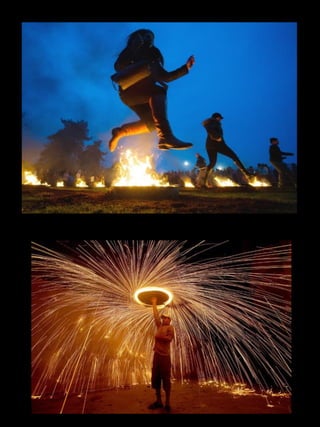
Nowruz is the day of the
astronomical vernal equinox (or
northward equinox), which marks
the beginning of the spring in the
northern hemisphere and usually
occurs on March 21 or the
previous/following day depending
on where it is observed. The
moment the sun crosses the
celestial equator and equalizes
night and day is calculated exactly
every year and families gather
together to observe the rituals.
Although having Persian and
religious Zoroastrian origins,
Nowruz has been celebrated by
people from diverse ethnic
communities and religious
backgrounds for thousands of
years. It is a secular holiday for
most celebrants that is enjoyed by
people of several different faiths,
but remains a holy day for
Zoroastrians.
Origin
Nowruz is partly rooted in the
religious tradition of Iranian
religions such as Zoroastrianism or
even older in tradition of Mitraism
because in Mitraism festivals had a
deep linkage with the sun light. The
Persian festivals of Yalda (longest
night) and Mehregan (autumnal
equinox) and Tiregān (longest day)
also had an origin in the Sun god
(Surya). Among other ideas,
Zoroastrianism is the first
monotheistic religion that
emphasizes broad concepts such as
the corresponding work of good
and evil in the world, and the
connection of humans to nature.
Zoroastrian practices were
dominant for much of the history of
ancient Persia (modern day Iran &
Western Afghanistan
1
Nowruz is believed to have been
invented by Zoroaster himself in
Balkh (modern-day Afghanistan),
although there is no clear date of
origin. Since the Achaemenid era
the official year has begun with the
New Day when the Sun leaves the
zodiac of Pisces and enters the
zodiacal sign of Aries, signifying the
Spring Equinox. Nowruz is also a
holy day for Sufi Muslims,
Bektashis, Ismailis, Alawites,Alevis,
Babis and adherents of the Bahá'í
Faith.
The term Nowruz in writing first
appeared in historical Persian
records in the 2nd century CE, but
it was also an important day during
the time of the Achaemenids (c.
550–330 BCE), where kings from
different nations under the Persian
Empire used to bring gifts to the
Emperor, also called King of Kings
(Shahanshah), of Persia on Nowruz.
The significance of Nowruz in the
Achaemenid Empire was such that
the great Persian king
Cambyses II's appointment as the
king of Babylon was legitimized
only after his participation in the
New Year festival
History and tradition
The celebration has its roots in
Ancient Iran. Due to its antiquity,
there exist various foundation
myths for Nowruz in Iranian
mythology. In the Zoroastrian
tradition, the seven most important
Zoroastrian festivals are the
Gahambars and Nowruz, which
occurs at the spring equinox.
According to Mary Boyce,
“It seems a reasonable surmise that
Nowruz, the holiest of them all,
with deep doctrinal significance,
was founded by Zoroaster
himself.Between sunset on the day
of the 6th Gahanbar and sunrise of
Nowruz, Hamaspathmaedaya (later
known, in its extended form, as
Frawardinegan) was celebrated.
This and the Gahanbar are the only
festivals named in the surviving text
of the Avesta.
The Shahnameh dates Nowruz as
far back to the reign of Jamshid,
who in Zoroastrian texts saved
mankind from a killer winter that
was destined to kill every living
creature. The mythical Persian King
Jamshid (Yima or Yama of the Indo-
Iranian lore) perhaps symbolizes
the transition of the Indo-Iranians
from animal hunting to animal
husbandry and a more settled life
in human history
In the Shahnameh and Iranian
mythology, he is credited with the
foundation of Nowruz. In the
Shahnama, Jamshid constructed a
throne studded with gems. He had
demons raise him above the earth
into the heavens; there he sat on
his throne like the sun shining in
the sky. The world's creatures
gathered in wonder about him
and scattered jewels around him,
and called this day the New Day or
No/Now-Ruz.
This was the first day of the month
of Farvardin (the first month of the
Persian calendar).
The Persian scholar Abu Rayhan
Biruni of the 10th century CE,
in his Persian work
"Kitab al-Tafhim li Awa'il Sina'at al-
Tanjim" provides a description of
the calendar of various nations.
Besides
the Persian calendar, various
festivals of Arabs, Jews, Sabians,
Greeks and other nations are
mentioned in this book. In the
section on the Persian calendar ,
he mentions Nowruz, Sadeh,
Tiregan, Mehregan, the six
Gahanbar, Parvardegaan,
Bahmanja, Isfandarmazh and
several other festivals.
According to him: It is the belief of
the Persians that Nowruz marks the
first day when the universe started
its motion.The Persian historian
Abu Saʿīd Gardēzī in his work titled
Zayn al-Akhbār under the section of
the Zoroastrians festivals mentions
Nowruz (among other festivals) and
specifically points out that
Zoroaster highly emphasized the
celebration of Nowruz and
Mehregan.
History
Nowruz in Persia
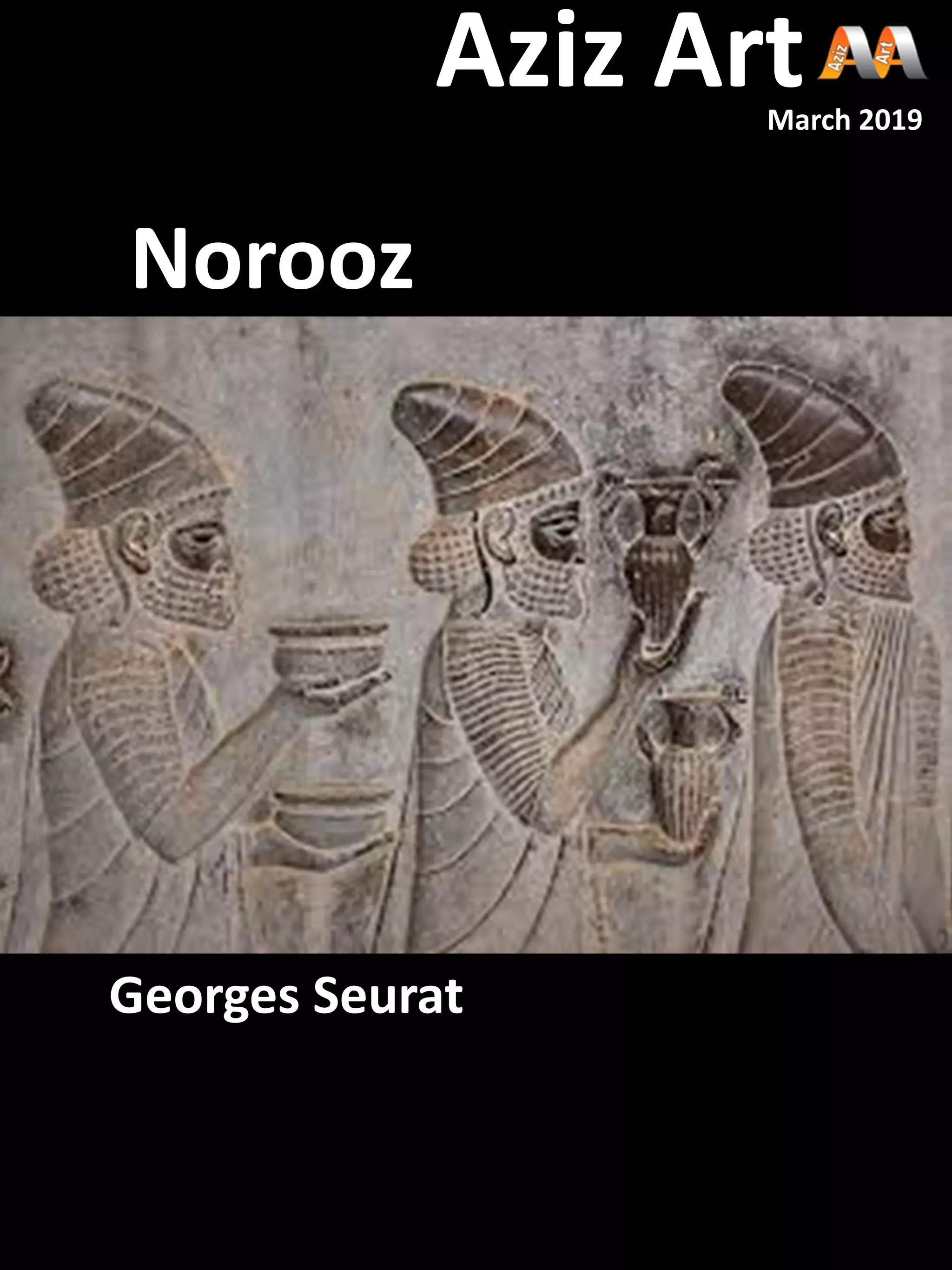
Persepolis all nations staircase.
Notice the people from across the
Achaemenid Persian Empire
bringing gifts. Some scholars have
associated the occasion to be
either Mehregan or Nowruz.
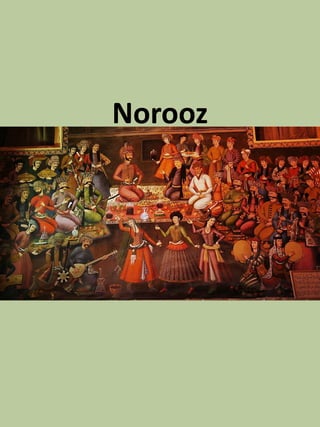
Shah Tahmasp I and Humayun
celebrating Nowvruz festival, 16th
century, Isfahan, Persia
Although it is not clear whether
proto-Indo-Iranians celebrated a
feast as the first day of the
calendar, there are indications that
both Iranians and Indians may have
observed the beginning of both
autumn and spring, related to the
harvest and the sowing of seeds,
respectively, for the celebration of
new year.
Boyce and Grenet explain the
traditions for seasonal festivals
and comment: "It is possible that
the splendor of the Babylonian
festivities at this season led the
Persians to develop their own
spring festival into an established
new year feast, with the name
Navasarda 'New Year' (a name
which, though first attested
through Middle Persian
derivatives, is attributed to the
Achaemenian period). Since the
communal observations of the
ancient Iranians appear in general
to have been a seasonal ones, and
related to agriculture, it is
probable, that they traditionally
held festivals in both autumn and
spring, to mark the major turning
points of the natural year".
We have reasons to believe that
the celebration is much older than
that date and was surely
celebrated by the people and
royalty during the Achaemenid
times (555–330 BC). It was,
therefore, a highly auspicious
occasion for the ancient Iranian
peoples. It has been suggested
that the famous Persepolis
complex, or at least the palace of
Apadana and the Hundred Columns
Hall,
were built for the specific purpose
of celebrating Nowruz. Although
there may be no mention of
Nowruz in recorded Achaemenid
inscriptions (see picture),there is a
detailed account by Xenophon of a
Nowruz celebration taking place in
Persepolis and the continuity of this
festival in the Achaemenid
tradition.in 539 BC the Jews came
under Persian rule thus exposing
both groups to each other's
customs. According to
Encyclopædia Britannica, the story
of Purim as told in the Book of
Esther is adapted from a Persian
novella about the shrewdness of
harem queens suggesting that
Purim may be a transformation of
the Persian New Year. A specific
novella is not identified and
Encyclopædia Britannica itself
notes that "no Jewish texts of this
genre from the Persian period are
extant, so these new elements can
be recognized only inferentially".
The Encyclopaedia of Religion and
Ethics notes that the Purim holiday
is based on a lunar calendar while
Nowruz occurs at the spring
equinox (solar calendar).
The two holidays are therefore
celebrated on different dates but
within a few weeks of each other,
depending on the year. Both
holidays are joyous celebrations.
Given their temporal associations,
it is possible that the Jews and
Persians of the time may have
shared or adopted similar customs
for these holidays. The story of
Purim as told in the Book of Esther
has been dated anywhere from
625–465 BC (although the story
takes place with the Jews under
the rule of the Achaemenid
Empire and the Jews had come
under Persian rule in 539 BC),
while Nowruz is thought to have
first been celebrated between
555–330 BC. It remains unclear
which holiday was established
first.
Nowruz was the holiday of
Arsacid/Parthian dynastic Empires
who ruled Iran (248 BC-224 CE)
and the other areas ruled by the
Arsacid dynasties outside Parthia
(such as the Arsacid dynasty of
Armenia and Iberia). There are
specific references to the
celebration of Nowruz during the
reign of Vologases I (51–78 CE), but
these include no details.Before
Sassanids established their power
in West Asia around 300 CE,
Parthians celebrated Nowruz in
Autumn and 1st of Farvardin began
at the Autumn Equinox. During
Parthian dynasty the Spring Festival
was Mehragan, a Zoroastrian and
Iranian festival celebrated in honor
of Mithra.
Extensive records on the
celebration of Nowruz appear
following the accession of Ardashir
I of Persia, the founder of the
Sassanid dynasty (224–651 CE).
Under the Sassanid Emperors,
Nowruz was celebrated as the most
important day of the year. Most
royal traditions of Nowruz such as
royal audiences with the public,
cash gifts, and the pardoning of
prisoners, were established during
the Sassanian era and persisted
unchanged until modern times.
Nowruz, along with Sadeh
(celebrated in mid-winter), survived
in society following the
introduction of Islam in 650 CE.
Other celebrations such Gahanbar
and Mehragan were eventually
side-lined or were only followed by
the Zoroastrians, who carried them.
It was adopted as the main royal
holiday during the Abbasid period.
In the book Nowruznama
("Book of the New Year", which is
attributed to Omar Khayyam,
a well known Persian poet and
mathematician),
a vivid description of the
celebration in the courts of the
Kings of Persia is provided:
“From the era of Kai Khusraw till
the days of Yazdegard, last of the
pre-Islamic kings of Persia, the
royal custom was thus: on the
first day of the New Year,
Now Ruz, the King's first visitor
was the High Mobad of the
Zoroastrians, who brought with
him as gifts a golden goblet full of
wine, a ring, some gold coins, a
fistful of green sprigs of wheat, a
sword, and a bow. In the language
of Persia he would then glorify God
and praise the monarch. This was
the address of the High Mobad to
the king : "O Majesty, on this feast
of the Equinox, first day of the first
month of the year, seeing that thou
hast freely chosen God and the
Faith of the Ancient ones; may
Surush, the Angel-messenger,
grant thee wisdom and insight
and sagacity in thy affairs.
Live long in praise, be happy and
fortunate upon thy golden throne,
drink immortality from the Cup of
Jamshid; and keep in solemn trust
the customs of our ancestors, their
noble aspirations, fair gestures and
the exercise of justice and
righteousness. May thy soul
flourish; may thy youth be as the
new-grown grain; may thy horse be
puissant, victorious; thy sword
bright and deadly against foes; thy
hawk swift against its prey; thy
every act straight as the arrow's
shaft. Go forth from thy rich
throne, conquer new lands. Honor
the craftsman and the sage in equal
degree; disdain the acquisition of
wealth. May thy house prosper and
thy life be long!"
Following the demise of the
Caliphate and the subsequent re-
emergence of Persian dynasties
such as the Samanids and Buyids,
Nowruz was elevated to an even
more important event. The Buyids
revived the ancient traditions of
Sassanian times and restored many
smaller celebrations that had been
eliminated by the Caliphate.
According to the Syrian historian
Yaqut al-Hamawi, the Iranian Buyid
ruler ʿAżod-od-Dawla (r. 949-83)
customarily welcomed Nowruz in a
majestic hall,
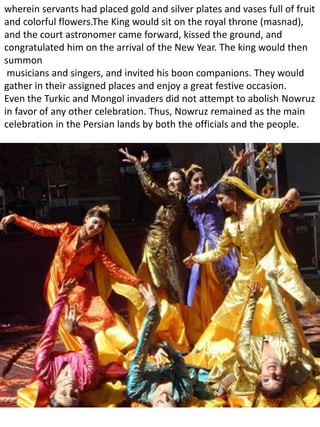
wherein servants had placed gold and silver plates and vases full of fruit
and colorful flowers.The King would sit on the royal throne (masnad),
and the court astronomer came forward, kissed the ground, and
congratulated him on the arrival of the New Year. The king would then
summon
musicians and singers, and invited his boon companions. They would
gather in their assigned places and enjoy a great festive occasion.
Even the Turkic and Mongol invaders did not attempt to abolish Nowruz
in favor of any other celebration. Thus, Nowruz remained as the main
celebration in the Persian lands by both the officials and the people.
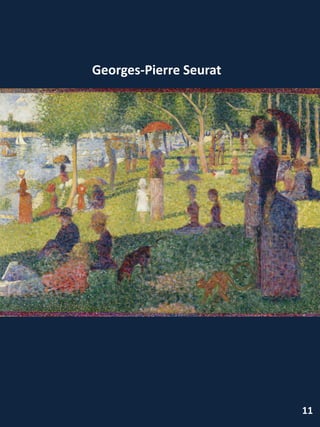
Georges-Pierre Seurat
11
Georges-Pierre Seurat
2 December 1859 – 29 March 1891
was a French post-Impressionist
artist. He is best known for
devising the painting techniques
known as chromoluminarism and
pointillism. While less famous
than his paintings, his
conté crayon drawings have also
garnered a great deal of critical
appreciation. Seurat's artistic
personality was compounded of
qualities which are usually
supposed to be opposed and
incompatible: on the one hand,
his extreme and delicate
sensibility; on the other, a passion
for logical abstraction and an
almost mathematical precision of
mind. His large-scale work, A
Sunday Afternoon on the Island of
La Grande Jatte (1884–1886),
altered the direction of modern
art by initiating
Neo-impressionism, and is one of
the icons of late 19th-century
painting.
Family and education
Seurat was born on the 2
December 1859 in Paris, at 60 rue
de Bondy. The Seurat family
moved to 136 boulevard de
Magenta in 1862 or 1863. His
father, Antoine Chrysostome
Seurat, originally from Champagne,
was a former legal official who had
become wealthy from speculating
in property, and his mother,
Ernestine Faivre, was from
Paris.Georges had a brother, Émile
Augustin, and a sister, Marie-
Berthe, both older. His father lived
in Le Raincy and visited his wife and
children once a week at boulevard
de Magenta.
Georges Seurat first studied art at
the École Municipale de Sculpture
et Dessin, near his family's home in
the boulevard Magenta, which was
run by the sculptor Justin
Lequien.In 1878 he moved on to
the École des Beaux-Arts where he
was taught by Henri Lehmann, and
followed a conventional academic
training, drawing from casts of
antique sculpture and copying
drawings by old masters.Seurat's
studies resulted in a well-
considered and fertile theory of
contrasts: a theory to which all his
work was thereafter subjected.His
formal artistic education came to
an end in November 1879, when he
left the École des Beaux-Arts for a
year of military service.
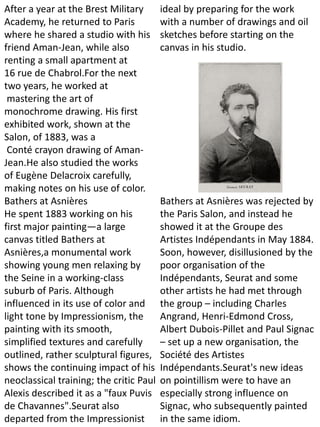
After a year at the Brest Military
Academy, he returned to Paris
where he shared a studio with his
friend Aman-Jean, while also
renting a small apartment at
16 rue de Chabrol.For the next
two years, he worked at
mastering the art of
monochrome drawing. His first
exhibited work, shown at the
Salon, of 1883, was a
Conté crayon drawing of Aman-
Jean.He also studied the works
of Eugène Delacroix carefully,
making notes on his use of color.
Bathers at Asnières
He spent 1883 working on his
first major painting—a large
canvas titled Bathers at
Asnières,a monumental work
showing young men relaxing by
the Seine in a working-class
suburb of Paris. Although
influenced in its use of color and
light tone by Impressionism, the
painting with its smooth,
simplified textures and carefully
outlined, rather sculptural figures,
shows the continuing impact of his
neoclassical training; the critic Paul
Alexis described it as a "faux Puvis
de Chavannes".Seurat also
departed from the Impressionist
ideal by preparing for the work
with a number of drawings and oil
sketches before starting on the
canvas in his studio.
Bathers at Asnières was rejected by
the Paris Salon, and instead he
showed it at the Groupe des
Artistes Indépendants in May 1884.
Soon, however, disillusioned by the
poor organisation of the
Indépendants, Seurat and some
other artists he had met through
the group – including Charles
Angrand, Henri-Edmond Cross,
Albert Dubois-Pillet and Paul Signac
– set up a new organisation, the
Société des Artistes
Indépendants.Seurat's new ideas
on pointillism were to have an
especially strong influence on
Signac, who subsequently painted
in the same idiom.
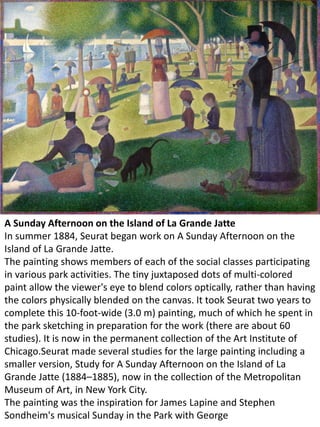
A Sunday Afternoon on the Island of La Grande Jatte
In summer 1884, Seurat began work on A Sunday Afternoon on the
Island of La Grande Jatte.
The painting shows members of each of the social classes participating
in various park activities. The tiny juxtaposed dots of multi-colored
paint allow the viewer's eye to blend colors optically, rather than having
the colors physically blended on the canvas. It took Seurat two years to
complete this 10-foot-wide (3.0 m) painting, much of which he spent in
the park sketching in preparation for the work (there are about 60
studies). It is now in the permanent collection of the Art Institute of
Chicago.Seurat made several studies for the large painting including a
smaller version, Study for A Sunday Afternoon on the Island of La
Grande Jatte (1884–1885), now in the collection of the Metropolitan
Museum of Art, in New York City.
The painting was the inspiration for James Lapine and Stephen
Sondheim's musical Sunday in the Park with George
Later career
Seurat concealed his relationship
with Madeleine Knobloch (or
Madeleine Knoblock, 1868–1903),
an artist's model whom he
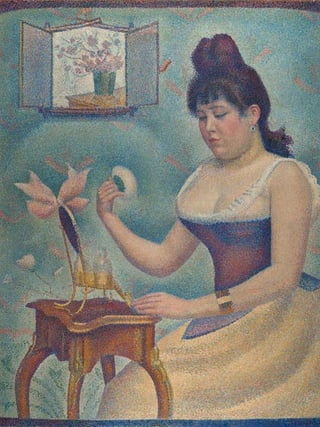
portrayed in his painting Jeune
femme se poudrant. In 1889 she
moved in with Seurat in his studio
on the seventh floor of 128 bis
Boulevard de Clichy.
When Madeleine became
pregnant, the couple moved to a
studio at 39 passage de l'Élysée-
des-Beaux-Arts (now rue André
Antoine). There she gave birth to
their son, who was named Pierre-
Georges, 16 February 1890.
Seurat spent the summer of 1890
on the coast at Gravelines, where
he painted four canvases including
The Channel of Gravelines, Petit
Fort Philippe, as well as eight oil
panels, and made a few drawings.
Death
Seurat died in Paris in his parents'
home on 29 March 1891 at the age
of 31.The cause of his death is
uncertain, and has been variously
attributed to a form of meningitis,
pneumonia, infectious angina, and
diphtheria. His son died two weeks
later from the same disease. His
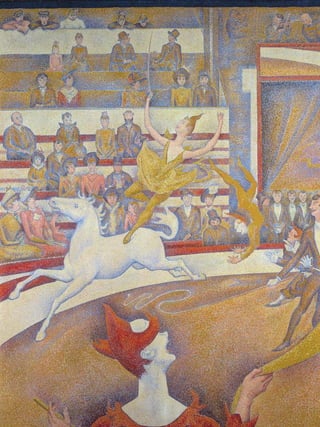
last ambitious work, The Circus,
was left unfinished at the time of
his death.
30 March 1891 a commemorative
service was held in the church of
Saint-Vincent-de-Paul.Seurat was
interred 31 March 1891 at
Cimetière du Père-Lachaise.
At the time of Seurat's death,
Madeleine was pregnant with a
second child who died during or
shortly after birth.
Contemporary ideas
During the 19th century, scientist-
writers such as Michel Eugène
Chevreul, Ogden Rood and David
Sutter wrote treatises on color,
optical effects and perception. They
adapted the scientific research of
Hermann von Helmholtz and Isaac
Newton into a form accessible to
laypeople.Artists followed new
discoveries in perception with great
interest.
Chevreul was perhaps the most
important influence on artists at
the time
his great contribution was
producing a color wheel of
primary and intermediary hues.
Chevreul was a French chemist
who restored tapestries.
During his restorations he noticed
that the only way to restore a
section properly was to take into
account the influence of the
colors around the missing wool;
he could not produce the right
hue unless he recognized the
surrounding dyes. Chevreul
discovered that two colors
juxtaposed, slightly overlapping or
very close together, would have
the effect of another color when
seen from a distance.
The discovery of this phenomenon
became the
basis for the pointillist technique
of the Neoimpressionist painters.
Chevreul also realized that the
"halo" that one sees after looking
at a color is the opposing color
(also known as complementary
color). For example: After looking
at a red object, one may see a
cyan echo/halo of the original
object. This complementary color
(as an example, cyan for red) is
due to retinal persistence.
Neoimpressionist painters
interested in the interplay of colors
made extensive use of
complementary colors in their
paintings. In his works, Chevreul
advised artists to think and paint
not just the color of the central
object, but to add colors and make
appropriate adjustments to achieve
a harmony among colors. It seems
that the harmony Chevreul wrote
about is what Seurat came to call
"emotion".
It is not clear whether Seurat read
all of Chevreul's book on color
contrast, published in 1859, but he
did copy out several paragraphs
from the chapter on painting, and
he had read Charles Blanc's
Grammaire des arts du dessin
(1867),which cites Chevreul's work.
Blanc's book was directed at artists
and art connoisseurs. Because of
color's emotional significance to
him, he made explicit
recommendations that were close
to the theories later adopted by the
Neoimpressionists. He said that
color should not be based on the
"judgment of taste", but rather it
should be close to what we
experience in reality.
Blanc did not want artists to use
equal intensities of color, but to
consciously plan and understand
the role of each hue in creating a
whole.
While Chevreul based his
theories on Newton's thoughts
on the mixing of light,
Ogden Rood based his writings on
the work of Helmholtz.
He analyzed the effects of mixing
and juxtaposing material
pigments. Rood valued as
primary colors red, green,
and blue-violet. Like Chevreul, he
said that if two colors are placed
next to each other, from a
distance they look like a third
distinctive color. He also pointed
out that the juxtaposition of
primary hues next to each other
would create a far more intense
and pleasing color, when
perceived by the eye and mind,
than the corresponding color
made simply by mixing paint.
Rood advised artists to be
aware of the difference between
additive and subtractive qualities
of color,
since material pigments and
optical pigments (light) do not mix
in the same way:
Material pigments: Red + Yellow +
Blue = Black
Optical / Light : Red + Green + Blue
= White
Seurat was also influenced by
Sutter's Phenomena of Vision
(1880), in which he wrote that "the
laws of harmony can be learned as
one learns the laws of harmony and
music".[23] He heard lectures in
the 1880s by the mathematician
Charles Henry at the Sorbonne,
who discussed the emotional
properties and symbolic meaning of
lines and color. There remains
controversy over the extent to
which Henry's ideas were adopted
by Seurat.
The language of color
Seurat took to heart the color
theorists' notion of a scientific
approach to painting. He believed
that a painter could use color to
create harmony and emotion in art
in the same way that a musician
uses counterpoint and variation to
create harmony in music. He
theorized that the scientific
application of color was like any
other natural law,
And he was driven to prove this
conjecture. He thought that the
knowledge of perception and
optical laws could be used to
create a new language of art
based on its own set of heuristics
and he set out to show this
language using lines, color
intensity and
color schema. Seurat called this
language Chromoluminarism.
In a letter to the writer Maurice
Beaubourg in 1890 he wrote:
"Art is Harmony. Harmony is the
analogy of the contrary and of
similar elements of tone, of
colour and of line. In tone, lighter
against darker. In colour, the
complementary, red-green,
orange-blue, yellow-violet. In line,
those that form a right-angle. The
frame is in a harmony that
opposes those of the tones,
colours and lines of the picture,
these aspects are considered
according to their dominance and
under the influence of light,
in gay, calm or sad combinations".
Seurat's theories can be
summarized as follows: The
emotion of gaiety can be achieved
by the domination of luminous
hues, by the predominance of
warm colors, and by the use of lines
directed upward. Calm is achieved
through an equivalence/balance of
the use of the light and the dark, by
the balance of warm and cold
colors, and by lines that are
horizontal. Sadness is achieved by
using dark and cold colors and by
lines pointing downward
Influence
Where the dialectic nature of Paul
Cézanne's work had been greatly
influential during the highly
expressionistic phase of proto-
Cubism, between 1908 and 1910,
the work of Seurat, with its flatter,
more linear structures, would
capture the attention of the Cubists
from 1911.Seurat in his few years of
activity, was able, with his
observations on irradiation and the
effects of contrast, to create afresh
without any guiding tradition, to
complete an esthetic system with a
new technical method perfectly
adapted to its expression.
"With the advent of monochromatic Cubism in 1910–1911," writes art
historian Robert Herbert, "questions of form displaced color in the
artists' attention, and for these Seurat was more relevant. Thanks to
several exhibitions, his paintings and drawings were easily seen in Paris,
and reproductions of his major compositions circulated widely among
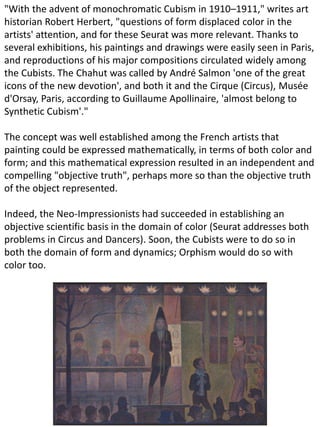
the Cubists. The Chahut was called by André Salmon 'one of the great
icons of the new devotion', and both it and the Cirque (Circus), Musée
d'Orsay, Paris, according to Guillaume Apollinaire, 'almost belong to
Synthetic Cubism'."
The concept was well established among the French artists that
painting could be expressed mathematically, in terms of both color and
form; and this mathematical expression resulted in an independent and
compelling "objective truth", perhaps more so than the objective truth
of the object represented.
Indeed, the Neo-Impressionists had succeeded in establishing an
objective scientific basis in the domain of color (Seurat addresses both
problems in Circus and Dancers). Soon, the Cubists were to do so in
both the domain of form and dynamics; Orphism would do so with
color too.
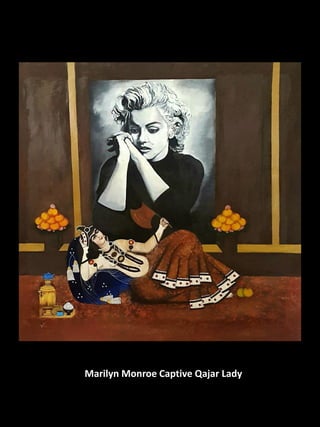
Marilyn Monroe Captive Qajar Lady
Aziz art march 2019

Aziz art march 2019

  • 1.
  • 2.
    1-Norooz 11-Georges-Pierre Seurat Director: AzizAnzabi Editor : Nafiseh Yaghoubi Translator : Asra Yaghoubi Research: Zohreh Nazari http://www.aziz-anzabi.com
  • 3.
  • 4.
    Norooz ( "New Day")is the name of the Iranian New Year, also known as the Persian and Kurdish New Year, is celebrated by Iranian peoples worldwide as the beginning of the new year. It has been celebrated for over 3,000 years in the Balkans, the Black Sea Basin, the Caucasus, Central Asia, and the Middle East.It marks the first day of the month of Farvardin in the Iranian calendar. Nowruz is the day of the astronomical vernal equinox (or northward equinox), which marks the beginning of the spring in the northern hemisphere and usually occurs on March 21 or the previous/following day depending on where it is observed. The moment the sun crosses the celestial equator and equalizes night and day is calculated exactly every year and families gather together to observe the rituals. Although having Persian and religious Zoroastrian origins, Nowruz has been celebrated by people from diverse ethnic communities and religious backgrounds for thousands of years. It is a secular holiday for most celebrants that is enjoyed by people of several different faiths, but remains a holy day for Zoroastrians. Origin Nowruz is partly rooted in the religious tradition of Iranian religions such as Zoroastrianism or even older in tradition of Mitraism because in Mitraism festivals had a deep linkage with the sun light. The Persian festivals of Yalda (longest night) and Mehregan (autumnal equinox) and Tiregān (longest day) also had an origin in the Sun god (Surya). Among other ideas, Zoroastrianism is the first monotheistic religion that emphasizes broad concepts such as the corresponding work of good and evil in the world, and the connection of humans to nature. Zoroastrian practices were dominant for much of the history of ancient Persia (modern day Iran & Western Afghanistan 1
  • 5.
    Nowruz is believedto have been invented by Zoroaster himself in Balkh (modern-day Afghanistan), although there is no clear date of origin. Since the Achaemenid era the official year has begun with the New Day when the Sun leaves the zodiac of Pisces and enters the zodiacal sign of Aries, signifying the Spring Equinox. Nowruz is also a holy day for Sufi Muslims, Bektashis, Ismailis, Alawites,Alevis, Babis and adherents of the Bahá'í Faith. The term Nowruz in writing first appeared in historical Persian records in the 2nd century CE, but it was also an important day during the time of the Achaemenids (c. 550–330 BCE), where kings from different nations under the Persian Empire used to bring gifts to the Emperor, also called King of Kings (Shahanshah), of Persia on Nowruz. The significance of Nowruz in the Achaemenid Empire was such that the great Persian king Cambyses II's appointment as the king of Babylon was legitimized only after his participation in the New Year festival History and tradition The celebration has its roots in Ancient Iran. Due to its antiquity, there exist various foundation myths for Nowruz in Iranian mythology. In the Zoroastrian tradition, the seven most important Zoroastrian festivals are the Gahambars and Nowruz, which occurs at the spring equinox. According to Mary Boyce, “It seems a reasonable surmise that Nowruz, the holiest of them all, with deep doctrinal significance, was founded by Zoroaster himself.Between sunset on the day of the 6th Gahanbar and sunrise of Nowruz, Hamaspathmaedaya (later known, in its extended form, as Frawardinegan) was celebrated. This and the Gahanbar are the only festivals named in the surviving text of the Avesta. The Shahnameh dates Nowruz as far back to the reign of Jamshid, who in Zoroastrian texts saved mankind from a killer winter that was destined to kill every living creature. The mythical Persian King Jamshid (Yima or Yama of the Indo- Iranian lore) perhaps symbolizes the transition of the Indo-Iranians from animal hunting to animal husbandry and a more settled life in human history
  • 7.
    In the Shahnamehand Iranian mythology, he is credited with the foundation of Nowruz. In the Shahnama, Jamshid constructed a throne studded with gems. He had demons raise him above the earth into the heavens; there he sat on his throne like the sun shining in the sky. The world's creatures gathered in wonder about him and scattered jewels around him, and called this day the New Day or No/Now-Ruz. This was the first day of the month of Farvardin (the first month of the Persian calendar). The Persian scholar Abu Rayhan Biruni of the 10th century CE, in his Persian work "Kitab al-Tafhim li Awa'il Sina'at al- Tanjim" provides a description of the calendar of various nations. Besides the Persian calendar, various festivals of Arabs, Jews, Sabians, Greeks and other nations are mentioned in this book. In the section on the Persian calendar , he mentions Nowruz, Sadeh, Tiregan, Mehregan, the six Gahanbar, Parvardegaan, Bahmanja, Isfandarmazh and several other festivals. According to him: It is the belief of the Persians that Nowruz marks the first day when the universe started its motion.The Persian historian Abu Saʿīd Gardēzī in his work titled Zayn al-Akhbār under the section of the Zoroastrians festivals mentions Nowruz (among other festivals) and specifically points out that Zoroaster highly emphasized the celebration of Nowruz and Mehregan. History Nowruz in Persia Persepolis all nations staircase. Notice the people from across the Achaemenid Persian Empire bringing gifts. Some scholars have associated the occasion to be either Mehregan or Nowruz. Shah Tahmasp I and Humayun celebrating Nowvruz festival, 16th century, Isfahan, Persia Although it is not clear whether proto-Indo-Iranians celebrated a feast as the first day of the calendar, there are indications that both Iranians and Indians may have observed the beginning of both autumn and spring, related to the harvest and the sowing of seeds, respectively, for the celebration of new year.
  • 9.
    Boyce and Grenetexplain the traditions for seasonal festivals and comment: "It is possible that the splendor of the Babylonian festivities at this season led the Persians to develop their own spring festival into an established new year feast, with the name Navasarda 'New Year' (a name which, though first attested through Middle Persian derivatives, is attributed to the Achaemenian period). Since the communal observations of the ancient Iranians appear in general to have been a seasonal ones, and related to agriculture, it is probable, that they traditionally held festivals in both autumn and spring, to mark the major turning points of the natural year". We have reasons to believe that the celebration is much older than that date and was surely celebrated by the people and royalty during the Achaemenid times (555–330 BC). It was, therefore, a highly auspicious occasion for the ancient Iranian peoples. It has been suggested that the famous Persepolis complex, or at least the palace of Apadana and the Hundred Columns Hall, were built for the specific purpose of celebrating Nowruz. Although there may be no mention of Nowruz in recorded Achaemenid inscriptions (see picture),there is a detailed account by Xenophon of a Nowruz celebration taking place in Persepolis and the continuity of this festival in the Achaemenid tradition.in 539 BC the Jews came under Persian rule thus exposing both groups to each other's customs. According to Encyclopædia Britannica, the story of Purim as told in the Book of Esther is adapted from a Persian novella about the shrewdness of harem queens suggesting that Purim may be a transformation of the Persian New Year. A specific novella is not identified and Encyclopædia Britannica itself notes that "no Jewish texts of this genre from the Persian period are extant, so these new elements can be recognized only inferentially". The Encyclopaedia of Religion and Ethics notes that the Purim holiday is based on a lunar calendar while Nowruz occurs at the spring equinox (solar calendar).
  • 11.
    The two holidaysare therefore celebrated on different dates but within a few weeks of each other, depending on the year. Both holidays are joyous celebrations. Given their temporal associations, it is possible that the Jews and Persians of the time may have shared or adopted similar customs for these holidays. The story of Purim as told in the Book of Esther has been dated anywhere from 625–465 BC (although the story takes place with the Jews under the rule of the Achaemenid Empire and the Jews had come under Persian rule in 539 BC), while Nowruz is thought to have first been celebrated between 555–330 BC. It remains unclear which holiday was established first. Nowruz was the holiday of Arsacid/Parthian dynastic Empires who ruled Iran (248 BC-224 CE) and the other areas ruled by the Arsacid dynasties outside Parthia (such as the Arsacid dynasty of Armenia and Iberia). There are specific references to the celebration of Nowruz during the reign of Vologases I (51–78 CE), but these include no details.Before Sassanids established their power in West Asia around 300 CE, Parthians celebrated Nowruz in Autumn and 1st of Farvardin began at the Autumn Equinox. During Parthian dynasty the Spring Festival was Mehragan, a Zoroastrian and Iranian festival celebrated in honor of Mithra. Extensive records on the celebration of Nowruz appear following the accession of Ardashir I of Persia, the founder of the Sassanid dynasty (224–651 CE). Under the Sassanid Emperors, Nowruz was celebrated as the most important day of the year. Most royal traditions of Nowruz such as royal audiences with the public, cash gifts, and the pardoning of prisoners, were established during the Sassanian era and persisted unchanged until modern times. Nowruz, along with Sadeh (celebrated in mid-winter), survived in society following the introduction of Islam in 650 CE. Other celebrations such Gahanbar and Mehragan were eventually side-lined or were only followed by the Zoroastrians, who carried them. It was adopted as the main royal holiday during the Abbasid period.
  • 12.
    In the bookNowruznama ("Book of the New Year", which is attributed to Omar Khayyam, a well known Persian poet and mathematician), a vivid description of the celebration in the courts of the Kings of Persia is provided: “From the era of Kai Khusraw till the days of Yazdegard, last of the pre-Islamic kings of Persia, the royal custom was thus: on the first day of the New Year, Now Ruz, the King's first visitor was the High Mobad of the Zoroastrians, who brought with him as gifts a golden goblet full of wine, a ring, some gold coins, a fistful of green sprigs of wheat, a sword, and a bow. In the language of Persia he would then glorify God and praise the monarch. This was the address of the High Mobad to the king : "O Majesty, on this feast of the Equinox, first day of the first month of the year, seeing that thou hast freely chosen God and the Faith of the Ancient ones; may Surush, the Angel-messenger, grant thee wisdom and insight and sagacity in thy affairs. Live long in praise, be happy and fortunate upon thy golden throne, drink immortality from the Cup of Jamshid; and keep in solemn trust the customs of our ancestors, their noble aspirations, fair gestures and the exercise of justice and righteousness. May thy soul flourish; may thy youth be as the new-grown grain; may thy horse be puissant, victorious; thy sword bright and deadly against foes; thy hawk swift against its prey; thy every act straight as the arrow's shaft. Go forth from thy rich throne, conquer new lands. Honor the craftsman and the sage in equal degree; disdain the acquisition of wealth. May thy house prosper and thy life be long!" Following the demise of the Caliphate and the subsequent re- emergence of Persian dynasties such as the Samanids and Buyids, Nowruz was elevated to an even more important event. The Buyids revived the ancient traditions of Sassanian times and restored many smaller celebrations that had been eliminated by the Caliphate. According to the Syrian historian Yaqut al-Hamawi, the Iranian Buyid ruler ʿAżod-od-Dawla (r. 949-83) customarily welcomed Nowruz in a majestic hall,
  • 13.
    wherein servants hadplaced gold and silver plates and vases full of fruit and colorful flowers.The King would sit on the royal throne (masnad), and the court astronomer came forward, kissed the ground, and congratulated him on the arrival of the New Year. The king would then summon musicians and singers, and invited his boon companions. They would gather in their assigned places and enjoy a great festive occasion. Even the Turkic and Mongol invaders did not attempt to abolish Nowruz in favor of any other celebration. Thus, Nowruz remained as the main celebration in the Persian lands by both the officials and the people.
  • 14.
  • 15.
    Georges-Pierre Seurat 2 December1859 – 29 March 1891 was a French post-Impressionist artist. He is best known for devising the painting techniques known as chromoluminarism and pointillism. While less famous than his paintings, his conté crayon drawings have also garnered a great deal of critical appreciation. Seurat's artistic personality was compounded of qualities which are usually supposed to be opposed and incompatible: on the one hand, his extreme and delicate sensibility; on the other, a passion for logical abstraction and an almost mathematical precision of mind. His large-scale work, A Sunday Afternoon on the Island of La Grande Jatte (1884–1886), altered the direction of modern art by initiating Neo-impressionism, and is one of the icons of late 19th-century painting. Family and education Seurat was born on the 2 December 1859 in Paris, at 60 rue de Bondy. The Seurat family moved to 136 boulevard de Magenta in 1862 or 1863. His father, Antoine Chrysostome Seurat, originally from Champagne, was a former legal official who had become wealthy from speculating in property, and his mother, Ernestine Faivre, was from Paris.Georges had a brother, Émile Augustin, and a sister, Marie- Berthe, both older. His father lived in Le Raincy and visited his wife and children once a week at boulevard de Magenta. Georges Seurat first studied art at the École Municipale de Sculpture et Dessin, near his family's home in the boulevard Magenta, which was run by the sculptor Justin Lequien.In 1878 he moved on to the École des Beaux-Arts where he was taught by Henri Lehmann, and followed a conventional academic training, drawing from casts of antique sculpture and copying drawings by old masters.Seurat's studies resulted in a well- considered and fertile theory of contrasts: a theory to which all his work was thereafter subjected.His formal artistic education came to an end in November 1879, when he left the École des Beaux-Arts for a year of military service.
  • 16.
    After a yearat the Brest Military Academy, he returned to Paris where he shared a studio with his friend Aman-Jean, while also renting a small apartment at 16 rue de Chabrol.For the next two years, he worked at mastering the art of monochrome drawing. His first exhibited work, shown at the Salon, of 1883, was a Conté crayon drawing of Aman- Jean.He also studied the works of Eugène Delacroix carefully, making notes on his use of color. Bathers at Asnières He spent 1883 working on his first major painting—a large canvas titled Bathers at Asnières,a monumental work showing young men relaxing by the Seine in a working-class suburb of Paris. Although influenced in its use of color and light tone by Impressionism, the painting with its smooth, simplified textures and carefully outlined, rather sculptural figures, shows the continuing impact of his neoclassical training; the critic Paul Alexis described it as a "faux Puvis de Chavannes".Seurat also departed from the Impressionist ideal by preparing for the work with a number of drawings and oil sketches before starting on the canvas in his studio. Bathers at Asnières was rejected by the Paris Salon, and instead he showed it at the Groupe des Artistes Indépendants in May 1884. Soon, however, disillusioned by the poor organisation of the Indépendants, Seurat and some other artists he had met through the group – including Charles Angrand, Henri-Edmond Cross, Albert Dubois-Pillet and Paul Signac – set up a new organisation, the Société des Artistes Indépendants.Seurat's new ideas on pointillism were to have an especially strong influence on Signac, who subsequently painted in the same idiom.
  • 18.
    A Sunday Afternoonon the Island of La Grande Jatte In summer 1884, Seurat began work on A Sunday Afternoon on the Island of La Grande Jatte. The painting shows members of each of the social classes participating in various park activities. The tiny juxtaposed dots of multi-colored paint allow the viewer's eye to blend colors optically, rather than having the colors physically blended on the canvas. It took Seurat two years to complete this 10-foot-wide (3.0 m) painting, much of which he spent in the park sketching in preparation for the work (there are about 60 studies). It is now in the permanent collection of the Art Institute of Chicago.Seurat made several studies for the large painting including a smaller version, Study for A Sunday Afternoon on the Island of La Grande Jatte (1884–1885), now in the collection of the Metropolitan Museum of Art, in New York City. The painting was the inspiration for James Lapine and Stephen Sondheim's musical Sunday in the Park with George
  • 19.
    Later career Seurat concealedhis relationship with Madeleine Knobloch (or Madeleine Knoblock, 1868–1903), an artist's model whom he portrayed in his painting Jeune femme se poudrant. In 1889 she moved in with Seurat in his studio on the seventh floor of 128 bis Boulevard de Clichy. When Madeleine became pregnant, the couple moved to a studio at 39 passage de l'Élysée- des-Beaux-Arts (now rue André Antoine). There she gave birth to their son, who was named Pierre- Georges, 16 February 1890. Seurat spent the summer of 1890 on the coast at Gravelines, where he painted four canvases including The Channel of Gravelines, Petit Fort Philippe, as well as eight oil panels, and made a few drawings. Death Seurat died in Paris in his parents' home on 29 March 1891 at the age of 31.The cause of his death is uncertain, and has been variously attributed to a form of meningitis, pneumonia, infectious angina, and diphtheria. His son died two weeks later from the same disease. His last ambitious work, The Circus, was left unfinished at the time of his death. 30 March 1891 a commemorative service was held in the church of Saint-Vincent-de-Paul.Seurat was interred 31 March 1891 at Cimetière du Père-Lachaise. At the time of Seurat's death, Madeleine was pregnant with a second child who died during or shortly after birth. Contemporary ideas During the 19th century, scientist- writers such as Michel Eugène Chevreul, Ogden Rood and David Sutter wrote treatises on color, optical effects and perception. They adapted the scientific research of Hermann von Helmholtz and Isaac Newton into a form accessible to laypeople.Artists followed new discoveries in perception with great interest. Chevreul was perhaps the most important influence on artists at the time
  • 20.
    his great contributionwas producing a color wheel of primary and intermediary hues. Chevreul was a French chemist who restored tapestries. During his restorations he noticed that the only way to restore a section properly was to take into account the influence of the colors around the missing wool; he could not produce the right hue unless he recognized the surrounding dyes. Chevreul discovered that two colors juxtaposed, slightly overlapping or very close together, would have the effect of another color when seen from a distance. The discovery of this phenomenon became the basis for the pointillist technique of the Neoimpressionist painters. Chevreul also realized that the "halo" that one sees after looking at a color is the opposing color (also known as complementary color). For example: After looking at a red object, one may see a cyan echo/halo of the original object. This complementary color (as an example, cyan for red) is due to retinal persistence. Neoimpressionist painters interested in the interplay of colors made extensive use of complementary colors in their paintings. In his works, Chevreul advised artists to think and paint not just the color of the central object, but to add colors and make appropriate adjustments to achieve a harmony among colors. It seems that the harmony Chevreul wrote about is what Seurat came to call "emotion". It is not clear whether Seurat read all of Chevreul's book on color contrast, published in 1859, but he did copy out several paragraphs from the chapter on painting, and he had read Charles Blanc's Grammaire des arts du dessin (1867),which cites Chevreul's work. Blanc's book was directed at artists and art connoisseurs. Because of color's emotional significance to him, he made explicit recommendations that were close to the theories later adopted by the Neoimpressionists. He said that color should not be based on the "judgment of taste", but rather it should be close to what we experience in reality.
  • 22.
    Blanc did notwant artists to use equal intensities of color, but to consciously plan and understand the role of each hue in creating a whole. While Chevreul based his theories on Newton's thoughts on the mixing of light, Ogden Rood based his writings on the work of Helmholtz. He analyzed the effects of mixing and juxtaposing material pigments. Rood valued as primary colors red, green, and blue-violet. Like Chevreul, he said that if two colors are placed next to each other, from a distance they look like a third distinctive color. He also pointed out that the juxtaposition of primary hues next to each other would create a far more intense and pleasing color, when perceived by the eye and mind, than the corresponding color made simply by mixing paint. Rood advised artists to be aware of the difference between additive and subtractive qualities of color, since material pigments and optical pigments (light) do not mix in the same way: Material pigments: Red + Yellow + Blue = Black Optical / Light : Red + Green + Blue = White Seurat was also influenced by Sutter's Phenomena of Vision (1880), in which he wrote that "the laws of harmony can be learned as one learns the laws of harmony and music".[23] He heard lectures in the 1880s by the mathematician Charles Henry at the Sorbonne, who discussed the emotional properties and symbolic meaning of lines and color. There remains controversy over the extent to which Henry's ideas were adopted by Seurat. The language of color Seurat took to heart the color theorists' notion of a scientific approach to painting. He believed that a painter could use color to create harmony and emotion in art in the same way that a musician uses counterpoint and variation to create harmony in music. He theorized that the scientific application of color was like any other natural law,
  • 23.
    And he wasdriven to prove this conjecture. He thought that the knowledge of perception and optical laws could be used to create a new language of art based on its own set of heuristics and he set out to show this language using lines, color intensity and color schema. Seurat called this language Chromoluminarism. In a letter to the writer Maurice Beaubourg in 1890 he wrote: "Art is Harmony. Harmony is the analogy of the contrary and of similar elements of tone, of colour and of line. In tone, lighter against darker. In colour, the complementary, red-green, orange-blue, yellow-violet. In line, those that form a right-angle. The frame is in a harmony that opposes those of the tones, colours and lines of the picture, these aspects are considered according to their dominance and under the influence of light, in gay, calm or sad combinations". Seurat's theories can be summarized as follows: The emotion of gaiety can be achieved by the domination of luminous hues, by the predominance of warm colors, and by the use of lines directed upward. Calm is achieved through an equivalence/balance of the use of the light and the dark, by the balance of warm and cold colors, and by lines that are horizontal. Sadness is achieved by using dark and cold colors and by lines pointing downward Influence Where the dialectic nature of Paul Cézanne's work had been greatly influential during the highly expressionistic phase of proto- Cubism, between 1908 and 1910, the work of Seurat, with its flatter, more linear structures, would capture the attention of the Cubists from 1911.Seurat in his few years of activity, was able, with his observations on irradiation and the effects of contrast, to create afresh without any guiding tradition, to complete an esthetic system with a new technical method perfectly adapted to its expression.
  • 24.
    "With the adventof monochromatic Cubism in 1910–1911," writes art historian Robert Herbert, "questions of form displaced color in the artists' attention, and for these Seurat was more relevant. Thanks to several exhibitions, his paintings and drawings were easily seen in Paris, and reproductions of his major compositions circulated widely among the Cubists. The Chahut was called by André Salmon 'one of the great icons of the new devotion', and both it and the Cirque (Circus), Musée d'Orsay, Paris, according to Guillaume Apollinaire, 'almost belong to Synthetic Cubism'." The concept was well established among the French artists that painting could be expressed mathematically, in terms of both color and form; and this mathematical expression resulted in an independent and compelling "objective truth", perhaps more so than the objective truth of the object represented. Indeed, the Neo-Impressionists had succeeded in establishing an objective scientific basis in the domain of color (Seurat addresses both problems in Circus and Dancers). Soon, the Cubists were to do so in both the domain of form and dynamics; Orphism would do so with color too.
  • 25.