Ricky Swallow
Postmodern art
Abdulnasser Gharem
Aziz Art June 2019
Director: Aziz Anzabi
Editor : Nafiseh
Yaghoubi
Translator : Asra
Yaghoubi
Research: Zohreh
Nazari
Iranian art
department:
Mohadese Yaghoubi
http://www.aziz-anzabi.com
1- Postmodern
20- Ricky Swallow
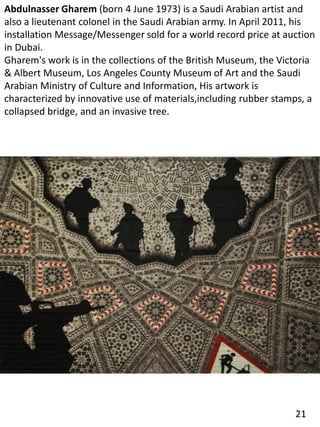
21- Abdulnasser Gharem
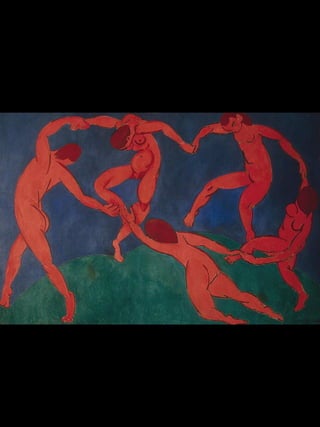
Postmodern art is a body of art
movements that sought to
contradict some aspects of
modernism or some aspects that
emerged or developed in its
aftermath. In general, movements
such as intermedia, installation art,
conceptual art and multimedia,
particularly involving video are
described as postmodern.
There are several characteristics
which lend art to being
postmodern; these include
bricolage, the use of text
prominently as the central artistic
element, collage, simplification,
appropriation, performance art,
the recycling of past styles and
themes in a modern-day context, as
well as the break-up of the barrier
between fine and high arts and
low art and popular culture.
Use of the term
The predominant term for art
produced since the 1950s is
"contemporary art". Not all art
labeled as contemporary art is
postmodern, and the broader
term encompasses both artists
who continue to work in
modernist and late modernist
traditions, as well as artists who
reject postmodernism for other
reasons. Arthur Danto argues
"contemporary" is the broader
term, and postmodern objects
represent a "subsector" of the
contemporary movement. Some
postmodern artists have made
more distinctive breaks from the
ideas of modern art and there is no
consensus as to what is "late-
modern" and what is "post-
modern." Ideas rejected by the
modern aesthetic have been re-
established. In painting,
postmodernism reintroduced
representation.Some critics argue
much of the current "postmodern"
art, the latest avant-gardism,
should still classify as modern art.
As well as describing certain
tendencies of contemporary art,
postmodern has also been used to
denote a phase of modern art.
Defenders of modernism, such as
Clement Greenberg,as well as
radical opponents of modernism,
such as Félix Guattari, who calls it
modernism's "last gasp," have
adopted this position.
1
The neo-conservative Hilton
Kramer describes postmodernism
as "a creation of modernism at the
end of its tether."Jean-François
Lyotard, in Fredric Jameson's
analysis, does not hold there is a
postmodern stage radically
different from the period of high
modernism; instead, postmodern
discontent with this or that high
modernist style is part of the
experimentation of high
modernism, giving birth to new
modernisms. In the context of
aesthetics and art, Jean-François
Lyotard is a major philosopher of
postmodernism.
Many critics hold postmodern art
emerges from modern art.
Suggested dates for the shift from
modern to postmodern include
1914 in Europe, and 1962or
1968 in America. James Elkins,
commenting on discussions about
the exact date of the transition
from modernism to
postmodernism, compares it to
the discussion in the 1960s about
the exact span of Mannerism and
whether it should begin directly
after the High Renaissance or later
in the century. He makes the point
these debates go on all the time
with respect to art movements and
periods, which is not to say they
are not important.The close of the
period of postmodern art has been
dated to the end of the 1980s,
when the word postmodernism lost
much of its critical resonance, and
art practices began to address the
impact of globalization and new
media.
Jean Baudrillard has had a
significant influence on
postmodern-inspired art and
emphasised the possibilities of new
forms of creativity.The artist Peter
Halley describes his day-glo colours
as "hyperrealization of real color",
and acknowledges Baudrillard as an
influence.Baudrillard himself, since
1984, was fairly consistent in his
view contemporary art, and
postmodern art in particular, was
inferior to the modernist art of the
post World War II period,while
Jean-François Lyotard praised
Contemporary painting and
remarked on its evolution from
Modern art
Major Women artists in the
Twentieth Century are associated
with postmodern art since much
theoretical articulation of their
work emerged from French
psychoanalysis and Feminist Theory
that is strongly related to post
modern philosophy.
As with all uses of the term
postmodern there are critics of its
application. Kirk Varnedoe, for
instance, stated that there is no
such thing as postmodernism, and
that the possibilities of modernism
have not yet been exhausted.
Though the usage of the term as a
kind of shorthand to designate the
work of certain Post-war "schools"
employing relatively specific
material and generic techniques
has become conventional since the
mid-1980s, the theoretical
underpinnings of Postmodernism
as an epochal or epistemic division
are still very much in controversy.
Defining postmodern art
Postmodernism describes
movements which both arise from,
and react against or reject, trends
in modernism.General citations for
specific trends of modernism are
formal purity, medium specificity,
art for art's sake, authenticity,
universality, originality and
revolutionary or reactionary
tendency, i.e. the avant-garde.
However, paradox is probably the
most important modernist idea
against which postmodernism
reacts. Paradox was central to the
modernist enterprise, which Manet
introduced. Manet's various
violations of representational art
brought to prominence the
supposed mutual exclusiveness of
reality and representation, design
and representation, abstraction and
reality, and so on. The
incorporation of paradox was highly
stimulating from Manet to the
conceptualists.
The status of the avant-garde is
controversial: many institutions
argue being visionary, forward-
looking, cutting-edge, and
progressive are crucial to the
mission of art in the present, and
therefore postmodern art
contradicts the value of "art of our
times". Postmodernism rejects the
notion of advancement or progress
in art per se, and thus aims to
overturn the "myth of the avant-
garde".
Rosalind Krauss was one of the
important enunciators of the view
that avant-gardism was over, and
the new artistic era is post-liberal
and post-progress.Griselda Pollock
studied and confronted the avant-
garde and modern art in a series of
groundbreaking books, reviewing
modern art at the same time as
redefining postmodern art.
One characteristic of postmodern
art is its conflation of high and low
culture through the use of
industrial materials and
pop culture imagery. The use of
low forms of art were a part of
modernist experimentation as well,
as documented in Kirk Varnedoe
and Adam Gopnik's 1990–91 show
High and Low: Popular Culture
and Modern Art at New York's
Museum of Modern Art,an
exhibition that was universally
panned at the time as the only
event that could bring Douglas
Crimp and Hilton Kramer together
in a chorus of scorn.
Postmodern art is noted for the
way in which it blurs the
distinctions between what is
perceived as fine or high art and
what is generally seen as low or
kitsch art.While this concept of
"blurring" or "fusing" high art with
low art had been experimented
during modernism, it only ever
became fully endorsed after the
advent of the postmodern
era.Postmodernism introduced
elements of commercialism, kitsch
and a general camp aesthetic
within its artistic context;
postmodernism takes styles from
past periods, such as Gothicism, the
Renaissance and the Baroque, and
mixes them so as to ignore their
original use in their corresponding
artistic movement. Such elements
are common characteristics of what
defines postmodern art.
Fredric Jameson suggests
postmodern works abjure any claim
to spontaneity and directness of
expression, making use instead of
pastiche and discontinuity. Against
this definition, Art and Language's
Charles Harrison and Paul Wood
maintained pastiche and
discontinuity are endemic to
modernist art, and are deployed
effectively by modern artists such
as Manet and Picasso.
One compact definition is
postmodernism rejects
modernism's grand narratives of
artistic direction, eradicating the
boundaries between high and low
forms of art, and disrupting genre's
conventions with collision, collage,
and fragmentation. Postmodern art
holds all stances are unstable and
insincere, and therefore irony,
parody, and humor are the only
positions critique or revision
cannot overturn. "Pluralism and
diversity" are other defining
features.
Avant-garde precursors
Radical movements and trends
regarded as influential and
potentially as precursors to
postmodernism emerged around
World War I and particularly in its
aftermath. With the introduction
of the use of industrial artifacts in
art and techniques such as collage,
avant-garde movements such as
Cubism, Dada and Surrealism
questioned the nature and value
of art. New artforms, such as
cinema and the rise of
reproduction, influenced these
movements as a means of creating
artworks. The ignition point for the
definition of modernism, Clement
Greenberg's essay, Avant-Garde
and Kitsch, first published in
Partisan Review in 1939, defends
the avant-garde in the face of
popular culture.Later, Peter Bürger
would make a distinction between
the historical avant-garde and
modernism, and critics such as
Krauss, Huyssen, and Douglas
Crimp, following Bürger, identified
the historical avant-garde as a
precursor to postmodernism.
Krauss, for example, describes
Pablo Picasso's use of collage as an
avant-garde practice anticipating
postmodern art with its emphasis
on language at the expense of
autobiography.Another point of
view is avant-garde and modernist
artists used similar strategies and
postmodernism repudiates both.
Dada
In the early 20th century Marcel
Duchamp exhibited a urinal as a
sculpture. His point was to have
people look at the urinal as if it
were a work of art just because he
said it was a work of art. He
referred to his work as
"Readymades".
The Fountain was a urinal signed
with the pseudonym R. Mutt,
which shocked the art world in
1917. This and Duchamp's other
works are generally labelled as
Dada. Duchamp can be seen as a
precursor to conceptual art. Some
critics question calling
Duchamp—whose obsession with
paradox is well known—
postmodernist on the grounds he
eschews any specific medium,
since paradox is not medium-
specific, although it arose first in
Manet's paintings.
Dadaism can be viewed as part of
the modernist propensity to
challenge established styles and
forms, along with Surrealism,
Futurism and Abstract
Expressionism.From a
chronological point of view,
Dada is located solidly within
modernism, however a number of
critics hold it anticipates
postmodernism, while others,
such as Ihab Hassan and Steven
Connor, consider it a possible
changeover point between
modernism and
postmodernism.For example,
according to McEvilly,
postmodernism begins with
realizing one no longer believes in
the myth of progress, and Duchamp
sensed this in 1914 when he
changed from a modernist practice
to a postmodernist one, "abjuring
aesthetic delectation, transcendent
ambition, and tour de force
demonstrations of formal agility in
favor of aesthetic indifference,
acknowledgement of the ordinary
world, and the found object or
readymade.
Radical movements in modern art
In general, Pop Art and Minimalism
began as modernist movements: a
paradigm shift and philosophical
split between formalism and anti-
formalism in the early 1970s
caused those movements to be
viewed by some as precursors or
transitional postmodern art. Other
modern movements cited as
influential to postmodern art are
conceptual art and the use of
techniques such as assemblage,
montage, bricolage, and
appropriation.
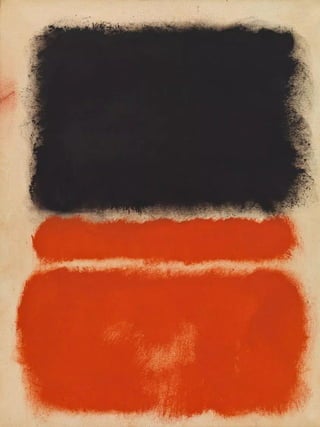
Jackson Pollock and abstract
expressionism
Main articles: Jackson Pollock,
Abstract expressionism, and
Western painting
During the late 1940s and early
1950s, Pollock's radical approach to
painting revolutionized the
potential for all Contemporary art
following him. Pollock realized the
journey toward making a work of
art was as important as the work
of art itself. Like Pablo Picasso's
innovative reinventions of
painting and sculpture near the
turn of the century via Cubism
and constructed sculpture,
Pollock redefined artmaking
during the mid-century. Pollock's
move from easel painting and
conventionality liberated his
contemporaneous artists and
following artists. They realized
Pollock's process — working on
the floor,
unstretched raw canvas, from all
four sides, using artist materials,
industrial materials, imagery, non-
imagery, throwing linear skeins of
paint, dripping, drawing, staining,
brushing - blasted artmaking
beyond prior boundaries. Abstract
expressionism expanded and
developed the definitions and
possibilities artists had available
for the creation of new works of
art. In a sense, the innovations of
Jackson Pollock, Willem de
Kooning, Franz Kline, Mark Rothko,
Philip Guston, Hans Hofmann,
Clyfford Still, Barnett Newman, Ad
Reinhardt and others, opened the
floodgates to the diversity and
scope of following artworks.
After abstract expressionism
Main articles: Post-painterly
abstraction, Color Field painting,
Lyrical Abstraction, Arte Povera,
Process Art, and Western painting
In abstract painting during the
1950s and 1960s several new
directions like Hard-edge painting
and other forms of Geometric
abstraction like the work of Frank
Stella popped up, as a reaction
against the subjectivism of Abstract
expressionism began to appear in
artist studios and in radical avant-
garde circles. Clement Greenberg
became the voice of Post-painterly
abstraction; by curating an
influential exhibition of new
painting touring important art
museums throughout the United
States in 1964. Color field painting,
Hard-edge painting and Lyrical
Abstraction emerged as radical new
directions.
By the late 1960s, Postminimalism,
Process Art and Arte Povera also
emerged as revolutionary
concepts and movements
encompassing painting and
sculpture, via Lyrical Abstraction
and the Postminimalist movement,
and in early Conceptual
Art.Process art as inspired by
Pollock enabled artists to
experiment with and make use
of a diverse encyclopedia of style,
content, material, placement,
sense of time, and plastic and real
space. Nancy Graves, Ronald Davis,
Howard Hodgkin, Larry Poons,
Jannis Kounellis, Brice Marden,
Bruce Nauman, Richard Tuttle,
Alan Saret, Walter Darby Bannard,
Lynda Benglis, Dan Christensen,
Larry Zox, Ronnie Landfield, Eva
Hesse, Keith Sonnier, Richard Serra,
Sam Gilliam, Mario Merz, Peter
Reginato, Lee Lozano, were some of
the younger artists emerging during
the era of late modernism
spawning the heyday of the art of
the late 1960s.
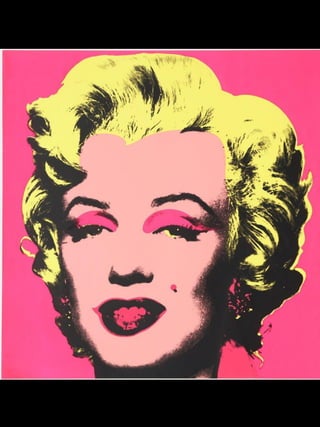
Pop Art
Lawrence Alloway used the term
"Pop art" to describe paintings
celebrating consumerism of the
post World War II era. This
movement rejected Abstract
expressionism and its focus on the
hermeneutic and psychological
interior, in favor of art which
depicted, and often celebrated,
material consumer culture,
advertising, and iconography of the
mass production age. The early
works of David Hockney and the
works of Richard Hamilton, John
McHale, and Eduardo Paolozzi were
considered seminal examples in the
movement. While later American
examples include the bulk of the
careers of Andy Warhol and Roy
Lichtenstein and his use of Benday
dots, a technique used in
commercial reproduction.
There is a clear connection
between the radical works of
Duchamp, the rebellious Dadaist —
with a sense of humor; and Pop
Artists like Claes Oldenburg, Andy
Warhol, Roy Lichtenstein and the
others.
Thomas McEvilly, agreeing with
Dave Hickey, says U.S
postmodernism in the visual arts
began with the first exhibitions of
Pop art in 1962,.
"though it took about twenty years
before postmodernism became a
dominant attitude in the visual
arts."Fredric Jameson, too,
considers pop art to be
postmodern
One way Pop art is postmodern
is it breaks down what Andreas
Huyssen calls the "Great Divide"
between high art and popular
culture.Postmodernism emerges
from a "generational refusal of the
categorical certainties of high
modernism.
Fluxus
Fluxus was named and loosely
organized in 1962 by George
Maciunas (1931–78), a Lithuanian-
born American artist.
Fluxus traces its beginnings to
John Cage's 1957 to 1959
Experimental Composition classes
at the New School for Social
Research in New York City.
Many of his students were artists
working in other media with little
or no background in music. Cage's
students included Fluxus founding
members Jackson Mac Low, Al
Hansen, George Brecht and Dick
Higgins. In 1962 in Germany Fluxus
started with the: FLUXUS
Internationale Festspiele Neuester
Musik in Wiesbaden with, George
Maciunas, Joseph Beuys, Wolf
Vostell, Nam June Paik and others.
And in 1963 with the: Festum
Fluxorum Fluxus in Düsseldorf with
George Maciunas, Wolf Vostell,
Joseph Beuys, Dick Higgins, Nam
June Paik, Ben Patterson, Emmett
Williams and others.
Fluxus encouraged a do it yourself
aesthetic, and valued simplicity
over complexity. Like Dada before
it, Fluxus included a strong current
of anti-commercialism and an anti-
art sensibility, disparaging the
conventional market-driven art
world in favor of an artist-centered
creative practice. Fluxus artists
preferred to work with whatever
materials were at hand, and either
created their own work or
collaborated in the creation process
with their colleagues.
Fluxus can be viewed as part of the
first phase of postmodernism,
along with Rauschenberg, Johns,
Warhol and the Situationist
International
Fluxus can be viewed as part of the
first phase of postmodernism,
along with Rauschenberg, Johns,
Warhol and the Situationist
International.Andreas Huyssen
criticises attempts to claim Fluxus
for postmodernism as, "either the
master-code of postmodernism or
the ultimately unrepresentable art
movement – as it were,
postmodernism's sublime." Instead
he sees Fluxus as a major Neo-
Dadaist phenomena within the
avant-garde tradition. It did not
represent a major advance in the
development of artistic strategies,
though it did express a rebellion
against, "the administered culture
of the 1950s, in which a moderate,
domesticated modernism served
as ideological prop to the Cold
War."
Minimalism
By the early 1960s Minimalism
emerged as an abstract movement
in art (with roots in geometric
abstraction via Malevich, the
Bauhaus and Mondrian) which
rejected the idea of relational, and
subjective painting, the complexity
of Abstract expressionist surfaces,
and the emotional zeitgeist and
polemics present in the arena of
Action painting. Minimalism argued
extreme simplicity could capture
the sublime representation art
requires. Associated with painters
such as Frank Stella, minimalism in
painting, as opposed to other
areas, is a modernist movement
and depending on the context can
be construed as a precursor to the
postmodern movement.
Hal Foster, in his essay The Crux of
Minimalism, examines the extent to
which Donald Judd and Robert
Morris both acknowledge and
exceed Greenbergian modernism in
their published definitions of
minimalism. He argues minimalism
is not a "dead end" of modernism,
but a "paradigm shift toward
postmodern practices that continue
to be elaborated today.
Postminimalism
Robert Pincus-Witten coined the
term Post-minimalism in 1977 to
describe minimalist derived art
which had content and contextual
overtones minimalism rejected.
His use of the term covered the
period 1966 – 1976 and applied to
the work of Eva Hesse, Keith
Sonnier, Richard Serra and new
work by former minimalists
Robert Smithson, Robert Morris,
Sol LeWitt, and Barry Le Va, and
others Process art and anti-form
art are other terms describing this
work, which the space it occupies
and the process by which it is
made determines.
Rosalind Krauss argues by 1968
artists such as Morris, LeWitt,
Smithson and Serra had "entered
a situation the logical conditions
of which can no longer be
described as modernist."The
expansion of the category of
sculpture to include land art and
architecture, "brought about the
shift into postmodernism."
Minimalists like Donald Judd, Dan
Flavin, Carl Andre, Agnes Martin,
John McCracken and others
continued to produce their late
modernist paintings and sculpture
for the remainder of their careers.
Movements in postmodern art
Conceptual art
Conceptual art is sometimes
labelled as postmodern because it
is expressly involved in
deconstruction of what makes a
work of art, "art". Conceptual art,
because it is often designed to
confront, offend or attack notions
held by many of the people who
view it, is regarded with particular
controversy.[citation needed]
Precursors to conceptual art
include the work of Duchamp, John
Cage's 4' 33", in which the music is
said to be "the sounds of the
environment that the listeners'
hear while it is performed," and
Rauschenberg's Erased De Kooning
Drawing. Many conceptual works
take the position that art is created
by the viewer viewing an object or
act as art, not from the intrinsic
qualities of the work itself. Thus,
because Fountain was exhibited, it
was a sculpture.
Installation art
An important series of
movements in art which have
consistently been described as
postmodern involved installation
art and creation of artifacts that
are conceptual in nature. One
example being the signs of Jenny
Holzer which use the devices of
art to convey specific messages,
such as "Protect Me From What I
Want". Installation Art has been
important in determining the
spaces selected for museums of
contemporary art in order to be
able to hold the large works which
are composed of vast collages of
manufactured and found objects.
These installations and collages
are often electrified, with moving
parts and lights.
They are often designed to create
environmental effects, as Christo
and Jeanne-Claude's Iron Curtain,
Wall of 240 Oil Barrels, Blocking
Rue Visconti, Paris, June 1962
which was a poetic response to
the Berlin Wall built in 1961.
Lowbrow art
Lowbrow is a widespread populist
art movement with origins in the
underground comix world, punk
music, hot-rod street culture, and
other California subcultures. It is
also often known by the name pop
surrealism. Lowbrow art highlights
a central theme in postmodernism
in that the distinction between
"high" and "low" art are no longer
recognized.
Digital art
Digital art is a general term for a
range of artistic works and
practices that use digital
technology as an essential part of
the creative and/or presentation
process. The impact of digital
technology has transformed
activities such as painting, drawing,
sculpture and music/sound art,
while new forms, such as net art,
digital installation art, and virtual
reality, have become recognized
artistic practices.
Leading art theorists and historians
in this field include Christiane Paul,
Frank Popper, Christine Buci-
Glucksmann, Dominique Moulon,
Robert C. Morgan, Roy Ascott,
Catherine Perret, Margot Lovejoy,
Edmond Couchot, Fred Forest and
Edward A. Shanken.
Intermedia and multi-media
Another trend in art which has
been associated with the term
postmodern is the use of a
number of different media
together. Intermedia, a term
coined by Dick Higgins and meant
to convey new artforms along the
lines of Fluxus, Concrete Poetry,
Found objects, Performance art,
and Computer art. Higgins was the
publisher of the Something Else
Press, a Concrete poet, married to
artist Alison Knowles and an
admirer of Marcel Duchamp. Ihab
Hassan includes, "Intermedia, the
fusion of forms, the confusion of
realms," in his list of the
characteristics of postmodern
art.One of the most common
forms of "multi-media art" is the
use of video-tape and CRT
monitors, termed Video art. While
the theory of combining multiple
arts into one art is quite old, and
has been revived periodically, the
postmodern manifestation is often
in combination with performance
art, where the dramatic subtext is
removed, and what is left is the
specific statements of the artist in
question or the conceptual
statement of their action.Higgin's
conception of Intermedia is
connected to the growth of
multimedia digital practice such as
immersive virtual reality, digital art
and computer art.
Telematic Art
Telematic art is a descriptive of art
projects using computer mediated
telecommunications networks as
their medium. Telematic art
challenges the traditional
relationship between active
viewing subjects and passive art
objects by creating interactive,
behavioural contexts for remote
aesthetic encounters. Roy Ascott
sees the telematic art form as the
transformation of the viewer into
an active participator of creating
the artwork which remains in
process throughout its duration.
Ascott has been at the forefront of
the theory and practice of
telematic art since 1978 when he
went online for the first time,
organizing different collaborative
online projects.
Appropriation art and neo-
conceptual art
In his 1980 essay The Allegorical
Impulse: Toward a Theory of
Postmodernism,
Craig Owens identifies the re-
emergence of an allegorical
impulse as characteristic of
postmodern art. This impulse can
be seen in the appropriation art of
artists such as Sherrie Levine and
Robert Longo because, "Allegorical
imagery is appropriated imagery."
Appropriation art debunks
modernist notions of artistic
genius and originality and is more
ambivalent and contradictory than
modern art, simultaneously
installing and subverting ideologies,
"being both critical and complicit."
Neo-expressionism and painting
The return to the traditional art
forms of sculpture and painting in
the late 1970s and early 1980s
seen in the work of Neo-
expressionist artists such as Georg
Baselitz and Julian Schnabel has
been described as a postmodern
tendency, and one of the first
coherent movements to emerge
in the postmodern era. Its strong
links with the commercial art
market has raised questions,
however, both about its status as
a postmodern movement and the
definition of postmodernism itself.
Hal Foster states that neo-
expressionism was complicit with
the conservative cultural politics of
the Reagan-Bush era in the U.S.Félix
Guattari disregards the "large
promotional operations dubbed
'neo-expressionism' in Germany,"
as a too easy way for him "to
demonstrate that postmodernism is
nothing but the last gasp of
modernism."These critiques of neo-
expressionism reveal that money
and public relations really sustained
contemporary art world credibility
in America during the same period
that conceptual artists, and
practices of women artists
including painters and feminist
theorists like
Griselda Pollock,were
systematically reevaluating modern
art. Brian Massumi claims that
Deleuze and Guattari open the
horizon of new definitions of
Beauty in postmodern art. For Jean-
François Lyotard, it was painting of
the artists Valerio Adami, Daniel
Buren, Marcel Duchamp, Bracha
Ettinger, and Barnett Newman that,
after the avant-garde's time and
the painting of Paul Cézanne and
Wassily Kandinsky, was the vehicle
for new ideas of the sublime in
contemporary art.
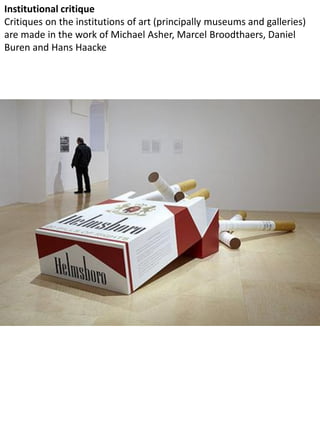
Institutional critique
Critiques on the institutions of art (principally museums and galleries)
are made in the work of Michael Asher, Marcel Broodthaers, Daniel
Buren and Hans Haacke
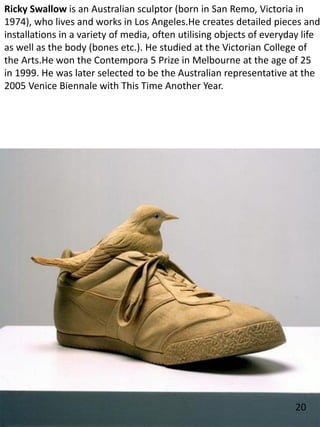
Ricky Swallow is an Australian sculptor (born in San Remo, Victoria in
1974), who lives and works in Los Angeles.He creates detailed pieces and
installations in a variety of media, often utilising objects of everyday life
as well as the body (bones etc.). He studied at the Victorian College of
the Arts.He won the Contempora 5 Prize in Melbourne at the age of 25
in 1999. He was later selected to be the Australian representative at the
2005 Venice Biennale with This Time Another Year.
20
Abdulnasser Gharem (born 4 June 1973) is a Saudi Arabian artist and
also a lieutenant colonel in the Saudi Arabian army. In April 2011, his
installation Message/Messenger sold for a world record price at auction
in Dubai.
Gharem's work is in the collections of the British Museum, the Victoria
& Albert Museum, Los Angeles County Museum of Art and the Saudi
Arabian Ministry of Culture and Information, His artwork is
characterized by innovative use of materials,including rubber stamps, a
collapsed bridge, and an invasive tree.
21
http://www.aziz-anzabi.com

Aziz art june 2019

  • 1.
  • 2.
    Director: Aziz Anzabi Editor: Nafiseh Yaghoubi Translator : Asra Yaghoubi Research: Zohreh Nazari Iranian art department: Mohadese Yaghoubi http://www.aziz-anzabi.com 1- Postmodern 20- Ricky Swallow 21- Abdulnasser Gharem
  • 3.
    Postmodern art isa body of art movements that sought to contradict some aspects of modernism or some aspects that emerged or developed in its aftermath. In general, movements such as intermedia, installation art, conceptual art and multimedia, particularly involving video are described as postmodern. There are several characteristics which lend art to being postmodern; these include bricolage, the use of text prominently as the central artistic element, collage, simplification, appropriation, performance art, the recycling of past styles and themes in a modern-day context, as well as the break-up of the barrier between fine and high arts and low art and popular culture. Use of the term The predominant term for art produced since the 1950s is "contemporary art". Not all art labeled as contemporary art is postmodern, and the broader term encompasses both artists who continue to work in modernist and late modernist traditions, as well as artists who reject postmodernism for other reasons. Arthur Danto argues "contemporary" is the broader term, and postmodern objects represent a "subsector" of the contemporary movement. Some postmodern artists have made more distinctive breaks from the ideas of modern art and there is no consensus as to what is "late- modern" and what is "post- modern." Ideas rejected by the modern aesthetic have been re- established. In painting, postmodernism reintroduced representation.Some critics argue much of the current "postmodern" art, the latest avant-gardism, should still classify as modern art. As well as describing certain tendencies of contemporary art, postmodern has also been used to denote a phase of modern art. Defenders of modernism, such as Clement Greenberg,as well as radical opponents of modernism, such as Félix Guattari, who calls it modernism's "last gasp," have adopted this position. 1
  • 4.
    The neo-conservative Hilton Kramerdescribes postmodernism as "a creation of modernism at the end of its tether."Jean-François Lyotard, in Fredric Jameson's analysis, does not hold there is a postmodern stage radically different from the period of high modernism; instead, postmodern discontent with this or that high modernist style is part of the experimentation of high modernism, giving birth to new modernisms. In the context of aesthetics and art, Jean-François Lyotard is a major philosopher of postmodernism. Many critics hold postmodern art emerges from modern art. Suggested dates for the shift from modern to postmodern include 1914 in Europe, and 1962or 1968 in America. James Elkins, commenting on discussions about the exact date of the transition from modernism to postmodernism, compares it to the discussion in the 1960s about the exact span of Mannerism and whether it should begin directly after the High Renaissance or later in the century. He makes the point these debates go on all the time with respect to art movements and periods, which is not to say they are not important.The close of the period of postmodern art has been dated to the end of the 1980s, when the word postmodernism lost much of its critical resonance, and art practices began to address the impact of globalization and new media. Jean Baudrillard has had a significant influence on postmodern-inspired art and emphasised the possibilities of new forms of creativity.The artist Peter Halley describes his day-glo colours as "hyperrealization of real color", and acknowledges Baudrillard as an influence.Baudrillard himself, since 1984, was fairly consistent in his view contemporary art, and postmodern art in particular, was inferior to the modernist art of the post World War II period,while Jean-François Lyotard praised Contemporary painting and remarked on its evolution from Modern art
  • 5.
    Major Women artistsin the Twentieth Century are associated with postmodern art since much theoretical articulation of their work emerged from French psychoanalysis and Feminist Theory that is strongly related to post modern philosophy. As with all uses of the term postmodern there are critics of its application. Kirk Varnedoe, for instance, stated that there is no such thing as postmodernism, and that the possibilities of modernism have not yet been exhausted. Though the usage of the term as a kind of shorthand to designate the work of certain Post-war "schools" employing relatively specific material and generic techniques has become conventional since the mid-1980s, the theoretical underpinnings of Postmodernism as an epochal or epistemic division are still very much in controversy. Defining postmodern art Postmodernism describes movements which both arise from, and react against or reject, trends in modernism.General citations for specific trends of modernism are formal purity, medium specificity, art for art's sake, authenticity, universality, originality and revolutionary or reactionary tendency, i.e. the avant-garde. However, paradox is probably the most important modernist idea against which postmodernism reacts. Paradox was central to the modernist enterprise, which Manet introduced. Manet's various violations of representational art brought to prominence the supposed mutual exclusiveness of reality and representation, design and representation, abstraction and reality, and so on. The incorporation of paradox was highly stimulating from Manet to the conceptualists. The status of the avant-garde is controversial: many institutions argue being visionary, forward- looking, cutting-edge, and progressive are crucial to the mission of art in the present, and therefore postmodern art contradicts the value of "art of our times". Postmodernism rejects the notion of advancement or progress in art per se, and thus aims to overturn the "myth of the avant- garde".
  • 7.
    Rosalind Krauss wasone of the important enunciators of the view that avant-gardism was over, and the new artistic era is post-liberal and post-progress.Griselda Pollock studied and confronted the avant- garde and modern art in a series of groundbreaking books, reviewing modern art at the same time as redefining postmodern art. One characteristic of postmodern art is its conflation of high and low culture through the use of industrial materials and pop culture imagery. The use of low forms of art were a part of modernist experimentation as well, as documented in Kirk Varnedoe and Adam Gopnik's 1990–91 show High and Low: Popular Culture and Modern Art at New York's Museum of Modern Art,an exhibition that was universally panned at the time as the only event that could bring Douglas Crimp and Hilton Kramer together in a chorus of scorn. Postmodern art is noted for the way in which it blurs the distinctions between what is perceived as fine or high art and what is generally seen as low or kitsch art.While this concept of "blurring" or "fusing" high art with low art had been experimented during modernism, it only ever became fully endorsed after the advent of the postmodern era.Postmodernism introduced elements of commercialism, kitsch and a general camp aesthetic within its artistic context; postmodernism takes styles from past periods, such as Gothicism, the Renaissance and the Baroque, and mixes them so as to ignore their original use in their corresponding artistic movement. Such elements are common characteristics of what defines postmodern art. Fredric Jameson suggests postmodern works abjure any claim to spontaneity and directness of expression, making use instead of pastiche and discontinuity. Against this definition, Art and Language's Charles Harrison and Paul Wood maintained pastiche and discontinuity are endemic to modernist art, and are deployed effectively by modern artists such as Manet and Picasso.
  • 8.
    One compact definitionis postmodernism rejects modernism's grand narratives of artistic direction, eradicating the boundaries between high and low forms of art, and disrupting genre's conventions with collision, collage, and fragmentation. Postmodern art holds all stances are unstable and insincere, and therefore irony, parody, and humor are the only positions critique or revision cannot overturn. "Pluralism and diversity" are other defining features. Avant-garde precursors Radical movements and trends regarded as influential and potentially as precursors to postmodernism emerged around World War I and particularly in its aftermath. With the introduction of the use of industrial artifacts in art and techniques such as collage, avant-garde movements such as Cubism, Dada and Surrealism questioned the nature and value of art. New artforms, such as cinema and the rise of reproduction, influenced these movements as a means of creating artworks. The ignition point for the definition of modernism, Clement Greenberg's essay, Avant-Garde and Kitsch, first published in Partisan Review in 1939, defends the avant-garde in the face of popular culture.Later, Peter Bürger would make a distinction between the historical avant-garde and modernism, and critics such as Krauss, Huyssen, and Douglas Crimp, following Bürger, identified the historical avant-garde as a precursor to postmodernism. Krauss, for example, describes Pablo Picasso's use of collage as an avant-garde practice anticipating postmodern art with its emphasis on language at the expense of autobiography.Another point of view is avant-garde and modernist artists used similar strategies and postmodernism repudiates both. Dada In the early 20th century Marcel Duchamp exhibited a urinal as a sculpture. His point was to have people look at the urinal as if it were a work of art just because he said it was a work of art. He referred to his work as "Readymades".
  • 9.
    The Fountain wasa urinal signed with the pseudonym R. Mutt, which shocked the art world in 1917. This and Duchamp's other works are generally labelled as Dada. Duchamp can be seen as a precursor to conceptual art. Some critics question calling Duchamp—whose obsession with paradox is well known— postmodernist on the grounds he eschews any specific medium, since paradox is not medium- specific, although it arose first in Manet's paintings. Dadaism can be viewed as part of the modernist propensity to challenge established styles and forms, along with Surrealism, Futurism and Abstract Expressionism.From a chronological point of view, Dada is located solidly within modernism, however a number of critics hold it anticipates postmodernism, while others, such as Ihab Hassan and Steven Connor, consider it a possible changeover point between modernism and postmodernism.For example, according to McEvilly, postmodernism begins with realizing one no longer believes in the myth of progress, and Duchamp sensed this in 1914 when he changed from a modernist practice to a postmodernist one, "abjuring aesthetic delectation, transcendent ambition, and tour de force demonstrations of formal agility in favor of aesthetic indifference, acknowledgement of the ordinary world, and the found object or readymade. Radical movements in modern art In general, Pop Art and Minimalism began as modernist movements: a paradigm shift and philosophical split between formalism and anti- formalism in the early 1970s caused those movements to be viewed by some as precursors or transitional postmodern art. Other modern movements cited as influential to postmodern art are conceptual art and the use of techniques such as assemblage, montage, bricolage, and appropriation. Jackson Pollock and abstract expressionism Main articles: Jackson Pollock, Abstract expressionism, and Western painting
  • 11.
    During the late1940s and early 1950s, Pollock's radical approach to painting revolutionized the potential for all Contemporary art following him. Pollock realized the journey toward making a work of art was as important as the work of art itself. Like Pablo Picasso's innovative reinventions of painting and sculpture near the turn of the century via Cubism and constructed sculpture, Pollock redefined artmaking during the mid-century. Pollock's move from easel painting and conventionality liberated his contemporaneous artists and following artists. They realized Pollock's process — working on the floor, unstretched raw canvas, from all four sides, using artist materials, industrial materials, imagery, non- imagery, throwing linear skeins of paint, dripping, drawing, staining, brushing - blasted artmaking beyond prior boundaries. Abstract expressionism expanded and developed the definitions and possibilities artists had available for the creation of new works of art. In a sense, the innovations of Jackson Pollock, Willem de Kooning, Franz Kline, Mark Rothko, Philip Guston, Hans Hofmann, Clyfford Still, Barnett Newman, Ad Reinhardt and others, opened the floodgates to the diversity and scope of following artworks. After abstract expressionism Main articles: Post-painterly abstraction, Color Field painting, Lyrical Abstraction, Arte Povera, Process Art, and Western painting In abstract painting during the 1950s and 1960s several new directions like Hard-edge painting and other forms of Geometric abstraction like the work of Frank Stella popped up, as a reaction against the subjectivism of Abstract expressionism began to appear in artist studios and in radical avant- garde circles. Clement Greenberg became the voice of Post-painterly abstraction; by curating an influential exhibition of new painting touring important art museums throughout the United States in 1964. Color field painting, Hard-edge painting and Lyrical Abstraction emerged as radical new directions.
  • 13.
    By the late1960s, Postminimalism, Process Art and Arte Povera also emerged as revolutionary concepts and movements encompassing painting and sculpture, via Lyrical Abstraction and the Postminimalist movement, and in early Conceptual Art.Process art as inspired by Pollock enabled artists to experiment with and make use of a diverse encyclopedia of style, content, material, placement, sense of time, and plastic and real space. Nancy Graves, Ronald Davis, Howard Hodgkin, Larry Poons, Jannis Kounellis, Brice Marden, Bruce Nauman, Richard Tuttle, Alan Saret, Walter Darby Bannard, Lynda Benglis, Dan Christensen, Larry Zox, Ronnie Landfield, Eva Hesse, Keith Sonnier, Richard Serra, Sam Gilliam, Mario Merz, Peter Reginato, Lee Lozano, were some of the younger artists emerging during the era of late modernism spawning the heyday of the art of the late 1960s. Pop Art Lawrence Alloway used the term "Pop art" to describe paintings celebrating consumerism of the post World War II era. This movement rejected Abstract expressionism and its focus on the hermeneutic and psychological interior, in favor of art which depicted, and often celebrated, material consumer culture, advertising, and iconography of the mass production age. The early works of David Hockney and the works of Richard Hamilton, John McHale, and Eduardo Paolozzi were considered seminal examples in the movement. While later American examples include the bulk of the careers of Andy Warhol and Roy Lichtenstein and his use of Benday dots, a technique used in commercial reproduction. There is a clear connection between the radical works of Duchamp, the rebellious Dadaist — with a sense of humor; and Pop Artists like Claes Oldenburg, Andy Warhol, Roy Lichtenstein and the others. Thomas McEvilly, agreeing with Dave Hickey, says U.S postmodernism in the visual arts began with the first exhibitions of Pop art in 1962,.
  • 14.
    "though it tookabout twenty years before postmodernism became a dominant attitude in the visual arts."Fredric Jameson, too, considers pop art to be postmodern One way Pop art is postmodern is it breaks down what Andreas Huyssen calls the "Great Divide" between high art and popular culture.Postmodernism emerges from a "generational refusal of the categorical certainties of high modernism. Fluxus Fluxus was named and loosely organized in 1962 by George Maciunas (1931–78), a Lithuanian- born American artist. Fluxus traces its beginnings to John Cage's 1957 to 1959 Experimental Composition classes at the New School for Social Research in New York City. Many of his students were artists working in other media with little or no background in music. Cage's students included Fluxus founding members Jackson Mac Low, Al Hansen, George Brecht and Dick Higgins. In 1962 in Germany Fluxus started with the: FLUXUS Internationale Festspiele Neuester Musik in Wiesbaden with, George Maciunas, Joseph Beuys, Wolf Vostell, Nam June Paik and others. And in 1963 with the: Festum Fluxorum Fluxus in Düsseldorf with George Maciunas, Wolf Vostell, Joseph Beuys, Dick Higgins, Nam June Paik, Ben Patterson, Emmett Williams and others. Fluxus encouraged a do it yourself aesthetic, and valued simplicity over complexity. Like Dada before it, Fluxus included a strong current of anti-commercialism and an anti- art sensibility, disparaging the conventional market-driven art world in favor of an artist-centered creative practice. Fluxus artists preferred to work with whatever materials were at hand, and either created their own work or collaborated in the creation process with their colleagues. Fluxus can be viewed as part of the first phase of postmodernism, along with Rauschenberg, Johns, Warhol and the Situationist International
  • 15.
    Fluxus can beviewed as part of the first phase of postmodernism, along with Rauschenberg, Johns, Warhol and the Situationist International.Andreas Huyssen criticises attempts to claim Fluxus for postmodernism as, "either the master-code of postmodernism or the ultimately unrepresentable art movement – as it were, postmodernism's sublime." Instead he sees Fluxus as a major Neo- Dadaist phenomena within the avant-garde tradition. It did not represent a major advance in the development of artistic strategies, though it did express a rebellion against, "the administered culture of the 1950s, in which a moderate, domesticated modernism served as ideological prop to the Cold War." Minimalism By the early 1960s Minimalism emerged as an abstract movement in art (with roots in geometric abstraction via Malevich, the Bauhaus and Mondrian) which rejected the idea of relational, and subjective painting, the complexity of Abstract expressionist surfaces, and the emotional zeitgeist and polemics present in the arena of Action painting. Minimalism argued extreme simplicity could capture the sublime representation art requires. Associated with painters such as Frank Stella, minimalism in painting, as opposed to other areas, is a modernist movement and depending on the context can be construed as a precursor to the postmodern movement. Hal Foster, in his essay The Crux of Minimalism, examines the extent to which Donald Judd and Robert Morris both acknowledge and exceed Greenbergian modernism in their published definitions of minimalism. He argues minimalism is not a "dead end" of modernism, but a "paradigm shift toward postmodern practices that continue to be elaborated today.
  • 16.
    Postminimalism Robert Pincus-Witten coinedthe term Post-minimalism in 1977 to describe minimalist derived art which had content and contextual overtones minimalism rejected. His use of the term covered the period 1966 – 1976 and applied to the work of Eva Hesse, Keith Sonnier, Richard Serra and new work by former minimalists Robert Smithson, Robert Morris, Sol LeWitt, and Barry Le Va, and others Process art and anti-form art are other terms describing this work, which the space it occupies and the process by which it is made determines. Rosalind Krauss argues by 1968 artists such as Morris, LeWitt, Smithson and Serra had "entered a situation the logical conditions of which can no longer be described as modernist."The expansion of the category of sculpture to include land art and architecture, "brought about the shift into postmodernism." Minimalists like Donald Judd, Dan Flavin, Carl Andre, Agnes Martin, John McCracken and others continued to produce their late modernist paintings and sculpture for the remainder of their careers. Movements in postmodern art Conceptual art Conceptual art is sometimes labelled as postmodern because it is expressly involved in deconstruction of what makes a work of art, "art". Conceptual art, because it is often designed to confront, offend or attack notions held by many of the people who view it, is regarded with particular controversy.[citation needed] Precursors to conceptual art include the work of Duchamp, John Cage's 4' 33", in which the music is said to be "the sounds of the environment that the listeners' hear while it is performed," and Rauschenberg's Erased De Kooning Drawing. Many conceptual works take the position that art is created by the viewer viewing an object or act as art, not from the intrinsic qualities of the work itself. Thus, because Fountain was exhibited, it was a sculpture.
  • 17.
    Installation art An importantseries of movements in art which have consistently been described as postmodern involved installation art and creation of artifacts that are conceptual in nature. One example being the signs of Jenny Holzer which use the devices of art to convey specific messages, such as "Protect Me From What I Want". Installation Art has been important in determining the spaces selected for museums of contemporary art in order to be able to hold the large works which are composed of vast collages of manufactured and found objects. These installations and collages are often electrified, with moving parts and lights. They are often designed to create environmental effects, as Christo and Jeanne-Claude's Iron Curtain, Wall of 240 Oil Barrels, Blocking Rue Visconti, Paris, June 1962 which was a poetic response to the Berlin Wall built in 1961. Lowbrow art Lowbrow is a widespread populist art movement with origins in the underground comix world, punk music, hot-rod street culture, and other California subcultures. It is also often known by the name pop surrealism. Lowbrow art highlights a central theme in postmodernism in that the distinction between "high" and "low" art are no longer recognized. Digital art Digital art is a general term for a range of artistic works and practices that use digital technology as an essential part of the creative and/or presentation process. The impact of digital technology has transformed activities such as painting, drawing, sculpture and music/sound art, while new forms, such as net art, digital installation art, and virtual reality, have become recognized artistic practices. Leading art theorists and historians in this field include Christiane Paul, Frank Popper, Christine Buci- Glucksmann, Dominique Moulon, Robert C. Morgan, Roy Ascott, Catherine Perret, Margot Lovejoy, Edmond Couchot, Fred Forest and Edward A. Shanken.
  • 19.
    Intermedia and multi-media Anothertrend in art which has been associated with the term postmodern is the use of a number of different media together. Intermedia, a term coined by Dick Higgins and meant to convey new artforms along the lines of Fluxus, Concrete Poetry, Found objects, Performance art, and Computer art. Higgins was the publisher of the Something Else Press, a Concrete poet, married to artist Alison Knowles and an admirer of Marcel Duchamp. Ihab Hassan includes, "Intermedia, the fusion of forms, the confusion of realms," in his list of the characteristics of postmodern art.One of the most common forms of "multi-media art" is the use of video-tape and CRT monitors, termed Video art. While the theory of combining multiple arts into one art is quite old, and has been revived periodically, the postmodern manifestation is often in combination with performance art, where the dramatic subtext is removed, and what is left is the specific statements of the artist in question or the conceptual statement of their action.Higgin's conception of Intermedia is connected to the growth of multimedia digital practice such as immersive virtual reality, digital art and computer art. Telematic Art Telematic art is a descriptive of art projects using computer mediated telecommunications networks as their medium. Telematic art challenges the traditional relationship between active viewing subjects and passive art objects by creating interactive, behavioural contexts for remote aesthetic encounters. Roy Ascott sees the telematic art form as the transformation of the viewer into an active participator of creating the artwork which remains in process throughout its duration. Ascott has been at the forefront of the theory and practice of telematic art since 1978 when he went online for the first time, organizing different collaborative online projects. Appropriation art and neo- conceptual art In his 1980 essay The Allegorical Impulse: Toward a Theory of Postmodernism,
  • 20.
    Craig Owens identifiesthe re- emergence of an allegorical impulse as characteristic of postmodern art. This impulse can be seen in the appropriation art of artists such as Sherrie Levine and Robert Longo because, "Allegorical imagery is appropriated imagery." Appropriation art debunks modernist notions of artistic genius and originality and is more ambivalent and contradictory than modern art, simultaneously installing and subverting ideologies, "being both critical and complicit." Neo-expressionism and painting The return to the traditional art forms of sculpture and painting in the late 1970s and early 1980s seen in the work of Neo- expressionist artists such as Georg Baselitz and Julian Schnabel has been described as a postmodern tendency, and one of the first coherent movements to emerge in the postmodern era. Its strong links with the commercial art market has raised questions, however, both about its status as a postmodern movement and the definition of postmodernism itself. Hal Foster states that neo- expressionism was complicit with the conservative cultural politics of the Reagan-Bush era in the U.S.Félix Guattari disregards the "large promotional operations dubbed 'neo-expressionism' in Germany," as a too easy way for him "to demonstrate that postmodernism is nothing but the last gasp of modernism."These critiques of neo- expressionism reveal that money and public relations really sustained contemporary art world credibility in America during the same period that conceptual artists, and practices of women artists including painters and feminist theorists like Griselda Pollock,were systematically reevaluating modern art. Brian Massumi claims that Deleuze and Guattari open the horizon of new definitions of Beauty in postmodern art. For Jean- François Lyotard, it was painting of the artists Valerio Adami, Daniel Buren, Marcel Duchamp, Bracha Ettinger, and Barnett Newman that, after the avant-garde's time and the painting of Paul Cézanne and Wassily Kandinsky, was the vehicle for new ideas of the sublime in contemporary art.
  • 21.
    Institutional critique Critiques onthe institutions of art (principally museums and galleries) are made in the work of Michael Asher, Marcel Broodthaers, Daniel Buren and Hans Haacke
  • 22.
    Ricky Swallow isan Australian sculptor (born in San Remo, Victoria in 1974), who lives and works in Los Angeles.He creates detailed pieces and installations in a variety of media, often utilising objects of everyday life as well as the body (bones etc.). He studied at the Victorian College of the Arts.He won the Contempora 5 Prize in Melbourne at the age of 25 in 1999. He was later selected to be the Australian representative at the 2005 Venice Biennale with This Time Another Year. 20
  • 23.
    Abdulnasser Gharem (born4 June 1973) is a Saudi Arabian artist and also a lieutenant colonel in the Saudi Arabian army. In April 2011, his installation Message/Messenger sold for a world record price at auction in Dubai. Gharem's work is in the collections of the British Museum, the Victoria & Albert Museum, Los Angeles County Museum of Art and the Saudi Arabian Ministry of Culture and Information, His artwork is characterized by innovative use of materials,including rubber stamps, a collapsed bridge, and an invasive tree. 21
  • 24.