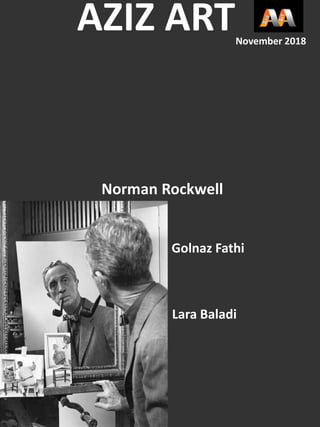
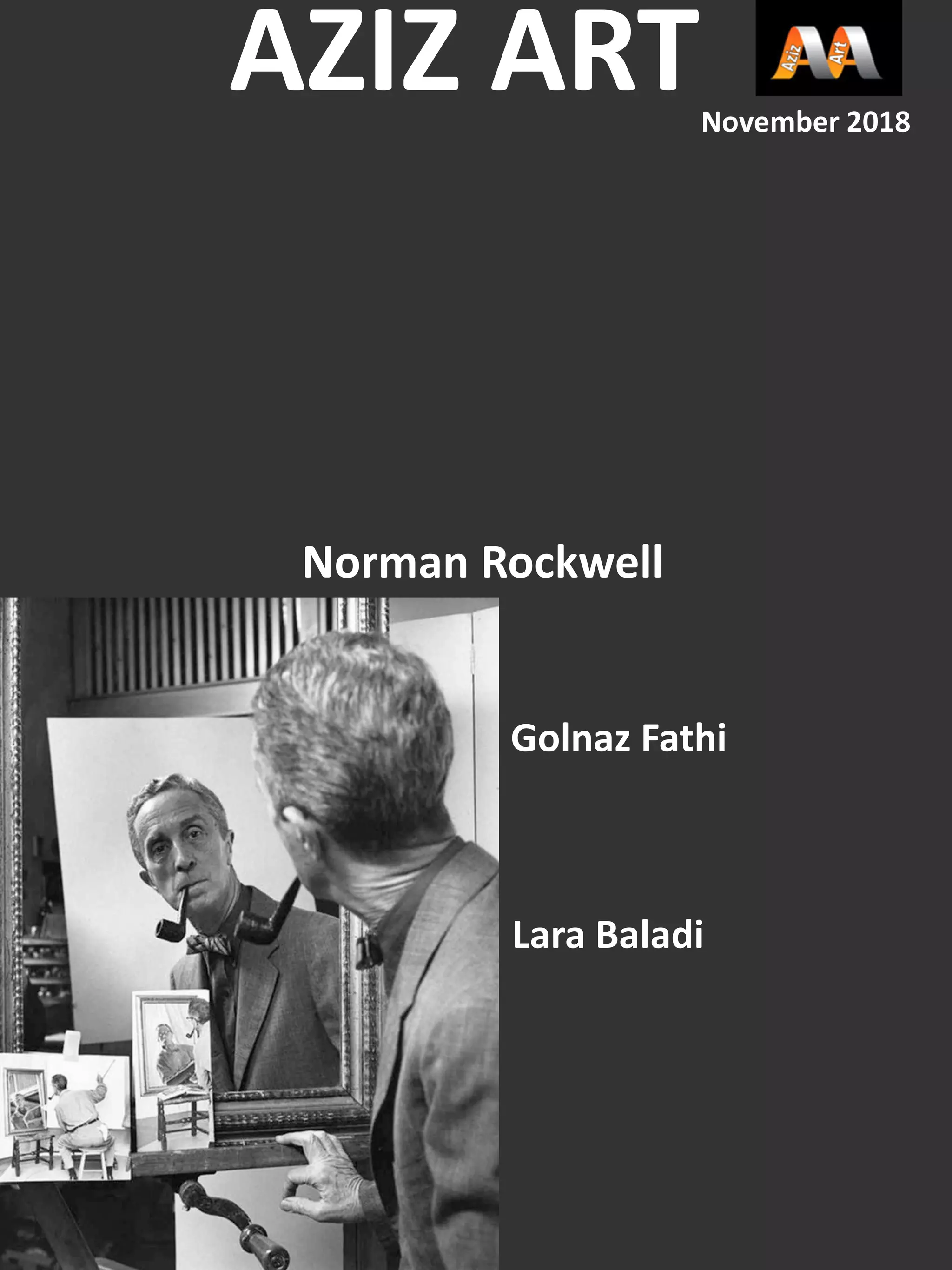
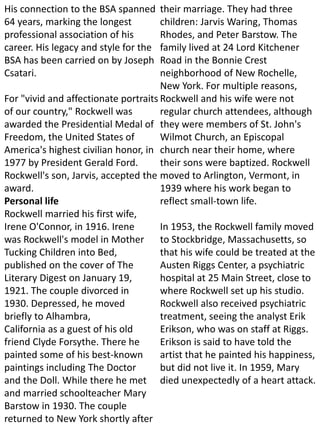
Norman Rockwell
Golnaz Fathi
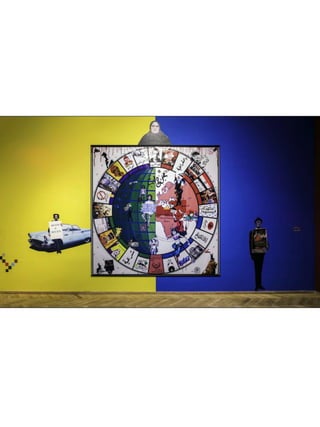
Lara Baladi
AZIZ ARTNovember 2018
1-Norman Rockwell
9-Golnaz Fathi
12-Competition
13-Lara Baladi
Director: Aziz Anzabi
Editor : Nafiseh Yaghoubi
Translator : Asra Yaghoubi
Research: Zohreh Nazari
http://www.aziz_anzabi.com
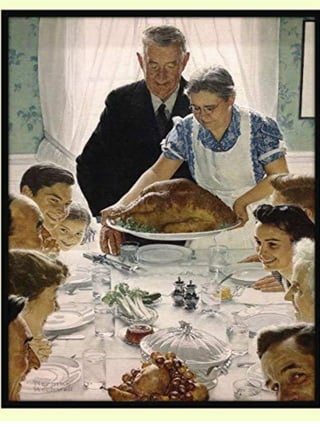
Norman Percevel Rockwell
(February 3, 1894 – November 8,
1978) was an American author,
painter and illustrator. His works
have a broad popular appeal in
the United States for their
reflection of American culture.
Rockwell is most famous for the
cover illustrations of everyday life
he created for The Saturday
Evening Post magazine over
nearly five decades. Among the
best-known of Rockwell's
works are
the Willie Gillis series, Rosie the
Riveter, The Problem We All Live
With, Saying Grace, and the Four
Freedoms series. He is also noted
for his 64-year relationship
with the Boy Scouts of America
(BSA), during which he produced
covers for their publication Boys'
Life, calendars, and other
illustrations. These works include
popular images that reflect the
Scout Oath and Scout Law such as
The Scoutmaster, A Scout is
Reverent and A Guiding
Hand,among many others.
Norman Rockwell was a prolific
artist, producing more than 4,000
original works in his lifetime. Most
of his works are either in public
collections, or have been destroyed
in fire or other misfortunes.
Rockwell was also commissioned to
illustrate more than 40 books,
including Tom Sawyer and
Huckleberry Finn as well as painting
the portraits for Presidents
Eisenhower, Kennedy, Johnson, and
Nixon, as well as those of foreign
figures, including Gamal Abdel
Nasser and Jawaharlal Nehru. His
portrait subjects included Judy
Garland. One of his last portraits
was of Colonel Sanders in 1973. His
annual contributions for the Boy
Scouts calendars between 1925 and
1976 (Rockwell was a 1939
recipient of the Silver Buffalo
Award, the highest adult award
given by the Boy Scouts of
America), were only slightly
overshadowed by his most popular
of calendar works: the "Four
Seasons" illustrations for Brown &
Bigelow that were published for 17
years beginning in 1947 and
reproduced in various styles and
sizes since 1964.
1
He painted six images for
Coca-Cola advertising.Illustrations
for booklets, catalogs, posters
(particularly movie promotions),
sheet music, stamps, playing cards,
and murals (including "Yankee
Doodle Dandy" and "God Bless the
Hills", which was completed in
1936 for the Nassau Inn in
Princeton, New Jersey) rounded
out Rockwell's œuvre as an
illustrator.
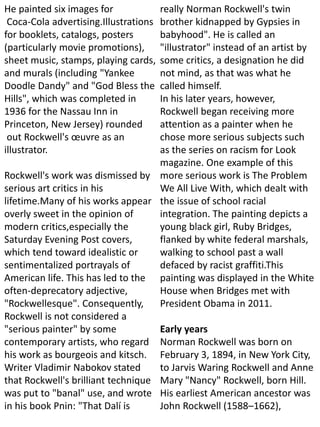
Rockwell's work was dismissed by
serious art critics in his
lifetime.Many of his works appear
overly sweet in the opinion of
modern critics,especially the
Saturday Evening Post covers,
which tend toward idealistic or
sentimentalized portrayals of
American life. This has led to the
often-deprecatory adjective,
"Rockwellesque". Consequently,
Rockwell is not considered a
"serious painter" by some
contemporary artists, who regard
his work as bourgeois and kitsch.
Writer Vladimir Nabokov stated
that Rockwell's brilliant technique
was put to "banal" use, and wrote
in his book Pnin: "That Dalí is
really Norman Rockwell's twin
brother kidnapped by Gypsies in
babyhood". He is called an
"illustrator" instead of an artist by
some critics, a designation he did
not mind, as that was what he
called himself.
In his later years, however,
Rockwell began receiving more
attention as a painter when he
chose more serious subjects such
as the series on racism for Look
magazine. One example of this
more serious work is The Problem
We All Live With, which dealt with
the issue of school racial
integration. The painting depicts a
young black girl, Ruby Bridges,
flanked by white federal marshals,
walking to school past a wall
defaced by racist graffiti.This
painting was displayed in the White
House when Bridges met with
President Obama in 2011.
Early years
Norman Rockwell was born on
February 3, 1894, in New York City,
to Jarvis Waring Rockwell and Anne
Mary "Nancy" Rockwell, born Hill.
His earliest American ancestor was
John Rockwell (1588–1662),
from Somerset, England, who
immigrated to colonial North
America, probably in 1635,
aboard the ship Hopewell and
became one of the first settlers of
Windsor, Connecticut.
He had one brother,
Jarvis Waring Rockwell, Jr.,
older by a year and a half.Jarvis
Waring, Sr., was the manager
of the New York office of a
Philadelphia textile firm, George
Wood, Sons & Company, where he
spent his entire career.
Rockwell transferred from high
school to the Chase Art School at
the age of 14. He then went on to
the National Academy of Design
and finally to the Art Students
League. There, he was taught by
Thomas Fogarty,
George Bridgman, and Frank
Vincent DuMond; his early works
were produced for St. Nicholas
Magazine, the Boy Scouts of
America (BSA) publication Boys'
Life, and other youth publications.
As a student, Rockwell was given
small jobs of minor importance.
His first major breakthrough
came at age 18 with his first book
illustration for Carl H. Claudy's Tell
Me Why:
Stories about Mother Nature.
After that, Rockwell was hired as a
staff artist for Boys' Life magazine.
In this role, he received 50 dollars'
compensation each month for one
completed cover and a set of story
illustrations. It is said to have been
his first paying job as an artist. At
19, he became the art editor for
Boys' Life, published by the Boy
Scouts of America. He held the job
for three years, during which he
painted several covers, beginning
with his first published magazine
cover, Scout at Ship's Wheel, which
appeared on the Boys' Life
September edition.
Painting years
Rockwell's family moved to New
Rochelle, New York, when Norman
was 21 years old. They shared a
studio with the cartoonist Clyde
Forsythe, who worked for The
Saturday Evening Post. With
Forsythe's help, Rockwell submitted
his first successful cover painting to
the Post in 1916, Mother's Day Off
(published on May 20).
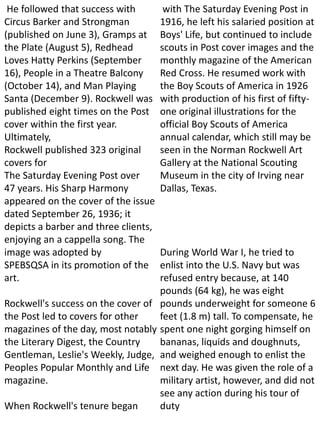
He followed that success with
Circus Barker and Strongman
(published on June 3), Gramps at
the Plate (August 5), Redhead
Loves Hatty Perkins (September
16), People in a Theatre Balcony
(October 14), and Man Playing
Santa (December 9). Rockwell was
published eight times on the Post
cover within the first year.
Ultimately,
Rockwell published 323 original
covers for
The Saturday Evening Post over
47 years. His Sharp Harmony
appeared on the cover of the issue
dated September 26, 1936; it
depicts a barber and three clients,
enjoying an a cappella song. The
image was adopted by
SPEBSQSA in its promotion of the
art.
Rockwell's success on the cover of
the Post led to covers for other
magazines of the day, most notably
the Literary Digest, the Country
Gentleman, Leslie's Weekly, Judge,
Peoples Popular Monthly and Life
magazine.
When Rockwell's tenure began
with The Saturday Evening Post in
1916, he left his salaried position at
Boys' Life, but continued to include
scouts in Post cover images and the
monthly magazine of the American
Red Cross. He resumed work with
the Boy Scouts of America in 1926
with production of his first of fifty-
one original illustrations for the
official Boy Scouts of America
annual calendar, which still may be
seen in the Norman Rockwell Art
Gallery at the National Scouting
Museum in the city of Irving near
Dallas, Texas.
During World War I, he tried to
enlist into the U.S. Navy but was
refused entry because, at 140
pounds (64 kg), he was eight
pounds underweight for someone 6
feet (1.8 m) tall. To compensate, he
spent one night gorging himself on
bananas, liquids and doughnuts,
and weighed enough to enlist the
next day. He was given the role of a
military artist, however, and did not
see any action during his tour of
duty
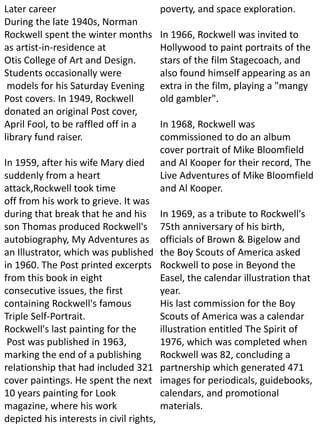
Later career
During the late 1940s, Norman
Rockwell spent the winter months
as artist-in-residence at
Otis College of Art and Design.
Students occasionally were
models for his Saturday Evening
Post covers. In 1949, Rockwell
donated an original Post cover,
April Fool, to be raffled off in a
library fund raiser.
In 1959, after his wife Mary died
suddenly from a heart
attack,Rockwell took time
off from his work to grieve. It was
during that break that he and his
son Thomas produced Rockwell's
autobiography, My Adventures as
an Illustrator, which was published
in 1960. The Post printed excerpts
from this book in eight
consecutive issues, the first
containing Rockwell's famous
Triple Self-Portrait.
Rockwell's last painting for the
Post was published in 1963,
marking the end of a publishing
relationship that had included 321
cover paintings. He spent the next
10 years painting for Look
magazine, where his work
depicted his interests in civil rights,
poverty, and space exploration.
In 1966, Rockwell was invited to
Hollywood to paint portraits of the
stars of the film Stagecoach, and
also found himself appearing as an
extra in the film, playing a "mangy
old gambler".
In 1968, Rockwell was
commissioned to do an album
cover portrait of Mike Bloomfield
and Al Kooper for their record, The
Live Adventures of Mike Bloomfield
and Al Kooper.
In 1969, as a tribute to Rockwell's
75th anniversary of his birth,
officials of Brown & Bigelow and
the Boy Scouts of America asked
Rockwell to pose in Beyond the
Easel, the calendar illustration that
year.
His last commission for the Boy
Scouts of America was a calendar
illustration entitled The Spirit of
1976, which was completed when
Rockwell was 82, concluding a
partnership which generated 471
images for periodicals, guidebooks,
calendars, and promotional
materials.
His connection to the BSA spanned
64 years, marking the longest
professional association of his
career. His legacy and style for the
BSA has been carried on by Joseph
Csatari.
For "vivid and affectionate portraits
of our country," Rockwell was
awarded the Presidential Medal of
Freedom, the United States of
America's highest civilian honor, in
1977 by President Gerald Ford.
Rockwell's son, Jarvis, accepted the
award.
Personal life
Rockwell married his first wife,
Irene O'Connor, in 1916. Irene
was Rockwell's model in Mother
Tucking Children into Bed,
published on the cover of The
Literary Digest on January 19,
1921. The couple divorced in
1930. Depressed, he moved
briefly to Alhambra,
California as a guest of his old
friend Clyde Forsythe. There he
painted some of his best-known
paintings including The Doctor
and the Doll. While there he met
and married schoolteacher Mary
Barstow in 1930. The couple
returned to New York shortly after
their marriage. They had three
children: Jarvis Waring, Thomas
Rhodes, and Peter Barstow. The
family lived at 24 Lord Kitchener
Road in the Bonnie Crest
neighborhood of New Rochelle,
New York. For multiple reasons,
Rockwell and his wife were not
regular church attendees, although
they were members of St. John's
Wilmot Church, an Episcopal
church near their home, where
their sons were baptized. Rockwell
moved to Arlington, Vermont, in
1939 where his work began to
reflect small-town life.
In 1953, the Rockwell family moved
to Stockbridge, Massachusetts, so
that his wife could be treated at the
Austen Riggs Center, a psychiatric
hospital at 25 Main Street, close to
where Rockwell set up his studio.
Rockwell also received psychiatric
treatment, seeing the analyst Erik
Erikson, who was on staff at Riggs.
Erikson is said to have told the
artist that he painted his happiness,
but did not live it. In 1959, Mary
died unexpectedly of a heart attack.
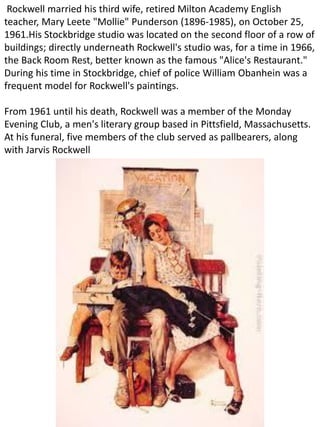
Rockwell married his third wife, retired Milton Academy English
teacher, Mary Leete "Mollie" Punderson (1896-1985), on October 25,
1961.His Stockbridge studio was located on the second floor of a row of
buildings; directly underneath Rockwell's studio was, for a time in 1966,
the Back Room Rest, better known as the famous "Alice's Restaurant."
During his time in Stockbridge, chief of police William Obanhein was a
frequent model for Rockwell's paintings.
From 1961 until his death, Rockwell was a member of the Monday
Evening Club, a men's literary group based in Pittsfield, Massachusetts.
At his funeral, five members of the club served as pallbearers, along
with Jarvis Rockwell
9
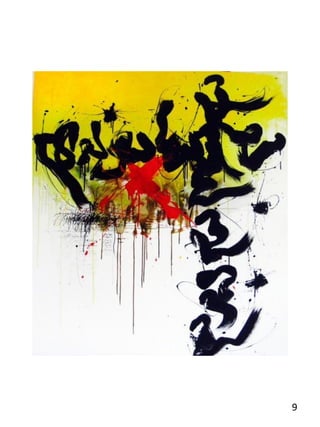
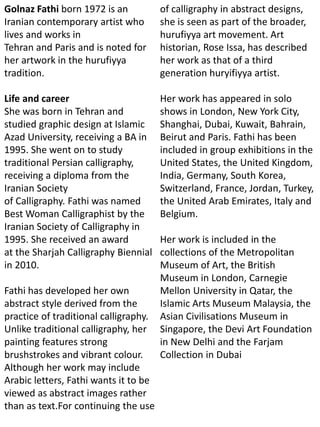
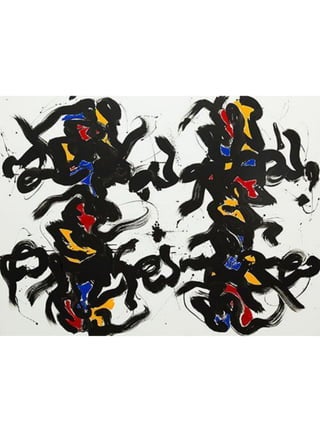
Golnaz Fathi born 1972 is an
Iranian contemporary artist who
lives and works in
Tehran and Paris and is noted for
her artwork in the hurufiyya
tradition.
Life and career
She was born in Tehran and
studied graphic design at Islamic
Azad University, receiving a BA in
1995. She went on to study
traditional Persian calligraphy,
receiving a diploma from the
Iranian Society
of Calligraphy. Fathi was named
Best Woman Calligraphist by the
Iranian Society of Calligraphy in
1995. She received an award
at the Sharjah Calligraphy Biennial
in 2010.
Fathi has developed her own
abstract style derived from the
practice of traditional calligraphy.
Unlike traditional calligraphy, her
painting features strong
brushstrokes and vibrant colour.
Although her work may include
Arabic letters, Fathi wants it to be
viewed as abstract images rather
than as text.For continuing the use
of calligraphy in abstract designs,
she is seen as part of the broader,
hurufiyya art movement. Art
historian, Rose Issa, has described
her work as that of a third
generation huryifiyya artist.
Her work has appeared in solo
shows in London, New York City,
Shanghai, Dubai, Kuwait, Bahrain,
Beirut and Paris. Fathi has been
included in group exhibitions in the
United States, the United Kingdom,
India, Germany, South Korea,
Switzerland, France, Jordan, Turkey,
the United Arab Emirates, Italy and
Belgium.
Her work is included in the
collections of the Metropolitan
Museum of Art, the British
Museum in London, Carnegie
Mellon University in Qatar, the
Islamic Arts Museum Malaysia, the
Asian Civilisations Museum in
Singapore, the Devi Art Foundation
in New Delhi and the Farjam
Collection in Dubai
12
13
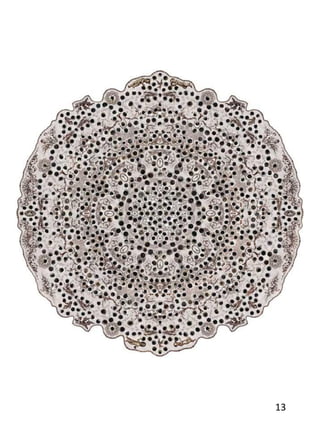
Lara Baladi born 1969 in Beirut,
Lebanon is an acclaimed Egyptian-
Lebanese photographer, archivist
and multimedia artist. She was
educated in Paris and London and
currently lives in Cairo. Baladi
exhibits and publishes worldwide.
Her body of work encompasses
photography, video, visual
montages/collages, installations,
architectural constructions,
tapestries, sculptures and even
perfume.Much of her work
reflects her "concerns with
Egypt's extremely alarming
sociopolitical context.
Work
Since 1997, she has been a
member of the Arab Image
Foundation (AIF), for which she
directs magazine editorials and
curates exhibitions and artist
residencies.She curated the artist
residency Fenenin el Rehal
(Nomadic Artists) in Egypt's White
Desert in 2006 and participated in
workshops and conferences
around the world. Baladi is
represented by the Townhouse
Gallery of Contemporary Art in
Cairo and IVDE Gallery in Dubai.
Baladi received a Japan Foundation
Fellowship in 2003 to research
manga and anime in Tokyo. Among
other global locations, she
participated in the VASL residency
program in Karachi, Pakistan in
2010. The breadth and variety of
Baladi’s international experience
influences her use of iconography
drawn from numerous cultures.
Photo-montage
In 2000, she participated in The
Desert, a group exhibition at
Fondation Cartier in Paris with Om
El Dounia (Mother of the World), a
vast mosaic of photographs with
highly saturated colors.This piece,
while playful and with many
references to pop culture, is also an
exploration of the Biblical story of
creation.
In 2007, Baladi presented a work
called Justice for the Mother, which
depicts leaders of Arab countries.
She considers it part of a series she
calls "anthropological
photography," where she
assembles series of photographs
that tell a larger story. In this piece,
Baladi draws from influences from
both Western and Islamic
traditions, creating "fantastical,
playful surveys of history, culture
and personal reflection."
Sandouk el Dounia is a huge
composition of hundreds of
scanned photographs. The name
of the piece references traditional
street theater for children in
Cairo.Sandouk was presented in
2009 at the Queens Museum of
Art's group exhibition
Tarjama/Translationand in 2011 at
the Venice Biennial's group show
Penelope’s Labor: Weaving Words
and Images. Reviewers called it "a
giant tapestry version of a photo
collage packed with images of
action heroines"
Installations
An enormous installation titled
"Al Fanous el Sehryn" (the Magic
Lantern) was shown at the
Townhouse Gallery in Cairo in
2003. The work consists of "a large
eight-pointed star constructed of
steel--approximately 23 feet in
diameter--and a series of light
boxes containing saturated
colored images produced from x-
ray
giving birth".[16] The art suggests a
cyclical nature where the images of
the doll endlessly grow up and then
giving birth over and over. The star
shape was inspired by the
chandeliers which hang in the
mosque of Mohammed Ali in the
Cairo Citadel.
Her installation Roba Vecchia was
presented in 2006 at the
Townhouse Gallery in Cairo, in 2007
at the Sharjah Biennal and in 2009
at Arabesques, an exhibition of
Arab contemporary art at the
Kennedy Center in Washington and
described as a "human-scale
kaleidoscope", that "incorporated
images from pop culture, then
shattered them in constantly
changing geometries", and in which
"the participant becomes
immersed in a psychedelic
environment where rapidly yet
systematically changing imagery
engulfs the viewer".
Borg el Amal (Tower of Hope), an
ephemeral construction and sound
installation, won the Grand Nile
Award at the 2008/2009 Cairo
Biennale.
The inspiration for the tower
comes from the
slums surrounding Cairo known as
ashwa'iyat (haphazard things).
Her own tower in Borg el Amal
was constructed of similar
materials to the ashwa'iyat and
allowed the audience to experience
music under the oper sky.
The entire installation is a
challenge to "the censorship of
the Mubarak era and addressed
the state's ignorance of
[that social plight]," which Baladi
saw as a problem which she
likened to a "ticking bomb about
to explode."She commissioned
the Kiev Kamera Orchestra to
perform the Donkey Symphony,
Borg el Amal’s sound component,
at the first Kiev Biennial in 2012.
Coffee cups, presented in 2010 at
Gallery Isabelle van den Eynde in
Dubai has been considered both
"playful" and inviting the viewer
"into a world of contemplation
and reflection".
Tahrir
During the Egyptian Revolution of
2011, Baladi co-founded two
media initiatives: Radio Tahrir and
Tahrir Cinema. Both projects were
inspired and informed by the
eighteen days that toppled
Egyptian leader, Hosni Mubarak’s,
leadership.
Radio Tahrir came about when
Baladi and her friends, along with
other like-minded people, started
importing the equipment needed
to start a pirate radio station.Radio
Tahrir was the first free online radio
in Egypt.
Tahrir Cinema was co-founded with
Mosireen, an Egyptian non-profit
media initiative.The project served
as a public platform to build and
share a video archive on and for the
revolution. The impetus to create
Tahrir Cinema came from the chaos
surrounding the second sit-in in
Tahrir: "People were screaming and
shouting on stages into
microphones," she says, "there was
so much diffused information
floating around, but no focus." Her
training as a visual artist helped her
organize, show and share
documents relating to the
revolution using these platforms.
Tahrir Cinema went live on
July 14, 2011.The public
experienced
Tahrir Cinema as film shown on a
screen constructed of wood and
plastic in the main thoroughfare
of the square. Surrounding the
screen were rugs for people to sit
on and areas for a larger standing
crowd to view the footage. Lara
Baladi created a collection of
footage that included videos shot
by activists directly involved in the
revolution.She was very broad in
her collecting, even showing
"solidarity protests"
from London.Being able to view
and experience images and
video taken by citizens in Egypt
was an abrupt break with
Mubarak's regime, where
photography was prohibited in
many areas of Egypt.Baladi writes,
"people in the square took photos
because they felt the social
responsibility to do so...
The camera became a
nonviolent weapon aimed directly
at the state, denouncing it.
Continuing work
Baladi received a Fellowship from
the Massachusetts Institute of
Technology's (MIT) Open
Documentary Lab for 2014 and
2015 in order to research, archive
and create a transmedia activism
project called Vox Populi, Archiving
a Revolution in the Digital Age.Vox
Populi is a multimedia
documentary that consists of an
archive of articles, images and
videos that Baladi had been
gathering since January 25,
2011.Preserving the ephemera and
the images of the revolution in
Tahrir is important to Baladi.
She writes that "most of the
images of the 18 days vanishing
into a bottomless pit thanks to
Google's PageRank algorithm, will
the vision of a possible new world
people glimpsed in [Tahrir] Square
die along with its digital traces?"
This expression of the fleeting
nature of the digital world informs
her current work.
Selected solo exhibitions
2015 Perspectives, Arthur M. Sackler Gallery, Washington, DC, USA
2011 Hope, NY Abu Dhabi University Gallery, New York City, NY, USA
2010 Diary of the Future, Gallery Isabelle Van Den Eynde, Dubai, UAE
2008 Surface of Time, B21 Art Gallery, Dubai, UAE
2006 Towards the Light, 20 screen projections along one kilometer of
the seashore on opening night of Image of the Middle
East Festival, Copenhagen International Theatre, Denmark
Roba Vecchia, Townhouse Gallery of Contemporary Art, Cairo, Egypt
2004-6 Kai’ro Lansmuseet, Vasternorrland, Harnosand, Sweden, 2005-6
Nikolai, Copenhagen Contemporary Art Centre, Denmark, 2005 Pori
Museum, Pori, Finland, 2005
Bilmuseet, Umea, Sweden, 2004
2002 Al Fanous Al Sehry, Townhouse Gallery of Contemporary Art,
Cairo, Egypt
2001 Sandouk Al Dounia
El Nitaq Festival, Cairo, Egypt Ashkal Alwan, Beirut, Lebanon
NASIR OL MOLK MOSQUE, SHIRAZ,
IRAN
http://www.aziz_anzabi.com

Aziz art november 2018

  • 1.
    Norman Rockwell Golnaz Fathi LaraBaladi AZIZ ARTNovember 2018
  • 2.
    1-Norman Rockwell 9-Golnaz Fathi 12-Competition 13-LaraBaladi Director: Aziz Anzabi Editor : Nafiseh Yaghoubi Translator : Asra Yaghoubi Research: Zohreh Nazari http://www.aziz_anzabi.com
  • 3.
    Norman Percevel Rockwell (February3, 1894 – November 8, 1978) was an American author, painter and illustrator. His works have a broad popular appeal in the United States for their reflection of American culture. Rockwell is most famous for the cover illustrations of everyday life he created for The Saturday Evening Post magazine over nearly five decades. Among the best-known of Rockwell's works are the Willie Gillis series, Rosie the Riveter, The Problem We All Live With, Saying Grace, and the Four Freedoms series. He is also noted for his 64-year relationship with the Boy Scouts of America (BSA), during which he produced covers for their publication Boys' Life, calendars, and other illustrations. These works include popular images that reflect the Scout Oath and Scout Law such as The Scoutmaster, A Scout is Reverent and A Guiding Hand,among many others. Norman Rockwell was a prolific artist, producing more than 4,000 original works in his lifetime. Most of his works are either in public collections, or have been destroyed in fire or other misfortunes. Rockwell was also commissioned to illustrate more than 40 books, including Tom Sawyer and Huckleberry Finn as well as painting the portraits for Presidents Eisenhower, Kennedy, Johnson, and Nixon, as well as those of foreign figures, including Gamal Abdel Nasser and Jawaharlal Nehru. His portrait subjects included Judy Garland. One of his last portraits was of Colonel Sanders in 1973. His annual contributions for the Boy Scouts calendars between 1925 and 1976 (Rockwell was a 1939 recipient of the Silver Buffalo Award, the highest adult award given by the Boy Scouts of America), were only slightly overshadowed by his most popular of calendar works: the "Four Seasons" illustrations for Brown & Bigelow that were published for 17 years beginning in 1947 and reproduced in various styles and sizes since 1964. 1
  • 5.
    He painted siximages for Coca-Cola advertising.Illustrations for booklets, catalogs, posters (particularly movie promotions), sheet music, stamps, playing cards, and murals (including "Yankee Doodle Dandy" and "God Bless the Hills", which was completed in 1936 for the Nassau Inn in Princeton, New Jersey) rounded out Rockwell's œuvre as an illustrator. Rockwell's work was dismissed by serious art critics in his lifetime.Many of his works appear overly sweet in the opinion of modern critics,especially the Saturday Evening Post covers, which tend toward idealistic or sentimentalized portrayals of American life. This has led to the often-deprecatory adjective, "Rockwellesque". Consequently, Rockwell is not considered a "serious painter" by some contemporary artists, who regard his work as bourgeois and kitsch. Writer Vladimir Nabokov stated that Rockwell's brilliant technique was put to "banal" use, and wrote in his book Pnin: "That Dalí is really Norman Rockwell's twin brother kidnapped by Gypsies in babyhood". He is called an "illustrator" instead of an artist by some critics, a designation he did not mind, as that was what he called himself. In his later years, however, Rockwell began receiving more attention as a painter when he chose more serious subjects such as the series on racism for Look magazine. One example of this more serious work is The Problem We All Live With, which dealt with the issue of school racial integration. The painting depicts a young black girl, Ruby Bridges, flanked by white federal marshals, walking to school past a wall defaced by racist graffiti.This painting was displayed in the White House when Bridges met with President Obama in 2011. Early years Norman Rockwell was born on February 3, 1894, in New York City, to Jarvis Waring Rockwell and Anne Mary "Nancy" Rockwell, born Hill. His earliest American ancestor was John Rockwell (1588–1662),
  • 6.
    from Somerset, England,who immigrated to colonial North America, probably in 1635, aboard the ship Hopewell and became one of the first settlers of Windsor, Connecticut. He had one brother, Jarvis Waring Rockwell, Jr., older by a year and a half.Jarvis Waring, Sr., was the manager of the New York office of a Philadelphia textile firm, George Wood, Sons & Company, where he spent his entire career. Rockwell transferred from high school to the Chase Art School at the age of 14. He then went on to the National Academy of Design and finally to the Art Students League. There, he was taught by Thomas Fogarty, George Bridgman, and Frank Vincent DuMond; his early works were produced for St. Nicholas Magazine, the Boy Scouts of America (BSA) publication Boys' Life, and other youth publications. As a student, Rockwell was given small jobs of minor importance. His first major breakthrough came at age 18 with his first book illustration for Carl H. Claudy's Tell Me Why: Stories about Mother Nature. After that, Rockwell was hired as a staff artist for Boys' Life magazine. In this role, he received 50 dollars' compensation each month for one completed cover and a set of story illustrations. It is said to have been his first paying job as an artist. At 19, he became the art editor for Boys' Life, published by the Boy Scouts of America. He held the job for three years, during which he painted several covers, beginning with his first published magazine cover, Scout at Ship's Wheel, which appeared on the Boys' Life September edition. Painting years Rockwell's family moved to New Rochelle, New York, when Norman was 21 years old. They shared a studio with the cartoonist Clyde Forsythe, who worked for The Saturday Evening Post. With Forsythe's help, Rockwell submitted his first successful cover painting to the Post in 1916, Mother's Day Off (published on May 20).
  • 7.
    He followed thatsuccess with Circus Barker and Strongman (published on June 3), Gramps at the Plate (August 5), Redhead Loves Hatty Perkins (September 16), People in a Theatre Balcony (October 14), and Man Playing Santa (December 9). Rockwell was published eight times on the Post cover within the first year. Ultimately, Rockwell published 323 original covers for The Saturday Evening Post over 47 years. His Sharp Harmony appeared on the cover of the issue dated September 26, 1936; it depicts a barber and three clients, enjoying an a cappella song. The image was adopted by SPEBSQSA in its promotion of the art. Rockwell's success on the cover of the Post led to covers for other magazines of the day, most notably the Literary Digest, the Country Gentleman, Leslie's Weekly, Judge, Peoples Popular Monthly and Life magazine. When Rockwell's tenure began with The Saturday Evening Post in 1916, he left his salaried position at Boys' Life, but continued to include scouts in Post cover images and the monthly magazine of the American Red Cross. He resumed work with the Boy Scouts of America in 1926 with production of his first of fifty- one original illustrations for the official Boy Scouts of America annual calendar, which still may be seen in the Norman Rockwell Art Gallery at the National Scouting Museum in the city of Irving near Dallas, Texas. During World War I, he tried to enlist into the U.S. Navy but was refused entry because, at 140 pounds (64 kg), he was eight pounds underweight for someone 6 feet (1.8 m) tall. To compensate, he spent one night gorging himself on bananas, liquids and doughnuts, and weighed enough to enlist the next day. He was given the role of a military artist, however, and did not see any action during his tour of duty
  • 8.
    Later career During thelate 1940s, Norman Rockwell spent the winter months as artist-in-residence at Otis College of Art and Design. Students occasionally were models for his Saturday Evening Post covers. In 1949, Rockwell donated an original Post cover, April Fool, to be raffled off in a library fund raiser. In 1959, after his wife Mary died suddenly from a heart attack,Rockwell took time off from his work to grieve. It was during that break that he and his son Thomas produced Rockwell's autobiography, My Adventures as an Illustrator, which was published in 1960. The Post printed excerpts from this book in eight consecutive issues, the first containing Rockwell's famous Triple Self-Portrait. Rockwell's last painting for the Post was published in 1963, marking the end of a publishing relationship that had included 321 cover paintings. He spent the next 10 years painting for Look magazine, where his work depicted his interests in civil rights, poverty, and space exploration. In 1966, Rockwell was invited to Hollywood to paint portraits of the stars of the film Stagecoach, and also found himself appearing as an extra in the film, playing a "mangy old gambler". In 1968, Rockwell was commissioned to do an album cover portrait of Mike Bloomfield and Al Kooper for their record, The Live Adventures of Mike Bloomfield and Al Kooper. In 1969, as a tribute to Rockwell's 75th anniversary of his birth, officials of Brown & Bigelow and the Boy Scouts of America asked Rockwell to pose in Beyond the Easel, the calendar illustration that year. His last commission for the Boy Scouts of America was a calendar illustration entitled The Spirit of 1976, which was completed when Rockwell was 82, concluding a partnership which generated 471 images for periodicals, guidebooks, calendars, and promotional materials.
  • 9.
    His connection tothe BSA spanned 64 years, marking the longest professional association of his career. His legacy and style for the BSA has been carried on by Joseph Csatari. For "vivid and affectionate portraits of our country," Rockwell was awarded the Presidential Medal of Freedom, the United States of America's highest civilian honor, in 1977 by President Gerald Ford. Rockwell's son, Jarvis, accepted the award. Personal life Rockwell married his first wife, Irene O'Connor, in 1916. Irene was Rockwell's model in Mother Tucking Children into Bed, published on the cover of The Literary Digest on January 19, 1921. The couple divorced in 1930. Depressed, he moved briefly to Alhambra, California as a guest of his old friend Clyde Forsythe. There he painted some of his best-known paintings including The Doctor and the Doll. While there he met and married schoolteacher Mary Barstow in 1930. The couple returned to New York shortly after their marriage. They had three children: Jarvis Waring, Thomas Rhodes, and Peter Barstow. The family lived at 24 Lord Kitchener Road in the Bonnie Crest neighborhood of New Rochelle, New York. For multiple reasons, Rockwell and his wife were not regular church attendees, although they were members of St. John's Wilmot Church, an Episcopal church near their home, where their sons were baptized. Rockwell moved to Arlington, Vermont, in 1939 where his work began to reflect small-town life. In 1953, the Rockwell family moved to Stockbridge, Massachusetts, so that his wife could be treated at the Austen Riggs Center, a psychiatric hospital at 25 Main Street, close to where Rockwell set up his studio. Rockwell also received psychiatric treatment, seeing the analyst Erik Erikson, who was on staff at Riggs. Erikson is said to have told the artist that he painted his happiness, but did not live it. In 1959, Mary died unexpectedly of a heart attack.
  • 10.
    Rockwell married histhird wife, retired Milton Academy English teacher, Mary Leete "Mollie" Punderson (1896-1985), on October 25, 1961.His Stockbridge studio was located on the second floor of a row of buildings; directly underneath Rockwell's studio was, for a time in 1966, the Back Room Rest, better known as the famous "Alice's Restaurant." During his time in Stockbridge, chief of police William Obanhein was a frequent model for Rockwell's paintings. From 1961 until his death, Rockwell was a member of the Monday Evening Club, a men's literary group based in Pittsfield, Massachusetts. At his funeral, five members of the club served as pallbearers, along with Jarvis Rockwell
  • 11.
  • 12.
    Golnaz Fathi born1972 is an Iranian contemporary artist who lives and works in Tehran and Paris and is noted for her artwork in the hurufiyya tradition. Life and career She was born in Tehran and studied graphic design at Islamic Azad University, receiving a BA in 1995. She went on to study traditional Persian calligraphy, receiving a diploma from the Iranian Society of Calligraphy. Fathi was named Best Woman Calligraphist by the Iranian Society of Calligraphy in 1995. She received an award at the Sharjah Calligraphy Biennial in 2010. Fathi has developed her own abstract style derived from the practice of traditional calligraphy. Unlike traditional calligraphy, her painting features strong brushstrokes and vibrant colour. Although her work may include Arabic letters, Fathi wants it to be viewed as abstract images rather than as text.For continuing the use of calligraphy in abstract designs, she is seen as part of the broader, hurufiyya art movement. Art historian, Rose Issa, has described her work as that of a third generation huryifiyya artist. Her work has appeared in solo shows in London, New York City, Shanghai, Dubai, Kuwait, Bahrain, Beirut and Paris. Fathi has been included in group exhibitions in the United States, the United Kingdom, India, Germany, South Korea, Switzerland, France, Jordan, Turkey, the United Arab Emirates, Italy and Belgium. Her work is included in the collections of the Metropolitan Museum of Art, the British Museum in London, Carnegie Mellon University in Qatar, the Islamic Arts Museum Malaysia, the Asian Civilisations Museum in Singapore, the Devi Art Foundation in New Delhi and the Farjam Collection in Dubai
  • 14.
  • 15.
  • 16.
    Lara Baladi born1969 in Beirut, Lebanon is an acclaimed Egyptian- Lebanese photographer, archivist and multimedia artist. She was educated in Paris and London and currently lives in Cairo. Baladi exhibits and publishes worldwide. Her body of work encompasses photography, video, visual montages/collages, installations, architectural constructions, tapestries, sculptures and even perfume.Much of her work reflects her "concerns with Egypt's extremely alarming sociopolitical context. Work Since 1997, she has been a member of the Arab Image Foundation (AIF), for which she directs magazine editorials and curates exhibitions and artist residencies.She curated the artist residency Fenenin el Rehal (Nomadic Artists) in Egypt's White Desert in 2006 and participated in workshops and conferences around the world. Baladi is represented by the Townhouse Gallery of Contemporary Art in Cairo and IVDE Gallery in Dubai. Baladi received a Japan Foundation Fellowship in 2003 to research manga and anime in Tokyo. Among other global locations, she participated in the VASL residency program in Karachi, Pakistan in 2010. The breadth and variety of Baladi’s international experience influences her use of iconography drawn from numerous cultures. Photo-montage In 2000, she participated in The Desert, a group exhibition at Fondation Cartier in Paris with Om El Dounia (Mother of the World), a vast mosaic of photographs with highly saturated colors.This piece, while playful and with many references to pop culture, is also an exploration of the Biblical story of creation. In 2007, Baladi presented a work called Justice for the Mother, which depicts leaders of Arab countries. She considers it part of a series she calls "anthropological photography," where she assembles series of photographs that tell a larger story. In this piece,
  • 17.
    Baladi draws frominfluences from both Western and Islamic traditions, creating "fantastical, playful surveys of history, culture and personal reflection." Sandouk el Dounia is a huge composition of hundreds of scanned photographs. The name of the piece references traditional street theater for children in Cairo.Sandouk was presented in 2009 at the Queens Museum of Art's group exhibition Tarjama/Translationand in 2011 at the Venice Biennial's group show Penelope’s Labor: Weaving Words and Images. Reviewers called it "a giant tapestry version of a photo collage packed with images of action heroines" Installations An enormous installation titled "Al Fanous el Sehryn" (the Magic Lantern) was shown at the Townhouse Gallery in Cairo in 2003. The work consists of "a large eight-pointed star constructed of steel--approximately 23 feet in diameter--and a series of light boxes containing saturated colored images produced from x- ray giving birth".[16] The art suggests a cyclical nature where the images of the doll endlessly grow up and then giving birth over and over. The star shape was inspired by the chandeliers which hang in the mosque of Mohammed Ali in the Cairo Citadel. Her installation Roba Vecchia was presented in 2006 at the Townhouse Gallery in Cairo, in 2007 at the Sharjah Biennal and in 2009 at Arabesques, an exhibition of Arab contemporary art at the Kennedy Center in Washington and described as a "human-scale kaleidoscope", that "incorporated images from pop culture, then shattered them in constantly changing geometries", and in which "the participant becomes immersed in a psychedelic environment where rapidly yet systematically changing imagery engulfs the viewer". Borg el Amal (Tower of Hope), an ephemeral construction and sound installation, won the Grand Nile Award at the 2008/2009 Cairo Biennale.
  • 18.
    The inspiration forthe tower comes from the slums surrounding Cairo known as ashwa'iyat (haphazard things). Her own tower in Borg el Amal was constructed of similar materials to the ashwa'iyat and allowed the audience to experience music under the oper sky. The entire installation is a challenge to "the censorship of the Mubarak era and addressed the state's ignorance of [that social plight]," which Baladi saw as a problem which she likened to a "ticking bomb about to explode."She commissioned the Kiev Kamera Orchestra to perform the Donkey Symphony, Borg el Amal’s sound component, at the first Kiev Biennial in 2012. Coffee cups, presented in 2010 at Gallery Isabelle van den Eynde in Dubai has been considered both "playful" and inviting the viewer "into a world of contemplation and reflection". Tahrir During the Egyptian Revolution of 2011, Baladi co-founded two media initiatives: Radio Tahrir and Tahrir Cinema. Both projects were inspired and informed by the eighteen days that toppled Egyptian leader, Hosni Mubarak’s, leadership. Radio Tahrir came about when Baladi and her friends, along with other like-minded people, started importing the equipment needed to start a pirate radio station.Radio Tahrir was the first free online radio in Egypt. Tahrir Cinema was co-founded with Mosireen, an Egyptian non-profit media initiative.The project served as a public platform to build and share a video archive on and for the revolution. The impetus to create Tahrir Cinema came from the chaos surrounding the second sit-in in Tahrir: "People were screaming and shouting on stages into microphones," she says, "there was so much diffused information floating around, but no focus." Her training as a visual artist helped her organize, show and share documents relating to the revolution using these platforms.
  • 20.
    Tahrir Cinema wentlive on July 14, 2011.The public experienced Tahrir Cinema as film shown on a screen constructed of wood and plastic in the main thoroughfare of the square. Surrounding the screen were rugs for people to sit on and areas for a larger standing crowd to view the footage. Lara Baladi created a collection of footage that included videos shot by activists directly involved in the revolution.She was very broad in her collecting, even showing "solidarity protests" from London.Being able to view and experience images and video taken by citizens in Egypt was an abrupt break with Mubarak's regime, where photography was prohibited in many areas of Egypt.Baladi writes, "people in the square took photos because they felt the social responsibility to do so... The camera became a nonviolent weapon aimed directly at the state, denouncing it. Continuing work Baladi received a Fellowship from the Massachusetts Institute of Technology's (MIT) Open Documentary Lab for 2014 and 2015 in order to research, archive and create a transmedia activism project called Vox Populi, Archiving a Revolution in the Digital Age.Vox Populi is a multimedia documentary that consists of an archive of articles, images and videos that Baladi had been gathering since January 25, 2011.Preserving the ephemera and the images of the revolution in Tahrir is important to Baladi. She writes that "most of the images of the 18 days vanishing into a bottomless pit thanks to Google's PageRank algorithm, will the vision of a possible new world people glimpsed in [Tahrir] Square die along with its digital traces?" This expression of the fleeting nature of the digital world informs her current work.
  • 21.
    Selected solo exhibitions 2015Perspectives, Arthur M. Sackler Gallery, Washington, DC, USA 2011 Hope, NY Abu Dhabi University Gallery, New York City, NY, USA 2010 Diary of the Future, Gallery Isabelle Van Den Eynde, Dubai, UAE 2008 Surface of Time, B21 Art Gallery, Dubai, UAE 2006 Towards the Light, 20 screen projections along one kilometer of the seashore on opening night of Image of the Middle East Festival, Copenhagen International Theatre, Denmark Roba Vecchia, Townhouse Gallery of Contemporary Art, Cairo, Egypt 2004-6 Kai’ro Lansmuseet, Vasternorrland, Harnosand, Sweden, 2005-6 Nikolai, Copenhagen Contemporary Art Centre, Denmark, 2005 Pori Museum, Pori, Finland, 2005 Bilmuseet, Umea, Sweden, 2004 2002 Al Fanous Al Sehry, Townhouse Gallery of Contemporary Art, Cairo, Egypt 2001 Sandouk Al Dounia El Nitaq Festival, Cairo, Egypt Ashkal Alwan, Beirut, Lebanon
  • 22.
    NASIR OL MOLKMOSQUE, SHIRAZ, IRAN http://www.aziz_anzabi.com