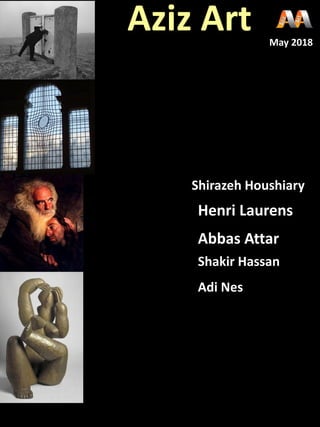
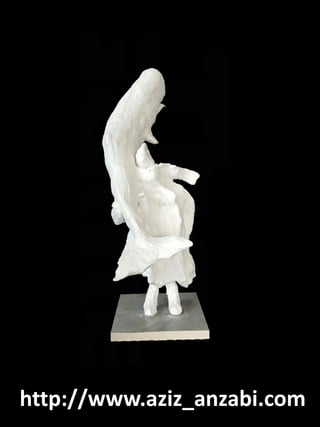
Henri Laurens
Abbas Attar
Adi Nes
Shirazeh Houshiary
Shakir Hassan
Aziz Art May 2018
Director: Aziz Anzabi
Editor : Nafiseh Yaghoubi
Translator : Asra Yaghoubi
Research: Zohreh Nazari
http://www.aziz_anzabi.com
1-Henri Laurens
5-Abbas Attar
11-Adi Nes
13-Shirazeh Houshiary
16-Shakir Hassan Al Said
Henri Laurens
February 18, 1885 – May 5, 1954)
was a French sculptor and
illustrator.
Early life and education
Born in Paris, Henri Laurens
worked as a stonemason
before he became a sculptor. In
1899 he attended drawing classes,
during which he produced works
that were greatly influenced by the
popularity of Auguste Rodin.
Career
Later Laurens was drawn to a new
gathering of artistic creativity in
Montparnasse. From 1915 he
began to sculpt in the Cubist style
after meeting Pablo Picasso,
Georges Braque, Juan Gris and
Fernand Léger.
Laurens was exempted from call-up
for the First World War, after having
a leg amputated in 1909 due to
osteo-tuberculosis.
L'Amphion located at the Central
University of Venezuela, Caracas
Multi-talented, Laurens worked
with poster paint, and collage, was
an engraver and created theatre
design and decoration. In 1915 he
illustrated a book for his friend, the
author Pierre Reverdy.
In 1938 he shared an exhibition
with Braque and Picasso that
travelled to major Scandinavian
cities. In 1947, he made prints for
book illustrations. In 1948 he
exhibited his art at the important
international Venice Biennale. That
same year, he exhibited at the
Galerie d'Art Moderne in Basel,
Switzerland.
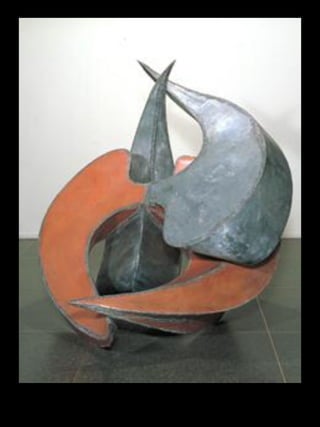
A great many of his sculptures are
massive objects. An example of this
style is the monumental piece
L'Amphion, created in 1952 for the
Central University of Venezuela,
Caracas after a request from the
architect Carlos Raúl Villanueva.
1
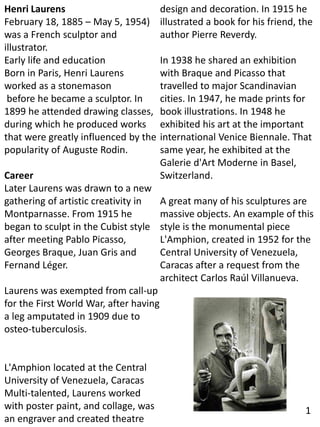
Laurens sculptural work influenced the work of architect Jørn Utzon,
famous for the Sydney Opera House, in particular Laurens' tomb for an
aviator designed for the cemetery of Montparnasse, Paris, in 1924
Death
Henri Laurens died in Paris, and was interred in the Cimetière du
Montparnasse there. His tomb is decorated with his sculpture, La
Douleur
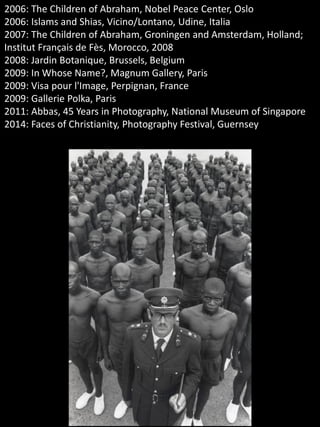
Abbas Attar
29 March 1944 25 April 2018
better known by his mononym
Abbas, was an Iranian
photographer known for his
photojournalism in
Biafra, Vietnam and South Africa
in the 1970s, and for his extensive
essays on religions in later years.
He was a member of Sipa Press
from 1971 to 1973, a member of
Gamma from 1974 to 1980, and
joined Magnum Photos in 1981.
Career
Attar, an Iranian transplanted to
Paris, dedicated his photographic
work to the political and social
coverage of the developing
southern nations. Since 1970, his
major works have been published
in world magazines and include
wars and revolutions in Biafra,
Bangladesh, Ulster, Vietnam, the
Middle East, Chile, Cuba,
and South Africa with an essay on
apartheid.
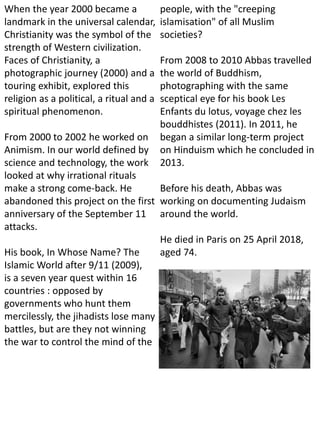
From 1978 to 1980, he
photographed the revolution in
Iran, and returned in 1997 after a
17 year voluntary exile. His book
Iran Diary 1971-2002 (2002) is a
critical interpretation of its history,
photographed and written as a
personal diary.
From 1983 to 1986, he travelled
throughout Mexico, photographing
the country as if he were writing a
novel. An exhibition and a book,
Return to Mexico, journeys beyond
the mask (1992), which includes his
travel diaries, helped him define his
aesthetics in photography.
From 1987 to 1994, he
photographed the resurgence of
Islam from the Xinjiang to Morocco.
His book and exhibition Allah O
Akbar, a journey through militant
Islam (1994) exposes the internal
tensions within Muslim societies,
torn between a mythical past and a
desire for modernization and
democracy. The book drew
additional attention after the
September 11 attacks in 2001.
5
When the year 2000 became a
landmark in the universal calendar,
Christianity was the symbol of the
strength of Western civilization.
Faces of Christianity, a
photographic journey (2000) and a
touring exhibit, explored this
religion as a political, a ritual and a
spiritual phenomenon.
From 2000 to 2002 he worked on
Animism. In our world defined by
science and technology, the work
looked at why irrational rituals
make a strong come-back. He
abandoned this project on the first
anniversary of the September 11
attacks.
His book, In Whose Name? The
Islamic World after 9/11 (2009),
is a seven year quest within 16
countries : opposed by
governments who hunt them
mercilessly, the jihadists lose many
battles, but are they not winning
the war to control the mind of the
people, with the "creeping
islamisation" of all Muslim
societies?
From 2008 to 2010 Abbas travelled
the world of Buddhism,
photographing with the same
sceptical eye for his book Les
Enfants du lotus, voyage chez les
bouddhistes (2011). In 2011, he
began a similar long-term project
on Hinduism which he concluded in
2013.
Before his death, Abbas was
working on documenting Judaism
around the world.
He died in Paris on 25 April 2018,
aged 74.
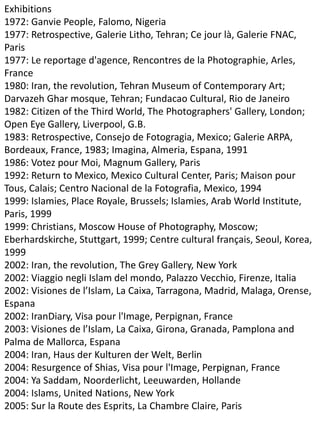
About his photography Abbas wrote:
"My photography is a reflection, which comes to life in action and leads
to meditation. Spontaneity – the suspended moment – intervenes
during action, in the viewfinder. A reflection on the subject precedes it.
A meditation on finality follows it, and it is here, during this exalting
and fragile moment, that the real photographic writing develops,
sequencing the images. For this reason a writer’s spirit is necessary to
this enterprise. Isn’t photography « writing with light »? But with the
difference that while the writer possesses his word, the photographer is
himself possessed by his photo, by the limit of the real which he must
transcend so as not to become its prisoner."
Books
Iran, la révolution confisquée, Clétrat, Paris, 1980
Retornos a Oapan, FCE Rio de Luz, Mexico, 1986
Return to Mexico, W. W. Norton, New York, 1992
Allah O Akbar, voyages dans l’Islam militant, Phaidon, London, 1994
Allah O Akbar, a journey through militant Islam, Phaidon, London, 1994
Viaggio negli Islam del Mondo, Contrasto, Roma, 2002
Voyage en chrétientés, La Martiniere, Paris, 2000
Faces of Christianity, A. Abrams, New York, 2000
Glaube-liebe-hoffnung, Knesebeck, Munchen, 2000
IranDiary 1971-2002, Autrement, Paris, 2002
IranDiario 1971-2005, Sagiattore, Milano, 2006
Abbas, I Grandi Fotografi di Magnum, Hachette, Milan, 2005
Sur la Route des Esprits, Delpire, Paris, 2005
The children of Abraham, (exhibition catalogue), Intervalles, Paris, 2006
In Whose Name?, Thames & Hudson, London, 2009
Ali, le Combat, Sonatines, Paris, 2011
Les Enfants du lotus, voyage chez les bouddhistes, De la Martinière,
Paris, 2011
Exhibitions
1972: Ganvie People, Falomo, Nigeria
1977: Retrospective, Galerie Litho, Tehran; Ce jour là, Galerie FNAC,
Paris
1977: Le reportage d'agence, Rencontres de la Photographie, Arles,
France
1980: Iran, the revolution, Tehran Museum of Contemporary Art;
Darvazeh Ghar mosque, Tehran; Fundacao Cultural, Rio de Janeiro
1982: Citizen of the Third World, The Photographers' Gallery, London;
Open Eye Gallery, Liverpool, G.B.
1983: Retrospective, Consejo de Fotogragia, Mexico; Galerie ARPA,
Bordeaux, France, 1983; Imagina, Almeria, Espana, 1991
1986: Votez pour Moi, Magnum Gallery, Paris
1992: Return to Mexico, Mexico Cultural Center, Paris; Maison pour
Tous, Calais; Centro Nacional de la Fotografia, Mexico, 1994
1999: Islamies, Place Royale, Brussels; Islamies, Arab World Institute,
Paris, 1999
1999: Christians, Moscow House of Photography, Moscow;
Eberhardskirche, Stuttgart, 1999; Centre cultural français, Seoul, Korea,
1999
2002: Iran, the revolution, The Grey Gallery, New York
2002: Viaggio negli Islam del mondo, Palazzo Vecchio, Firenze, Italia
2002: Visiones de l’Islam, La Caixa, Tarragona, Madrid, Malaga, Orense,
Espana
2002: IranDiary, Visa pour l'Image, Perpignan, France
2003: Visiones de l’Islam, La Caixa, Girona, Granada, Pamplona and
Palma de Mallorca, Espana
2004: Iran, Haus der Kulturen der Welt, Berlin
2004: Resurgence of Shias, Visa pour l'Image, Perpignan, France
2004: Ya Saddam, Noorderlicht, Leeuwarden, Hollande
2004: Islams, United Nations, New York
2005: Sur la Route des Esprits, La Chambre Claire, Paris
2006: The Children of Abraham, Nobel Peace Center, Oslo
2006: Islams and Shias, Vicino/Lontano, Udine, Italia
2007: The Children of Abraham, Groningen and Amsterdam, Holland;
Institut Français de Fès, Morocco, 2008
2008: Jardin Botanique, Brussels, Belgium
2009: In Whose Name?, Magnum Gallery, Paris
2009: Visa pour l'Image, Perpignan, France
2009: Gallerie Polka, Paris
2011: Abbas, 45 Years in Photography, National Museum of Singapore
2014: Faces of Christianity, Photography Festival, Guernsey
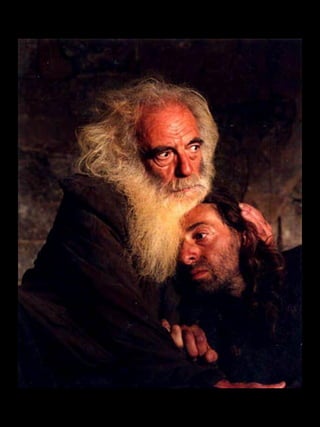
Adi Nes
Born 1966
Life and career
Adi Nes was born in Kiryat Gat.
His parents are Jewish immigrants
from Iran.
Nes is notable for series "Soldiers",
in which he mixes masculinity and
homoerotic sexuality, depicting
Israeli soldiers in a fragile way. In
2003 he did a feature for Vogue
Hommes. Nes has given solo
exhibitions at the Wexner Center
for the Arts, Legion of Honor in
San Francisco, the
Tel Aviv Museum of Art, the
Museum of Contemporary Art in
San Diego, and the Melkweg
Gallery in Amsterdam, among
others. His work has also shown in
group exhibitions at the Hotel de
Sully in Paris, Haifa Museum of Art
and the Jewish Museum in New
York, among many others. He has
been reviewed in The New York
Times, the Financial Times, and
others. In 2005 Nes was
chosen as an outstanding artist of
the prestigious Israel Cultural
Excellence Foundation.
Nes' most famous piece recalls
Leonardo da Vinci's The Last
Supper, * replacing the characters
with young male Israeli soldiers. A
print sold at auction in Sotheby's
for $102,000 in 2005, and another
for $264,000 in 2007. The work
appeared on the front page of the
New York Times in May, 2008.
Nes' early work has been
characterized as subverting the
stereotype of the masculine Israeli
man by using homoeroticism and
sleeping, vulnerable figures.
He regularly uses dark-skinned
Israeli models.The models' poses
often evoke the Baroque period.
Nes has said that the inspiration for
his photography is partially
autobiographical:
“My staged photographs are
oversized and often recall well-
known scenes from Art History and
Western Civilization combined with
personal experiences based on my
life as a gay youth growing up in a
small town on the periphery of
Israeli society. ”
11
Adi Nes
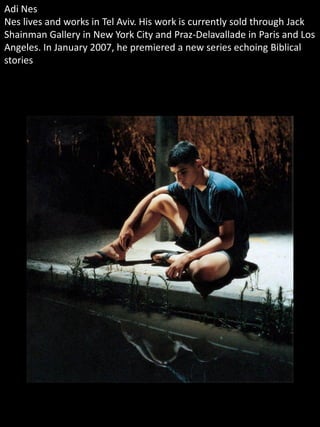
Nes lives and works in Tel Aviv. His work is currently sold through Jack
Shainman Gallery in New York City and Praz-Delavallade in Paris and Los
Angeles. In January 2007, he premiered a new series echoing Biblical
stories
Shirazeh Houshiary
born Shiraz 15 January 1955 is an
Iranian installation artist and
sculptor. She is a former Turner
Prize nominee, and lives and
works in London.
Life and work
Shirazeh Houshiary left her native
country of Iran in 1973. She
attended Chelsea School of Art,
London (1976–9) and was a
Cardiff College of Art junior fellow
at (1979–80).
Houshiary was identified with
other young sculptors of her
generation such as
Richard Deacon and Anish Kapoor,
but her work was distinct from
theirs in the strong Persian
influence which it displayed,
though sharing with Kapoor a
spiritual concern. Her ideology
draws on Sufi mystical doctrine
and Jalal ad-Din Muhammad Rumi,
a Persian mystic and poet from
the 13th century.
She was a nominee for the 1994
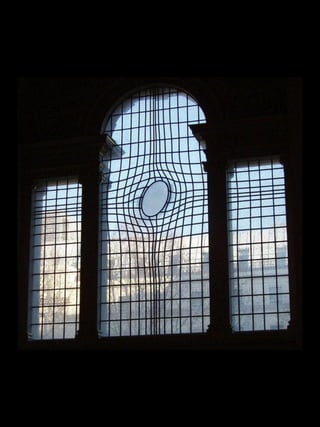
Turner Prize. In 2008, the St Martin-
in-the-Fields Church in London
unveiled a commission by Shirazeh
Houshiary and Pip Horne for the
East Window.Houshiary's work is
included in numerous public and
private collections including the
Museum of Modern Art, New York
and The Tate Collection, London. In
2005, Creative Time commissioned
Houshiary and Pip Horne for their
Creative Time Art on the Plaza
series where the monumental
Breath tower was exhibited in New
York City. Her work was also
included in Feri Daftari's exhibition
Without Boundary: Seventeen
Ways of Looking at the Museum of
Modern Art in 2006 and the 17th
Biennale of Sydney in 2010.
In 2005 (Veil) and 2008
(Shroud),Houshiary worked with
animator Mark Hatchard of Hotbox
Studios to create animations for
gallery installations at the Lehmann
Maupin Gallery in New York and
the Lisson Gallery in London.
13
Shakir Hassan Al Said 1925–2004
an Iraqi painter, sculptor and
writer, is considered one of Iraq's
most innovative and influential
artists.
Biography
Born in Samawa,Al Said lived,
worked and died in Bagdad. He
received in 1948 a degree in
social science from the Higher
Institute of Teachers in Baghdad
and in 1954 a diploma in painting
from the Institute of Fine Arts in
Baghdad where he was taught by
Jawad Saleem.He continued his
studies at the École nationale
supérieure des Beaux-Arts in
Paris until 1959,[6] where he was
taught by Raymond Legueult.
During his stay in Paris, he
discovered Western modern art in
galleries and Sumerian art at the
Louvre.After his return to
Baghdad in 1959, Al Said studied
the work of Yahya ibn
Mahmud al-Wasiti,sufism and
Mansur Al-Hallaj.He gradually
abandoned figurative expressions
and centered his compositions on
Arabic calligraphy.
He co-founded in 1951 with Jawad
Saleem Jama'et Baghdad lil Fann al-
Hadith (Baghdad Modern Art
Group), one of the most unusual
arts movements in the Middle East
in the post–World War II,[9] that
aimed to achieve an artistic
approach both modern and
embracing of tradition.This specific
approach was called Istilham al-
turath (Seeking inspiration from
tradition), considered as "the basic
point of departure, to achieve
through modern styles, a cultural
vision".He headed the group after
the death of Saleem in 1961.
In 1971, he founded Al Bu'd al
Wahad (the One Dimension
Group)",which promoted the
modern calligraphic school in Arab
art.This group was part of a broader
Islamic art movement that emerged
independently across North Africa
and parts of Asia in the 1950s and
known as the hurufiyah art
movement. Hurufiyah refers to the
attempt by artists to combine
traditional art forms, notably
calligraphy as a graphic element
within a contemporary atwork.
16
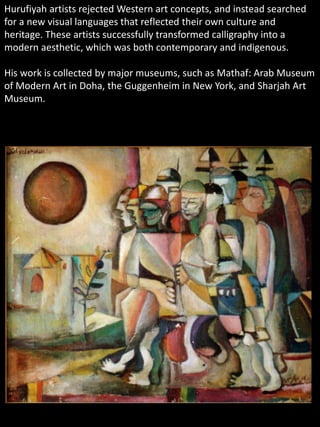
Hurufiyah artists rejected Western art concepts, and instead searched
for a new visual languages that reflected their own culture and
heritage. These artists successfully transformed calligraphy into a
modern aesthetic, which was both contemporary and indigenous.
His work is collected by major museums, such as Mathaf: Arab Museum
of Modern Art in Doha, the Guggenheim in New York, and Sharjah Art
Museum.
http://www.aziz_anzabi.com

Aziz art may 2018

  • 1.
    Henri Laurens Abbas Attar AdiNes Shirazeh Houshiary Shakir Hassan Aziz Art May 2018
  • 2.
    Director: Aziz Anzabi Editor: Nafiseh Yaghoubi Translator : Asra Yaghoubi Research: Zohreh Nazari http://www.aziz_anzabi.com 1-Henri Laurens 5-Abbas Attar 11-Adi Nes 13-Shirazeh Houshiary 16-Shakir Hassan Al Said
  • 3.
    Henri Laurens February 18,1885 – May 5, 1954) was a French sculptor and illustrator. Early life and education Born in Paris, Henri Laurens worked as a stonemason before he became a sculptor. In 1899 he attended drawing classes, during which he produced works that were greatly influenced by the popularity of Auguste Rodin. Career Later Laurens was drawn to a new gathering of artistic creativity in Montparnasse. From 1915 he began to sculpt in the Cubist style after meeting Pablo Picasso, Georges Braque, Juan Gris and Fernand Léger. Laurens was exempted from call-up for the First World War, after having a leg amputated in 1909 due to osteo-tuberculosis. L'Amphion located at the Central University of Venezuela, Caracas Multi-talented, Laurens worked with poster paint, and collage, was an engraver and created theatre design and decoration. In 1915 he illustrated a book for his friend, the author Pierre Reverdy. In 1938 he shared an exhibition with Braque and Picasso that travelled to major Scandinavian cities. In 1947, he made prints for book illustrations. In 1948 he exhibited his art at the important international Venice Biennale. That same year, he exhibited at the Galerie d'Art Moderne in Basel, Switzerland. A great many of his sculptures are massive objects. An example of this style is the monumental piece L'Amphion, created in 1952 for the Central University of Venezuela, Caracas after a request from the architect Carlos Raúl Villanueva. 1
  • 4.
    Laurens sculptural workinfluenced the work of architect Jørn Utzon, famous for the Sydney Opera House, in particular Laurens' tomb for an aviator designed for the cemetery of Montparnasse, Paris, in 1924 Death Henri Laurens died in Paris, and was interred in the Cimetière du Montparnasse there. His tomb is decorated with his sculpture, La Douleur
  • 7.
    Abbas Attar 29 March1944 25 April 2018 better known by his mononym Abbas, was an Iranian photographer known for his photojournalism in Biafra, Vietnam and South Africa in the 1970s, and for his extensive essays on religions in later years. He was a member of Sipa Press from 1971 to 1973, a member of Gamma from 1974 to 1980, and joined Magnum Photos in 1981. Career Attar, an Iranian transplanted to Paris, dedicated his photographic work to the political and social coverage of the developing southern nations. Since 1970, his major works have been published in world magazines and include wars and revolutions in Biafra, Bangladesh, Ulster, Vietnam, the Middle East, Chile, Cuba, and South Africa with an essay on apartheid. From 1978 to 1980, he photographed the revolution in Iran, and returned in 1997 after a 17 year voluntary exile. His book Iran Diary 1971-2002 (2002) is a critical interpretation of its history, photographed and written as a personal diary. From 1983 to 1986, he travelled throughout Mexico, photographing the country as if he were writing a novel. An exhibition and a book, Return to Mexico, journeys beyond the mask (1992), which includes his travel diaries, helped him define his aesthetics in photography. From 1987 to 1994, he photographed the resurgence of Islam from the Xinjiang to Morocco. His book and exhibition Allah O Akbar, a journey through militant Islam (1994) exposes the internal tensions within Muslim societies, torn between a mythical past and a desire for modernization and democracy. The book drew additional attention after the September 11 attacks in 2001. 5
  • 8.
    When the year2000 became a landmark in the universal calendar, Christianity was the symbol of the strength of Western civilization. Faces of Christianity, a photographic journey (2000) and a touring exhibit, explored this religion as a political, a ritual and a spiritual phenomenon. From 2000 to 2002 he worked on Animism. In our world defined by science and technology, the work looked at why irrational rituals make a strong come-back. He abandoned this project on the first anniversary of the September 11 attacks. His book, In Whose Name? The Islamic World after 9/11 (2009), is a seven year quest within 16 countries : opposed by governments who hunt them mercilessly, the jihadists lose many battles, but are they not winning the war to control the mind of the people, with the "creeping islamisation" of all Muslim societies? From 2008 to 2010 Abbas travelled the world of Buddhism, photographing with the same sceptical eye for his book Les Enfants du lotus, voyage chez les bouddhistes (2011). In 2011, he began a similar long-term project on Hinduism which he concluded in 2013. Before his death, Abbas was working on documenting Judaism around the world. He died in Paris on 25 April 2018, aged 74.
  • 9.
    About his photographyAbbas wrote: "My photography is a reflection, which comes to life in action and leads to meditation. Spontaneity – the suspended moment – intervenes during action, in the viewfinder. A reflection on the subject precedes it. A meditation on finality follows it, and it is here, during this exalting and fragile moment, that the real photographic writing develops, sequencing the images. For this reason a writer’s spirit is necessary to this enterprise. Isn’t photography « writing with light »? But with the difference that while the writer possesses his word, the photographer is himself possessed by his photo, by the limit of the real which he must transcend so as not to become its prisoner." Books Iran, la révolution confisquée, Clétrat, Paris, 1980 Retornos a Oapan, FCE Rio de Luz, Mexico, 1986 Return to Mexico, W. W. Norton, New York, 1992 Allah O Akbar, voyages dans l’Islam militant, Phaidon, London, 1994 Allah O Akbar, a journey through militant Islam, Phaidon, London, 1994 Viaggio negli Islam del Mondo, Contrasto, Roma, 2002 Voyage en chrétientés, La Martiniere, Paris, 2000 Faces of Christianity, A. Abrams, New York, 2000 Glaube-liebe-hoffnung, Knesebeck, Munchen, 2000 IranDiary 1971-2002, Autrement, Paris, 2002 IranDiario 1971-2005, Sagiattore, Milano, 2006 Abbas, I Grandi Fotografi di Magnum, Hachette, Milan, 2005 Sur la Route des Esprits, Delpire, Paris, 2005 The children of Abraham, (exhibition catalogue), Intervalles, Paris, 2006 In Whose Name?, Thames & Hudson, London, 2009 Ali, le Combat, Sonatines, Paris, 2011 Les Enfants du lotus, voyage chez les bouddhistes, De la Martinière, Paris, 2011
  • 10.
    Exhibitions 1972: Ganvie People,Falomo, Nigeria 1977: Retrospective, Galerie Litho, Tehran; Ce jour là, Galerie FNAC, Paris 1977: Le reportage d'agence, Rencontres de la Photographie, Arles, France 1980: Iran, the revolution, Tehran Museum of Contemporary Art; Darvazeh Ghar mosque, Tehran; Fundacao Cultural, Rio de Janeiro 1982: Citizen of the Third World, The Photographers' Gallery, London; Open Eye Gallery, Liverpool, G.B. 1983: Retrospective, Consejo de Fotogragia, Mexico; Galerie ARPA, Bordeaux, France, 1983; Imagina, Almeria, Espana, 1991 1986: Votez pour Moi, Magnum Gallery, Paris 1992: Return to Mexico, Mexico Cultural Center, Paris; Maison pour Tous, Calais; Centro Nacional de la Fotografia, Mexico, 1994 1999: Islamies, Place Royale, Brussels; Islamies, Arab World Institute, Paris, 1999 1999: Christians, Moscow House of Photography, Moscow; Eberhardskirche, Stuttgart, 1999; Centre cultural français, Seoul, Korea, 1999 2002: Iran, the revolution, The Grey Gallery, New York 2002: Viaggio negli Islam del mondo, Palazzo Vecchio, Firenze, Italia 2002: Visiones de l’Islam, La Caixa, Tarragona, Madrid, Malaga, Orense, Espana 2002: IranDiary, Visa pour l'Image, Perpignan, France 2003: Visiones de l’Islam, La Caixa, Girona, Granada, Pamplona and Palma de Mallorca, Espana 2004: Iran, Haus der Kulturen der Welt, Berlin 2004: Resurgence of Shias, Visa pour l'Image, Perpignan, France 2004: Ya Saddam, Noorderlicht, Leeuwarden, Hollande 2004: Islams, United Nations, New York 2005: Sur la Route des Esprits, La Chambre Claire, Paris
  • 11.
    2006: The Childrenof Abraham, Nobel Peace Center, Oslo 2006: Islams and Shias, Vicino/Lontano, Udine, Italia 2007: The Children of Abraham, Groningen and Amsterdam, Holland; Institut Français de Fès, Morocco, 2008 2008: Jardin Botanique, Brussels, Belgium 2009: In Whose Name?, Magnum Gallery, Paris 2009: Visa pour l'Image, Perpignan, France 2009: Gallerie Polka, Paris 2011: Abbas, 45 Years in Photography, National Museum of Singapore 2014: Faces of Christianity, Photography Festival, Guernsey
  • 13.
    Adi Nes Born 1966 Lifeand career Adi Nes was born in Kiryat Gat. His parents are Jewish immigrants from Iran. Nes is notable for series "Soldiers", in which he mixes masculinity and homoerotic sexuality, depicting Israeli soldiers in a fragile way. In 2003 he did a feature for Vogue Hommes. Nes has given solo exhibitions at the Wexner Center for the Arts, Legion of Honor in San Francisco, the Tel Aviv Museum of Art, the Museum of Contemporary Art in San Diego, and the Melkweg Gallery in Amsterdam, among others. His work has also shown in group exhibitions at the Hotel de Sully in Paris, Haifa Museum of Art and the Jewish Museum in New York, among many others. He has been reviewed in The New York Times, the Financial Times, and others. In 2005 Nes was chosen as an outstanding artist of the prestigious Israel Cultural Excellence Foundation. Nes' most famous piece recalls Leonardo da Vinci's The Last Supper, * replacing the characters with young male Israeli soldiers. A print sold at auction in Sotheby's for $102,000 in 2005, and another for $264,000 in 2007. The work appeared on the front page of the New York Times in May, 2008. Nes' early work has been characterized as subverting the stereotype of the masculine Israeli man by using homoeroticism and sleeping, vulnerable figures. He regularly uses dark-skinned Israeli models.The models' poses often evoke the Baroque period. Nes has said that the inspiration for his photography is partially autobiographical: “My staged photographs are oversized and often recall well- known scenes from Art History and Western Civilization combined with personal experiences based on my life as a gay youth growing up in a small town on the periphery of Israeli society. ” 11
  • 14.
    Adi Nes Nes livesand works in Tel Aviv. His work is currently sold through Jack Shainman Gallery in New York City and Praz-Delavallade in Paris and Los Angeles. In January 2007, he premiered a new series echoing Biblical stories
  • 16.
    Shirazeh Houshiary born Shiraz15 January 1955 is an Iranian installation artist and sculptor. She is a former Turner Prize nominee, and lives and works in London. Life and work Shirazeh Houshiary left her native country of Iran in 1973. She attended Chelsea School of Art, London (1976–9) and was a Cardiff College of Art junior fellow at (1979–80). Houshiary was identified with other young sculptors of her generation such as Richard Deacon and Anish Kapoor, but her work was distinct from theirs in the strong Persian influence which it displayed, though sharing with Kapoor a spiritual concern. Her ideology draws on Sufi mystical doctrine and Jalal ad-Din Muhammad Rumi, a Persian mystic and poet from the 13th century. She was a nominee for the 1994 Turner Prize. In 2008, the St Martin- in-the-Fields Church in London unveiled a commission by Shirazeh Houshiary and Pip Horne for the East Window.Houshiary's work is included in numerous public and private collections including the Museum of Modern Art, New York and The Tate Collection, London. In 2005, Creative Time commissioned Houshiary and Pip Horne for their Creative Time Art on the Plaza series where the monumental Breath tower was exhibited in New York City. Her work was also included in Feri Daftari's exhibition Without Boundary: Seventeen Ways of Looking at the Museum of Modern Art in 2006 and the 17th Biennale of Sydney in 2010. In 2005 (Veil) and 2008 (Shroud),Houshiary worked with animator Mark Hatchard of Hotbox Studios to create animations for gallery installations at the Lehmann Maupin Gallery in New York and the Lisson Gallery in London. 13
  • 20.
    Shakir Hassan AlSaid 1925–2004 an Iraqi painter, sculptor and writer, is considered one of Iraq's most innovative and influential artists. Biography Born in Samawa,Al Said lived, worked and died in Bagdad. He received in 1948 a degree in social science from the Higher Institute of Teachers in Baghdad and in 1954 a diploma in painting from the Institute of Fine Arts in Baghdad where he was taught by Jawad Saleem.He continued his studies at the École nationale supérieure des Beaux-Arts in Paris until 1959,[6] where he was taught by Raymond Legueult. During his stay in Paris, he discovered Western modern art in galleries and Sumerian art at the Louvre.After his return to Baghdad in 1959, Al Said studied the work of Yahya ibn Mahmud al-Wasiti,sufism and Mansur Al-Hallaj.He gradually abandoned figurative expressions and centered his compositions on Arabic calligraphy. He co-founded in 1951 with Jawad Saleem Jama'et Baghdad lil Fann al- Hadith (Baghdad Modern Art Group), one of the most unusual arts movements in the Middle East in the post–World War II,[9] that aimed to achieve an artistic approach both modern and embracing of tradition.This specific approach was called Istilham al- turath (Seeking inspiration from tradition), considered as "the basic point of departure, to achieve through modern styles, a cultural vision".He headed the group after the death of Saleem in 1961. In 1971, he founded Al Bu'd al Wahad (the One Dimension Group)",which promoted the modern calligraphic school in Arab art.This group was part of a broader Islamic art movement that emerged independently across North Africa and parts of Asia in the 1950s and known as the hurufiyah art movement. Hurufiyah refers to the attempt by artists to combine traditional art forms, notably calligraphy as a graphic element within a contemporary atwork. 16
  • 21.
    Hurufiyah artists rejectedWestern art concepts, and instead searched for a new visual languages that reflected their own culture and heritage. These artists successfully transformed calligraphy into a modern aesthetic, which was both contemporary and indigenous. His work is collected by major museums, such as Mathaf: Arab Museum of Modern Art in Doha, the Guggenheim in New York, and Sharjah Art Museum.
  • 22.