ZoroastrianismZoroastrianism
(Parsism)(Parsism)
By-VipulBy-Vipul
MesariyaMesariya
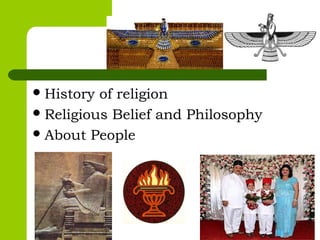
History of religion
Religious Belief and Philosophy
About People
OriginsOrigins
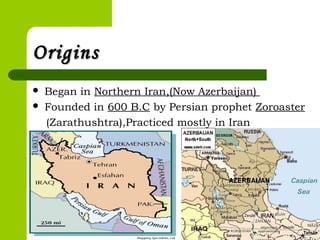
 Began in Northern Iran,(Now Azerbaijan)
 Founded in 600 B.C by Persian prophet Zoroaster
(Zarathushtra),Practiced mostly in Iran
FounderFounder
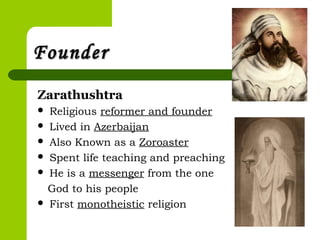
Zarathushtra
 Religious reformer and founder
 Lived in Azerbaijan
 Also Known as a Zoroaster
 Spent life teaching and preaching
 He is a messenger from the one
God to his people
 First monotheistic religion
Zoroastrianism at Its Peak….Zoroastrianism at Its Peak….
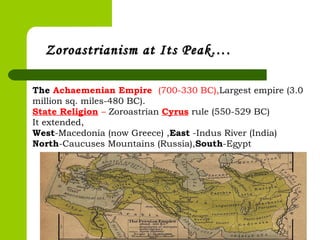
The Achaemenian Empire (700-330 BC),Largest empire (3.0
million sq. miles-480 BC).
State Religion – Zoroastrian Cyrus rule (550-529 BC)
It extended,
West-Macedonia (now Greece) ,East -Indus River (India)
North-Caucuses Mountains (Russia),South-Egypt
Key BeliefsKey Beliefs
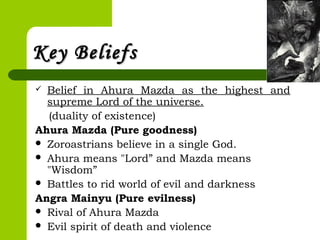
 Belief in Ahura Mazda as the highest and
supreme Lord of the universe.
(duality of existence)
Ahura Mazda (Pure goodness)
 Zoroastrians believe in a single God.
 Ahura means "Lord” and Mazda means
"Wisdom”
 Battles to rid world of evil and darkness
Angra Mainyu (Pure evilness)
 Rival of Ahura Mazda
 Evil spirit of death and violence
Key BeliefsKey Beliefs Cont’dCont’d
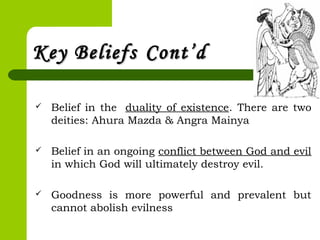
 Belief in the  duality of existence. There are two
deities: Ahura Mazda & Angra Mainya
 Belief in an ongoing conflict between God and evil
in which God will ultimately destroy evil.
 Goodness is more powerful and prevalent but
cannot abolish evilness
Key BeliefsKey Beliefs Cont’dCont’d
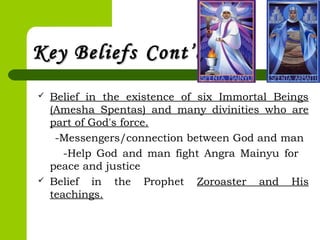
 Belief in the existence of six Immortal Beings
(Amesha Spentas) and many divinities who are
part of God's force.
-Messengers/connection between God and man
-Help God and man fight Angra Mainyu for
peace and justice
 Belief in the Prophet Zoroaster and His
teachings.
Key BeliefsKey Beliefs Cont’dCont’d
 Belief in the sanctity of fire as a symbol of God
in the material plane.
 Belief in the divinity of creation of God in the
spiritual and material planes.
 Belief in the spiritual nature of the world and
human(God created the spiritual entities).
Key BeliefsKey Beliefs Cont’dCont’d
 Belief in Heaven and Hell and Divine justice.
 Belief in the tradition of future prophets- next
prophet will be a future son of Zoroaster, whose
name would be Shoshyant, who would herald
the Judgment Day and the eventual
destruction of evil powers in the material world.
 Belief in the ending of the world in a violent
conflagration
Key BeliefsKey Beliefs Cont’dCont’d
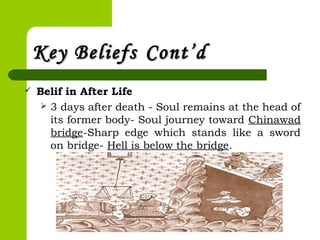
 Belif in After Life
 3 days after death - Soul remains at the head of
its former body- Soul journey toward Chinawad
bridge-Sharp edge which stands like a sword
on bridge- Hell is below the bridge.
After Life
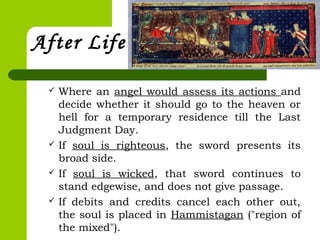
 Where an angel would assess its actions and
decide whether it should go to the heaven or
hell for a temporary residence till the Last
Judgment Day.
 If soul is righteous, the sword presents its
broad side.
 If soul is wicked, that sword continues to
stand edgewise, and does not give passage.
 If debits and credits cancel each other out,
the soul is placed in Hammistagan ("region of
the mixed").
Key BeliefsKey Beliefs Cont’dCont’d
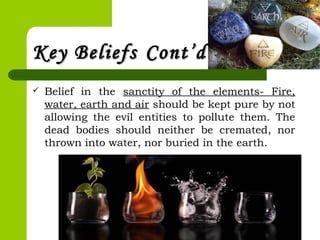
 Belief in the sanctity of the elements- Fire,
water, earth and air should be kept pure by not
allowing the evil entities to pollute them. The
dead bodies should neither be cremated, nor
thrown into water, nor buried in the earth.
Key Figures Cont’dKey Figures Cont’d
 Belief in the efficacy of sacred chants.
Zoroastrians believe in the ritual chanting as
the means to establish order and purity in the
world and in the lives of the worshippers
 Belief in the Judgment day- Belief in the
resurrection of the dead and last judgment day.
At the end of current cycle of 3000 years, God
will destroy the evil forces in a final
conflagration and herald the Judgment Day 
Religious Literature (HolyReligious Literature (Holy
Avesta)Avesta)
“AVESTA” is the Parsis HOLY BOOK.
Originally contained 21 books but
today it contains only:
(a) “YASANA” (Book of sacrifice – 17
Gathas are part of it).
(b) “YASTS” (Hymn like praises).
(c) “VENDIDAD” (Law & Code of
Purification).
(d) “VISPERAD” (Collection of prayers
& Liturgical texts)
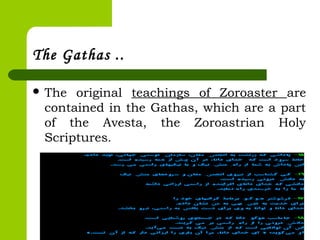
The Gathas ..
 The original teachings of Zoroaster are
contained in the Gathas, which are a part
of the Avesta, the Zoroastrian Holy
Scriptures.
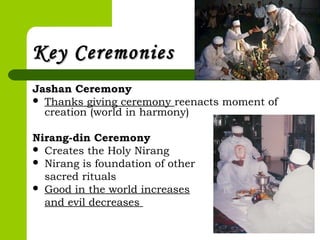
Key CeremoniesKey Ceremonies
Jashan Ceremony
 Thanks giving ceremony reenacts moment of
creation (world in harmony)
Nirang-din Ceremony
 Creates the Holy Nirang
 Nirang is foundation of other
sacred rituals
 Good in the world increases
and evil decreases
Key Ceremonies Cont’d
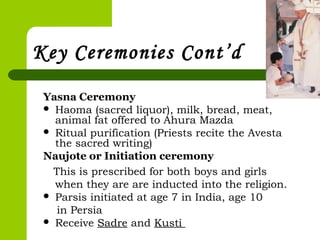
Yasna Ceremony
 Haoma (sacred liquor), milk, bread, meat,
animal fat offered to Ahura Mazda
 Ritual purification (Priests recite the Avesta
the sacred writing)
Naujote or Initiation ceremony
This is prescribed for both boys and girls
when they are are inducted into the religion.
 Parsis initiated at age 7 in India, age 10
in Persia
 Receive Sadre and Kusti
Key RitualsKey Rituals
Purification Ritual
 Keeps mind, body and environment pure to defeat
evil
 3 types of purification:
- Padyab (ablution)- a ritual washing of the
exposed parts of the body.
- Nahn (bath)
- Bareshnum -ritual which lasts nine nights.
(dog’s left ear is touched by the followers, dog's
gaze casts evil spirits away)
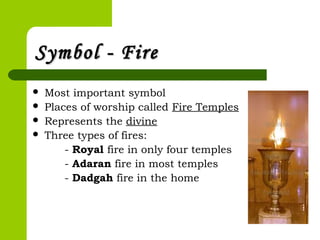
Symbol - FireSymbol - Fire
 Most important symbol
 Places of worship called Fire Temples
 Represents the divine
 Three types of fires:
- Royal fire in only four temples
- Adaran fire in most temples
- Dadgah fire in the home
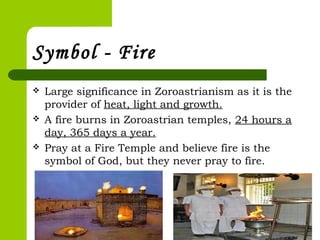
Symbol - Fire
 Large significance in Zoroastrianism as it is the
provider of heat, light and growth.
 A fire burns in Zoroastrian temples, 24 hours a
day, 365 days a year.
 Pray at a Fire Temple and believe fire is the
symbol of God, but they never pray to fire.
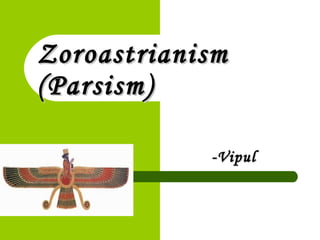
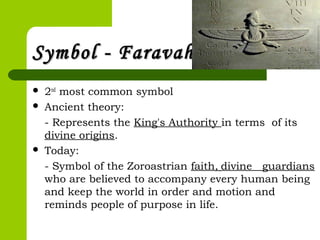
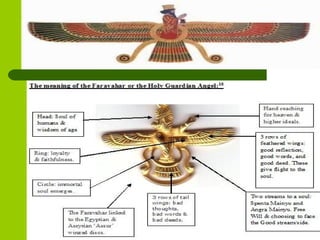
Symbol - FaravaharSymbol - Faravahar
 2nd
most common symbol
 Ancient theory:
- Represents the King's Authority in terms of its
divine origins.
 Today:
- Symbol of the Zoroastrian faith, divine guardians
who are believed to accompany every human being
and keep the world in order and motion and
reminds people of purpose in life.
Key Practices Cont’dCont’d
 Practice of three commandments.
(Every Parsi promises himself)
 To think - GOOD THOUGHTS.
 To do - GOOD DEEDS.
 To Speak - GOOD WORDS.
 
 Practice of moderation and balance. There is no
place for ascetic practices in Zoroastrianism.
People are advised to lead ethical, balanced and
harmonious lives.
Key Practices Cont’dCont’d
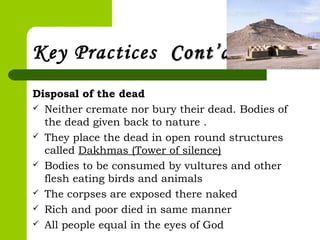
Disposal of the dead
 Neither cremate nor bury their dead. Bodies of
the dead given back to nature .
 They place the dead in open round structures
called Dakhmas (Tower of silence)
 Bodies to be consumed by vultures and other
flesh eating birds and animals
 The corpses are exposed there naked
 Rich and poor died in same manner
 All people equal in the eyes of God
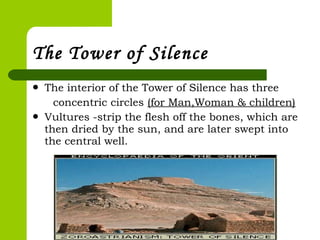
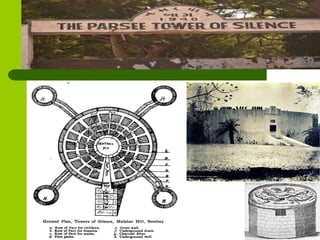
 The interior of the Tower of Silence has three
concentric circles (for Man,Woman & children)
 Vultures -strip the flesh off the bones, which are
then dried by the sun, and are later swept into
the central well.
The Tower of Silence
Key Practices Cont’d
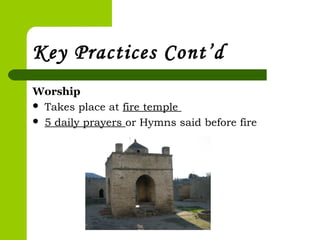
Worship
 Takes place at fire temple
 5 daily prayers or Hymns said before fire
Key Practices Cont’d
 Kusti and Sudre. Every follower should
wear kusti a sacred thread and sudreh a
white garment
Symbol –Symbol – Symbolic GarmentsSymbolic Garments
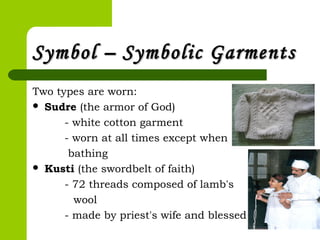
Two types are worn:
 Sudre (the armor of God)
- white cotton garment
- worn at all times except when
bathing
 Kusti (the swordbelt of faith)
- 72 threads composed of lamb's
wool
- made by priest's wife and blessed
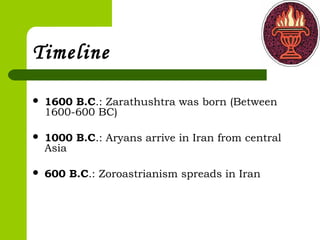
Timeline
 1600 B.C.: Zarathushtra was born (Between
1600-600 BC)
 1000 B.C.: Aryans arrive in Iran from central
Asia
 600 B.C.: Zoroastrianism spreads in Iran
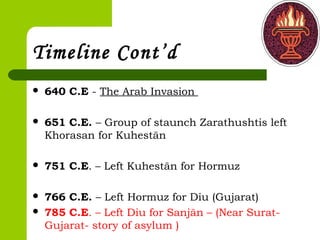
Timeline Cont’d
 640 C.E - The Arab Invasion
 651 C.E. – Group of staunch Zarathushtis left
Khorasan for Kuhestān
 751 C.E. – Left Kuhestān for Hormuz
 766 C.E. – Left Hormuz for Diu (Gujarat)
 785 C.E. – Left Diu for Sanjān – (Near Surat-
Gujarat- story of asylum )
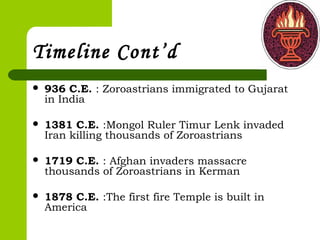
Timeline Cont’d
 936 C.E. : Zoroastrians immigrated to Gujarat
in India 
 1381 C.E. :Mongol Ruler Timur Lenk invaded
Iran killing thousands of Zoroastrians  
 1719 C.E. : Afghan invaders massacre
thousands of Zoroastrians in Kerman
 1878 C.E. :The first fire Temple is built in
America
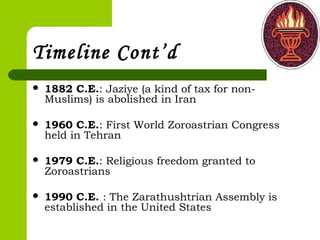
Timeline Cont’d
 1882 C.E.: Jaziye (a kind of tax for non-
Muslims) is abolished in Iran 
 1960 C.E.: First World Zoroastrian Congress
held in Tehran
 1979 C.E.: Religious freedom granted to
Zoroastrians
 1990 C.E. : The Zarathushtrian Assembly is
established in the United States
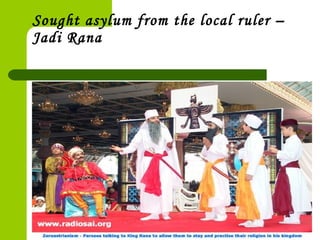
Sought asylum from the local ruler –
Jadi Rana
Condition for Asylum
1. Explain your religion and customs
2. Renounce your native language and take up
the local language
3. Women shall wear the local dress
4. Lay down your swords and arms
5. Marriages shall take place at night
Priest NERYO SANGH accepted all conditions
by putting SUGAR IN MILK POT
Asylum Granted
 Jadi Rana granted asylum and gave
them a parcel of land
 Named the land Sanjān after the
homeland from where they came
 790 C.E. – Consecrated an Atash
Behram fire in Sanjān, in fulfillment of
their vow
 Came to be known as “Parsis”-Persia
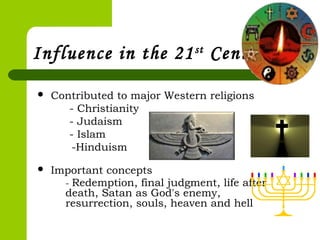
Influence in the 21st
Century
 Contributed to major Western religions
- Christianity
- Judaism
- Islam
-Hinduism
 
 Important concepts
- Redemption, final judgment, life after
death, Satan as God's enemy,
resurrection, souls, heaven and hell
 
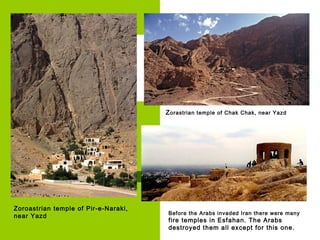
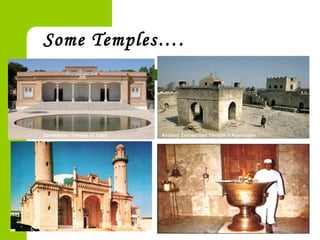
Zoroastrian Temple of Yazd,
Iran. 
Ancient Zoroastrian Temple in Azerbaijan
Some Temples….
Zorastrian temple of Chak Chak, near Yazd
Zoroastrian temple of Pir-e-Naraki,
near Yazd Before the Arabs invaded Iran there were many
fire temples in Esfahan. The Arabs
destroyed them all except for this one.
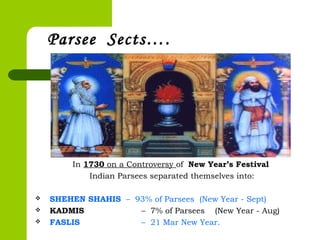
Parsee Sects….
In 1730 on a Controversy of New Year’s Festival
Indian Parsees separated themselves into:
 SHEHEN SHAHIS – 93% of Parsees (New Year - Sept)
 KADMIS – 7% of Parsees (New Year - Aug)
 FASLIS – 21 Mar New Year.
Gujarati Identity..
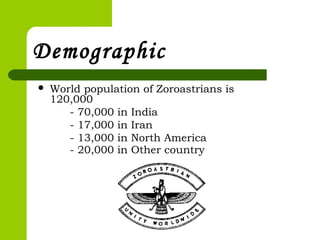
 World population of Zoroastrians is
120,000
- 70,000 in India
- 17,000 in Iran
- 13,000 in North America
- 20,000 in Other country
  
Demographic
Demographic Profile Of Parsis in India
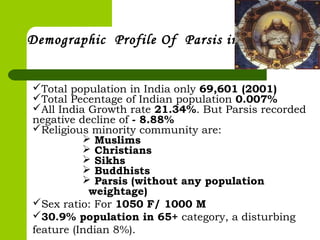
Total population in India only 69,601 (2001)
Total Pecentage of Indian population 0.007%
All India Growth rate 21.34%. But Parsis recorded
negative decline of - 8.88%
Religious minority community are:
 Muslims
 Christians
 Sikhs
 Buddhists
 Parsis (without any population
weightage)
Sex ratio: For 1050 F/ 1000 M
30.9% population in 65+ category, a disturbing
feature (Indian 8%).
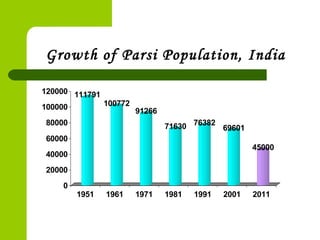
Growth of Parsi Population, India
111791
100772
91266
71630 76382
69601
45000
0
20000
40000
60000
80000
100000
120000
1951 1961 1971 1981 1991 2001 2011
Call for the Parsi Community….
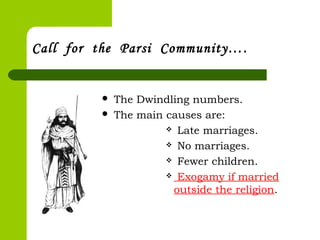
 The Dwindling numbers.
 The main causes are:
 Late marriages.
 No marriages.
 Fewer children.
 Exogamy if married
outside the religion.
Community services
 Indian Institute of Science, Bangalore
 TISS
 TIFR
 Tata Memorial Hospital
 NCPA
Parsis leave an honest impression of dedicated
& sincere in their chosen profession.
They work mirthfully & give their best.
Parsis are the best Social Worker and
Entrepreneur
They are in all chosen profession:
 Doctors, Bureaucrats, Scientist, Politics
 Bankers , Lawyers, Acting, Modeling
 Teachers , Chartered Accountant
 Journalists , Scholars, Arm forces
 Musicians, Writers , Sportsman
Professionally..
Parsis & The Raj
 Sir Jamshedjee Jeejeebhoy
 Dadabhai Naroji
 Sir Pherozeshah Mehta
 Loard Karan F Bilimoria
 Shapurji D Saklatvala
 Madam Bhikhaiji Cama
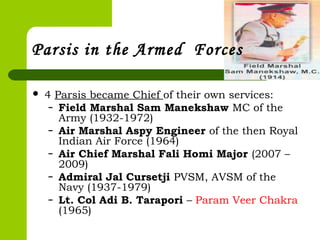
Parsis in the Armed Forces
 4 Parsis became Chief of their own services:
– Field Marshal Sam Manekshaw MC of the
Army (1932-1972)
– Air Marshal Aspy Engineer of the then Royal
Indian Air Force (1964)
– Air Chief Marshal Fali Homi Major (2007 –
2009)
– Admiral Jal Cursetji PVSM, AVSM of the
Navy (1937-1979)
– Lt. Col Adi B. Tarapori – Param Veer Chakra
(1965)
Contribution of Parsi
community in development of
India is far out of proportion to
their strength..
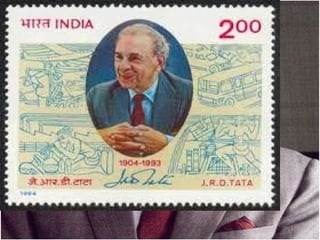
Some well known Parsis….Some well known Parsis….
ResourcesResources
 www.theparsidirectory.com
 www.theparsimatch.com
 www.theparsichronical.com
 www.w-z-o.org
 www.parsiresourcegroup.org
 www.wzcc.net
 www.hinduwebsite.com
 www.zoroastrianism.com
 www.google.com
Thanks…Thanks…

Parsism

  • 1.
  • 2.
    History of religion ReligiousBelief and Philosophy About People
  • 3.
    OriginsOrigins  Began inNorthern Iran,(Now Azerbaijan)  Founded in 600 B.C by Persian prophet Zoroaster (Zarathushtra),Practiced mostly in Iran
  • 4.
    FounderFounder Zarathushtra  Religious reformerand founder  Lived in Azerbaijan  Also Known as a Zoroaster  Spent life teaching and preaching  He is a messenger from the one God to his people  First monotheistic religion
  • 5.
    Zoroastrianism at ItsPeak….Zoroastrianism at Its Peak…. The Achaemenian Empire (700-330 BC),Largest empire (3.0 million sq. miles-480 BC). State Religion – Zoroastrian Cyrus rule (550-529 BC) It extended, West-Macedonia (now Greece) ,East -Indus River (India) North-Caucuses Mountains (Russia),South-Egypt
  • 6.
    Key BeliefsKey Beliefs Belief in Ahura Mazda as the highest and supreme Lord of the universe. (duality of existence) Ahura Mazda (Pure goodness)  Zoroastrians believe in a single God.  Ahura means "Lord” and Mazda means "Wisdom”  Battles to rid world of evil and darkness Angra Mainyu (Pure evilness)  Rival of Ahura Mazda  Evil spirit of death and violence
  • 7.
    Key BeliefsKey BeliefsCont’dCont’d  Belief in the  duality of existence. There are two deities: Ahura Mazda & Angra Mainya  Belief in an ongoing conflict between God and evil in which God will ultimately destroy evil.  Goodness is more powerful and prevalent but cannot abolish evilness
  • 8.
    Key BeliefsKey BeliefsCont’dCont’d  Belief in the existence of six Immortal Beings (Amesha Spentas) and many divinities who are part of God's force. -Messengers/connection between God and man -Help God and man fight Angra Mainyu for peace and justice  Belief in the Prophet Zoroaster and His teachings.
  • 9.
    Key BeliefsKey BeliefsCont’dCont’d  Belief in the sanctity of fire as a symbol of God in the material plane.  Belief in the divinity of creation of God in the spiritual and material planes.  Belief in the spiritual nature of the world and human(God created the spiritual entities).
  • 10.
    Key BeliefsKey BeliefsCont’dCont’d  Belief in Heaven and Hell and Divine justice.  Belief in the tradition of future prophets- next prophet will be a future son of Zoroaster, whose name would be Shoshyant, who would herald the Judgment Day and the eventual destruction of evil powers in the material world.  Belief in the ending of the world in a violent conflagration
  • 11.
    Key BeliefsKey BeliefsCont’dCont’d  Belif in After Life  3 days after death - Soul remains at the head of its former body- Soul journey toward Chinawad bridge-Sharp edge which stands like a sword on bridge- Hell is below the bridge.
  • 12.
    After Life  Wherean angel would assess its actions and decide whether it should go to the heaven or hell for a temporary residence till the Last Judgment Day.  If soul is righteous, the sword presents its broad side.  If soul is wicked, that sword continues to stand edgewise, and does not give passage.  If debits and credits cancel each other out, the soul is placed in Hammistagan ("region of the mixed").
  • 13.
    Key BeliefsKey BeliefsCont’dCont’d  Belief in the sanctity of the elements- Fire, water, earth and air should be kept pure by not allowing the evil entities to pollute them. The dead bodies should neither be cremated, nor thrown into water, nor buried in the earth.
  • 14.
    Key Figures Cont’dKeyFigures Cont’d  Belief in the efficacy of sacred chants. Zoroastrians believe in the ritual chanting as the means to establish order and purity in the world and in the lives of the worshippers  Belief in the Judgment day- Belief in the resurrection of the dead and last judgment day. At the end of current cycle of 3000 years, God will destroy the evil forces in a final conflagration and herald the Judgment Day 
  • 15.
    Religious Literature (HolyReligiousLiterature (Holy Avesta)Avesta) “AVESTA” is the Parsis HOLY BOOK. Originally contained 21 books but today it contains only: (a) “YASANA” (Book of sacrifice – 17 Gathas are part of it). (b) “YASTS” (Hymn like praises). (c) “VENDIDAD” (Law & Code of Purification). (d) “VISPERAD” (Collection of prayers & Liturgical texts)
  • 16.
    The Gathas .. The original teachings of Zoroaster are contained in the Gathas, which are a part of the Avesta, the Zoroastrian Holy Scriptures.
  • 17.
    Key CeremoniesKey Ceremonies JashanCeremony  Thanks giving ceremony reenacts moment of creation (world in harmony) Nirang-din Ceremony  Creates the Holy Nirang  Nirang is foundation of other sacred rituals  Good in the world increases and evil decreases
  • 18.
    Key Ceremonies Cont’d YasnaCeremony  Haoma (sacred liquor), milk, bread, meat, animal fat offered to Ahura Mazda  Ritual purification (Priests recite the Avesta the sacred writing) Naujote or Initiation ceremony This is prescribed for both boys and girls when they are are inducted into the religion.  Parsis initiated at age 7 in India, age 10 in Persia  Receive Sadre and Kusti
  • 19.
    Key RitualsKey Rituals PurificationRitual  Keeps mind, body and environment pure to defeat evil  3 types of purification: - Padyab (ablution)- a ritual washing of the exposed parts of the body. - Nahn (bath) - Bareshnum -ritual which lasts nine nights. (dog’s left ear is touched by the followers, dog's gaze casts evil spirits away)
  • 20.
    Symbol - FireSymbol- Fire  Most important symbol  Places of worship called Fire Temples  Represents the divine  Three types of fires: - Royal fire in only four temples - Adaran fire in most temples - Dadgah fire in the home
  • 21.
    Symbol - Fire Large significance in Zoroastrianism as it is the provider of heat, light and growth.  A fire burns in Zoroastrian temples, 24 hours a day, 365 days a year.  Pray at a Fire Temple and believe fire is the symbol of God, but they never pray to fire.
  • 22.
    Symbol - FaravaharSymbol- Faravahar  2nd most common symbol  Ancient theory: - Represents the King's Authority in terms of its divine origins.  Today: - Symbol of the Zoroastrian faith, divine guardians who are believed to accompany every human being and keep the world in order and motion and reminds people of purpose in life.
  • 24.
    Key Practices Cont’dCont’d Practice of three commandments. (Every Parsi promises himself)  To think - GOOD THOUGHTS.  To do - GOOD DEEDS.  To Speak - GOOD WORDS.    Practice of moderation and balance. There is no place for ascetic practices in Zoroastrianism. People are advised to lead ethical, balanced and harmonious lives.
  • 25.
    Key Practices Cont’dCont’d Disposalof the dead  Neither cremate nor bury their dead. Bodies of the dead given back to nature .  They place the dead in open round structures called Dakhmas (Tower of silence)  Bodies to be consumed by vultures and other flesh eating birds and animals  The corpses are exposed there naked  Rich and poor died in same manner  All people equal in the eyes of God
  • 26.
     The interiorof the Tower of Silence has three concentric circles (for Man,Woman & children)  Vultures -strip the flesh off the bones, which are then dried by the sun, and are later swept into the central well. The Tower of Silence
  • 28.
    Key Practices Cont’d Worship Takes place at fire temple  5 daily prayers or Hymns said before fire
  • 29.
    Key Practices Cont’d Kusti and Sudre. Every follower should wear kusti a sacred thread and sudreh a white garment
  • 30.
    Symbol –Symbol –Symbolic GarmentsSymbolic Garments Two types are worn:  Sudre (the armor of God) - white cotton garment - worn at all times except when bathing  Kusti (the swordbelt of faith) - 72 threads composed of lamb's wool - made by priest's wife and blessed
  • 31.
    Timeline  1600 B.C.:Zarathushtra was born (Between 1600-600 BC)  1000 B.C.: Aryans arrive in Iran from central Asia  600 B.C.: Zoroastrianism spreads in Iran
  • 32.
    Timeline Cont’d  640C.E - The Arab Invasion  651 C.E. – Group of staunch Zarathushtis left Khorasan for Kuhestān  751 C.E. – Left Kuhestān for Hormuz  766 C.E. – Left Hormuz for Diu (Gujarat)  785 C.E. – Left Diu for Sanjān – (Near Surat- Gujarat- story of asylum )
  • 33.
    Timeline Cont’d  936C.E. : Zoroastrians immigrated to Gujarat in India   1381 C.E. :Mongol Ruler Timur Lenk invaded Iran killing thousands of Zoroastrians    1719 C.E. : Afghan invaders massacre thousands of Zoroastrians in Kerman  1878 C.E. :The first fire Temple is built in America
  • 34.
    Timeline Cont’d  1882C.E.: Jaziye (a kind of tax for non- Muslims) is abolished in Iran   1960 C.E.: First World Zoroastrian Congress held in Tehran  1979 C.E.: Religious freedom granted to Zoroastrians  1990 C.E. : The Zarathushtrian Assembly is established in the United States
  • 35.
    Sought asylum fromthe local ruler – Jadi Rana
  • 36.
    Condition for Asylum 1.Explain your religion and customs 2. Renounce your native language and take up the local language 3. Women shall wear the local dress 4. Lay down your swords and arms 5. Marriages shall take place at night Priest NERYO SANGH accepted all conditions by putting SUGAR IN MILK POT
  • 37.
    Asylum Granted  JadiRana granted asylum and gave them a parcel of land  Named the land Sanjān after the homeland from where they came  790 C.E. – Consecrated an Atash Behram fire in Sanjān, in fulfillment of their vow  Came to be known as “Parsis”-Persia
  • 38.
    Influence in the21st Century  Contributed to major Western religions - Christianity - Judaism - Islam -Hinduism    Important concepts - Redemption, final judgment, life after death, Satan as God's enemy, resurrection, souls, heaven and hell  
  • 39.
    Zoroastrian Temple ofYazd, Iran.  Ancient Zoroastrian Temple in Azerbaijan Some Temples….
  • 40.
    Zorastrian temple ofChak Chak, near Yazd Zoroastrian temple of Pir-e-Naraki, near Yazd Before the Arabs invaded Iran there were many fire temples in Esfahan. The Arabs destroyed them all except for this one.
  • 41.
    Parsee Sects…. In 1730on a Controversy of New Year’s Festival Indian Parsees separated themselves into:  SHEHEN SHAHIS – 93% of Parsees (New Year - Sept)  KADMIS – 7% of Parsees (New Year - Aug)  FASLIS – 21 Mar New Year.
  • 42.
  • 43.
     World populationof Zoroastrians is 120,000 - 70,000 in India - 17,000 in Iran - 13,000 in North America - 20,000 in Other country    Demographic
  • 44.
    Demographic Profile OfParsis in India Total population in India only 69,601 (2001) Total Pecentage of Indian population 0.007% All India Growth rate 21.34%. But Parsis recorded negative decline of - 8.88% Religious minority community are:  Muslims  Christians  Sikhs  Buddhists  Parsis (without any population weightage) Sex ratio: For 1050 F/ 1000 M 30.9% population in 65+ category, a disturbing feature (Indian 8%).
  • 45.
    Growth of ParsiPopulation, India 111791 100772 91266 71630 76382 69601 45000 0 20000 40000 60000 80000 100000 120000 1951 1961 1971 1981 1991 2001 2011
  • 46.
    Call for theParsi Community….  The Dwindling numbers.  The main causes are:  Late marriages.  No marriages.  Fewer children.  Exogamy if married outside the religion.
  • 47.
    Community services  IndianInstitute of Science, Bangalore  TISS  TIFR  Tata Memorial Hospital  NCPA
  • 48.
    Parsis leave anhonest impression of dedicated & sincere in their chosen profession. They work mirthfully & give their best. Parsis are the best Social Worker and Entrepreneur They are in all chosen profession:  Doctors, Bureaucrats, Scientist, Politics  Bankers , Lawyers, Acting, Modeling  Teachers , Chartered Accountant  Journalists , Scholars, Arm forces  Musicians, Writers , Sportsman Professionally..
  • 49.
    Parsis & TheRaj  Sir Jamshedjee Jeejeebhoy  Dadabhai Naroji  Sir Pherozeshah Mehta  Loard Karan F Bilimoria  Shapurji D Saklatvala  Madam Bhikhaiji Cama
  • 50.
    Parsis in theArmed Forces  4 Parsis became Chief of their own services: – Field Marshal Sam Manekshaw MC of the Army (1932-1972) – Air Marshal Aspy Engineer of the then Royal Indian Air Force (1964) – Air Chief Marshal Fali Homi Major (2007 – 2009) – Admiral Jal Cursetji PVSM, AVSM of the Navy (1937-1979) – Lt. Col Adi B. Tarapori – Param Veer Chakra (1965)
  • 51.
    Contribution of Parsi communityin development of India is far out of proportion to their strength.. Some well known Parsis….Some well known Parsis….
  • 53.
    ResourcesResources  www.theparsidirectory.com  www.theparsimatch.com www.theparsichronical.com  www.w-z-o.org  www.parsiresourcegroup.org  www.wzcc.net  www.hinduwebsite.com  www.zoroastrianism.com  www.google.com
  • 54.