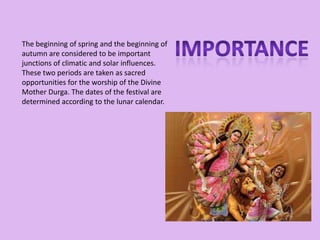
The beginning of spring and the beginning of
autumn are considered to be important
junctions of climatic and solar influences.
These two periods are taken as sacred
opportunities for the worship of the Divine
Mother Durga. The dates of the festival are
determined according to the lunar calendar.
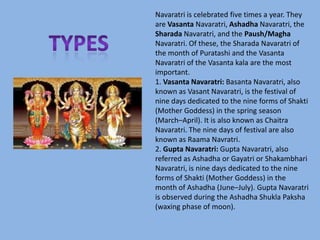
Navaratri is celebrated five times a year. They
are Vasanta Navaratri, Ashadha Navaratri, the
Sharada Navaratri, and the Paush/Magha
Navaratri. Of these, the Sharada Navaratri of
the month of Puratashi and the Vasanta
Navaratri of the Vasanta kala are the most
important.
1. Vasanta Navaratri: Basanta Navaratri, also
known as Vasant Navaratri, is the festival of
nine days dedicated to the nine forms of Shakti
(Mother Goddess) in the spring season
(March–April). It is also known as Chaitra
Navaratri. The nine days of festival are also
known as Raama Navratri.
2. Gupta Navaratri: Gupta Navaratri, also
referred as Ashadha or Gayatri or Shakambhari
Navaratri, is nine days dedicated to the nine
forms of Shakti (Mother Goddess) in the
month of Ashadha (June–July). Gupta Navaratri
is observed during the Ashadha Shukla Paksha
(waxing phase of moon).
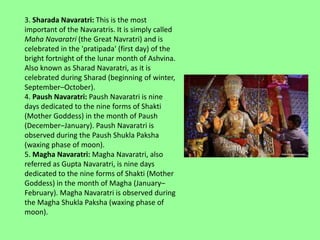
3. Sharada Navaratri: This is the most
important of the Navaratris. It is simply called
Maha Navaratri (the Great Navratri) and is
celebrated in the 'pratipada' (first day) of the
bright fortnight of the lunar month of Ashvina.
Also known as Sharad Navaratri, as it is
celebrated during Sharad (beginning of winter,
September–October).
4. Paush Navaratri: Paush Navaratri is nine
days dedicated to the nine forms of Shakti
(Mother Goddess) in the month of Paush
(December–January). Paush Navaratri is
observed during the Paush Shukla Paksha
(waxing phase of moon).
5. Magha Navaratri: Magha Navaratri, also
referred as Gupta Navaratri, is nine days
dedicated to the nine forms of Shakti (Mother
Goddess) in the month of Magha (January–
February). Magha Navaratri is observed during
the Magha Shukla Paksha (waxing phase of
moon).
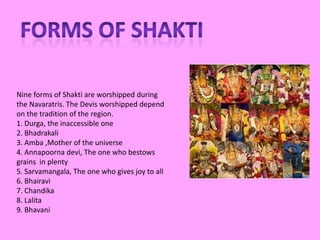
Nine forms of Shakti are worshipped during
the Navaratris. The Devis worshipped depend
on the tradition of the region.
1. Durga, the inaccessible one
2. Bhadrakali
3. Amba ,Mother of the universe
4. Annapoorna devi, The one who bestows
grains in plenty
5. Sarvamangala, The one who gives joy to all
6. Bhairavi
7. Chandika
8. Lalita
9. Bhavani
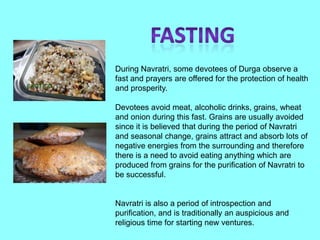
During Navratri, some devotees of Durga observe a
fast and prayers are offered for the protection of health
and prosperity.

Devotees avoid meat, alcoholic drinks, grains, wheat
and onion during this fast. Grains are usually avoided
since it is believed that during the period of Navratri
and seasonal change, grains attract and absorb lots of
negative energies from the surrounding and therefore
there is a need to avoid eating anything which are
produced from grains for the purification of Navratri to
be successful.


Navratri is also a period of introspection and
purification, and is traditionally an auspicious and
religious time for starting new ventures.
During the nine days of Navratri
there is a custom of wearing
different colour dress – Sarees
(Sari) and Churidhar – mainly in
Gujarat and Maharashtra.
Information on what are the
Navratri colours usually appears a
couple of days before in local
Gujarati and Marathi newspapers.
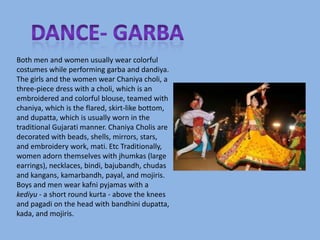
Both men and women usually wear colorful
costumes while performing garba and dandiya.
The girls and the women wear Chaniya choli, a
three-piece dress with a choli, which is an
embroidered and colorful blouse, teamed with
chaniya, which is the flared, skirt-like bottom,
and dupatta, which is usually worn in the
traditional Gujarati manner. Chaniya Cholis are
decorated with beads, shells, mirrors, stars,
and embroidery work, mati. Etc Traditionally,
women adorn themselves with jhumkas (large
earrings), necklaces, bindi, bajubandh, chudas
and kangans, kamarbandh, payal, and mojiris.
Boys and men wear kafni pyjamas with a
kediyu - a short round kurta - above the knees
and pagadi on the head with bandhini dupatta,
kada, and mojiris.
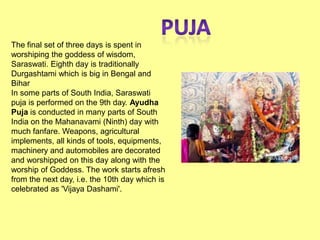
The final set of three days is spent in
worshiping the goddess of wisdom,
Saraswati. Eighth day is traditionally
Durgashtami which is big in Bengal and
Bihar
In some parts of South India, Saraswati
puja is performed on the 9th day. Ayudha
Puja is conducted in many parts of South
India on the Mahanavami (Ninth) day with
much fanfare. Weapons, agricultural
implements, all kinds of tools, equipments,
machinery and automobiles are decorated
and worshipped on this day along with the
worship of Goddess. The work starts afresh
from the next day, i.e. the 10th day which is
celebrated as 'Vijaya Dashami'.
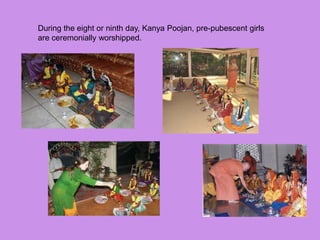
During the eight or ninth day, Kanya Poojan, pre-pubescent girls
are ceremonially worshipped.
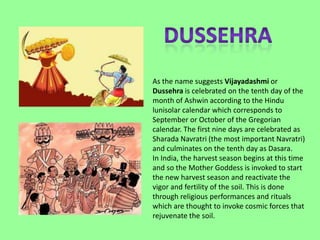
As the name suggests Vijayadashmi or
Dussehra is celebrated on the tenth day of the
month of Ashwin according to the Hindu
lunisolar calendar which corresponds to
September or October of the Gregorian
calendar. The first nine days are celebrated as
Sharada Navratri (the most important Navratri)
and culminates on the tenth day as Dasara.
In India, the harvest season begins at this time
and so the Mother Goddess is invoked to start
the new harvest season and reactivate the
vigor and fertility of the soil. This is done
through religious performances and rituals
which are thought to invoke cosmic forces that
rejuvenate the soil.
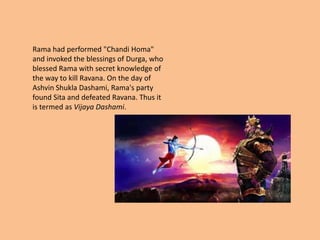
Rama had performed "Chandi Homa"
and invoked the blessings of Durga, who
blessed Rama with secret knowledge of
the way to kill Ravana. On the day of
Ashvin Shukla Dashami, Rama's party
found Sita and defeated Ravana. Thus it
is termed as Vijaya Dashami.
One Asura, Mahishasura, in the form of a
buffalo, grew very powerful and created havoc
on the earth. Under his leadership, the Asuras
defeated the Devas. The world was crushed
under Mahishasura's tyranny, the Devas joined
their energies into Shakti, a single mass of
incandescent energy, to kill Mahishasura.
A very powerful band of lightning emerged
from the mouths of Brahma, Vishnu and Shiva
and a young, beautiful female virgin with ten
hands appeared. All the Gods gave their
special weapons to her. This Shakti coalesced
to form the goddess Durga. Riding on a lion,
who assisted her, Durga fought Mahishasura.
The battle raged for nine days and nights.
Finally on the tenth day of Ashvin shukla
paksha, Mahishasura was defeated and killed
by Durga.
Navratri.pptx aahana

Navratri.pptx aahana

  • 2.
    The beginning ofspring and the beginning of autumn are considered to be important junctions of climatic and solar influences. These two periods are taken as sacred opportunities for the worship of the Divine Mother Durga. The dates of the festival are determined according to the lunar calendar.
  • 3.
    Navaratri is celebratedfive times a year. They are Vasanta Navaratri, Ashadha Navaratri, the Sharada Navaratri, and the Paush/Magha Navaratri. Of these, the Sharada Navaratri of the month of Puratashi and the Vasanta Navaratri of the Vasanta kala are the most important. 1. Vasanta Navaratri: Basanta Navaratri, also known as Vasant Navaratri, is the festival of nine days dedicated to the nine forms of Shakti (Mother Goddess) in the spring season (March–April). It is also known as Chaitra Navaratri. The nine days of festival are also known as Raama Navratri. 2. Gupta Navaratri: Gupta Navaratri, also referred as Ashadha or Gayatri or Shakambhari Navaratri, is nine days dedicated to the nine forms of Shakti (Mother Goddess) in the month of Ashadha (June–July). Gupta Navaratri is observed during the Ashadha Shukla Paksha (waxing phase of moon).
  • 4.
    3. Sharada Navaratri:This is the most important of the Navaratris. It is simply called Maha Navaratri (the Great Navratri) and is celebrated in the 'pratipada' (first day) of the bright fortnight of the lunar month of Ashvina. Also known as Sharad Navaratri, as it is celebrated during Sharad (beginning of winter, September–October). 4. Paush Navaratri: Paush Navaratri is nine days dedicated to the nine forms of Shakti (Mother Goddess) in the month of Paush (December–January). Paush Navaratri is observed during the Paush Shukla Paksha (waxing phase of moon). 5. Magha Navaratri: Magha Navaratri, also referred as Gupta Navaratri, is nine days dedicated to the nine forms of Shakti (Mother Goddess) in the month of Magha (January– February). Magha Navaratri is observed during the Magha Shukla Paksha (waxing phase of moon).
  • 5.
    Nine forms ofShakti are worshipped during the Navaratris. The Devis worshipped depend on the tradition of the region. 1. Durga, the inaccessible one 2. Bhadrakali 3. Amba ,Mother of the universe 4. Annapoorna devi, The one who bestows grains in plenty 5. Sarvamangala, The one who gives joy to all 6. Bhairavi 7. Chandika 8. Lalita 9. Bhavani
  • 6.
    During Navratri, somedevotees of Durga observe a fast and prayers are offered for the protection of health and prosperity. Devotees avoid meat, alcoholic drinks, grains, wheat and onion during this fast. Grains are usually avoided since it is believed that during the period of Navratri and seasonal change, grains attract and absorb lots of negative energies from the surrounding and therefore there is a need to avoid eating anything which are produced from grains for the purification of Navratri to be successful. Navratri is also a period of introspection and purification, and is traditionally an auspicious and religious time for starting new ventures.
  • 7.
    During the ninedays of Navratri there is a custom of wearing different colour dress – Sarees (Sari) and Churidhar – mainly in Gujarat and Maharashtra. Information on what are the Navratri colours usually appears a couple of days before in local Gujarati and Marathi newspapers.
  • 8.
    Both men andwomen usually wear colorful costumes while performing garba and dandiya. The girls and the women wear Chaniya choli, a three-piece dress with a choli, which is an embroidered and colorful blouse, teamed with chaniya, which is the flared, skirt-like bottom, and dupatta, which is usually worn in the traditional Gujarati manner. Chaniya Cholis are decorated with beads, shells, mirrors, stars, and embroidery work, mati. Etc Traditionally, women adorn themselves with jhumkas (large earrings), necklaces, bindi, bajubandh, chudas and kangans, kamarbandh, payal, and mojiris. Boys and men wear kafni pyjamas with a kediyu - a short round kurta - above the knees and pagadi on the head with bandhini dupatta, kada, and mojiris.
  • 9.
    The final setof three days is spent in worshiping the goddess of wisdom, Saraswati. Eighth day is traditionally Durgashtami which is big in Bengal and Bihar In some parts of South India, Saraswati puja is performed on the 9th day. Ayudha Puja is conducted in many parts of South India on the Mahanavami (Ninth) day with much fanfare. Weapons, agricultural implements, all kinds of tools, equipments, machinery and automobiles are decorated and worshipped on this day along with the worship of Goddess. The work starts afresh from the next day, i.e. the 10th day which is celebrated as 'Vijaya Dashami'.
  • 10.
    During the eightor ninth day, Kanya Poojan, pre-pubescent girls are ceremonially worshipped.
  • 11.
    As the namesuggests Vijayadashmi or Dussehra is celebrated on the tenth day of the month of Ashwin according to the Hindu lunisolar calendar which corresponds to September or October of the Gregorian calendar. The first nine days are celebrated as Sharada Navratri (the most important Navratri) and culminates on the tenth day as Dasara. In India, the harvest season begins at this time and so the Mother Goddess is invoked to start the new harvest season and reactivate the vigor and fertility of the soil. This is done through religious performances and rituals which are thought to invoke cosmic forces that rejuvenate the soil.
  • 12.
    Rama had performed"Chandi Homa" and invoked the blessings of Durga, who blessed Rama with secret knowledge of the way to kill Ravana. On the day of Ashvin Shukla Dashami, Rama's party found Sita and defeated Ravana. Thus it is termed as Vijaya Dashami.
  • 13.
    One Asura, Mahishasura,in the form of a buffalo, grew very powerful and created havoc on the earth. Under his leadership, the Asuras defeated the Devas. The world was crushed under Mahishasura's tyranny, the Devas joined their energies into Shakti, a single mass of incandescent energy, to kill Mahishasura. A very powerful band of lightning emerged from the mouths of Brahma, Vishnu and Shiva and a young, beautiful female virgin with ten hands appeared. All the Gods gave their special weapons to her. This Shakti coalesced to form the goddess Durga. Riding on a lion, who assisted her, Durga fought Mahishasura. The battle raged for nine days and nights. Finally on the tenth day of Ashvin shukla paksha, Mahishasura was defeated and killed by Durga.