CHAPTER 2
• Has changed profoundly since world war II
(Drucker,1986)
Perhaps the most fundamental change is the emergence of
global markets, responding to new opportunities, global
competitors have steadily displaced or aborted local ones.
Concurrently the integration of the world economy has
increased significantly.
Economic integration stood at 10 percent at the beginning
of the 20th century, today is approximately 50 percent.
Integration is particularly striking in two regions European
Union (EU) and the North American free trade area
(NAFTA)
Just 30 years ago, the world was far less
integrated that it is today (Krugman, 1992)
One of the Evidences of the changes that have
taken place is the automobile industry. Cars
with European nameplates such as
Renault,Citroen,Morris,Volvo and etc.were
radically different from the american chevrolet
Ford, or plymouth and from japanese models
such as Toyota or Nissan. These were local
cars built by local companies, mostly destined
for local or regional markets.
Within the past decades, there have been
several changes in the world economy.
• The first change is the Increased volume of
capital movements
• The second change concerns the
Relationship between positivity and
Employment
• The third major change is the emergence
of the world economy as the dominant
economic unit
THE THREE BASIC
ECONOMIC QUESTIONS
WHAT?
HOW?
FOR WHOM?
•Is the way a nation make
economic choices about
how the nation will use
its resources to produce
and distribute goods and
services.
•Traditional Economy
•Command Economy
•Market Economy
•Mixed Economy
• Completely dictated by a tradition (As
a society)
• Doesn’t have a lot of freedom
• No Room for innovation
Advantage
- Less stress
Disadvantage
- Standard of living does not go up
• Central Authority makes economic decision
• Central authority answers all economic questions
• Prices are not determined by demand and supply
Advantage
- Social Wefare
Disadvantage
- Individual desires are secondary to societal
desire
• Involves people and business
• The Government is hands off when it
comes to economy
• Supply and Demand rule the market
Advantage
-Consumer satisfaction is high
-No need to wait for government to decide
Disadvantage
-Economy may increase the gap between the rich and poor
• Command economy//Market Economy
• Government participates in making
economic decision
• Individual consumers and firms participate
in making economic decision
Advantage
-Individual freedom
-Government make sure the economy is moving forward
Disadvantage
-Higher taxes
• The world bank has developed a four category system of
classification that uses per capita (GNP) as a base.
Although the income definition for each of the stages is
arbitrary, countries within given category generally have a
number of characteristics in common. Thus, the stages
provide a useful basis for global market segmentation
and target marketing.
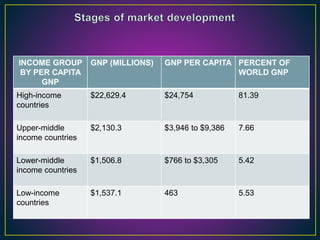
INCOME GROUP
BY PER CAPITA
GNP
GNP (MILLIONS) GNP PER CAPITA PERCENT OF
WORLD GNP
High-income
countries
$22,629.4 $24,754 81.39
Upper-middle
income countries
$2,130.3 $3,946 to $9,386 7.66
Lower-middle
income countries
$1,506.8 $766 to $3,305 5.42
Low-income
countries
$1,537.1 463 5.53
• Low income countries have GNP per capita of less than
$766. The characteristics shared by countries at this
income level are:
1. Limited industrialization and a high percentage of the
population engaged in agriculture and subsistence
farming.
2. High Birth rates
3. Low literacy rates
4. Heavy reliance on foreign aid
5. Political instability and unrest
• Although more than 50 percent of the world’s
population is included in this economic category,
many low income countries represents limited
markets for products.
• Many low income countries have such serious
economic,social and political problem that they
represent very limited opportunities for investment
and operations.
• Others were once growing relatively stable countries
that have
become divided by political stuggles.
• Sometimes, countries that can be assigned
to the lower income and lower middle
income categories are known collectively
as less developed countries (LDCs).
• The LDCs in the lower middle income
category have a major competitive
advantage in mature standardized labor
intensive Industries such as toy making
and textiles.
• These countries are also known as
industrializing or developing countries
with a GNP per capita ranging from
$3,036 to $9,385. in these countries,
the percentage of population engaged
in agriculture drops sharply as people
move to the industrial sector and the
degree of urbanization increases.
• High income countries are also known
as advanced, developed,
industrialized, or post-industrial
countries. They have GNP per capita
above $9,386 WITH exception of a
few oil-rich, the countries in this
category reached their present
income levels through a process of
sustained economic growth.
• There are 20 countries with large
(GDP) per capita in 2017. GDP is a
strong indicator of a country’s
economic performance and strenght.
It is measured by the added value of
all final goods and serviced produced
and manufactured by a country.
RANKING AND COUNTRY GDP Per in USS (in 2017)
1. Luxembourg
2. Switzerland
3. Macao
4. Norway
5. Iceland
6. Ireland
7. Qatar
8. United states
9. Denmark
10.Australia
11.Singapore
12.Sweden
13.Netherlands
14.San Marino
15.Austria
16.Finland
17.Hong kong
18.Canada
19.Germany
20.Belgium
107,708.22
80,836.66
79,563.56
73,615.15
73,092.2
68,604.38
60,811.86
59,495.34
56,334.61
56,135.42
53,880.13
53,248.14
48,271.67
47,302.15
46,435.93
45,692.89
44,999.31
44,773.26
44,184.45
43,243.3
Globalization Is About the Liberalization and Global
Integration of Markets
• “In other words the concrete
outcomes of market interactions are
neither intended nor forseen, but are
the result of the workings of what
Adam Smith famously called the
‘invisible happen'” yet Globalists
usuaully convey the assertion that
globalization is integration of markets
in the form of moral imperatives “The
concept of ‘free trade’ arose as a
moral principle even before it
became a pillar of economics”-
George Bush
• second mode of decontesting ‘globalization’ turns on the
adjacent concept ‘historical inevitability’. In the last
decade, the public discourse on globalization describing
its projected path was saturated with adjectives like
‘irresistable’, ‘inevitable’, ‘inexorable’, and ‘irreversible’.
• The third mode of decontesting globalization hinges on
the classical liberal concept of the ‘self-regulating
market’. The semantic link between ‘globalization market’
and the adjacent idea of ‘leaderlessness’ is simple: if the
undisturbed workings of the market indeed preordain a
certain course of history, then globalization does not
reflect the arbitrary agenda of a particular social class or
group. In other words, globalists are not ‘in charge’ in the
sense of imposing their own political agenda on people.
Rather, they merely carry out the unalterable imperatives
of a transcendental force much larger than narrow
partisan interests.
• “Economic growth and progress in today’s
interdependent world is bound up with the process of
globalization. Globalization provides great opportunities
for the future, not only for our countries, but for all others
too. Its many positive aspects include an unprecedented
expansion of investment and trade; the opening up to
international trade of the world’s most populous regions
and opportunities for more developing countries to
improve their standards of living; the increasingly rapid
dissemination of information,technological innovation,
and the proliferation of skilled jobs. These chracteristics
of globalization have lead to a considerable expansion of
wealth and prosperity in the world. Hence we are
convinced that the process of globalization is a source of
hope for the future”
• The fifth decontestation chain links ‘globalization’ and
‘market’ to the adjacent concept of ‘democracy’, which
also plays a significant role in liberalism, conservatism,
and socialism. Globalists typically decontest ‘democracy’
through its proximity to ‘market’ and the making of
economic choices—a theme developed through the
1980s in the peculiar variant of conservatism Freeden
calls ‘Thatcherism’. Indeed, a careful discourse analysis
of relevant texts reveals that globalists tend to treat
freedom, free markets, free trade and democracy as
synonymous terms.
• Like the previous claims, this final decontestation chain attests
to globalism’s political responsiveness and conceptual
flexibility. It combines the idea of economic globalization with
openly militaristic and nationalistic ideas associated with the
American-led global War on Terror. At the same time, however,
Claim 6 possesses a somewhat paradoxical character. If
global terror were no longer a major issue, it would disappear
without causing globalism to collapse. In that case, it seems
that Claim 6 is a contingent one and thus less important than
the previous five. On the other hand, if the global War on
Terror turns out to be a lengthy and intense engagement—as
suggested by the current American political leadership— then
it would become actually more important over time. No
wonder, then, that some commentators who favor the second
option have claimed to detect a dangerous turn of globalism
toward fascism.
• What is International economic Environment?
One system all over world which only used for the trade
internationally among the developed and developing countries
the environment in different countries, with conditions similar to
the home environment of the institutions, influencing decision-
making on capabilities and resource use.
can be described as the global factors that are outside of the
control of individual organizations but that can affect the way that
businesses operate. These factors include unemployment rates,
inflation rates, and labor costs.
• The law of one price
• The sustainability of ecosystems on which the global
economy depends must be guaranteed
• The economic partners must be satisfied that the basis of
exchange is equitable; relationships that are unequal and
based on dominance of one kind or another are not a
sound and durable basis for interdependence
• Economic Conditions: –Economic Policies of a business
unit are largely affected by the economic conditions of an
economy. Any improvement in the economic conditions
such as standard of living, purchasing power of public,
demand and supply, distribution of income etc. largely
affects the size of the market.
• Business cycle is another economic condition that is very
important for a business unit. Business Cycle has 6
different stages viz. (i) Expansion, (ii) Peak, (iii)
Decline/recession, (iv) Depression, (v)Trough, (vii)
Recovery.
• This is the first stage. When the expansion occurs, there
is an increase in employment, incomes, production, and
sales. People generally pay their debts on time. The
economy has a steady flow in the money supply and
investment is booming.
PEAK
• The second stage is a peak when the economy hits a
snag, having reached the maximum level of growth.
Prices hit their highest level, and economic indicators
stop growing. Many people start to restructure as the
economy's growth starts to reverse.
• These are periods of contraction. During a recession, unemployment
rises, production slows down, sales start to drop because of a decline in
demand, and incomes become stagnant or decline.
Depression
• Economic growth continues to drop while unemployment rises and
production plummets. Consumers and businesses find it hard to secure
credit, trade is reduced, and bankruptcies start to increase. Consumer
confidence and investment levels also drop.
Trough
this period marks the end of the depression, leading an economy into the
next step: recovery.
Recovery
In this stage, the economy starts to turn around. Low prices spur an
increase in demand, employment and production start to rise, and lenders
start to open up their credit coffers. This stage marks the end of one
business cycle.
Microeconomic
• Microeconomic part means focuses on the
recent economic environment and the
effect of location on business and
performance.
Macroeconomic
• The Macroeconomic part means focus on
the broader or spreader economic
environment and the world economy as all
in all.
• Finance system: International finance system
explains and researches the spread of money
over the international financial markets, and the
impacts of the exchange rates.
• Trade System: Which studies products, goods,
and services all over the world boundaries and it
makes some policy to spread up its trading
system.
• Monetary Macroeconomics System: this factor
research capital and macro flows all over the
world.
• Poverty, inequality and insufficiency: Almost all
over the many countries are live under the
poverty line. There have no proper system and
capital to improve them. However, inequality and
insufficiency of the products and working system
they are not developed. So, it is the challenges
for it.
• Greenhouse effect: Greenhouse effect is now an
n important discussion all over the world.
Economic environment is totally effected by this.
So it is the fact.
• Increasing awareness of the one
country political policies and
economic system.
• Learning the system of improving
relation through appropriate
communication.
• Identifying the other developed

Chapter 2 market globalism

  • 1.
  • 3.
    • Has changedprofoundly since world war II (Drucker,1986) Perhaps the most fundamental change is the emergence of global markets, responding to new opportunities, global competitors have steadily displaced or aborted local ones. Concurrently the integration of the world economy has increased significantly. Economic integration stood at 10 percent at the beginning of the 20th century, today is approximately 50 percent. Integration is particularly striking in two regions European Union (EU) and the North American free trade area (NAFTA)
  • 4.
    Just 30 yearsago, the world was far less integrated that it is today (Krugman, 1992) One of the Evidences of the changes that have taken place is the automobile industry. Cars with European nameplates such as Renault,Citroen,Morris,Volvo and etc.were radically different from the american chevrolet Ford, or plymouth and from japanese models such as Toyota or Nissan. These were local cars built by local companies, mostly destined for local or regional markets.
  • 5.
    Within the pastdecades, there have been several changes in the world economy. • The first change is the Increased volume of capital movements • The second change concerns the Relationship between positivity and Employment • The third major change is the emergence of the world economy as the dominant economic unit
  • 7.
    THE THREE BASIC ECONOMICQUESTIONS WHAT? HOW? FOR WHOM?
  • 8.
    •Is the waya nation make economic choices about how the nation will use its resources to produce and distribute goods and services.
  • 9.
  • 10.
    • Completely dictatedby a tradition (As a society) • Doesn’t have a lot of freedom • No Room for innovation Advantage - Less stress Disadvantage - Standard of living does not go up
  • 11.
    • Central Authoritymakes economic decision • Central authority answers all economic questions • Prices are not determined by demand and supply Advantage - Social Wefare Disadvantage - Individual desires are secondary to societal desire
  • 12.
    • Involves peopleand business • The Government is hands off when it comes to economy • Supply and Demand rule the market Advantage -Consumer satisfaction is high -No need to wait for government to decide Disadvantage -Economy may increase the gap between the rich and poor
  • 13.
    • Command economy//MarketEconomy • Government participates in making economic decision • Individual consumers and firms participate in making economic decision Advantage -Individual freedom -Government make sure the economy is moving forward Disadvantage -Higher taxes
  • 14.
    • The worldbank has developed a four category system of classification that uses per capita (GNP) as a base. Although the income definition for each of the stages is arbitrary, countries within given category generally have a number of characteristics in common. Thus, the stages provide a useful basis for global market segmentation and target marketing.
  • 15.
    INCOME GROUP BY PERCAPITA GNP GNP (MILLIONS) GNP PER CAPITA PERCENT OF WORLD GNP High-income countries $22,629.4 $24,754 81.39 Upper-middle income countries $2,130.3 $3,946 to $9,386 7.66 Lower-middle income countries $1,506.8 $766 to $3,305 5.42 Low-income countries $1,537.1 463 5.53
  • 16.
    • Low incomecountries have GNP per capita of less than $766. The characteristics shared by countries at this income level are: 1. Limited industrialization and a high percentage of the population engaged in agriculture and subsistence farming. 2. High Birth rates 3. Low literacy rates 4. Heavy reliance on foreign aid 5. Political instability and unrest
  • 17.
    • Although morethan 50 percent of the world’s population is included in this economic category, many low income countries represents limited markets for products. • Many low income countries have such serious economic,social and political problem that they represent very limited opportunities for investment and operations. • Others were once growing relatively stable countries that have become divided by political stuggles.
  • 18.
    • Sometimes, countriesthat can be assigned to the lower income and lower middle income categories are known collectively as less developed countries (LDCs). • The LDCs in the lower middle income category have a major competitive advantage in mature standardized labor intensive Industries such as toy making and textiles.
  • 19.
    • These countriesare also known as industrializing or developing countries with a GNP per capita ranging from $3,036 to $9,385. in these countries, the percentage of population engaged in agriculture drops sharply as people move to the industrial sector and the degree of urbanization increases.
  • 20.
    • High incomecountries are also known as advanced, developed, industrialized, or post-industrial countries. They have GNP per capita above $9,386 WITH exception of a few oil-rich, the countries in this category reached their present income levels through a process of sustained economic growth.
  • 21.
    • There are20 countries with large (GDP) per capita in 2017. GDP is a strong indicator of a country’s economic performance and strenght. It is measured by the added value of all final goods and serviced produced and manufactured by a country.
  • 22.
    RANKING AND COUNTRYGDP Per in USS (in 2017) 1. Luxembourg 2. Switzerland 3. Macao 4. Norway 5. Iceland 6. Ireland 7. Qatar 8. United states 9. Denmark 10.Australia 11.Singapore 12.Sweden 13.Netherlands 14.San Marino 15.Austria 16.Finland 17.Hong kong 18.Canada 19.Germany 20.Belgium 107,708.22 80,836.66 79,563.56 73,615.15 73,092.2 68,604.38 60,811.86 59,495.34 56,334.61 56,135.42 53,880.13 53,248.14 48,271.67 47,302.15 46,435.93 45,692.89 44,999.31 44,773.26 44,184.45 43,243.3
  • 23.
    Globalization Is Aboutthe Liberalization and Global Integration of Markets • “In other words the concrete outcomes of market interactions are neither intended nor forseen, but are the result of the workings of what Adam Smith famously called the ‘invisible happen'” yet Globalists usuaully convey the assertion that globalization is integration of markets in the form of moral imperatives “The concept of ‘free trade’ arose as a moral principle even before it became a pillar of economics”- George Bush
  • 24.
    • second modeof decontesting ‘globalization’ turns on the adjacent concept ‘historical inevitability’. In the last decade, the public discourse on globalization describing its projected path was saturated with adjectives like ‘irresistable’, ‘inevitable’, ‘inexorable’, and ‘irreversible’.
  • 25.
    • The thirdmode of decontesting globalization hinges on the classical liberal concept of the ‘self-regulating market’. The semantic link between ‘globalization market’ and the adjacent idea of ‘leaderlessness’ is simple: if the undisturbed workings of the market indeed preordain a certain course of history, then globalization does not reflect the arbitrary agenda of a particular social class or group. In other words, globalists are not ‘in charge’ in the sense of imposing their own political agenda on people. Rather, they merely carry out the unalterable imperatives of a transcendental force much larger than narrow partisan interests.
  • 26.
    • “Economic growthand progress in today’s interdependent world is bound up with the process of globalization. Globalization provides great opportunities for the future, not only for our countries, but for all others too. Its many positive aspects include an unprecedented expansion of investment and trade; the opening up to international trade of the world’s most populous regions and opportunities for more developing countries to improve their standards of living; the increasingly rapid dissemination of information,technological innovation, and the proliferation of skilled jobs. These chracteristics of globalization have lead to a considerable expansion of wealth and prosperity in the world. Hence we are convinced that the process of globalization is a source of hope for the future”
  • 27.
    • The fifthdecontestation chain links ‘globalization’ and ‘market’ to the adjacent concept of ‘democracy’, which also plays a significant role in liberalism, conservatism, and socialism. Globalists typically decontest ‘democracy’ through its proximity to ‘market’ and the making of economic choices—a theme developed through the 1980s in the peculiar variant of conservatism Freeden calls ‘Thatcherism’. Indeed, a careful discourse analysis of relevant texts reveals that globalists tend to treat freedom, free markets, free trade and democracy as synonymous terms.
  • 28.
    • Like theprevious claims, this final decontestation chain attests to globalism’s political responsiveness and conceptual flexibility. It combines the idea of economic globalization with openly militaristic and nationalistic ideas associated with the American-led global War on Terror. At the same time, however, Claim 6 possesses a somewhat paradoxical character. If global terror were no longer a major issue, it would disappear without causing globalism to collapse. In that case, it seems that Claim 6 is a contingent one and thus less important than the previous five. On the other hand, if the global War on Terror turns out to be a lengthy and intense engagement—as suggested by the current American political leadership— then it would become actually more important over time. No wonder, then, that some commentators who favor the second option have claimed to detect a dangerous turn of globalism toward fascism.
  • 29.
    • What isInternational economic Environment? One system all over world which only used for the trade internationally among the developed and developing countries the environment in different countries, with conditions similar to the home environment of the institutions, influencing decision- making on capabilities and resource use. can be described as the global factors that are outside of the control of individual organizations but that can affect the way that businesses operate. These factors include unemployment rates, inflation rates, and labor costs.
  • 30.
    • The lawof one price • The sustainability of ecosystems on which the global economy depends must be guaranteed • The economic partners must be satisfied that the basis of exchange is equitable; relationships that are unequal and based on dominance of one kind or another are not a sound and durable basis for interdependence
  • 31.
    • Economic Conditions:–Economic Policies of a business unit are largely affected by the economic conditions of an economy. Any improvement in the economic conditions such as standard of living, purchasing power of public, demand and supply, distribution of income etc. largely affects the size of the market. • Business cycle is another economic condition that is very important for a business unit. Business Cycle has 6 different stages viz. (i) Expansion, (ii) Peak, (iii) Decline/recession, (iv) Depression, (v)Trough, (vii) Recovery.
  • 32.
    • This isthe first stage. When the expansion occurs, there is an increase in employment, incomes, production, and sales. People generally pay their debts on time. The economy has a steady flow in the money supply and investment is booming. PEAK • The second stage is a peak when the economy hits a snag, having reached the maximum level of growth. Prices hit their highest level, and economic indicators stop growing. Many people start to restructure as the economy's growth starts to reverse.
  • 33.
    • These areperiods of contraction. During a recession, unemployment rises, production slows down, sales start to drop because of a decline in demand, and incomes become stagnant or decline. Depression • Economic growth continues to drop while unemployment rises and production plummets. Consumers and businesses find it hard to secure credit, trade is reduced, and bankruptcies start to increase. Consumer confidence and investment levels also drop. Trough this period marks the end of the depression, leading an economy into the next step: recovery. Recovery In this stage, the economy starts to turn around. Low prices spur an increase in demand, employment and production start to rise, and lenders start to open up their credit coffers. This stage marks the end of one business cycle.
  • 34.
    Microeconomic • Microeconomic partmeans focuses on the recent economic environment and the effect of location on business and performance. Macroeconomic • The Macroeconomic part means focus on the broader or spreader economic environment and the world economy as all in all.
  • 35.
    • Finance system:International finance system explains and researches the spread of money over the international financial markets, and the impacts of the exchange rates. • Trade System: Which studies products, goods, and services all over the world boundaries and it makes some policy to spread up its trading system. • Monetary Macroeconomics System: this factor research capital and macro flows all over the world.
  • 37.
    • Poverty, inequalityand insufficiency: Almost all over the many countries are live under the poverty line. There have no proper system and capital to improve them. However, inequality and insufficiency of the products and working system they are not developed. So, it is the challenges for it. • Greenhouse effect: Greenhouse effect is now an n important discussion all over the world. Economic environment is totally effected by this. So it is the fact.
  • 38.
    • Increasing awarenessof the one country political policies and economic system. • Learning the system of improving relation through appropriate communication. • Identifying the other developed