ACE-COMMISSIONED STUDY

New Study
Puts the
Crunch on
Ineffective Ab
Exercises

By Mark Anders

n recent years, a
host of infomercial
products and exercise videos have
preyed on people’s
desire for a toned
midsection. And
many avid exercisers are quick to share
their own favorite recipes for abdominal success. But what is the best, most
efficient route to tighter abs? A recent
study conducted by the Biomechanics
Lab at San Diego State University
reveals a unique look at 13 of the most
common abdominal exercises, ranking
them best to worst.

I

The Study
Led by Peter Francis, Ph.D.,
researchers recruited 30 healthy
women and men to participate in the
study. The subjects, ages 20 to 45,
ranged from occasional exercisers to
those who work out daily. Participants
were put through a battery of exercises that target the midsection,
including
the traditional

crunch, modified crunches, partial
body weight exercises and exercises
using both home and gym exercise
equipment. Because of ACE’s ongoing interest in examining popular
infomercial products, we provided
the research team with a Torso Track
and AB Rocker to be included in the
testing.
All of the exercises were introduced
in random order and participants were
allowed to practice each exercise
briefly. Subjects then completed 10 to
12 repetitions of each exercise, maintaining a two-count cadence throughout
(two seconds at the concentric phase,
two at the eccentric phase). Using electromyography (EMG) equipment,
researchers monitored each participant’s muscle activity as they exercised. Activity was recorded in the
upper and lower rectus abdominus and
the external obliques. Researchers also
measured activity in the rectus femoris
to indicate activity in the hip flexors.
These data are important because high
levels of activity in this area suggest
that an exercise is either done incorrectly or requires the body to recruit muscles other than the abdominals and

How to do the
Top Ab Exercises
Correctly

MAY/JUNE 2001

Upper
vs.
Lower
ACE FITNESSMATTERS

obliques. Testing for the entire round of
13 exercises took approximately one
hour per subject, not including the
EMG set up.
Using the EMG data, researchers
established the mean muscle activity
for each exercise and normalized it to
that of a traditional crunch—the baseline for comparison. Exercises were
then ranked best to worst based on the
average amount of EMG activity
recorded in each of the muscle areas.

The Results
After extensive data collection
and analysis, Dr. Francis and his
researchers found that exercises that
require constant abdominal stabilization, as well as body rotation, generated the most muscle activity in the
obliques.
Topping the list of the most effective exercises was the bicycle maneuver, followed closely by the second
ranked, captain’s chair. As for home
exercise equipment, crunches on an
exercise ball ranked highest—coming
in third overall.
Although crunches on an exercise
Continued on page 10

Activity in Rectus Abdominus
and Activity in Obliques

9
ACTIVITY IN RECTUS ABDOMINUS
RANKING
1
2
3
4
5
6
7
8
9
10
11
12
13

EXERCISE
Bicycle Maneuver
Captain’s Chair
Exercise Ball
Vertical Leg Crunch
Torso Track
Long Arm Crunch
Reverse Crunch
Crunch with Heel Push
Ab Roller
Hover
Traditional Crunch
Exercise Tubing Pull
Ab Rocker

MEAN % OF
ACTIVITY
248
212
139
129
127
119
109
107
105
100
100
92
21

ACTIVITY IN OBLIQUES
RANKING
1
2
3
4
5
6
7
8
9
10
11
12
13

EXERCISE
Captain’s Chair
Bicycle Maneuver
Reverse Crunch
Hover
Vertical Leg Crunch
Exercise Ball
Torso Track
Crunch with Heel Push
Long Arm Crunch
Ab Roller
Traditional Crunch
Exercise Tubing Pull
Ab Rocker

MEAN % OF
ACTIVITY
310
290
240
230
216
147
145
126
118
101
100
77
74

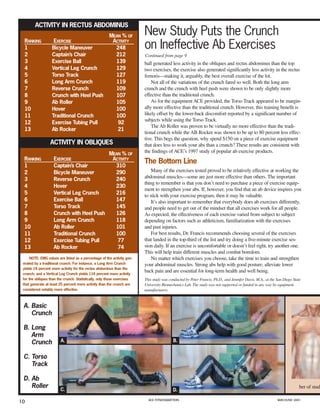
NOTE: EMG values are listed as a percentage of the activity generated by a traditional crunch. For instance, a Long Arm Crunch
yields 19 percent more activity for the rectus abdominus than the
crunch; and a Vertical Leg Crunch yields 116 percent more activity
for the obliques than the crunch. Statistically, only those exercises
that generate at least 25 percent more activity than the crunch are
considered notably more effective.

New Study Puts the Crunch
on Ineffective Ab Exercises
Continued from page 9

ball generated less activity in the obliques and rectus abdominus than the top
two exercises, the exercise also generated significantly less activity in the rectus
femoris—making it, arguably, the best overall exercise of the lot.
Not all of the variations of the crunch fared so well. Both the long arm
crunch and the crunch with heel push were shown to be only slightly more
effective than the traditional crunch.
As for the equipment ACE provided, the Torso Track appeared to be marginally more effective than the traditional crunch. However, this training benefit is
likely offset by the lower-back discomfort reported by a significant number of
subjects while using the Torso Track.
The Ab Roller was proven to be virtually no more effective than the traditional crunch while the AB Rocker was shown to be up to 80 percent less effective. This begs the question, why spend $150 on a piece of exercise equipment
that does less to work your abs than a crunch? These results are consistent with
the findings of ACE’s 1997 study of popular ab exercise products.

The Bottom Line
Many of the exercises tested proved to be relatively effective at working the
abdominal muscles—some are just more effective than others. The important
thing to remember is that you don’t need to purchase a piece of exercise equipment to strengthen your abs. If, however, you find that an ab device inspires you
to stick with your exercise program, then it may be valuable.
It’s also important to remember that everybody does ab exercises differently,
and people need to get out of the mindset that all exercises work for all people.
As expected, the effectiveness of each exercise varied from subject to subject
depending on factors such as athleticism, familiarization with the exercises
and past injuries.
For best results, Dr. Francis recommends choosing several of the exercises
that landed in the top-third of the list and try doing a five-minute exercise session daily. If an exercise is uncomfortable or doesn’t feel right, try another one.
This will help train different muscles and combat boredom.
No matter which exercises you choose, take the time to train and strengthen
your abdominal muscles. Strong abs help with good posture, alleviate lower
back pain and are essential for long-term health and well being.
This study was conducted by Peter Francis, Ph.D., and Jennifer Davis, M.A., at the San Diego State
University Biomechanics Lab. The study was not supported or funded in any way by equipment
manufacturers.

A. Basic
Crunch
B. Long
Arm
Crunch

A.

B.

C.

D.

C. Torso
Track
D. Ab
Roller
10

ACE FITNESSMATTERS

ber of stud
MAY/JUNE 2001
How to do the
Top Ab Exercises Correctly
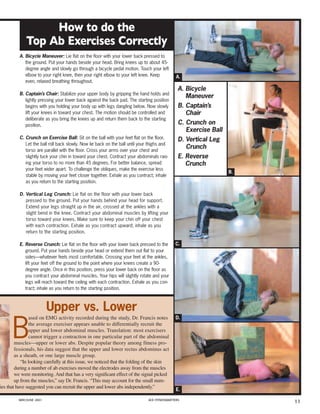
A. Bicycle Maneuver: Lie flat on the floor with your lower back pressed to
the ground. Put your hands beside your head. Bring knees up to about 45degree angle and slowly go through a bicycle pedal motion. Touch your left
elbow to your right knee, then your right elbow to your left knee. Keep
even, relaxed breathing throughout.
B. Captain’s Chair: Stabilize your upper body by gripping the hand holds and
lightly pressing your lower back against the back pad. The starting position
begins with you holding your body up with legs dangling below. Now slowly
lift your knees in toward your chest. The motion should be controlled and
deliberate as you bring the knees up and return them back to the starting
position.
C. Crunch on Exercise Ball: Sit on the ball with your feet flat on the floor.
Let the ball roll back slowly. Now lie back on the ball until your thighs and
torso are parallel with the floor. Cross your arms over your chest and
slightly tuck your chin in toward your chest. Contract your abdominals raising your torso to no more than 45 degrees. For better balance, spread
your feet wider apart. To challenge the obliques, make the exercise less
stable by moving your feet closer together. Exhale as you contract; inhale
as you return to the starting position.

A.

A. Bicycle
Maneuver
B. Captain’s
Chair
C. Crunch on
Exercise Ball
D. Vertical Leg
Crunch
E. Reverse
Crunch
B.

D. Vertical Leg Crunch: Lie flat on the floor with your lower back
pressed to the ground. Put your hands behind your head for support.
Extend your legs straight up in the air, crossed at the ankles with a
slight bend in the knee. Contract your abdominal muscles by lifting your
torso toward your knees. Make sure to keep your chin off your chest
with each contraction. Exhale as you contract upward; inhale as you
return to the starting position.
E. Reverse Crunch: Lie flat on the floor with your lower back pressed to the
ground. Put your hands beside your head or extend them out flat to your
sides—whatever feels most comfortable. Crossing your feet at the ankles,
lift your feet off the ground to the point where your knees create a 90degree angle. Once in this position, press your lower back on the floor as
you contract your abdominal muscles. Your hips will slightly rotate and your
legs will reach toward the ceiling with each contraction. Exhale as you contract; inhale as you return to the starting position.

C.

Upper vs. Lower

ased on EMG activity recorded during the study, Dr. Francis notes
the average exerciser appears unable to differentially recruit the
upper and lower abdominal muscles. Translation: most exercisers
cannot trigger a contraction in one particular part of the abdominal
muscles—upper or lower abs. Despite popular theory among fitness professionals, his data suggest that the upper and lower rectus abdominus act
as a sheath, or one large muscle group.
“In looking carefully at this issue, we noticed that the folding of the skin
during a number of ab exercises moved the electrodes away from the muscles
we were monitoring. And that has a very significant effect of the signal picked
up from the muscles,” say Dr. Francis. “This may account for the small numdies that have suggested you can recruit the upper and lower abs independently.”

B

MAY/JUNE 2001

D.

E.

ACE FITNESSMATTERS

11

New study puts the crunch on ineffective ab exercises

  • 1.
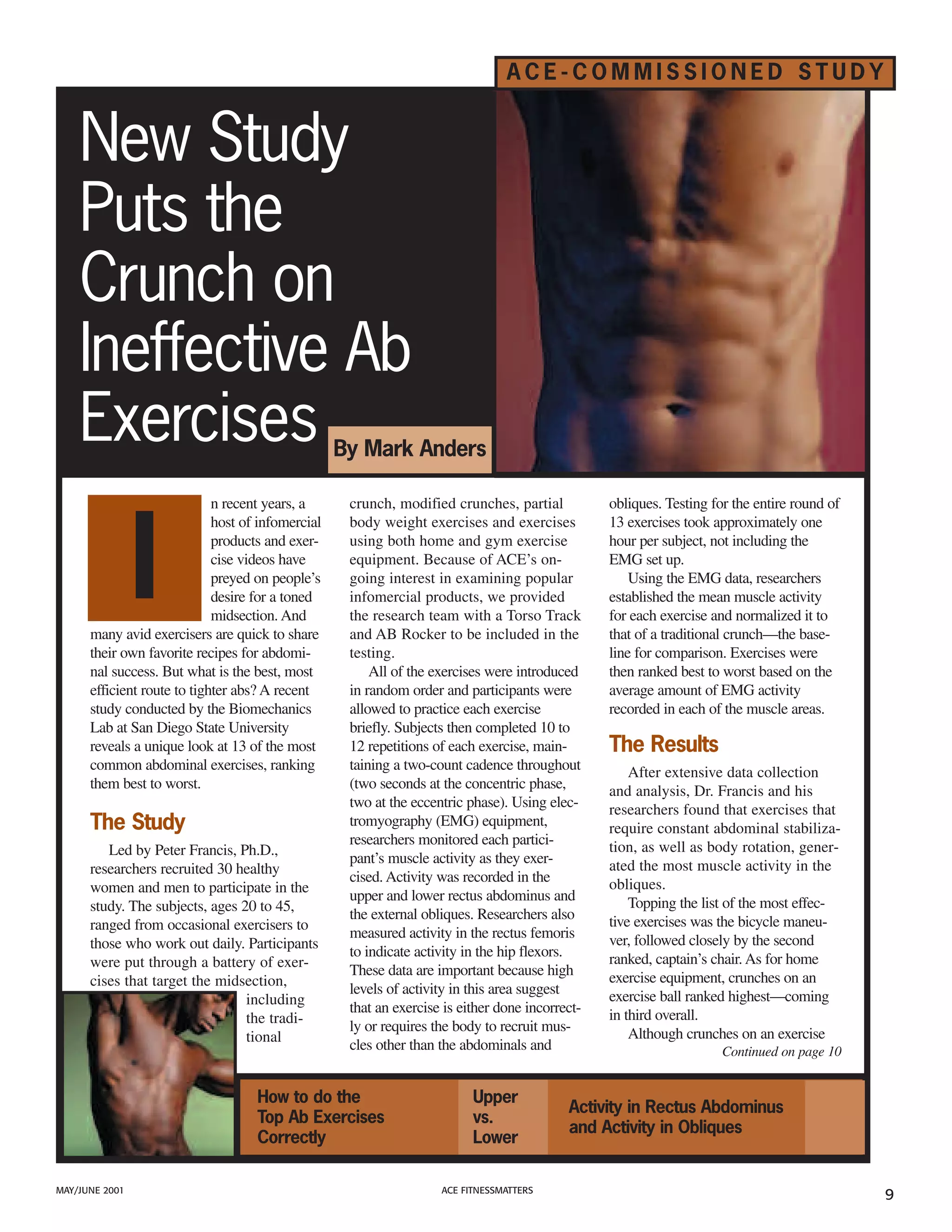
    ACE-COMMISSIONED STUDY New Study Putsthe Crunch on Ineffective Ab Exercises By Mark Anders n recent years, a host of infomercial products and exercise videos have preyed on people’s desire for a toned midsection. And many avid exercisers are quick to share their own favorite recipes for abdominal success. But what is the best, most efficient route to tighter abs? A recent study conducted by the Biomechanics Lab at San Diego State University reveals a unique look at 13 of the most common abdominal exercises, ranking them best to worst. I The Study Led by Peter Francis, Ph.D., researchers recruited 30 healthy women and men to participate in the study. The subjects, ages 20 to 45, ranged from occasional exercisers to those who work out daily. Participants were put through a battery of exercises that target the midsection, including the traditional crunch, modified crunches, partial body weight exercises and exercises using both home and gym exercise equipment. Because of ACE’s ongoing interest in examining popular infomercial products, we provided the research team with a Torso Track and AB Rocker to be included in the testing. All of the exercises were introduced in random order and participants were allowed to practice each exercise briefly. Subjects then completed 10 to 12 repetitions of each exercise, maintaining a two-count cadence throughout (two seconds at the concentric phase, two at the eccentric phase). Using electromyography (EMG) equipment, researchers monitored each participant’s muscle activity as they exercised. Activity was recorded in the upper and lower rectus abdominus and the external obliques. Researchers also measured activity in the rectus femoris to indicate activity in the hip flexors. These data are important because high levels of activity in this area suggest that an exercise is either done incorrectly or requires the body to recruit muscles other than the abdominals and How to do the Top Ab Exercises Correctly MAY/JUNE 2001 Upper vs. Lower ACE FITNESSMATTERS obliques. Testing for the entire round of 13 exercises took approximately one hour per subject, not including the EMG set up. Using the EMG data, researchers established the mean muscle activity for each exercise and normalized it to that of a traditional crunch—the baseline for comparison. Exercises were then ranked best to worst based on the average amount of EMG activity recorded in each of the muscle areas. The Results After extensive data collection and analysis, Dr. Francis and his researchers found that exercises that require constant abdominal stabilization, as well as body rotation, generated the most muscle activity in the obliques. Topping the list of the most effective exercises was the bicycle maneuver, followed closely by the second ranked, captain’s chair. As for home exercise equipment, crunches on an exercise ball ranked highest—coming in third overall. Although crunches on an exercise Continued on page 10 Activity in Rectus Abdominus and Activity in Obliques 9
  • 2.
    ACTIVITY IN RECTUSABDOMINUS RANKING 1 2 3 4 5 6 7 8 9 10 11 12 13 EXERCISE Bicycle Maneuver Captain’s Chair Exercise Ball Vertical Leg Crunch Torso Track Long Arm Crunch Reverse Crunch Crunch with Heel Push Ab Roller Hover Traditional Crunch Exercise Tubing Pull Ab Rocker MEAN % OF ACTIVITY 248 212 139 129 127 119 109 107 105 100 100 92 21 ACTIVITY IN OBLIQUES RANKING 1 2 3 4 5 6 7 8 9 10 11 12 13 EXERCISE Captain’s Chair Bicycle Maneuver Reverse Crunch Hover Vertical Leg Crunch Exercise Ball Torso Track Crunch with Heel Push Long Arm Crunch Ab Roller Traditional Crunch Exercise Tubing Pull Ab Rocker MEAN % OF ACTIVITY 310 290 240 230 216 147 145 126 118 101 100 77 74 NOTE: EMG values are listed as a percentage of the activity generated by a traditional crunch. For instance, a Long Arm Crunch yields 19 percent more activity for the rectus abdominus than the crunch; and a Vertical Leg Crunch yields 116 percent more activity for the obliques than the crunch. Statistically, only those exercises that generate at least 25 percent more activity than the crunch are considered notably more effective. New Study Puts the Crunch on Ineffective Ab Exercises Continued from page 9 ball generated less activity in the obliques and rectus abdominus than the top two exercises, the exercise also generated significantly less activity in the rectus femoris—making it, arguably, the best overall exercise of the lot. Not all of the variations of the crunch fared so well. Both the long arm crunch and the crunch with heel push were shown to be only slightly more effective than the traditional crunch. As for the equipment ACE provided, the Torso Track appeared to be marginally more effective than the traditional crunch. However, this training benefit is likely offset by the lower-back discomfort reported by a significant number of subjects while using the Torso Track. The Ab Roller was proven to be virtually no more effective than the traditional crunch while the AB Rocker was shown to be up to 80 percent less effective. This begs the question, why spend $150 on a piece of exercise equipment that does less to work your abs than a crunch? These results are consistent with the findings of ACE’s 1997 study of popular ab exercise products. The Bottom Line Many of the exercises tested proved to be relatively effective at working the abdominal muscles—some are just more effective than others. The important thing to remember is that you don’t need to purchase a piece of exercise equipment to strengthen your abs. If, however, you find that an ab device inspires you to stick with your exercise program, then it may be valuable. It’s also important to remember that everybody does ab exercises differently, and people need to get out of the mindset that all exercises work for all people. As expected, the effectiveness of each exercise varied from subject to subject depending on factors such as athleticism, familiarization with the exercises and past injuries. For best results, Dr. Francis recommends choosing several of the exercises that landed in the top-third of the list and try doing a five-minute exercise session daily. If an exercise is uncomfortable or doesn’t feel right, try another one. This will help train different muscles and combat boredom. No matter which exercises you choose, take the time to train and strengthen your abdominal muscles. Strong abs help with good posture, alleviate lower back pain and are essential for long-term health and well being. This study was conducted by Peter Francis, Ph.D., and Jennifer Davis, M.A., at the San Diego State University Biomechanics Lab. The study was not supported or funded in any way by equipment manufacturers. A. Basic Crunch B. Long Arm Crunch A. B. C. D. C. Torso Track D. Ab Roller 10 ACE FITNESSMATTERS ber of stud MAY/JUNE 2001
  • 3.
    How to dothe Top Ab Exercises Correctly A. Bicycle Maneuver: Lie flat on the floor with your lower back pressed to the ground. Put your hands beside your head. Bring knees up to about 45degree angle and slowly go through a bicycle pedal motion. Touch your left elbow to your right knee, then your right elbow to your left knee. Keep even, relaxed breathing throughout. B. Captain’s Chair: Stabilize your upper body by gripping the hand holds and lightly pressing your lower back against the back pad. The starting position begins with you holding your body up with legs dangling below. Now slowly lift your knees in toward your chest. The motion should be controlled and deliberate as you bring the knees up and return them back to the starting position. C. Crunch on Exercise Ball: Sit on the ball with your feet flat on the floor. Let the ball roll back slowly. Now lie back on the ball until your thighs and torso are parallel with the floor. Cross your arms over your chest and slightly tuck your chin in toward your chest. Contract your abdominals raising your torso to no more than 45 degrees. For better balance, spread your feet wider apart. To challenge the obliques, make the exercise less stable by moving your feet closer together. Exhale as you contract; inhale as you return to the starting position. A. A. Bicycle Maneuver B. Captain’s Chair C. Crunch on Exercise Ball D. Vertical Leg Crunch E. Reverse Crunch B. D. Vertical Leg Crunch: Lie flat on the floor with your lower back pressed to the ground. Put your hands behind your head for support. Extend your legs straight up in the air, crossed at the ankles with a slight bend in the knee. Contract your abdominal muscles by lifting your torso toward your knees. Make sure to keep your chin off your chest with each contraction. Exhale as you contract upward; inhale as you return to the starting position. E. Reverse Crunch: Lie flat on the floor with your lower back pressed to the ground. Put your hands beside your head or extend them out flat to your sides—whatever feels most comfortable. Crossing your feet at the ankles, lift your feet off the ground to the point where your knees create a 90degree angle. Once in this position, press your lower back on the floor as you contract your abdominal muscles. Your hips will slightly rotate and your legs will reach toward the ceiling with each contraction. Exhale as you contract; inhale as you return to the starting position. C. Upper vs. Lower ased on EMG activity recorded during the study, Dr. Francis notes the average exerciser appears unable to differentially recruit the upper and lower abdominal muscles. Translation: most exercisers cannot trigger a contraction in one particular part of the abdominal muscles—upper or lower abs. Despite popular theory among fitness professionals, his data suggest that the upper and lower rectus abdominus act as a sheath, or one large muscle group. “In looking carefully at this issue, we noticed that the folding of the skin during a number of ab exercises moved the electrodes away from the muscles we were monitoring. And that has a very significant effect of the signal picked up from the muscles,” say Dr. Francis. “This may account for the small numdies that have suggested you can recruit the upper and lower abs independently.” B MAY/JUNE 2001 D. E. ACE FITNESSMATTERS 11