Presented by
Mohamad Abdulrazik El saaid
Under supervision of
Professor Amir Ibrahim Mohamad Salah
Doctor Mohamad Anwar El Shafei
Doctor Mostafa Gamal Eldin Mahran
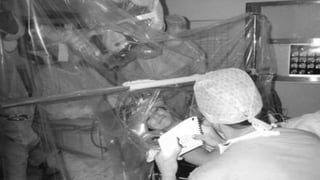
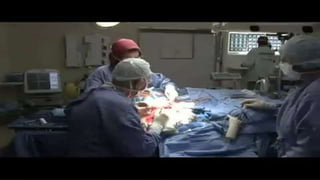
 Awake craniotomy literally means a procedure where the patient is
awake during critical portions of the surgery so that his vital functions
such as speech and movement can be monitored continuously.
Maintain Anesthetic Goal Ensure
1.Adequate patient comfort. 1.Patient Safety.
2.Analgesia. 2.Control and maintainance
3.Immobility. of critical functions.
4.Patient co-operation.
Advantage of awake craniotomy
1.Intraoperative Electrocorticography:
It is the “gold standard” for defining epileptogenic zones in clinical practice.
2.Cortical Mapping:
Recording the electric currents that result from muscle contractions in order to identify
motor areas of the cortex
Language areas are identified from the verbal responses of an awake patient.
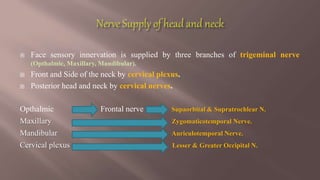
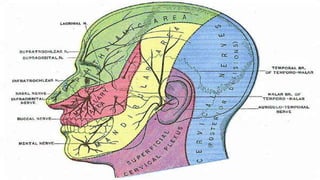
 Face sensory innervation is supplied by three branches of trigeminal nerve
(Opthalmic, Maxillary, Mandibular).
 Front and Side of the neck by cervical plexus.
 Posterior head and neck by cervical nerves.
Opthalmic Frontal nerve Supaorbital & Supratrochlear N.
Maxillary Zygomaticotemporal Nerve.
Mandibular Auriculotemporal Nerve.
Cervical plexus Lesser & Greater Occipital N.
 Poor anesthetic technique which allows coughing, straining,
hypotension, exaggerated hypertension, hypoxia and hypercarbia will
seriously damage the critically ill brain.
 Better results can be obtained by careful monitoring of the patient and
attention to simple details than by complex pharmacological
interventions.
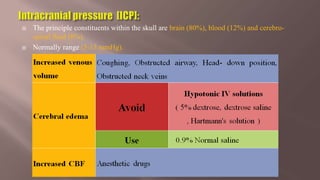
 The principle constituents within the skull are brain (80%), blood (12%) and cerebro-
spinal fluid (8%).
 Normally range (5-13 mmHg).
 Cerebral perfusion pressure [CPP] is defined as the difference between
mean arterial and intracranial pressures.
CPP = MAP – ICP
 Normal cerebral perfusion pressure is 80 mmHg, but when reduced to
less than 50 mmHg there is metabolic evidence of ischemia and
reduced electrical activity.
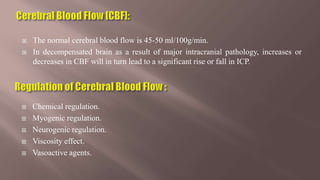
 The normal cerebral blood flow is 45-50 ml/100g/min.
 In decompensated brain as a result of major intracranial pathology, increases or
decreases in CBF will in turn lead to a significant rise or fall in ICP.
 Chemical regulation.
 Myogenic regulation.
 Neurogenic regulation.
 Viscosity effect.
 Vasoactive agents.
3. PaO2: From 60 to more than 300 mmHg have little influence on CBF. When the
PaO2 is less than 60 mmHg, CBF increases rapidly.
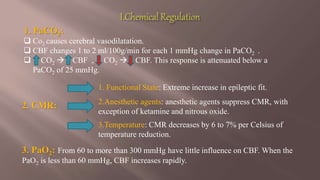
1. PaCO2:
 Co2 causes cerebral vasodilatation.
 CBF changes 1 to 2 ml/100g/min for each 1 mmHg change in PaCO2 .
 CO2  CBF , CO2  CBF. This response is attenuated below a
PaCO2 of 25 mmHg.
2. CMR: 2.Anesthetic agents: anesthetic agents suppress CMR, with
exception of ketamine and nitrous oxide.
3.Temperature: CMR decreases by 6 to 7% per Celsius of
temperature reduction.
1. Functional State: Extreme increase in epileptic fit.
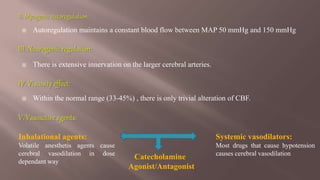
 Autoregulation maintains a constant blood flow between MAP 50 mmHg and 150 mmHg
 There is extensive innervation on the larger cerebral arteries.
 Within the normal range (33-45%) , there is only trivial alteration of CBF.
Inhalational agents:
Volatile anesthetis agents cause
cerebral vasodilation in dose
dependant way
Systemic vasodilators:
Most drugs that cause hypotension
causes cerebral vasodilation
Catecholamine
Agonist/Antagonist
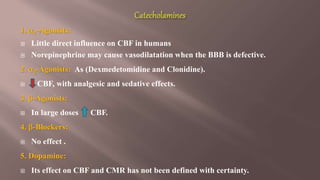
1. 1-Agonists:
 Little direct influence on CBF in humans
 Norepinephrine may cause vasodilatation when the BBB is defective.
2. 2-Agonists: As (Dexmedetomidine and Clonidine).
 CBF, with analgesic and sedative effects.
3. -Agonists:
 In large doses CBF.
4. -Blockers:
 No effect .
5. Dopamine:
 Its effect on CBF and CMR has not been defined with certainty.
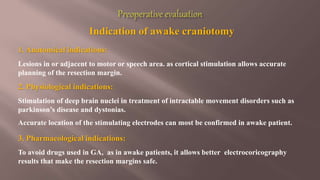
Indication of awake craniotomy
1. Anatomical indications:
Lesions in or adjacent to motor or speech area. as cortical stimulation allows accurate
planning of the resection margin.
2. Physiological indications:
Stimulation of deep brain nuclei in treatment of intractable movement disorders such as
parkinson’s disease and dystonias.
Accurate location of the stimulating electrodes can most be confirmed in awake patient.
3. Pharmacological indications:
To avoid drugs used in GA, as in awake patients, it allows better electrocoricography
results that make the resection margins safe.
1. Patient refusal.
2. Inability to communicate .
3. Low occipital tumors.
4. Significant dural invasion.
5. Pediatric patients with insufficient understanding and ability to cooperate.
6. Significant psychiatric illness.
7. Medical conditions that would prevent lying still for several hours.
8. Medical conditions that would compromise the patient’s ability to lie sedated for
prolonged periods without developing hypoxemia or hypercarbia.
9. Inexperienced neurosurgeon is absolute contraindication.
Preoperative psychological preparation:
 Psychological preparation is one of the most crucial aspects of operating on
patients under local anesthesia.
 the patient has to be reassured that the awake part of the procedure will be painless.
Laboratory evaluation
 Special attention to therapeutic levels of antiepileptic drugs as it doubles after
surgery.
Airway evaluation:
 Conversion from local anethesia to GA can occur at any moment.
Premedication:
1. Seditives:
 Midazolam is the best benzodiazepine for awake craniotomies.
2. Antiemetics and Antacids.
3. 2-Agonists:
 Analgesic and sedetive effect with blunting of adrenergic response.
4. Anticholinergics:
 Antisalivation effect may be troublesome for some patients.
5. Anticonvulsants.
6. Dexamethasone:
 To decrease possible brain edema.
7. Antibiotics.
I. Preparation of the operating room.
II. Positioning.
III. Scalp Block:
6 Scalp nerves should be blocked + Wound infiltration + Dural block
A. Timing and duration: done at least 20 minutes prior to skin incision, lasts for 3-4 hours.
B. Technique: A scalp block is performed using approximately 2.5 to 5 ml bupivacaine
0.25% to 0.5% with epinephrine 1: 200.000 at each site. Injection is performed with a 1.25 inch
25 gauge needle.
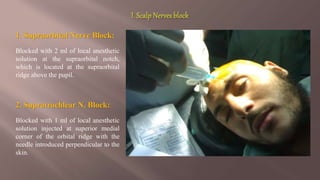
1. Supraorbital Nerve Block:
Blocked with 2 ml of local anesthetic
solution at the supraorbital notch,
which is located at the supraorbital
ridge above the pupil.
2. Supratrochlear N. Block:
Blocked with 1 ml of local anesthetic
solution injected at superior medial
corner of the orbital ridge with the
needle introduced perpendicular to the
skin.
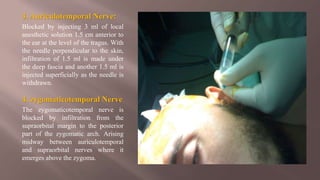
3. Auriculotemporal Nerve:
Blocked by injecting 3 ml of local
anesthetic solution 1.5 cm anterior to
the ear at the level of the tragus. With
the needle perpendicular to the skin,
infiltration of 1.5 ml is made under
the deep fascia and another 1.5 ml is
injected superficially as the needle is
withdrawn.
4. zygomaticotemporal Nerve
The zygomaticotemporal nerve is
blocked by infiltration from the
supraorbital margin to the posterior
part of the zygomatic arch. Arising
midway between auriculotemporal
and supraorbital nerves where it
emerges above the zygoma.
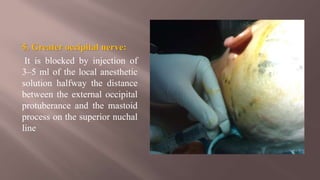
5. Greater occipital nerve:
It is blocked by injection of
3–5 ml of the local anesthetic
solution halfway the distance
between the external occipital
protuberance and the mastoid
process on the superior nuchal
line
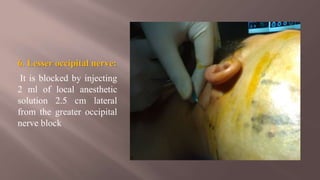
6. Lesser occipital nerve:
It is blocked by injecting
2 ml of local anesthetic
solution 2.5 cm lateral
from the greater occipital
nerve block
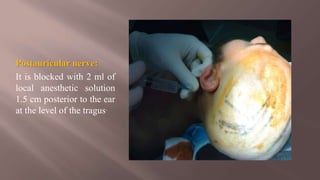
Postauricular nerve:
It is blocked with 2 ml of
local anesthetic solution
1.5 cm posterior to the ear
at the level of the tragus.
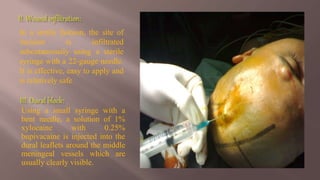
In a sterile fashion, the site of
incision is infiltrated
subcutaneously using a sterile
syringe with a 22-gauge needle.
It is effective, easy to apply and
is relatively safe
Using a small syringe with a
bent needle, a solution of 1%
xylocaine with 0.25%
bupivacaine is injected into the
dural leaflets around the middle
meningeal vessels which are
usually clearly visible.
1. Monitored Anesthesia care [MAC]:
 MAC is a specific anesthetic protocol that includes careful monitoring and support
of vital functions.
 Patients receives fentanyl, with or without either droperidol or midazolam,
followed by a propofol infusion.
 The craniotomy proceeds with the patient breathing spontaneously.
2. Asleep Awake Asleep [AAA] Technique:
A. LMA with Spontaneous Ventilation Technique:
B. LMA with Controlled Ventilation Technique:
Artificial ventilation allows better control of PaCO2, providing good operative
conditions.
A background infusion of remifentanyl is used to provide additional analgesia
during the awake period.
Speech mapping:
 Naming pictures, making simple sentences, and numbering while the
suspected cerebral cortical areas are stimulated
 Excessive and prolonged sedation must be avoided.
Motor mapping:
 Direct cortical stimulation on the suspected brain surface to elicit
movements in various parts of the face, eyelids, tongue, neck,
shoulders, and upper and lower extremities
Propofol:
 Short-acting sedative with anti-emetic and amnesic properties in sedative doses.
Droperidol
 Neuroleptanalgesic having sedative and antiemetic properties.
Remifentanyl
 Short half-life (<5 minutes  rapid modulation of analgesia and sedation required
during surgery.
 Disadvantage  Respiratory depression, airway obstruction, and desaturation and the
associated nausea and vomiting.
Dexmedetomidine
 Reduces the intraoperative and postoperative anesthetic requirements.
 It produces dose-dependent decreases in blood pressure and heart rate.
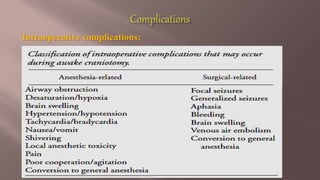
Intraoperative complications:
Postoperative complications:
Neurological complications:
Transient deterioration in function - Permanent deficit at discharge - Confusion/delirium -
Dysphasia - Postoperative seizures - Hydrocephalus.
Systemic complications:
Urinary retention - DVT - Nausea and vomiting - Drug reactions.
Cardiovascular complications:
Tachycardia – bradycardia – hypotension – hypertension – arrhythmias – myocardial ischemia.
Respiratory complications:
Respiratory depression.
Regional complications:
Hematoma - bleeding - Cerebrospinal fluid leak.
Awake Craniotomy
Awake Craniotomy

Awake Craniotomy

  • 1.
    Presented by Mohamad AbdulrazikEl saaid Under supervision of Professor Amir Ibrahim Mohamad Salah Doctor Mohamad Anwar El Shafei Doctor Mostafa Gamal Eldin Mahran
  • 2.
     Awake craniotomyliterally means a procedure where the patient is awake during critical portions of the surgery so that his vital functions such as speech and movement can be monitored continuously. Maintain Anesthetic Goal Ensure 1.Adequate patient comfort. 1.Patient Safety. 2.Analgesia. 2.Control and maintainance 3.Immobility. of critical functions. 4.Patient co-operation.
  • 3.
    Advantage of awakecraniotomy 1.Intraoperative Electrocorticography: It is the “gold standard” for defining epileptogenic zones in clinical practice. 2.Cortical Mapping: Recording the electric currents that result from muscle contractions in order to identify motor areas of the cortex Language areas are identified from the verbal responses of an awake patient.
  • 4.
     Face sensoryinnervation is supplied by three branches of trigeminal nerve (Opthalmic, Maxillary, Mandibular).  Front and Side of the neck by cervical plexus.  Posterior head and neck by cervical nerves. Opthalmic Frontal nerve Supaorbital & Supratrochlear N. Maxillary Zygomaticotemporal Nerve. Mandibular Auriculotemporal Nerve. Cervical plexus Lesser & Greater Occipital N.
  • 6.
     Poor anesthetictechnique which allows coughing, straining, hypotension, exaggerated hypertension, hypoxia and hypercarbia will seriously damage the critically ill brain.  Better results can be obtained by careful monitoring of the patient and attention to simple details than by complex pharmacological interventions.
  • 7.
     The principleconstituents within the skull are brain (80%), blood (12%) and cerebro- spinal fluid (8%).  Normally range (5-13 mmHg).
  • 8.
     Cerebral perfusionpressure [CPP] is defined as the difference between mean arterial and intracranial pressures. CPP = MAP – ICP  Normal cerebral perfusion pressure is 80 mmHg, but when reduced to less than 50 mmHg there is metabolic evidence of ischemia and reduced electrical activity.
  • 9.
     The normalcerebral blood flow is 45-50 ml/100g/min.  In decompensated brain as a result of major intracranial pathology, increases or decreases in CBF will in turn lead to a significant rise or fall in ICP.  Chemical regulation.  Myogenic regulation.  Neurogenic regulation.  Viscosity effect.  Vasoactive agents.
  • 10.
    3. PaO2: From60 to more than 300 mmHg have little influence on CBF. When the PaO2 is less than 60 mmHg, CBF increases rapidly. 1. PaCO2:  Co2 causes cerebral vasodilatation.  CBF changes 1 to 2 ml/100g/min for each 1 mmHg change in PaCO2 .  CO2  CBF , CO2  CBF. This response is attenuated below a PaCO2 of 25 mmHg. 2. CMR: 2.Anesthetic agents: anesthetic agents suppress CMR, with exception of ketamine and nitrous oxide. 3.Temperature: CMR decreases by 6 to 7% per Celsius of temperature reduction. 1. Functional State: Extreme increase in epileptic fit.
  • 11.
     Autoregulation maintainsa constant blood flow between MAP 50 mmHg and 150 mmHg  There is extensive innervation on the larger cerebral arteries.  Within the normal range (33-45%) , there is only trivial alteration of CBF. Inhalational agents: Volatile anesthetis agents cause cerebral vasodilation in dose dependant way Systemic vasodilators: Most drugs that cause hypotension causes cerebral vasodilation Catecholamine Agonist/Antagonist
  • 12.
    1. 1-Agonists:  Littledirect influence on CBF in humans  Norepinephrine may cause vasodilatation when the BBB is defective. 2. 2-Agonists: As (Dexmedetomidine and Clonidine).  CBF, with analgesic and sedative effects. 3. -Agonists:  In large doses CBF. 4. -Blockers:  No effect . 5. Dopamine:  Its effect on CBF and CMR has not been defined with certainty.
  • 13.
    Indication of awakecraniotomy 1. Anatomical indications: Lesions in or adjacent to motor or speech area. as cortical stimulation allows accurate planning of the resection margin. 2. Physiological indications: Stimulation of deep brain nuclei in treatment of intractable movement disorders such as parkinson’s disease and dystonias. Accurate location of the stimulating electrodes can most be confirmed in awake patient. 3. Pharmacological indications: To avoid drugs used in GA, as in awake patients, it allows better electrocoricography results that make the resection margins safe.
  • 14.
    1. Patient refusal. 2.Inability to communicate . 3. Low occipital tumors. 4. Significant dural invasion. 5. Pediatric patients with insufficient understanding and ability to cooperate. 6. Significant psychiatric illness. 7. Medical conditions that would prevent lying still for several hours. 8. Medical conditions that would compromise the patient’s ability to lie sedated for prolonged periods without developing hypoxemia or hypercarbia. 9. Inexperienced neurosurgeon is absolute contraindication.
  • 15.
    Preoperative psychological preparation: Psychological preparation is one of the most crucial aspects of operating on patients under local anesthesia.  the patient has to be reassured that the awake part of the procedure will be painless. Laboratory evaluation  Special attention to therapeutic levels of antiepileptic drugs as it doubles after surgery. Airway evaluation:  Conversion from local anethesia to GA can occur at any moment.
  • 16.
    Premedication: 1. Seditives:  Midazolamis the best benzodiazepine for awake craniotomies. 2. Antiemetics and Antacids. 3. 2-Agonists:  Analgesic and sedetive effect with blunting of adrenergic response. 4. Anticholinergics:  Antisalivation effect may be troublesome for some patients. 5. Anticonvulsants. 6. Dexamethasone:  To decrease possible brain edema. 7. Antibiotics.
  • 17.
    I. Preparation ofthe operating room. II. Positioning. III. Scalp Block: 6 Scalp nerves should be blocked + Wound infiltration + Dural block A. Timing and duration: done at least 20 minutes prior to skin incision, lasts for 3-4 hours. B. Technique: A scalp block is performed using approximately 2.5 to 5 ml bupivacaine 0.25% to 0.5% with epinephrine 1: 200.000 at each site. Injection is performed with a 1.25 inch 25 gauge needle.
  • 18.
    1. Supraorbital NerveBlock: Blocked with 2 ml of local anesthetic solution at the supraorbital notch, which is located at the supraorbital ridge above the pupil. 2. Supratrochlear N. Block: Blocked with 1 ml of local anesthetic solution injected at superior medial corner of the orbital ridge with the needle introduced perpendicular to the skin.
  • 19.
    3. Auriculotemporal Nerve: Blockedby injecting 3 ml of local anesthetic solution 1.5 cm anterior to the ear at the level of the tragus. With the needle perpendicular to the skin, infiltration of 1.5 ml is made under the deep fascia and another 1.5 ml is injected superficially as the needle is withdrawn. 4. zygomaticotemporal Nerve The zygomaticotemporal nerve is blocked by infiltration from the supraorbital margin to the posterior part of the zygomatic arch. Arising midway between auriculotemporal and supraorbital nerves where it emerges above the zygoma.
  • 20.
    5. Greater occipitalnerve: It is blocked by injection of 3–5 ml of the local anesthetic solution halfway the distance between the external occipital protuberance and the mastoid process on the superior nuchal line
  • 21.
    6. Lesser occipitalnerve: It is blocked by injecting 2 ml of local anesthetic solution 2.5 cm lateral from the greater occipital nerve block
  • 22.
    Postauricular nerve: It isblocked with 2 ml of local anesthetic solution 1.5 cm posterior to the ear at the level of the tragus.
  • 23.
    In a sterilefashion, the site of incision is infiltrated subcutaneously using a sterile syringe with a 22-gauge needle. It is effective, easy to apply and is relatively safe Using a small syringe with a bent needle, a solution of 1% xylocaine with 0.25% bupivacaine is injected into the dural leaflets around the middle meningeal vessels which are usually clearly visible.
  • 25.
    1. Monitored Anesthesiacare [MAC]:  MAC is a specific anesthetic protocol that includes careful monitoring and support of vital functions.  Patients receives fentanyl, with or without either droperidol or midazolam, followed by a propofol infusion.  The craniotomy proceeds with the patient breathing spontaneously.
  • 26.
    2. Asleep AwakeAsleep [AAA] Technique: A. LMA with Spontaneous Ventilation Technique: B. LMA with Controlled Ventilation Technique: Artificial ventilation allows better control of PaCO2, providing good operative conditions. A background infusion of remifentanyl is used to provide additional analgesia during the awake period.
  • 27.
    Speech mapping:  Namingpictures, making simple sentences, and numbering while the suspected cerebral cortical areas are stimulated  Excessive and prolonged sedation must be avoided. Motor mapping:  Direct cortical stimulation on the suspected brain surface to elicit movements in various parts of the face, eyelids, tongue, neck, shoulders, and upper and lower extremities
  • 29.
    Propofol:  Short-acting sedativewith anti-emetic and amnesic properties in sedative doses. Droperidol  Neuroleptanalgesic having sedative and antiemetic properties. Remifentanyl  Short half-life (<5 minutes  rapid modulation of analgesia and sedation required during surgery.  Disadvantage  Respiratory depression, airway obstruction, and desaturation and the associated nausea and vomiting. Dexmedetomidine  Reduces the intraoperative and postoperative anesthetic requirements.  It produces dose-dependent decreases in blood pressure and heart rate.
  • 30.
  • 31.
    Postoperative complications: Neurological complications: Transientdeterioration in function - Permanent deficit at discharge - Confusion/delirium - Dysphasia - Postoperative seizures - Hydrocephalus. Systemic complications: Urinary retention - DVT - Nausea and vomiting - Drug reactions. Cardiovascular complications: Tachycardia – bradycardia – hypotension – hypertension – arrhythmias – myocardial ischemia. Respiratory complications: Respiratory depression. Regional complications: Hematoma - bleeding - Cerebrospinal fluid leak.

Editor's Notes

  • #4 Intraoperative electrocorticography electrodes placed directly on the exposed surface of the brain to record electrical activity from the cerebral cortex. ------------------------------------------------------------------- Cortical Mapping Electromyography (EMG)
  • #8 Hatmann’s solution Compound sodium lactate “CSL” Used as systemic alkalinizer & fluid & electrolyte replenisher Contraindicated in DM  lactate Congestive heart failure
  • #11 PaCo2 Hyperventilation can lead to a mean reduction in ICP of 50% within 2-30 mins. CBF influnced by respiratory acidosis greater than by metabolic acidosis because Co2 diffuses freely across BBB but H+ is not CMR Increased neuronal activity -- increased local brain metabolism, Increase in CMR --- proportional change in CBF.
  • #12 . Above and below the autoregulatory plateau, CBF is pressure dependent and varies linearly with CPP
  • #15 2. (Decreased level of consciousness, Profound confusion, Mental retardation, Severe language barrier, Emotional instability.) 4. as severe pain may occur on resection of the tumor dural portion. 7. rheumatological or movement disorders.  8. morbid obesity or severe obstructive pulmonary disease.
  • #16 because of its short-acting effect. Some authors recently discouraged benzodiazepine administration before awake craniotomy because these types of drugs may reduce pharyngeal muscular tone, influence cognitive function, and minimize epileptic foci. Opioid administration and dura mater or cerebral vessels traction may induce intractable nausea and vomiting. Vomiting is extremely dangerous during surgery due to risk of aspiration It induces mild sedation, hemodynamic stability due to blunting of the adrenergic response, as well as analgesic and antiemetic effect. . Antisalivation effect but it may be troublesome for awake patients.
  • #17 Seditives Negative effects as (respiratory depression , paradoxical agitation , interfere with ECoG , minimize epileptic foci) Clonidine is a good alternative. 2. Opiod and dural traction  nausea and vomiting  risk of aspiration, rise in ICP
  • #18 As with any awake technique, delays and technical problems in the operating theatre should be avoided. Staff should be aware of the presence of an awake patient, all devices and medications should be ready. It is usually prefered to allow the patients to position themselves on the operating table before institution of sedation or anesthesia so that they may lie in the most comfortable position.
  • #26 1. Anesthetist administers sedatives, analgesics, and hypnotics, Addresses any clinical problems, and provides the patient with psychological support during diagnostic and therapeutic procedures. 2. Patient’s age, weight and response to the surgical stimulus all of these direct drug dosage. The fear of respiratory depression limits the use of fentanyl. When the tumor is located, decrease propofol , the patient is awakened When tumor resection is complete, the dose of propofol is increased for closure
  • #27 Propofol infusion starts and the patient breathe spontenously with [ETCO2] attatched to monitor venilation adequency when tumor is located, propofol is stopped , LMA is removed the patient is allowed to wakeup, then when resection completes, propofol infused again and LMA is reinserted ------------------------------------------------------------------------------- This is a true Asleep Awake Asleep technique When the tumor is exposed, the remifentanyl is reduced until spontaneous respiration is resumed. The LMA is then removed. The propofol infusion is stopped and the patient is awakened. ----------------------------------------------------------------------------- When tumor resection is complete, the patient is re-anesthetized and the LMA is replaced. Ventilation is again controlled until completion of surgery.
  • #28 If the tumor is localized near the language area or the motor strip, mapping of speech or motor areas is indicated to avoid accidental resection. Premedication with a sedative should be minimal