ANAESTHESIA FOR
AWAKE CRANIOTOMY
DR. BHAGWATI PRASAD DEWANGAN
CONSULTANT ANAESTHESIOLOGIST
FOPJHRC, RAIGARH
AWAKE
CRANIOTOMY
INTRODUCTION
Awake craniotomy – it is
an important technique
used in neurosurgery
where patient remains
awake in all or in some
part of surgery.
MISNOMER ?? – as
patients may not remain
awake during complete
surgery.
Cont.
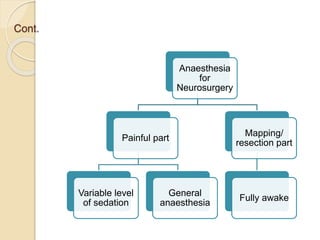
Anaesthesia
for
Neurosurgery
Painful part
Variable level
of sedation
General
anaesthesia
Mapping/
resection part
Fully awake
INDICATIONS
1. Brain tumor excision from eloquent cortex.
2. Epilepsy surgery
3. Deep brain stimulation surgery
4. Less commonly, mycotic aneurysms and arterio-
venous malformations near critical brain areas.
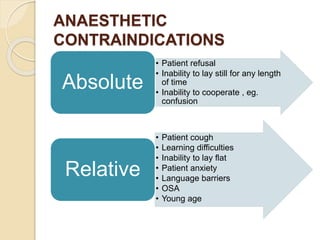
ANAESTHETIC
CONTRAINDICATIONS
• Patient refusal
• Inability to lay still for any length
of time
• Inability to cooperate , eg.
confusion
Absolute
• Patient cough
• Learning difficulties
• Inability to lay flat
• Patient anxiety
• Language barriers
• OSA
• Young age
Relative
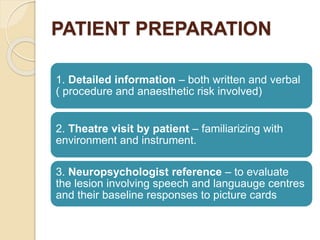
PATIENT PREPARATION
1. Detailed information – both written and verbal
( procedure and anaesthetic risk involved)
2. Theatre visit by patient – familiarizing with
environment and instrument.
3. Neuropsychologist reference – to evaluate
the lesion involving speech and languauge centres
and their baseline responses to picture cards
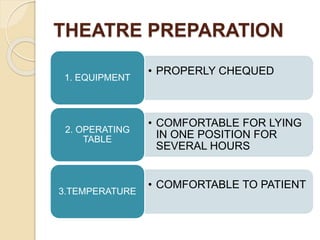
THEATRE PREPARATION
• PROPERLY CHEQUED
1. EQUIPMENT
• COMFORTABLE FOR LYING
IN ONE POSITION FOR
SEVERAL HOURS
2. OPERATING
TABLE
• COMFORTABLE TO PATIENT
3.TEMPERATURE
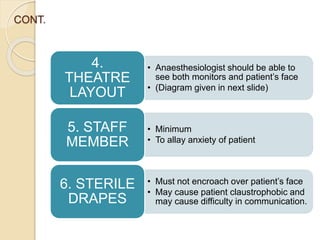
CONT.
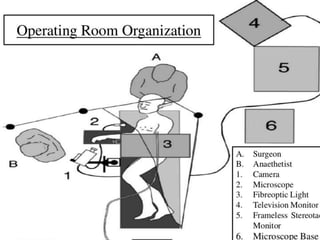
• Anaesthesiologist should be able to
see both monitors and patient’s face
• (Diagram given in next slide)
4.
THEATRE
LAYOUT
• Minimum
• To allay anxiety of patient
5. STAFF
MEMBER
• Must not encroach over patient’s face
• May cause patient claustrophobic and
may cause difficulty in communication.
6. STERILE
DRAPES
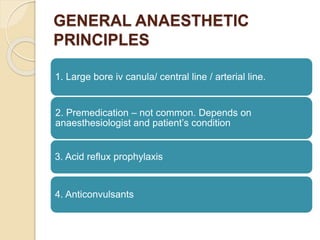
GENERAL ANAESTHETIC
PRINCIPLES
1. Large bore iv canula/ central line / arterial line.
2. Premedication – not common. Depends on
anaesthesiologist and patient’s condition
3. Acid reflux prophylaxis
4. Anticonvulsants
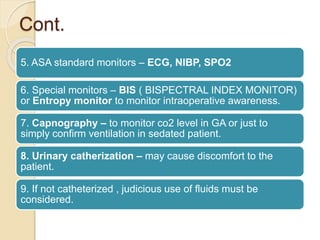
Cont.
5. ASA standard monitors – ECG, NIBP, SPO2
6. Special monitors – BIS ( BISPECTRAL INDEX MONITOR)
or Entropy monitor to monitor intraoperative awareness.
7. Capnography – to monitor co2 level in GA or just to
simply confirm ventilation in sedated patient.
8. Urinary catherization – may cause discomfort to the
patient.
9. If not catheterized , judicious use of fluids must be
considered.
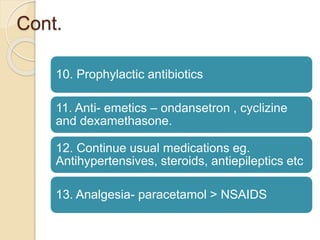
Cont.
10. Prophylactic antibiotics
11. Anti- emetics – ondansetron , cyclizine
and dexamethasone.
12. Continue usual medications eg.
Antihypertensives, steroids, antiepileptics etc
13. Analgesia- paracetamol > NSAIDS
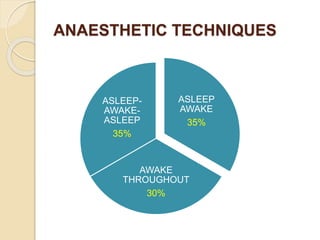
ANAESTHETIC TECHNIQUES
ASLEEP
AWAKE
35%
AWAKE
THROUGHOUT
30%
ASLEEP-
AWAKE-
ASLEEP
35%
AWAKE
THROUGHOUT
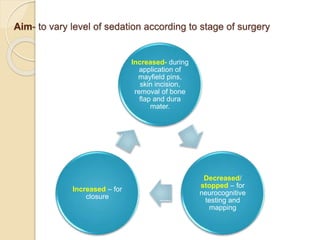
Aim- to vary level of sedation according to stage of surgery
Increased- during
application of
mayfield pins,
skin incision,
removal of bone
flap and dura
mater.
Decreased/
stopped – for
neurocognitive
testing and
mapping
Increased – for
closure
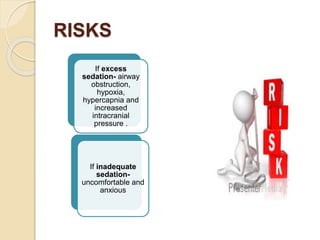
RISKS
If excess
sedation- airway
obstruction,
hypoxia,
hypercapnia and
increased
intracranial
pressure .
If inadequate
sedation-
uncomfortable and
anxious
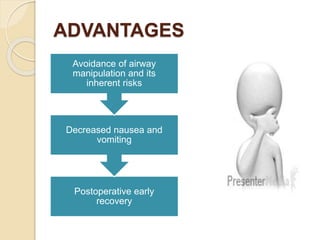
ADVANTAGES
Postoperative early
recovery
Decreased nausea and
vomiting
Avoidance of airway
manipulation and its
inherent risks
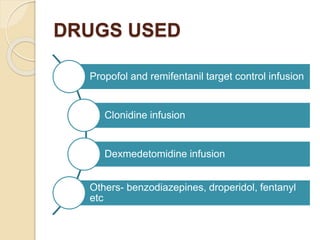
DRUGS USED
Propofol and remifentanil target control infusion
Clonidine infusion
Dexmedetomidine infusion
Others- benzodiazepines, droperidol, fentanyl
etc
SLEEP –AWAKE –
SLEEP TECHNIQUE
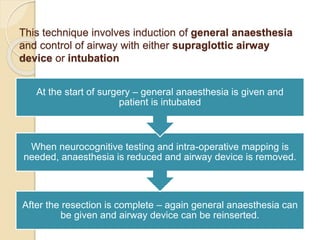
This technique involves induction of general anaesthesia
and control of airway with either supraglottic airway
device or intubation
After the resection is complete – again general anaesthesia can
be given and airway device can be reinserted.
When neurocognitive testing and intra-operative mapping is
needed, anaesthesia is reduced and airway device is removed.
At the start of surgery – general anaesthesia is given and
patient is intubated
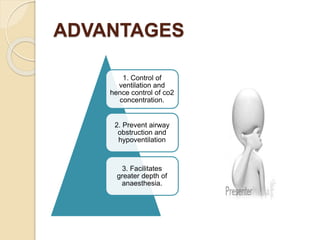
ADVANTAGES
1. Control of
ventilation and
hence control of co2
concentration.
2. Prevent airway
obstruction and
hypoventilation
3. Facilitates
greater depth of
anaesthesia.
DRUGS USED
Often same as awake anaesthesia.
1. Propofol + remifentanil followed by inhalational
anaesthetic.
2. Dexmedetomidine infusion
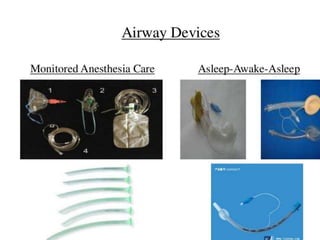
AIRWAY MANAGEMENT
1. Mc- Standard LMA ( Laryngeal Mask Airway)
2. Proseal LMA – advantages of gastric port and high
pressure seal.
3. Supreme LMA – integral bite block
4. I-GEL – rigidity
5. Intubation with endotracheal tube
ANALGESIA
Patient tolerance of an awake craniotomy depends
on effective analgesia of the surgical field.
Cannot rely purely on sedation and anaesthesia
alone.
Scalp block – provides haemodynamic stability and
decreases the stress response to painful stimuli.
Cont.
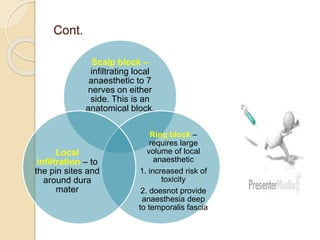
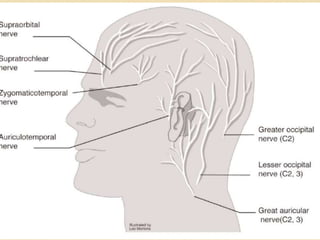
Scalp block –
infiltrating local
anaesthetic to 7
nerves on either
side. This is an
anatomical block.
Ring block –
requires large
volume of local
anaesthetic
1. increased risk of
toxicity
2. doesnot provide
anaesthesia deep
to temporalis fascia
Local
infiltration – to
the pin sites and
around dura
mater
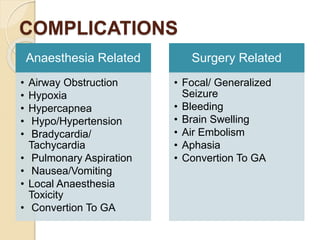
COMPLICATIONS
Anaesthesia Related
• Airway Obstruction
• Hypoxia
• Hypercapnea
• Hypo/Hypertension
• Bradycardia/
Tachycardia
• Pulmonary Aspiration
• Nausea/Vomiting
• Local Anaesthesia
Toxicity
• Convertion To GA
Surgery Related
• Focal/ Generalized
Seizure
• Bleeding
• Brain Swelling
• Air Embolism
• Aphasia
• Convertion To GA
POSTOPERATIVE
1. Shifted to neurosurgical icu or high
dependency unit
2. Close neurological monitoring –
postoperative haematomas during first 6
hr
3. May require urgent repeat craniotomy
4. Most patients are in hospital for 1-2
days after surgery
5. Postop pain relief – after scalp block
has worn off , may use paracetamol,
codeine or other opioids.
CONCLUSION
There is increasing evidence that an awake craniotomy
would be an appropriate choice for removal of all
supratentorial tumors no-selectively.
It can maximize lesion resection, which can be linked to
1. improved survival rates and
2. low complication rates.
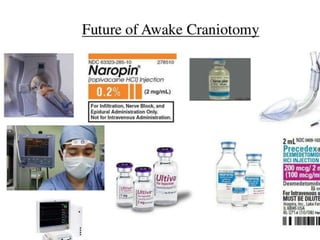
-New technologies are being developed to allow brain
mapping
-New drugs are being developed for better anaesthesia
which will play a significant role in near future.
THANK
YOU

ANAESTHESIA FOR AWAKE CRANIOTOMY

  • 1.
    ANAESTHESIA FOR AWAKE CRANIOTOMY DR.BHAGWATI PRASAD DEWANGAN CONSULTANT ANAESTHESIOLOGIST FOPJHRC, RAIGARH
  • 3.
  • 4.
    INTRODUCTION Awake craniotomy –it is an important technique used in neurosurgery where patient remains awake in all or in some part of surgery. MISNOMER ?? – as patients may not remain awake during complete surgery.
  • 5.
    Cont. Anaesthesia for Neurosurgery Painful part Variable level ofsedation General anaesthesia Mapping/ resection part Fully awake
  • 6.
    INDICATIONS 1. Brain tumorexcision from eloquent cortex. 2. Epilepsy surgery 3. Deep brain stimulation surgery 4. Less commonly, mycotic aneurysms and arterio- venous malformations near critical brain areas.
  • 7.
    ANAESTHETIC CONTRAINDICATIONS • Patient refusal •Inability to lay still for any length of time • Inability to cooperate , eg. confusion Absolute • Patient cough • Learning difficulties • Inability to lay flat • Patient anxiety • Language barriers • OSA • Young age Relative
  • 8.
    PATIENT PREPARATION 1. Detailedinformation – both written and verbal ( procedure and anaesthetic risk involved) 2. Theatre visit by patient – familiarizing with environment and instrument. 3. Neuropsychologist reference – to evaluate the lesion involving speech and languauge centres and their baseline responses to picture cards
  • 9.
    THEATRE PREPARATION • PROPERLYCHEQUED 1. EQUIPMENT • COMFORTABLE FOR LYING IN ONE POSITION FOR SEVERAL HOURS 2. OPERATING TABLE • COMFORTABLE TO PATIENT 3.TEMPERATURE
  • 10.
    CONT. • Anaesthesiologist shouldbe able to see both monitors and patient’s face • (Diagram given in next slide) 4. THEATRE LAYOUT • Minimum • To allay anxiety of patient 5. STAFF MEMBER • Must not encroach over patient’s face • May cause patient claustrophobic and may cause difficulty in communication. 6. STERILE DRAPES
  • 12.
    GENERAL ANAESTHETIC PRINCIPLES 1. Largebore iv canula/ central line / arterial line. 2. Premedication – not common. Depends on anaesthesiologist and patient’s condition 3. Acid reflux prophylaxis 4. Anticonvulsants
  • 13.
    Cont. 5. ASA standardmonitors – ECG, NIBP, SPO2 6. Special monitors – BIS ( BISPECTRAL INDEX MONITOR) or Entropy monitor to monitor intraoperative awareness. 7. Capnography – to monitor co2 level in GA or just to simply confirm ventilation in sedated patient. 8. Urinary catherization – may cause discomfort to the patient. 9. If not catheterized , judicious use of fluids must be considered.
  • 14.
    Cont. 10. Prophylactic antibiotics 11.Anti- emetics – ondansetron , cyclizine and dexamethasone. 12. Continue usual medications eg. Antihypertensives, steroids, antiepileptics etc 13. Analgesia- paracetamol > NSAIDS
  • 15.
  • 16.
  • 17.
    Aim- to varylevel of sedation according to stage of surgery Increased- during application of mayfield pins, skin incision, removal of bone flap and dura mater. Decreased/ stopped – for neurocognitive testing and mapping Increased – for closure
  • 18.
    RISKS If excess sedation- airway obstruction, hypoxia, hypercapniaand increased intracranial pressure . If inadequate sedation- uncomfortable and anxious
  • 19.
    ADVANTAGES Postoperative early recovery Decreased nauseaand vomiting Avoidance of airway manipulation and its inherent risks
  • 20.
    DRUGS USED Propofol andremifentanil target control infusion Clonidine infusion Dexmedetomidine infusion Others- benzodiazepines, droperidol, fentanyl etc
  • 21.
  • 22.
    This technique involvesinduction of general anaesthesia and control of airway with either supraglottic airway device or intubation After the resection is complete – again general anaesthesia can be given and airway device can be reinserted. When neurocognitive testing and intra-operative mapping is needed, anaesthesia is reduced and airway device is removed. At the start of surgery – general anaesthesia is given and patient is intubated
  • 23.
    ADVANTAGES 1. Control of ventilationand hence control of co2 concentration. 2. Prevent airway obstruction and hypoventilation 3. Facilitates greater depth of anaesthesia.
  • 24.
    DRUGS USED Often sameas awake anaesthesia. 1. Propofol + remifentanil followed by inhalational anaesthetic. 2. Dexmedetomidine infusion
  • 25.
    AIRWAY MANAGEMENT 1. Mc-Standard LMA ( Laryngeal Mask Airway) 2. Proseal LMA – advantages of gastric port and high pressure seal. 3. Supreme LMA – integral bite block 4. I-GEL – rigidity 5. Intubation with endotracheal tube
  • 27.
    ANALGESIA Patient tolerance ofan awake craniotomy depends on effective analgesia of the surgical field. Cannot rely purely on sedation and anaesthesia alone. Scalp block – provides haemodynamic stability and decreases the stress response to painful stimuli.
  • 28.
    Cont. Scalp block – infiltratinglocal anaesthetic to 7 nerves on either side. This is an anatomical block. Ring block – requires large volume of local anaesthetic 1. increased risk of toxicity 2. doesnot provide anaesthesia deep to temporalis fascia Local infiltration – to the pin sites and around dura mater
  • 30.
    COMPLICATIONS Anaesthesia Related • AirwayObstruction • Hypoxia • Hypercapnea • Hypo/Hypertension • Bradycardia/ Tachycardia • Pulmonary Aspiration • Nausea/Vomiting • Local Anaesthesia Toxicity • Convertion To GA Surgery Related • Focal/ Generalized Seizure • Bleeding • Brain Swelling • Air Embolism • Aphasia • Convertion To GA
  • 31.
    POSTOPERATIVE 1. Shifted toneurosurgical icu or high dependency unit 2. Close neurological monitoring – postoperative haematomas during first 6 hr 3. May require urgent repeat craniotomy 4. Most patients are in hospital for 1-2 days after surgery 5. Postop pain relief – after scalp block has worn off , may use paracetamol, codeine or other opioids.
  • 32.
    CONCLUSION There is increasingevidence that an awake craniotomy would be an appropriate choice for removal of all supratentorial tumors no-selectively. It can maximize lesion resection, which can be linked to 1. improved survival rates and 2. low complication rates. -New technologies are being developed to allow brain mapping -New drugs are being developed for better anaesthesia which will play a significant role in near future.
  • 34.