Downloaded 27 times
![Copyright 2010 ISA. All Rights Reserved.
Security Certification – A critical review
Ragnar Schierholz Kevin McGrath
Industrial Software Systems Industrial Communication
ABB Corporate Research ABB Corporate Research
Segelhofstr 1k Bergerveien 12
5405 Baden-Daettwil, Switzerland 1375 Billingstad, Norway
ragnar.schierholz@ch.abb.com kevin.mcgrath@no.abb.com
Keywords: security, assurance, certification, economics, transaction cost, principal
agent, industrial, automation, control, system, iacs
ABSTRACT
Security for industrial automation and control systems (IACS) is a much discussed topic for several
years now. Certification of security properties of products has been gaining rising attention in the more
recent past. We analyze security certification from an economic background and take a look at how
security certification initiatives in the enterprise system domain have performed in the past. From this
analysis, we extract a number of critical elements which have lead to failure of certification initiatives
and check whether and how the current security certification initiatives address these pitfalls.
1 INTRODUCTION
Security for Industrial Automation and Control Systems (IACS) has become a much discussed topic in
the recent past. Despite the lack of solid data on incidents and attacks available for research and still
comparatively few publicly known vulnerabilities in IACS, there is common agreement among the
experts that IACS need to better address security [1,2,3,4,5]. Regulations such as NERC CIP reflect
this need and international standards such as ISA 99/IEC 62443 or IEC 62351 as well as industry
organizations’ guidelines and requirements specifications such as the WIB Security Requirements for
Vendors are trying to help the industry achieve better security levels [6]. In particular, these standards
attempt to address the specific needs of IACS as opposed to enterprise IT systems [1,3,6].
Security properties of software products or systems (including IACS systems or components) are hard
or even impossible to observe during their procurement. In order to ease the process and to increase
transparency, several actors in the industry have started certification programs, which certify certain
security-related properties of products and systems. There are programs based on proprietary
specifications, there are programs based on relatively open specifications, there are programs
addressing individual device’s stack robustness, there are programs addressing functional security
requirements and there are programs addressing development and support processes. So far, there is a
lot of confusion about these different programs and their contribution to the automation industry.
Distributed with permission of author(s) by ISA 2010 Presented at ISA Automation Week 2010; http://www.isa.org](https://image.slidesharecdn.com/aw10securitypaper-110718075744-phpapp01/85/Security-Certification-Critical-Review-1-320.jpg)
![Copyright 2010 ISA. All Rights Reserved.
Security Certification – A critical review
Ragnar Schierholz Kevin McGrath
Industrial Software Systems Industrial Communication
ABB Corporate Research ABB Corporate Research
Segelhofstr 1k Bergerveien 12
5405 Baden-Daettwil, Switzerland 1375 Billingstad, Norway
ragnar.schierholz@ch.abb.com kevin.mcgrath@no.abb.com
Keywords: security, assurance, certification, economics, transaction cost, principal
agent, industrial, automation, control, system, iacs
ABSTRACT
Security for industrial automation and control systems (IACS) is a much discussed topic for several
years now. Certification of security properties of products has been gaining rising attention in the more
recent past. We analyze security certification from an economic background and take a look at how
security certification initiatives in the enterprise system domain have performed in the past. From this
analysis, we extract a number of critical elements which have lead to failure of certification initiatives
and check whether and how the current security certification initiatives address these pitfalls.
1 INTRODUCTION
Security for Industrial Automation and Control Systems (IACS) has become a much discussed topic in
the recent past. Despite the lack of solid data on incidents and attacks available for research and still
comparatively few publicly known vulnerabilities in IACS, there is common agreement among the
experts that IACS need to better address security [1,2,3,4,5]. Regulations such as NERC CIP reflect
this need and international standards such as ISA 99/IEC 62443 or IEC 62351 as well as industry
organizations’ guidelines and requirements specifications such as the WIB Security Requirements for
Vendors are trying to help the industry achieve better security levels [6]. In particular, these standards
attempt to address the specific needs of IACS as opposed to enterprise IT systems [1,3,6].
Security properties of software products or systems (including IACS systems or components) are hard
or even impossible to observe during their procurement. In order to ease the process and to increase
transparency, several actors in the industry have started certification programs, which certify certain
security-related properties of products and systems. There are programs based on proprietary
specifications, there are programs based on relatively open specifications, there are programs
addressing individual device’s stack robustness, there are programs addressing functional security
requirements and there are programs addressing development and support processes. So far, there is a
lot of confusion about these different programs and their contribution to the automation industry.
Distributed with permission of author(s) by ISA 2010 Presented at ISA Automation Week 2010; http://www.isa.org](https://image.slidesharecdn.com/aw10securitypaper-110718075744-phpapp01/75/Security-Certification-Critical-Review-1-2048.jpg)
![Copyright 2010 ISA. All Rights Reserved.
Security Certification – A critical review
In this paper, we attempt to shed some light on the fundamental concepts behind security certification
primarily from an economic perspective, not so much a technical one. First, in section 2 we outline the
background of standardization and certification in general and relate that to the context of security in
particular. In section 3 we explain the fundamental concepts of security certification, look at
experiences from other fields and briefly outline how the current security certification programs in the
automation industry work. In section 4 we analyze these current programs with regard to the
fundamental concepts and the experiences. Finally, we conclude the paper in section 5.
2 BACKGROUND
2.1 SECURITY STANDARDIZATION
The automation industry is strongly dependent on standards. This has various reasons and serves
various goals. Probably the most important goals of industry standardization are (adopted from [5]1):
• Setting a minimum acceptable level of quality for a given scope of a standard (both on a technical
and organizational level).
• Enabling technical interoperability of products from different vendors.
Compliance with interoperability standards is usually done by testing against reference
implementations or test cases which are part of the standard specification. Examples of interoperability
standards in the security domain are protocols such as TLS or data formats such as X.509 certificates.
In the automation industry, examples are protocols such as the various fieldbuses or OPC. If the
specification of the standard is well written and non-ambiguous, the testing and certification of
compliance is an undisputed, trivial matter.
However, standards addressing a minimum level of quality, not interoperability, often are less specific
and prescriptive – usually on purpose to leave room for differentiation in the market. An example of
such a standard is the ISO 9000 series for quality management. Formal testing of compliance with
these standards is usually not possible as the standards do not rigorously specify objectively
measurable criteria. Instead, auditors offer certification of compliance and this usually involves the
auditor’s interpretation of the standard. Over time, a common practice of interpretation is usually
established in the respective market. In the security domain, examples of such minimum level of
quality standards include the ISO/IEC 27000 series for enterprise information security management or
the Common Criteria (ISO/IEC 15408) for information technology security evaluation. Examples from
the IACS security domain are the ISA 99/IEC 62443 standard or the Process Control Domain Security
Requirements for Vendors as published by the WIB.
Despite the fact that some of these standards are not yet final or published and others are only
relatively recently published, different efforts have been conducted or are underway to leverage their
results already. These efforts include assessments of deployed control systems to derive
recommendations to improve the security of the plants [7], but also certification programs to certify
1
Regulations and corporate standards are not relevant in this context as regulations usually enforce a minimum level of
quality and only differ from standards by the regulating authority’s capability of enforcement and corporate standards
usually are not subject of certification (as it is understood in this paper).
Distributed with permission of ABB by ISA 2010
Presented at IAS Automation Week; http://www.isa.org
Distributed with permission of author(s) by ISA 2010 Presented at ISA Automation Week 2010; http://www.isa.org](https://image.slidesharecdn.com/aw10securitypaper-110718075744-phpapp01/85/Security-Certification-Critical-Review-2-320.jpg)
![Copyright 2010 ISA. All Rights Reserved.
Security Certification – A critical review
that certain products, systems or organizations comply with the standards [8,9]. The concepts behind
the latter will be the focus of this paper.
2.2 MARKETS WITH INFORMATION ASYMMETRY
As all relevant parties in this scenario are economic actors, it makes sense to also take into account
economic considerations when looking at information security and certification. Many economic
actions are indeed explained by incentives and market mechanisms the actors are exposed to or
affected by [10,11,12,13].
Security properties of a software product are a quality dimension which is difficult to assess for an end
user prior to purchase, at least not at a justifiable cost. While statistics about past vulnerabilities may
be considered an indicator, this would actually imply that most IACS would be rated rather well. This
is a typical case of information asymmetry which is commonly considered a condition leading to
market failure [14,15,16]. In this situation the market fails to provide optimal resource allocation.
Consider a vendor A selling a product with desirable quality features (in this case strong security) and
a vendor B selling a product without the desirable features (i.e. with weak or no security). Vendor A
cannot reap the benefits of better quality because vendor B has lower costs and can therefore offer his
product at a price which is prohibitively low for vendor A. The customer can’t tell the difference due
to the information asymmetry and thus will buy from vendor B. This initiates a race to the bottom with
regard to the desired quality property. This is commonly called a “market for lemons” referring to the
seminal paper of Akerlof [14]. Typically, in these kinds of markets, the normal market mechanisms
don’t lead to an optimal resource allocation (market failure). Several theoretical frameworks exist
which explain such market failures and suggest mechanisms to prevent such failures. In the following
we’ll take a closer look at some of these frameworks.
3 SECURITY CERTIFICATION EXPLAINED
3.1 ECONOMICS PERSPECTIVE
Several mechanisms have been proposed in order to remove the information asymmetry, among them
certification of product properties by an independent third party. The benefit of certification by
independent third party certifiers can be explained using the transaction costs theory and principal-
agent theory from the economics discipline.
3.1.1 TRANSACTION COST ECONOMICS
Transaction cost economics (TCE) go back to Coase and have been much extended by Williamson
[17,18,19,20,21,22,23]. They address the organization of economic transactions. TCE postulates that a
producer optimizes not only towards production costs of producing a product, but also takes into
account the transaction costs of selling the product on the market and similarly a buyer does not only
optimize on purchasing costs for a product but also on transaction costs associated with the purchasing
transaction. According to Picot et al. an economic transaction can be subdivided into different stages
(see Table 1) [24].
Distributed with permission of ABB by ISA 2010
Presented at IAS Automation Week; http://www.isa.org
Distributed with permission of author(s) by ISA 2010 Presented at ISA Automation Week 2010; http://www.isa.org](https://image.slidesharecdn.com/aw10securitypaper-110718075744-phpapp01/85/Security-Certification-Critical-Review-3-320.jpg)
![Copyright 2010 ISA. All Rights Reserved.
Security Certification – A critical review
Stage Examples for associated activities and costs
Initiation identification of transaction partners, e.g. marketing (on the
vendor’s side) and product/supplier search and comparison
(on consumers’ side)
Negotiation consulting and administrative costs for contract closure,
coordination costs in specification, delivery planning, etc.
Settlement costs for product delivery, management of the exchange of
products and payments, validation of delivery and payment
Monitoring monitoring of quality and timeliness of transaction execution
Adjustment modification of contracts according to changes in
requirements
Table 1: Stages of a market transaction (from [24], p. 67)
Typically, in a market situation the actors are impaired in their decision making by limited information
availability. This can be hidden characteristics (of the product or service as well as of the supplier),
hidden action or information (when the buyer can't monitor or assess the supplier's actions) or hidden
intention (when the buyer cannot sanction the supplier's opportunistic behavior). Consequences can be
adverse selection due to hidden characteristics (e.g. primarily customers with bad risk properties
looking for an insurance), moral hazard due to hidden action/information (e.g. a supplier billing a
buyer for inspections that were not done or not necessary) or hold up due to hidden intention (e.g. a
supplier increases service rates after the buyer has invested in the product).
3.1.2 PRINCIPAL-AGENT THEORY
The principal-agent theory goes back to Ross and Jensen/Heckling and has been extended by various
researchers [25,26,27,28]. It investigates the implications of such information asymmetry and the
associated uncertainties or risks. The theory identifies the role of a principal (e.g. a stock holder or a
buyer) sourcing a service or product from an agent (e.g. a management team or a supplier) and models
the decision situation from the principal's point of view. During the different stages of a transaction,
different costs and risks of this agency relation are imposed on both the principal as well as the agent.
The principal-agent theory identifies mechanisms for the governance and minimization of these costs
and risks. These mechanisms are signaling, screening and self-selection.
Signalling is a mechanism by which the agent can indicate to the principal that he is able to deliver the
desired products/services. Examples for signaling mechanisms are letters of reference or certificates
that an applicant shows in his application to indicate to a potential employer that she is a skilled
candidate. Three fundamental requirements must be met for a working signaling mechanism:
Distributed with permission of ABB by ISA 2010
Presented at IAS Automation Week; http://www.isa.org
Distributed with permission of author(s) by ISA 2010 Presented at ISA Automation Week 2010; http://www.isa.org](https://image.slidesharecdn.com/aw10securitypaper-110718075744-phpapp01/85/Security-Certification-Critical-Review-4-320.jpg)
![Copyright 2010 ISA. All Rights Reserved.
Security Certification – A critical review
• For "good agents" the benefits for creating the signal must be higher than the costs of the signal (i.e.
the investment pays off).
• For "bad agents" the benefit for creating the signal must be lower than the costs of the signal (i.e.
the costs are prohibitively high).
• For the principal, the signal actually has to be a reliable and expressive indicator for the desired
property.
Screening is the counterpart of signaling on the principal's side. This summarizes all activities that the
principal performs to gather and evaluate the agent's signals.
Self-selection is a mechanism that tries to split the "good agents" from the "bad agents" by setting
boundary conditions which motivate the agents to refrain from opportunistic behavior. This is often
done by setting up corresponding incentives in a contract. Examples from literature and practice
include several examples from the insurance industry [29,30], but also education or law enforcement
contracts [30].
Finally, Eisenhardt suggests the establishment of institutions or mechanisms which help in lowering
the information asymmetry or differences in interest which are at the root of the agency problems [31].
Examples are contracts based on observable outcome rather on hard-to-observe behavior or
information systems that can measure and monitor behavior efficiently. These have to take into
account the risk transfer which is implied e.g. by outcome-based contracts where the outcome is
partially influenced by factors beyond the control of the agent.
In summary, the transaction cost economics point out frictions (with associated costs) that come with
market transactions. The principal-agent theory offers some explanations on how the actors in the
market are affected by these frictions and offers some mechanisms for minimizing these costs.
3.1.3 APPLICATIONS IN PRACTICE
Several applications of transaction cost economics and principal-agent theory to industry scenarios are
known. Examples include the analysis of outsourcing relationships [32,33], supply chain management
[34,35], procurement contracts in general [36] or quality assurance in construction engineering [37]. Of
particular interest are the adverse selection and moral hazard problems that appear here due to
information asymmetries as well as the mitigation mechanisms such as self-selection and signaling.
Schlaak et al. [32] focus specifically on security aspects in outsourcing relationships and the
externalities that materialize here.
Nellore [38] argues that validation of specifications can also be done using contracts (even in scenarios
with complex specifications and where failures can easily lead to loss of life or other similarly
dramatic consequences) based on examples from the aircraft industry. Rice [39] provides an in-depth
analysis of multiple mechanisms for achieving stronger software security such as regulation (analogous
to the car safety rating in the U.S.), liability legislation, certification (of software engineers, the
software development process and of the software itself) or third party assessments and
standardization. Eventually Rice points out several weaknesses and strengths of each of these
approaches, but unfortunately doesn't come to a final conclusion but calls for a broader discussion.
Obviously, security certification can be viewed as a signaling/screening mechanism. As Rannenberg
[40] points out, originally the idea of security certification has been initiated by users and procurers
Distributed with permission of ABB by ISA 2010
Presented at IAS Automation Week; http://www.isa.org
Distributed with permission of author(s) by ISA 2010 Presented at ISA Automation Week 2010; http://www.isa.org](https://image.slidesharecdn.com/aw10securitypaper-110718075744-phpapp01/85/Security-Certification-Critical-Review-5-320.jpg)
![Copyright 2010 ISA. All Rights Reserved.
Security Certification – A critical review
(particularly the U.S. military and government), hoping to ease the procurement process (while in the
industrial automation domain it has been introduced by certification providers). However, there are
multiple points often criticized about security certification and the criteria against which certification
happens, among them are lack of publicly accessible, standardized certification criteria and processes,
meaningfulness of the results (or rather lack thereof) and cost of certification. Section Error!
Reference source not found. briefly discusses the history of security certification and outlines
strengths and weaknesses of the existing approaches from the non-industrial industries.
However, as the applications of economic theories on outsourcing, supply chain management or
procurement quoted above already showed, certification is not the only mechanism that can help to fix
the problem. Typically, these analyses come to the conclusion that proper incentives in the contracts
can mitigate the risks (i.e. self-selection mechanisms), e.g. by defining liability clauses or payment
based on outcome (e.g. in the procurement contracts or in liability legislation). Almond [41]
specifically analyzes liability options of COTS and custom-developed systems (custom-developed
being a system where the purchaser defines requirements and suppliers can bid for the project). Given
their nature control system projects qualify as custom-developed systems, as they are procured to
individual requirements and have a specific implementation phase (engineering and commissioning).
Almond further suggests that the purchaser explicitly defines security properties in the requirements
and asks for proof of a proper security organization on the supplier’s side, incl. a manager position
with security responsibilities (and sufficient resources), appropriate security policies or clearly defined
security responsibilities (again including sufficient resources) in the development teams. For the
implementation phase, Almond recommends that the purchaser’s security team and the supplier’s
security team collaborate closely, including collaborative security assessments and security checks of
the planned operations model (processes and responsibilities). This way “the security-savvy buyer will
create an environment where business for security deficient vendors will dry up and only organizations
which provide secure, flaw-free (or at least ‘flaw-fewer’) applications will find work” [41].
3.2 HISTORY OF SECURITY CERTIFICATION
As the analysis above shows, the market for secure software has issues of asymmetric information,
which can be addressed using mechanisms suggested by economic theories and the certification of
security properties can be considered such a mechanism (signaling). This has been applied in the field
of software security already for several years. Thus, we now look at the experiences that industries
other than the control systems industry has made with such certifications. In this effort we extend the
analysis already published by Anderson/Fuloria [13].
3.2.1 TCSEC / ORANGE BOOK
Probably the first major initiative to certify security properties of software products has been the
Trusted Computer System Evaluation Criteria (TCSEC) – commonly referred to as the Orange Book.
It was initially issued in 1983 by the U.S. Department of Defense as a mandatory requirement in the
procurement of information systems. It defined basic requirements for the evaluation of the
effectiveness of security controls in those products. Certification was performed by the National
Computer Security Center – a division of the NSA. Certification was a lengthy process, involving in-
depth analysis by the NSA experts, entry costs were high and for entry a government agency had to
sponsor the application for certification. The certification process lead to the system under evaluation
Distributed with permission of ABB by ISA 2010
Presented at IAS Automation Week; http://www.isa.org
Distributed with permission of author(s) by ISA 2010 Presented at ISA Automation Week 2010; http://www.isa.org](https://image.slidesharecdn.com/aw10securitypaper-110718075744-phpapp01/85/Security-Certification-Critical-Review-6-320.jpg)
![Copyright 2010 ISA. All Rights Reserved.
Security Certification – A critical review
• It was initiated by a relatively powerful buyer (the governments in the EU), which created a market
for certified products. It is now used by a huge number of organizations which has enlarged and
diversified the market significantly.
• The buyer is not involved in the certification process, which leads to intransparency of the process
both with regard to the compliance criteria (defined by the vendor) as well as the rigor of
compliance checking (under control of the CLEF) and a misalignment of incentives and interest as
the evaluator is not liable for the failure of evaluated systems. Furthermore, largely leaving out the
buyer from the process removes the operational context of the system from the certification,
violating the requirements as set forth by Eloff/Solms [42]and Goertzel et al. [43].
• The cost of the certification process depends on the EAL and the way the CLEF actually performs
the evaluation, which leads to significantly decreased costs but also to different incomparable
certificates (due to variances in the rigor applied by CLEFs) and a race to the bottom as vendors
have an incentive to get a certification at the CLEF with the lowest price – driving out the CLEFs
which spent more resources on more rigorous evaluations.
• The certified EAL depends on the rigor of the evaluation process and thus doesn’t say anything
about the technical level of security provided. Generally, certified products are marketed with the
achieved EAL, but the technical details such as protection profile(s) and Security Target are not
mentioned. This strongly limits the meaningfulness of Common Criteria certificates as history
shows that vendors can choose protection profiles or security targets with unrealistic limitations
(e.g. certifying a client workstation operating system with a diskless workstation profile). Notably,
there is no proven correlation between strong security properties of products and certification
achieved. Instead, there are examples of products which have achieved relatively high EAL
certification, but later showed significant number of vulnerabilities [44].
In all fairness it should be noted that the designers of the CC did foresee the potential problem of
CLEFs competing on price only and thus entering a race to the bottom concerning the rigor of
evaluations. To mitigate this risk, national authorities regulate the CLEFs and can revoke their license.
However, in practice it has not been observed that a license has ever been revoked [13].
3.2.3 ISO/IEC 27000
The ISO 27000 series is set of standards for enterprise information security which also dates back
originally to a government initiative – the British standard BS7799 targeting the secure operation of
government information systems. ISO/IEC 27000 differs from the approaches described above in that
it addresses the problem entirely from the operational side. The ISO/IEC 27000 standards consist of a
part addressing the security program (called Information Security Management System, ISMS) which
an enterprise should operate (ISO/IEC 27001). In short, this begins with defining a security policy,
defining the scope of the ISMS, performing a risk assessment, deriving mitigation plans and accepting
residual risks. This is designed as an iterative, continuous process – called the Plan-Do-Check-Act
(PDCA) cycle. Mitigation planning is encouraged to pick security controls from a part describing
security controls – both technical and organizational ones (ISO/IEC 27002). An organization can be
certified against ISO/IEC 27001 (which contains a normative annex listing security controls from ISO
27002).
Further parts complement the first two, but certification against those is not possible. ISO/IEC 27003
provides guidance on the processes of the PDCA cycle, describing the activities in a workflow style
(defining activities, their objectives, their inputs, guidance on performing them and their output).
Distributed with permission of ABB by ISA 2010
Presented at IAS Automation Week; http://www.isa.org
Distributed with permission of author(s) by ISA 2010 Presented at ISA Automation Week 2010; http://www.isa.org](https://image.slidesharecdn.com/aw10securitypaper-110718075744-phpapp01/85/Security-Certification-Critical-Review-8-320.jpg)
![Copyright 2010 ISA. All Rights Reserved.
Security Certification – A critical review
• Certification criteria
The certification only is of value as a signaling mechanism, if the criteria actually represent the
desired property of the certified product, i.e. whether they are meaningful or not. A buyer needs to
be able to assess whether the criteria match his needs. Usually this can only be achieved if the
criteria are transparent to the buyer or even publicly available. However, the challenge remains to
create a meaningful set of criteria applicable to a broad enough number of buyers to create a
sufficient market for certified products.
Eloff/Solms [42] address the aspect of meaningfulness and come to the conclusion that security of
IT systems is dependent on both operational processes in using and managing the IT systems as well
as product security. Similarly, Goertzel et al. [43] note that “Software security is a dynamic property
– software that is secure in a particular environment within a particular threat landscape may no
longer be secure if that environment or threat landscape changes or if the software itself changes.”
Therefore a meaningful security certification must address the product/in its context of use – incl.
the operational processes and the environment it is operated in.
Generally, testing a given product for vulnerabilities can only produce relatively short-lived test
results, as attackers and security researchers continuously discover new ways of attacking systems
and vulnerabilities in components used in products and systems (i.e. operating systems and
applications). Thus the test cases for certification have to be updated very frequently and for a
product that has passed certification last month, today there may be a dozen known vulnerabilities
and exploits.
• Race to the bottom
The buyer usually is liable for the risk resulting from insecure systems. If several certification
authorities compete, this means the certification they can provide is identical or at least
substitutable. Thus, the only factor they can compete on is the price. Thus, vendors will primarily
choose certification authorities by the price of the certification. As the certification authorities are
not liable for the risk associated with their action, they have an incentive to decrease their cost to be
able to offer the lowest price and to outbid competition. This leads to lax certification criteria or lax
evaluation of those criteria (depending on where the certification authority has the flexibility). As
the analysis above shows, so far governing mechanisms for rigorous evaluations such as the
licensing of certification authorities under national regulation have failed in practice [13].
• Adverse selection
The race to the bottom also has another side-effect on the value of the certificate. Not only will the
rigor of evaluation go down over time, the low price makes it cheaper for a rogue vendor to obtain
certification for a product which doesn’t hold the desired properties than to redesign the product to
build-in the desired property. This leads to adverse selection, where only those vendors obtain
certification which can’t establish their reputation through other more expensive means (e.g. closely
collaborating with important customers on security issues). Edelman [45,46] observes this effect in
online shopping sites and the TRUSTe certification.
• Moral Hazard
Distributed with permission of ABB by ISA 2010
Presented at IAS Automation Week; http://www.isa.org
Distributed with permission of author(s) by ISA 2010 Presented at ISA Automation Week 2010; http://www.isa.org](https://image.slidesharecdn.com/aw10securitypaper-110718075744-phpapp01/85/Security-Certification-Critical-Review-10-320.jpg)
![Copyright 2010 ISA. All Rights Reserved.
Security Certification – A critical review
Certifying products or systems secure may send a wrong message to the market which leads buyers
to think that when purchasing a certified secure system, their job is done. As pointed out earlier, the
security of a system depends on both the system capabilities and on the operational context where
those are used [42,43]. An example of this can be observed in the banking industry, where banks
transferred the liability of payment card fraud based on security claims of payment card
authentication systems, but operated the systems in a lax manner [47]. It should be admitted though
that this scenario is less applicable to the control system industry, as the operators of the system
usually also have liability for the risk of their operations.
• Lifecycle considerations
Nowadays it is commonly accepted that the threat landscape is continuously changing and that
target systems need to react to this change. One example is the significant number of researchers
that search for vulnerabilities in products to which vendors react by publishing updates to their
products. A change to the product however invalidates the certificate and therefore requires a re-
certification (incl. the time delay and additional cost associated with this). This puts an end-user
organization which mandates certified products into the dilemma of either sticking to their policy of
using certified products only versus fixing a known issue in their system. Similarly, product vendors
are in a dilemma. They have to choose between fixing a a known issue and loose certification for
the latest release of their product (at least until re-certification can be achieved) or not fixing a
known but maintaining the product certification (which again points out the limited meaningfulness
of product certification).
3.3 CURRENT AND UPCOMING APPROACHES IN INDUSTRIAL AUTOMATION
Several certification programs exist today, some more successful than others. The following is a list of
such programs that will be described in this section
• WST Achilles Communications Certification (ACC)
• WST Achilles Practices Certification (APC)
• Exida’s Integrity Certification
• Mu-Dynamics MUSIC Certification
• ISCI ISASecure EDSA Certification
In general, the certification programs are used as a means to communicate an acceptable security level
from different vantage points. Error! Reference source not found. summarizes at an abstract level
what each can communicate to stakholders.
Program What it communicates?
ACC, MUSIC, ISASecure Communicates an acceptable level of stack robustness
ESA CRT
WIB/APC Communicates an acceptable level of organizational preparedness
ISASecure EDSA FSA and Communicates an acceptable security functionality and acceptable
SDSA secure development practices
Table 2 – What it communicates?
Distributed with permission of ABB by ISA 2010
Presented at IAS Automation Week; http://www.isa.org
Distributed with permission of author(s) by ISA 2010 Presented at ISA Automation Week 2010; http://www.isa.org](https://image.slidesharecdn.com/aw10securitypaper-110718075744-phpapp01/85/Security-Certification-Critical-Review-11-320.jpg)
![Copyright 2010 ISA. All Rights Reserved.
Security Certification – A critical review
The certification program applies the categorized component model proposed by ISA 99 derived
requirements task group, that is it distinguishes embedded devices, network components, host devices
and control application. The available certification levels are shown in Error! Reference source not
found., where Level 1 is widely used.
Certification requires the use of a proprietary third-party control system evaluation platform named the
Achilles Satellite Unit. The unit carries out the following test cases; Negative testing (Grammar-based
test generation) iterates through the protocol to identify various implementation weaknesses/
vulnerabilities, e.g. coding errors (buffer overflow, and format string bugs). Traffic storms simulate
denial-of-service attacks, in an attempt to exhaust resources, such as network, bandwidth, CPU time, or
memory. Known vulnerability testing which is an automated process using appropriate scanning tools
and techniques to identify existing weaknesses and security holes.
Name Detail
Level 1 Widely used protocols found in layers 2-4 of OSI
model
Control Protocols specific to industrial control
Proprietary Closed protocols that are specific to a vendor
Other Protocols that do not belong to the in the above
categories
Table 3 – ACC certification levels
The Wurldtech ACC program can be described with the following characteristics:
• It was initiated by WST, who created a market for certified products. It is now used by many IACS
vendors, as part of the development process or at the request of customers. Through a partnership
with Exida, WST have licensed out their certification service.
• The buyer is not involved in the certification process, which leads to intransparency of the process
with regard to the the rigor of compliance checking and a misalignment of incentives and interest
as the evaluator is not liable for the failure of evaluated systems. Furthermore, largely leaving out
the buyer from the process removes the operational context of the system from the certification,
violating the requirements as set forth by Eloff/Solms [42]and Goertzel et al. [43]
• The cost of certification process is influenced by the desired certification level and the way the
evaluator performs the evaluation. The evaluator can either be an authorized body or the vendor
requesting the certification. In the latter case, test reports are independently verified by the certifier.
In this instance, the cost of certification is significantly less to the certifier, but additional costs
such as purchasing of the evaluation platform and the associated labor required to perform
Distributed with permission of ABB by ISA 2010
Presented at IAS Automation Week; http://www.isa.org
Distributed with permission of author(s) by ISA 2010 Presented at ISA Automation Week 2010; http://www.isa.org](https://image.slidesharecdn.com/aw10securitypaper-110718075744-phpapp01/85/Security-Certification-Critical-Review-13-320.jpg)
![Copyright 2010 ISA. All Rights Reserved.
Security Certification – A critical review
certification needs to be considered. A certificate is only valid for the tested version of a product,
i.e. fixes for discovered vulnerabilities void the certificate, even though one would assume that
security is improved by the fix.
• Various certification levels are provided by WST, information on this in Error! Reference source
not found.. The certified product depends on passing a suite of tests provided by the evaluation
platform. Providing more information to stakeholders on test coverage for each protocol would
give more value to the certificate. The levels of certification are shown in Error! Reference
source not found., the higher the certification level the more robust control communication
protocols are.
3.3.2 WURLDTECH ACHILLES PRACTICE CERTIFICATION
Earlier this year, WST launched a new certification category, called the Achilles Practices Certification
program. This certification is derived from WIB Process Control Domain - Security Requirements for
Vendors[48]. So far, Wurldtech is the only accredited certification authority that can certify against the
WIB requirements, but the WIB has stated that accreditation shall be open to other certification bodies.
The Achilles Practice Certification (APC) does not address a product, but rather a product vendor
and/or system integrator. It defines requirements on the organizational policies and procedures as well
as organizational responsibilities. These requirements are categorized according to different process
areas. An organizational process area defines general requirements both product vendors and system
integrators should address (e.g. providing a central security contact, have policies in place). A second
process area specifies product requirements on a system level (e.g. it mandates system hardening,
account management capabilities, etc.). A third process area addresses the system integrator and
specifies requirements for the commissioning and maintenance phase of projects (e.g. system
hardening, account configuration and management). These requirements basically seem to intend to
ensure that the product capabilities defined in the product process area are properly used in a given
project. Different levels of certification are planned, based on the System Security Engineering
Capability Maturity Model [49]. With these process areas, the APC is very close to the requirements as
set forth by Eloff/Solms [42]and Goertzel et al. [43] and the recommendations by Almond [41]. Thus
the Wurldtech APC certification can be described with the following characteristics:
• It was initiated by an industry association of buyers (asset owners from different process industries),
which could create a market for certified organizations. It is so far only used by a single member of
this association though, so the market is not developed fully yet. This may be at least partially due
to the fairly recent release of the specification.
• The buyer is not involved in the certification process, which could lead to intransparency of the
process both with regard to the compliance criteria (defined by the accredited certification authority
and approved by WIB) as well as the rigor of compliance checking (under control of the accredited
certification authority) and a misalignment of incentives and interest as the evaluator is not liable
for the failure of evaluated systems. However, there are plans for a regulation of certification
authorities by accreditation through WIB. It remains to be seen whether the WIB can better control
the rigor of certification authorities than the national regulators for CC and ISO 27000.
• The organizational context is addressed via the process area requirements for commissioning and
maintenance. However, the certification is not done per project but per organization working on
Distributed with permission of ABB by ISA 2010
Presented at IAS Automation Week; http://www.isa.org
Distributed with permission of author(s) by ISA 2010 Presented at ISA Automation Week 2010; http://www.isa.org](https://image.slidesharecdn.com/aw10securitypaper-110718075744-phpapp01/85/Security-Certification-Critical-Review-14-320.jpg)
![Copyright 2010 ISA. All Rights Reserved.
Security Certification – A critical review
projects. Thus the certification checks whether the organization has policies in place but can’t check
whether the policies are adhered to in a given project. It remains to be seen how the construct of
senior management signed statements can hold up in a liability context.
• The cost of the certification process depends on the compliance criteria and the way the evaluator
actually performs the evaluation, which leads to significantly decreased costs but could also lead to
different incomparable certificates (due to variances in the compliance criteria and the rigor applied
by evaluators). Thus a race to the bottom is possible as vendors have an incentive to get a
certification at the authority with the lowest price – driving out the authorities which spent more
resources on more rigorous evaluations. Again, this will have to be countered by the accreditation
process of the WIB and can only be evaluated seriously once more certification authorities compete.
• The certified level depends on the maturity of the processes in place, that is higher certification
levels indicate a more mature organization with advanced policies and procedures in place, which
should be able to produce better security.
3.3.3 EXIDA INTEGRITY CERTIFICATION
With the acquisition of Byres Research in 2009, Exida expanded its business to include functional
security services. Through this acquisition and a partnership with WST, Exida were able to create a
new certification program that would evaluate functional safety, security and reliability. The program
is called Integrity Certification [50] and was launched at ISA Expo 2009. Although Exida have
Achilles certified one product (Honeywell’s Experion Safety Manager), no product line has received
the Integrity Certification. The certification program involves evaluation of a product and development
process to determine its Safety Integrity Level (SIL) capability and a security assessment based on ISA
Security Compliance Institute Embedded Controller Security Assurance (EDSA) test specification.
This assessement includes a combination of network stack robustness testing (probably involving the
WST Achilles Satellite unit), functional security assessement and a development lifecycle assessment
in order to detect and avoid vulnerabilities. The Integrity Certification program would create a one stop
shop for safety and security certifications. Given the functional security is evaluation is based on ISCI
EDSA test specficiations, the analysis is carried out on section relating to the ISCI ISASecure
certification program.
3.3.4 MUDYNAMICS MUSIC CERTIFICATION
Mu Dynamics offers a certification program for industrial devices, called MUSIC Certification [51]. It
operates in a similar manner to that of the ACC program; however its acceptance lags behind the latter,
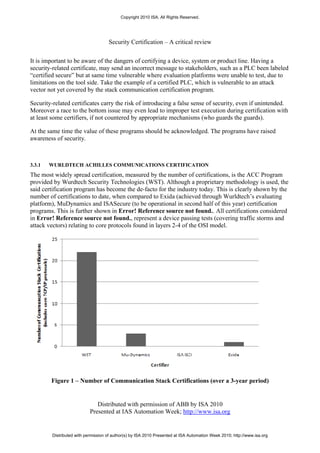
with a total of 3 devices certified over a 3 year period. This program requires the use of an evaluation
platform, which in this case is the Mu-8000 Service Analyzer [52]. It supports a similar set of test
cases as the Achilles Satellite unit. However in saying that, protocol test coverage is not known for
these types of tools. For the MUSIC Certification program, the certification levels are shown in Error!
Reference source not found., certified devices have only received Foundation Level recognition. Mu-
Dynamics have indicated they are planning to phase out the MUSIC Certification program in favor of
the ISASecure certification program, whether that means MuDynamics will seek accreditation to be a
certified body or seek recognition of the evaluation platform for the commmunication robustness part
of ISASecure EDSA, remains to be seen.
Distributed with permission of ABB by ISA 2010
Presented at IAS Automation Week; http://www.isa.org
Distributed with permission of author(s) by ISA 2010 Presented at ISA Automation Week 2010; http://www.isa.org](https://image.slidesharecdn.com/aw10securitypaper-110718075744-phpapp01/85/Security-Certification-Critical-Review-15-320.jpg)
![Copyright 2010 ISA. All Rights Reserved.
Security Certification – A critical review
Level Detail
Foundation Includes ARP, DHCP, IEEE 802.1p/Q, IPv4, TCP,
TFTP, UDP
Advanced Application and control protocol analysis
Table 4 – MUSIC certification Levels
The Mu Dynamics MUSIC certification can be described with the following characteristics:
• It was largely initiated by the test equipment supplier. No clear facts available on why but one can
speculate the following motivation, (i) a growing number of customers from the IACS sector, (ii)
direct customer request for certification service, (iii) participation in ISCI, (iv) opportunity to
expand and grow business.
• The buyer is not involved in the certification process, which leads to intransparency of the process
with regard to the the rigor of compliance checking and a misalignment of incentives and interest
as the evaluator is not liable for the failure of evaluated systems. Furthermore, largely leaving out
the buyer from the process removes the operational context of the system from the certification,
violating the requirements as set forth by Eloff/Solms [42]and Goertzel et al. [43]
• The cost of certification process is influenced by the desired certification level and the way the
evaluator performs the evaluation. The evaluator can either be an authorized body or the vendor
requesting the certification.In the latter case, digitally-signed tests are independently verified by an
authorized body. In this instance, the cost of certification is significantly less to the certifying body,
but additional costs such as purchasing of the evaluation platform and the associated labor required
to perform certification needs to be considered.
• The certified product depends on the rigor of tests from the evaluation platform. A drawback of the
certified products is that key device functions were not monitored through the evaluation platform
during test and hence could not be a part of the certification process. Recently, Mu-Dynamics have
extended the evaluation platform to support the monitoring of key device functions. The levels of
certification are shown in Error! Reference source not found., the higher the certification level
the more robust control communication protocols are.
3.3.5 ISCI ISASECURE
The ISA Security Compliance Institute (ISCI) was founded in 2007. ISCI is focusing on integrating
security into the product development lifecycle by introducing a conformance testing program. In
2010, ISCI has published parts of the ISASecure Embedded Device Security Assurance (EDSA)
certification specification [53]. ISASecure EDSA is one of many planned certification programs under
the ISCI mandate. The ISASecure EDSA certification program consists of the following parts
Distributed with permission of ABB by ISA 2010
Presented at IAS Automation Week; http://www.isa.org
Distributed with permission of author(s) by ISA 2010 Presented at ISA Automation Week 2010; http://www.isa.org](https://image.slidesharecdn.com/aw10securitypaper-110718075744-phpapp01/85/Security-Certification-Critical-Review-16-320.jpg)
![Copyright 2010 ISA. All Rights Reserved.
Security Certification – A critical review
• Functional security assessment (FSA)
• Software development security assessment (SDSA)
• Communication robustness testing (CRT)
•
A mapping of certification levels to FSA, SDSA and CRT is shown in Error! Reference source not
found.. A brief description of each follows; The FSA audits the devices security functionality, for
example the ability to maintain network resource availability under different conditions, against vendor
documentation and the requirements for the desired certification level. The SDSA audits the vendor’s
software development processes, similar to when a safety-related system has been SIL certified to the
software development requirements in IEC 61508. Moreover the SDSA requirements are partly
derived from IEC 61508 and other reference models. This is often seen as problematic, as attacks on
security do not occur according to a statistical distribution, as random failures subject to the laws of
physics do. The third part of this certification is CRT. This is closely related to existing certifications
programs, such as Achilles Communications Certification program. A key aspect of both programs is
that the critical function, such as the safety loop, must be adequately maintained to achieve
certification.
Figure 2 – Certification levels [53]
The ISCI ISASecure EDSA certification can be described with the following characteristics:
• It was initiated by a standards organization, which could create a market for certified products. The
standards organization has formed a consortium which includes control system users (asset owners
from OGP sector), manufacturers and industry organizations who may be involved in certifying
products. Given the recent release of the specification, it is anticipated that the certification
program will become operational in the second half of this year.
• The buyer is not involved in the certification process, which leads to intransparency of the process
with regard to the the rigor of compliance checking and a misalignment of incentives and interest
as the evaluator is not liable for the failure of evaluated systems. Furthermore, largely leaving out
Distributed with permission of ABB by ISA 2010
Presented at IAS Automation Week; http://www.isa.org
Distributed with permission of author(s) by ISA 2010 Presented at ISA Automation Week 2010; http://www.isa.org](https://image.slidesharecdn.com/aw10securitypaper-110718075744-phpapp01/85/Security-Certification-Critical-Review-17-320.jpg)
![Copyright 2010 ISA. All Rights Reserved.
Security Certification – A critical review
the buyer from the process removes the operational context of the system from the certification,
violating the requirements as set forth by Eloff/Solms [42]and Goertzel et al. [43]
• The cost of certification process depends on the desired EDSA level and the way the chartered
laboratory actually performs the evaluation. The rigor and cost applied by one chartered laboratory
should be the same for another. Variances in rigor and cost would aid a race to the bottom scenario
as vendors have an incentive to get certification at the chartered laboratory with the lowest price –
driving out the chartered laboratories which spent more resources on more rigorous evaluations.
• The certified level depends on the rigor of the evaluation process and the maturity of manufacturer
development processes. In order for certificates to be comparable and meaningful, besides
requiring consistency for FSA and SDSA audits, test coverage of different CRT tool needs to be
considered and its impact on the certificate
4 ANALYSIS
In this section we will summarize the analysis of the current security certification initiatives and point
out some elements where we see a danger of mistakes from enterprise system security certification
being repeated. Since the certification initiatives are still in a maturing phase, we see this as a
constructive criticism, aiming at the improvement of the overall situation in the industry.
• Certification criteria
In most current certification programs, the certification criteria are not publicly accessible, i.e. they
can’t be evaluated by subject matter experts for their meaningfulness. Furthermore, buyers seeking
a meaningful signaling mechanism have no way of checking the appropriateness of a given
certification program for their purposes. Obviously, certification program developers currently are
in discussion with individual buyers to market their programs and also disclose the criteria to these
buyers. However, this merely shifts the transaction costs from evaluating a supplier to evaluating a
certification program and thus at least reduces if not eliminates the economic advantage of
signaling. Furthermore, this cannot be expected to be a permanent approach, as the evaluators will
need to stabilize their certification criteria to achieve a stable and comparable certificate.
• Race to the bottom
Most current certification initiatives encourage or at least enable independent evaluators to also
setup certification programs under the same framework. While the requirements for certification are
defined, the specific certification criteria and the process applied to assess a subject’s compliance
are not strictly defined not is there a requirement to make them public. This makes the programs
susceptible to the “race to the bottom” in which evaluators compete on price and probability of
passing.
• Adverse selection
Limited meaningfulness may lead vendors who take security serious to engage in other signaling
mechanisms, e.g. in-depth discussions with buyers in the project specification phase. Especially in a
market which is characterized by a low number of large actors on both the buyer and the supplier
side where buyers choose a few strategic suppliers for mid- to long-term periods, this may turn out
Distributed with permission of ABB by ISA 2010
Presented at IAS Automation Week; http://www.isa.org
Distributed with permission of author(s) by ISA 2010 Presented at ISA Automation Week 2010; http://www.isa.org](https://image.slidesharecdn.com/aw10securitypaper-110718075744-phpapp01/85/Security-Certification-Critical-Review-18-320.jpg)

![Copyright 2010 ISA. All Rights Reserved.
Security Certification – A critical review
6 REFERENCES
[1] D. Dzung, M. Naedele, T. Von Hoff, and M. Crevatin, "Security for industrial communication
systems," Proceedings of the IEEE, vol. 93, 2005, p. 1152–1177.
[2] E. Byres and D. Hoffman, "The Myths and Facts behind Cyber Security Risks for Industrial
Control Systems," Control, 2003.
[3] M. Naedele, "IT Security for Automation Systems," Industrial Information Technology
Handbook, R. Zurawski, CRC Press, 2004.
[4] E. Byres, J. Carter, A. Elramly, and D. Hoffman, "Worlds in collision: Ethernet on the plant
floor," ISA Emerging Technologies Conference, Instrumentation Systems and Automation
Society, 2002.
[5] R. Schierholz and B. de Wijs, "Cybersecurity in power plants: Still an underestimated problem
- How end users and vendors are or should be facing it," PowerGen Europe, Amsterdam:
Pennwell Publishing, 2010.
[6] M. Naedele, "Standardizing Industrial IT Security A First Look at the IEC approach," Proc.
10th IEEE International Conference on Emerging Technologies and Factory Automation
(ETFA 05), IEEE Computer Society, 2005.
[7] R. Schierholz, S. Obermeier, L. Guidi, D. Pestonesi, and G. Carpi, "Evaluation of ISA 99 in a
Real-World Power Plant Security Assessment," DHS Industrial Control System Joint Working
Group 2010 Spring Conference, San Antonio, TX: Department of Homeland Security, 2010.
[8] P. Kwaspen and T. Williams, "Functional Cyber Security Best Practices Certification Program:
An Update for Industrial Stakeholders," DHS Industrial Control System Joint Working Group
2010 Spring Conference, San Antonio, TX: Department of Homeland Security, 2010.
[9] T. Culling, A. Ristaino, K. Staggs, and J. Cusimano, "Role of Product Certification in an
Overall Cyber Security Strategy," DHS Industrial Control System Joint Working Group 2010
Spring Conference, San Antonio, TX: Department of Homeland Security, 2010.
[10] R. Anderson and T. Moore, "The economics of information security.," Science (New York,
N.Y.), vol. 314, 2006, pp. 610-3.
[11] R. Anderson and T. Moore, "Information Security Economics – and Beyond Foundational
Concepts," Information Security, 2008, pp. 1-26.
[12] R. Anderson and S. Fuloria, "Security Economics and Critical National Infrastructure," 2009
Workshop on the Economics of Information Security, 2009.
Distributed with permission of ABB by ISA 2010
Presented at IAS Automation Week; http://www.isa.org
Distributed with permission of author(s) by ISA 2010 Presented at ISA Automation Week 2010; http://www.isa.org](https://image.slidesharecdn.com/aw10securitypaper-110718075744-phpapp01/85/Security-Certification-Critical-Review-21-320.jpg)
![Copyright 2010 ISA. All Rights Reserved.
Security Certification – A critical review
[13] R. Anderson and S. Fuloria, "Certification and evaluation: A security economics perspective,"
2009 IEEE Conference on Emerging Technologies & Factory Automation, IEEE Comput. Soc.
Press, 2009, pp. 1-7.
[14] G.A. Akerlof, "The Market for "Lemons": Quality Uncertainty and the Market Mechanism,"
The Quarterly Journal of Economics, vol. 84, 1970, p. 488.
[15] F.M. Bator, "The Anatomy of Market Failure," The Quarterly Journal of Economics, vol. 72,
1958, pp. 351-379.
[16] S. Balakrishnan and M. Koza, "Information asymmetry, market failure and joint-ventures :
theory and evidence," Journal of Economic Behavior and Organization, vol. 20, 1993, pp. 99-
117.
[17] R.H. Coase, "The Nature of the Firm," Economica, vol. 4, 1937, pp. 386-405.
[18] O.E. Williamson, Markets and Hierarchies: Analysis and Antitrust Implications, New York:
The Free Press, 1975.
[19] O.E. Williamson, "Transaction-Cost Economics: The Governance of Contractual Relations,"
The Journal of Law and Economics, vol. 22, 1979, pp. 233-261.
[20] O.E. Williamson, "The Economics of Organization: The Transaction Cost Approach," The
American Journal of Sociology, vol. 87, 1981, pp. 548-577.
[21] O.E. Williamson, "Assessing Contract," Jounal of Law, Economics and Organization, vol. 1,
1985, pp. 177-208.
[22] O.E. Williamson, "Transaction Cost Economics: How it Works; Where it is Headed," De
Economist, vol. 146, 1998, pp. 23-58.
[23] O.E. Williamson, "Transaction Cost Economics and Organization Theory," Technology,
Organization, and Competitiveness: Perspectives on Industrial and Corporate Change, G.
Dosi, D.J. Teece, and J. Chytry, Oxford University Press, 1998, pp. 17-66.
[24] A. Picot, H. Dietl, and E. Franck, Organisation: Eine ökonomische Perspektive, Stuttgart:
Schäffer-Poeschel, 1999.
[25] S.A. Ross, "The Economic Theory of Agency: The Principal's Problem," The American
Economic Review, vol. 63, 1973, pp. 134-139.
[26] M.C. Jensen and W.H. Meckling, "Theory of the Firm : Managerial Behavior , Agency Costs
and Ownership Structure Theory of the Firm : Managerial Behavior , Agency Costs and
Ownership Structure," Journal of Financial Economics, vol. 3, 1976, pp. 305-360.
Distributed with permission of ABB by ISA 2010
Presented at IAS Automation Week; http://www.isa.org
Distributed with permission of author(s) by ISA 2010 Presented at ISA Automation Week 2010; http://www.isa.org](https://image.slidesharecdn.com/aw10securitypaper-110718075744-phpapp01/85/Security-Certification-Critical-Review-22-320.jpg)
![Copyright 2010 ISA. All Rights Reserved.
Security Certification – A critical review
[27] K. Spremann, "Agent and Principal," Agency Theory, Information, and Incentives, G. Bamberg
and K. Spremann, Berlin: Springer, 1987, pp. 3-38.
[28] S.P. Shapiro, "Agency Theory," Annual Review of Sociology, vol. 31, 2005, pp. 263-284.
[29] A. Blomqvist, "The doctor as double agent: Information asymmetry, health insurance, and
medical care," Journal of Health Economics, vol. 10, 1991, pp. 411-432.
[30] M. Harris and A. Raviv, "Some Results on Incentive Contracts with Applications to Education
and Employment, Health Insurance, and Law Enforcement," The American Economic Review,
vol. 68, 1978, pp. 20-30.
[31] K.M. Eisenhardt, "Agency Theory: An Assessment and Review," Academy of Management
Review, vol. 14, 1989, pp. 57-74.
[32] B. Schlaak, S. Dynes, L.M. Kolbe, and R. Schierholz, "Managing of Information Systems
Risks in Extended Enterprises: The Case of Outsourcing," Proceedings of the Fourteenth
Americas Conference on Information Systems, Toronto, ON, CA: 2008.
[33] D. Wu and L. Hitt, "Learning in ERP contracting: a principal-agent analysis," 37th Annual
Hawaii International Conference on System Sciences, 2004. Proceedings of the, IEEE, 2003,
pp. 217-225.
[34] X. Huans, "Production Strategy in Supply Chain under Asymmetric Information," pp. 2-6.
[35] X.H. Lei and K. Zhang, Research on the subdivision of transaction cost in supply chain based
on analysis of enterprises relation, IEEE, 2008.
[36] P. Bajari and S. Tadelis, "Incentives versus transaction costs: a theory of procurement
contracts," Rand Journal of Economics, vol. 32, 2001, pp. 387-407.
[37] X. Chen, L. Ding, H. Luo, and J. Sun, "Research on the Optimal Inentive Contract Considering
Contractor's Intrinsic Motivation in the Construction Quality Insurance System," Proceedings of
the Seventh International Conference on Machine Learning and Cybernetics, IEEE, 2008.
[38] R. Nellore, "Validating specifications: a contract-based approach," IEEE Transactions on
Engineering Management, vol. 48, 2001, pp. 491-504.
[39] D. Rice, Geekonomics - The Real Cost of Insecure Software, Upper Saddler River, NJ:
Addson-Wesley, 2008.
[40] K. Rannenberg, "IT Security Certification and Criteria - Progress , Problems and Perspectives,"
Proceedings of the IFIP TC11 Fifteenth Annual Working Conference on Information Security
for Global Information Infrastructures, S. Qing and J.H. Eloff, Kluwer, 2000, pp. 1-10.
Distributed with permission of ABB by ISA 2010
Presented at IAS Automation Week; http://www.isa.org
Distributed with permission of author(s) by ISA 2010 Presented at ISA Automation Week 2010; http://www.isa.org](https://image.slidesharecdn.com/aw10securitypaper-110718075744-phpapp01/85/Security-Certification-Critical-Review-23-320.jpg)
![Copyright 2010 ISA. All Rights Reserved.
Security Certification – A critical review
[41] C. Almond, "Should vendors be liable for security flaws in software?," Computer Fraud &
Security, vol. 2009, 2009, pp. 4-7.
[42] M.M. Eloff and S.H. Solms, "Information Security Management : An Approach to Combine
Process Certification And Product Evaluation," Science, vol. 19, 2000, pp. 698-709.
[43] K.M. Goertzel, T. Winograd, H.L. McKinley, L. Oh, M. Colon, T. McGibbon, E. Fedchak, and
R. Vienneau, "Software Security Assurance: State-of-the-Art Report," Information Assurance
Technology Analysis Center (IATAC), 2007.
[44] J. Shapiro, "Understanding the windows EAL4 evaluation," Computer, vol. 36, 2003, pp. 103-
105.
[45] B. Edelman, "Adverse selection in online "trust" certifications," Proceedings of the 11th
International Conference on Electronic Commerce - ICEC '09, New York, New York, USA:
ACM Press, 2009, p. 205.
[46] B. Edelman, "Adverse selection in online “trust” certifications and search results," Electronic
Commerce Research and Applications, 2010.
[47] R. Anderson, "System Evaluation and Assurance," Security Engineering – A Guide to Building
Dependable Distributed Systems, Wiley, 2008, pp. 857-888.
[48] WIB, "Process Control Domain - Security Requirements for Vendors," 2010, pp. 1-33.
[49] CMU, "Systems Security Engineering Capability Maturity Model (SSE-CMM) V3.0,"
Carnegie Mellon University - Software Engineering Institute, 2003.
[50] Exida, "Professional Services for Control System Security Functional Safety Services :
Intersection between Safety and Security," 2009.
[51] Mu-Dynamics, "Mu Dynamics Industrial Control Certification (MUSIC)," 2007.
[52] http://www.mudynamics.com, "The Mu Test Platform," 2010.
[53] http://www.isasecure.org/Certification-Program/ISASecure-Program-Description.aspx, "ISCI
ISASecure EDSA Specification," 2010.
[54] NIST, "Requiring Software Independence in VVSG 2007 : STS Recommendations for the
TGDC," Technical Guidelines Development Committee, 2006.
Distributed with permission of ABB by ISA 2010
Presented at IAS Automation Week; http://www.isa.org
Distributed with permission of author(s) by ISA 2010 Presented at ISA Automation Week 2010; http://www.isa.org](https://image.slidesharecdn.com/aw10securitypaper-110718075744-phpapp01/85/Security-Certification-Critical-Review-24-320.jpg)

This document provides a critical review of security certification from an economic perspective. It analyzes security certification using theories of transaction cost economics and principal-agent theory to understand information asymmetries in markets. The document also examines experiences with certification in other domains and assesses how current industrial automation security certification initiatives address past failures. It argues that while certification can help reduce information asymmetries, proper contractual incentives are also needed to fully address issues of adverse selection, moral hazard, and hidden intentions.


![Getting Started with Apache Spark: Big Data Made Simple [Free Meetup]](https://cdn.slidesharecdn.com/ss_thumbnails/apachesparkgettingstarted-260203175547-8361bcc3-thumbnail.jpg?width=640&height=640&fit=bounds)


