


CHIN UP!
AVOIDING TECH NECK: ADVERTING
BIOMECHANICAL DYSFUNCTION FROM THE
USE OF TECHNOLOGICAL DEVICES
www.f4cp.com
Special thanks to the following:
•Dr. Heidi Haavik – Haavik Research
•Dr. Steve Weiniger – BodyZone & PostureZone
•Dr. Mark Wade - American Posture Institute
•Dr. Krista Burns - American Posture Institute
Sherry McAllister, MS, DC, CCPS
F4CP Executive Vice President
CHIN UP!
SHERRY MCALLISTER MS DC CCSP
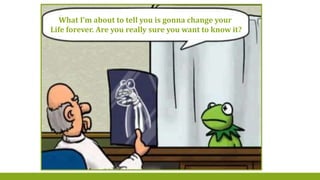
What I’m about to tell you is gonna change your
Life forever. Are you really sure you want to know it?
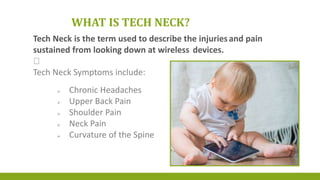
WHAT IS TECH NECK?
Tech Neck is the term used to describe the injuriesand pain
sustained from looking down at wireless devices.
Tech Neck Symptoms include:
 Chronic Headaches
 Upper Back Pain
 Shoulder Pain
 Neck Pain
 Curvature of the Spine
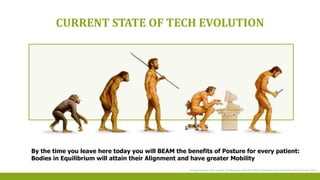
CURRENT STATE OF TECH EVOLUTION
By the time you leave here today you will BEAM the benefits of Posture for every patient:
Bodies in Equilibrium will attain their Alignment and have greater Mobility
Image Source: http://www.33rdsquare.com/2013/04/computer-scientists-find-that-evolution.html
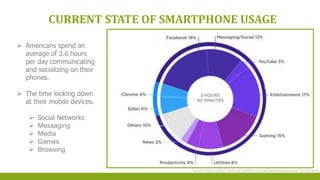
CURRENT STATE OF SMARTPHONE USAGE
 Americans spend an
average of 3.6 hours
per day communicating
and socializing on their
phones.
 The time looking down
at their mobile devices.
 Social Networks
 Messaging
 Media
 Games
 Browsing
Source: Flurry Analytics, comScore, Pandora, Facebook,NetMarketShare Note: US June 2015
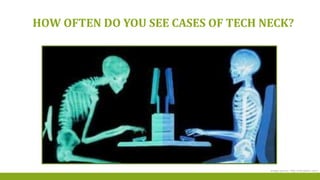
HOW OFTEN DO YOU SEE CASES OF TECH NECK?
Image source: http://erikdalton.com/
IT'S TIME
 In 2013, 1.91 trillion text messages sent.
 Smartphone used 3.6 hours a day or about 1,300 hours a year
 High school students spend 5,000 hours a year forward flexed.
 Kaiser Family Foundation found that 8 to 18 year olds spend
7.5 hours on tech "entertainment media".
 Smartphone data usage tripled from 2010 to 2011.
 Tablets users use 3.4 times more data than Smartphone users. Cisco's Global Mobile Data Traffic Forecast Update
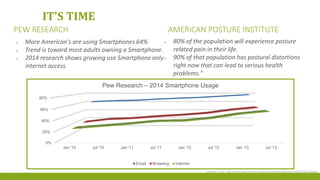
PEW RESEARCH
IT'S TIME
 More American's are using Smartphones 64%
 Trend is toward most adults owning a Smartphone.
 2014 research shows growing use Smartphone only
internet access.
 80% of the population will experience posture
related pain in their life.
 90% of that population has postural distortions
right now that can lead to serious health
problems."
AMERICAN POSTURE INSTITUTE
0%
20%
40%
60%
80%
Jan '10 Jul '10 Jan '11 Jul '11 Jan '12 Jul '12 Jan '13 Jul '13
Pew Research – 2014 Smartphone Usage
Email Browsing Internet
October 2104: http://www.pewinternet.org/fact-sheets/mobile-technology-fact-sheet/
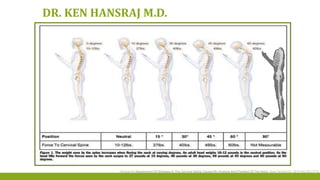
Hansraj Kk Assessment Of Stresses In The Cervical Spine Caused By Posture And Position Of The Head. Surg Technol Int. 2014 Nov;25:277-9.
DR. KEN HANSRAJ M.D.
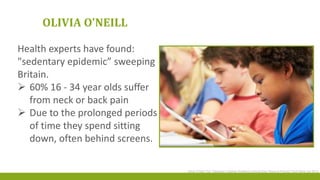
OLIVIA O'NEILL
Health experts have found:
"sedentary epidemic” sweeping
Britain.
 60% 16 - 34 year olds suffer
from neck or back pain
 Due to the prolonged periods
of time they spend sitting
down, often behind screens.
Olivia O’Neill The Telegraph Lifestyle Wellbeing Article Easy Ways to Prevent Tech Neck Apr 2014
WHAT IS THE SYMPTOMS RELATED TO FORWARD HEAD CARRIAGE
Restricted Breathing
Degenerative Disc Disease
Disc Compression
Kyphosis
Depression
Increased stress
Diminished Levels of Energy
Decreased Libido Tension Headaches
Digestive Symptoms
Constipation
Acid Reflux and Hernias
Obstructive Sleep Apnea Cardiovascular irregularities
(related to vagus nerve irritation)
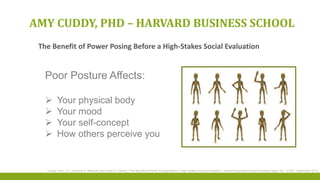
AMY CUDDY, PHD – HARVARD BUSINESS SCHOOL
Poor Posture Affects:
 Your physical body
 Your mood
 Your self-concept
 How others perceive you
The Benefit of Power Posing Before a High-Stakes Social Evaluation
Cuddy, Amy J.C., Caroline A. Wilmuth, and Dana R. Carney. "The Benefit of Power Posing Before a High-Stakes Social Evaluation." Harvard Business School Working Paper, No. 13-027, September 2012.
AMY CUDDY, PHD – HARVARD BUSINESS SCHOOL
Powerful Low Power
Cuddy, Amy J.C., Caroline A. Wilmuth, and Dana R. Carney. "The Benefit of Power Posing Before a High-Stakes Social Evaluation." Harvard Business School Working Paper, No. 13-027, September 2012.
AMY CUDDY, PHD – HARVARD BUSINESS SCHOOL
Findings supported by Dr. Kenneth Hansraj MD: Good posture is associated with “elevations in testosterone, increases in serotonin, decreases in cortisol, and increased feelings of power and tolerance for risk taking.”
25%
-20%
83%
-15%
15%
60%
-30%
-10%
10%
30%
50%
70%
90%
Testosterone Cortisol Risk Tolerance
Powerful Low Power
Cuddy, Amy J.C., Caroline A. Wilmuth, and Dana R. Carney. "The Benefit of Power Posing Before a High-Stakes Social Evaluation." Harvard Business School Working Paper, No. 13-027, September 2012.
VLADIMIR JANDA
Hypokinetic Disease: The degeneration which occurs
when a sedentary lifestyle causes the body to compensate
subtly to maintain stability.
“Prolonged muscle tightness leads to fatigue, which ultimately decreases
the force available to meet postural and movement demands”
Janda V, Kraus J. Neurologie pro rehabilitacni pracovniky [Neurology for Physiotherapists]. Prague: Avicenumzdravotnicke nakladatelstvi, 1987:126
BREATHING PATTERN DISORDERS AND FUNCTIONAL MOVEMENT
Helen Bradley, PT, Msc1 And Joseph Dr. Esformes, Phd, CSCS2 Int J Sports Phys Ther. 2014 Feb; 9(1): 28–39. Pmcid: Pmc3924606 Breathing Pattern Disorders And Functional Movement
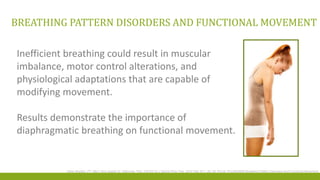
Inefficient breathing could result in muscular
imbalance, motor control alterations, and
physiological adaptations that are capable of
modifying movement.
Results demonstrate the importance of
diaphragmatic breathing on functional movement.
SLEEP AND POSTURAL DISTORTION OF THE NECK
S E Martin, I Marshall, and N J Douglas “The effect of posture on airway caliber with the sleep-apnea/hypopnea syndrome.” American
Journal of Respiratory and Critical Care Medicine Vol. 152, No. 2 (1995), pp. 721-4. doi: 10.1164/ajrccm.152.2.7633733
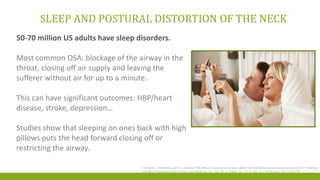
50-70 million US adults have sleep disorders.
Most common OSA: blockage of the airway in the
throat, closing off air supply and leaving the
sufferer without air for up to a minute.
This can have significant outcomes: HBP/heart
disease, stroke, depression…
Studies show that sleeping on ones back with high
pillows puts the head forward closing off or
restricting the airway.
HEADACHES
NIKOLAI BOGDUK BSC(MED) MB BS MD PHD
[i] Bogduk,N., Anatomy and Physiology of Headache, Biomedicine and Pharmacotherapy, Volume49, number10, pp.435-445 [ii] McCrory, Douglas C., Donald B. Penzien, Bic Hasselblad, and
Rebecca N. Gray. Evidence report behavioral and physical treatments for tension type and cervicogenic headache. Durham, NC: Duke University Evidence-based Practice Center; 2001.
Trigeminocervical Nucleus (TN)
 A main factor affecting nerves surrounding the Trigeminocervical
Nucleus is the biomechanical aspects of the upper cervical spine.
 Postural changes stimulate nerve endings connecting to nucleus.
 This happens through irritation of the nerves themselves, or
decreasing the level of inhibition of the nucleus itself.
Chiropractic care, specifically cervical spine adjustments, results in
inhibition of triggering function mechanisms and ultimately results
decreased central sensitization.
S. Goya Wannamethee, PhD; A. Gerald Shaper, FRCP; Lucy Lennon, MSc; Peter H. Whincup, FRCP, PhD, Arch Intern Med. 2006;166:2546-2552. December 19, 2006
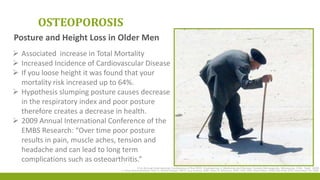
 Associated increase in Total Mortality
 Increased Incidence of Cardiovascular Disease
 If you loose height it was found that your
mortality risk increased up to 64%.
 Hypothesis slumping posture causes decrease
in the respiratory index and poor posture
therefore creates a decrease in health.
 2009 Annual International Conference of the
EMBS Research: “Over time poor posture
results in pain, muscle aches, tension and
headache and can lead to long term
complications such as osteoarthritis.”
OSTEOPOROSIS
Posture and Height Loss in Older Men
31st Annual International Conference of the IEEE Engineering in Medicine and Biology Society Minneapolis, Minnesota, USA, Sept, 2009.
S. Goya Wannamethee, PhD; A. Gerald Shaper, FRCP; Lucy Lennon, MSc; Peter H. Whincup, FRCP, PhD, Arch Intern Med. 2006;166:2546-2552. December 19, 2006
OSTEOPOROSIS
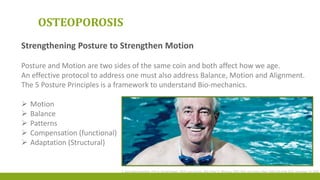
Strengthening Posture to Strengthen Motion
Posture and Motion are two sides of the same coin and both affect how we age.
An effective protocol to address one must also address Balance, Motion and Alignment.
The 5 Posture Principles is a framework to understand Bio-mechanics.
 Motion
 Balance
 Patterns
 Compensation (functional)
 Adaptation (Structural)
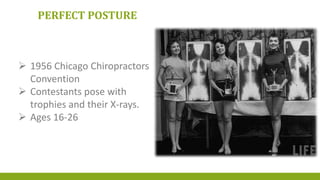
PERFECT POSTURE
 1956 Chicago Chiropractors
Convention
 Contestants pose with
trophies and their X-rays.
 Ages 16-26
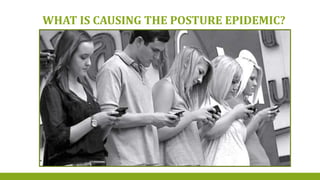
WHAT IS CAUSING THE POSTURE EPIDEMIC?
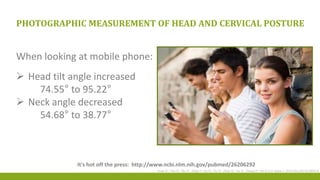
PHOTOGRAPHIC MEASUREMENT OF HEAD AND CERVICAL POSTURE
When looking at mobile phone:
 Head tilt angle increased
74.55° to 95.22°
 Neck angle decreased
54.68° to 38.77°
Guan X1, Fan G1, Wu X1, Zeng Y2, Su H1, Gu G1, Zhou Q1, Gu X1, Zhang H1, He S3.Eur Spine J. 2015 Dec;24(12):2892-8.
It's hot off the press: http://www.ncbi.nlm.nih.gov/pubmed/26206292
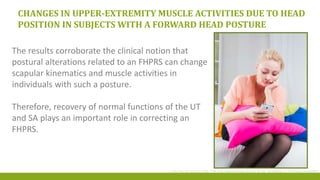
CHANGES IN UPPER-EXTREMITY MUSCLE ACTIVITIES DUE TO HEAD
POSITION IN SUBJECTS WITH A FORWARD HEAD POSTURE
J Phys Ther Sci. 2015 Jun; 27(6): 1739–1742. Published Online 2015 Jun 30. Doi: 10.1589/Jpts.27.1739 Pmcid: Pmc4499973
The results corroborate the clinical notion that
postural alterations related to an FHPRS can change
scapular kinematics and muscle activities in
individuals with such a posture.
Therefore, recovery of normal functions of the UT
and SA plays an important role in correcting an
FHPRS.
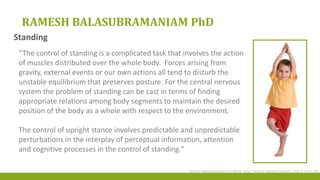
RAMESH BALASUBRAMANIAM PhD
“The control of standing is a complicated task that involves the action
of muscles distributed over the whole body. Forces arising from
gravity, external events or our own actions all tend to disturb the
unstable equilibrium that preserves posture. For the central nervous
system the problem of standing can be cast in terms of finding
appropriate relations among body segments to maintain the desired
position of the body as a whole with respect to the environment.
The control of upright stance involves predictable and unpredictable
perturbations in the interplay of perceptual information, attention
and cognitive processes in the control of standing."
Ramesh Balasubramaniam And Alan M. Wing, Trends In Cognitive Sciences, 2002, 6:12:531-536
Standing
RENE CAILLIET, MD
“Head in forward posture can add up to thirty pounds of
abnormal leverage on the cervical spine. This can pull the
entire spine out of alignment. Forward head posture (FHP)
may result in the loss of 30% of vital lung capacity. These
breath-related effects are primarily due to the loss of the
cervical lordosis, which blocks the action of the hyoid muscles,
especially the inferior hyoid responsible for helping lift the first
rib during inhalation.”
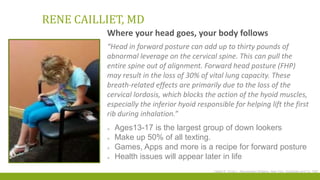
Where your head goes, your body follows
 Ages13-17 is the largest group of down lookers
 Make up 50% of all texting.
 Games, Apps and more is a recipe for forward posture
 Health issues will appear later in life
Cailliet R, Gross L, Rejuvenation Strategy. New York, Doubleday and Co. 1987
RENE CAILLIET, MD
“Head in forward posture can add up to thirty pounds of
abnormal leverage on the cervical spine. This can pull the
entire spine out of alignment. Forward head posture (FHP)
may result in the loss of 30% of vital lung capacity. These
breath-related effects are primarily due to the loss of the
cervical lordosis, which blocks the action of the hyoid muscles,
especially the inferior hyoid responsible for helping lift the first
rib during inhalation.”
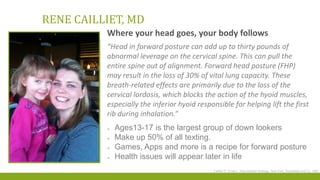
Where your head goes, your body follows
 Ages13-17 is the largest group of down lookers
 Make up 50% of all texting.
 Games, Apps and more is a recipe for forward posture
 Health issues will appear later in life
Cailliet R, Gross L, Rejuvenation Strategy. New York, Doubleday and Co. 1987
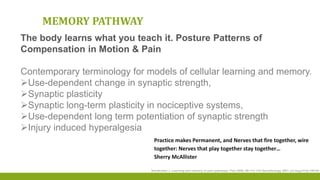
MEMORY PATHWAY
Practice makes Permanent, and Nerves that fire together, wire
together: Nerves that play together stay together…
Sherry McAllister
The body learns what you teach it. Posture Patterns of
Compensation in Motion & Pain
Contemporary terminology for models of cellular learning and memory.
Use-dependent change in synaptic strength,
Synaptic plasticity
Synaptic long-term plasticity in nociceptive systems,
Use-dependent long term potentiation of synaptic strength
Injury induced hyperalgesia
Sandkuhler J. Learning and memory in pain pathways. Pain 2000; 88:113-118 Geronthology 2001 Jul-Aug;47(4):189-94
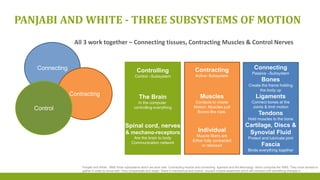
PANJABI AND WHITE - THREE SUBSYSTEMS OF MOTION
Connecting
Contracting
Control
All 3 work together – Connecting tissues, Contracting Muscles & Control Nerves
Connecting
Passive –Subsystem
Bones
Create the frame holding
the body up
Ligaments
Connect bones at the
Joints & limit motion
Tendons
Hold muscles to the bone
Cartilage, Discs &
Synovial Fluid
Protect and lubricate joint
Fascia
Binds everything together
Controlling
Control –Subsystem
The Brain
In the computer
controlling everything
Spinal cord, nerves
& mechano-receptors
Are the brain to body
Communication network
Contracting
Active–Subsystem
Muscles
Contacts to create
Motion. Muscles pull
Bones like rope.
Individual
Muscle fibers are
Either fully contracted
or released
Panjabi and White : NMS three subsystems which we work with. Contracting muscle and connecting ligament and the Neurology which comprise the NMS. They must worked to
gather in order to move well. They compensate and adapt. There is mechanical and control. Unused muscle weakened and it will contract until something changes it.
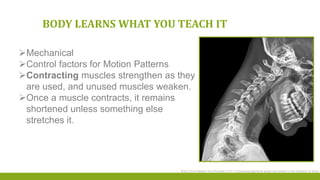
BODY LEARNS WHAT YOU TEACH IT
Mechanical
Control factors for Motion Patterns
Contracting muscles strengthen as they
are used, and unused muscles weaken.
Once a muscle contracts, it remains
shortened unless something else
stretches it.
Body Zone Ralston-from Kendall p 270 Connecting ligaments adapt and stretch in the direction of strain
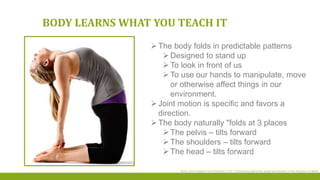
BODY LEARNS WHAT YOU TEACH IT
The body folds in predictable patterns
Designed to stand up
To look in front of us
To use our hands to manipulate, move
or otherwise affect things in our
environment.
Joint motion is specific and favors a
direction.
The body naturally "folds at 3 places
The pelvis – tilts forward
The shoulders – tilts forward
The head – tilts forward
Body Zone Ralston-from Kendall p 270 Connecting ligaments adapt and stretch in the direction of strain
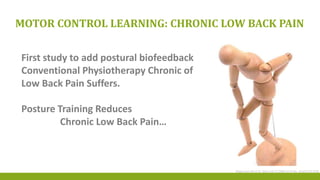
MOTOR CONTROL LEARNING: CHRONIC LOW BACK PAIN
First study to add postural biofeedback
Conventional Physiotherapy Chronic of
Low Back Pain Suffers.
Posture Training Reduces
Chronic Low Back Pain…
Magnusson ML et Al. Spine July 15 2008 Vol 33 No. 16 pp E532-E538
POSTURAL DISTORTION
Physiologic Compromise of a Spinal Misalignment Complex
1. Unequal load creates increased load on one of the facets
2. Elastic deformation of the muscles and tendons
a. Muscles: first to weaken and the first to heal. It takes 6 hours for atrophy to begin.
Once atrophy begins, you lose 1.5% of muscle mass per day of non‐use
b. Tendons breakdown: unequal load of the muscle‐tendon junction, causes
tendonitis
3. Plastic deformation of the ligaments (which is more likely to become permanent)
a. Ligaments change due to the load applied. Loss of muscle tone decreases joint
tension and increases the load to the ligaments
The Principles of Posturology 2015 by Dr. Krista Burns DC, DrHA, CPE, CPEP Dr. Mark Wade DC, DrPH, CPE, CPEP
POSTURAL DISTORTION
Physiologic Compromise of a Spinal Misalignment Complex
4. Cartilage most severe damage can occur; heals the slowest and the least. Nutrition is
critical for repair of cartilage
5. Vertebral discs degenerate causing decreased rotational torque. The spine may suffer
from 25% less rotational ability at the effected joint complex
6. Spinal nerves demonstrate a lower threshold, meaning they fire easier.
7. Nerve pathways become de-facilitated with restriction, and the associated body part
becomes weak and clumsy
The Principles of Posturology 2015 by Dr. Krista Burns DC, DrHA, CPE, CPEP Dr. Mark Wade DC, DrPH, CPE, CPEP
POSTURAL DISTORTION
Physiologic Compromise of a Spinal Misalignment Complex
8. Vasculature becomes compromised causing hypoxia in certain tissues, and decreased
circulation
9. Osteophyte formation: Adhesions and bony degeneration. Wolfe’s Law states that any
abnormal stress to the bone creates bony abnormalities
10. Osteoarthritis or DJD is caused by improper biomechanics and mechanical stress of
joints due to weight bearing forces or repetitive activities
11. Abnormal Stimulation to Brain: due to Joints abnormal movement result in abnormal
stimulation by the surrounding muscle spindles.
a. CNS: changes not controlling the movement of that spinal segment properly. Motor
control and stability is different at this level
The Principles of Posturology 2015 by Dr. Krista Burns DC, DrHA, CPE, CPEP Dr. Mark Wade DC, DrPH, CPE, CPEP
VLADIMIR JANDA’S CROSS SYNDROME
Janda V, Kraus J. Neurologie pro rehabilitacni pracovniky [Neurology for Physiotherapists]. Prague: Avicenumzdravotnicke nakladatelstvi, 1987:126
POSTURAL ASSESSMENTS
 Assessment is a clinical shortcut and confirmatory
clinical modality.
 Yanda describes the stereotypical “Antalgic Posture.”
 We see similar changes with Tech Neck
Janda V, Kraus J. Neurologie pro rehabilitacni pracovniky [Neurology for Physiotherapists]. Prague: Avicenumzdravotnicke nakladatelstvi, 1987:126
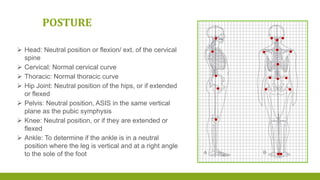
 Head: Neutral position or flexion/ ext. of the cervical
spine
 Cervical: Normal cervical curve
 Thoracic: Normal thoracic curve
 Hip Joint: Neutral position of the hips, or if extended
or flexed
 Pelvis: Neutral position, ASIS in the same vertical
plane as the pubic symphysis
 Knee: Neutral position, or if they are extended or
flexed
 Ankle: To determine if the ankle is in a neutral
position where the leg is vertical and at a right angle
to the sole of the foot
POSTURE
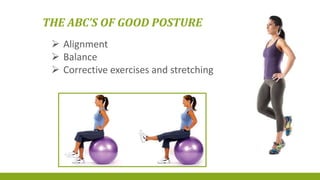
THE ABC’S OF GOOD POSTURE
 Alignment
 Balance
 Corrective exercises and stretching
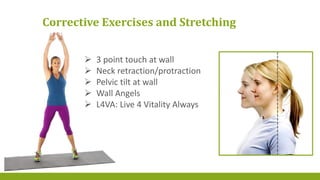
Corrective Exercises and Stretching
 3 point touch at wall
 Neck retraction/protraction
 Pelvic tilt at wall
 Wall Angels
 L4VA: Live 4 Vitality Always
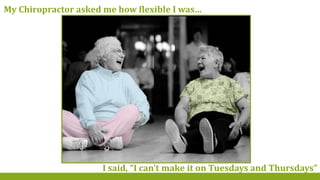
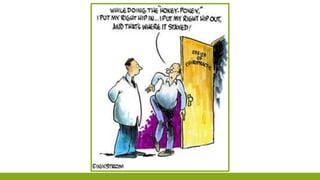
My Chiropractor asked me how flexible I was…
I said, “I can’t make it on Tuesdays and Thursdays”
CHIN UP!
SHERRY MCALLISTER MS DC CCSP
CHIN UP!
www.f4cp.com
Sherry McAllister, MS, DC, CCPS
F4CP Executive Vice President
13th A n n i v e r s a r y
Visit us at our
booth for handouts

Avoiding tech neck: adverting biomechanical dysfunction from the use of technological devices

  • 1.
    CHIN UP! AVOIDING TECHNECK: ADVERTING BIOMECHANICAL DYSFUNCTION FROM THE USE OF TECHNOLOGICAL DEVICES www.f4cp.com Special thanks to the following: •Dr. Heidi Haavik – Haavik Research •Dr. Steve Weiniger – BodyZone & PostureZone •Dr. Mark Wade - American Posture Institute •Dr. Krista Burns - American Posture Institute Sherry McAllister, MS, DC, CCPS F4CP Executive Vice President
  • 2.
  • 3.
    What I’m aboutto tell you is gonna change your Life forever. Are you really sure you want to know it?
  • 4.
    WHAT IS TECHNECK? Tech Neck is the term used to describe the injuriesand pain sustained from looking down at wireless devices. Tech Neck Symptoms include:  Chronic Headaches  Upper Back Pain  Shoulder Pain  Neck Pain  Curvature of the Spine
  • 5.
    CURRENT STATE OFTECH EVOLUTION By the time you leave here today you will BEAM the benefits of Posture for every patient: Bodies in Equilibrium will attain their Alignment and have greater Mobility Image Source: http://www.33rdsquare.com/2013/04/computer-scientists-find-that-evolution.html
  • 6.
    CURRENT STATE OFSMARTPHONE USAGE  Americans spend an average of 3.6 hours per day communicating and socializing on their phones.  The time looking down at their mobile devices.  Social Networks  Messaging  Media  Games  Browsing Source: Flurry Analytics, comScore, Pandora, Facebook,NetMarketShare Note: US June 2015
  • 7.
    HOW OFTEN DOYOU SEE CASES OF TECH NECK? Image source: http://erikdalton.com/
  • 8.
    IT'S TIME  In2013, 1.91 trillion text messages sent.  Smartphone used 3.6 hours a day or about 1,300 hours a year  High school students spend 5,000 hours a year forward flexed.  Kaiser Family Foundation found that 8 to 18 year olds spend 7.5 hours on tech "entertainment media".  Smartphone data usage tripled from 2010 to 2011.  Tablets users use 3.4 times more data than Smartphone users. Cisco's Global Mobile Data Traffic Forecast Update
  • 9.
    PEW RESEARCH IT'S TIME More American's are using Smartphones 64%  Trend is toward most adults owning a Smartphone.  2014 research shows growing use Smartphone only internet access.  80% of the population will experience posture related pain in their life.  90% of that population has postural distortions right now that can lead to serious health problems." AMERICAN POSTURE INSTITUTE 0% 20% 40% 60% 80% Jan '10 Jul '10 Jan '11 Jul '11 Jan '12 Jul '12 Jan '13 Jul '13 Pew Research – 2014 Smartphone Usage Email Browsing Internet October 2104: http://www.pewinternet.org/fact-sheets/mobile-technology-fact-sheet/
  • 10.
    Hansraj Kk AssessmentOf Stresses In The Cervical Spine Caused By Posture And Position Of The Head. Surg Technol Int. 2014 Nov;25:277-9. DR. KEN HANSRAJ M.D.
  • 11.
    OLIVIA O'NEILL Health expertshave found: "sedentary epidemic” sweeping Britain.  60% 16 - 34 year olds suffer from neck or back pain  Due to the prolonged periods of time they spend sitting down, often behind screens. Olivia O’Neill The Telegraph Lifestyle Wellbeing Article Easy Ways to Prevent Tech Neck Apr 2014
  • 13.
    WHAT IS THESYMPTOMS RELATED TO FORWARD HEAD CARRIAGE Restricted Breathing Degenerative Disc Disease Disc Compression Kyphosis Depression Increased stress Diminished Levels of Energy Decreased Libido Tension Headaches Digestive Symptoms Constipation Acid Reflux and Hernias Obstructive Sleep Apnea Cardiovascular irregularities (related to vagus nerve irritation)
  • 14.
    AMY CUDDY, PHD– HARVARD BUSINESS SCHOOL Poor Posture Affects:  Your physical body  Your mood  Your self-concept  How others perceive you The Benefit of Power Posing Before a High-Stakes Social Evaluation Cuddy, Amy J.C., Caroline A. Wilmuth, and Dana R. Carney. "The Benefit of Power Posing Before a High-Stakes Social Evaluation." Harvard Business School Working Paper, No. 13-027, September 2012.
  • 15.
    AMY CUDDY, PHD– HARVARD BUSINESS SCHOOL Powerful Low Power Cuddy, Amy J.C., Caroline A. Wilmuth, and Dana R. Carney. "The Benefit of Power Posing Before a High-Stakes Social Evaluation." Harvard Business School Working Paper, No. 13-027, September 2012.
  • 16.
    AMY CUDDY, PHD– HARVARD BUSINESS SCHOOL Findings supported by Dr. Kenneth Hansraj MD: Good posture is associated with “elevations in testosterone, increases in serotonin, decreases in cortisol, and increased feelings of power and tolerance for risk taking.” 25% -20% 83% -15% 15% 60% -30% -10% 10% 30% 50% 70% 90% Testosterone Cortisol Risk Tolerance Powerful Low Power Cuddy, Amy J.C., Caroline A. Wilmuth, and Dana R. Carney. "The Benefit of Power Posing Before a High-Stakes Social Evaluation." Harvard Business School Working Paper, No. 13-027, September 2012.
  • 17.
    VLADIMIR JANDA Hypokinetic Disease:The degeneration which occurs when a sedentary lifestyle causes the body to compensate subtly to maintain stability. “Prolonged muscle tightness leads to fatigue, which ultimately decreases the force available to meet postural and movement demands” Janda V, Kraus J. Neurologie pro rehabilitacni pracovniky [Neurology for Physiotherapists]. Prague: Avicenumzdravotnicke nakladatelstvi, 1987:126
  • 18.
    BREATHING PATTERN DISORDERSAND FUNCTIONAL MOVEMENT Helen Bradley, PT, Msc1 And Joseph Dr. Esformes, Phd, CSCS2 Int J Sports Phys Ther. 2014 Feb; 9(1): 28–39. Pmcid: Pmc3924606 Breathing Pattern Disorders And Functional Movement Inefficient breathing could result in muscular imbalance, motor control alterations, and physiological adaptations that are capable of modifying movement. Results demonstrate the importance of diaphragmatic breathing on functional movement.
  • 19.
    SLEEP AND POSTURALDISTORTION OF THE NECK S E Martin, I Marshall, and N J Douglas “The effect of posture on airway caliber with the sleep-apnea/hypopnea syndrome.” American Journal of Respiratory and Critical Care Medicine Vol. 152, No. 2 (1995), pp. 721-4. doi: 10.1164/ajrccm.152.2.7633733 50-70 million US adults have sleep disorders. Most common OSA: blockage of the airway in the throat, closing off air supply and leaving the sufferer without air for up to a minute. This can have significant outcomes: HBP/heart disease, stroke, depression… Studies show that sleeping on ones back with high pillows puts the head forward closing off or restricting the airway.
  • 20.
  • 21.
    NIKOLAI BOGDUK BSC(MED)MB BS MD PHD [i] Bogduk,N., Anatomy and Physiology of Headache, Biomedicine and Pharmacotherapy, Volume49, number10, pp.435-445 [ii] McCrory, Douglas C., Donald B. Penzien, Bic Hasselblad, and Rebecca N. Gray. Evidence report behavioral and physical treatments for tension type and cervicogenic headache. Durham, NC: Duke University Evidence-based Practice Center; 2001. Trigeminocervical Nucleus (TN)  A main factor affecting nerves surrounding the Trigeminocervical Nucleus is the biomechanical aspects of the upper cervical spine.  Postural changes stimulate nerve endings connecting to nucleus.  This happens through irritation of the nerves themselves, or decreasing the level of inhibition of the nucleus itself. Chiropractic care, specifically cervical spine adjustments, results in inhibition of triggering function mechanisms and ultimately results decreased central sensitization.
  • 22.
    S. Goya Wannamethee,PhD; A. Gerald Shaper, FRCP; Lucy Lennon, MSc; Peter H. Whincup, FRCP, PhD, Arch Intern Med. 2006;166:2546-2552. December 19, 2006  Associated increase in Total Mortality  Increased Incidence of Cardiovascular Disease  If you loose height it was found that your mortality risk increased up to 64%.  Hypothesis slumping posture causes decrease in the respiratory index and poor posture therefore creates a decrease in health.  2009 Annual International Conference of the EMBS Research: “Over time poor posture results in pain, muscle aches, tension and headache and can lead to long term complications such as osteoarthritis.” OSTEOPOROSIS Posture and Height Loss in Older Men 31st Annual International Conference of the IEEE Engineering in Medicine and Biology Society Minneapolis, Minnesota, USA, Sept, 2009.
  • 23.
    S. Goya Wannamethee,PhD; A. Gerald Shaper, FRCP; Lucy Lennon, MSc; Peter H. Whincup, FRCP, PhD, Arch Intern Med. 2006;166:2546-2552. December 19, 2006 OSTEOPOROSIS Strengthening Posture to Strengthen Motion Posture and Motion are two sides of the same coin and both affect how we age. An effective protocol to address one must also address Balance, Motion and Alignment. The 5 Posture Principles is a framework to understand Bio-mechanics.  Motion  Balance  Patterns  Compensation (functional)  Adaptation (Structural)
  • 24.
    PERFECT POSTURE  1956Chicago Chiropractors Convention  Contestants pose with trophies and their X-rays.  Ages 16-26
  • 25.
    WHAT IS CAUSINGTHE POSTURE EPIDEMIC?
  • 26.
    PHOTOGRAPHIC MEASUREMENT OFHEAD AND CERVICAL POSTURE When looking at mobile phone:  Head tilt angle increased 74.55° to 95.22°  Neck angle decreased 54.68° to 38.77° Guan X1, Fan G1, Wu X1, Zeng Y2, Su H1, Gu G1, Zhou Q1, Gu X1, Zhang H1, He S3.Eur Spine J. 2015 Dec;24(12):2892-8. It's hot off the press: http://www.ncbi.nlm.nih.gov/pubmed/26206292
  • 27.
    CHANGES IN UPPER-EXTREMITYMUSCLE ACTIVITIES DUE TO HEAD POSITION IN SUBJECTS WITH A FORWARD HEAD POSTURE J Phys Ther Sci. 2015 Jun; 27(6): 1739–1742. Published Online 2015 Jun 30. Doi: 10.1589/Jpts.27.1739 Pmcid: Pmc4499973 The results corroborate the clinical notion that postural alterations related to an FHPRS can change scapular kinematics and muscle activities in individuals with such a posture. Therefore, recovery of normal functions of the UT and SA plays an important role in correcting an FHPRS.
  • 28.
    RAMESH BALASUBRAMANIAM PhD “Thecontrol of standing is a complicated task that involves the action of muscles distributed over the whole body. Forces arising from gravity, external events or our own actions all tend to disturb the unstable equilibrium that preserves posture. For the central nervous system the problem of standing can be cast in terms of finding appropriate relations among body segments to maintain the desired position of the body as a whole with respect to the environment. The control of upright stance involves predictable and unpredictable perturbations in the interplay of perceptual information, attention and cognitive processes in the control of standing." Ramesh Balasubramaniam And Alan M. Wing, Trends In Cognitive Sciences, 2002, 6:12:531-536 Standing
  • 29.
    RENE CAILLIET, MD “Headin forward posture can add up to thirty pounds of abnormal leverage on the cervical spine. This can pull the entire spine out of alignment. Forward head posture (FHP) may result in the loss of 30% of vital lung capacity. These breath-related effects are primarily due to the loss of the cervical lordosis, which blocks the action of the hyoid muscles, especially the inferior hyoid responsible for helping lift the first rib during inhalation.” Where your head goes, your body follows  Ages13-17 is the largest group of down lookers  Make up 50% of all texting.  Games, Apps and more is a recipe for forward posture  Health issues will appear later in life Cailliet R, Gross L, Rejuvenation Strategy. New York, Doubleday and Co. 1987
  • 30.
    RENE CAILLIET, MD “Headin forward posture can add up to thirty pounds of abnormal leverage on the cervical spine. This can pull the entire spine out of alignment. Forward head posture (FHP) may result in the loss of 30% of vital lung capacity. These breath-related effects are primarily due to the loss of the cervical lordosis, which blocks the action of the hyoid muscles, especially the inferior hyoid responsible for helping lift the first rib during inhalation.” Where your head goes, your body follows  Ages13-17 is the largest group of down lookers  Make up 50% of all texting.  Games, Apps and more is a recipe for forward posture  Health issues will appear later in life Cailliet R, Gross L, Rejuvenation Strategy. New York, Doubleday and Co. 1987
  • 31.
    MEMORY PATHWAY Practice makesPermanent, and Nerves that fire together, wire together: Nerves that play together stay together… Sherry McAllister The body learns what you teach it. Posture Patterns of Compensation in Motion & Pain Contemporary terminology for models of cellular learning and memory. Use-dependent change in synaptic strength, Synaptic plasticity Synaptic long-term plasticity in nociceptive systems, Use-dependent long term potentiation of synaptic strength Injury induced hyperalgesia Sandkuhler J. Learning and memory in pain pathways. Pain 2000; 88:113-118 Geronthology 2001 Jul-Aug;47(4):189-94
  • 32.
    PANJABI AND WHITE- THREE SUBSYSTEMS OF MOTION Connecting Contracting Control All 3 work together – Connecting tissues, Contracting Muscles & Control Nerves Connecting Passive –Subsystem Bones Create the frame holding the body up Ligaments Connect bones at the Joints & limit motion Tendons Hold muscles to the bone Cartilage, Discs & Synovial Fluid Protect and lubricate joint Fascia Binds everything together Controlling Control –Subsystem The Brain In the computer controlling everything Spinal cord, nerves & mechano-receptors Are the brain to body Communication network Contracting Active–Subsystem Muscles Contacts to create Motion. Muscles pull Bones like rope. Individual Muscle fibers are Either fully contracted or released Panjabi and White : NMS three subsystems which we work with. Contracting muscle and connecting ligament and the Neurology which comprise the NMS. They must worked to gather in order to move well. They compensate and adapt. There is mechanical and control. Unused muscle weakened and it will contract until something changes it.
  • 33.
    BODY LEARNS WHATYOU TEACH IT Mechanical Control factors for Motion Patterns Contracting muscles strengthen as they are used, and unused muscles weaken. Once a muscle contracts, it remains shortened unless something else stretches it. Body Zone Ralston-from Kendall p 270 Connecting ligaments adapt and stretch in the direction of strain
  • 34.
    BODY LEARNS WHATYOU TEACH IT The body folds in predictable patterns Designed to stand up To look in front of us To use our hands to manipulate, move or otherwise affect things in our environment. Joint motion is specific and favors a direction. The body naturally "folds at 3 places The pelvis – tilts forward The shoulders – tilts forward The head – tilts forward Body Zone Ralston-from Kendall p 270 Connecting ligaments adapt and stretch in the direction of strain
  • 35.
    MOTOR CONTROL LEARNING:CHRONIC LOW BACK PAIN First study to add postural biofeedback Conventional Physiotherapy Chronic of Low Back Pain Suffers. Posture Training Reduces Chronic Low Back Pain… Magnusson ML et Al. Spine July 15 2008 Vol 33 No. 16 pp E532-E538
  • 36.
    POSTURAL DISTORTION Physiologic Compromiseof a Spinal Misalignment Complex 1. Unequal load creates increased load on one of the facets 2. Elastic deformation of the muscles and tendons a. Muscles: first to weaken and the first to heal. It takes 6 hours for atrophy to begin. Once atrophy begins, you lose 1.5% of muscle mass per day of non‐use b. Tendons breakdown: unequal load of the muscle‐tendon junction, causes tendonitis 3. Plastic deformation of the ligaments (which is more likely to become permanent) a. Ligaments change due to the load applied. Loss of muscle tone decreases joint tension and increases the load to the ligaments The Principles of Posturology 2015 by Dr. Krista Burns DC, DrHA, CPE, CPEP Dr. Mark Wade DC, DrPH, CPE, CPEP
  • 37.
    POSTURAL DISTORTION Physiologic Compromiseof a Spinal Misalignment Complex 4. Cartilage most severe damage can occur; heals the slowest and the least. Nutrition is critical for repair of cartilage 5. Vertebral discs degenerate causing decreased rotational torque. The spine may suffer from 25% less rotational ability at the effected joint complex 6. Spinal nerves demonstrate a lower threshold, meaning they fire easier. 7. Nerve pathways become de-facilitated with restriction, and the associated body part becomes weak and clumsy The Principles of Posturology 2015 by Dr. Krista Burns DC, DrHA, CPE, CPEP Dr. Mark Wade DC, DrPH, CPE, CPEP
  • 38.
    POSTURAL DISTORTION Physiologic Compromiseof a Spinal Misalignment Complex 8. Vasculature becomes compromised causing hypoxia in certain tissues, and decreased circulation 9. Osteophyte formation: Adhesions and bony degeneration. Wolfe’s Law states that any abnormal stress to the bone creates bony abnormalities 10. Osteoarthritis or DJD is caused by improper biomechanics and mechanical stress of joints due to weight bearing forces or repetitive activities 11. Abnormal Stimulation to Brain: due to Joints abnormal movement result in abnormal stimulation by the surrounding muscle spindles. a. CNS: changes not controlling the movement of that spinal segment properly. Motor control and stability is different at this level The Principles of Posturology 2015 by Dr. Krista Burns DC, DrHA, CPE, CPEP Dr. Mark Wade DC, DrPH, CPE, CPEP
  • 39.
    VLADIMIR JANDA’S CROSSSYNDROME Janda V, Kraus J. Neurologie pro rehabilitacni pracovniky [Neurology for Physiotherapists]. Prague: Avicenumzdravotnicke nakladatelstvi, 1987:126
  • 40.
    POSTURAL ASSESSMENTS  Assessmentis a clinical shortcut and confirmatory clinical modality.  Yanda describes the stereotypical “Antalgic Posture.”  We see similar changes with Tech Neck Janda V, Kraus J. Neurologie pro rehabilitacni pracovniky [Neurology for Physiotherapists]. Prague: Avicenumzdravotnicke nakladatelstvi, 1987:126
  • 41.
     Head: Neutralposition or flexion/ ext. of the cervical spine  Cervical: Normal cervical curve  Thoracic: Normal thoracic curve  Hip Joint: Neutral position of the hips, or if extended or flexed  Pelvis: Neutral position, ASIS in the same vertical plane as the pubic symphysis  Knee: Neutral position, or if they are extended or flexed  Ankle: To determine if the ankle is in a neutral position where the leg is vertical and at a right angle to the sole of the foot POSTURE
  • 43.
    THE ABC’S OFGOOD POSTURE  Alignment  Balance  Corrective exercises and stretching
  • 44.
    Corrective Exercises andStretching  3 point touch at wall  Neck retraction/protraction  Pelvic tilt at wall  Wall Angels  L4VA: Live 4 Vitality Always
  • 45.
    My Chiropractor askedme how flexible I was… I said, “I can’t make it on Tuesdays and Thursdays”
  • 46.
  • 47.
    CHIN UP! www.f4cp.com Sherry McAllister,MS, DC, CCPS F4CP Executive Vice President 13th A n n i v e r s a r y Visit us at our booth for handouts