NAVIGATING THE CONCUSSION FRONTIER
Brian Hainline, MD
NCAA Chief Medical Officer
Clinical Professor of Neurology
Indiana University School of Medicine
New York University School of Medicine
Sport Science Institute
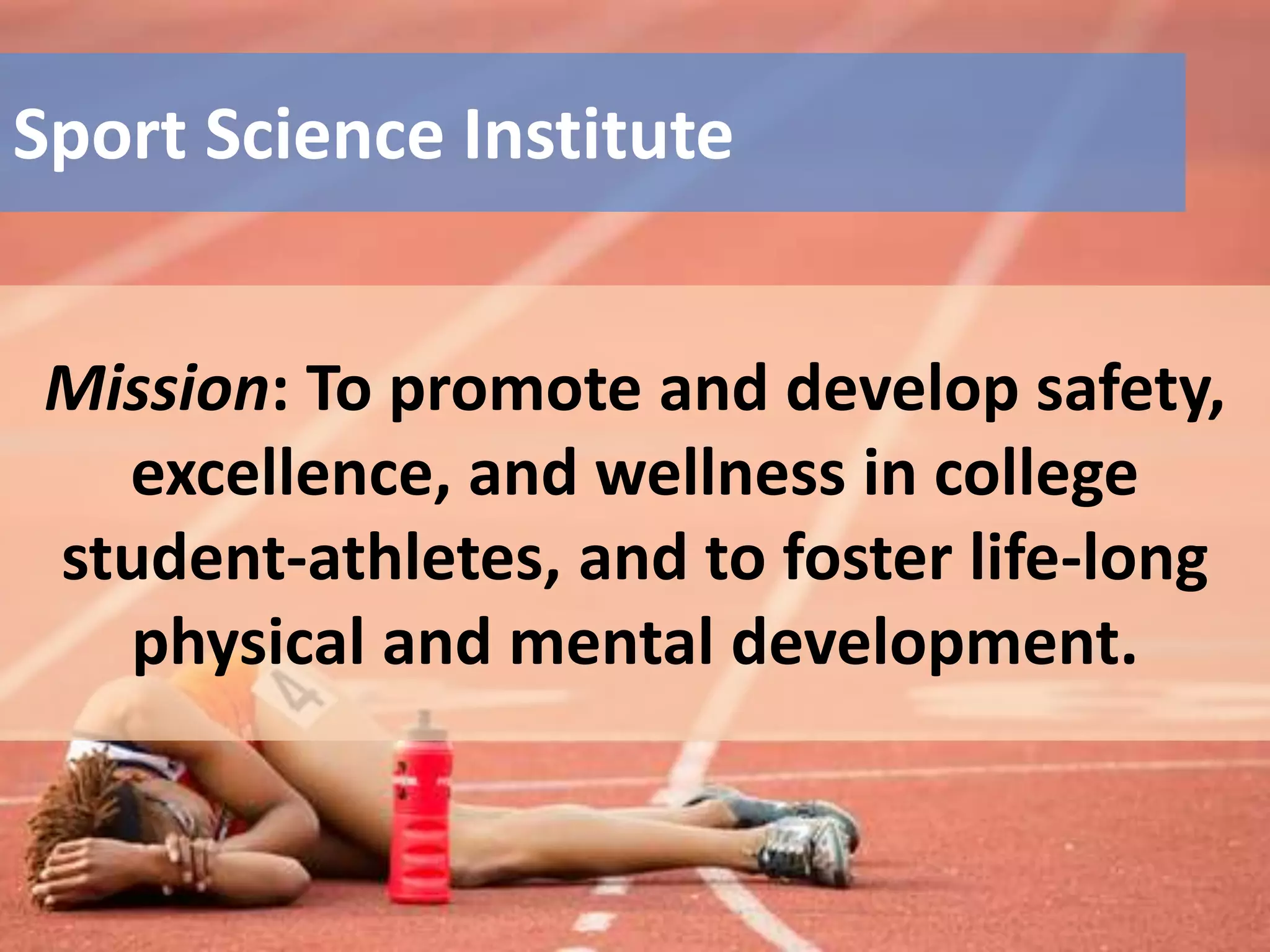
Mission: To promote and develop safety,
excellence, and wellness in college
student-athletes, and to foster life-long
physical and mental development.
Sport Science Institute
Vision: To be the pre-eminent sport
science voice for all student-athletes and
NCAA member institutions, and to be the
steward of best practices for youth and
intercollegiate sports.
Strategic Agenda
• Phase I:
– Trust.
– Identify Knowledge Gaps.
• Phase II:
– Education.
– “Eptitude.”
• Phase III:
– The NCAA is recognized as the leading Public Health
authority in the sports world.
Knowledge Gaps
Concussion.
Mental health.
Cardiac health.
Overuse & early specialization.
Doping & recreational drug use.
Data analytics & informatics.
Sexual Assault and Interpersonal Violence
Nutrition and Performance
CONCUSSION
Concussion
• Of the 43 working definitions of concussion, 1
is evidence-based and none localize brain
dysfunction.
• We do not understand the natural history of
concussion.
• We do not understand neurobiological
recovery in concussion.
43rd Working Definition of Concussion
Concussion is:
• a change in brain function,
• following a force to the head, which
• may be accompanied by temporary loss of
consciousness, but is
• identified in awake individuals, with
• measures of neurologic and cognitive dysfunction.
NCAA and DoD Joint Endeavor
• >97% of military TBIs are concussions.
• 85% of military concussions are biomechanically similar to
sport-related concussion.
– 15% are from blast injuries.
• College s-a and military service are similar in age,
athleticism, risk taking and pushing to the edge of
excellence.
• The military theatre is poorly controlled; college sports are
a much more controlled environment.
• Numerous meetings, evaluations, culminating in NCAA-DoD
MOU and CRADA and White House announcement.
Negotiate 8 contracts and
22 sub-contracts
Submit 24 IRB and HRPO
applications
Convene 2 investigator
meetings
Develop CSC, ARC,
and AOC protocols
and conduct training
Develop SOPs
Launch Website
(www.careconsortium.net)
Build CARE Electronic
Data Capture System
and Direct Entry Portal
13,241 baseline evaluations completed
among athletes/Service Academy
cadets; Collected 176+ specimens;
Injury data on 310 concussions
Award
received
Sept 2014
September
2015
Clinical Study Aims
Clinical Study Core (CSC)
• To conduct a prospective, longitudinal, multi-center, multi-sport
investigation that delineates the natural history of concussion in
both men and women by incorporating a multi-dimensional
assessment of standardized clinical measures of post-concussive
symptomatology, performance-based testing (cognitive function,
postural stability), and psychological health.
Advanced Research Core (ARC)
• Utilize the framework of the CSC to conduct advanced scientific
studies which integrate biomechanical, clinical, neuroimaging,
neurobiological and genetic markers of injury to advance our
understanding of neurophysiological effects and recovery after
sport-related concussion in college student-athletes.
Assessment Categories
Assessment Measures: ARC
• Head Impact Sensors
– Head Impact Telemetry (HIT) System
and X-Patch
• Neuroimaging Studies (3T MRI)
– T1 SPGR anatomical images.
– T2 FLAIR for general pathological
detection.
– Diffusion weighted MRI (DTI and DKI)
for microscopic white and gray
matter injury.
– SWI to identify microhemorrhage.
– Pseudo-continuous arterial spin
labeling (pCASL) for cerebral blood
flow.
• Genotyping
– APOE, GDNF, COMT, etc
Blood Biomarker Studies
• Acute Biomarkers
– UCH-L1 (ubiquitin C-terminal hydrolase L1;
neuronal protein).
– GFAP (glial fibrillary acid protein; astrocytic
protein).
– SBDP150 (calpain cleaved fragment of
alpha II-spectrin breakdown product 150;
a neural cell cytoskeleton structural
protein).
– S100B (S100 calcium binding protein B;
astrocytic protein).
– Micro RNA
• Chronic Biomarkers
– MAP-2 (microtubule associated protein-2;
marker of axonal damage).
• CNPase (2,3-cyclic-nucleotide 3-
phosphodiesterase; marker of
oligodendrocytes).
• Micro RNA
Executive Committee
Hainline (NCAA), Hack & Rauch (DoD), Koroshetz (NIH)
Administrative
Coordinating Center:
Indiana U School of Medicine
McAllister (coPI)
Advanced Research
Coordinating Center:
Medical College of Wisconsin
McCrea (coPI)
Longitudinal Clinical Study
Coordinating Center:
U of Michigan
Broglio (coPI)
Longitudinal Clinical Study
Core (CSC)
Advanced Research Core
(ARC)
U Nebraska
(BIG10)
Molfese
U Michigan
(BIG10)
Eckner
Washington
(PAC12)
Chrisman
U North Carolina
(ACC)
Guskiewicz &
Mihalik
U Pittsburgh
(ACC)
Kontos & Collins
U Georgia
(SEC)
Schmidt
U Florida
(SEC)
Clugston
U Oklahoma
(BIG12)
Anderson
UCLA
(PAC12)
Giza & DiFiori
Consortium Operating Committee
Anderson, Broglio (co-Chair), Clugston, Duma, Giza, Guskiewicz,
McAllister (co-Chair), McCrea (co-Chair), McGinty, Molfese, Putukian
Senior Scientific
Advisory Panel
Iverson, Jordan, Kelly, Marshall,
Saykin, Smith, Talavage, Wallace, Xu
U Wisconsin
(BIG10)
Brooks
Princeton
(Ivy)
Putukian
Concussion Research Initiative
US Military
Academy
(Independent)
Svoboda & Kelly
US Air Force
Academy
(Mountain West)
McGinty & Campbell
US Coast Guard
Academy
(New England)
Doria
US Naval Academy
(Independent)
Pyne & Tsao
Virginia Tech
(ACC)
Duma & Rowson
U Delaware
(Colonial)
Buckley & Kaminski
Humboldt State
(California
Collegiate)
Ortega
Azusa Pacific
(Pacific West)
Hoy
U Rochester
(University)
Bazarian
Cal Lutheran
(Southern
California)
Davis
TBD
Year 3
TBD
Year 3
TBD
Year 3
TBD
Year 3
TBD
Year 3
TBD
Year 3
TBD
Year 3
TBD
Year 3
TBD
Year 3
CSC & ARC Assessment Protocol
Pre-
Season
Acute Concussion
Sub-Acute Concussion Post-
Concussion
Baseline
<6hrs
Post-
Injury
24-48hrs
Post-
Injury
Asymptomatic
/ Cleared for
Return to Play
Progression
Unrestricted
Return to
Play
7 days
following
Return to
Play
6 Months
Post-Injury
Neurocognitive
and Behavioral
Testing (CSC)
X X X X X X X
Blood Biomarker
& DNA Collection
X X X X X X
Multi-modal MRI
Studies
O X X X X
Head Impact Measurement: HITS (FB) and non-helmeted sensors (FB, SCR, LAX, IH)
Neurobiological
Pre-Injury
Factors
- Genetics
- Neurologic
Vulnerabilities
Trauma
Burden
- Injury Severity
- Repetitive
Exposure
- Polytrauma
Biomarkers
- Structural/
Functional
Imaging
- Blood
Biomarkers
Psychosocial
Psychological
Function
- Premorbid
- Post-injury
Comorbidities
Environmental
Factors
- Social Support
- Life Stressors
- Iatrogenesis
Motivational
Factors
- Expectation
- Secondary
Gain
Multi-Domain Predictor Variables
Neurobiopsychosocial Model
Neurocognitive
Function
Neurobehavioral
Function
Psychological
Health and
Wellness
Life Function &
Quality
Neurologic
Health
Multi-Dimensional Outcome
McCrea, McAllister & Morey, 2012
Advancing the Science of SRC and TBI
Current Status (Sept 11, 2015)
• 13,241 baseline evaluations completed.
– 12,004 unique subjects, 1237 in 2nd year.
• 310 concussions captured.
• All West Point/Air Force cadets registered.
• Developmental stage of youth concussion registry and
rollout of study to youth.
• Developmental stage to extend study to 50+ years (to
become the Framingham study of concussion).
Concussion: The Kindling Effect
Helmets: The Warrior Effect
NCAA-DoD Mind Matters
Educational Grand Challenge
Executive Committee
Leadership from NCAA (Hainline), DoD (Hack & Rauch), NIH (Koroshetz)
Educational Grand Challenge
Consortium
(Operating Committee)
NCAA: Amy Dunham, Latrice Sales, Dana Thomas
DoD: Tara Cozzarelli, Stephanie Maxfield-Parker, Kathleen Quinkert
CDC: Kelly Sarmiento
Nine Sigma: Amy Jo Beighley, Denys Resnick, Eloise Young
Immediate Impact Challenge Long-Term Impact Challenge
Mind Matters Challenge
Goal: To change important concussion safety behaviors and
the culture of concussion reporting and management by
funding research to better understand behavior change
strategies and by identifying novel educational approaches.
• Aim 1 (Immediate Impact Challenge)
– Develop a multi-media educational program based on the best
evidence currently available about how to change culture in
young and emerging adults.
• Aim 2 (Long-term Impact Challenge)
– Identify key factors and ways to affect change in the culture and
behavior of young and emerging adults and their influencers
around concussion.
Inter-Association Guidelines
Independent medical care
Year-round practice contact
Concussion diagnosis & management
www.ncaa.org/concussionsafety
Guidelines Endorsements
• American Academy of Neurology
• American College of Sports Medicine
• American Association of Neurological
Surgeons
• American Medical Society for Sports
Medicine
• American Orthopaedic Society for
Sports Medicine
• American Osteopathic Academy for
Sports Medicine
• College Athletic Trainers’ Society
• Congress of Neurological Surgeons
• National Athletic Trainers’ Association
• NCAA Concussion Task Force
• Sports Neuropsychological Society
• American Football Coaches
Association
• Football Championship Subdivision
Executive Committee
• National Association of Collegiate
Directors of Athletics
• National Football Foundation
Concussion Diagnosis and Management
• Education.
• Pre-participation assessment: one-time:
– Brain injury/concussion history.
– Symptom evaluation.
– Cognitive assessment.
– Balance evaluation.
– Team physician determines pre-participation clearance.
• Recognition and diagnosis.
• Post-concussion management.
• Return to activity:
– Return-to-play.
– Return-to-learn.
Football Rules
• “Football is an aggressive, rugged contact sport.”
• “There is no place for unfair tactics,
unsportsmanlike conduct or maneuvers
deliberately designed to inflict injury.”
• “To gain an advantage by circumvention or
disregard for the rules brands a coach or player as
unfit to be associated with football.”
5
1
5 6
8
2 1 1 1 1 1 2 1
7
8
17
30
18
7
0 3 2
3
1
4 4
6 7 6
6
5
2
4 2
2 5
2
4 3
10
10
20
30
40
1950
1960
1965
1968
1970
1980
1990
1991
1992
1993
1994
1995
1996
1997
1998
1999
2000
2001
2002
2003
2004
2005
2006
2007
2008
2009
2010
2011
2012
Brain
Neck
YEAR
NUMBEROFINJURIES
FOOTBALL FATALITIES (All Levels)
BRAIN AND NECK INJURIES
YEAR
Numbers in the bars represent the number of injuries. If the color is
not present, there were not injuries of that type in the given year.
National Center for Catastrophic Sport Injury Research
Rules of Sport
• Football Kickoff:
– 300% increase in touchbacks.
– ~50% decrease in concussion relative to other
injuries.
• Targeting
– Qualitative change in tackling and blocking.
• Cross-functional work with all sports.
The Societal Dialogue
• Why play sport?
• What is the risk/benefit ratio of sport?
• Are all sports a model of wellness for life?
Thank you.
SPORT CONCUSSION
SUMMIT
September 24, 2015#uminjuryctr

Navigating the Concussion Frontier by Brian Hainline

  • 1.
    NAVIGATING THE CONCUSSIONFRONTIER Brian Hainline, MD NCAA Chief Medical Officer Clinical Professor of Neurology Indiana University School of Medicine New York University School of Medicine
  • 2.
    Sport Science Institute Mission:To promote and develop safety, excellence, and wellness in college student-athletes, and to foster life-long physical and mental development.
  • 3.
    Sport Science Institute Vision:To be the pre-eminent sport science voice for all student-athletes and NCAA member institutions, and to be the steward of best practices for youth and intercollegiate sports.
  • 4.
    Strategic Agenda • PhaseI: – Trust. – Identify Knowledge Gaps. • Phase II: – Education. – “Eptitude.” • Phase III: – The NCAA is recognized as the leading Public Health authority in the sports world.
  • 5.
    Knowledge Gaps Concussion. Mental health. Cardiachealth. Overuse & early specialization. Doping & recreational drug use. Data analytics & informatics. Sexual Assault and Interpersonal Violence Nutrition and Performance
  • 6.
  • 7.
    Concussion • Of the43 working definitions of concussion, 1 is evidence-based and none localize brain dysfunction. • We do not understand the natural history of concussion. • We do not understand neurobiological recovery in concussion.
  • 8.
    43rd Working Definitionof Concussion Concussion is: • a change in brain function, • following a force to the head, which • may be accompanied by temporary loss of consciousness, but is • identified in awake individuals, with • measures of neurologic and cognitive dysfunction.
  • 9.
    NCAA and DoDJoint Endeavor • >97% of military TBIs are concussions. • 85% of military concussions are biomechanically similar to sport-related concussion. – 15% are from blast injuries. • College s-a and military service are similar in age, athleticism, risk taking and pushing to the edge of excellence. • The military theatre is poorly controlled; college sports are a much more controlled environment. • Numerous meetings, evaluations, culminating in NCAA-DoD MOU and CRADA and White House announcement.
  • 10.
    Negotiate 8 contractsand 22 sub-contracts Submit 24 IRB and HRPO applications Convene 2 investigator meetings Develop CSC, ARC, and AOC protocols and conduct training Develop SOPs Launch Website (www.careconsortium.net) Build CARE Electronic Data Capture System and Direct Entry Portal 13,241 baseline evaluations completed among athletes/Service Academy cadets; Collected 176+ specimens; Injury data on 310 concussions Award received Sept 2014 September 2015
  • 11.
    Clinical Study Aims ClinicalStudy Core (CSC) • To conduct a prospective, longitudinal, multi-center, multi-sport investigation that delineates the natural history of concussion in both men and women by incorporating a multi-dimensional assessment of standardized clinical measures of post-concussive symptomatology, performance-based testing (cognitive function, postural stability), and psychological health. Advanced Research Core (ARC) • Utilize the framework of the CSC to conduct advanced scientific studies which integrate biomechanical, clinical, neuroimaging, neurobiological and genetic markers of injury to advance our understanding of neurophysiological effects and recovery after sport-related concussion in college student-athletes.
  • 12.
  • 13.
    Assessment Measures: ARC •Head Impact Sensors – Head Impact Telemetry (HIT) System and X-Patch • Neuroimaging Studies (3T MRI) – T1 SPGR anatomical images. – T2 FLAIR for general pathological detection. – Diffusion weighted MRI (DTI and DKI) for microscopic white and gray matter injury. – SWI to identify microhemorrhage. – Pseudo-continuous arterial spin labeling (pCASL) for cerebral blood flow. • Genotyping – APOE, GDNF, COMT, etc Blood Biomarker Studies • Acute Biomarkers – UCH-L1 (ubiquitin C-terminal hydrolase L1; neuronal protein). – GFAP (glial fibrillary acid protein; astrocytic protein). – SBDP150 (calpain cleaved fragment of alpha II-spectrin breakdown product 150; a neural cell cytoskeleton structural protein). – S100B (S100 calcium binding protein B; astrocytic protein). – Micro RNA • Chronic Biomarkers – MAP-2 (microtubule associated protein-2; marker of axonal damage). • CNPase (2,3-cyclic-nucleotide 3- phosphodiesterase; marker of oligodendrocytes). • Micro RNA
  • 14.
    Executive Committee Hainline (NCAA),Hack & Rauch (DoD), Koroshetz (NIH) Administrative Coordinating Center: Indiana U School of Medicine McAllister (coPI) Advanced Research Coordinating Center: Medical College of Wisconsin McCrea (coPI) Longitudinal Clinical Study Coordinating Center: U of Michigan Broglio (coPI) Longitudinal Clinical Study Core (CSC) Advanced Research Core (ARC) U Nebraska (BIG10) Molfese U Michigan (BIG10) Eckner Washington (PAC12) Chrisman U North Carolina (ACC) Guskiewicz & Mihalik U Pittsburgh (ACC) Kontos & Collins U Georgia (SEC) Schmidt U Florida (SEC) Clugston U Oklahoma (BIG12) Anderson UCLA (PAC12) Giza & DiFiori Consortium Operating Committee Anderson, Broglio (co-Chair), Clugston, Duma, Giza, Guskiewicz, McAllister (co-Chair), McCrea (co-Chair), McGinty, Molfese, Putukian Senior Scientific Advisory Panel Iverson, Jordan, Kelly, Marshall, Saykin, Smith, Talavage, Wallace, Xu U Wisconsin (BIG10) Brooks Princeton (Ivy) Putukian Concussion Research Initiative US Military Academy (Independent) Svoboda & Kelly US Air Force Academy (Mountain West) McGinty & Campbell US Coast Guard Academy (New England) Doria US Naval Academy (Independent) Pyne & Tsao Virginia Tech (ACC) Duma & Rowson U Delaware (Colonial) Buckley & Kaminski Humboldt State (California Collegiate) Ortega Azusa Pacific (Pacific West) Hoy U Rochester (University) Bazarian Cal Lutheran (Southern California) Davis TBD Year 3 TBD Year 3 TBD Year 3 TBD Year 3 TBD Year 3 TBD Year 3 TBD Year 3 TBD Year 3 TBD Year 3
  • 15.
    CSC & ARCAssessment Protocol Pre- Season Acute Concussion Sub-Acute Concussion Post- Concussion Baseline <6hrs Post- Injury 24-48hrs Post- Injury Asymptomatic / Cleared for Return to Play Progression Unrestricted Return to Play 7 days following Return to Play 6 Months Post-Injury Neurocognitive and Behavioral Testing (CSC) X X X X X X X Blood Biomarker & DNA Collection X X X X X X Multi-modal MRI Studies O X X X X Head Impact Measurement: HITS (FB) and non-helmeted sensors (FB, SCR, LAX, IH)
  • 16.
    Neurobiological Pre-Injury Factors - Genetics - Neurologic Vulnerabilities Trauma Burden -Injury Severity - Repetitive Exposure - Polytrauma Biomarkers - Structural/ Functional Imaging - Blood Biomarkers Psychosocial Psychological Function - Premorbid - Post-injury Comorbidities Environmental Factors - Social Support - Life Stressors - Iatrogenesis Motivational Factors - Expectation - Secondary Gain Multi-Domain Predictor Variables Neurobiopsychosocial Model Neurocognitive Function Neurobehavioral Function Psychological Health and Wellness Life Function & Quality Neurologic Health Multi-Dimensional Outcome McCrea, McAllister & Morey, 2012 Advancing the Science of SRC and TBI
  • 17.
    Current Status (Sept11, 2015) • 13,241 baseline evaluations completed. – 12,004 unique subjects, 1237 in 2nd year. • 310 concussions captured. • All West Point/Air Force cadets registered. • Developmental stage of youth concussion registry and rollout of study to youth. • Developmental stage to extend study to 50+ years (to become the Framingham study of concussion).
  • 18.
  • 19.
  • 20.
    NCAA-DoD Mind Matters EducationalGrand Challenge Executive Committee Leadership from NCAA (Hainline), DoD (Hack & Rauch), NIH (Koroshetz) Educational Grand Challenge Consortium (Operating Committee) NCAA: Amy Dunham, Latrice Sales, Dana Thomas DoD: Tara Cozzarelli, Stephanie Maxfield-Parker, Kathleen Quinkert CDC: Kelly Sarmiento Nine Sigma: Amy Jo Beighley, Denys Resnick, Eloise Young Immediate Impact Challenge Long-Term Impact Challenge
  • 21.
    Mind Matters Challenge Goal:To change important concussion safety behaviors and the culture of concussion reporting and management by funding research to better understand behavior change strategies and by identifying novel educational approaches. • Aim 1 (Immediate Impact Challenge) – Develop a multi-media educational program based on the best evidence currently available about how to change culture in young and emerging adults. • Aim 2 (Long-term Impact Challenge) – Identify key factors and ways to affect change in the culture and behavior of young and emerging adults and their influencers around concussion.
  • 23.
    Inter-Association Guidelines Independent medicalcare Year-round practice contact Concussion diagnosis & management www.ncaa.org/concussionsafety
  • 24.
    Guidelines Endorsements • AmericanAcademy of Neurology • American College of Sports Medicine • American Association of Neurological Surgeons • American Medical Society for Sports Medicine • American Orthopaedic Society for Sports Medicine • American Osteopathic Academy for Sports Medicine • College Athletic Trainers’ Society • Congress of Neurological Surgeons • National Athletic Trainers’ Association • NCAA Concussion Task Force • Sports Neuropsychological Society • American Football Coaches Association • Football Championship Subdivision Executive Committee • National Association of Collegiate Directors of Athletics • National Football Foundation
  • 25.
    Concussion Diagnosis andManagement • Education. • Pre-participation assessment: one-time: – Brain injury/concussion history. – Symptom evaluation. – Cognitive assessment. – Balance evaluation. – Team physician determines pre-participation clearance. • Recognition and diagnosis. • Post-concussion management. • Return to activity: – Return-to-play. – Return-to-learn.
  • 26.
    Football Rules • “Footballis an aggressive, rugged contact sport.” • “There is no place for unfair tactics, unsportsmanlike conduct or maneuvers deliberately designed to inflict injury.” • “To gain an advantage by circumvention or disregard for the rules brands a coach or player as unfit to be associated with football.”
  • 27.
    5 1 5 6 8 2 11 1 1 1 2 1 7 8 17 30 18 7 0 3 2 3 1 4 4 6 7 6 6 5 2 4 2 2 5 2 4 3 10 10 20 30 40 1950 1960 1965 1968 1970 1980 1990 1991 1992 1993 1994 1995 1996 1997 1998 1999 2000 2001 2002 2003 2004 2005 2006 2007 2008 2009 2010 2011 2012 Brain Neck YEAR NUMBEROFINJURIES FOOTBALL FATALITIES (All Levels) BRAIN AND NECK INJURIES YEAR Numbers in the bars represent the number of injuries. If the color is not present, there were not injuries of that type in the given year. National Center for Catastrophic Sport Injury Research
  • 28.
    Rules of Sport •Football Kickoff: – 300% increase in touchbacks. – ~50% decrease in concussion relative to other injuries. • Targeting – Qualitative change in tackling and blocking. • Cross-functional work with all sports.
  • 29.
    The Societal Dialogue •Why play sport? • What is the risk/benefit ratio of sport? • Are all sports a model of wellness for life?
  • 30.
  • 31.

Editor's Notes

  • #6 CSMAS identified us as collaborator
  • #24 CSMAS identified us as collaborator