Need of Project Objectives Methodology CHT Case in OpenFOAM Server Case Preprocessing Results Conclusion Future Sco
Conjugate Heat Transfer for Electronic Cooling
using OpenFOAM
Avinash Valiba Gorde(CMS-1310)
Internal Guide
Dr. Sukratu Barve
Dr. Mihir Arjunwadkar
Centre for Modelling and Simulation
External Guide
Dr. Vikas Kumar
Mr. Mohan Labade
Centre for Development of Advanced Computing Pune,INDIA
June 20, 2015
Need of Project Objectives Methodology CHT Case in OpenFOAM Server Case Preprocessing Results Conclusion Future Sco
Outline
1 Need of Project
2 Objectives
3 Methodology
4 CHT Case in OpenFOAM
5 Server Case
6 Preprocessing
7 Results
8 Conclusion
9 Future Scope
10 References
Need of Project Objectives Methodology CHT Case in OpenFOAM Server Case Preprocessing Results Conclusion Future Sco
Need of Project
Considering following aspect,
A very limited conjugate heat transfer case studies have been
analyzed using OpenFOAM.
Need of Project Objectives Methodology CHT Case in OpenFOAM Server Case Preprocessing Results Conclusion Future Sco
Objectives
To develop a CFD model for conjugate heat transfer analysis
of an electronics cooling system
Validation of CFD model with experimental results
Need of Project Objectives Methodology CHT Case in OpenFOAM Server Case Preprocessing Results Conclusion Future Sco
Methodology
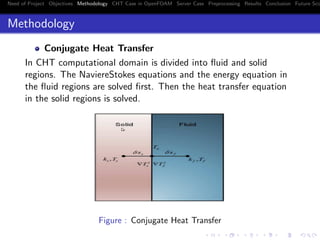
Conjugate Heat Transfer
In CHT computational domain is divided into fluid and solid
regions. The NaviereStokes equations and the energy equation in
the fluid regions are solved first. Then the heat transfer equation
in the solid regions is solved.
Figure : Conjugate Heat Transfer
Need of Project Objectives Methodology CHT Case in OpenFOAM Server Case Preprocessing Results Conclusion Future Sco
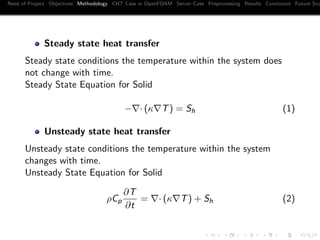
Steady state heat transfer
Steady state conditions the temperature within the system does
not change with time.
Steady State Equation for Solid
− · (κ T) = Sh (1)
Unsteady state heat transfer
Unsteady state conditions the temperature within the system
changes with time.
Unsteady State Equation for Solid
ρCp
∂T
∂t
= · (κ T) + Sh (2)
Need of Project Objectives Methodology CHT Case in OpenFOAM Server Case Preprocessing Results Conclusion Future Sco
Solver
chtMutiRegionSimpleFoam Solver
It is steady state solver for conjugate heat transfer. It is
combination of heatConductionFoam and buoyantFoam for
conjugate heat transfer
Governing Equation Used by OpenFoam
chtMultiregionSimpleFoam Solver
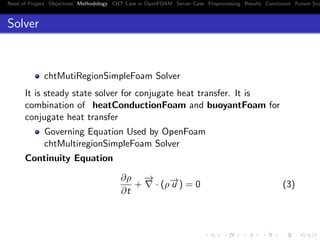
Continuity Equation
∂ρ
∂t
+
−→
· (ρ−→u ) = 0 (3)
Need of Project Objectives Methodology CHT Case in OpenFOAM Server Case Preprocessing Results Conclusion Future Sco
Momentum Equation
The sum of all forces acting on a body is equal to the rate of
change of momentum of it
1) Body forces = gravitational, centrifugal
2)Surface forces acting on the surface of the body e.g. pressure or
viscous forces
∂ (ρu)
∂t
+ · (ρuu) = − p + · τ − ρg (4)
Energy Equation
∂(ρE)
∂t
+ · (ρuE) = · (α e) − · [u (p − ρgr)] + Sh (5)
α =
µCp
κ is the thermal diffusivity.
Sh is the thermal source term.
e is the specific internal energy.
E is the specific total energy of the gas defined as:
E = e + u2
2
Need of Project Objectives Methodology CHT Case in OpenFOAM Server Case Preprocessing Results Conclusion Future Sco
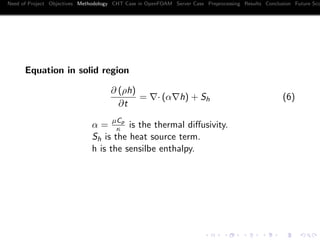
Equation in solid region
∂ (ρh)
∂t
= · (α h) + Sh (6)
α =
µCp
κ is the thermal diffusivity.
Sh is the heat source term.
h is the sensilbe enthalpy.
Need of Project Objectives Methodology CHT Case in OpenFOAM Server Case Preprocessing Results Conclusion Future Sco
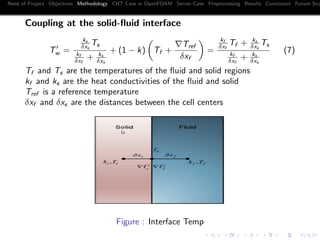
Coupling at the solid-fluid interface
Tw =
ks
δxs
Ts
kf
δxf
+ ks
δxs
+ (1 − k) Tf +
Tref
δxf
=
kf
δxf
Tf + ks
δxs
Ts
kf
δxf
+ ks
δxs
(7)
Tf and Ts are the temperatures of the fluid and solid regions
kf and ks are the heat conductivities of the fluid and solid
Tref is a reference temperature
δxf and δxs are the distances between the cell centers
Figure : Interface Temp
Need of Project Objectives Methodology CHT Case in OpenFOAM Server Case Preprocessing Results Conclusion Future Sco
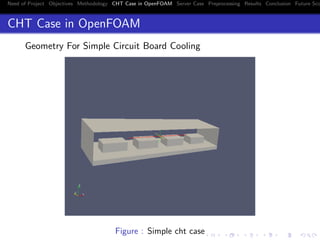
CHT Case in OpenFOAM
Geometry For Simple Circuit Board Cooling
Figure : Simple cht case
Need of Project Objectives Methodology CHT Case in OpenFOAM Server Case Preprocessing Results Conclusion Future Sco
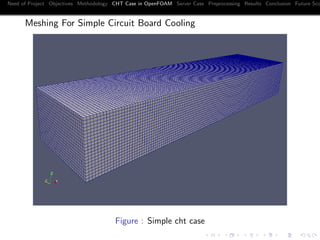
Meshing For Simple Circuit Board Cooling
Figure : Simple cht case
Need of Project Objectives Methodology CHT Case in OpenFOAM Server Case Preprocessing Results Conclusion Future Sco
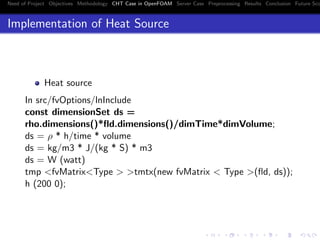
Implementation of Heat Source
Heat source
In src/fvOptions/lnInclude
const dimensionSet ds =
rho.dimensions()*fld.dimensions()/dimTime*dimVolume;
ds = ρ * h/time * volume
ds = kg/m3 * J/(kg * S) * m3
ds = W (watt)
tmp <fvMatrix<Type > >tmtx(new fvMatrix < Type >(fld, ds));
h (200 0);
Need of Project Objectives Methodology CHT Case in OpenFOAM Server Case Preprocessing Results Conclusion Future Sco
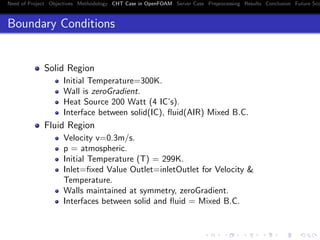
Boundary Conditions
Solid Region
Initial Temperature=300K.
Wall is zeroGradient.
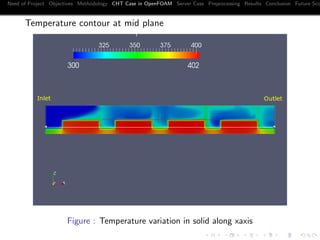
Heat Source 200 Watt (4 IC’s).
Interface between solid(IC), fluid(AIR) Mixed B.C.
Fluid Region
Velocity v=0.3m/s.
p = atmospheric.
Initial Temperature (T) = 299K.
Inlet=fixed Value Outlet=inletOutlet for Velocity &
Temperature.
Walls maintained at symmetry, zeroGradient.
Interfaces between solid and fluid = Mixed B.C.
Need of Project Objectives Methodology CHT Case in OpenFOAM Server Case Preprocessing Results Conclusion Future Sco
Temperature contour at mid plane
Figure : Temperature variation in solid along xaxis
Need of Project Objectives Methodology CHT Case in OpenFOAM Server Case Preprocessing Results Conclusion Future Sco
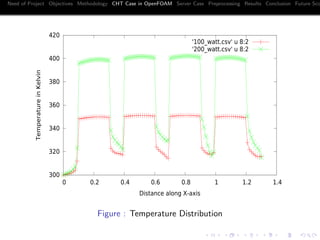
300
320
340
360
380
400
420
0 0.2 0.4 0.6 0.8 1 1.2 1.4
TemperatureinKelvin
Distance along X-axis
'100_watt.csv' u 8:2
'200_watt.csv' u 8:2
Figure : Temperature Distribution
Need of Project Objectives Methodology CHT Case in OpenFOAM Server Case Preprocessing Results Conclusion Future Sco
Server Case
Need of Project Objectives Methodology CHT Case in OpenFOAM Server Case Preprocessing Results Conclusion Future Sco
Server Case
Geometry of Server
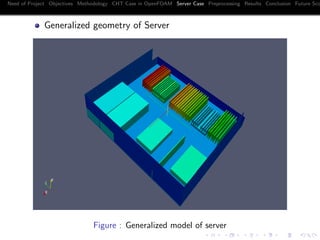
This is Intel Server Board S2600GZ/GL having 2 SOCKETS, 24
RAMS, PCB, 2SMPS
Need of Project Objectives Methodology CHT Case in OpenFOAM Server Case Preprocessing Results Conclusion Future Sco
Generalized geometry of Server
Figure : Generalized model of server
Need of Project Objectives Methodology CHT Case in OpenFOAM Server Case Preprocessing Results Conclusion Future Sco
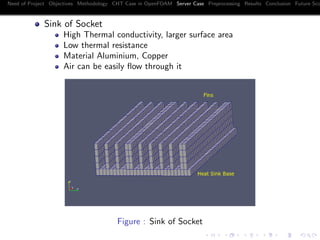
Sink of Socket
High Thermal conductivity, larger surface area
Low thermal resistance
Material Aluminium, Copper
Air can be easily flow through it
Figure : Sink of Socket
Need of Project Objectives Methodology CHT Case in OpenFOAM Server Case Preprocessing Results Conclusion Future Sco
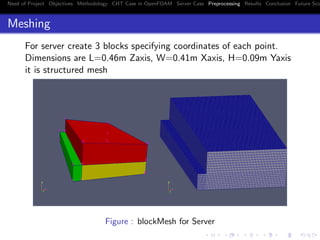
Meshing
For server create 3 blocks specifying coordinates of each point.
Dimensions are L=0.46m Zaxis, W=0.41m Xaxis, H=0.09m Yaxis
it is structured mesh
Figure : blockMesh for Server
Need of Project Objectives Methodology CHT Case in OpenFOAM Server Case Preprocessing Results Conclusion Future Sco
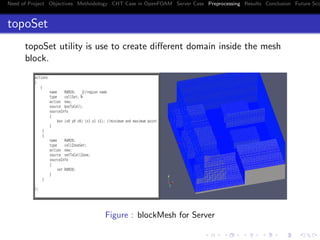
topoSet
topoSet utility is use to create different domain inside the mesh
block.
Figure : blockMesh for Server
Need of Project Objectives Methodology CHT Case in OpenFOAM Server Case Preprocessing Results Conclusion Future Sco
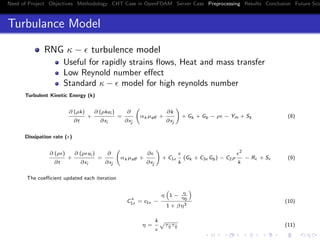
Turbulance Model
RNG κ − turbulence model
Useful for rapidly strains flows, Heat and mass transfer
Low Reynold number effect
Standard κ − model for high reynolds number
Turbulent Kinetic Energy (k)
∂ (ρk)
∂t
+
∂ (ρkui )
∂xi
=
∂
∂xj
αk µeff +
∂k
∂xj
+ Gk + Gb − ρ − Ym + Sk (8)
Dissipation rate ( )
∂ (ρ )
∂t
+
∂ (ρ ui )
∂xi
=
∂
∂xj
αk µeff +
∂
∂xj
+ C1
k
(Gk + C3 Gb) − C2ρ
2
k
− R + S (9)
The coefficient updated each iteration
C
∗
1 = c1 −
η 1 − η
η0
1 + βη3
(10)
η =
k
τij τij (11)
Need of Project Objectives Methodology CHT Case in OpenFOAM Server Case Preprocessing Results Conclusion Future Sco
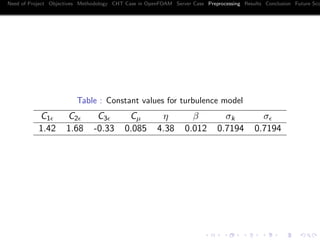
Table : Constant values for turbulence model
C1 C2 C3 Cµ η β σk σ
1.42 1.68 -0.33 0.085 4.38 0.012 0.7194 0.7194
Need of Project Objectives Methodology CHT Case in OpenFOAM Server Case Preprocessing Results Conclusion Future Sco
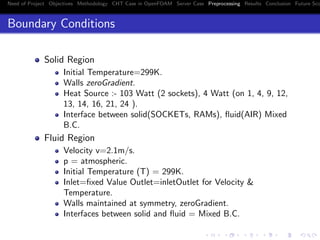
Boundary Conditions
Solid Region
Initial Temperature=299K.
Walls zeroGradient.
Heat Source :- 103 Watt (2 sockets), 4 Watt (on 1, 4, 9, 12,
13, 14, 16, 21, 24 ).
Interface between solid(SOCKETs, RAMs), fluid(AIR) Mixed
B.C.
Fluid Region
Velocity v=2.1m/s.
p = atmospheric.
Initial Temperature (T) = 299K.
Inlet=fixed Value Outlet=inletOutlet for Velocity &
Temperature.
Walls maintained at symmetry, zeroGradient.
Interfaces between solid and fluid = Mixed B.C.
Need of Project Objectives Methodology CHT Case in OpenFOAM Server Case Preprocessing Results Conclusion Future Sco
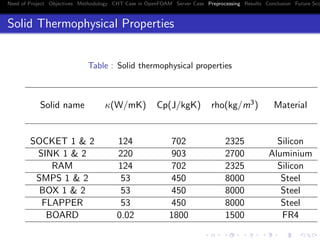
Solid Thermophysical Properties
Table : Solid thermophysical properties
Solid name κ(W/mK) Cp(J/kgK) rho(kg/m3) Material
SOCKET 1 & 2 124 702 2325 Silicon
SINK 1 & 2 220 903 2700 Aluminium
RAM 124 702 2325 Silicon
SMPS 1 & 2 53 450 8000 Steel
BOX 1 & 2 53 450 8000 Steel
FLAPPER 53 450 8000 Steel
BOARD 0.02 1800 1500 FR4
Need of Project Objectives Methodology CHT Case in OpenFOAM Server Case Preprocessing Results Conclusion Future Sco
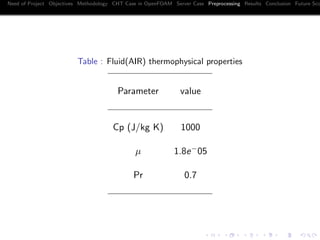
Table : Fluid(AIR) thermophysical properties
Parameter value
Cp (J/kg K) 1000
µ 1.8e−05
Pr 0.7
Need of Project Objectives Methodology CHT Case in OpenFOAM Server Case Preprocessing Results Conclusion Future Sco
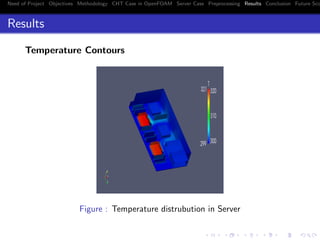
Results
Temperature Contours
Figure : Temperature distrubution in Server
Need of Project Objectives Methodology CHT Case in OpenFOAM Server Case Preprocessing Results Conclusion Future Sco
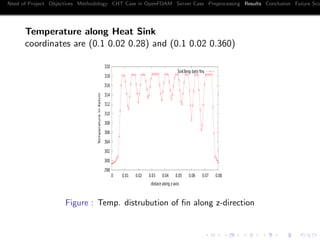
Temperature along Heat Sink
coordinates are (0.1 0.02 0.28) and (0.1 0.02 0.360)
298
300
302
304
306
308
310
312
314
316
318
320
0 0.01 0.02 0.03 0.04 0.05 0.06 0.07 0.08
TemperatureinKelvin
distace along z-axis
SinkTemp betn fins
Figure : Temp. distrubution of fin along z-direction
Need of Project Objectives Methodology CHT Case in OpenFOAM Server Case Preprocessing Results Conclusion Future Sco
Temperature between fin passage
coordinates are (0.06 0.02 0.332) & (0.19 0.02 0.0332)
298
300
302
304
306
308
310
312
314
316
0 0.02 0.04 0.06 0.08 0.1 0.12 0.14 0.16 0.18 0.2
Temp.inKelvin
distace along x-axis
HeatsinkTemp
Figure : Temp. distrubution of fin along x-direction
Need of Project Objectives Methodology CHT Case in OpenFOAM Server Case Preprocessing Results Conclusion Future Sco
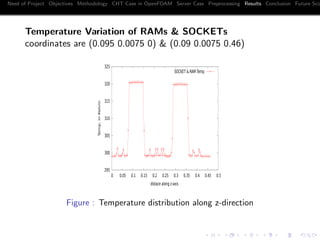
Temperature Variation of RAMs & SOCKETs
coordinates are (0.095 0.0075 0) & (0.09 0.0075 0.46)
295
300
305
310
315
320
325
0 0.05 0.1 0.15 0.2 0.25 0.3 0.35 0.4 0.45 0.5
Temp.inKelvin
distace along z-axis
SOCKET & RAM Temp
Figure : Temperature distribution along z-direction
Need of Project Objectives Methodology CHT Case in OpenFOAM Server Case Preprocessing Results Conclusion Future Sco
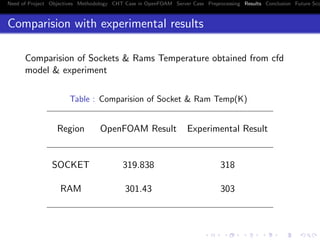
Comparision with experimental results
Comparision of Sockets & Rams Temperature obtained from cfd
model & experiment
Table : Comparision of Socket & Ram Temp(K)
Region OpenFOAM Result Experimental Result
SOCKET 319.838 318
RAM 301.43 303
Need of Project Objectives Methodology CHT Case in OpenFOAM Server Case Preprocessing Results Conclusion Future Sco
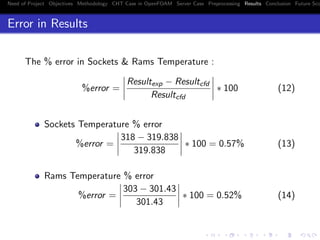
Error in Results
The % error in Sockets & Rams Temperature :
%error =
Resultexp − Resultcfd
Resultcfd
∗ 100 (12)
Sockets Temperature % error
%error =
318 − 319.838
319.838
∗ 100 = 0.57% (13)
Rams Temperature % error
%error =
303 − 301.43
301.43
∗ 100 = 0.52% (14)
Need of Project Objectives Methodology CHT Case in OpenFOAM Server Case Preprocessing Results Conclusion Future Sco
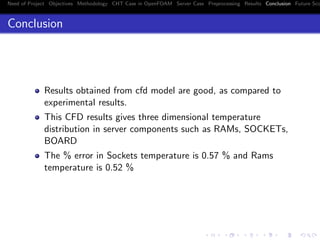
Conclusion
Results obtained from cfd model are good, as compared to
experimental results.
This CFD results gives three dimensional temperature
distribution in server components such as RAMs, SOCKETs,
BOARD
The % error in Sockets temperature is 0.57 % and Rams
temperature is 0.52 %
Need of Project Objectives Methodology CHT Case in OpenFOAM Server Case Preprocessing Results Conclusion Future Sco
Future Scope
To implement Fan boundary condition for mass flow rate
To implement micro thickness baffle for sink region
Need of Project Objectives Methodology CHT Case in OpenFOAM Server Case Preprocessing Results Conclusion Future Sco
References
ANSYS.
Fluent 6.3 users guide.
www.sharcnet.ca/Software/Fluent6/html/ug/node479.htm.
Yunus A. Cengel.
Heat Transfer A Practical Approach.
McGraw-Hill, forth edition, 2003.
Yongsheng Lian Chaolei Zang.
Conjugate heat transfer analysis using simplified household refrigerator model.
Technical report, Department of Mechanical Engineering University of Lousville USA, June 2014.
Porterie B. Consalvi J.L., Pizzo Y.
Numerical analysis of heating process in upward flame spread over thick pmma slab.
Fire Safty J, V43(N5):351–362, 7/08.
John D.Anderson.
Computational Fluid Dynamics Basic with application.
Mc GrawHill, 2000.
Wilcox D.C.
Turbulence Modeling for CFD.
DCW Industries, 3 edition, 2006.
D.E.Dwyer.
Defining ventilation boundary condition for green house climate model.
Master’s thesis, Delft University of Technology, August 2014.
OpenFOAM Foundation.
Openfoam programmer guide.
www.openfoam.org.
OpenFOAM Foundation.
Openfoam user guide.
www.openfoam.org.
Need of Project Objectives Methodology CHT Case in OpenFOAM Server Case Preprocessing Results Conclusion Future Sco
Thank You !

Avinash_PPT

  • 1.
    Need of ProjectObjectives Methodology CHT Case in OpenFOAM Server Case Preprocessing Results Conclusion Future Sco Conjugate Heat Transfer for Electronic Cooling using OpenFOAM Avinash Valiba Gorde(CMS-1310) Internal Guide Dr. Sukratu Barve Dr. Mihir Arjunwadkar Centre for Modelling and Simulation External Guide Dr. Vikas Kumar Mr. Mohan Labade Centre for Development of Advanced Computing Pune,INDIA June 20, 2015
  • 2.
    Need of ProjectObjectives Methodology CHT Case in OpenFOAM Server Case Preprocessing Results Conclusion Future Sco Outline 1 Need of Project 2 Objectives 3 Methodology 4 CHT Case in OpenFOAM 5 Server Case 6 Preprocessing 7 Results 8 Conclusion 9 Future Scope 10 References
  • 3.
    Need of ProjectObjectives Methodology CHT Case in OpenFOAM Server Case Preprocessing Results Conclusion Future Sco Need of Project Considering following aspect, A very limited conjugate heat transfer case studies have been analyzed using OpenFOAM.
  • 4.
    Need of ProjectObjectives Methodology CHT Case in OpenFOAM Server Case Preprocessing Results Conclusion Future Sco Objectives To develop a CFD model for conjugate heat transfer analysis of an electronics cooling system Validation of CFD model with experimental results
  • 5.
    Need of ProjectObjectives Methodology CHT Case in OpenFOAM Server Case Preprocessing Results Conclusion Future Sco Methodology Conjugate Heat Transfer In CHT computational domain is divided into fluid and solid regions. The NaviereStokes equations and the energy equation in the fluid regions are solved first. Then the heat transfer equation in the solid regions is solved. Figure : Conjugate Heat Transfer
  • 6.
    Need of ProjectObjectives Methodology CHT Case in OpenFOAM Server Case Preprocessing Results Conclusion Future Sco Steady state heat transfer Steady state conditions the temperature within the system does not change with time. Steady State Equation for Solid − · (κ T) = Sh (1) Unsteady state heat transfer Unsteady state conditions the temperature within the system changes with time. Unsteady State Equation for Solid ρCp ∂T ∂t = · (κ T) + Sh (2)
  • 7.
    Need of ProjectObjectives Methodology CHT Case in OpenFOAM Server Case Preprocessing Results Conclusion Future Sco Solver chtMutiRegionSimpleFoam Solver It is steady state solver for conjugate heat transfer. It is combination of heatConductionFoam and buoyantFoam for conjugate heat transfer Governing Equation Used by OpenFoam chtMultiregionSimpleFoam Solver Continuity Equation ∂ρ ∂t + −→ · (ρ−→u ) = 0 (3)
  • 8.
    Need of ProjectObjectives Methodology CHT Case in OpenFOAM Server Case Preprocessing Results Conclusion Future Sco Momentum Equation The sum of all forces acting on a body is equal to the rate of change of momentum of it 1) Body forces = gravitational, centrifugal 2)Surface forces acting on the surface of the body e.g. pressure or viscous forces ∂ (ρu) ∂t + · (ρuu) = − p + · τ − ρg (4) Energy Equation ∂(ρE) ∂t + · (ρuE) = · (α e) − · [u (p − ρgr)] + Sh (5) α = µCp κ is the thermal diffusivity. Sh is the thermal source term. e is the specific internal energy. E is the specific total energy of the gas defined as: E = e + u2 2
  • 9.
    Need of ProjectObjectives Methodology CHT Case in OpenFOAM Server Case Preprocessing Results Conclusion Future Sco Equation in solid region ∂ (ρh) ∂t = · (α h) + Sh (6) α = µCp κ is the thermal diffusivity. Sh is the heat source term. h is the sensilbe enthalpy.
  • 10.
    Need of ProjectObjectives Methodology CHT Case in OpenFOAM Server Case Preprocessing Results Conclusion Future Sco Coupling at the solid-fluid interface Tw = ks δxs Ts kf δxf + ks δxs + (1 − k) Tf + Tref δxf = kf δxf Tf + ks δxs Ts kf δxf + ks δxs (7) Tf and Ts are the temperatures of the fluid and solid regions kf and ks are the heat conductivities of the fluid and solid Tref is a reference temperature δxf and δxs are the distances between the cell centers Figure : Interface Temp
  • 11.
    Need of ProjectObjectives Methodology CHT Case in OpenFOAM Server Case Preprocessing Results Conclusion Future Sco CHT Case in OpenFOAM Geometry For Simple Circuit Board Cooling Figure : Simple cht case
  • 12.
    Need of ProjectObjectives Methodology CHT Case in OpenFOAM Server Case Preprocessing Results Conclusion Future Sco Meshing For Simple Circuit Board Cooling Figure : Simple cht case
  • 13.
    Need of ProjectObjectives Methodology CHT Case in OpenFOAM Server Case Preprocessing Results Conclusion Future Sco Implementation of Heat Source Heat source In src/fvOptions/lnInclude const dimensionSet ds = rho.dimensions()*fld.dimensions()/dimTime*dimVolume; ds = ρ * h/time * volume ds = kg/m3 * J/(kg * S) * m3 ds = W (watt) tmp <fvMatrix<Type > >tmtx(new fvMatrix < Type >(fld, ds)); h (200 0);
  • 14.
    Need of ProjectObjectives Methodology CHT Case in OpenFOAM Server Case Preprocessing Results Conclusion Future Sco Boundary Conditions Solid Region Initial Temperature=300K. Wall is zeroGradient. Heat Source 200 Watt (4 IC’s). Interface between solid(IC), fluid(AIR) Mixed B.C. Fluid Region Velocity v=0.3m/s. p = atmospheric. Initial Temperature (T) = 299K. Inlet=fixed Value Outlet=inletOutlet for Velocity & Temperature. Walls maintained at symmetry, zeroGradient. Interfaces between solid and fluid = Mixed B.C.
  • 15.
    Need of ProjectObjectives Methodology CHT Case in OpenFOAM Server Case Preprocessing Results Conclusion Future Sco Temperature contour at mid plane Figure : Temperature variation in solid along xaxis
  • 16.
    Need of ProjectObjectives Methodology CHT Case in OpenFOAM Server Case Preprocessing Results Conclusion Future Sco 300 320 340 360 380 400 420 0 0.2 0.4 0.6 0.8 1 1.2 1.4 TemperatureinKelvin Distance along X-axis '100_watt.csv' u 8:2 '200_watt.csv' u 8:2 Figure : Temperature Distribution
  • 17.
    Need of ProjectObjectives Methodology CHT Case in OpenFOAM Server Case Preprocessing Results Conclusion Future Sco Server Case
  • 18.
    Need of ProjectObjectives Methodology CHT Case in OpenFOAM Server Case Preprocessing Results Conclusion Future Sco Server Case Geometry of Server This is Intel Server Board S2600GZ/GL having 2 SOCKETS, 24 RAMS, PCB, 2SMPS
  • 19.
    Need of ProjectObjectives Methodology CHT Case in OpenFOAM Server Case Preprocessing Results Conclusion Future Sco Generalized geometry of Server Figure : Generalized model of server
  • 20.
    Need of ProjectObjectives Methodology CHT Case in OpenFOAM Server Case Preprocessing Results Conclusion Future Sco Sink of Socket High Thermal conductivity, larger surface area Low thermal resistance Material Aluminium, Copper Air can be easily flow through it Figure : Sink of Socket
  • 21.
    Need of ProjectObjectives Methodology CHT Case in OpenFOAM Server Case Preprocessing Results Conclusion Future Sco Meshing For server create 3 blocks specifying coordinates of each point. Dimensions are L=0.46m Zaxis, W=0.41m Xaxis, H=0.09m Yaxis it is structured mesh Figure : blockMesh for Server
  • 22.
    Need of ProjectObjectives Methodology CHT Case in OpenFOAM Server Case Preprocessing Results Conclusion Future Sco topoSet topoSet utility is use to create different domain inside the mesh block. Figure : blockMesh for Server
  • 23.
    Need of ProjectObjectives Methodology CHT Case in OpenFOAM Server Case Preprocessing Results Conclusion Future Sco Turbulance Model RNG κ − turbulence model Useful for rapidly strains flows, Heat and mass transfer Low Reynold number effect Standard κ − model for high reynolds number Turbulent Kinetic Energy (k) ∂ (ρk) ∂t + ∂ (ρkui ) ∂xi = ∂ ∂xj αk µeff + ∂k ∂xj + Gk + Gb − ρ − Ym + Sk (8) Dissipation rate ( ) ∂ (ρ ) ∂t + ∂ (ρ ui ) ∂xi = ∂ ∂xj αk µeff + ∂ ∂xj + C1 k (Gk + C3 Gb) − C2ρ 2 k − R + S (9) The coefficient updated each iteration C ∗ 1 = c1 − η 1 − η η0 1 + βη3 (10) η = k τij τij (11)
  • 24.
    Need of ProjectObjectives Methodology CHT Case in OpenFOAM Server Case Preprocessing Results Conclusion Future Sco Table : Constant values for turbulence model C1 C2 C3 Cµ η β σk σ 1.42 1.68 -0.33 0.085 4.38 0.012 0.7194 0.7194
  • 25.
    Need of ProjectObjectives Methodology CHT Case in OpenFOAM Server Case Preprocessing Results Conclusion Future Sco Boundary Conditions Solid Region Initial Temperature=299K. Walls zeroGradient. Heat Source :- 103 Watt (2 sockets), 4 Watt (on 1, 4, 9, 12, 13, 14, 16, 21, 24 ). Interface between solid(SOCKETs, RAMs), fluid(AIR) Mixed B.C. Fluid Region Velocity v=2.1m/s. p = atmospheric. Initial Temperature (T) = 299K. Inlet=fixed Value Outlet=inletOutlet for Velocity & Temperature. Walls maintained at symmetry, zeroGradient. Interfaces between solid and fluid = Mixed B.C.
  • 26.
    Need of ProjectObjectives Methodology CHT Case in OpenFOAM Server Case Preprocessing Results Conclusion Future Sco Solid Thermophysical Properties Table : Solid thermophysical properties Solid name κ(W/mK) Cp(J/kgK) rho(kg/m3) Material SOCKET 1 & 2 124 702 2325 Silicon SINK 1 & 2 220 903 2700 Aluminium RAM 124 702 2325 Silicon SMPS 1 & 2 53 450 8000 Steel BOX 1 & 2 53 450 8000 Steel FLAPPER 53 450 8000 Steel BOARD 0.02 1800 1500 FR4
  • 27.
    Need of ProjectObjectives Methodology CHT Case in OpenFOAM Server Case Preprocessing Results Conclusion Future Sco Table : Fluid(AIR) thermophysical properties Parameter value Cp (J/kg K) 1000 µ 1.8e−05 Pr 0.7
  • 28.
    Need of ProjectObjectives Methodology CHT Case in OpenFOAM Server Case Preprocessing Results Conclusion Future Sco Results Temperature Contours Figure : Temperature distrubution in Server
  • 29.
    Need of ProjectObjectives Methodology CHT Case in OpenFOAM Server Case Preprocessing Results Conclusion Future Sco Temperature along Heat Sink coordinates are (0.1 0.02 0.28) and (0.1 0.02 0.360) 298 300 302 304 306 308 310 312 314 316 318 320 0 0.01 0.02 0.03 0.04 0.05 0.06 0.07 0.08 TemperatureinKelvin distace along z-axis SinkTemp betn fins Figure : Temp. distrubution of fin along z-direction
  • 30.
    Need of ProjectObjectives Methodology CHT Case in OpenFOAM Server Case Preprocessing Results Conclusion Future Sco Temperature between fin passage coordinates are (0.06 0.02 0.332) & (0.19 0.02 0.0332) 298 300 302 304 306 308 310 312 314 316 0 0.02 0.04 0.06 0.08 0.1 0.12 0.14 0.16 0.18 0.2 Temp.inKelvin distace along x-axis HeatsinkTemp Figure : Temp. distrubution of fin along x-direction
  • 31.
    Need of ProjectObjectives Methodology CHT Case in OpenFOAM Server Case Preprocessing Results Conclusion Future Sco Temperature Variation of RAMs & SOCKETs coordinates are (0.095 0.0075 0) & (0.09 0.0075 0.46) 295 300 305 310 315 320 325 0 0.05 0.1 0.15 0.2 0.25 0.3 0.35 0.4 0.45 0.5 Temp.inKelvin distace along z-axis SOCKET & RAM Temp Figure : Temperature distribution along z-direction
  • 32.
    Need of ProjectObjectives Methodology CHT Case in OpenFOAM Server Case Preprocessing Results Conclusion Future Sco Comparision with experimental results Comparision of Sockets & Rams Temperature obtained from cfd model & experiment Table : Comparision of Socket & Ram Temp(K) Region OpenFOAM Result Experimental Result SOCKET 319.838 318 RAM 301.43 303
  • 33.
    Need of ProjectObjectives Methodology CHT Case in OpenFOAM Server Case Preprocessing Results Conclusion Future Sco Error in Results The % error in Sockets & Rams Temperature : %error = Resultexp − Resultcfd Resultcfd ∗ 100 (12) Sockets Temperature % error %error = 318 − 319.838 319.838 ∗ 100 = 0.57% (13) Rams Temperature % error %error = 303 − 301.43 301.43 ∗ 100 = 0.52% (14)
  • 34.
    Need of ProjectObjectives Methodology CHT Case in OpenFOAM Server Case Preprocessing Results Conclusion Future Sco Conclusion Results obtained from cfd model are good, as compared to experimental results. This CFD results gives three dimensional temperature distribution in server components such as RAMs, SOCKETs, BOARD The % error in Sockets temperature is 0.57 % and Rams temperature is 0.52 %
  • 35.
    Need of ProjectObjectives Methodology CHT Case in OpenFOAM Server Case Preprocessing Results Conclusion Future Sco Future Scope To implement Fan boundary condition for mass flow rate To implement micro thickness baffle for sink region
  • 36.
    Need of ProjectObjectives Methodology CHT Case in OpenFOAM Server Case Preprocessing Results Conclusion Future Sco References ANSYS. Fluent 6.3 users guide. www.sharcnet.ca/Software/Fluent6/html/ug/node479.htm. Yunus A. Cengel. Heat Transfer A Practical Approach. McGraw-Hill, forth edition, 2003. Yongsheng Lian Chaolei Zang. Conjugate heat transfer analysis using simplified household refrigerator model. Technical report, Department of Mechanical Engineering University of Lousville USA, June 2014. Porterie B. Consalvi J.L., Pizzo Y. Numerical analysis of heating process in upward flame spread over thick pmma slab. Fire Safty J, V43(N5):351–362, 7/08. John D.Anderson. Computational Fluid Dynamics Basic with application. Mc GrawHill, 2000. Wilcox D.C. Turbulence Modeling for CFD. DCW Industries, 3 edition, 2006. D.E.Dwyer. Defining ventilation boundary condition for green house climate model. Master’s thesis, Delft University of Technology, August 2014. OpenFOAM Foundation. Openfoam programmer guide. www.openfoam.org. OpenFOAM Foundation. Openfoam user guide. www.openfoam.org.
  • 37.
    Need of ProjectObjectives Methodology CHT Case in OpenFOAM Server Case Preprocessing Results Conclusion Future Sco Thank You !