The document discusses aviation security challenges and practical solutions, emphasizing the need for rigorous screening, intelligence, and training to mitigate threats. It details historical attacks, highlights the evolution of attack methods, and advocates for a comprehensive rings of protection approach at airports. Ultimately, it stresses the importance of cooperation among security entities and the role of technology and personnel in enhancing safety measures.
Introduction to aviation security, covering challenges, practical solutions, and an outline of the presentation.
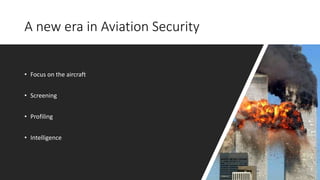
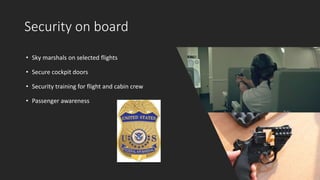
Focus on new security methods for aircraft, including profiling, intelligence, and onboard security protocols.
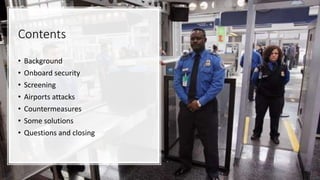
Challenges faced in airport screening processes and advancements in screening technologies for passengers and baggage.
Discussion of significant airport attacks globally, their impact, and the resulting changes in security protocols.
Changing patterns of attacks and the need for comprehensive countermeasures and protective rings at airports. Challenges of insider threats and media influence on security perception, leading to increased security measures. Strategies to counter threats including cooperation among agencies, profiling, training, and the use of technology.
Concluding remarks on the evolving nature of threats and the importance of technology and human factors in security.
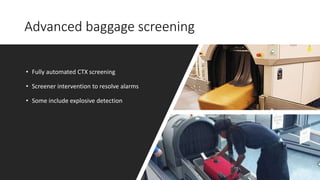
Advanced baggage screening
•Fully automated CTX screening
• Screener intervention to resolve alarms
• Some include explosive detection
8.
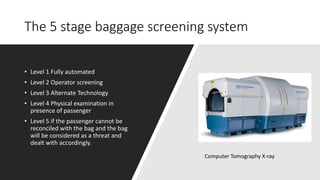
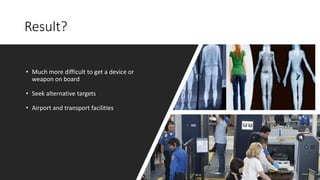
The 5 stagebaggage screening system
• Level 1 Fully automated
• Level 2 Operator screening
• Level 3 Alternate Technology
• Level 4 Physical examination in
presence of passenger
• Level 5 if the passenger cannot be
reconciled with the bag and the bag
will be considered as a threat and
dealt with accordingly.
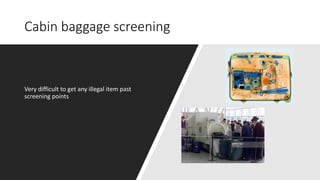
Computer Tomography X-ray
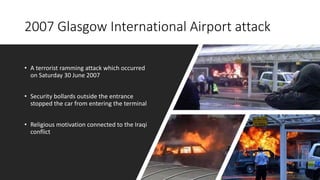
2007 Glasgow InternationalAirport attack
• A terrorist ramming attack which occurred
on Saturday 30 June 2007
• Security bollards outside the entrance
stopped the car from entering the terminal
• Religious motivation connected to the Iraqi
conflict
14.
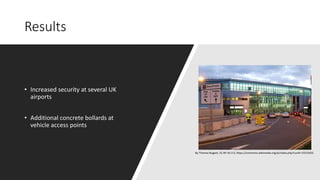
Results
• Increased securityat several UK
airports
• Additional concrete bollards at
vehicle access points
By Thomas Nugent, CC BY-SA 2.0, https://commons.wikimedia.org/w/index.php?curid=13153432
15.
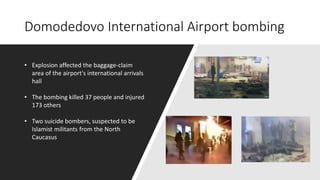
Domodedovo International Airportbombing
• Explosion affected the baggage-claim
area of the airport's international arrivals
hall
• The bombing killed 37 people and injured
173 others
• Two suicide bombers, suspected to be
Islamist militants from the North
Caucasus
16.
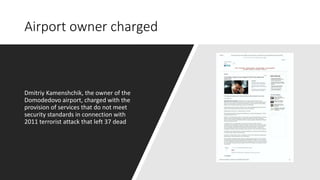
Airport owner charged
DmitriyKamenshchik, the owner of the
Domodedovo airport, charged with the
provision of services that do not meet
security standards in connection with
2011 terrorist attack that left 37 dead
17.
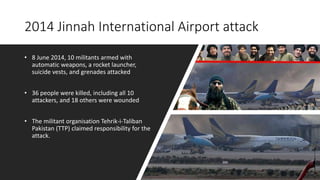
2014 Jinnah InternationalAirport attack
• 8 June 2014, 10 militants armed with
automatic weapons, a rocket launcher,
suicide vests, and grenades attacked
• 36 people were killed, including all 10
attackers, and 18 others were wounded
• The militant organisation Tehrik-i-Taliban
Pakistan (TTP) claimed responsibility for the
attack.
18.
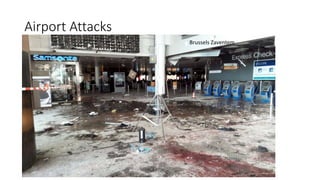
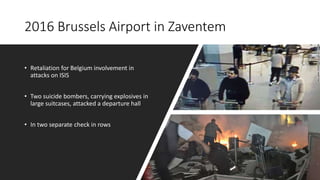
2016 Brussels Airportin Zaventem
• Retaliation for Belgium involvement in
attacks on ISIS
• Two suicide bombers, carrying explosives in
large suitcases, attacked a departure hall
• In two separate check in rows
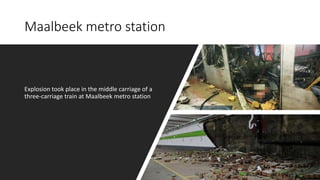
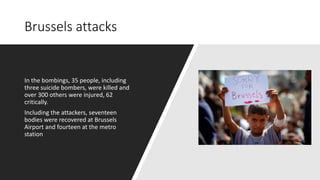
Brussels attacks
In thebombings, 35 people, including
three suicide bombers, were killed and
over 300 others were injured, 62
critically.
Including the attackers, seventeen
bodies were recovered at Brussels
Airport and fourteen at the metro
station
21.
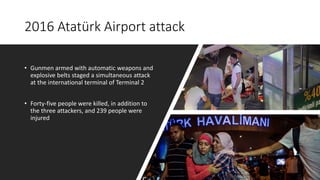
2016 Atatürk Airportattack
• Gunmen armed with automatic weapons and
explosive belts staged a simultaneous attack
at the international terminal of Terminal 2
• Forty-five people were killed, in addition to
the three attackers, and 239 people were
injured
22.
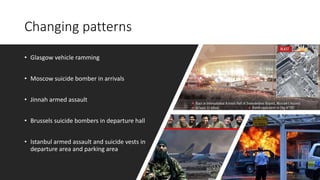
Changing patterns
• Glasgowvehicle ramming
• Moscow suicide bomber in arrivals
• Jinnah armed assault
• Brussels suicide bombers in departure hall
• Istanbul armed assault and suicide vests in
departure area and parking area
23.
The challenge ofnew
media
• Were reliant on media houses
• Now self publish
• They decide when they get attention
24.
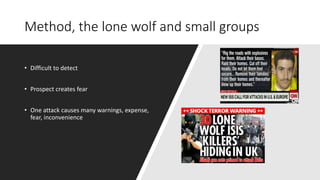
Method, the lonewolf and small groups
• Difficult to detect
• Prospect creates fear
• One attack causes many warnings, expense,
fear, inconvenience
25.
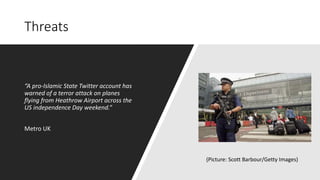
Threats
“A pro-Islamic StateTwitter account has
warned of a terror attack on planes
flying from Heathrow Airport across the
US independence Day weekend.”
Metro UK
(Picture: Scott Barbour/Getty Images)
26.
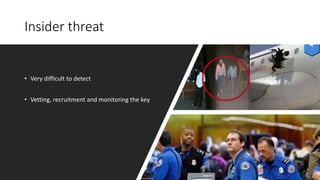
Insider threat
• Verydifficult to detect
• Vetting, recruitment and monitoring the key
27.
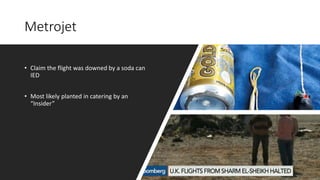
Metrojet
• Claim theflight was downed by a soda can
IED
• Most likely planted in catering by an
“Insider”
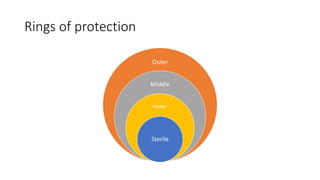
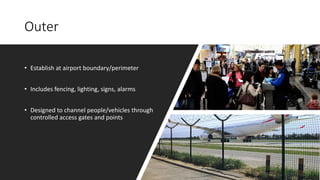
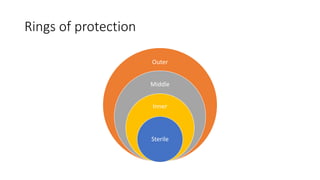
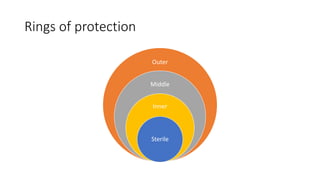
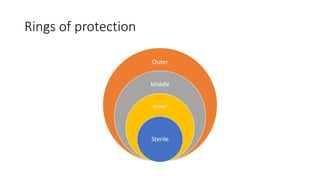
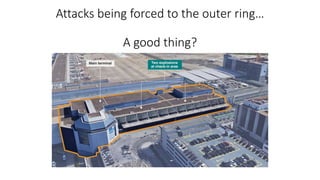
Outer
• Establish atairport boundary/perimeter
• Includes fencing, lighting, signs, alarms
• Designed to channel people/vehicles through
controlled access gates and points
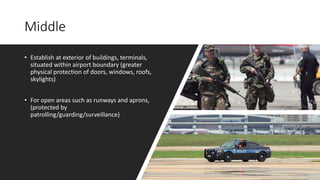
Middle
• Establish atexterior of buildings, terminals,
situated within airport boundary (greater
physical protection of doors, windows, roofs,
skylights)
• For open areas such as runways and aprons,
(protected by
patrolling/guarding/surveillance)
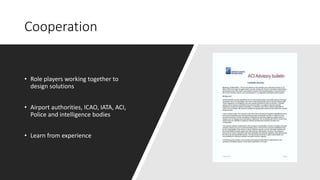
Cooperation
• Role playersworking together to
design solutions
• Airport authorities, ICAO, IATA, ACI,
Police and intelligence bodies
• Learn from experience
40.
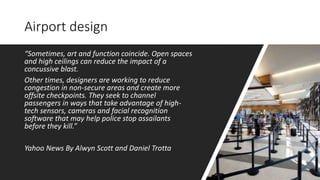
Airport design
“Sometimes, artand function coincide. Open spaces
and high ceilings can reduce the impact of a
concussive blast.
Other times, designers are working to reduce
congestion in non-secure areas and create more
offsite checkpoints. They seek to channel
passengers in ways that take advantage of high-
tech sensors, cameras and facial recognition
software that may help police stop assailants
before they kill.”
Yahoo News By Alwyn Scott and Daniel Trotta
41.
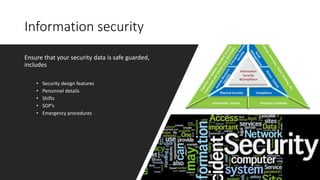
Information security
Ensure thatyour security data is safe guarded,
includes
• Security design features
• Personnel details
• Shifts
• SOP’s
• Emergency procedures
42.
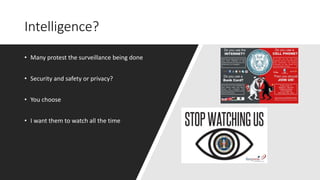
Intelligence?
• Many protestthe surveillance being done
• Security and safety or privacy?
• You choose
• I want them to watch all the time
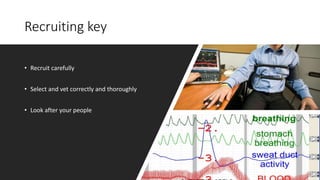
Recruiting key
• Recruitcarefully
• Select and vet correctly and thoroughly
• Look after your people
45.
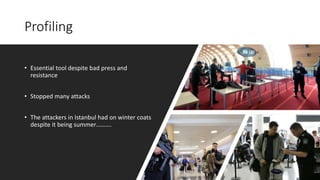
Profiling
• Essential tooldespite bad press and
resistance
• Stopped many attacks
• The attackers in Istanbul had on winter coats
despite it being summer……….
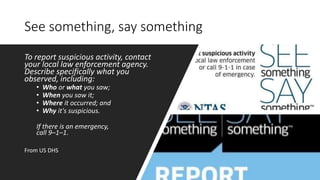
See something, saysomething
To report suspicious activity, contact
your local law enforcement agency.
Describe specifically what you
observed, including:
• Who or what you saw;
• When you saw it;
• Where it occurred; and
• Why it's suspicious.
If there is an emergency,
call 9–1–1.
From US DHS
48.
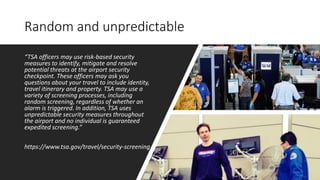
Random and unpredictable
“TSAofficers may use risk-based security
measures to identify, mitigate and resolve
potential threats at the airport security
checkpoint. These officers may ask you
questions about your travel to include identity,
travel itinerary and property. TSA may use a
variety of screening processes, including
random screening, regardless of whether an
alarm is triggered. In addition, TSA uses
unpredictable security measures throughout
the airport and no individual is guaranteed
expedited screening.”
https://www.tsa.gov/travel/security-screening
49.
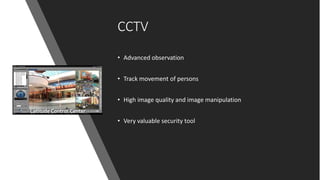
CCTV
• Advanced observation
•Track movement of persons
• High image quality and image manipulation
• Very valuable security tool
50.
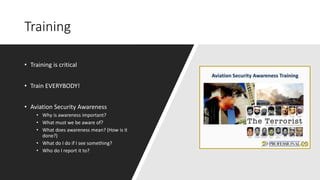
Training
• Training iscritical
• Train EVERYBODY!
• Aviation Security Awareness
• Why is awareness important?
• What must we be aware of?
• What does awareness mean? (How is it
done?)
• What do I do if I see something?
• Who do I report it to?
51.
Don’t train becauseyou
must……..
• Train because it is the most effective way to create maximum
“eyes” on security and possible threats
• Train everybody, all can contribute to security
• Train for your circumstances, include practical exercises
52.
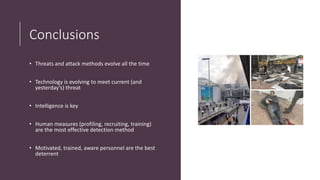
Conclusions
• Threats andattack methods evolve all the time
• Technology is evolving to meet current (and
yesterday’s) threat
• Intelligence is key
• Human measures (profiling, recruiting, training)
are the most effective detection method
• Motivated, trained, aware personnel are the best
deterrent
53.
Questions?
Presentation by DavidAlexander ICAO AVSEC PM
Professional Aviation Services (Pty) Ltd
082 308 0169 david@professional.za.com
Editor's Notes
#4 After the 9/11 attacks the focus was placed on preventing the introduction of threats (devices, people, objects) that could be used to commit and act against the aircraft
Emphasis on screening of passengers and cargo
Profiling of passengers not on religious or ethnic grounds but on who could present a threat (behaviour, clothing, appearance)
Sharing of intelligence on possible threats
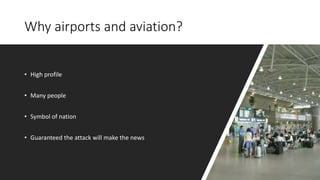
#11 Airport attacks targeting pre security “soft” areas
#14 Police identified the two men as Bilal Abdullah, a British-born, Muslim doctor of Iraqi descent working at the Royal Alexandra Hospital,[10][11] and Kafeel Ahmed, also known as Khalid Ahmed, an engineer and the driver, who was treated for fatal burns at the same hospital.[12] The newspaper, The Australian, alleges that a suicide note indicated that the two had intended to die in the attack.[13] Kafeel Ahmed died from his injuries on 2 August.[14] Bilal Abdullah was later found guilty of conspiracy to commit murder and was sentenced to life imprisonment with a minimum of 32 years.
#16 The explosion affected the baggage-claim area of the airport's international arrivals hall.[1] Some reports have suggested that the explosion was the work of a suicide bomber, with investigators saying the explosion was caused by an "improvised device packed with shrapnel, pieces of chopped wire" and the equivalent to between two and five kilograms of TNT.[7][8] Russia's chief investigator has stated the explosion was the work of terrorists.[4] Investigators found a male head and believed it might have been that of the suicide bomber.[8][9]
#18 the attackers were foreigners of Uzbek origin who belonged to the Islamic Movement of Uzbekistan (IMU), an Al Qaeda-linked militant organisation that works closely with TTP.[3][4] The TTP later confirmed that the attack was a joint operation they executed with the IMU, who independently admitted to having supplied personnel for the attack.
The attack began at 11:10 PM on 8 June and lasted until the morning around 4:00 AM of 9 June.[16] Ten attackers divided in 2 groups, stormed at two different checkpoint and attacked the cargo terminal of the airport with [17] automatic weapons, hand grenades, rocket-propelled grenades, and other explosives. The attackers were dressed as security guards, with some also wearing suicide vests. They were wearing uniforms of the Airports Security Force (ASF).[2] A senior Pakistani intelligence official said some of the militants tried to hijack a plane, but were unsuccessful.[18]
Airports Security Force troops fought bravely, limited the terrorists attack and started taking them out one by one. Within 2 hours, eight of the ten militants were shot dead by the Airports Security Force troops and the remaining two blew themselves up when they were cornered. About 90 minutes after the attack began, hundreds of Rangers, Police and Army troops arrived on the scene but the majority of terrorists had already been eliminated by Airports Security Force.[19][20] The siege officially ended after five hours; 28 people, including the ten terrorists, 12 ASF personnel, one Pakistan Rangers officials, a Sindh Police official, and four PIA employees (including two senior aircraft engineers)[14] were killed in the incident.[13] At least 18 security personnel were also injured in the attack and admitted to Abbasi Shaheed Hospital.[16] Seven bodies that were burnt beyond recognition were also recovered from the airport's cold storage facility after a 28-hour rescue operation.[21]
#19 wo suicide bombers, carrying explosives in large suitcases, attacked a departure hall at Brussels Airport in Zaventem. The first explosion occurred at 7:58 a.m. in check-in row 11; the second explosion occurred about nine seconds later in check-in row 2. The suicide bombers were visible in CCTV footage.[37] Some witnesses said that before the first explosion occurred, shots were fired and there were yells in Arabic. However, authorities have stated afterwards that no shots were fired.[38][39][40][citation needed]
Belgium is a participant in the ongoing military intervention against ISIL, during the Iraqi Civil War.[11] On 5 October 2014, a Belgian F-16 dropped its first bomb on an ISIL target, east of Baghdad.[12] On 12 November 2015, Iraq warned members of the coalition that Abu Bakr al-Baghdadi, the leader of ISIL, had ordered retaliatory attacks on countries involved in the coalition against ISIL.[13]
Belgium has more nationals fighting for jihadist forces as a proportion of its population than any other Western European country, with an estimated 440 Belgians having left for Syria and Iraq as of January 2015.[14][15] Due to Belgium's weak security apparatus and competing intelligence agencies, it has become a hub of jihadist-recruiting and terrorist activity
#22 Shortly before 22:00 Istanbul time, two assailants approached the x-ray scanner at a security checkpoint, and opened fire.[10] Police officers then returned fire. The assailants then detonated bombs on their persons.[11][12]
Based on a security camera video, one of the bombers was about 80 feet (24 m) inside Terminal 2 (the International terminal) when he detonated his suicide bomb.[13] In the CCTV video the explosion can be seen within or near a group of people.[13] It is also believed that one of the explosions was in the parking lot across the street of the terminal.[14]
A closed-circuit video of the incident showed an armed assailant walking and firing at people within the terminal. The gunman was then shot by a security officer and fell to the ground, with the security officer approaching to investigate. The officer then ran away, presumably having noticed the gunman's explosive belt. The suicide belt then detonated.[15]
During and immediately after the attacks, hundreds of passengers and people inside the airport hid anywhere they could in shops, washrooms, and under benches.[16]
Two of the attackers detonated explosive devices, killing themselves; one was killed, presumably by security forces.[16]
There were three perpetrators who detonated their explosives in or near the terminal. However, there were reports and witnesses stating that there were four armed men running away from the blasts; this has not yet been confirmed by police personnel. A US intelligence source told CBS News that the coordinated attacks lasted only about 90 seconds.[17]
Many travelers described what they saw during the attack to reporters. One man stated, "We came right to international departures and saw the man randomly shooting. He was just firing at anyone coming in front of him. He was wearing all black. His face was not masked. I was 50 meters away from him."[18] He continued, "We ducked behind a ticket counter but I stood up and watched him. Two explosions went off shortly after one another. By that time he had stopped shooting."[18] Lastly he said "He turned around and started coming towards us. He was holding his gun inside his jacket. He looked around anxiously to see if anyone was going to stop him and then went down the escalator ... We heard some more gunfire and then another explosion, and then it was over."[18]
Other people who had arrived outside the terminal said that taxicab drivers were screaming, "Don't enter! A bomb exploded!" from their windows to incoming traffic.[19]
#40 Domed to dissipate explosions
No choke points
Barriers