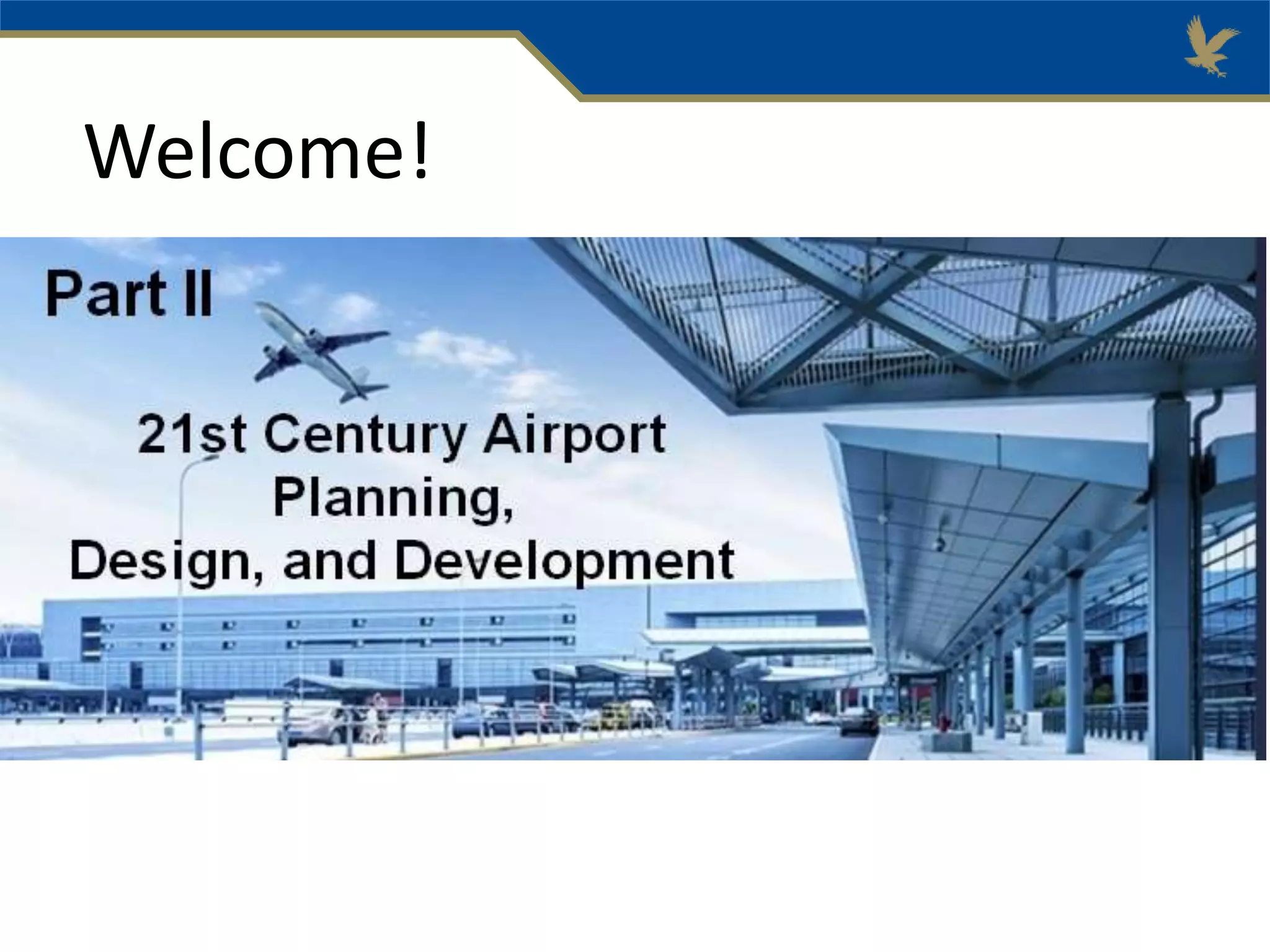
Welcome!
Today’s Agenda
• Welcome and Introduction
—Rob Kelly, Webinar Moderator
Project Manager, Office of Professional Education
• Presentation by Shawn Arena/Q &A
• Presentation by Daniel Benny/Q &A
• General Questions and Answers
• Airport and Aviation Online Professional
Certification
• Wrap up and Survey
Rob Kelly
What is your role?
Poll #1
A few session pointers
• We’ll answer questions at the conclusion of each presentation.
Post your questions during that speaker’s presentation. Preface
the question with the speaker’s name (Arena or Benny). Use
the Q&A space for presentation-related questions.
• Use the “Technical Help” space if you have technical problems.
• Slides are available for download at any time.
• The recording link will be emailed to you.
• Participation certificates are NOT available for this session.
• Be sure to complete our survey, which will be presented at the
end of the live session (Survey is not available on the
recording).
What is the greatest need for training at airports?
Poll #2
Assistant Professor Shawn Arena
• Assistant Professor at ERAU-Worldwide
• 27-year airport industry professional
• Management positions at four commercial and
four general aviation airports
• Accredited Airport Executive (A.A.E)
• Active on local, regional and national professional
airport boards
• Degrees from Embry-Riddle Aeronautical
University and the University of Southern
California
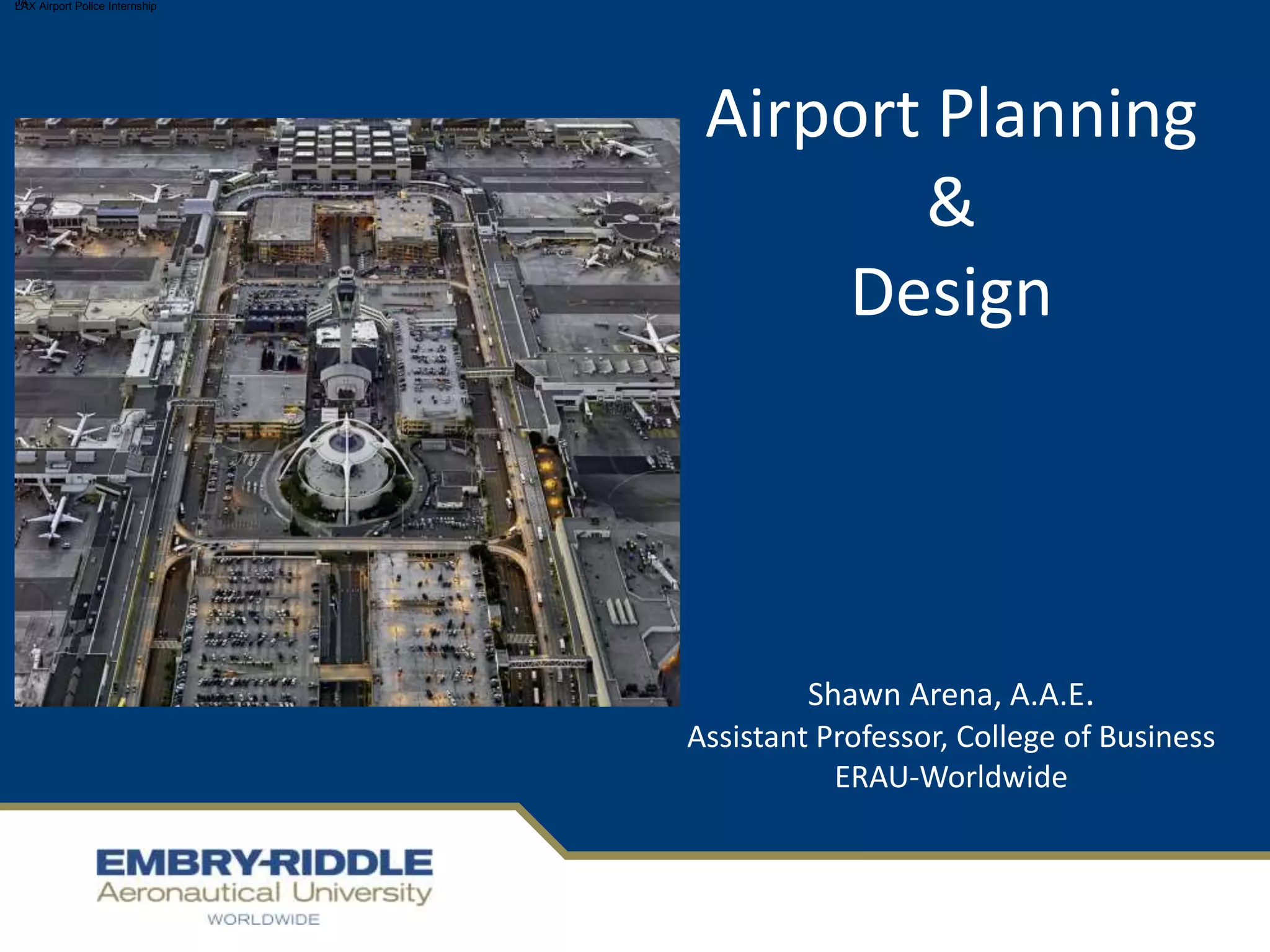
Airport Planning
&
Design
Shawn Arena, A.A.E.
Assistant Professor, College of Business
ERAU-Worldwide
LAX Airport Police InternshipJA
This presentation provides an
overview to Airport Planning
& Design Certification. Topics
covered include:
• Present and Future Trends in
Airport Planning / Design
• Dynamic Strategic Planning
(SWOT)
• Landside Terminal Design;
Ground Access; Baggage
Systems
• Airport Capacity / Delay
• Demand Mgmt. ATM impacts
• Airport Layout Design &
Environmental concerns
Airport Planning & Design
Regulatory Guidance
– Advisory Circulars
AC 150/5300-13
Current Trends
– Mobile apps
– Automated Passport
Control
Future Considerations
– Aerotropolis
– UAV/UAS impacts
– AIP / PFC Funding
– Current Pilot Shortage
Present & Future Trends
In Airport Planning & Design
Dynamic Planning
– Historically, Airport Planners relied
strictly on Master Plan Data
– Current philosophy is incorporate
Dynamic Strategic Planning concepts
– SWOT Analysis
– Demand Driven not Time Driven
Multi- Airport Systems
– Efficiently move Pax / Cargo
throughout regional hubs
– SFO / LAX / HOU / JFK
Dynamic Strategic Planning &
Multi- Airport Systems
Five Terminal Design
Configurations
– Finger Pier (PHX)
– Satellites (DCA)
– Midfield (DTW)
– Linear (SNA)
– Transporter (IAD)
Ground Access Considerations
Intermodal Transportation
Baggage Handling Systems
RFID
In-line systems
Terminal Design / Ground
Access / Baggage
Handling
• Factors Affecting Capacity of a Runway System
– Number and geometric layout of runways
– Separation requirements per ATM systems
– Visibility, cloud ceiling, and precipitation
– Wind direction and speed
– Mix of aircraft movements on each runway /
sequence
– Type and location of taxiway exits from runway (ROT)
– State and Performance of ATM system
– Noise / other environmental constraints
Airfield Capacity & Delay
• Administrative Policy
Slot Control (i.e. High Density Rules) [DCA, LGA, JFK, EWR]
FAA required Airline Competition Plan - Large Hub Airports
• Economic Policy
Congestion Pricing
• Hybrid
• Slots Plus Congestion Pricing
• Slot Auctions
Demand Mgmt. /ATM Impact
• Administrative / Economic /
Hybrid Policies
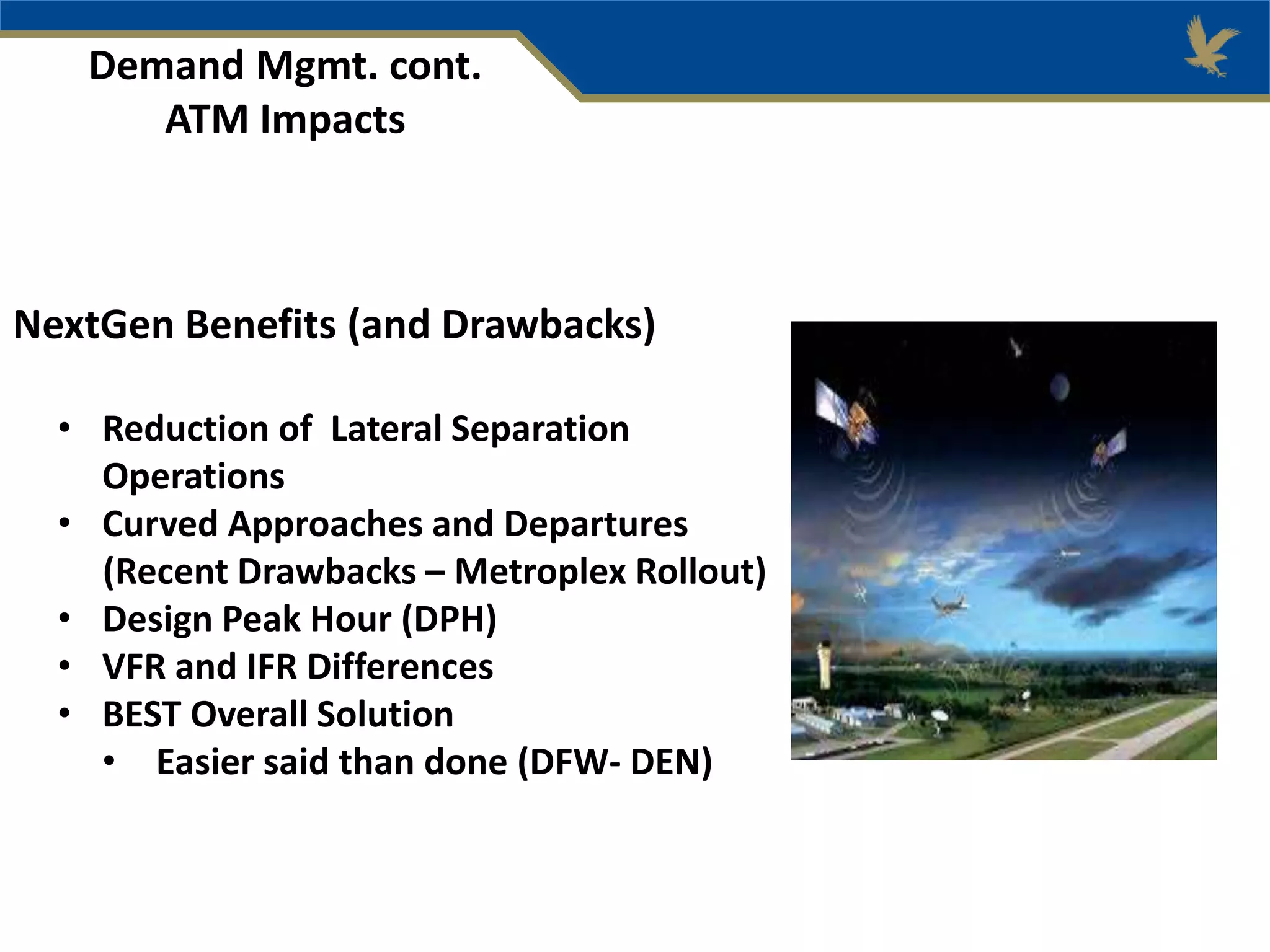
Demand Mgmt. cont.
ATM Impacts
NextGen Benefits (and Drawbacks)
• Reduction of Lateral Separation
Operations
• Curved Approaches and Departures
(Recent Drawbacks – Metroplex Rollout)
• Design Peak Hour (DPH)
• VFR and IFR Differences
• BEST Overall Solution
• Easier said than done (DFW- DEN)
The Airport Layout Plan Set (ALP) is the
primary document used for current and
future planning and design considerations for
any airport. While the complexity and size of
an airport may vary (ORD vs. RDD), the FAA
requires the following information on the
ALP:
• Wind Rose
• Current and forecasted Terminals
• Runways, Taxiways, aircraft ramp
area
• RSA / OFZ / BRL
• FAR Part 77 Imaginary Surfaces
• Physical / Natural Boundaries
Airfield Layout and Design &
Environmental Concerns
Questions?
Dr. Daniel Benny
• Program Chair for B.S. in Aviation Security
• Ph.D. in Criminal Justices and Masters Degrees in
Aeronautical Science, Security Administration
• Author of leading textbook on general aviation
security
• Authored more than 300 articles on security
administration
• U.S. Naval Intelligence Officer
• Director of Public Safety
• Major in the USAF Auxiliary Civil Air Patrol
Airport and Aviation
Security
Dr. Daniel J. Benny, Program Chair
Bachelor of Science, Aviation Security
LAX Airport Police InternshipJA
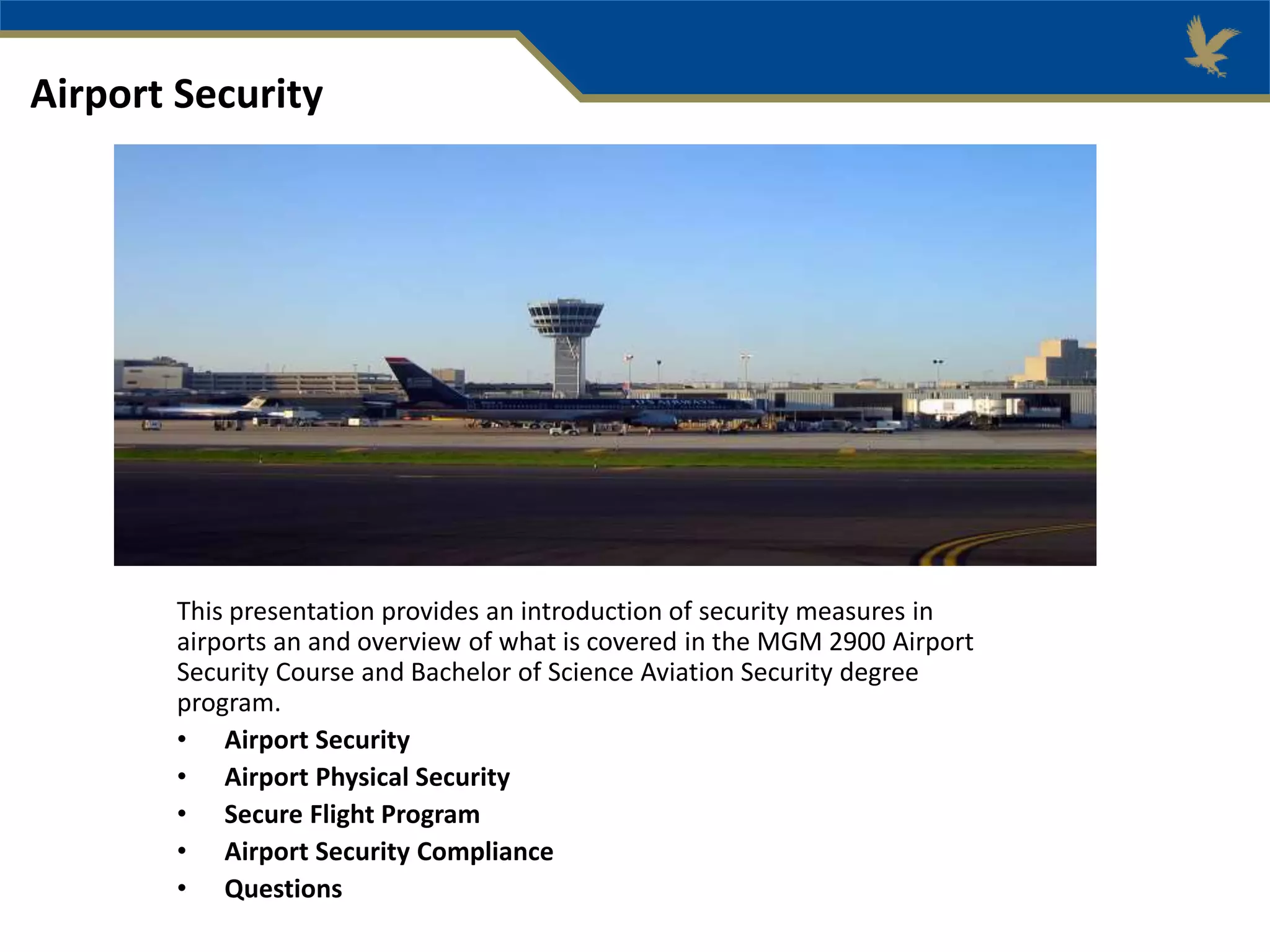
This presentation provides an introduction of security measures in
airports an and overview of what is covered in the MGM 2900 Airport
Security Course and Bachelor of Science Aviation Security degree
program.
• Airport Security
• Airport Physical Security
• Secure Flight Program
• Airport Security Compliance
• Questions
Airport Security
The aviation industry has
evolved from preventing flight
accidents to increasing global
security awareness in the
protection of travelers as well as
national and economic security
interests around the world.
Airport and Aviation
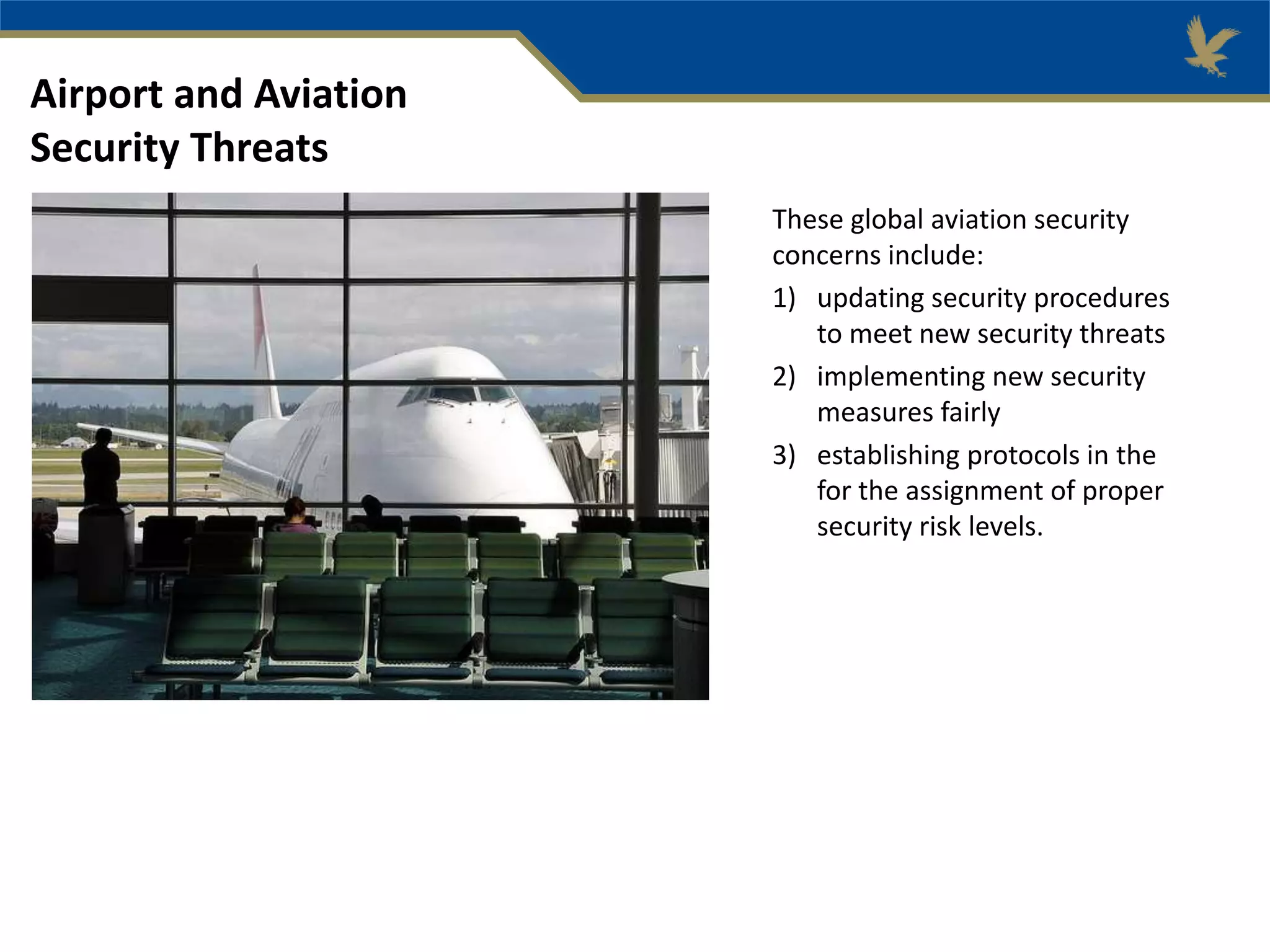
Security Threats
These global aviation security
concerns include:
1) updating security procedures
to meet new security threats
2) implementing new security
measures fairly
3) establishing protocols in the
for the assignment of proper
security risk levels.
Airport and Aviation
Security Threats
Aviation security is vital to protect
airports and aircraft from domestic
and international threats including:
Terrorism
• Hijacking
• Bombs
• Small arms attack
• Missile and Drone Attacks
• Cyberterrorism
Criminal Activity
• Theft and Fraud
• Smuggling
• Assault
• Workplace Violence
Airport and Aviation
Security
An aviation security consideration is to be aware of
internal threats including current and
ex-employees, contract workers and others
who may have physical access to facilities and
aircraft or intelligence of security procedures.
Security credential policies and procedures must
be strictly enforced and reviewed periodically to
prevent theft, fraud, hacking, workplace violence, etc.
Airport and Aviation Security
Airport Physical Security
Along with the airport screening process,
additional measures have been initiated to
physically protect airport terminals and aircraft.
The Security Identification Display Areas (SIDA),
are areas of the highest level of security where
security identification must always be displayed.
Others areas include:
• Security Areas established to limit
access/egress to “cleared” personnel
• Access Control and credentialing
• Intrusion Detection Systems
• Screening of Passengers and Baggage
• Fencing and Barriers
• Security Cameras
• Security Lighting
• Airport Security Coordinator
• Transportation Security Administration
• Law Enforcement Response
• Airline Security
The Transportation Security Administration (TSA) has implemented a uniform watch list
matching program – Secure Flight.
The mission of the Secure Flight program is to enhance the security of domestic and
international commercial air travel in the United States through the use of improved watch
list matching.
• Section 4012 of the Intelligence Reform and Terrorism Prevention Act (IRTPA)
requires the Department of Homeland Security (DHS) to assume the function of
conducting watch list matching of airline passenger data to Federal Government
watch lists for international and domestic flights.
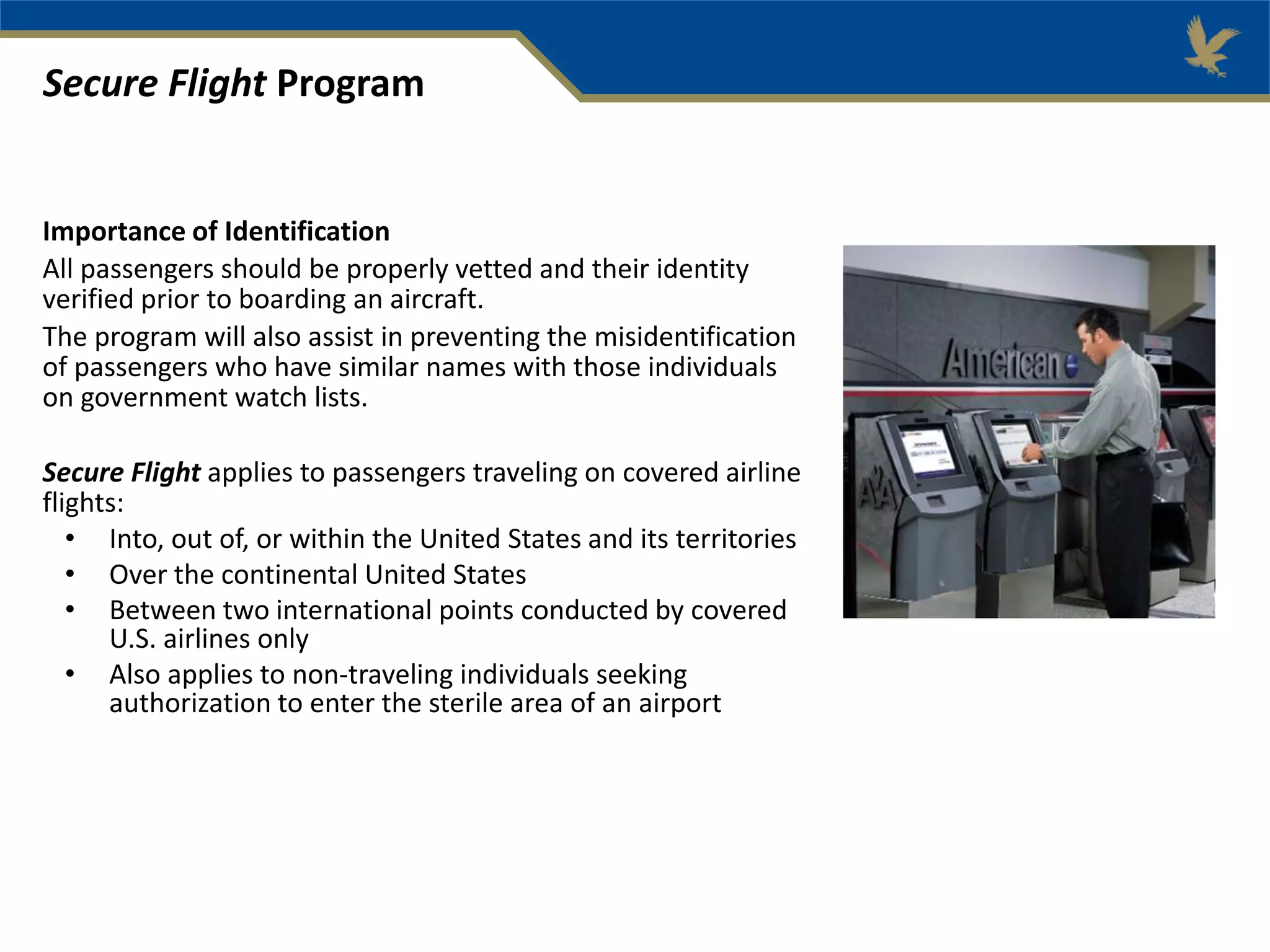
Secure Flight Program
Importance of Identification
All passengers should be properly vetted and their identity
verified prior to boarding an aircraft.
The program will also assist in preventing the misidentification
of passengers who have similar names with those individuals
on government watch lists.
Secure Flight applies to passengers traveling on covered airline
flights:
• Into, out of, or within the United States and its territories
• Over the continental United States
• Between two international points conducted by covered
U.S. airlines only
• Also applies to non-traveling individuals seeking
authorization to enter the sterile area of an airport
Secure Flight Program
• Enhances the security of commercial air travel
• Raises the baseline standard in terms of the
technology and automation used in watch list matching
• Decreases the chance for compromised watch list data
by limiting distribution
• Expedites law enforcement notification by gaining
earlier insight to potential matches
• Provides fair, equitable, and consistent watch list
matching across all airlines
• Facilitates an expedited and integrated redress process
for misidentification passengers
• Supports the travel industry’s operational needs
Secure Flight Program
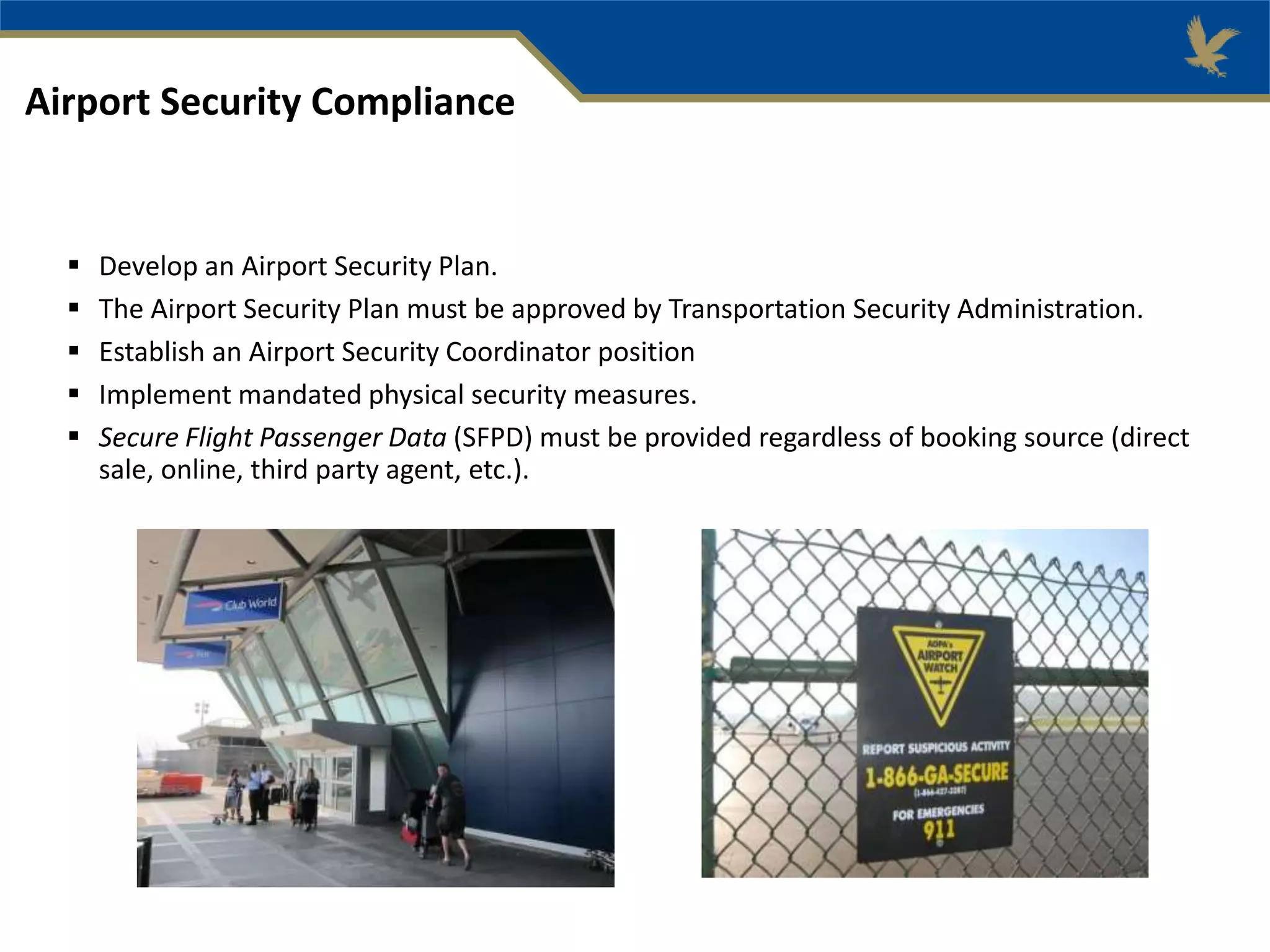
 Develop an Airport Security Plan.
 The Airport Security Plan must be approved by Transportation Security Administration.
 Establish an Airport Security Coordinator position
 Implement mandated physical security measures.
 Secure Flight Passenger Data (SFPD) must be provided regardless of booking source (direct
sale, online, third party agent, etc.).
Airport Security Compliance
Questions?
Airport and Aviation Online Professional Certificates
Aviation and
Airport
Professional
Certificates
Aviation Risk
Management
Airport
Planning,
Design and
Development
Airport Risk
Management
and Safety
Small
Unmanned
Aircraft
Systems
Airport Planning and
Design
MGM 2500
April 2016
6 weeks
Airport Safety and
Certification
MGM 3100
April 2016
6 weeks
Terminal Planning
MGM 2600
August 2016
9 weeks
Optional Course
Airport Security
MGM 2900
April 2016
6 weeks Airport Sustainability and
Environmental Management
MGM 2700
August 2016
6 weeks
Airport
Planning,
Design and
Development
WEB: PROED.ERAU.EDU
EMAIL: TRAINING@ERAU.EDU
Safety Management
Systems
MGM 2000
April 2016
5 weeks
Aviation Risk
Management
Aviation Law and Risk
Management
MGM 2100
April 2016
5 weeks
Aviation Insurance and Risk
Management
MGM 2200
April 2016
5 weeks
Risk Management and
Hazard ID
MGM 2300
April 2016
4 weeks
Financial Risk Management
MGM 2400
April 2016
8 weeks
Safety Management
Systems For Public Service
Aviation
MGM 3000
May 2016
8 weeks
OR
Airport Risk
Management and
Insurance
MGM 2800
April 2016
6 weeks
OR
WEB: PROED.ERAU.EDU
EMAIL: TRAINING@ERAU.EDU
Airport Risk Management
and Insurance
MGM 2800
April 2016
6 weeks
Safety and Risk
Management in the
Construction Industry
RCM 1100
April 2016
6 weeks
Airport Safety and
Certification
MGM 3100
April 2016
6 weeks
Airport Security
MGM 2900
April 2016
6 weeks
Airport Risk
Management
and Safety
(3 required
courses)
Required
Required
Required
Recommended
Online – facilitated asynchronously
Courses can be taken individually or
towards completion of the certificate
WEB: PROED.ERAU.EDU
EMAIL: TRAINING@ERAU.EDU
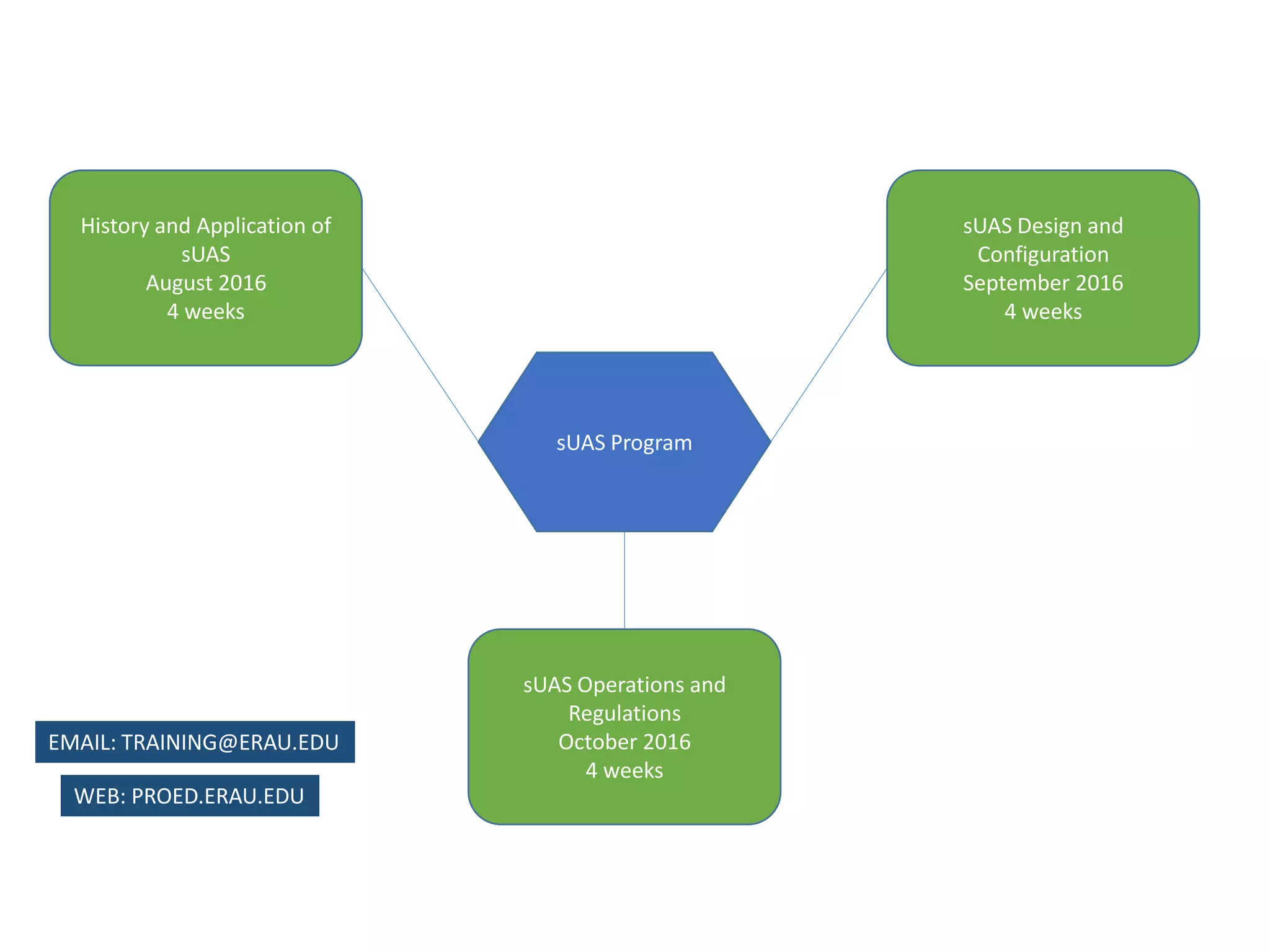
sUAS Program
History and Application of
sUAS
August 2016
4 weeks
sUAS Design and
Configuration
September 2016
4 weeks
sUAS Operations and
Regulations
October 2016
4 weeks
WEB: PROED.ERAU.EDU
EMAIL: TRAINING@ERAU.EDU
Other Online Professional Programs
• Project Management Professional (PMP ®)Test Preparation
• Agile Project Management Course (PMI-ACP ®)
• Aerospace Coatings Applicator Certification Training
• Aerospace Coatings Inspection Course
• Health, Wellness, Regulations and the Environment (Painting Applications)
• Fixed Based Operators Certificate
• Construction Risk Management
• Corporate Aviation Management Certificate
• Specialty Pilot Courses
• Online Ground School
• Business, Law and Finance Courses
WEB: PROED.ERAU.EDU
EMAIL: TRAINING@ERAU.EDU
Questions
• Gary Burke
• 386-226-7232
• Rob Kelly
• 386-226-7436
• Al Astbury
• 386-226-7694
WEB: PROED.ERAU.EDU
EMAIL: TRAINING@ERAU.EDU
Upcoming Webinars:
Apr. 14 Project Management Solutions to Help You Stay on
Schedule and on Budget
May 12 Create Communications that Really Make the Point: Writing
Effective Emails, Reports, and Messages
June 9 How to Write a Resume that Gets Results
webinars.erau.edu
Thank You!
This concludes today’s webinar. Before you log off be sure to complete
our survey. Watch for a follow up email for today’s session that includes
a link to the recording.
For questions about the webinar series:
Bill Gibbs, Webinar Series Coordinator
Bill.Gibbs@erau.edu

Airport planning part 2 -erau webinar

  • 1.
  • 2.
    Today’s Agenda • Welcomeand Introduction —Rob Kelly, Webinar Moderator Project Manager, Office of Professional Education • Presentation by Shawn Arena/Q &A • Presentation by Daniel Benny/Q &A • General Questions and Answers • Airport and Aviation Online Professional Certification • Wrap up and Survey Rob Kelly
  • 3.
    What is yourrole? Poll #1
  • 4.
    A few sessionpointers • We’ll answer questions at the conclusion of each presentation. Post your questions during that speaker’s presentation. Preface the question with the speaker’s name (Arena or Benny). Use the Q&A space for presentation-related questions. • Use the “Technical Help” space if you have technical problems. • Slides are available for download at any time. • The recording link will be emailed to you. • Participation certificates are NOT available for this session. • Be sure to complete our survey, which will be presented at the end of the live session (Survey is not available on the recording).
  • 5.
    What is thegreatest need for training at airports? Poll #2
  • 6.
    Assistant Professor ShawnArena • Assistant Professor at ERAU-Worldwide • 27-year airport industry professional • Management positions at four commercial and four general aviation airports • Accredited Airport Executive (A.A.E) • Active on local, regional and national professional airport boards • Degrees from Embry-Riddle Aeronautical University and the University of Southern California
  • 7.
    Airport Planning & Design Shawn Arena,A.A.E. Assistant Professor, College of Business ERAU-Worldwide LAX Airport Police InternshipJA
  • 8.
    This presentation providesan overview to Airport Planning & Design Certification. Topics covered include: • Present and Future Trends in Airport Planning / Design • Dynamic Strategic Planning (SWOT) • Landside Terminal Design; Ground Access; Baggage Systems • Airport Capacity / Delay • Demand Mgmt. ATM impacts • Airport Layout Design & Environmental concerns Airport Planning & Design
  • 9.
    Regulatory Guidance – AdvisoryCirculars AC 150/5300-13 Current Trends – Mobile apps – Automated Passport Control Future Considerations – Aerotropolis – UAV/UAS impacts – AIP / PFC Funding – Current Pilot Shortage Present & Future Trends In Airport Planning & Design
  • 10.
    Dynamic Planning – Historically,Airport Planners relied strictly on Master Plan Data – Current philosophy is incorporate Dynamic Strategic Planning concepts – SWOT Analysis – Demand Driven not Time Driven Multi- Airport Systems – Efficiently move Pax / Cargo throughout regional hubs – SFO / LAX / HOU / JFK Dynamic Strategic Planning & Multi- Airport Systems
  • 11.
    Five Terminal Design Configurations –Finger Pier (PHX) – Satellites (DCA) – Midfield (DTW) – Linear (SNA) – Transporter (IAD) Ground Access Considerations Intermodal Transportation Baggage Handling Systems RFID In-line systems Terminal Design / Ground Access / Baggage Handling
  • 12.
    • Factors AffectingCapacity of a Runway System – Number and geometric layout of runways – Separation requirements per ATM systems – Visibility, cloud ceiling, and precipitation – Wind direction and speed – Mix of aircraft movements on each runway / sequence – Type and location of taxiway exits from runway (ROT) – State and Performance of ATM system – Noise / other environmental constraints Airfield Capacity & Delay
  • 13.
    • Administrative Policy SlotControl (i.e. High Density Rules) [DCA, LGA, JFK, EWR] FAA required Airline Competition Plan - Large Hub Airports • Economic Policy Congestion Pricing • Hybrid • Slots Plus Congestion Pricing • Slot Auctions Demand Mgmt. /ATM Impact • Administrative / Economic / Hybrid Policies
  • 14.
    Demand Mgmt. cont. ATMImpacts NextGen Benefits (and Drawbacks) • Reduction of Lateral Separation Operations • Curved Approaches and Departures (Recent Drawbacks – Metroplex Rollout) • Design Peak Hour (DPH) • VFR and IFR Differences • BEST Overall Solution • Easier said than done (DFW- DEN)
  • 15.
    The Airport LayoutPlan Set (ALP) is the primary document used for current and future planning and design considerations for any airport. While the complexity and size of an airport may vary (ORD vs. RDD), the FAA requires the following information on the ALP: • Wind Rose • Current and forecasted Terminals • Runways, Taxiways, aircraft ramp area • RSA / OFZ / BRL • FAR Part 77 Imaginary Surfaces • Physical / Natural Boundaries Airfield Layout and Design & Environmental Concerns
  • 16.
  • 17.
    Dr. Daniel Benny •Program Chair for B.S. in Aviation Security • Ph.D. in Criminal Justices and Masters Degrees in Aeronautical Science, Security Administration • Author of leading textbook on general aviation security • Authored more than 300 articles on security administration • U.S. Naval Intelligence Officer • Director of Public Safety • Major in the USAF Auxiliary Civil Air Patrol
  • 18.
    Airport and Aviation Security Dr.Daniel J. Benny, Program Chair Bachelor of Science, Aviation Security LAX Airport Police InternshipJA
  • 19.
    This presentation providesan introduction of security measures in airports an and overview of what is covered in the MGM 2900 Airport Security Course and Bachelor of Science Aviation Security degree program. • Airport Security • Airport Physical Security • Secure Flight Program • Airport Security Compliance • Questions Airport Security
  • 20.
    The aviation industryhas evolved from preventing flight accidents to increasing global security awareness in the protection of travelers as well as national and economic security interests around the world. Airport and Aviation Security Threats
  • 21.
    These global aviationsecurity concerns include: 1) updating security procedures to meet new security threats 2) implementing new security measures fairly 3) establishing protocols in the for the assignment of proper security risk levels. Airport and Aviation Security Threats
  • 22.
    Aviation security isvital to protect airports and aircraft from domestic and international threats including: Terrorism • Hijacking • Bombs • Small arms attack • Missile and Drone Attacks • Cyberterrorism Criminal Activity • Theft and Fraud • Smuggling • Assault • Workplace Violence Airport and Aviation Security
  • 23.
    An aviation securityconsideration is to be aware of internal threats including current and ex-employees, contract workers and others who may have physical access to facilities and aircraft or intelligence of security procedures. Security credential policies and procedures must be strictly enforced and reviewed periodically to prevent theft, fraud, hacking, workplace violence, etc. Airport and Aviation Security
  • 24.
    Airport Physical Security Alongwith the airport screening process, additional measures have been initiated to physically protect airport terminals and aircraft. The Security Identification Display Areas (SIDA), are areas of the highest level of security where security identification must always be displayed. Others areas include: • Security Areas established to limit access/egress to “cleared” personnel • Access Control and credentialing • Intrusion Detection Systems • Screening of Passengers and Baggage • Fencing and Barriers • Security Cameras • Security Lighting • Airport Security Coordinator • Transportation Security Administration • Law Enforcement Response • Airline Security
  • 25.
    The Transportation SecurityAdministration (TSA) has implemented a uniform watch list matching program – Secure Flight. The mission of the Secure Flight program is to enhance the security of domestic and international commercial air travel in the United States through the use of improved watch list matching. • Section 4012 of the Intelligence Reform and Terrorism Prevention Act (IRTPA) requires the Department of Homeland Security (DHS) to assume the function of conducting watch list matching of airline passenger data to Federal Government watch lists for international and domestic flights. Secure Flight Program
  • 26.
    Importance of Identification Allpassengers should be properly vetted and their identity verified prior to boarding an aircraft. The program will also assist in preventing the misidentification of passengers who have similar names with those individuals on government watch lists. Secure Flight applies to passengers traveling on covered airline flights: • Into, out of, or within the United States and its territories • Over the continental United States • Between two international points conducted by covered U.S. airlines only • Also applies to non-traveling individuals seeking authorization to enter the sterile area of an airport Secure Flight Program
  • 27.
    • Enhances thesecurity of commercial air travel • Raises the baseline standard in terms of the technology and automation used in watch list matching • Decreases the chance for compromised watch list data by limiting distribution • Expedites law enforcement notification by gaining earlier insight to potential matches • Provides fair, equitable, and consistent watch list matching across all airlines • Facilitates an expedited and integrated redress process for misidentification passengers • Supports the travel industry’s operational needs Secure Flight Program
  • 28.
     Develop anAirport Security Plan.  The Airport Security Plan must be approved by Transportation Security Administration.  Establish an Airport Security Coordinator position  Implement mandated physical security measures.  Secure Flight Passenger Data (SFPD) must be provided regardless of booking source (direct sale, online, third party agent, etc.). Airport Security Compliance
  • 29.
  • 30.
    Airport and AviationOnline Professional Certificates Aviation and Airport Professional Certificates Aviation Risk Management Airport Planning, Design and Development Airport Risk Management and Safety Small Unmanned Aircraft Systems
  • 31.
    Airport Planning and Design MGM2500 April 2016 6 weeks Airport Safety and Certification MGM 3100 April 2016 6 weeks Terminal Planning MGM 2600 August 2016 9 weeks Optional Course Airport Security MGM 2900 April 2016 6 weeks Airport Sustainability and Environmental Management MGM 2700 August 2016 6 weeks Airport Planning, Design and Development WEB: PROED.ERAU.EDU EMAIL: TRAINING@ERAU.EDU
  • 32.
    Safety Management Systems MGM 2000 April2016 5 weeks Aviation Risk Management Aviation Law and Risk Management MGM 2100 April 2016 5 weeks Aviation Insurance and Risk Management MGM 2200 April 2016 5 weeks Risk Management and Hazard ID MGM 2300 April 2016 4 weeks Financial Risk Management MGM 2400 April 2016 8 weeks Safety Management Systems For Public Service Aviation MGM 3000 May 2016 8 weeks OR Airport Risk Management and Insurance MGM 2800 April 2016 6 weeks OR WEB: PROED.ERAU.EDU EMAIL: TRAINING@ERAU.EDU
  • 33.
    Airport Risk Management andInsurance MGM 2800 April 2016 6 weeks Safety and Risk Management in the Construction Industry RCM 1100 April 2016 6 weeks Airport Safety and Certification MGM 3100 April 2016 6 weeks Airport Security MGM 2900 April 2016 6 weeks Airport Risk Management and Safety (3 required courses) Required Required Required Recommended Online – facilitated asynchronously Courses can be taken individually or towards completion of the certificate WEB: PROED.ERAU.EDU EMAIL: TRAINING@ERAU.EDU
  • 34.
    sUAS Program History andApplication of sUAS August 2016 4 weeks sUAS Design and Configuration September 2016 4 weeks sUAS Operations and Regulations October 2016 4 weeks WEB: PROED.ERAU.EDU EMAIL: TRAINING@ERAU.EDU
  • 35.
    Other Online ProfessionalPrograms • Project Management Professional (PMP ®)Test Preparation • Agile Project Management Course (PMI-ACP ®) • Aerospace Coatings Applicator Certification Training • Aerospace Coatings Inspection Course • Health, Wellness, Regulations and the Environment (Painting Applications) • Fixed Based Operators Certificate • Construction Risk Management • Corporate Aviation Management Certificate • Specialty Pilot Courses • Online Ground School • Business, Law and Finance Courses WEB: PROED.ERAU.EDU EMAIL: TRAINING@ERAU.EDU
  • 36.
    Questions • Gary Burke •386-226-7232 • Rob Kelly • 386-226-7436 • Al Astbury • 386-226-7694 WEB: PROED.ERAU.EDU EMAIL: TRAINING@ERAU.EDU
  • 37.
    Upcoming Webinars: Apr. 14Project Management Solutions to Help You Stay on Schedule and on Budget May 12 Create Communications that Really Make the Point: Writing Effective Emails, Reports, and Messages June 9 How to Write a Resume that Gets Results webinars.erau.edu
  • 38.
    Thank You! This concludestoday’s webinar. Before you log off be sure to complete our survey. Watch for a follow up email for today’s session that includes a link to the recording. For questions about the webinar series: Bill Gibbs, Webinar Series Coordinator Bill.Gibbs@erau.edu

Editor's Notes

  • #17 Titles are 60 font, Gridlines on to see margin spacing and body of text design.
  • #30 Titles are 60 font, Gridlines on to see margin spacing and body of text design.