AUTOMOBILE
PLATFORMS
Outline
• Introduction
• History of automobile
• Evolution
• New trends in automobile industry
• Artificial intelligence in automotive industry
• Data science
• Connected cars
• Future of mobility
AUTOMOBILE PLATFORMS
Introduction For Automobile Platform
Platform,
• A platform is a group of technologies that are used as a base upon which
applications, processes or technologies are developed.
Automobile,
• “auto” mean “itself”. “Mobile” mean “capable of motion”. Together they describe the
ability to move from one place to another without addition power assistance.
• Therefor, “automobile” mean a vehicle that has the capability to move without
external power assistance.
Automobile Platform,
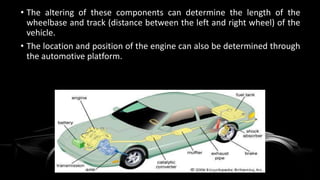
• An automobile platform can be described as the collaboration of certain
components of a vehicle.
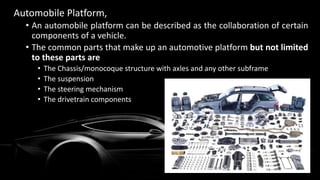
• The common parts that make up an automotive platform but not limited
to these parts are
• The Chassis/monocoque structure with axles and any other subframe
• The suspension
• The steering mechanism
• The drivetrain components
• The altering of these components can determine the length of the
wheelbase and track (distance between the left and right wheel) of the
vehicle.
• The location and position of the engine can also be determined through
the automotive platform.
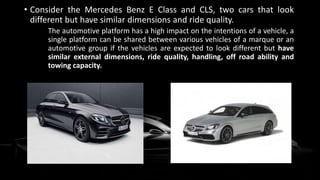
• Consider the Mercedes Benz E Class and CLS, two cars that look
different but have similar dimensions and ride quality.
The automotive platform has a high impact on the intentions of a vehicle, a
single platform can be shared between various vehicles of a marque or an
automotive group if the vehicles are expected to look different but have
similar external dimensions, ride quality, handling, off road ability and
towing capacity.
HISTORY OF AUTOMOBILE
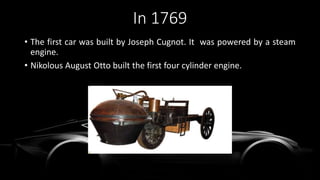
In 1769
• The first car was built by Joseph Cugnot. It was powered by a steam
engine.
• Nikolous August Otto built the first four cylinder engine.
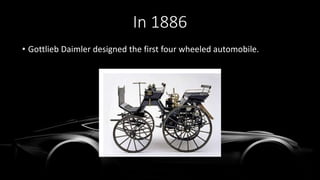
• Gottlieb Daimler designed the first four wheeled automobile.
In 1886
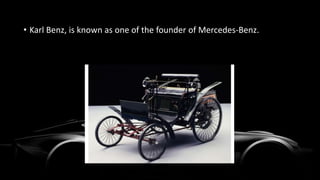
• Karl Benz, is known as one of the founder of Mercedes-Benz.
In 1926
• Gottlieb Daimler and Wilhelm Maybach created Daimler Benz.
In 1927
• Henry Ford, designed the world’ s biggest car.
• Hybrid cars have also been around since the 1900’s.
In 1910
• The first hybrid commercial truck was built.
20th Century And Years Upon.
In 1920
• four wheel hydraulic break systems.
• improve carburetors.
• shatterproof glass.
• Balloon tires.
In 1930
• car engines and bodies become large and luxurious.
Between 1950’s and 1960’s.
• American manufactures started making smaller cars.
• The computer chip manages most of the car system today.
• They also have GPS system in cars.
• Cars are now made of lighter materials that are quite very strong.
EVOLUTION
The Four Leaps,
The great inventions that brought car, to the common are
• Birth of Pneumatic Tyre by DR.Dunlop
• Invention of Assembly Henry Ford ,for Model T
• Thermal Cracking Crude Oil ,by William Burton
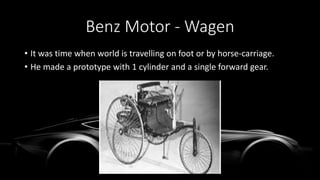
Benz Motor - Wagen
• It was time when world is travelling on foot or by horse-carriage.
• He made a prototype with 1 cylinder and a single forward gear.
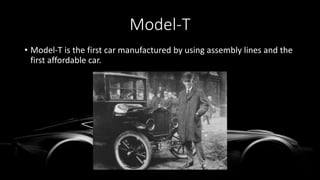
Model-T
• Model-T is the first car manufactured by using assembly lines and the
first affordable car.
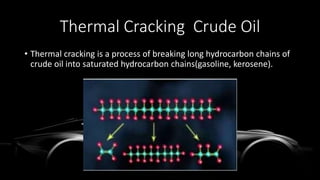
Thermal Cracking Crude Oil
• Thermal cracking is a process of breaking long hydrocarbon chains of
crude oil into saturated hydrocarbon chains(gasoline, kerosene).
Later Developments
There many other developments took place in the field ,which made
cars to become more common ode of transport,
• Common Rail Injections Systems were developed first in Switzerland and
Japan.
• These were very efficient and made cars more smooth ,fuel efficient than
their older cam driven systems .Alfa Romeo 1977 model and c-class used this
technology first.
• Today almost all the automobile manufacturers use this technology with
different names.
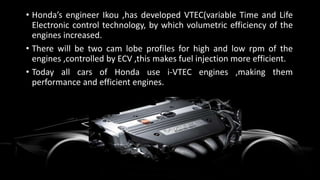
• Honda’s engineer Ikou ,has developed VTEC(variable Time and Life
Electronic control technology, by which volumetric efficiency of the
engines increased.
• There will be two cam lobe profiles for high and low rpm of the
engines ,controlled by ECV ,this makes fuel injection more efficient.
• Today all cars of Honda use i-VTEC engines ,making them
performance and efficient engines.
NEW TRENDS IN
AUTOMOBILE INDUSTRY
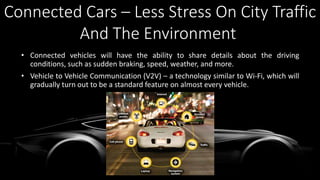
• Connected vehicles will have the ability to share details about the driving
conditions, such as sudden braking, speed, weather, and more.
• Vehicle to Vehicle Communication (V2V) – a technology similar to Wi-Fi, which will
gradually turn out to be a standard feature on almost every vehicle.
Connected Cars – Less Stress On City Traffic
And The Environment
• IoT and connected devices have now made their way into the automotive industry.
• It expected that connected cars will step out of developmental obscurity and become an
important personal item to be connected to the internet.
• While technology in itself isn’t new, the adoption rate of connected vehicle will rise
steadily over the next five years.
IoT ( Internet of Thing) sparking
the growth of connected cars
3D Printing – Changing The Face Of
Automotive Manufacturing
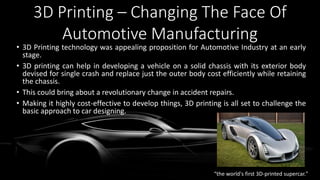
• 3D Printing technology was appealing proposition for Automotive Industry at an early
stage.
• 3D printing can help in developing a vehicle on a solid chassis with its exterior body
devised for single crash and replace just the outer body cost efficiently while retaining
the chassis.
• This could bring about a revolutionary change in accident repairs.
• Making it highly cost-effective to develop things, 3D printing is all set to challenge the
basic approach to car designing.
“the world's first 3D-printed supercar."
Advantages of 3D-Printing in Automotive Industry
Rapid Prototyping
• One of the major benefits of 3D printers in automotive design is the empowerment of rapid
prototyping in the pre-manufacturing stage.
Lower Turnaround Time
• Time saved in the prototyping stages drastically reduces turnaround time across all subsequent
stages of manufacturing.
Low Consumption and Wastage
• 3D printing in automotive design drives lower consumption and wastage unlike the traditional
approaches of vehicle design.
Lower Costs
• Time and resources saved in the various stages of production reduces overall cost of production.
Added Flexibility
• 3D printers in automotive design empowers companies to try multiple options and iterations right in
the development stages, leading to optimum and efficient automobile design.
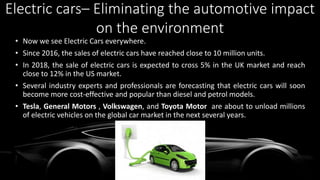
• Now we see Electric Cars everywhere.
• Since 2016, the sales of electric cars have reached close to 10 million units.
• In 2018, the sale of electric cars is expected to cross 5% in the UK market and reach
close to 12% in the US market.
• Several industry experts and professionals are forecasting that electric cars will soon
become more cost-effective and popular than diesel and petrol models.
• Tesla, General Motors , Volkswagen, and Toyota Motor are about to unload millions
of electric vehicles on the global car market in the next several years.
Electric cars– Eliminating the automotive impact
on the environment
Driverless with autonomous vehicles
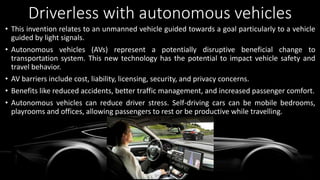
• This invention relates to an unmanned vehicle guided towards a goal particularly to a vehicle
guided by light signals.
• Autonomous vehicles (AVs) represent a potentially disruptive beneficial change to
transportation system. This new technology has the potential to impact vehicle safety and
travel behavior.
• AV barriers include cost, liability, licensing, security, and privacy concerns.
• Benefits like reduced accidents, better traffic management, and increased passenger comfort.
• Autonomous vehicles can reduce driver stress. Self-driving cars can be mobile bedrooms,
playrooms and offices, allowing passengers to rest or be productive while travelling.
ARTIFICIAL INTELLIGENCE IN
AUTOMOTIVE INDUSTRY
Artificial Intelligence(AI).
• AI is emphasize the creation of intelligence machine that work and
react like humans.
• AI and machine learning are creating huge possibilities for reading
and analyzing data from vehicles.
Machine Learning.
• ML focuses on developing programs that grow and change by
themselves as soon as new data is provide.
• machine learning algorithms can be divided into two categories:
• supervised learning algorithms.
• unsupervised learning algorithms.
1. Supervised learning algorithms.
Require known target values for a problem.
• ML algorithms are more than capable for processing images,audio files, videos,
numerical data and text.
• E.g. identify traffic signs using cameras(images of traffic signs).
2. Unsupervised learning algorithms.
• have the goal of characterizing a data set in general.
• Identify relationships between individual data points and group them
into clusters.
• In some case the output from UML algorithms can in turn be used as
an input for supervised methods.
AI In Cars Past And Forecast.
• In 2015,the install rate of AI based systems in new vehicles was just 8%,it is
expected to soar to 109%in 2025.
• Self driving cars with AI are starting to be used in 2017 and will gain more
use in 2018.
• In 2021 will increase the use of autonomous car. (no human driver)
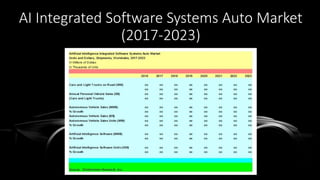
• 90.87 million autonomous-capable consumer vehicle, cars and light trucks
are expected to be on the road worldwide in 2023.(winter Green research)
AI Integrated Software Systems Auto Market
(2017-2023)
Features of Intelligence Car.
• Integrates sensors and bundles sensors.
• Creates map of locations.
• Makes sense of diverse info streams.
• Support navigation and points of interest.
• Implements live weather and traffic monitoring.
Advantages of AI in car.
• Highest level of sophistication.
• Numerous intelligence assistance system support to reduce drivers’
stress levels.
• Make driving more enjoyable.
• Increase driver attentiveness.
DATA SCIENCE
Definition
• Data science is a key technology when it comes to the processes and products with
automatic learning to be used in automotive industry.
• Within consumer industries, data science has been more associated with
manufacturer and design.
• This science is being taken very seriously by vehicle manufacture than ever before.
• The finance and banking industry was an early adopter of big data.
• Banking and insurance company policies were driven down from data analytics and
complex formulas.
Data Mining Process
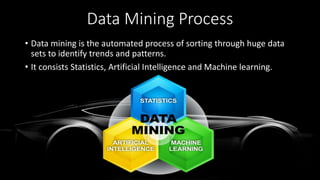
• Data mining is the automated process of sorting through huge data
sets to identify trends and patterns.
• It consists Statistics, Artificial Intelligence and Machine learning.
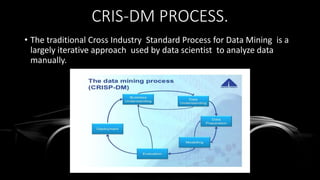
CRIS-DM PROCESS.
• The traditional Cross Industry Standard Process for Data Mining is a
largely iterative approach used by data scientist to analyze data
manually.
The Rise of The Data Use In
Automotive Sector
• Many of us will be aware of the increasing role data now plays in
vehicle servicing. A regular car service entails downloading
information from a vehicle whose sensors monitor report on mileage,
fuel efficiency and routes.
Definitive Predictive Analytics In Automotive
Market Data.
• Succinct predictive analytics in automotive market analysis
• Predictive analytics in automotive technological insight
• Clear competitor analysis
• Actionable business recommendation.
Target audience
• Automobile manufacturers
• Big data specialists
• Technology companies
• Software providers
• Automotive retailers
Companies Listed
• Alpine Data
• American Honda Motor Co
• Angass
• Audi AC
• BMW Group
CONNECTED CARS
Imagine
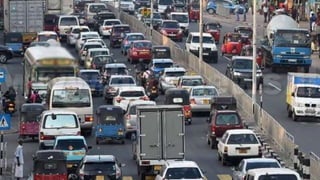
Now you are in Colombo
Traffic
All the vehicle are stuck on the road.
Average time is go to 12 kilometers you have to waste 1 hour.
What are the solutions?
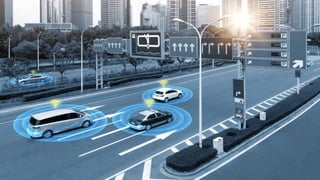
What Is A Connected Car?
The connected car is a vehicle that is connected to the environment
(often the internet) via a mobile data stream.
Environment
• it can be a another car, cloud, pedestrian ,even a system which is
implanted in parking space and anything car can be communicate
via a mobile data stream.
• it is process of transferring data one place to another place through
some network.
• simply a car has been connected with the internet and communicate
with other internet of things we can call it connected car.
Mobile Data Stream
The car includes a SIM card,
• that enables a data stream from the car to cloud servers,
• also a data stream from cloud servers to the car.
What Does By Connected Car
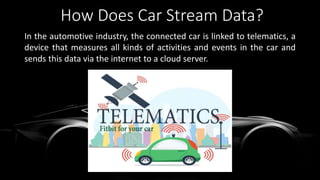
How Does Car Stream Data?
In the automotive industry, the connected car is linked to telematics, a
device that measures all kinds of activities and events in the car and
sends this data via the internet to a cloud server.
• Personal information
• Locations and routes
• Health information
• Consumer insights
What Types of Data Goes To Clouds?
• Increases Safety
• Connected cars enable communication between vehicles, providing
drivers with vital information about obstacles, traffic, difficult turns,
ice, and so on.
Benefits
FUTURE OF MOBILITY
What Is Mobility?
• Mobility includes technologies and services that enable people
and goods to move around more freely.
What Does Future Mobility Look Like
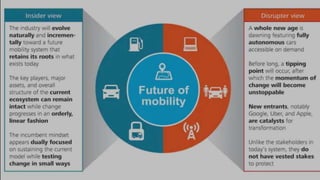
• There are two different visions of the future of the mobility
1. the insider view
2. the disrupter view
• The “insider” view believes that today’s system can progress in
an orderly, linear fashion, in which the current industry assets
• The “disrupter” view envisions a tipping-point approach to a
very different future
Car-Sharing Vs. Ride-Hailing
• There are two different indices of shared mobility: car-sharing
and ride-hailing.
• There are two indices of car sharing, specifically station-based
and free-floating.
• The basic variance lies in the availability of the vehicles.
• Ride hailing, is about sharing a journey.
Contd.
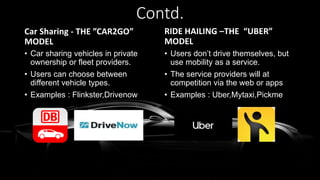
Car Sharing - THE ”CAR2GO”
MODEL
• Car sharing vehicles in private
ownership or fleet providers.
• Users can choose between
different vehicle types.
• Examples : Flinkster,Drivenow
RIDE HAILING –THE “UBER”
MODEL
• Users don’t drive themselves, but
use mobility as a service.
• The service providers will at
competition via the web or apps
• Examples : Uber,Mytaxi,Pickme
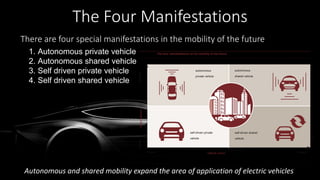
The Four Manifestations
1. Autonomous private vehicle
2. Autonomous shared vehicle
3. Self driven private vehicle
4. Self driven shared vehicle
The four manifestations of the mobility of the future
private
autonomous
private vehicle
self-driven private
vehicle
autonomous
shared vehicle
self-driven shared
vehicle
sharedvehicle owner
There are four special manifestations in the mobility of the future
Autonomous and shared mobility expand the area of application of electric vehicles
THANK YOU!

Automobile platforms

  • 1.
  • 2.
    Outline • Introduction • Historyof automobile • Evolution • New trends in automobile industry • Artificial intelligence in automotive industry • Data science • Connected cars • Future of mobility
  • 3.
  • 4.
    Introduction For AutomobilePlatform Platform, • A platform is a group of technologies that are used as a base upon which applications, processes or technologies are developed. Automobile, • “auto” mean “itself”. “Mobile” mean “capable of motion”. Together they describe the ability to move from one place to another without addition power assistance. • Therefor, “automobile” mean a vehicle that has the capability to move without external power assistance.
  • 5.
    Automobile Platform, • Anautomobile platform can be described as the collaboration of certain components of a vehicle. • The common parts that make up an automotive platform but not limited to these parts are • The Chassis/monocoque structure with axles and any other subframe • The suspension • The steering mechanism • The drivetrain components
  • 6.
    • The alteringof these components can determine the length of the wheelbase and track (distance between the left and right wheel) of the vehicle. • The location and position of the engine can also be determined through the automotive platform.
  • 7.
    • Consider theMercedes Benz E Class and CLS, two cars that look different but have similar dimensions and ride quality. The automotive platform has a high impact on the intentions of a vehicle, a single platform can be shared between various vehicles of a marque or an automotive group if the vehicles are expected to look different but have similar external dimensions, ride quality, handling, off road ability and towing capacity.
  • 8.
  • 9.
    In 1769 • Thefirst car was built by Joseph Cugnot. It was powered by a steam engine. • Nikolous August Otto built the first four cylinder engine.
  • 10.
    • Gottlieb Daimlerdesigned the first four wheeled automobile. In 1886
  • 11.
    • Karl Benz,is known as one of the founder of Mercedes-Benz.
  • 12.
    In 1926 • GottliebDaimler and Wilhelm Maybach created Daimler Benz. In 1927 • Henry Ford, designed the world’ s biggest car. • Hybrid cars have also been around since the 1900’s. In 1910 • The first hybrid commercial truck was built.
  • 13.
    20th Century AndYears Upon. In 1920 • four wheel hydraulic break systems. • improve carburetors. • shatterproof glass. • Balloon tires. In 1930 • car engines and bodies become large and luxurious.
  • 14.
    Between 1950’s and1960’s. • American manufactures started making smaller cars. • The computer chip manages most of the car system today. • They also have GPS system in cars. • Cars are now made of lighter materials that are quite very strong.
  • 15.
  • 16.
    The Four Leaps, Thegreat inventions that brought car, to the common are • Birth of Pneumatic Tyre by DR.Dunlop • Invention of Assembly Henry Ford ,for Model T • Thermal Cracking Crude Oil ,by William Burton
  • 17.
    Benz Motor -Wagen • It was time when world is travelling on foot or by horse-carriage. • He made a prototype with 1 cylinder and a single forward gear.
  • 18.
    Model-T • Model-T isthe first car manufactured by using assembly lines and the first affordable car.
  • 19.
    Thermal Cracking CrudeOil • Thermal cracking is a process of breaking long hydrocarbon chains of crude oil into saturated hydrocarbon chains(gasoline, kerosene).
  • 20.
    Later Developments There manyother developments took place in the field ,which made cars to become more common ode of transport, • Common Rail Injections Systems were developed first in Switzerland and Japan. • These were very efficient and made cars more smooth ,fuel efficient than their older cam driven systems .Alfa Romeo 1977 model and c-class used this technology first. • Today almost all the automobile manufacturers use this technology with different names.
  • 21.
    • Honda’s engineerIkou ,has developed VTEC(variable Time and Life Electronic control technology, by which volumetric efficiency of the engines increased. • There will be two cam lobe profiles for high and low rpm of the engines ,controlled by ECV ,this makes fuel injection more efficient. • Today all cars of Honda use i-VTEC engines ,making them performance and efficient engines.
  • 22.
  • 23.
    • Connected vehicleswill have the ability to share details about the driving conditions, such as sudden braking, speed, weather, and more. • Vehicle to Vehicle Communication (V2V) – a technology similar to Wi-Fi, which will gradually turn out to be a standard feature on almost every vehicle. Connected Cars – Less Stress On City Traffic And The Environment
  • 24.
    • IoT andconnected devices have now made their way into the automotive industry. • It expected that connected cars will step out of developmental obscurity and become an important personal item to be connected to the internet. • While technology in itself isn’t new, the adoption rate of connected vehicle will rise steadily over the next five years. IoT ( Internet of Thing) sparking the growth of connected cars
  • 25.
    3D Printing –Changing The Face Of Automotive Manufacturing • 3D Printing technology was appealing proposition for Automotive Industry at an early stage. • 3D printing can help in developing a vehicle on a solid chassis with its exterior body devised for single crash and replace just the outer body cost efficiently while retaining the chassis. • This could bring about a revolutionary change in accident repairs. • Making it highly cost-effective to develop things, 3D printing is all set to challenge the basic approach to car designing. “the world's first 3D-printed supercar."
  • 26.
    Advantages of 3D-Printingin Automotive Industry Rapid Prototyping • One of the major benefits of 3D printers in automotive design is the empowerment of rapid prototyping in the pre-manufacturing stage. Lower Turnaround Time • Time saved in the prototyping stages drastically reduces turnaround time across all subsequent stages of manufacturing. Low Consumption and Wastage • 3D printing in automotive design drives lower consumption and wastage unlike the traditional approaches of vehicle design. Lower Costs • Time and resources saved in the various stages of production reduces overall cost of production. Added Flexibility • 3D printers in automotive design empowers companies to try multiple options and iterations right in the development stages, leading to optimum and efficient automobile design.
  • 27.
    • Now wesee Electric Cars everywhere. • Since 2016, the sales of electric cars have reached close to 10 million units. • In 2018, the sale of electric cars is expected to cross 5% in the UK market and reach close to 12% in the US market. • Several industry experts and professionals are forecasting that electric cars will soon become more cost-effective and popular than diesel and petrol models. • Tesla, General Motors , Volkswagen, and Toyota Motor are about to unload millions of electric vehicles on the global car market in the next several years. Electric cars– Eliminating the automotive impact on the environment
  • 28.
    Driverless with autonomousvehicles • This invention relates to an unmanned vehicle guided towards a goal particularly to a vehicle guided by light signals. • Autonomous vehicles (AVs) represent a potentially disruptive beneficial change to transportation system. This new technology has the potential to impact vehicle safety and travel behavior. • AV barriers include cost, liability, licensing, security, and privacy concerns. • Benefits like reduced accidents, better traffic management, and increased passenger comfort. • Autonomous vehicles can reduce driver stress. Self-driving cars can be mobile bedrooms, playrooms and offices, allowing passengers to rest or be productive while travelling.
  • 29.
  • 30.
    Artificial Intelligence(AI). • AIis emphasize the creation of intelligence machine that work and react like humans. • AI and machine learning are creating huge possibilities for reading and analyzing data from vehicles.
  • 31.
    Machine Learning. • MLfocuses on developing programs that grow and change by themselves as soon as new data is provide. • machine learning algorithms can be divided into two categories: • supervised learning algorithms. • unsupervised learning algorithms.
  • 32.
    1. Supervised learningalgorithms. Require known target values for a problem. • ML algorithms are more than capable for processing images,audio files, videos, numerical data and text. • E.g. identify traffic signs using cameras(images of traffic signs).
  • 33.
    2. Unsupervised learningalgorithms. • have the goal of characterizing a data set in general. • Identify relationships between individual data points and group them into clusters. • In some case the output from UML algorithms can in turn be used as an input for supervised methods.
  • 34.
    AI In CarsPast And Forecast. • In 2015,the install rate of AI based systems in new vehicles was just 8%,it is expected to soar to 109%in 2025. • Self driving cars with AI are starting to be used in 2017 and will gain more use in 2018. • In 2021 will increase the use of autonomous car. (no human driver) • 90.87 million autonomous-capable consumer vehicle, cars and light trucks are expected to be on the road worldwide in 2023.(winter Green research)
  • 35.
    AI Integrated SoftwareSystems Auto Market (2017-2023)
  • 36.
    Features of IntelligenceCar. • Integrates sensors and bundles sensors. • Creates map of locations. • Makes sense of diverse info streams. • Support navigation and points of interest. • Implements live weather and traffic monitoring.

  • 37.
    Advantages of AIin car. • Highest level of sophistication. • Numerous intelligence assistance system support to reduce drivers’ stress levels. • Make driving more enjoyable. • Increase driver attentiveness.
  • 38.
  • 39.
    Definition • Data scienceis a key technology when it comes to the processes and products with automatic learning to be used in automotive industry. • Within consumer industries, data science has been more associated with manufacturer and design. • This science is being taken very seriously by vehicle manufacture than ever before. • The finance and banking industry was an early adopter of big data. • Banking and insurance company policies were driven down from data analytics and complex formulas.
  • 40.
    Data Mining Process •Data mining is the automated process of sorting through huge data sets to identify trends and patterns. • It consists Statistics, Artificial Intelligence and Machine learning.
  • 41.
    CRIS-DM PROCESS. • Thetraditional Cross Industry Standard Process for Data Mining is a largely iterative approach used by data scientist to analyze data manually.
  • 42.
    The Rise ofThe Data Use In Automotive Sector • Many of us will be aware of the increasing role data now plays in vehicle servicing. A regular car service entails downloading information from a vehicle whose sensors monitor report on mileage, fuel efficiency and routes.
  • 43.
    Definitive Predictive AnalyticsIn Automotive Market Data. • Succinct predictive analytics in automotive market analysis • Predictive analytics in automotive technological insight • Clear competitor analysis • Actionable business recommendation.
  • 44.
    Target audience • Automobilemanufacturers • Big data specialists • Technology companies • Software providers • Automotive retailers Companies Listed • Alpine Data • American Honda Motor Co • Angass • Audi AC • BMW Group
  • 45.
  • 46.
  • 48.
    Traffic All the vehicleare stuck on the road. Average time is go to 12 kilometers you have to waste 1 hour. What are the solutions?
  • 50.
    What Is AConnected Car? The connected car is a vehicle that is connected to the environment (often the internet) via a mobile data stream.
  • 51.
    Environment • it canbe a another car, cloud, pedestrian ,even a system which is implanted in parking space and anything car can be communicate via a mobile data stream. • it is process of transferring data one place to another place through some network. • simply a car has been connected with the internet and communicate with other internet of things we can call it connected car. Mobile Data Stream
  • 52.
    The car includesa SIM card, • that enables a data stream from the car to cloud servers, • also a data stream from cloud servers to the car. What Does By Connected Car
  • 53.
    How Does CarStream Data? In the automotive industry, the connected car is linked to telematics, a device that measures all kinds of activities and events in the car and sends this data via the internet to a cloud server.
  • 54.
    • Personal information •Locations and routes • Health information • Consumer insights What Types of Data Goes To Clouds?
  • 55.
    • Increases Safety •Connected cars enable communication between vehicles, providing drivers with vital information about obstacles, traffic, difficult turns, ice, and so on. Benefits
  • 56.
  • 57.
    What Is Mobility? •Mobility includes technologies and services that enable people and goods to move around more freely.
  • 58.
    What Does FutureMobility Look Like • There are two different visions of the future of the mobility 1. the insider view 2. the disrupter view • The “insider” view believes that today’s system can progress in an orderly, linear fashion, in which the current industry assets • The “disrupter” view envisions a tipping-point approach to a very different future
  • 60.
    Car-Sharing Vs. Ride-Hailing •There are two different indices of shared mobility: car-sharing and ride-hailing. • There are two indices of car sharing, specifically station-based and free-floating. • The basic variance lies in the availability of the vehicles. • Ride hailing, is about sharing a journey.
  • 61.
    Contd. Car Sharing -THE ”CAR2GO” MODEL • Car sharing vehicles in private ownership or fleet providers. • Users can choose between different vehicle types. • Examples : Flinkster,Drivenow RIDE HAILING –THE “UBER” MODEL • Users don’t drive themselves, but use mobility as a service. • The service providers will at competition via the web or apps • Examples : Uber,Mytaxi,Pickme
  • 62.
    The Four Manifestations 1.Autonomous private vehicle 2. Autonomous shared vehicle 3. Self driven private vehicle 4. Self driven shared vehicle The four manifestations of the mobility of the future private autonomous private vehicle self-driven private vehicle autonomous shared vehicle self-driven shared vehicle sharedvehicle owner There are four special manifestations in the mobility of the future Autonomous and shared mobility expand the area of application of electric vehicles
  • 63.