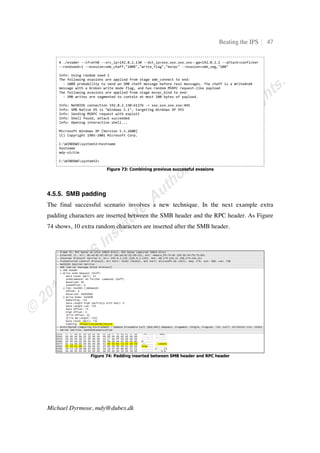
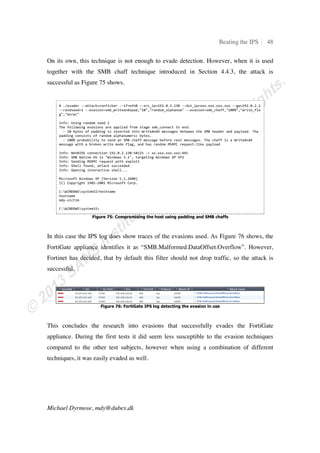
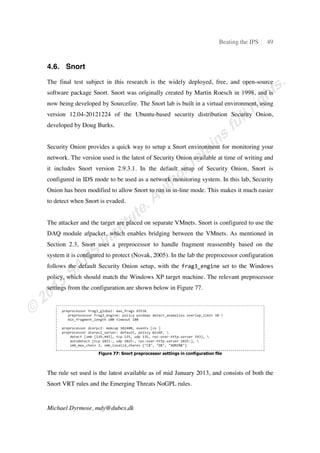
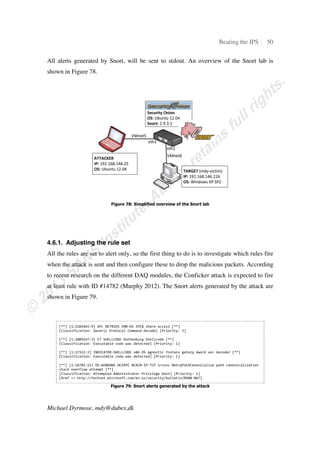
Interested in learning
more about security?
SANS Institute
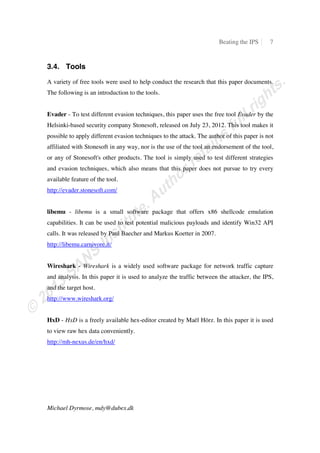
InfoSec Reading Room
This paper is from the SANS Institute Reading Room site. Reposting is not permitted without express written permission.
Beating the IPS
This paper introduces various Intrusion Prevention System (IPS) evasion techniques and shows how they can be
used to successfully evade detection by widely used products from major security vendors. By manipulating the
header, payload, and traffic flow of a well-known attack, it is possible to trick the IPS inspection engines
into passing the traffic - allowing the attacker shell access to the target system protected by the IPS.
Copyright SANS Institute
Author Retains Full Rights
AD
BEATING THE IPS
GIAC (GCIA) Gold Certification
Author:
Michael Dyrmose
Security Consultant
Dubex A/S
mdy@dubex.dk dyrmose@gmail.com
Advisor:
Rob VandenBrink
Accepted: January 5th
2013
Abstract
This paper introduces various Intrusion Prevention System (IPS) evasion techniques and
shows how they can be used to successfully evade detection by widely used products
from major security vendors. By manipulating the header, payload, and traffic flow of a
well-known attack, it is possible to trick the IPS inspection engines into passing the
traffic - allowing the attacker shell access to the target system protected by the IPS.
Beating the IPS 2
Michael Dyrmose, mdy@dubex.dk
1. Introduction
Firewalls and Intrusion Prevention Systems (IPS) are core equipment in any enterprise or
organization’s network infrastructure. While a simple firewall filters traffic based on
information such as TCP/UDP ports and IP-addresses, IPSs are doing a much more in-
depth investigation into the actual data contents of the network packet. To really
understand and evaluate the network packets, the system needs a deep understanding of
the network protocols in use. Implementing protocol understanding might seem like a
fairly straightforward task; however, it often proves not to be.
Back in 1998, Ptacek and Newsham demonstrated how IDS systems could be evaded by
using various techniques such as overlapping fragments, wrapping sequence numbers,
and packet insertion. This was possible because the IDS might not process and interpret
the packets in the same way the protected host behind it would (Ptacek & Newsham,
1998).
This paper will show that some of the techniques introduced by Ptacek and Newsham can
still be used today. When applying different evasion techniques to a known and well-
documented attack, it is possible to bypass a range of IPS products from a variety of
major vendors. The techniques used in this paper tamper with different protocols
spanning the Internet Layer (IPv4), the Transport Layer (TCP) and the Application Layer
(SMB).
The paper begins with an introduction to different areas in the field of evasion as well as
a technical explanation of the vulnerability being exploited. This is followed by a study
of the impact of applying different evasion techniques to combat the IPS solutions. The
study will prove just how vulnerable modern IPS products are to minor modifications to
the attack.
Beating the IPS 3
Michael Dyrmose, mdy@dubex.dk
2. Evasion techniques
There are a number of quite different approaches and techniques that can be used when it
comes to IPS evasion. This chapter provides an overview of the different categories.
2.1. Obfuscation
Simply speaking, obfuscation is the process of taking a readable string of characters, and
turning it into something that is unreadable (obfuscated). Though the result may be
difficult to interpret or identify, the obfuscated result still performs the same actions as
the original string. Often, this technique is used by attackers to hide malicious activity in
executable code. This paper will use the built-in obfuscation capabilities in the attack
tool, when simple string-matching filters are the final obstacle to overcome.
2.2. Encryption and tunneling
Encryption and tunneling of encrypted data is another strategy that can be used to avoid
IPS inspection. Encrypting the attack by sending it through an SSH connection or in a
VPN tunnel makes it virtually impossible for the IPS to inspect the data. To do this, the
IPS has to be placed at a point in the network which lies after the tunnel termination
(Burns & Adesina, 2011). This paper does not use any techniques in this category, as this
approach would require that a previous connection was established to the target machine
through the IPS.
2.3. Fragmentation
By splitting up malicious network packets into smaller fragments, an attacker might be
able to circumvent the network security mechanisms in place. This approach is known as
fragmentation. The issue with fragmentation is that the IPS has to reassemble the packets
in order to identify the attack. Each fragment contains a value in the header that informs
the receiver of the data’s position in the original data stream. If the fragments are
Beating the IPS 4
Michael Dyrmose, mdy@dubex.dk
modified in such a way that the fragments are overlapping, reassembly becomes complex,
as it is not clear which of the fragments’ data should be used. To add to the confusion,
different operating systems treat overlapping fragments differently.
So if the IPS reassembles the packets differently from the end host, it may reassemble the
fragments to a non-malicious payload and allow it. At the same time, the end host
reassembles the same fragments into a malicious payload, thus allowing the attacker to
compromise the system (Baggett, 2012). Judy Novak’s paper on fragmentation
reassembly discusses these issues and demonstrates how Snort uses a preprocessor to
handle fragments differently based on the systems it’s configured to protect (Novak,
2005). In the demonstration section of this paper, both simple fragmentation and
overlapping fragments will be used in some scenarios.
Another approach in the area of fragmentation is simply to delay the fragments. If the IPS
has a different timeout for fragments than the end host, the IPS can potentially be evaded
by delaying the packets. When the IPS receives the next fragment, it has lost the context
of the previously received fragments and allows the packet, since the fragment on its own
is not malicious. The end host might still be waiting for the fragment though, and will
reassemble the fragments into the malicious payload. This paper does not use any evasion
techniques that relate to timeouts.
2.4. Protocol violations
Many attacks are targeted at complex protocols such as SMB (Server Message Block). In
order to provide protection to a complex protocol, the IPS has to have a deep
understanding of it. The implementation also needs to be fault-tolerant and resilient to be
able to cope with excessive and unexpected connections and requests. The research
presented in this paper utilizes techniques from this category to great extent. The results
will show how modified header values, flags and decoy connections can be used to
successfully evade many IPS products. Each approach will be described in more detail
when used.
Beating the IPS 5
Michael Dyrmose, mdy@dubex.dk
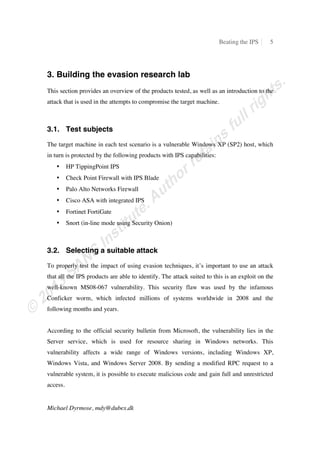
3. Building the evasion research lab
This section provides an overview of the products tested, as well as an introduction to the
attack that is used in the attempts to compromise the target machine.
3.1. Test subjects
The target machine in each test scenario is a vulnerable Windows XP (SP2) host, which
in turn is protected by the following products with IPS capabilities:
• HP TippingPoint IPS
• Check Point Firewall with IPS Blade
• Palo Alto Networks Firewall
• Cisco ASA with integrated IPS
• Fortinet FortiGate
• Snort (in-line mode using Security Onion)
3.2. Selecting a suitable attack
To properly test the impact of using evasion techniques, it’s important to use an attack
that all the IPS products are able to identify. The attack suited to this is an exploit on the
well-known MS08-067 vulnerability. This security flaw was used by the infamous
Conficker worm, which infected millions of systems worldwide in 2008 and the
following months and years.
According to the official security bulletin from Microsoft, the vulnerability lies in the
Server service, which is used for resource sharing in Windows networks. This
vulnerability affects a wide range of Windows versions, including Windows XP,
Windows Vista, and Windows Server 2008. By sending a modified RPC request to a
vulnerable system, it is possible to execute malicious code and gain full and unrestricted
access.
Beating the IPS 6
Michael Dyrmose, mdy@dubex.dk
Even though the MS08-067 exploit is ‘old’, and due to OS patching does not pose as big
a threat anymore, it is still a good example to use when evaluating evasion techniques.
This is both due to the history and publicity that the Conficker worm received, as well as
the fact that the security vendors have now had lots of time to adjust and improve their
protections against the attack. Besides… the Conficker worm exploiting this vulnerability
is still active on the Internet as of 2012 (Kandek, 2012).
3.3. Technical details
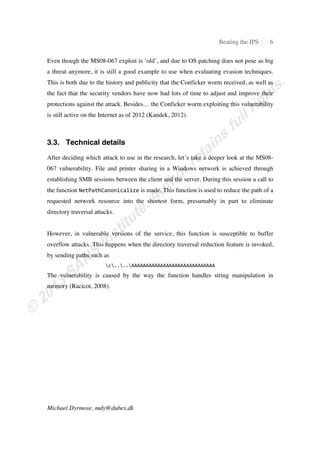
After deciding which attack to use in the research, let’s take a deeper look at the MS08-
067 vulnerability. File and printer sharing in a Windows network is achieved through
establishing SMB sessions between the client and the server. During this session a call to
the function ‡–ƒ–Š ƒ‘‹…ƒŽ‹œ‡ is made. This function is used to reduce the path of a
requested network resource into the shortest form, presumably in part to eliminate
directory traversal attacks.
However, in vulnerable versions of the service, this function is susceptible to buffer
overflow attacks. This happens when the directory traversal reduction feature is invoked,
by sending paths such as
Ɏ…ɎŜŜɎŜŜɎ
The vulnerability is caused by the way the function handles string manipulation in
memory (Racicot, 2008).
Beating the IPS 7
Michael Dyrmose, mdy@dubex.dk
3.4. Tools
A variety of free tools were used to help conduct the research that this paper documents.
The following is an introduction to the tools.
Evader - To test different evasion techniques, this paper uses the free tool Evader by the
Helsinki-based security company Stonesoft, released on July 23, 2012. This tool makes it
possible to apply different evasion techniques to the attack. The author of this paper is not
affiliated with Stonesoft in any way, nor is the use of the tool an endorsement of the tool,
or any of Stonesoft's other products. The tool is simply used to test different strategies
and evasion techniques, which also means that this paper does not pursue to try every
available feature of the tool.
http://evader.stonesoft.com/
libemu - libemu is a small software package that offers x86 shellcode emulation
capabilities. It can be used to test potential malicious payloads and identify Win32 API
calls. It was released by Paul Baecher and Markus Koetter in 2007.
http://libemu.carnivore.it/
Wireshark - Wireshark is a widely used software package for network traffic capture
and analysis. In this paper it is used to analyze the traffic between the attacker, the IPS,
and the target host.
http://www.wireshark.org/
HxD - HxD is a freely available hex-editor created by Maël Hörz. In this paper it is used
to view raw hex data conveniently.
http://mh-nexus.de/en/hxd/
Beating the IPS 8
Michael Dyrmose, mdy@dubex.dk
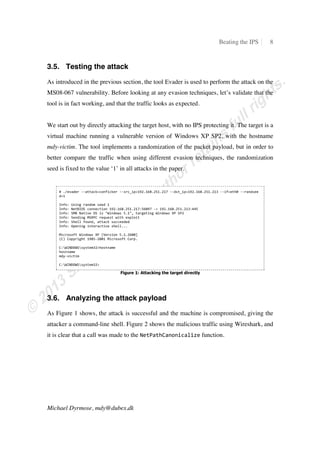
3.5. Testing the attack
As introduced in the previous section, the tool Evader is used to perform the attack on the
MS08-067 vulnerability. Before looking at any evasion techniques, let’s validate that the
tool is in fact working, and that the traffic looks as expected.
We start out by directly attacking the target host, with no IPS protecting it. The target is a
virtual machine running a vulnerable version of Windows XP SP2, with the hostname
mdy-victim. The tool implements a randomization of the packet payload, but in order to
better compare the traffic when using different evasion techniques, the randomization
seed is fixed to the value ‘1’ in all attacks in the paper.
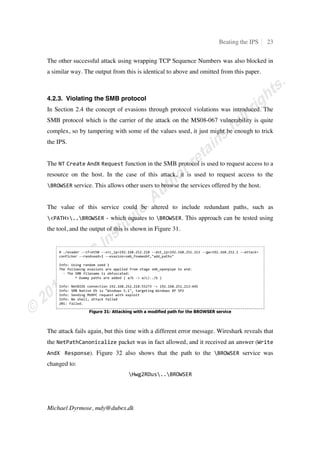
ɤ Ŝŵ‡˜ƒ†‡” ŞŞƒ––ƒ…ʰ…‘ˆ‹…‡” ŞŞ•”…ɏ‹’ʰɨɰɩŜɨɭɯŜɩɬɨŜɩɨɮ ŞŞ†•–ɏ‹’ʰɨɰɩŜɨɭɯŜɩɬɨŜɩɨɪ ŞŞ‹ˆʰ‡–Šɥ ŞŞ”ƒ†•‡‡
†ʰɨ
ˆ‘ś •‹‰ ”ƒ†‘ •‡‡† ɨ
ˆ‘ś ‡–
…‘‡…–‹‘ ɨɰɩŜɨɭɯŜɩɬɨŜɩɨɮśɬɭɥɰɮ Şʴ ɨɰɩŜɨɭɯŜɩɬɨŜɩɨɪśɫɫɬ
ˆ‘ś  ƒ–‹˜‡  ‹• ɑ‹†‘™• ɬŜɨɑř –ƒ”‰‡–‹‰ ‹†‘™•  ɩ
ˆ‘ś ‡†‹‰  ”‡“—‡•– ™‹–Š ‡š’Ž‘‹–
ˆ‘ś Š‡ŽŽ ˆ‘—†ř ƒ––ƒ… •—……‡‡†‡†
ˆ‘ś ’‡‹‰ ‹–‡”ƒ…–‹˜‡ •Š‡ŽŽŜŜŜ
‹…”‘•‘ˆ– ‹†‘™•  ƃ‡”•‹‘ ɬŜɨŜɩɭɥɥƄ
ſ ƀ ‘’›”‹‰Š– ɨɰɯɬŞɩɥɥɨ ‹…”‘•‘ˆ– ‘”’Ŝ
śɎ
Ɏ•›•–‡ɪɩʴŠ‘•–ƒ‡
Š‘•–ƒ‡
†›Ş˜‹…–‹
śɎ
Ɏ•›•–‡ɪɩʴ
Figure 1: Attacking the target directly
3.6. Analyzing the attack payload
As Figure 1 shows, the attack is successful and the machine is compromised, giving the
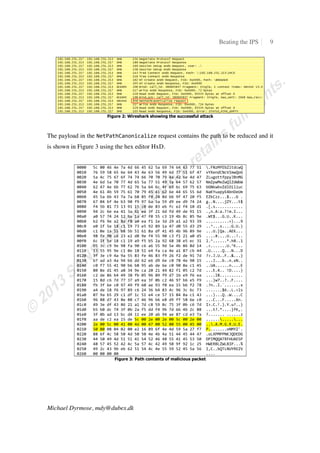
attacker a command-line shell. Figure 2 shows the malicious traffic using Wireshark, and
it is clear that a call was made to the ‡–ƒ–Š ƒ‘‹…ƒŽ‹œ‡ function.
Beating the IPS 9
Michael Dyrmose, mdy@dubex.dk
Figure 2: Wireshark showing the successful attack
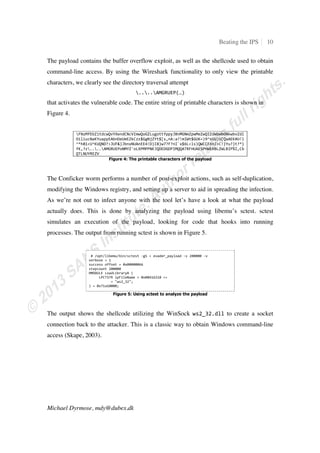
The payload in the ‡–ƒ–Š ƒ‘‹…ƒŽ‹œ‡ request contains the path to be reduced and it
is shown in Figure 3 using the hex editor HxD.
ɥɥɥɥ ɬ… ɥɥ ɫɭ ɫ‡ ɮƒ ɫ† ɭɭ ɫɬ ɭɩ ɬƒ ɭɰ ɮɫ ɭɫ ɭɪ ɮɮ ɬɨ ɎŜ œˆ „‹–†…™
ɥɥɨɥ ɮɭ ɬɰ ɬɯ ɭɬ ɭ‡ ɭɫ ɫɪ ɫ‡ ɭɪ ɬɭ ɫɰ ɭ† ɮɮ ɬɨ ɭˆ ɫɮ ˜‡† …
™‘

ɥɥɩɥ ɬƒ ɫ… ɮɬ ɭɮ ɭˆ ɮɫ ɮɫ ɭɭ ɮɥ ɮɥ ɮɰ ɫƒ ɫɩ ɭ‡ ɫ† ɫɮ —‰‘––ˆ’’›
 

ɥɥɪɥ ɫ‡ ɭ† ɬƒ ɮɥ ɮɮ ɫ† ɭɬ ɬƒ ɮɮ ɬɨ ɫɰ ɬƒ ɭɫ ɬɮ ɭɩ ɬɮ ’™‡™
†„
ɥɥɫɥ ɭɩ ɫɮ ɫ‡ ɭ„ ɮɮ ɭɩ ɮɭ ɬƒ ɭɫ ɭ… ɫˆ ɭɰ ɭ… ɭɰ ɮɬ ɭɪ „
™„˜†Ž‹Ž‹—…
ɥɥɬɥ ɫ‡ ɭɨ ɫ„ ɬɰ ɮɬ ɭɨ ɮɥ ɮɰ ɫɬ ɫɨ ɭɩ ɭ‡ ɫɫ ɭɬ ɬɬ ɭ† ƒ—ƒ’› „ ‡
ɥɥɭɥ ɫɬ ɬƒ ɭ„ ɫɪ ɮƒ ɮƒ „ɯ ɯɬ ˆɯ ɩɫ ɯ† „ɭ ɰˆ ɫɮ ɩɥ ˆɬ  œœŜŜŜɛŜŜŜ
 Ŝ
ɥɥɮɥ ɭɮ ɥɫ „ˆ ɫ‡ „ɪ ɰɥ ˆɰ ɰɮ ɭƒ ɬƒ ɬɰ †ɰ ‡‡ †ɰ ɮɫ ɩɫ ‰ŜŜŜŜŜŜŒŜŜŜ–ɛ
ɥɥɯɥ ˆɫ ɬ„ ɯɨ ɮɪ ɨɪ ɰɨ ɨɬ …ɥ †‡ ɯɪ ‡„ ˆ… ‡ɩ ˆɫ ɨɥ †ɨ ŜƃŜ•ŜŜŜŜŜŜŜŜŜŜŜŜ
ɥɥɰɥ ɰɫ ɩ… ɭ‡ ‡ƒ ɫɨ ɪƒ ɭɨ ‡ƒ ɪˆ ɩɨ ɭ† ˆ† ɫɰ †‡ ɰɨ ɨɬ ŜřŜ śƒŜţŠŜ
ŜŜŜ
ɥɥƒɥ ƒɥ ɬɮ ɮɫ ɩɫ ɨɩ „ƒ ɨƒ ɫɮ ˆɥ ɬɬ …ɪ ɨɰ ɫ„ ɯ… ɯɬ ɰ‡ Ŝ–ɛŜŜŜ
ŜŜŜŜŜŜ
ɥɥ„ɥ „ɩ ˆɭ ɰ‡ ƒɩ ɯƒ ˆɯ ƒɥ ‡ƒ ˆɨ ɨ‡ ɪ† ɩɰ ƒɨ ƒɩ ɰɪ ɪɰ ŜŜŜŜŜŜŜŜŜŜʰƀŜŜŜɰ
ɥɥ…ɥ ‡ɥ ɨˆ ɬ‡ ɨɯ …ɨ ɨɰ ɮɪ ‡ɬ ɰɩ ɯɰ ɨƒ ɫɮ †ɥ ɬɬ †ɪ ɩɰ ŜŜɋŜŜŜ•ŜŜŜŜ
ŜŜƀ
ɥɥ†ɥ …ɨ ɥ‡ ɨƒ ɬɬ „ɯ ɬ„ ɬɨ ɭɨ ɯƒ †ˆ ɫɨ ɫɬ ɫ„ ɰɭ ɯɰ ɰ‡ ŜŜŜŜƃƒŜŜ ŜŜŜ
ɥɥ‡ɥ ɰɯ ˆ‡ ɰɥ …ɭ ɩɪ ‡ɩ †ɯ ɰ‡ ˆɫ ɬɬ ɰɥ …ɪ ˆɨ ɩɨ ƒɥ †ɬ ŜŜŜŜɤŜŜŜŜŜŜŜŠŜŜ
ɥɥˆɥ ɭ… ɨˆ ɬ‡ ɨɯ …ɨ ɨɰ ƒɰ ˆɬ „ɬ ɩƒ ɰɩ ɭɯ ɪɯ ‡ɬ ‡… ɪɨ ŽŜɋŜŜŜŜŜŜƋŜŠɯŜŜɨ
ɥɨɥɥ „ɬ ɪ… …ɰ ɰ‡ ɰɯ ˆƒ ɰɥ …ɭ ƒɭ ɬɬ ɰ† ɬ‡ ɫ„ ɯɭ ɯ† ɨɫ ŜʳŜŜŜŜŜŜŜŜɋŜŜŜ
ɥɨɨɥ ɨɪ ɬɬ ɰɬ ɰ‡ …ɨ ɥ‡ ɨɯ ɬɨ ‡ɫ ˆƒ …ƒ ɫ‡ ƒɨ ɯɮ …„ ɫɫ ŜŜŜŜŜŜŜŜŜŜŜŜ
ɥɨɩɥ ɪˆ ɪ‡ …ɰ ɫƒ ɰƒ ɬɬ ɯɪ ˆ‡ ɫɭ ɯɪ ˆɰ ɩɭ ˆɩ †‡ ɰɨ ɮ† ţʴŜ
ŜŜŜ ŜŜĺŜŜŜƈ
ɥɨɪɥ „ɮ ƒ† ƒɪ ɫƒ ɰɫ „ɭ †† ɭɩ ‡ɭ †ɰ ɭ‡ …ɥ ɮɯ ɫ‡ ɰɥ ɨɬ ŜŜŜ
ŜŜŜ„ŜŜŜšŜŜ
ɥɨɫɥ …ɥ ˆɮ ɬɬ ɫɨ ɰɥ „ɭ „ɯ ɰɬ ƒ„ †‡ ɭ‡ …ɥ ɰɥ ɯ‡ …ɨ ɫɬ ŜŜ ŜŜŜŜŜŜŜŜŜŜ
ɥɨɬɥ ɯɥ ɯ‡ †ɨ ɫɬ ƒɯ ɪɫ ɰ‡ …ƒ ɩɥ ɩɨ ɫɫ ɯɩ ˆɨ ɥɬ …ɩ ɮ† ŜŜŜ ŜɫŜŜ Š ŜŜŜŜƈ
ɥɨɭɥ …ɩ †‡ ɯɭ „ɫ ɫɰ ɪɯ ˆ„ ɥɬ ɰɭ ɯɰ ˆɰ †ɮ ɨ„ ‡ɰ ˆɭ ‡ƒ ŜŜŜŜ
ɯŜŜŜŜŜŜŜŜŜŜ
ɥɨɮɥ ɨɬ ɯ† …ɭ ɮ† ɮɮ ɪɮ ƒɰ ‡ƒ ɪˆ ɥ„ …ɩ ɫɭ ɰɮ „ɭ ‡ɬ ˆɰ ŜŜŜƈ™ɮŜŜţŜŜ ŜŜŜŜ
ɥɨɯɥ ˆ„ ɪˆ ɭ‡ …ɥ ɰɮ ɫɰ ˆɰ ɭɥ ƒ‡ ɰɪ ˆɥ ‡ƒ ɨɬ „ɭ ˆɩ ɮɯ ŜţŜŜ
ŜļŜŜŜŜŜŜŜš
ɥɨɰɥ ƒɫ †‡ ɨɯ ˆɭ ɰɮ ɯɰ …ɭ ɩɫ ɪɭ „ɫ ɯɪ ɫ… ɰɭ ɪ… ɭ… ɮɪ ŜŜŜŜŜŜŜɛɭŜŜŜʳŽ•
ɥɨƒɥ ɥɮ ɰƒ „ɬ ɩɰ …ɨ †ˆ ɨ… ɬɨ ‡ɫ …‡ ɬɮ ɨɬ ɯɫ ɯƒ …ɨ ɫɪ ŜŜŜƀŜŜŜŜŜŜŜŜŜ
ɥɨ„ɥ ɰɭ ɯɯ †ɮ ɫɪ ɯ‡ ɯɯ …ɮ ɫɭ ɰɭ „ɭ ‡ɯ †ɰ ˆˆ ɬɯ ɭ‡ …ɥ ŜŜŜ ŜŜŜ ŜŜŜŜŜŜ
ɥɨ…ɥ ɫɰ ɪ‡ †ˆ ɫɪ ɯɭ ɩɨ ƒɨ ɮ† …ɯ ɬɰ ɯ… ɮɬ ɪˆ ɥ„ …ɭ ɮ†
ʴŜ ŜŠŜƈŜŜ—ţŜŜƈ
ɥɨ†ɥ „ɬ „ɥ †… ɮɫ ɪˆ ɥ„ ɩƒ ˆɬ †† ˆɫ ɰ„ ɮ† ɭɭ ɫ„ ɩ… ɯɯ ŜŜŜ–ţŜƋŜŜŜŜƈˆřŜ
ɥɨ‡ɥ ɪˆ ɥ„ ƒ† ɨɪ „… †ɫ ɨɨ ‡‡ ɩɥ ƒ„ ɰɫ ƒ‡ ɯɮ …† ‡ɪ ɮƒ ţŜŜŜŜŜŜŜ ŜŜŜŜŜŜœ
ɥɨˆɥ ƒƒ †‡ …ɩ ‡ƒ ɨɬ †‡ ɬ… ɥɥ ɩ‡ ɥɥ ɩ‡ ɥɥ ɬ… ɥɥ ɩ‡ ɥɥ ŜŜŜŜŜŜɎŜŜŜŜŜɎŜŜŜ
ɥɩɥɥ ɩ‡ ɥɥ ɬ… ɥɥ ɫɨ ɥɥ ɫ† ɥɥ ɫɮ ɥɥ ɬɩ ɥɥ ɬɬ ɥɥ ɫɬ ɥɥ ŜŜɎŜ ŜŜ
ŜŜŜ Ŝ
ɥɩɨɥ ɬɥ ɥɥ ɥɯ ɥɫ ɥɩ ɥɥ ‡ɩ ɨɭ ɯɰ ɭˆ ɫ‡ ɫ† ɬɰ ɬƒ ɩɮ ˆɮ ŜŜŜŜŜŜŜŜ‘ɐŜ
ɥɩɩɥ ɯɯ ɭˆ ɫ… ɬɯ ɬɥ ɫ† ɬɥ ɬɥ ɫ‡ ɫ„ ɫƒ ɬɨ ɫɫ ɫɬ ɫɫ ɫɮ Ŝ‘
 

ɥɩɪɥ ɫɫ ɬɥ ɫɰ ɫ† ɬɨ ɬɨ ɫɨ ɬɫ ɬɩ ɫɭ ɫɯ ɬɬ ɫɨ ɫɬ ɬɪ ɬɥ
ɥɩɫɥ ɫɯ ɬɮ ɫɬ ɬɩ ɫɩ ɫ… ɬƒ ɬɮ ɫ… ɫɩ ɫɰ ɬɥ ɰˆ ɰɩ ɨ… ɩɬ
ŜŜŜʩ
ɥɩɬɥ ɫɰ ɩ… ɫɪ ɰ„ ‡„ ɭɩ ɬɨ ɬɫ ɫ… ɫ‡ ɬɬ ɬɰ ɬɩ ɫɬ ɬƒ ɬɭ
ř ŜŜ„ 
ɥɩɭɥ ɥɥ ɥɥ ɥɥ ɥɥ ŜŜŜŜ
Figure 3: Path contents of malicious packet
Beating the IPS 10
Michael Dyrmose, mdy@dubex.dk
The payload contains the buffer overflow exploit, as well as the shellcode used to obtain
command-line access. By using the Wireshark functionality to only view the printable
characters, we clearly see the directory traversal attempt
ɎŜŜɎŜŜɎ 
 ſŝƀ
that activates the vulnerable code. The entire string of printable characters is shown in
Figure 4.
Ɏ œˆ „‹–†…™˜‡† …
™‘
—‰‘––ˆ’’›
 
’™‡™
†„„
™„˜†Ž
‹Ž‹—…ƒ—ƒ’› „ ‡  œœɛ
‰Œ–ɛƃ•ř śƒţŠ
–ɛ
ʰƀɰɋ•
ƀƃƒ ɤŠŽ
ɋƋŠɯɨʳɋ ţʴ
 ĺƈ
„š  ɫŠ ƈ
ɯƈ™ɮţ ţ
ļšɛɭʳŽ•ƀ 
ʴ Šƈ—ţƈ–ţƋƈ
ˆřţœɎŜŜɎŜŜɎ 
 ‘ɐ‘
ʩ
ř „
 
Figure 4: The printable characters of the payload
The Conficker worm performs a number of post-exploit actions, such as self-duplication,
modifying the Windows registry, and setting up a server to aid in spreading the infection.
As we’re not out to infect anyone with the tool let’s have a look at what the payload
actually does. This is done by analyzing the payload using libemu’s sctest. sctest
simulates an execution of the payload, looking for code that hooks into running
processes. The output from running sctest is shown in Figure 5.
ɤ ŵ‘’–ŵŽ‹„‡—ŵ„‹ŵ•…–‡•– މ ʳ ‡˜ƒ†‡”ɏ’ƒ›Ž‘ƒ† Ş• ɩɥɥɥɥɥ ޘ
˜‡”„‘•‡ ʰ ɨ
•—……‡•• ‘ˆˆ•‡– ʰ ɥšɥɥɥɥɥɥɭɭ
•–‡’…‘—– ɩɥɥɥɥɥ
  ‘ƒ†‹„”ƒ”› ſ
  Ž’ ‹Ž‡ƒ‡ ʰ ɥšɥɥɫɨɭɩɨɯ ʰʴ
ʰ ɑ™•ɩɏɪɩɑŚ
ƀ ʰ ɥšɮɨƒɨɥɥɥɥŚ
Figure 5: Using sctest to analyze the payload
The output shows the shellcode utilizing the WinSock ™•ɩɏɪɩŜ†ŽŽ to create a socket
connection back to the attacker. This is a classic way to obtain Windows command-line
access (Skape, 2003).
Beating the IPS 11
Michael Dyrmose, mdy@dubex.dk
4. Evasion research
This chapter presents research into ways to evade the different IPS products introduced in
Section 3.1. Whenever possible, the test subject is configured to use the recommended
settings provided by the vendor. This provides means of comparing how the different
products handle the same attack and evasion techniques. In the cases where
recommended settings are not available, the product is configured manually. Each test-
lab introduction includes a description of how the product is configured. For each
product, the first test is always to validate that when using no evasions, the IPS does in
fact identify and block the attack.
Please note that this paper only looks at how susceptible the different products are to the
different evasion techniques used. It is not meant as an overall evaluation to determine
which is the better IPS in general and should not be read as such.
4.1. HP TippingPoint
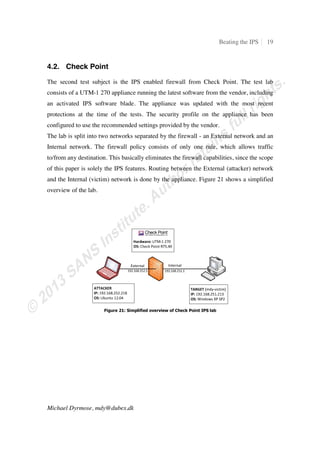
The first test subject is the IPS appliance from HP TippingPoint. The test-lab is built
using a 600E appliance running the most recent software. The appliance has been updated
with the latest Digital Vaccine (IPS signature file) available at the time of the tests. Each
filter in the security profile has been configured to use the action that is recommended by
HP TippingPoint. As the IPS is an in-line layer-2 device, it only requires an IP-address
for the management port, and no routing between the attacker and the victim is necessary.
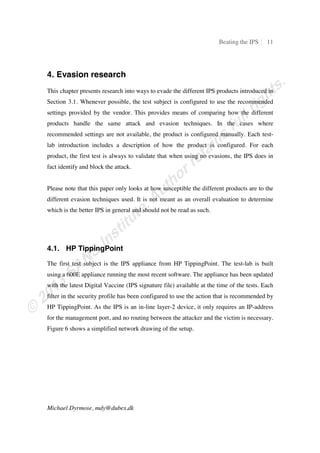
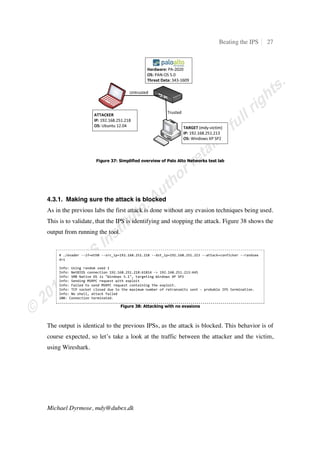
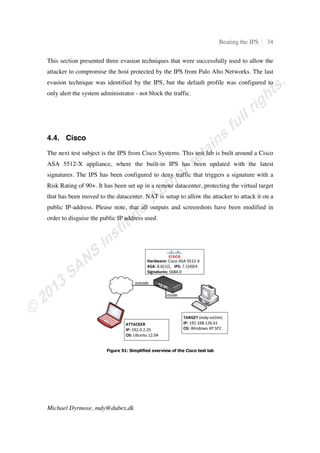
Figure 6 shows a simplified network drawing of the setup.
Beating the IPS 12
Michael Dyrmose, mdy@dubex.dk
ATTACKER
IP: 192.168.251.218
OS: Ubuntu 12.04
Hardware: TP 600E
OS: TOS 2.5.8.7168
DV: 2.5.2.8368
TARGET (mdy-victim)
IP: 192.168.251.213
OS: Windows XP SP2
Figure 6: Simplified drawing of HP TippingPoint IPS lab
4.1.1. Making sure the attack is blocked
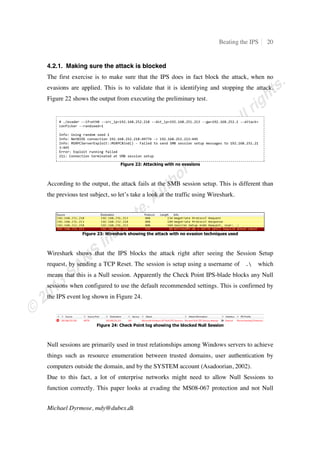
First off, it’s important to make sure that the IPS is indeed capable of identifying and
blocking the attack, so the first attack is sent without using any evasion techniques.
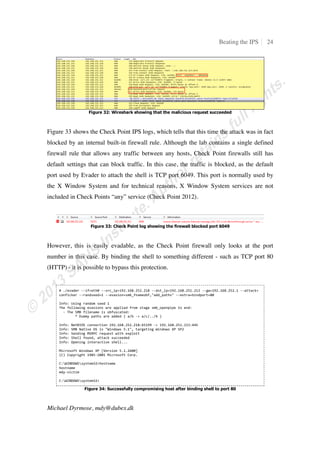
ɤ Ŝŵ‡˜ƒ†‡” ŞŞ‹ˆʰ‡–Šɥ ŞŞ•”…ɏ‹’ʰɨɰɩŜɨɭɯŜɩɬɨŜɩɨɯ ŞŞ†•–ɏ‹’ʰɨɰɩŜɨɭɯŜɩɬɨŜɩɨɪ ŞŞƒ––ƒ…ʰ…‘ˆ‹…‡” ŞŞ”ƒ†•‡‡
†ʰɨ
ˆ‘ś •‹‰ ”ƒ†‘ •‡‡† ɨ
ˆ‘ś ‡–
…‘‡…–‹‘ ɨɰɩŜɨɭɯŜɩɬɨŜɩɨɯśɭɬɨɯɪ Şʴ ɨɰɩŜɨɭɯŜɩɬɨŜɩɨɪśɫɫɬ
ˆ‘ś  ƒ–‹˜‡  ‹• ɑ‹†‘™• ɬŜɨɑř –ƒ”‰‡–‹‰ ‹†‘™•  ɩ
ˆ‘ś ‡†‹‰  ”‡“—‡•– ™‹–Š ‡š’Ž‘‹–
ˆ‘ś ƒ‹Ž‡† –‘ •‡†  ”‡“—‡•– …‘–ƒ‹‹‰ –Ї ‡š’Ž‘‹–Ŝ
ˆ‘ś   •‘…‡– …Ž‘•‡† †—‡ –‘ –Ї ƒš‹— —„‡” ‘ˆ ”‡–”ƒ•‹–• •‡– Ş ’”‘„ƒ„އ
–‡”‹ƒ–‹‘Ŝ
ˆ‘ś ‘ •Š‡ŽŽř ƒ––ƒ… ˆƒ‹Ž‡†
ɩɥɥś ‘‡…–‹‘ –‡”‹ƒ–‡†Ŝ
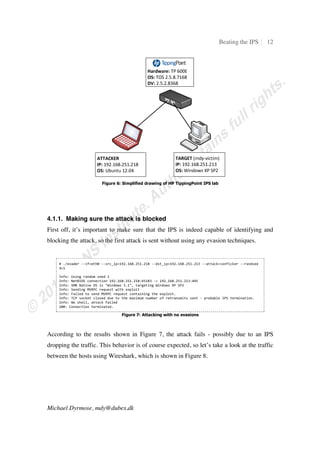
Figure 7: Attacking with no evasions
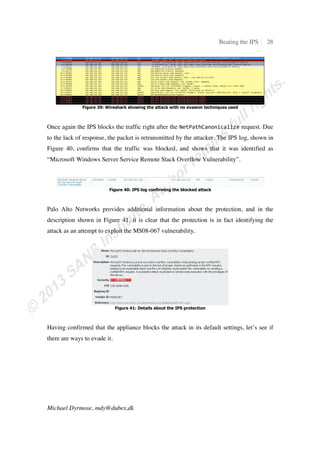
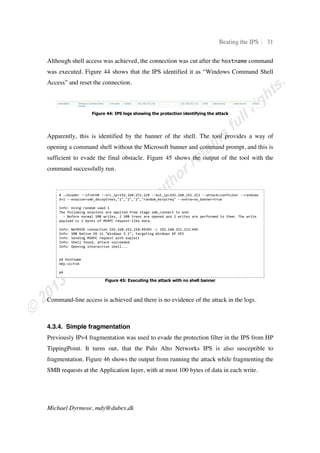
According to the results shown in Figure 7, the attack fails - possibly due to an IPS
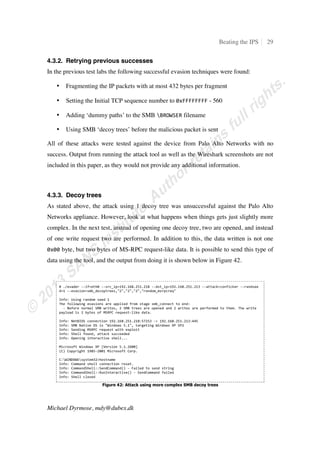
dropping the traffic. This behavior is of course expected, so let’s take a look at the traffic
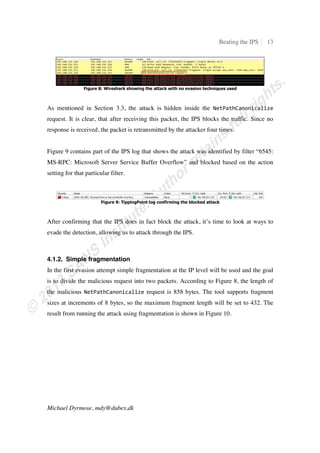
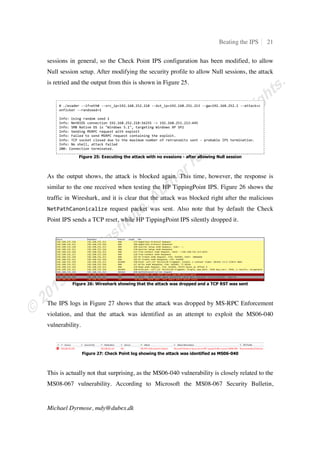
between the hosts using Wireshark, which is shown in Figure 8.
Beating the IPS 13
Michael Dyrmose, mdy@dubex.dk
Figure 8: Wireshark showing the attack with no evasion techniques used
As mentioned in Section 3.3, the attack is hidden inside the ‡–ƒ–Š ƒ‘‹…ƒŽ‹œ‡
request. It is clear, that after receiving this packet, the IPS blocks the traffic. Since no
response is received, the packet is retransmitted by the attacker four times.
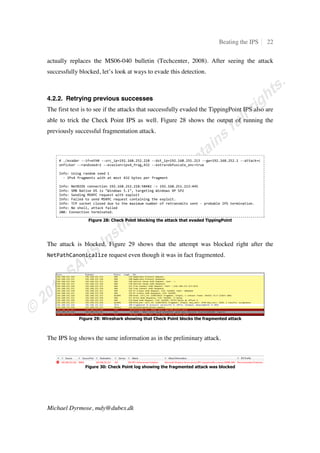
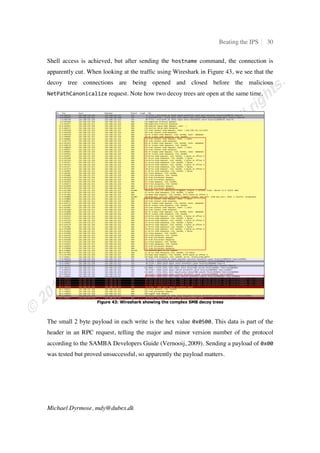
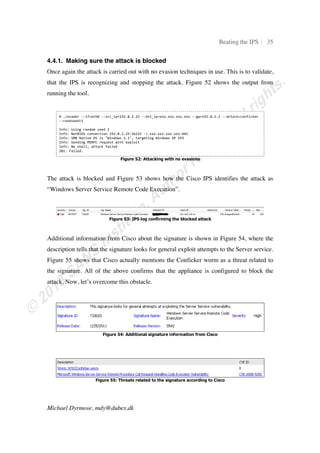
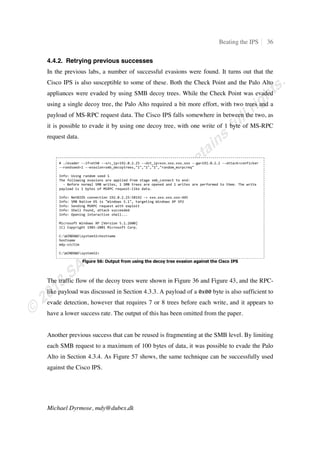
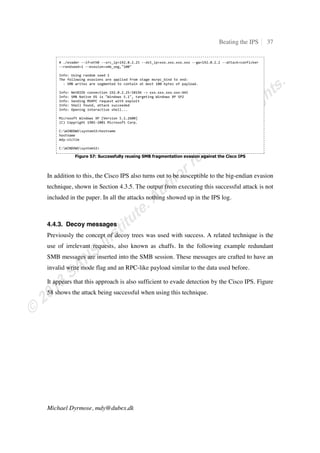
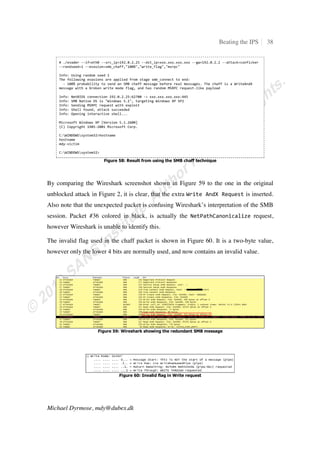
Figure 9 contains part of the IPS log that shows the attack was identified by filter “6545:
MS-RPC: Microsoft Server Service Buffer Overflow” and blocked based on the action
setting for that particular filter.
Figure 9: TippingPoint log confirming the blocked attack
After confirming that the IPS does in fact block the attack, it’s time to look at ways to
evade the detection, allowing us to attack through the IPS.
4.1.2. Simple fragmentation
In the first evasion attempt simple fragmentation at the IP level will be used and the goal
is to divide the malicious request into two packets. According to Figure 8, the length of
the malicious ‡–ƒ–Š ƒ‘‹…ƒŽ‹œ‡ request is 858 bytes. The tool supports fragment
sizes at increments of 8 bytes, so the maximum fragment length will be set to 432. The
result from running the attack using fragmentation is shown in Figure 10.
Beating the IPS 14
Michael Dyrmose, mdy@dubex.dk
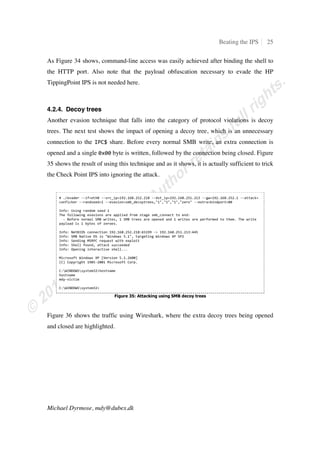
ɤ Ŝŵ‡˜ƒ†‡” ŞŞ‹ˆʰ‡–Šɥ ŞŞ•”…ɏ‹’ʰɨɰɩŜɨɭɯŜɩɬɨŜɩɨɯ ŞŞ†•–ɏ‹’ʰɨɰɩŜɨɭɯŜɩɬɨŜɩɨɪ ŞŞƒ––ƒ…ʰ…‘ˆ‹…‡” ŞŞ”ƒ†•‡‡
†ʰɨ ŞŞ‡˜ƒ•‹‘ʰ‹’˜ɫɏˆ”ƒ‰řɫɪɩ
ˆ‘ś •‹‰ ”ƒ†‘ •‡‡† ɨ
Ş
˜ɫ ˆ”ƒ‰‡–• ™‹–Š ƒ– ‘•– ɫɪɩ „›–‡• ’‡” ˆ”ƒ‰‡–
ˆ‘ś ‡–
…‘‡…–‹‘ ɨɰɩŜɨɭɯŜɩɬɨŜɩɨɯśɬɪɬɭɥ Şʴ ɨɰɩŜɨɭɯŜɩɬɨŜɩɨɪśɫɫɬ
ˆ‘ś  ƒ–‹˜‡  ‹• ɑ‹†‘™• ɬŜɨɑř –ƒ”‰‡–‹‰ ‹†‘™•  ɩ
ˆ‘ś ‡†‹‰  ”‡“—‡•– ™‹–Š ‡š’Ž‘‹–
ˆ‘ś ƒ‹Ž‡† –‘ •‡†  ”‡“—‡•– …‘–ƒ‹‹‰ –Ї ‡š’Ž‘‹–Ŝ
ˆ‘ś   •‘…‡– …Ž‘•‡† †—‡ –‘ –Ї ƒš‹— —„‡” ‘ˆ ”‡–”ƒ•‹–• •‡– Ş ’”‘„ƒ„އ
–‡”‹ƒ–‹‘Ŝ
ˆ‘ś ‘ •Š‡ŽŽř ƒ––ƒ… ˆƒ‹Ž‡†
ɩɥɥś ‘‡…–‹‘ –‡”‹ƒ–‡†Ŝ
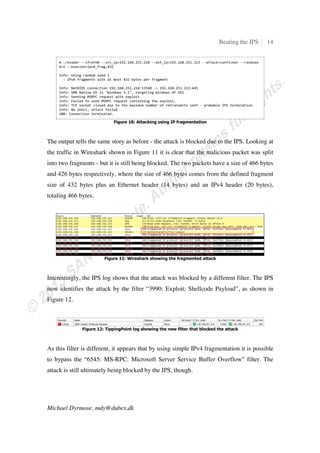
Figure 10: Attacking using IP fragmentation
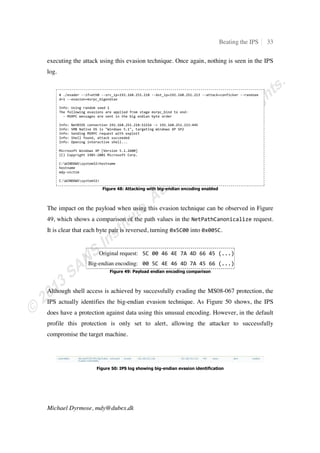
The output tells the same story as before - the attack is blocked due to the IPS. Looking at
the traffic in Wireshark shown in Figure 11 it is clear that the malicious packet was split
into two fragments - but it is still being blocked. The two packets have a size of 466 bytes
and 426 bytes respectively, where the size of 466 bytes comes from the defined fragment
size of 432 bytes plus an Ethernet header (14 bytes) and an IPv4 header (20 bytes),
totaling 466 bytes.
Figure 11: Wireshark showing the fragmented attack
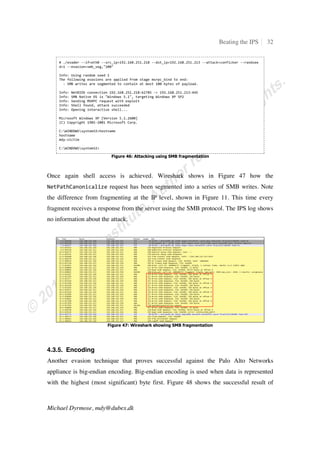
Interestingly, the IPS log shows that the attack was blocked by a different filter. The IPS
now identifies the attack by the filter “3990: Exploit: Shellcode Payload”, as shown in
Figure 12.
Figure 12: TippingPoint log showing the new filter that blocked the attack
As this filter is different, it appears that by using simple IPv4 fragmentation it is possible
to bypass the “6545: MS-RPC: Microsoft Server Service Buffer Overflow” filter. The
attack is still ultimately being blocked by the IPS, though.
Beating the IPS 15
Michael Dyrmose, mdy@dubex.dk
4.1.3. Payload obfuscation
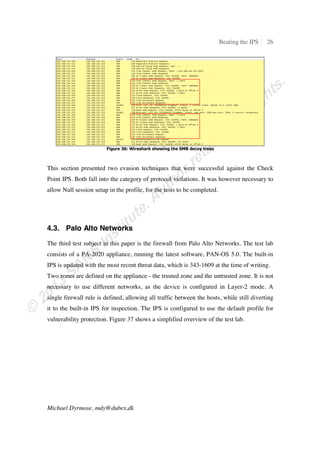
Now, let’s take a look at the impact of using the obfuscation functionality built into the
tool. Obfuscation was introduced in Section 2.1, and this approach has the potential to
bypass the filter, if it is a simple string matching rule. First we’re using the obfuscation
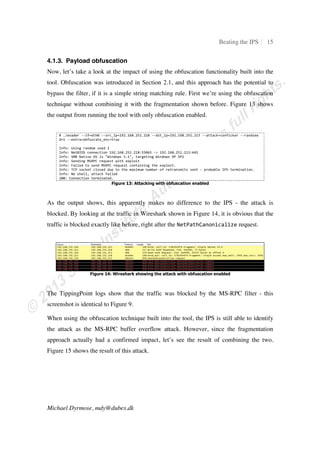
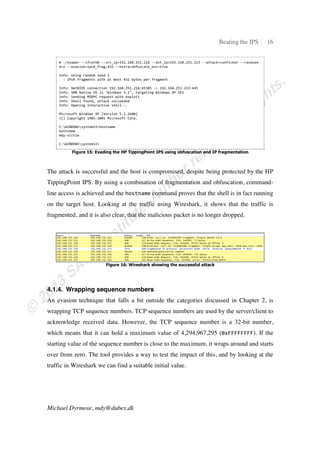
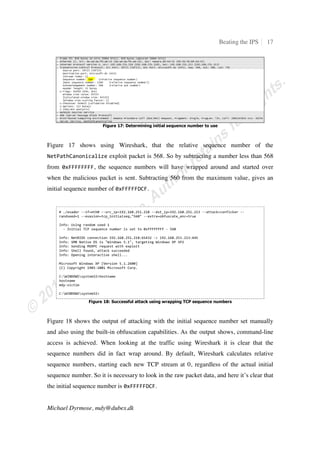
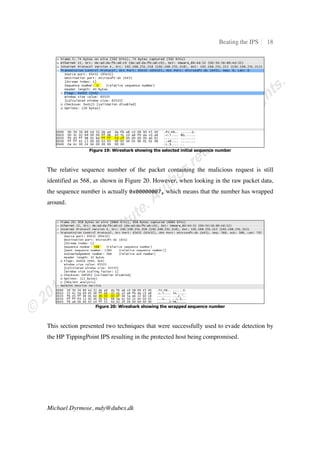
technique without combining it with the fragmentation shown before. Figure 13 shows
the output from running the tool with only obfuscation enabled.
ɤ Ŝŵ‡˜ƒ†‡” ŞŞ‹ˆʰ‡–Šɥ ŞŞ•”…ɏ‹’ʰɨɰɩŜɨɭɯŜɩɬɨŜɩɨɯ ŞŞ†•–ɏ‹’ʰɨɰɩŜɨɭɯŜɩɬɨŜɩɨɪ ŞŞƒ––ƒ…ʰ…‘ˆ‹…‡” ŞŞ”ƒ†•‡‡
†ʰɨ ŞŞ‡š–”ƒʰ‘„ˆ—•…ƒ–‡ɏ‡…ʰ–”—‡
ˆ‘ś •‹‰ ”ƒ†‘ •‡‡† ɨ
ˆ‘ś ‡–

Beating ips 34137

  • 1.
    Interested in learning moreabout security? SANS Institute InfoSec Reading Room This paper is from the SANS Institute Reading Room site. Reposting is not permitted without express written permission. Beating the IPS This paper introduces various Intrusion Prevention System (IPS) evasion techniques and shows how they can be used to successfully evade detection by widely used products from major security vendors. By manipulating the header, payload, and traffic flow of a well-known attack, it is possible to trick the IPS inspection engines into passing the traffic - allowing the attacker shell access to the target system protected by the IPS. Copyright SANS Institute Author Retains Full Rights AD
  • 2.
    BEATING THE IPS GIAC(GCIA) Gold Certification Author: Michael Dyrmose Security Consultant Dubex A/S mdy@dubex.dk dyrmose@gmail.com Advisor: Rob VandenBrink Accepted: January 5th 2013 Abstract This paper introduces various Intrusion Prevention System (IPS) evasion techniques and shows how they can be used to successfully evade detection by widely used products from major security vendors. By manipulating the header, payload, and traffic flow of a well-known attack, it is possible to trick the IPS inspection engines into passing the traffic - allowing the attacker shell access to the target system protected by the IPS.
  • 3.
    Beating the IPS2 Michael Dyrmose, mdy@dubex.dk 1. Introduction Firewalls and Intrusion Prevention Systems (IPS) are core equipment in any enterprise or organization’s network infrastructure. While a simple firewall filters traffic based on information such as TCP/UDP ports and IP-addresses, IPSs are doing a much more in- depth investigation into the actual data contents of the network packet. To really understand and evaluate the network packets, the system needs a deep understanding of the network protocols in use. Implementing protocol understanding might seem like a fairly straightforward task; however, it often proves not to be. Back in 1998, Ptacek and Newsham demonstrated how IDS systems could be evaded by using various techniques such as overlapping fragments, wrapping sequence numbers, and packet insertion. This was possible because the IDS might not process and interpret the packets in the same way the protected host behind it would (Ptacek & Newsham, 1998). This paper will show that some of the techniques introduced by Ptacek and Newsham can still be used today. When applying different evasion techniques to a known and well- documented attack, it is possible to bypass a range of IPS products from a variety of major vendors. The techniques used in this paper tamper with different protocols spanning the Internet Layer (IPv4), the Transport Layer (TCP) and the Application Layer (SMB). The paper begins with an introduction to different areas in the field of evasion as well as a technical explanation of the vulnerability being exploited. This is followed by a study of the impact of applying different evasion techniques to combat the IPS solutions. The study will prove just how vulnerable modern IPS products are to minor modifications to the attack.
  • 4.
    Beating the IPS3 Michael Dyrmose, mdy@dubex.dk 2. Evasion techniques There are a number of quite different approaches and techniques that can be used when it comes to IPS evasion. This chapter provides an overview of the different categories. 2.1. Obfuscation Simply speaking, obfuscation is the process of taking a readable string of characters, and turning it into something that is unreadable (obfuscated). Though the result may be difficult to interpret or identify, the obfuscated result still performs the same actions as the original string. Often, this technique is used by attackers to hide malicious activity in executable code. This paper will use the built-in obfuscation capabilities in the attack tool, when simple string-matching filters are the final obstacle to overcome. 2.2. Encryption and tunneling Encryption and tunneling of encrypted data is another strategy that can be used to avoid IPS inspection. Encrypting the attack by sending it through an SSH connection or in a VPN tunnel makes it virtually impossible for the IPS to inspect the data. To do this, the IPS has to be placed at a point in the network which lies after the tunnel termination (Burns & Adesina, 2011). This paper does not use any techniques in this category, as this approach would require that a previous connection was established to the target machine through the IPS. 2.3. Fragmentation By splitting up malicious network packets into smaller fragments, an attacker might be able to circumvent the network security mechanisms in place. This approach is known as fragmentation. The issue with fragmentation is that the IPS has to reassemble the packets in order to identify the attack. Each fragment contains a value in the header that informs the receiver of the data’s position in the original data stream. If the fragments are
  • 5.
    Beating the IPS4 Michael Dyrmose, mdy@dubex.dk modified in such a way that the fragments are overlapping, reassembly becomes complex, as it is not clear which of the fragments’ data should be used. To add to the confusion, different operating systems treat overlapping fragments differently. So if the IPS reassembles the packets differently from the end host, it may reassemble the fragments to a non-malicious payload and allow it. At the same time, the end host reassembles the same fragments into a malicious payload, thus allowing the attacker to compromise the system (Baggett, 2012). Judy Novak’s paper on fragmentation reassembly discusses these issues and demonstrates how Snort uses a preprocessor to handle fragments differently based on the systems it’s configured to protect (Novak, 2005). In the demonstration section of this paper, both simple fragmentation and overlapping fragments will be used in some scenarios. Another approach in the area of fragmentation is simply to delay the fragments. If the IPS has a different timeout for fragments than the end host, the IPS can potentially be evaded by delaying the packets. When the IPS receives the next fragment, it has lost the context of the previously received fragments and allows the packet, since the fragment on its own is not malicious. The end host might still be waiting for the fragment though, and will reassemble the fragments into the malicious payload. This paper does not use any evasion techniques that relate to timeouts. 2.4. Protocol violations Many attacks are targeted at complex protocols such as SMB (Server Message Block). In order to provide protection to a complex protocol, the IPS has to have a deep understanding of it. The implementation also needs to be fault-tolerant and resilient to be able to cope with excessive and unexpected connections and requests. The research presented in this paper utilizes techniques from this category to great extent. The results will show how modified header values, flags and decoy connections can be used to successfully evade many IPS products. Each approach will be described in more detail when used.
  • 6.
    Beating the IPS5 Michael Dyrmose, mdy@dubex.dk 3. Building the evasion research lab This section provides an overview of the products tested, as well as an introduction to the attack that is used in the attempts to compromise the target machine. 3.1. Test subjects The target machine in each test scenario is a vulnerable Windows XP (SP2) host, which in turn is protected by the following products with IPS capabilities: • HP TippingPoint IPS • Check Point Firewall with IPS Blade • Palo Alto Networks Firewall • Cisco ASA with integrated IPS • Fortinet FortiGate • Snort (in-line mode using Security Onion) 3.2. Selecting a suitable attack To properly test the impact of using evasion techniques, it’s important to use an attack that all the IPS products are able to identify. The attack suited to this is an exploit on the well-known MS08-067 vulnerability. This security flaw was used by the infamous Conficker worm, which infected millions of systems worldwide in 2008 and the following months and years. According to the official security bulletin from Microsoft, the vulnerability lies in the Server service, which is used for resource sharing in Windows networks. This vulnerability affects a wide range of Windows versions, including Windows XP, Windows Vista, and Windows Server 2008. By sending a modified RPC request to a vulnerable system, it is possible to execute malicious code and gain full and unrestricted access.
  • 7.
    Beating the IPS6 Michael Dyrmose, mdy@dubex.dk Even though the MS08-067 exploit is ‘old’, and due to OS patching does not pose as big a threat anymore, it is still a good example to use when evaluating evasion techniques. This is both due to the history and publicity that the Conficker worm received, as well as the fact that the security vendors have now had lots of time to adjust and improve their protections against the attack. Besides… the Conficker worm exploiting this vulnerability is still active on the Internet as of 2012 (Kandek, 2012). 3.3. Technical details After deciding which attack to use in the research, let’s take a deeper look at the MS08- 067 vulnerability. File and printer sharing in a Windows network is achieved through establishing SMB sessions between the client and the server. During this session a call to the function ‡–ƒ–Š ƒ‘‹…ƒŽ‹œ‡ is made. This function is used to reduce the path of a requested network resource into the shortest form, presumably in part to eliminate directory traversal attacks. However, in vulnerable versions of the service, this function is susceptible to buffer overflow attacks. This happens when the directory traversal reduction feature is invoked, by sending paths such as Ɏ…ɎŜŜɎŜŜɎ The vulnerability is caused by the way the function handles string manipulation in memory (Racicot, 2008).
  • 8.
    Beating the IPS7 Michael Dyrmose, mdy@dubex.dk 3.4. Tools A variety of free tools were used to help conduct the research that this paper documents. The following is an introduction to the tools. Evader - To test different evasion techniques, this paper uses the free tool Evader by the Helsinki-based security company Stonesoft, released on July 23, 2012. This tool makes it possible to apply different evasion techniques to the attack. The author of this paper is not affiliated with Stonesoft in any way, nor is the use of the tool an endorsement of the tool, or any of Stonesoft's other products. The tool is simply used to test different strategies and evasion techniques, which also means that this paper does not pursue to try every available feature of the tool. http://evader.stonesoft.com/ libemu - libemu is a small software package that offers x86 shellcode emulation capabilities. It can be used to test potential malicious payloads and identify Win32 API calls. It was released by Paul Baecher and Markus Koetter in 2007. http://libemu.carnivore.it/ Wireshark - Wireshark is a widely used software package for network traffic capture and analysis. In this paper it is used to analyze the traffic between the attacker, the IPS, and the target host. http://www.wireshark.org/ HxD - HxD is a freely available hex-editor created by Maël Hörz. In this paper it is used to view raw hex data conveniently. http://mh-nexus.de/en/hxd/
  • 9.
    Beating the IPS8 Michael Dyrmose, mdy@dubex.dk 3.5. Testing the attack As introduced in the previous section, the tool Evader is used to perform the attack on the MS08-067 vulnerability. Before looking at any evasion techniques, let’s validate that the tool is in fact working, and that the traffic looks as expected. We start out by directly attacking the target host, with no IPS protecting it. The target is a virtual machine running a vulnerable version of Windows XP SP2, with the hostname mdy-victim. The tool implements a randomization of the packet payload, but in order to better compare the traffic when using different evasion techniques, the randomization seed is fixed to the value ‘1’ in all attacks in the paper. ɤ Ŝŵ‡˜ƒ†‡” ŞŞƒ––ƒ…ʰ…‘ˆ‹…‡” ŞŞ•”…ɏ‹’ʰɨɰɩŜɨɭɯŜɩɬɨŜɩɨɮ ŞŞ†•–ɏ‹’ʰɨɰɩŜɨɭɯŜɩɬɨŜɩɨɪ ŞŞ‹ˆʰ‡–Šɥ ŞŞ”ƒ†•‡‡ †ʰɨ
  • 10.
  • 11.
  • 12.
  • 13.
    ˆ‘ś ƒ–‹˜‡ ‹• ɑ‹†‘™• ɬŜɨɑř –ƒ”‰‡–‹‰ ‹†‘™• ɩ
  • 14.
    ˆ‘ś ‡†‹‰ ”‡“—‡•– ™‹–Š ‡š’Ž‘‹–
  • 15.
    ˆ‘ś Š‡ŽŽ ˆ‘—†řƒ––ƒ… •—……‡‡†‡†
  • 16.
    ˆ‘ś ’‡‹‰ ‹–‡”ƒ…–‹˜‡•Š‡ŽŽŜŜŜ ‹…”‘•‘ˆ– ‹†‘™• ƃ‡”•‹‘ ɬŜɨŜɩɭɥɥƄ ſ ƀ ‘’›”‹‰Š– ɨɰɯɬŞɩɥɥɨ ‹…”‘•‘ˆ– ‘”’Ŝ śɎ
  • 17.
  • 18.
    Ɏ•›•–‡ɪɩʴ Figure 1: Attackingthe target directly 3.6. Analyzing the attack payload As Figure 1 shows, the attack is successful and the machine is compromised, giving the attacker a command-line shell. Figure 2 shows the malicious traffic using Wireshark, and it is clear that a call was made to the ‡–ƒ–Š ƒ‘‹…ƒŽ‹œ‡ function.
  • 19.
    Beating the IPS9 Michael Dyrmose, mdy@dubex.dk Figure 2: Wireshark showing the successful attack The payload in the ‡–ƒ–Š ƒ‘‹…ƒŽ‹œ‡ request contains the path to be reduced and it is shown in Figure 3 using the hex editor HxD. ɥɥɥɥ ɬ… ɥɥ ɫɭ ɫ‡ ɮƒ ɫ† ɭɭ ɫɬ ɭɩ ɬƒ ɭɰ ɮɫ ɭɫ ɭɪ ɮɮ ɬɨ ɎŜ œˆ „‹–†…™ ɥɥɨɥ ɮɭ ɬɰ ɬɯ ɭɬ ɭ‡ ɭɫ ɫɪ ɫ‡ ɭɪ ɬɭ ɫɰ ɭ† ɮɮ ɬɨ ɭˆ ɫɮ ˜‡† …
  • 20.
    ™‘ ɥɥɩɥ ɬƒ ɫ…ɮɬ ɭɮ ɭˆ ɮɫ ɮɫ ɭɭ ɮɥ ɮɥ ɮɰ ɫƒ ɫɩ ɭ‡ ɫ† ɫɮ —‰‘––ˆ’’›  ɥɥɪɥ ɫ‡ ɭ† ɬƒ ɮɥ ɮɮ ɫ† ɭɬ ɬƒ ɮɮ ɬɨ ɫɰ ɬƒ ɭɫ ɬɮ ɭɩ ɬɮ ’™‡™
  • 21.
    †„ ɥɥɫɥ ɭɩ ɫɮɫ‡ ɭ„ ɮɮ ɭɩ ɮɭ ɬƒ ɭɫ ɭ… ɫˆ ɭɰ ɭ… ɭɰ ɮɬ ɭɪ „ ™„˜†Ž‹Ž‹—… ɥɥɬɥ ɫ‡ ɭɨ ɫ„ ɬɰ ɮɬ ɭɨ ɮɥ ɮɰ ɫɬ ɫɨ ɭɩ ɭ‡ ɫɫ ɭɬ ɬɬ ɭ† ƒ—ƒ’› „ ‡ ɥɥɭɥ ɫɬ ɬƒ ɭ„ ɫɪ ɮƒ ɮƒ „ɯ ɯɬ ˆɯ ɩɫ ɯ† „ɭ ɰˆ ɫɮ ɩɥ ˆɬ  œœŜŜŜɛŜŜŜ Ŝ ɥɥɮɥ ɭɮ ɥɫ „ˆ ɫ‡ „ɪ ɰɥ ˆɰ ɰɮ ɭƒ ɬƒ ɬɰ †ɰ ‡‡ †ɰ ɮɫ ɩɫ ‰ŜŜŜŜŜŜŒŜŜŜ–ɛ ɥɥɯɥ ˆɫ ɬ„ ɯɨ ɮɪ ɨɪ ɰɨ ɨɬ …ɥ †‡ ɯɪ ‡„ ˆ… ‡ɩ ˆɫ ɨɥ †ɨ ŜƃŜ•ŜŜŜŜŜŜŜŜŜŜŜŜ ɥɥɰɥ ɰɫ ɩ… ɭ‡ ‡ƒ ɫɨ ɪƒ ɭɨ ‡ƒ ɪˆ ɩɨ ɭ† ˆ† ɫɰ †‡ ɰɨ ɨɬ ŜřŜ śƒŜţŠŜ
  • 22.
    ŜŜŜ ɥɥƒɥ ƒɥ ɬɮɮɫ ɩɫ ɨɩ „ƒ ɨƒ ɫɮ ˆɥ ɬɬ …ɪ ɨɰ ɫ„ ɯ… ɯɬ ɰ‡ Ŝ–ɛŜŜŜ ŜŜŜŜŜŜ ɥɥ„ɥ „ɩ ˆɭ ɰ‡ ƒɩ ɯƒ ˆɯ ƒɥ ‡ƒ ˆɨ ɨ‡ ɪ† ɩɰ ƒɨ ƒɩ ɰɪ ɪɰ ŜŜŜŜŜŜŜŜŜŜʰƀŜŜŜɰ ɥɥ…ɥ ‡ɥ ɨˆ ɬ‡ ɨɯ …ɨ ɨɰ ɮɪ ‡ɬ ɰɩ ɯɰ ɨƒ ɫɮ †ɥ ɬɬ †ɪ ɩɰ ŜŜɋŜŜŜ•ŜŜŜŜ ŜŜƀ ɥɥ†ɥ …ɨ ɥ‡ ɨƒ ɬɬ „ɯ ɬ„ ɬɨ ɭɨ ɯƒ †ˆ ɫɨ ɫɬ ɫ„ ɰɭ ɯɰ ɰ‡ ŜŜŜŜƃƒŜŜ ŜŜŜ ɥɥ‡ɥ ɰɯ ˆ‡ ɰɥ …ɭ ɩɪ ‡ɩ †ɯ ɰ‡ ˆɫ ɬɬ ɰɥ …ɪ ˆɨ ɩɨ ƒɥ †ɬ ŜŜŜŜɤŜŜŜŜŜŜŜŠŜŜ ɥɥˆɥ ɭ… ɨˆ ɬ‡ ɨɯ …ɨ ɨɰ ƒɰ ˆɬ „ɬ ɩƒ ɰɩ ɭɯ ɪɯ ‡ɬ ‡… ɪɨ ŽŜɋŜŜŜŜŜŜƋŜŠɯŜŜɨ ɥɨɥɥ „ɬ ɪ… …ɰ ɰ‡ ɰɯ ˆƒ ɰɥ …ɭ ƒɭ ɬɬ ɰ† ɬ‡ ɫ„ ɯɭ ɯ† ɨɫ ŜʳŜŜŜŜŜŜŜŜɋŜŜŜ ɥɨɨɥ ɨɪ ɬɬ ɰɬ ɰ‡ …ɨ ɥ‡ ɨɯ ɬɨ ‡ɫ ˆƒ …ƒ ɫ‡ ƒɨ ɯɮ …„ ɫɫ ŜŜŜŜŜŜŜŜŜŜŜŜ ɥɨɩɥ ɪˆ ɪ‡ …ɰ ɫƒ ɰƒ ɬɬ ɯɪ ˆ‡ ɫɭ ɯɪ ˆɰ ɩɭ ˆɩ †‡ ɰɨ ɮ† ţʴŜ ŜŜŜ ŜŜĺŜŜŜƈ ɥɨɪɥ „ɮ ƒ† ƒɪ ɫƒ ɰɫ „ɭ †† ɭɩ ‡ɭ †ɰ ɭ‡ …ɥ ɮɯ ɫ‡ ɰɥ ɨɬ ŜŜŜ ŜŜŜ„ŜŜŜšŜŜ ɥɨɫɥ …ɥ ˆɮ ɬɬ ɫɨ ɰɥ „ɭ „ɯ ɰɬ ƒ„ †‡ ɭ‡ …ɥ ɰɥ ɯ‡ …ɨ ɫɬ ŜŜ ŜŜŜŜŜŜŜŜŜŜ ɥɨɬɥ ɯɥ ɯ‡ †ɨ ɫɬ ƒɯ ɪɫ ɰ‡ …ƒ ɩɥ ɩɨ ɫɫ ɯɩ ˆɨ ɥɬ …ɩ ɮ† ŜŜŜ ŜɫŜŜ Š ŜŜŜŜƈ ɥɨɭɥ …ɩ †‡ ɯɭ „ɫ ɫɰ ɪɯ ˆ„ ɥɬ ɰɭ ɯɰ ˆɰ †ɮ ɨ„ ‡ɰ ˆɭ ‡ƒ ŜŜŜŜ
  • 23.
    ɯŜŜŜŜŜŜŜŜŜŜ ɥɨɮɥ ɨɬ ɯ†…ɭ ɮ† ɮɮ ɪɮ ƒɰ ‡ƒ ɪˆ ɥ„ …ɩ ɫɭ ɰɮ „ɭ ‡ɬ ˆɰ ŜŜŜƈ™ɮŜŜţŜŜ ŜŜŜŜ ɥɨɯɥ ˆ„ ɪˆ ɭ‡ …ɥ ɰɮ ɫɰ ˆɰ ɭɥ ƒ‡ ɰɪ ˆɥ ‡ƒ ɨɬ „ɭ ˆɩ ɮɯ ŜţŜŜ
  • 24.
    ŜļŜŜŜŜŜŜŜš ɥɨɰɥ ƒɫ †‡ɨɯ ˆɭ ɰɮ ɯɰ …ɭ ɩɫ ɪɭ „ɫ ɯɪ ɫ… ɰɭ ɪ… ɭ… ɮɪ ŜŜŜŜŜŜŜɛɭŜŜŜʳŽ• ɥɨƒɥ ɥɮ ɰƒ „ɬ ɩɰ …ɨ †ˆ ɨ… ɬɨ ‡ɫ …‡ ɬɮ ɨɬ ɯɫ ɯƒ …ɨ ɫɪ ŜŜŜƀŜŜŜŜŜŜŜŜŜ ɥɨ„ɥ ɰɭ ɯɯ †ɮ ɫɪ ɯ‡ ɯɯ …ɮ ɫɭ ɰɭ „ɭ ‡ɯ †ɰ ˆˆ ɬɯ ɭ‡ …ɥ ŜŜŜ ŜŜŜ ŜŜŜŜŜŜ ɥɨ…ɥ ɫɰ ɪ‡ †ˆ ɫɪ ɯɭ ɩɨ ƒɨ ɮ† …ɯ ɬɰ ɯ… ɮɬ ɪˆ ɥ„ …ɭ ɮ†
  • 25.
    ʴŜ ŜŠŜƈŜŜ—ţŜŜƈ ɥɨ†ɥ „ɬ„ɥ †… ɮɫ ɪˆ ɥ„ ɩƒ ˆɬ †† ˆɫ ɰ„ ɮ† ɭɭ ɫ„ ɩ… ɯɯ ŜŜŜ–ţŜƋŜŜŜŜƈˆřŜ ɥɨ‡ɥ ɪˆ ɥ„ ƒ† ɨɪ „… †ɫ ɨɨ ‡‡ ɩɥ ƒ„ ɰɫ ƒ‡ ɯɮ …† ‡ɪ ɮƒ ţŜŜŜŜŜŜŜ ŜŜŜŜŜŜœ ɥɨˆɥ ƒƒ †‡ …ɩ ‡ƒ ɨɬ †‡ ɬ… ɥɥ ɩ‡ ɥɥ ɩ‡ ɥɥ ɬ… ɥɥ ɩ‡ ɥɥ ŜŜŜŜŜŜɎŜŜŜŜŜɎŜŜŜ ɥɩɥɥ ɩ‡ ɥɥ ɬ… ɥɥ ɫɨ ɥɥ ɫ† ɥɥ ɫɮ ɥɥ ɬɩ ɥɥ ɬɬ ɥɥ ɫɬ ɥɥ ŜŜɎŜ ŜŜ ŜŜŜ Ŝ ɥɩɨɥ ɬɥ ɥɥ ɥɯ ɥɫ ɥɩ ɥɥ ‡ɩ ɨɭ ɯɰ ɭˆ ɫ‡ ɫ† ɬɰ ɬƒ ɩɮ ˆɮ ŜŜŜŜŜŜŜŜ‘ɐŜ ɥɩɩɥ ɯɯ ɭˆ ɫ… ɬɯ ɬɥ ɫ† ɬɥ ɬɥ ɫ‡ ɫ„ ɫƒ ɬɨ ɫɫ ɫɬ ɫɫ ɫɮ Ŝ‘ ɥɩɪɥ ɫɫ ɬɥ ɫɰ ɫ† ɬɨ ɬɨ ɫɨ ɬɫ ɬɩ ɫɭ ɫɯ ɬɬ ɫɨ ɫɬ ɬɪ ɬɥ
  • 26.
    ɥɩɫɥ ɫɯ ɬɮɫɬ ɬɩ ɫɩ ɫ… ɬƒ ɬɮ ɫ… ɫɩ ɫɰ ɬɥ ɰˆ ɰɩ ɨ… ɩɬ
  • 27.
    ŜŜŜʩ ɥɩɬɥ ɫɰ ɩ…ɫɪ ɰ„ ‡„ ɭɩ ɬɨ ɬɫ ɫ… ɫ‡ ɬɬ ɬɰ ɬɩ ɫɬ ɬƒ ɬɭ
  • 28.
    ř ŜŜ„ ɥɩɭɥɥɥ ɥɥ ɥɥ ɥɥ ŜŜŜŜ Figure 3: Path contents of malicious packet
  • 29.
    Beating the IPS10 Michael Dyrmose, mdy@dubex.dk The payload contains the buffer overflow exploit, as well as the shellcode used to obtain command-line access. By using the Wireshark functionality to only view the printable characters, we clearly see the directory traversal attempt ɎŜŜɎŜŜɎ ſŝƀ that activates the vulnerable code. The entire string of printable characters is shown in Figure 4. Ɏ œˆ „‹–†…™˜‡† …
  • 30.
  • 31.
  • 32.
  • 33.
  • 34.
  • 35.
  • 36.
  • 37.
    ř „ Figure4: The printable characters of the payload The Conficker worm performs a number of post-exploit actions, such as self-duplication, modifying the Windows registry, and setting up a server to aid in spreading the infection. As we’re not out to infect anyone with the tool let’s have a look at what the payload actually does. This is done by analyzing the payload using libemu’s sctest. sctest simulates an execution of the payload, looking for code that hooks into running processes. The output from running sctest is shown in Figure 5. ɤ ŵ‘’–ŵŽ‹„‡—ŵ„‹ŵ•…–‡•– މ ʳ ‡˜ƒ†‡”ɏ’ƒ›Ž‘ƒ† Ş• ɩɥɥɥɥɥ ޘ ˜‡”„‘•‡ ʰ ɨ •—……‡•• ‘ˆˆ•‡– ʰ ɥšɥɥɥɥɥɥɭɭ •–‡’…‘—– ɩɥɥɥɥɥ ‘ƒ†‹„”ƒ”› ſ Ž’ ‹Ž‡ƒ‡ ʰ ɥšɥɥɫɨɭɩɨɯ ʰʴ ʰ ɑ™•ɩɏɪɩɑŚ ƀ ʰ ɥšɮɨƒɨɥɥɥɥŚ Figure 5: Using sctest to analyze the payload The output shows the shellcode utilizing the WinSock ™•ɩɏɪɩŜ†ŽŽ to create a socket connection back to the attacker. This is a classic way to obtain Windows command-line access (Skape, 2003).
  • 38.
    Beating the IPS11 Michael Dyrmose, mdy@dubex.dk 4. Evasion research This chapter presents research into ways to evade the different IPS products introduced in Section 3.1. Whenever possible, the test subject is configured to use the recommended settings provided by the vendor. This provides means of comparing how the different products handle the same attack and evasion techniques. In the cases where recommended settings are not available, the product is configured manually. Each test- lab introduction includes a description of how the product is configured. For each product, the first test is always to validate that when using no evasions, the IPS does in fact identify and block the attack. Please note that this paper only looks at how susceptible the different products are to the different evasion techniques used. It is not meant as an overall evaluation to determine which is the better IPS in general and should not be read as such. 4.1. HP TippingPoint The first test subject is the IPS appliance from HP TippingPoint. The test-lab is built using a 600E appliance running the most recent software. The appliance has been updated with the latest Digital Vaccine (IPS signature file) available at the time of the tests. Each filter in the security profile has been configured to use the action that is recommended by HP TippingPoint. As the IPS is an in-line layer-2 device, it only requires an IP-address for the management port, and no routing between the attacker and the victim is necessary. Figure 6 shows a simplified network drawing of the setup.
  • 39.
    Beating the IPS12 Michael Dyrmose, mdy@dubex.dk ATTACKER IP: 192.168.251.218 OS: Ubuntu 12.04 Hardware: TP 600E OS: TOS 2.5.8.7168 DV: 2.5.2.8368 TARGET (mdy-victim) IP: 192.168.251.213 OS: Windows XP SP2 Figure 6: Simplified drawing of HP TippingPoint IPS lab 4.1.1. Making sure the attack is blocked First off, it’s important to make sure that the IPS is indeed capable of identifying and blocking the attack, so the first attack is sent without using any evasion techniques. ɤ Ŝŵ‡˜ƒ†‡” ŞŞ‹ˆʰ‡–Šɥ ŞŞ•”…ɏ‹’ʰɨɰɩŜɨɭɯŜɩɬɨŜɩɨɯ ŞŞ†•–ɏ‹’ʰɨɰɩŜɨɭɯŜɩɬɨŜɩɨɪ ŞŞƒ––ƒ…ʰ…‘ˆ‹…‡” ŞŞ”ƒ†•‡‡ †ʰɨ
  • 40.
  • 41.
  • 42.
  • 43.
    ˆ‘ś ƒ–‹˜‡ ‹• ɑ‹†‘™• ɬŜɨɑř –ƒ”‰‡–‹‰ ‹†‘™• ɩ
  • 44.
    ˆ‘ś ‡†‹‰ ”‡“—‡•– ™‹–Š ‡š’Ž‘‹–
  • 45.
    ˆ‘ś ƒ‹Ž‡† –‘•‡† ”‡“—‡•– …‘–ƒ‹‹‰ –Ї ‡š’Ž‘‹–Ŝ
  • 46.
    ˆ‘ś •‘…‡– …Ž‘•‡† †—‡ –‘ –Ї ƒš‹— —„‡” ‘ˆ ”‡–”ƒ•‹–• •‡– Ş ’”‘„ƒ„އ
  • 47.
  • 48.
    ˆ‘ś ‘ •Š‡ŽŽřƒ––ƒ… ˆƒ‹Ž‡† ɩɥɥś ‘‡…–‹‘ –‡”‹ƒ–‡†Ŝ Figure 7: Attacking with no evasions According to the results shown in Figure 7, the attack fails - possibly due to an IPS dropping the traffic. This behavior is of course expected, so let’s take a look at the traffic between the hosts using Wireshark, which is shown in Figure 8.
  • 49.
    Beating the IPS13 Michael Dyrmose, mdy@dubex.dk Figure 8: Wireshark showing the attack with no evasion techniques used As mentioned in Section 3.3, the attack is hidden inside the ‡–ƒ–Š ƒ‘‹…ƒŽ‹œ‡ request. It is clear, that after receiving this packet, the IPS blocks the traffic. Since no response is received, the packet is retransmitted by the attacker four times. Figure 9 contains part of the IPS log that shows the attack was identified by filter “6545: MS-RPC: Microsoft Server Service Buffer Overflow” and blocked based on the action setting for that particular filter. Figure 9: TippingPoint log confirming the blocked attack After confirming that the IPS does in fact block the attack, it’s time to look at ways to evade the detection, allowing us to attack through the IPS. 4.1.2. Simple fragmentation In the first evasion attempt simple fragmentation at the IP level will be used and the goal is to divide the malicious request into two packets. According to Figure 8, the length of the malicious ‡–ƒ–Š ƒ‘‹…ƒŽ‹œ‡ request is 858 bytes. The tool supports fragment sizes at increments of 8 bytes, so the maximum fragment length will be set to 432. The result from running the attack using fragmentation is shown in Figure 10.
  • 50.
    Beating the IPS14 Michael Dyrmose, mdy@dubex.dk ɤ Ŝŵ‡˜ƒ†‡” ŞŞ‹ˆʰ‡–Šɥ ŞŞ•”…ɏ‹’ʰɨɰɩŜɨɭɯŜɩɬɨŜɩɨɯ ŞŞ†•–ɏ‹’ʰɨɰɩŜɨɭɯŜɩɬɨŜɩɨɪ ŞŞƒ––ƒ…ʰ…‘ˆ‹…‡” ŞŞ”ƒ†•‡‡ †ʰɨ ŞŞ‡˜ƒ•‹‘ʰ‹’˜ɫɏˆ”ƒ‰řɫɪɩ
  • 51.
  • 52.
    ˜ɫ ˆ”ƒ‰‡–• ™‹–Šƒ– ‘•– ɫɪɩ „›–‡• ’‡” ˆ”ƒ‰‡–
  • 53.
  • 54.
  • 55.
    ˆ‘ś ƒ–‹˜‡ ‹• ɑ‹†‘™• ɬŜɨɑř –ƒ”‰‡–‹‰ ‹†‘™• ɩ
  • 56.
    ˆ‘ś ‡†‹‰ ”‡“—‡•– ™‹–Š ‡š’Ž‘‹–
  • 57.
    ˆ‘ś ƒ‹Ž‡† –‘•‡† ”‡“—‡•– …‘–ƒ‹‹‰ –Ї ‡š’Ž‘‹–Ŝ
  • 58.
    ˆ‘ś •‘…‡– …Ž‘•‡† †—‡ –‘ –Ї ƒš‹— —„‡” ‘ˆ ”‡–”ƒ•‹–• •‡– Ş ’”‘„ƒ„އ
  • 59.
  • 60.
    ˆ‘ś ‘ •Š‡ŽŽřƒ––ƒ… ˆƒ‹Ž‡† ɩɥɥś ‘‡…–‹‘ –‡”‹ƒ–‡†Ŝ Figure 10: Attacking using IP fragmentation The output tells the same story as before - the attack is blocked due to the IPS. Looking at the traffic in Wireshark shown in Figure 11 it is clear that the malicious packet was split into two fragments - but it is still being blocked. The two packets have a size of 466 bytes and 426 bytes respectively, where the size of 466 bytes comes from the defined fragment size of 432 bytes plus an Ethernet header (14 bytes) and an IPv4 header (20 bytes), totaling 466 bytes. Figure 11: Wireshark showing the fragmented attack Interestingly, the IPS log shows that the attack was blocked by a different filter. The IPS now identifies the attack by the filter “3990: Exploit: Shellcode Payload”, as shown in Figure 12. Figure 12: TippingPoint log showing the new filter that blocked the attack As this filter is different, it appears that by using simple IPv4 fragmentation it is possible to bypass the “6545: MS-RPC: Microsoft Server Service Buffer Overflow” filter. The attack is still ultimately being blocked by the IPS, though.
  • 61.
    Beating the IPS15 Michael Dyrmose, mdy@dubex.dk 4.1.3. Payload obfuscation Now, let’s take a look at the impact of using the obfuscation functionality built into the tool. Obfuscation was introduced in Section 2.1, and this approach has the potential to bypass the filter, if it is a simple string matching rule. First we’re using the obfuscation technique without combining it with the fragmentation shown before. Figure 13 shows the output from running the tool with only obfuscation enabled. ɤ Ŝŵ‡˜ƒ†‡” ŞŞ‹ˆʰ‡–Šɥ ŞŞ•”…ɏ‹’ʰɨɰɩŜɨɭɯŜɩɬɨŜɩɨɯ ŞŞ†•–ɏ‹’ʰɨɰɩŜɨɭɯŜɩɬɨŜɩɨɪ ŞŞƒ––ƒ…ʰ…‘ˆ‹…‡” ŞŞ”ƒ†•‡‡ †ʰɨ ŞŞ‡š–”ƒʰ‘„ˆ—•…ƒ–‡ɏ‡…ʰ–”—‡
  • 62.
  • 63.