Spiffy:
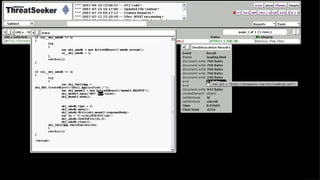
Automated
JavaScript Deobfuscation
Stephan Chenette               Alex Rice
Principle Security Researcher   Sr. Security Researcher
Malcode analysis
 Current malcode research is focused on binary analysis.


 Multiple tools to assist researchers in analysis.
   IDA
   OllyDbg


 Fact: More delivery of malware is moving to the web.

 A new set of skills and tools are required.
What you know…
What you need to know…
 Malicious binary analysis
   Languages: Assembly, C, C++, vb, delphi, etc.
   Concepts: PE file format, win32 function usage, unpacking, anti-
    disassembling tricks, etc.
   Tools: IDA, OllyDbg, PEiD, Imprec

 Malicious web content analysis
   Languages: (D)HTML, VBScript, JavaScript, Perl/Python/Ruby
   Concepts: HTTP Protocol, XMLHTTPRequest, Document Object
    Model (DOM), Browser Security Models, JSON,
   Tools: ???
Those Who Forget History Are
Doomed to Repeat It
 Malcode authors will protect malicious web content the
  same way they protected malicious binaries.


   Signature evasion
   Anti-analysis techniques
   Pain in the #*&#$! for all researchers!!
Unpacking and anti-debugging
 Packing/Protecting/Anti-reversing
 Compression, Encryption, CRC protection
 Anti-debugging
 Virtualization detection
 Anti-emulation
 XOR stubs
Obfuscation Evolution
 String splitting:
    “AD” + “ODB.S” + “treAM”
 String encoding/escaping:
    “%41u0044” + “Ox44%42u002ES” + “t%72eAM”
 Closing html tags (e.g. </TEXTAREA>)
 Code length dependant obfuscation:
    arguments.callee.toString()
 Server-side [poly|meta]-morphic obfuscation
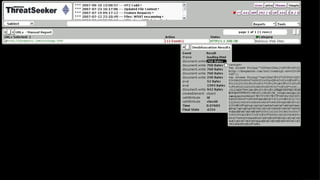
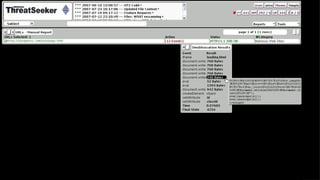
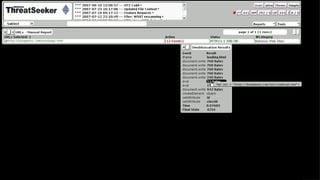
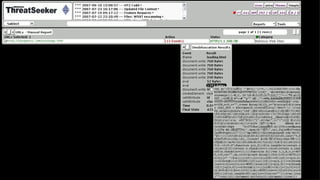
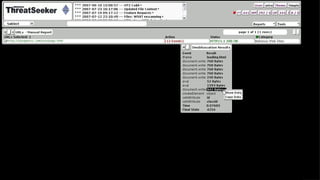
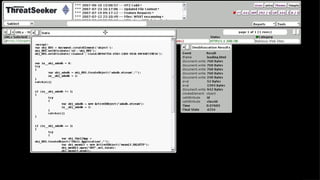
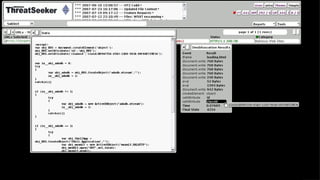
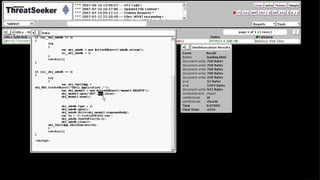
Malicious JavaScript
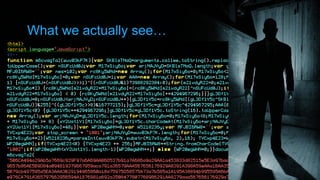
What we actually see…
Our Approach
 Emulation: a browser without a browser…
    HTML Parser
    DOM Implementation
    Scripting Engine(s)/Interpreter(s)
 Allow the page to decode itself
 Don’t render content, just log everything!
HTML Parser
 The first step in emulating a browser: HTML.


 Retrieve all the content needed by the page:
  external SCRIPTs, IFRAMEs, etc.


 Side effect – basic HTML obfuscation is defeated:
    <iframe src=“&#104;&#116;&#116;&#112;
     &#58;&#47;&#47;%77%77%77%2E%74….
A Little DOM, Please
 Modern browsers are dynamic, so our emulator
  must also be.


 Implement Document Object Model


 Attempting to detect all instances of an element by
  simply parsing static HTML is not enough….
    createElement(‘IFRAME’);
Coming At You Like A Spider Monkey
 Integrate scripting engine(s) with our DOM to
  execute scripts as they are discovered


 Scripts are [mostly] safe for execution


 Firefox’s SpiderMonkey JavaScript Engine
  (MPL/GPL/LGPL)
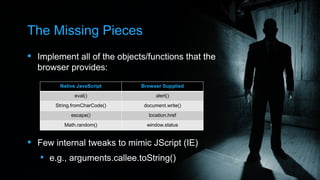
The Missing Pieces
 Implement all of the objects/functions that the
  browser provides:
        Native JavaScript      Browser Supplied
              eval()                 alert()
       String.fromCharCode()    document.write()
             escape()             location.href
          Math.random()          window.status


 Few internal tweaks to mimic JScript (IE)
    e.g., arguments.callee.toString()
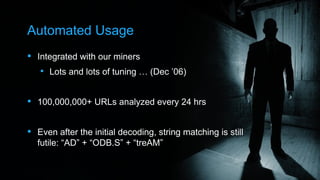
Automated Usage
 Integrated with our miners
    Lots and lots of tuning … (Dec ’06)


 100,000,000+ URLs analyzed every 24 hrs


 Even after the initial decoding, string matching is still
  futile: “AD” + “ODB.S” + “treAM”
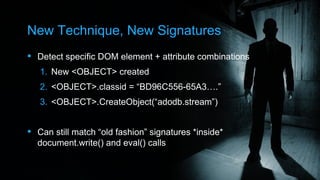
New Technique, New Signatures
 Detect specific DOM element + attribute combinations
   1. New <OBJECT> created
   2. <OBJECT>.classid = “BD96C556-65A3….”
   3. <OBJECT>.CreateObject(“adodb.stream”)


 Can still match “old fashion” signatures *inside*
  document.write() and eval() calls
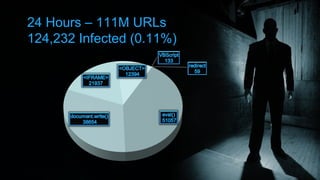
24 Hours – 111M URLs
124,232 Infected (0.11%)
Limitations – JavaScript Only?
 Other Languages?
    Same concepts apply!
 VBScript
    vbscript.dll under WinE!
    Currently working on experimental version
 ActionScript
    Partially implemented when Adobe open sourced
     the engine; now part of Mozilla’s Tamarin Project
Limitations – variable is not defined!
 Attackers can potentially use intentional errors to
  prevent code execution
 Identical input/output is very important
 Easy: document.width
 Hard: window.open()
 Really hard: XMLHTTPRequest
 Centralized verbose error logging!
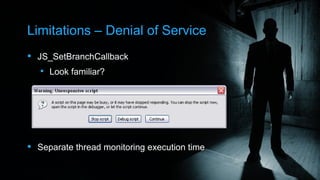
Limitations – Denial of Service
 JS_SetBranchCallback
    Look familiar?


 Separate thread monitoring execution time
Limitations – User Interaction
 Malicious code could potentially rely upon a user’s
  action before execution begins
 We implemented some basic event handling:
    body – onload
    window – focus
    document – onmouse___
 Not foolproof!
CaffeineMonkey
 Ben Feinstein & Daniel Peck @ SecureWorks
 Released Open Source
 Excellent tool for manual reverse engineering of
  obfuscation; needs HTML/DOM!
 Promising research that attempts to identify malicious
  activity based on behavior, not static signatures.
 http://secureworks.com/research/tools/caffeinemonkey.html
Other Resources
 Tutorials from ISC, excellent starting point
    http://handlers.sans.org/dwesemann/decode/

 Jose Nazario’s CanSecWest presentation
    http://www.cansecwest.com/slides07/csw07-nazario.pdf

 Websense Blogs
    http://www.websense.com/securitylabs/blog/blog.php?BlogID=86
    http://www.websense.com/securitylabs/blog/blog.php?BlogID=98
    http://www.websense.com/securitylabs/blog/blog.php?BlogID=142
The End
Stephan Chenette               Alex Rice
Principle Security Researcher   Sr .Security Researcher
schenette || websense com       arice || websense com

Automated JavaScript Deobfuscation - PacSec 2007

  • 1.
    Spiffy: Automated JavaScript Deobfuscation Stephan Chenette Alex Rice Principle Security Researcher Sr. Security Researcher
  • 2.
    Malcode analysis  Currentmalcode research is focused on binary analysis.  Multiple tools to assist researchers in analysis.  IDA  OllyDbg  Fact: More delivery of malware is moving to the web.  A new set of skills and tools are required.
  • 3.
    What you know… Whatyou need to know…  Malicious binary analysis  Languages: Assembly, C, C++, vb, delphi, etc.  Concepts: PE file format, win32 function usage, unpacking, anti- disassembling tricks, etc.  Tools: IDA, OllyDbg, PEiD, Imprec  Malicious web content analysis  Languages: (D)HTML, VBScript, JavaScript, Perl/Python/Ruby  Concepts: HTTP Protocol, XMLHTTPRequest, Document Object Model (DOM), Browser Security Models, JSON,  Tools: ???
  • 4.
    Those Who ForgetHistory Are Doomed to Repeat It  Malcode authors will protect malicious web content the same way they protected malicious binaries.  Signature evasion  Anti-analysis techniques  Pain in the #*&#$! for all researchers!!
  • 5.
    Unpacking and anti-debugging Packing/Protecting/Anti-reversing  Compression, Encryption, CRC protection  Anti-debugging  Virtualization detection  Anti-emulation  XOR stubs
  • 6.
    Obfuscation Evolution  Stringsplitting:  “AD” + “ODB.S” + “treAM”  String encoding/escaping:  “%41u0044” + “Ox44%42u002ES” + “t%72eAM”  Closing html tags (e.g. </TEXTAREA>)  Code length dependant obfuscation:  arguments.callee.toString()  Server-side [poly|meta]-morphic obfuscation
  • 7.
  • 8.
  • 9.
    Our Approach  Emulation:a browser without a browser…  HTML Parser  DOM Implementation  Scripting Engine(s)/Interpreter(s)  Allow the page to decode itself  Don’t render content, just log everything!
  • 10.
    HTML Parser  Thefirst step in emulating a browser: HTML.  Retrieve all the content needed by the page: external SCRIPTs, IFRAMEs, etc.  Side effect – basic HTML obfuscation is defeated:  <iframe src=“&#104;&#116;&#116;&#112; &#58;&#47;&#47;%77%77%77%2E%74….
  • 11.
    A Little DOM,Please  Modern browsers are dynamic, so our emulator must also be.  Implement Document Object Model  Attempting to detect all instances of an element by simply parsing static HTML is not enough….  createElement(‘IFRAME’);
  • 12.
    Coming At YouLike A Spider Monkey  Integrate scripting engine(s) with our DOM to execute scripts as they are discovered  Scripts are [mostly] safe for execution  Firefox’s SpiderMonkey JavaScript Engine (MPL/GPL/LGPL)
  • 13.
    The Missing Pieces Implement all of the objects/functions that the browser provides: Native JavaScript Browser Supplied eval() alert() String.fromCharCode() document.write() escape() location.href Math.random() window.status  Few internal tweaks to mimic JScript (IE)  e.g., arguments.callee.toString()
  • 26.
    Automated Usage  Integratedwith our miners  Lots and lots of tuning … (Dec ’06)  100,000,000+ URLs analyzed every 24 hrs  Even after the initial decoding, string matching is still futile: “AD” + “ODB.S” + “treAM”
  • 27.
    New Technique, NewSignatures  Detect specific DOM element + attribute combinations 1. New <OBJECT> created 2. <OBJECT>.classid = “BD96C556-65A3….” 3. <OBJECT>.CreateObject(“adodb.stream”)  Can still match “old fashion” signatures *inside* document.write() and eval() calls
  • 28.
    24 Hours –111M URLs 124,232 Infected (0.11%)
  • 29.
    Limitations – JavaScriptOnly?  Other Languages?  Same concepts apply!  VBScript  vbscript.dll under WinE!  Currently working on experimental version  ActionScript  Partially implemented when Adobe open sourced the engine; now part of Mozilla’s Tamarin Project
  • 30.
    Limitations – variableis not defined!  Attackers can potentially use intentional errors to prevent code execution  Identical input/output is very important  Easy: document.width  Hard: window.open()  Really hard: XMLHTTPRequest  Centralized verbose error logging!
  • 31.
    Limitations – Denialof Service  JS_SetBranchCallback  Look familiar?  Separate thread monitoring execution time
  • 32.
    Limitations – UserInteraction  Malicious code could potentially rely upon a user’s action before execution begins  We implemented some basic event handling:  body – onload  window – focus  document – onmouse___  Not foolproof!
  • 33.
    CaffeineMonkey  Ben Feinstein& Daniel Peck @ SecureWorks  Released Open Source  Excellent tool for manual reverse engineering of obfuscation; needs HTML/DOM!  Promising research that attempts to identify malicious activity based on behavior, not static signatures.  http://secureworks.com/research/tools/caffeinemonkey.html
  • 34.
    Other Resources  Tutorialsfrom ISC, excellent starting point  http://handlers.sans.org/dwesemann/decode/  Jose Nazario’s CanSecWest presentation  http://www.cansecwest.com/slides07/csw07-nazario.pdf  Websense Blogs  http://www.websense.com/securitylabs/blog/blog.php?BlogID=86  http://www.websense.com/securitylabs/blog/blog.php?BlogID=98  http://www.websense.com/securitylabs/blog/blog.php?BlogID=142
  • 35.
    The End Stephan Chenette Alex Rice Principle Security Researcher Sr .Security Researcher schenette || websense com arice || websense com