Download as PDF, PPTX

![What we want
❖Improve Global Variables management
– "console","window","document","String","Object","Array","eval"...
❖Operations on Native Data (JSFuck … ) +[] ..
❖Global functions execution
– escape, unescape, String.*,Array.*..
❖Variable Substitution w/ constants or globals
– var win=window; …. t=win > var win=window; …. t=window
❖Scoping and Function Evaluation
– Function evaluation according to variable scoping.
Objects Management:
– var t={a:2}; var b=t.a;
Possibly Deobfuscate all known obfuscators](https://image.slidesharecdn.com/mindedsecurity-advancedjsdeobv2-151027143007-lva1-app6891/75/Advanced-JS-Deobfuscation-13-2048.jpg)
![Dealing W/ Complex Data
❖ Hardest task so far
❖ Similar to Variable Substitution but harder
❖ Deal w/ Arrays and Objects
❖ Deal with dynamic properties
----------------------------
❖ Ended up creating a scope wise state machine. :O
❖ Partially implemented
var h={w:2};
var t="a";
h[t]=3;
var b=h.w+h[t]](https://image.slidesharecdn.com/mindedsecurity-advancedjsdeobv2-151027143007-lva1-app6891/75/Advanced-JS-Deobfuscation-15-2048.jpg)


This document discusses JavaScript deobfuscation techniques using abstract syntax trees (ASTs). It begins by explaining goals of JavaScript obfuscation like blocking reverse engineering and bypassing antivirus detection. Common obfuscation techniques like eval packing and JSFuck are described. The document then discusses approaches to deobfuscation including runtime execution and manual analysis. It focuses on the benefits of partial evaluation using AST traversal and subtree reduction to perform operations like constant folding and function inlining. Examples are provided of challenges in evaluating complex data structures and functions. The conclusion is that AST-based deobfuscation is difficult but can counter some obfuscation techniques through multi-pass analysis and function hoisting.
Introducing advanced JavaScript concepts focused on the challenges and techniques of obfuscation.
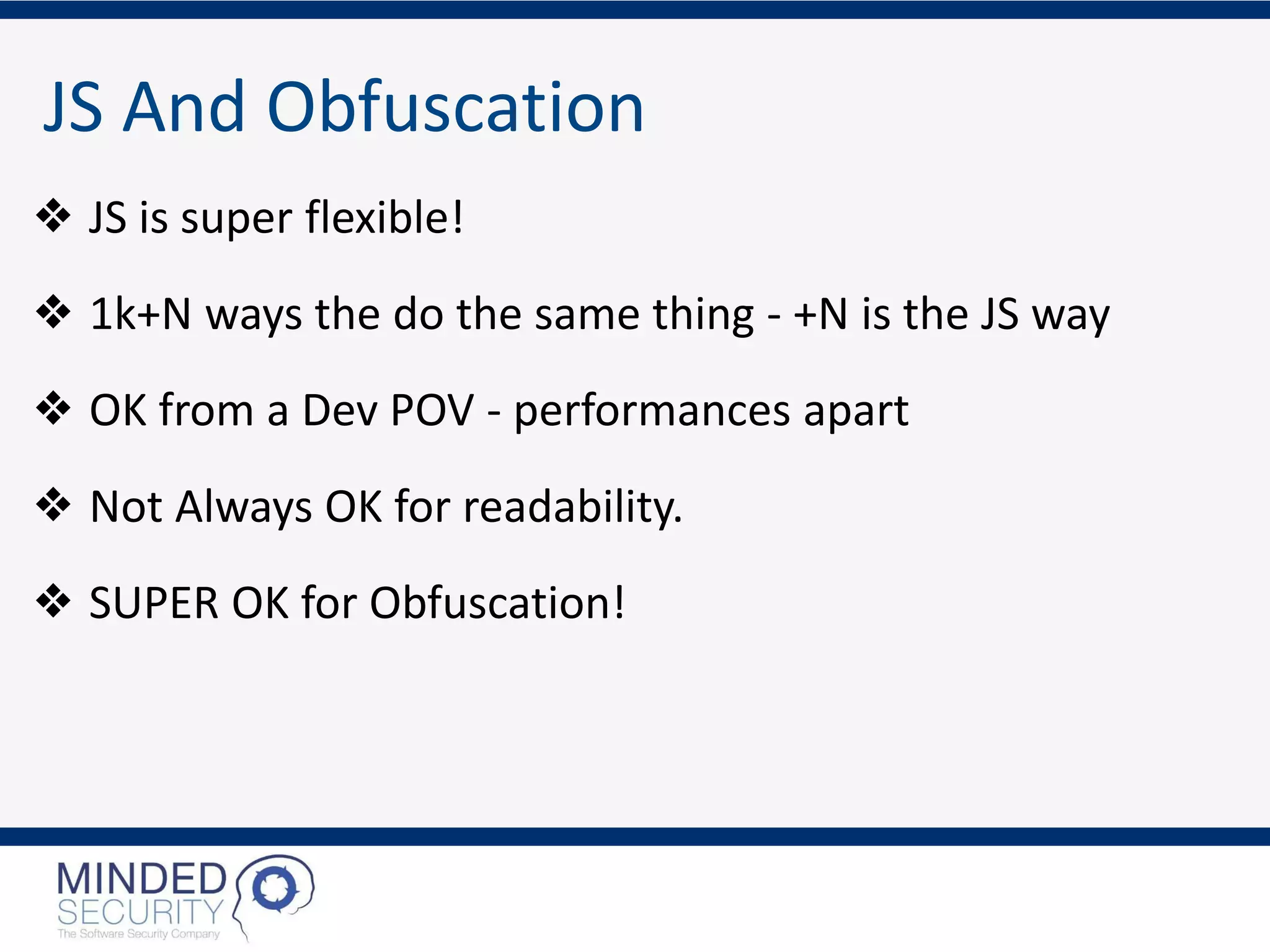
JavaScript's flexibility enables various coding methods, enhancing obfuscation at the cost of readability.
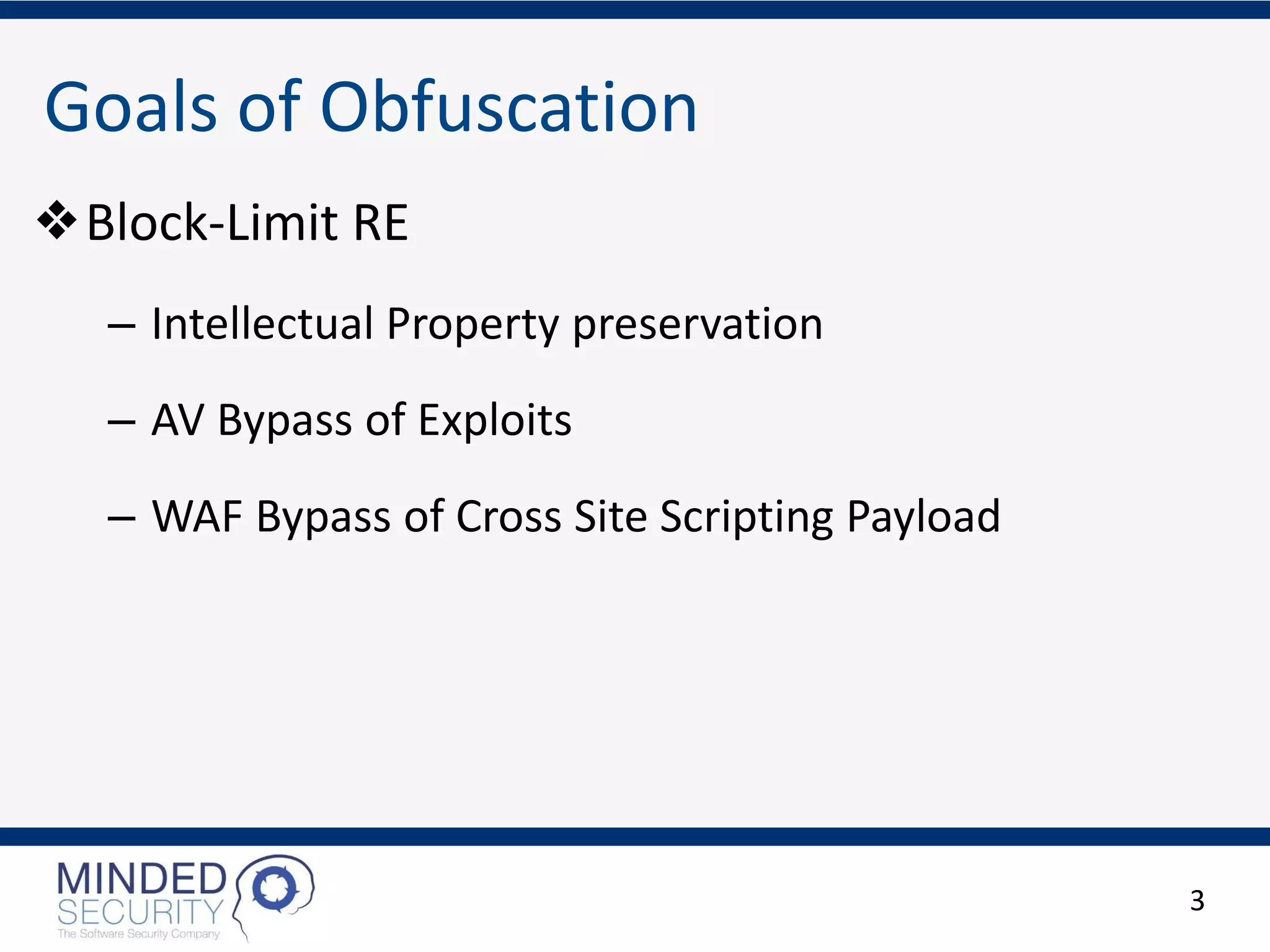
Goals include protecting intellectual property and bypassing security measures like AV and WAF.
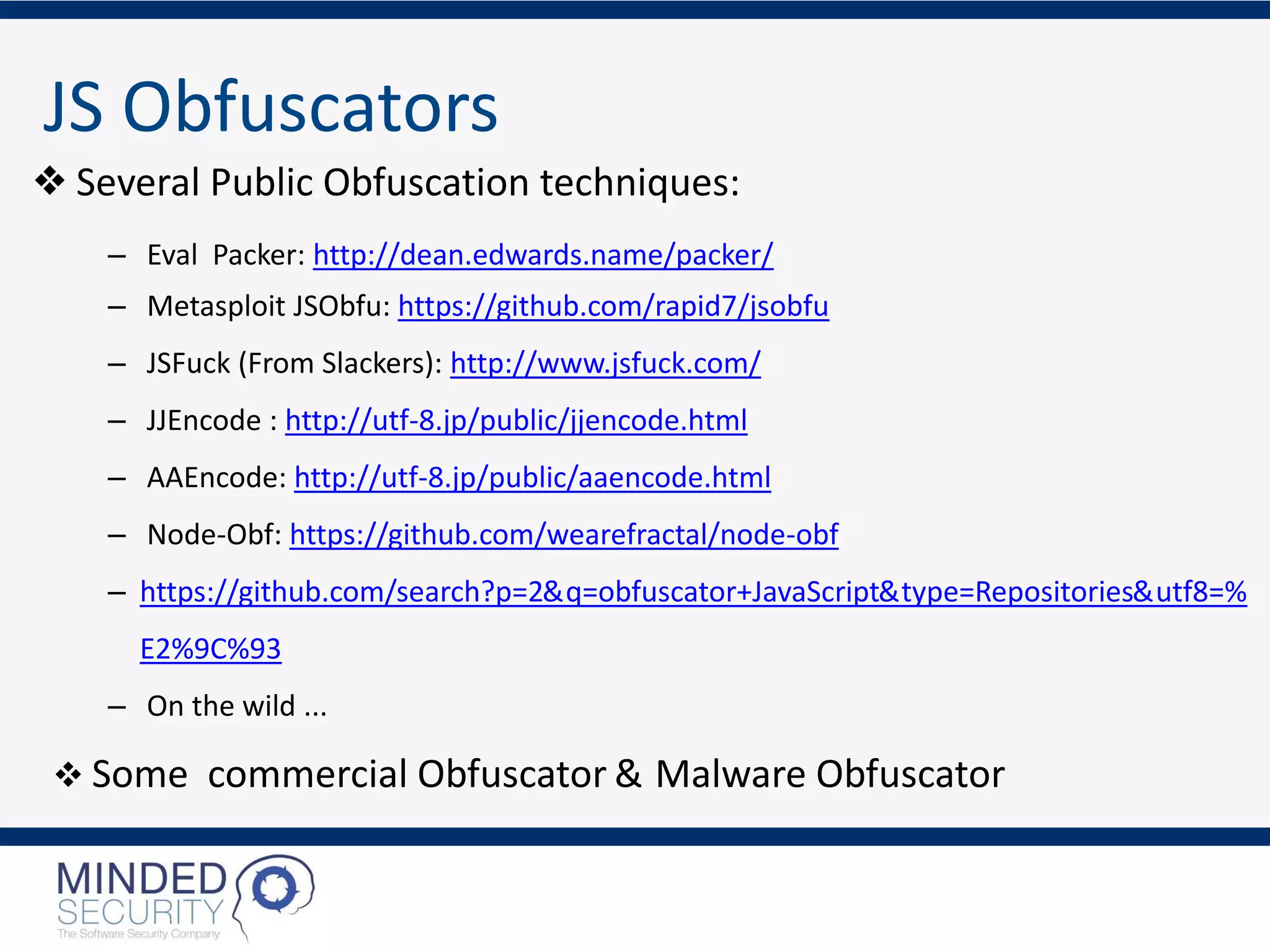
Listing several obfuscation tools and techniques used in public and commercial applications.
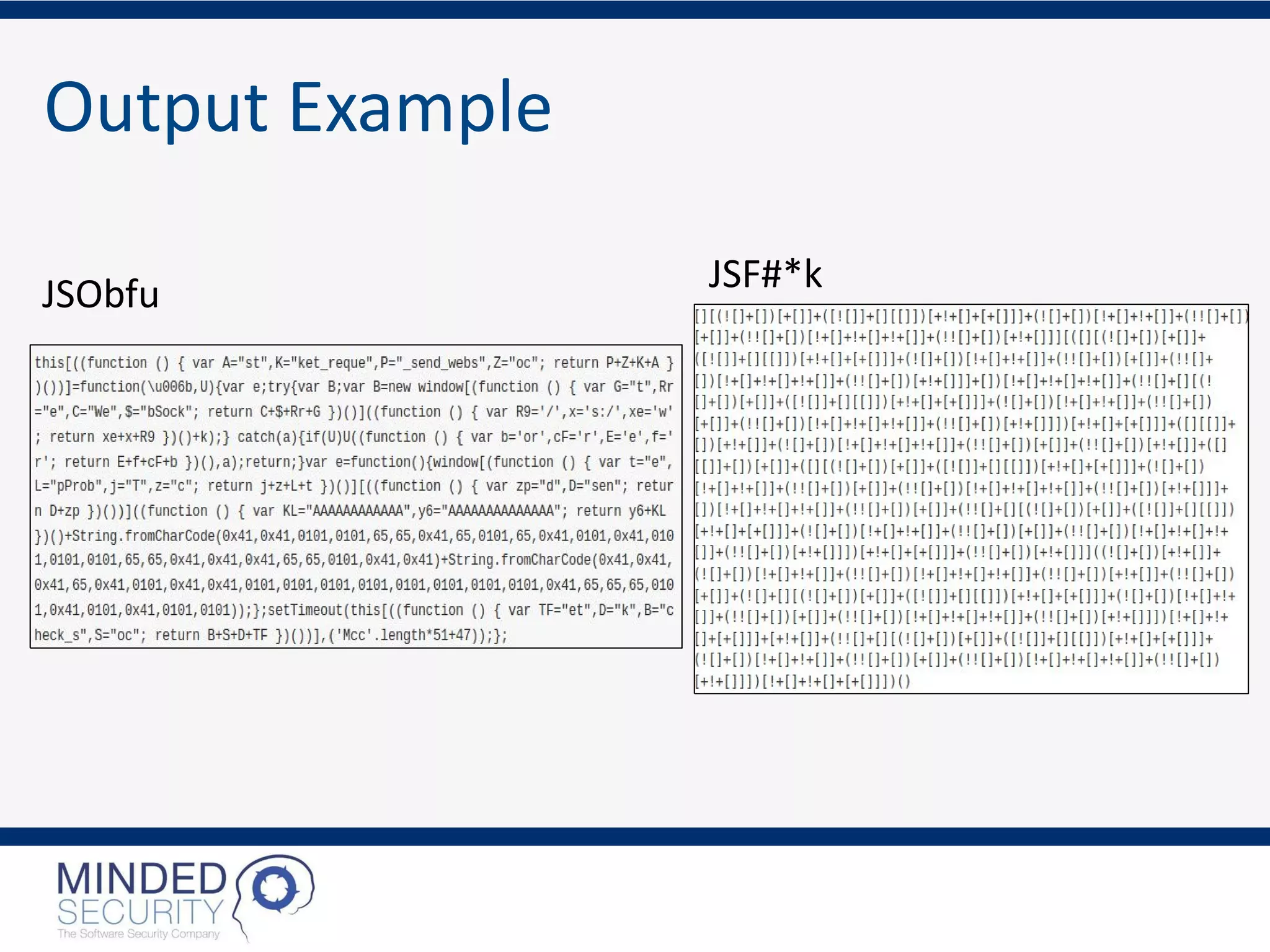
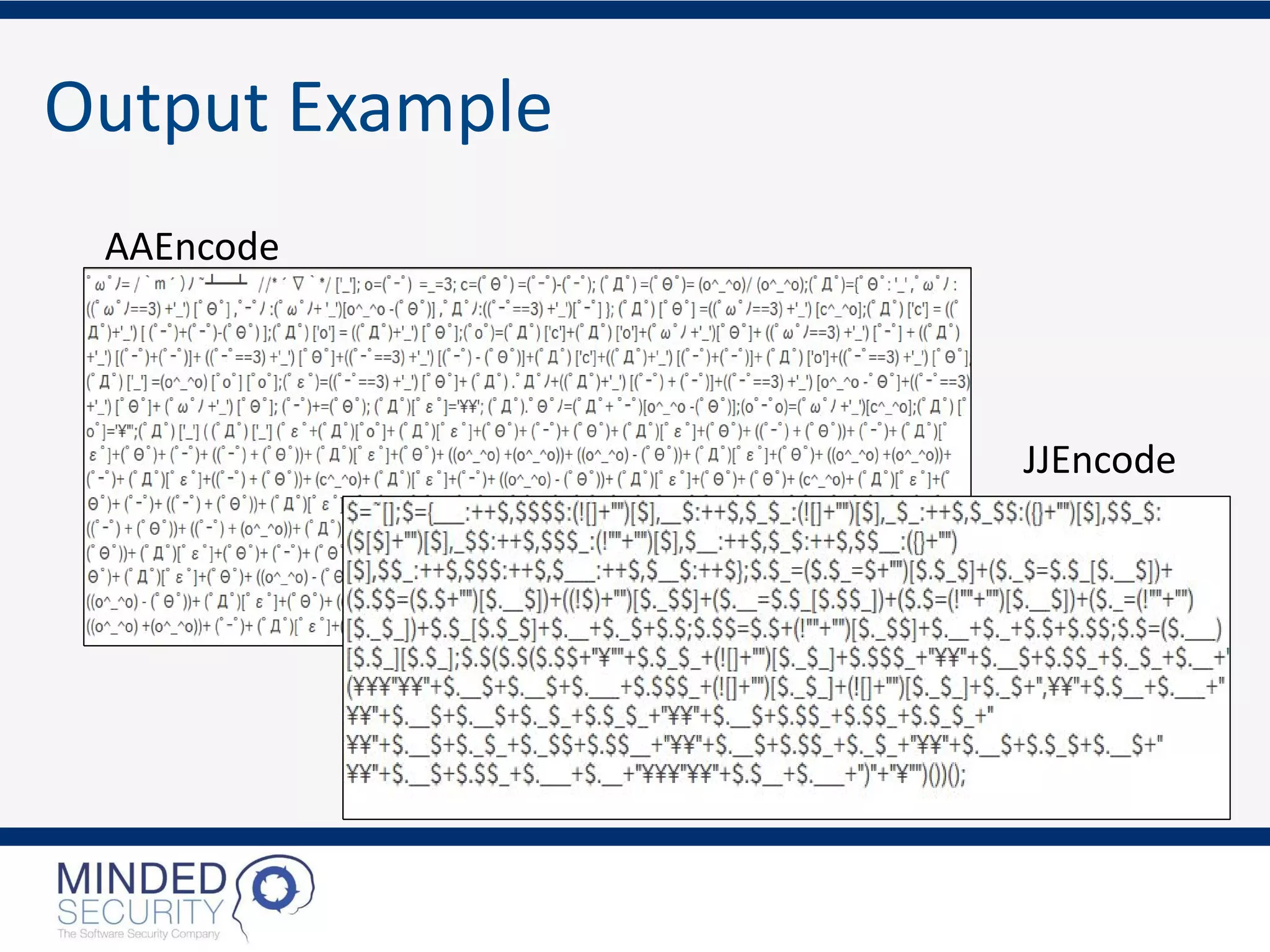
Demonstrating outputs from JSObfu, AAEncode, and JJEncode to illustrate obfuscation effectiveness.
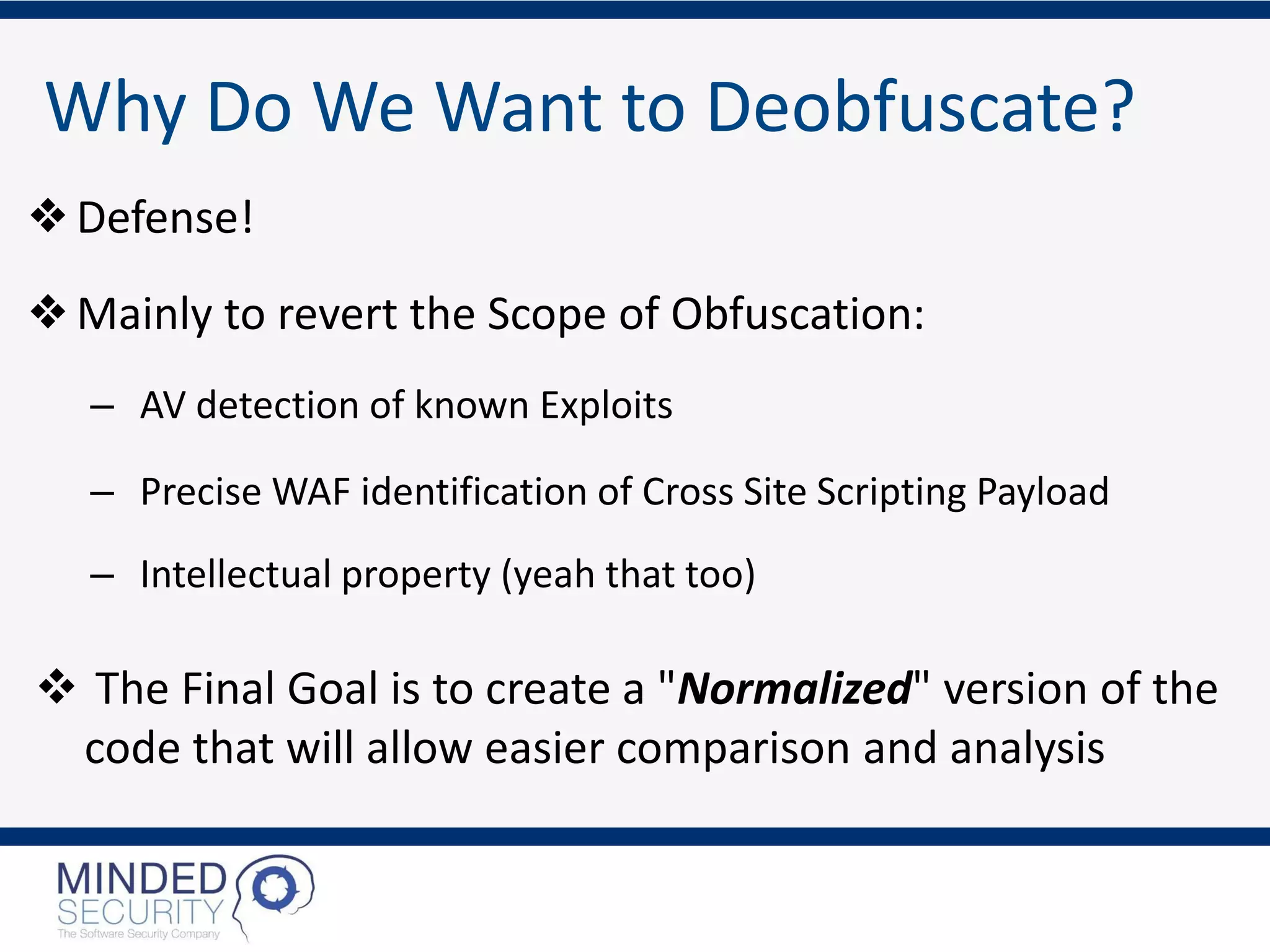
Emphasizing the importance of deobfuscation for defense, detection, and analysis of obfuscated code.
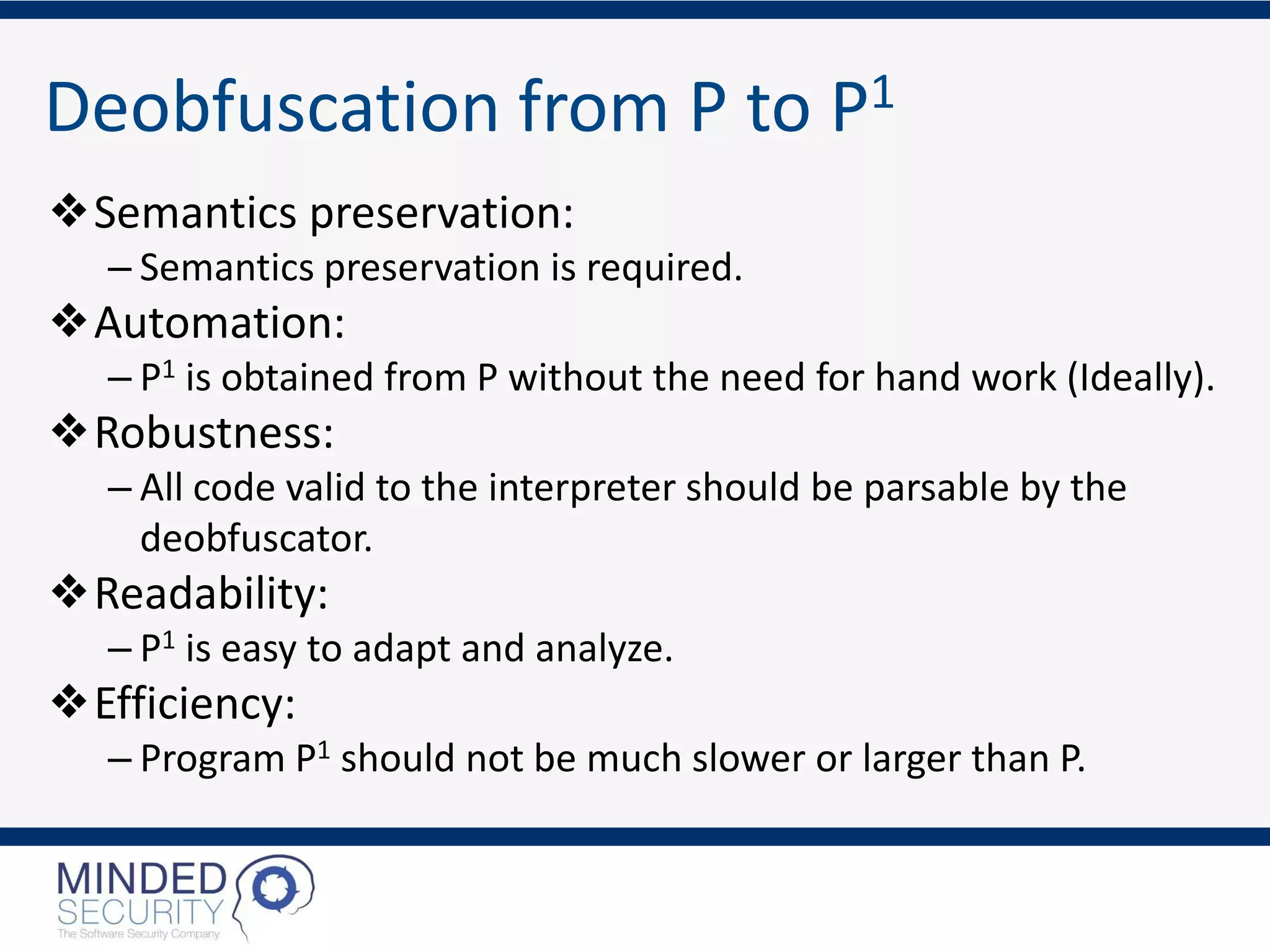
Describes essential attributes of a successful deobfuscation process: semantics, automation, readability, etc.
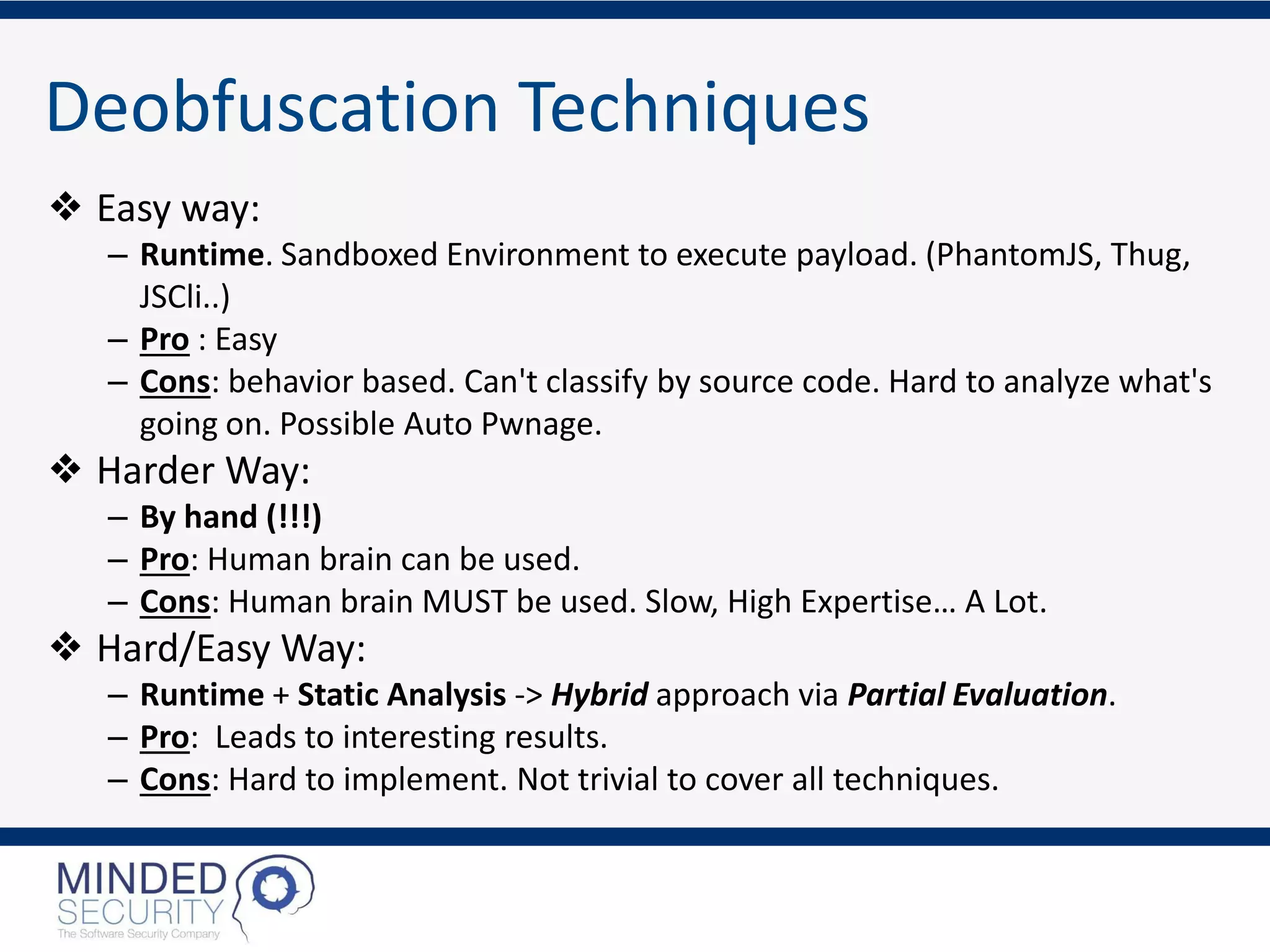
Exploring methods of deobfuscation ranging from runtime analysis to manual efforts and hybrid approaches.
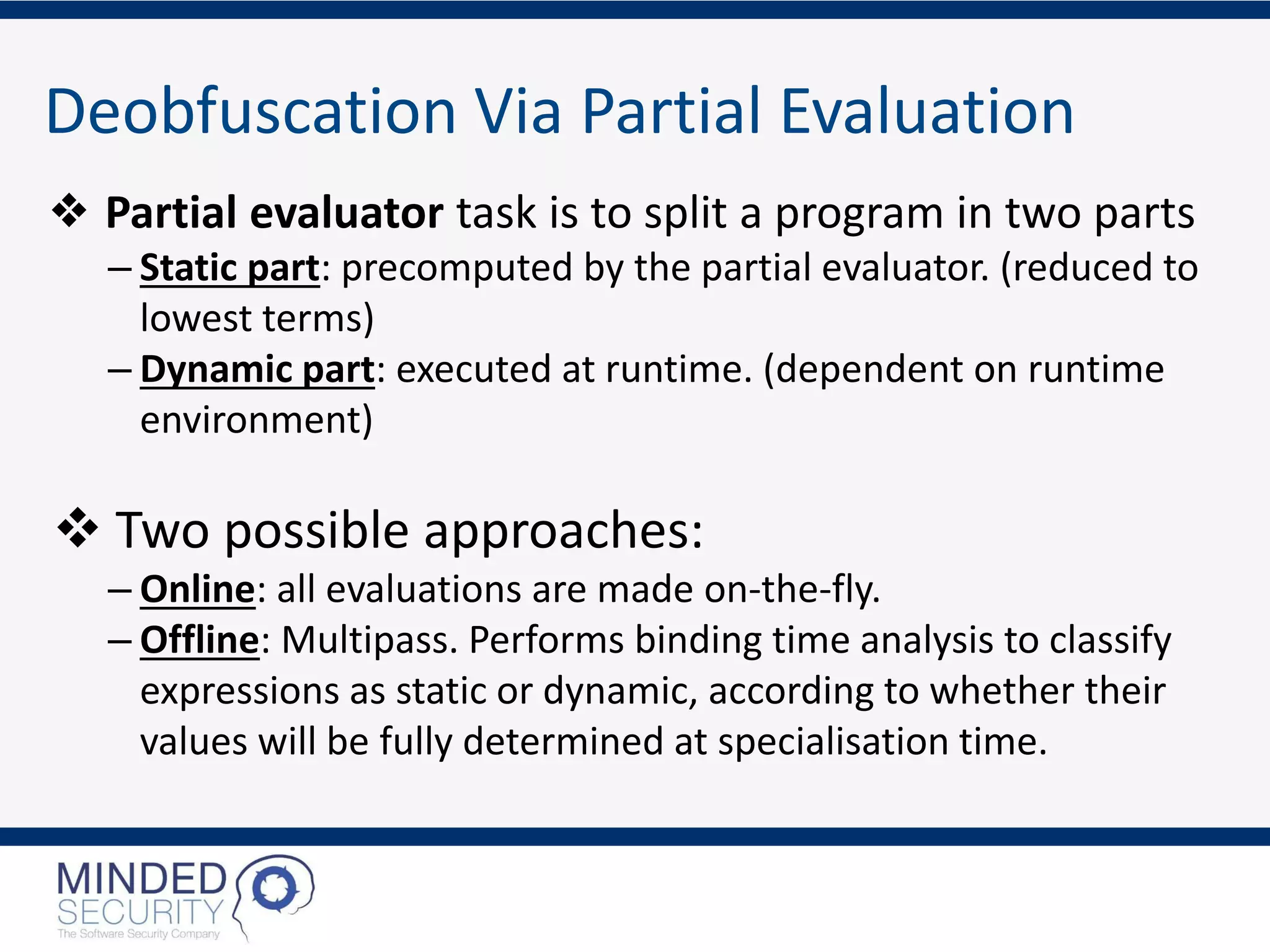
Using partial evaluation to split programs into static and dynamic parts for better analysis.
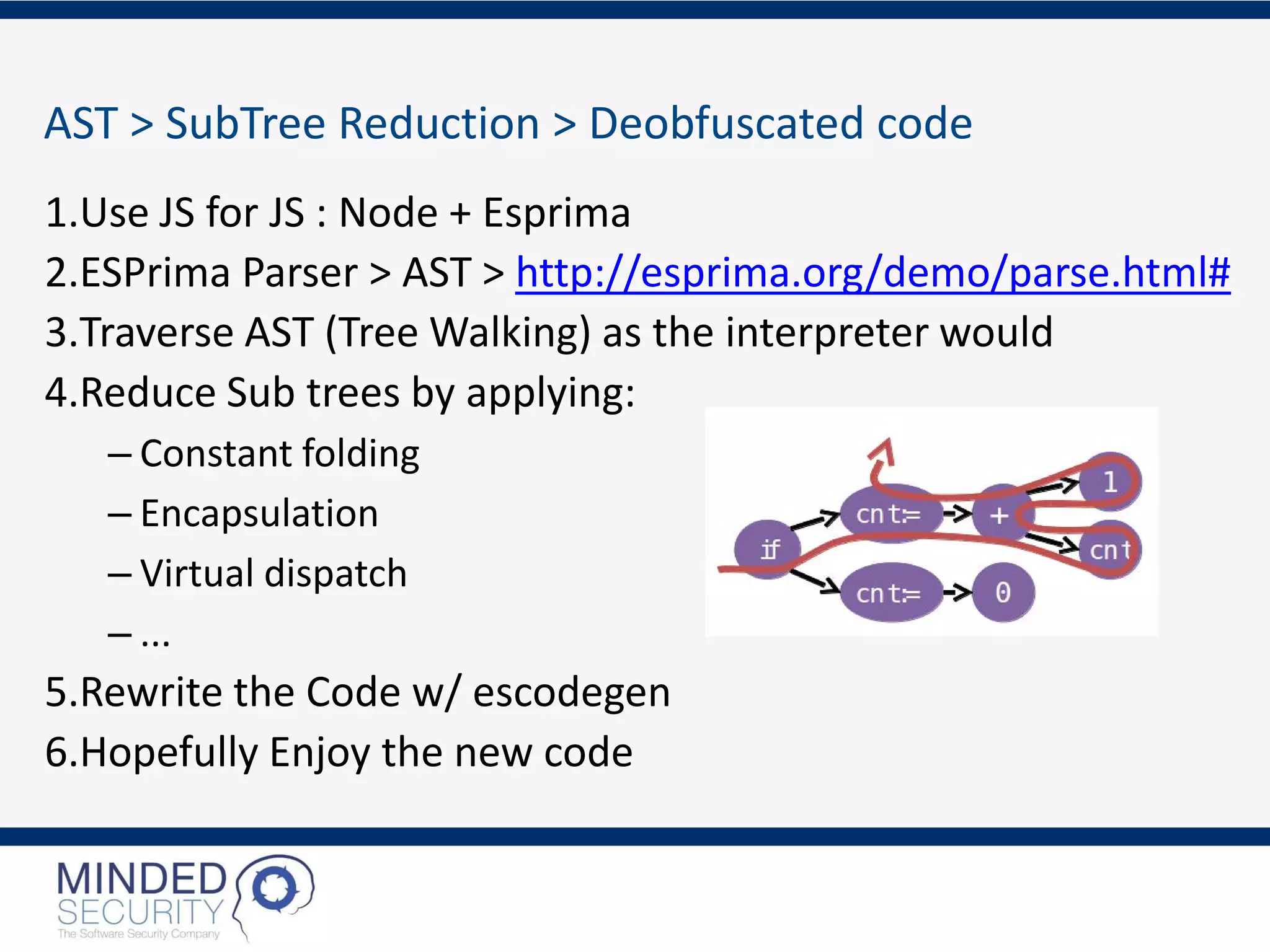
Describing the process of using an Abstract Syntax Tree (AST) for code reduction and clarity.
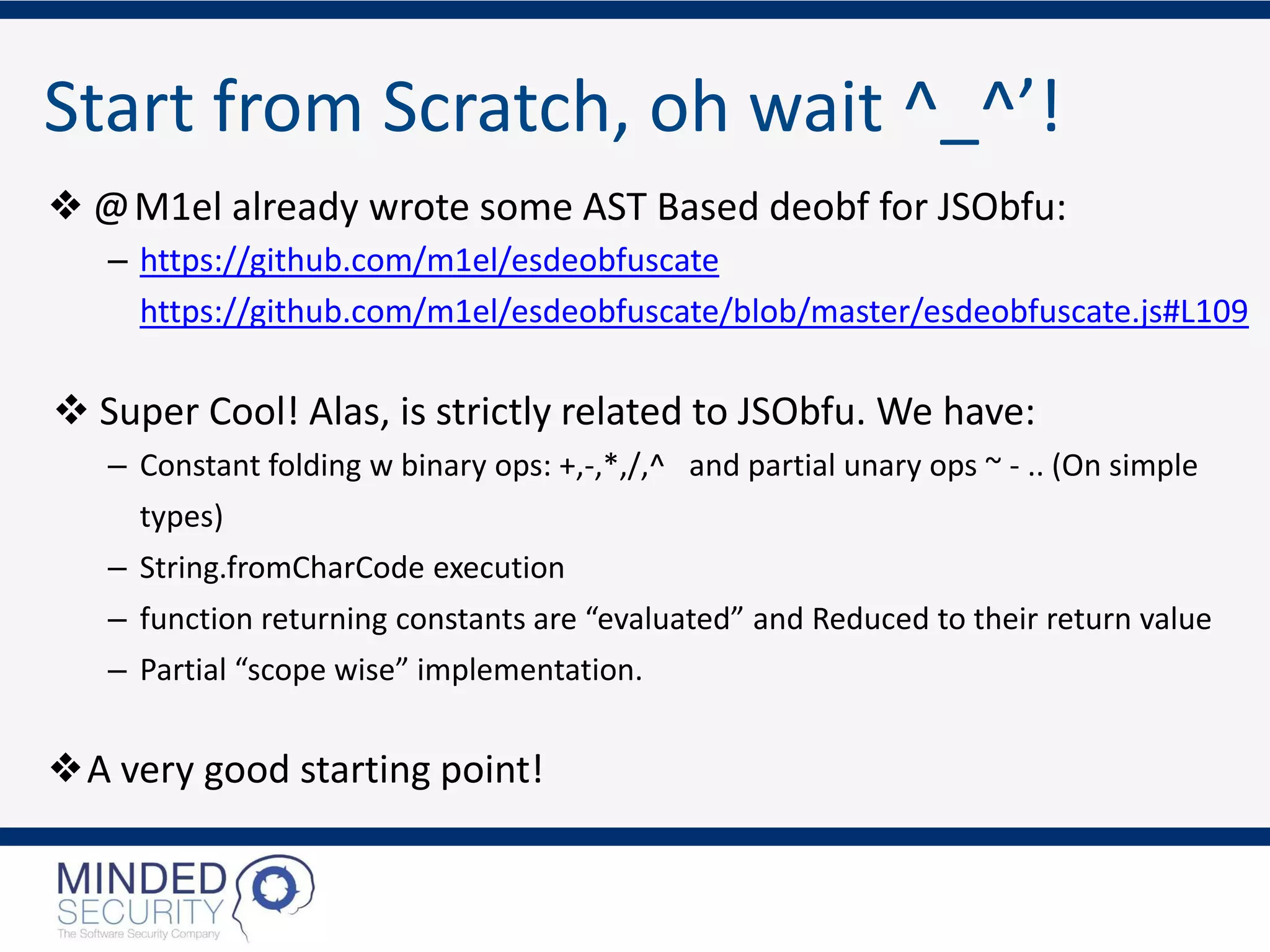
Presenting an initiative to create an AST-based deobfuscator tailored for JSObfu.
Discussing improvements in handling global variable management and object management for deobfuscation.
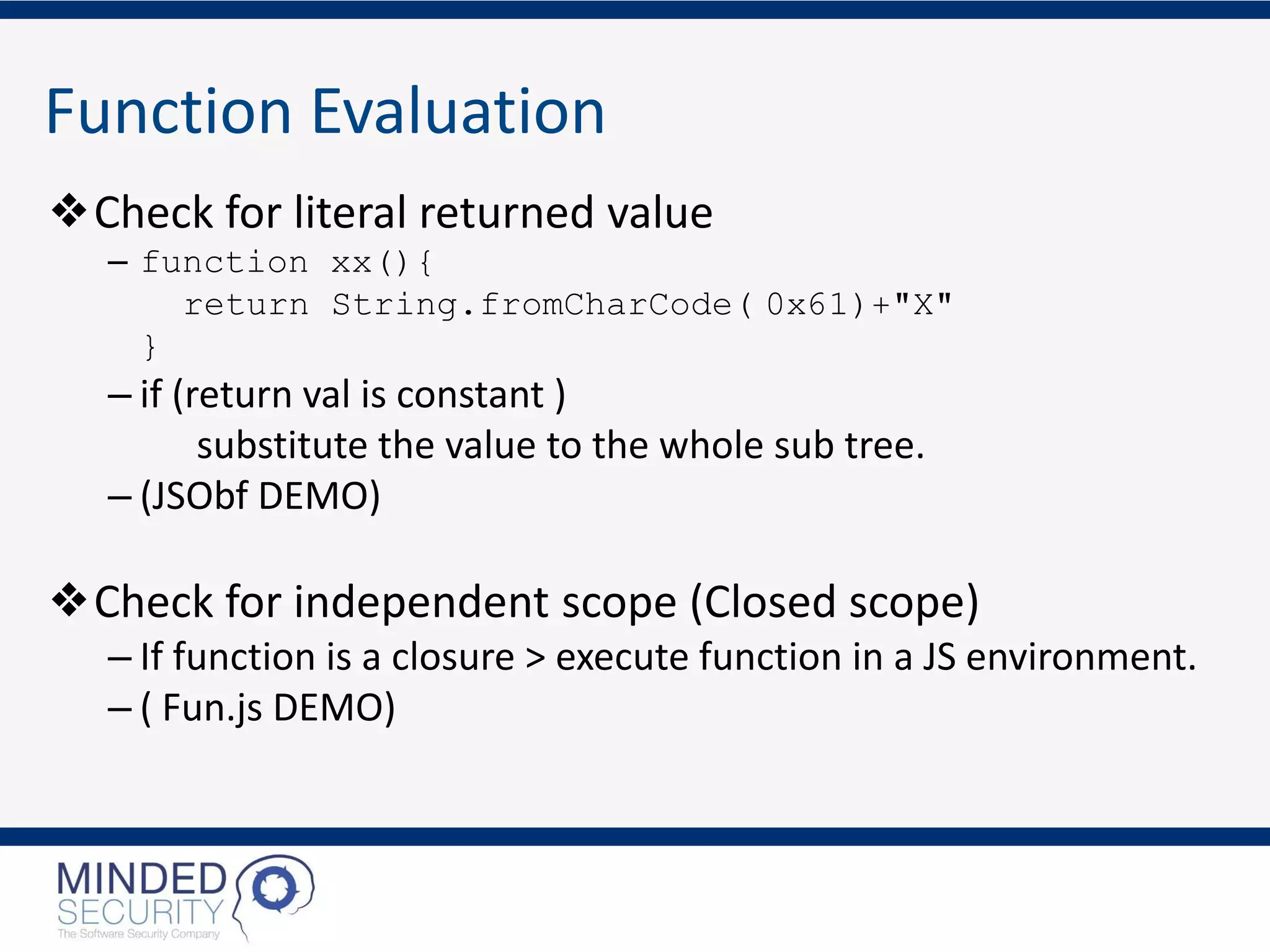
Methods for evaluating functions and substituting constant values in deobfuscation optimization.
Addressing difficulties in manipulating complex data structures like arrays and objects during deobfuscation.
Live demonstration of a tool related to the concepts discussed in the presentation.
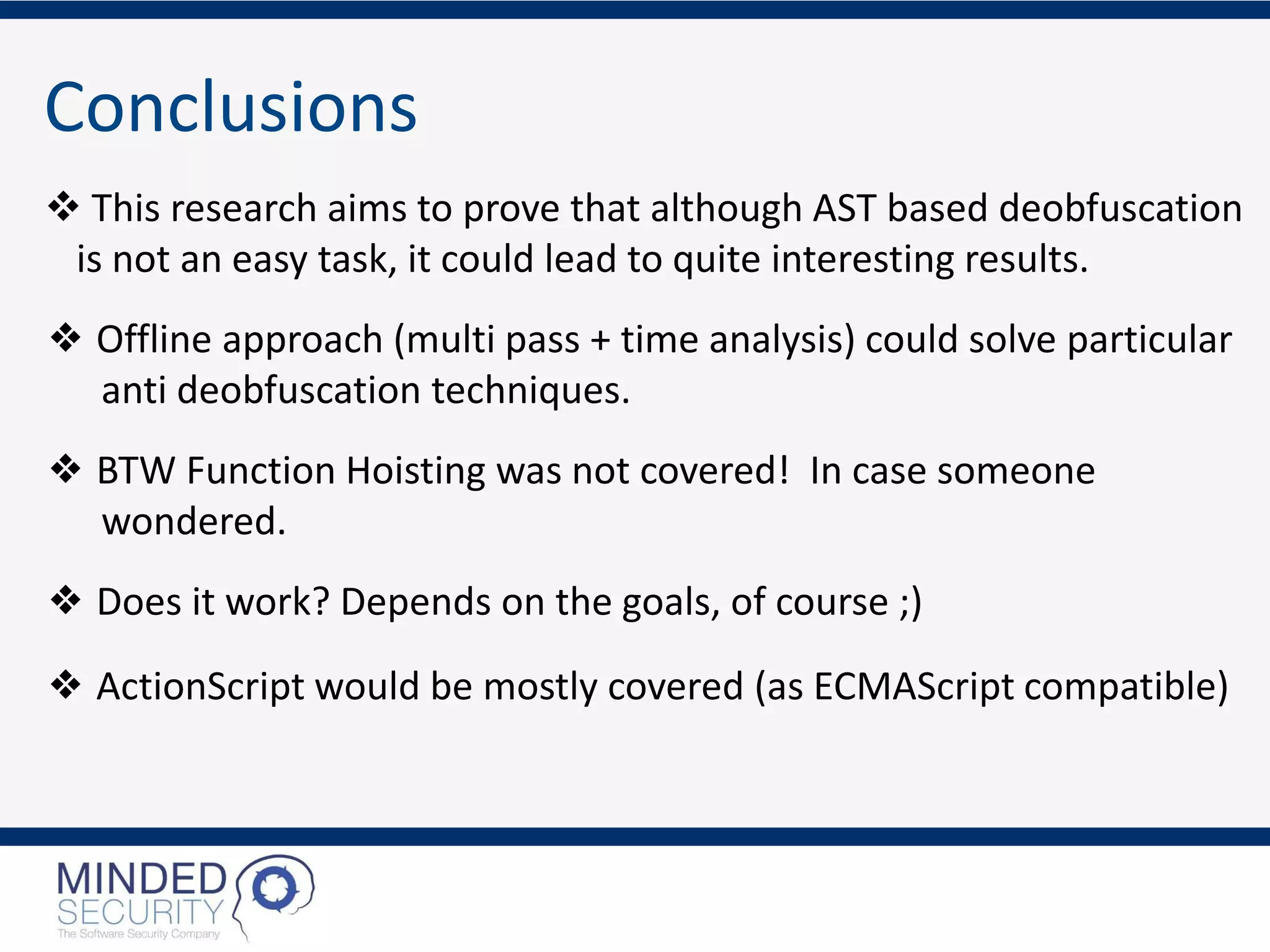
Concluding thoughts on the effectiveness of AST-based deobfuscation techniques and future implications.
Providing contact details and inviting questions regarding the presented content.


