In late 2015 Gartner announced
that “the future of the data center is
software-defined”1
. Automation embraces
technology, processes, and human
interaction to automate and accelerate
recurring processes and to avoid errors
of manual interventions. Automated,
or software-defined data centers help
orchestrate and streamline different IT
processes. The automated data center is a
promise of more efficient, safe and secure,
servers able to enforce even the most
exorbitant service level agreement (SLA).
Gartner predicts that by 2017, 75% of
enterprises will have more than four various
automation technologies within their IT
management portfolio. In Garner report VP
and Distinguished Analyst Ronni Colville
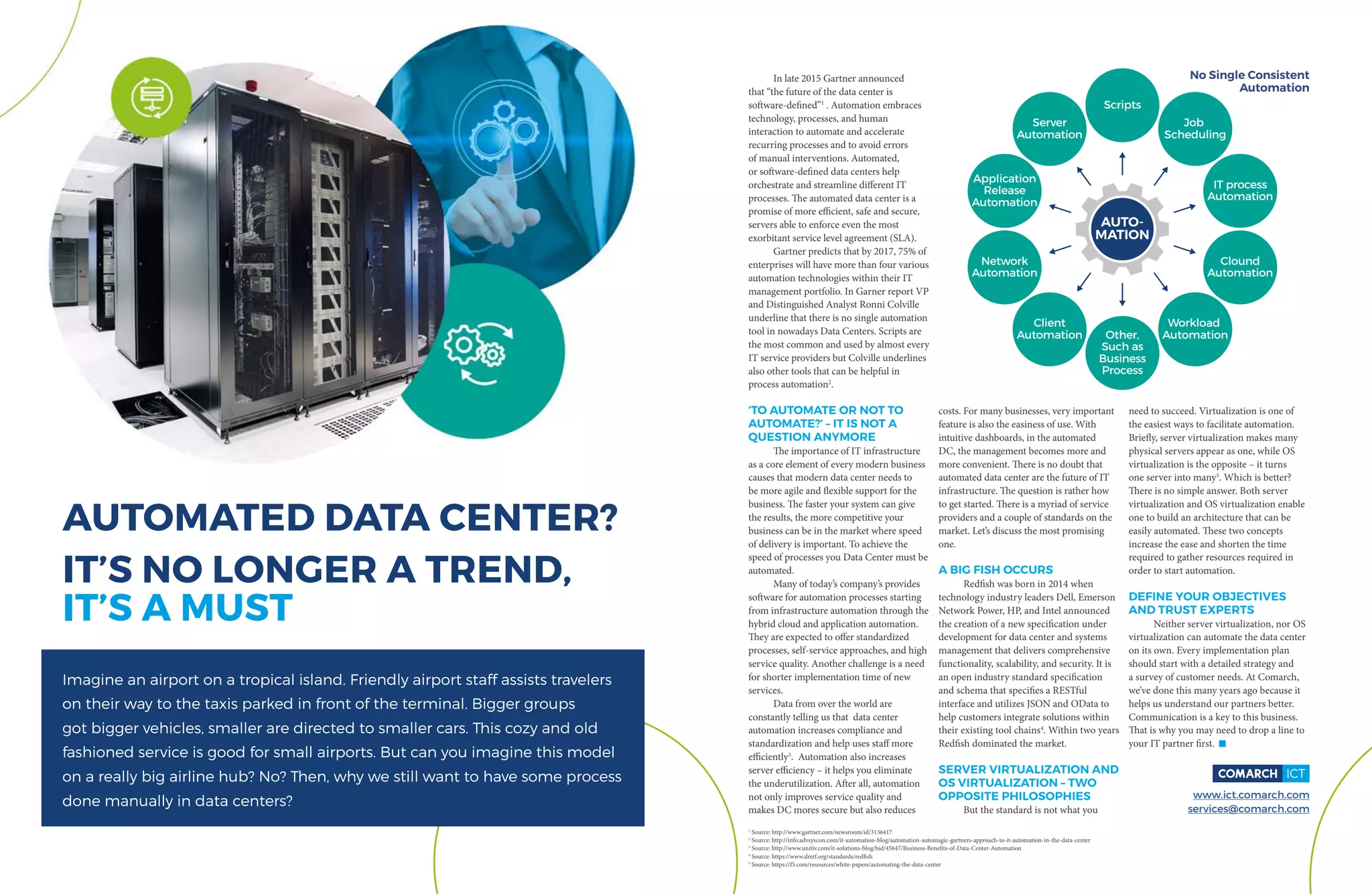
underline that there is no single automation
tool in nowadays Data Centers. Scripts are
the most common and used by almost every
IT service providers but Colville underlines
also other tools that can be helpful in
process automation2
.
‘TO AUTOMATE OR NOT TO
AUTOMATE?’ – IT IS NOT A
QUESTION ANYMORE
The importance of IT infrastructure
as a core element of every modern business
causes that modern data center needs to
be more agile and flexible support for the
business. The faster your system can give
the results, the more competitive your
business can be in the market where speed
of delivery is important. To achieve the
speed of processes you Data Center must be
automated.
Many of today’s company’s provides
software for automation processes starting
from infrastructure automation through the
hybrid cloud and application automation.
They are expected to offer standardized
processes, self-service approaches, and high
service quality. Another challenge is a need
for shorter implementation time of new
services.
Data from over the world are
constantly telling us that data center
automation increases compliance and
standardization and help uses staff more
efficiently3
. Automation also increases
server efficiency – it helps you eliminate
the underutilization. After all, automation
not only improves service quality and
makes DC mores secure but also reduces
costs. For many businesses, very important
feature is also the easiness of use. With
intuitive dashboards, in the automated
DC, the management becomes more and
more convenient. There is no doubt that
automated data center are the future of IT
infrastructure. The question is rather how
to get started. There is a myriad of service
providers and a couple of standards on the
market. Let’s discuss the most promising
one.
A BIG FISH OCCURS
Redfish was born in 2014 when
technology industry leaders Dell, Emerson
Network Power, HP, and Intel announced
the creation of a new specification under
development for data center and systems
management that delivers comprehensive
functionality, scalability, and security. It is
an open industry standard specification
and schema that specifies a RESTful
interface and utilizes JSON and OData to
help customers integrate solutions within
their existing tool chains4
. Within two years
Redfish dominated the market.
SERVER VIRTUALIZATION AND
OS VIRTUALIZATION – TWO
OPPOSITE PHILOSOPHIES
But the standard is not what you
need to succeed. Virtualization is one of
the easiest ways to facilitate automation.
Briefly, server virtualization makes many
physical servers appear as one, while OS
virtualization is the opposite – it turns
one server into many5
. Which is better?
There is no simple answer. Both server
virtualization and OS virtualization enable
one to build an architecture that can be
easily automated. These two concepts
increase the ease and shorten the time
required to gather resources required in
order to start automation.
DEFINE YOUR OBJECTIVES
AND TRUST EXPERTS
Neither server virtualization, nor OS
virtualization can automate the data center
on its own. Every implementation plan
should start with a detailed strategy and
a survey of customer needs. At Comarch,
we’ve done this many years ago because it
helps us understand our partners better.
Communication is a key to this business.
That is why you may need to drop a line to
your IT partner first.
1
Source: http://www.gartner.com/newsroom/id/3136417
2
Source: http://info.advsyscon.com/it-automation-blog/automation-automagic-gartners-approach-to-it-automation-in-the-data-center
3
Source: http://www.unitiv.com/it-solutions-blog/bid/45647/Business-Benefits-of-Data-Center-Automation
4
Source: https://www.dmtf.org/standards/redfish
5
Source: https://f5.com/resources/white-papers/automating-the-data-center
AUTOMATED DATA CENTER?
IT’S NO LONGER A TREND,
IT’S A MUST
www.ict.comarch.com
services@comarch.com
Scripts
Job
Scheduling
IT process
Automation
Clound
Automation
Workload
AutomationOther,
Such as
Business
Process
Client
Automation
Network
Automation
Application
Release
Automation
Server
Automation
AUTO-
MATION
No Single Consistent
Automation
Imagine an airport on a tropical island. Friendly airport staff assists travelers
on their way to the taxis parked in front of the terminal. Bigger groups
got bigger vehicles, smaller are directed to smaller cars. This cozy and old
fashioned service is good for small airports. But can you imagine this model
on a really big airline hub? No? Then, why we still want to have some process
done manually in data centers?

Automated Data Center?

  • 1.
    In late 2015Gartner announced that “the future of the data center is software-defined”1 . Automation embraces technology, processes, and human interaction to automate and accelerate recurring processes and to avoid errors of manual interventions. Automated, or software-defined data centers help orchestrate and streamline different IT processes. The automated data center is a promise of more efficient, safe and secure, servers able to enforce even the most exorbitant service level agreement (SLA). Gartner predicts that by 2017, 75% of enterprises will have more than four various automation technologies within their IT management portfolio. In Garner report VP and Distinguished Analyst Ronni Colville underline that there is no single automation tool in nowadays Data Centers. Scripts are the most common and used by almost every IT service providers but Colville underlines also other tools that can be helpful in process automation2 . ‘TO AUTOMATE OR NOT TO AUTOMATE?’ – IT IS NOT A QUESTION ANYMORE The importance of IT infrastructure as a core element of every modern business causes that modern data center needs to be more agile and flexible support for the business. The faster your system can give the results, the more competitive your business can be in the market where speed of delivery is important. To achieve the speed of processes you Data Center must be automated. Many of today’s company’s provides software for automation processes starting from infrastructure automation through the hybrid cloud and application automation. They are expected to offer standardized processes, self-service approaches, and high service quality. Another challenge is a need for shorter implementation time of new services. Data from over the world are constantly telling us that data center automation increases compliance and standardization and help uses staff more efficiently3 . Automation also increases server efficiency – it helps you eliminate the underutilization. After all, automation not only improves service quality and makes DC mores secure but also reduces costs. For many businesses, very important feature is also the easiness of use. With intuitive dashboards, in the automated DC, the management becomes more and more convenient. There is no doubt that automated data center are the future of IT infrastructure. The question is rather how to get started. There is a myriad of service providers and a couple of standards on the market. Let’s discuss the most promising one. A BIG FISH OCCURS Redfish was born in 2014 when technology industry leaders Dell, Emerson Network Power, HP, and Intel announced the creation of a new specification under development for data center and systems management that delivers comprehensive functionality, scalability, and security. It is an open industry standard specification and schema that specifies a RESTful interface and utilizes JSON and OData to help customers integrate solutions within their existing tool chains4 . Within two years Redfish dominated the market. SERVER VIRTUALIZATION AND OS VIRTUALIZATION – TWO OPPOSITE PHILOSOPHIES But the standard is not what you need to succeed. Virtualization is one of the easiest ways to facilitate automation. Briefly, server virtualization makes many physical servers appear as one, while OS virtualization is the opposite – it turns one server into many5 . Which is better? There is no simple answer. Both server virtualization and OS virtualization enable one to build an architecture that can be easily automated. These two concepts increase the ease and shorten the time required to gather resources required in order to start automation. DEFINE YOUR OBJECTIVES AND TRUST EXPERTS Neither server virtualization, nor OS virtualization can automate the data center on its own. Every implementation plan should start with a detailed strategy and a survey of customer needs. At Comarch, we’ve done this many years ago because it helps us understand our partners better. Communication is a key to this business. That is why you may need to drop a line to your IT partner first. 1 Source: http://www.gartner.com/newsroom/id/3136417 2 Source: http://info.advsyscon.com/it-automation-blog/automation-automagic-gartners-approach-to-it-automation-in-the-data-center 3 Source: http://www.unitiv.com/it-solutions-blog/bid/45647/Business-Benefits-of-Data-Center-Automation 4 Source: https://www.dmtf.org/standards/redfish 5 Source: https://f5.com/resources/white-papers/automating-the-data-center AUTOMATED DATA CENTER? IT’S NO LONGER A TREND, IT’S A MUST www.ict.comarch.com services@comarch.com Scripts Job Scheduling IT process Automation Clound Automation Workload AutomationOther, Such as Business Process Client Automation Network Automation Application Release Automation Server Automation AUTO- MATION No Single Consistent Automation Imagine an airport on a tropical island. Friendly airport staff assists travelers on their way to the taxis parked in front of the terminal. Bigger groups got bigger vehicles, smaller are directed to smaller cars. This cozy and old fashioned service is good for small airports. But can you imagine this model on a really big airline hub? No? Then, why we still want to have some process done manually in data centers?