



www.OpsRamp.com
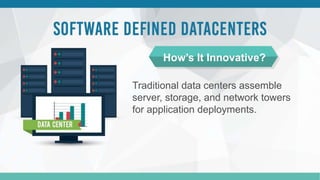
Traditional data centers assemble
server, storage, and network towers
for application deployments.
How’s It Innovative?
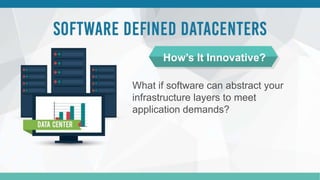
What if software can abstract your
infrastructure layers to meet
application demands?
How’s It Innovative?
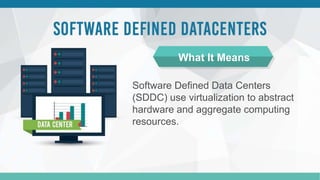
Software Defined Data Centers
(SDDC) use virtualization to abstract
hardware and aggregate computing
resources.
What It Means
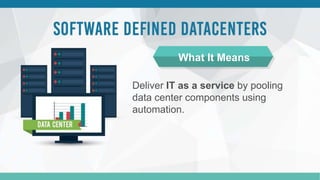
Deliver IT as a service by pooling
data center components using
automation.
What It Means
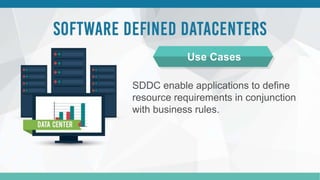
SDDC enable applications to define
resource requirements in conjunction
with business rules.
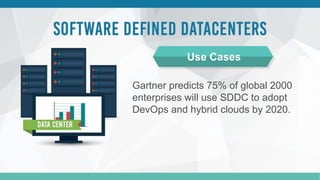
Use Cases
Gartner predicts 75% of global 2000
enterprises will use SDDC to adopt
DevOps and hybrid clouds by 2020.
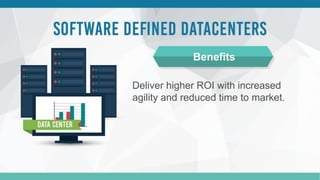
Use Cases
Deliver higher ROI with increased
agility and reduced time to market.
Benefits
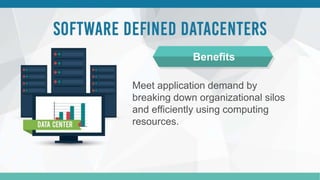
Meet application demand by
breaking down organizational silos
and efficiently using computing
resources.
Benefits
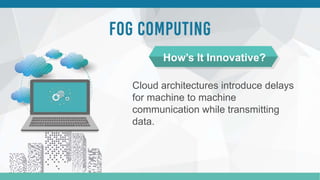
Cloud architectures introduce delays
for machine to machine
communication while transmitting
data.
How’s It Innovative?
What if you can embed intelligence
at the edge of the network instead of
having all the processing power in
the cloud?
How’s It Innovative?
Fog computing delivers distributed
intelligence to devices that are
closest to users.
What It Means
Handle data and communication
needs of intelligent machines by
aggregating and filtering local data.
What It Means
The explosion of Internet of Things
(IoT) requires intelligence at the
edge of the network.
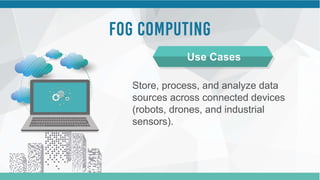
Use Cases
Store, process, and analyze data
sources across connected devices
(robots, drones, and industrial
sensors).
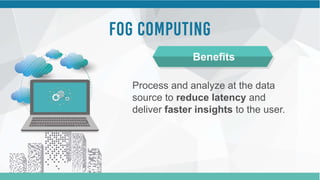
Use Cases
Process and analyze at the data
source to reduce latency and
deliver faster insights to the user.
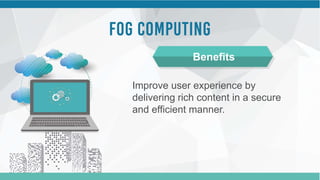
Benefits
Improve user experience by
delivering rich content in a secure
and efficient manner.
Benefits
Cloud computing still needs IT to
provision and manage servers
based on application demands.
How’s It Innovative?
What if you could stop worrying
about infrastructure management
and focus on application
functionality?
How’s It Innovative?
Serverless computing allows
developers to build apps without
worrying about underlying computing
resources.
What It Means
The cloud provider takes care of the
actual infrastructure management.
What It Means
Build IoT and mobile apps that
interact through APIs.
Use Cases
Create microservices that use the
"fire and forget" paradigm with
serverless approaches.
Use Cases
Stop paying for unused server
capacity. Pay only when your code
runs in production.
Benefits
Scale rapidly without worrying about
server uptime, upgrades, and
security.
Benefits
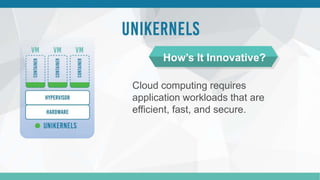
Cloud computing requires
application workloads that are
efficient, fast, and secure.
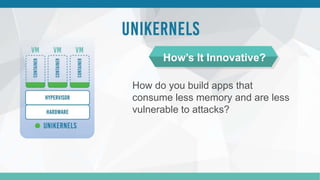
How’s It Innovative?
How do you build apps that
consume less memory and are less
vulnerable to attacks?
How’s It Innovative?
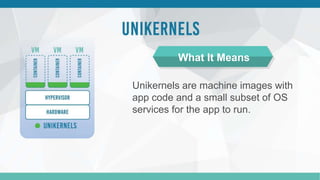
Unikernels are machine images with
app code and a small subset of OS
services for the app to run.
What It Means
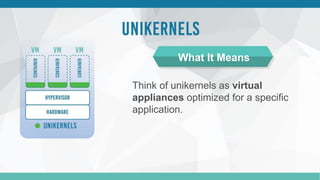
Think of unikernels as virtual
appliances optimized for a specific
application.
What It Means
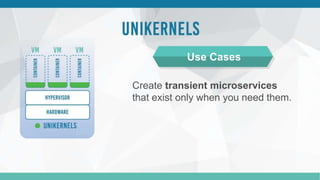
Create transient microservices
that exist only when you need them.
Use Cases
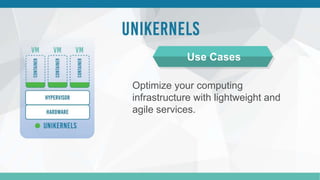
Optimize your computing
infrastructure with lightweight and
agile services.
Use Cases
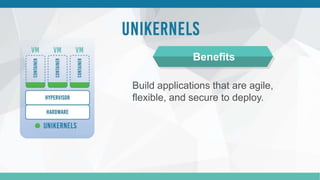
Build applications that are agile,
flexible, and secure to deploy.
Benefits
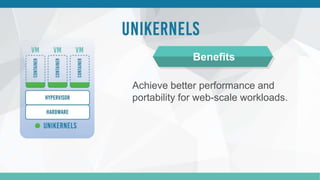
Achieve better performance and
portability for web-scale workloads.
Benefits
Security pros have long had an
antagonistic relationship with Dev
and Ops teams.
How’s It Innovative?
What if you can deliver security and
compliance as a service to
safeguard the enterprise?
How’s It Innovative?
Deliver security at speed and scale
without compromising safety.
What It Means
Achieve compliance by embracing
security as code. Ensure “everyone
is responsible for security.”
What It Means
Deploy agile cloud services by
incorporating security practices
iteratively.
Use Cases
Reduce security breaches and costly
downtime with security automation.
Use Cases
Create secure and defensible
infrastructures with DevSecOps
principles.
Benefits
Increase release velocity without
risking stability and governance.
Benefits
You use instant messaging every
day to collaborate with your
co-workers.
How’s It Innovative?
What if you could use chat bots to
not just communicate but automate
IT ops tasks?
How’s It Innovative?
ChatOps is IM-enabled devops.
Use APIs to connect to other
applications in your chat console.
What It Means
Use your chat window to collaborate
and solve business problems.
What It Means
Deploy, provision, and manage
systems and infrastructure with chat
bots.
Use Cases
Integrate IT projects with real time
notifications in a single location.
Use Cases
Real time information sharing and
transparency across your teams.
Benefits
Automate manual tasks by running a
command in your chat window.
Benefits
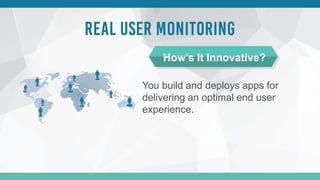
You build and deploys apps for
delivering an optimal end user
experience.
How’s It Innovative?
Have you ever wondered how
users actually interact with your
app?
How’s It Innovative?
Monitor and analyze every end
user transaction on your website
or app.
What It Means
Observe your system in action to
ensure availability,
responsiveness, and reliability.
What It Means
Improve performance by fixing
app sluggishness issues.
Use Cases
Understand what problems users
experience and learn how to
address them.
Use Cases
Make user experience front and
center of your DevOps initiatives.
Benefits
Track the metrics that matter most
to your business performance.
Benefits
Follow the OpsRamp Blog for
insights on IT Operations

7 Innovations That Will Transform IT Operations