


AUTOIMMUNITYAUTOIMMUNITY
Dr. Anand Kumar &Dr. Anand Kumar &
Dr. R.. A. SiddiqueDr. R.. A. Siddique
N.D.R.I., KarnalN.D.R.I., Karnal
(Haryana)(Haryana)
India, 132001India, 132001
Email-riazndri@gmail.comEmail-riazndri@gmail.com
Self/Non-self Discrimination
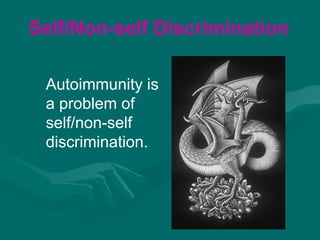
Autoimmunity is
a problem of
self/non-self
discrimination.
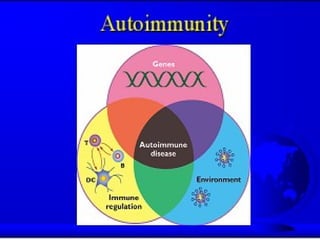
Autoimmunity
• 5 % to 7% adult affected.5 % to 7% adult affected.
• Two third women.Two third women.
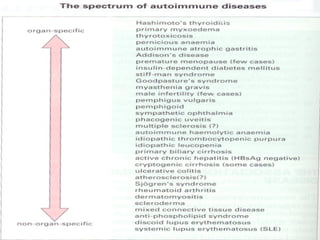
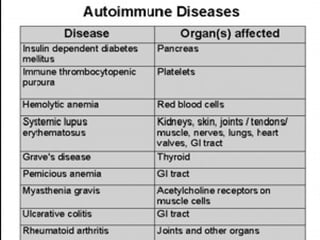
• More than 40 human diseasesMore than 40 human diseases
autoimmune in origin.autoimmune in origin.
AUTOIMMUNITY & LEFT-AUTOIMMUNITY & LEFT-
HANDEDNESSHANDEDNESS
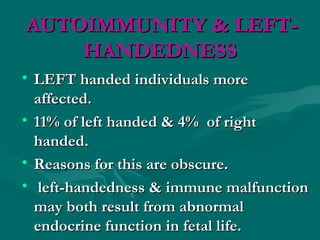
• LEFT handed individuals moreLEFT handed individuals more
affected.affected.
• 11% of left handed & 4% of right11% of left handed & 4% of right
handed.handed.
• Reasons for this are obscure.Reasons for this are obscure.
• left-handedness & immune malfunctionleft-handedness & immune malfunction
may both result from abnormalmay both result from abnormal
endocrine function in fetal life.endocrine function in fetal life.
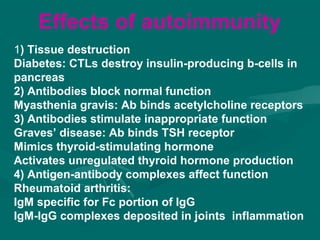
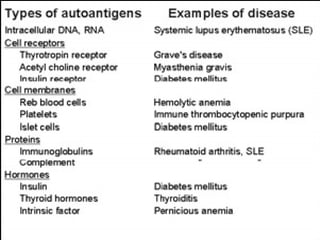
1) Tissue destruction
Diabetes: CTLs destroy insulin-producing b-cells in
pancreas
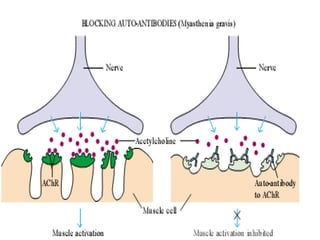
2) Antibodies block normal function
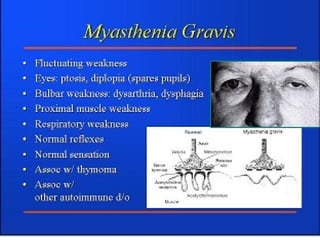
Myasthenia gravis: Ab binds acetylcholine receptors
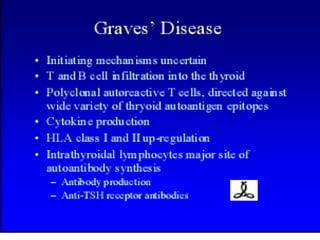
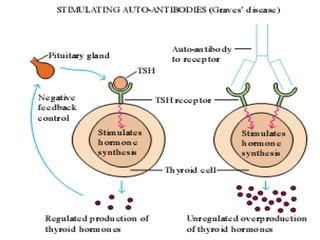
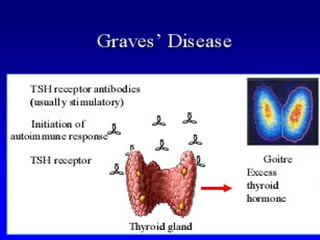
3) Antibodies stimulate inappropriate function
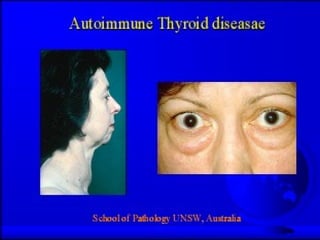
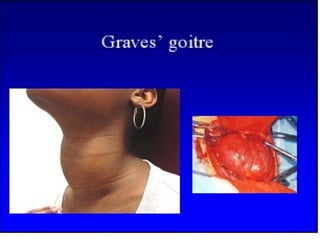
Graves’ disease: Ab binds TSH receptor
Mimics thyroid-stimulating hormone
Activates unregulated thyroid hormone production
4) Antigen-antibody complexes affect function
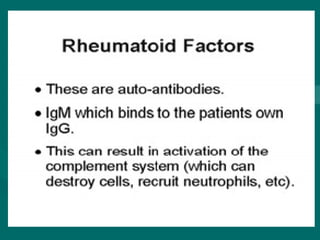
Rheumatoid arthritis:
IgM specific for Fc portion of IgG
IgM-IgG complexes deposited in joints inflammation
Effects of autoimmunity
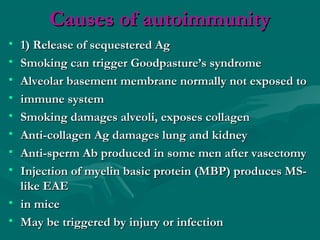
Causes of autoimmunityCauses of autoimmunity
• 1) Release of sequestered Ag1) Release of sequestered Ag
• Smoking can trigger Goodpasture’s syndromeSmoking can trigger Goodpasture’s syndrome
• Alveolar basement membrane normally not exposed toAlveolar basement membrane normally not exposed to
• immune systemimmune system
• Smoking damages alveoli, exposes collagenSmoking damages alveoli, exposes collagen
• Anti-collagen Ag damages lung and kidneyAnti-collagen Ag damages lung and kidney
• Anti-sperm Ab produced in some men after vasectomyAnti-sperm Ab produced in some men after vasectomy
• Injection of myelin basic protein (MBP) produces MS-Injection of myelin basic protein (MBP) produces MS-
like EAElike EAE
• in micein mice
• May be triggered by injury or infectionMay be triggered by injury or infection
Causes of autoimmunityCauses of autoimmunity
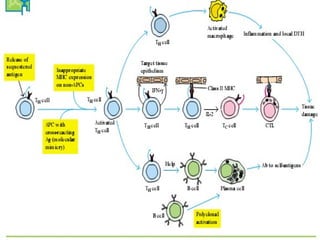
• 2) Immune stimulation2) Immune stimulation
• Microbial infection stimulates APCsMicrobial infection stimulates APCs
carrying self Agcarrying self Ag
• High level of APCs with “second signal”High level of APCs with “second signal”
breaks anergybreaks anergy
Mechanisms of autoimmunityMechanisms of autoimmunity
• Ag released from hidden location.Ag released from hidden location.
• Antigen generated by molecular changes.Antigen generated by molecular changes.
• Molecular mimicry.Molecular mimicry.
• Alteration in Ag processing.Alteration in Ag processing.
• Infection.Infection.
• Genetic factors.Genetic factors.
Mechanisms of autoimmunityMechanisms of autoimmunity
• Lymphocytes abnormalities.Lymphocytes abnormalities.
• Failure of central tolerance.Failure of central tolerance.
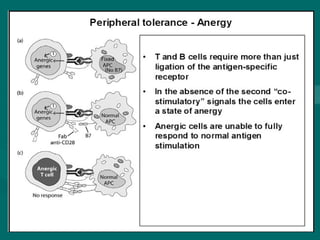
• Overcome of peripheral tolerance.Overcome of peripheral tolerance.
• Polyclonal lymphocytes activation.Polyclonal lymphocytes activation.
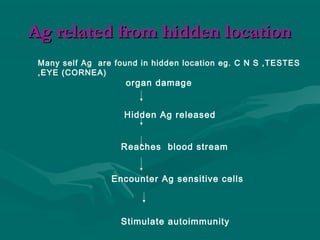
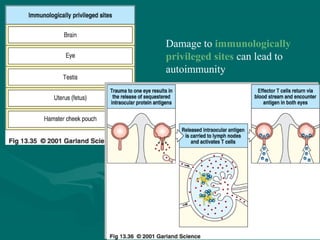
Ag related from hidden locationAg related from hidden location
Many self Ag are found in hidden location eg. C N S ,TESTES
,EYE (CORNEA)
organ damage
Hidden Ag released
Reaches blood stream
Encounter Ag sensitive cells
Stimulate autoimmunity
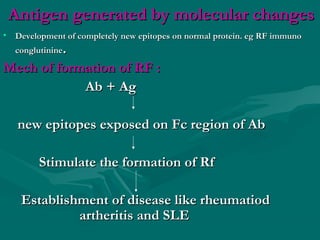
Antigen generated by molecular changesAntigen generated by molecular changes
• Development of completely new epitopes on normal protein. eg RF immunoDevelopment of completely new epitopes on normal protein. eg RF immuno
conglutinineconglutinine..
Mech of formation of RF :Mech of formation of RF :
Ab + AgAb + Ag
new epitopes exposed on Fc region of Abnew epitopes exposed on Fc region of Ab
Stimulate the formation of RfStimulate the formation of Rf
Establishment of disease like rheumatiodEstablishment of disease like rheumatiod
artheritis and SLEartheritis and SLE
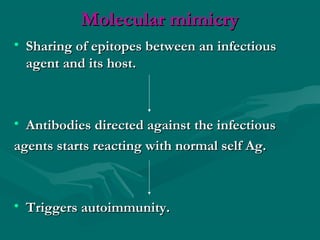
Molecular mimicryMolecular mimicry
• Sharing of epitopes between an infectiousSharing of epitopes between an infectious
agent and its host.agent and its host.
• Antibodies directed against the infectiousAntibodies directed against the infectious
agents starts reacting with normal self Ag.agents starts reacting with normal self Ag.
• Triggers autoimmunity.Triggers autoimmunity.
Alteration in Ag processingAlteration in Ag processing
• A T cell may fail to develop tolerance to anA T cell may fail to develop tolerance to an
self Ag simply because it is not efficientlyself Ag simply because it is not efficiently
procured.procured.
• If something happens to improve theIf something happens to improve the
processing, an autoimmune disease may beprocessing, an autoimmune disease may be
triggered.triggered.
• This usually happens at the site ofThis usually happens at the site of
inflamation resulting in modified Ab.inflamation resulting in modified Ab.
• Eg. Thyrotoxicosis , diabetese.Eg. Thyrotoxicosis , diabetese.
InfectionInfection
• Here autoimmunity is not due to infectious agentHere autoimmunity is not due to infectious agent
itself ,but results from dis regulation of hostitself ,but results from dis regulation of host
immune response by the microbes.immune response by the microbes.
This may be due to :This may be due to :
• Polyclonal lymphocyte activation.Polyclonal lymphocyte activation.
• inhanced stimulation of co stimulator.inhanced stimulation of co stimulator.
• Alteration of self Ag(cross reactive neo-Ag)Alteration of self Ag(cross reactive neo-Ag)
GENETIC FACTORSGENETIC FACTORS
• The important genes that regulate the development of autoimmunity areThe important genes that regulate the development of autoimmunity are
located within MHC.located within MHC.
• MHC have got critical role in maturation of T cell & induction of IR .MHC have got critical role in maturation of T cell & induction of IR .
• MHC ll genes are directly responsible for auto antigen processing andMHC ll genes are directly responsible for auto antigen processing and
presentation.presentation.
• The structure of Ag binding groove will determine , if specific Ag willThe structure of Ag binding groove will determine , if specific Ag will
trigger an AU response.trigger an AU response.
• Eg. Diabetes mellitus in dog:Eg. Diabetes mellitus in dog:
DLA-A3, A7, A10 and DLA-B4DLA-A3, A7, A10 and DLA-B4
SLE: DLA- A7SLE: DLA- A7
POLYARTHRITIS: DLA- A7POLYARTHRITIS: DLA- A7
Lymphocytes abnormalitiesLymphocytes abnormalities
• Primary abnormalities either in B cell or T cell.Primary abnormalities either in B cell or T cell.
• Since these cells are critical regulators of all IR.Since these cells are critical regulators of all IR.
• MHC presentation of all antigenic peptide to theseMHC presentation of all antigenic peptide to these
cells will be defective, in case the cells are abnormal.cells will be defective, in case the cells are abnormal.
• Abnormalities in lymphocytes could affect any one ofAbnormalities in lymphocytes could affect any one of
the mechanism that normally maintains self tolerance.the mechanism that normally maintains self tolerance.
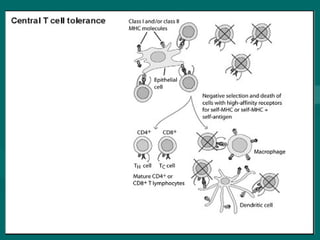
Failure of central tolerenceFailure of central tolerence
Inside primary lymphoid organ;Inside primary lymphoid organ;
 positive selectionpositive selection
 negative selection (Deletion of self reacting Tnegative selection (Deletion of self reacting T
cells in thymus apoptosis).cells in thymus apoptosis).
Failure of central tolerance starts AU diseases.Failure of central tolerance starts AU diseases.
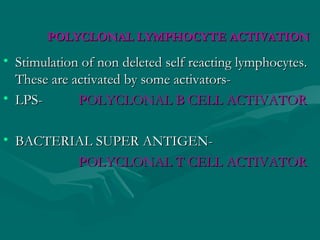
POLYCLONAL LYMPHOCYTE ACTIVATIONPOLYCLONAL LYMPHOCYTE ACTIVATION
• Stimulation of non deleted self reacting lymphocytes.Stimulation of non deleted self reacting lymphocytes.
These are activated by some activators-These are activated by some activators-
• LPS-LPS- POLYCLONAL B CELL ACTIVATORPOLYCLONAL B CELL ACTIVATOR
• BACTERIAL SUPER ANTIGEN-BACTERIAL SUPER ANTIGEN-
POLYCLONAL T CELL ACTIVATORPOLYCLONAL T CELL ACTIVATOR
Damage to immunologically
privileged sites can lead to
autoimmunity
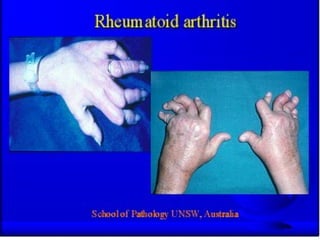
Rheumatiod ArthritisRheumatiod Arthritis
• Auto-immune disorder which results inAuto-immune disorder which results in
inflammation of the synovial lining of the jointinflammation of the synovial lining of the joint
and cartilage destruction.and cartilage destruction.
• This result in loss of function.This result in loss of function.
• Affects 1% of adults.Affects 1% of adults.
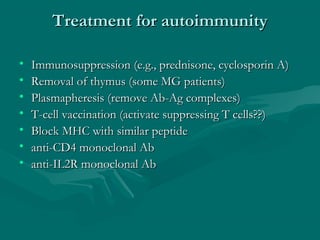
Treatment for autoimmunityTreatment for autoimmunity
• Immunosuppression (e.g., prednisone, cyclosporin A)Immunosuppression (e.g., prednisone, cyclosporin A)
• Removal of thymus (some MG patients)Removal of thymus (some MG patients)
• Plasmapheresis (remove Ab-Ag complexes)Plasmapheresis (remove Ab-Ag complexes)
• T-cell vaccination (activate suppressing T cells??)T-cell vaccination (activate suppressing T cells??)
• Block MHC with similar peptideBlock MHC with similar peptide
• anti-CD4 monoclonal Abanti-CD4 monoclonal Ab
• anti-IL2R monoclonal Abanti-IL2R monoclonal Ab
autoimmunity

autoimmunity

  • 1.
    AUTOIMMUNITYAUTOIMMUNITY Dr. Anand Kumar&Dr. Anand Kumar & Dr. R.. A. SiddiqueDr. R.. A. Siddique N.D.R.I., KarnalN.D.R.I., Karnal (Haryana)(Haryana) India, 132001India, 132001 Email-riazndri@gmail.comEmail-riazndri@gmail.com
  • 2.
    Self/Non-self Discrimination Autoimmunity is aproblem of self/non-self discrimination.
  • 3.
    Autoimmunity • 5 %to 7% adult affected.5 % to 7% adult affected. • Two third women.Two third women. • More than 40 human diseasesMore than 40 human diseases autoimmune in origin.autoimmune in origin.
  • 7.
    AUTOIMMUNITY & LEFT-AUTOIMMUNITY& LEFT- HANDEDNESSHANDEDNESS • LEFT handed individuals moreLEFT handed individuals more affected.affected. • 11% of left handed & 4% of right11% of left handed & 4% of right handed.handed. • Reasons for this are obscure.Reasons for this are obscure. • left-handedness & immune malfunctionleft-handedness & immune malfunction may both result from abnormalmay both result from abnormal endocrine function in fetal life.endocrine function in fetal life.
  • 8.
    1) Tissue destruction Diabetes:CTLs destroy insulin-producing b-cells in pancreas 2) Antibodies block normal function Myasthenia gravis: Ab binds acetylcholine receptors 3) Antibodies stimulate inappropriate function Graves’ disease: Ab binds TSH receptor Mimics thyroid-stimulating hormone Activates unregulated thyroid hormone production 4) Antigen-antibody complexes affect function Rheumatoid arthritis: IgM specific for Fc portion of IgG IgM-IgG complexes deposited in joints inflammation Effects of autoimmunity
  • 9.
    Causes of autoimmunityCausesof autoimmunity • 1) Release of sequestered Ag1) Release of sequestered Ag • Smoking can trigger Goodpasture’s syndromeSmoking can trigger Goodpasture’s syndrome • Alveolar basement membrane normally not exposed toAlveolar basement membrane normally not exposed to • immune systemimmune system • Smoking damages alveoli, exposes collagenSmoking damages alveoli, exposes collagen • Anti-collagen Ag damages lung and kidneyAnti-collagen Ag damages lung and kidney • Anti-sperm Ab produced in some men after vasectomyAnti-sperm Ab produced in some men after vasectomy • Injection of myelin basic protein (MBP) produces MS-Injection of myelin basic protein (MBP) produces MS- like EAElike EAE • in micein mice • May be triggered by injury or infectionMay be triggered by injury or infection
  • 10.
    Causes of autoimmunityCausesof autoimmunity • 2) Immune stimulation2) Immune stimulation • Microbial infection stimulates APCsMicrobial infection stimulates APCs carrying self Agcarrying self Ag • High level of APCs with “second signal”High level of APCs with “second signal” breaks anergybreaks anergy
  • 12.
    Mechanisms of autoimmunityMechanismsof autoimmunity • Ag released from hidden location.Ag released from hidden location. • Antigen generated by molecular changes.Antigen generated by molecular changes. • Molecular mimicry.Molecular mimicry. • Alteration in Ag processing.Alteration in Ag processing. • Infection.Infection. • Genetic factors.Genetic factors.
  • 13.
    Mechanisms of autoimmunityMechanismsof autoimmunity • Lymphocytes abnormalities.Lymphocytes abnormalities. • Failure of central tolerance.Failure of central tolerance. • Overcome of peripheral tolerance.Overcome of peripheral tolerance. • Polyclonal lymphocytes activation.Polyclonal lymphocytes activation.
  • 14.
    Ag related fromhidden locationAg related from hidden location Many self Ag are found in hidden location eg. C N S ,TESTES ,EYE (CORNEA) organ damage Hidden Ag released Reaches blood stream Encounter Ag sensitive cells Stimulate autoimmunity
  • 15.
    Antigen generated bymolecular changesAntigen generated by molecular changes • Development of completely new epitopes on normal protein. eg RF immunoDevelopment of completely new epitopes on normal protein. eg RF immuno conglutinineconglutinine.. Mech of formation of RF :Mech of formation of RF : Ab + AgAb + Ag new epitopes exposed on Fc region of Abnew epitopes exposed on Fc region of Ab Stimulate the formation of RfStimulate the formation of Rf Establishment of disease like rheumatiodEstablishment of disease like rheumatiod artheritis and SLEartheritis and SLE
  • 16.
    Molecular mimicryMolecular mimicry •Sharing of epitopes between an infectiousSharing of epitopes between an infectious agent and its host.agent and its host. • Antibodies directed against the infectiousAntibodies directed against the infectious agents starts reacting with normal self Ag.agents starts reacting with normal self Ag. • Triggers autoimmunity.Triggers autoimmunity.
  • 17.
    Alteration in AgprocessingAlteration in Ag processing • A T cell may fail to develop tolerance to anA T cell may fail to develop tolerance to an self Ag simply because it is not efficientlyself Ag simply because it is not efficiently procured.procured. • If something happens to improve theIf something happens to improve the processing, an autoimmune disease may beprocessing, an autoimmune disease may be triggered.triggered. • This usually happens at the site ofThis usually happens at the site of inflamation resulting in modified Ab.inflamation resulting in modified Ab. • Eg. Thyrotoxicosis , diabetese.Eg. Thyrotoxicosis , diabetese.
  • 18.
    InfectionInfection • Here autoimmunityis not due to infectious agentHere autoimmunity is not due to infectious agent itself ,but results from dis regulation of hostitself ,but results from dis regulation of host immune response by the microbes.immune response by the microbes. This may be due to :This may be due to : • Polyclonal lymphocyte activation.Polyclonal lymphocyte activation. • inhanced stimulation of co stimulator.inhanced stimulation of co stimulator. • Alteration of self Ag(cross reactive neo-Ag)Alteration of self Ag(cross reactive neo-Ag)
  • 19.
    GENETIC FACTORSGENETIC FACTORS •The important genes that regulate the development of autoimmunity areThe important genes that regulate the development of autoimmunity are located within MHC.located within MHC. • MHC have got critical role in maturation of T cell & induction of IR .MHC have got critical role in maturation of T cell & induction of IR . • MHC ll genes are directly responsible for auto antigen processing andMHC ll genes are directly responsible for auto antigen processing and presentation.presentation. • The structure of Ag binding groove will determine , if specific Ag willThe structure of Ag binding groove will determine , if specific Ag will trigger an AU response.trigger an AU response. • Eg. Diabetes mellitus in dog:Eg. Diabetes mellitus in dog: DLA-A3, A7, A10 and DLA-B4DLA-A3, A7, A10 and DLA-B4 SLE: DLA- A7SLE: DLA- A7 POLYARTHRITIS: DLA- A7POLYARTHRITIS: DLA- A7
  • 20.
    Lymphocytes abnormalitiesLymphocytes abnormalities •Primary abnormalities either in B cell or T cell.Primary abnormalities either in B cell or T cell. • Since these cells are critical regulators of all IR.Since these cells are critical regulators of all IR. • MHC presentation of all antigenic peptide to theseMHC presentation of all antigenic peptide to these cells will be defective, in case the cells are abnormal.cells will be defective, in case the cells are abnormal. • Abnormalities in lymphocytes could affect any one ofAbnormalities in lymphocytes could affect any one of the mechanism that normally maintains self tolerance.the mechanism that normally maintains self tolerance.
  • 21.
    Failure of centraltolerenceFailure of central tolerence Inside primary lymphoid organ;Inside primary lymphoid organ;  positive selectionpositive selection  negative selection (Deletion of self reacting Tnegative selection (Deletion of self reacting T cells in thymus apoptosis).cells in thymus apoptosis). Failure of central tolerance starts AU diseases.Failure of central tolerance starts AU diseases.
  • 25.
    POLYCLONAL LYMPHOCYTE ACTIVATIONPOLYCLONALLYMPHOCYTE ACTIVATION • Stimulation of non deleted self reacting lymphocytes.Stimulation of non deleted self reacting lymphocytes. These are activated by some activators-These are activated by some activators- • LPS-LPS- POLYCLONAL B CELL ACTIVATORPOLYCLONAL B CELL ACTIVATOR • BACTERIAL SUPER ANTIGEN-BACTERIAL SUPER ANTIGEN- POLYCLONAL T CELL ACTIVATORPOLYCLONAL T CELL ACTIVATOR
  • 28.
    Damage to immunologically privilegedsites can lead to autoimmunity
  • 36.
    Rheumatiod ArthritisRheumatiod Arthritis •Auto-immune disorder which results inAuto-immune disorder which results in inflammation of the synovial lining of the jointinflammation of the synovial lining of the joint and cartilage destruction.and cartilage destruction. • This result in loss of function.This result in loss of function. • Affects 1% of adults.Affects 1% of adults.
  • 41.
    Treatment for autoimmunityTreatmentfor autoimmunity • Immunosuppression (e.g., prednisone, cyclosporin A)Immunosuppression (e.g., prednisone, cyclosporin A) • Removal of thymus (some MG patients)Removal of thymus (some MG patients) • Plasmapheresis (remove Ab-Ag complexes)Plasmapheresis (remove Ab-Ag complexes) • T-cell vaccination (activate suppressing T cells??)T-cell vaccination (activate suppressing T cells??) • Block MHC with similar peptideBlock MHC with similar peptide • anti-CD4 monoclonal Abanti-CD4 monoclonal Ab • anti-IL2R monoclonal Abanti-IL2R monoclonal Ab