Photo source: http://live.longhill.org.uk/wp-content/uploads/2013/05/YAWYETL.png
In terms of food
Elena Chatzopoulou
PhD Candidate
Food Marketing
e.chatzopoulou@ncl.ac.uk
Objectives
• Be able to define the terms “authenticity” and “identity” in terms of food.
• Be aware of practical examples-case studies deriving from my own
research
• Gain critical insights and grasp the deeper meanings of food
• Understand the role of food within the society and the social relations
Test your knowledge
Write down a note:
“What makes an ethnic restaurant authentic”?
Please keep it till the end of the lecture…
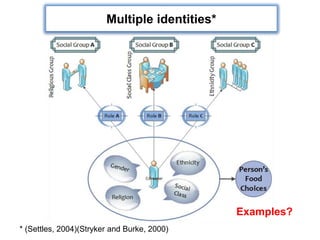
* (Settles, 2004)(Stryker and Burke, 2000)
Multiple identities*
Examples?
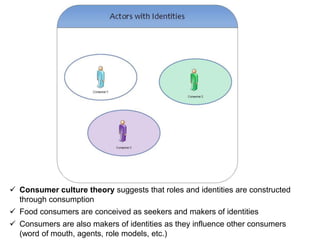
 Consumer culture theory suggests that roles and identities are constructed
through consumption
 Food consumers are conceived as seekers and makers of identities
 Consumers are also makers of identities as they influence other consumers
(word of mouth, agents, role models, etc.)
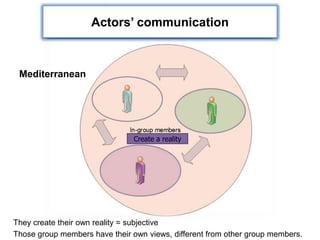
Create a reality
Actors’ communication
They create their own reality = subjective
Those group members have their own views, different from other group members.
Mediterranean
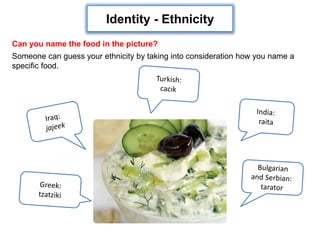
Can you name the food in the picture?
Someone can guess your ethnicity by taking into consideration how you name a
specific food.
Identity - Ethnicity
Interview with a Greek restaurateur in London:
-Well, what original is?... Listen, sometimes, some recipes, like "dolmades"
alright? This thing here other countries do it too, alright? This doesn't mean are
Greek though. Some recipes, in the world were created before countries were
organised by border. To give you an example with "dolmades", they make it in
Albania, they make it in Bulgaria, they make it in Serbia, probably in Romania
too.
- And tzatziki as well.
-Yeah, yeah. These recipes were created before border lines were created. So,
say if there is no borders around the Balkans emm... Some tribes, some
locations did this recipe and then, the border line came… Separated Bulgaria
from Greece, FYROM from Greece. So, this recipe now eventually belongs to
Bulgaria, belongs to Greece, belongs to FYROM, belongs to Albania. So, some
recipes are older than the construction of countries. Not nations, countries.
Cause there is a difference. Alright?
Participants construct meanings and actions about food in the
situations of consuming and communicating it.
As we said, they construct their own reality...
The “ethnic restaurants” case:
Through consumption customers of an ethnic restaurant are possibly
feeling nostalgia*; a basic factor so as to judge their personal view,
their personal authenticity about a food product or a restaurant.
“...Authenticity is social and personal and hence unfixed, subjective and
variable...authenticity can be negotiated...” (Reisinger and Steiner,
2006) p. 67
* The term nostalgia refer to a painful yearning to return home.
Authenticity
However, the perceived authenticity of a restaurant does not only
include the food, as it could be expected:
The decoration,
the use of traditional recipes,
the food quality,
the music,
the costumes
or even the ethnicity of the employees
shall be part of the perceived authenticity and significant factors of
positive emotions to the consumers.
The International Association of the Italian Restaurants has specified
which requirements are needed so as for an Italian restaurant to be
characterised as authentic.
An Italian restaurant is authentic if only:
the ingredients are Italian,
at least three quarters of the wine in the cellar is Italian,
at least one of the waiters speaks Italian and the rest can explain
properly the dishes &
the chef had proper training in the Italian cuisine.
An official definition of authentic ethnic restaurants abroad
However, the untouched original recipes are an illusion…
Chefs during the creation of the menu put their own touch.
They do so to keep their customers satisfied, according to the clients’
tastes and preferences.
Interview with an ethnic restaurant in the U.K…
(which is market oriented and not purely authentic):
“We might tease them here and there a little bit. Like this needs more
of this or that. And then, once we have it right, we keep it like that. We
are obviously trying to keep it like that because people do want it and
we listen to our customers, which is another major factor”.
Authenticity & Market orientation
Only those consumers who are familiar with a country’s culture tend to
appreciate more the authentic restaurants rather than the plainly
“themed” restaurants.
BUT, customers of the same ethnicity tend to controvert the originality
of the ethnic restaurants and of their menus as well.
Interview with a Greek ethnic restaurant in the North East (U.K.):
“Greeks are funny people. Nobody cooks like their mother”.
Interview with a Greek ethnic restaurant in Oxford (U.K.):
“Customers from Greece ahh... judge it as if they are actually in
Greece, which is fine, which is good. They are the hardest individuals
to satisfy, to please. But, at the same time it's quite nice to have that
type of person because they... I would like to believe, they know what
they are talking about”.
Interview with a Greek restaurateur in London:
- I have people comment that my tzatziki is purely garlic, which I think is a
good comment not a bad comment, cause emm... Well, it might be a bad
comment cause people do not like garlic but, tzatziki you know... That's how
supposed to be, has to have a lot of garlic inside. So, I think for good
reasons and bad reasons I'm close to the tradition. With the good sides and
the bad sides of it.
- What's the bad?
- Like I said: "This tastes too much garlic". Is that a good or bad feedback? It
might be a bad feedback concerning them cause it has too much garlic but, I
know it's a good feedback cause that's how tzatziki supposed to be.
Who are them?
What type of people do not like the garlic?
Does he imply a separation between people who know the
authentic recipe and the “others”?
Interview with a Greek restaurateur in London:
- Here is a thing...If you are a local but a Londoner doesn't mean that you
are British also eh? So, I can say 60% will be local alright? But, that doesn't
mean they are English alright? That's Greek, Italian, Spanish, whatever. And
another 40% will break down to tourists but, there is a lot of Greek which are
not exactly tourists, they come for business trips and they want to eat Greek.
And... That's how I would break it down.
- Do you feel that a Greek is not a tourist for you?
- No, he is not. That's why I said it, that's why I broke down the tourist part.
Indeed, ethnicity matters. Those who know the traditional
recipes cannot be conceived as tourists for the restaurant
owner.
Test your knowledge
Please go back to your initial notes about the authenticity.
Is it any different the view that you have now about the term
“authenticity”?
How is that?
Discuss in pairs & let me know the results please.
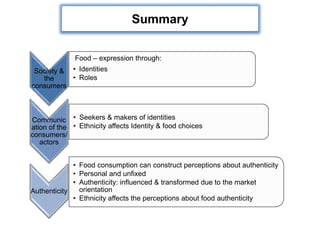
Summary
Society &
the
consumers
• Identities
• Roles
Communic
ation of the
consumers/
actors
• Seekers & makers of identities
• Ethnicity affects Identity & food choices
Authenticity
• Food consumption can construct perceptions about authenticity
• Personal and unfixed
• Authenticity: influenced & transformed due to the market
orientation
• Ethnicity affects the perceptions about food authenticity
Food – expression through:
e.chatzopoulou@ncl.ac.uk
Thank you for your attention

Authenticity & identity (food)

  • 1.
    Photo source: http://live.longhill.org.uk/wp-content/uploads/2013/05/YAWYETL.png Interms of food Elena Chatzopoulou PhD Candidate Food Marketing e.chatzopoulou@ncl.ac.uk
  • 2.
    Objectives • Be ableto define the terms “authenticity” and “identity” in terms of food. • Be aware of practical examples-case studies deriving from my own research • Gain critical insights and grasp the deeper meanings of food • Understand the role of food within the society and the social relations
  • 3.
    Test your knowledge Writedown a note: “What makes an ethnic restaurant authentic”? Please keep it till the end of the lecture…
  • 4.
    * (Settles, 2004)(Strykerand Burke, 2000) Multiple identities* Examples?
  • 5.
     Consumer culturetheory suggests that roles and identities are constructed through consumption  Food consumers are conceived as seekers and makers of identities  Consumers are also makers of identities as they influence other consumers (word of mouth, agents, role models, etc.)
  • 6.
    Create a reality Actors’communication They create their own reality = subjective Those group members have their own views, different from other group members. Mediterranean
  • 7.
    Can you namethe food in the picture? Someone can guess your ethnicity by taking into consideration how you name a specific food. Identity - Ethnicity
  • 8.
    Interview with aGreek restaurateur in London: -Well, what original is?... Listen, sometimes, some recipes, like "dolmades" alright? This thing here other countries do it too, alright? This doesn't mean are Greek though. Some recipes, in the world were created before countries were organised by border. To give you an example with "dolmades", they make it in Albania, they make it in Bulgaria, they make it in Serbia, probably in Romania too. - And tzatziki as well. -Yeah, yeah. These recipes were created before border lines were created. So, say if there is no borders around the Balkans emm... Some tribes, some locations did this recipe and then, the border line came… Separated Bulgaria from Greece, FYROM from Greece. So, this recipe now eventually belongs to Bulgaria, belongs to Greece, belongs to FYROM, belongs to Albania. So, some recipes are older than the construction of countries. Not nations, countries. Cause there is a difference. Alright?
  • 9.
    Participants construct meaningsand actions about food in the situations of consuming and communicating it. As we said, they construct their own reality... The “ethnic restaurants” case: Through consumption customers of an ethnic restaurant are possibly feeling nostalgia*; a basic factor so as to judge their personal view, their personal authenticity about a food product or a restaurant. “...Authenticity is social and personal and hence unfixed, subjective and variable...authenticity can be negotiated...” (Reisinger and Steiner, 2006) p. 67 * The term nostalgia refer to a painful yearning to return home. Authenticity
  • 10.
    However, the perceivedauthenticity of a restaurant does not only include the food, as it could be expected: The decoration, the use of traditional recipes, the food quality, the music, the costumes or even the ethnicity of the employees shall be part of the perceived authenticity and significant factors of positive emotions to the consumers.
  • 11.
    The International Associationof the Italian Restaurants has specified which requirements are needed so as for an Italian restaurant to be characterised as authentic. An Italian restaurant is authentic if only: the ingredients are Italian, at least three quarters of the wine in the cellar is Italian, at least one of the waiters speaks Italian and the rest can explain properly the dishes & the chef had proper training in the Italian cuisine. An official definition of authentic ethnic restaurants abroad
  • 12.
    However, the untouchedoriginal recipes are an illusion… Chefs during the creation of the menu put their own touch. They do so to keep their customers satisfied, according to the clients’ tastes and preferences. Interview with an ethnic restaurant in the U.K… (which is market oriented and not purely authentic): “We might tease them here and there a little bit. Like this needs more of this or that. And then, once we have it right, we keep it like that. We are obviously trying to keep it like that because people do want it and we listen to our customers, which is another major factor”. Authenticity & Market orientation
  • 13.
    Only those consumerswho are familiar with a country’s culture tend to appreciate more the authentic restaurants rather than the plainly “themed” restaurants. BUT, customers of the same ethnicity tend to controvert the originality of the ethnic restaurants and of their menus as well. Interview with a Greek ethnic restaurant in the North East (U.K.): “Greeks are funny people. Nobody cooks like their mother”. Interview with a Greek ethnic restaurant in Oxford (U.K.): “Customers from Greece ahh... judge it as if they are actually in Greece, which is fine, which is good. They are the hardest individuals to satisfy, to please. But, at the same time it's quite nice to have that type of person because they... I would like to believe, they know what they are talking about”.
  • 14.
    Interview with aGreek restaurateur in London: - I have people comment that my tzatziki is purely garlic, which I think is a good comment not a bad comment, cause emm... Well, it might be a bad comment cause people do not like garlic but, tzatziki you know... That's how supposed to be, has to have a lot of garlic inside. So, I think for good reasons and bad reasons I'm close to the tradition. With the good sides and the bad sides of it. - What's the bad? - Like I said: "This tastes too much garlic". Is that a good or bad feedback? It might be a bad feedback concerning them cause it has too much garlic but, I know it's a good feedback cause that's how tzatziki supposed to be. Who are them? What type of people do not like the garlic? Does he imply a separation between people who know the authentic recipe and the “others”?
  • 15.
    Interview with aGreek restaurateur in London: - Here is a thing...If you are a local but a Londoner doesn't mean that you are British also eh? So, I can say 60% will be local alright? But, that doesn't mean they are English alright? That's Greek, Italian, Spanish, whatever. And another 40% will break down to tourists but, there is a lot of Greek which are not exactly tourists, they come for business trips and they want to eat Greek. And... That's how I would break it down. - Do you feel that a Greek is not a tourist for you? - No, he is not. That's why I said it, that's why I broke down the tourist part. Indeed, ethnicity matters. Those who know the traditional recipes cannot be conceived as tourists for the restaurant owner.
  • 16.
    Test your knowledge Pleasego back to your initial notes about the authenticity. Is it any different the view that you have now about the term “authenticity”? How is that? Discuss in pairs & let me know the results please.
  • 17.
    Summary Society & the consumers • Identities •Roles Communic ation of the consumers/ actors • Seekers & makers of identities • Ethnicity affects Identity & food choices Authenticity • Food consumption can construct perceptions about authenticity • Personal and unfixed • Authenticity: influenced & transformed due to the market orientation • Ethnicity affects the perceptions about food authenticity Food – expression through:
  • 18.