By
Rajdeep Singh Bundela
P.G.D.M.{T.T.,B}
Gastronomy
Tourism
Gastronomy Tourism
 Gastronomy’s importance in the development of
tourism destinations in the world – UNWTO
gastronomic tourism applies to tourists and visitors
who plan their trips partially or totally in order to
taste the cuisine of the place or to carry out activities
related to gastronomy.
Their are another name of gastronomy
tourism is “Culinary tourism or food tourism”.
Gastronomic tourism refers to trips made to
destinations where the local food and
beverages are the main motivating factors for
travel.
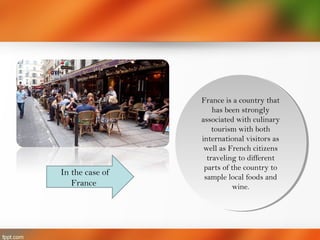
France is a country that
has been strongly
associated with culinary
tourism with both
international visitors as
well as French citizens
traveling to different
parts of the country to
sample local foods and
wine.
France is a country that
has been strongly
associated with culinary
tourism with both
international visitors as
well as French citizens
traveling to different
parts of the country to
sample local foods and
wine.
In the case of
France
Food and the tourism experience
Food and tourism play a major part in the
contemporary experience economy. Food is a key part
of all cultures, a major element of global intangible
heritage and an increasingly important attraction for
tourists. The linkages between food and tourism also
provide a platform for local economic development, and
food experiences help to brand and market
destinations, as well as supporting the local culture
that is so attractive to tourists
Food provides a basis for tourism experiences by
Linking culture and tourism
Developing the meal experience
Producing distinctive foods
Developing the critical infrastructure for food
production and consumption
Supporting local culture
Case Studies
1. Euro-toques in Europe –
Euro-Toques is recognized by the European Union as
an organization that defends Quality Food. It forms
part of the privileged network of contacts of the
European Commission.
Euro-toques acts as a lobby group in European and
national institutions. The organization focuses its
activities on Food Law as well as on the new Common
Agricultural Policy, the Common Fisheries Policy and
DG SANCO activities.
Cont.…..
The art of cooking should adapt itself to our times. Let
us be creative, let us be open to neighbouring cultures,
but let us preserve our beautiful regional traditions and
adapt them to modern tastes.
These are the foundations of quality gastronomic
tourism. We advocate a model based on the diversity of
traditions and regions, quality products, products of
the land and traditional recipes, which are the
guarantee of the culinary heritage and continuity of
local products.
Cont.
…..
The products used in our kitchens are fresh and are
prepared on the premises. Our work is based on
seasonal products in order to respect the cycles of
nature and ensure an authentic taste. And this respect
for tradition is compatible with modernity: the pleasure
and the art of living are passed on.Moreover, we chefs
play an important role in consumer protection and the
preservation of knowledge of our territory.Not only do
we help people eat well, but we also welcome visitors
and advise them about our gastronomy,
products,places.
The main objectives of Euro-toques are
 To promote the good practices of artisan food
producers.
 To protect the culinary heritage of Europe in all its
diversity and with its different origins.
 To safeguard the healthiness of food products and
encourage natural combinations.
 To demand proper labelling in order to provide
consumers with clear information allowing them to
make choices based on solid criteria.
2. THEME NIGHTS HOSTED BY HOTELS IN
NAKURU {KENYA} –
Tourism comprises of activities of persons travelling to
and staying in a place outside their usual environment
for more than one consecutive year for leisure, business
or other purposes. Nakuru is the fourth largest urban
town in Kenya.
Cont.…..
Tourism is one of the economic backbones of the town
as it is host to the famous Lake Nakuru National Park,
which is home to a vast number of flamingos and other
wildlife species seen during safaris. It has hotels which
host theme or cultural events which show case the
various cultural cuisines. Gastronomy is the art of
preparing, serving and enjoying fine food but overtime
the concept has come to include “peasant food”. Today
a large number of destinations are developing and
marketing gastronomy as one of their attractions.
Cont.…..
It has served as a motivational factor (Scarpato,
2002).In Kenyan context, cultural events also known as
theme nights are held in the various tourism and
hospitality establishments, they have served to
promote the different ethnical foods accompanied by
traditional music and dance. These events have
promoted gastronomic culture in Kenya both for
domestic and international tourists. These tourists
appreciate and enjoy the experience of other peoples’
cuisine and cultures.
Cont.…..
The study had four objectives i.e., to examine the
relationship of tourism and food, to find out the effects
of globalization in the development of Kenya’s
gastronomic tourism, to explain how domestic tourism
can be promoted through food tourism and to
document how gastronomy can add value to tourism
development in Kenya. The research used
questionnaires and personal interviews to collect
primary data. Questionnaires were administered to
thirty respondents. Interviews were conducted on
event organizers in hotels and tourist officers.
Cont.…..
The results indicated that in a scale of one to ten, food as a
motivating factor for travel scored an average of five for
domestic tourists, a seven for international tourist. It also
showed that it is more popular amongst the business people
scoring eight, followed by the unemployed, five and the
employed, five. The results also indicated that the age group
that attends the theme nights is between 18-30 years, majority
being male. This study recommends that efforts need to be put
in to promoting food tourism as cultural events to encourage
cultural exchange. This can be done through the Kenya Tourist
Board exploratory study on an attraction and incorporating
local food in relation to traditions and customs in tourism
promotional campaigns.
Cont.…..
This research has revealed that although Kenya tourism is
focused on wildlife and beach based tourism, Kenya has more
than 40 vernacular and foreign ethnic groups each with unique
food types and eating habits. This gives Kenya a new form of
tourism that appreciates and enhances tourism development
with regard to local culture and identities. In conclusion,
Kenya’s rich and diverse cultures and traditions create a great
culinary nation, despite its considerable importance. Food can be
used to promote a different form of tourism as well as promote
good health instead of it just being part of the experience but as
a peak experience for current and potential tourists in and out of
Kenya.
Gastronomy Tourism in India
The market for culinary tourism to India is growing as
the country’s culinary traditions continue to garner
increasing international attention. Cooking classes,
both formal and included in home stays, are a favorite
activity among foreign visitors. India’s broad culinary
culture reflects influences of Persian, Middle Eastern,
Central Asian and Southeast Asian cuisines.
Cont…..
•Northern Region
In the northern region of India, flat breads such as roti,
puri, chapattis and paratha frequently accompany
tandoori, or clay oven-baked dishes. Northern India
is recognized for some of the world’s finest
vegetarian cuisine, resulting in part from the
religious influence of the Vaishnava Hindus in the
region. Wheat is more common in the northern
region than throughout much of the rest of the
country.
cont….
• Southern Region
The vast coastal regions and tropical climate of southern India
influence the region’s cuisine. Food in this area tends to be
spicier than in other parts of India, and the close proximity to
the coast results in numerous seafood dishes including a
variety of fish and prawns. Other local dishes include dosas
(thin rice crepes with savory filling), idli, rice and lentil cakes
served with sambar or chutney. India’s southern region is
known for its extravagant rice dishes and is quickly gaining
recognition as one of the top culinary tourism destinations in
the country. Frommer’s recently recognized the city of Cochin
in the southern coastal state of Kerala as the center for Indian
culinary tourism and named it a top travel destination in 2010.
Cont…
• Northwest (Punjab) Region
India’s western region produces simpler cuisines and
incorporates more of the country’s staple foods, such
as rice and flat breads, into each dish. Peanut oil is
frequently used in place of ghee, and vegetables are
steamed instead of fried. The emphasis in the
northwest region is on texture and presentation
style. Kala masala is a regional spice mixture
common to many of the local recipes. Visitors to the
region can enjoy a variety of vegetarian and seafood
dishes, many of which are particularly delightful in
the western state of Maharashtra.
Cont….
• Eastern Region
India’s eastern region has some of the most varied cultural
influences in the country, including long periods of European
colonization. Seafood, particularly freshwater fish, plays a
prominent role in the local cuisine, as do various fresh fruits
and vegetables. Mustard oil is the preferred cooking oil in
Bengal. Dishes in this region are lighter and prepared with
fewer spices than in the northern or southern regions. India’s
eastern region is recognized for quality candies, desert-style
sweets and cakes, many of which are prepared using paneer,
or Indian cheese made from milk.
Thank you …

Gastronomy tourism

  • 1.
  • 2.
    Gastronomy Tourism  Gastronomy’simportance in the development of tourism destinations in the world – UNWTO gastronomic tourism applies to tourists and visitors who plan their trips partially or totally in order to taste the cuisine of the place or to carry out activities related to gastronomy.
  • 3.
    Their are anothername of gastronomy tourism is “Culinary tourism or food tourism”. Gastronomic tourism refers to trips made to destinations where the local food and beverages are the main motivating factors for travel.
  • 4.
    France is acountry that has been strongly associated with culinary tourism with both international visitors as well as French citizens traveling to different parts of the country to sample local foods and wine. France is a country that has been strongly associated with culinary tourism with both international visitors as well as French citizens traveling to different parts of the country to sample local foods and wine. In the case of France
  • 5.
    Food and thetourism experience Food and tourism play a major part in the contemporary experience economy. Food is a key part of all cultures, a major element of global intangible heritage and an increasingly important attraction for tourists. The linkages between food and tourism also provide a platform for local economic development, and food experiences help to brand and market destinations, as well as supporting the local culture that is so attractive to tourists
  • 6.
    Food provides abasis for tourism experiences by Linking culture and tourism Developing the meal experience Producing distinctive foods Developing the critical infrastructure for food production and consumption Supporting local culture
  • 7.
    Case Studies 1. Euro-toquesin Europe – Euro-Toques is recognized by the European Union as an organization that defends Quality Food. It forms part of the privileged network of contacts of the European Commission. Euro-toques acts as a lobby group in European and national institutions. The organization focuses its activities on Food Law as well as on the new Common Agricultural Policy, the Common Fisheries Policy and DG SANCO activities.
  • 8.
    Cont.….. The art ofcooking should adapt itself to our times. Let us be creative, let us be open to neighbouring cultures, but let us preserve our beautiful regional traditions and adapt them to modern tastes. These are the foundations of quality gastronomic tourism. We advocate a model based on the diversity of traditions and regions, quality products, products of the land and traditional recipes, which are the guarantee of the culinary heritage and continuity of local products.
  • 9.
    Cont. ….. The products usedin our kitchens are fresh and are prepared on the premises. Our work is based on seasonal products in order to respect the cycles of nature and ensure an authentic taste. And this respect for tradition is compatible with modernity: the pleasure and the art of living are passed on.Moreover, we chefs play an important role in consumer protection and the preservation of knowledge of our territory.Not only do we help people eat well, but we also welcome visitors and advise them about our gastronomy, products,places.
  • 10.
    The main objectivesof Euro-toques are  To promote the good practices of artisan food producers.  To protect the culinary heritage of Europe in all its diversity and with its different origins.  To safeguard the healthiness of food products and encourage natural combinations.  To demand proper labelling in order to provide consumers with clear information allowing them to make choices based on solid criteria.
  • 11.
    2. THEME NIGHTSHOSTED BY HOTELS IN NAKURU {KENYA} – Tourism comprises of activities of persons travelling to and staying in a place outside their usual environment for more than one consecutive year for leisure, business or other purposes. Nakuru is the fourth largest urban town in Kenya.
  • 12.
    Cont.….. Tourism is oneof the economic backbones of the town as it is host to the famous Lake Nakuru National Park, which is home to a vast number of flamingos and other wildlife species seen during safaris. It has hotels which host theme or cultural events which show case the various cultural cuisines. Gastronomy is the art of preparing, serving and enjoying fine food but overtime the concept has come to include “peasant food”. Today a large number of destinations are developing and marketing gastronomy as one of their attractions.
  • 13.
    Cont.….. It has servedas a motivational factor (Scarpato, 2002).In Kenyan context, cultural events also known as theme nights are held in the various tourism and hospitality establishments, they have served to promote the different ethnical foods accompanied by traditional music and dance. These events have promoted gastronomic culture in Kenya both for domestic and international tourists. These tourists appreciate and enjoy the experience of other peoples’ cuisine and cultures.
  • 14.
    Cont.….. The study hadfour objectives i.e., to examine the relationship of tourism and food, to find out the effects of globalization in the development of Kenya’s gastronomic tourism, to explain how domestic tourism can be promoted through food tourism and to document how gastronomy can add value to tourism development in Kenya. The research used questionnaires and personal interviews to collect primary data. Questionnaires were administered to thirty respondents. Interviews were conducted on event organizers in hotels and tourist officers.
  • 15.
    Cont.….. The results indicatedthat in a scale of one to ten, food as a motivating factor for travel scored an average of five for domestic tourists, a seven for international tourist. It also showed that it is more popular amongst the business people scoring eight, followed by the unemployed, five and the employed, five. The results also indicated that the age group that attends the theme nights is between 18-30 years, majority being male. This study recommends that efforts need to be put in to promoting food tourism as cultural events to encourage cultural exchange. This can be done through the Kenya Tourist Board exploratory study on an attraction and incorporating local food in relation to traditions and customs in tourism promotional campaigns.
  • 16.
    Cont.….. This research hasrevealed that although Kenya tourism is focused on wildlife and beach based tourism, Kenya has more than 40 vernacular and foreign ethnic groups each with unique food types and eating habits. This gives Kenya a new form of tourism that appreciates and enhances tourism development with regard to local culture and identities. In conclusion, Kenya’s rich and diverse cultures and traditions create a great culinary nation, despite its considerable importance. Food can be used to promote a different form of tourism as well as promote good health instead of it just being part of the experience but as a peak experience for current and potential tourists in and out of Kenya.
  • 17.
    Gastronomy Tourism inIndia The market for culinary tourism to India is growing as the country’s culinary traditions continue to garner increasing international attention. Cooking classes, both formal and included in home stays, are a favorite activity among foreign visitors. India’s broad culinary culture reflects influences of Persian, Middle Eastern, Central Asian and Southeast Asian cuisines.
  • 18.
    Cont….. •Northern Region In thenorthern region of India, flat breads such as roti, puri, chapattis and paratha frequently accompany tandoori, or clay oven-baked dishes. Northern India is recognized for some of the world’s finest vegetarian cuisine, resulting in part from the religious influence of the Vaishnava Hindus in the region. Wheat is more common in the northern region than throughout much of the rest of the country.
  • 19.
    cont…. • Southern Region Thevast coastal regions and tropical climate of southern India influence the region’s cuisine. Food in this area tends to be spicier than in other parts of India, and the close proximity to the coast results in numerous seafood dishes including a variety of fish and prawns. Other local dishes include dosas (thin rice crepes with savory filling), idli, rice and lentil cakes served with sambar or chutney. India’s southern region is known for its extravagant rice dishes and is quickly gaining recognition as one of the top culinary tourism destinations in the country. Frommer’s recently recognized the city of Cochin in the southern coastal state of Kerala as the center for Indian culinary tourism and named it a top travel destination in 2010.
  • 20.
    Cont… • Northwest (Punjab)Region India’s western region produces simpler cuisines and incorporates more of the country’s staple foods, such as rice and flat breads, into each dish. Peanut oil is frequently used in place of ghee, and vegetables are steamed instead of fried. The emphasis in the northwest region is on texture and presentation style. Kala masala is a regional spice mixture common to many of the local recipes. Visitors to the region can enjoy a variety of vegetarian and seafood dishes, many of which are particularly delightful in the western state of Maharashtra.
  • 21.
    Cont…. • Eastern Region India’seastern region has some of the most varied cultural influences in the country, including long periods of European colonization. Seafood, particularly freshwater fish, plays a prominent role in the local cuisine, as do various fresh fruits and vegetables. Mustard oil is the preferred cooking oil in Bengal. Dishes in this region are lighter and prepared with fewer spices than in the northern or southern regions. India’s eastern region is recognized for quality candies, desert-style sweets and cakes, many of which are prepared using paneer, or Indian cheese made from milk.
  • 22.