Leadership Strategies and Tools A Webinar Presented by NYS ARTS  Craig Dreeszen, Ph.D., 2009 This program is made possible with support from National Endowment for the Arts, American Express Foundation and the New York State Council on the Arts, a State Agency
Hear some of your reflections on leadership Explore paradoxes of leadership and a few more principles Examine leadership tools and ongoing learning opportunities Encourage your plan to enhance your leadership
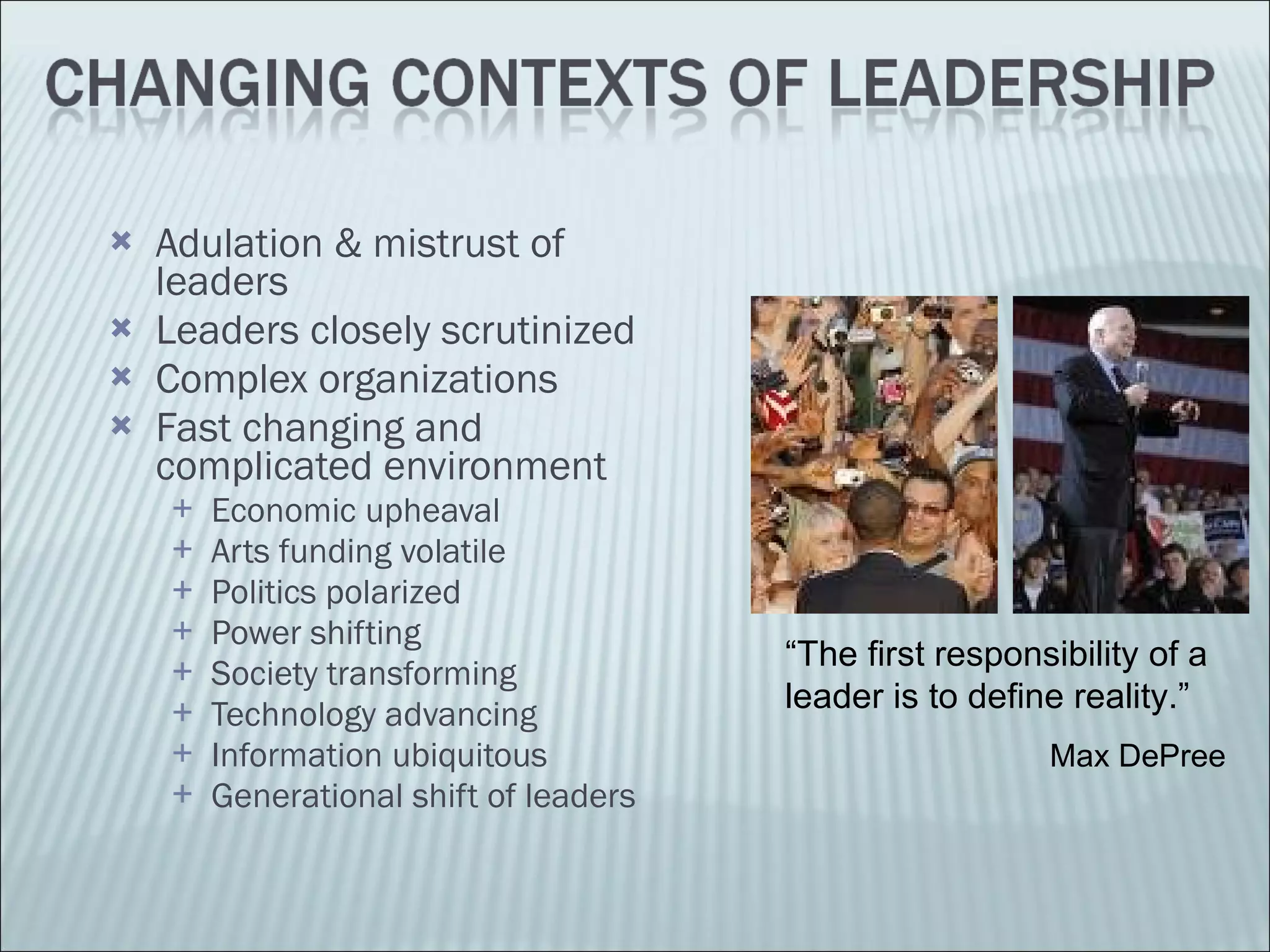
Adulation & mistrust of leaders Leaders closely scrutinized Complex organizations Fast changing and complicated environment Economic upheaval Arts funding volatile Politics polarized Power shifting Society transforming Technology advancing Information ubiquitous Generational shift of leaders “ The first responsibility of a leader is to define reality.”   Max DePree
Organizations in crisis Organization turnarounds and failures Leadership succession  Founding directors leaving Baby boomers (slowly) retiring Interim directors Next generation leaders
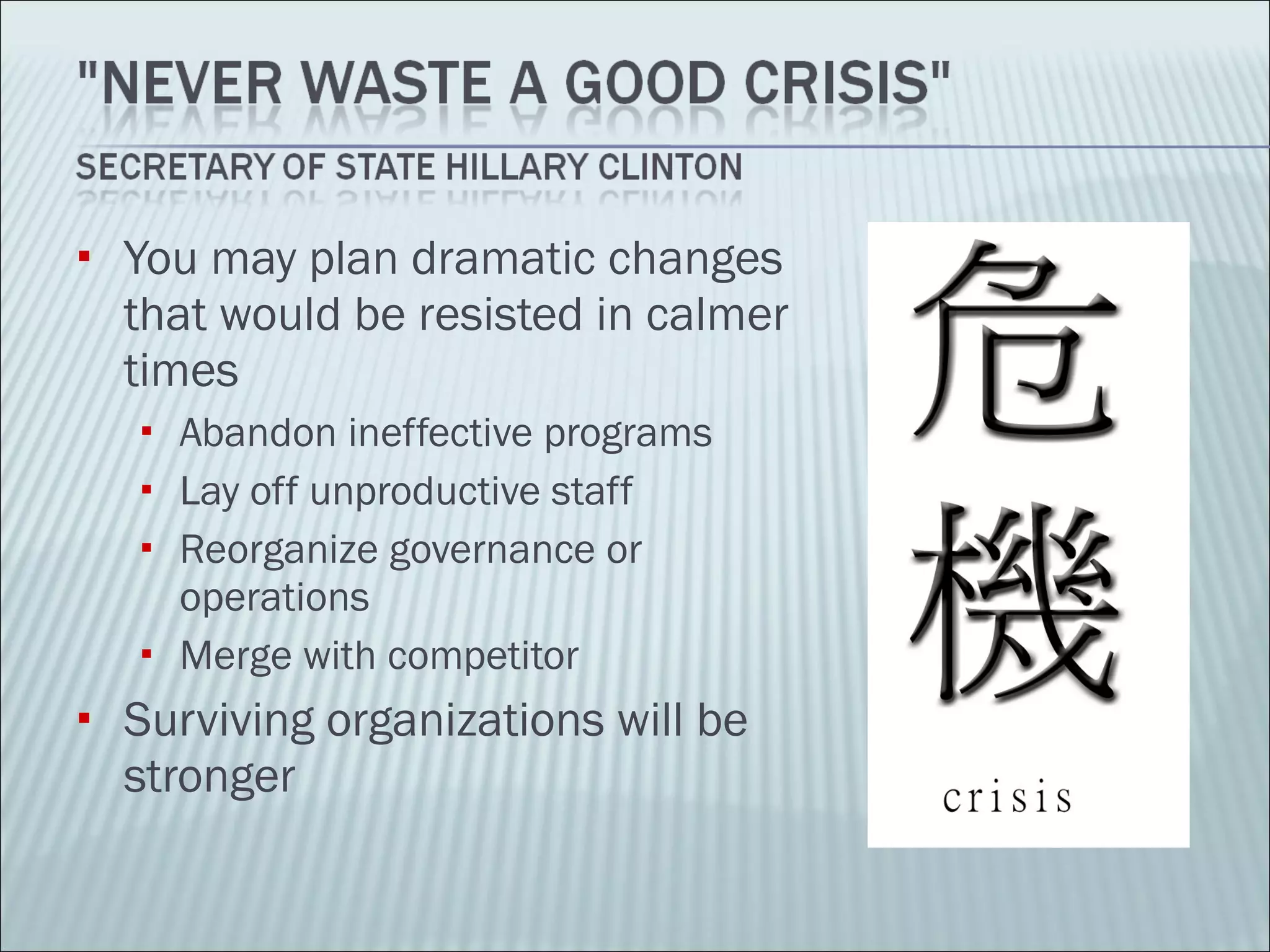
You may plan dramatic changes that would be resisted in calmer times Abandon ineffective programs Lay off unproductive staff Reorganize governance or operations Merge with competitor Surviving organizations will be stronger
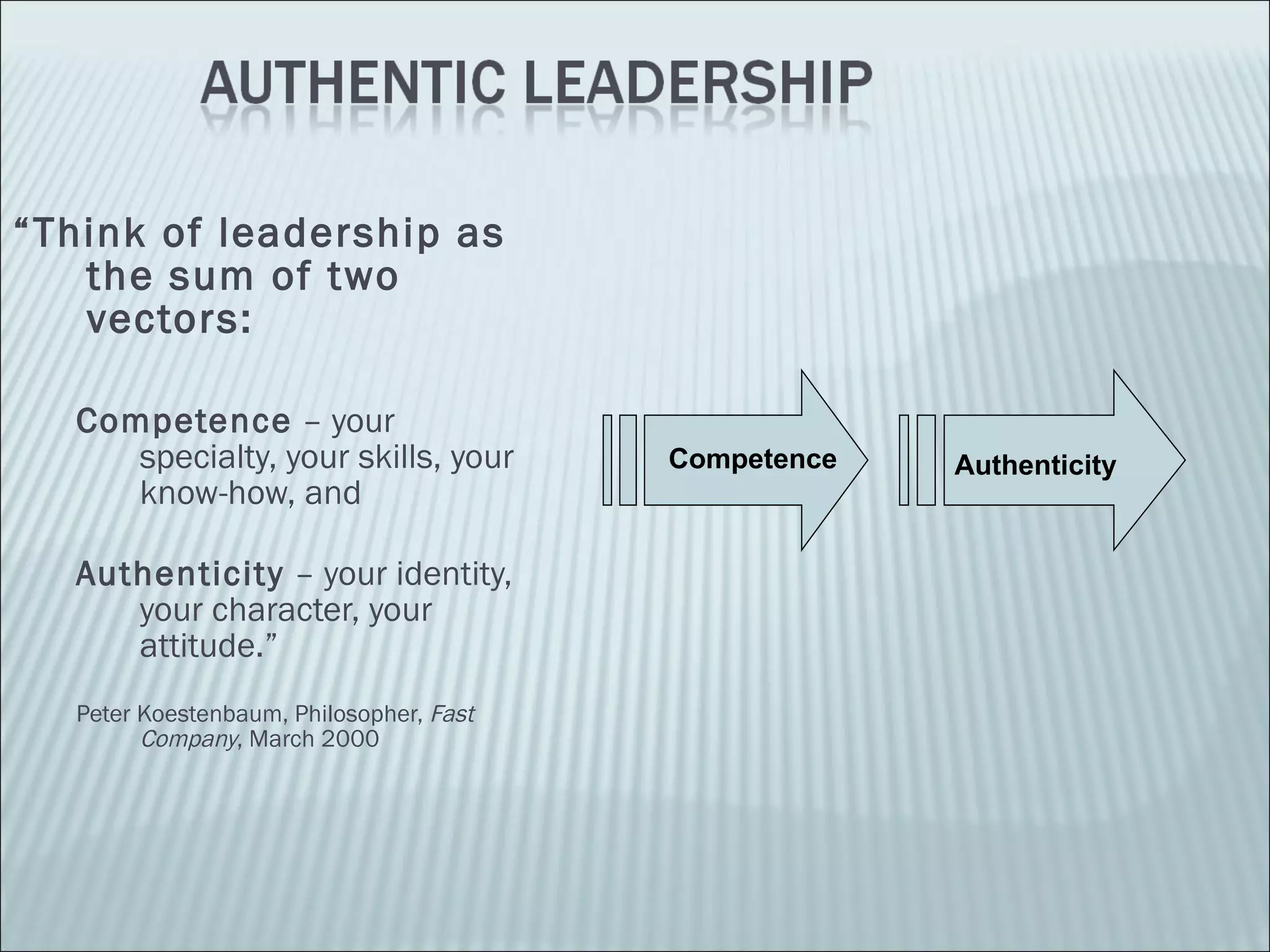
“ Think of leadership as the sum of two vectors: Competence  – your specialty, your skills, your know-how, and Authenticity  – your identity, your character, your attitude.” Peter Koestenbaum, Philosopher,  Fast Company , March 2000 Competence Authenticity
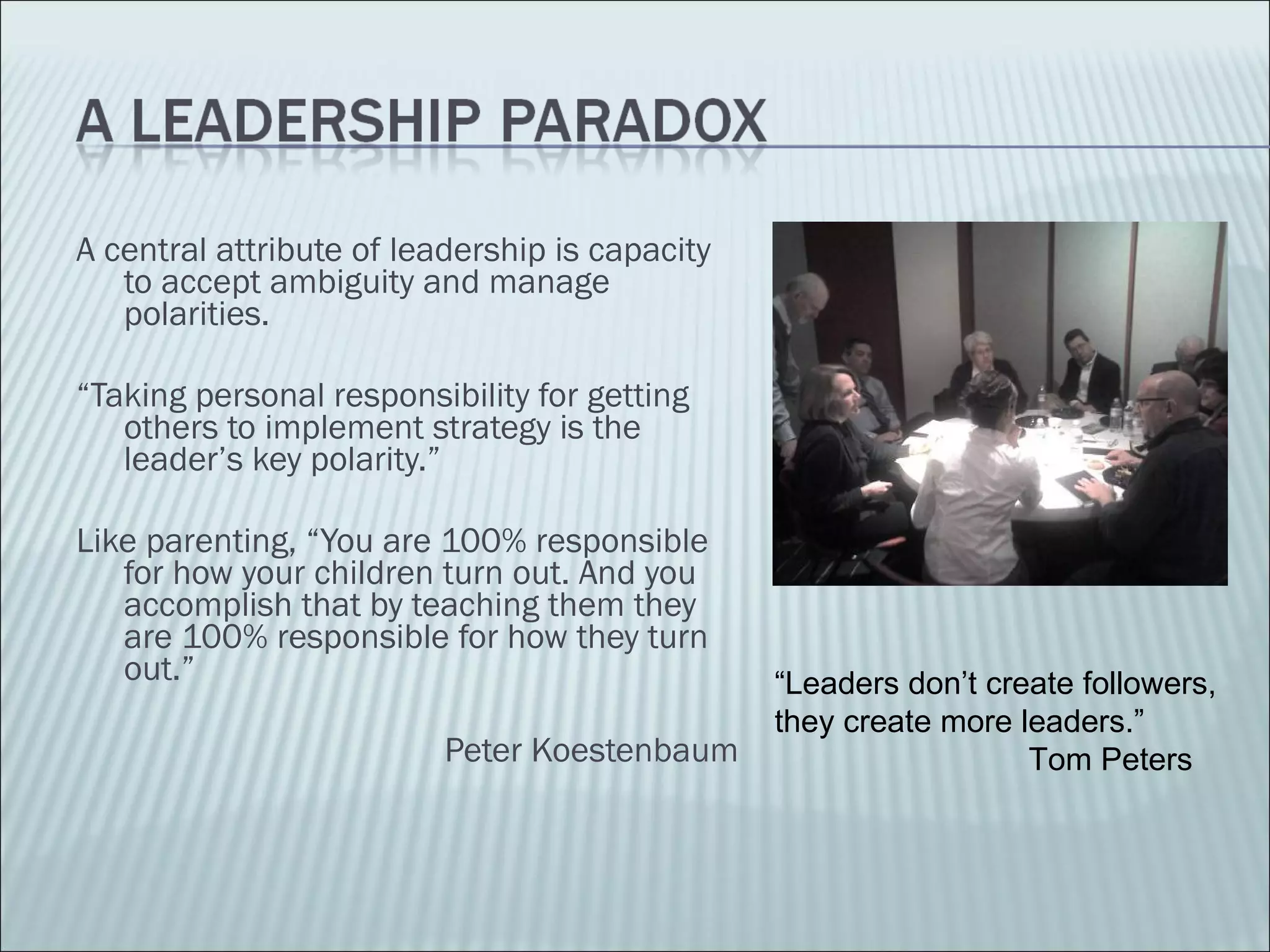
A central attribute of leadership is capacity to accept ambiguity and manage polarities. “ Taking personal responsibility for getting others to implement strategy is the leader’s key polarity.” Like parenting, “You are 100% responsible for how your children turn out. And you accomplish that by teaching them they are 100% responsible for how they turn out.”  Peter Koestenbaum “ Leaders don’t create followers, they create more leaders.”  Tom Peters
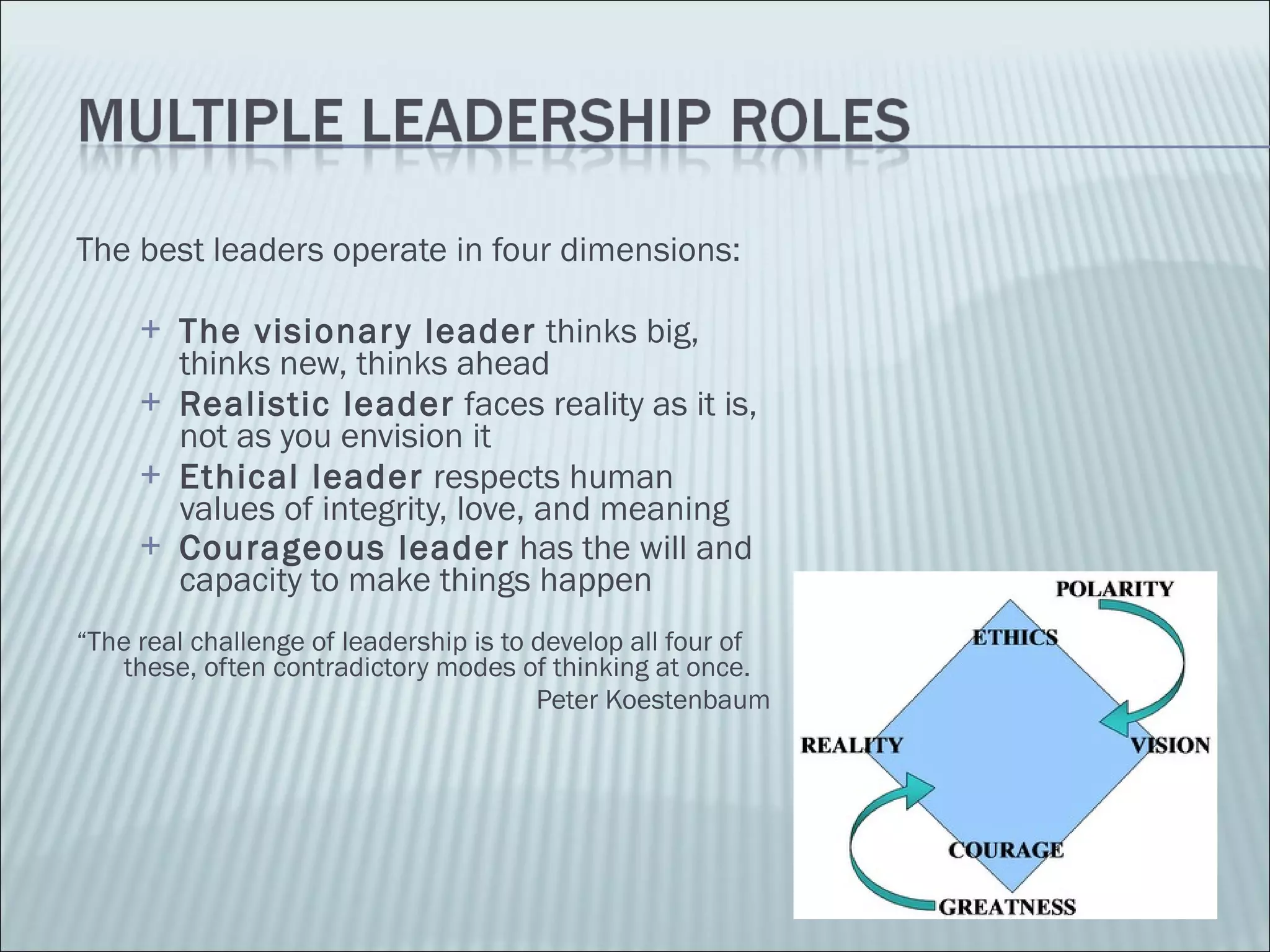
The best leaders operate in four dimensions: The visionary leader  thinks big, thinks new, thinks ahead Realistic leader  faces reality as it is, not as you envision it Ethical leader  respects human values of integrity, love, and meaning Courageous leader  has the will and capacity to make things happen “ The real challenge of leadership is to develop all four of these, often contradictory modes of thinking at once.  Peter Koestenbaum
“ Too many people separate the act of leadership from the leader. They see leadership as something that they do – rather than as an expression of who they are. People who understand who they are…have a more powerful voice.” Three core qualities of leadership : Authenticity Self expression Value creation Ask yourself : “ Do you know yourself? Why do I pursue the work and life that I do? What do I act like during the most fulfilling times of my life? Do you know how to listen – and to hear?” Fast Company , December 2007
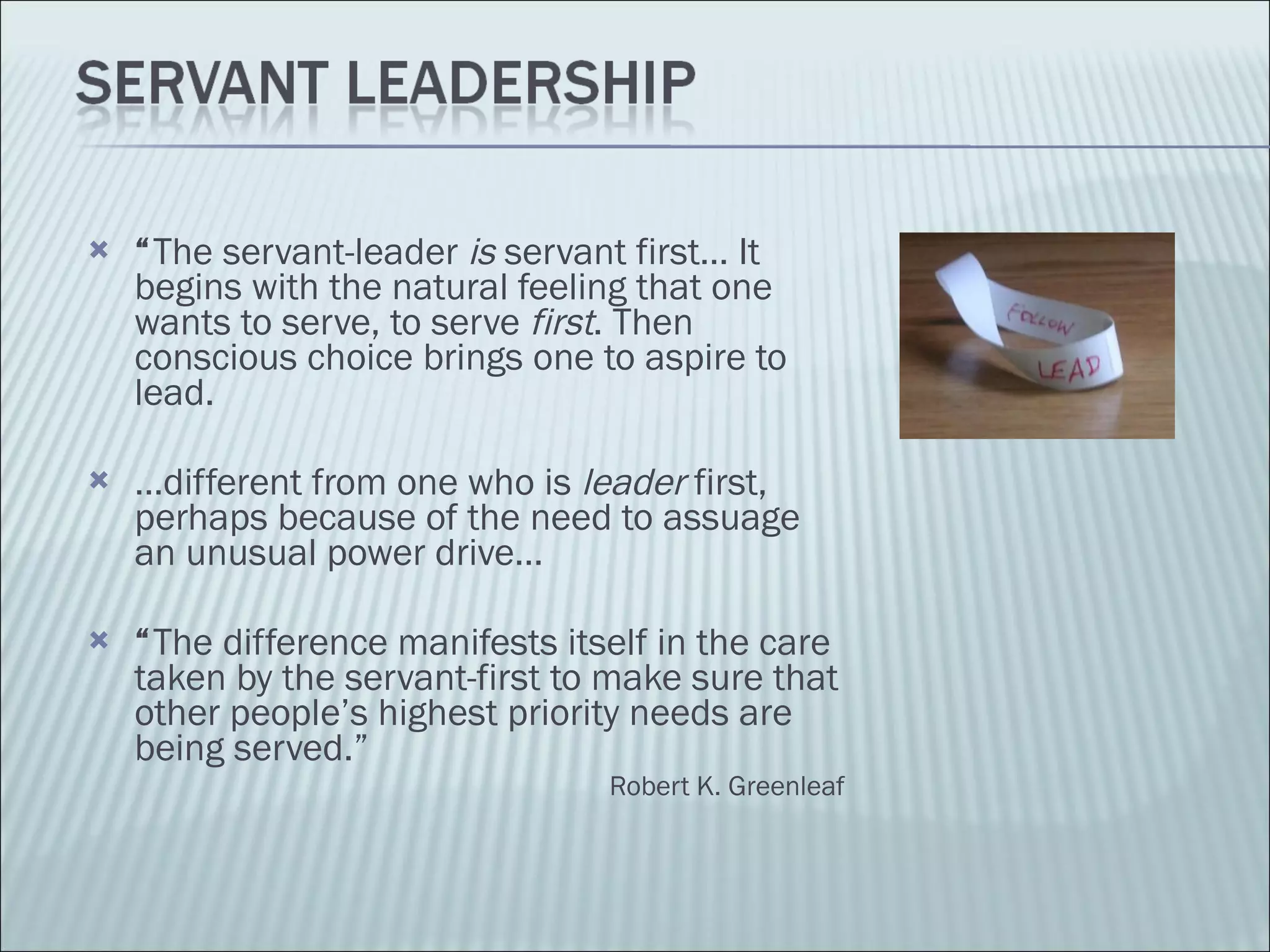
“ The servant-leader  is  servant first… It begins with the natural feeling that one wants to serve, to serve  first . Then conscious choice brings one to aspire to lead.  … different from one who is  leader  first, perhaps because of the need to assuage an unusual power drive… “ The difference manifests itself in the care taken by the servant-first to make sure that other people’s highest priority needs are being served.” Robert K. Greenleaf
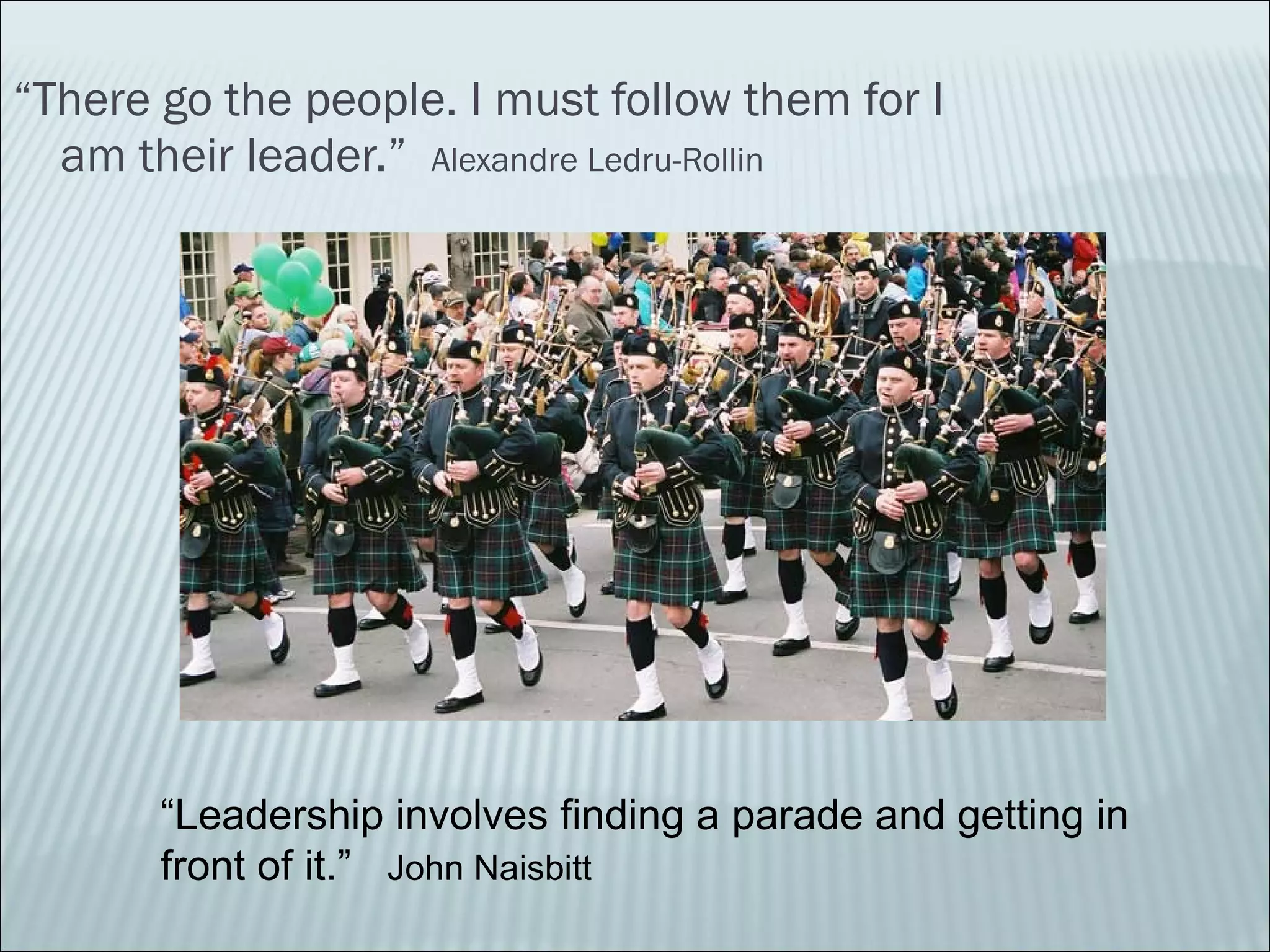
“ There go the people. I must follow them for I am their leader.”  Alexandre Ledru-Rollin “ Leadership involves finding a parade and getting in front of it.”  John Naisbitt
Barbara Kellerman,  Bad Leadership , identifies seven types of bad leaders Incompetent -- Lack skill or will Rigid -- Inflexible Intemperate -- Lack self control Callous -- Uncaring or unkind Corrupt -- Lie, steal, or cheat Insular -- Disregard welfare of those outside immediate group Evil – commit severe harm
When the Master governs, the people are hardly aware that he exists…. If you don’t trust the people,  you make them untrustworthy. The Master doesn’t talk, he acts. When his work is done, the people say, “Amazing: we did it, all by ourselves.” Lao Tzu 5 th  Century B.C.E. A real leader, through actions and words, has the ability to motivate others to their highest level of achievement;  then gives them the opportunity and the freedom to grow. The leader acts with little motion, instructs not with words but by deeds, keeps informed but seldom interferes. Warren Bennis
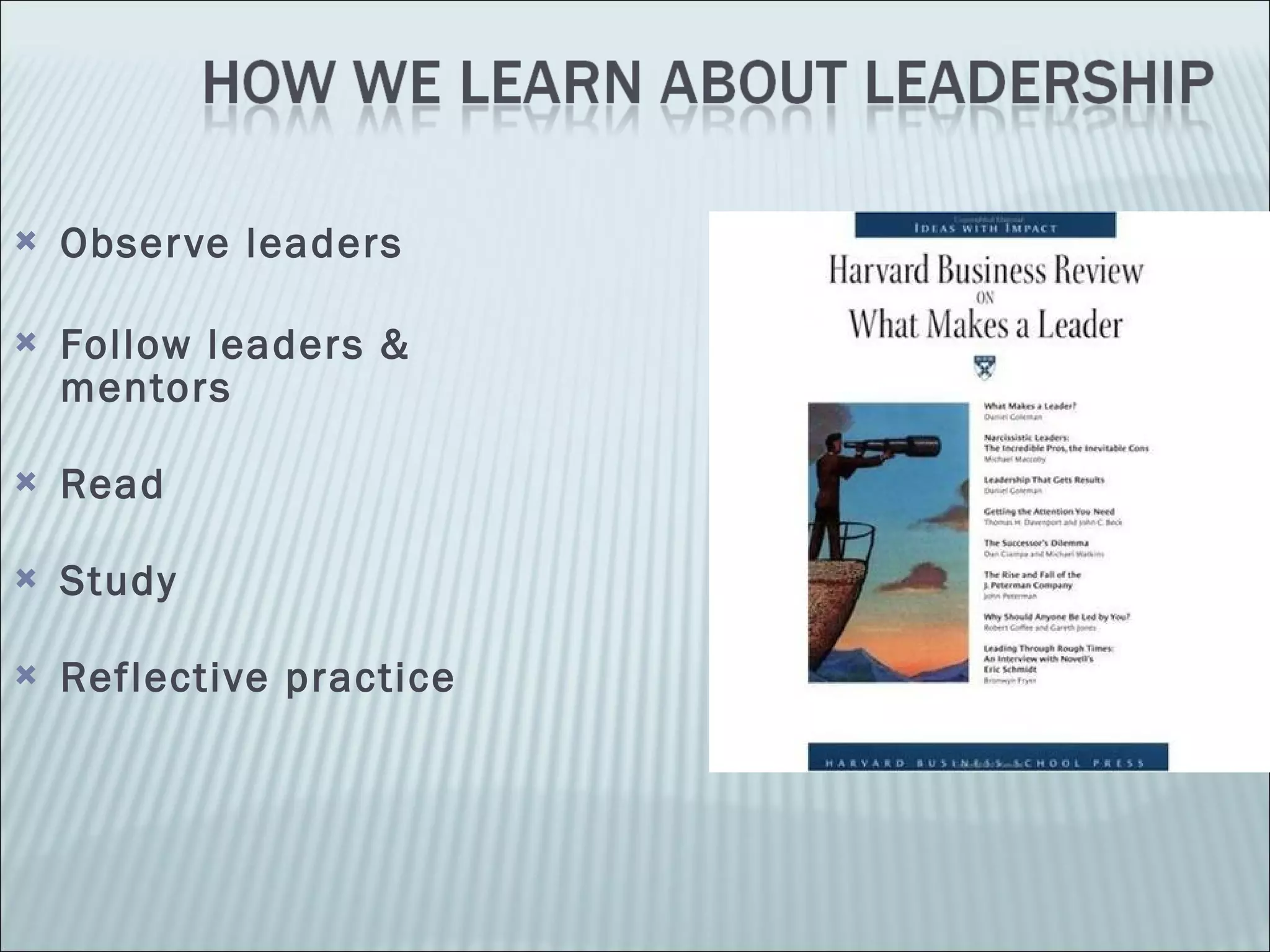
Observe leaders Follow leaders & mentors Read Study Reflective practice
Shannon Leadership Institute http://www.wilder.org/shannon NY State Arts Webinar series www.nysarts.org Americans for the Arts Webinar local arts management series www.arts-usa.org Arts Extension Service online Certificate in Arts Management www.umass.edu/aes James P. Shannon Leadership Institute, St. Paul, MN “ Organizations flourish under the leadership of people who are:  clear about their purpose and values, approach challenges proactively and with energy, and  who have a vision of how they can best serve the people in their community.”
Leadership is an Art , Max DePree  The Starfish and the Spider , Ori Brafman and Rod Beckstrom Leaders: The Strategies for Taking Charge , Warren Bennis and Burt Nanus Leadership and the New Science , Margaret Wheatley Leading Change , John P. Kotter Bad Leadership , Barbara Kellerman Governance as Leadership , Richard Chait, William Ryan, Barbara Taylor Community: The Structure of Belonging , Peter Block The Creative Community Builder’s Handbook , Tom Borrup Harvard Business Review on Leadership Harvard Business Review on What Makes a Leader Tao te Ching , Lao Tzu
Reflect on your practice Be comfortable with yourself Take care of yourself Exercise Rest Create Reflect Get support
What have you learned about your leadership? What do you need to learn? Resolve to learn and improve your leadership practice.
“ If your actions inspire others to dream more, learn more, do more and become more, you are a leader.”  John Quincy Adams

Authentic Leadership Part Iii

  • 1.
    Leadership Strategies andTools A Webinar Presented by NYS ARTS Craig Dreeszen, Ph.D., 2009 This program is made possible with support from National Endowment for the Arts, American Express Foundation and the New York State Council on the Arts, a State Agency
  • 2.
    Hear some ofyour reflections on leadership Explore paradoxes of leadership and a few more principles Examine leadership tools and ongoing learning opportunities Encourage your plan to enhance your leadership
  • 3.
    Adulation & mistrustof leaders Leaders closely scrutinized Complex organizations Fast changing and complicated environment Economic upheaval Arts funding volatile Politics polarized Power shifting Society transforming Technology advancing Information ubiquitous Generational shift of leaders “ The first responsibility of a leader is to define reality.” Max DePree
  • 4.
    Organizations in crisisOrganization turnarounds and failures Leadership succession Founding directors leaving Baby boomers (slowly) retiring Interim directors Next generation leaders
  • 5.
    You may plandramatic changes that would be resisted in calmer times Abandon ineffective programs Lay off unproductive staff Reorganize governance or operations Merge with competitor Surviving organizations will be stronger
  • 6.
    “ Think ofleadership as the sum of two vectors: Competence – your specialty, your skills, your know-how, and Authenticity – your identity, your character, your attitude.” Peter Koestenbaum, Philosopher, Fast Company , March 2000 Competence Authenticity
  • 7.
    A central attributeof leadership is capacity to accept ambiguity and manage polarities. “ Taking personal responsibility for getting others to implement strategy is the leader’s key polarity.” Like parenting, “You are 100% responsible for how your children turn out. And you accomplish that by teaching them they are 100% responsible for how they turn out.” Peter Koestenbaum “ Leaders don’t create followers, they create more leaders.” Tom Peters
  • 8.
    The best leadersoperate in four dimensions: The visionary leader thinks big, thinks new, thinks ahead Realistic leader faces reality as it is, not as you envision it Ethical leader respects human values of integrity, love, and meaning Courageous leader has the will and capacity to make things happen “ The real challenge of leadership is to develop all four of these, often contradictory modes of thinking at once. Peter Koestenbaum
  • 9.
    “ Too manypeople separate the act of leadership from the leader. They see leadership as something that they do – rather than as an expression of who they are. People who understand who they are…have a more powerful voice.” Three core qualities of leadership : Authenticity Self expression Value creation Ask yourself : “ Do you know yourself? Why do I pursue the work and life that I do? What do I act like during the most fulfilling times of my life? Do you know how to listen – and to hear?” Fast Company , December 2007
  • 10.
    “ The servant-leader is servant first… It begins with the natural feeling that one wants to serve, to serve first . Then conscious choice brings one to aspire to lead. … different from one who is leader first, perhaps because of the need to assuage an unusual power drive… “ The difference manifests itself in the care taken by the servant-first to make sure that other people’s highest priority needs are being served.” Robert K. Greenleaf
  • 11.
    “ There gothe people. I must follow them for I am their leader.” Alexandre Ledru-Rollin “ Leadership involves finding a parade and getting in front of it.” John Naisbitt
  • 12.
    Barbara Kellerman, Bad Leadership , identifies seven types of bad leaders Incompetent -- Lack skill or will Rigid -- Inflexible Intemperate -- Lack self control Callous -- Uncaring or unkind Corrupt -- Lie, steal, or cheat Insular -- Disregard welfare of those outside immediate group Evil – commit severe harm
  • 13.
    When the Mastergoverns, the people are hardly aware that he exists…. If you don’t trust the people, you make them untrustworthy. The Master doesn’t talk, he acts. When his work is done, the people say, “Amazing: we did it, all by ourselves.” Lao Tzu 5 th Century B.C.E. A real leader, through actions and words, has the ability to motivate others to their highest level of achievement; then gives them the opportunity and the freedom to grow. The leader acts with little motion, instructs not with words but by deeds, keeps informed but seldom interferes. Warren Bennis
  • 14.
    Observe leaders Followleaders & mentors Read Study Reflective practice
  • 15.
    Shannon Leadership Institutehttp://www.wilder.org/shannon NY State Arts Webinar series www.nysarts.org Americans for the Arts Webinar local arts management series www.arts-usa.org Arts Extension Service online Certificate in Arts Management www.umass.edu/aes James P. Shannon Leadership Institute, St. Paul, MN “ Organizations flourish under the leadership of people who are: clear about their purpose and values, approach challenges proactively and with energy, and who have a vision of how they can best serve the people in their community.”
  • 16.
    Leadership is anArt , Max DePree The Starfish and the Spider , Ori Brafman and Rod Beckstrom Leaders: The Strategies for Taking Charge , Warren Bennis and Burt Nanus Leadership and the New Science , Margaret Wheatley Leading Change , John P. Kotter Bad Leadership , Barbara Kellerman Governance as Leadership , Richard Chait, William Ryan, Barbara Taylor Community: The Structure of Belonging , Peter Block The Creative Community Builder’s Handbook , Tom Borrup Harvard Business Review on Leadership Harvard Business Review on What Makes a Leader Tao te Ching , Lao Tzu
  • 17.
    Reflect on yourpractice Be comfortable with yourself Take care of yourself Exercise Rest Create Reflect Get support
  • 18.
    What have youlearned about your leadership? What do you need to learn? Resolve to learn and improve your leadership practice.
  • 19.
    “ If youractions inspire others to dream more, learn more, do more and become more, you are a leader.” John Quincy Adams