Annex 2B.1 to DepEd Order No. 42, s. 2016
DAILY LESSON LOG
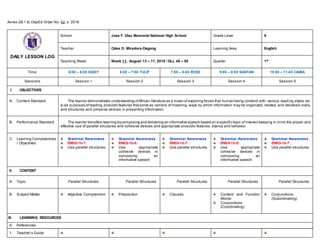
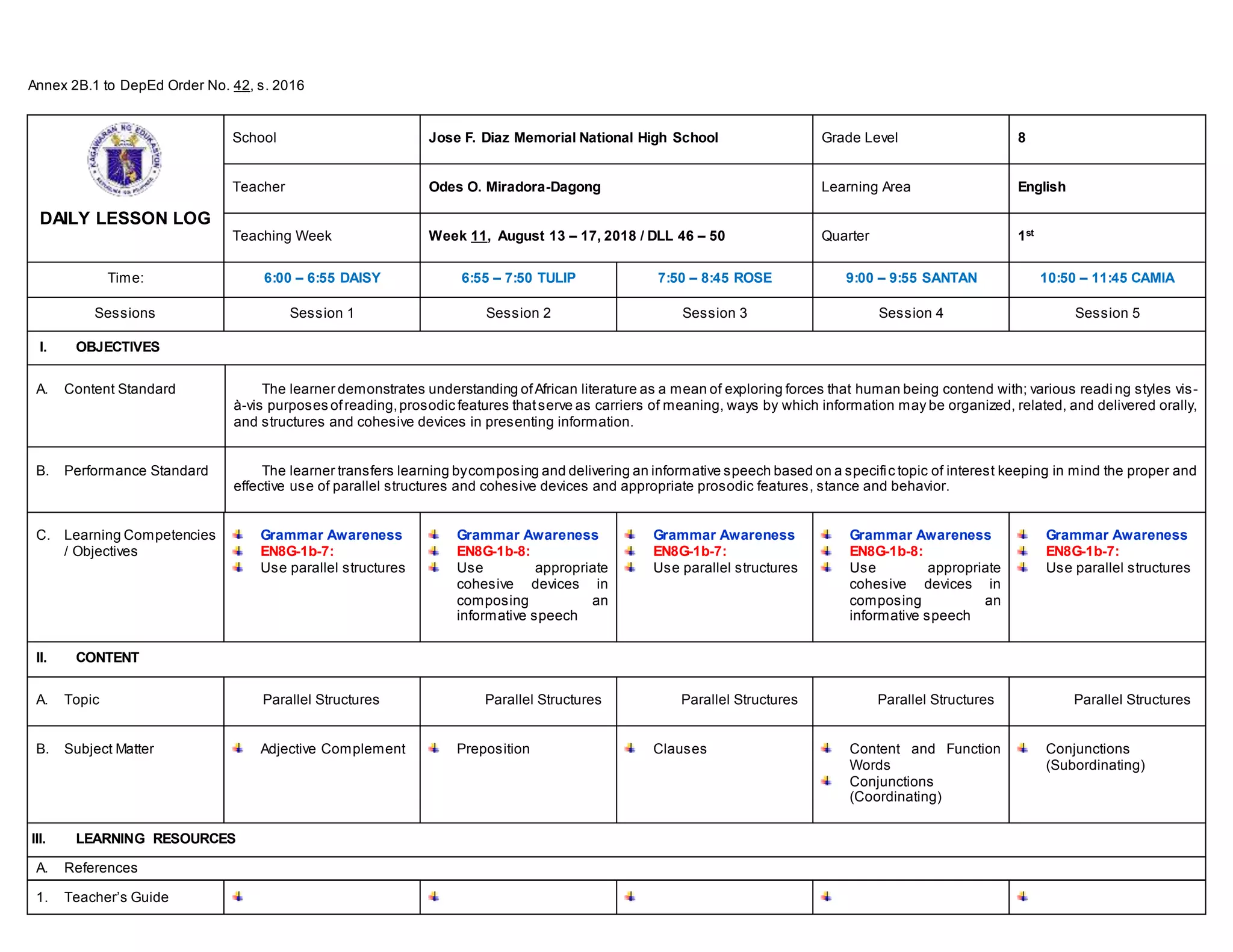
School Jose F. Diaz Memorial National High School Grade Level 8
Teacher Odes O. Miradora-Dagong Learning Area English
Teaching Week Week 11, August 13 – 17, 2018 / DLL 46 – 50 Quarter 1st
Time: 6:00 – 6:55 DAISY 6:55 – 7:50 TULIP 7:50 – 8:45 ROSE 9:00 – 9:55 SANTAN 10:50 – 11:45 CAMIA
Sessions Session 1 Session 2 Session 3 Session 4 Session 5
I. OBJECTIVES
A. Content Standard The learner demonstrates understanding ofAfrican literature as a mean of exploring forces that human being contend with; various readi ng styles vis-
à-vis purposes ofreading,prosodic features thatserve as carriers of meaning, ways by which information may be organized, related, and delivered orally,
and structures and cohesive devices in presenting information.
B. Performance Standard The learner transfers learning bycomposing and delivering an informative speech based on a specific topic of interest keeping in mind the proper and
effective use of parallel structures and cohesive devices and appropriate prosodic features, stance and behavior.
C. Learning Competencies
/ Objectives
Grammar Awareness
EN8G-1b-7:
Use parallel structures
Grammar Awareness
EN8G-1b-8:
Use appropriate
cohesive devices in
composing an
informative speech
Grammar Awareness
EN8G-1b-7:
Use parallel structures
Grammar Awareness
EN8G-1b-8:
Use appropriate
cohesive devices in
composing an
informative speech
Grammar Awareness
EN8G-1b-7:
Use parallel structures
II. CONTENT
A. Topic Parallel Structures Parallel Structures Parallel Structures Parallel Structures Parallel Structures
B. Subject Matter Adjective Complement Preposition Clauses Content and Function
Words
Conjunctions
(Coordinating)
Conjunctions
(Subordinating)
III. LEARNING RESOURCES
A. References
1. Teacher’s Guide
2. Learner’s Materials
3. Textbook
4. LRMDS
B. Other Learning
Resources
www.grammarbytes,co
m
www.grammarbytes,co
m
www.grammarbytes,co
m
www.grammarbytes,co
m
www.grammarbytes,co
m
IV. PROCEDURES
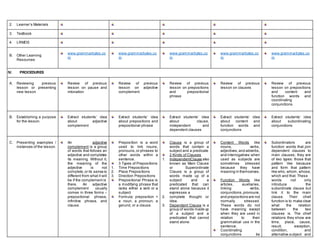
A. Reviewing previous
lesson or presenting
new lesson
Review of previous
lesson on pause and
intonation
Review of previous
lesson on adjective
complement
Review of previous
lesson on prepositions
and prepositional
phrase
Review of previous
lesson on clauses
Review of previous
lesson on prepositions
and content and
function words and
coordinating
conjunctions.
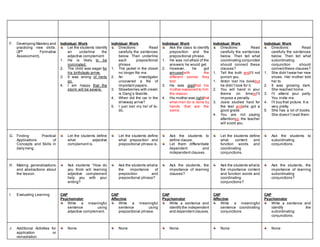
1.
B. Establishing a purpose
for the lesson.
Extract students’ idea
about adjective
complement
Extract students’ idea
about prepositions and
prepositional phrase
Extract students’ idea
about clause,
independent and
dependent clauses
Extract students’ idea
about content and
function words and
conjunctions
Extract students’ idea
about subordinating
conjunctions
1.
C. Presenting examples /
instances of the lesson.
An adjective
complement is a group
of words that follows an
adjective and completes
its meaning. Without it,
the meaning of the
adjective is not
complete,or its sense is
different from what it will
be if the complement is
there. An adjective
complement usually
comes in three forms –
prepositional phrase,
infinitive phrase, and
clause.
Preposition is a word
used to link nouns,
pronouns,or phrases to
other words within a
sentence.
3 Types of Prepositions
1. Time Prepositions
2. Place Prepositions
3. Direction Prepositions
Prepositional Phrase is
a modifying phrase that
lacks either a verb or a
subject
Formula: preposition +
a noun, a pronoun, a
gerund, or a clause.
Clause is a group of
words that contain a
subject and a predicate
2 Kinds of Clauses
1. IndependentClause also
known as Main Clause
or Superordinate
Clause is a group of
words made up of a
subject and a
predicated that can
stand alone because it
expresses a
2. complete thought or
idea.
3. Dependent Clause is a
group of words made up
of a subject and a
predicated that cannot
stand alone.
Content Words like
nouns, verbs,
adjectives,and adverbs,
and interrogatives when
used as subjects are
sometimes stressed
because they have
meaning in themselves.
Function Words like
articles, auxiliaries,
linking verbs,
conjunctions,pronouns,
and prepositions are not
normally stressed.
These words do not
have meaning except
when they are used in
relation to their
grammatical use in the
sentence.
Coordinating
conjunctions tie
Subordinators are
function words that join
dependent clauses to
main clauses; they are
of two types: those that
pattern like because
and form that pattern
like who, whom, whose,
which and that. These
words not only
introduce the
subordinate clause but
link it to the main
clause. Their chief
function is to make clear
what the relation
between the two
clauses is. The chief
relations they show are
time, place, cause,
result, exception,
condition, and
alternative.subject and
together words and
word-groups which
have the same
grammatical
construction.
For And Nor But Or Yet
So (FANBOYS)
a predicated that can
stand alone.
1.
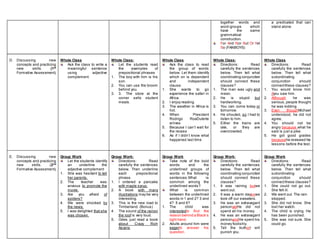
D. Discussing new
concepts and practicing
new skills. (1st
Formative Assessment).
Whole Class
Ask the class to write a
meaningful sentence
using adjective
complement.
Whole Class:
Let the students read
the examples of
prepositional phrases
1. The boy with him is his
son.
2. You can use the broom
behind you.
3. 3. The store at the
corner sells student
meals.
Whole Class
Ask the class to read
the group of words
below. Let them identify
which on is dependent
and independent
clause.
1. She wants to go
experience the safari in
Africa.
2. I enjoy reading.
3. The weather in Africa is
hot.
4. When President
Rodrigo RoaDuterte
arrives
5. Because I can’t wait for
the recess
6. As if I didn’t know what
happened last time
Whole Class:
Directions: Read
carefully the sentences
below. Then tell what
coordinating conjunction
should connect these
clauses?
1. The man was ugly and
mean.
2. He is stupid but
hardworking.
3. You can come today or
tomorrow.
4. He shouted, so I had to
listen to him.
5. Either the trains are
late, or they are
overcrowded.
Whole Class
Directions: Read
carefully the sentences
below. Then tell what
subordinating
conjunction should
connectthese clauses?
1. You would know him
ifyou saw him.
2. Although he was
serious, people thought
he was kidding.
3. Even thoughMichael
understood, he did not
agree.
4. You should not be
angry because what he
said is just a joke.
5. He got good grades
becausehe reviewed his
lessons before the test.
E. Discussing new
concepts and practicing
new skills. (2nd
Formative Assessment).
Group Work
Let the students identify
an underline the
adjective complement
1. She was hesitant to tell
her parents.
2. The teacher was
anxious to promote the
movie.
3. Are you afraid of
spiders?
4. We were shocked by
the news.
5. I was delighted that she
was chosen.
Group Work:
Directions: Read
carefully the sentences
below. Then underline
each prepositional
phrase.
1. I ordered a pancake
with maple syrup.
2. A book with many
illustrations may be very
interesting.
3. This is the new road to
Timberland. (Bonus)
4. The sound of the rainon
the roof is very loud.
5. Odes just read a book
about Crazy Rich
Asians.
Group Work
Take note of the bold
words and the
underlined groups of
words in the following
sentences.What is
common among the
underlined words?
What is common
between the underlined
words in 1 and 2? 3 and
4? 5 and 6?
1. The child was
interestedto find the
reason behind a Black’s
light hand.
2. Adults around him were
eagerto answer his
question.
Group Work:
Directions: Read
carefully the sentences
below. Then tell what
coordinating conjunction
should connect these
clauses?
1. It was raining butwe
went out.
2. It was a warm daysowe
took off our sweaters.
3. He was an extravagant
personyetHe did not
spend all his money.
4. He was an extravagant
personandHe spent his
money foolishly.
5. Tell the truthorI will
punish you.
Group Work
Directions: Read
carefully the sentences
below. Then tell what
subordinating
conjunction should
connectthese clauses?
1. She could not go out.
She felt ill.
2. We went out. The rain
stopped.
3. She did not know. She
lost her watch.
4. The child is crying. He
has been punished.
5. She was not sure. She
could go.
1.
F. Developing Mastery and
practicing new skills.
(3rd
Formative
Assessment).
Individual Work
Let the students identify
an underline the
adjective complement
1. He is likely to be
nominated.
2. The child was eager for
his birthdayto arrive.
3. It was wrong of herto
go.
4. I am happy that the
storm will be severe.
Individual Work
Directions: Read
carefully the sentences
below. Then underline
each prepositional
phrase.
1. The jacket in the closet
no longer fits me.
2. An investigator
uncovered a file of
important papers.
3. Strawberries with cream
is Dang’s favorite.
4. When did the car in the
driveway arrive?
5. I just lost my list of to-
do.
Individual Work
Ask the class to identify
preposition and the
prepositional phrase.
1. He was not afraid of the
answers he would get.
2. However, he got
amusedwith the
different stories they
told.
3. He was gladthat his
mother explained to him
the reason.
4. His mother was rightthat
what men do is done by
hands that are the
same.
Individual Work
Directions: Read
carefully the sentences
below. Then tell what
coordinating conjunction
should connect these
clauses?
1. Tell the truth andI’ll not
punish you.
1. Anton lost his bookbut
he didn’t look for it.
2. You will hand in your
theme on timeorI’ll
impose a penalty.
3. Josie studied hard for
the test andshe got a
good grade.
4. You are not paying
attentionso the teacher
will scold you.
Individual Work
Directions: Read
carefully the sentences
below. Then tell what
subordinating
conjunction should
connectthese clauses?
1. She didn’twear her new
shoes. Her mother told
her to.
2. It was growing dark.
She reached home.
3. I’ll attend your party.
You invite me.
4. I’ll buy that picture. It is
very pretty.
5. She has a lot of books.
She doesn’t read them.
1.
G. Finding Practical
Applications of
Concepts and Skills in
daily living.
Let the students define
what adjective
complement is.
Let the students define
what preposition and
prepositional phrase is.
Ask the students to
define clause.
Let them differentiate
dependent and
independent clauses.
Let the students define
what content and
function words and
coordinating
conjunctions.
Ask the students to
subordinating
conjunctions.
H. Making generalizations
and abstractions about
the lesson.
Ask students “How do
you think will learning
adjective complement
help you with your
writing?
Ask the students whatis
the importance of
preposition and
prepositional phrase?
Ask the students, the
importance of learning
clauses?
Ask the students whatis
the importance content
and function words and
coordinating
conjunctions?
Ask the students, the
importance of learning
subordinating
conjunctions?
1.
I. Evaluating Learning CAP
Psychomotor
Write a meaningful
sentence using
adjective complement.
CAP
Affective
Write a meaningful
sentence using
prepositional phrase.
CAP
Psychomotor
Write a sentence and
identify the independent
and dependent clauses.
CAP
Affective
Write a meaningful
sentence coordinating
conjunctions.
CAP
Psychomotor
Write a sentence and
identify the
subordinating
conjunctions.
1.
J. Additional Activities for
application or
remediation.
None None None None None
V. REMARKS
Indicate if the lesson will
be continued, re-teach
or lack of time, transfer
of lesson to the
following day in cases
of class suspension.
VI. REFLECTION
A. Number oflearners who
earned 80% in the
evaluation.
Daisy _____________
Tulip _____________
Rose ______________
Santan____________
Camia ____________
Daisy _____________
Tulip _____________
Rose ______________
Santan____________
Camia ____________
Daisy _____________
Tulip _____________
Rose ______________
Santan____________
Camia ____________
Daisy _____________
Tulip _____________
Rose ______________
Santan____________
Camia ____________
Daisy _____________
Tulip _____________
Rose ______________
Santan____________
Camia ____________
B. Number oflearners who
require additional
activities for
remediation.
Daisy _____________
Tulip _____________
Rose ______________
Santan____________
Camia ____________
Daisy _____________
Tulip _____________
Rose ______________
Santan____________
Camia ____________
Daisy _____________
Tulip _____________
Rose ______________
Santan____________
Camia ____________
Daisy _____________
Tulip _____________
Rose ______________
Santan____________
Camia ____________
Daisy _____________
Tulip _____________
Rose ______________
Santan____________
Camia ____________
C. Did the remedial
lessons work? Number
of learners who have
caught up with the
lesson.
Daisy _____________
Tulip _____________
Rose ______________
Santan____________
Camia ____________
Daisy _____________
Tulip _____________
Rose ______________
Santan____________
Camia ____________
Daisy _____________
Tulip _____________
Rose ______________
Santan____________
Camia ____________
Daisy _____________
Tulip _____________
Rose ______________
Santan____________
Camia ____________
Daisy _____________
Tulip _____________
Rose ______________
Santan____________
Camia ____________
D. Number oflearners who
continue to require
remediation.
Daisy _____________
Tulip _____________
Rose ______________
Santan____________
Camia ____________
Daisy _____________
Tulip _____________
Rose ______________
Santan____________
Camia ____________
Daisy _____________
Tulip _____________
Rose ______________
Santan____________
Camia ____________
Daisy _____________
Tulip _____________
Rose ______________
Santan____________
Camia ____________
Daisy _____________
Tulip _____________
Rose ______________
Santan____________
Camia ____________
E. Which of my teaching
strategies worked well?
Why did these work?
E. What difficulties did I
encounter which my
principal or supervisor
can help me solve?
F. What innovation or
localized materials did I
use / discover which I
wish to share with other
teachers?
Checked by MRS. RIZALINA G. DEAN
Department Chairperson

AUGUST 17, 2018

  • 1.
    Annex 2B.1 toDepEd Order No. 42, s. 2016 DAILY LESSON LOG School Jose F. Diaz Memorial National High School Grade Level 8 Teacher Odes O. Miradora-Dagong Learning Area English Teaching Week Week 11, August 13 – 17, 2018 / DLL 46 – 50 Quarter 1st Time: 6:00 – 6:55 DAISY 6:55 – 7:50 TULIP 7:50 – 8:45 ROSE 9:00 – 9:55 SANTAN 10:50 – 11:45 CAMIA Sessions Session 1 Session 2 Session 3 Session 4 Session 5 I. OBJECTIVES A. Content Standard The learner demonstrates understanding ofAfrican literature as a mean of exploring forces that human being contend with; various readi ng styles vis- à-vis purposes ofreading,prosodic features thatserve as carriers of meaning, ways by which information may be organized, related, and delivered orally, and structures and cohesive devices in presenting information. B. Performance Standard The learner transfers learning bycomposing and delivering an informative speech based on a specific topic of interest keeping in mind the proper and effective use of parallel structures and cohesive devices and appropriate prosodic features, stance and behavior. C. Learning Competencies / Objectives Grammar Awareness EN8G-1b-7: Use parallel structures Grammar Awareness EN8G-1b-8: Use appropriate cohesive devices in composing an informative speech Grammar Awareness EN8G-1b-7: Use parallel structures Grammar Awareness EN8G-1b-8: Use appropriate cohesive devices in composing an informative speech Grammar Awareness EN8G-1b-7: Use parallel structures II. CONTENT A. Topic Parallel Structures Parallel Structures Parallel Structures Parallel Structures Parallel Structures B. Subject Matter Adjective Complement Preposition Clauses Content and Function Words Conjunctions (Coordinating) Conjunctions (Subordinating) III. LEARNING RESOURCES A. References 1. Teacher’s Guide
  • 2.
    2. Learner’s Materials 3.Textbook 4. LRMDS B. Other Learning Resources www.grammarbytes,co m www.grammarbytes,co m www.grammarbytes,co m www.grammarbytes,co m www.grammarbytes,co m IV. PROCEDURES A. Reviewing previous lesson or presenting new lesson Review of previous lesson on pause and intonation Review of previous lesson on adjective complement Review of previous lesson on prepositions and prepositional phrase Review of previous lesson on clauses Review of previous lesson on prepositions and content and function words and coordinating conjunctions. 1. B. Establishing a purpose for the lesson. Extract students’ idea about adjective complement Extract students’ idea about prepositions and prepositional phrase Extract students’ idea about clause, independent and dependent clauses Extract students’ idea about content and function words and conjunctions Extract students’ idea about subordinating conjunctions 1. C. Presenting examples / instances of the lesson. An adjective complement is a group of words that follows an adjective and completes its meaning. Without it, the meaning of the adjective is not complete,or its sense is different from what it will be if the complement is there. An adjective complement usually comes in three forms – prepositional phrase, infinitive phrase, and clause. Preposition is a word used to link nouns, pronouns,or phrases to other words within a sentence. 3 Types of Prepositions 1. Time Prepositions 2. Place Prepositions 3. Direction Prepositions Prepositional Phrase is a modifying phrase that lacks either a verb or a subject Formula: preposition + a noun, a pronoun, a gerund, or a clause. Clause is a group of words that contain a subject and a predicate 2 Kinds of Clauses 1. IndependentClause also known as Main Clause or Superordinate Clause is a group of words made up of a subject and a predicated that can stand alone because it expresses a 2. complete thought or idea. 3. Dependent Clause is a group of words made up of a subject and a predicated that cannot stand alone. Content Words like nouns, verbs, adjectives,and adverbs, and interrogatives when used as subjects are sometimes stressed because they have meaning in themselves. Function Words like articles, auxiliaries, linking verbs, conjunctions,pronouns, and prepositions are not normally stressed. These words do not have meaning except when they are used in relation to their grammatical use in the sentence. Coordinating conjunctions tie Subordinators are function words that join dependent clauses to main clauses; they are of two types: those that pattern like because and form that pattern like who, whom, whose, which and that. These words not only introduce the subordinate clause but link it to the main clause. Their chief function is to make clear what the relation between the two clauses is. The chief relations they show are time, place, cause, result, exception, condition, and alternative.subject and
  • 3.
    together words and word-groupswhich have the same grammatical construction. For And Nor But Or Yet So (FANBOYS) a predicated that can stand alone. 1. D. Discussing new concepts and practicing new skills. (1st Formative Assessment). Whole Class Ask the class to write a meaningful sentence using adjective complement. Whole Class: Let the students read the examples of prepositional phrases 1. The boy with him is his son. 2. You can use the broom behind you. 3. 3. The store at the corner sells student meals. Whole Class Ask the class to read the group of words below. Let them identify which on is dependent and independent clause. 1. She wants to go experience the safari in Africa. 2. I enjoy reading. 3. The weather in Africa is hot. 4. When President Rodrigo RoaDuterte arrives 5. Because I can’t wait for the recess 6. As if I didn’t know what happened last time Whole Class: Directions: Read carefully the sentences below. Then tell what coordinating conjunction should connect these clauses? 1. The man was ugly and mean. 2. He is stupid but hardworking. 3. You can come today or tomorrow. 4. He shouted, so I had to listen to him. 5. Either the trains are late, or they are overcrowded. Whole Class Directions: Read carefully the sentences below. Then tell what subordinating conjunction should connectthese clauses? 1. You would know him ifyou saw him. 2. Although he was serious, people thought he was kidding. 3. Even thoughMichael understood, he did not agree. 4. You should not be angry because what he said is just a joke. 5. He got good grades becausehe reviewed his lessons before the test. E. Discussing new concepts and practicing new skills. (2nd Formative Assessment). Group Work Let the students identify an underline the adjective complement 1. She was hesitant to tell her parents. 2. The teacher was anxious to promote the movie. 3. Are you afraid of spiders? 4. We were shocked by the news. 5. I was delighted that she was chosen. Group Work: Directions: Read carefully the sentences below. Then underline each prepositional phrase. 1. I ordered a pancake with maple syrup. 2. A book with many illustrations may be very interesting. 3. This is the new road to Timberland. (Bonus) 4. The sound of the rainon the roof is very loud. 5. Odes just read a book about Crazy Rich Asians. Group Work Take note of the bold words and the underlined groups of words in the following sentences.What is common among the underlined words? What is common between the underlined words in 1 and 2? 3 and 4? 5 and 6? 1. The child was interestedto find the reason behind a Black’s light hand. 2. Adults around him were eagerto answer his question. Group Work: Directions: Read carefully the sentences below. Then tell what coordinating conjunction should connect these clauses? 1. It was raining butwe went out. 2. It was a warm daysowe took off our sweaters. 3. He was an extravagant personyetHe did not spend all his money. 4. He was an extravagant personandHe spent his money foolishly. 5. Tell the truthorI will punish you. Group Work Directions: Read carefully the sentences below. Then tell what subordinating conjunction should connectthese clauses? 1. She could not go out. She felt ill. 2. We went out. The rain stopped. 3. She did not know. She lost her watch. 4. The child is crying. He has been punished. 5. She was not sure. She could go.
  • 4.
    1. F. Developing Masteryand practicing new skills. (3rd Formative Assessment). Individual Work Let the students identify an underline the adjective complement 1. He is likely to be nominated. 2. The child was eager for his birthdayto arrive. 3. It was wrong of herto go. 4. I am happy that the storm will be severe. Individual Work Directions: Read carefully the sentences below. Then underline each prepositional phrase. 1. The jacket in the closet no longer fits me. 2. An investigator uncovered a file of important papers. 3. Strawberries with cream is Dang’s favorite. 4. When did the car in the driveway arrive? 5. I just lost my list of to- do. Individual Work Ask the class to identify preposition and the prepositional phrase. 1. He was not afraid of the answers he would get. 2. However, he got amusedwith the different stories they told. 3. He was gladthat his mother explained to him the reason. 4. His mother was rightthat what men do is done by hands that are the same. Individual Work Directions: Read carefully the sentences below. Then tell what coordinating conjunction should connect these clauses? 1. Tell the truth andI’ll not punish you. 1. Anton lost his bookbut he didn’t look for it. 2. You will hand in your theme on timeorI’ll impose a penalty. 3. Josie studied hard for the test andshe got a good grade. 4. You are not paying attentionso the teacher will scold you. Individual Work Directions: Read carefully the sentences below. Then tell what subordinating conjunction should connectthese clauses? 1. She didn’twear her new shoes. Her mother told her to. 2. It was growing dark. She reached home. 3. I’ll attend your party. You invite me. 4. I’ll buy that picture. It is very pretty. 5. She has a lot of books. She doesn’t read them. 1. G. Finding Practical Applications of Concepts and Skills in daily living. Let the students define what adjective complement is. Let the students define what preposition and prepositional phrase is. Ask the students to define clause. Let them differentiate dependent and independent clauses. Let the students define what content and function words and coordinating conjunctions. Ask the students to subordinating conjunctions. H. Making generalizations and abstractions about the lesson. Ask students “How do you think will learning adjective complement help you with your writing? Ask the students whatis the importance of preposition and prepositional phrase? Ask the students, the importance of learning clauses? Ask the students whatis the importance content and function words and coordinating conjunctions? Ask the students, the importance of learning subordinating conjunctions? 1. I. Evaluating Learning CAP Psychomotor Write a meaningful sentence using adjective complement. CAP Affective Write a meaningful sentence using prepositional phrase. CAP Psychomotor Write a sentence and identify the independent and dependent clauses. CAP Affective Write a meaningful sentence coordinating conjunctions. CAP Psychomotor Write a sentence and identify the subordinating conjunctions. 1. J. Additional Activities for application or remediation. None None None None None
  • 5.
    V. REMARKS Indicate ifthe lesson will be continued, re-teach or lack of time, transfer of lesson to the following day in cases of class suspension. VI. REFLECTION A. Number oflearners who earned 80% in the evaluation. Daisy _____________ Tulip _____________ Rose ______________ Santan____________ Camia ____________ Daisy _____________ Tulip _____________ Rose ______________ Santan____________ Camia ____________ Daisy _____________ Tulip _____________ Rose ______________ Santan____________ Camia ____________ Daisy _____________ Tulip _____________ Rose ______________ Santan____________ Camia ____________ Daisy _____________ Tulip _____________ Rose ______________ Santan____________ Camia ____________ B. Number oflearners who require additional activities for remediation. Daisy _____________ Tulip _____________ Rose ______________ Santan____________ Camia ____________ Daisy _____________ Tulip _____________ Rose ______________ Santan____________ Camia ____________ Daisy _____________ Tulip _____________ Rose ______________ Santan____________ Camia ____________ Daisy _____________ Tulip _____________ Rose ______________ Santan____________ Camia ____________ Daisy _____________ Tulip _____________ Rose ______________ Santan____________ Camia ____________ C. Did the remedial lessons work? Number of learners who have caught up with the lesson. Daisy _____________ Tulip _____________ Rose ______________ Santan____________ Camia ____________ Daisy _____________ Tulip _____________ Rose ______________ Santan____________ Camia ____________ Daisy _____________ Tulip _____________ Rose ______________ Santan____________ Camia ____________ Daisy _____________ Tulip _____________ Rose ______________ Santan____________ Camia ____________ Daisy _____________ Tulip _____________ Rose ______________ Santan____________ Camia ____________ D. Number oflearners who continue to require remediation. Daisy _____________ Tulip _____________ Rose ______________ Santan____________ Camia ____________ Daisy _____________ Tulip _____________ Rose ______________ Santan____________ Camia ____________ Daisy _____________ Tulip _____________ Rose ______________ Santan____________ Camia ____________ Daisy _____________ Tulip _____________ Rose ______________ Santan____________ Camia ____________ Daisy _____________ Tulip _____________ Rose ______________ Santan____________ Camia ____________ E. Which of my teaching strategies worked well? Why did these work?
  • 6.
    E. What difficultiesdid I encounter which my principal or supervisor can help me solve? F. What innovation or localized materials did I use / discover which I wish to share with other teachers? Checked by MRS. RIZALINA G. DEAN Department Chairperson