
Audit planning and
Procedures of MI
Cement Factory
Welcome to our
Presentation
NAME ID NO
ZARIN TASNIM 17-009
TAMANNA NIGAR 17-031
FATEMA-TUJ-JOHORA SHORNA 17-119
NABILA MAHABUB 17-189
SAMANTA HAQUE 17-191
SUBMITTED BY:
SUBMITTED TO
Mohammad Salahuddin Chowdhury
Lecturer
DEPARTMENT OF FINANCE
UNIVERSITY OF DHAKA
Company Overview
M.I. Cement Factory’s brand "Crown Cement" is renowned both
at home and abroad. It is one of the leading manufacturers of
cement in Bangladesh.
On December 31, 1994 it started its journey with the commitment for
providing high quality cement to the country
Crown Cement is the largest cement exporter in Bangladesh. The
major export market of Crown cement is the northeastern states of
India including Tripura, Meghalaya, eastern and western region of
Assam.
Corporate Social Responsibility (CSR) has become a fundamental
business practice and has gained much attention from board of
directors and executive management team of M.I. Cement Factory Ltd.
Process of
assurance
Audit
strategy
• involves the formulation of the
general strategy for the
audit, which sets the
scope, timing and direction of
the audit and guides the
development of the audit plan
Audit
plan
• More detailed than audit
strategy
• sets out the nature, timing and
extent of audit procedures to
be performed by the
engagement team in order to
obtain sufficient appropriate
audit evidence
Planning the
assignment
Approaches of audit planning
Approaches
1.Ensuring that all the
ethical requirements are
met
2.Ensuring that the terms of
the engagement are
understood by both auditor
and MI Cement
Management
3.Establishing the overall
audit strategy for MI
Cement
4.Developing an audit plan
for MI Cement
Developing Audit Strategy: key contents
• General economic factors of Bangladesh and cement industry
conditions
• Important characteristics of M.I Cement, such as-business, principal
business strategies, financial performance, Reporting
requirements, including changes since the previous audit
• The setting of materiality for audit planning purposes.
• The possibility of material misstatements, including the experience of past
periods or frauds.
• The identification of complex accounting areas including those involving
estimates.
• The expected assessment of risks of fraud or error and identification of
significant audit areas
• The effect of information technology on the audit
• Possible change of emphasis on specific audit areas
Understanding
M.I cement’s
environment
Risk &
materiality
Consequent
nature, timing
and extent of
procedures
• The number of locations. Basically we have four production
locations.
• Staffing requirements – the contribution and benefit plans
for employees
• Need to attend client premises for inventory count or other
year-end procedures.
• The possibility that the going concern basis may be subject
to question
• Conditions requiring special attention
• The nature and timing of reports or other communication
with the M. I Cement that are expected under the
engagement
Co-ordination,
direction,
supervision
and review
Other
matters
Steps to create strategy
The terms of engagement
• write up the nominal ledger and draft statutory accounts from the M.I Cement’s records.
Understanding the Company and its business
• Assess risks and identify procedure
• Plan and perform the audit effectively and efficiently
• Evaluate the audit evidence
Special audit problems
•We looked at the factors that the company organized a contributory provision
fund and its recognition from the National Board of revenue.
•We ensured both of them were consistent with the company’s earnings and
expenses
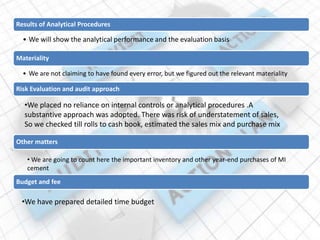
Results of Analytical Procedures
• We will show the analytical performance and the evaluation basis
Materiality
• We are not claiming to have found every error, but we figured out the relevant materiality
Risk Evaluation and audit approach
Other matters
Budget and fee
•We placed no reliance on internal controls or analytical procedures .A
substantive approach was adopted. There was risk of understatement of sales,
So we checked till rolls to cash book, estimated the sales mix and purchase mix
• We are going to count here the important inventory and other year-end purchases of MI
cement
•We have prepared detailed time budget
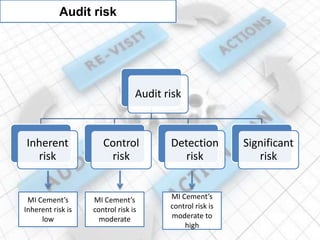
Audit risk
Audit risk
Inherent
risk
Control
risk
Detection
risk
Significant
risk
MI Cement’s
Inherent risk is
low
MI Cement’s
control risk is
moderate
MI Cement’s
control risk is
moderate to
high
Internal control
Actions MI cement takes to
minimize internal control
breakdowns might include:
Management displaying a
culture of responsiveness to
identified control
weaknesses and encouraging
reporting of internal control
weaknesses
Training in internal control
processes as part of staff
induction, with regular
follow up training
Easy access to user-friendly
documented internal
procedures
Having a financial
management practice
manual that reflects current
practice of the agency
Regular review of potential
risks that may significantly
impact agency operations
Regular review and update
of internal operational,
financial and other processes
Performance audit reports
Test of Controls in Purchasing and
Revenue system of M.I.Cement
Factories Ltd
Check that references are being obtained for all
new customers
Check that all new accounts on the receivable
ledger have been authorized by senior staff
Check that orders are only accepted from
customers who have within the credit terms and
limits
Check that customer’s orders are being matched
with production order and dispatch notes
Tests of control : Purchasing
Verify details of trade sales or goods dispatch
notes with sales invoices
Verify details of trade sales with entries in
inventory records
Verify non routine sales (scrap, noncurrent assets
etc)
Verify credit notes
Test numerical sequence of dispatch notes and
enquire into missing numbers
Tests of control : (dispatch and Invoicing)
Review list of suppliers and check a sample to
orders made
Check sequence of pre numbered order forms
Check orders are supported by a particular
purchase requisition
Review security arrangements over blank orders
Tests of control : Ordering
Check invoices for goods are supported by goods
received notes
Check calculation and additions
Check for returns that credit notes are duly
received from suppliers
Test numerical sequence and enquire into missing
numbers
Tests of control : (Goods inward s and recording of invoices)
Evaluation Systems
(Existence, valuation)
• Tangible assets are (property, plant, equipment)
BAS 16 are calculated at historical cost less
cumulative depreciation and cumulative
impairment.
Trade and other Receivable
(Valuation assertion)
• Trade receivables are carried at original invoice price. All receivables
are considered as good and realizable.
Inventory (Valuation assertion)
Inventories are valued in accordance with BAS 2 in lower cost and at Net
realizable value. NPV is based on estimated selling price in the ordinary course
of business less any expected cost to be occurred in the future.
Evidence & sampling
CAAT
Audit softwareTest data
Audit software makes use of
the assurance providers’ own
specialised software. There
are a number of off the shelf
packages available, or the
assurance provider could have
a tailor made system. Audit
software works on the basis of
interrogating the client’s
system and extracting and
analysing information.
Under this test of control, the
assurance provider supervises the
process of running data through
the client’s system
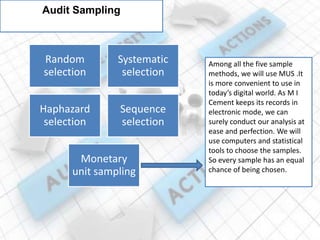
Audit Sampling
Random
selection
Systematic
selection
Haphazard
selection
Sequence
selection
Monetary
unit sampling
Among all the five sample
methods, we will use MUS .It
is more convenient to use in
today’s digital world. As M I
Cement keeps its records in
electronic mode, we can
surely conduct our analysis at
ease and perfection. We will
use computers and statistical
tools to choose the samples.
So every sample has an equal
chance of being chosen.
Audit Report
Opinion
Qualified
Unqualified
Recommendation
•For conducting more feasible statistical analysis we would need more
professional expertise opinions .therefore, it is important for us to build a
strong network with the professional auditors
•Developing more technological expertise for using research and statistical
tools in audit analysis
•Developing more appropriate intuition for assessment of managerial
assumption and estimates
•Getting well acquainted with the assigned company managerial and
auditing committee

Audit slide

  • 1.
    Audit planning and Proceduresof MI Cement Factory Welcome to our Presentation
  • 2.
    NAME ID NO ZARINTASNIM 17-009 TAMANNA NIGAR 17-031 FATEMA-TUJ-JOHORA SHORNA 17-119 NABILA MAHABUB 17-189 SAMANTA HAQUE 17-191 SUBMITTED BY: SUBMITTED TO Mohammad Salahuddin Chowdhury Lecturer DEPARTMENT OF FINANCE UNIVERSITY OF DHAKA
  • 3.
    Company Overview M.I. CementFactory’s brand "Crown Cement" is renowned both at home and abroad. It is one of the leading manufacturers of cement in Bangladesh. On December 31, 1994 it started its journey with the commitment for providing high quality cement to the country Crown Cement is the largest cement exporter in Bangladesh. The major export market of Crown cement is the northeastern states of India including Tripura, Meghalaya, eastern and western region of Assam. Corporate Social Responsibility (CSR) has become a fundamental business practice and has gained much attention from board of directors and executive management team of M.I. Cement Factory Ltd.
  • 4.
    Process of assurance Audit strategy • involvesthe formulation of the general strategy for the audit, which sets the scope, timing and direction of the audit and guides the development of the audit plan Audit plan • More detailed than audit strategy • sets out the nature, timing and extent of audit procedures to be performed by the engagement team in order to obtain sufficient appropriate audit evidence Planning the assignment
  • 5.
    Approaches of auditplanning Approaches 1.Ensuring that all the ethical requirements are met 2.Ensuring that the terms of the engagement are understood by both auditor and MI Cement Management 3.Establishing the overall audit strategy for MI Cement 4.Developing an audit plan for MI Cement
  • 6.
    Developing Audit Strategy:key contents • General economic factors of Bangladesh and cement industry conditions • Important characteristics of M.I Cement, such as-business, principal business strategies, financial performance, Reporting requirements, including changes since the previous audit • The setting of materiality for audit planning purposes. • The possibility of material misstatements, including the experience of past periods or frauds. • The identification of complex accounting areas including those involving estimates. • The expected assessment of risks of fraud or error and identification of significant audit areas • The effect of information technology on the audit • Possible change of emphasis on specific audit areas Understanding M.I cement’s environment Risk & materiality Consequent nature, timing and extent of procedures
  • 7.
    • The numberof locations. Basically we have four production locations. • Staffing requirements – the contribution and benefit plans for employees • Need to attend client premises for inventory count or other year-end procedures. • The possibility that the going concern basis may be subject to question • Conditions requiring special attention • The nature and timing of reports or other communication with the M. I Cement that are expected under the engagement Co-ordination, direction, supervision and review Other matters
  • 8.
    Steps to createstrategy The terms of engagement • write up the nominal ledger and draft statutory accounts from the M.I Cement’s records. Understanding the Company and its business • Assess risks and identify procedure • Plan and perform the audit effectively and efficiently • Evaluate the audit evidence Special audit problems •We looked at the factors that the company organized a contributory provision fund and its recognition from the National Board of revenue. •We ensured both of them were consistent with the company’s earnings and expenses
  • 9.
    Results of AnalyticalProcedures • We will show the analytical performance and the evaluation basis Materiality • We are not claiming to have found every error, but we figured out the relevant materiality Risk Evaluation and audit approach Other matters Budget and fee •We placed no reliance on internal controls or analytical procedures .A substantive approach was adopted. There was risk of understatement of sales, So we checked till rolls to cash book, estimated the sales mix and purchase mix • We are going to count here the important inventory and other year-end purchases of MI cement •We have prepared detailed time budget
  • 10.
    Audit risk Audit risk Inherent risk Control risk Detection risk Significant risk MICement’s Inherent risk is low MI Cement’s control risk is moderate MI Cement’s control risk is moderate to high
  • 11.
    Internal control Actions MIcement takes to minimize internal control breakdowns might include: Management displaying a culture of responsiveness to identified control weaknesses and encouraging reporting of internal control weaknesses Training in internal control processes as part of staff induction, with regular follow up training Easy access to user-friendly documented internal procedures Having a financial management practice manual that reflects current practice of the agency Regular review of potential risks that may significantly impact agency operations Regular review and update of internal operational, financial and other processes Performance audit reports
  • 12.
    Test of Controlsin Purchasing and Revenue system of M.I.Cement Factories Ltd
  • 13.
    Check that referencesare being obtained for all new customers Check that all new accounts on the receivable ledger have been authorized by senior staff Check that orders are only accepted from customers who have within the credit terms and limits Check that customer’s orders are being matched with production order and dispatch notes Tests of control : Purchasing
  • 14.
    Verify details oftrade sales or goods dispatch notes with sales invoices Verify details of trade sales with entries in inventory records Verify non routine sales (scrap, noncurrent assets etc) Verify credit notes Test numerical sequence of dispatch notes and enquire into missing numbers Tests of control : (dispatch and Invoicing)
  • 15.
    Review list ofsuppliers and check a sample to orders made Check sequence of pre numbered order forms Check orders are supported by a particular purchase requisition Review security arrangements over blank orders Tests of control : Ordering
  • 16.
    Check invoices forgoods are supported by goods received notes Check calculation and additions Check for returns that credit notes are duly received from suppliers Test numerical sequence and enquire into missing numbers Tests of control : (Goods inward s and recording of invoices)
  • 17.
    Evaluation Systems (Existence, valuation) •Tangible assets are (property, plant, equipment) BAS 16 are calculated at historical cost less cumulative depreciation and cumulative impairment.
  • 18.
    Trade and otherReceivable (Valuation assertion) • Trade receivables are carried at original invoice price. All receivables are considered as good and realizable. Inventory (Valuation assertion) Inventories are valued in accordance with BAS 2 in lower cost and at Net realizable value. NPV is based on estimated selling price in the ordinary course of business less any expected cost to be occurred in the future.
  • 19.
    Evidence & sampling CAAT AuditsoftwareTest data Audit software makes use of the assurance providers’ own specialised software. There are a number of off the shelf packages available, or the assurance provider could have a tailor made system. Audit software works on the basis of interrogating the client’s system and extracting and analysing information. Under this test of control, the assurance provider supervises the process of running data through the client’s system
  • 20.
    Audit Sampling Random selection Systematic selection Haphazard selection Sequence selection Monetary unit sampling Amongall the five sample methods, we will use MUS .It is more convenient to use in today’s digital world. As M I Cement keeps its records in electronic mode, we can surely conduct our analysis at ease and perfection. We will use computers and statistical tools to choose the samples. So every sample has an equal chance of being chosen.
  • 21.
  • 22.
    Recommendation •For conducting morefeasible statistical analysis we would need more professional expertise opinions .therefore, it is important for us to build a strong network with the professional auditors •Developing more technological expertise for using research and statistical tools in audit analysis •Developing more appropriate intuition for assessment of managerial assumption and estimates •Getting well acquainted with the assigned company managerial and auditing committee