Learning Objective
4.1.1 Distinguishbetween management’s and auditor’s
responsibility
4.1.2 Explain the auditor’s responsibility for discovering
material misstatements due to fraud or error.
4.1.3 Discuss the three categories of management assertions
about financial information
4.1.4 Describe the need to maintain professional skepticism
when conducting an audit.
4.1.5 Identify the benefits of a cycle approach to segmenting
the audit.
4.1.6 Describe how audit objectives (transaction related
balance related) relate to management assertions
4.1.6 Explain the relationship between audit objectives and
the accumulation of audit evidence.
3.
Audit Responsibility &Objective
The objective of an audit of the financial statements- is an expression
of an opinion on the fairness of the financial statements in all
material respects.
• How auditor’s achieve this objective?
• Auditors accumulate evidence in order to reach conclusions
about whether the financial statements are fairly stated and to
determine the effectiveness of internal control, after which they
issue the appropriate audit report.
• If the auditor believes that the statements are not fairly
presented or is unable to reach a conclusion because of
insufficient evidence, the auditor has the responsibility of
notifying users through the auditor’s report.
Subsequent to their issuance, if facts indicate that the
statements were not fairly presented, the auditor will probably
have to demonstrate/experess to the courts or regulatory agencies
that the audit was conducted in a proper manner and the
auditor reached reasonable conclusions.
.
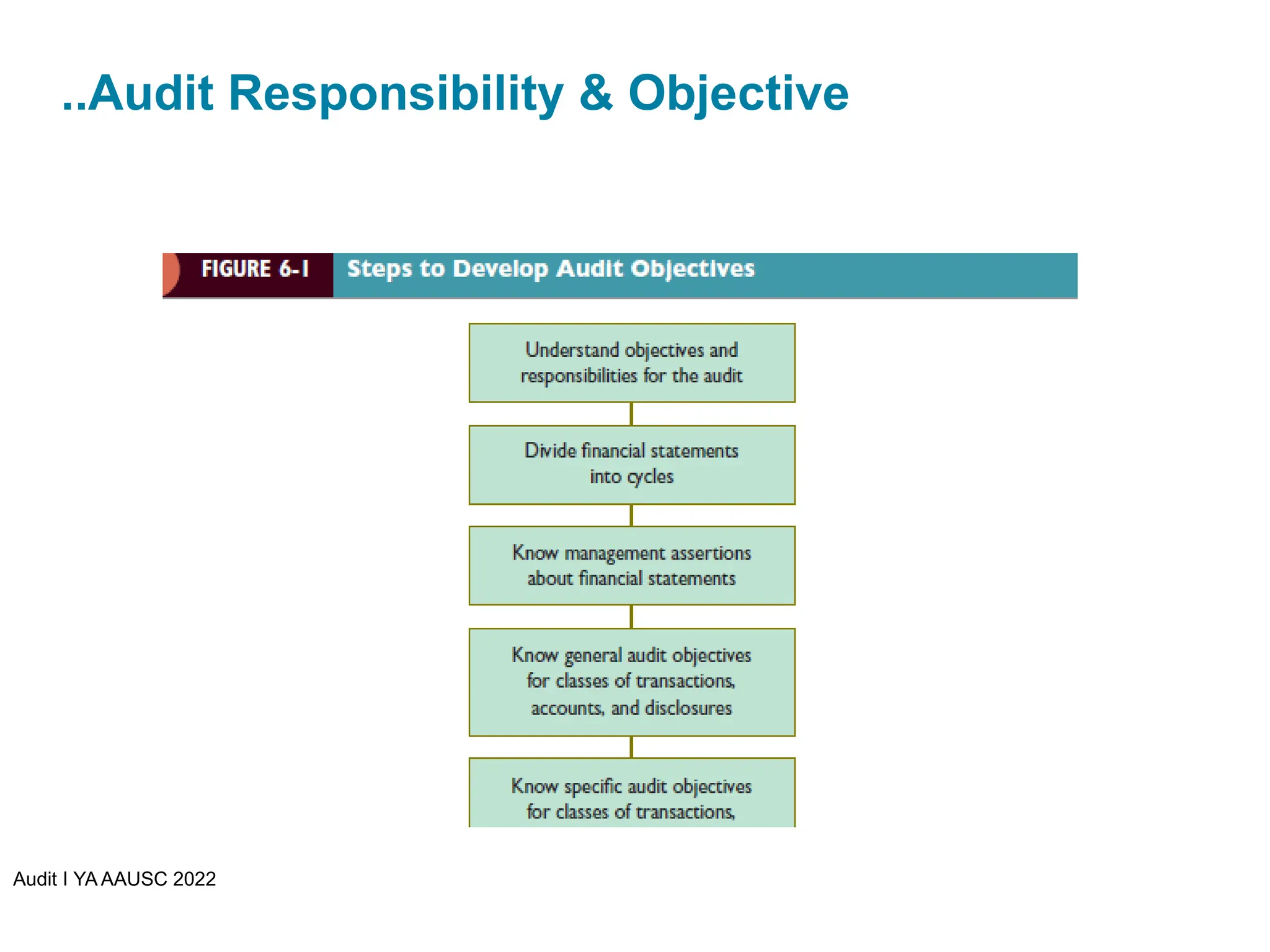
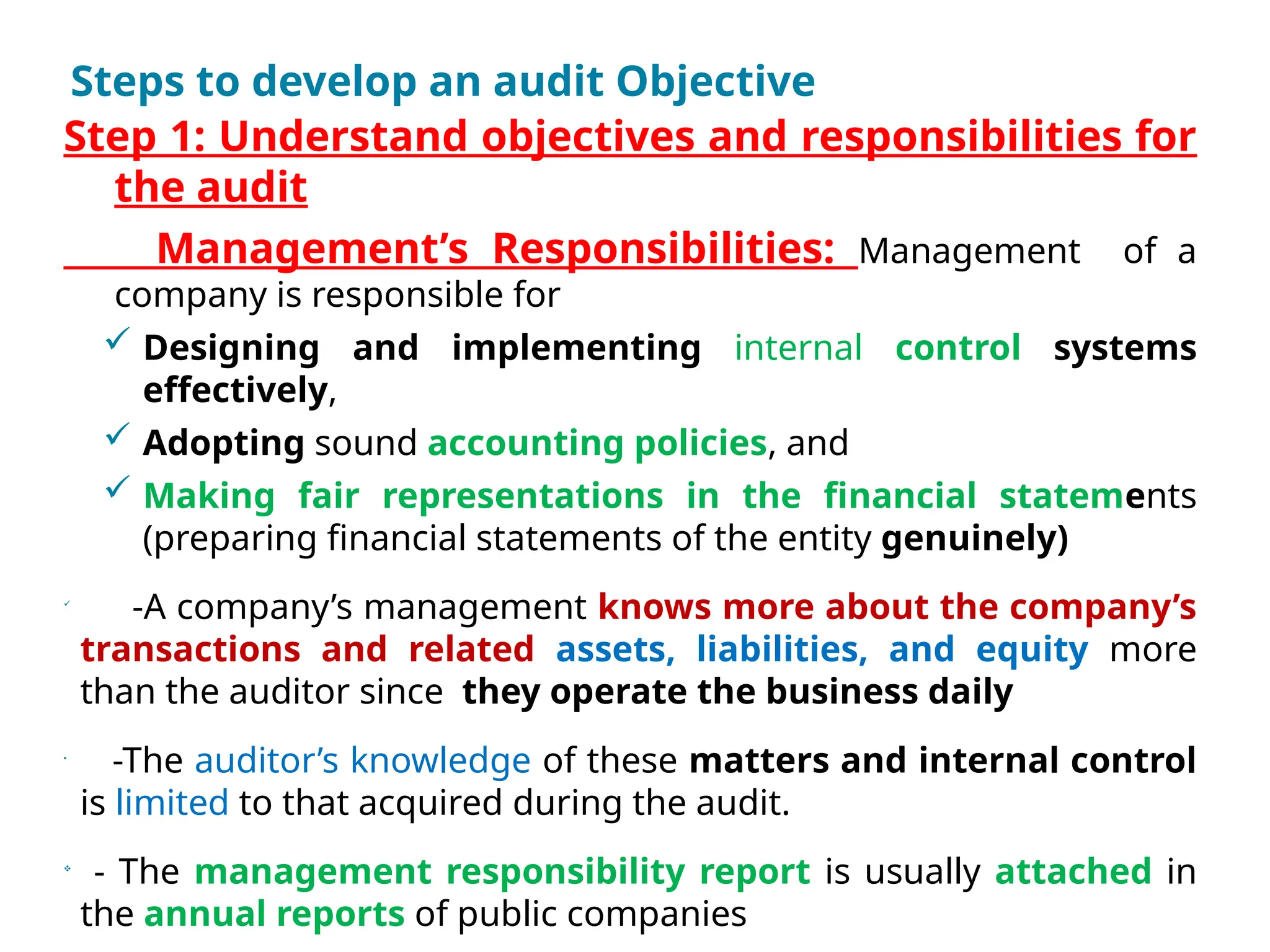
Steps to developan audit Objective
Step 1: Understand objectives and responsibilities for
the audit
Management’s Responsibilities: Management of a
company is responsible for
Designing and implementing internal control systems
effectively,
Adopting sound accounting policies, and
Making fair representations in the financial statements
(preparing financial statements of the entity genuinely)
-A company’s management knows more about the company’s
transactions and related assets, liabilities, and equity more
than the auditor since they operate the business daily
•
-The auditor’s knowledge of these matters and internal control
is limited to that acquired during the audit.
- The management responsibility report is usually attached in
the annual reports of public companies
6.
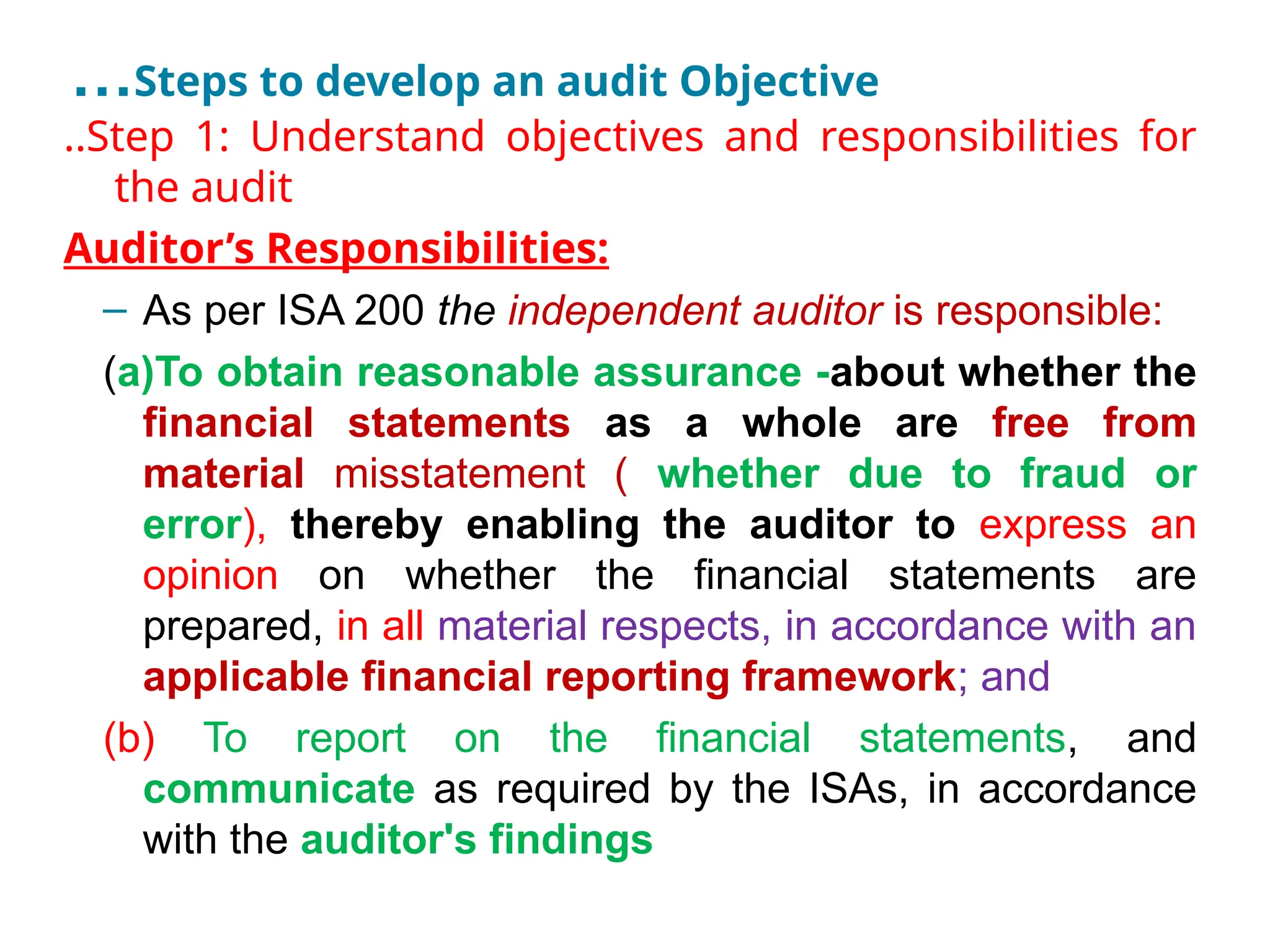
…Steps to developan audit Objective
..Step 1: Understand objectives and responsibilities for
the audit
Auditor’s Responsibilities:
– As per ISA 200 the independent auditor is responsible:
(a)To obtain reasonable assurance -about whether the
financial statements as a whole are free from
material misstatement ( whether due to fraud or
error), thereby enabling the auditor to express an
opinion on whether the financial statements are
prepared, in all material respects, in accordance with an
applicable financial reporting framework; and
(b) To report on the financial statements, and
communicate as required by the ISAs, in accordance
with the auditor's findings
7.
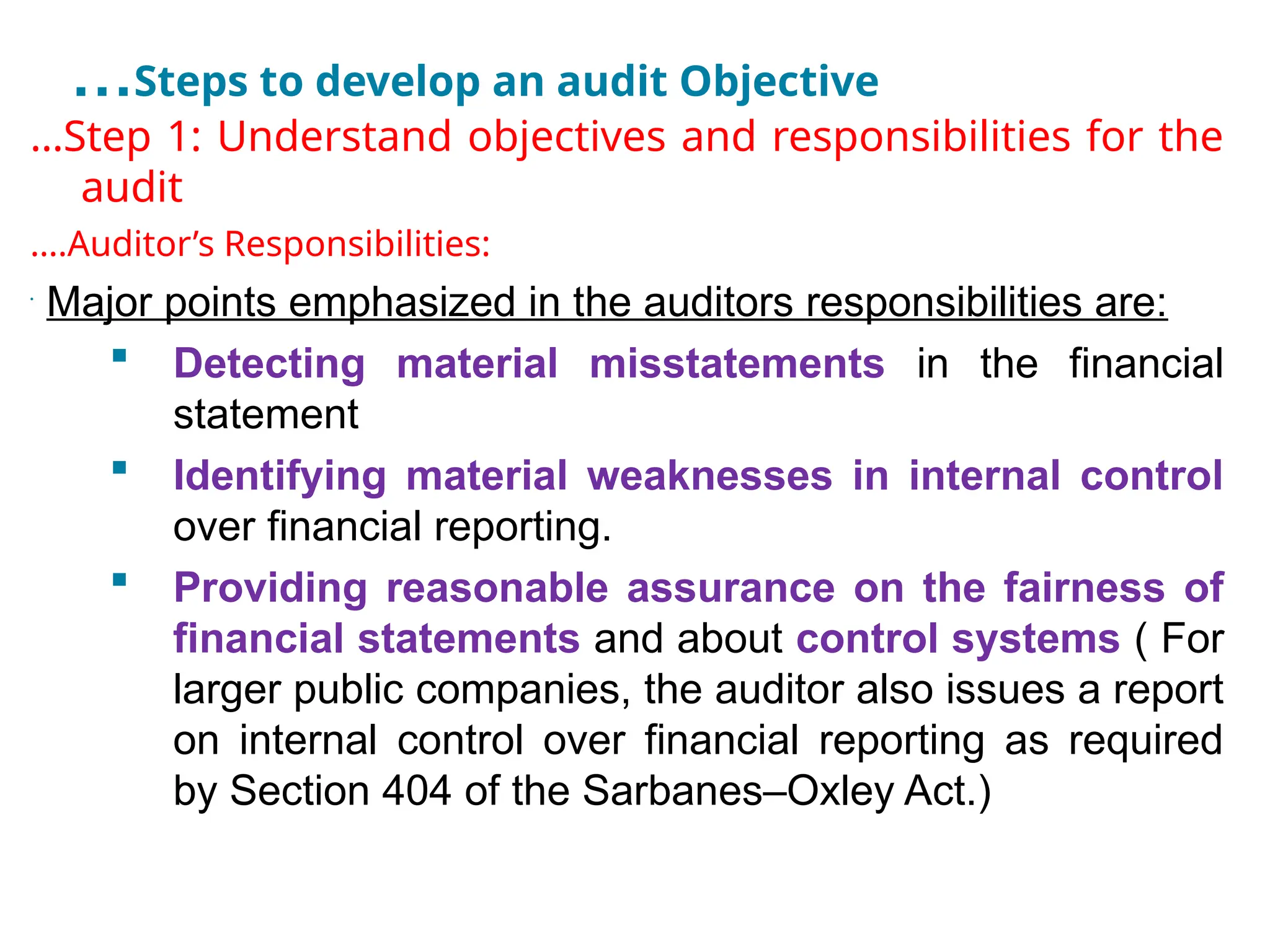
…Steps to developan audit Objective
…Step 1: Understand objectives and responsibilities for the
audit
….Auditor’s Responsibilities:
•
Major points emphasized in the auditors responsibilities are:
Detecting material misstatements in the financial
statement
Identifying material weaknesses in internal control
over financial reporting.
Providing reasonable assurance on the fairness of
financial statements and about control systems ( For
larger public companies, the auditor also issues a report
on internal control over financial reporting as required
by Section 404 of the Sarbanes–Oxley Act.)
8.
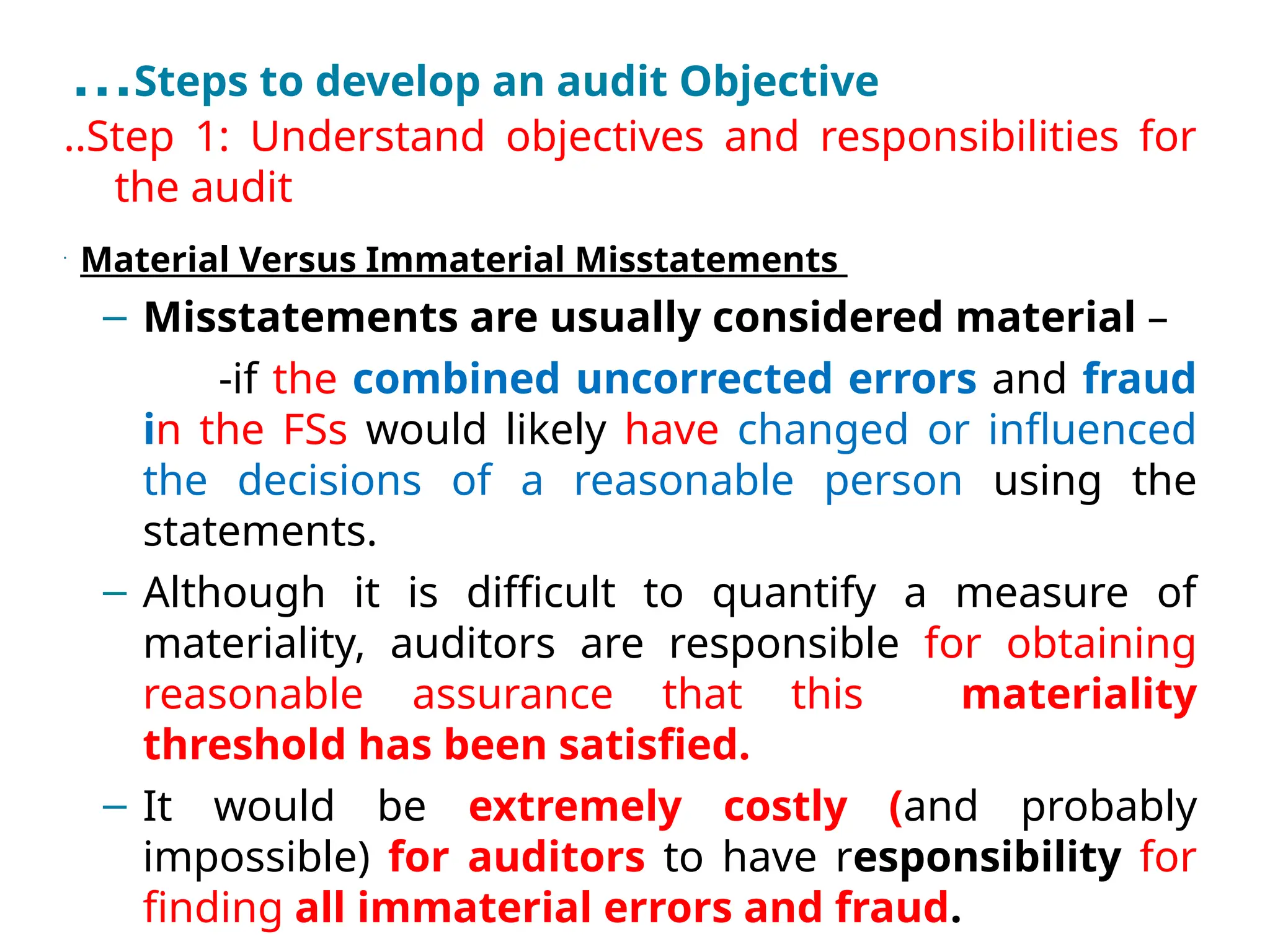
…Steps to developan audit Objective
..Step 1: Understand objectives and responsibilities for
the audit
•
Material Versus Immaterial Misstatements
– Misstatements are usually considered material –
-if the combined uncorrected errors and fraud
in the FSs would likely have changed or influenced
the decisions of a reasonable person using the
statements.
– Although it is difficult to quantify a measure of
materiality, auditors are responsible for obtaining
reasonable assurance that this materiality
threshold has been satisfied.
– It would be extremely costly (and probably
impossible) for auditors to have responsibility for
finding all immaterial errors and fraud.
9.
…Steps to developan audit Objective
..Step 1: Understand objectives and responsibilities for the audit
•
Reasonable Assurance
– Assurance - is a measure of the level of certainty
that the auditor has obtained at the completion of
the audit.
Auditing standards indicate reasonable assurance-
is a high level of assurance, but not absolute level
of assurance that indicates financial statements are
free of material misstatements.
The concept of reasonable, but not absolute,
assurance indicates that the auditor is not an
insurer or guarantor of the correctness of the FSs.
– Thus, an audit that is conducted in accordance with
auditing standards may fail to detect a material
misstatement.
10.
…Steps to developan audit Objective
..Step 1: Understand objectives and responsibilities for the audit
….Auditor’s Responsibilities:
•
Why the auditor is responsible for reasonable but
not absolute assurance?
1. Audits are usually conducted on test basis
(sampling)
Sampling inevitably includes some risk
of not detecting a material
misstatement.
Auditors may also make mistake in
making judgments about the area to be
tested, the type, extent, and timing of
the tests and also evaluation of the
evidences.
11.
…Steps to developan audit Objective
..Step 1: Understand objectives and responsibilities for the audit
2. In accounting complex estimates are used, which
inherently involve uncertainty and can be affected by
future events.
Because of the uncertainties involved in the estimates,
an audit can not give absolute assurance
3. Fraudulently prepared financial statements are
often extremely difficult, if not impossible, for the
auditor to detect, especially when there is collusion
among management.
.
12.
Audit I YAAAUSC 2022
To conclude:
It is evident that looking at each and every
document is costly and will not be
economical;
So the auditor’s best defense, when material
misstatements are not uncovered- is to have
conducted the audit in accordance with
auditing standards
13.
…Steps to developan audit Objective
..Step 1: Understand objectives and responsibilities for the
audit
Errors Versus Fraud
- Auditing standards distinguish between two types of
misstatements:
a. errors and
b. fraud.
-Either type of misstatement can be material or
immaterial.
-An error is an unintentional misstatement of the
financial statements,
-whereas fraud is intentional .
14.
Audit I YAAAUSC 2022
Fraud has been classified in to two:
1.Misappropriation(taking) of assets,- often called
defalca`tion ( employee fraud)
- eg. a clerk taking cash at the time a sale is made and
not entering the sale in the cash register
2. Fraudulent financial reporting,- often called
management fraud.
-eg. intentional overstatement of sales near the
balance sheet date to increase reported earnings.
15.
…Steps to developan audit Objective
..Step 1: Understand objectives and responsibilities for the audit
. Auditor’s Responsibilities for Detecting Material
Errors
•
-Auditors spend a great portion of their time in
planning and performing audits to detect errors in
financial statements.
-Auditors find a variety of errors resulting from such
things as :
mistakes in calculations,
omissions,
misunderstanding and misapplication of
accounting standards, and
incorrect summarizations and descriptions.
16.
…Steps to developan audit Objective
..Step 1: Understand objectives and responsibilities for the audit
Auditor’s Responsibilities for Detecting Material Frauds
Auditing standards make no distinction between
the auditor’s responsibilities for searching for
errors and fraud.
In either case, the auditor must obtain
reasonable assurance about whether the
statements are free of material misstatements.
The standards also recognize that fraud is often
more difficult to detect because management
or the employees perpetrating/commit the
fraud attempt to conceal the fraud.
17.
Audit I YAAAUSC 2022
Still, the difficulty of detection does not
change the auditor’s responsibility to
properly plan and perform the audit to
detect material misstatements, whether
caused by error or fraud, so proper planning
is essential
18.
…Steps to developan audit Objective
..Step 1: Understand objectives and responsibilities for the audit
Fraud Resulting from Fraudulent Financial
Reporting
Versus
Misappropriation of Assets
Both fraudulent financial reporting and
misappropriation of assets are potentially
harmful to FS users, but there is an important
difference between them.
Fraudulent financial reporting -harms users by
providing them incorrect FS information for
their decision making.
When assets are misappropriated, -
stockholders, creditors, and others are harmed
because assets are no longer available to their
19.
…Steps to developan audit Objective
..Step 1: Understand objectives and responsibilities for the audit
….Auditor’s Responsibilities:
•
Auditor’s responsibility to Consider non-compliance of
Laws and regulations/ illegal acts (ISA 250)- :
– In obtaining reasonable assurance -that the
financial statements are free of material
misstatement, the auditor takes into account
applicable legal and regulatory frameworks
relevant to the -client.
-For example, when auditing the FSs of a
bank, the auditor would need to consider
requirements of banking regulators such
as reserve requirement and others.
20.
The auditor’sresponsibilities regarding
noncompliance with laws and regulations
(called-illegal acts) depend on whether the
laws or regulations are expected to have a
direct effect on the amounts and
disclosures in the financial statements.
illegal acts: are violations of laws or
government regulations other than fraud.
-Examples of illegal acts include:
-violation of tax laws
-violation of the environmental
protection laws.
Audit I YA AAUSC 2022
21.
…Steps to developan audit Objective
..Step 1: Understand objectives and responsibilities for the audit
Direct-Effect of Illegal Acts:
Certain violations of laws and regulations have
a direct financial effect on specific account
balances in the FS.
Eg. a violation of tax laws directly affects income
tax expense and income taxes payable.
The auditor’s responsibility for direct-effect
illegal acts is the same as for errors and
fraud.
On each audit, the auditor should evaluate
whether or not there is evidence indicating
material violations of tax laws.
22.
Audit I YAAAUSC 2022
Discussions with client personnel and
examining reports issued by auditors from
Internal Revenue Service (after the completion
of an examination of the client’s tax return) are
helpful for the auditor to see if there is material
violation of tax laws
23.
…Steps to developan audit Objective
..Step 1: Understand objectives and responsibilities for the audit
•
Indirect-Effect illegal Acts:
•
-These are illegal acts that affect the financial
statements only indirectly.
EX. if a company violates environmental protection
laws, financial statements are affected only if there is a
fine or sanction.
- Potential material fines and sanctions indirectly
affect FSs by creating the need to disclose a contingent
liability for the potential amount that might ultimately be
paid.
- This is called an indirect-effect illegal act.
- Civil rights laws and employee safety requirements can
24.
…Steps to developan audit Objective
..Step 1: Understand objectives and responsibilities for the audit
… Auditor’s responsibility to Consider Laws and regulations
ISA 250 - state that the auditor provides no
assurance that indirect-effect illegal acts will
be detected, due to the following reasons:
1. Auditors lack legal expertise,
2. The frequent indirect relationship
between illegal acts and the financial
statements
•
So it is it impractical for auditors to assume
responsibility for discovering indirect-effect
illegal acts.
25.
…Steps to developan audit Objective
..Step 1: Understand objectives and responsibilities for the audit
•
- When the auditor believes that an illegal act may have
occurred,
•
-several actions are necessary to determine whether
the suspected illegal act actually exists:
1. The auditor should first inquire of management
at a level above those likely to be involved in the
potential illegal act.
2. The auditor should consult with the client’s legal
counsel or other specialist who is knowledgeable
about the potential illegal act.
3. The auditor should consider accumulating
additional evidence to determine whether there actually
26.
…Steps to developan audit Objective
..Step 1: Understand objectives and responsibilities for the audit
Actions When the Auditor Knows of an illegal Act
1. The first action is to consider the effects on
the FSs, including the adequacy of
disclosures. Effects may be complex and
difficult to resolve
eg. effect of violation of civil rights laws could be
significant fines, loss of customers or key
employees, which could materially affect future
revenues and expenses.
or
-If the auditor concludes that the disclosures relative
to an illegal act are inadequate, the auditor should
modify the audit report accordingly.
27.
Audit I YAAAUSC 2022
In deciding whether to modify/not to modify the
report, the auditor should analyze the implication of
the illegal act on important issues like –
- the audit firm’s relationship with management, i.e
- if management knew of the illegal act and failed to
inform the auditor, it is questionable whether
management can be believed in other discussions.
28.
…Steps to developan audit Objective
2. The auditor should communicate (oral or written) with the
audit committee or others of equivalent authority to make
sure that they know of the illegal act.
- If it is oral, the nature of the communication and discussion
should be documented in the audit files.
-If the client either refuses to accept the auditor’s modified report
or fails to take appropriate remedial action concerning the illegal
act, the auditor may find it necessary to withdraw from the
engagement.
- If the client is publicly held, the auditor must also report the
matter directly to the SEC.
- Such decisions are complex and normally involve consultation by
the auditor with the auditor’s legal counsel
29.
…Steps to developan audit Objective
…..Auditor’s Responsibilities:
Professional skepticism
Auditor’s responsibility includes performing an audit with an
attitude of professional skepticism
Assignment 2-on professional judgment and skepticism
–Submission date: end of discussion on Ch 4
1. Explain the concept of professional skepticism and identify its
two elements
2. Describe the key elements of an effective professional judgment
process.
3. List and describe the six elements of professional skepticism?
4. What are the five elements of an effective professional judgment
process?
5. Describe two of the more common judgment traps and biases.
30.
…Steps to developan audit Objective
•
Step 2: Divide Financial Statements in to Cycles
Audits - are performed by dividing the financial statements
into smaller segments or components.
– The division is needed:
To make the audit more manageable and
To facilitate the assignment of tasks to different
members of the audit team.
Eg: The audit of fixed assets and notes payable
– These two items may be audited in different segment
separately but not on a completely independent basis.
-(eg. the audit of fixed assets may reveal an unrecorded note
payable.)
– After the audit of each segment is completed, the results are
combined.
A conclusion can then be reached about the financial
statements taken as a whole.
31.
…Steps to developan audit Objective
•
…Step 2: Divide Financial Statements in to Cycles
•
There are different ways of segmenting an audit.
1. To treat every account balance on the statements
as a separate segment.
Segmenting in this way is usually inefficient.
It would result in the independent audit of such
closely related accounts -as inventory and cost
of goods sold.
2. To use Cycle Approach to Segment an Audit
It is a common way to divide an audit
It involves keeping closely related types (or
classes) of transactions and account balances
in the same segment
32.
…Steps to developan audit Objective
•
…Step 2: Divide Financial Statements in to Cycles
The cycle approach combines transactions recorded in
different journals with the general ledger balances that
result from those transactions
The cycle approach divides financial statement items in
to five cycles
•
1. Sales and collection cycle (S)
•
2. Acquisition and payment cycle (A)
•
3. Payroll and personnel cycle (P)
•
4. Inventory and warehousing cycle (I)
•
5. Capital acquisition and repayment cycle (C)
•
1. Sales and collection cycle (S)
-The sales and collection cycle is the first cycle listed and is a
primary focus on most audits.
- Collections on trade accounts receivable in the cash receipts
journal is the primary operating inflow to cash in the bank.
33.
33
…Steps to developan audit Objective
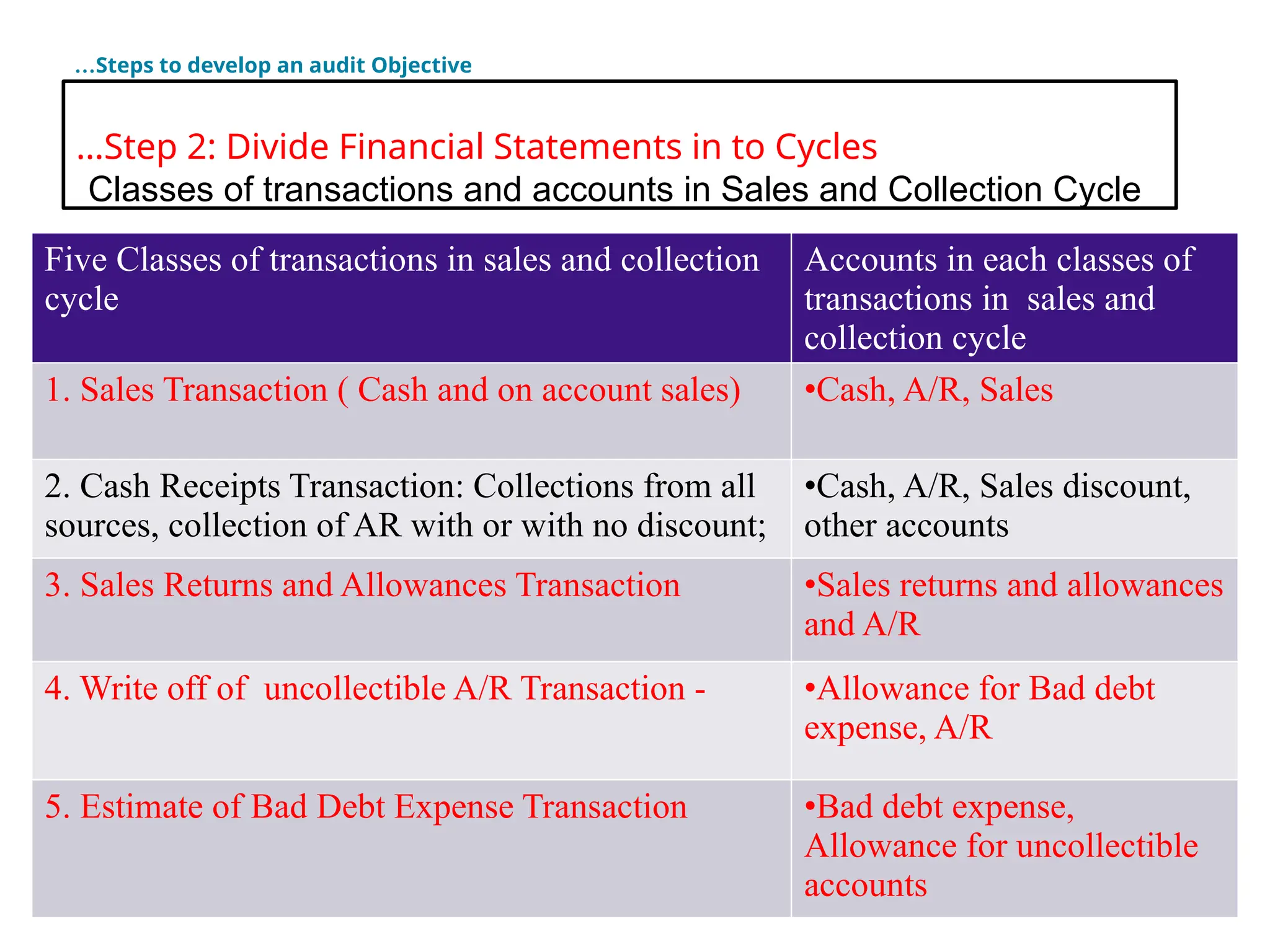
Five Classes of transactions in sales and collection
cycle
Accounts in each classes of
transactions in sales and
collection cycle
1. Sales Transaction ( Cash and on account sales) •Cash, A/R, Sales
2. Cash Receipts Transaction: Collections from all
sources, collection of AR with or with no discount;
•Cash, A/R, Sales discount,
other accounts
3. Sales Returns and Allowances Transaction •Sales returns and allowances
and A/R
4. Write off of uncollectible A/R Transaction - •Allowance for Bad debt
expense, A/R
5. Estimate of Bad Debt Expense Transaction •Bad debt expense,
Allowance for uncollectible
accounts
…Step 2: Divide Financial Statements in to Cycles
Classes of transactions and accounts in Sales and Collection Cycle
34.
…Steps to developan audit Objective
•
…Step 2: Divide Financial Statements in to Cycles
•
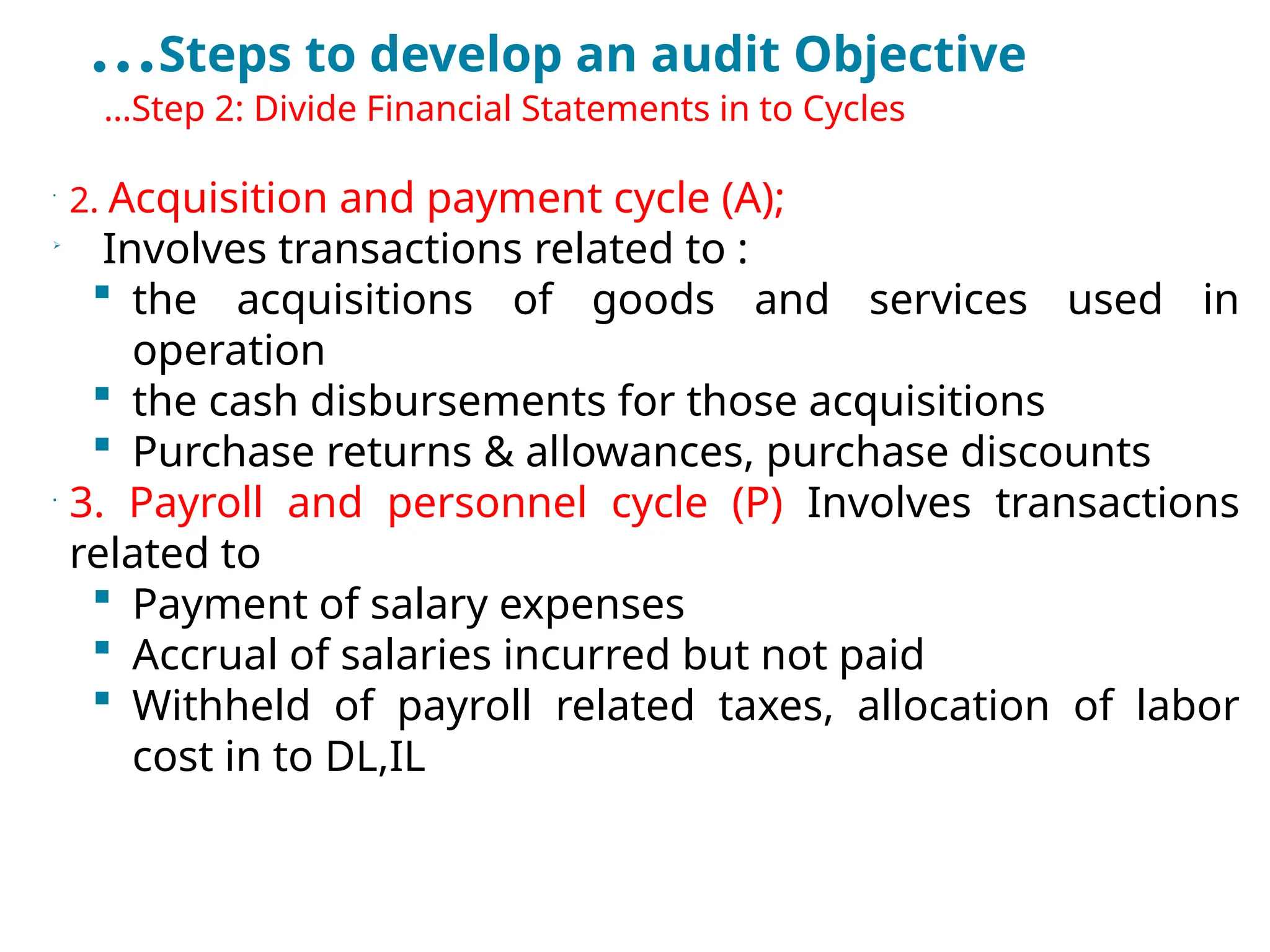
2. Acquisition and payment cycle (A);
Involves transactions related to :
the acquisitions of goods and services used in
operation
the cash disbursements for those acquisitions
Purchase returns & allowances, purchase discounts
•
3. Payroll and personnel cycle (P) Involves transactions
related to
Payment of salary expenses
Accrual of salaries incurred but not paid
Withheld of payroll related taxes, allocation of labor
cost in to DL,IL
35.
Audit I YAAAUSC 2022
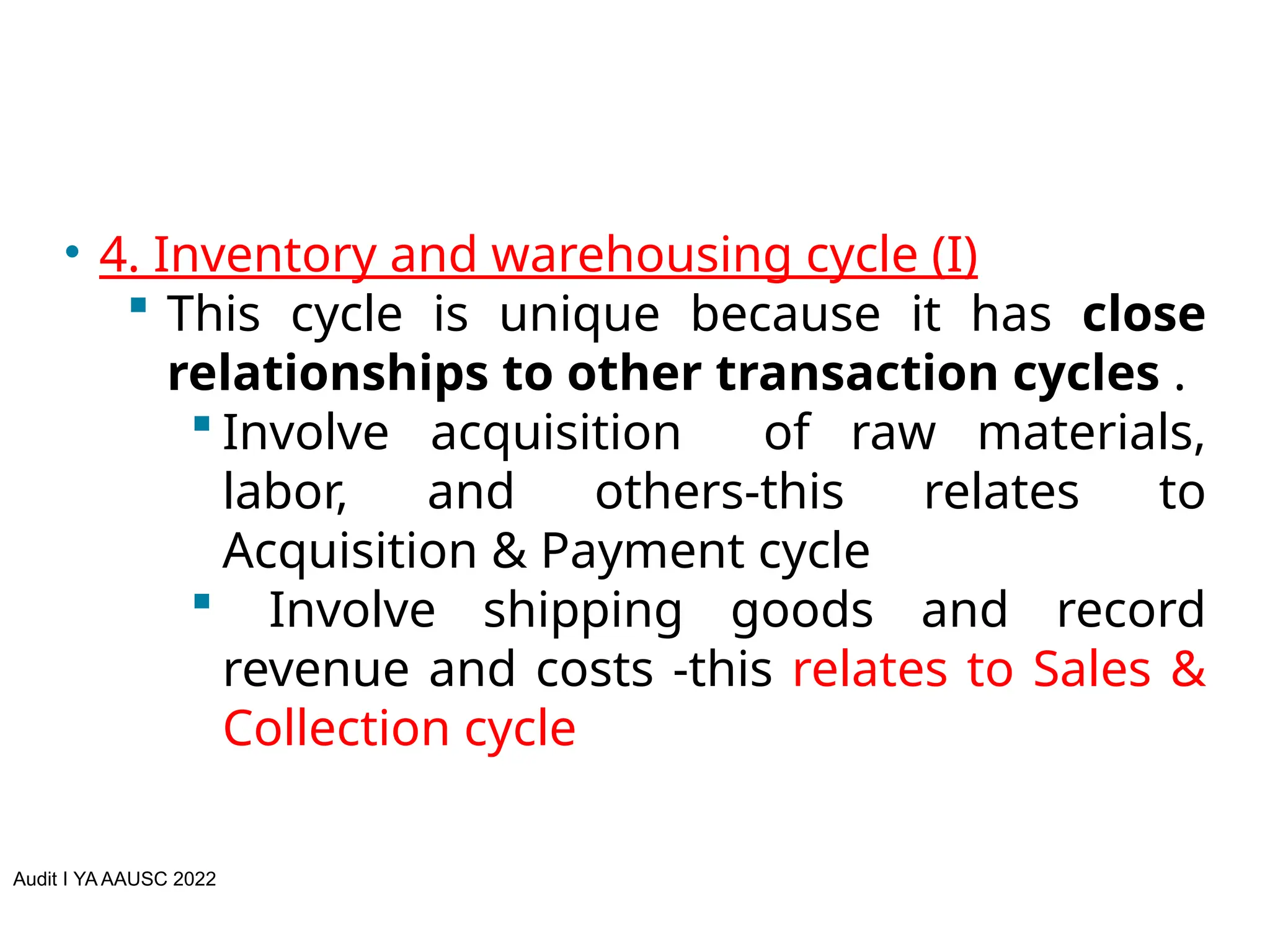
• 4. Inventory and warehousing cycle (I)
This cycle is unique because it has close
relationships to other transaction cycles .
Involve acquisition of raw materials,
labor, and others-this relates to
Acquisition & Payment cycle
Involve shipping goods and record
revenue and costs -this relates to Sales &
Collection cycle
36.
…Steps to developan audit Objective
•
..Step 2: Divide Financial Statements in to Cycles
•
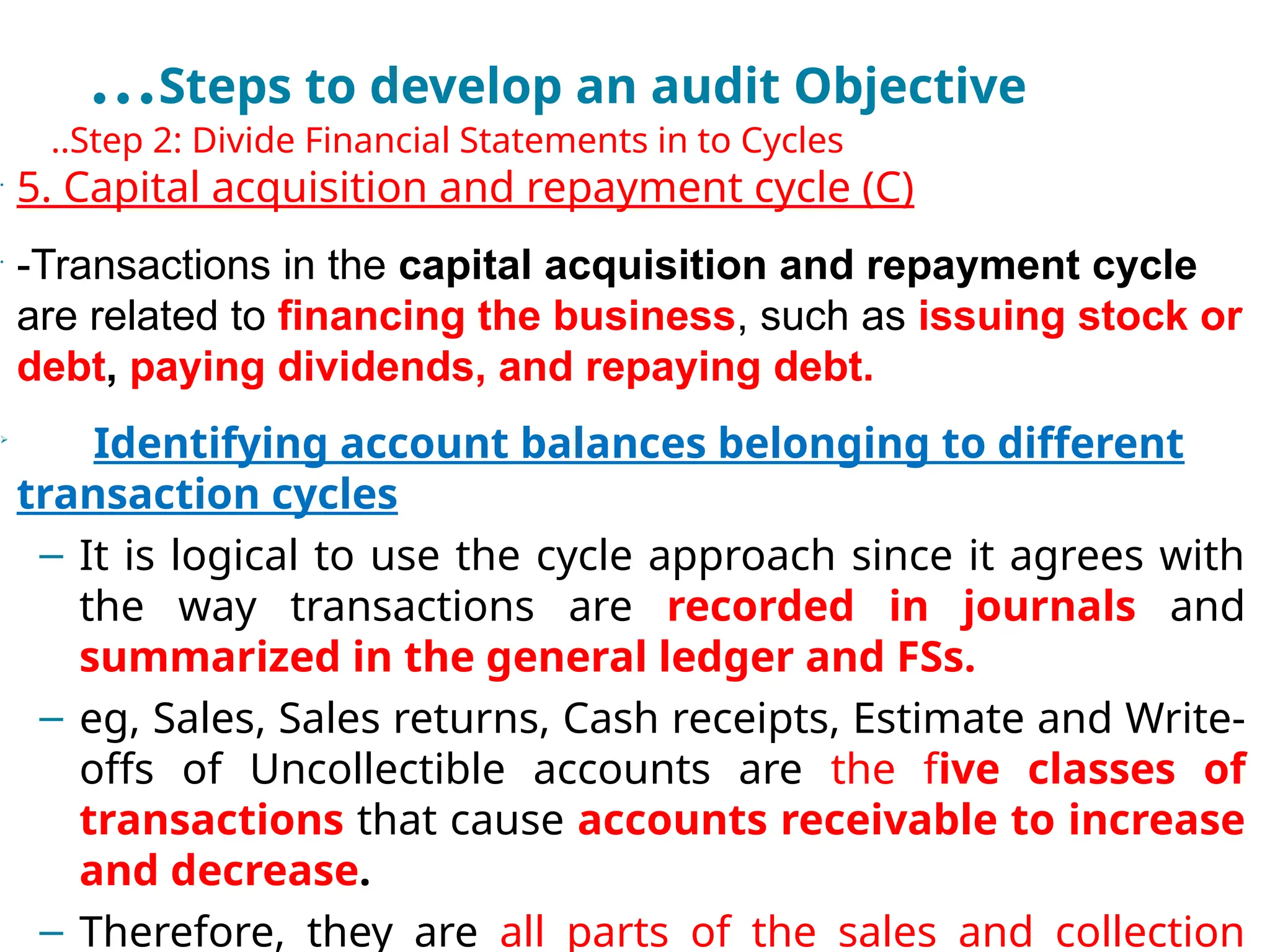
5. Capital acquisition and repayment cycle (C)
•
-Transactions in the capital acquisition and repayment cycle
are related to financing the business, such as issuing stock or
debt, paying dividends, and repaying debt.
Identifying account balances belonging to different
transaction cycles
– It is logical to use the cycle approach since it agrees with
the way transactions are recorded in journals and
summarized in the general ledger and FSs.
– eg, Sales, Sales returns, Cash receipts, Estimate and Write-
offs of Uncollectible accounts are the five classes of
transactions that cause accounts receivable to increase
and decrease.
– Therefore, they are all parts of the sales and collection
37.
…Steps to developan audit Objective
•
..Step 2: Divide Financial Statements in to Cycles
Identifying account balances belonging to different
transaction cycles
– Trial balance - is a primary focus of every audit as it is
the starting point to prepare financial statements.
– The letter representing a cycle is shown for each account
in the left column beside the account name.
Note:
-Each account has at least one cycle associated with it, and
only cash and inventory are a part of two or more
cycles.
– Some journals and general ledger accounts are included in
more than one cycle; which shows the journal is used to
record transactions from more than one cycle and indicates a
tie-in between the cycles.
38.
Audit I YAAAUSC 2022
The most important general ledger account included in
and affecting several cycles is general cash (cash in
bank).
– General cash connects most cycles.
Although auditors need to consider the
interrelationships between cycles, they typically treat
cycles independently to the extent practical to manage
complex audits effectively.
39.
…Steps to developan audit Objective
•
..Step 2: Divide Financial Statements in to Cycles
•
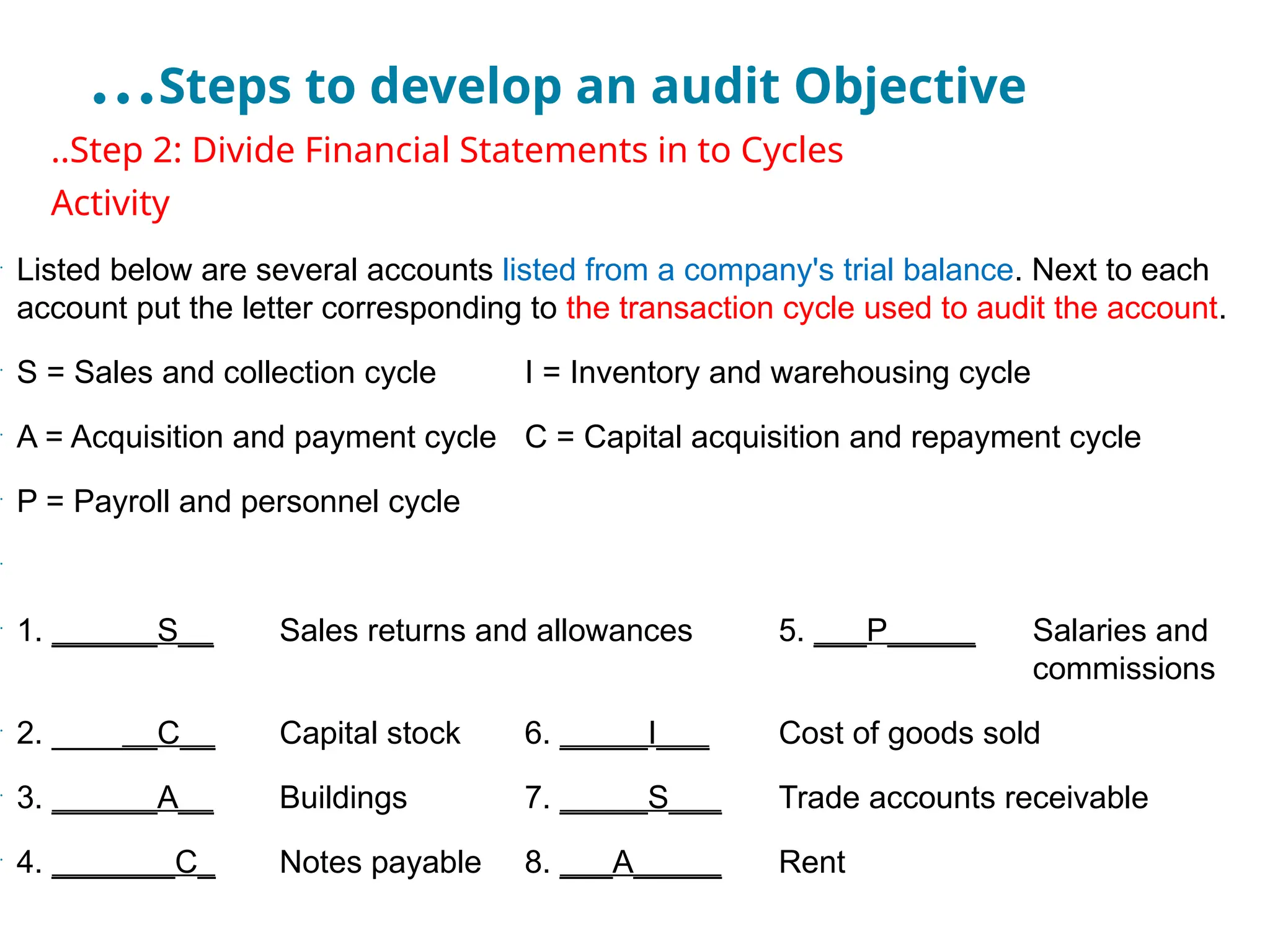
Activity
•
Listed below are several accounts listed from a company's trial balance. Next to each
account put the letter corresponding to the transaction cycle used to audit the account.
•
S = Sales and collection cycle I = Inventory and warehousing cycle
•
A = Acquisition and payment cycle C = Capital acquisition and repayment cycle
•
P = Payroll and personnel cycle
•
•
1. ______S__ Sales returns and allowances 5. ___P_____ Salaries and
commissions
•
2. ______C__ Capital stock 6. _____I___ Cost of goods sold
•
3. ______A__ Buildings 7. _____S___ Trade accounts receivable
•
4. _______C_ Notes payable 8. ___A_____ Rent
40.
Steps to developan audit Objective
•
Step 3: Setting Audit Objectives
Since the objective of an audit is to express opinion
that financial statements are fairly stated, they
develop audit objectives that test each management
assertions
•
Management assertions
– Management is responsible for the preparation of
financial statements that give a true and fair view.
– Assertions are implied or expressed representations
made by the client’s management about classes of
transactions, account balances and disclosures in the
financial statements
– Assertions are tested by the auditor to check the
different types of potential misstatements that may
occur
41.
Audit I YAAAUSC 2022
– Financial statements represent -management's
assertions
– Management assertions are directly related to the
financial reporting framework used by the company
(usually U.S. GAAP or IFRS)
Why Assertions matter for the Auditor?
– The auditor’s responsibility is to determine whether
management assertions - about financial statements
are justified.
42.
…Steps to developan audit Objective
•
….Step 3: Setting Audit Objectives
= In order to provide opinion on financial
statements, it is necessary to test transactions, balances
and disclosures.
•
-Management assertions are classified in to three
categories:
1. Transaction –related assertions- Assertions about
transactions and events
2. Balance –related assertions- Assertions about
account balances
3. Disclosure –related assertions- Assertions about
Disclosures
43.
…Steps to developan audit Objective
•
Step 3: Setting Audit Objectives
•
…..Management Assertions
•
Management assertion related to classes of transactions
•
.1. Occurrence. Transactions and events that have been
recorded have occurred and pertain to the entity.
•
2. Completeness. All transactions and events that should
have been recorded have been recorded.
•
3. Accuracy. Amounts and other data relating to recorded
transactions and events have been recorded
appropriately.
•
4. Classification. Transactions and events have been
recorded in the proper accounts.
•
5. Cutoff. Transactions and events have been recorded in
44.
…Steps to developan audit Objective
•
Step 3: Setting Audit Objectives
•
Management assertion related to balances
•
1. Existence. Are Assets, liabilities, and equity interests
exist.
•
2. Completeness. All assets, liabilities, and equity
interests that should have been recorded have been
recorded.
3. Valuation and allocation. Assets, liabilities, and equity
interests are included in the financial statements at
appropriate amounts and any resulting valuation
adjustments are appropriately recorded.
•
4. Rights and obligations. Does the entity holds or
controls the rights to assets, and liabilities are the
obligation of the entity.
45.
…Steps to developan audit Objective
•
Step 3: Setting Audit Objectives
•
Management assertion related to presentation &
disclosures
•
1. Occurrence and rights and obligations. Disclosed events
and transactions have occurred and pertain to the entity.
•
2. Completeness. All disclosures that should have been
included in the financial statements have been included.
•
4. Accuracy and valuation. Financial and other information
are disclosed appropriately and at appropriate amounts.
•
5. Classification and understandability. Financial and other
information is appropriately presented and described and
disclosures are clearly expressed.
46.
…Steps to developan audit Objective
•
-Auditors develop the following audit objectives to test
management assertions:
1. Transaction-Related Audit objective- reach a conclusion that
transactions are properly recorded
. General transaction-related audit objectives-apply to all classes of
transaction (Sales & Collection, Payment & acquisition….
• Specific transaction-related audit objectives - apply to all classes of
transaction but tailored to each class
2. Balance-Related Audit Objective- reach a conclusion that
balances are properly stated .
General balance-related audit objectives-apply to all account balances
Eg Testing Existence of A/R & Inventory
Specific transaction-related audit objectives - apply to all account balances
but tailored to each (Audit procedure to test existence of inventory is
different from audit procedure to test existence of A/R)
47.
…Steps to developan audit Objective
•
….Step 3: Setting Audit Objectives
•
The Six General Transaction Related Audit Objectives
•
1. Occurrence
•
2. Completeness
•
3. Accuracy
•
4. Posting and summarization
•
5. Classification
•
6. Timing
•
*These transaction related audit objectives - follow related
management assertion and help the auditor to accumulate
sufficient appropriate evidence about transactions
48.
…Steps to developan audit Objective
•
….Step 3: Setting Audit Objectives
•
The Six General Transaction Related Audit Objectives
•
1. Occurrence
– This objective deals with whether recorded transactions have
actually occurred
Eg Vouching recorded sales from the sales journal to the file
of bills of lading.
Vouching recorded expenses from the Cash payment journal
to the file of check payment.
– Eg. inclusion of payment for expenses in cash disbursement
journal when the event does not occur violates occurrence
objectives
– This objective corresponds with management assertion of
occurrence
49.
…Steps to developan audit Objective
•
..The Six General Transaction Related Audit Objectives
•
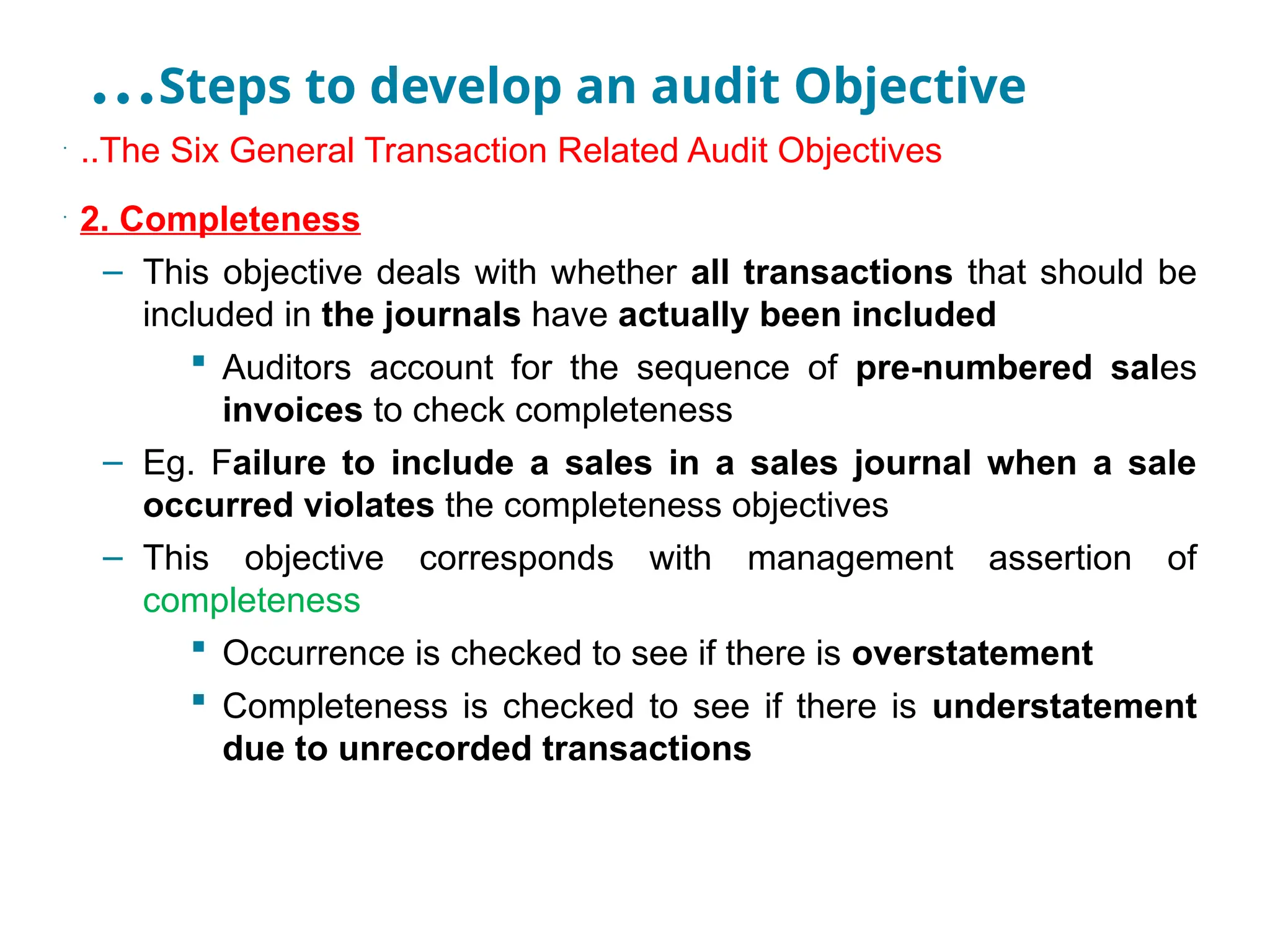
2. Completeness
– This objective deals with whether all transactions that should be
included in the journals have actually been included
Auditors account for the sequence of pre-numbered sales
invoices to check completeness
– Eg. Failure to include a sales in a sales journal when a sale
occurred violates the completeness objectives
– This objective corresponds with management assertion of
completeness
Occurrence is checked to see if there is overstatement
Completeness is checked to see if there is understatement
due to unrecorded transactions
50.
…Steps to developan audit Objective
•
…The Six General Transaction Related Audit Objectives
•
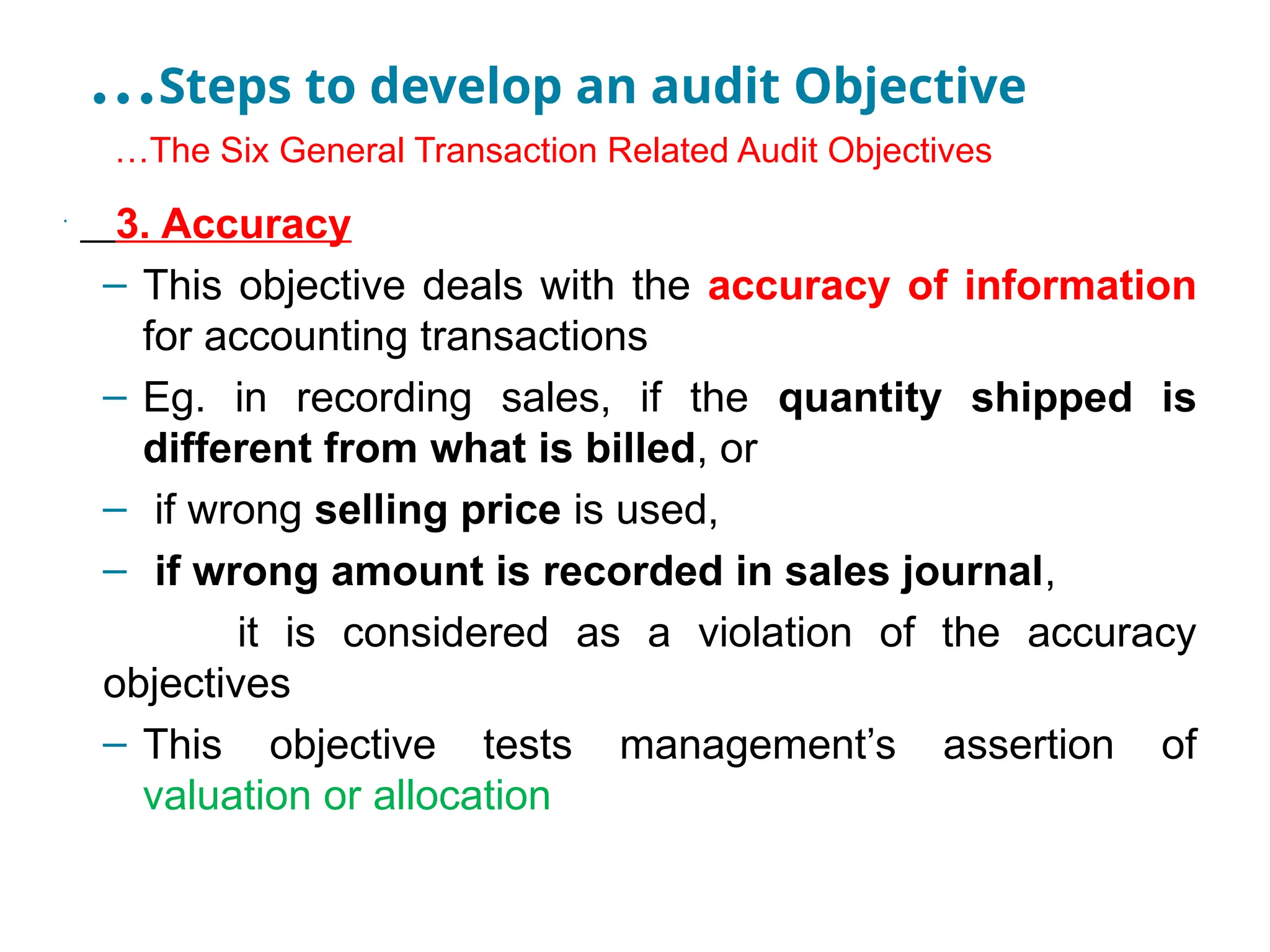
3. Accuracy
– This objective deals with the accuracy of information
for accounting transactions
– Eg. in recording sales, if the quantity shipped is
different from what is billed, or
– if wrong selling price is used,
– if wrong amount is recorded in sales journal,
it is considered as a violation of the accuracy
objectives
– This objective tests management’s assertion of
valuation or allocation
51.
…Steps to developan audit Objective
•
…The Six General Transaction Related Audit Objectives
•
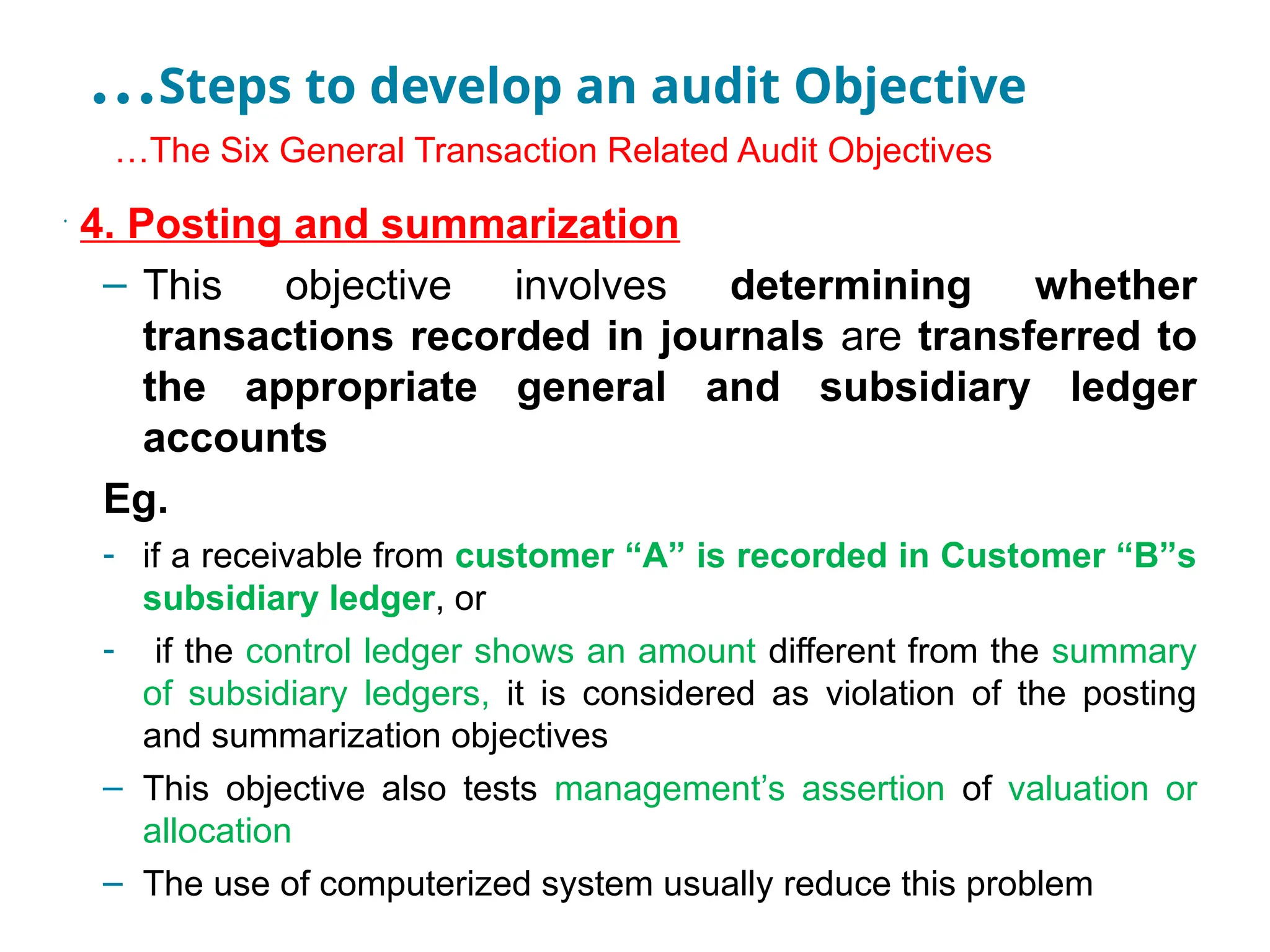
4. Posting and summarization
– This objective involves determining whether
transactions recorded in journals are transferred to
the appropriate general and subsidiary ledger
accounts
Eg.
- if a receivable from customer “A” is recorded in Customer “B”s
subsidiary ledger, or
- if the control ledger shows an amount different from the summary
of subsidiary ledgers, it is considered as violation of the posting
and summarization objectives
– This objective also tests management’s assertion of valuation or
allocation
– The use of computerized system usually reduce this problem
52.
…Steps to developan audit Objective
•
….Step 3: Setting Audit Objectives
•
..The Six General Transaction Related Audit Objectives
•
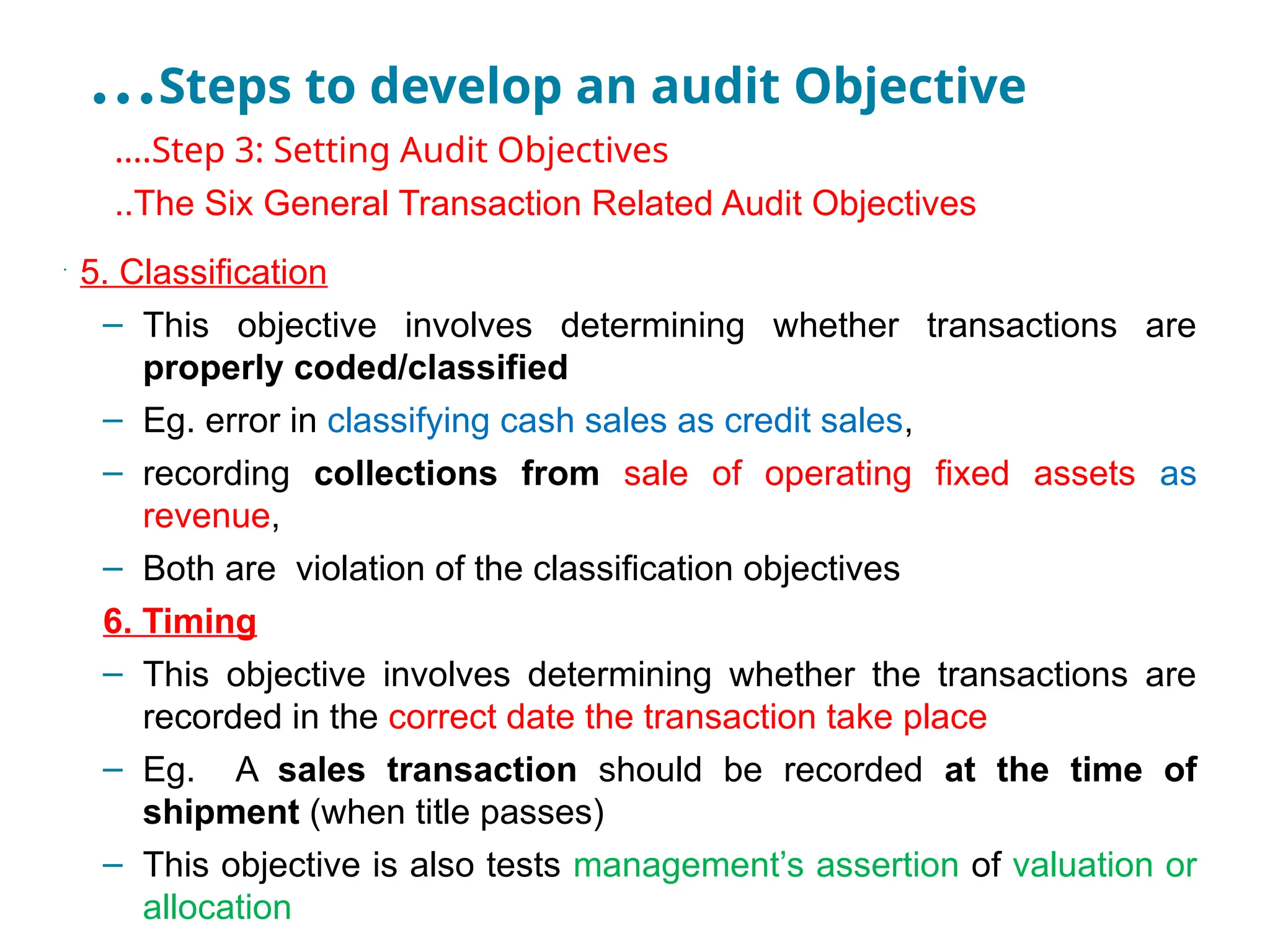
5. Classification
– This objective involves determining whether transactions are
properly coded/classified
– Eg. error in classifying cash sales as credit sales,
– recording collections from sale of operating fixed assets as
revenue,
– Both are violation of the classification objectives
6. Timing
– This objective involves determining whether the transactions are
recorded in the correct date the transaction take place
– Eg. A sales transaction should be recorded at the time of
shipment (when title passes)
– This objective is also tests management’s assertion of valuation or
allocation
53.
…Steps to developan audit Objective
•
….Step 3: Setting Audit Objectives
•
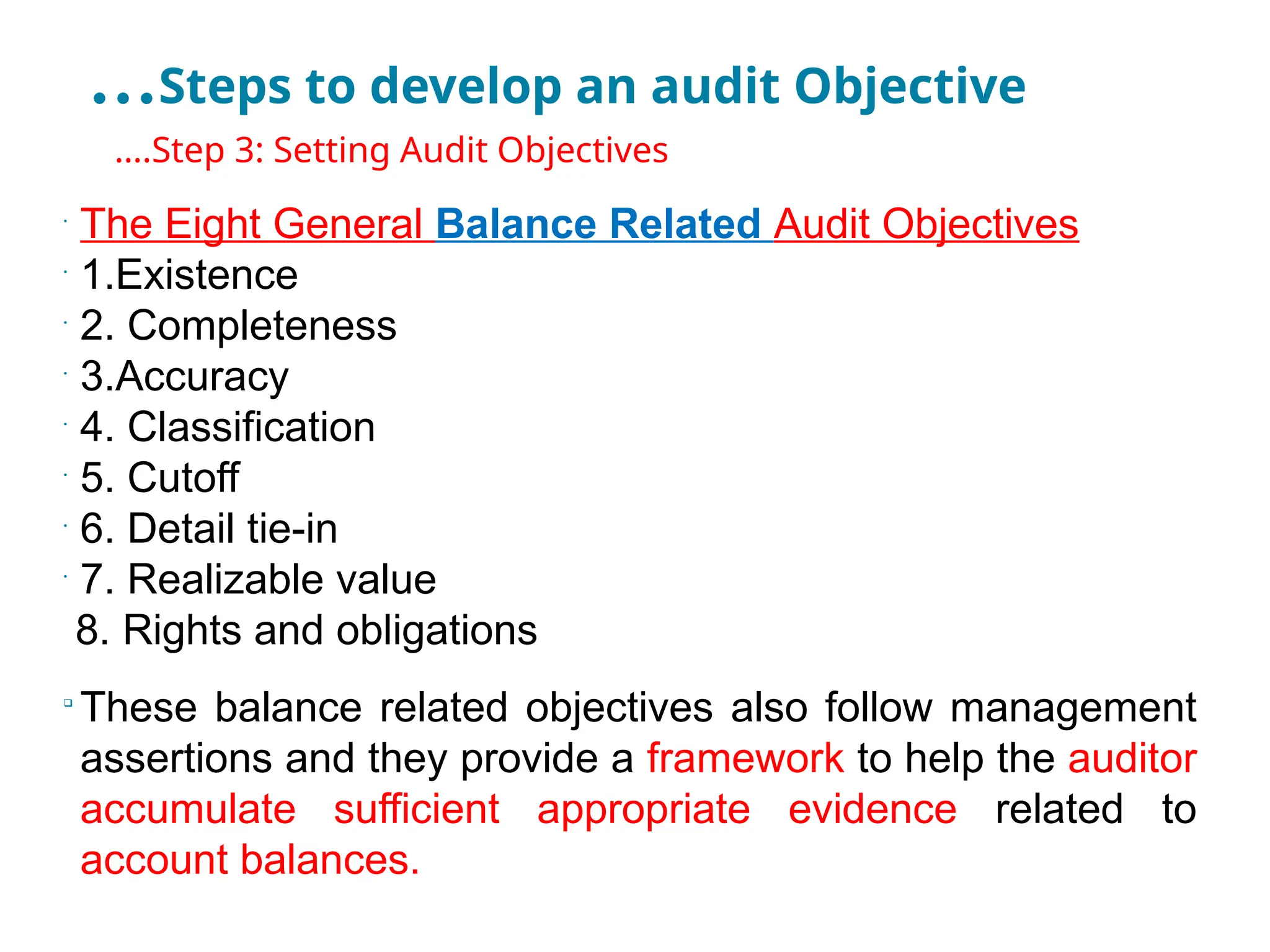
The Eight General Balance Related Audit Objectives
•
1.Existence
•
2. Completeness
•
3.Accuracy
•
4. Classification
•
5. Cutoff
•
6. Detail tie-in
•
7. Realizable value
8. Rights and obligations
These balance related objectives also follow management
assertions and they provide a framework to help the auditor
accumulate sufficient appropriate evidence related to
account balances.
54.
…Steps to developan audit Objective
•
….Step 3: Setting Audit Objectives
•
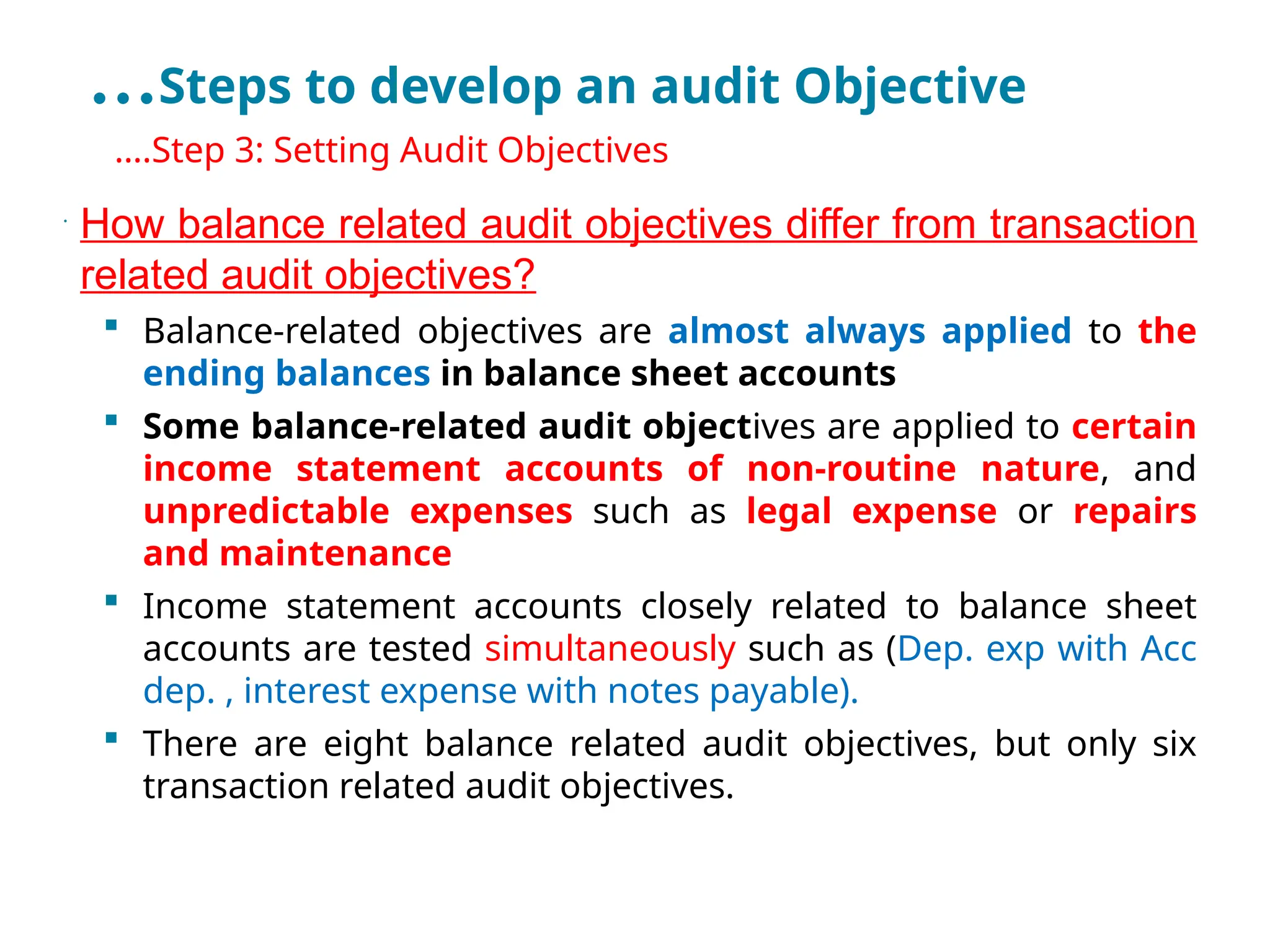
How balance related audit objectives differ from transaction
related audit objectives?
Balance-related objectives are almost always applied to the
ending balances in balance sheet accounts
Some balance-related audit objectives are applied to certain
income statement accounts of non-routine nature, and
unpredictable expenses such as legal expense or repairs
and maintenance
Income statement accounts closely related to balance sheet
accounts are tested simultaneously such as (Dep. exp with Acc
dep. , interest expense with notes payable).
There are eight balance related audit objectives, but only six
transaction related audit objectives.
55.
…Steps to developan audit Objective
•
….Step 3: Setting Audit Objectives
•
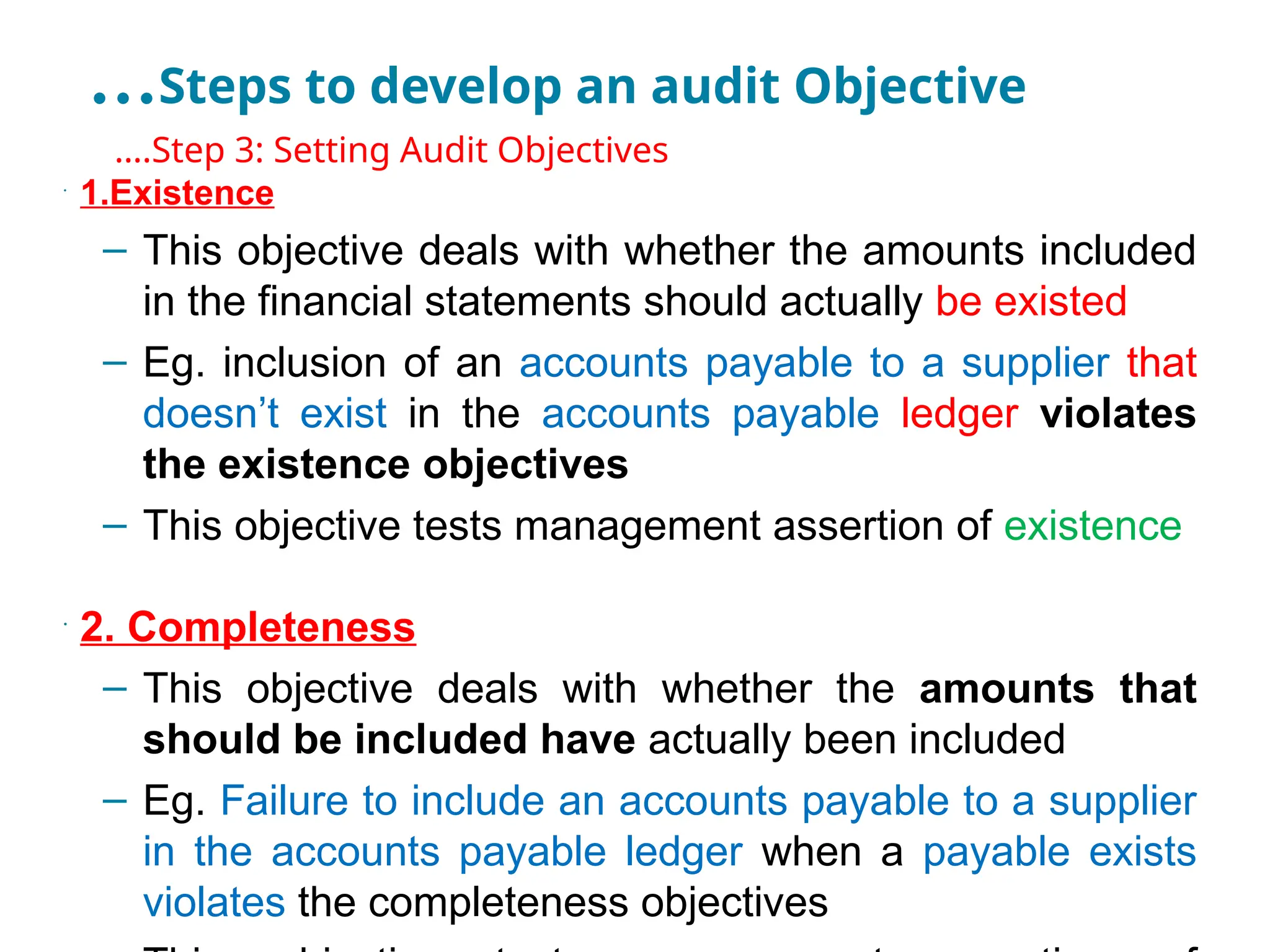
1.Existence
– This objective deals with whether the amounts included
in the financial statements should actually be existed
– Eg. inclusion of an accounts payable to a supplier that
doesn’t exist in the accounts payable ledger violates
the existence objectives
– This objective tests management assertion of existence
•
2. Completeness
– This objective deals with whether the amounts that
should be included have actually been included
– Eg. Failure to include an accounts payable to a supplier
in the accounts payable ledger when a payable exists
violates the completeness objectives
56.
…Steps to developan audit Objective
•
….Step 3: Setting Audit Objectives
•
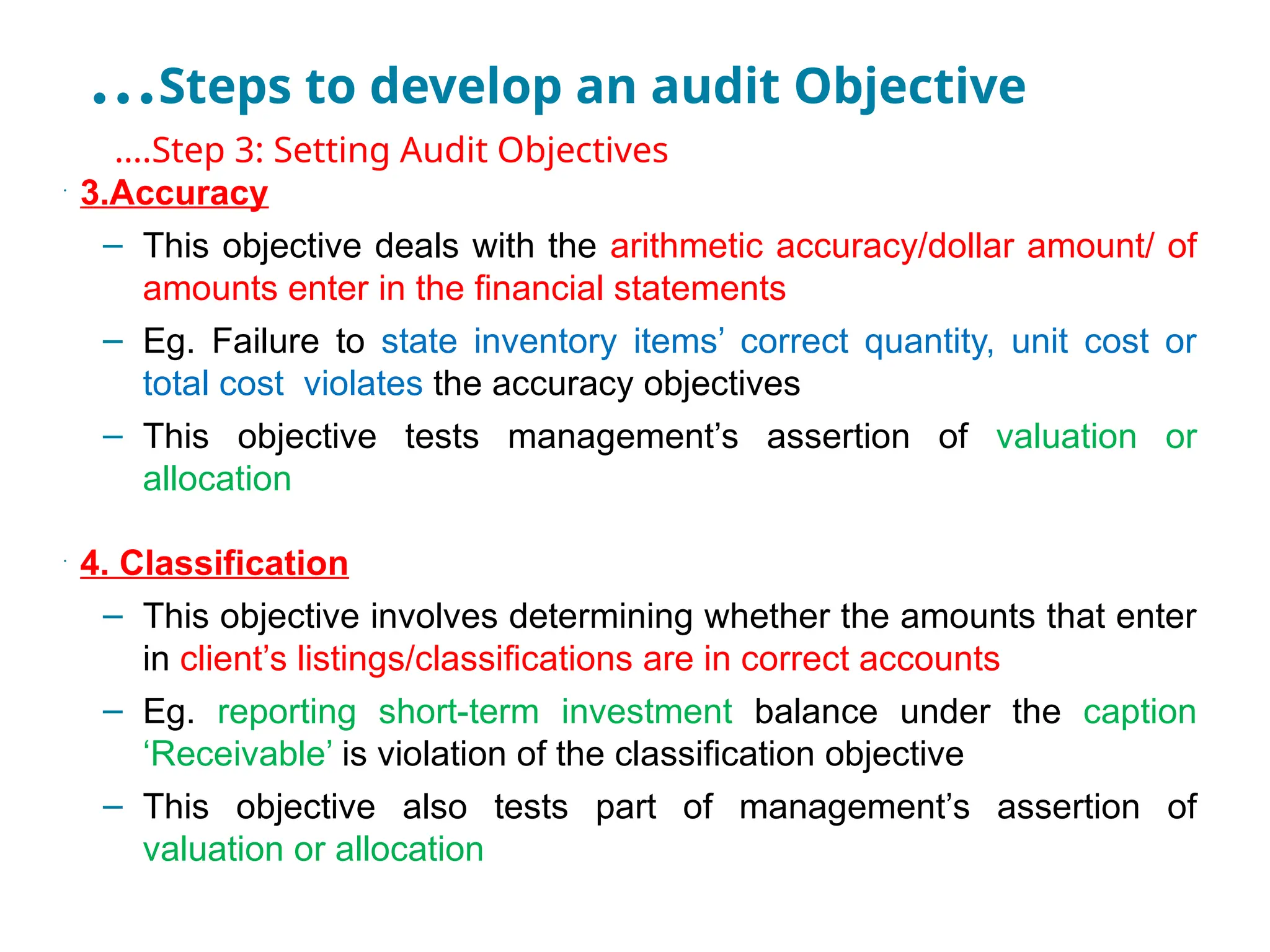
3.Accuracy
– This objective deals with the arithmetic accuracy/dollar amount/ of
amounts enter in the financial statements
– Eg. Failure to state inventory items’ correct quantity, unit cost or
total cost violates the accuracy objectives
– This objective tests management’s assertion of valuation or
allocation
•
4. Classification
– This objective involves determining whether the amounts that enter
in client’s listings/classifications are in correct accounts
– Eg. reporting short-term investment balance under the caption
‘Receivable’ is violation of the classification objective
– This objective also tests part of management’s assertion of
valuation or allocation
57.
…Steps to developan audit Objective
•
….Step 3: Setting Audit Objectives
•
…The Eight General Balance Related Audit Objectives
•
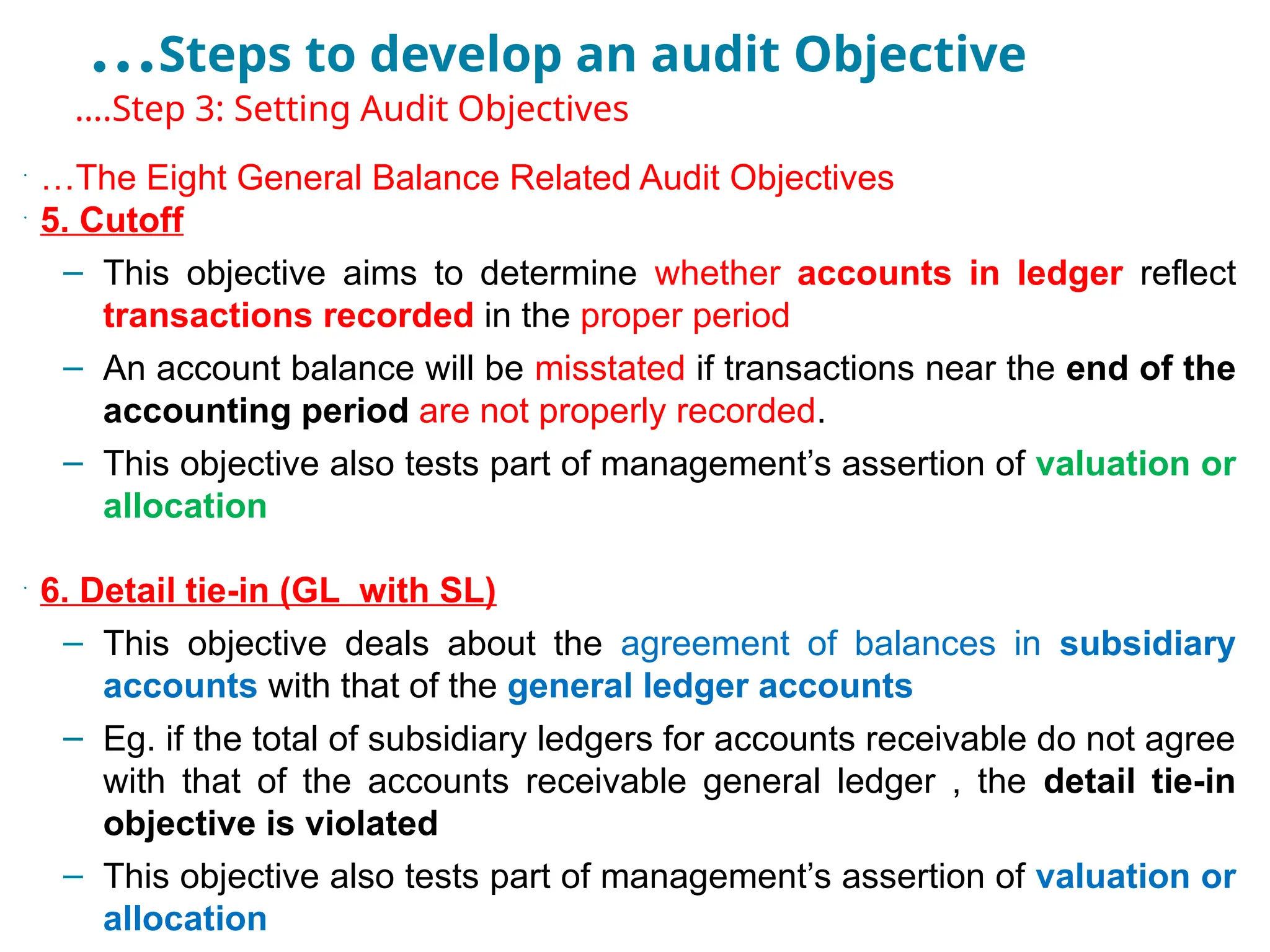
5. Cutoff
– This objective aims to determine whether accounts in ledger reflect
transactions recorded in the proper period
– An account balance will be misstated if transactions near the end of the
accounting period are not properly recorded.
– This objective also tests part of management’s assertion of valuation or
allocation
•
6. Detail tie-in (GL with SL)
– This objective deals about the agreement of balances in subsidiary
accounts with that of the general ledger accounts
– Eg. if the total of subsidiary ledgers for accounts receivable do not agree
with that of the accounts receivable general ledger , the detail tie-in
objective is violated
– This objective also tests part of management’s assertion of valuation or
allocation
58.
…Steps to developan audit Objective
•
….Step 3: Setting Audit Objectives
•
…The Eight General Balance Related Audit Objectives
•
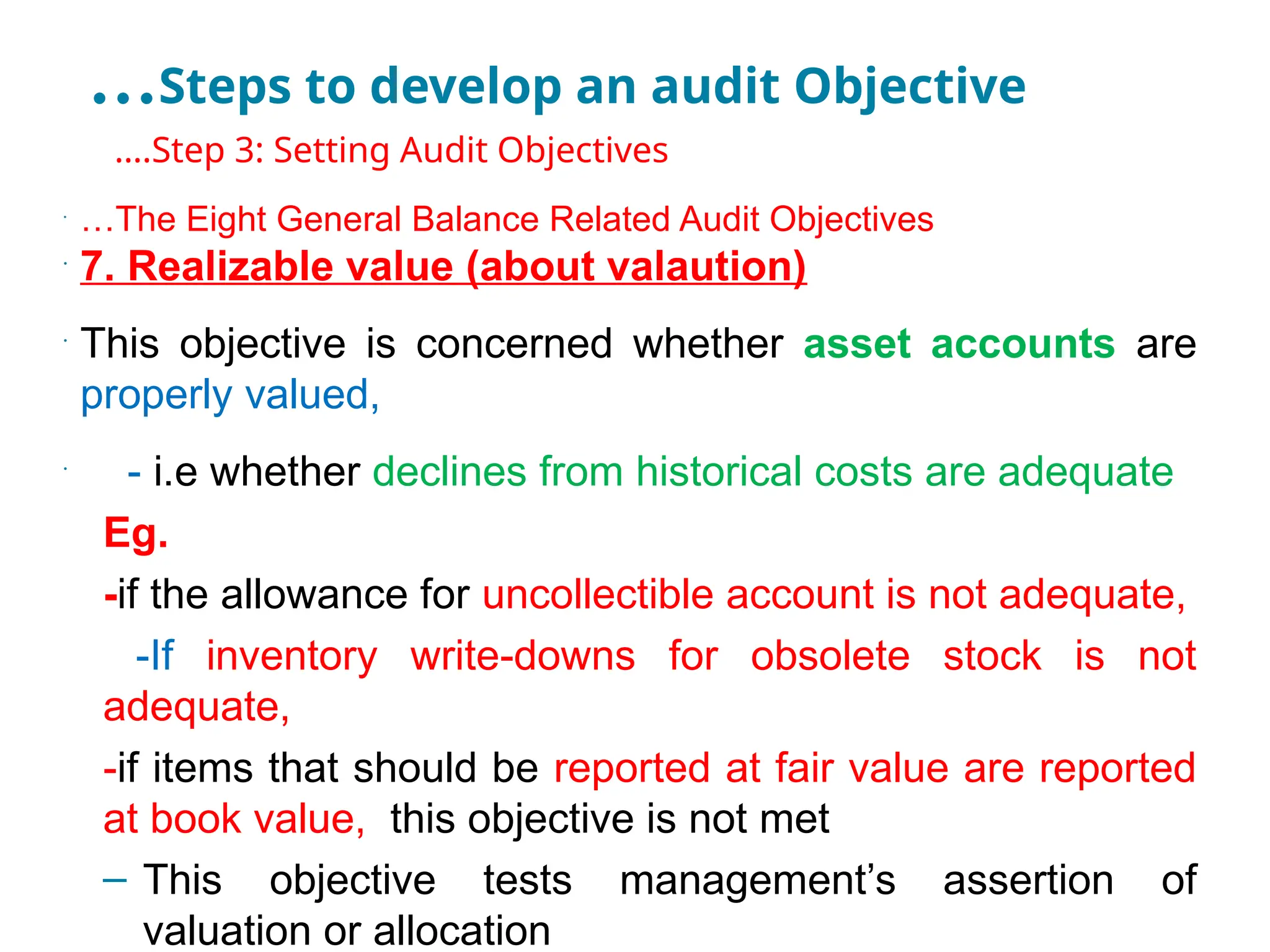
7. Realizable value (about valaution)
•
This objective is concerned whether asset accounts are
properly valued,
•
- i.e whether declines from historical costs are adequate
Eg.
-if the allowance for uncollectible account is not adequate,
-If inventory write-downs for obsolete stock is not
adequate,
-if items that should be reported at fair value are reported
at book value, this objective is not met
– This objective tests management’s assertion of
valuation or allocation
59.
…Steps to developan audit Objective
•
….Step 3: Setting Audit Objectives
•
…The Eight General Balance Related Audit Objectives
•
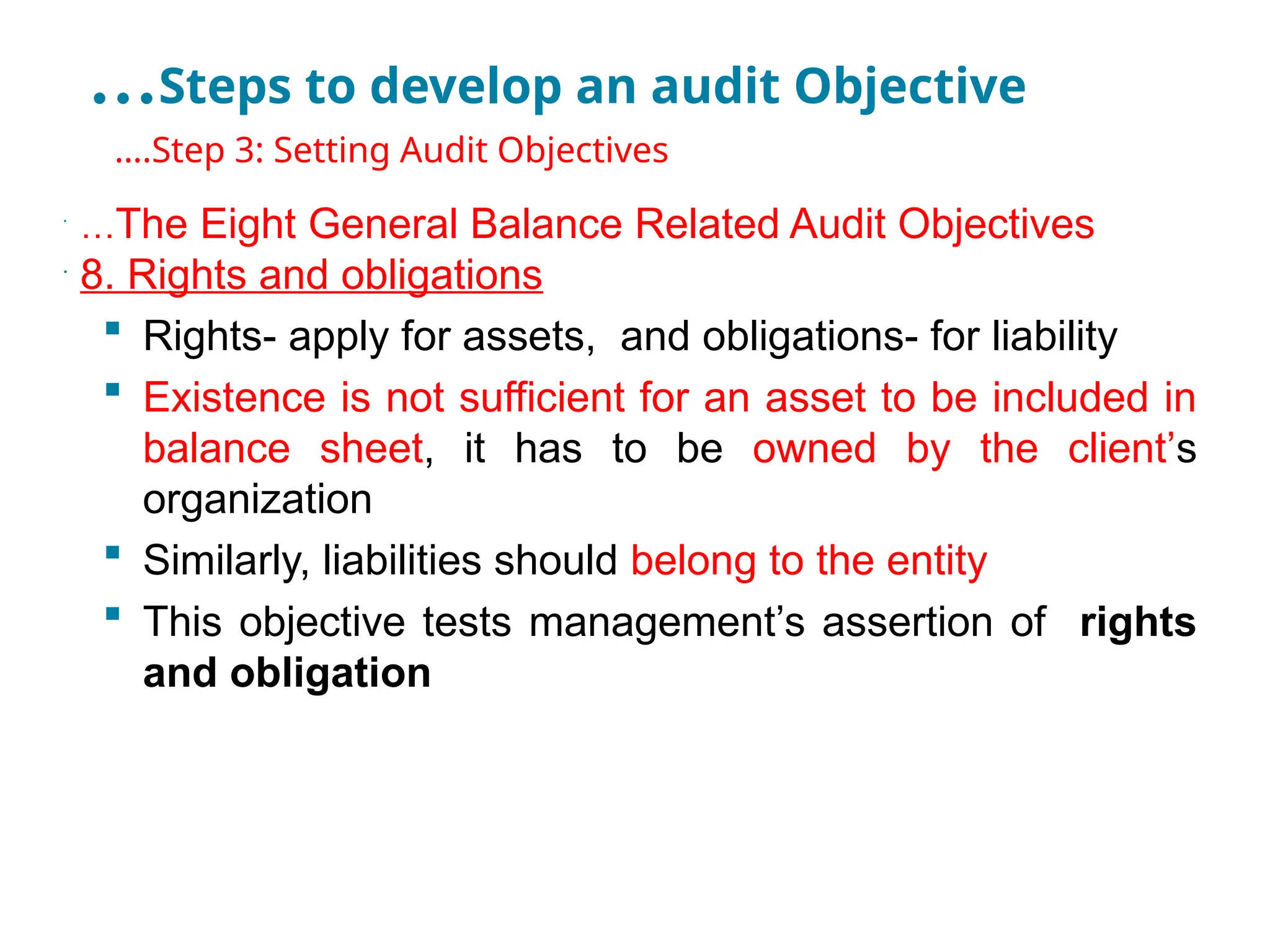
8. Rights and obligations
Rights- apply for assets, and obligations- for liability
Existence is not sufficient for an asset to be included in
balance sheet, it has to be owned by the client’s
organization
Similarly, liabilities should belong to the entity
This objective tests management’s assertion of rights
and obligation
60.
…Steps to developan audit Objective
•
….Step 3: Setting Audit Objectives
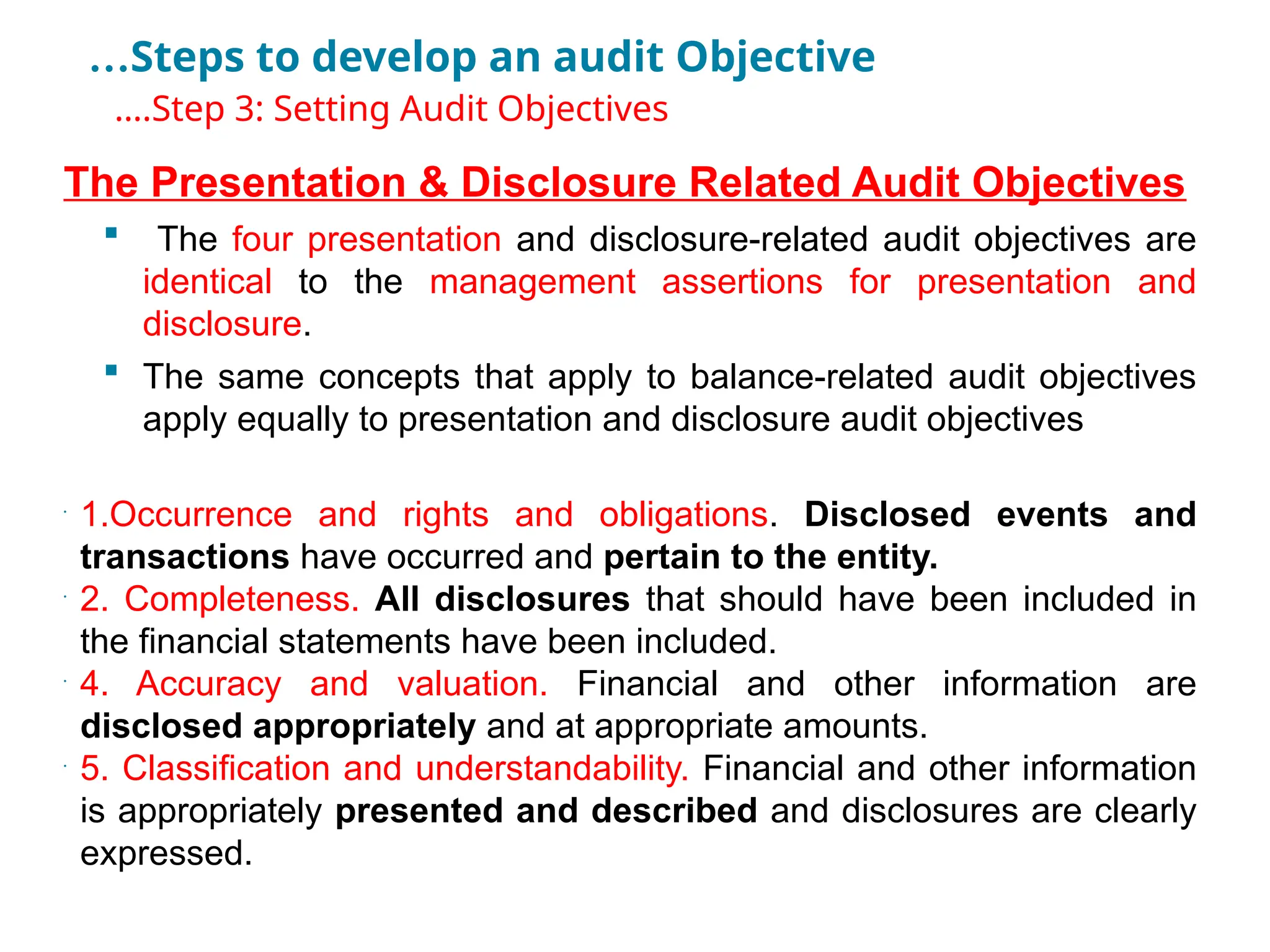
The Presentation & Disclosure Related Audit Objectives
The four presentation and disclosure-related audit objectives are
identical to the management assertions for presentation and
disclosure.
The same concepts that apply to balance-related audit objectives
apply equally to presentation and disclosure audit objectives
•
1.Occurrence and rights and obligations. Disclosed events and
transactions have occurred and pertain to the entity.
•
2. Completeness. All disclosures that should have been included in
the financial statements have been included.
•
4. Accuracy and valuation. Financial and other information are
disclosed appropriately and at appropriate amounts.
•
5. Classification and understandability. Financial and other information
is appropriately presented and described and disclosures are clearly
expressed.
61.
…Steps to developan audit Objective
•
….Step 3: Setting Audit Objectives
Relationships between Audit Objectives
There is a significant overlap between the transaction-
related and balance-related audit objectives.
Rights and obligations is the only balance-related
assertion without a similar transaction-related assertion.
Presentation and disclosure-related audit objectives are
closely related to the balance-related audit objectives.
Auditors often consider presentation and disclosure
audit objectives when addressing the balance related
audit objectives.
62.
…Steps to developan audit Objective
•
….Step 3: Setting Audit Objectives
How Audit Objectives are Met?
-
The auditor must obtain sufficient appropriate audit
evidence to support all management assertions in the
financial statements.
This is done by accumulating evidence in support of
some appropriate combination of transaction-related
audit objectives and balance-related audit objectives.
The auditor must decide the appropriate audit objectives
and the evidence to accumulate, to meet those
objectives on every audit
63.
…Steps to developan audit Objective
•
….Step 3: Setting Audit Objectives
..How Audit Objectives are Met?
To accumulate evidence that enables to achieve audit
objectives, auditors follow the audit process.
The audit process -= is a well-defined methodology for
organizing an audit to ensure that the evidence
gathered is both sufficient and appropriate and that all
required audit objectives are both specified and met.
- The auditor should know the legal and operating
environment in which the client organization operates, and
also the reporting requirement so that the audit plan can
meet the objectives associated with reporting requirements
in the industry
64.
Audit I YAAAUSC 2022
Four Phases of the Audit Process
1. Plan and design the audit approach
2. Perform tests of control and substantive tests of
transactions
3. Perform analytical procedures and tests of details of
balances
4. Complete the audit and issue an audit report
Audit I YAAAUSC 2022
Audit assertions
• Auditors need to use assertions when assessing the risk of
material misstatement and designing audit procedures.
How—by collecting evidence
• Means- auditors need to gather sufficient(how much audit
evidence) and appropriate (tripe of evidence)evidence
about each assertion for each transaction and account
balance or disclosure.
67.
Audit I YAAAUSC 2022
Assertions about classes of transactions and Events
P/L Statement
• Occurrence:- Whether transactions actually occurred
during the accounting period – it happened
• Completeness;- whether all transactions that should be
included are in fact included
• Accuracy:- whether transactions have been recorded in
correct journal account
• Classification- Whether transactions are recorded at
correct amounts ( ledgers Drs and Crs)
• Cutoff:- whether transactions are recorded in the proper
accounting period
68.
Audit I YAAAUSC 2022
Assertions about account balances : Balance
sheet B/S
• Existence: whether A, L, and E interests actually existed at
the balance sheet date (are there any fake assets)
• Completeness: whether all the accounts that should be
presented are included (liabilities concerned)
• Valuation (dollar value ) and allocation (Current and
N/current) : whether A, L and E interests have been
included at appropriate amounts
• Rights (ownership/control ) and obligations; whether the
assets are the rights of the entity, and whether the
liabilities are the obligations of the entity.
69.
Audit I YAAAUSC 2022
Assertions about Presentation and Disclosure
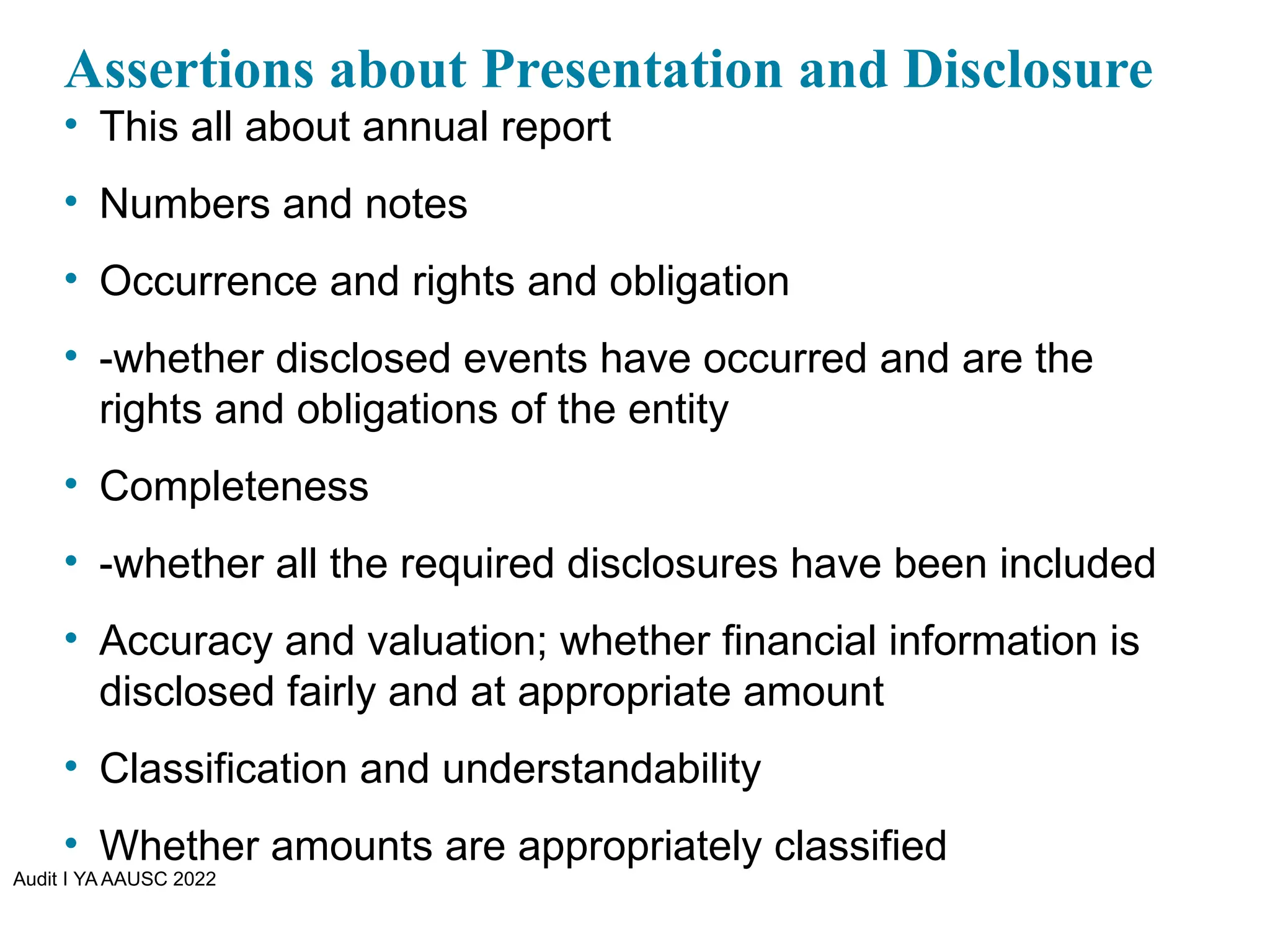
• This all about annual report
• Numbers and notes
• Occurrence and rights and obligation
• -whether disclosed events have occurred and are the
rights and obligations of the entity
• Completeness
• -whether all the required disclosures have been included
• Accuracy and valuation; whether financial information is
disclosed fairly and at appropriate amount
• Classification and understandability
• Whether amounts are appropriately classified
70.
Audit I YAAAUSC 2022
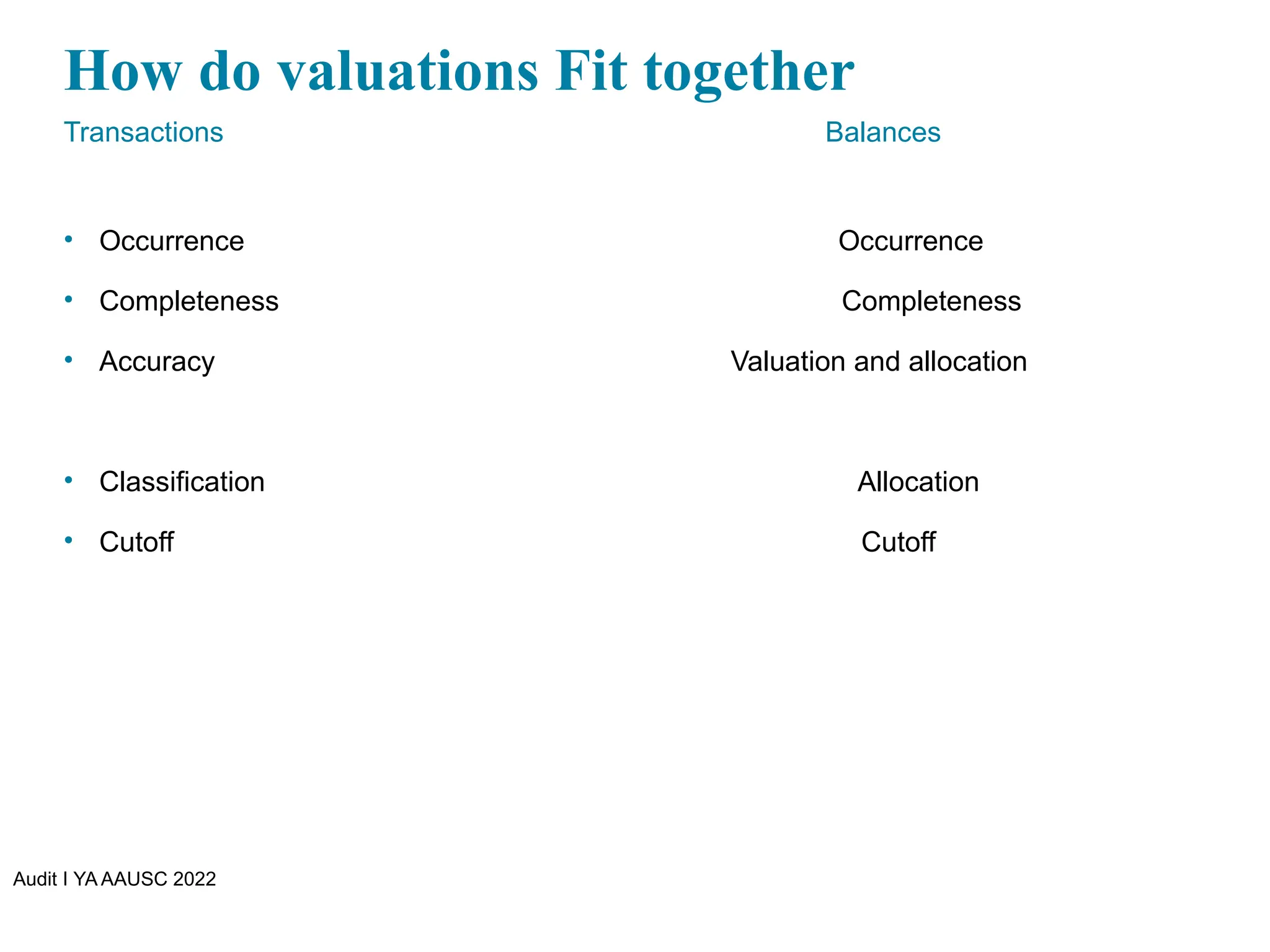
How do valuations Fit together
Transactions Balances
• Occurrence Occurrence
• Completeness Completeness
• Accuracy Valuation and allocation
• Classification Allocation
• Cutoff Cutoff
71.
Audit I YAAAUSC 2022
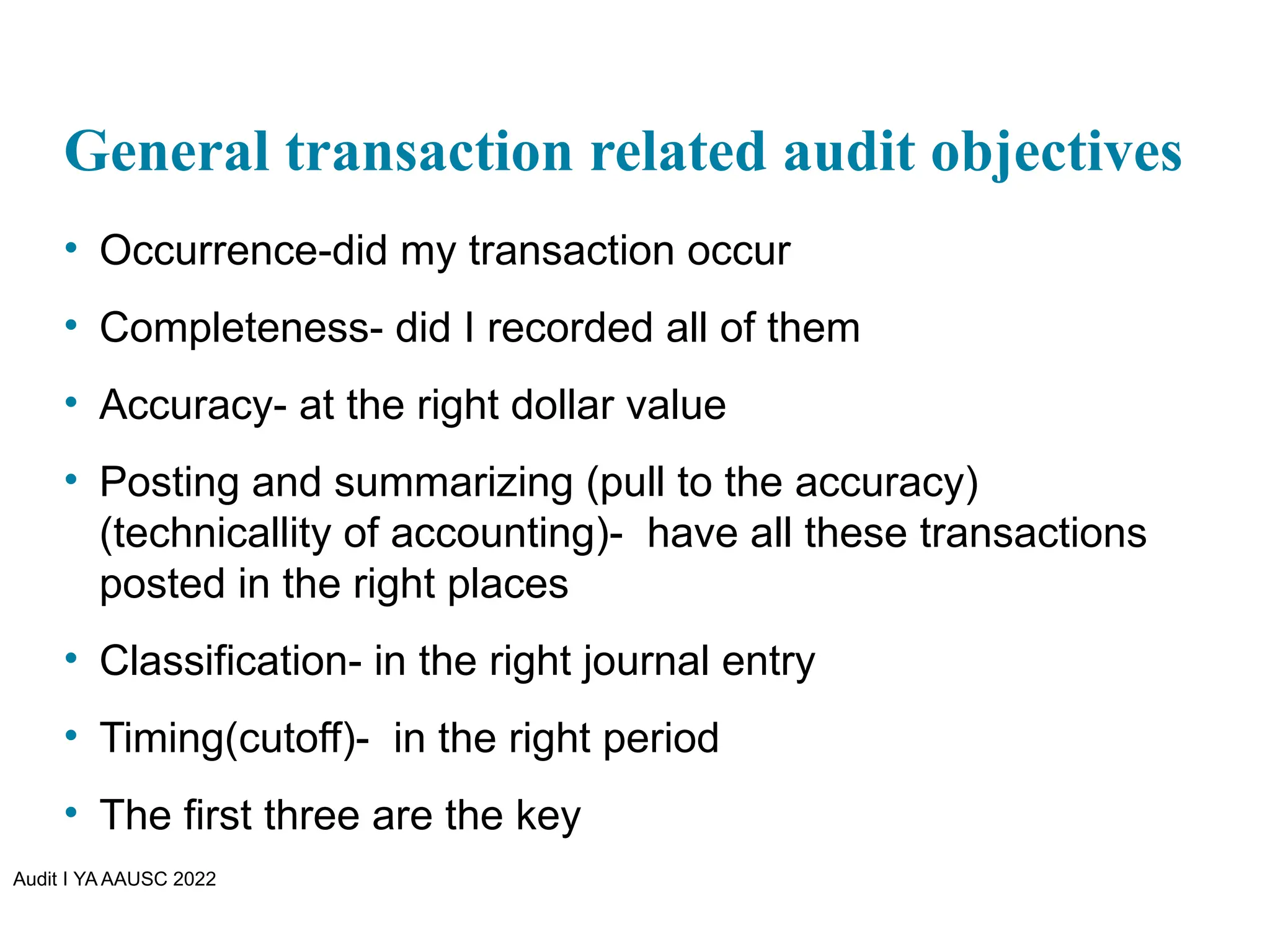
General transaction related audit objectives
• Occurrence-did my transaction occur
• Completeness- did I recorded all of them
• Accuracy- at the right dollar value
• Posting and summarizing (pull to the accuracy)
(technicallity of accounting)- have all these transactions
posted in the right places
• Classification- in the right journal entry
• Timing(cutoff)- in the right period
• The first three are the key
72.
Audit I YAAAUSC 2022
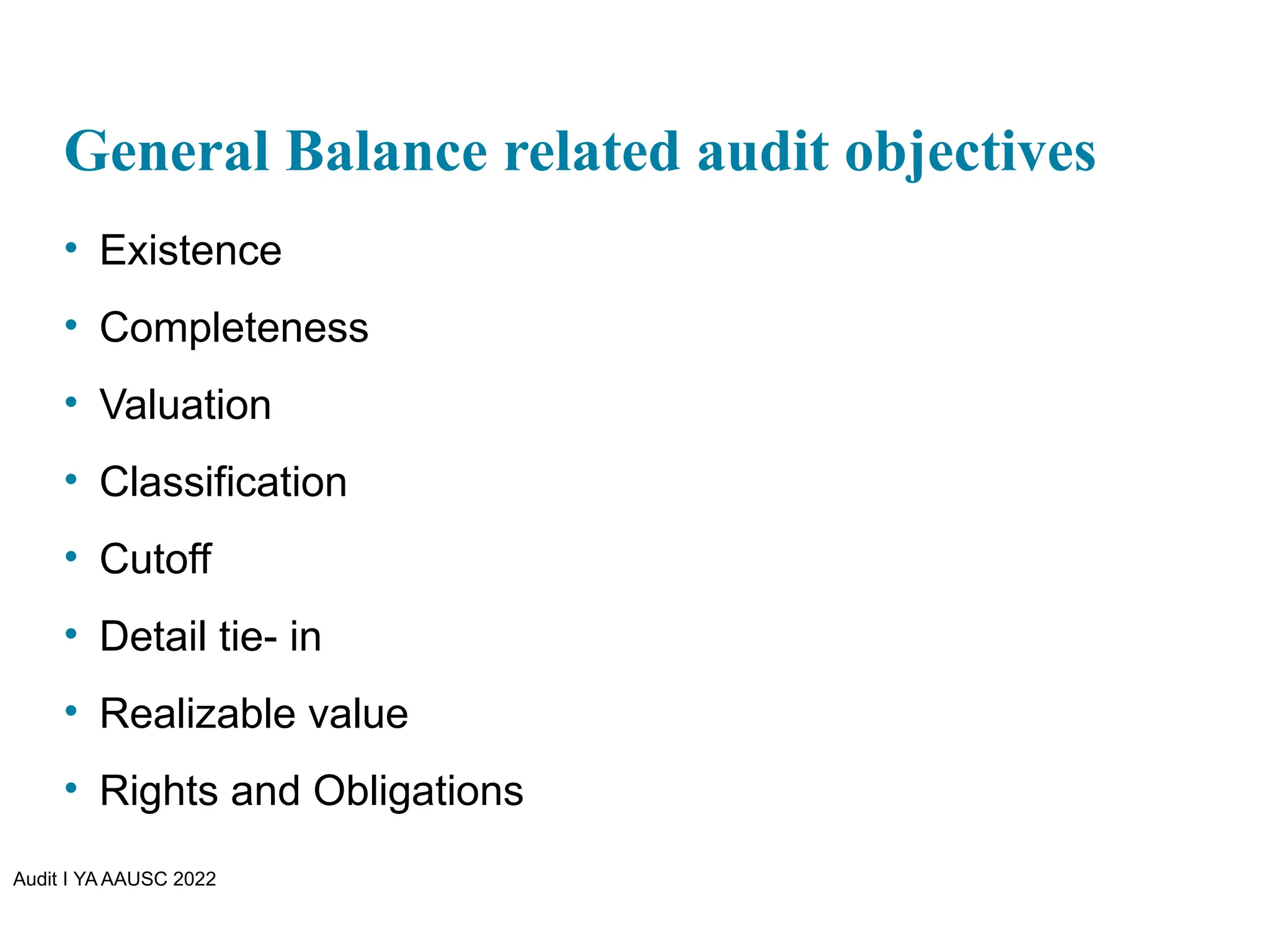
General Balance related audit objectives
• Existence
• Completeness
• Valuation
• Classification
• Cutoff
• Detail tie- in
• Realizable value
• Rights and Obligations
73.
Audit I YAAAUSC 2022
Presentation and dusclosure audit objevtives
• Occurrence and rights and obligations
• Complteness
• Accuracy and valyaution
• Classification and aunderstandability
74.
Audit I YAAAUSC 2022
How audit objectives are met?
The Auditor plans the appropriate combination of:
Audit objectives
The evidence that must be accumulated to meet them
-This plan is called AUDIT PROGRAM (Design)
Audit process is :
A well defined methodology for organizing an audit to
ensure that:
o The evidence gathered is sufficient and appropriate
o All audit objectives are both specified and met.
75.
Audit I YAAAUSC 2022
Four Phases of the Audit Process
1. Plan and design the audit approach
2. Perform tests of control and substantive tests of
transactions
3. Perform analytical procedures and tests of details
of balances
4. Complete the audit and issue an audit report
Editor's Notes
#7 Material= Relevant/important errors in the FS
How do you know is whether material or note+ -Cause and effect, dollar value, impact
#23 Slide 2 is list of textbook LO numbers and statements
#24 Indirect-effect illegal acts do not affect financial statements directly, but result in potential fines. Auditing standards clearly state that auditors provide no assurance that such illegal acts will be detected.
#25 Generally, these laws and regulations relate more to an entity's operating aspects than to its financial and accounting aspects, and their financial statement effect is indirect.
#51 Slide 2 is list of textbook LO numbers and statements
#53 Slide 2 is list of textbook LO numbers and statements
#54 Assertion is a statement one believes is true. How we can prove it is true?
We use a specifoc set of assertions related to the financial statements
Assertions are statements regarding the recognition, measurement, presentation and disclosure of items included in the financial report
#55 Slide 2 is list of textbook LO numbers and statements
#60 Slide 2 is list of textbook LO numbers and statements