The Effects of the Media

Audience Theory
Effects of the media
 The

creation of a ‘Mass
society’
– Modern societies destroy
individuality by bringing
people under the control of
the owners of large
conglomerates
Are modern societies mass
societies?


Frankfurt school (Marxists)
– Feared the power of the Mass Media they
blamed it for destroying free thinking and
creativity.
– Marcuse (1968)
• ‘One dimensional man’ - In other words we are all the
same, no one has individuality any more

– Agger (2003)
• ‘Conformists and consumers’ – again stressing that we
have very little individuality
Early Theories







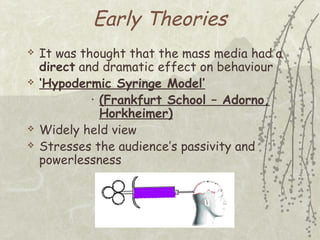
It was thought that the mass media had a
direct and dramatic effect on behaviour
‘Hypodermic Syringe Model’
• (Frankfurt School – Adorno,
Horkheimer)
Widely held view
Stresses the audience’s passivity and
powerlessness
Later Theories
 Two

step flow (Indirect
effects)
– Lazersfeld et al
– Individuals are not directly influenced
– Messages are filtered down through
significant individuals
– These individuals are called opinion
leaders


Uses and gratifications model
• Bulmer and Katz (1974)
– Stresses how audiences are not
passive but in charge.
– No such thing as a single mass
audience
– Audiences are highly differentiated
eg class, race, sex religion,
nationality.
Uses and
gratifications

Regularity and structure



Researchers in the 1970’s
argued that audiences use the
media to satisfy certain basic
psychological needs. These ‘uses
and gratifications’ as they called
them, include the need for
information, a personal identity,
social interaction and
entertainment.
The media has its own particular
uses and pleasures for its
audience; it provide many things,
including……..



Shared experiences/ a
sense of Community



Audience identification



Educational uses



Escapism



People centred needs
Scheduling and Regularity






The pattern and structure provided by the
media is considered one of the primary
gratifications.
The media can integrate itself into the
rhythms and routines of the home. This
allows advertisers to reach a core audience
at a regular time but also provides viewers
with a means of organising their day and, in
some cases, structuring their lives.
The regularised pattern of interruption
and continuity rewards viewers who
maintain an ongoing engagement with the
text.








Sharing opinions as social interaction + virtual
community
The fact that the media is discussed among friends
means that it gives a diverse range of viewers something
to share. As EastEnders advertising campaign puts it,
‘everybody’s talking about it’ To miss something in the
media is to exclude yourself from a wider community and
pass-up opportunities for interaction.
A virtual community arises, bound together by the
discussion of last night’s show/ latest film and possible
future plot developments.
As Mal Young (Head of BBC Drama Series) states:- ‘as
real life communities and the traditional family group
have deconstructed, so our reliance on virtual
communities has become more important in our lives. The
TV audience may be going through massive change as the
viewer is confronted by choice, but TV remains the
shared experience






People identify with the characters and
personalities in the media and get involved with
the programmes
In order to maximise a the media’s potential, production companies
try to reflect the age range and interests of the viewers. People
like to identify with their own peer group - although as David
Buckingham states ‘viewers do not always identify with the
characters or personalities who are most ‘like them’.
Identification (the notion that a character or personality shares
your perspective), and the sense of involvement/inclusion it
promotes, is one of the primary gratifications of the media.
There is an attempt to accommodate a diverse range of character
and personality types, creating an appropriate gender mix, and a
blend of social and ethnic backgrounds which aims to ensure and
‘gratify’ a wide potential audience by reflecting them on-screen.





Education: People learn from the media
Programme makers acknowledge that, while the media is not always
‘issues-based’, issues arise naturally as a consequence of the
entertainment. As well as entertaining viewers these programmes
have a secondary educational or informational function, offering a
discussion of current topics that may concern them.
David Buckingham notes that the media directly ‘invites its viewers
to make moral and ideological judgements. The kinds of judgements
invited are more frequently moral than ideological – that is
judgements that relate to the rights and wrongs of individual
behaviour rather than broader social forces. Nevertheless, in
criticising and discussing characters and issues, viewers may well
be using television as a vehicle for working out their own ideological
perspectives.’ As Mike Clarke states, ‘viewers explore ways of
dealing with problems which may be useful to them in real-life
situations.’
The media provides escapism








While it is true that most of the media aims to provide a sense of
realism, it is also true that one of the chief gratifications of the
media is the sense of removal to a very clearly defined ‘elsewhere’
for some part of each day – an escape during which you can put
your own worries aside.
The media provides a voyeuristic insight into the high points and,
particularly, low points of characters’ and personality’s lives, thus
inducing potential feelings of superiority and relief (rather them
than me).
Research suggests that viewers are not particularly interested in
happy endings, or living out dreams vicariously. The fact that the
fictional woes of characters outweigh your own is in itself a cause
for audience pleasure.
The media offers ‘real life’ X 10
The media fulfils people centred needs
(individual viewing pleasure)






It would be a mistake to ignore the fact that the media is intent
on delivering entertainment - incorporating elements from a
variety of genres - from melodrama to sitcom - to provide this
entertainment. Moreover, it is populated by interesting and
attractive people.
We are given events that are occurring ‘now’ and audiences
respond well to the perceived ‘immediacy’ in the media.
As Mike Clarke explains ‘one significant source of pleasure is the
continuity of characters and setting. It is possible for regular
viewers to build up a much more nuanced understanding and a fund
of archival knowledge which enables them to experience the
programmes more fully and more enjoyably.’
Most Recent Theory


Cultural effects theories:
• Philo (1990)
– Compare media effects to a ‘dripping tap’
– Constant exposure to certain limited points of
view may create a bias in the audience’s minds
– However we do interpret what we see according
to our own cultural experience

Audience theory

  • 1.
    The Effects ofthe Media Audience Theory
  • 2.
    Effects of themedia  The creation of a ‘Mass society’ – Modern societies destroy individuality by bringing people under the control of the owners of large conglomerates
  • 3.
    Are modern societiesmass societies?  Frankfurt school (Marxists) – Feared the power of the Mass Media they blamed it for destroying free thinking and creativity. – Marcuse (1968) • ‘One dimensional man’ - In other words we are all the same, no one has individuality any more – Agger (2003) • ‘Conformists and consumers’ – again stressing that we have very little individuality
  • 4.
    Early Theories     It wasthought that the mass media had a direct and dramatic effect on behaviour ‘Hypodermic Syringe Model’ • (Frankfurt School – Adorno, Horkheimer) Widely held view Stresses the audience’s passivity and powerlessness
  • 5.
    Later Theories  Two stepflow (Indirect effects) – Lazersfeld et al – Individuals are not directly influenced – Messages are filtered down through significant individuals – These individuals are called opinion leaders
  • 6.
     Uses and gratificationsmodel • Bulmer and Katz (1974) – Stresses how audiences are not passive but in charge. – No such thing as a single mass audience – Audiences are highly differentiated eg class, race, sex religion, nationality.
  • 7.
    Uses and gratifications Regularity andstructure  Researchers in the 1970’s argued that audiences use the media to satisfy certain basic psychological needs. These ‘uses and gratifications’ as they called them, include the need for information, a personal identity, social interaction and entertainment. The media has its own particular uses and pleasures for its audience; it provide many things, including……..  Shared experiences/ a sense of Community  Audience identification  Educational uses  Escapism  People centred needs
  • 8.
    Scheduling and Regularity    Thepattern and structure provided by the media is considered one of the primary gratifications. The media can integrate itself into the rhythms and routines of the home. This allows advertisers to reach a core audience at a regular time but also provides viewers with a means of organising their day and, in some cases, structuring their lives. The regularised pattern of interruption and continuity rewards viewers who maintain an ongoing engagement with the text.
  • 9.
        Sharing opinions associal interaction + virtual community The fact that the media is discussed among friends means that it gives a diverse range of viewers something to share. As EastEnders advertising campaign puts it, ‘everybody’s talking about it’ To miss something in the media is to exclude yourself from a wider community and pass-up opportunities for interaction. A virtual community arises, bound together by the discussion of last night’s show/ latest film and possible future plot developments. As Mal Young (Head of BBC Drama Series) states:- ‘as real life communities and the traditional family group have deconstructed, so our reliance on virtual communities has become more important in our lives. The TV audience may be going through massive change as the viewer is confronted by choice, but TV remains the shared experience
  • 10.
       People identify withthe characters and personalities in the media and get involved with the programmes In order to maximise a the media’s potential, production companies try to reflect the age range and interests of the viewers. People like to identify with their own peer group - although as David Buckingham states ‘viewers do not always identify with the characters or personalities who are most ‘like them’. Identification (the notion that a character or personality shares your perspective), and the sense of involvement/inclusion it promotes, is one of the primary gratifications of the media. There is an attempt to accommodate a diverse range of character and personality types, creating an appropriate gender mix, and a blend of social and ethnic backgrounds which aims to ensure and ‘gratify’ a wide potential audience by reflecting them on-screen.
  • 11.
       Education: People learnfrom the media Programme makers acknowledge that, while the media is not always ‘issues-based’, issues arise naturally as a consequence of the entertainment. As well as entertaining viewers these programmes have a secondary educational or informational function, offering a discussion of current topics that may concern them. David Buckingham notes that the media directly ‘invites its viewers to make moral and ideological judgements. The kinds of judgements invited are more frequently moral than ideological – that is judgements that relate to the rights and wrongs of individual behaviour rather than broader social forces. Nevertheless, in criticising and discussing characters and issues, viewers may well be using television as a vehicle for working out their own ideological perspectives.’ As Mike Clarke states, ‘viewers explore ways of dealing with problems which may be useful to them in real-life situations.’
  • 12.
    The media providesescapism     While it is true that most of the media aims to provide a sense of realism, it is also true that one of the chief gratifications of the media is the sense of removal to a very clearly defined ‘elsewhere’ for some part of each day – an escape during which you can put your own worries aside. The media provides a voyeuristic insight into the high points and, particularly, low points of characters’ and personality’s lives, thus inducing potential feelings of superiority and relief (rather them than me). Research suggests that viewers are not particularly interested in happy endings, or living out dreams vicariously. The fact that the fictional woes of characters outweigh your own is in itself a cause for audience pleasure. The media offers ‘real life’ X 10
  • 13.
    The media fulfilspeople centred needs (individual viewing pleasure)    It would be a mistake to ignore the fact that the media is intent on delivering entertainment - incorporating elements from a variety of genres - from melodrama to sitcom - to provide this entertainment. Moreover, it is populated by interesting and attractive people. We are given events that are occurring ‘now’ and audiences respond well to the perceived ‘immediacy’ in the media. As Mike Clarke explains ‘one significant source of pleasure is the continuity of characters and setting. It is possible for regular viewers to build up a much more nuanced understanding and a fund of archival knowledge which enables them to experience the programmes more fully and more enjoyably.’
  • 14.
    Most Recent Theory  Culturaleffects theories: • Philo (1990) – Compare media effects to a ‘dripping tap’ – Constant exposure to certain limited points of view may create a bias in the audience’s minds – However we do interpret what we see according to our own cultural experience

Editor's Notes