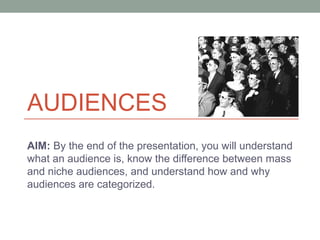
AUDIENCES 
AIM: By the end of the presentation, you will understand 
what an audience is, know the difference between mass 
and niche audiences, and understand how and why 
audiences are categorized.
What is an audience? 
• An individual or collective group of people who 
read or consume any media text 
• Examples: Radio listeners, Television viewers, 
Newspaper and magazine readers, Web traffic on 
web sites. 
• Can you think of any other types of 
audiences?
Why are audiences important? 
•Without audiences there would be no media. 
•Media organizations produce media texts to make profit – 
no audience = no profit. 
•The mass media is becoming more competitive than ever 
to attract more and more audiences in different ways and 
stay profitable.
Impact of New Technology on Audiences 
• Old media (TV, Print, Radio) which used to have 
high audience numbers must now work harder to 
maintain audience numbers. 
• Digital technology has also led to an increasing 
uncertainty over how we define an audience, with 
the general agreement that a large group of people 
reading the same thing at the same time is outdated 
and that audiences are now ‘fragmented’.
Fragmented audience 
• The division of audiences into smaller groups due to the 
variety of media outlets. 
• EXAMPLE:Newspapers and magazines – you can now 
view the hard copy AND online version (sometimes free). 
• The aim is to hit as many people as possible/sell more 
copies/generate a larger audience. But measuring that 
audience becomes hard! You may have some people that 
only look online, some that only read the hard copy, or 
some that do both!
So how do institutions continue to 
make money? 
• Nothing in life is free 
• Free apps always have adverts, unless you pay to remove 
adds. 
• Websites and search engines work hard to target you with 
ads whilst you consume ‘free online’ versions of your 
media product 
• These adverts are carefully constructed and selected for 
the primary audience for each text 
• With newspapers, printing less copies and switching to 
online distribution can reduce production costs. (see your 
local newspaper)
Types of Audience 
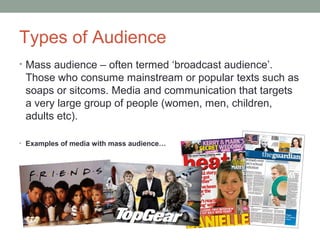
• Mass audience – often termed ‘broadcast audience’. 
Those who consume mainstream or popular texts such as 
soaps or sitcoms. Media and communication that targets 
a very large group of people (women, men, children, 
adults etc). 
• Examples of media with mass audience…
Types of Audience 
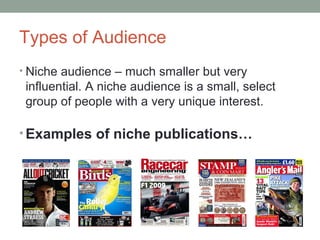
• Niche audience – much smaller but very 
influential. A niche audience is a small, select 
group of people with a very unique interest. 
•Examples of niche publications…
Categories 
Audiences can be divided into categories 
based on social class/grade. 
Why do we 
categorise 
audiences?
Psychographics 
• Every advertiser wants to target a particular type of 
audience. Therefore, media companies produce 
texts that target a particular ‘type’ of audience. 
• In terms of commercial media, much of their funding 
is generated by advertising revenue. Their product 
needs to appeal to a specific type of audience so 
that advertisers will pay to promote their product. 
• Most media products can define their ‘typical’ 
audience member, often with a psychographic 
profile. 
• Example http://au.advertising.yahoo.com/our-network/ 
brands/-/5006012/marie-claire
A full list of categories with detailed 
notes 
• Can be found at 
http://www.thinkbox.tv/server/show/nav.914 
• For a summary, please look at the following slides
What types of media texts would they 
consume? Group A 
• Lawyers 
•Doctors 
• Scientists 
•Well paid professionals
Group B – for each category, think 
about income boundaries 
•Teachers 
• Middle management 
•Fairly well paid professionals
Group C1 – remember that categories 
are not fixed 
• Junior management 
•Bank clerks 
•Nurses 
• ‘White collar’ professions
Group C2 
• Electricians 
• Plumbers 
•Carpenters 
• ‘Blue collar’ professions
Group D – some categories 
represent audience stereotypes 
•Manual workers such as: 
• Drivers 
•Post sorters
Group E - You 
• Students 
•Unemployed 
•Pensioners
Research methods 
• How do we measure media audiences? 
• Sales, subscriptions, ratings, figures 
• Who measures audiences? 
• NRS 
• ABC 
• BARB 
• Bookseller 
• (these are just some of the organisations who monitor 
audience sizes). 
• http://www.thinkbox.tv/server/show/nav.836 
TASK: Find out about these companies, and see if you can find some more.
New Media 
• Can you think of any NEW ways in which we can 
measure audience? Think about the picture below… 
• Facebook and other social network sites – ‘like’ 
• Online forums – comments tools 
• Views on YouTube & Google +1 
• Twitter trends 
• CASE STUDY: Rebecca Black 
• How did a $4000 vanity video become a part of modern 
pop culture?
Research 
• When looking at audiences, there are two main types of research: 
• Quantitative research – e.g. questionnaires. 
• Number based 
• Closed questions to generate exact answers 
• Very factual 
• Qualitative research – e.g. interviews, focus groups 
• Analysis of existing products 
• Open questions to generate answers open to interpretation 
• Individual preferences 
• Qualitative research will be very important in your 
coursework!

Audiences

  • 1.
    AUDIENCES AIM: Bythe end of the presentation, you will understand what an audience is, know the difference between mass and niche audiences, and understand how and why audiences are categorized.
  • 2.
    What is anaudience? • An individual or collective group of people who read or consume any media text • Examples: Radio listeners, Television viewers, Newspaper and magazine readers, Web traffic on web sites. • Can you think of any other types of audiences?
  • 3.
    Why are audiencesimportant? •Without audiences there would be no media. •Media organizations produce media texts to make profit – no audience = no profit. •The mass media is becoming more competitive than ever to attract more and more audiences in different ways and stay profitable.
  • 4.
    Impact of NewTechnology on Audiences • Old media (TV, Print, Radio) which used to have high audience numbers must now work harder to maintain audience numbers. • Digital technology has also led to an increasing uncertainty over how we define an audience, with the general agreement that a large group of people reading the same thing at the same time is outdated and that audiences are now ‘fragmented’.
  • 5.
    Fragmented audience •The division of audiences into smaller groups due to the variety of media outlets. • EXAMPLE:Newspapers and magazines – you can now view the hard copy AND online version (sometimes free). • The aim is to hit as many people as possible/sell more copies/generate a larger audience. But measuring that audience becomes hard! You may have some people that only look online, some that only read the hard copy, or some that do both!
  • 6.
    So how doinstitutions continue to make money? • Nothing in life is free • Free apps always have adverts, unless you pay to remove adds. • Websites and search engines work hard to target you with ads whilst you consume ‘free online’ versions of your media product • These adverts are carefully constructed and selected for the primary audience for each text • With newspapers, printing less copies and switching to online distribution can reduce production costs. (see your local newspaper)
  • 7.
    Types of Audience • Mass audience – often termed ‘broadcast audience’. Those who consume mainstream or popular texts such as soaps or sitcoms. Media and communication that targets a very large group of people (women, men, children, adults etc). • Examples of media with mass audience…
  • 8.
    Types of Audience • Niche audience – much smaller but very influential. A niche audience is a small, select group of people with a very unique interest. •Examples of niche publications…
  • 9.
    Categories Audiences canbe divided into categories based on social class/grade. Why do we categorise audiences?
  • 10.
    Psychographics • Everyadvertiser wants to target a particular type of audience. Therefore, media companies produce texts that target a particular ‘type’ of audience. • In terms of commercial media, much of their funding is generated by advertising revenue. Their product needs to appeal to a specific type of audience so that advertisers will pay to promote their product. • Most media products can define their ‘typical’ audience member, often with a psychographic profile. • Example http://au.advertising.yahoo.com/our-network/ brands/-/5006012/marie-claire
  • 11.
    A full listof categories with detailed notes • Can be found at http://www.thinkbox.tv/server/show/nav.914 • For a summary, please look at the following slides
  • 12.
    What types ofmedia texts would they consume? Group A • Lawyers •Doctors • Scientists •Well paid professionals
  • 13.
    Group B –for each category, think about income boundaries •Teachers • Middle management •Fairly well paid professionals
  • 14.
    Group C1 –remember that categories are not fixed • Junior management •Bank clerks •Nurses • ‘White collar’ professions
  • 15.
    Group C2 •Electricians • Plumbers •Carpenters • ‘Blue collar’ professions
  • 16.
    Group D –some categories represent audience stereotypes •Manual workers such as: • Drivers •Post sorters
  • 17.
    Group E -You • Students •Unemployed •Pensioners
  • 18.
    Research methods •How do we measure media audiences? • Sales, subscriptions, ratings, figures • Who measures audiences? • NRS • ABC • BARB • Bookseller • (these are just some of the organisations who monitor audience sizes). • http://www.thinkbox.tv/server/show/nav.836 TASK: Find out about these companies, and see if you can find some more.
  • 19.
    New Media •Can you think of any NEW ways in which we can measure audience? Think about the picture below… • Facebook and other social network sites – ‘like’ • Online forums – comments tools • Views on YouTube & Google +1 • Twitter trends • CASE STUDY: Rebecca Black • How did a $4000 vanity video become a part of modern pop culture?
  • 20.
    Research • Whenlooking at audiences, there are two main types of research: • Quantitative research – e.g. questionnaires. • Number based • Closed questions to generate exact answers • Very factual • Qualitative research – e.g. interviews, focus groups • Analysis of existing products • Open questions to generate answers open to interpretation • Individual preferences • Qualitative research will be very important in your coursework!