humantalents


Competency Needs Assessment (CNA)
                                 Jayadeva de Silva.M.Sc,MBIM,FIPM,FITD


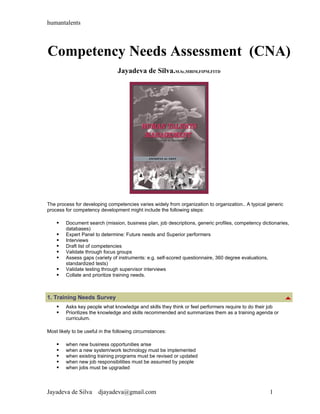
The process for developing competencies varies widely from organization to organization.. A typical generic
process for competency development might include the following steps:

       Document search (mission, business plan, job descriptions, generic profiles, competency dictionaries,
        databases)
       Expert Panel to determine: Future needs and Superior performers
       Interviews
       Draft list of competencies
       Validate through focus groups
       Assess gaps (variety of instruments: e.g. self-scored questionnaire, 360 degree evaluations,
        standardized tests)
       Validate testing through supervisor interviews
       Collate and prioritize training needs.


1. Training Needs Survey
       Asks key people what knowledge and skills they think or feel performers require to do their job
       Prioritizes the knowledge and skills recommended and summarizes them as a training agenda or
        curriculum.

Most likely to be useful in the following circumstances:

       when new business opportunities arise
       when a new system/work technology must be implemented
       when existing training programs must be revised or updated
       when new job responsibilities must be assumed by people
       when jobs must be upgraded


Jayadeva de Silva       djayadeva@gmail.com                                                         1
humantalents
        when organizations undergo downsizing

        when organizations experience rapid growth.

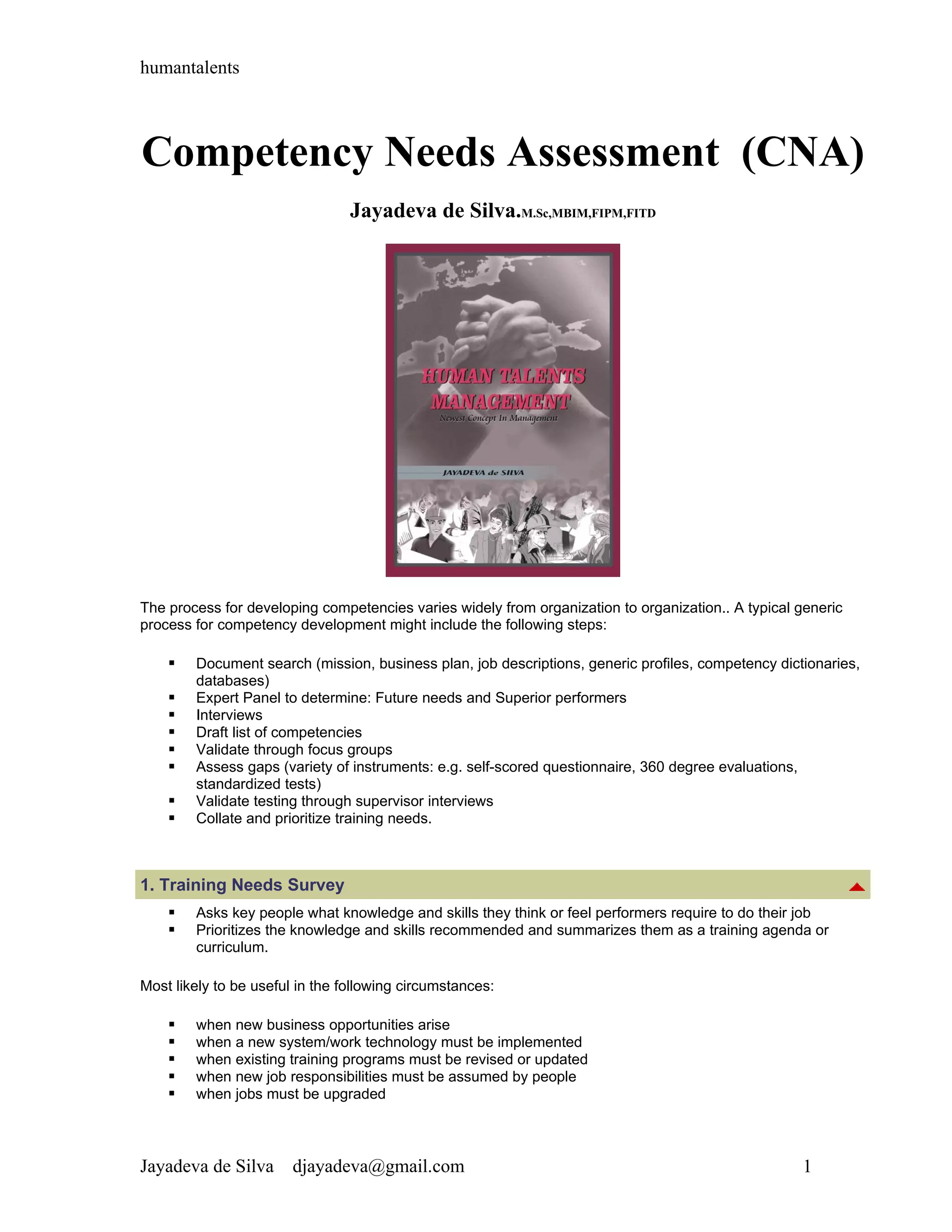
 Advantages                             Disadvantages

 D   fast, inexpensive                  l not precise or specific
 f   broad involvement                  n based on opinion
 b   low-risk                           b difficult to validate
 l   low-visibility                     d difficult to set priorities
                                        d difficult to relate to output or to evaluate the importance of training
                                        d once you ask people what training they feel is important you create an
                                        implicit expectation that you will deliver it.


2. Competency Studies
        Asks key people what competencies they think performers require to do the job
        Determines the knowledge and skills required to attain the stated competencies
        Prioritizes the knowledge and skills recommended and summarizes as a training agenda or
         curriculum.

Most effective when:

        competencies for management, supervisory, or professional jobs must be identified

        a credible system or template for recruiting, hiring, developing, and promoting must be developed.

 Advantages                             Disadvantages

 D relatively fast, inexpensive         n difficult to assess relative importance of competencies
 r broad involvement                    d difficult to relate to output or to evaluate training
 b consensus creating                   d difficult to set importance for knowledge and skills input
 c in addition to training needs        d consensus will not necessarily identify the critical differences between
 articulation and agreement, success    exemplary and average performance
 profile for performer                  e does not address other factors including performance
 p helps to identify generic training   d can be highly visible
 needs covering a broad population


3. Task Analysis
        Determines what tasks are required of the performer for the job to be performed correctly and
         successfully
        Determines the knowledge and skills required to correctly perform the tasks
        Identifies priorities among the tasks, and thereby the knowledge and skills, and summarizes as a
         training agenda or curriculum.

Most effective under the following circumstances:

        when new or existing job descriptions or profiles for managerial and non-managerial jobs must be
         developed as part of performance management system
        when jobs must be redesigned and tasks (knowledge, skills, and abilities) for each job indemnified
        when a consistent set of training requirements must be created, especially those involving highly
         technical or specialized job functions

     Clas Room Exercise


Jayadeva de Silva        djayadeva@gmail.com                                                                    2
humantalents

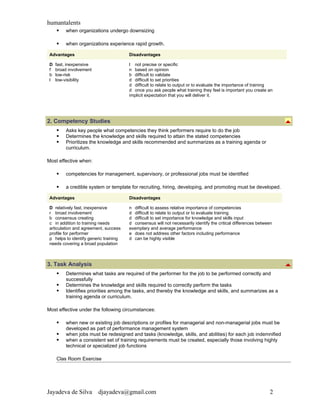
Select a job and do a Task analysis


4. Performance Analysis
        Determines what performance is required
        Determines the critical job output or accomplishments
        Determines what tasks are required of the trainee-performer to produce the job outputs or
         accomplishments
        Determines the knowledge and skills required to correctly perform the tasks identified
        Determines the other factors (in addition to knowledge and skills) that influence job performance -
         such as job design, resources, and feedback
        Prioritizes the knowledge and skills required based on impact on job performance and summarizes
         these as a training agenda or curriculum
        Summarizes recommendations to modify negative influences on performance as identified above.

Most effective when:

        identifying individual training needs
        when annual training plans need to be developed
        when an organization has an effective performance management process.


 Advantages                              Disadvantages

 D links knowledge and skills            p takes time and skill
 requirements to job performance         t visible
 r can validate, evaluate
 c addresses other factors affecting
 performance
 p impact of training outputs is
 established and therefore can
 prioritize knowledge and skills input


Questions


Jayadeva de Silva         djayadeva@gmail.com                                                         3
humantalents

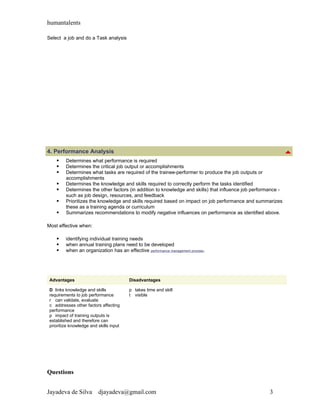
1 Why do you consider TNA is to be an important exercise?

2 What are the methods available for TNA ?


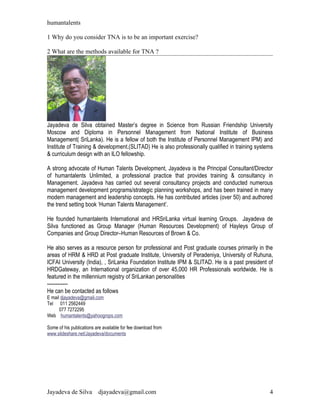
Jayadeva de Silva obtained Master’s degree in Science from Russian Friendship University
Moscow and Diploma in Personnel Management from National Institute of Business
Management( SriLanka). He is a fellow of both the Institute of Personnel Management IPM) and
Institute of Training & development.(SLITAD) He is also professionally qualified in training systems
& curriculum design with an ILO fellowship.

A strong advocate of Human Talents Development, Jayadeva is the Principal Consultant/Director
of humantalents Unlimited, a professional practice that provides training & consultancy in
Management. Jayadeva has carried out several consultancy projects and conducted numerous
management development programs/strategic planning workshops, and has been trained in many
modern management and leadership concepts. He has contributed articles (over 50) and authored
the trend setting book ‘Human Talents Management’.

He founded humantalents International and HRSriLanka virtual learning Groups. Jayadeva de
Silva functioned as Group Manager (Human Resources Development) of Hayleys Group of
Companies and Group Director–Human Resources of Brown & Co.

He also serves as a resource person for professional and Post graduate courses primarily in the
areas of HRM & HRD at Post graduate Institute, University of Peradeniya, University of Ruhuna,
ICFAI University (India), , SriLanka Foundation Institute IPM & SLITAD. He is a past president of
HRDGateway, an International organization of over 45,000 HR Professionals worldwide. He is
featured in the millennium registry of SriLankan personalities
------------
He can be contacted as follows
E mail djayadeva@gmail.com
Tel 011 2562449
      077 7272295
Web humantalents@yahoogrops.com

Some of his publications are available for fee download from
www.slideshare.net/Jayadeva/documents


Jayadeva de Silva         djayadeva@gmail.com                                                     4

Comptency Needs Assessment

  • 1.
    humantalents Competency Needs Assessment(CNA) Jayadeva de Silva.M.Sc,MBIM,FIPM,FITD The process for developing competencies varies widely from organization to organization.. A typical generic process for competency development might include the following steps:  Document search (mission, business plan, job descriptions, generic profiles, competency dictionaries, databases)  Expert Panel to determine: Future needs and Superior performers  Interviews  Draft list of competencies  Validate through focus groups  Assess gaps (variety of instruments: e.g. self-scored questionnaire, 360 degree evaluations, standardized tests)  Validate testing through supervisor interviews  Collate and prioritize training needs. 1. Training Needs Survey  Asks key people what knowledge and skills they think or feel performers require to do their job  Prioritizes the knowledge and skills recommended and summarizes them as a training agenda or curriculum. Most likely to be useful in the following circumstances:  when new business opportunities arise  when a new system/work technology must be implemented  when existing training programs must be revised or updated  when new job responsibilities must be assumed by people  when jobs must be upgraded Jayadeva de Silva djayadeva@gmail.com 1
  • 2.
    humantalents  when organizations undergo downsizing  when organizations experience rapid growth. Advantages Disadvantages D fast, inexpensive l not precise or specific f broad involvement n based on opinion b low-risk b difficult to validate l low-visibility d difficult to set priorities d difficult to relate to output or to evaluate the importance of training d once you ask people what training they feel is important you create an implicit expectation that you will deliver it. 2. Competency Studies  Asks key people what competencies they think performers require to do the job  Determines the knowledge and skills required to attain the stated competencies  Prioritizes the knowledge and skills recommended and summarizes as a training agenda or curriculum. Most effective when:  competencies for management, supervisory, or professional jobs must be identified  a credible system or template for recruiting, hiring, developing, and promoting must be developed. Advantages Disadvantages D relatively fast, inexpensive n difficult to assess relative importance of competencies r broad involvement d difficult to relate to output or to evaluate training b consensus creating d difficult to set importance for knowledge and skills input c in addition to training needs d consensus will not necessarily identify the critical differences between articulation and agreement, success exemplary and average performance profile for performer e does not address other factors including performance p helps to identify generic training d can be highly visible needs covering a broad population 3. Task Analysis  Determines what tasks are required of the performer for the job to be performed correctly and successfully  Determines the knowledge and skills required to correctly perform the tasks  Identifies priorities among the tasks, and thereby the knowledge and skills, and summarizes as a training agenda or curriculum. Most effective under the following circumstances:  when new or existing job descriptions or profiles for managerial and non-managerial jobs must be developed as part of performance management system  when jobs must be redesigned and tasks (knowledge, skills, and abilities) for each job indemnified  when a consistent set of training requirements must be created, especially those involving highly technical or specialized job functions Clas Room Exercise Jayadeva de Silva djayadeva@gmail.com 2
  • 3.
    humantalents Select a joband do a Task analysis 4. Performance Analysis  Determines what performance is required  Determines the critical job output or accomplishments  Determines what tasks are required of the trainee-performer to produce the job outputs or accomplishments  Determines the knowledge and skills required to correctly perform the tasks identified  Determines the other factors (in addition to knowledge and skills) that influence job performance - such as job design, resources, and feedback  Prioritizes the knowledge and skills required based on impact on job performance and summarizes these as a training agenda or curriculum  Summarizes recommendations to modify negative influences on performance as identified above. Most effective when:  identifying individual training needs  when annual training plans need to be developed  when an organization has an effective performance management process. Advantages Disadvantages D links knowledge and skills p takes time and skill requirements to job performance t visible r can validate, evaluate c addresses other factors affecting performance p impact of training outputs is established and therefore can prioritize knowledge and skills input Questions Jayadeva de Silva djayadeva@gmail.com 3
  • 4.
    humantalents 1 Why doyou consider TNA is to be an important exercise? 2 What are the methods available for TNA ? Jayadeva de Silva obtained Master’s degree in Science from Russian Friendship University Moscow and Diploma in Personnel Management from National Institute of Business Management( SriLanka). He is a fellow of both the Institute of Personnel Management IPM) and Institute of Training & development.(SLITAD) He is also professionally qualified in training systems & curriculum design with an ILO fellowship. A strong advocate of Human Talents Development, Jayadeva is the Principal Consultant/Director of humantalents Unlimited, a professional practice that provides training & consultancy in Management. Jayadeva has carried out several consultancy projects and conducted numerous management development programs/strategic planning workshops, and has been trained in many modern management and leadership concepts. He has contributed articles (over 50) and authored the trend setting book ‘Human Talents Management’. He founded humantalents International and HRSriLanka virtual learning Groups. Jayadeva de Silva functioned as Group Manager (Human Resources Development) of Hayleys Group of Companies and Group Director–Human Resources of Brown & Co. He also serves as a resource person for professional and Post graduate courses primarily in the areas of HRM & HRD at Post graduate Institute, University of Peradeniya, University of Ruhuna, ICFAI University (India), , SriLanka Foundation Institute IPM & SLITAD. He is a past president of HRDGateway, an International organization of over 45,000 HR Professionals worldwide. He is featured in the millennium registry of SriLankan personalities ------------ He can be contacted as follows E mail djayadeva@gmail.com Tel 011 2562449 077 7272295 Web humantalents@yahoogrops.com Some of his publications are available for fee download from www.slideshare.net/Jayadeva/documents Jayadeva de Silva djayadeva@gmail.com 4