Introduction
E
damame, translated as “beans on
branches,” is the Japanese name for
green vegetable soybeans. (1) These
are the immature, green form of edible soy-
beans. Edible or food-grade soybeans differ
from field soybeans by being larger-seeded,
milder-tasting, more tender, and more digest-
ible. They also contain a lower percentage
of gas-producing starches. Otherwise, the
nutritional value of edible and field soybeans
is comparable.
Edamame is a traditional food popular in
Asia. In Japan, it is served boiled in salt
water as a snack or appetizer. In China and
other areas, the shelled, raw edible soy-
beans are cooked with meat or mixed with
other vegetables for various dishes. Edam-
ame is becoming increasingly popular in
the United States as consumers become
more interested in Asian cuisine.
Production
Edamame production is similar to that
of traditional grain soybeans, although
planting techniques and equipment need
to accommodate the larger seed size
of edamame. (2)
As with all soybeans, edamame is classi-
fied into maturity groups 0 to 8—where
0 represents the earliest maturation and
8, the latest—depending on the effect of
day length on maturity. Select from vari-
eties in the maturity group appropriate to
your area. The lower-numbered maturity
groups are more appropriate for northern
areas and higher-numbered groups are best
suited for southern areas. Your local Coop-
erative Extension service can advise you on
the correct maturity group for your specific
area. Market gardeners may want to plant
several varieties to extend the season and to
always have fresh edamame to market.
Edamame and grain soybeans share
the same range of disease and insect
pests. However, since edamame is har-
vested when green, growers can avoid
many of the late season problems that
occur with grain soybeans. (2) Regionally
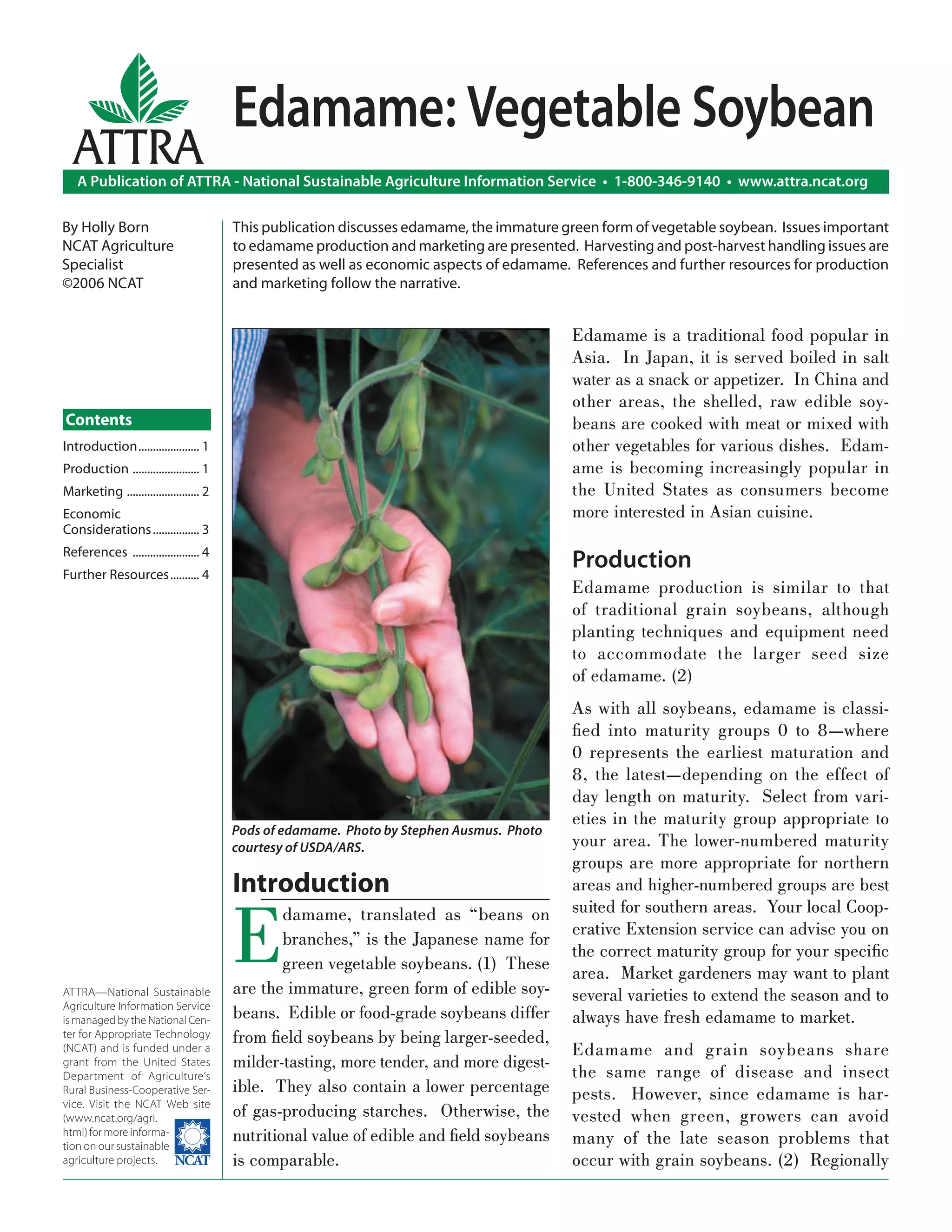
Pods of edamame. Photo by Stephen Ausmus. Photo
courtesy of USDA/ARS.
Introduction..................... 1
Production ....................... 1
Marketing ......................... 2
Economic
Considerations................ 3
References ....................... 4
Further Resources.......... 4
A Publication of ATTRA - National Sustainable Agriculture Information Service • 1-800-346-9140 • www.attra.ncat.org
ATTRA—National Sustainable
Agriculture Information Service
is managed by the National Cen-
ter for Appropriate Technology
(NCAT) and is funded under a
grant from the United States
Department of Agriculture’s
Rural Business-Cooperative Ser-
vice. Visit the NCAT Web site
(www.ncat.org/agri.
html) for more informa-
tion on our sustainable
agriculture projects. ����
ATTRA
Contents
By Holly Born
NCAT Agriculture
Specialist
©2006 NCAT
Edamame: Vegetable Soybean
This publication discusses edamame, the immature green form of vegetable soybean. Issues important
to edamame production and marketing are presented. Harvesting and post-harvest handling issues are
presented as well as economic aspects of edamame. References and further resources for production
and marketing follow the narrative.
Page 2 ATTRA Edamame: Vegetable Soybean
specific production and marketing resources
are listed in Further Resources.
Harvest and Handling
Edamame is harvested 99 to 120 days
from planting, which can fit well into exist-
ing crop rotation patterns. Hand harvest-
ing is preferred, but is costly. Equipment
to harvest edamame differs from that used
for other soybeans. Edamame may be har-
vested with the same equipment used for
green beans, although this can cause bruis-
ing and reduce marketable yield. A fresh
bean harvester causes approximately 24
percent loss and 5 percent bruising. (5)
Timing of the fresh edamame harvest
is a critical factor in determining con-
sumer acceptability and marketability. The
harvest window for edamame is very
short—only a few days. The optimum
time to harvest edamame is when the pods
are still green, immature, and tight with
fully developed immature green seeds, usu-
ally at 85 percent pod fill. Chilling beans
for 3 to 10 hours after harvest helps pre-
serve quality. (3)
The appearance of the pod is extremely
important in the Asian market. The high-
est prices are paid for bright green pods
about 2.5 inches long and covered with
fine, white or very light brown hairs, with
two or more bright green seeds with light-
colored hilum. (4) Blemished or damaged
pods and those with only one seed are
not acceptable. (2)
Organic Production
Many companies offer organic edamame
products. See www.soyfoods.org/products/
lists/retail_soybeans.html for a complete list-
ing. Since organic production of edam-
ame soybeans is much the same as organic
production of grain soybeans, request the
ATTRA publication Organic Soybean Pro-
duction for comprehensive information.
Marketers need to determine whether
organic certification will add value to their
edamame. Direct marketers can simply
talk to their customers to determine how
much value would be added by organic
certification. Indirect marketers can begin
investigating potential markets and buyers
in the Organic Trade Association’s Organic
Pages Online directory at www.ota.com.
For more information, request the ATTRA
publication Organic Marketing Resources.
Marketing
Edamame is marketed in three main
ways. (5)
Whole plants: Fresh beans are har-
vested by cutting the entire plant
at about two inches and bunching
stalks together in groups of four to
six plants. The top leaves and small
damaged pods are removed, while
whole plants with leaves, pods,
stems, and roots are packed in bun-
dles or in 25-pound wooden boxes
or cartons. This form is considered
the most desirable and brings the
highest prices, since Japanese con-
sumers believe this method best
preserves pod quality. (2)
Pod only: Marketable pods are
removed from the stalks and packed
and marketed in plastic net bags.
To maintain freshness, speedy har-
vesting and packaging is crucial.
Bean only: Beans are shelled and
marketed fresh or—more often in
the U.S.—frozen.
Edamame is also sometimes marketed as
bunches of beans in pods, called “hands.”
In the U.S., edamame is currently becom-
ing more popular, especially along the West
Coast, and seems to be moving from spe-
cialty to mainstream status. (4)
While frozen edamame imports into the
U.S. have grown rapidly since the 1990s,
very little frozen edamame is produced in
the United States. (2) Production is con-
centrated around the only two processors of
frozen edamame: Sunrich Foods in Minne-
sota and Seapoint Farms in California. (2)
Food brokers identify fresh edamame as the
highest in demand and hardest to find, due
to its seasonal and local market only. (2)
There are probably fewer than 100 acres
•
•
•
Related ATTRA
Publications
Organic Soybean
Production
Organic Marketing
Resources
Edible Soybean
Production and
Marketing
Page 3ATTRAwww.attra.ncat.org
farmed for fresh market sale of edamame
in the U.S.
Producers need to consider which mar-
kets to target. Japanese consumers pre-
fer edamame on the stalk or in-pod, while
fresh shelled beans are preferred by Chi-
nese consumers. Small-scale producers
will probably want to target fresh markets,
since setups to produce shelled beans may
be expensive. Freshness of produce is the
key to gaining the Chinese market. Experts
recommend limiting the market radius to
about 200 miles to ensure freshness. (4)
Economic Considerations
Research in Kentucky indicates break-even
prices for fresh edamame at about $22 per
20- to 25-pound box of fresh edamame,
which is considerably higher than current
frozen wholesale edamame prices. (6) This
high break-even price is due to high labor
costs to both harvest and pack fresh mar-
ket edamame. (6) Evidence suggests that
considerable value is added by marketing
on-stalk to a strong Japanese market base.
Marketing the whole plant (bunched on
the stalk) requires the least amount of time
and labor. (7)
The Kentucky researchers found that har-
vesting (especially when hand labor is used)
and post-harvest handling are the main
costs to edamame production.
For small-scale production, hand harvest is
the most viable technique. Machine har-
vest, however, is definitely more economi-
cal; some estimates indicate machine harvest
can cut edamame production costs by up to
25 percent. Total expenses per acre, includ-
ing fixed costs, are projected to be $6,750
to $11,250. Edamame has the potential to
return $400 to $1,300 per acre to land and
management on the fresh, wholesale market.
For those producers with access to a direct
local market for fresh edamame, returns can
reach $2,500 per acre. (6)
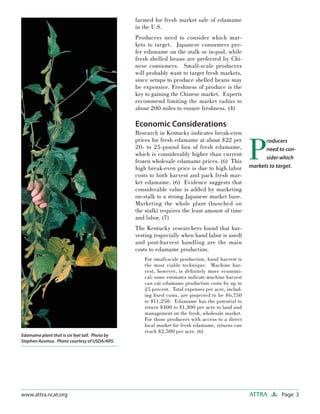
Edamame plant that is six feet tall. Photo by
Stephen Ausmus. Photo courtesy of USDA/ARS.
P
roducers
need to con-
sider which
markets to target.
References
Killeen, Jo Anne. 2000. Beyond Organic: Entre-
preneurial Family Builds On Its Past. In Busi-
ness. July-August. p. 15.
Ernst, Matt. 2001. Edamame Marketing Fact
Sheet. Cooperative Extension Service, Univer-
sity of Kentucky. March. p. 1.
Delate, K., H. Friedrich, B. Burcham, W. Fehr,
and L. Wilson. 2003. Edamame (Vegetable
Soybean) Variety Trial: IDALS Specialty Grant
Program-2002. Annual Research Reports-
2002. Armstrong Research and Demonstration
Farm, Iowa State University, Ames, IA. p. 1.
Mentreddy, S.R., A.I. Mohamed, N. Joshee, and
A.K. Yadav. 2002. Edamame: A nutritious
vegetable crop. p. 432–438. In: J. Janick and
A. Whipkey (eds.), Trends in new crops and
new uses.
Nguyen, Vong Q. 2001. Edamame (vegetable
green soybean). p. 49-56. In: The New Rural
Industries: A handbook for Farmers and Inves-
tors. Rural Industries Research & Develop-
ment Corporation (Australia).
Ernst, Matt, and Tim Woods. 2001. Marketing
Challenges for Emerging Crops in Kentucky:
Vegetable Soybeans. Presented at the Second
International Vegetable Soybean Conference in
Tacoma, WA. August. 4 p.
Ernst, Matt. 2001. 2001 Edamame Marketing
Fact Sheet. Cooperative Extension Service,
University of Kentucky. October. 2 p.
Further Resources
Woods, Tim, and Matt Ernst. 2003. Challenges for
Marketing New Crops in Kentucky: Edamame. New
Crop Opportunities Research Report PR-483. New
Crop Opportunities Center, University of Kentucky.
4 p.
The Rodale Institute’s New Farm Web site at
www.newfarm.org offers some information on edam-
ame (search on “edamame”) from farmers in different
areas of the country.
Several different varieties of edamame seed are
described on Evergreen Seeds’ Web site.
www.evergreenseeds.com/evergreenseeds/edsoyed.html
1.
2.
3.
4.
5.
6.
7.
Southeast
University of Kentucky’s Edamame Information
www.uky.edu/Ag/HortBiz/edamame.html
Northwest
Washington State University’s Edamame Site
www.edamame.wsu.edu
West
Colorado State’s Edamame Information
www.colostate.edu/Depts/SoilCrop/extension/
Newsletters/1999/JAN99.PDF
University of California Central Coast Region
Edamame Information
www.sbceo.k12.ca.us/~uccesb1/sf8.htm
Midwest
Iowa State’s Organic Edamame Information
http://extension.agron.iastate.edu/organicag/
researchreports/nkedamame02.pdf
Northeast
Penn State’s Edamame Research
www.ams.usda.gov/tmd/FSMIP/FY2002/PA0375.htm
A great series on marketing edamame to chefs is avail-
able in Penn State’s Vegetable Gazette newsletters for
2005, which can be found at
http://hortweb.cas.psu.edu/extension/vegcrops/
newsletterlist.html
Page 4 ATTRA
Edamame: Vegetable Soybean
By Holly Born
NCAT Agriculture Specialist
©2006 NCAT
Paul Driscoll, Editor
Cynthia Arnold, Production
This publication is available on the Web at:
www.attra.ncat.org/attra-pub/edamame.html
and
www.attra.ncat.org/attra-pub/PDF/edamame.pdf
IP286
Slot 285
Version 060706

Edamame: Vegetable Soybean

  • 1.
    Introduction E damame, translated as“beans on branches,” is the Japanese name for green vegetable soybeans. (1) These are the immature, green form of edible soy- beans. Edible or food-grade soybeans differ from field soybeans by being larger-seeded, milder-tasting, more tender, and more digest- ible. They also contain a lower percentage of gas-producing starches. Otherwise, the nutritional value of edible and field soybeans is comparable. Edamame is a traditional food popular in Asia. In Japan, it is served boiled in salt water as a snack or appetizer. In China and other areas, the shelled, raw edible soy- beans are cooked with meat or mixed with other vegetables for various dishes. Edam- ame is becoming increasingly popular in the United States as consumers become more interested in Asian cuisine. Production Edamame production is similar to that of traditional grain soybeans, although planting techniques and equipment need to accommodate the larger seed size of edamame. (2) As with all soybeans, edamame is classi- fied into maturity groups 0 to 8—where 0 represents the earliest maturation and 8, the latest—depending on the effect of day length on maturity. Select from vari- eties in the maturity group appropriate to your area. The lower-numbered maturity groups are more appropriate for northern areas and higher-numbered groups are best suited for southern areas. Your local Coop- erative Extension service can advise you on the correct maturity group for your specific area. Market gardeners may want to plant several varieties to extend the season and to always have fresh edamame to market. Edamame and grain soybeans share the same range of disease and insect pests. However, since edamame is har- vested when green, growers can avoid many of the late season problems that occur with grain soybeans. (2) Regionally Pods of edamame. Photo by Stephen Ausmus. Photo courtesy of USDA/ARS. Introduction..................... 1 Production ....................... 1 Marketing ......................... 2 Economic Considerations................ 3 References ....................... 4 Further Resources.......... 4 A Publication of ATTRA - National Sustainable Agriculture Information Service • 1-800-346-9140 • www.attra.ncat.org ATTRA—National Sustainable Agriculture Information Service is managed by the National Cen- ter for Appropriate Technology (NCAT) and is funded under a grant from the United States Department of Agriculture’s Rural Business-Cooperative Ser- vice. Visit the NCAT Web site (www.ncat.org/agri. html) for more informa- tion on our sustainable agriculture projects. ���� ATTRA Contents By Holly Born NCAT Agriculture Specialist ©2006 NCAT Edamame: Vegetable Soybean This publication discusses edamame, the immature green form of vegetable soybean. Issues important to edamame production and marketing are presented. Harvesting and post-harvest handling issues are presented as well as economic aspects of edamame. References and further resources for production and marketing follow the narrative.
  • 2.
    Page 2 ATTRAEdamame: Vegetable Soybean specific production and marketing resources are listed in Further Resources. Harvest and Handling Edamame is harvested 99 to 120 days from planting, which can fit well into exist- ing crop rotation patterns. Hand harvest- ing is preferred, but is costly. Equipment to harvest edamame differs from that used for other soybeans. Edamame may be har- vested with the same equipment used for green beans, although this can cause bruis- ing and reduce marketable yield. A fresh bean harvester causes approximately 24 percent loss and 5 percent bruising. (5) Timing of the fresh edamame harvest is a critical factor in determining con- sumer acceptability and marketability. The harvest window for edamame is very short—only a few days. The optimum time to harvest edamame is when the pods are still green, immature, and tight with fully developed immature green seeds, usu- ally at 85 percent pod fill. Chilling beans for 3 to 10 hours after harvest helps pre- serve quality. (3) The appearance of the pod is extremely important in the Asian market. The high- est prices are paid for bright green pods about 2.5 inches long and covered with fine, white or very light brown hairs, with two or more bright green seeds with light- colored hilum. (4) Blemished or damaged pods and those with only one seed are not acceptable. (2) Organic Production Many companies offer organic edamame products. See www.soyfoods.org/products/ lists/retail_soybeans.html for a complete list- ing. Since organic production of edam- ame soybeans is much the same as organic production of grain soybeans, request the ATTRA publication Organic Soybean Pro- duction for comprehensive information. Marketers need to determine whether organic certification will add value to their edamame. Direct marketers can simply talk to their customers to determine how much value would be added by organic certification. Indirect marketers can begin investigating potential markets and buyers in the Organic Trade Association’s Organic Pages Online directory at www.ota.com. For more information, request the ATTRA publication Organic Marketing Resources. Marketing Edamame is marketed in three main ways. (5) Whole plants: Fresh beans are har- vested by cutting the entire plant at about two inches and bunching stalks together in groups of four to six plants. The top leaves and small damaged pods are removed, while whole plants with leaves, pods, stems, and roots are packed in bun- dles or in 25-pound wooden boxes or cartons. This form is considered the most desirable and brings the highest prices, since Japanese con- sumers believe this method best preserves pod quality. (2) Pod only: Marketable pods are removed from the stalks and packed and marketed in plastic net bags. To maintain freshness, speedy har- vesting and packaging is crucial. Bean only: Beans are shelled and marketed fresh or—more often in the U.S.—frozen. Edamame is also sometimes marketed as bunches of beans in pods, called “hands.” In the U.S., edamame is currently becom- ing more popular, especially along the West Coast, and seems to be moving from spe- cialty to mainstream status. (4) While frozen edamame imports into the U.S. have grown rapidly since the 1990s, very little frozen edamame is produced in the United States. (2) Production is con- centrated around the only two processors of frozen edamame: Sunrich Foods in Minne- sota and Seapoint Farms in California. (2) Food brokers identify fresh edamame as the highest in demand and hardest to find, due to its seasonal and local market only. (2) There are probably fewer than 100 acres • • • Related ATTRA Publications Organic Soybean Production Organic Marketing Resources Edible Soybean Production and Marketing
  • 3.
    Page 3ATTRAwww.attra.ncat.org farmed forfresh market sale of edamame in the U.S. Producers need to consider which mar- kets to target. Japanese consumers pre- fer edamame on the stalk or in-pod, while fresh shelled beans are preferred by Chi- nese consumers. Small-scale producers will probably want to target fresh markets, since setups to produce shelled beans may be expensive. Freshness of produce is the key to gaining the Chinese market. Experts recommend limiting the market radius to about 200 miles to ensure freshness. (4) Economic Considerations Research in Kentucky indicates break-even prices for fresh edamame at about $22 per 20- to 25-pound box of fresh edamame, which is considerably higher than current frozen wholesale edamame prices. (6) This high break-even price is due to high labor costs to both harvest and pack fresh mar- ket edamame. (6) Evidence suggests that considerable value is added by marketing on-stalk to a strong Japanese market base. Marketing the whole plant (bunched on the stalk) requires the least amount of time and labor. (7) The Kentucky researchers found that har- vesting (especially when hand labor is used) and post-harvest handling are the main costs to edamame production. For small-scale production, hand harvest is the most viable technique. Machine har- vest, however, is definitely more economi- cal; some estimates indicate machine harvest can cut edamame production costs by up to 25 percent. Total expenses per acre, includ- ing fixed costs, are projected to be $6,750 to $11,250. Edamame has the potential to return $400 to $1,300 per acre to land and management on the fresh, wholesale market. For those producers with access to a direct local market for fresh edamame, returns can reach $2,500 per acre. (6) Edamame plant that is six feet tall. Photo by Stephen Ausmus. Photo courtesy of USDA/ARS. P roducers need to con- sider which markets to target.
  • 4.
    References Killeen, Jo Anne.2000. Beyond Organic: Entre- preneurial Family Builds On Its Past. In Busi- ness. July-August. p. 15. Ernst, Matt. 2001. Edamame Marketing Fact Sheet. Cooperative Extension Service, Univer- sity of Kentucky. March. p. 1. Delate, K., H. Friedrich, B. Burcham, W. Fehr, and L. Wilson. 2003. Edamame (Vegetable Soybean) Variety Trial: IDALS Specialty Grant Program-2002. Annual Research Reports- 2002. Armstrong Research and Demonstration Farm, Iowa State University, Ames, IA. p. 1. Mentreddy, S.R., A.I. Mohamed, N. Joshee, and A.K. Yadav. 2002. Edamame: A nutritious vegetable crop. p. 432–438. In: J. Janick and A. Whipkey (eds.), Trends in new crops and new uses. Nguyen, Vong Q. 2001. Edamame (vegetable green soybean). p. 49-56. In: The New Rural Industries: A handbook for Farmers and Inves- tors. Rural Industries Research & Develop- ment Corporation (Australia). Ernst, Matt, and Tim Woods. 2001. Marketing Challenges for Emerging Crops in Kentucky: Vegetable Soybeans. Presented at the Second International Vegetable Soybean Conference in Tacoma, WA. August. 4 p. Ernst, Matt. 2001. 2001 Edamame Marketing Fact Sheet. Cooperative Extension Service, University of Kentucky. October. 2 p. Further Resources Woods, Tim, and Matt Ernst. 2003. Challenges for Marketing New Crops in Kentucky: Edamame. New Crop Opportunities Research Report PR-483. New Crop Opportunities Center, University of Kentucky. 4 p. The Rodale Institute’s New Farm Web site at www.newfarm.org offers some information on edam- ame (search on “edamame”) from farmers in different areas of the country. Several different varieties of edamame seed are described on Evergreen Seeds’ Web site. www.evergreenseeds.com/evergreenseeds/edsoyed.html 1. 2. 3. 4. 5. 6. 7. Southeast University of Kentucky’s Edamame Information www.uky.edu/Ag/HortBiz/edamame.html Northwest Washington State University’s Edamame Site www.edamame.wsu.edu West Colorado State’s Edamame Information www.colostate.edu/Depts/SoilCrop/extension/ Newsletters/1999/JAN99.PDF University of California Central Coast Region Edamame Information www.sbceo.k12.ca.us/~uccesb1/sf8.htm Midwest Iowa State’s Organic Edamame Information http://extension.agron.iastate.edu/organicag/ researchreports/nkedamame02.pdf Northeast Penn State’s Edamame Research www.ams.usda.gov/tmd/FSMIP/FY2002/PA0375.htm A great series on marketing edamame to chefs is avail- able in Penn State’s Vegetable Gazette newsletters for 2005, which can be found at http://hortweb.cas.psu.edu/extension/vegcrops/ newsletterlist.html Page 4 ATTRA Edamame: Vegetable Soybean By Holly Born NCAT Agriculture Specialist ©2006 NCAT Paul Driscoll, Editor Cynthia Arnold, Production This publication is available on the Web at: www.attra.ncat.org/attra-pub/edamame.html and www.attra.ncat.org/attra-pub/PDF/edamame.pdf IP286 Slot 285 Version 060706