Volume 3 | Issue 11
September-2017
RNI No.: HARENG/2014/61357Price: 75/- Postal No. PKL-212/2015-2017
FeedTechExpo 2018Animal Feed Technology
08-09-10 FEBRUARY 2018
Auto Cluster Exhibition Centre, Pune, India
BUSINESS PLATFORM FOR FEED INDUSTRY
www.feedtechexpo.com
ORGANIZERFor exhibition and sponsor opportunities
Prachi Arora
M: +91 8607 463377 / 3366 / 3355 | e: feedtechexpo@gmail.com
BENISON Media
SCO 17, 2nd Floor, Mugal Canal Market, Karnal-132001, Haryana
Ph: +91 184 4047817 | e: info@benisonmedia.com
JOIN US
@feedtechexpo
Published by
BENISON Media
SCO 17, 2nd Floor, Mugal Canal Market
Karnal - 132001 (Haryana)
Tel: +91 184 4047817
info@thinkgrainthinkfeed.co.in
Publisher & Editor
Prachi Arora
prachi.a@thinkgrainthinkfeed.co.in
Monthly Magazine for Feed Technology
EDITORIAL COMMITTEE
Marketing & Designing
Ashwani Verma
info@thinkgrainthinkfeed.co.in
Circulation & Subscription Head
Rahul Bhardwaj
info@thinkgrainthinkfeed.co.in
Dr. Dinesh T. Bhosale
Former Chairman, CLFMA of India
Mr. Amit Sachdev
Indian Representative, US Grain Council
Dr. P.E. Vijay Anand
US Soybean Export Council
Dr. Suhas Amrutkar
Subject Matter Specialist, Animal Nutrition,
MAFSU, Parbhani
Dr. SN Mohanty
Former Principal Scientist, CIFA
Dr. Meeta Punjabi Mehta
Agricultural Economist
Dr. Swamy Haladi
Feed Additive Expert
Dr. R Gnana Sekar
Lead Consultant, GS Dairy Farm Consulting
Dr. Suraj Amrutkar
Assistant Professor, Dept. of ILFC,
SKUAST-J, Jammu
www.thinkgrainthinkfeed.co.in
www.benisonmedia.com
Managing Editor
Dr. T.K. Walli
Former Head,
Dairy Cattle Nutrition, NDRI
EDITORIAL
ndian maize prices remain comparatively
stable, and could show a downward trend for
Isome time, till the new crop comes in the
market. By and large rains have been normal, but there was some
deficit in the corn-belt. The maize sowing too has been lagging behind
by 5.93%, towards the last week of August., 7.799 million ha, as
compared to .291 million ha last year, which is also bound to affect
overall productivity. Reduction in corn prices lead to stable DDGS
prices, while the SBM prices have been moving up steadily. US,
especially Texas which was hit by Hurrican Harvey, has not affect the
corn crop. Right now the prices are stable. If there is an export demand,
then the prices may go up.
A wonder grass for the tropical ( Arid/ Semi Arid) regions
Little-known wild perennial grass could be a double blessing to
farmers in arid areas, not just for their crops, but also for their livestock.
Research by the International Livestock Research Institute (ILRI) and the
Kenya Agricultural Livestock Research Organisation (Kalro), shows that
the grass called brachiaria, fixes minerals in the soil that are crucial for
plant health. These minerals including nitrogen, phosphorous and
carbon, are often lacking in arid areas. Not only is this grass good for
plants, it is also a resilient feed for livestock in arid lands where farmers
often lose their livestock during periods of drought, due to lack of
pasture. The other good traits of this grass are that the grass is disease-
and drought-resistant. Brachiaria has been used to transform livestock
production in South America. However, despite the immense benefits
it demonstrated in that region, the true potential of this grass is yet to
be realized in its motherland, Africa.”Brachiaria looks like napier grass,
which is commonly used by Kenyan farmers as feed, but it grows taller
and produces seeds unlike napier grass. Napier grass is also prone to
diseases, unlike the resilient brachiaria. Being perennial, the wild grass
can be harvested four months after planting, and then onwards can be
harvested every two months, and can live as long as 10 years. It
produces 19 tonnes of green fodder per acre, and about nine tonnes
after drying. The Food and Agriculture Organisation has estimated that
70 per cent of livestock is reared on this barren lands. These dry lands
are only famous for nomadic pastoralism, not for crop production, The
low amount of rainfall they receive as well as soil erosion, makes
agriculture unsustainable in arid areas. The traits possessed by the
Brachiaria grass make it a potential “saviour” for arid areas. Since India
has a vast stretch of arid and semi arid regions in the country. It is time
that our fodder specialists should try to procure/ import the best
quality seeds from Africa, through the good offices of International
Livestock Research Institute, Kenya, and try to propagate the
cultivation of this wonder grass in the arid and semi arid regions of the
country.
TK Walli
Think Grain Think Feed - Volume 3 | Issue 11 | Sep 2017
Present trend in
maize prices
Printed by: Jaiswal Printing Press | Published by: On behalf of: BENISON Media | Printed at: Chaura Bazar, Karnal-132001,
Haryana | Published at: SCO-17, 2nd Floor, Mugal Canal Market, Karnal-132001, Haryana | Editor: Prachi Arora
Prachi Arora |
Monthly Magazine for Feed & Feed Technology
Vollume 1 | Issue 10 | August 2015
Think Grain Think Feed is a monthly magazine published by BENISON Media at its office in Karnal. Editorial
policy is independent. Views expressed by authors are not necessarily those held by the editors. The
data/information provided in the magazine is sourced through various sources and the publisher considers its
sources reliable and verifies as much data as possible. However, the publisher accepts no liability for the
material herein and consequently readers using this information do so at their own risk.
Although persons and companies mentioned herein are believed to be reputable, neither BENISON Media, nor
any of its employees or contributors accept any responsibility whatsoever for such persons’ and companies’
activities. All legal matters are subjected to Karnal Jurisdiction.
Contents
Think Grain Think Feed - Volume 3 | Issue 11 | Sep 2017
Front Cover: Ethanol Producer Magazine & Pinterest
SUBSCRIPTION INFORMATION:
Simple Post Courier Overseas
One Year : INR 1200 INR 1800 USD 300
Three Year : INR 3300 INR 4800 USD 900
Five Year : INR 5200 INR 6500 USD 1500
Disclaimer :
info@thinkgrainthinkfeed.co.in. BENISON Media or Think Grain Think Feed is not liable for any claim prior to written information.
The published material and images are sourced from various websites and newspapers, and used for information purpose only, if you have any issue, please inform us at
RESEARCH & DEVELOPMENT
05
ARTICLE
EVENT CALENDAR - 30
MARKET PROJECTION EVENT COVERAGE
Brachiaria: Wonder grass holds
key to drought-resistant animal feed
Price forecast for maize & DDGS
08
12
Methionine–Underlying
opportunities in Asian economies
06
Grain chiller: the importance
of technology for Feed industry
Energy: the key factor for
efficient milk production
16
20
INTERVIEW
26 Key discussions at 6th
AGM of INFAH
UPCOMING EVENTS
26-28 October
2017
27-29 September
2017
Da ryINDUSTRY EXP 2017
The Farming & Processing Event
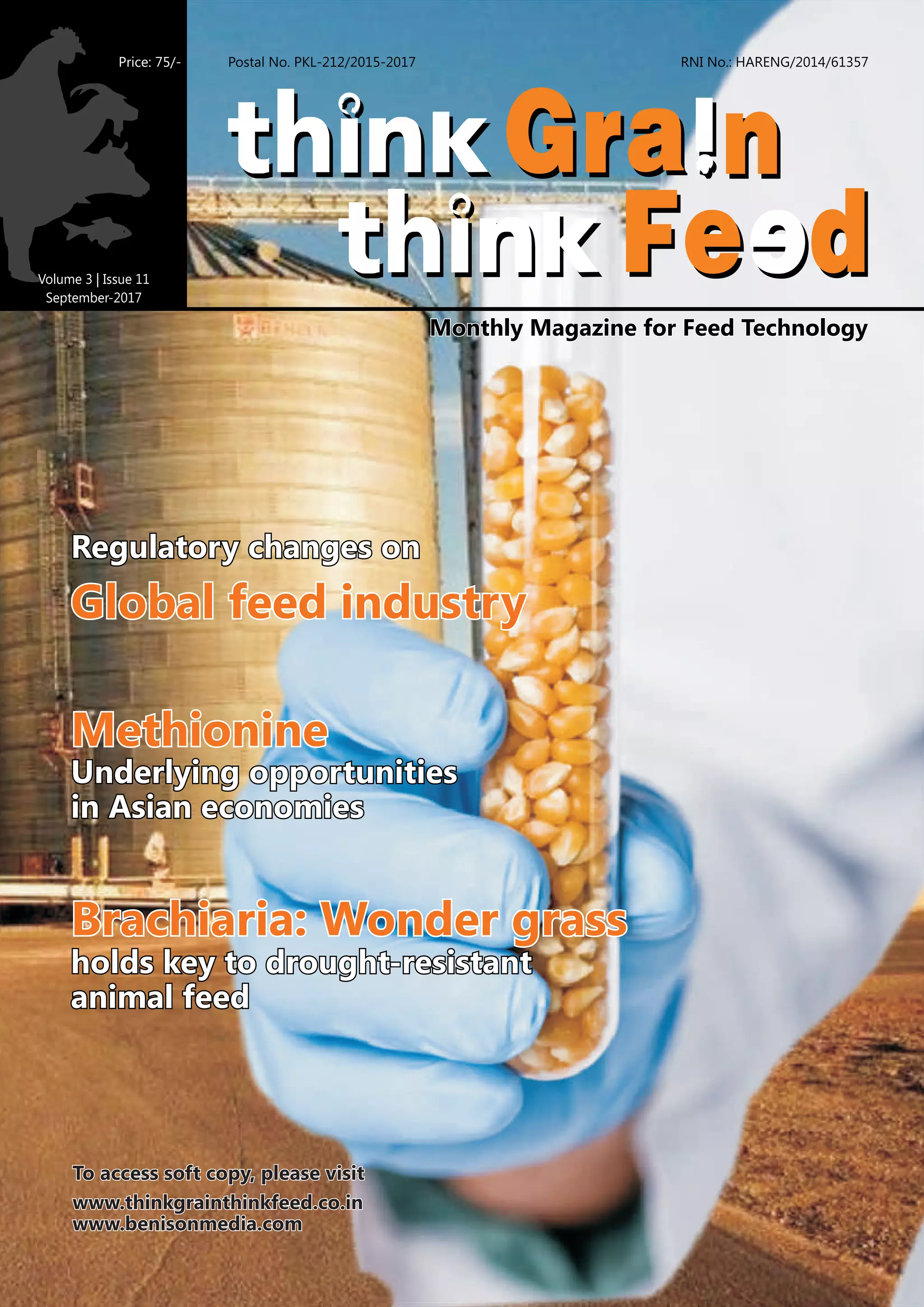
Regulatory changes on
Global feed industry
It produces 19 tonnes of green fodder
per acre, and about nine tonnes after
drying.
As sub-Saharan Africa's climate
changes, small-scale farmers are
increasingly looking to innovative ways
of dealing with agricultural challenges.
And in some instances, the techniques
they adopt are helping to combat
climate change, too.
Alternative animal feed, climate-friendly
grasses and the use of fodder trees are
among the examples providing farmers
resilience and leading to benefits such
as more productive livestock and new
business opportunities -- all while
reducing greenhouse gas emissions
and building healthy soils.
A little-known wild grass could be a
double blessing to farmers in arid areas,
not just for their crops, but also for
their livestock.
Research by the International Livestock
Research Institute (ILRI) and the Kenya
Agricultural Livestock Research
Organisation (Kalro), shows that the
grass called brachiaria, fixes minerals in
R&D
www.benisonmedia.com
05
Brachiaria: Wonder grass holds
key to drought-resistant animal feed
the soil that are crucial for plant health. These minerals
including nitrogen, phosphorous and carbon, are often
lacking in arid areas.
Not only is this grass good for plants, it is also a resilient
feed for livestock in arid lands where farmers often lose
their livestock during periods of drought, due to lack of
pasture.
In an article on ILRI's website, Sita Ghimire, a senior
scientist who led the research, said: Brachiaria has been
used to transform livestock production in South
America. However, despite the immense benefits it
demonstrated in that region, the true potential of this
grass is yet to be realised in its motherland, Africa.”
Brachiaria looks like napier grass, which is commonly
used by Kenyan farmers as feed, but it grows taller and
produces seeds unlike napier grass.
Napier grass is also prone to diseases, unlike the
resilient brachiaria. Previous studies on the wild grass
showed that it is harvested four months after planting,
can be harvested every two months, and can live as
long as 10 years.
It produces 19 tonnes of green fodder per acre, and
about nine tonnes after drying.
These traits make it a potential “saviour” for arid areas
that account for 80 per cent of Kenya's land. These dry
lands are only famous for nomadic pastoralism, not for
crop production, with the Food and Agriculture
ImageSource:agric.wa.gov.au
R&D Think Grain Think Feed - Volume 3 | Issue 11 | Sep 2017
www.thinkgrainthinkfeed.co.in
06
Organisation, estimating that 70 per
cent of livestock is reared on this barren
land.
The low amount of rainfall they receive
as well as soil erosion, makes
agriculture unsustainable in arid areas.
Farmers in these areas also bear the
brunt of the negative effect of climate
change, with their herds of livestock
dying during periods of drought and
famine.
However, with the introduction of
grasses such as brachiaria, the dry lands
hold potential for food security for both
humans and animals.
Since the launch of a project funded by
the Swedish International Development
Cooperation Agency in 2013, four
improved varieties of the grass have
been piloted by Kalro, with positive
results. Counties that were covered
included Kilifi, Malindi, Machakos,
Embu, Meru, Makueni, Uasin Gishu,
Trans Nzoia and Nyandarua, where the
grass aims to increase farmers'
resilience in the face of the effects of devastating
climate change.
Brachiaria's crucial role
! The wild grass is native to Africa and has been
used to transform livestock production in South
America.
! It fixes soil minerals such as nitrogen, phosphorous
and carbon, which are often lacking in arid areas.
! Brachiaria looks like napier grass, but grows taller
and produces seeds which replenish the grass after
harvest.
! The wild grass is disease- and drought-resistant.
! Brachiaria produces 19 tonnes of green fodder per
acre and about nine tonnes after drying.
! Arid lands make up 80 per cent of land in the
country, and livestock farmers found in these
regions need resilient animal feed.
! 90 per cent of livestock is reared in arid areas
where the land is barren.
! Four improved varieties of brachiaria grass have
been planted in various counties for use as fodder
by livestock farmers.
Source: Nation
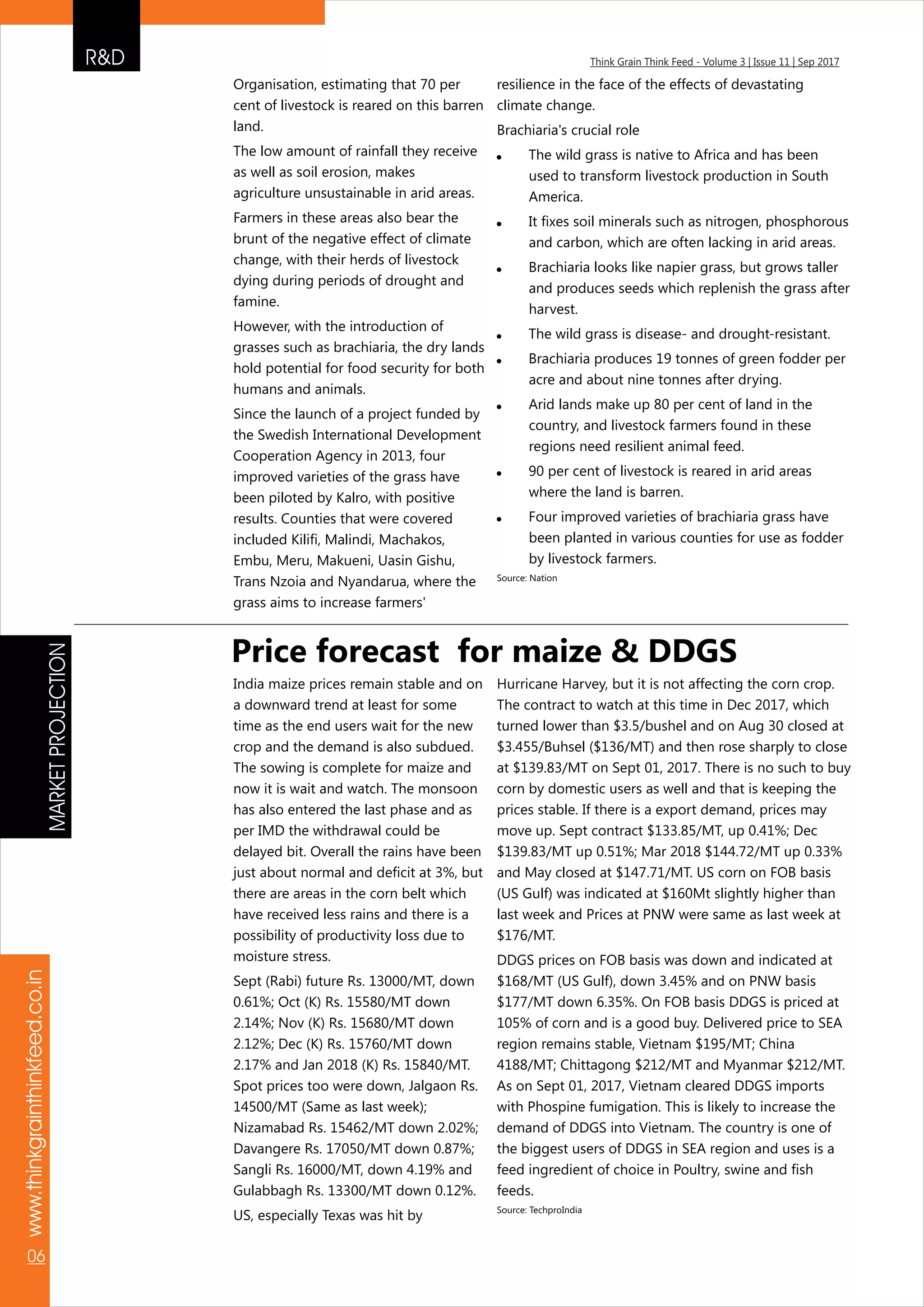
India maize prices remain stable and on
a downward trend at least for some
time as the end users wait for the new
crop and the demand is also subdued.
The sowing is complete for maize and
now it is wait and watch. The monsoon
has also entered the last phase and as
per IMD the withdrawal could be
delayed bit. Overall the rains have been
just about normal and deficit at 3%, but
there are areas in the corn belt which
have received less rains and there is a
possibility of productivity loss due to
moisture stress.
Sept (Rabi) future Rs. 13000/MT, down
0.61%; Oct (K) Rs. 15580/MT down
2.14%; Nov (K) Rs. 15680/MT down
2.12%; Dec (K) Rs. 15760/MT down
2.17% and Jan 2018 (K) Rs. 15840/MT.
Spot prices too were down, Jalgaon Rs.
14500/MT (Same as last week);
Nizamabad Rs. 15462/MT down 2.02%;
Davangere Rs. 17050/MT down 0.87%;
Sangli Rs. 16000/MT, down 4.19% and
Gulabbagh Rs. 13300/MT down 0.12%.
US, especially Texas was hit by
Hurricane Harvey, but it is not affecting the corn crop.
The contract to watch at this time in Dec 2017, which
turned lower than $3.5/bushel and on Aug 30 closed at
$3.455/Buhsel ($136/MT) and then rose sharply to close
at $139.83/MT on Sept 01, 2017. There is no such to buy
corn by domestic users as well and that is keeping the
prices stable. If there is a export demand, prices may
move up. Sept contract $133.85/MT, up 0.41%; Dec
$139.83/MT up 0.51%; Mar 2018 $144.72/MT up 0.33%
and May closed at $147.71/MT. US corn on FOB basis
(US Gulf) was indicated at $160Mt slightly higher than
last week and Prices at PNW were same as last week at
$176/MT.
DDGS prices on FOB basis was down and indicated at
$168/MT (US Gulf), down 3.45% and on PNW basis
$177/MT down 6.35%. On FOB basis DDGS is priced at
105% of corn and is a good buy. Delivered price to SEA
region remains stable, Vietnam $195/MT; China
4188/MT; Chittagong $212/MT and Myanmar $212/MT.
As on Sept 01, 2017, Vietnam cleared DDGS imports
with Phospine fumigation. This is likely to increase the
demand of DDGS into Vietnam. The country is one of
the biggest users of DDGS in SEA region and uses is a
feed ingredient of choice in Poultry, swine and fish
feeds.
Source: TechproIndia
Price forecast for maize & DDGS
MARKETPROJECTION
ARTICLE Think Grain Think Feed - Volume 3 | Issue 11 | Sep 2017
www.thinkgrainthinkfeed.co.in
08
The role of methionine is very vibrant in
the animal poultry market. Methionine is
advantageous as a feed supplement
across the spectrum of livestock
production and particularly in the
poultry segment. The industry is
expected to develop along with the
expansion of world economy and rising
meat consumption.
As per the report of the Food and
Agricultural Policy Research
Institute(2010), the economic growth in
developing economies of Asia are
projected to grow at an average rate of
5.6%. This contrasts with the average
growth in mature countries of 2.2%.
Continued growth from countries such as China, India,
and Rest of Asia makes the region an important part of
the global economy. Asia's share of the world's GDP is
expected to rise to 22% by 2018. China alone will become
more than 10% of the global economy.
Big growth predicted
With a combined population of 1.7 billion or about one
fourth of the world's population, the major countries of
South Asia–India, Pakistan, and Bangladesh as well as the
smaller nations such as Nepal and Sri Lanka, all are
growing at more than 7% of annual average growth rate.
Out of the growing animal feed markets, India is one of
those economies which are experiencing a livestock
revolution. It has long been one of the world's most
undernourished regions in terms of caloric intake and
consumption of animal proteins. With its huge population
Methionine–Underlying
opportunities in Asian
economies
Nishikant Yadav, Markets and Markets
ImageSource:TheMorningCall
www.benisonmedia.com
09
Think Grain Think Feed - Volume 3 | Issue 11 | Sep 2017
and growing middle-class population,
the demand for meat is on the rise, and
hence the industry is demanding
methionine for the production of feed.
Methionine is presently the largest
revenue contributor to the Indian
market, which can be ascribed to its
higher price and growing use in feed
grade amino acids for compound feed
products. The demand for methionine is
dependent upon the proportionate
demand for protein in general and
poultry in particular. The Indian industry
for poultry is expected to grow more
than 9% of the compound annual
growth rate in the coming years.
Rising investments for local
manufacturing
Currently, the usage of DL-Methionine is
flourishing in Asian Economies, particular
in India and is expected to grow fairly for
the next 15 years. However, most Asian
economies are dependent on imports of
methionine to satisfy their demand for
animal feed, owing to lack of production facilities. Lack of
producers in developing nations can be attributed to the
difficulty in adopting overseas technology and the nature
of raw materials such as methyl mercaptan, acrolein, and
hydrogen cyanide.
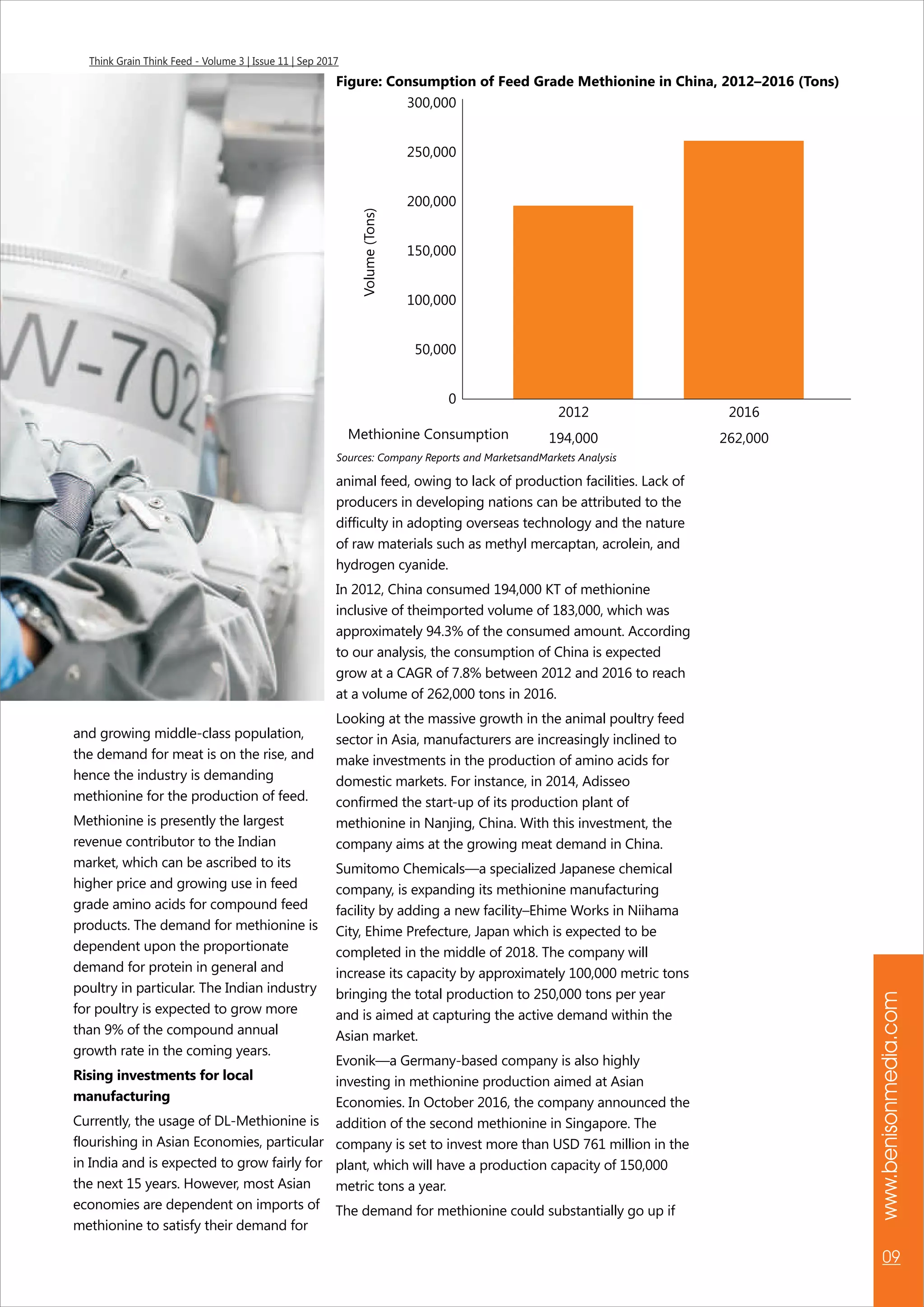
In 2012, China consumed 194,000 KT of methionine
inclusive of theimported volume of 183,000, which was
approximately 94.3% of the consumed amount. According
to our analysis, the consumption of China is expected
grow at a CAGR of 7.8% between 2012 and 2016 to reach
at a volume of 262,000 tons in 2016.
Looking at the massive growth in the animal poultry feed
sector in Asia, manufacturers are increasingly inclined to
make investments in the production of amino acids for
domestic markets. For instance, in 2014, Adisseo
confirmed the start-up of its production plant of
methionine in Nanjing, China. With this investment, the
company aims at the growing meat demand in China.
Sumitomo Chemicals—a specialized Japanese chemical
company, is expanding its methionine manufacturing
facility by adding a new facility–Ehime Works in Niihama
City, Ehime Prefecture, Japan which is expected to be
completed in the middle of 2018. The company will
increase its capacity by approximately 100,000 metric tons
bringing the total production to 250,000 tons per year
and is aimed at capturing the active demand within the
Asian market.
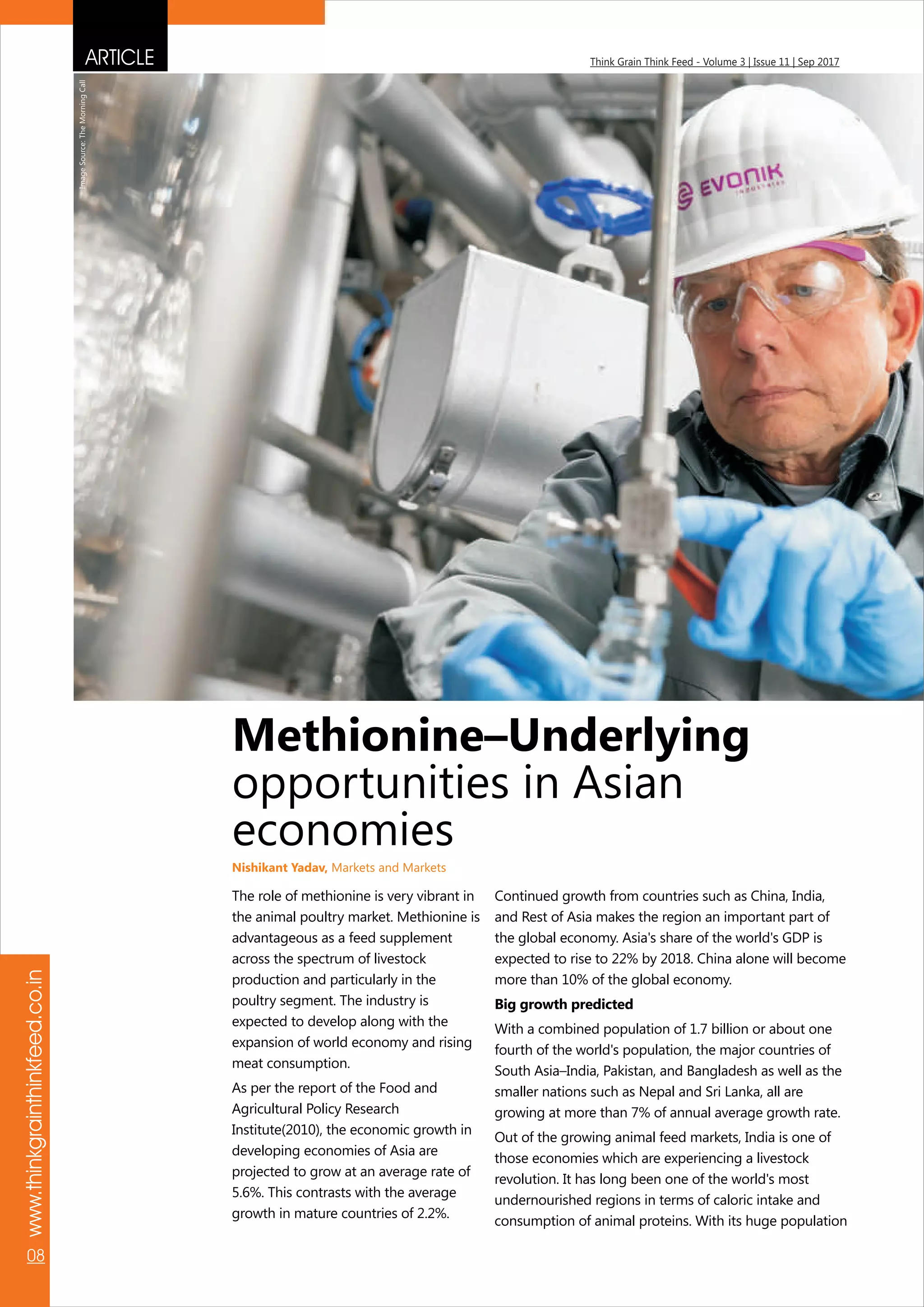
Evonik—a Germany-based company is also highly
investing in methionine production aimed at Asian
Economies. In October 2016, the company announced the
addition of the second methionine in Singapore. The
company is set to invest more than USD 761 million in the
plant, which will have a production capacity of 150,000
metric tons a year.
The demand for methionine could substantially go up if
300,000
250,000
200,000
150,000
100,000
50,000
0
194,000 262,000
20162012
Methionine Consumption
Volume(Tons)
Figure: Consumption of Feed Grade Methionine in China, 2012–2016 (Tons)
Sources: Company Reports and MarketsandMarkets Analysis
the product is readily available in the
Asian market. This brings us to the
conclusion that progress in technology,
rapid population growth, and rising
consumption of meat in the region are
fueling Asia's high demand for
methionine.
What does the future hold for the
Asian Methionine Industry?
One of the most promising and
significant markets of the amino acids
industry is methionine. There are various
factors affecting the production
methionine; right from the technology to
the raw materials used. Thus, currently,
manufacturers are continuing to expand
their market and technology leadership
in methionine with highly efficient, state-
of-the-art production facilities in all
major regions of the world including
developing Asian economies such as China and South
Asia.
Factors such as companies' incorporating sustainable
modern methods of livestock farming, population growth,
and rising purchasing power are boosting the demand for
animal protein, which is subsequently expected to bring
forward the growth in the Asian methionine market.
Interestingly, companies are not only expanding their
production plants but also investing in technologies for
the development of innovative products. The expansion
investment by Evonik last year in Jurong Island
(Singapore), which started in November 2014, is an
integrated production plant which was planned for the
production of MetAMINO (DL-Methionine) and all
necessary precursors. Investments and growth strategies
such as these are focusedon keeping pace with the
growth of the market. Thus, a sustainable and constant
growth is expected from the Asian methionine industry in
the long run especially for newer and enhanced feed
products.
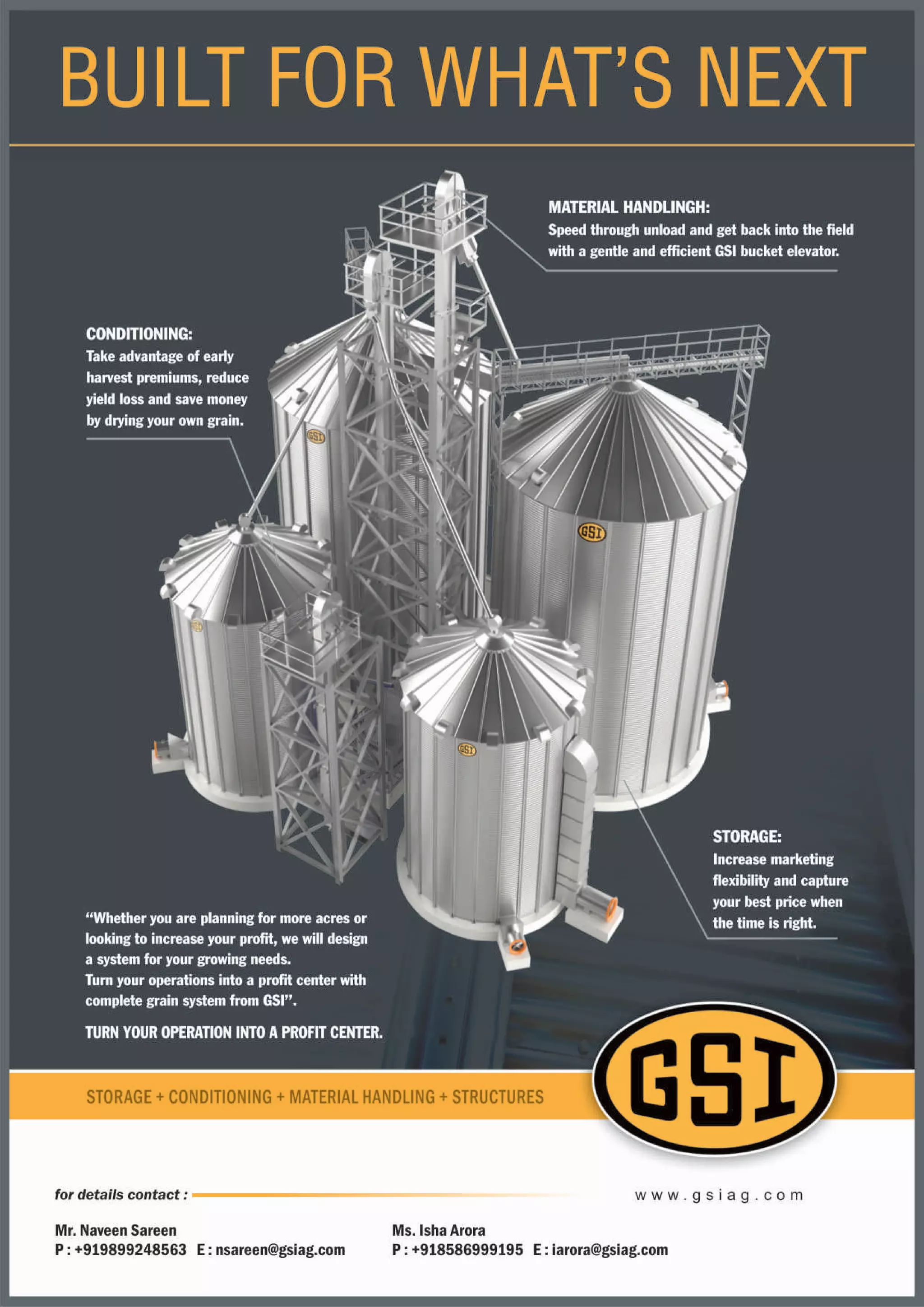
FlexWave: Technology
innovation by GSI
Farmers and commercial grain operations
will soon have an alternative to grain bin
sweeps, brooms and shovels for bin
cleanout with new FlexWave technology
from GSI.
Currently, standard grain bins are emptied
through a combination of gravity and
augers or bin sweep technology. However,
with these methods, there's always a
remaining level of grain on the bin floor
that needs to be swept out. According to
GSI, it's hard, time-consuming, dusty work
that also can be dangerous if this chore is
performed while an auger is still running.
GSI's new, patent-pending FlexWave
technology can eliminate this labor-
intensive task. The system utilizes two
large liners that alternately inflate and
deflate, gently pushing the remaining
grain into a centrally-located conveyor
trough for removal, without the need to
enter the bin. A control system
automatically senses the amount of grain
and shuts off when the process has been
completed.
“FlexWave technology results in 99%
cleanout and eliminates the risk of
entrapment from falling grain or auger
entanglement since it is truly a zero-entry
bin unload method,” said Greg Trame, GSI
director of engineering.
Trame said FlexWave is also more reliable than conventional
methods, since there are no exposed mechanical
components. Another advantage is that perforated bin
floors are eliminated, increasing capacity.
Each inflatable liner can unload more than 100 tons of grain
using less than one psi of air pressure. The liners are
constructed of durable, commercial-grade material
designed to last over 30 years under normal conditions. In
addition, they can easily be repaired in case of accidental
puncture with a simple glue patch because of the system's
low-pressure operation, which is gentler on grain than
traditional options, protecting grain quality and profits.
Traditional grain hopper tanks are emptied by gravity
through a cone at the bottom. With FlexWave, a flat bottom
storage tank may be used instead, which not only increases
capacity but also eliminates the need to install legs since it
can sit on the ground, GSI said.
“FlexWave technology is another unload option added to
company's complete product portfolio and can be used
with any standard current unload system,” Trame said. “This
technology is exclusive to the company for grain storage
and represents an exciting advancement that supports our
commitment to continuous innovation.”
Field trials are under way, he said, to ensure proper aeration
is maintained to provide long-term, safe storage. The first
FlexWave offering is planned for 2018.
Trame noted there is a lot of potential for future
applications with FlexWave, since any equipment that relies
on a hopper cone for gravity-flow cleanout can benefit
from this technology.
ARTICLE Think Grain Think Feed - Volume 3 | Issue 11 | Sep 2017
www.thinkgrainthinkfeed.co.in
10
INDUSTRYNEWS
www.thinkgrainthinkfeed.co.in
12
Jean Fontaine is the founder and president of Jefo, a
global feed additive company headquartered in Canada.
Under his leadership, this year the company is
celebrating 35 years of global growth and innovation.
Jefo is a world leader in the field of non-medicated
performance feed additives for the poultry, swine,
ruminant and aquaculture sectors. Today the company
has offices on 5 continents, and specialises in the design,
manufacturing, warehousing and JIT-distribution of an
array of animal nutrition specialty products.
It was a visit to Europe that propelled Fontaine into
launching his own feed additive business. After working
for a premix company post-graduation from university,
he took a trip on his own to investigate the additives
scenes in Belgium, France, Holland and Germany. A visit
to premix company, Sodial, in France was particularly
important. “When I realised the price difference between
feed additives in Europe and Canada, I quickly realised
there was a huge opportunity. I was very excited, but I
needed to find a way to get some capital to start
importing some products. My brother Michel was of
great help. He endorsed me for CAN$?20,000. He had a
veterinary clinic and laboratory.”
In particular, Mr Fontaine noticed a large cost difference
between Europe and Canada on phosphates and
bicarbonate, and he started to import these ingredients,
competing with established suppliers. “I wanted to help
Think Grain Think Feed - Volume 3 | Issue 11 | Sep 2017
Jean Fontaine, Jefo
www.benisonmedia.com
13
the Canadian feed manufacturers and
premixers to be more competitive,” he
says. “Having worked for the premix
company as a buyer and nutritionist, I
was quite knowledgeable about
selecting ingredients. Having a degree
in nutrition always allowed me to
choose the right additive with good
judgement.”
After starting Jefo in 1982 and receiving
very positive customer feedback, Mr
Fontaine started to look for many more
alternatives to products being offered
by competing suppliers. “I opened our
borders for sourcing ingredients. In
1987, we started to promote the
concept of slow-release nutrients like
amino acids, essential oils, and 'bypass'
amino acids and vitamins for dairy.”
Firstly, on behalf of Think Grain
Think Feed, I would like to
congratulate you for the 35th
anniversary of the company. Could
you please share your thoughts
about the company history and how
you have seen the global feed
industry evolving over last decade?
JEFO has grown over any expectation. The need did not
seem necessary by any industry people, initially. We
forged our place and today, it is well recognized that
JEFO and its philosophy of putting closer suppliers and
customers was needed indeed.
The last 25 years for JEFO doing so much research and
breakthrough discovery in nutrition, allowed JEFO to
become a leader in the feed additive to replace drugs in
feed and protect the environment.
The first Challenge we face is to do more with less.
Improve nutrition effectiveness with always keeping the
health as a parallel is very important to maintain in
permanence. The other main challenge I see, is the
change in the market demand. Consumers are driven
by media and they request specific norms that impose
more challenges to the animal feed industry.
Understanding the behaviour of the micro flora in the
intestine of the animals, all bacterias have a
consumption of vitamins, amino acids, energy for their
growth and they produce toxines or other metabolic
excretions that are beneficial and negative to the
animal.
It is our task to understand and master these micro
organism.
All regulatory changes are established to protect the
consumers for a quality food. Any regulation is
requested to control the promises made by the
suppliers of food to the human. However, the labeling
requirements have been changing dramatically in the
last few years, and this may pose a major problem for
the competitive advantages of companies working on
innovating concepts. Some countries now require a
complete guaranteed analysis of all ingredients.
Companies now need to, in addition to a good
formulation, proprietary production processes to
guarantee their competitiveness in the market.
ASIA is evolving fast. there is a lot of researchers and a
lot of consumers. They can try more and more new
concept faster than we can in Canada for example. We
need to work with them closely for innovation. India has
Could you please share the challenges that are being
faced by Global livestock industry, the theme
around which discussions took place during last
year’s Industry Stakeholders’ Gathering organized
by the company?
In your view, what are the key trends which you
believe may have a big impact on the feed additives
industry moving forward?
Can you please throw some light on regulatory
changes and their implications upon the Global feed
industry?
How do you compare Asian market to developed
market? Where does India stand on the company
radar?
Think Grain Think Feed - Volume 3 | Issue 11 | Sep 2017
INTERVIEW Think Grain Think Feed - Volume 3 | Issue 11 | Sep 2017
www.thinkgrainthinkfeed.co.in
14
the same attitude: curiosity and
innovation.
IT is all with the aim to do more with
less. For example in dairy cows, 5%
According to Markets & Markets
report, feed enzyme market growing
at a rate of 9.3% CAGR, is expected
to reach USD 1428 Million by 2022.
Your comment. What is the species
wise market share of Jefo Group and
also its strength which give the
company an edge over its
competitors?
better feed conversion will mean approx. 500,000 tons
of manure less/year for 1 million cows… Enzyme is the
future and their efficacy has to be monitored. JEFO with
their research station are very actively developping
solutions that will improve the efficacy of feeds.
INDIA is now in the target zone. We are making inroads
to choose the right partner there and share with them
our discoveries.
It is a huge market and they need better efficacy in
nutrition of their chickens and dairy.
What does Jefo look like in 10 years from now in
global and Indian market?
Fishery exports and Least
Developed Countries
Fish is one of the world's most traded
food commodities and, with the global
population growing to an expected 9.7
billion people by 2050, demand for it fish
also expected to increase. That offers
valuable trade opportunities. In addition
to human consumption, industrial need
for fishery resources is projected to rise in
the coming decades due to growing
demand for fish oil and animal feed.
Wild catch alone will not sustain the
increase in demand for fish. There should
be deliberate actions by Least Developed
Countries (LDCs) to enhance aquaculture
development so as to meet the increase.
The UNCTAD study documents that, over
the last three decades, global aquaculture
production has tripled, growing at an
average annual rate of 8.3 per cent. In
2014, aquaculture constituted 46 per cent
of world fish production compared to 26
per cent in 1994.
The fisheries sector is also a viable
alternative to manufacturing as a source
of export-led growth. Developing
countries as a whole have substantially
increased their share in world fishery
exports, from 34.6 per cent in 1981 to 50.2
per cent in 2013. However, despite their
ample fish stocks, not many LDCs have
been able to follow suit, and their share in
global fish exports has only risen
marginally, from 1.6 to 3.5 per cent in the
same period. The work of UNCTAD reveals
that the fishery sector in LDCs remains
predominantly traditional or artisanal.
In its research, UNCTAD presents case
studies of six of the world's 47 LDCs — Bangladesh,
Cambodia, the Comoros , Mozambique, Myanmar and
Uganda — and identifies a series of supply-side and
demand-side challenges undermining the role of their
fishery sectors.
On the supply side, the main challenges are deficient
transportation and storage facilities; poor energy
infrastructure and high electricity costs; a lack of investment,
finance or credit for small operators; overfishing and
depletion of fish resources; water pollution; and a lack of
common fishery policies among countries that share water
resources.
On the demand side, LDC fish products face few or no tariff
barriers in developed country markets. However, the
biggest non-tariff trade barrier for producers and
processors from LDCs are the stringent quality and safety
standards systems imposed on fish products in major
overseas markets, instituted in the 1990s and 2000s.
The study argues that stringent public safety norms are
often compounded by further cumbersome private quality
and safety standards. The confluences of public and private
standards have effectively restricted access to major
importing markets for many LDC fishery exporters.
This is mainly due to the fact that standards are not
harmonized and are costly for LDCs to meet. It is also due
to structural problems in LDCs, including in processing
facilities and procurement methods, as well as a lack of
testing and certification of products throughout the value
chain.
The study provides policy conclusions and
recommendations aimed at helping LDCs to realize the full
development potential of their fisheries sectors, including
the provision of infrastructure, the improvement of
regulatory and institutional capacities, monitoring and
regulation of domestic fishing, and the harmonization of
international standards.
INDUSTRYNEWS
www.benisonmedia.com
15
Think Grain Think Feed - Volume 3 | Issue 11 | Sep 2017
Bühler Insect Technology is
to build first industrial plant
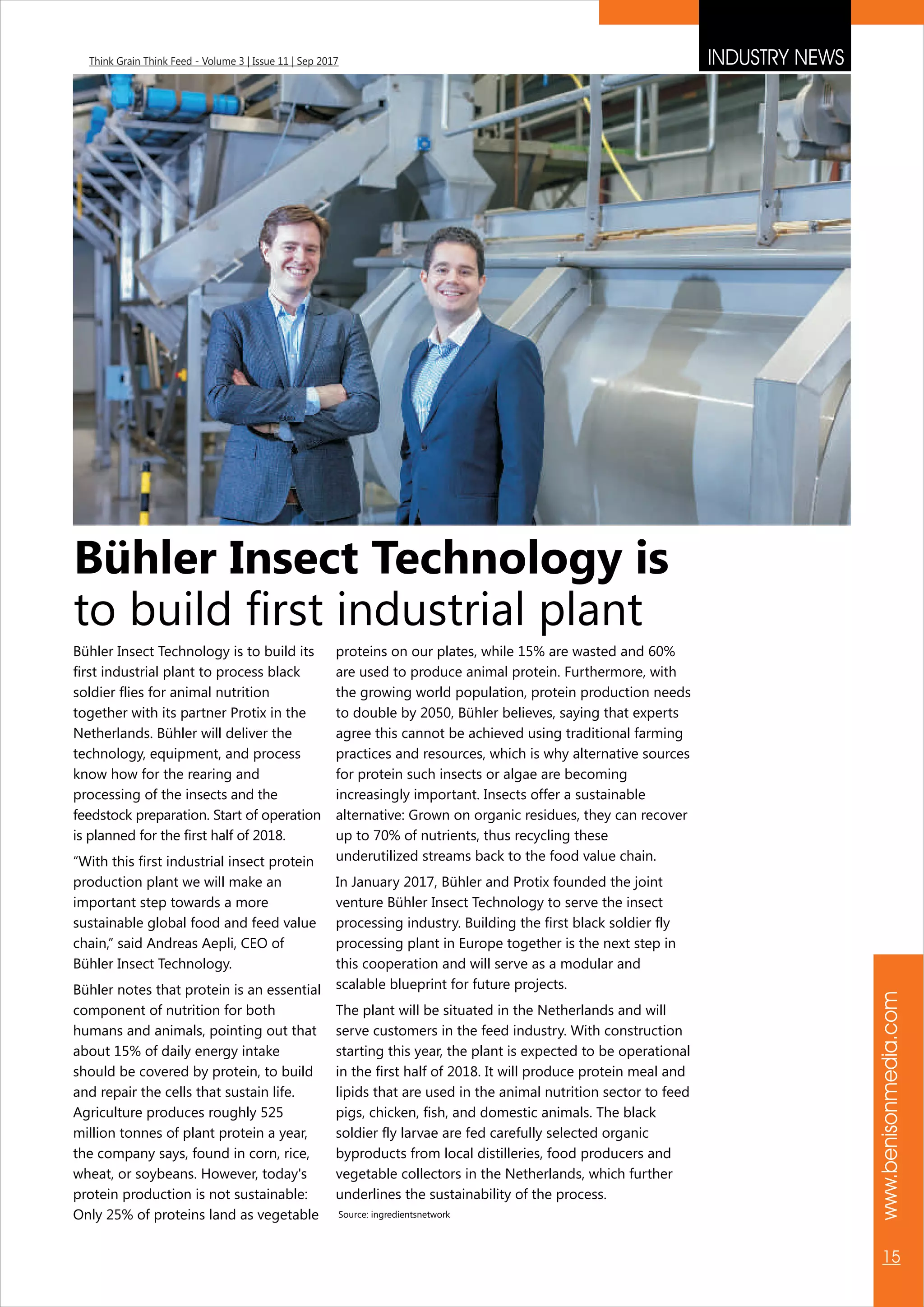
Bühler Insect Technology is to build its
first industrial plant to process black
soldier flies for animal nutrition
together with its partner Protix in the
Netherlands. Bühler will deliver the
technology, equipment, and process
know how for the rearing and
processing of the insects and the
feedstock preparation. Start of operation
is planned for the first half of 2018.
“With this first industrial insect protein
production plant we will make an
important step towards a more
sustainable global food and feed value
chain,” said Andreas Aepli, CEO of
Bühler Insect Technology.
Bühler notes that protein is an essential
component of nutrition for both
humans and animals, pointing out that
about 15% of daily energy intake
should be covered by protein, to build
and repair the cells that sustain life.
Agriculture produces roughly 525
million tonnes of plant protein a year,
the company says, found in corn, rice,
wheat, or soybeans. However, today's
protein production is not sustainable:
Only 25% of proteins land as vegetable
proteins on our plates, while 15% are wasted and 60%
are used to produce animal protein. Furthermore, with
the growing world population, protein production needs
to double by 2050, Bühler believes, saying that experts
agree this cannot be achieved using traditional farming
practices and resources, which is why alternative sources
for protein such insects or algae are becoming
increasingly important. Insects offer a sustainable
alternative: Grown on organic residues, they can recover
up to 70% of nutrients, thus recycling these
underutilized streams back to the food value chain.
In January 2017, Bühler and Protix founded the joint
venture Bühler Insect Technology to serve the insect
processing industry. Building the first black soldier fly
processing plant in Europe together is the next step in
this cooperation and will serve as a modular and
scalable blueprint for future projects.
The plant will be situated in the Netherlands and will
serve customers in the feed industry. With construction
starting this year, the plant is expected to be operational
in the first half of 2018. It will produce protein meal and
lipids that are used in the animal nutrition sector to feed
pigs, chicken, fish, and domestic animals. The black
soldier fly larvae are fed carefully selected organic
byproducts from local distilleries, food producers and
vegetable collectors in the Netherlands, which further
underlines the sustainability of the process.
Source: ingredientsnetwork
INDUSTRY NEWS
ARTICLE
www.thinkgrainthinkfeed.co.in
16
Think Grain Think Feed - Volume 3 | Issue 11 | Sep 2017
Grain chiller: the importance
of technology for Feed industry
Pari Mamallan, GrainTechnik
Feed is a mix of whole or processed
grains & concentrates for all species of
animals, which is now commercially
produced for livestock, poultry, and fish
industries. Corn is the major ingredient
in poultry feed whereas soybean meal
is for cattle feed. The price variation in
feed grain, makes grain storage an
important part of economical
production.
Various factors like demand, quality and
price fluctuation (of approx. 30%
between summer and winter crop),
require the feed producers to store
feed grains for a period of 3-8 months,
especially in India. The corn availability
in India usually is with high moisture
which needs to be dried to approx. 13%
M.C. by electrical, bio fuel or even by
sun drying for safe storage in silos.
Corn behavior in storage bins
Grains are hygroscopic in nature, it gain or lose
moisture, when the vapor pressure of water in the space
surrounding the grain is greater or lesser than the vapor
pressure exerted by the moisture within the grain. (Ref.
Hogan and Karon, 1955)
In simple terms, corn respires and hence releases heat &
moisture while respiration. Typical storage conditions in
a humid & hot tropical country can have ambient
temperatures in the range of 30-40 Deg C while corn
moisture content is 15%. These conditions may lead to
heat generation of about 1MJ/T per day which can
increase eventually. The heat generation causes drying
losses in the grain. In addition to that, insect infestation
is also a consequence of natural heat generation.
Dryers may not equalize variability; aeration by ambient
air may develop moisture variation among kernels.
Moisture variation results in shorter shelf life and bigger
storage risk.
As the shelf life of the corn is temperature dependent,
therefore, it is important to bring down the temperature
to 10-18 Deg C as soon as possible. A delay of a month
ImageSource:FrigorTec
www.benisonmedia.com
17
Think Grain Think Feed - Volume 3 | Issue 11 | Sep 2017
in the cooling process can substantially reduce the shelf
life and hence the grain is more prone to future
spoilage.
Molds in the grain are known to produce mycotoxins
under specific unsafe conditions of temperature and
humidity. An increase in CO2 can indicate unwanted
biological activity that is caused by fungus, insects or
other infestations in the grain.
Corn quality management
It is known that ambient temperature and relative
humidity influence the corn activity in the silo. Cooling
the grain by a grain chiller can simply put an end to
drying loss, insects and molds. The cooling is applied on
ARTICLE
www.thinkgrainthinkfeed.co.in
18
Think Grain Think Feed - Volume 3 | Issue 11 | Sep 2017
the basis of Sorption isotherms of corn.
The chiller will produce a uniform
temperature and relative humidity
irrespective of the ambient conditions.
The chiller by default, dehumidifies the
cold air depending on the pre-set
temperature..
The cooled air is distributed in the
silo/flat storage through a duct system
in the bottom of the silo/flat storage.
As the cooled/conditioned air moves
up through the grain mass, the
temperature in the grain is reduced,
eventually reaching the set value. Grain
being an excellent insulator, once
cooled to a low temperature, will
remain cool for a substantial time
period. Even at peak summer, the
radiations will heat up the surface of
the silo but grain close to the silo wall
will act as an insulator.
Since corn is dried before storage, the
final drying can be an expensive affair
(reducing moisture content from 16%
to 15%). Heat drying is also harsh to
grain. By using grain chilling, partial
drying is possible, through cold
dehumidified air which is more
economical and gentle to the grain. The
advantage is the grain coming out of
the dryer at a higher moisture content,
and then 1-2% of moisture is lost in the
cooling process. The drying effect
varies with the moisture content of the
grain. With more moisture, the drying
effect is up to 2% and below 14%
moisture content, drying effect is 0.2%.
The chart below illustrates chances of
mold formation are highest at
temperature above 25 Deg C & with grain moisture
level of ~15%. If the ambient RH value is high, through
aeration, the grain would get further moist and lead to
infestation & mold formation. By cooling the grain,
storing at even moisture level of 16% becomes risk free.
The grain chilled raw material corn will have the same
harvest freshness and shape, eventually leading to
improved milling performance.
Grain chilling proves to be a strong value addition tool
for the feed pellet. During pelletisation, the
conventional cooling from the ambient air is not
sufficient to achieve the complete cooling of the core
pellet. This results in higher risk of stress cracks, making
it prone to powdery surface. By preservation cooling,
the pellets is cooled to the core and hardened. The end-
product is easy to transport and ideal for bird and
animal consumption.
Aeration in silos in tropical countries
Aeration uses ambient air which is not a solution. The
ability of that air to reduce the heat is limited under
tropical & desert conditions, where the ambient
temperature is higher. Secondly, relative humidity is
higher in tropical zone which leads in moisturizing the
grain. The air is only able to take the excess heat from
the grain which is above ambient temperature. Also,
there is a risk of moisture migration in the grain silo
which leads to mold formation. Therefore, the
temperature of the bulk grain remains relative higher
which results in high dry matter loss (weight loss) of
carbohydrates and water accumulation in the grain
mass.
Conclusions
Cooling the maize immediately (after harvest?) is the
key for conserving the freshness and quantity. The corn
shape is maintained till it is unloaded. By combination of
drying and grain cooling, 30% of power cost can be
saved. In case, a feed mill is just using a processing silo
and not for storage, even then grain used within 2
months' time also needs be cooled to avoid unhygienic
perspective. There is no need of insulation for the silo if
grain is chilled using grain chiller. It requires only 3
weeks of running of unit for archiving achieving the set
temperature inside the silo. The cooled maize will
remain cooler for longer duration which is also free from
insects and molds. The feed producer need not to use
any chemical/fumigation inside the silo bins. It is true
the insects developed immunity towards fumigation and
even fumigation can never be a success as the gas
cannot penetrate into the entire silo. Whereas the grain
chiller can cool the complete bulk in the silo bins. The
end quality of the feed pellet is free from mycotoxins
and fine finish (no stress cracks on the pellet). Therefore,
cooling corn before processing and cooling feed pellet
will give better out come in quality as well as quantity.
For further information about the technology, please contact
pari@graintechnik.com
18
17
16
15
14
13
0 5 10 15 20 25 30 35
%ofMoistureatBinning
Fewer days
Safe Storage
0
Temp C at Binning
Grain Technik Pvt. Ltd.
Chart of fungus infestation related spoilage depending on grain
temperate binning and Moisture binning
Tel :+74952871354
ARTICLE
www.thinkgrainthinkfeed.co.in
20
Think Grain Think Feed - Volume 3 | Issue 11 | Sep 2017
Despite worldwide milk prices
remaining at low levels over the last
few years, demand for dairy products
has held steady, especially in many
South Asian countries. Now that prices
are returning to higher levels,
producers have an opportunity to
achieve better profits by increasing the
level of production. Good rumen
health, quality feedstuffs and
appropriate management practices can
all help ensure that cows have the
energy they need to support increased
milk production.
Energy is the key
The secret of efficient milk production
relies on satisfying cow requirements.
Cow comfort, proper management and
adequate nutrition will pay back
producers with robust fertility,
consistent milk output and minimal
incidence of health problems. Each of
these depends directly or indirectly on
the cow's energy status.
A positive energy balance relies on
feedstuffs of the appropriate quantity and quality, along
with the type of environment and good management of
critical phases like dry and transition periods. Energy
demands can in fact rise, based on climate, walking
distances inside the farm, adequate space at the feed
bunk and animal density.
However, it is undoubted, that feed quality and its
utilisation by dairy cows play main role in cow energy
balance.
Ruminants are special
From the cow's perspective, the energy issue is not
primarily related to milk production but rather to her
very survival.
Cows naturally produce milk to feed their calves.
However, in the case of an energy gap, they will first
discontinue reproduction, followed by reduction or total
discontinuation of milk production, just in the attempt
to improve the likelihood of their own survival.
This explains why fertility and milk production fall when
a cow's energy demands are not satisfied. Nowadays,
this situation is becoming more and more dramatic, as
genetic selection in favour of increasingly productive
animals results in animals which can produce more milk,
but with higher management and nutrition
Energy: the key factor for
efficient milk productionPaolo Fantinati, BIOMIN
ImageSource:CambridgeCoreBlog
www.benisonmedia.com
21
Think Grain Think Feed - Volume 3 | Issue 11 | Sep 2017
requirements—particularly in terms of
energy and protein.
It is safe to assume that cows are often
in negative energy balance –expending
more energy than is consumed—
especially during early part of lactation.
While it is relatively easy to fulfil
protein requirements by optimising the
amino acids profile at the intestinal
level, satisfying the energy requirement
of a cow is a real challenge.
Cows, being ruminants, are very special
animals. Their diet composition needs
to contain a minimum amount of fibre
to ensure proper health and to avoid
diseases such as acidosis.
Unfortunately, fibre does not provide
them the same amount of energy as
other feedstuffs e.g. grains, sugars or
fats.
Ruminants rely on the rumen, a special
part of their gastrointestinal tract, for
around 70% of their energy. More
precisely, energy is produced through
the fermentation of feedstuffs by
rumen microflora, a complex ecosystem
made of bacteria, fungi and protozoa.
Working in synergy to ensure their
growth, rumen bacteria produce large
quantities of volatile fatty acids (VFAs),
as by-products of their metabolic activities, and these
VFAs are the main source of energy for the cow.
To ensure a healthy population of microorganisms, we
need to provide grains which are the main energy
source for bacteria and fibre to stimulate rumen
motility, rumination and saliva production—activities
that are necessary to keep animals healthy.
Feedstuff quality
How is it possible to improve rumen function and fulfil a
cow's energy demands?
First, we need to enhance fibre digestion. Fibre occupies
a certain amount of space in the rumen, but is less
fermentable and has a lower energy production
capacity than grains.
One suggestion is to use forages with high fibre
digestibility and to feed them especially to transition
and first lactation animals, as they have a higher energy
demand. In addition, good quality fermented silage and
mould-free forages will favour intake and sustain rumen
fermentations.
Considering grains and by-products, we need to be
generous with them in order to cover the space
remaining in the rumen after having satisfied the fibre
requirements. A cow producing 32 kg of milk with a
feed intake of 22 kg of dry matter should be fed at least
6 kg of starch and 1.2 kg of sugar depending on the
quality of forages. This corresponds roughly to 20 kg of
corn silage and 7 kg of ground corn plus 0.7 kg of
molasses.
Quality feedstuffs should not have anti-nutritional
factors, e.g. mycotoxins, that can make energy
production less efficient. Mycotoxins reduce feed
quality.
During the 2016 BIOMIN World Nutrition Forum,
experts reported that mycotoxin contamination can
reduce the quality and nutritive value of feedstuffs.
Mycotoxins are secondary metabolites of fungi and
mould that widely contaminate grains, forages and
silages. They exert a negative effect on a cow's health,
fertility, rumen microorganisms and rumen function.
In recent research conducted in South Asia, Kiyothong
et al. (2012) showed that feeding dairy cows a total
mixed ration (TMR) naturally contaminated with
multiple mycotoxins, can reduce the rumen bacterial
population, as well as protozoa and fungi. This
translated into a reduction in volatile fatty acids, leaving
less energy available for the cows. The application of a
mycotoxin deactivating feed additive was able to
resolve the situation and increase milk production and
fat percentage.
Conclusions on rumen health
The rumen is the main organ of energy production in
cattle and the quantity of outputs depends on
GMP+ International partners
with China
BFIA represents feed companies (Feed
Ingredients, Mixed Feeds) in the Beijing
province, China. Many of its members
are focused on export of feed
ingredients worldwide. It was founded
in 1986, as a non-profit organization.
BFIA has six professional committees
serving for the government, more than
100 members, including livestock, feed
and feed additive manufacturers,
ingredient suppliers, equipment
manufacturers and companies that supply other
products, services and supplies to feed manufacturers.
As a key segment of the animal production chain, BFIA
has close contact with their members and government
authorities. BFIA has close contact with their members
and government authorities. They also support
members on legislation and regulations of sustainable
development program including feed safety assurance
through promotion and clarification.
GMP+ International manages the international GMP+
Feed Certification scheme with the GMP+ Feed Safety
Assurance (GMP+ FSA) module. At this moment, more
than 16,600 companies located in 80 countries are
already GMP+ FSA certified worldwide. GMP+
International aims to provide an international platform
on feed safety assurance and to facilitate feed
companies regarding feed safety assurance. For that
reason GMP+ International continuously seeks
involvement and support of stakeholders in the feed
and following animal production chain through
partnership with trade associations and food
companies; and it appreciates BFIA's partnership very
much. In China, almost 100 Chinese feed (ingredient)
suppliers are GMP+ FSA certified.
BFIA and GMP+ International aim to support application
of proper feed safety assurance by BFIA's members in
accordance with the international standard. They
support international and domestic marketing and
promotions in the interest of Chinese companies and
also to work with long term sustainable programs.
In 2016,the China feed industry was continually on
production restructuring. Although the number of the
feed and feed additives enterprises in China was down
from 13,236 in 2015 to 11,627 in 2016, the production
of feed still has an increased by 4.5% and reached at
209.18 million tons compared with 2015. Now, China
feed industrial system is getting more mature and
efficient. Maturation is also about getting more focus on
ensuring the safety of feed production for production of
safe animal products for consumers.
www.thinkgrainthinkfeed.co.in
22
Think Grain Think Feed - Volume 3 | Issue 11 | Sep 2017
feedstuffs' quality, rumen health and
microbial balance.
A healthy rumen will be able to
squeeze more energy from both
forages and grains, giving more values
to feedstuffs (silages and hays)
prepared by farmers and to
concentrates offered by feed millers.
For this reason, there is the need to
optimise rumen function to keep
rumen microbiota healthy. Key actions are to avoid
drops in rumen pH, to favour beneficial bacteria growth
and to avoid any poisoning substance such as
mycotoxins.
Bunk management (proper and homogeneous mixing,
adequate fibre particle size, proper humidity) is
fundamental for rumen equilibrium. Also, stimulating
rumen bacteria with proper prebiotic strategy (like with
autolyzed yeasts) can ensure a better rumen
environment, a more controlled pH and a higher energy
output.
ARTICLEINDUSTRYNEWS
INDUSTRY NEWS Think Grain Think Feed - Volume 3 | Issue 11 | Sep 2017
www.thinkgrainthinkfeed.co.in
24
GM Crops: only facts based decision
can pave the way in India
It is said that for those who believe, no
proof is needed, and for those who do
not, no proof is possible. Into which
category should one slot a
parliamentary committee, chaired by
Congress MP Renuka Chowdhury, on
“genetically modified crops and their
impact on environment”? Six institutes
of the Indian Council of Agricultural
Research (ICAR) told the committee
that their research showed that the sole
GM crop approved for large-scale
cultivation in India, that is, Bt cotton
which has the bollworm-killing Cry 1Ac
gene and a variant, implanted in it from
a soil bacterium, is safe on the basis of
animals fed with its leaves and oilcake.
The Central Avian Research Institute at
Izatnagar in Bareilly, said it had fed Bt
cotton, Bt brinjal, transgenic corn and
Bt rice to broiler chicken of up to 42
days from nine years from 2003 to
2011. It said the response in terms of
body-weight gain, feed intake, feed-
conversion efficiency, immune
response, carcass attributes and organ
yield for both GM crops and non-GM
crops was similar.
The Central Sheep and Wool Research
Institute at Avikanagar in Rajasthan conducted a study.
They found no difference in the growth performance of
lambs that were given feed containing Bt cottonseed
and conventional cottonseed.
The Indian Veterinary Research Institute also at
Izatnagar studied goats fed with Bt cottonseed. On
post-mortem examination, none of the goats—whether
fed on Bt cottonseed or non-transgenic cottonseed
showed lesions of toxicity. The share of this mixture in
total feed intake was 25% and the animals were fed the
diet for 90 days.
The National Dairy Research Institute at Karnal in
Haryana conducted a study for four weeks on cows to
see the side effects of the toxic transgenes in Bt cotton
and their absorption in milk. Cows in both the control
and non-control groups improved their body weight
during the study period and the weight gain was similar.
CICR carried out a field study involving a team of
scientists for two years (2007-2009) by tethering six
goats in one hectare of Bt cotton and one hectare of
conventional cotton. They were fed continuously on the
crops for four months and there were no differences in
any biological aspects of the two sets of animals.
The Central Institute of Fisheries Education, Mumbai
conducted a “systematic study” with Bt cottonseed as a
feed for fish common carp.
On this basis, and the literature on the subject, ICAR
told the committee it had drawn the following
ImageSource:SoilAssociation
www.benisonmedia.com
25
Think Grain Think Feed - Volume 3 | Issue 11 | Sep 2017
conclusions on the impact of GM crops
on animal health:
(a) More than two decades of proven
history indicates safe use of GM crops
as feed to animals.
(b) Scientific methods used for the
assessment of the safety of GM crops
as food and feed are harmonized
globally over the years.
(c) Bt cotton, Bt brinjal and GM mustard
assessed by Indian regulators has
proved to be safe as feed to animals.
(d) No deleterious effect of GM plants
approved for animal feed has been
described.
(e) Gene constructs used for creating
insect-resistant and herbicide-tolerant
plants tested by appropriate bio-
molecular methods are safe for animal
feeds.
(f) Methods used for safety assessment
and recommendations of new plants for
use as animal feed are appropriate for
detection of any ill-effect on animal
health and performance.
(g) The absence of recombinant DNA,
either as whole gene or gene fragment
in animal products, milk, meat and eggs
was confirmed in the results of 12
publications, based on several hundred
samples.
But the parliamentary committee is not
convinced. It notes that feeding trials of Bt cotton on
some animals have been of very short duration. It is
surprised that these trials were conducted “on a very
limited number of animals” when they should have been
done on a large number of animals and over “at least 2-
3 generations”. The committee is also “wary of the
methodology” opted by ICAR for conducting these
trials.
Once the safety of Bt cotton on animal health is
established, the technology should be recommended to
farmers through a package of practices.
The Genetic Engineering Appraisal Committee (GEAC)
has declared that the GM mustard hybrid, DMH-11, is
safe for cultivation and recommended to the
government in May that it should be allowed for
commercial cultivation, when the Supreme Court is yet
to decide on the matter. The committee ignores the
reasons given by the GEAC.
It ignores that fact that GEAC had consulted all
stakeholders before advising the government. The
committee recommends a thorough “consultation with
the concerned government agencies, experts,
environmentalists, civil society, and other stakeholders
so that the nation is very clear about all its probable
impacts before taking a call in the matter”. This is what
happens when fact-finding committees turn fault-
finding ones.
Source : Financial Express
EVENT COVERAGE Think Grain Think Feed - Volume 3 | Issue 11 | Sep 2017
www.thinkgrainthinkfeed.co.in
26
The 6th Annual General Body
meeting of INFAH held recently in
Mumbai, was attended by close to
100 industry colleagues
representing Indian Animal Health
&Nutrition Industry.
Dr. D.K Dey , Vice President-INFAH,
expressed in the welcome note that
the role of INFAH has become more
significant to meet the new
challenges, adopt new culture and
practices, be more proactive towards
our role in policy making decisions
and overall creating new opportunity
for sustainable growth by adopting
best professional and ethical
practices.
Dr. Arun Atrey , President-INFAH,
appreciated the support of all
members of INFAH to create some
new milestones which would give a
new direction to its future growth.
INFAHs initiatives has resulted in
FDCs, mention of withdrawal periods
of products labels, scientific representation of AMR
issues, Nil GST on Feed Supplements, High Visibility
of INFAH at GAHC in collaboration with HFA.
"The Growth of any Industry is linked with the quality
and availability of the desired talent. It's essential
that we continue to make our industry lucrative for
the scientist community. The Sub Committee on
Human Resources has already started working in
spreading the awareness regarding the Industry", he
added.
"Animal Health being a unique area, it's possible that
our requirements in terms of the drug laws and
practices could be different. We need to continue to
have a dialogue with Scientists and regulators to
work towards creating the best possible practices for
the Industry which can be scientifically as well as
commercially justified", he said.
This was followed by an insightful presentation on
Status Update with respect to Goods & Service Tax
(GST) representations by INFAH & its outcome was
made by Mr. Satish Pasrija (Past President &
Chairman Sub Committee on Feed Supplements).
Key discussions at 6th
AGM of INFAH
www.benisonmedia.com
27
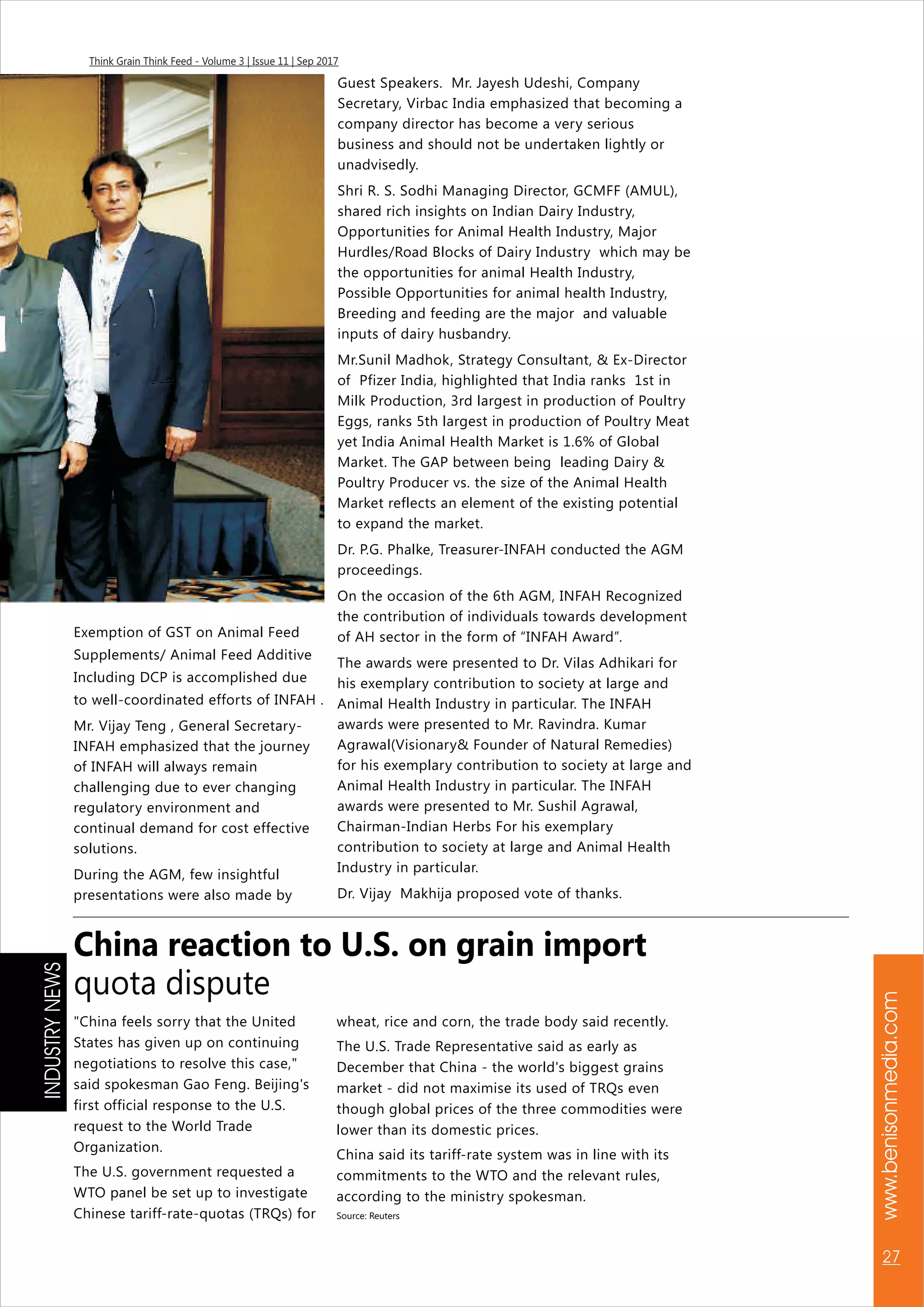
Think Grain Think Feed - Volume 3 | Issue 11 | Sep 2017
Exemption of GST on Animal Feed
Supplements/ Animal Feed Additive
Including DCP is accomplished due
to well-coordinated efforts of INFAH .
Mr. Vijay Teng , General Secretary-
INFAH emphasized that the journey
of INFAH will always remain
challenging due to ever changing
regulatory environment and
continual demand for cost effective
solutions.
During the AGM, few insightful
presentations were also made by
Guest Speakers. Mr. Jayesh Udeshi, Company
Secretary, Virbac India emphasized that becoming a
company director has become a very serious
business and should not be undertaken lightly or
unadvisedly.
Shri R. S. Sodhi Managing Director, GCMFF (AMUL),
shared rich insights on Indian Dairy Industry,
Opportunities for Animal Health Industry, Major
Hurdles/Road Blocks of Dairy Industry which may be
the opportunities for animal Health Industry,
Possible Opportunities for animal health Industry,
Breeding and feeding are the major and valuable
inputs of dairy husbandry.
Mr.Sunil Madhok, Strategy Consultant, & Ex-Director
of Pfizer India, highlighted that India ranks 1st in
Milk Production, 3rd largest in production of Poultry
Eggs, ranks 5th largest in production of Poultry Meat
yet India Animal Health Market is 1.6% of Global
Market. The GAP between being leading Dairy &
Poultry Producer vs. the size of the Animal Health
Market reflects an element of the existing potential
to expand the market.
Dr. P.G. Phalke, Treasurer-INFAH conducted the AGM
proceedings.
On the occasion of the 6th AGM, INFAH Recognized
the contribution of individuals towards development
of AH sector in the form of “INFAH Award”.
The awards were presented to Dr. Vilas Adhikari for
his exemplary contribution to society at large and
Animal Health Industry in particular. The INFAH
awards were presented to Mr. Ravindra. Kumar
Agrawal(Visionary& Founder of Natural Remedies)
for his exemplary contribution to society at large and
Animal Health Industry in particular. The INFAH
awards were presented to Mr. Sushil Agrawal,
Chairman-Indian Herbs For his exemplary
contribution to society at large and Animal Health
Industry in particular.
Dr. Vijay Makhija proposed vote of thanks.
"China feels sorry that the United
States has given up on continuing
negotiations to resolve this case,"
said spokesman Gao Feng. Beijing's
first official response to the U.S.
request to the World Trade
Organization.
The U.S. government requested a
WTO panel be set up to investigate
Chinese tariff-rate-quotas (TRQs) for
wheat, rice and corn, the trade body said recently.
The U.S. Trade Representative said as early as
December that China - the world's biggest grains
market - did not maximise its used of TRQs even
though global prices of the three commodities were
lower than its domestic prices.
China said its tariff-rate system was in line with its
commitments to the WTO and the relevant rules,
according to the ministry spokesman.
Source: Reuters
China reaction to U.S. on grain import
quota dispute
INDUSTRYNEWS
www.thinkgrainthinkfeed.co.in
28
INDUSTRY NEWS Think Grain Think Feed - Volume 3 | Issue 11 | Sep 2017
Soya: High carryover stock may save
the day for crushing industry
Good August rains, along with record
carryover stock of soyabean from last
year's crop, may help ease pricing
pressures for the crushing industry and
boost exports.
Trade has estimated a carryover stock of
1.5-2 million tonnes, based on the crop
size of 11.5 million tonnes in 2016-17.
Higher carryover stock may help the
crushing industry with availability of seeds,
thereby containing a possible bullish price
trend emanating from lower acreage.
A sluggish beginning of sowing in the
ongoing kharif season caused loss of
acreage. Weather uncertainty also hit the
crop. This prompted experts to estimate
lower soyabean production for 2017-18;
however, initial estimates will take some
time as rains continue to lash growing
regions in several States.
Davish Jain, President, Soyabean
Processors Association of India (SOPA),
highlighted the key concerns troubling
growers, traders and exporters.
Weather pattern
“The August rains came at a crucial time
of plant growth. But concerns still remain.
The acreage has already gone down and
the weather pattern is not as good as it
was last year. So production will take a hit.
But the silver lining is that we will have a
carryover stock of 1.5-2 million tonnes,
which will not squeeze the availability of
seeds for crushing,” he said.
The area coverage under soyabean, as on August 25, was
down 7.3 per cent at 104.9 lakh hectares, compared to 113
lakh hectares at the same period last year. According to
SOPA, arrivals of soyabean were at 74 lakh tonnes (lt) in
October-July, up from 54.5 lt a year ago, while stocks with
farmers are at 30.9 lt, up from 796,000 tonnes a year ago.
However, there is widespread concern among the industry
players about losing export competitiveness due to costlier
domestic production. According to sources, Indian
soyameal is currently $30-50 per tonne costlier in the
international market. Addressing the farmers' concerns, the
government increased MSP on soyabean for the 2017-18
crop year to Rs. 3,050/quintal from Rs. 2,775/quintal last
year.
Further, while a reduction in sowing area will dent
production, soyabean prices may not escalate thanks to a
huge carryover stock. “Farmers always anticipate better
prices. Several farmers are now holding last year's stock.
More than 2 million tonnes is being carried forward. This
will offset the drop in production,” said Rajesh Agarwal,
former president of SOPA.
According to Agarwal, excess availability will help crushing
with better price parity. “The crushing industry is in a dire
state. Many units are either not operational or running at
lower capacity. Crushing couldn't take place because of
higher domestic prices and lower global market,” he added.
Angel Commodities, a brokerage house, noted that the
most active soyabean futures contract for October delivery
on NCDEX may have its largest weekly loss in more than 16
months due to weak physical demand on rising input costs.
On NCDEX, soyabean futures fell more than Rs. 195, or 6
per cent, during the week to trade at Rs. 3,082/quintal.
Source: Business Line
ImageSource:Shutterstock
Think Grain Think Feed - Volume 3 | Issue 11 | Sep 2017CALENDAR OF EVENTS
www.thinkgrainthinkfeed.co.in
30
2017-18
To list any industry event related to Grain & Feed industry please write us at
info@thinkgrainthinkfeed.co.in
SEPTEMBER
CLFMA AGM & National Symposium
Date: 15-16 September 2017
Venue: JW Marriott, Mumbai, India
Email: clfmaindia@gmail.com
Web: www.clfmaofindia.org
Feed Additives
Date: 27–29 September 2017
Venue: Amsterdam, The Netherlands
Email: olympia.theocharous@briefingmedia.com
Web: www.feedadditives-global.com
NOVEMBER
Poultry India
Date: 22-24 November 2017
Venue: HITEX, Hyderabad, India
Email: info@poultryindia.co.in
Web: www.poultryindia.co.in
Date: 26-28 October 2017
Venue: Auto Cluster Exhibition Centre, Pune, India
Email: dairyindustryexpo@gmail.com
Web: www.dairyindustryexpo.com
OCTOBER
FEBRUARY
Date: 8-10 February 2018
Venue: Pune, Maharashtra, India
Email: feedtechexpo@gmail.com
Web: www.feedtechexpo.com
MARCH
FVG Asia
Date: 27-29 March 2018
Venue: BITEC, Bangkok, Thailand
Email: maarcservices@gmail.com
Web: www.victam.com
APRIL
Livestock Asia
Date: 19-21 April 2018
Venue: Kuala Lumpur Convention Centre, Malaysia
Email: rita.lau@ubm.com
Web: www.livestockasia.com
FeedTechExpo 2018Animal Feed Technology
Da ryINDUSTRY EXP 2017
The Farming & Processing Event
NZFMA Broiler Nutritionist Conference 2017
Date: 16-20 October 2017
Venue: Queenstown, New Zealand
Email: info@nzfma.org.nz
Web: www.nzfma.org.nz
Think Grain Think Feed September issue

Think Grain Think Feed September issue

  • 1.
    Volume 3 |Issue 11 September-2017 RNI No.: HARENG/2014/61357Price: 75/- Postal No. PKL-212/2015-2017
  • 2.
    FeedTechExpo 2018Animal FeedTechnology 08-09-10 FEBRUARY 2018 Auto Cluster Exhibition Centre, Pune, India BUSINESS PLATFORM FOR FEED INDUSTRY www.feedtechexpo.com ORGANIZERFor exhibition and sponsor opportunities Prachi Arora M: +91 8607 463377 / 3366 / 3355 | e: feedtechexpo@gmail.com BENISON Media SCO 17, 2nd Floor, Mugal Canal Market, Karnal-132001, Haryana Ph: +91 184 4047817 | e: info@benisonmedia.com JOIN US @feedtechexpo
  • 3.
    Published by BENISON Media SCO17, 2nd Floor, Mugal Canal Market Karnal - 132001 (Haryana) Tel: +91 184 4047817 info@thinkgrainthinkfeed.co.in Publisher & Editor Prachi Arora prachi.a@thinkgrainthinkfeed.co.in Monthly Magazine for Feed Technology EDITORIAL COMMITTEE Marketing & Designing Ashwani Verma info@thinkgrainthinkfeed.co.in Circulation & Subscription Head Rahul Bhardwaj info@thinkgrainthinkfeed.co.in Dr. Dinesh T. Bhosale Former Chairman, CLFMA of India Mr. Amit Sachdev Indian Representative, US Grain Council Dr. P.E. Vijay Anand US Soybean Export Council Dr. Suhas Amrutkar Subject Matter Specialist, Animal Nutrition, MAFSU, Parbhani Dr. SN Mohanty Former Principal Scientist, CIFA Dr. Meeta Punjabi Mehta Agricultural Economist Dr. Swamy Haladi Feed Additive Expert Dr. R Gnana Sekar Lead Consultant, GS Dairy Farm Consulting Dr. Suraj Amrutkar Assistant Professor, Dept. of ILFC, SKUAST-J, Jammu www.thinkgrainthinkfeed.co.in www.benisonmedia.com Managing Editor Dr. T.K. Walli Former Head, Dairy Cattle Nutrition, NDRI EDITORIAL ndian maize prices remain comparatively stable, and could show a downward trend for Isome time, till the new crop comes in the market. By and large rains have been normal, but there was some deficit in the corn-belt. The maize sowing too has been lagging behind by 5.93%, towards the last week of August., 7.799 million ha, as compared to .291 million ha last year, which is also bound to affect overall productivity. Reduction in corn prices lead to stable DDGS prices, while the SBM prices have been moving up steadily. US, especially Texas which was hit by Hurrican Harvey, has not affect the corn crop. Right now the prices are stable. If there is an export demand, then the prices may go up. A wonder grass for the tropical ( Arid/ Semi Arid) regions Little-known wild perennial grass could be a double blessing to farmers in arid areas, not just for their crops, but also for their livestock. Research by the International Livestock Research Institute (ILRI) and the Kenya Agricultural Livestock Research Organisation (Kalro), shows that the grass called brachiaria, fixes minerals in the soil that are crucial for plant health. These minerals including nitrogen, phosphorous and carbon, are often lacking in arid areas. Not only is this grass good for plants, it is also a resilient feed for livestock in arid lands where farmers often lose their livestock during periods of drought, due to lack of pasture. The other good traits of this grass are that the grass is disease- and drought-resistant. Brachiaria has been used to transform livestock production in South America. However, despite the immense benefits it demonstrated in that region, the true potential of this grass is yet to be realized in its motherland, Africa.”Brachiaria looks like napier grass, which is commonly used by Kenyan farmers as feed, but it grows taller and produces seeds unlike napier grass. Napier grass is also prone to diseases, unlike the resilient brachiaria. Being perennial, the wild grass can be harvested four months after planting, and then onwards can be harvested every two months, and can live as long as 10 years. It produces 19 tonnes of green fodder per acre, and about nine tonnes after drying. The Food and Agriculture Organisation has estimated that 70 per cent of livestock is reared on this barren lands. These dry lands are only famous for nomadic pastoralism, not for crop production, The low amount of rainfall they receive as well as soil erosion, makes agriculture unsustainable in arid areas. The traits possessed by the Brachiaria grass make it a potential “saviour” for arid areas. Since India has a vast stretch of arid and semi arid regions in the country. It is time that our fodder specialists should try to procure/ import the best quality seeds from Africa, through the good offices of International Livestock Research Institute, Kenya, and try to propagate the cultivation of this wonder grass in the arid and semi arid regions of the country. TK Walli Think Grain Think Feed - Volume 3 | Issue 11 | Sep 2017 Present trend in maize prices
  • 4.
    Printed by: JaiswalPrinting Press | Published by: On behalf of: BENISON Media | Printed at: Chaura Bazar, Karnal-132001, Haryana | Published at: SCO-17, 2nd Floor, Mugal Canal Market, Karnal-132001, Haryana | Editor: Prachi Arora Prachi Arora | Monthly Magazine for Feed & Feed Technology Vollume 1 | Issue 10 | August 2015 Think Grain Think Feed is a monthly magazine published by BENISON Media at its office in Karnal. Editorial policy is independent. Views expressed by authors are not necessarily those held by the editors. The data/information provided in the magazine is sourced through various sources and the publisher considers its sources reliable and verifies as much data as possible. However, the publisher accepts no liability for the material herein and consequently readers using this information do so at their own risk. Although persons and companies mentioned herein are believed to be reputable, neither BENISON Media, nor any of its employees or contributors accept any responsibility whatsoever for such persons’ and companies’ activities. All legal matters are subjected to Karnal Jurisdiction. Contents Think Grain Think Feed - Volume 3 | Issue 11 | Sep 2017 Front Cover: Ethanol Producer Magazine & Pinterest SUBSCRIPTION INFORMATION: Simple Post Courier Overseas One Year : INR 1200 INR 1800 USD 300 Three Year : INR 3300 INR 4800 USD 900 Five Year : INR 5200 INR 6500 USD 1500 Disclaimer : info@thinkgrainthinkfeed.co.in. BENISON Media or Think Grain Think Feed is not liable for any claim prior to written information. The published material and images are sourced from various websites and newspapers, and used for information purpose only, if you have any issue, please inform us at RESEARCH & DEVELOPMENT 05 ARTICLE EVENT CALENDAR - 30 MARKET PROJECTION EVENT COVERAGE Brachiaria: Wonder grass holds key to drought-resistant animal feed Price forecast for maize & DDGS 08 12 Methionine–Underlying opportunities in Asian economies 06 Grain chiller: the importance of technology for Feed industry Energy: the key factor for efficient milk production 16 20 INTERVIEW 26 Key discussions at 6th AGM of INFAH UPCOMING EVENTS 26-28 October 2017 27-29 September 2017 Da ryINDUSTRY EXP 2017 The Farming & Processing Event Regulatory changes on Global feed industry
  • 5.
    It produces 19tonnes of green fodder per acre, and about nine tonnes after drying. As sub-Saharan Africa's climate changes, small-scale farmers are increasingly looking to innovative ways of dealing with agricultural challenges. And in some instances, the techniques they adopt are helping to combat climate change, too. Alternative animal feed, climate-friendly grasses and the use of fodder trees are among the examples providing farmers resilience and leading to benefits such as more productive livestock and new business opportunities -- all while reducing greenhouse gas emissions and building healthy soils. A little-known wild grass could be a double blessing to farmers in arid areas, not just for their crops, but also for their livestock. Research by the International Livestock Research Institute (ILRI) and the Kenya Agricultural Livestock Research Organisation (Kalro), shows that the grass called brachiaria, fixes minerals in R&D www.benisonmedia.com 05 Brachiaria: Wonder grass holds key to drought-resistant animal feed the soil that are crucial for plant health. These minerals including nitrogen, phosphorous and carbon, are often lacking in arid areas. Not only is this grass good for plants, it is also a resilient feed for livestock in arid lands where farmers often lose their livestock during periods of drought, due to lack of pasture. In an article on ILRI's website, Sita Ghimire, a senior scientist who led the research, said: Brachiaria has been used to transform livestock production in South America. However, despite the immense benefits it demonstrated in that region, the true potential of this grass is yet to be realised in its motherland, Africa.” Brachiaria looks like napier grass, which is commonly used by Kenyan farmers as feed, but it grows taller and produces seeds unlike napier grass. Napier grass is also prone to diseases, unlike the resilient brachiaria. Previous studies on the wild grass showed that it is harvested four months after planting, can be harvested every two months, and can live as long as 10 years. It produces 19 tonnes of green fodder per acre, and about nine tonnes after drying. These traits make it a potential “saviour” for arid areas that account for 80 per cent of Kenya's land. These dry lands are only famous for nomadic pastoralism, not for crop production, with the Food and Agriculture ImageSource:agric.wa.gov.au
  • 6.
    R&D Think GrainThink Feed - Volume 3 | Issue 11 | Sep 2017 www.thinkgrainthinkfeed.co.in 06 Organisation, estimating that 70 per cent of livestock is reared on this barren land. The low amount of rainfall they receive as well as soil erosion, makes agriculture unsustainable in arid areas. Farmers in these areas also bear the brunt of the negative effect of climate change, with their herds of livestock dying during periods of drought and famine. However, with the introduction of grasses such as brachiaria, the dry lands hold potential for food security for both humans and animals. Since the launch of a project funded by the Swedish International Development Cooperation Agency in 2013, four improved varieties of the grass have been piloted by Kalro, with positive results. Counties that were covered included Kilifi, Malindi, Machakos, Embu, Meru, Makueni, Uasin Gishu, Trans Nzoia and Nyandarua, where the grass aims to increase farmers' resilience in the face of the effects of devastating climate change. Brachiaria's crucial role ! The wild grass is native to Africa and has been used to transform livestock production in South America. ! It fixes soil minerals such as nitrogen, phosphorous and carbon, which are often lacking in arid areas. ! Brachiaria looks like napier grass, but grows taller and produces seeds which replenish the grass after harvest. ! The wild grass is disease- and drought-resistant. ! Brachiaria produces 19 tonnes of green fodder per acre and about nine tonnes after drying. ! Arid lands make up 80 per cent of land in the country, and livestock farmers found in these regions need resilient animal feed. ! 90 per cent of livestock is reared in arid areas where the land is barren. ! Four improved varieties of brachiaria grass have been planted in various counties for use as fodder by livestock farmers. Source: Nation India maize prices remain stable and on a downward trend at least for some time as the end users wait for the new crop and the demand is also subdued. The sowing is complete for maize and now it is wait and watch. The monsoon has also entered the last phase and as per IMD the withdrawal could be delayed bit. Overall the rains have been just about normal and deficit at 3%, but there are areas in the corn belt which have received less rains and there is a possibility of productivity loss due to moisture stress. Sept (Rabi) future Rs. 13000/MT, down 0.61%; Oct (K) Rs. 15580/MT down 2.14%; Nov (K) Rs. 15680/MT down 2.12%; Dec (K) Rs. 15760/MT down 2.17% and Jan 2018 (K) Rs. 15840/MT. Spot prices too were down, Jalgaon Rs. 14500/MT (Same as last week); Nizamabad Rs. 15462/MT down 2.02%; Davangere Rs. 17050/MT down 0.87%; Sangli Rs. 16000/MT, down 4.19% and Gulabbagh Rs. 13300/MT down 0.12%. US, especially Texas was hit by Hurricane Harvey, but it is not affecting the corn crop. The contract to watch at this time in Dec 2017, which turned lower than $3.5/bushel and on Aug 30 closed at $3.455/Buhsel ($136/MT) and then rose sharply to close at $139.83/MT on Sept 01, 2017. There is no such to buy corn by domestic users as well and that is keeping the prices stable. If there is a export demand, prices may move up. Sept contract $133.85/MT, up 0.41%; Dec $139.83/MT up 0.51%; Mar 2018 $144.72/MT up 0.33% and May closed at $147.71/MT. US corn on FOB basis (US Gulf) was indicated at $160Mt slightly higher than last week and Prices at PNW were same as last week at $176/MT. DDGS prices on FOB basis was down and indicated at $168/MT (US Gulf), down 3.45% and on PNW basis $177/MT down 6.35%. On FOB basis DDGS is priced at 105% of corn and is a good buy. Delivered price to SEA region remains stable, Vietnam $195/MT; China 4188/MT; Chittagong $212/MT and Myanmar $212/MT. As on Sept 01, 2017, Vietnam cleared DDGS imports with Phospine fumigation. This is likely to increase the demand of DDGS into Vietnam. The country is one of the biggest users of DDGS in SEA region and uses is a feed ingredient of choice in Poultry, swine and fish feeds. Source: TechproIndia Price forecast for maize & DDGS MARKETPROJECTION
  • 8.
    ARTICLE Think GrainThink Feed - Volume 3 | Issue 11 | Sep 2017 www.thinkgrainthinkfeed.co.in 08 The role of methionine is very vibrant in the animal poultry market. Methionine is advantageous as a feed supplement across the spectrum of livestock production and particularly in the poultry segment. The industry is expected to develop along with the expansion of world economy and rising meat consumption. As per the report of the Food and Agricultural Policy Research Institute(2010), the economic growth in developing economies of Asia are projected to grow at an average rate of 5.6%. This contrasts with the average growth in mature countries of 2.2%. Continued growth from countries such as China, India, and Rest of Asia makes the region an important part of the global economy. Asia's share of the world's GDP is expected to rise to 22% by 2018. China alone will become more than 10% of the global economy. Big growth predicted With a combined population of 1.7 billion or about one fourth of the world's population, the major countries of South Asia–India, Pakistan, and Bangladesh as well as the smaller nations such as Nepal and Sri Lanka, all are growing at more than 7% of annual average growth rate. Out of the growing animal feed markets, India is one of those economies which are experiencing a livestock revolution. It has long been one of the world's most undernourished regions in terms of caloric intake and consumption of animal proteins. With its huge population Methionine–Underlying opportunities in Asian economies Nishikant Yadav, Markets and Markets ImageSource:TheMorningCall
  • 9.
    www.benisonmedia.com 09 Think Grain ThinkFeed - Volume 3 | Issue 11 | Sep 2017 and growing middle-class population, the demand for meat is on the rise, and hence the industry is demanding methionine for the production of feed. Methionine is presently the largest revenue contributor to the Indian market, which can be ascribed to its higher price and growing use in feed grade amino acids for compound feed products. The demand for methionine is dependent upon the proportionate demand for protein in general and poultry in particular. The Indian industry for poultry is expected to grow more than 9% of the compound annual growth rate in the coming years. Rising investments for local manufacturing Currently, the usage of DL-Methionine is flourishing in Asian Economies, particular in India and is expected to grow fairly for the next 15 years. However, most Asian economies are dependent on imports of methionine to satisfy their demand for animal feed, owing to lack of production facilities. Lack of producers in developing nations can be attributed to the difficulty in adopting overseas technology and the nature of raw materials such as methyl mercaptan, acrolein, and hydrogen cyanide. In 2012, China consumed 194,000 KT of methionine inclusive of theimported volume of 183,000, which was approximately 94.3% of the consumed amount. According to our analysis, the consumption of China is expected grow at a CAGR of 7.8% between 2012 and 2016 to reach at a volume of 262,000 tons in 2016. Looking at the massive growth in the animal poultry feed sector in Asia, manufacturers are increasingly inclined to make investments in the production of amino acids for domestic markets. For instance, in 2014, Adisseo confirmed the start-up of its production plant of methionine in Nanjing, China. With this investment, the company aims at the growing meat demand in China. Sumitomo Chemicals—a specialized Japanese chemical company, is expanding its methionine manufacturing facility by adding a new facility–Ehime Works in Niihama City, Ehime Prefecture, Japan which is expected to be completed in the middle of 2018. The company will increase its capacity by approximately 100,000 metric tons bringing the total production to 250,000 tons per year and is aimed at capturing the active demand within the Asian market. Evonik—a Germany-based company is also highly investing in methionine production aimed at Asian Economies. In October 2016, the company announced the addition of the second methionine in Singapore. The company is set to invest more than USD 761 million in the plant, which will have a production capacity of 150,000 metric tons a year. The demand for methionine could substantially go up if 300,000 250,000 200,000 150,000 100,000 50,000 0 194,000 262,000 20162012 Methionine Consumption Volume(Tons) Figure: Consumption of Feed Grade Methionine in China, 2012–2016 (Tons) Sources: Company Reports and MarketsandMarkets Analysis
  • 10.
    the product isreadily available in the Asian market. This brings us to the conclusion that progress in technology, rapid population growth, and rising consumption of meat in the region are fueling Asia's high demand for methionine. What does the future hold for the Asian Methionine Industry? One of the most promising and significant markets of the amino acids industry is methionine. There are various factors affecting the production methionine; right from the technology to the raw materials used. Thus, currently, manufacturers are continuing to expand their market and technology leadership in methionine with highly efficient, state- of-the-art production facilities in all major regions of the world including developing Asian economies such as China and South Asia. Factors such as companies' incorporating sustainable modern methods of livestock farming, population growth, and rising purchasing power are boosting the demand for animal protein, which is subsequently expected to bring forward the growth in the Asian methionine market. Interestingly, companies are not only expanding their production plants but also investing in technologies for the development of innovative products. The expansion investment by Evonik last year in Jurong Island (Singapore), which started in November 2014, is an integrated production plant which was planned for the production of MetAMINO (DL-Methionine) and all necessary precursors. Investments and growth strategies such as these are focusedon keeping pace with the growth of the market. Thus, a sustainable and constant growth is expected from the Asian methionine industry in the long run especially for newer and enhanced feed products. FlexWave: Technology innovation by GSI Farmers and commercial grain operations will soon have an alternative to grain bin sweeps, brooms and shovels for bin cleanout with new FlexWave technology from GSI. Currently, standard grain bins are emptied through a combination of gravity and augers or bin sweep technology. However, with these methods, there's always a remaining level of grain on the bin floor that needs to be swept out. According to GSI, it's hard, time-consuming, dusty work that also can be dangerous if this chore is performed while an auger is still running. GSI's new, patent-pending FlexWave technology can eliminate this labor- intensive task. The system utilizes two large liners that alternately inflate and deflate, gently pushing the remaining grain into a centrally-located conveyor trough for removal, without the need to enter the bin. A control system automatically senses the amount of grain and shuts off when the process has been completed. “FlexWave technology results in 99% cleanout and eliminates the risk of entrapment from falling grain or auger entanglement since it is truly a zero-entry bin unload method,” said Greg Trame, GSI director of engineering. Trame said FlexWave is also more reliable than conventional methods, since there are no exposed mechanical components. Another advantage is that perforated bin floors are eliminated, increasing capacity. Each inflatable liner can unload more than 100 tons of grain using less than one psi of air pressure. The liners are constructed of durable, commercial-grade material designed to last over 30 years under normal conditions. In addition, they can easily be repaired in case of accidental puncture with a simple glue patch because of the system's low-pressure operation, which is gentler on grain than traditional options, protecting grain quality and profits. Traditional grain hopper tanks are emptied by gravity through a cone at the bottom. With FlexWave, a flat bottom storage tank may be used instead, which not only increases capacity but also eliminates the need to install legs since it can sit on the ground, GSI said. “FlexWave technology is another unload option added to company's complete product portfolio and can be used with any standard current unload system,” Trame said. “This technology is exclusive to the company for grain storage and represents an exciting advancement that supports our commitment to continuous innovation.” Field trials are under way, he said, to ensure proper aeration is maintained to provide long-term, safe storage. The first FlexWave offering is planned for 2018. Trame noted there is a lot of potential for future applications with FlexWave, since any equipment that relies on a hopper cone for gravity-flow cleanout can benefit from this technology. ARTICLE Think Grain Think Feed - Volume 3 | Issue 11 | Sep 2017 www.thinkgrainthinkfeed.co.in 10 INDUSTRYNEWS
  • 12.
    www.thinkgrainthinkfeed.co.in 12 Jean Fontaine isthe founder and president of Jefo, a global feed additive company headquartered in Canada. Under his leadership, this year the company is celebrating 35 years of global growth and innovation. Jefo is a world leader in the field of non-medicated performance feed additives for the poultry, swine, ruminant and aquaculture sectors. Today the company has offices on 5 continents, and specialises in the design, manufacturing, warehousing and JIT-distribution of an array of animal nutrition specialty products. It was a visit to Europe that propelled Fontaine into launching his own feed additive business. After working for a premix company post-graduation from university, he took a trip on his own to investigate the additives scenes in Belgium, France, Holland and Germany. A visit to premix company, Sodial, in France was particularly important. “When I realised the price difference between feed additives in Europe and Canada, I quickly realised there was a huge opportunity. I was very excited, but I needed to find a way to get some capital to start importing some products. My brother Michel was of great help. He endorsed me for CAN$?20,000. He had a veterinary clinic and laboratory.” In particular, Mr Fontaine noticed a large cost difference between Europe and Canada on phosphates and bicarbonate, and he started to import these ingredients, competing with established suppliers. “I wanted to help Think Grain Think Feed - Volume 3 | Issue 11 | Sep 2017 Jean Fontaine, Jefo
  • 13.
    www.benisonmedia.com 13 the Canadian feedmanufacturers and premixers to be more competitive,” he says. “Having worked for the premix company as a buyer and nutritionist, I was quite knowledgeable about selecting ingredients. Having a degree in nutrition always allowed me to choose the right additive with good judgement.” After starting Jefo in 1982 and receiving very positive customer feedback, Mr Fontaine started to look for many more alternatives to products being offered by competing suppliers. “I opened our borders for sourcing ingredients. In 1987, we started to promote the concept of slow-release nutrients like amino acids, essential oils, and 'bypass' amino acids and vitamins for dairy.” Firstly, on behalf of Think Grain Think Feed, I would like to congratulate you for the 35th anniversary of the company. Could you please share your thoughts about the company history and how you have seen the global feed industry evolving over last decade? JEFO has grown over any expectation. The need did not seem necessary by any industry people, initially. We forged our place and today, it is well recognized that JEFO and its philosophy of putting closer suppliers and customers was needed indeed. The last 25 years for JEFO doing so much research and breakthrough discovery in nutrition, allowed JEFO to become a leader in the feed additive to replace drugs in feed and protect the environment. The first Challenge we face is to do more with less. Improve nutrition effectiveness with always keeping the health as a parallel is very important to maintain in permanence. The other main challenge I see, is the change in the market demand. Consumers are driven by media and they request specific norms that impose more challenges to the animal feed industry. Understanding the behaviour of the micro flora in the intestine of the animals, all bacterias have a consumption of vitamins, amino acids, energy for their growth and they produce toxines or other metabolic excretions that are beneficial and negative to the animal. It is our task to understand and master these micro organism. All regulatory changes are established to protect the consumers for a quality food. Any regulation is requested to control the promises made by the suppliers of food to the human. However, the labeling requirements have been changing dramatically in the last few years, and this may pose a major problem for the competitive advantages of companies working on innovating concepts. Some countries now require a complete guaranteed analysis of all ingredients. Companies now need to, in addition to a good formulation, proprietary production processes to guarantee their competitiveness in the market. ASIA is evolving fast. there is a lot of researchers and a lot of consumers. They can try more and more new concept faster than we can in Canada for example. We need to work with them closely for innovation. India has Could you please share the challenges that are being faced by Global livestock industry, the theme around which discussions took place during last year’s Industry Stakeholders’ Gathering organized by the company? In your view, what are the key trends which you believe may have a big impact on the feed additives industry moving forward? Can you please throw some light on regulatory changes and their implications upon the Global feed industry? How do you compare Asian market to developed market? Where does India stand on the company radar? Think Grain Think Feed - Volume 3 | Issue 11 | Sep 2017
  • 14.
    INTERVIEW Think GrainThink Feed - Volume 3 | Issue 11 | Sep 2017 www.thinkgrainthinkfeed.co.in 14 the same attitude: curiosity and innovation. IT is all with the aim to do more with less. For example in dairy cows, 5% According to Markets & Markets report, feed enzyme market growing at a rate of 9.3% CAGR, is expected to reach USD 1428 Million by 2022. Your comment. What is the species wise market share of Jefo Group and also its strength which give the company an edge over its competitors? better feed conversion will mean approx. 500,000 tons of manure less/year for 1 million cows… Enzyme is the future and their efficacy has to be monitored. JEFO with their research station are very actively developping solutions that will improve the efficacy of feeds. INDIA is now in the target zone. We are making inroads to choose the right partner there and share with them our discoveries. It is a huge market and they need better efficacy in nutrition of their chickens and dairy. What does Jefo look like in 10 years from now in global and Indian market? Fishery exports and Least Developed Countries Fish is one of the world's most traded food commodities and, with the global population growing to an expected 9.7 billion people by 2050, demand for it fish also expected to increase. That offers valuable trade opportunities. In addition to human consumption, industrial need for fishery resources is projected to rise in the coming decades due to growing demand for fish oil and animal feed. Wild catch alone will not sustain the increase in demand for fish. There should be deliberate actions by Least Developed Countries (LDCs) to enhance aquaculture development so as to meet the increase. The UNCTAD study documents that, over the last three decades, global aquaculture production has tripled, growing at an average annual rate of 8.3 per cent. In 2014, aquaculture constituted 46 per cent of world fish production compared to 26 per cent in 1994. The fisheries sector is also a viable alternative to manufacturing as a source of export-led growth. Developing countries as a whole have substantially increased their share in world fishery exports, from 34.6 per cent in 1981 to 50.2 per cent in 2013. However, despite their ample fish stocks, not many LDCs have been able to follow suit, and their share in global fish exports has only risen marginally, from 1.6 to 3.5 per cent in the same period. The work of UNCTAD reveals that the fishery sector in LDCs remains predominantly traditional or artisanal. In its research, UNCTAD presents case studies of six of the world's 47 LDCs — Bangladesh, Cambodia, the Comoros , Mozambique, Myanmar and Uganda — and identifies a series of supply-side and demand-side challenges undermining the role of their fishery sectors. On the supply side, the main challenges are deficient transportation and storage facilities; poor energy infrastructure and high electricity costs; a lack of investment, finance or credit for small operators; overfishing and depletion of fish resources; water pollution; and a lack of common fishery policies among countries that share water resources. On the demand side, LDC fish products face few or no tariff barriers in developed country markets. However, the biggest non-tariff trade barrier for producers and processors from LDCs are the stringent quality and safety standards systems imposed on fish products in major overseas markets, instituted in the 1990s and 2000s. The study argues that stringent public safety norms are often compounded by further cumbersome private quality and safety standards. The confluences of public and private standards have effectively restricted access to major importing markets for many LDC fishery exporters. This is mainly due to the fact that standards are not harmonized and are costly for LDCs to meet. It is also due to structural problems in LDCs, including in processing facilities and procurement methods, as well as a lack of testing and certification of products throughout the value chain. The study provides policy conclusions and recommendations aimed at helping LDCs to realize the full development potential of their fisheries sectors, including the provision of infrastructure, the improvement of regulatory and institutional capacities, monitoring and regulation of domestic fishing, and the harmonization of international standards. INDUSTRYNEWS
  • 15.
    www.benisonmedia.com 15 Think Grain ThinkFeed - Volume 3 | Issue 11 | Sep 2017 Bühler Insect Technology is to build first industrial plant Bühler Insect Technology is to build its first industrial plant to process black soldier flies for animal nutrition together with its partner Protix in the Netherlands. Bühler will deliver the technology, equipment, and process know how for the rearing and processing of the insects and the feedstock preparation. Start of operation is planned for the first half of 2018. “With this first industrial insect protein production plant we will make an important step towards a more sustainable global food and feed value chain,” said Andreas Aepli, CEO of Bühler Insect Technology. Bühler notes that protein is an essential component of nutrition for both humans and animals, pointing out that about 15% of daily energy intake should be covered by protein, to build and repair the cells that sustain life. Agriculture produces roughly 525 million tonnes of plant protein a year, the company says, found in corn, rice, wheat, or soybeans. However, today's protein production is not sustainable: Only 25% of proteins land as vegetable proteins on our plates, while 15% are wasted and 60% are used to produce animal protein. Furthermore, with the growing world population, protein production needs to double by 2050, Bühler believes, saying that experts agree this cannot be achieved using traditional farming practices and resources, which is why alternative sources for protein such insects or algae are becoming increasingly important. Insects offer a sustainable alternative: Grown on organic residues, they can recover up to 70% of nutrients, thus recycling these underutilized streams back to the food value chain. In January 2017, Bühler and Protix founded the joint venture Bühler Insect Technology to serve the insect processing industry. Building the first black soldier fly processing plant in Europe together is the next step in this cooperation and will serve as a modular and scalable blueprint for future projects. The plant will be situated in the Netherlands and will serve customers in the feed industry. With construction starting this year, the plant is expected to be operational in the first half of 2018. It will produce protein meal and lipids that are used in the animal nutrition sector to feed pigs, chicken, fish, and domestic animals. The black soldier fly larvae are fed carefully selected organic byproducts from local distilleries, food producers and vegetable collectors in the Netherlands, which further underlines the sustainability of the process. Source: ingredientsnetwork INDUSTRY NEWS
  • 16.
    ARTICLE www.thinkgrainthinkfeed.co.in 16 Think Grain ThinkFeed - Volume 3 | Issue 11 | Sep 2017 Grain chiller: the importance of technology for Feed industry Pari Mamallan, GrainTechnik Feed is a mix of whole or processed grains & concentrates for all species of animals, which is now commercially produced for livestock, poultry, and fish industries. Corn is the major ingredient in poultry feed whereas soybean meal is for cattle feed. The price variation in feed grain, makes grain storage an important part of economical production. Various factors like demand, quality and price fluctuation (of approx. 30% between summer and winter crop), require the feed producers to store feed grains for a period of 3-8 months, especially in India. The corn availability in India usually is with high moisture which needs to be dried to approx. 13% M.C. by electrical, bio fuel or even by sun drying for safe storage in silos. Corn behavior in storage bins Grains are hygroscopic in nature, it gain or lose moisture, when the vapor pressure of water in the space surrounding the grain is greater or lesser than the vapor pressure exerted by the moisture within the grain. (Ref. Hogan and Karon, 1955) In simple terms, corn respires and hence releases heat & moisture while respiration. Typical storage conditions in a humid & hot tropical country can have ambient temperatures in the range of 30-40 Deg C while corn moisture content is 15%. These conditions may lead to heat generation of about 1MJ/T per day which can increase eventually. The heat generation causes drying losses in the grain. In addition to that, insect infestation is also a consequence of natural heat generation. Dryers may not equalize variability; aeration by ambient air may develop moisture variation among kernels. Moisture variation results in shorter shelf life and bigger storage risk. As the shelf life of the corn is temperature dependent, therefore, it is important to bring down the temperature to 10-18 Deg C as soon as possible. A delay of a month ImageSource:FrigorTec
  • 17.
    www.benisonmedia.com 17 Think Grain ThinkFeed - Volume 3 | Issue 11 | Sep 2017 in the cooling process can substantially reduce the shelf life and hence the grain is more prone to future spoilage. Molds in the grain are known to produce mycotoxins under specific unsafe conditions of temperature and humidity. An increase in CO2 can indicate unwanted biological activity that is caused by fungus, insects or other infestations in the grain. Corn quality management It is known that ambient temperature and relative humidity influence the corn activity in the silo. Cooling the grain by a grain chiller can simply put an end to drying loss, insects and molds. The cooling is applied on
  • 18.
    ARTICLE www.thinkgrainthinkfeed.co.in 18 Think Grain ThinkFeed - Volume 3 | Issue 11 | Sep 2017 the basis of Sorption isotherms of corn. The chiller will produce a uniform temperature and relative humidity irrespective of the ambient conditions. The chiller by default, dehumidifies the cold air depending on the pre-set temperature.. The cooled air is distributed in the silo/flat storage through a duct system in the bottom of the silo/flat storage. As the cooled/conditioned air moves up through the grain mass, the temperature in the grain is reduced, eventually reaching the set value. Grain being an excellent insulator, once cooled to a low temperature, will remain cool for a substantial time period. Even at peak summer, the radiations will heat up the surface of the silo but grain close to the silo wall will act as an insulator. Since corn is dried before storage, the final drying can be an expensive affair (reducing moisture content from 16% to 15%). Heat drying is also harsh to grain. By using grain chilling, partial drying is possible, through cold dehumidified air which is more economical and gentle to the grain. The advantage is the grain coming out of the dryer at a higher moisture content, and then 1-2% of moisture is lost in the cooling process. The drying effect varies with the moisture content of the grain. With more moisture, the drying effect is up to 2% and below 14% moisture content, drying effect is 0.2%. The chart below illustrates chances of mold formation are highest at temperature above 25 Deg C & with grain moisture level of ~15%. If the ambient RH value is high, through aeration, the grain would get further moist and lead to infestation & mold formation. By cooling the grain, storing at even moisture level of 16% becomes risk free. The grain chilled raw material corn will have the same harvest freshness and shape, eventually leading to improved milling performance. Grain chilling proves to be a strong value addition tool for the feed pellet. During pelletisation, the conventional cooling from the ambient air is not sufficient to achieve the complete cooling of the core pellet. This results in higher risk of stress cracks, making it prone to powdery surface. By preservation cooling, the pellets is cooled to the core and hardened. The end- product is easy to transport and ideal for bird and animal consumption. Aeration in silos in tropical countries Aeration uses ambient air which is not a solution. The ability of that air to reduce the heat is limited under tropical & desert conditions, where the ambient temperature is higher. Secondly, relative humidity is higher in tropical zone which leads in moisturizing the grain. The air is only able to take the excess heat from the grain which is above ambient temperature. Also, there is a risk of moisture migration in the grain silo which leads to mold formation. Therefore, the temperature of the bulk grain remains relative higher which results in high dry matter loss (weight loss) of carbohydrates and water accumulation in the grain mass. Conclusions Cooling the maize immediately (after harvest?) is the key for conserving the freshness and quantity. The corn shape is maintained till it is unloaded. By combination of drying and grain cooling, 30% of power cost can be saved. In case, a feed mill is just using a processing silo and not for storage, even then grain used within 2 months' time also needs be cooled to avoid unhygienic perspective. There is no need of insulation for the silo if grain is chilled using grain chiller. It requires only 3 weeks of running of unit for archiving achieving the set temperature inside the silo. The cooled maize will remain cooler for longer duration which is also free from insects and molds. The feed producer need not to use any chemical/fumigation inside the silo bins. It is true the insects developed immunity towards fumigation and even fumigation can never be a success as the gas cannot penetrate into the entire silo. Whereas the grain chiller can cool the complete bulk in the silo bins. The end quality of the feed pellet is free from mycotoxins and fine finish (no stress cracks on the pellet). Therefore, cooling corn before processing and cooling feed pellet will give better out come in quality as well as quantity. For further information about the technology, please contact pari@graintechnik.com 18 17 16 15 14 13 0 5 10 15 20 25 30 35 %ofMoistureatBinning Fewer days Safe Storage 0 Temp C at Binning Grain Technik Pvt. Ltd. Chart of fungus infestation related spoilage depending on grain temperate binning and Moisture binning
  • 19.
  • 20.
    ARTICLE www.thinkgrainthinkfeed.co.in 20 Think Grain ThinkFeed - Volume 3 | Issue 11 | Sep 2017 Despite worldwide milk prices remaining at low levels over the last few years, demand for dairy products has held steady, especially in many South Asian countries. Now that prices are returning to higher levels, producers have an opportunity to achieve better profits by increasing the level of production. Good rumen health, quality feedstuffs and appropriate management practices can all help ensure that cows have the energy they need to support increased milk production. Energy is the key The secret of efficient milk production relies on satisfying cow requirements. Cow comfort, proper management and adequate nutrition will pay back producers with robust fertility, consistent milk output and minimal incidence of health problems. Each of these depends directly or indirectly on the cow's energy status. A positive energy balance relies on feedstuffs of the appropriate quantity and quality, along with the type of environment and good management of critical phases like dry and transition periods. Energy demands can in fact rise, based on climate, walking distances inside the farm, adequate space at the feed bunk and animal density. However, it is undoubted, that feed quality and its utilisation by dairy cows play main role in cow energy balance. Ruminants are special From the cow's perspective, the energy issue is not primarily related to milk production but rather to her very survival. Cows naturally produce milk to feed their calves. However, in the case of an energy gap, they will first discontinue reproduction, followed by reduction or total discontinuation of milk production, just in the attempt to improve the likelihood of their own survival. This explains why fertility and milk production fall when a cow's energy demands are not satisfied. Nowadays, this situation is becoming more and more dramatic, as genetic selection in favour of increasingly productive animals results in animals which can produce more milk, but with higher management and nutrition Energy: the key factor for efficient milk productionPaolo Fantinati, BIOMIN ImageSource:CambridgeCoreBlog
  • 21.
    www.benisonmedia.com 21 Think Grain ThinkFeed - Volume 3 | Issue 11 | Sep 2017 requirements—particularly in terms of energy and protein. It is safe to assume that cows are often in negative energy balance –expending more energy than is consumed— especially during early part of lactation. While it is relatively easy to fulfil protein requirements by optimising the amino acids profile at the intestinal level, satisfying the energy requirement of a cow is a real challenge. Cows, being ruminants, are very special animals. Their diet composition needs to contain a minimum amount of fibre to ensure proper health and to avoid diseases such as acidosis. Unfortunately, fibre does not provide them the same amount of energy as other feedstuffs e.g. grains, sugars or fats. Ruminants rely on the rumen, a special part of their gastrointestinal tract, for around 70% of their energy. More precisely, energy is produced through the fermentation of feedstuffs by rumen microflora, a complex ecosystem made of bacteria, fungi and protozoa. Working in synergy to ensure their growth, rumen bacteria produce large quantities of volatile fatty acids (VFAs), as by-products of their metabolic activities, and these VFAs are the main source of energy for the cow. To ensure a healthy population of microorganisms, we need to provide grains which are the main energy source for bacteria and fibre to stimulate rumen motility, rumination and saliva production—activities that are necessary to keep animals healthy. Feedstuff quality How is it possible to improve rumen function and fulfil a cow's energy demands? First, we need to enhance fibre digestion. Fibre occupies a certain amount of space in the rumen, but is less fermentable and has a lower energy production capacity than grains. One suggestion is to use forages with high fibre digestibility and to feed them especially to transition and first lactation animals, as they have a higher energy demand. In addition, good quality fermented silage and mould-free forages will favour intake and sustain rumen fermentations. Considering grains and by-products, we need to be generous with them in order to cover the space remaining in the rumen after having satisfied the fibre requirements. A cow producing 32 kg of milk with a feed intake of 22 kg of dry matter should be fed at least 6 kg of starch and 1.2 kg of sugar depending on the quality of forages. This corresponds roughly to 20 kg of corn silage and 7 kg of ground corn plus 0.7 kg of molasses. Quality feedstuffs should not have anti-nutritional factors, e.g. mycotoxins, that can make energy production less efficient. Mycotoxins reduce feed quality. During the 2016 BIOMIN World Nutrition Forum, experts reported that mycotoxin contamination can reduce the quality and nutritive value of feedstuffs. Mycotoxins are secondary metabolites of fungi and mould that widely contaminate grains, forages and silages. They exert a negative effect on a cow's health, fertility, rumen microorganisms and rumen function. In recent research conducted in South Asia, Kiyothong et al. (2012) showed that feeding dairy cows a total mixed ration (TMR) naturally contaminated with multiple mycotoxins, can reduce the rumen bacterial population, as well as protozoa and fungi. This translated into a reduction in volatile fatty acids, leaving less energy available for the cows. The application of a mycotoxin deactivating feed additive was able to resolve the situation and increase milk production and fat percentage. Conclusions on rumen health The rumen is the main organ of energy production in cattle and the quantity of outputs depends on
  • 22.
    GMP+ International partners withChina BFIA represents feed companies (Feed Ingredients, Mixed Feeds) in the Beijing province, China. Many of its members are focused on export of feed ingredients worldwide. It was founded in 1986, as a non-profit organization. BFIA has six professional committees serving for the government, more than 100 members, including livestock, feed and feed additive manufacturers, ingredient suppliers, equipment manufacturers and companies that supply other products, services and supplies to feed manufacturers. As a key segment of the animal production chain, BFIA has close contact with their members and government authorities. BFIA has close contact with their members and government authorities. They also support members on legislation and regulations of sustainable development program including feed safety assurance through promotion and clarification. GMP+ International manages the international GMP+ Feed Certification scheme with the GMP+ Feed Safety Assurance (GMP+ FSA) module. At this moment, more than 16,600 companies located in 80 countries are already GMP+ FSA certified worldwide. GMP+ International aims to provide an international platform on feed safety assurance and to facilitate feed companies regarding feed safety assurance. For that reason GMP+ International continuously seeks involvement and support of stakeholders in the feed and following animal production chain through partnership with trade associations and food companies; and it appreciates BFIA's partnership very much. In China, almost 100 Chinese feed (ingredient) suppliers are GMP+ FSA certified. BFIA and GMP+ International aim to support application of proper feed safety assurance by BFIA's members in accordance with the international standard. They support international and domestic marketing and promotions in the interest of Chinese companies and also to work with long term sustainable programs. In 2016,the China feed industry was continually on production restructuring. Although the number of the feed and feed additives enterprises in China was down from 13,236 in 2015 to 11,627 in 2016, the production of feed still has an increased by 4.5% and reached at 209.18 million tons compared with 2015. Now, China feed industrial system is getting more mature and efficient. Maturation is also about getting more focus on ensuring the safety of feed production for production of safe animal products for consumers. www.thinkgrainthinkfeed.co.in 22 Think Grain Think Feed - Volume 3 | Issue 11 | Sep 2017 feedstuffs' quality, rumen health and microbial balance. A healthy rumen will be able to squeeze more energy from both forages and grains, giving more values to feedstuffs (silages and hays) prepared by farmers and to concentrates offered by feed millers. For this reason, there is the need to optimise rumen function to keep rumen microbiota healthy. Key actions are to avoid drops in rumen pH, to favour beneficial bacteria growth and to avoid any poisoning substance such as mycotoxins. Bunk management (proper and homogeneous mixing, adequate fibre particle size, proper humidity) is fundamental for rumen equilibrium. Also, stimulating rumen bacteria with proper prebiotic strategy (like with autolyzed yeasts) can ensure a better rumen environment, a more controlled pH and a higher energy output. ARTICLEINDUSTRYNEWS
  • 24.
    INDUSTRY NEWS ThinkGrain Think Feed - Volume 3 | Issue 11 | Sep 2017 www.thinkgrainthinkfeed.co.in 24 GM Crops: only facts based decision can pave the way in India It is said that for those who believe, no proof is needed, and for those who do not, no proof is possible. Into which category should one slot a parliamentary committee, chaired by Congress MP Renuka Chowdhury, on “genetically modified crops and their impact on environment”? Six institutes of the Indian Council of Agricultural Research (ICAR) told the committee that their research showed that the sole GM crop approved for large-scale cultivation in India, that is, Bt cotton which has the bollworm-killing Cry 1Ac gene and a variant, implanted in it from a soil bacterium, is safe on the basis of animals fed with its leaves and oilcake. The Central Avian Research Institute at Izatnagar in Bareilly, said it had fed Bt cotton, Bt brinjal, transgenic corn and Bt rice to broiler chicken of up to 42 days from nine years from 2003 to 2011. It said the response in terms of body-weight gain, feed intake, feed- conversion efficiency, immune response, carcass attributes and organ yield for both GM crops and non-GM crops was similar. The Central Sheep and Wool Research Institute at Avikanagar in Rajasthan conducted a study. They found no difference in the growth performance of lambs that were given feed containing Bt cottonseed and conventional cottonseed. The Indian Veterinary Research Institute also at Izatnagar studied goats fed with Bt cottonseed. On post-mortem examination, none of the goats—whether fed on Bt cottonseed or non-transgenic cottonseed showed lesions of toxicity. The share of this mixture in total feed intake was 25% and the animals were fed the diet for 90 days. The National Dairy Research Institute at Karnal in Haryana conducted a study for four weeks on cows to see the side effects of the toxic transgenes in Bt cotton and their absorption in milk. Cows in both the control and non-control groups improved their body weight during the study period and the weight gain was similar. CICR carried out a field study involving a team of scientists for two years (2007-2009) by tethering six goats in one hectare of Bt cotton and one hectare of conventional cotton. They were fed continuously on the crops for four months and there were no differences in any biological aspects of the two sets of animals. The Central Institute of Fisheries Education, Mumbai conducted a “systematic study” with Bt cottonseed as a feed for fish common carp. On this basis, and the literature on the subject, ICAR told the committee it had drawn the following ImageSource:SoilAssociation
  • 25.
    www.benisonmedia.com 25 Think Grain ThinkFeed - Volume 3 | Issue 11 | Sep 2017 conclusions on the impact of GM crops on animal health: (a) More than two decades of proven history indicates safe use of GM crops as feed to animals. (b) Scientific methods used for the assessment of the safety of GM crops as food and feed are harmonized globally over the years. (c) Bt cotton, Bt brinjal and GM mustard assessed by Indian regulators has proved to be safe as feed to animals. (d) No deleterious effect of GM plants approved for animal feed has been described. (e) Gene constructs used for creating insect-resistant and herbicide-tolerant plants tested by appropriate bio- molecular methods are safe for animal feeds. (f) Methods used for safety assessment and recommendations of new plants for use as animal feed are appropriate for detection of any ill-effect on animal health and performance. (g) The absence of recombinant DNA, either as whole gene or gene fragment in animal products, milk, meat and eggs was confirmed in the results of 12 publications, based on several hundred samples. But the parliamentary committee is not convinced. It notes that feeding trials of Bt cotton on some animals have been of very short duration. It is surprised that these trials were conducted “on a very limited number of animals” when they should have been done on a large number of animals and over “at least 2- 3 generations”. The committee is also “wary of the methodology” opted by ICAR for conducting these trials. Once the safety of Bt cotton on animal health is established, the technology should be recommended to farmers through a package of practices. The Genetic Engineering Appraisal Committee (GEAC) has declared that the GM mustard hybrid, DMH-11, is safe for cultivation and recommended to the government in May that it should be allowed for commercial cultivation, when the Supreme Court is yet to decide on the matter. The committee ignores the reasons given by the GEAC. It ignores that fact that GEAC had consulted all stakeholders before advising the government. The committee recommends a thorough “consultation with the concerned government agencies, experts, environmentalists, civil society, and other stakeholders so that the nation is very clear about all its probable impacts before taking a call in the matter”. This is what happens when fact-finding committees turn fault- finding ones. Source : Financial Express
  • 26.
    EVENT COVERAGE ThinkGrain Think Feed - Volume 3 | Issue 11 | Sep 2017 www.thinkgrainthinkfeed.co.in 26 The 6th Annual General Body meeting of INFAH held recently in Mumbai, was attended by close to 100 industry colleagues representing Indian Animal Health &Nutrition Industry. Dr. D.K Dey , Vice President-INFAH, expressed in the welcome note that the role of INFAH has become more significant to meet the new challenges, adopt new culture and practices, be more proactive towards our role in policy making decisions and overall creating new opportunity for sustainable growth by adopting best professional and ethical practices. Dr. Arun Atrey , President-INFAH, appreciated the support of all members of INFAH to create some new milestones which would give a new direction to its future growth. INFAHs initiatives has resulted in FDCs, mention of withdrawal periods of products labels, scientific representation of AMR issues, Nil GST on Feed Supplements, High Visibility of INFAH at GAHC in collaboration with HFA. "The Growth of any Industry is linked with the quality and availability of the desired talent. It's essential that we continue to make our industry lucrative for the scientist community. The Sub Committee on Human Resources has already started working in spreading the awareness regarding the Industry", he added. "Animal Health being a unique area, it's possible that our requirements in terms of the drug laws and practices could be different. We need to continue to have a dialogue with Scientists and regulators to work towards creating the best possible practices for the Industry which can be scientifically as well as commercially justified", he said. This was followed by an insightful presentation on Status Update with respect to Goods & Service Tax (GST) representations by INFAH & its outcome was made by Mr. Satish Pasrija (Past President & Chairman Sub Committee on Feed Supplements). Key discussions at 6th AGM of INFAH
  • 27.
    www.benisonmedia.com 27 Think Grain ThinkFeed - Volume 3 | Issue 11 | Sep 2017 Exemption of GST on Animal Feed Supplements/ Animal Feed Additive Including DCP is accomplished due to well-coordinated efforts of INFAH . Mr. Vijay Teng , General Secretary- INFAH emphasized that the journey of INFAH will always remain challenging due to ever changing regulatory environment and continual demand for cost effective solutions. During the AGM, few insightful presentations were also made by Guest Speakers. Mr. Jayesh Udeshi, Company Secretary, Virbac India emphasized that becoming a company director has become a very serious business and should not be undertaken lightly or unadvisedly. Shri R. S. Sodhi Managing Director, GCMFF (AMUL), shared rich insights on Indian Dairy Industry, Opportunities for Animal Health Industry, Major Hurdles/Road Blocks of Dairy Industry which may be the opportunities for animal Health Industry, Possible Opportunities for animal health Industry, Breeding and feeding are the major and valuable inputs of dairy husbandry. Mr.Sunil Madhok, Strategy Consultant, & Ex-Director of Pfizer India, highlighted that India ranks 1st in Milk Production, 3rd largest in production of Poultry Eggs, ranks 5th largest in production of Poultry Meat yet India Animal Health Market is 1.6% of Global Market. The GAP between being leading Dairy & Poultry Producer vs. the size of the Animal Health Market reflects an element of the existing potential to expand the market. Dr. P.G. Phalke, Treasurer-INFAH conducted the AGM proceedings. On the occasion of the 6th AGM, INFAH Recognized the contribution of individuals towards development of AH sector in the form of “INFAH Award”. The awards were presented to Dr. Vilas Adhikari for his exemplary contribution to society at large and Animal Health Industry in particular. The INFAH awards were presented to Mr. Ravindra. Kumar Agrawal(Visionary& Founder of Natural Remedies) for his exemplary contribution to society at large and Animal Health Industry in particular. The INFAH awards were presented to Mr. Sushil Agrawal, Chairman-Indian Herbs For his exemplary contribution to society at large and Animal Health Industry in particular. Dr. Vijay Makhija proposed vote of thanks. "China feels sorry that the United States has given up on continuing negotiations to resolve this case," said spokesman Gao Feng. Beijing's first official response to the U.S. request to the World Trade Organization. The U.S. government requested a WTO panel be set up to investigate Chinese tariff-rate-quotas (TRQs) for wheat, rice and corn, the trade body said recently. The U.S. Trade Representative said as early as December that China - the world's biggest grains market - did not maximise its used of TRQs even though global prices of the three commodities were lower than its domestic prices. China said its tariff-rate system was in line with its commitments to the WTO and the relevant rules, according to the ministry spokesman. Source: Reuters China reaction to U.S. on grain import quota dispute INDUSTRYNEWS
  • 28.
    www.thinkgrainthinkfeed.co.in 28 INDUSTRY NEWS ThinkGrain Think Feed - Volume 3 | Issue 11 | Sep 2017 Soya: High carryover stock may save the day for crushing industry Good August rains, along with record carryover stock of soyabean from last year's crop, may help ease pricing pressures for the crushing industry and boost exports. Trade has estimated a carryover stock of 1.5-2 million tonnes, based on the crop size of 11.5 million tonnes in 2016-17. Higher carryover stock may help the crushing industry with availability of seeds, thereby containing a possible bullish price trend emanating from lower acreage. A sluggish beginning of sowing in the ongoing kharif season caused loss of acreage. Weather uncertainty also hit the crop. This prompted experts to estimate lower soyabean production for 2017-18; however, initial estimates will take some time as rains continue to lash growing regions in several States. Davish Jain, President, Soyabean Processors Association of India (SOPA), highlighted the key concerns troubling growers, traders and exporters. Weather pattern “The August rains came at a crucial time of plant growth. But concerns still remain. The acreage has already gone down and the weather pattern is not as good as it was last year. So production will take a hit. But the silver lining is that we will have a carryover stock of 1.5-2 million tonnes, which will not squeeze the availability of seeds for crushing,” he said. The area coverage under soyabean, as on August 25, was down 7.3 per cent at 104.9 lakh hectares, compared to 113 lakh hectares at the same period last year. According to SOPA, arrivals of soyabean were at 74 lakh tonnes (lt) in October-July, up from 54.5 lt a year ago, while stocks with farmers are at 30.9 lt, up from 796,000 tonnes a year ago. However, there is widespread concern among the industry players about losing export competitiveness due to costlier domestic production. According to sources, Indian soyameal is currently $30-50 per tonne costlier in the international market. Addressing the farmers' concerns, the government increased MSP on soyabean for the 2017-18 crop year to Rs. 3,050/quintal from Rs. 2,775/quintal last year. Further, while a reduction in sowing area will dent production, soyabean prices may not escalate thanks to a huge carryover stock. “Farmers always anticipate better prices. Several farmers are now holding last year's stock. More than 2 million tonnes is being carried forward. This will offset the drop in production,” said Rajesh Agarwal, former president of SOPA. According to Agarwal, excess availability will help crushing with better price parity. “The crushing industry is in a dire state. Many units are either not operational or running at lower capacity. Crushing couldn't take place because of higher domestic prices and lower global market,” he added. Angel Commodities, a brokerage house, noted that the most active soyabean futures contract for October delivery on NCDEX may have its largest weekly loss in more than 16 months due to weak physical demand on rising input costs. On NCDEX, soyabean futures fell more than Rs. 195, or 6 per cent, during the week to trade at Rs. 3,082/quintal. Source: Business Line ImageSource:Shutterstock
  • 30.
    Think Grain ThinkFeed - Volume 3 | Issue 11 | Sep 2017CALENDAR OF EVENTS www.thinkgrainthinkfeed.co.in 30 2017-18 To list any industry event related to Grain & Feed industry please write us at info@thinkgrainthinkfeed.co.in SEPTEMBER CLFMA AGM & National Symposium Date: 15-16 September 2017 Venue: JW Marriott, Mumbai, India Email: clfmaindia@gmail.com Web: www.clfmaofindia.org Feed Additives Date: 27–29 September 2017 Venue: Amsterdam, The Netherlands Email: olympia.theocharous@briefingmedia.com Web: www.feedadditives-global.com NOVEMBER Poultry India Date: 22-24 November 2017 Venue: HITEX, Hyderabad, India Email: info@poultryindia.co.in Web: www.poultryindia.co.in Date: 26-28 October 2017 Venue: Auto Cluster Exhibition Centre, Pune, India Email: dairyindustryexpo@gmail.com Web: www.dairyindustryexpo.com OCTOBER FEBRUARY Date: 8-10 February 2018 Venue: Pune, Maharashtra, India Email: feedtechexpo@gmail.com Web: www.feedtechexpo.com MARCH FVG Asia Date: 27-29 March 2018 Venue: BITEC, Bangkok, Thailand Email: maarcservices@gmail.com Web: www.victam.com APRIL Livestock Asia Date: 19-21 April 2018 Venue: Kuala Lumpur Convention Centre, Malaysia Email: rita.lau@ubm.com Web: www.livestockasia.com FeedTechExpo 2018Animal Feed Technology Da ryINDUSTRY EXP 2017 The Farming & Processing Event NZFMA Broiler Nutritionist Conference 2017 Date: 16-20 October 2017 Venue: Queenstown, New Zealand Email: info@nzfma.org.nz Web: www.nzfma.org.nz