ATTRA is the national sustainable agriculture information service operated by the National Center for
Appropriate Technology under a grant from the Rural Business-Cooperative Service, U.S. Department
of Agriculture. These organizations do not recommend or endorse products, companies, or individuals.
ATTRA is headquartered in Fayetteville, Arkansas (P.O. Box 3657, Fayetteville, AR 72702), with
offices in Butte, Montana and Davis, California.
By Preston Sullivan
NCAT Agriculture Specialist
September 2003
EDIBLE SOYBEAN PRODUCTION
AND MARKETING
CURRENT TOPIC
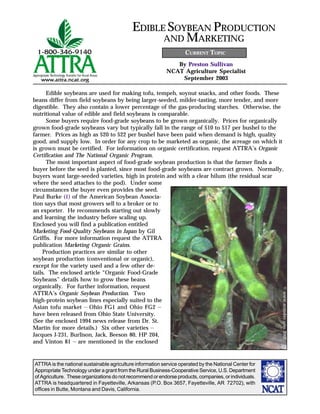
Edible soybeans are used for making tofu, tempeh, soynut snacks, and other foods. These
beans differ from field soybeans by being larger-seeded, milder-tasting, more tender, and more
digestible. They also contain a lower percentage of the gas-producing starches. Otherwise, the
nutritional value of edible and field soybeans is comparable.
Some buyers require food-grade soybeans to be grown organically. Prices for organically
grown food-grade soybeans vary but typically fall in the range of $10 to $17 per bushel to the
farmer. Prices as high as $20 to $22 per bushel have been paid when demand is high, quality
good, and supply low. In order for any crop to be marketed as organic, the acreage on which it
is grown must be certified. For information on organic certification, request ATTRA’s Organic
Certification and The National Organic Program.
The most important aspect of food-grade soybean production is that the farmer finds a
buyer before the seed is planted, since most food-grade soybeans are contract grown. Normally,
buyers want large-seeded varieties, high in protein and with a clear hilum (the residual scar
where the seed attaches to the pod). Under some
circumstances the buyer even provides the seed.
Paul Burke (1) of the American Soybean Associa-
tion says that most growers sell to a broker or to
an exporter. He recommends starting out slowly
and learning the industry before scaling up.
Enclosed you will find a publication entitled
Marketing Food-Quality Soybeans in Japan by Gil
Griffis. For more information request the ATTRA
publication Marketing Organic Grains.
Production practices are similar to other
soybean production (conventional or organic),
except for the variety used and a few other de-
tails. The enclosed article “Organic Food-Grade
Soybeans” details how to grow these beans
organically. For further information, request
ATTRA’s Organic Soybean Production. Two
high-protein soybean lines especially suited to the
Asian tofu market — Ohio FG1 and Ohio FG2 —
have been released from Ohio State University.
(See the enclosed 1994 news release from Dr. St.
Martin for more details.) Six other varieties —
Jacques J-231, Burlison, Jack, Beeson 80, HP 204,
and Vinton 81 — are mentioned in the enclosed
©www.arttoday.com2002
//EDIBLE SOYBEAN PRODUCTION AND MARKETINGPAGE 2
REFERENCES
article entitled “Bonus Beans: Do Specialty Types Pay!” More than 30 varieties are mentioned in
the enclosure on marketing food-quality soybeans in Japan. The growing location significantly
influences tofu yield, grain yield, protein, and oil content, according to a North Dakota study (2).
Processors can benefit from purchasing tofu beans from locations with the higher tofu yields and
quality.
Comprehensive information on food-grade soybeans is found at the U.S. Soyfoods Web site
sponsored by the Indiana Soybean Board (3), including a directory of soyfoods information
resources and professional industry associations. Searches of this site can help locate U.S. manu-
facturers and distributors of soyfoods, as well. Information is enclosed on Monsanto Ag., in
Stuttgart, Arkansas (4), which is involved in food-grade soybeans. They contract with growers
using seed from five varieties and buy the beans back at a $2 premium. They start contracting in
January for the coming year. Heartland Organic Marketing Cooperative (5) cleans, bags, and
markets soybeans, in addition to serving as a broker. American Health and Nutrition (6) also
buys food-grade soybeans, cleans and bags them, then markets them to processors. They do
forward-contracting with farmers as well as spot-buying at harvest time. The U.S. Soyfoods
Directory, which provides contact information for several industry associations and numerous
state soybean associations, is enclosed.
1) Paul Burke, Asia Director
American Soybean Association
12125 Woodcrest Executive Dr., Ste. 100
St. Louis, MO 63141
800-688-7692
314-576-1770
314-576-2786 FAX
2) Helms, T.C., T.D. Cai, K.C. Chang, and J.W. Enz. 1998. Tofu characteristics influenced by
soybean crop. North Dakota Agricultural Research. Fall. 11 p.
3) U.S. Soyfoods Directory
http://www.soyfoods.com/
4) Roy Owen or Gary Jones
Monsanto Ag.
901 North Park Avenue
Stuttgart, AR 72160
870-673-8565
5) Heartland Organic Marketing Cooperative
219 SW 2nd
PO Box 39
Stuart, IA 50256
515-523-1888
emhome@heartlandorganic.com
http://www.heartlandorganic.com
//EDIBLE SOYBEAN PRODUCTION AND MARKETING PAGE 3
ENCLOSURES
By Preston Sullivan
NCAT Agriculture Specialist
CT 171
6) American Health and Nutrition
3990 Varsity Drive
Ann Arbor, MI 48108-2226
800-992-1818
734-677-5570
ahn@organictrading.com
http://www.organictrading.com
Anderson, Barb B. 1996. Food beans offer taste of contract production. Progressive Farmer.
February 15. p. 84, 86.
Anon. No date. Organic Food-Grade Soybeans. Agroecology/Sustainable Agriculture Program,
University of Illinois. 4 p. <http://www.aces.uiuc.edu/%7easap/research/fs-organic-
soybeans.html>.
Brunoehler, Ron. 1994. Bonus beans: do specialty types pay? Farm Industry News.
Mid-February. p. 60-61.
Griffis, Gil, and Lars Wiedermann. 1990. Marketing Food-Quality Soybeans in Japan, 3rd
edi-
tion. American Soybean Association. 22 p.
Boes, James R. 1999. [Grower’s letter showing buyer’s standards.] Heartland Organic Market-
ing Cooperative. May 25. 2 p.
Silva, Beth. 1998. Tofu soybeans mean premiums. AgVentures. June-July. p. 36–37.
Unrein, John. 1998. Organic beans have fans in Japan. Farmer’s Digest [repr. from AgWeek].
January. p. 4-6.
Indiana Soybean Board. 1998. U.S. Soyfoods Directory. Soyfoods information resources and
professional industry associations. 5 p. <http://www.soyfoods.com/telephone.html>.
The electronic version of Edible Soybean Production and Marketing
is located at:
HTML
http://www.attra.ncat.org/attra-pub/ediblesoybean.html
PDF
http://www.attra.ncat.org/attra-pub/PDF/ediblesoybean.pdf

Edible Soybean Production and Marketing

  • 1.
    ATTRA is thenational sustainable agriculture information service operated by the National Center for Appropriate Technology under a grant from the Rural Business-Cooperative Service, U.S. Department of Agriculture. These organizations do not recommend or endorse products, companies, or individuals. ATTRA is headquartered in Fayetteville, Arkansas (P.O. Box 3657, Fayetteville, AR 72702), with offices in Butte, Montana and Davis, California. By Preston Sullivan NCAT Agriculture Specialist September 2003 EDIBLE SOYBEAN PRODUCTION AND MARKETING CURRENT TOPIC Edible soybeans are used for making tofu, tempeh, soynut snacks, and other foods. These beans differ from field soybeans by being larger-seeded, milder-tasting, more tender, and more digestible. They also contain a lower percentage of the gas-producing starches. Otherwise, the nutritional value of edible and field soybeans is comparable. Some buyers require food-grade soybeans to be grown organically. Prices for organically grown food-grade soybeans vary but typically fall in the range of $10 to $17 per bushel to the farmer. Prices as high as $20 to $22 per bushel have been paid when demand is high, quality good, and supply low. In order for any crop to be marketed as organic, the acreage on which it is grown must be certified. For information on organic certification, request ATTRA’s Organic Certification and The National Organic Program. The most important aspect of food-grade soybean production is that the farmer finds a buyer before the seed is planted, since most food-grade soybeans are contract grown. Normally, buyers want large-seeded varieties, high in protein and with a clear hilum (the residual scar where the seed attaches to the pod). Under some circumstances the buyer even provides the seed. Paul Burke (1) of the American Soybean Associa- tion says that most growers sell to a broker or to an exporter. He recommends starting out slowly and learning the industry before scaling up. Enclosed you will find a publication entitled Marketing Food-Quality Soybeans in Japan by Gil Griffis. For more information request the ATTRA publication Marketing Organic Grains. Production practices are similar to other soybean production (conventional or organic), except for the variety used and a few other de- tails. The enclosed article “Organic Food-Grade Soybeans” details how to grow these beans organically. For further information, request ATTRA’s Organic Soybean Production. Two high-protein soybean lines especially suited to the Asian tofu market — Ohio FG1 and Ohio FG2 — have been released from Ohio State University. (See the enclosed 1994 news release from Dr. St. Martin for more details.) Six other varieties — Jacques J-231, Burlison, Jack, Beeson 80, HP 204, and Vinton 81 — are mentioned in the enclosed ©www.arttoday.com2002
  • 2.
    //EDIBLE SOYBEAN PRODUCTIONAND MARKETINGPAGE 2 REFERENCES article entitled “Bonus Beans: Do Specialty Types Pay!” More than 30 varieties are mentioned in the enclosure on marketing food-quality soybeans in Japan. The growing location significantly influences tofu yield, grain yield, protein, and oil content, according to a North Dakota study (2). Processors can benefit from purchasing tofu beans from locations with the higher tofu yields and quality. Comprehensive information on food-grade soybeans is found at the U.S. Soyfoods Web site sponsored by the Indiana Soybean Board (3), including a directory of soyfoods information resources and professional industry associations. Searches of this site can help locate U.S. manu- facturers and distributors of soyfoods, as well. Information is enclosed on Monsanto Ag., in Stuttgart, Arkansas (4), which is involved in food-grade soybeans. They contract with growers using seed from five varieties and buy the beans back at a $2 premium. They start contracting in January for the coming year. Heartland Organic Marketing Cooperative (5) cleans, bags, and markets soybeans, in addition to serving as a broker. American Health and Nutrition (6) also buys food-grade soybeans, cleans and bags them, then markets them to processors. They do forward-contracting with farmers as well as spot-buying at harvest time. The U.S. Soyfoods Directory, which provides contact information for several industry associations and numerous state soybean associations, is enclosed. 1) Paul Burke, Asia Director American Soybean Association 12125 Woodcrest Executive Dr., Ste. 100 St. Louis, MO 63141 800-688-7692 314-576-1770 314-576-2786 FAX 2) Helms, T.C., T.D. Cai, K.C. Chang, and J.W. Enz. 1998. Tofu characteristics influenced by soybean crop. North Dakota Agricultural Research. Fall. 11 p. 3) U.S. Soyfoods Directory http://www.soyfoods.com/ 4) Roy Owen or Gary Jones Monsanto Ag. 901 North Park Avenue Stuttgart, AR 72160 870-673-8565 5) Heartland Organic Marketing Cooperative 219 SW 2nd PO Box 39 Stuart, IA 50256 515-523-1888 emhome@heartlandorganic.com http://www.heartlandorganic.com
  • 3.
    //EDIBLE SOYBEAN PRODUCTIONAND MARKETING PAGE 3 ENCLOSURES By Preston Sullivan NCAT Agriculture Specialist CT 171 6) American Health and Nutrition 3990 Varsity Drive Ann Arbor, MI 48108-2226 800-992-1818 734-677-5570 ahn@organictrading.com http://www.organictrading.com Anderson, Barb B. 1996. Food beans offer taste of contract production. Progressive Farmer. February 15. p. 84, 86. Anon. No date. Organic Food-Grade Soybeans. Agroecology/Sustainable Agriculture Program, University of Illinois. 4 p. <http://www.aces.uiuc.edu/%7easap/research/fs-organic- soybeans.html>. Brunoehler, Ron. 1994. Bonus beans: do specialty types pay? Farm Industry News. Mid-February. p. 60-61. Griffis, Gil, and Lars Wiedermann. 1990. Marketing Food-Quality Soybeans in Japan, 3rd edi- tion. American Soybean Association. 22 p. Boes, James R. 1999. [Grower’s letter showing buyer’s standards.] Heartland Organic Market- ing Cooperative. May 25. 2 p. Silva, Beth. 1998. Tofu soybeans mean premiums. AgVentures. June-July. p. 36–37. Unrein, John. 1998. Organic beans have fans in Japan. Farmer’s Digest [repr. from AgWeek]. January. p. 4-6. Indiana Soybean Board. 1998. U.S. Soyfoods Directory. Soyfoods information resources and professional industry associations. 5 p. <http://www.soyfoods.com/telephone.html>. The electronic version of Edible Soybean Production and Marketing is located at: HTML http://www.attra.ncat.org/attra-pub/ediblesoybean.html PDF http://www.attra.ncat.org/attra-pub/PDF/ediblesoybean.pdf