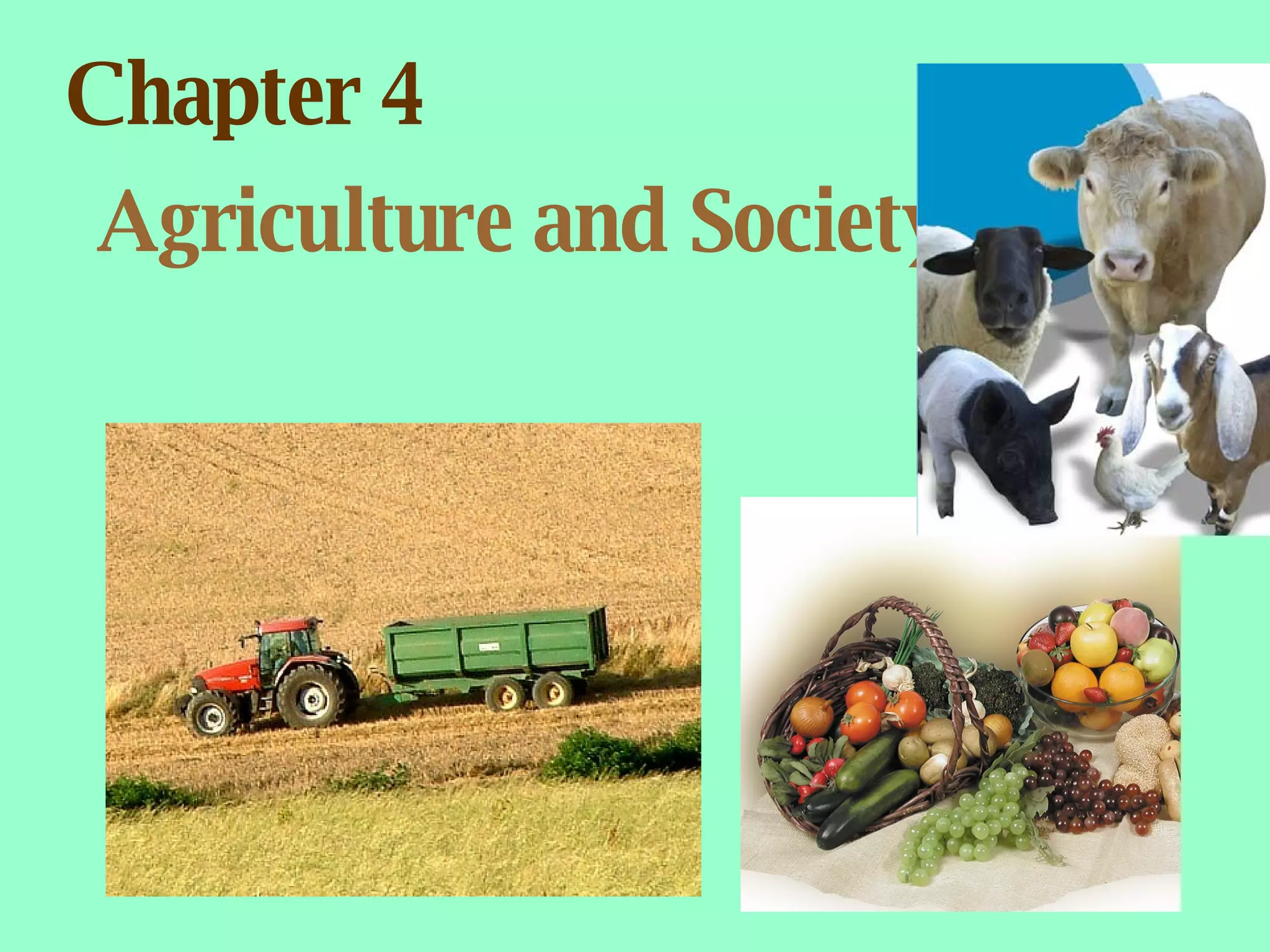
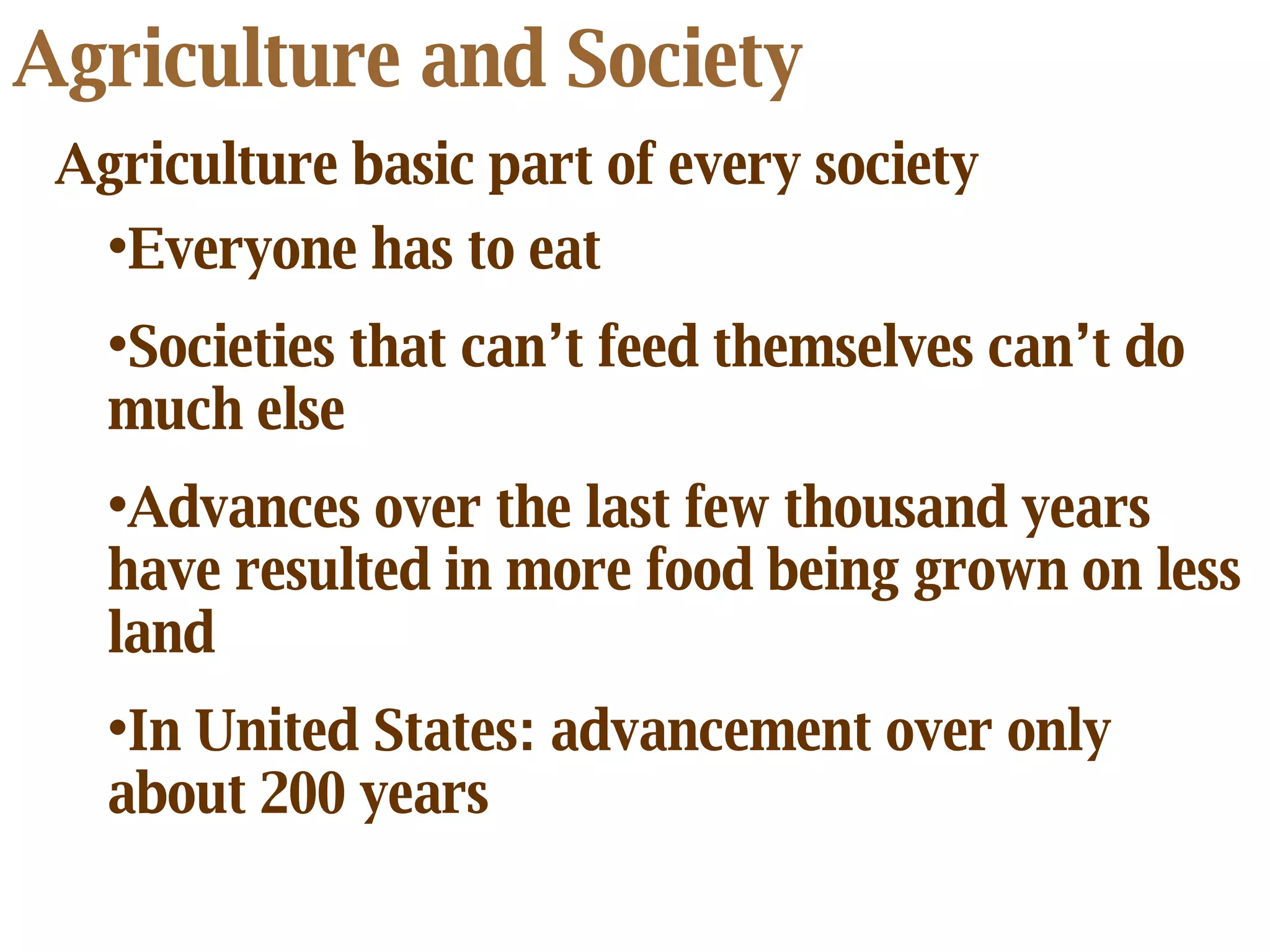
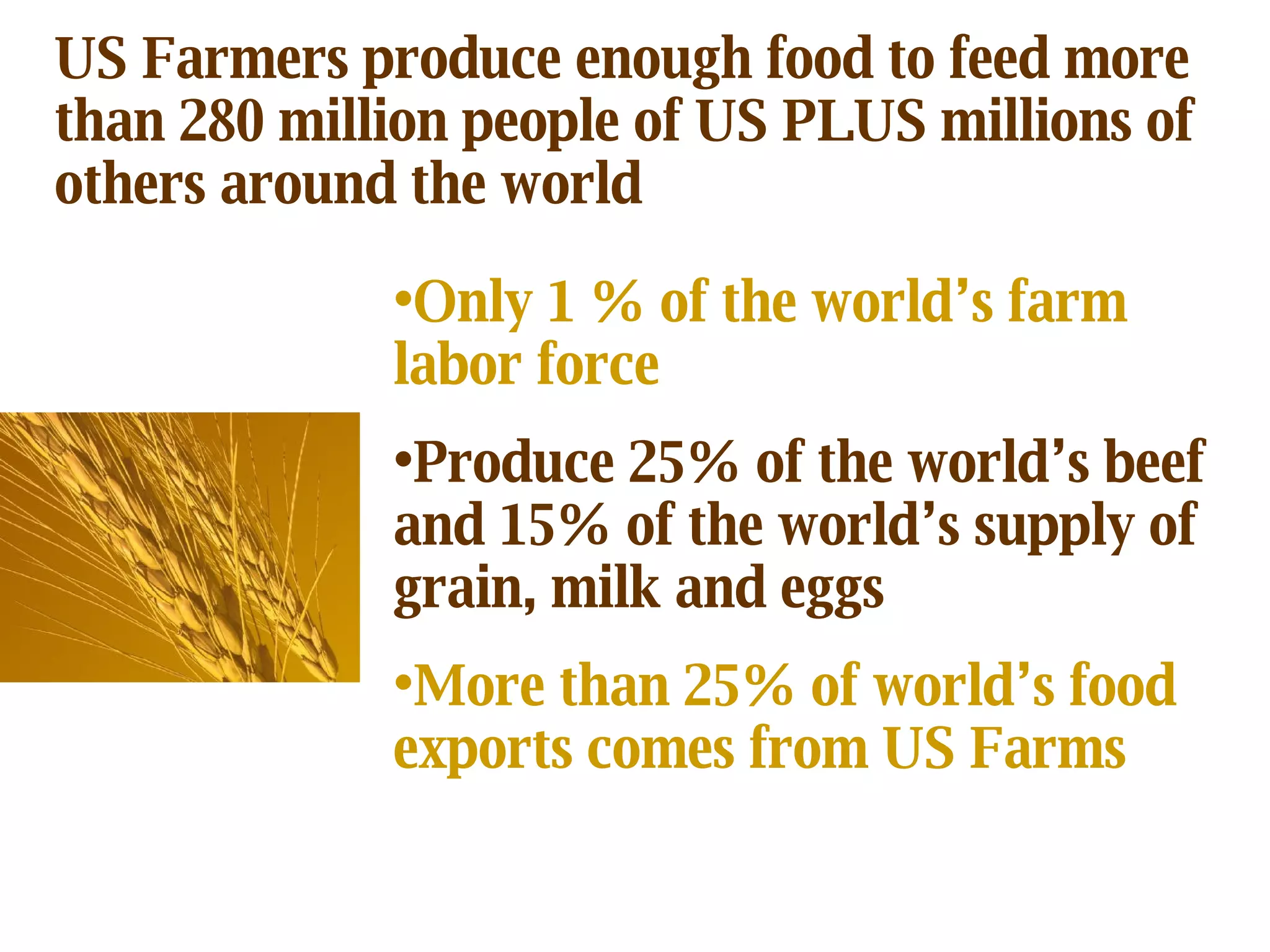
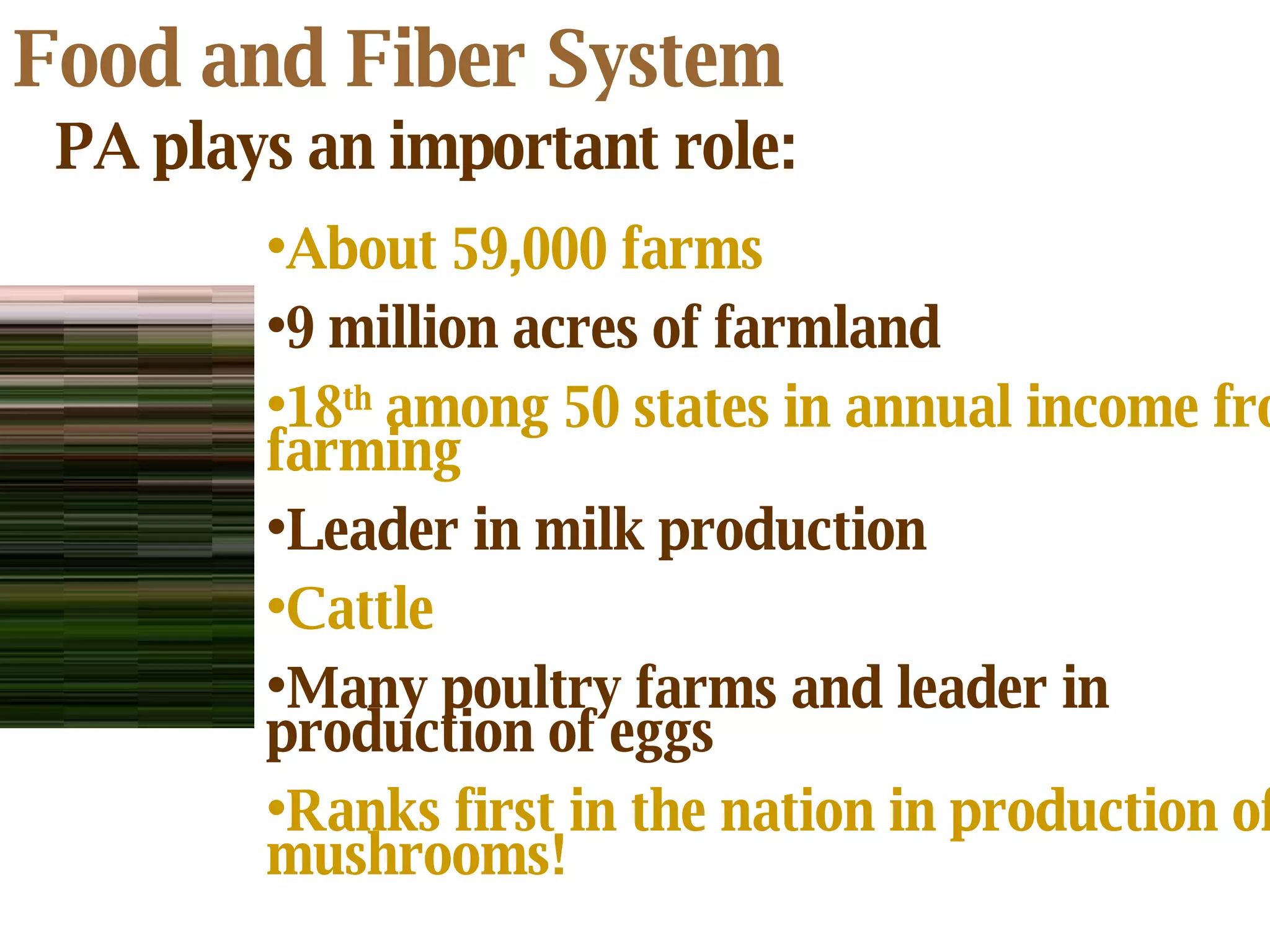
Chapter 4 Agriculture and Society
Agriculture and Society Agriculture basic part of every society Everyone has to eat Societies that can’t feed themselves can’t do much else Advances over the last few thousand years have resulted in more food being grown on less land In United States: advancement over only about 200 years
US Farmers produce enough food to feed more than 280 million people of US PLUS millions of others around the world Only 1 % of the world’s farm labor force Produce 25% of the world’s beef and 15% of the world’s supply of grain, milk and eggs More than 25% of world’s food exports comes from US Farms
Food and Fiber System PA plays an important role: About 59,000 farms 9 million acres of farmland 18 th  among 50 states in annual income from farming Leader in milk production Cattle   Many poultry farms and leader in production of eggs Ranks first in the nation in production of mushrooms!
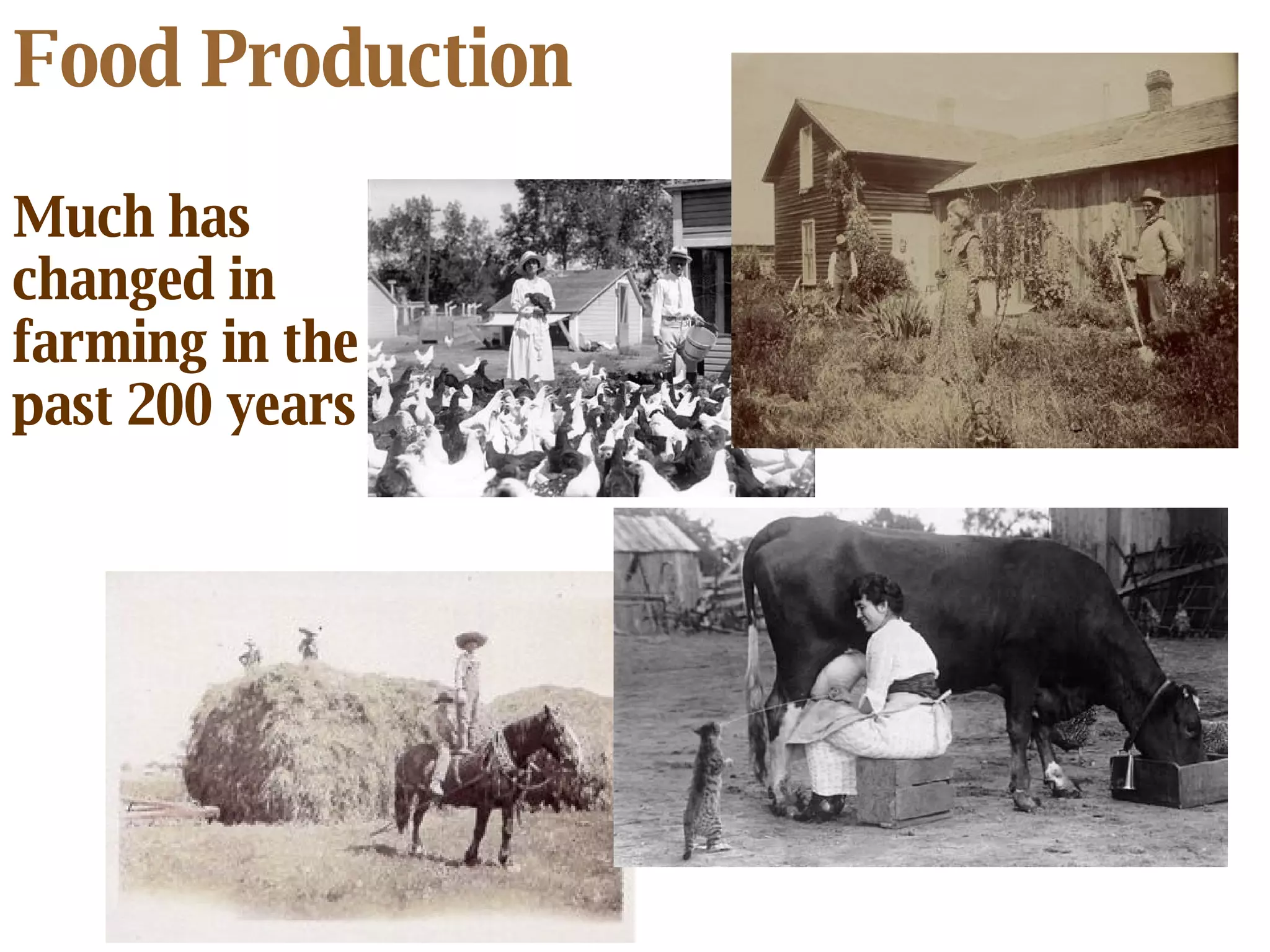
Food Production Much has changed in farming in the past 200 years
Food Production Changes over the years: Small farms: sell less than $250,000 worth of crops and livestock each year Small farms still outnumber large farms in US Bulk of food produced in US comes from large farms Corporate farms dominate the US food and fiber system New technologies have made farming efficient but expensive   Numbers of farms have decreased but the average farm size has increased
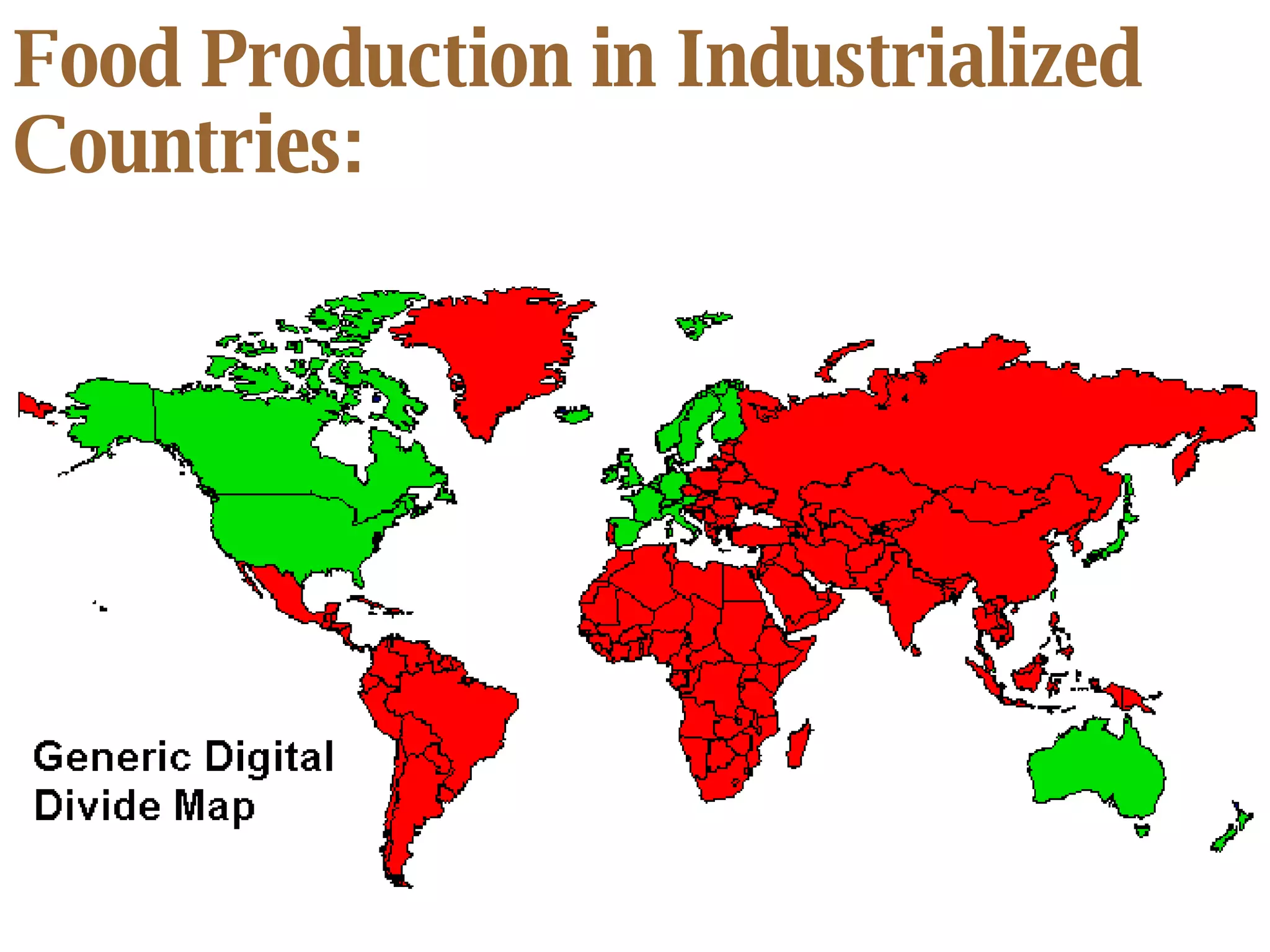
Food Production in Industrialized Countries:
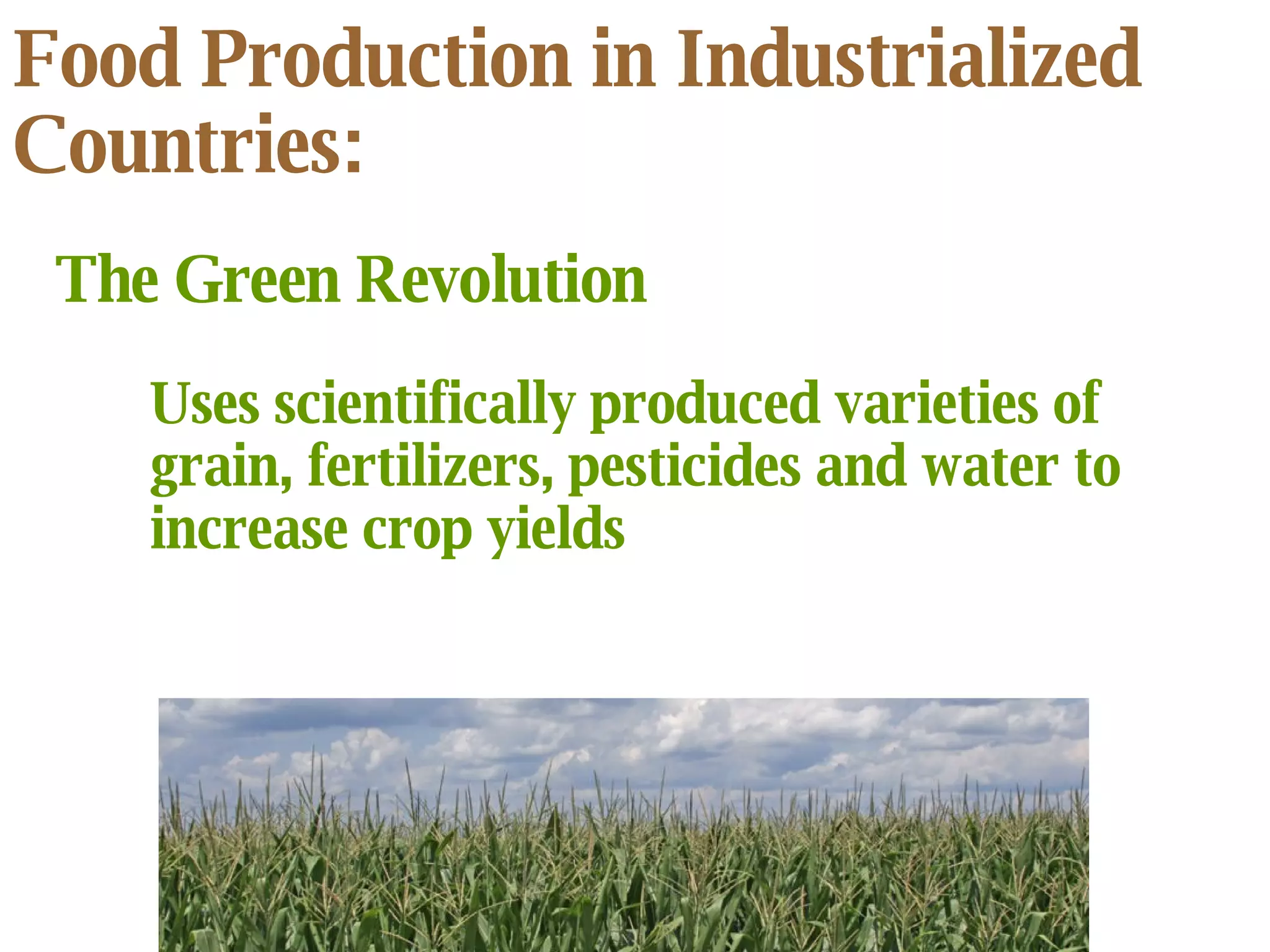
Food Production in Industrialized Countries: The Green Revolution Uses scientifically produced varieties of grain, fertilizers, pesticides and water to increase crop yields
Food Production in Industrialized Countries: The Green Revolution Until 1950, farmers increased yield by increasing the numbers of acres planted The Green Revolution allows farms produce more food not by planting more acres but by coaxing the land that is already planted to produce more Now countries that are using these methods can produce enough food to feed themselves AND export to other nations (make money from it)
Food Production in Industrialized Countries: Irrigation systems:  food can be produced on dry lands that would otherwise be unsuitable Modern laborsaving machinery to prepare fields, plant and tend crops, and bring in harvests Modern facilities and machines that help raise livestock, giving them food and water Other tools that increase productivity:
Food Production in Industrialized Countries: Benefits Food is cheaper People spend less money on food, more money on other things Raises standards of living Provides jobs and income for people Surplus food and fiber to sell as exports which helps the economy of the nation
From Farm to Market Farming local and personal Raised food for families and friends Work done entirely by hand 1000’s of years ago: Today: Few of us grow our own food; or raise our own animals for meat Small percentage of people provide food and fiber for the rest
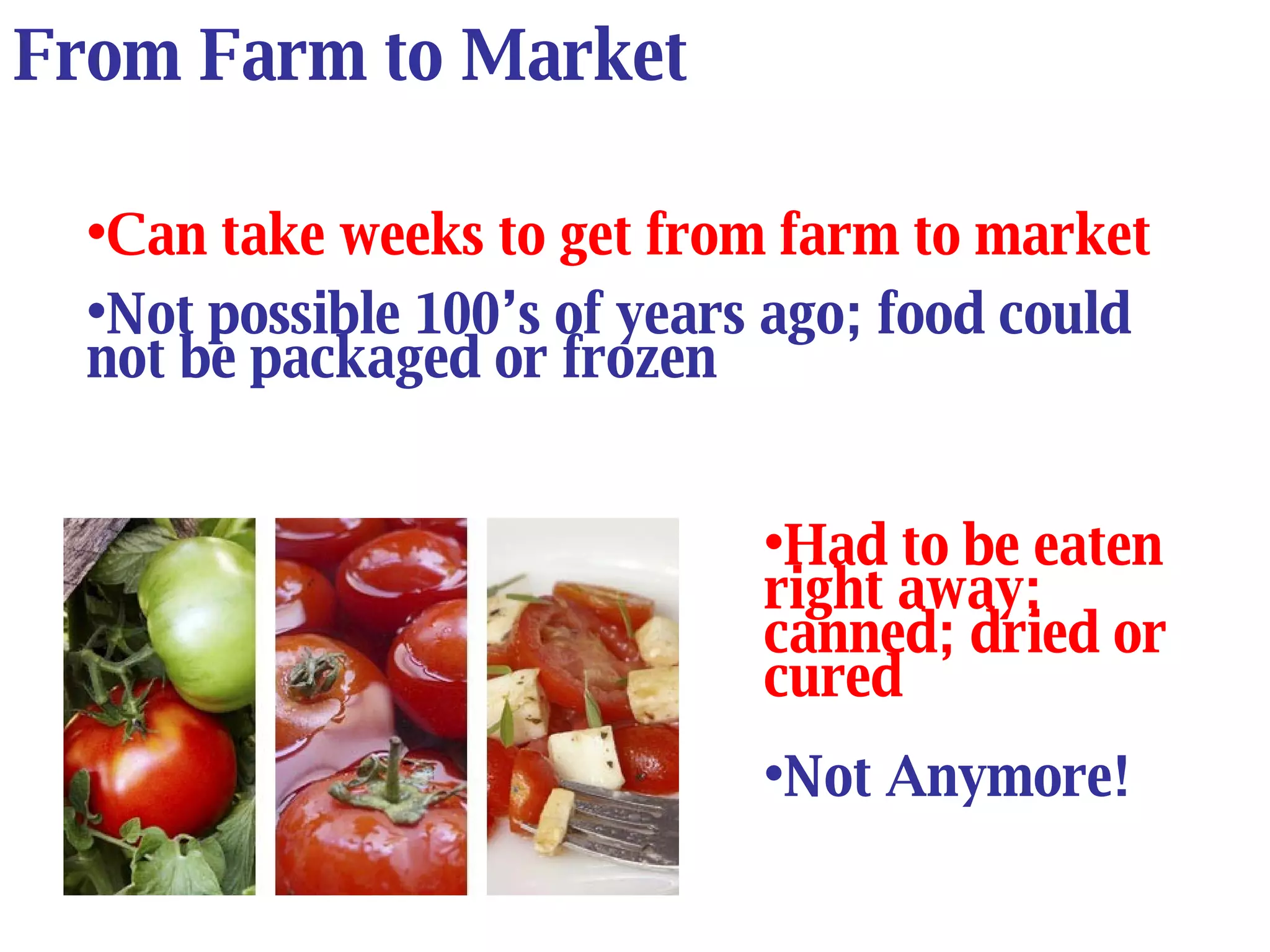
From Farm to Market Can take weeks to get from farm to market Not possible 100’s of years ago; food could not be packaged or frozen Had to be eaten right away; canned; dried or cured Not Anymore!
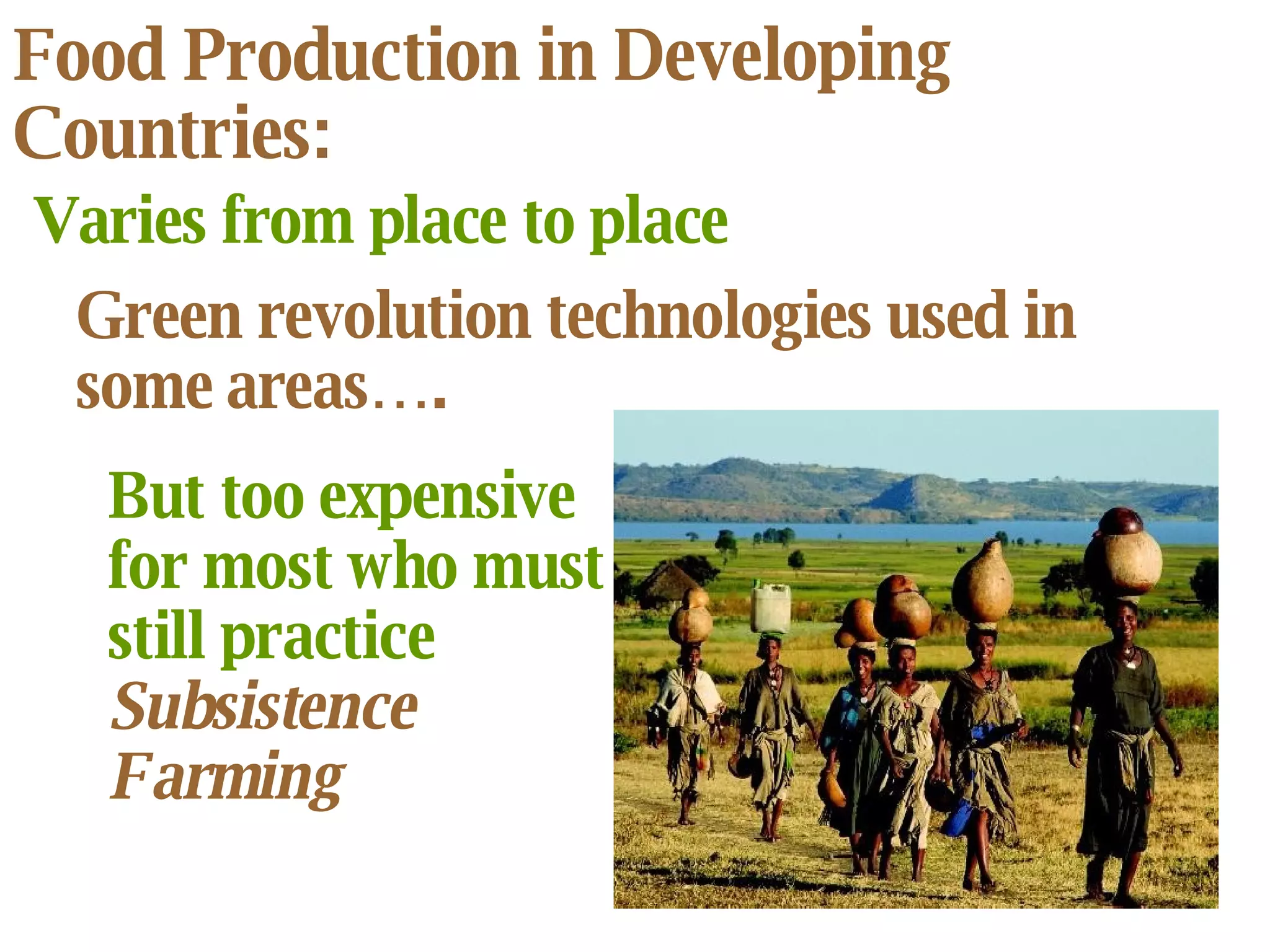
Food Production in Developing Countries: Varies from place to place Green revolution technologies used in some areas….  But too expensive for most who must still practice  Subsistence Farming
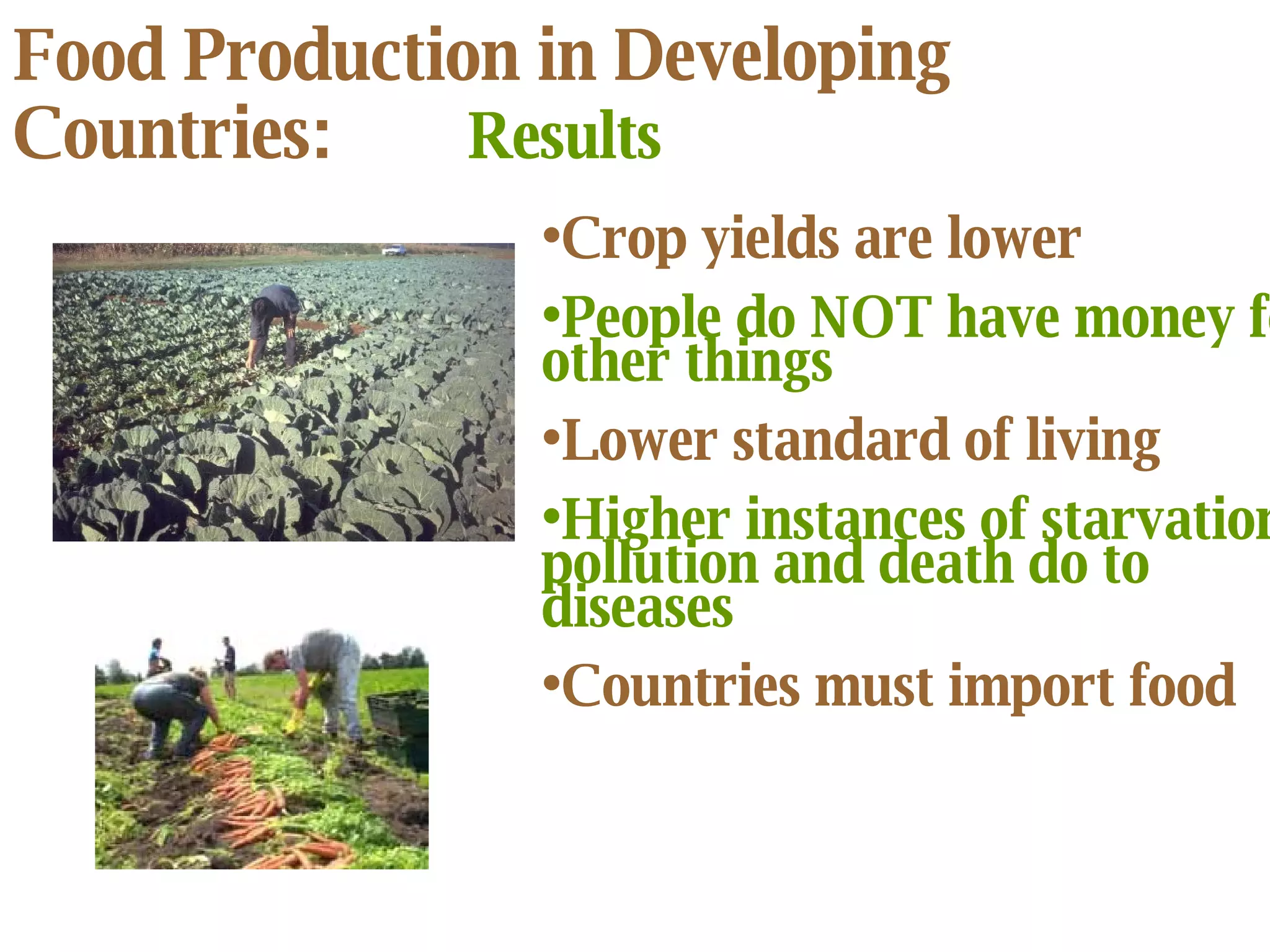
Food Production in Developing Countries: Results Crop yields are lower People do NOT have money for other things Lower standard of living Higher instances of starvation, pollution and death do to diseases Countries must import food
Food Production in Developing Countries: Some methods in tropical areas: Shifting cultivation:   Farmers clear land in a forest Plant crops for a few years until the soil is used up Move on to clear another field Slash and burn agriculture:   Farmers cut down trees Burn vegetation  Use ash as a “fertilizer” Plant between tree stumps
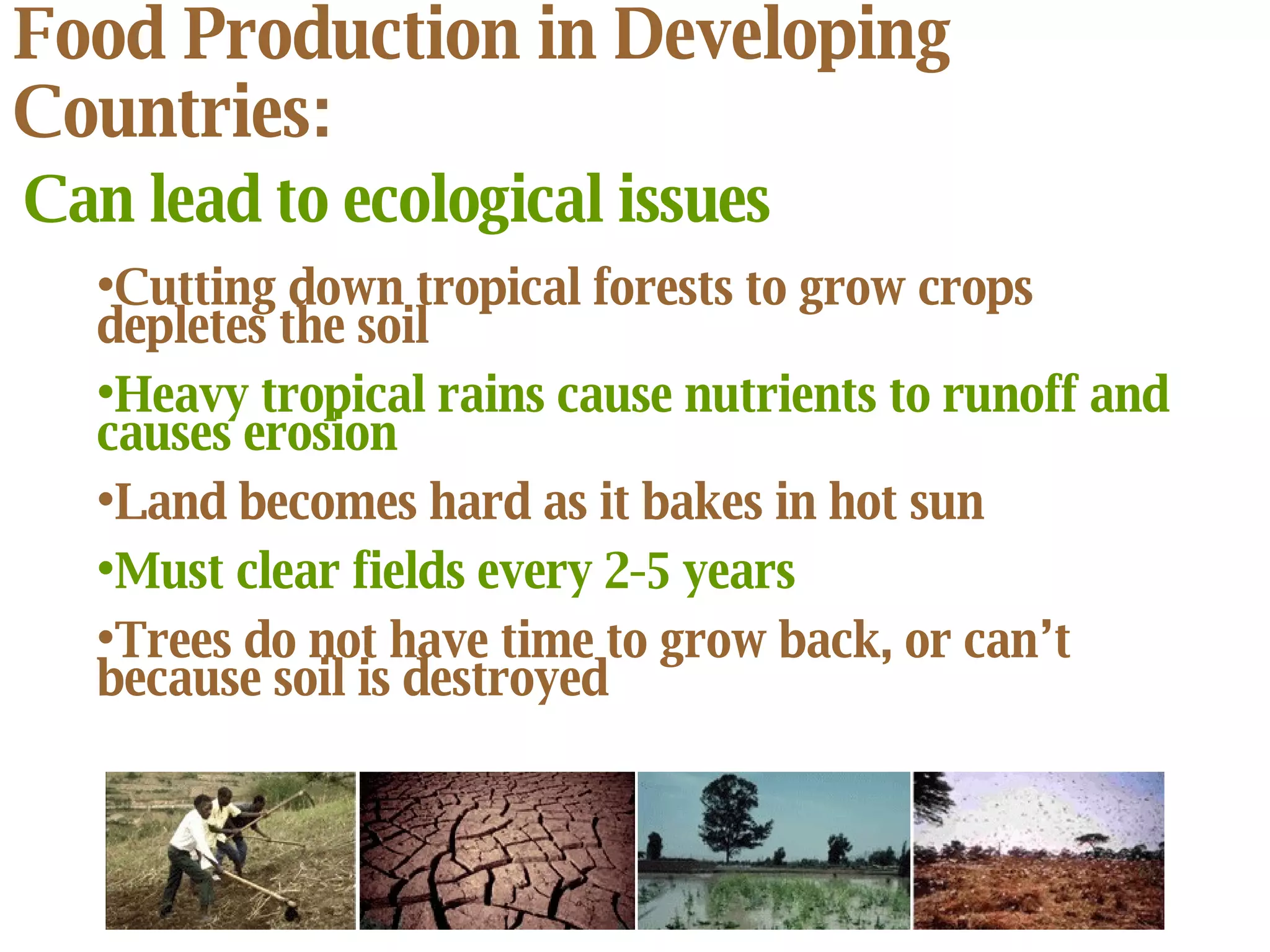
Food Production in Developing Countries: Can lead to ecological issues Cutting down tropical forests to grow crops depletes the soil Heavy tropical rains cause nutrients to runoff and causes erosion Land becomes hard as it bakes in hot sun Must clear fields every 2-5 years Trees do not have time to grow back, or can’t because soil is destroyed
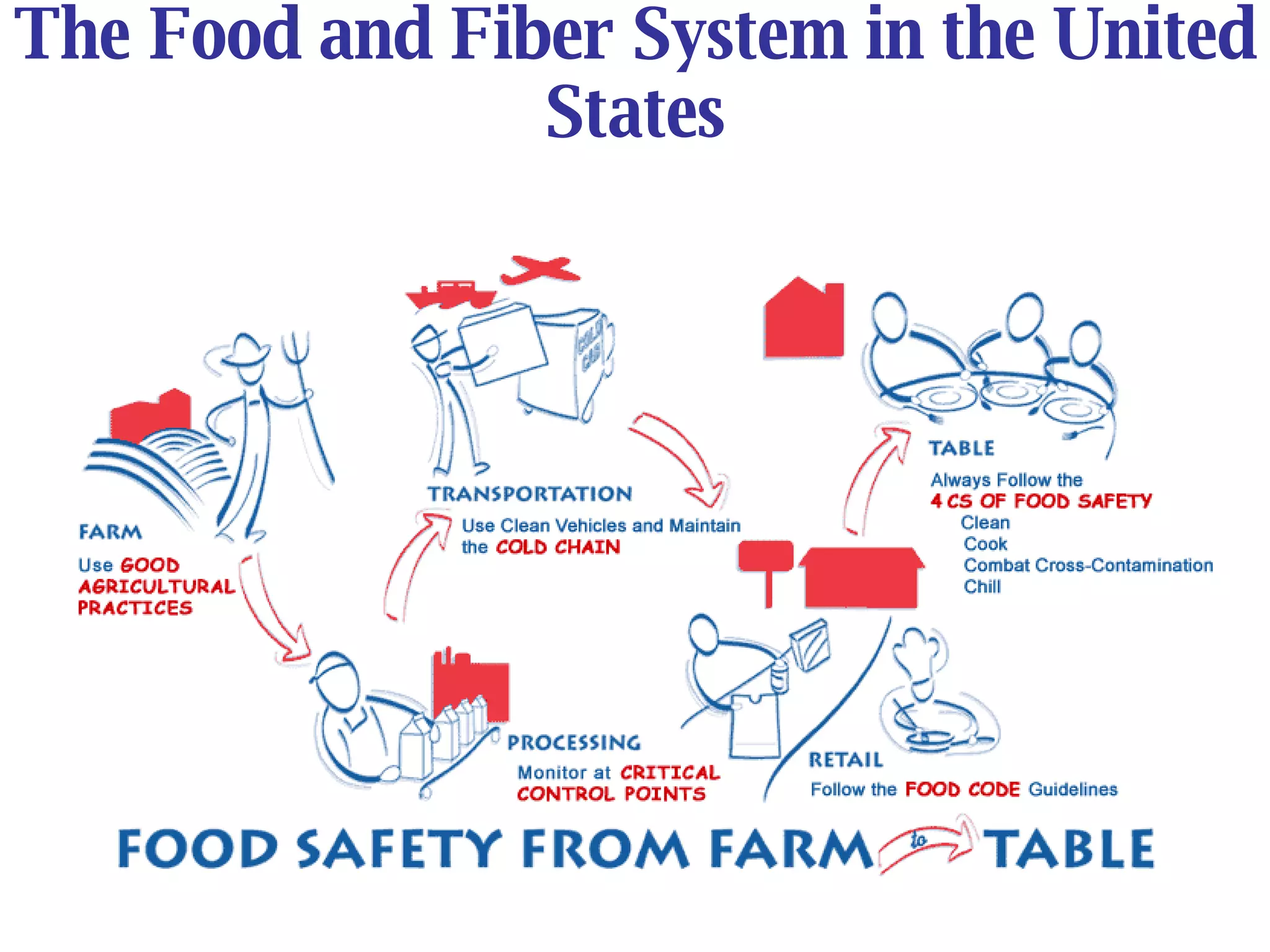
The Food and Fiber System in the United States
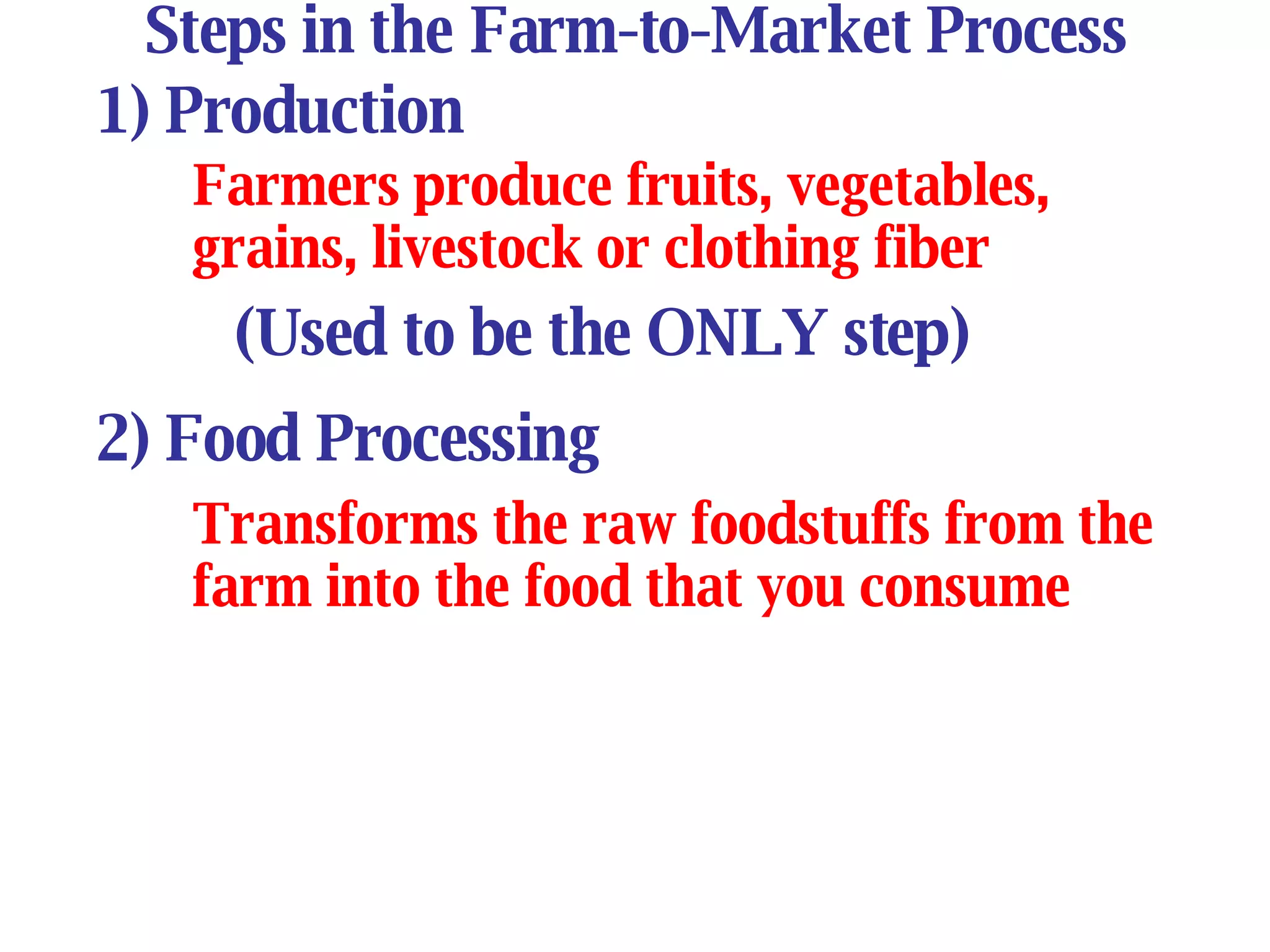
Steps in the Farm-to-Market Process 1) Production Farmers produce fruits, vegetables, grains, livestock or clothing fiber (Used to be the ONLY step) 2) Food Processing Transforms the raw foodstuffs from the farm into the food that you consume
2) Food Processing Raw foods are: dried, canned, frozen, pickled, powder, juiced Raw foods are put into other products or mixed together with additives to make other products Some processes improve food quality Some processes also slaughter livestock and fish to  make meat products
Packaging Last step of the processing  Protects foods from spoiling, spilling or breaking 3) Transportation and Distribution From farm to processing From farm to market From processors to wholesalers From wholesalers to restaurants, bakeshops, cafeterias etc.. From processors to retailers
Most consumers buy food from retailers Supermarkets, grocery stores, delicatessens, butcher shops, vending machines Marketing The advertising, buying and selling of products in the food and fiber system 3) Transportation and Distribution
Regulations USDA: United States Department of Agriculture FDA: Food and Drug Administration Food safety inspections “ Grading”  foods for standards Ensure truthfulness of information on labels Inspect imported foods Ensure that farm and production practices are safe for the environment
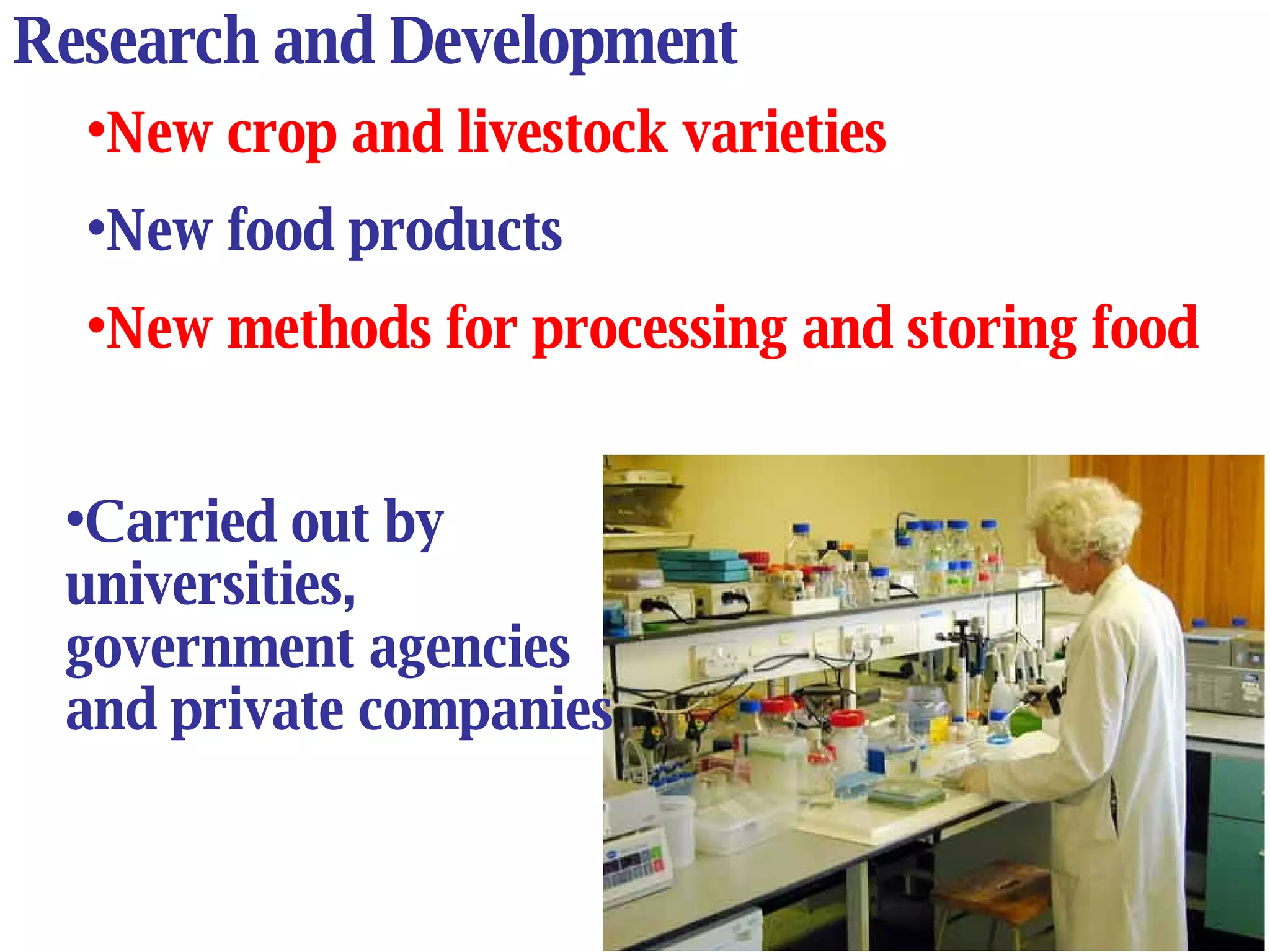
Research and Development New crop and livestock varieties New food products New methods for processing and storing food Carried out by universities, government agencies and private companies
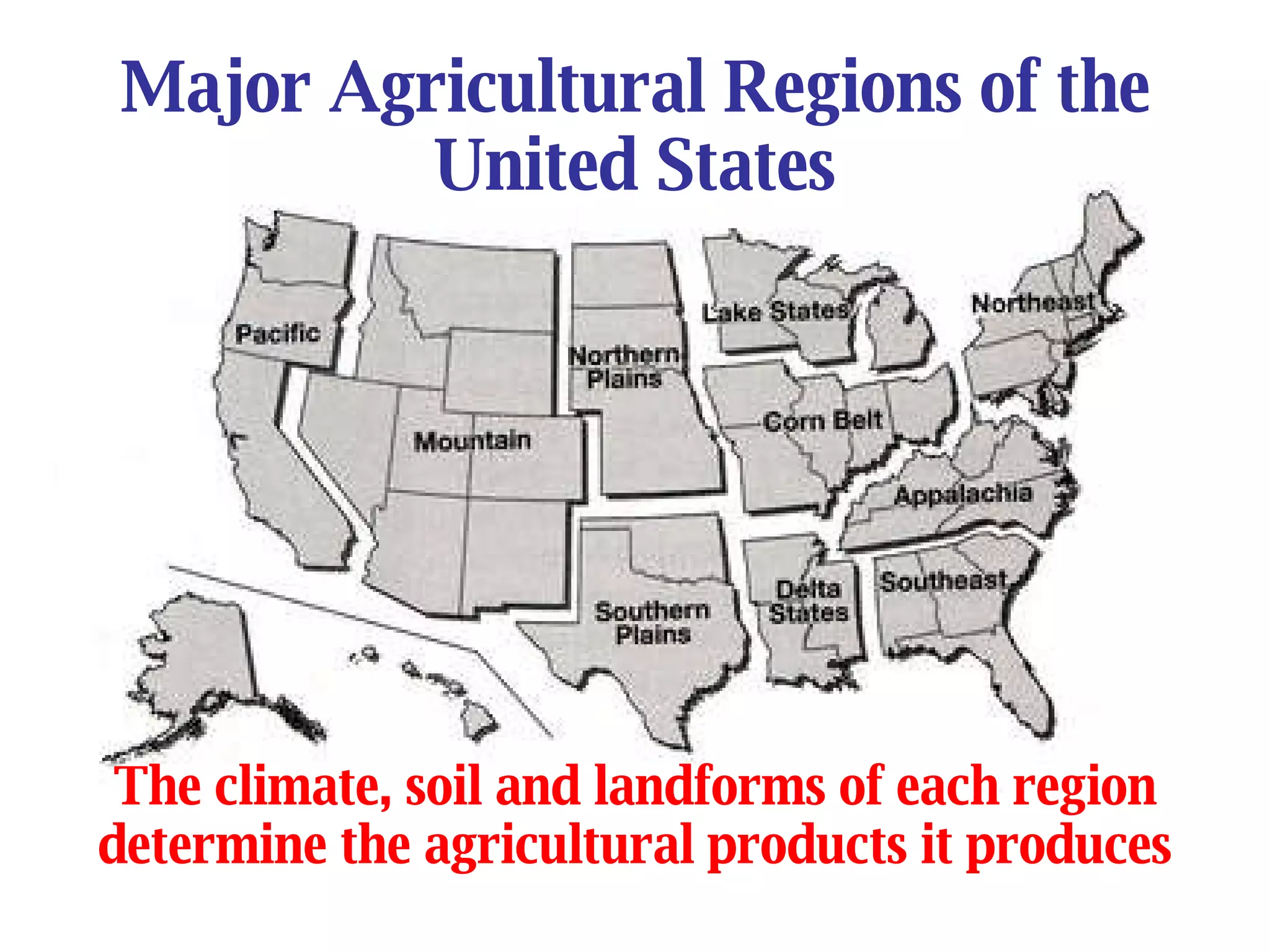
Major Agricultural Regions of the United States The climate, soil and landforms of each region determine the agricultural products it produces
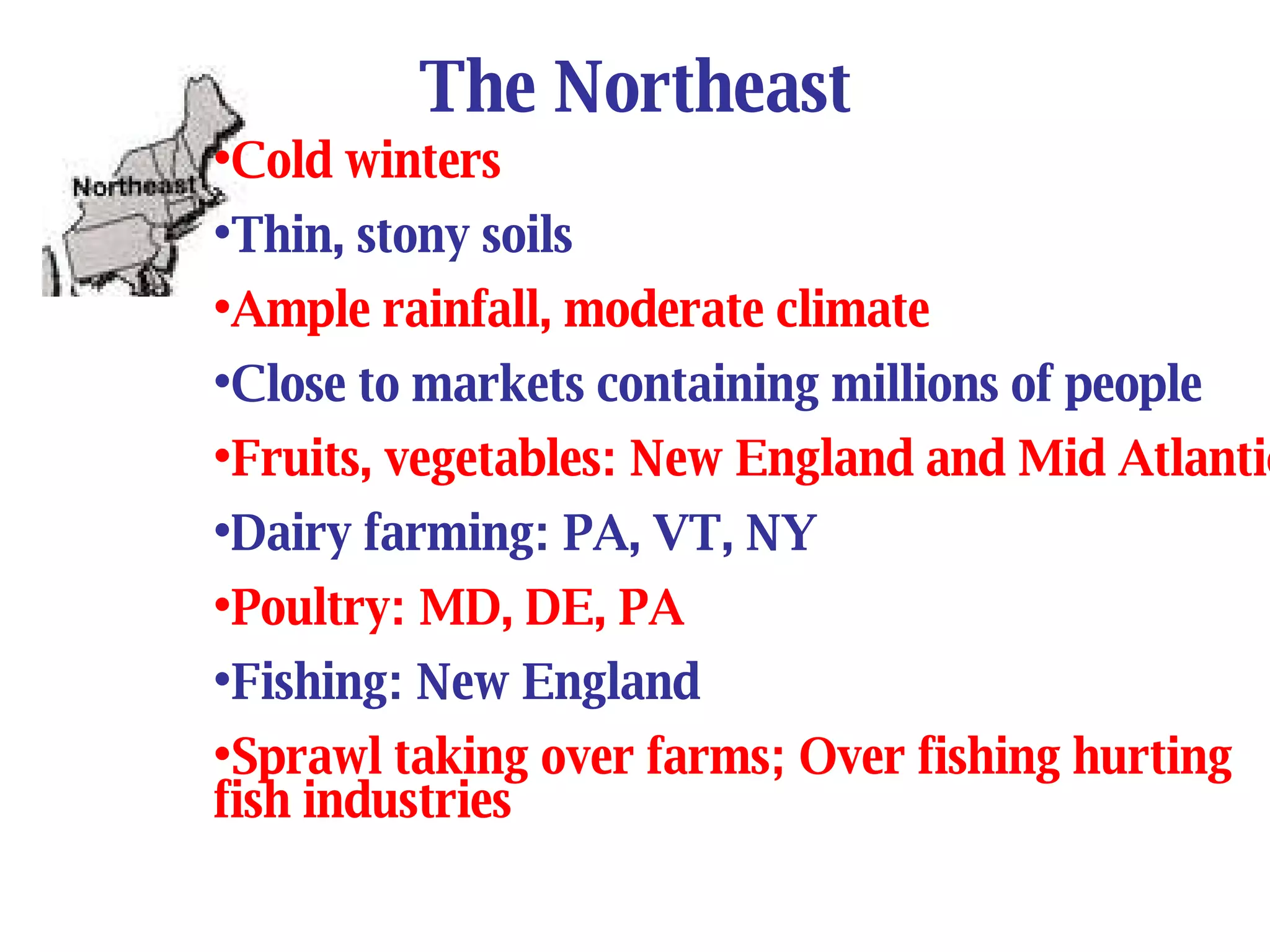
The Northeast Cold winters Thin, stony soils Ample rainfall, moderate climate Close to markets containing millions of people Fruits, vegetables: New England and Mid Atlantic Dairy farming: PA, VT, NY Poultry: MD, DE, PA Fishing: New England Sprawl taking over farms; Over fishing hurting fish industries
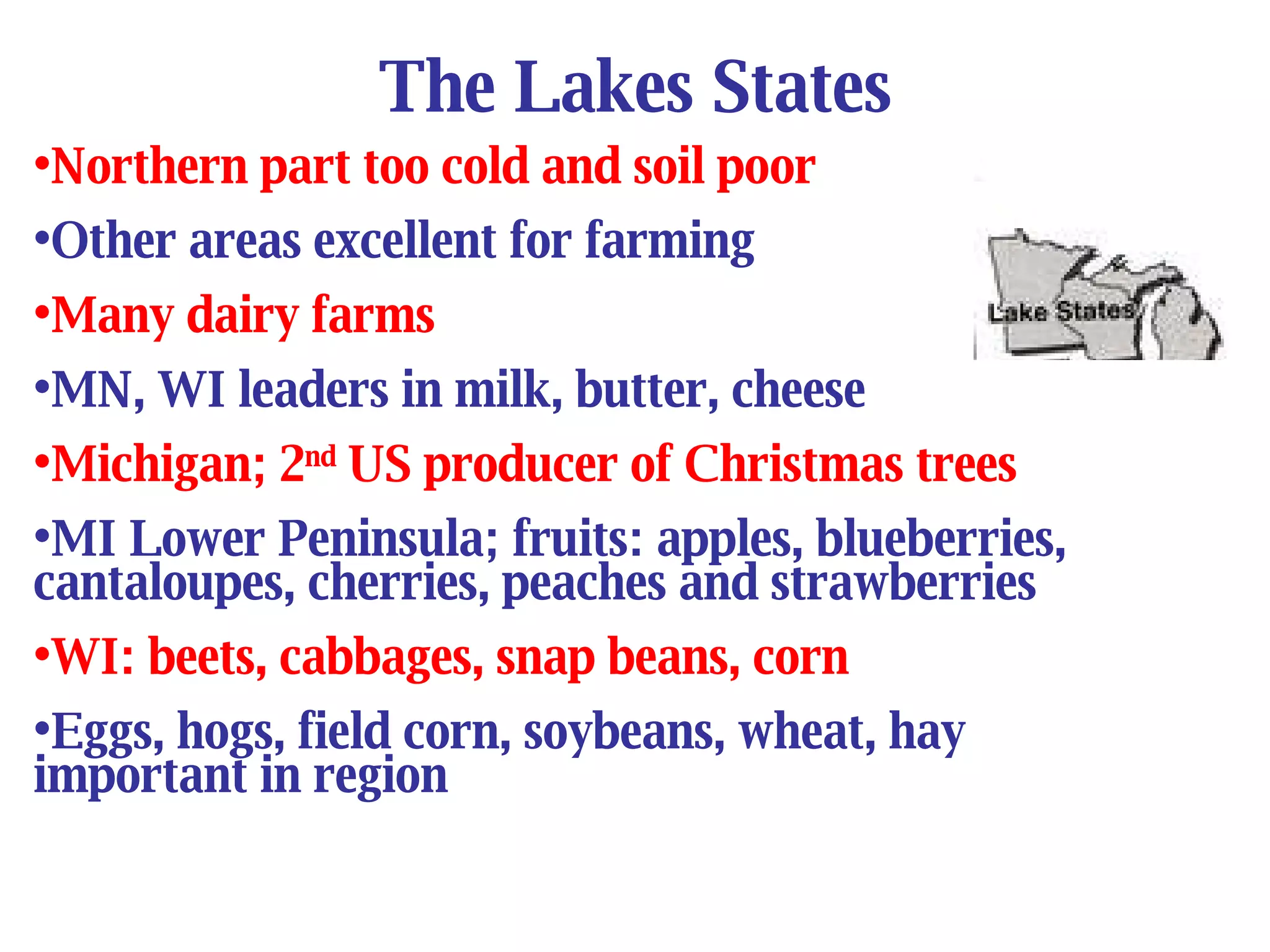
The Lakes States Northern part too cold and soil poor Other areas excellent for farming Many dairy farms MN, WI leaders in milk, butter, cheese Michigan; 2 nd  US producer of Christmas trees MI Lower Peninsula; fruits: apples, blueberries, cantaloupes, cherries, peaches and strawberries WI: beets, cabbages, snap beans, corn Eggs, hogs, field corn, soybeans, wheat, hay  important in region
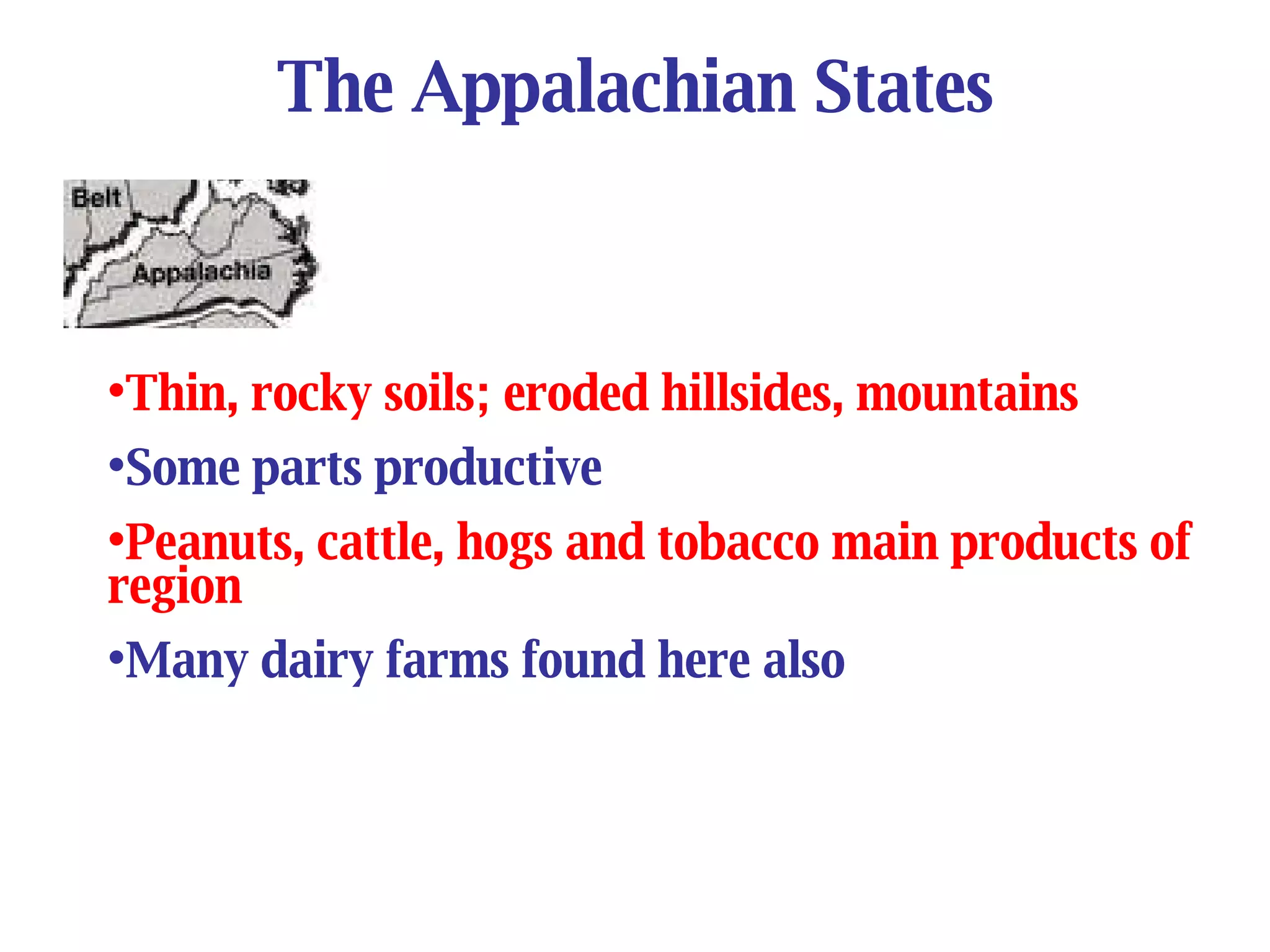
The Appalachian States Thin, rocky soils; eroded hillsides, mountains Some parts productive  Peanuts, cattle, hogs and tobacco main products of region Many dairy farms found here also
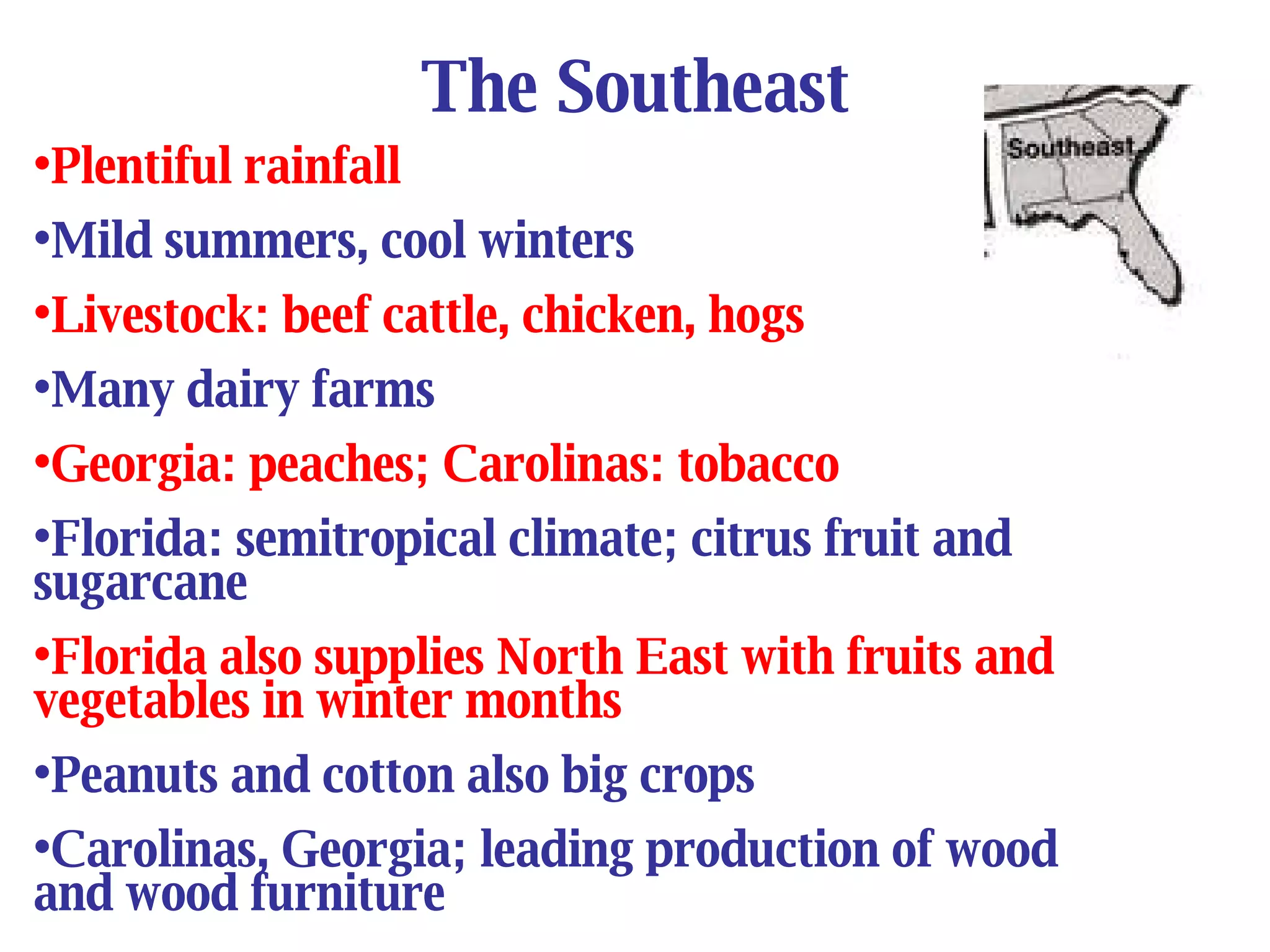
The Southeast Plentiful rainfall Mild summers, cool winters Livestock: beef cattle, chicken, hogs Many dairy farms Georgia: peaches; Carolinas: tobacco Florida: semitropical climate; citrus fruit and sugarcane Florida also supplies North East with fruits and vegetables in winter months Peanuts and cotton also big crops Carolinas, Georgia; leading production of wood and wood furniture
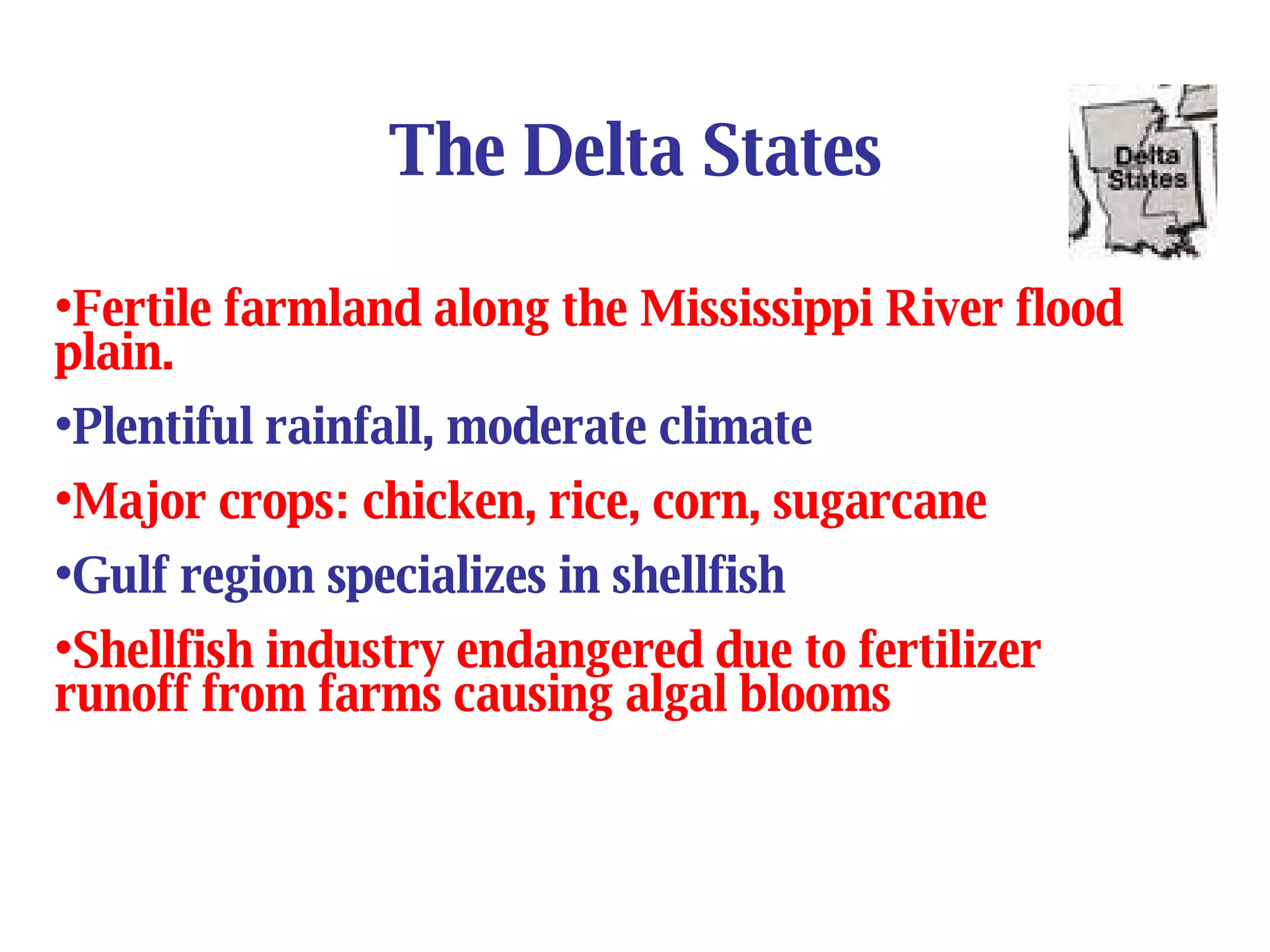
The Delta States Fertile farmland along the Mississippi River flood plain. Plentiful rainfall, moderate climate Major crops: chicken, rice, corn, sugarcane Gulf region specializes in shellfish Shellfish industry endangered due to fertilizer runoff from farms causing algal blooms
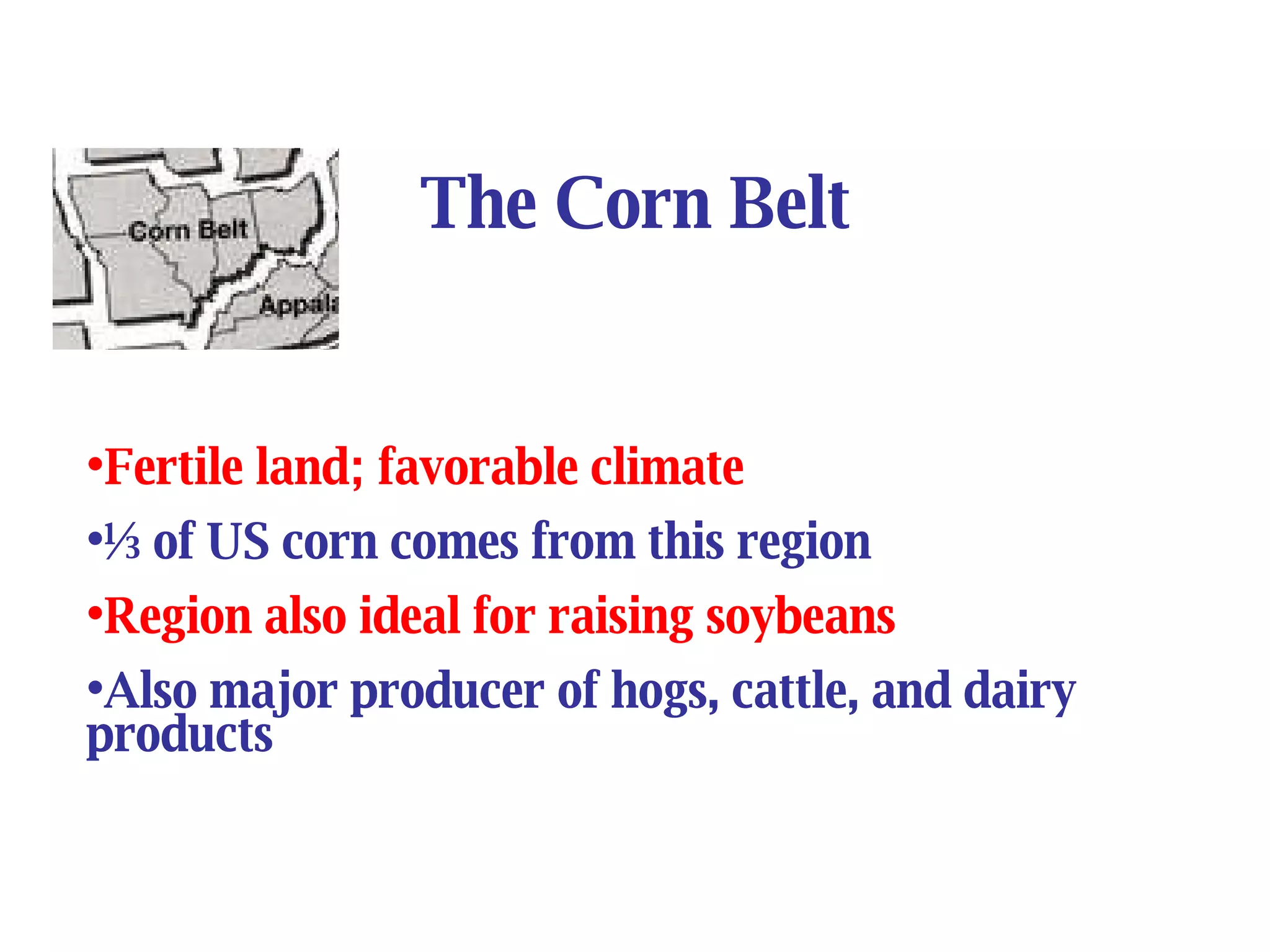
The Corn Belt Fertile land; favorable climate ½ of US corn comes from this region Region also ideal for raising soybeans Also major producer of hogs, cattle, and dairy products
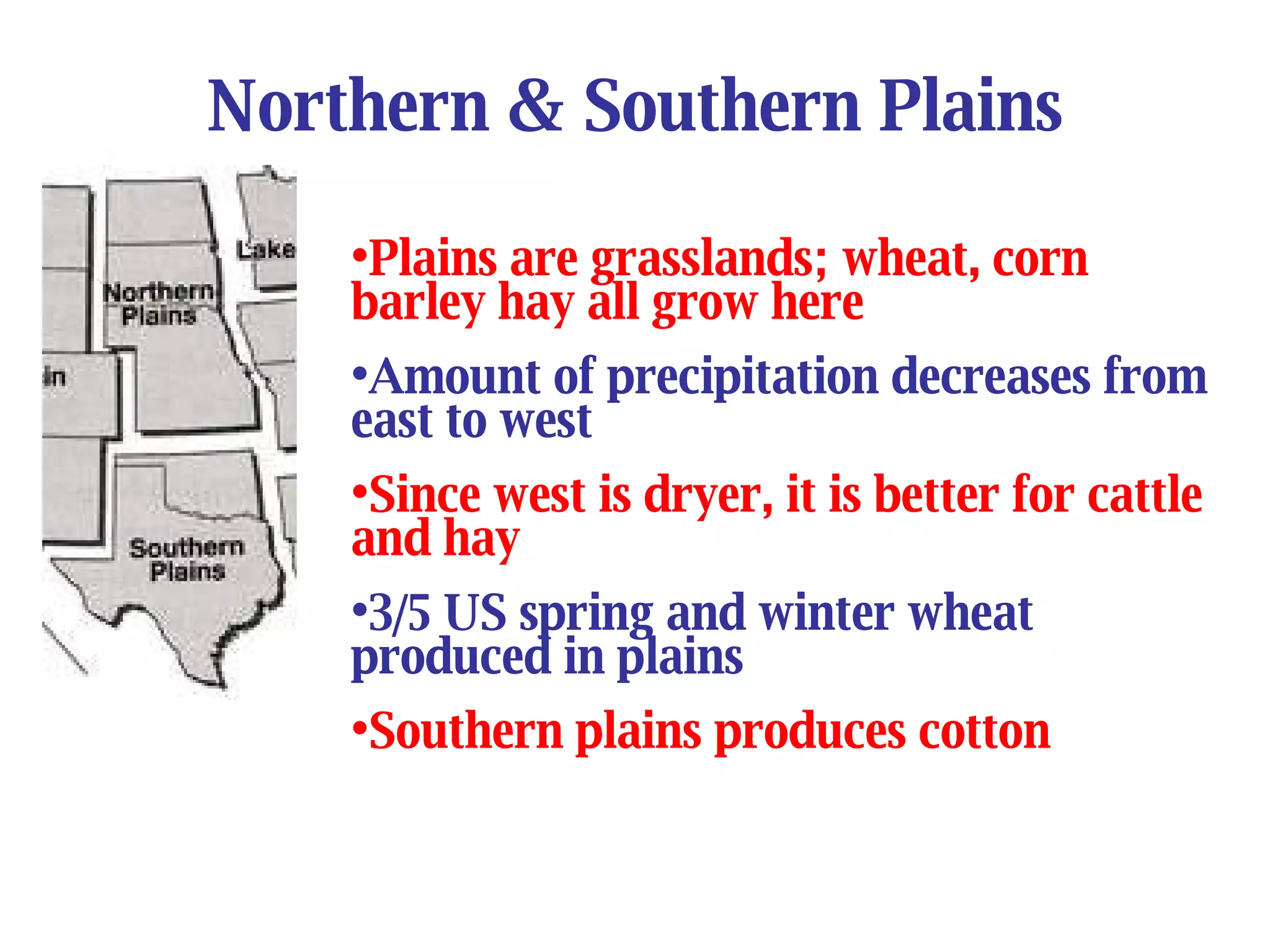
Northern & Southern Plains Plains are grasslands; wheat, corn barley hay all grow here Amount of precipitation decreases from east to west Since west is dryer, it is better for cattle and hay 3/5 US spring and winter wheat produced in plains Southern plains produces cotton
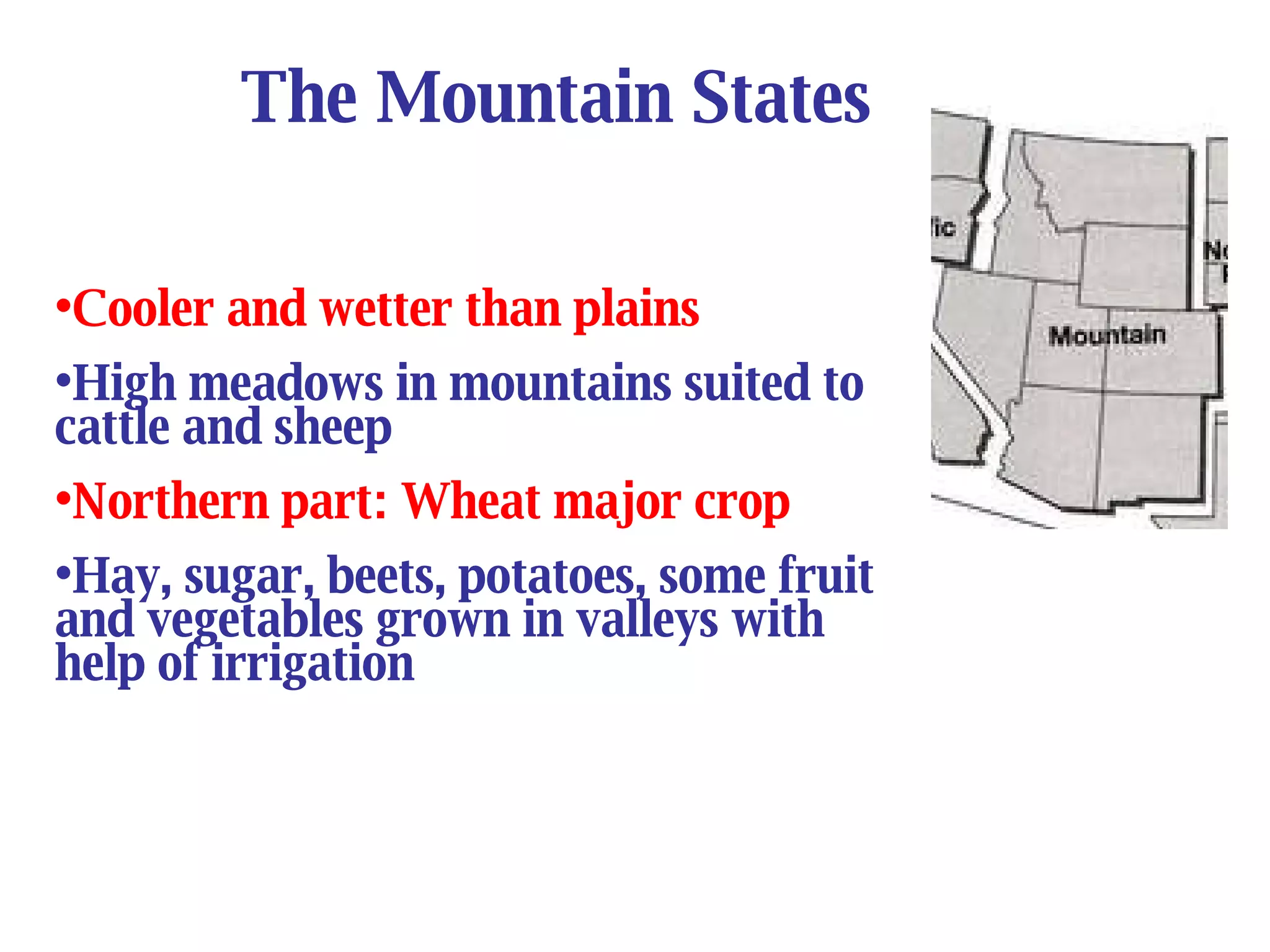
The Mountain States Cooler and wetter than plains High meadows in mountains suited to cattle and sheep Northern part: Wheat major crop Hay, sugar, beets, potatoes, some fruit and vegetables grown in valleys with help of irrigation
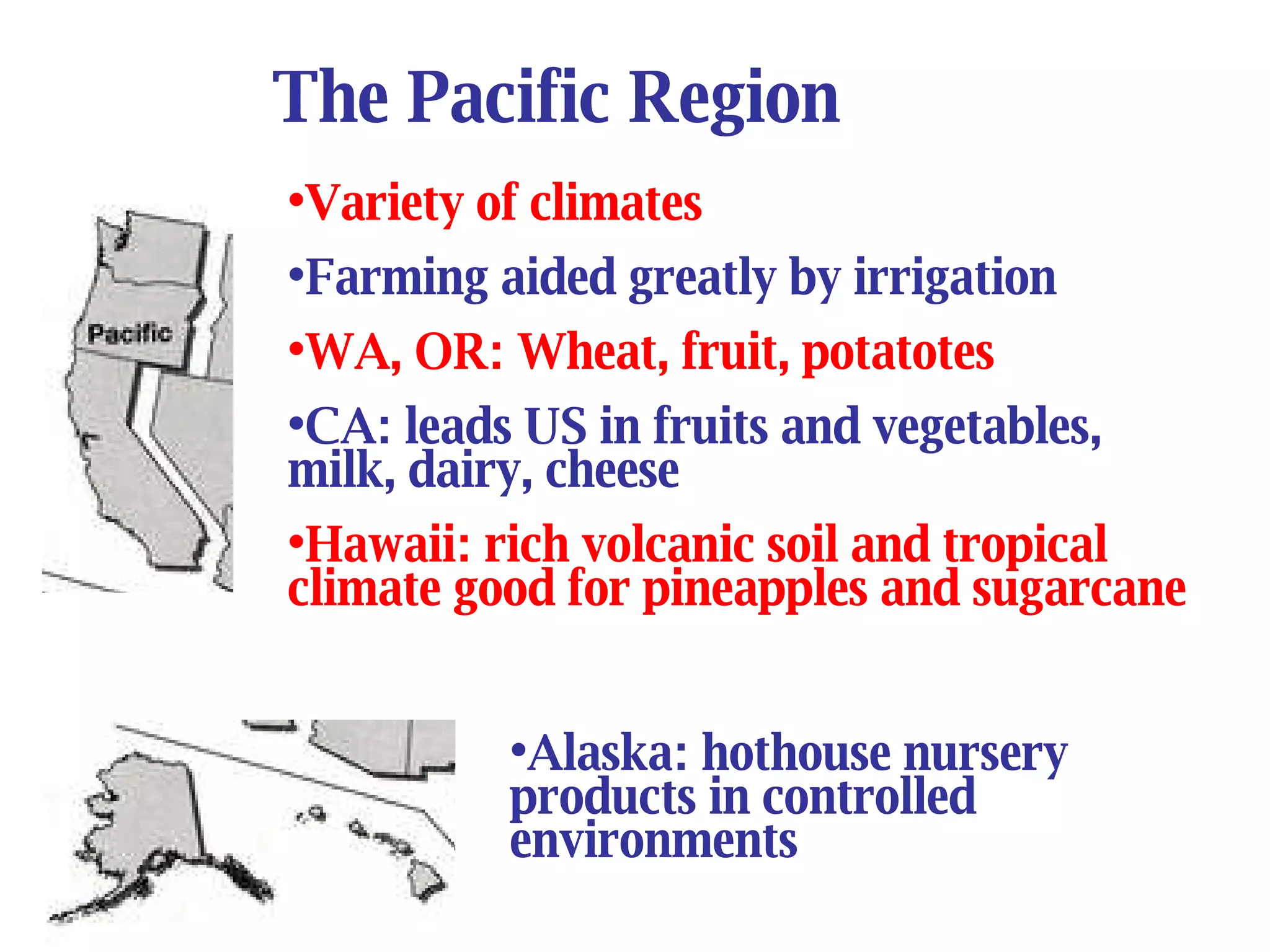
The Pacific Region Variety of climates  Farming aided greatly by irrigation WA, OR: Wheat, fruit, potatotes CA: leads US in fruits and vegetables, milk, dairy, cheese Hawaii: rich volcanic soil and tropical climate good for pineapples and sugarcane Alaska: hothouse nursery products in controlled environments
Food Safety Many ways that food can get contaminated  Bacterial (Salmonella, E. Coli, Campylobacter) Chemicals Foreign substances Foodborne illnesses usually follow the eating of foods that have been contaminated with bacteria during processing, improper storage, or improper handling
Food Safety Can happen at the factory Can happen at the store Can happen at the restaurant Can happen at home (and does!) Upton Sinclair “The Jungle” exposed the world of the meat packing industry and made many changes in food safety
Food Safety Now three agencies that keep food safe USDA Inspects meat in slaughterhouses and processing plants Grades meat to indicate quality Enforces regulations to protect animals and plants from diseases and pests Conducts research  EPA Chemical residues in food Pesticides
Food Safety FDA Truthfulness in food labels Safety of food packaging Maintenance of sanitary conditions in restaurants and other public eating places Administers programs to help ensure safety of dairy products and shellfish Nutritional labeling   Investigates outbreaks
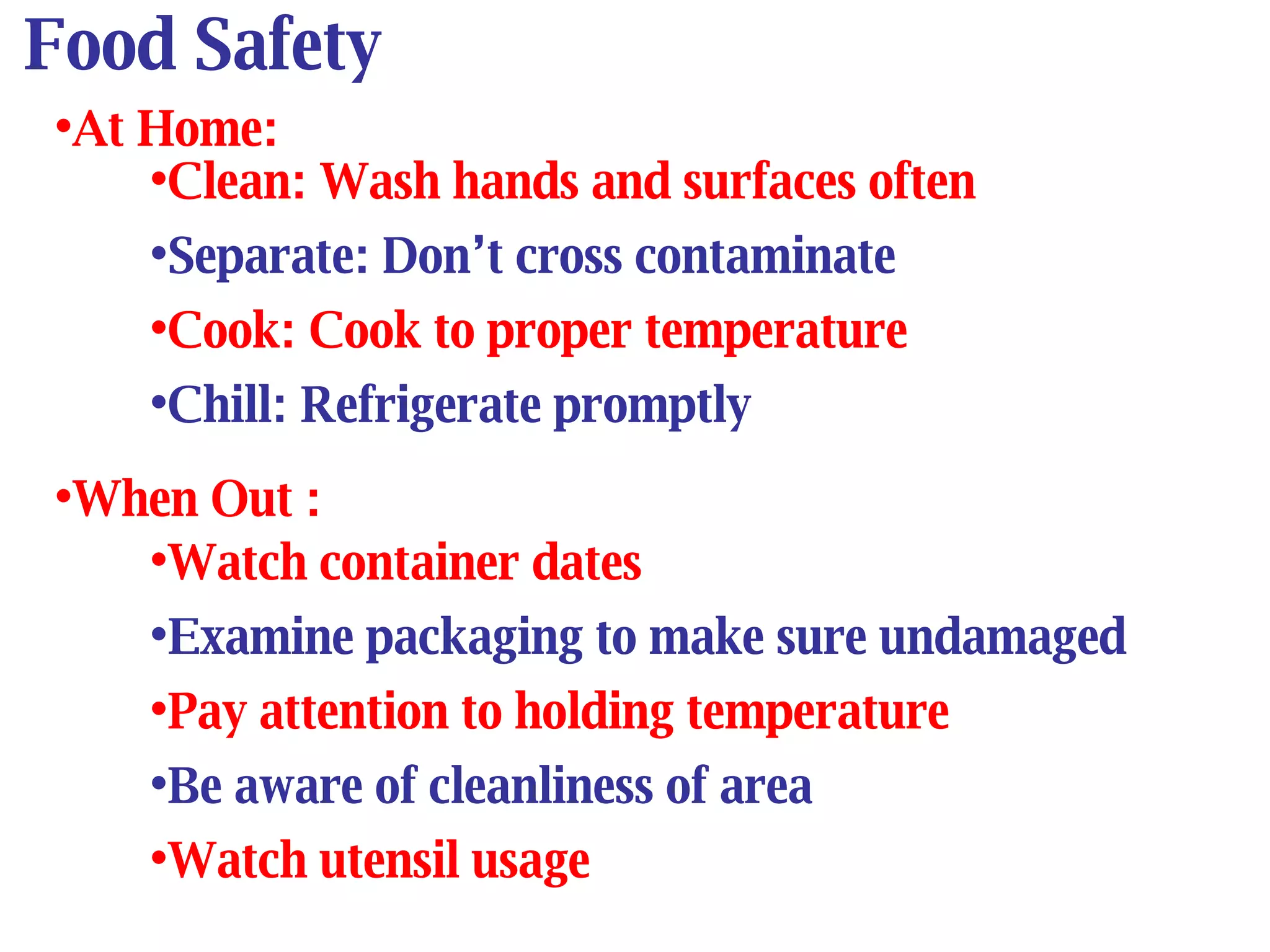
Food Safety At Home: Clean: Wash hands and surfaces often Separate: Don’t cross contaminate Cook: Cook to proper temperature Chill: Refrigerate promptly When Out : Watch container dates Examine packaging to make sure undamaged Pay attention to holding temperature Be aware of cleanliness of area Watch utensil usage
Agriculture and Technology Some Important Agricultural Advances Cotton Gin 1793 Eli Whitney Mechanically separated seeds, hulls and other unwanted parts from cotton fiber Cast-Iron Plow 1797 Replaced wood plow Allow farmers to till soil better and faster
Reaper 1831 Cyrus McCormick Horse drawn machine for harvesting wheat crops Some Important Agricultural Advances Steel Plow 1837 John Deere & Leonard Andrus Heavier plow easily plows thick, sod covered soils of the Midwest
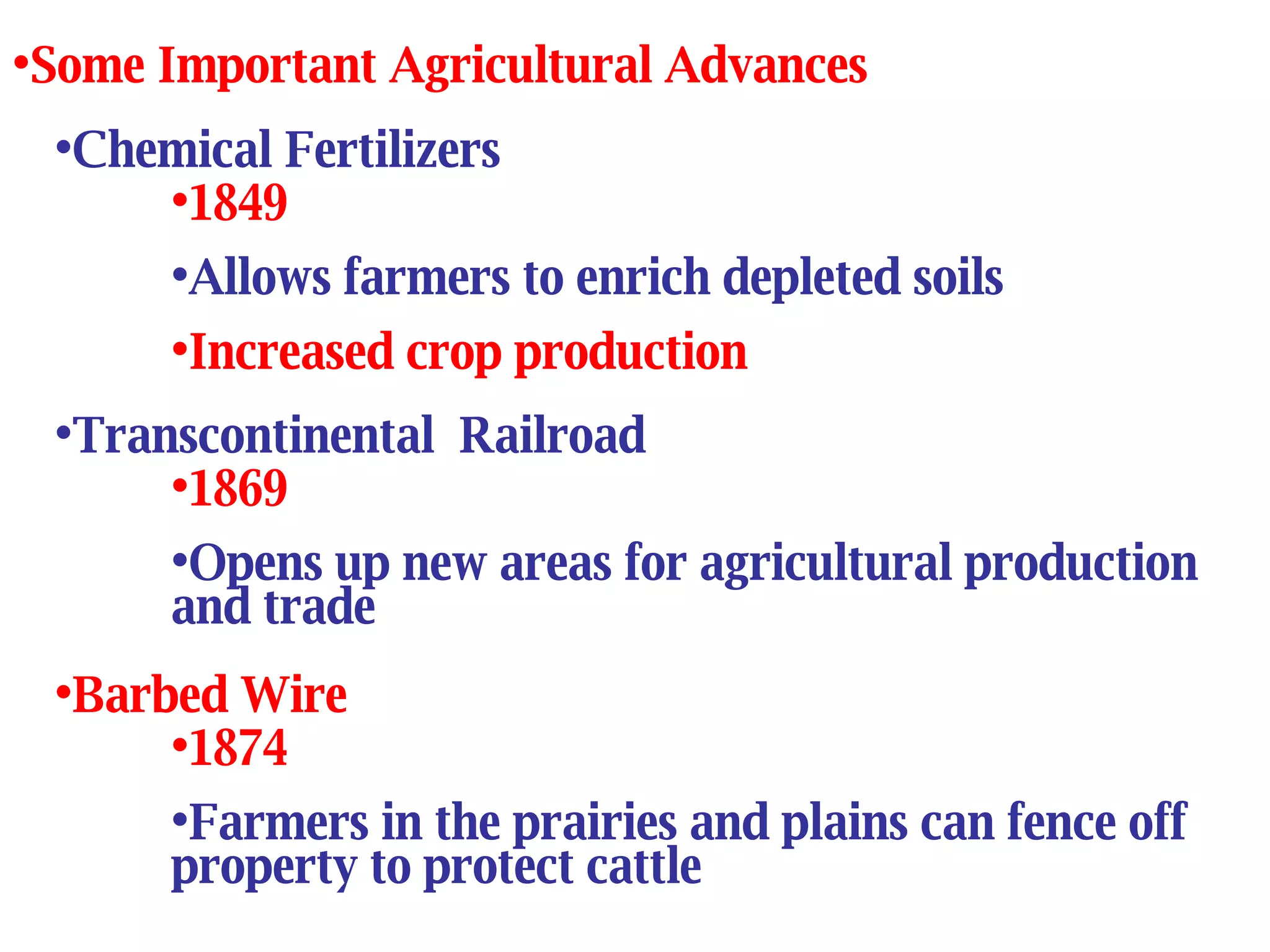
Chemical Fertilizers 1849 Allows farmers to enrich depleted soils Increased crop production Some Important Agricultural Advances Transcontinental  Railroad 1869 Opens up new areas for agricultural production and trade Barbed Wire 1874 Farmers in the prairies and plains can fence off property to protect cattle
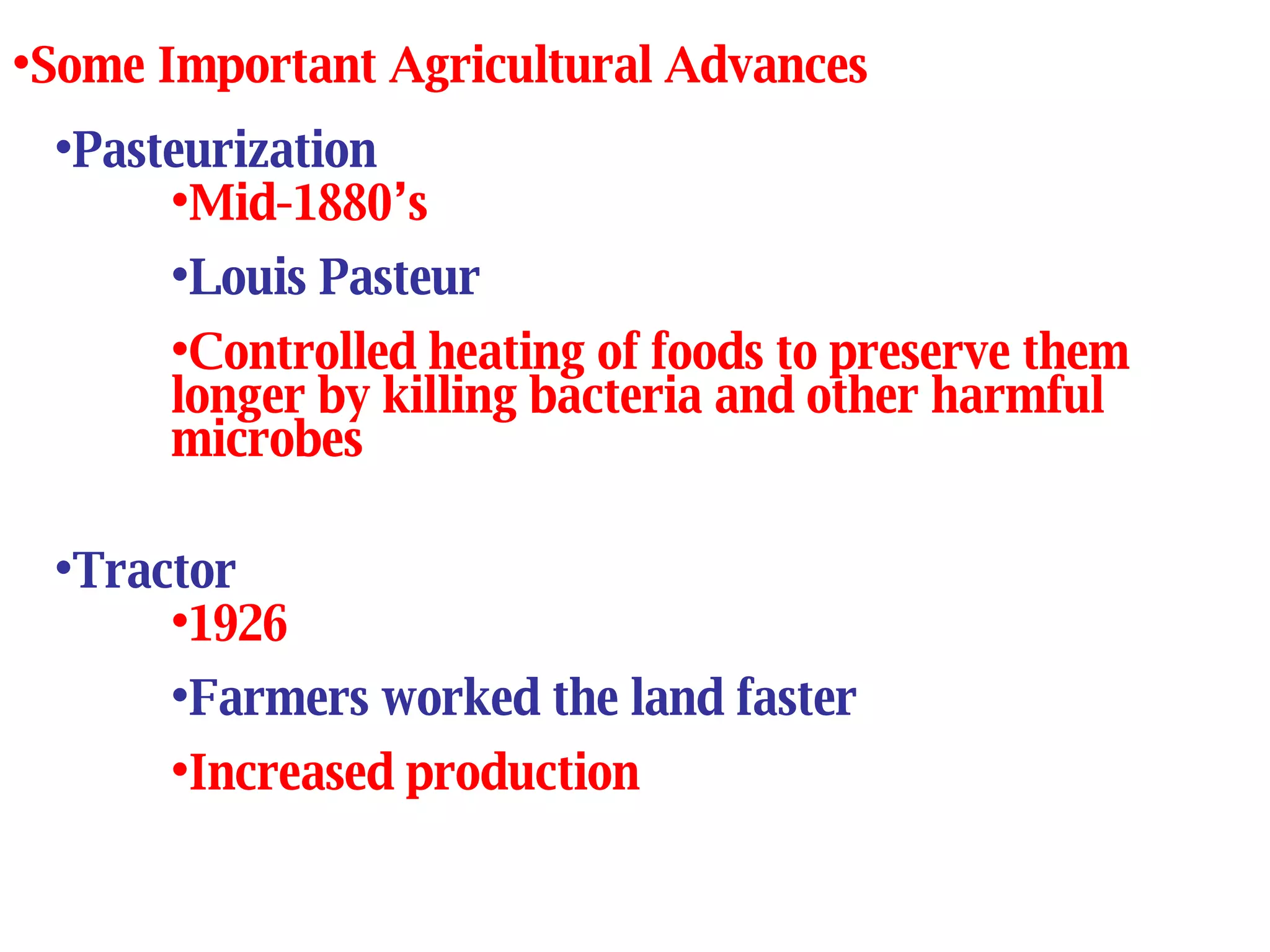
Pasteurization Mid-1880’s Louis Pasteur Controlled heating of foods to preserve them longer by killing bacteria and other harmful microbes Some Important Agricultural Advances Tractor 1926 Farmers worked the land faster Increased production
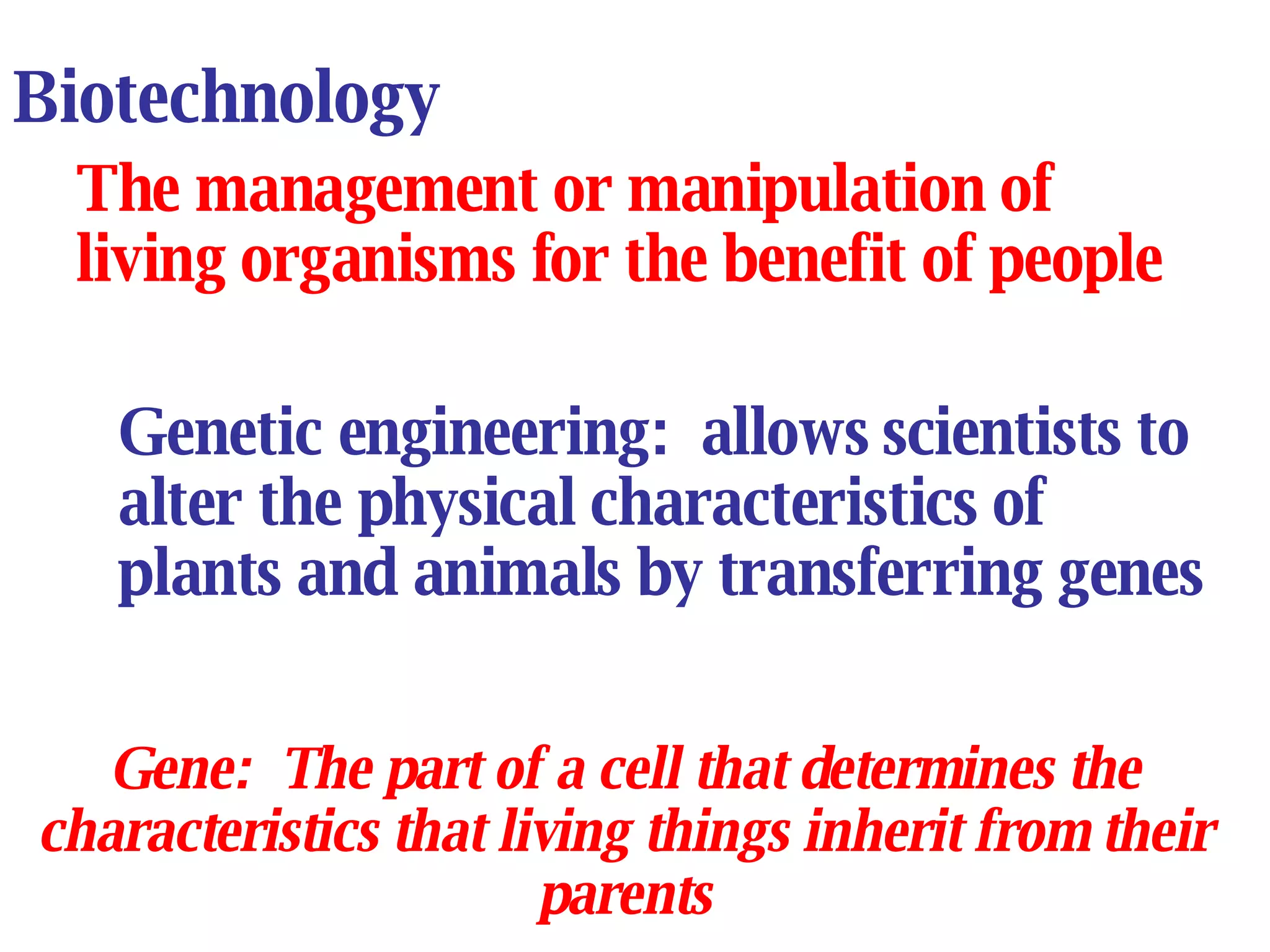
Biotechnology The management or manipulation of living organisms for the benefit of people Genetic engineering:  allows scientists to alter the physical characteristics of plants and animals by transferring genes Gene:  The part of a cell that determines the characteristics that living things inherit from their parents

Chapter 4 Notes-Agriculture

  • 1.
  • 2.
    Agriculture and SocietyAgriculture basic part of every society Everyone has to eat Societies that can’t feed themselves can’t do much else Advances over the last few thousand years have resulted in more food being grown on less land In United States: advancement over only about 200 years
  • 3.
    US Farmers produceenough food to feed more than 280 million people of US PLUS millions of others around the world Only 1 % of the world’s farm labor force Produce 25% of the world’s beef and 15% of the world’s supply of grain, milk and eggs More than 25% of world’s food exports comes from US Farms
  • 4.
    Food and FiberSystem PA plays an important role: About 59,000 farms 9 million acres of farmland 18 th among 50 states in annual income from farming Leader in milk production Cattle Many poultry farms and leader in production of eggs Ranks first in the nation in production of mushrooms!
  • 5.
    Food Production Muchhas changed in farming in the past 200 years
  • 6.
    Food Production Changesover the years: Small farms: sell less than $250,000 worth of crops and livestock each year Small farms still outnumber large farms in US Bulk of food produced in US comes from large farms Corporate farms dominate the US food and fiber system New technologies have made farming efficient but expensive Numbers of farms have decreased but the average farm size has increased
  • 7.
    Food Production inIndustrialized Countries:
  • 8.
    Food Production inIndustrialized Countries: The Green Revolution Uses scientifically produced varieties of grain, fertilizers, pesticides and water to increase crop yields
  • 9.
    Food Production inIndustrialized Countries: The Green Revolution Until 1950, farmers increased yield by increasing the numbers of acres planted The Green Revolution allows farms produce more food not by planting more acres but by coaxing the land that is already planted to produce more Now countries that are using these methods can produce enough food to feed themselves AND export to other nations (make money from it)
  • 10.
    Food Production inIndustrialized Countries: Irrigation systems: food can be produced on dry lands that would otherwise be unsuitable Modern laborsaving machinery to prepare fields, plant and tend crops, and bring in harvests Modern facilities and machines that help raise livestock, giving them food and water Other tools that increase productivity:
  • 11.
    Food Production inIndustrialized Countries: Benefits Food is cheaper People spend less money on food, more money on other things Raises standards of living Provides jobs and income for people Surplus food and fiber to sell as exports which helps the economy of the nation
  • 12.
    From Farm toMarket Farming local and personal Raised food for families and friends Work done entirely by hand 1000’s of years ago: Today: Few of us grow our own food; or raise our own animals for meat Small percentage of people provide food and fiber for the rest
  • 13.
    From Farm toMarket Can take weeks to get from farm to market Not possible 100’s of years ago; food could not be packaged or frozen Had to be eaten right away; canned; dried or cured Not Anymore!
  • 14.
    Food Production inDeveloping Countries: Varies from place to place Green revolution technologies used in some areas…. But too expensive for most who must still practice Subsistence Farming
  • 15.
    Food Production inDeveloping Countries: Results Crop yields are lower People do NOT have money for other things Lower standard of living Higher instances of starvation, pollution and death do to diseases Countries must import food
  • 16.
    Food Production inDeveloping Countries: Some methods in tropical areas: Shifting cultivation: Farmers clear land in a forest Plant crops for a few years until the soil is used up Move on to clear another field Slash and burn agriculture: Farmers cut down trees Burn vegetation Use ash as a “fertilizer” Plant between tree stumps
  • 17.
    Food Production inDeveloping Countries: Can lead to ecological issues Cutting down tropical forests to grow crops depletes the soil Heavy tropical rains cause nutrients to runoff and causes erosion Land becomes hard as it bakes in hot sun Must clear fields every 2-5 years Trees do not have time to grow back, or can’t because soil is destroyed
  • 18.
    The Food andFiber System in the United States
  • 19.
    Steps in theFarm-to-Market Process 1) Production Farmers produce fruits, vegetables, grains, livestock or clothing fiber (Used to be the ONLY step) 2) Food Processing Transforms the raw foodstuffs from the farm into the food that you consume
  • 20.
    2) Food ProcessingRaw foods are: dried, canned, frozen, pickled, powder, juiced Raw foods are put into other products or mixed together with additives to make other products Some processes improve food quality Some processes also slaughter livestock and fish to make meat products
  • 21.
    Packaging Last stepof the processing Protects foods from spoiling, spilling or breaking 3) Transportation and Distribution From farm to processing From farm to market From processors to wholesalers From wholesalers to restaurants, bakeshops, cafeterias etc.. From processors to retailers
  • 22.
    Most consumers buyfood from retailers Supermarkets, grocery stores, delicatessens, butcher shops, vending machines Marketing The advertising, buying and selling of products in the food and fiber system 3) Transportation and Distribution
  • 23.
    Regulations USDA: UnitedStates Department of Agriculture FDA: Food and Drug Administration Food safety inspections “ Grading” foods for standards Ensure truthfulness of information on labels Inspect imported foods Ensure that farm and production practices are safe for the environment
  • 24.
    Research and DevelopmentNew crop and livestock varieties New food products New methods for processing and storing food Carried out by universities, government agencies and private companies
  • 25.
    Major Agricultural Regionsof the United States The climate, soil and landforms of each region determine the agricultural products it produces
  • 26.
    The Northeast Coldwinters Thin, stony soils Ample rainfall, moderate climate Close to markets containing millions of people Fruits, vegetables: New England and Mid Atlantic Dairy farming: PA, VT, NY Poultry: MD, DE, PA Fishing: New England Sprawl taking over farms; Over fishing hurting fish industries
  • 27.
    The Lakes StatesNorthern part too cold and soil poor Other areas excellent for farming Many dairy farms MN, WI leaders in milk, butter, cheese Michigan; 2 nd US producer of Christmas trees MI Lower Peninsula; fruits: apples, blueberries, cantaloupes, cherries, peaches and strawberries WI: beets, cabbages, snap beans, corn Eggs, hogs, field corn, soybeans, wheat, hay important in region
  • 28.
    The Appalachian StatesThin, rocky soils; eroded hillsides, mountains Some parts productive Peanuts, cattle, hogs and tobacco main products of region Many dairy farms found here also
  • 29.
    The Southeast Plentifulrainfall Mild summers, cool winters Livestock: beef cattle, chicken, hogs Many dairy farms Georgia: peaches; Carolinas: tobacco Florida: semitropical climate; citrus fruit and sugarcane Florida also supplies North East with fruits and vegetables in winter months Peanuts and cotton also big crops Carolinas, Georgia; leading production of wood and wood furniture
  • 30.
    The Delta StatesFertile farmland along the Mississippi River flood plain. Plentiful rainfall, moderate climate Major crops: chicken, rice, corn, sugarcane Gulf region specializes in shellfish Shellfish industry endangered due to fertilizer runoff from farms causing algal blooms
  • 31.
    The Corn BeltFertile land; favorable climate ½ of US corn comes from this region Region also ideal for raising soybeans Also major producer of hogs, cattle, and dairy products
  • 32.
    Northern & SouthernPlains Plains are grasslands; wheat, corn barley hay all grow here Amount of precipitation decreases from east to west Since west is dryer, it is better for cattle and hay 3/5 US spring and winter wheat produced in plains Southern plains produces cotton
  • 33.
    The Mountain StatesCooler and wetter than plains High meadows in mountains suited to cattle and sheep Northern part: Wheat major crop Hay, sugar, beets, potatoes, some fruit and vegetables grown in valleys with help of irrigation
  • 34.
    The Pacific RegionVariety of climates Farming aided greatly by irrigation WA, OR: Wheat, fruit, potatotes CA: leads US in fruits and vegetables, milk, dairy, cheese Hawaii: rich volcanic soil and tropical climate good for pineapples and sugarcane Alaska: hothouse nursery products in controlled environments
  • 35.
    Food Safety Manyways that food can get contaminated Bacterial (Salmonella, E. Coli, Campylobacter) Chemicals Foreign substances Foodborne illnesses usually follow the eating of foods that have been contaminated with bacteria during processing, improper storage, or improper handling
  • 36.
    Food Safety Canhappen at the factory Can happen at the store Can happen at the restaurant Can happen at home (and does!) Upton Sinclair “The Jungle” exposed the world of the meat packing industry and made many changes in food safety
  • 37.
    Food Safety Nowthree agencies that keep food safe USDA Inspects meat in slaughterhouses and processing plants Grades meat to indicate quality Enforces regulations to protect animals and plants from diseases and pests Conducts research EPA Chemical residues in food Pesticides
  • 38.
    Food Safety FDATruthfulness in food labels Safety of food packaging Maintenance of sanitary conditions in restaurants and other public eating places Administers programs to help ensure safety of dairy products and shellfish Nutritional labeling Investigates outbreaks
  • 39.
    Food Safety AtHome: Clean: Wash hands and surfaces often Separate: Don’t cross contaminate Cook: Cook to proper temperature Chill: Refrigerate promptly When Out : Watch container dates Examine packaging to make sure undamaged Pay attention to holding temperature Be aware of cleanliness of area Watch utensil usage
  • 40.
    Agriculture and TechnologySome Important Agricultural Advances Cotton Gin 1793 Eli Whitney Mechanically separated seeds, hulls and other unwanted parts from cotton fiber Cast-Iron Plow 1797 Replaced wood plow Allow farmers to till soil better and faster
  • 41.
    Reaper 1831 CyrusMcCormick Horse drawn machine for harvesting wheat crops Some Important Agricultural Advances Steel Plow 1837 John Deere & Leonard Andrus Heavier plow easily plows thick, sod covered soils of the Midwest
  • 42.
    Chemical Fertilizers 1849Allows farmers to enrich depleted soils Increased crop production Some Important Agricultural Advances Transcontinental Railroad 1869 Opens up new areas for agricultural production and trade Barbed Wire 1874 Farmers in the prairies and plains can fence off property to protect cattle
  • 43.
    Pasteurization Mid-1880’s LouisPasteur Controlled heating of foods to preserve them longer by killing bacteria and other harmful microbes Some Important Agricultural Advances Tractor 1926 Farmers worked the land faster Increased production
  • 44.
    Biotechnology The managementor manipulation of living organisms for the benefit of people Genetic engineering: allows scientists to alter the physical characteristics of plants and animals by transferring genes Gene: The part of a cell that determines the characteristics that living things inherit from their parents