Presentation
on
ATS Sub-System
Automatic Train Supervision(ATS)
 Automatic Train Supervision(ATS) is a Sub-System of Signalling
and Train Control System (S&TC)
 ATS sub-system which can be shortly presented as a sub-system
which shall have data processing facilities & achieve the
minimum following main functions but not limited to,
1. Monitor and Control the traffic through continuous
Automatic Train Control equipment, perform automatic route
setting, automatic train regulation etc.
2. Monitor & regulate train movement continuously.
3. Display information on PIDS (Passenger Information Display
System).
4.Generation of the schedules.
5.Generate alarms & store system-operating data.
6.Analysis of operation and faults.
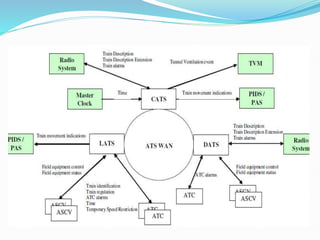
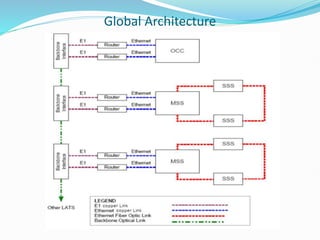
The ATS sub-system architecture can be split in 3 Levels:
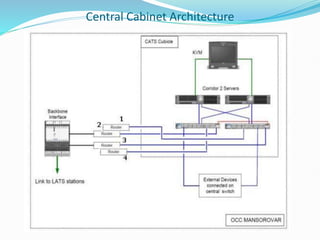
1. One Central ATS: CATS
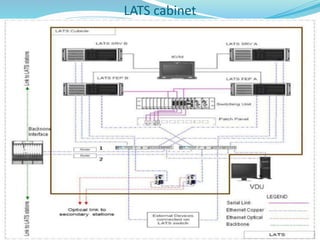
2.Three Local ATS (LATS) and One Depot ATS (DATS)
3.Each LATS/DATS connected ASCV and ATC
ATS sub-system General Overview
Global Architecture
Central Cabinet Architecture
LATS cabinet
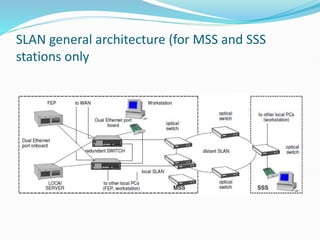
SLAN general architecture (for MSS and SSS
stations only
ATC & ASCV Interface Status
Following LRUs are mainly integrated in the ATS
cabinets, which are located in technical rooms.
1 ATS Server
2 FEP
3 KVM Drawer
4 KVM Switch
5 Optical Switch
6 Power Supply for Optical Switch
7 Ethernet Switches
8 Data Logger
9 Workstation CPU
CATS CABINET
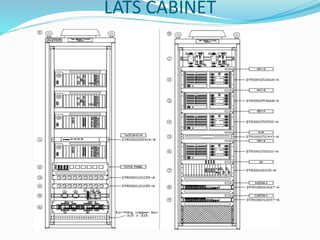
LATS CABINET
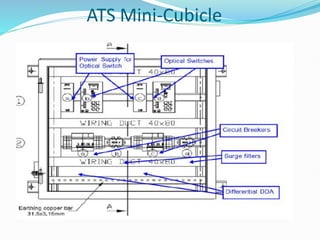
ATS Mini-Cubicle
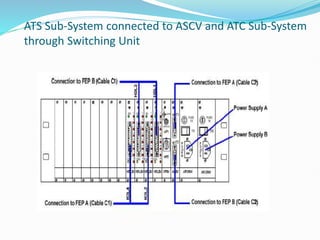
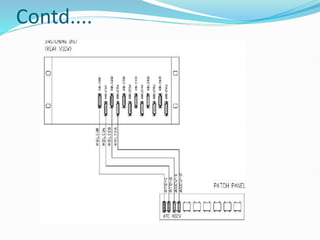
ATS Sub-System connected to ASCV and ATC Sub-System
through Switching Unit
Contd....
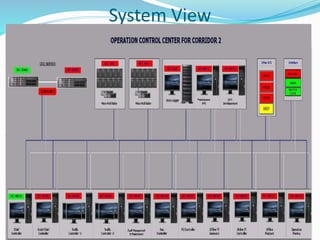
System View
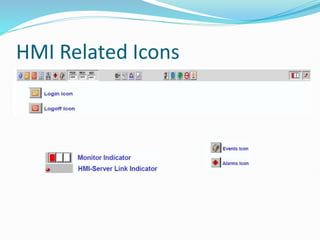
HMI Related Icons
Territory Assignment (TAS)
 For Signalling equipment management, a Take
Control / Release procedure is available :
 No operator is controlling the ASCV signalling view
then Responsibility symbol will be red
 Click on the TAKE CONTROL button to take control
of the displayed ASCV Signalling view. The
Responsibility symbol is updated with green colour.
 Click on the RELEASE button to release control of
the displayed ASCV signalling view. The
Responsibility symbol is updated with red colour.
.
ARS Principles
 In Scheduled mode, all the routes associated with the trips
described in the timetable are automatically set by the ARS
function
 In Constant Headway, routes are automatically set by the
ARS function according to the origin/destination platforms
and turn-backs selected by the operator. When the train is
arrived at destination it is automatically re-indexed
 When an ATS sector is controlled in local, the train identity
of a train entering in the sector is recovered from the
previous Local ATS through the PTI management function
Automatic train regulation (ATR)
 Automatic Train Regulation relies on train concept, train
movement events, and trip to regulate trains,
automatically. Also, it uses services provided by Topology
to collect context-specific data to apply regulation
strategies.
 Major goal is to detect and correct disturbances in
comparison to trip assigned to train and inform operator of
the observed disturbances.
 The ATR strategies apply automatic commands to respect
the defined constant headway (this headway is defined in
the trip assigned to the train) or to respect adherence to
schedule (arrival/departure of trains) expected by
timetable. These commands are mainly the dwell time
calculation and speed profile.
 Moreover, this components manages the skip/stop train
status and the change of end instructions to ATO.
Line operating mode
 The line operating mode is managed according to
the line control level (ATS Control level or Local
Control level)
 Manual mode
 Constant headway mode
 Scheduled mode
Contd...
Manual Mode
 Trains are not regulated
 Routes need to be set manually
 Cycles need to be set by the operator so that routes will
be automatically set on cycle approach
 Train stop is carried out in station if a train hold has
been previously set (TH sets: red, TH not set: grey)
Constant Headway
 In Constant Headway routes are automatically set by the ARS function
according to the origin/destination platforms and turn-backs selected
by the operator. When the train is arrived at destination it is
automatically re-indexed
 Trains are regulated
 Regulation is based on the Headway which is the time interval between
two train departures from the same platform
 Stop on platform is controlled and regulated by the Automatic Train
Regulation (ATR) function
 – When a train is in advance compared with the previous one, ATR
function delays the train departure from this platform by increasing the
dwell time in the limit of the maximum dwell time
 – When a train is delayed compared with the previous one, ATR
function reduces the train departure from this platform by decreases
the dwell time in the limit of the minimum dwell time
 Since the Automatic Route Setting function is active, routes will be set
automatically by the ARS function as trains arrive in the turn back
approach zones. The operator does not need to set cycles in turn back
zones
Contd...
 In Controls tab:
 – From Manual mode, click Constant Headway
 – Select the departure station (From)
 – Select the destination station (To)
 – If needed scroll to select another turn back
 – Enter the HEADWAY value
 The headway value must be upper than the recall minimum
headway value
 – Click OK
 Parameters are updated.
 – Click OK
 Parameters are updated.
 – Click Yes to confirm
 Cycles must not be set by the operator
Contd...
Contd...
Schedule mode
 In Scheduled mode, the ATS automatically
 – Numbers trains,
 – Sets the routes
 – Regulates trains with respect to the current timetable
 The regulation is applied to the trains running in the normal traffic
direction in accordance with timetable
 Trains running in the reverse traffic direction are not regulated
 When the operator requests the Scheduled line-operating mode, the
ATS controls automatically
 – The cancellation of the cycles set
 – If necessary, the setting, in permanent mode of predetermined routes
 The change of mode will be effective, if the above automatic controls
are successful
 When the line-operating mode is switched from Scheduled to Manual,
permanent mode on routes is not cancelled automatically. This has to
be manually done by the operator if required.
Delay departure time
 Delay departure time is between the actual train delay
and the theoretical start time
 It is available in Scheduled and Constant Headway
modes
 No manual control is available
 Delay departure time value (Format - minutes:
seconds)
Dwell time
 Dwell time
– Time for a train to stop at a given platform
– Variable between the minimum and the maximum dwell times
 Maximal dwell time
– Upper limit duration to stop a regulated train i.e. 120 sec.
– Used by Automatic Train Regulation (ATR) function to reduce
advance of regulated trains
 Minimum dwell time i.e. 10 sec
– Lower limit duration to stop a regulated train
– Used by Automatic Train Regulation (ATR) function to reduce delay
of regulated trains
 Nominal dwell time i.e. 30 sec
– Time a train stops on a platform when it is not regulated or else if it
is on time
– Data preparation predefined value based on signalling application
studies
Maintenance Activity
A. Daily Maintenance
1.Monitoring of room temperature.
B. Monthly Maintenance
1. Restart of CATS and LATS.
2. Cleaning of workstations, servers, cubicles, FEPs, and
switching unit.
3. Adjustment of brightness and contrast setting in
workstations.
4. Inspection of cubicles, FEP and server fans.
5. Measure voltage level of input power supply.
6. Visual inspection of Ethernet switch, optical switch and
router and there cleaning.
Contd…
C. Six Monthly Maintenance
1 Through cleaning of workstations and cubicles and
ensure that cubicles are free from corrosion, dust dirt
and other foreign bodies.
2. Maintenance of workstations and VDU panels as per
procedure prescribe by manufacturer.
3. Replacement of air filter of cubicles.
Thank You

ATS System - Copy.pptx

  • 1.
  • 2.
    Automatic Train Supervision(ATS) Automatic Train Supervision(ATS) is a Sub-System of Signalling and Train Control System (S&TC)  ATS sub-system which can be shortly presented as a sub-system which shall have data processing facilities & achieve the minimum following main functions but not limited to, 1. Monitor and Control the traffic through continuous Automatic Train Control equipment, perform automatic route setting, automatic train regulation etc. 2. Monitor & regulate train movement continuously. 3. Display information on PIDS (Passenger Information Display System). 4.Generation of the schedules. 5.Generate alarms & store system-operating data. 6.Analysis of operation and faults.
  • 3.
    The ATS sub-systemarchitecture can be split in 3 Levels: 1. One Central ATS: CATS 2.Three Local ATS (LATS) and One Depot ATS (DATS) 3.Each LATS/DATS connected ASCV and ATC
  • 4.
  • 5.
  • 6.
  • 7.
  • 8.
    SLAN general architecture(for MSS and SSS stations only
  • 9.
    ATC & ASCVInterface Status
  • 10.
    Following LRUs aremainly integrated in the ATS cabinets, which are located in technical rooms. 1 ATS Server 2 FEP 3 KVM Drawer 4 KVM Switch 5 Optical Switch 6 Power Supply for Optical Switch 7 Ethernet Switches 8 Data Logger 9 Workstation CPU
  • 11.
  • 12.
  • 13.
  • 14.
    ATS Sub-System connectedto ASCV and ATC Sub-System through Switching Unit
  • 15.
  • 16.
  • 17.
  • 18.
    Territory Assignment (TAS) For Signalling equipment management, a Take Control / Release procedure is available :  No operator is controlling the ASCV signalling view then Responsibility symbol will be red  Click on the TAKE CONTROL button to take control of the displayed ASCV Signalling view. The Responsibility symbol is updated with green colour.  Click on the RELEASE button to release control of the displayed ASCV signalling view. The Responsibility symbol is updated with red colour.
  • 19.
  • 20.
    ARS Principles  InScheduled mode, all the routes associated with the trips described in the timetable are automatically set by the ARS function  In Constant Headway, routes are automatically set by the ARS function according to the origin/destination platforms and turn-backs selected by the operator. When the train is arrived at destination it is automatically re-indexed  When an ATS sector is controlled in local, the train identity of a train entering in the sector is recovered from the previous Local ATS through the PTI management function
  • 21.
    Automatic train regulation(ATR)  Automatic Train Regulation relies on train concept, train movement events, and trip to regulate trains, automatically. Also, it uses services provided by Topology to collect context-specific data to apply regulation strategies.  Major goal is to detect and correct disturbances in comparison to trip assigned to train and inform operator of the observed disturbances.  The ATR strategies apply automatic commands to respect the defined constant headway (this headway is defined in the trip assigned to the train) or to respect adherence to schedule (arrival/departure of trains) expected by timetable. These commands are mainly the dwell time calculation and speed profile.  Moreover, this components manages the skip/stop train status and the change of end instructions to ATO.
  • 22.
    Line operating mode The line operating mode is managed according to the line control level (ATS Control level or Local Control level)  Manual mode  Constant headway mode  Scheduled mode
  • 23.
  • 24.
    Manual Mode  Trainsare not regulated  Routes need to be set manually  Cycles need to be set by the operator so that routes will be automatically set on cycle approach  Train stop is carried out in station if a train hold has been previously set (TH sets: red, TH not set: grey)
  • 25.
    Constant Headway  InConstant Headway routes are automatically set by the ARS function according to the origin/destination platforms and turn-backs selected by the operator. When the train is arrived at destination it is automatically re-indexed  Trains are regulated  Regulation is based on the Headway which is the time interval between two train departures from the same platform  Stop on platform is controlled and regulated by the Automatic Train Regulation (ATR) function  – When a train is in advance compared with the previous one, ATR function delays the train departure from this platform by increasing the dwell time in the limit of the maximum dwell time  – When a train is delayed compared with the previous one, ATR function reduces the train departure from this platform by decreases the dwell time in the limit of the minimum dwell time  Since the Automatic Route Setting function is active, routes will be set automatically by the ARS function as trains arrive in the turn back approach zones. The operator does not need to set cycles in turn back zones
  • 26.
    Contd...  In Controlstab:  – From Manual mode, click Constant Headway  – Select the departure station (From)  – Select the destination station (To)  – If needed scroll to select another turn back  – Enter the HEADWAY value  The headway value must be upper than the recall minimum headway value  – Click OK  Parameters are updated.  – Click OK  Parameters are updated.  – Click Yes to confirm  Cycles must not be set by the operator
  • 27.
  • 28.
  • 29.
    Schedule mode  InScheduled mode, the ATS automatically  – Numbers trains,  – Sets the routes  – Regulates trains with respect to the current timetable  The regulation is applied to the trains running in the normal traffic direction in accordance with timetable  Trains running in the reverse traffic direction are not regulated  When the operator requests the Scheduled line-operating mode, the ATS controls automatically  – The cancellation of the cycles set  – If necessary, the setting, in permanent mode of predetermined routes  The change of mode will be effective, if the above automatic controls are successful  When the line-operating mode is switched from Scheduled to Manual, permanent mode on routes is not cancelled automatically. This has to be manually done by the operator if required.
  • 30.
    Delay departure time Delay departure time is between the actual train delay and the theoretical start time  It is available in Scheduled and Constant Headway modes  No manual control is available  Delay departure time value (Format - minutes: seconds)
  • 31.
    Dwell time  Dwelltime – Time for a train to stop at a given platform – Variable between the minimum and the maximum dwell times  Maximal dwell time – Upper limit duration to stop a regulated train i.e. 120 sec. – Used by Automatic Train Regulation (ATR) function to reduce advance of regulated trains  Minimum dwell time i.e. 10 sec – Lower limit duration to stop a regulated train – Used by Automatic Train Regulation (ATR) function to reduce delay of regulated trains  Nominal dwell time i.e. 30 sec – Time a train stops on a platform when it is not regulated or else if it is on time – Data preparation predefined value based on signalling application studies
  • 32.
    Maintenance Activity A. DailyMaintenance 1.Monitoring of room temperature. B. Monthly Maintenance 1. Restart of CATS and LATS. 2. Cleaning of workstations, servers, cubicles, FEPs, and switching unit. 3. Adjustment of brightness and contrast setting in workstations. 4. Inspection of cubicles, FEP and server fans. 5. Measure voltage level of input power supply. 6. Visual inspection of Ethernet switch, optical switch and router and there cleaning.
  • 33.
    Contd… C. Six MonthlyMaintenance 1 Through cleaning of workstations and cubicles and ensure that cubicles are free from corrosion, dust dirt and other foreign bodies. 2. Maintenance of workstations and VDU panels as per procedure prescribe by manufacturer. 3. Replacement of air filter of cubicles.
  • 34.