Emergency Medical Technician
6 – Secondary Trauma
© 2014
Slide 2
Emergency Medical Technician
6 – Secondary Trauma
© 2014
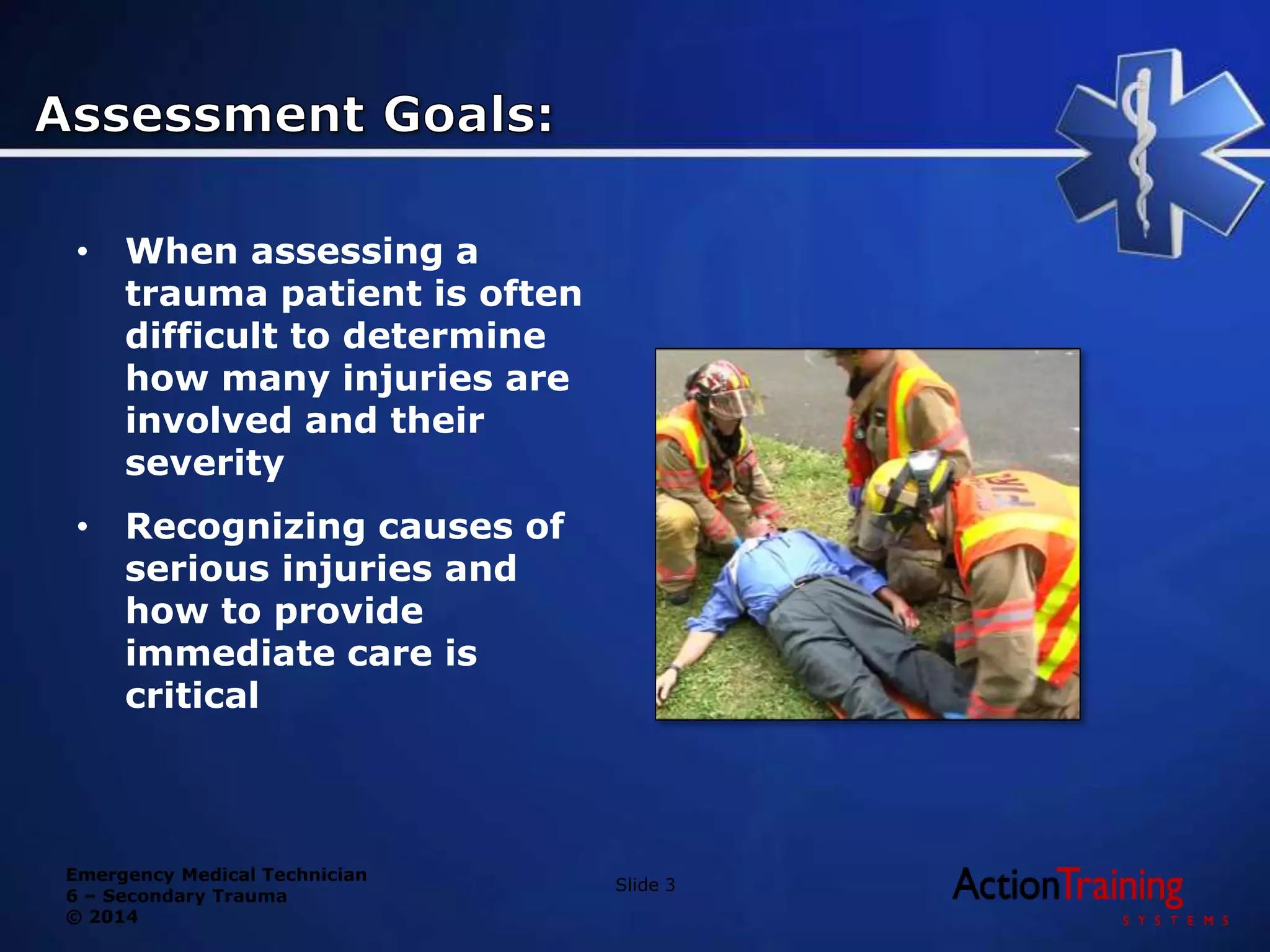
• When assessing a
trauma patient is often
difficult to determine
how many injuries are
involved and their
severity
• Recognizing causes of
serious injuries and
how to provide
immediate care is
critical
Slide 3
Emergency Medical Technician
6 – Secondary Trauma
© 2014
1. Mechanisms of Injury
2. Level of Consciousness
3. Assessing a Trauma Patient
4. Categorization of Trauma Patients
Slide 4
Emergency Medical Technician
6 – Secondary Trauma
© 2014
Slide 5
Emergency Medical Technician
6 – Secondary Trauma
© 2014
• A mechanism of injury,
(MOI) refers to the
forces that cause an
injury
• In some cases there
may be more than one
mechanism of injury
involved for the same
patient
Slide 6
Emergency Medical Technician
6 – Secondary Trauma
© 2014
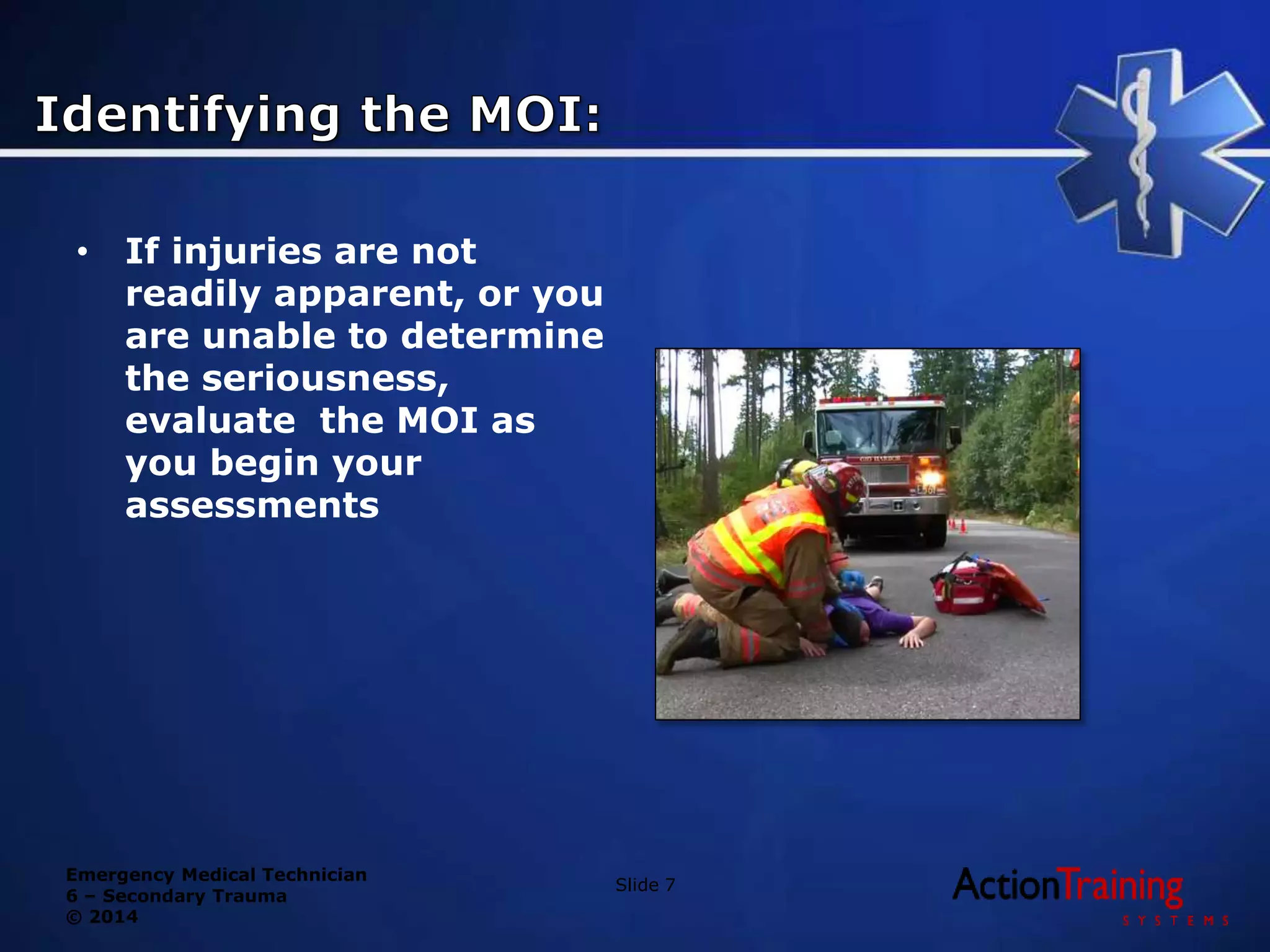
• If injuries are not
readily apparent, or you
are unable to determine
the seriousness,
evaluate the MOI as
you begin your
assessments
Slide 7
Emergency Medical Technician
6 – Secondary Trauma
© 2014
• Understanding what
types of injuries you
can expect from various
MOI’s will help you
anticipate the kind of
trauma you might
encounter
Slide 8
Emergency Medical Technician
6 – Secondary Trauma
© 2014
• Trauma patients fall
into two categories:
– Significant MOI
– Not significant MOI
• Significant mechanisms
of injury have a high
incidence of producing
life-threatening trauma
Slide 9
Emergency Medical Technician
6 – Secondary Trauma
© 2014
• Significant MOI in adults
involves vehicle
collisions, including:
– High-speed and rollover
collisions
– Vehicle-pedestrian and
vehicle-bicycle collisions
– Motorcycle crashes
– Any vehicular crash that
involves ejection, or the
death of a person in the
same passenger
compartment as the
patient
Slide 10
Emergency Medical Technician
6 – Secondary Trauma
© 2014
Slide 11
– A seat belt injury or
the failure to use a
seat belt, including
deployed airbags
– Any impact that causes
deformity to the
steering wheel or a
prolonged extrication
– Intrusion into the
passenger
compartment of 12’’
(30cm)
– Intrusion into any part
of vehicle of 18’’
(46cm)
Emergency Medical Technician
6 – Secondary Trauma
© 2014
• Blast injuries
• Penetration of the:
– Head
– Neck
– Chest
– Abdomen
– Penetration above the
knee or elbow
Slide 12
Emergency Medical Technician
6 – Secondary Trauma
© 2014
• Blunt or penetrating
trauma resulting in an
altered mental status
• Falls greater than 20 ft.
(6m)
Slide 13
Emergency Medical Technician
6 – Secondary Trauma
© 2014
• Bicycle collisions with vehicles
• Medium-speed vehicle collisions
involving a child:
– Pedestrian
– Occupant
• Vehicle collision in which a child
passenger was not restrained
• Falls of either:
– More than 10 ft (3m)
– 2 to 3 times the height of the child
Slide 14
Emergency Medical Technician
6 – Secondary Trauma
© 2014
Slide 15
Emergency Medical Technician
6 – Secondary Trauma
© 2014
• One of the first things
you noted in the
primary assessment
was the patient’s level
of consciousness (LOC)
• In the secondary
assessment reassess
the level of
consciousness
• Improvement or
deterioration of the
patient’s condition, can
be apparent from
changes in the LOC
Slide 16
Emergency Medical Technician
6 – Secondary Trauma
© 2014
• When you assess for
AVPU designate a score
for the patient’s
neurological status
using the Glasgow
Coma Scale (GCS)
• The GCS uses a point
system of 3 to 15 that
evaluates LOC
Slide 17
Emergency Medical Technician
6 – Secondary Trauma
© 2014
• The patient is evaluated
for:
– Eye-opening activity
– Verbal response
– Motor response
• Each is scored on the
level of responsiveness
from the patient
Slide 18
Emergency Medical Technician
6 – Secondary Trauma
© 2014
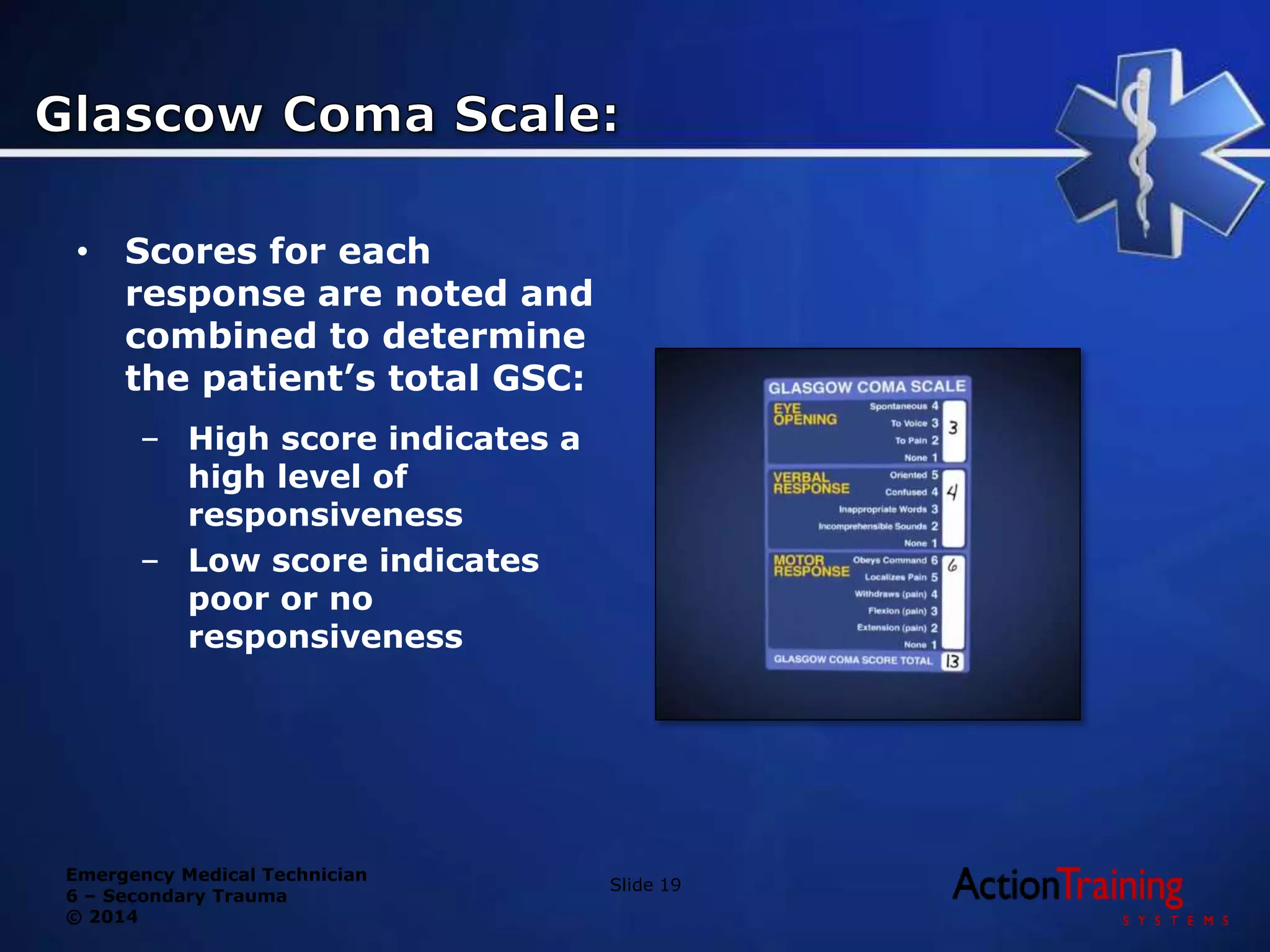
• Scores for each
response are noted and
combined to determine
the patient’s total GSC:
– High score indicates a
high level of
responsiveness
– Low score indicates
poor or no
responsiveness
Slide 19
Emergency Medical Technician
6 – Secondary Trauma
© 2014
Slide 20
• If the eye-opening
response is spontaneous,
apply a score of 4
• If eye opening is NOT
spontaneous:
– Verbally direct the
patient in a normal tone
of voice to open his eyes
• If the eyes remain
closed, shout the
command:
– If the patient is able to
comply to either
command, apply a score
of 3
Emergency Medical Technician
6 – Secondary Trauma
© 2014
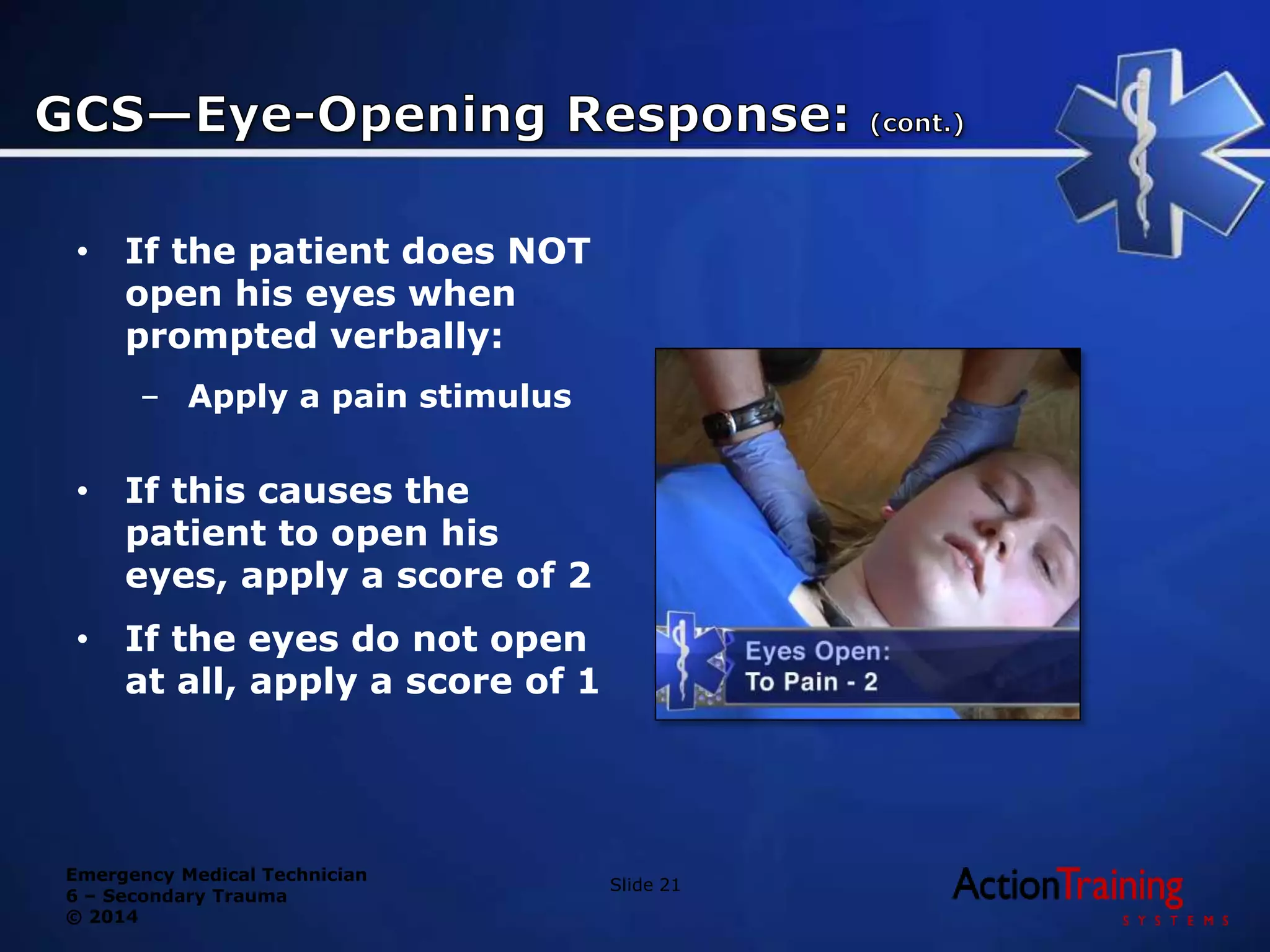
• If the patient does NOT
open his eyes when
prompted verbally:
– Apply a pain stimulus
• If this causes the
patient to open his
eyes, apply a score of 2
• If the eyes do not open
at all, apply a score of 1
Slide 21
Emergency Medical Technician
6 – Secondary Trauma
© 2014
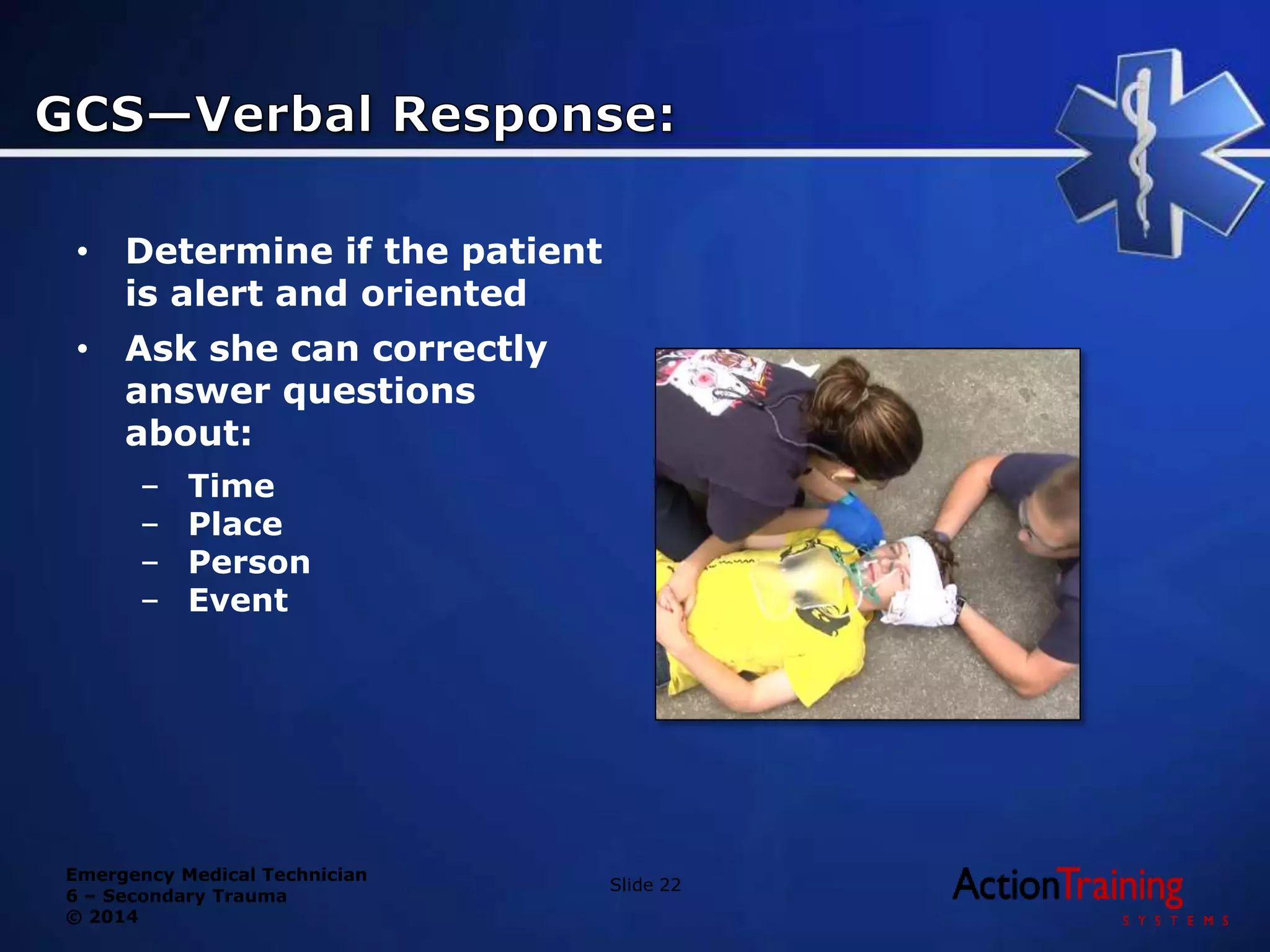
• Determine if the patient
is alert and oriented
• Ask she can correctly
answer questions
about:
– Time
– Place
– Person
– Event
Slide 22
Emergency Medical Technician
6 – Secondary Trauma
© 2014
Slide 23
• If the patient is
oriented, apply a score
of 5
• If the patient is
confused, apply a score
of 4:
– Patient can speak in
phrases and sentences
– But patient is unable to
answer questions
correctly
Emergency Medical Technician
6 – Secondary Trauma
© 2014
Slide 24
• If the patient uses
inappropriate words
that do not match a
particular question:
– Apply a score of 3
• If the patient makes
incomprehensible
sounds:
– Apply a score of 2:
 Mumbling
 Moaning
 Groaning
Emergency Medical Technician
6 – Secondary Trauma
© 2014
• If after repeated
stimulation the patient
makes no sound:
– Apply a score of 1
Slide 25
Emergency Medical Technician
6 – Secondary Trauma
© 2014
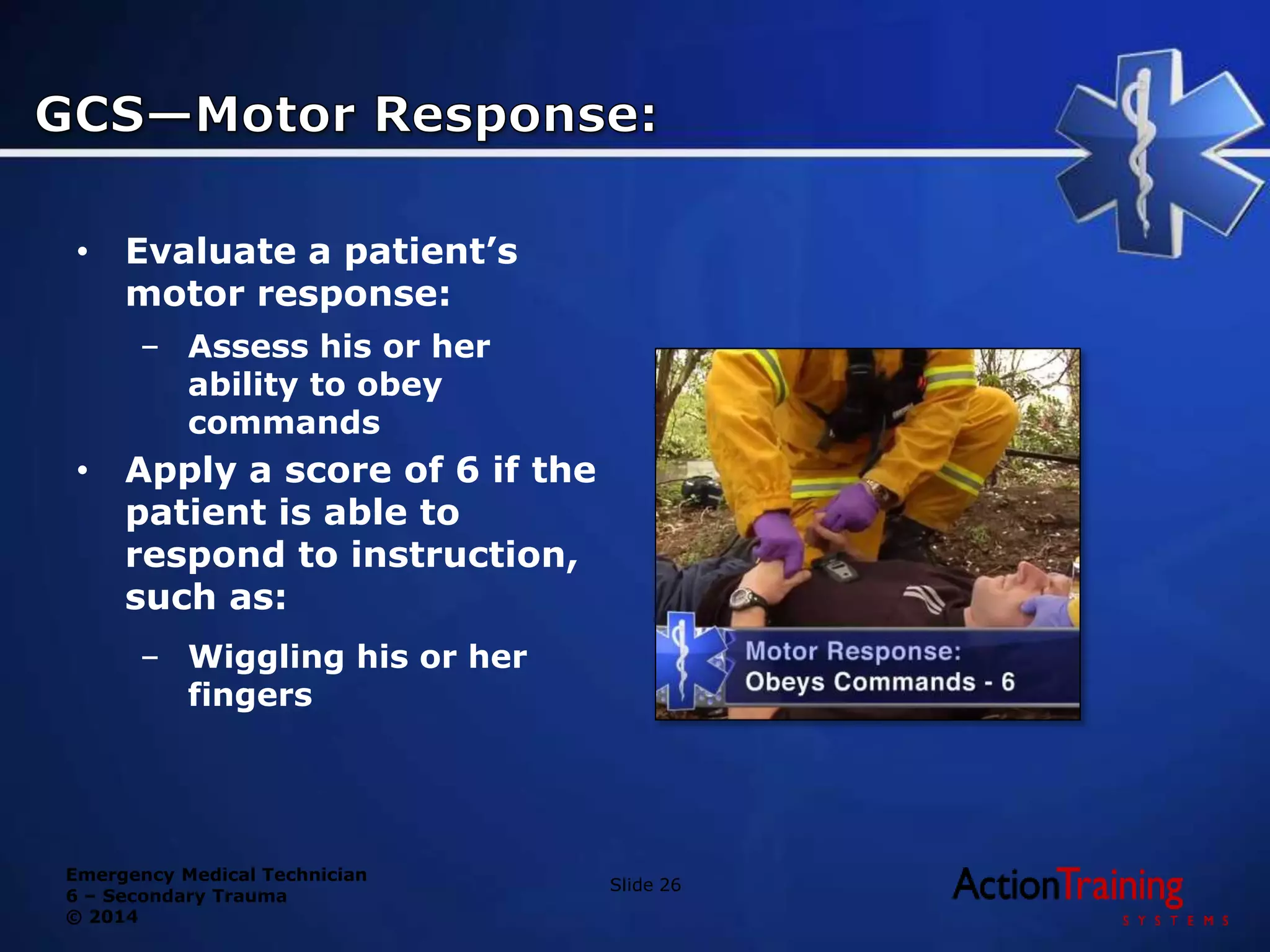
• Evaluate a patient’s
motor response:
– Assess his or her
ability to obey
commands
• Apply a score of 6 if the
patient is able to
respond to instruction,
such as:
– Wiggling his or her
fingers
Slide 26
Emergency Medical Technician
6 – Secondary Trauma
© 2014
• Apply a score of 5 if the
patient:
– Localizes pain:
 Identifies the level of
brain function the
patient has
– Is able to react when
pain stimulus is applied
by pushing it away
Slide 27
Emergency Medical Technician
6 – Secondary Trauma
© 2014
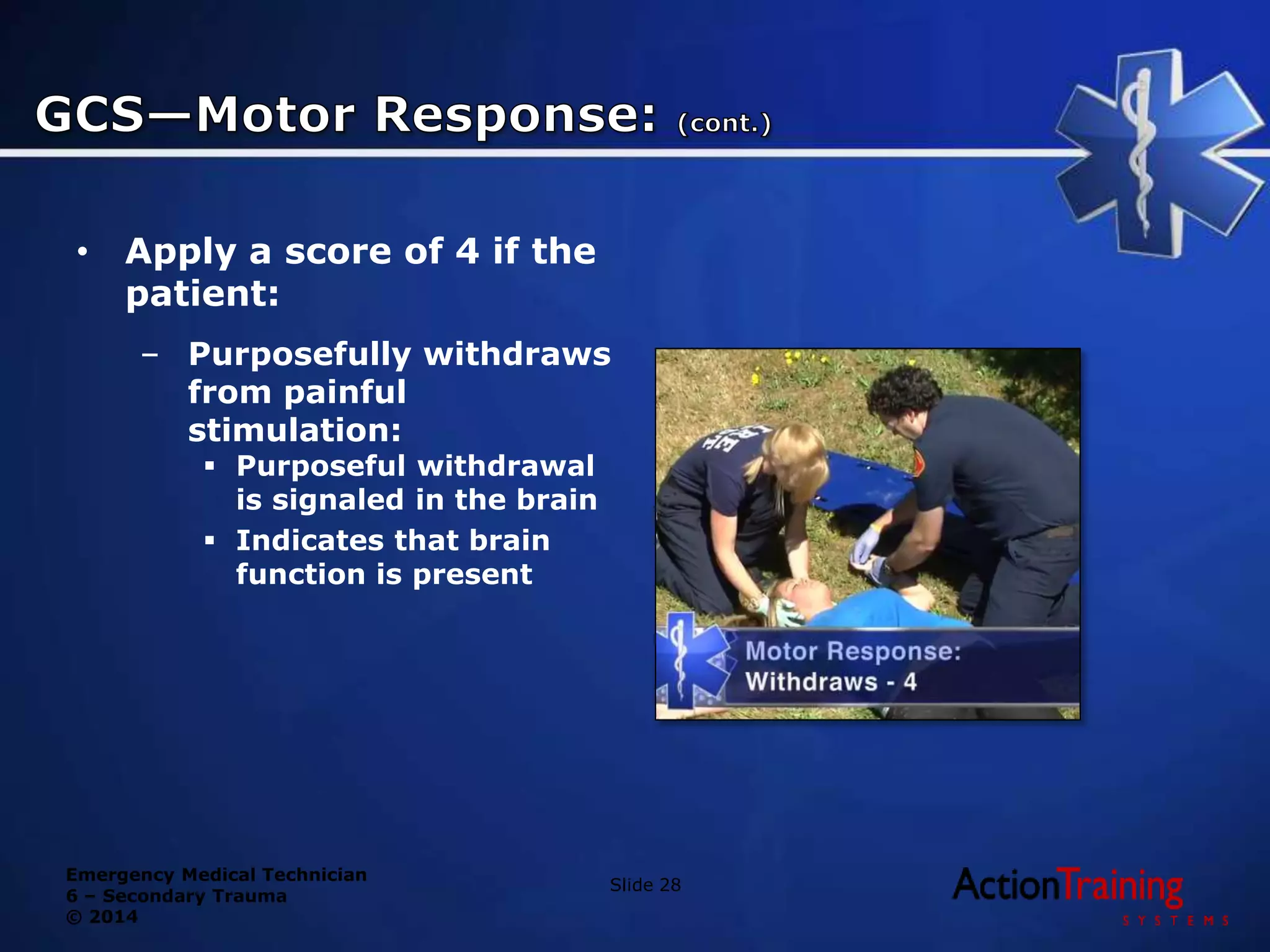
• Apply a score of 4 if the
patient:
– Purposefully withdraws
from painful
stimulation:
 Purposeful withdrawal
is signaled in the brain
 Indicates that brain
function is present
Slide 28
Emergency Medical Technician
6 – Secondary Trauma
© 2014
• NOTE: Joint flexion in
the limb where pain is
applied could be caused
by mere brain stem
reflex activity, which
does NOT indicate
purposeful withdrawal
from pain
Slide 29
Emergency Medical Technician
6 – Secondary Trauma
© 2014
• Apply a score of 3 if the
patient displays
abnormal flexion or
decorticate posturing,
in response to pain,
– Sign of severe brain or
brain stem damage
Slide 30
Emergency Medical Technician
6 – Secondary Trauma
© 2014
Slide 31
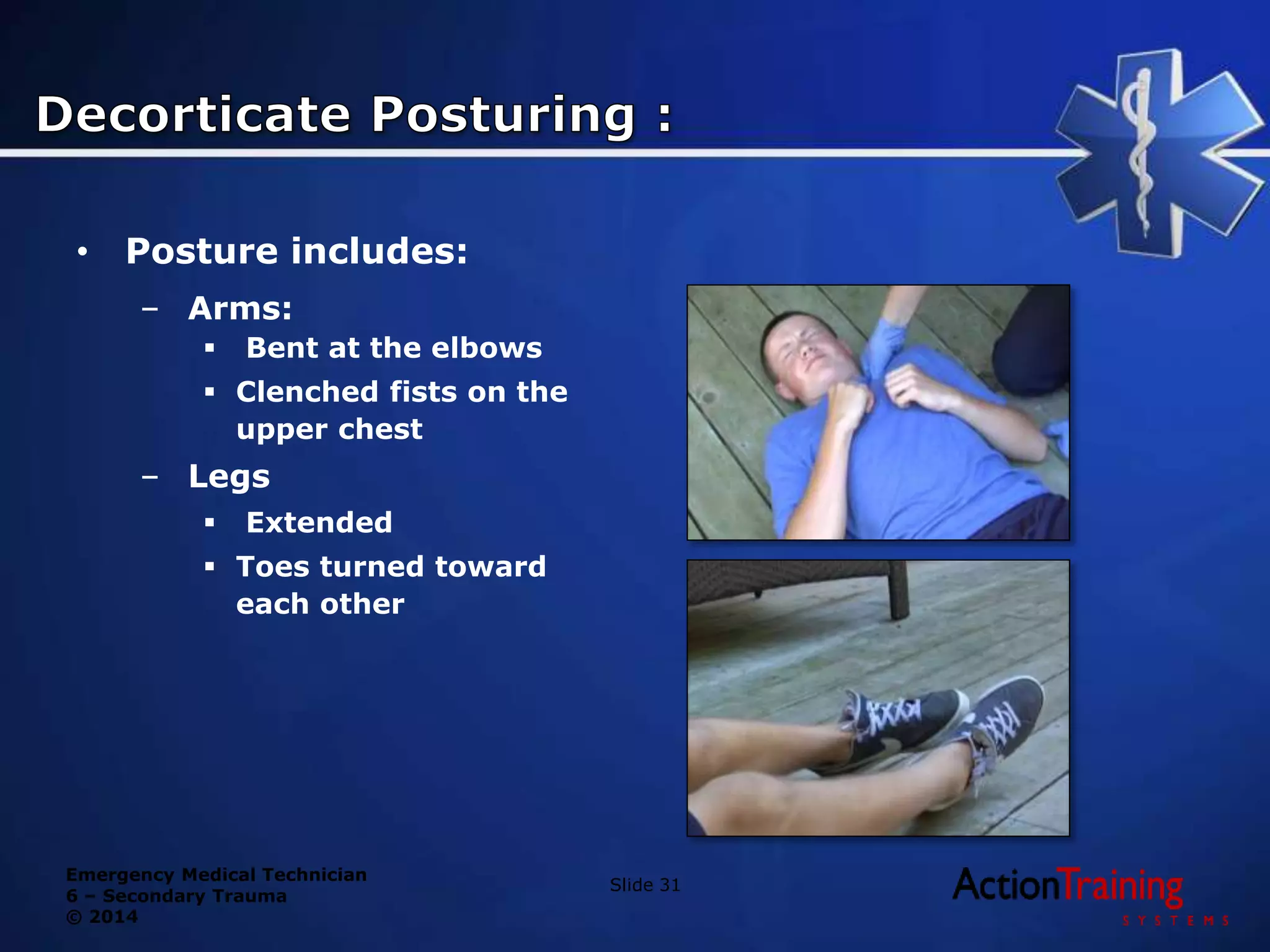
• Posture includes:
– Arms:
 Bent at the elbows
 Clenched fists on the
upper chest
– Legs
 Extended
 Toes turned toward
each other
Emergency Medical Technician
6 – Secondary Trauma
© 2014
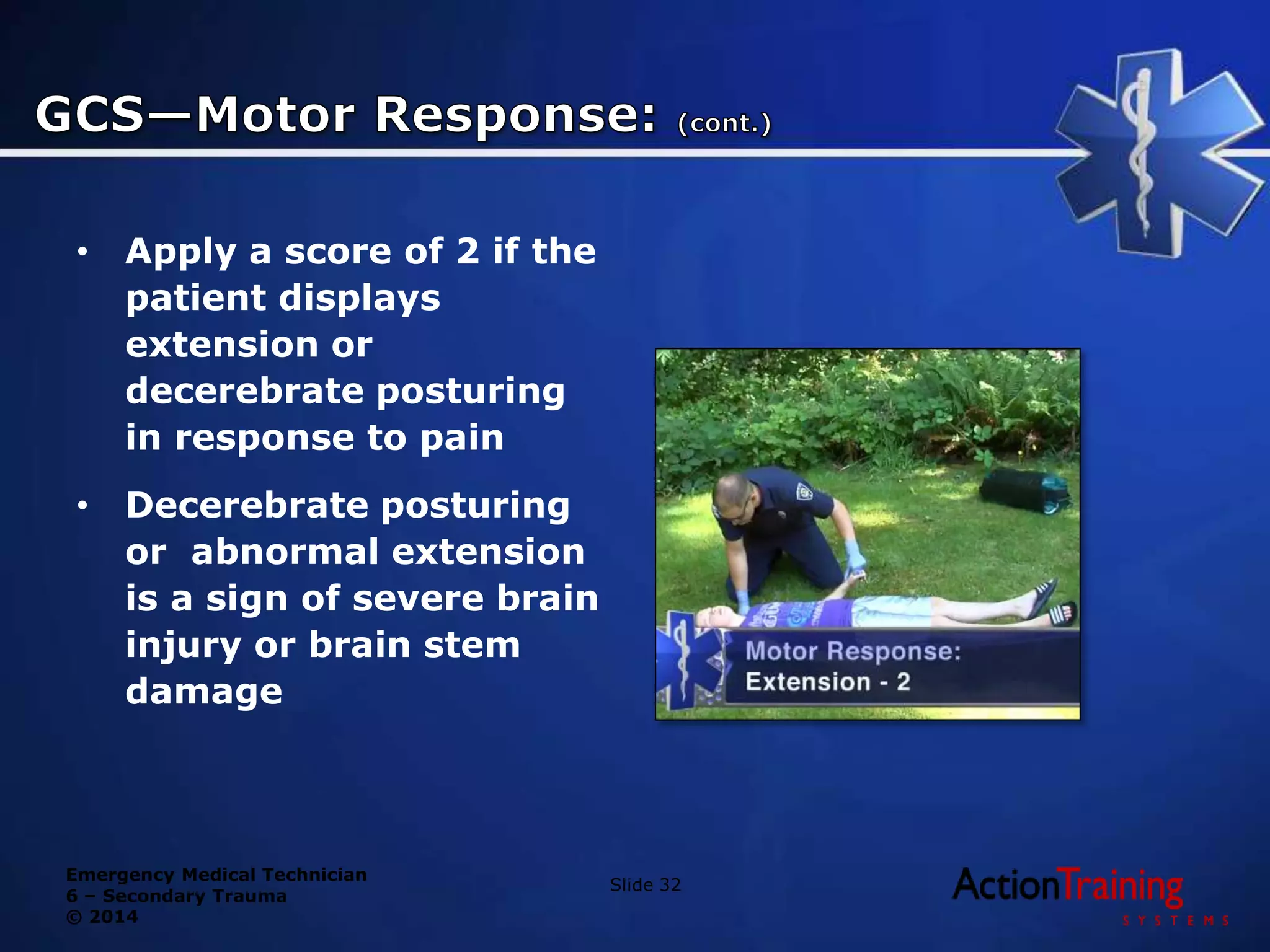
• Apply a score of 2 if the
patient displays
extension or
decerebrate posturing
in response to pain
• Decerebrate posturing
or abnormal extension
is a sign of severe brain
injury or brain stem
damage
Slide 32
Emergency Medical Technician
6 – Secondary Trauma
© 2014
Slide 33
• Abnormal extension is
more serious than the
flexion position:
– Patient is rigid
– Arms extended along the
sides of the body
– Back of the hands
alongside the hips
– Wrists clenched
– Shoulders rotated inward
toward the front of the
chest
– Head arched back
– Teeth clenched
– Legs extended
Emergency Medical Technician
6 – Secondary Trauma
© 2014
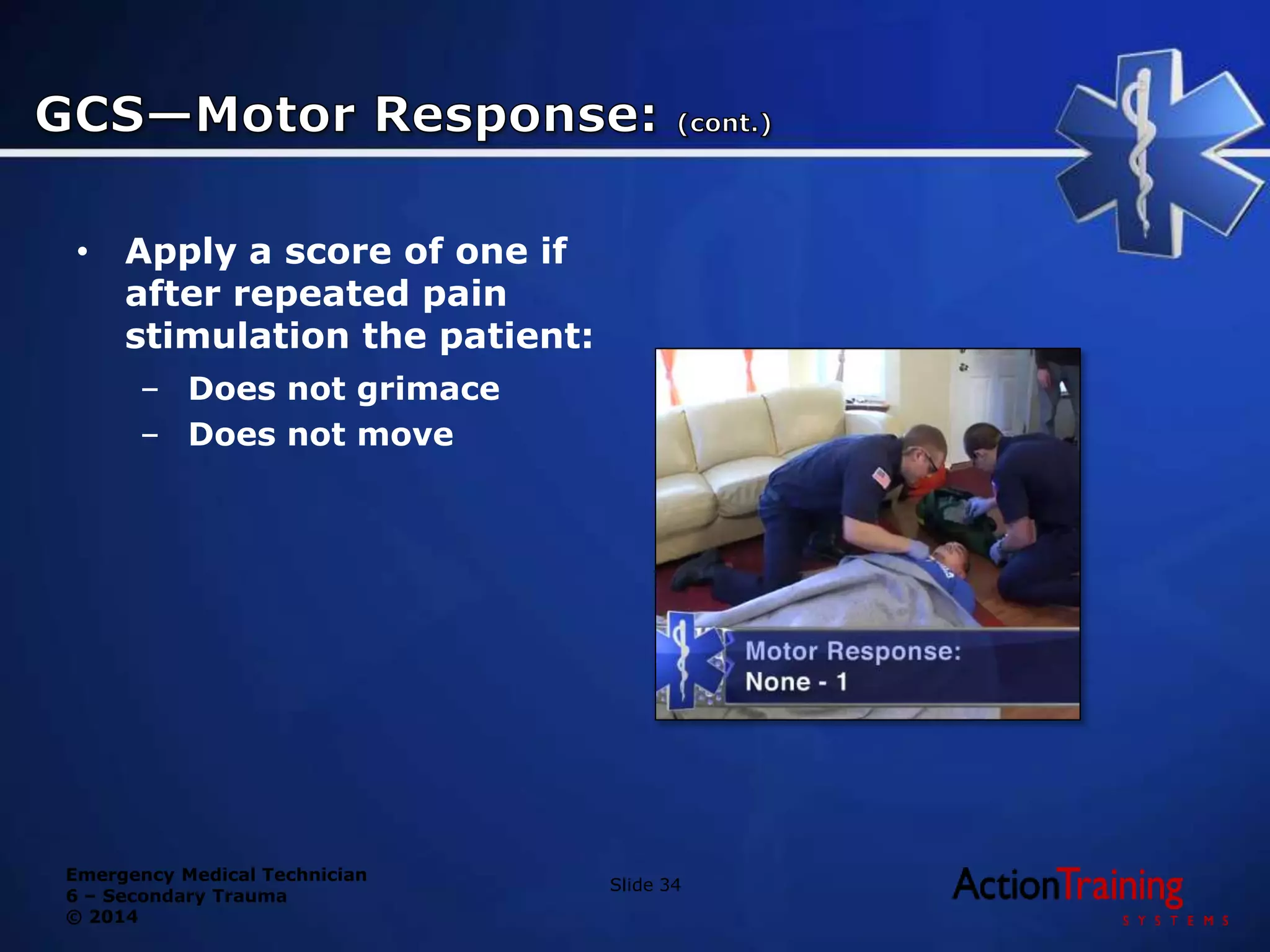
• Apply a score of one if
after repeated pain
stimulation the patient:
– Does not grimace
– Does not move
Slide 34
Emergency Medical Technician
6 – Secondary Trauma
© 2014
• Notify transporting
personnel of the results
of your findings so they
can make the
appropriate trauma
transport decision
• The lower the score, the
more likely is the need
for transport to a
trauma center
Slide 35
Emergency Medical Technician
6 – Secondary Trauma
© 2014
Slide 36
Emergency Medical Technician
6 – Secondary Trauma
© 2014
• The kind of secondary
assessment you
perform on a trauma
patient, and the order
of the steps you take in
performing it, will vary,
depending on the
circumstances
Slide 37
Emergency Medical Technician
6 – Secondary Trauma
© 2014
• Indications:
• Significant MOI
• Altered Mental Status
• Multiple Injuries
• Critical Findings
Slide 38
Emergency Medical Technician
6 – Secondary Trauma
© 2014
• Obtain a history of the present
condition
• Continue manual stabilization
• Request ALS if indicated
• Perform a rapid physical exam
• Assess baseline vital signs
• Obtain a past medical history
Slide 39
Emergency Medical Technician
6 – Secondary Trauma
© 2014
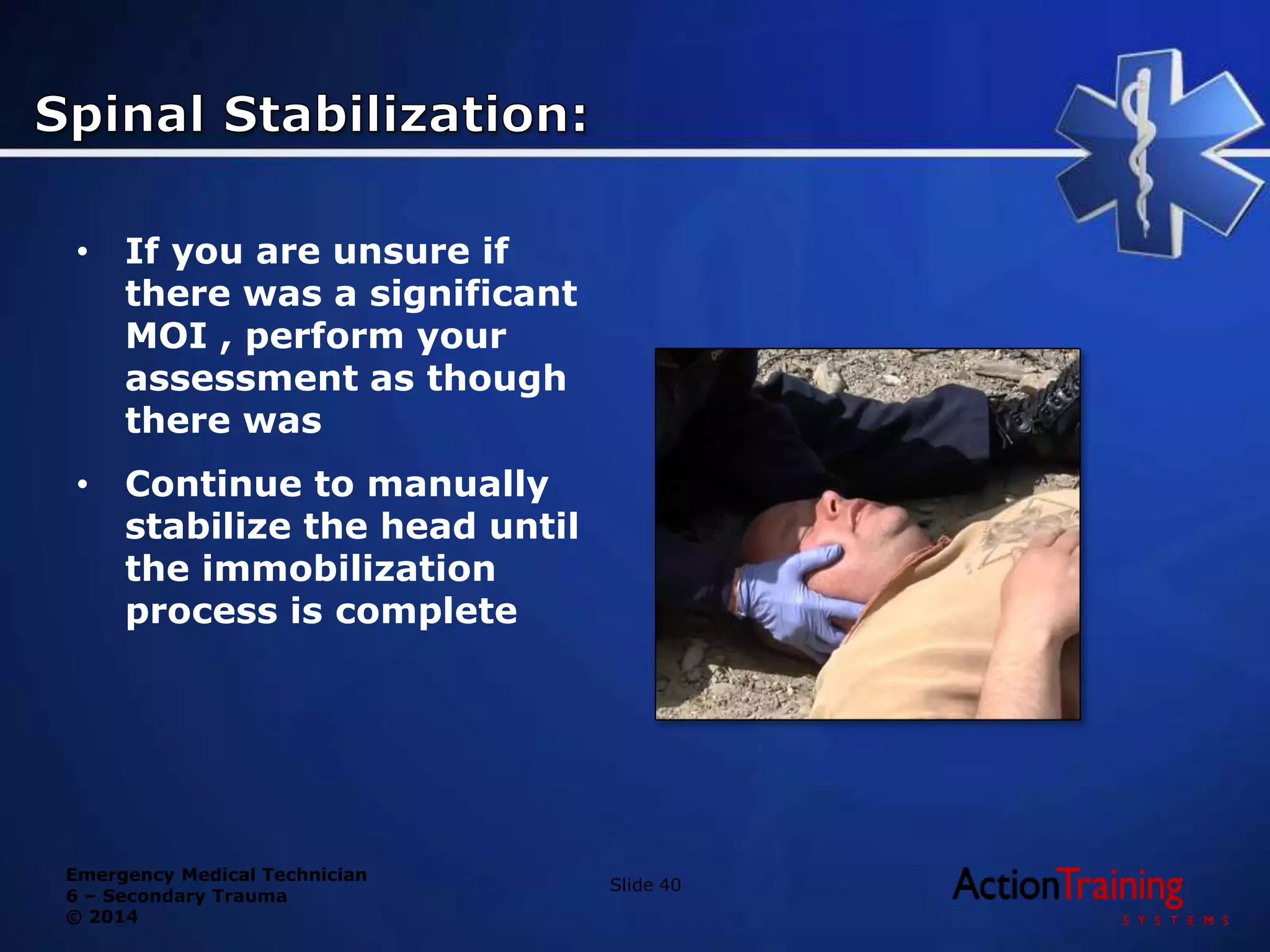
• If you are unsure if
there was a significant
MOI , perform your
assessment as though
there was
• Continue to manually
stabilize the head until
the immobilization
process is complete
Slide 40
Emergency Medical Technician
6 – Secondary Trauma
© 2014
• If indicated, contact
medical direction
and request ALS
support
• If immediate
transport was not
indicated initially
Reassess your
transport decision
Slide 41
Emergency Medical Technician
6 – Secondary Trauma
© 2014
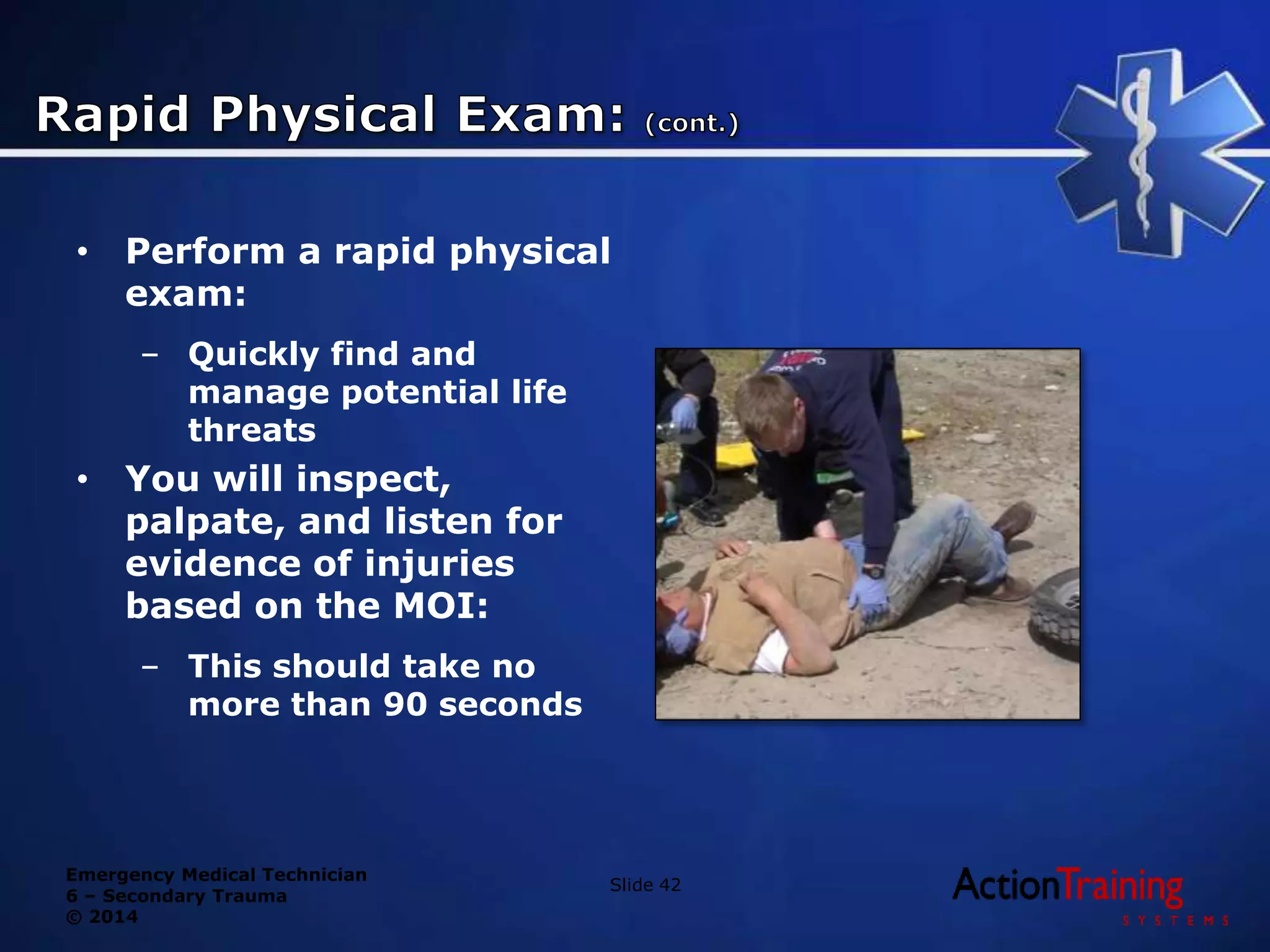
• Perform a rapid physical
exam:
– Quickly find and
manage potential life
threats
• You will inspect,
palpate, and listen for
evidence of injuries
based on the MOI:
– This should take no
more than 90 seconds
Slide 42
Emergency Medical Technician
6 – Secondary Trauma
© 2014
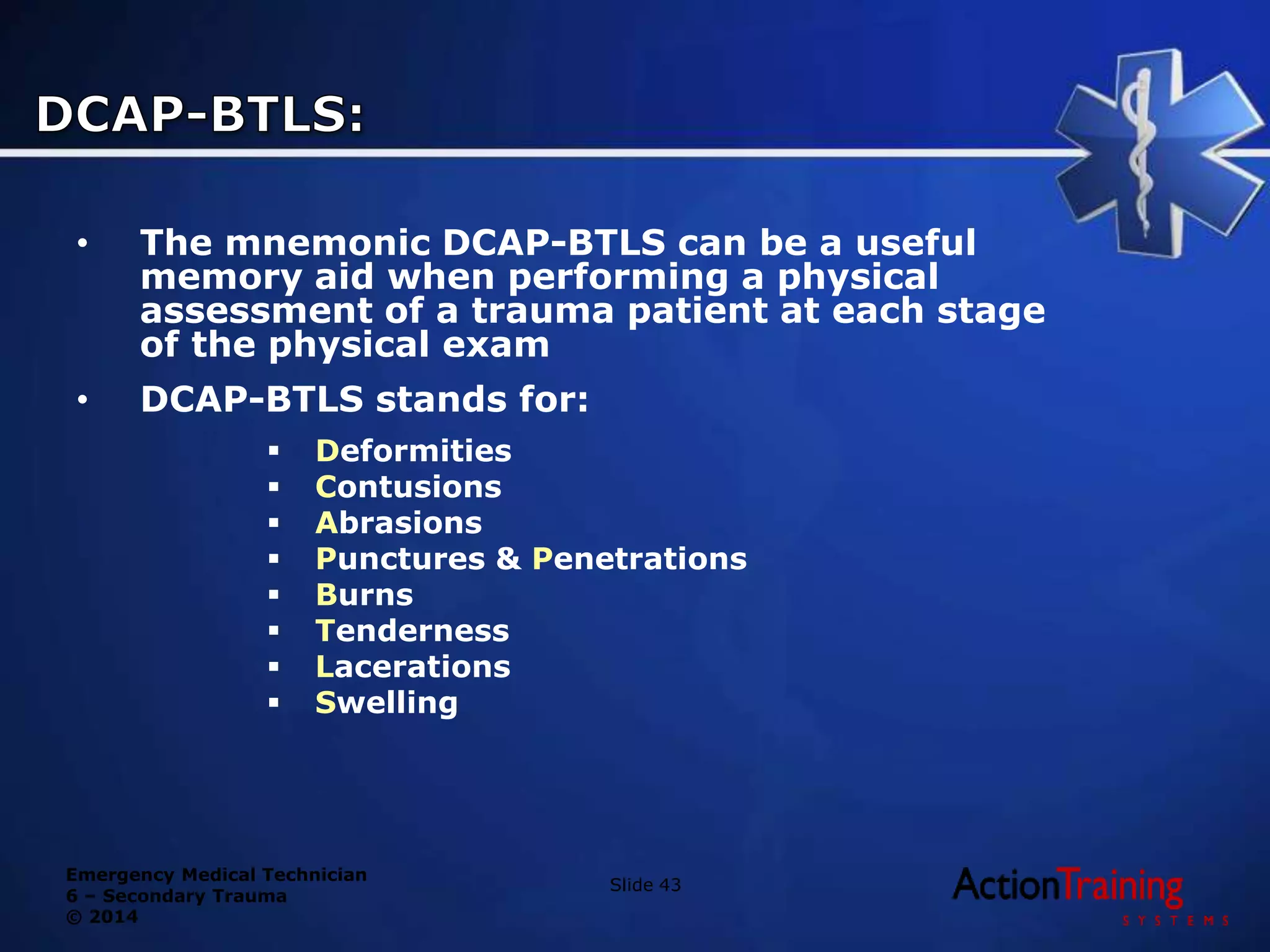
• The mnemonic DCAP-BTLS can be a useful
memory aid when performing a physical
assessment of a trauma patient at each stage
of the physical exam
• DCAP-BTLS stands for:
 Deformities
 Contusions
 Abrasions
 Punctures & Penetrations
 Burns
 Tenderness
 Lacerations
 Swelling
Slide 43
Emergency Medical Technician
6 – Secondary Trauma
© 2014
• Check the scalp and
skull for wounds,
swelling and blood
• Gently palpate the back
of the neck for
tenderness and
deformity
Slide 44
Emergency Medical Technician
6 – Secondary Trauma
© 2014
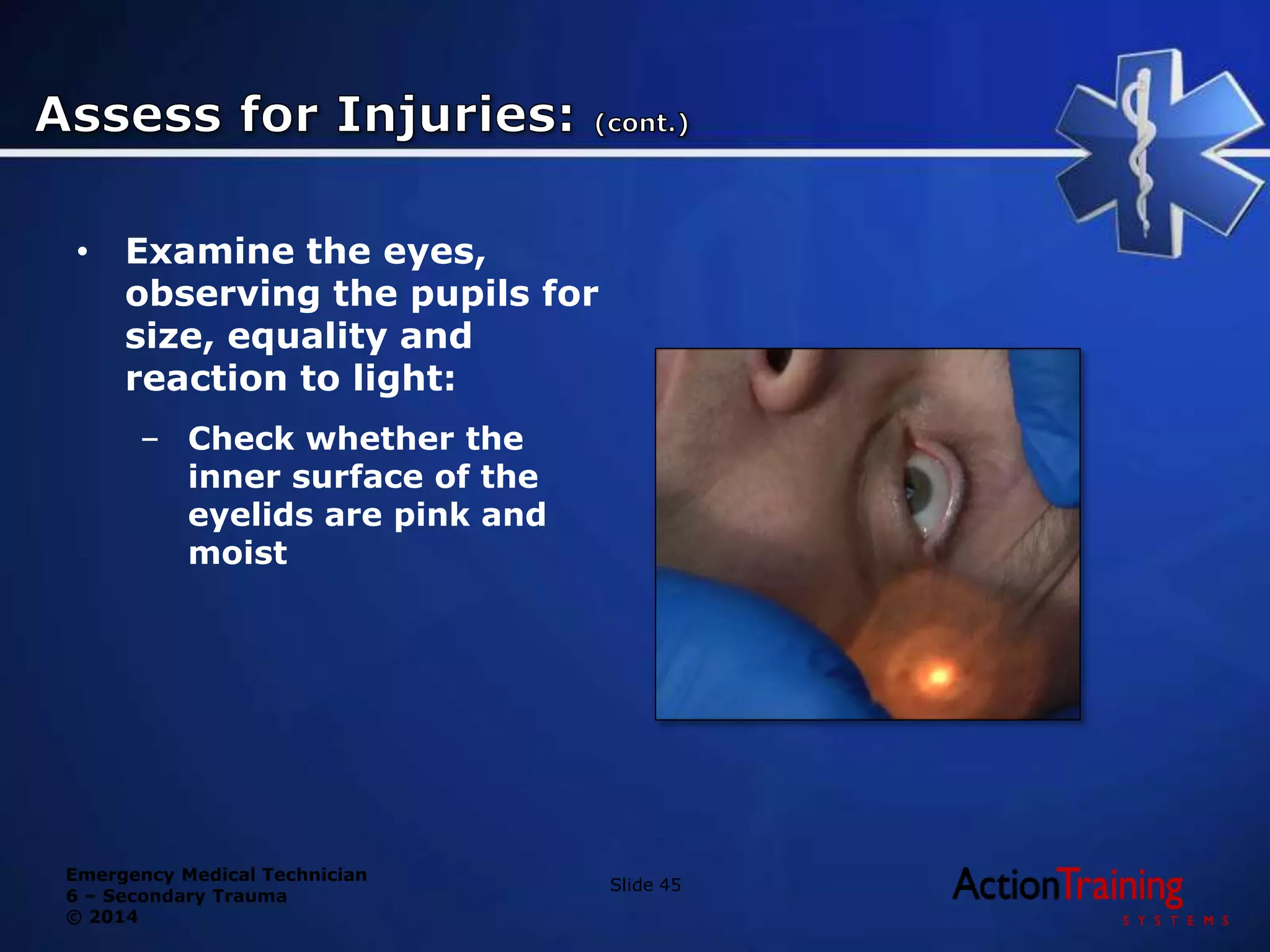
• Examine the eyes,
observing the pupils for
size, equality and
reaction to light:
– Check whether the
inner surface of the
eyelids are pink and
moist
Slide 45
Emergency Medical Technician
6 – Secondary Trauma
© 2014
Slide 46
• Check the nose and ears
for drainage
• Inspect the mouth for
foreign matter, bleeding
and injury
• Check the front of the
neck for jugular vein
distention
Emergency Medical Technician
6 – Secondary Trauma
© 2014
Slide 47
• Any suspicion of injury
to the spine based on
MOI, history or signs
and symptoms:
– Apply a cervical collar
• Remove any necklaces
or large earrings before
applying the collar
• Thoroughly assess the
neck and clavicles
before applying the
collar
Emergency Medical Technician
6 – Secondary Trauma
© 2014
Slide 48
• Use the correct collar
size to prevent
compromising the
airway or breathing
• To size the collar:
– Hold your palm next to
the side of the
patient’s neck to
estimate the distance,
in number of fingers,
between the top of the
shoulder and the
bottom of the chin
Emergency Medical Technician
6 – Secondary Trauma
© 2014
Slide 49
• Next, hold your fingers
on the side of the collar
between the
appropriate
measurement hole and
the bottom edge of the
collar that rests on the
shoulder
– The number of fingers
that fit should be the
same
• Adjust the collar to that
size
Emergency Medical Technician
6 – Secondary Trauma
© 2014
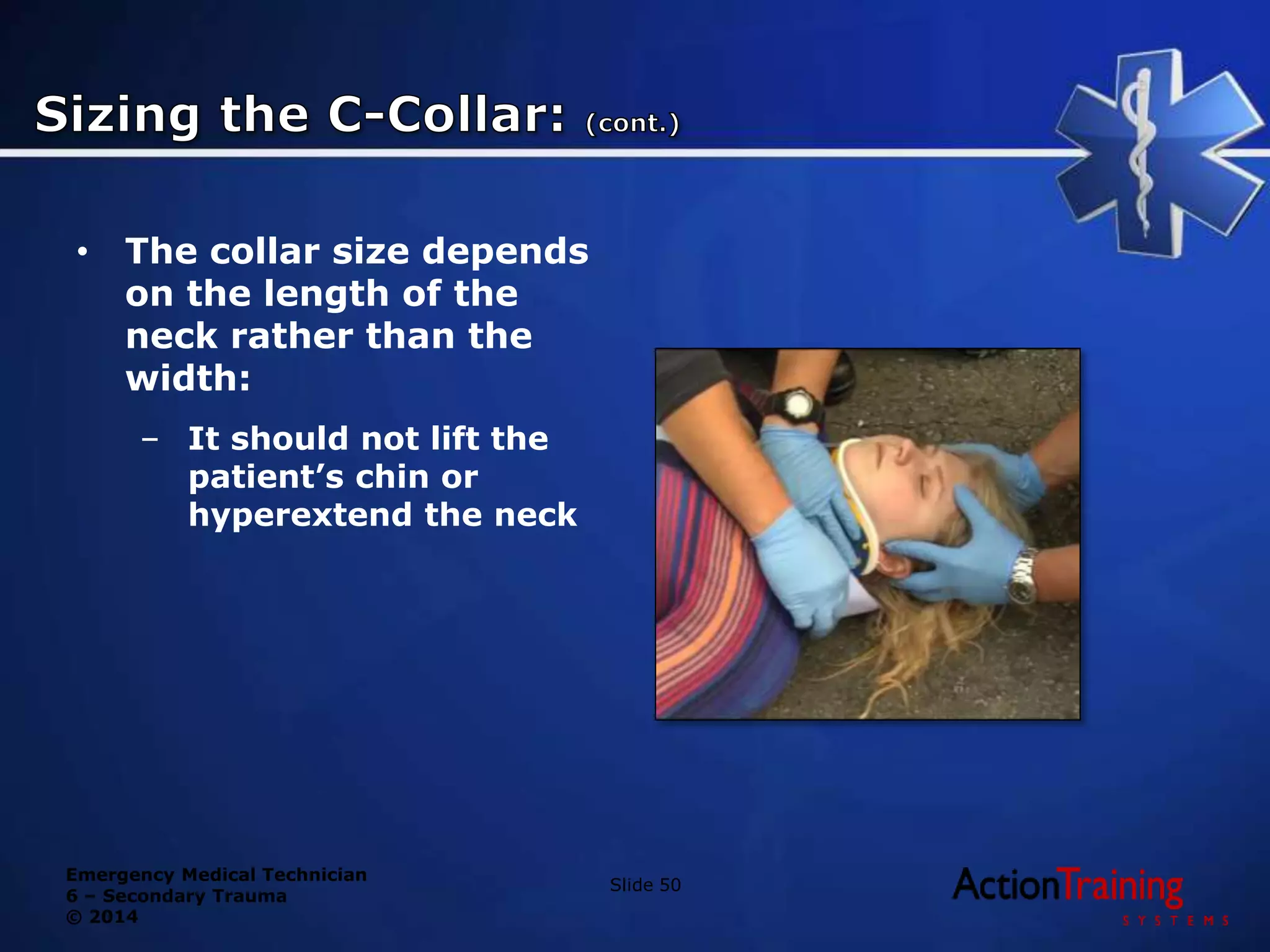
• The collar size depends
on the length of the
neck rather than the
width:
– It should not lift the
patient’s chin or
hyperextend the neck
Slide 50
Emergency Medical Technician
6 – Secondary Trauma
© 2014
Slide 51
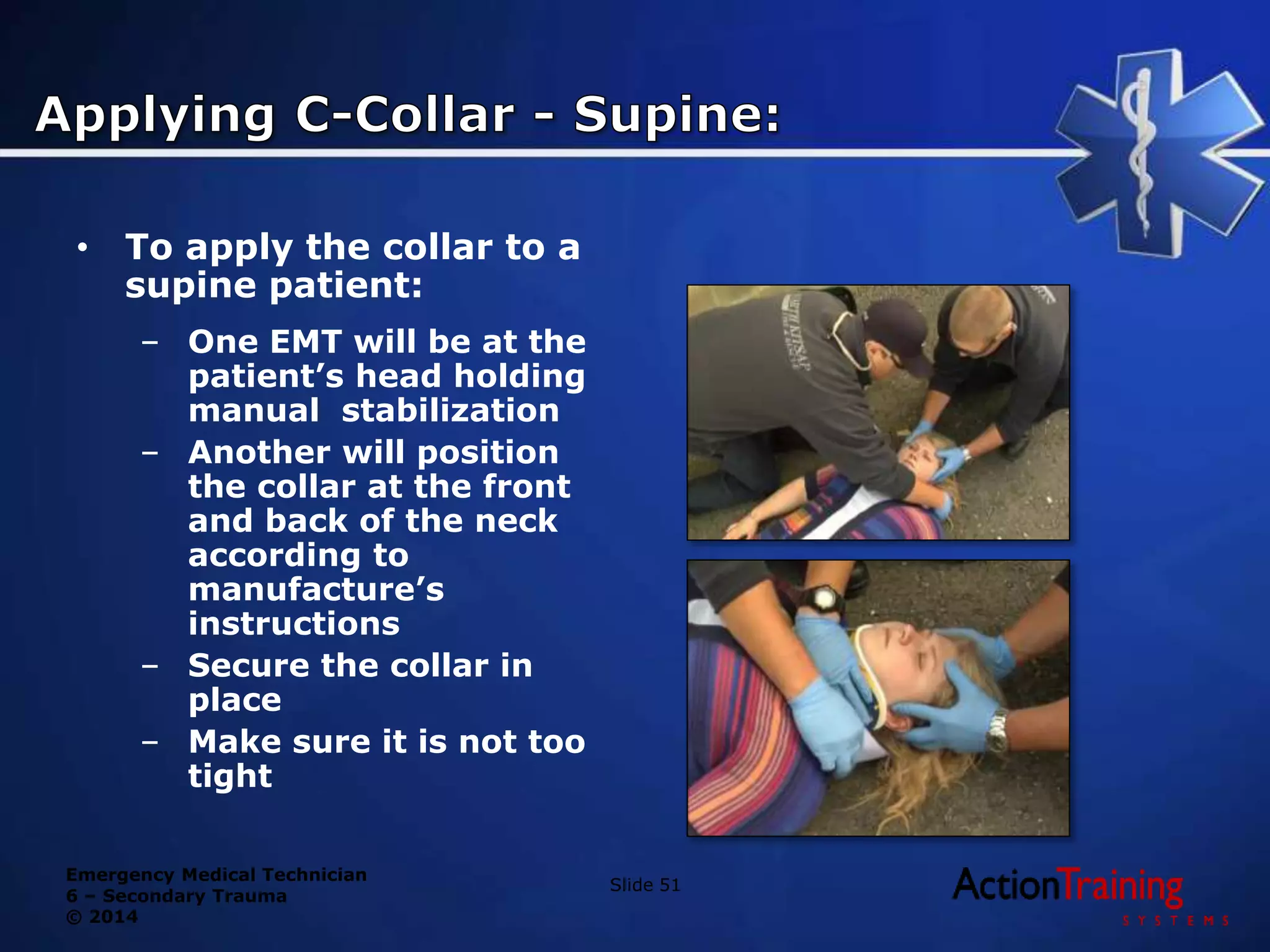
• To apply the collar to a
supine patient:
– One EMT will be at the
patient’s head holding
manual stabilization
– Another will position
the collar at the front
and back of the neck
according to
manufacture’s
instructions
– Secure the collar in
place
– Make sure it is not too
tight
Emergency Medical Technician
6 – Secondary Trauma
© 2014
Slide 52
• If the patient is seated,
follow these steps:
– One EMT will stabilize
the head and neck from
behind
– Another EMT holds the
open collar in front of
the clavicles and
angles it for placement
– Once angled, position
the collar at the front
of the neck and under
the chin
Emergency Medical Technician
6 – Secondary Trauma
© 2014
• Secure the collar in
place, making sure it is
not too tight
• Whenever you use a
collar, continue to
maintain manual
stabilization of the head
and neck until the
patient is immobilized
on a backboard
Slide 53
Emergency Medical Technician
6 – Secondary Trauma
© 2014
• Inspect the clavicles,
sternum and ribs
• Palpate the entire rib
cage for deformities and
crepitus
• Feel and look for equal
expansion of both sides
of the chest
Slide 54
Emergency Medical Technician
6 – Secondary Trauma
© 2014
Slide 55
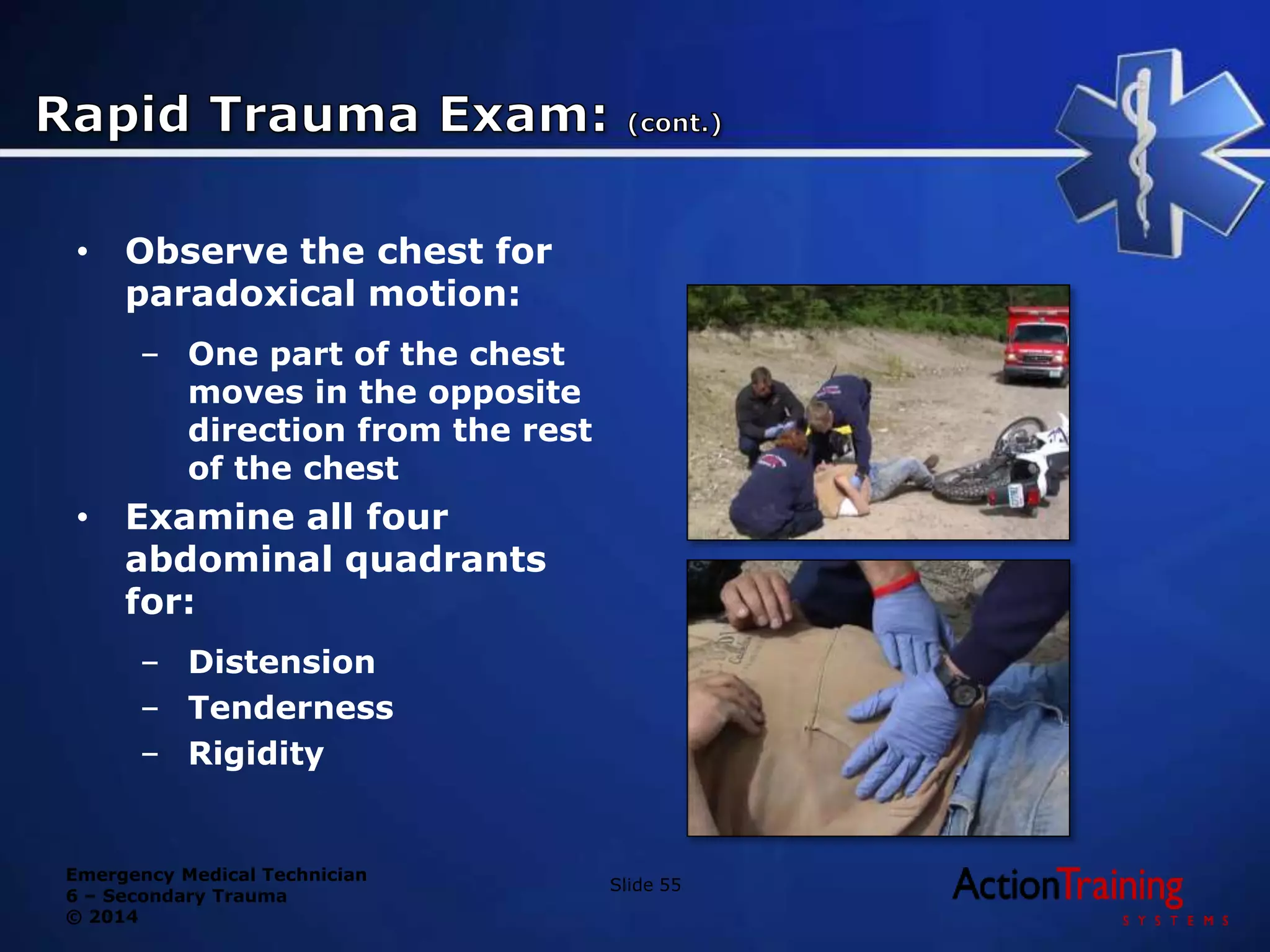
• Observe the chest for
paradoxical motion:
– One part of the chest
moves in the opposite
direction from the rest
of the chest
• Examine all four
abdominal quadrants
for:
– Distension
– Tenderness
– Rigidity
Emergency Medical Technician
6 – Secondary Trauma
© 2014
Slide 56
• Inspect the pelvis and
groin:
– Note presence of
priapism
– Incontinence
• Examine extremities,
comparing one side to
the other:
– Note any crepitation or
feeling of broken bones
• Check CSM if the patient is
responsive
Emergency Medical Technician
6 – Secondary Trauma
© 2014
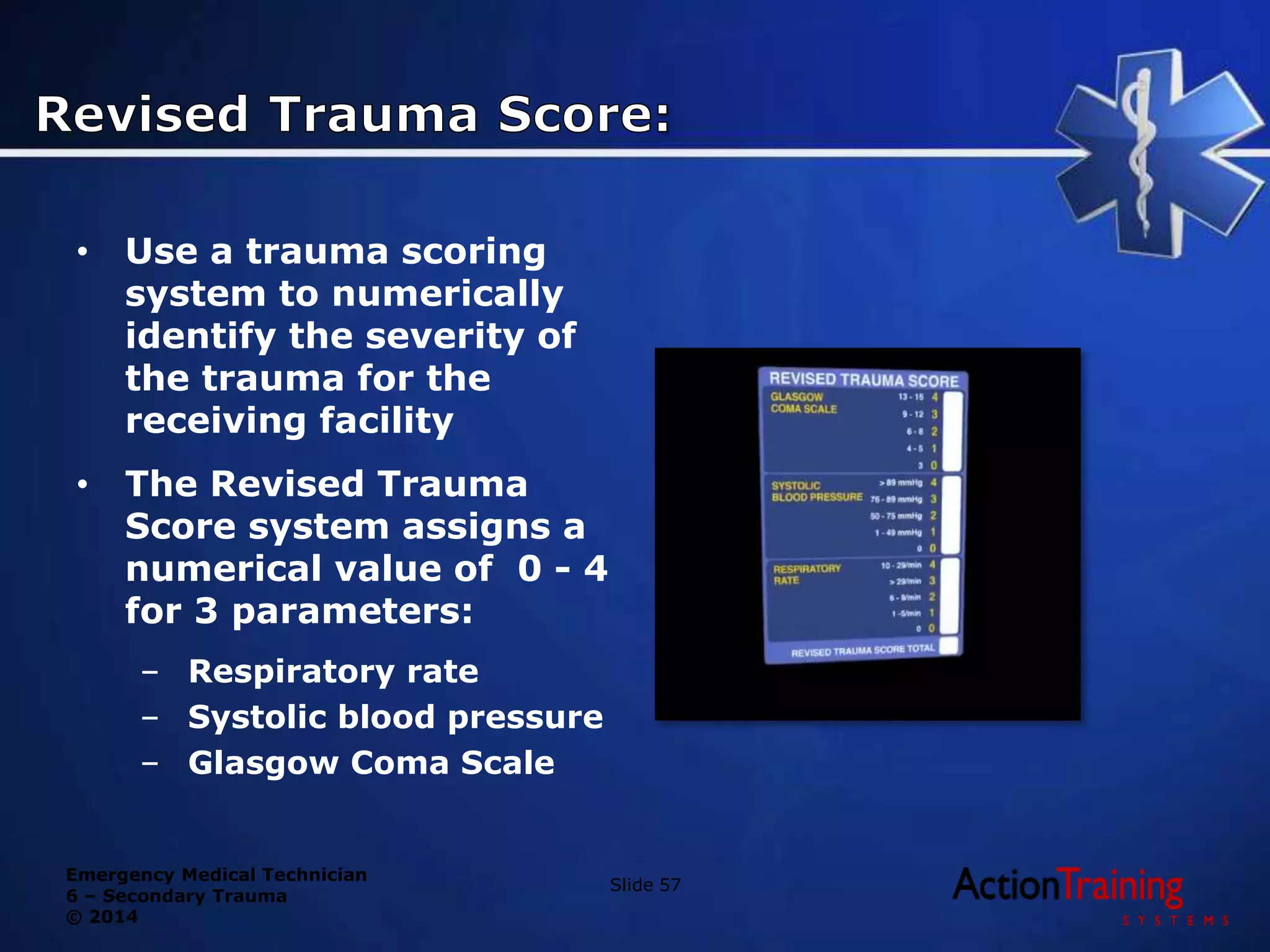
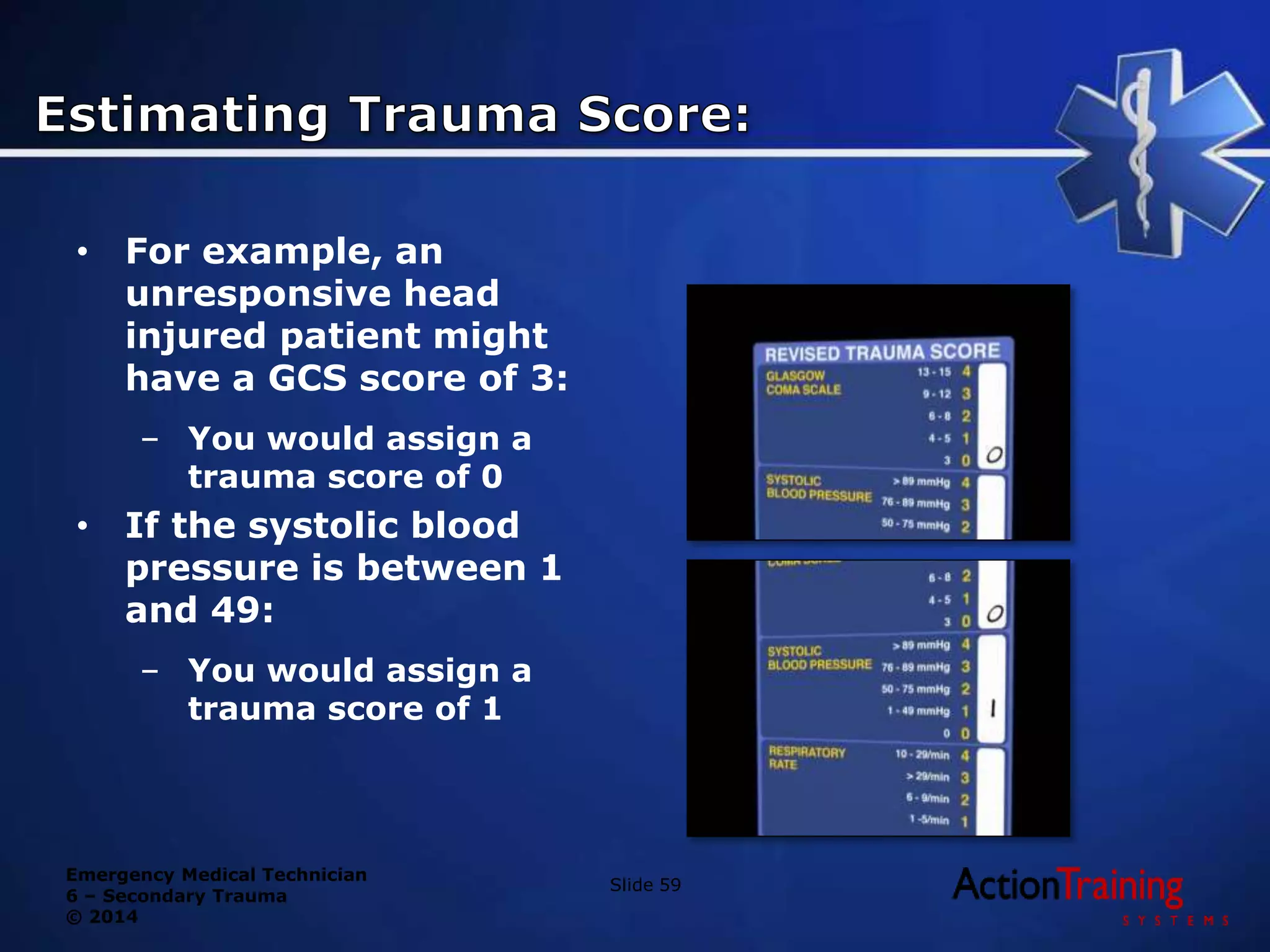
• Use a trauma scoring
system to numerically
identify the severity of
the trauma for the
receiving facility
• The Revised Trauma
Score system assigns a
numerical value of 0 - 4
for 3 parameters:
– Respiratory rate
– Systolic blood pressure
– Glasgow Coma Scale
Slide 57
Emergency Medical Technician
6 – Secondary Trauma
© 2014
• Adding the numerical
values from each
parameter provides the
trauma score
– The highest score
possible is 12
– The lowest score
possible is 0
• The lower the number,
the more serious the
trauma
Slide 58
Emergency Medical Technician
6 – Secondary Trauma
© 2014
Slide 59
• For example, an
unresponsive head
injured patient might
have a GCS score of 3:
– You would assign a
trauma score of 0
• If the systolic blood
pressure is between 1
and 49:
– You would assign a
trauma score of 1
Emergency Medical Technician
6 – Secondary Trauma
© 2014
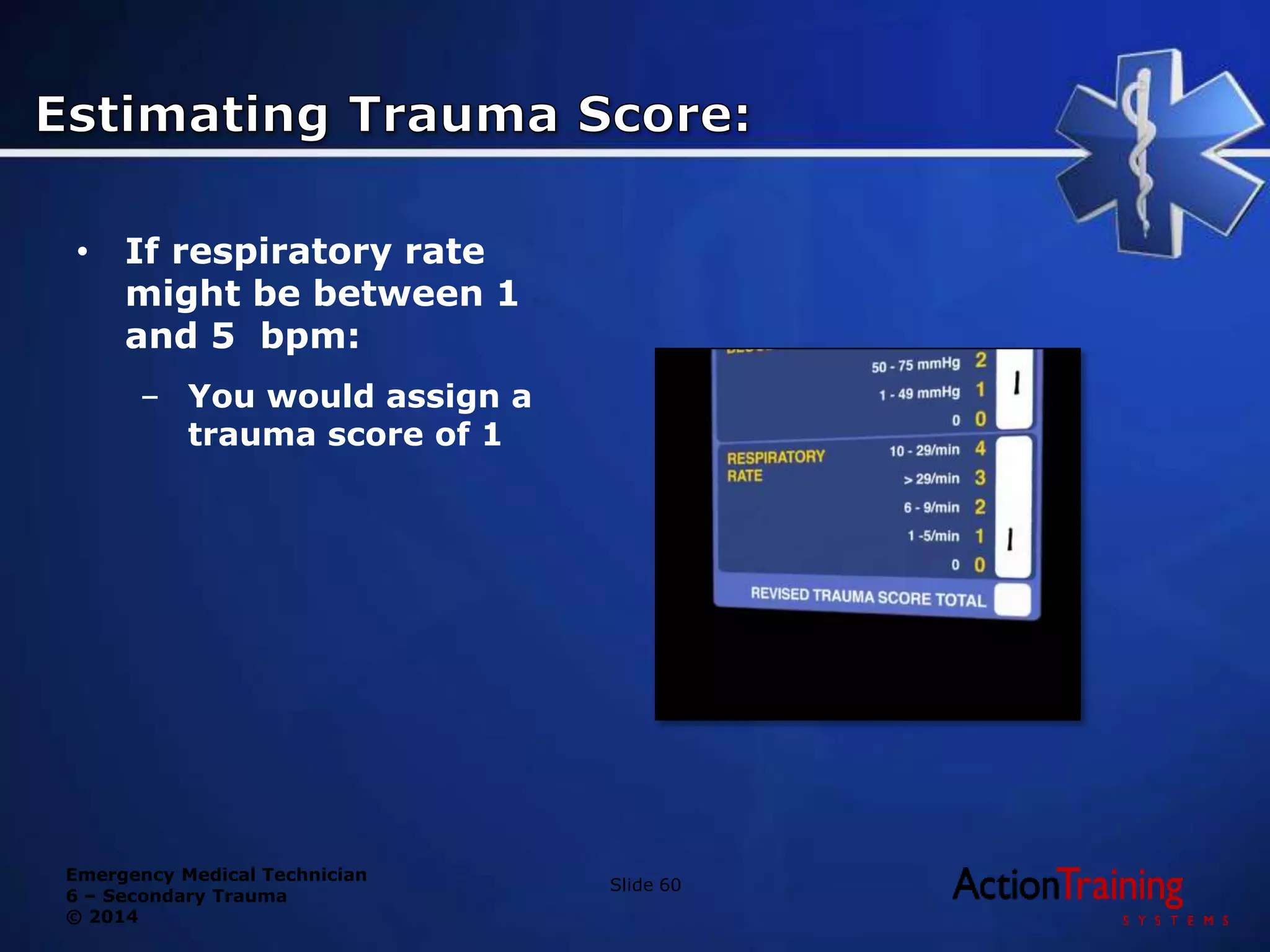
• If respiratory rate
might be between 1
and 5 bpm:
– You would assign a
trauma score of 1
Slide 60
Emergency Medical Technician
6 – Secondary Trauma
© 2014
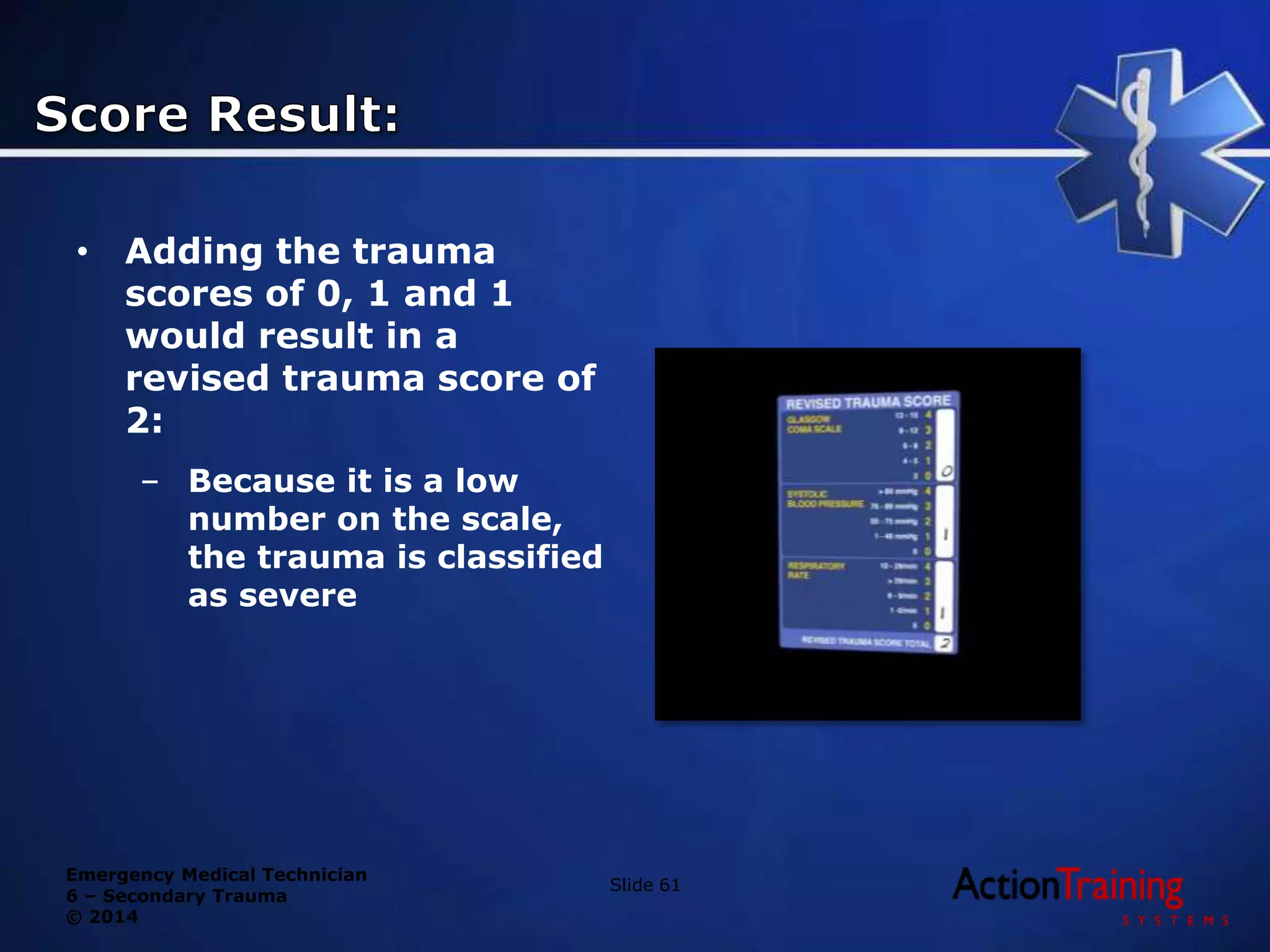
• Adding the trauma
scores of 0, 1 and 1
would result in a
revised trauma score of
2:
– Because it is a low
number on the scale,
the trauma is classified
as severe
Slide 61
Emergency Medical Technician
6 – Secondary Trauma
© 2014
Slide 62
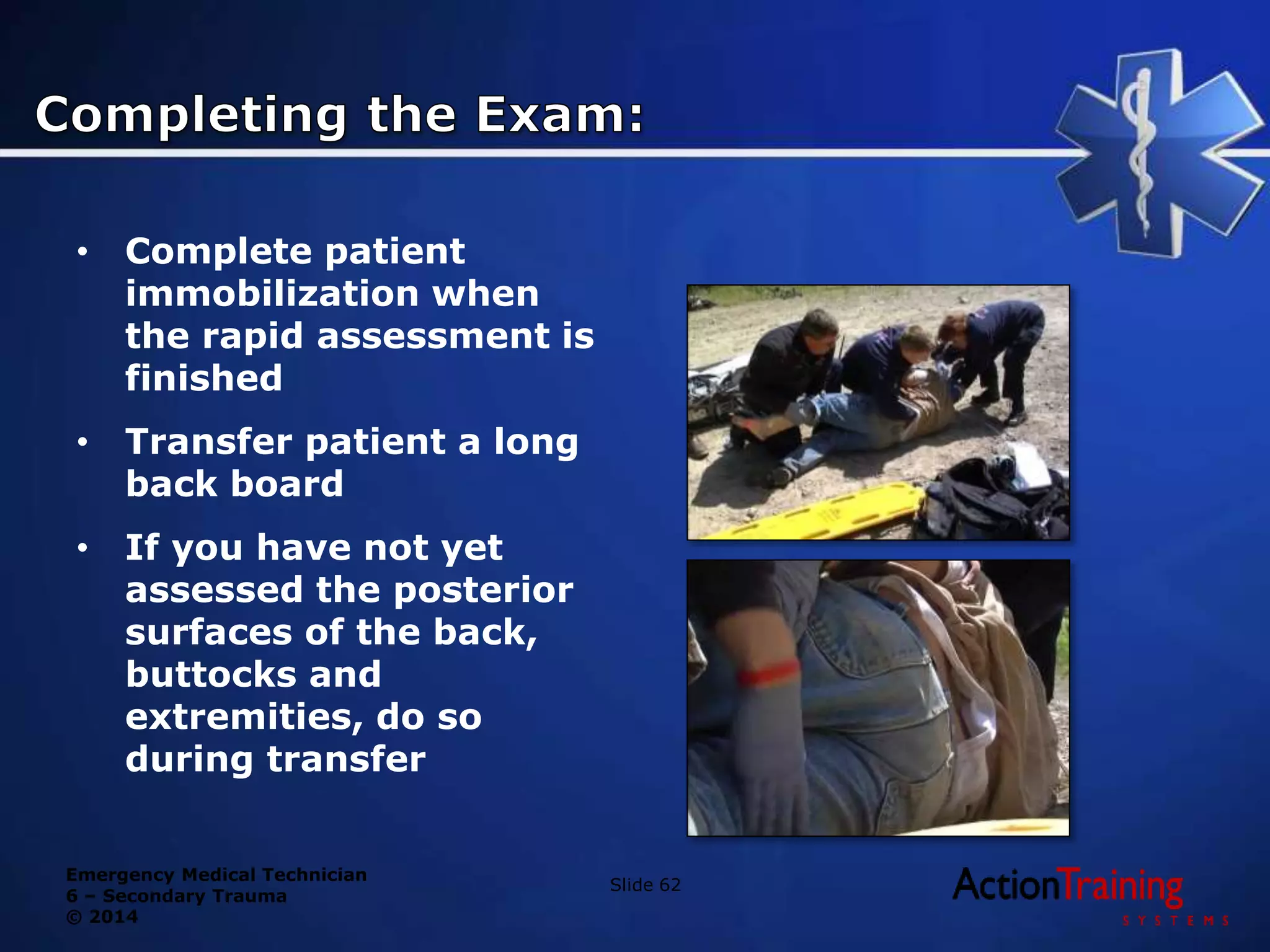
• Complete patient
immobilization when
the rapid assessment is
finished
• Transfer patient a long
back board
• If you have not yet
assessed the posterior
surfaces of the back,
buttocks and
extremities, do so
during transfer
Emergency Medical Technician
6 – Secondary Trauma
© 2014
Slide 63
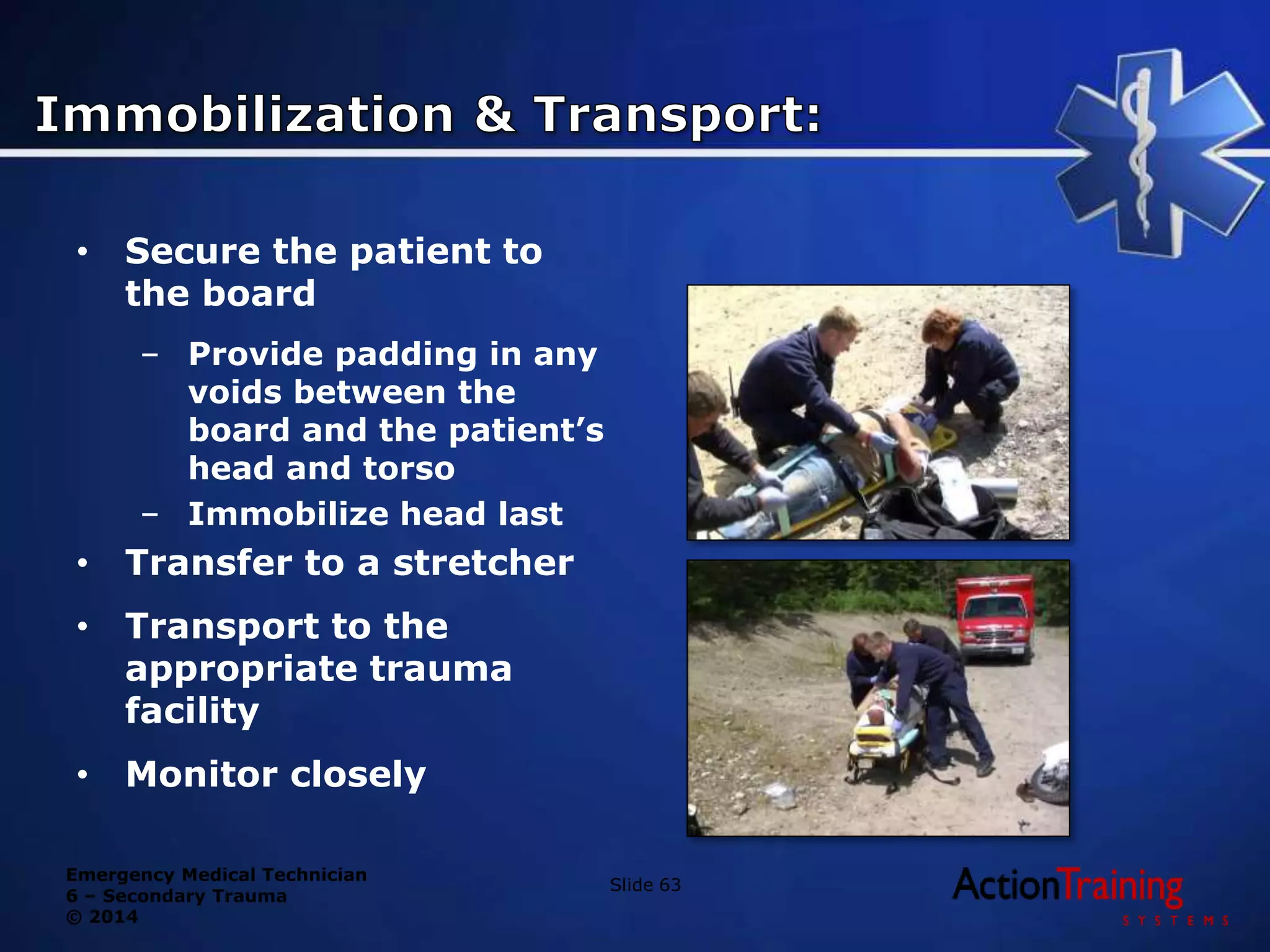
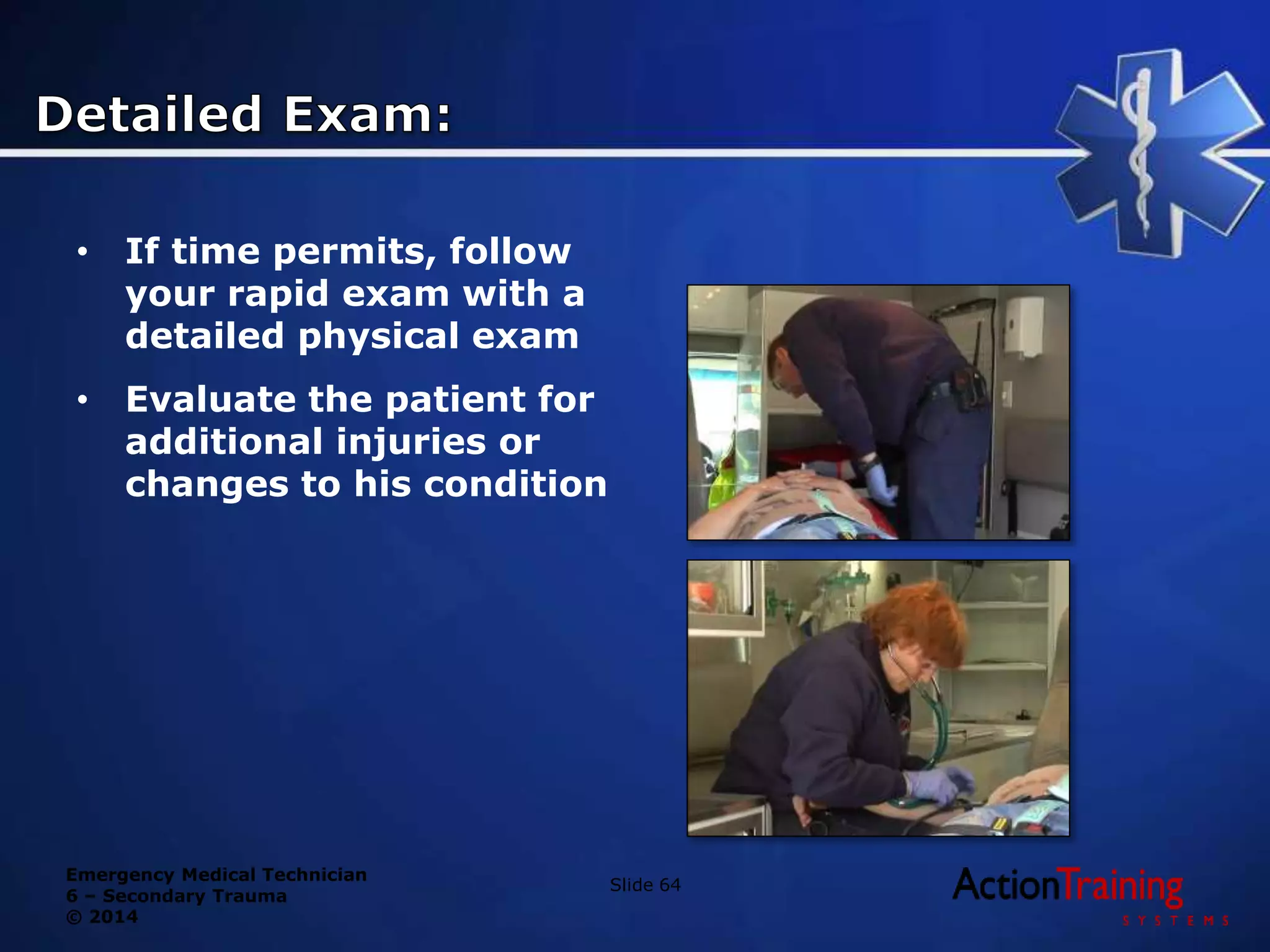
• Secure the patient to
the board
– Provide padding in any
voids between the
board and the patient’s
head and torso
– Immobilize head last
• Transfer to a stretcher
• Transport to the
appropriate trauma
facility
• Monitor closely
Emergency Medical Technician
6 – Secondary Trauma
© 2014
Slide 64
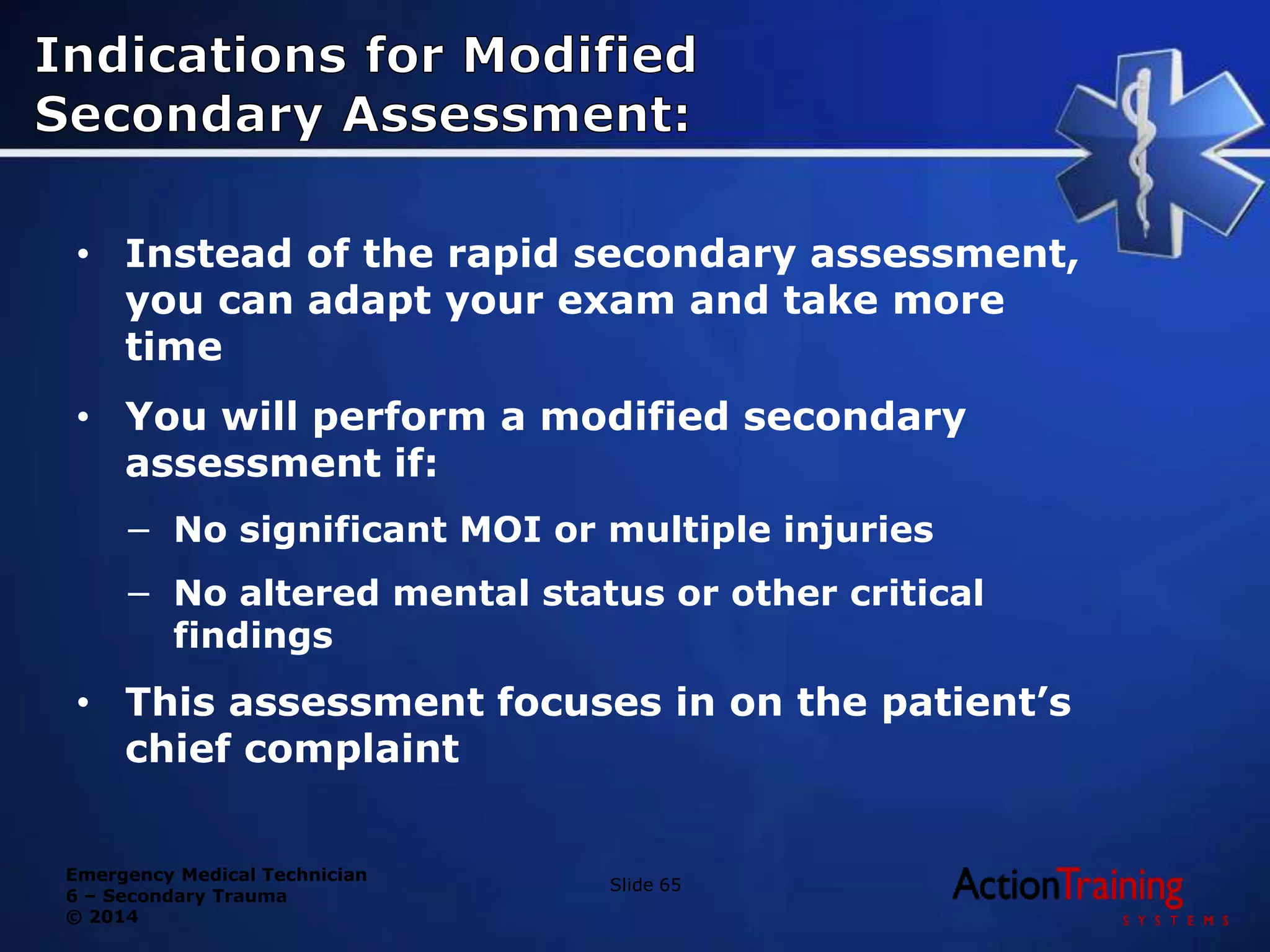
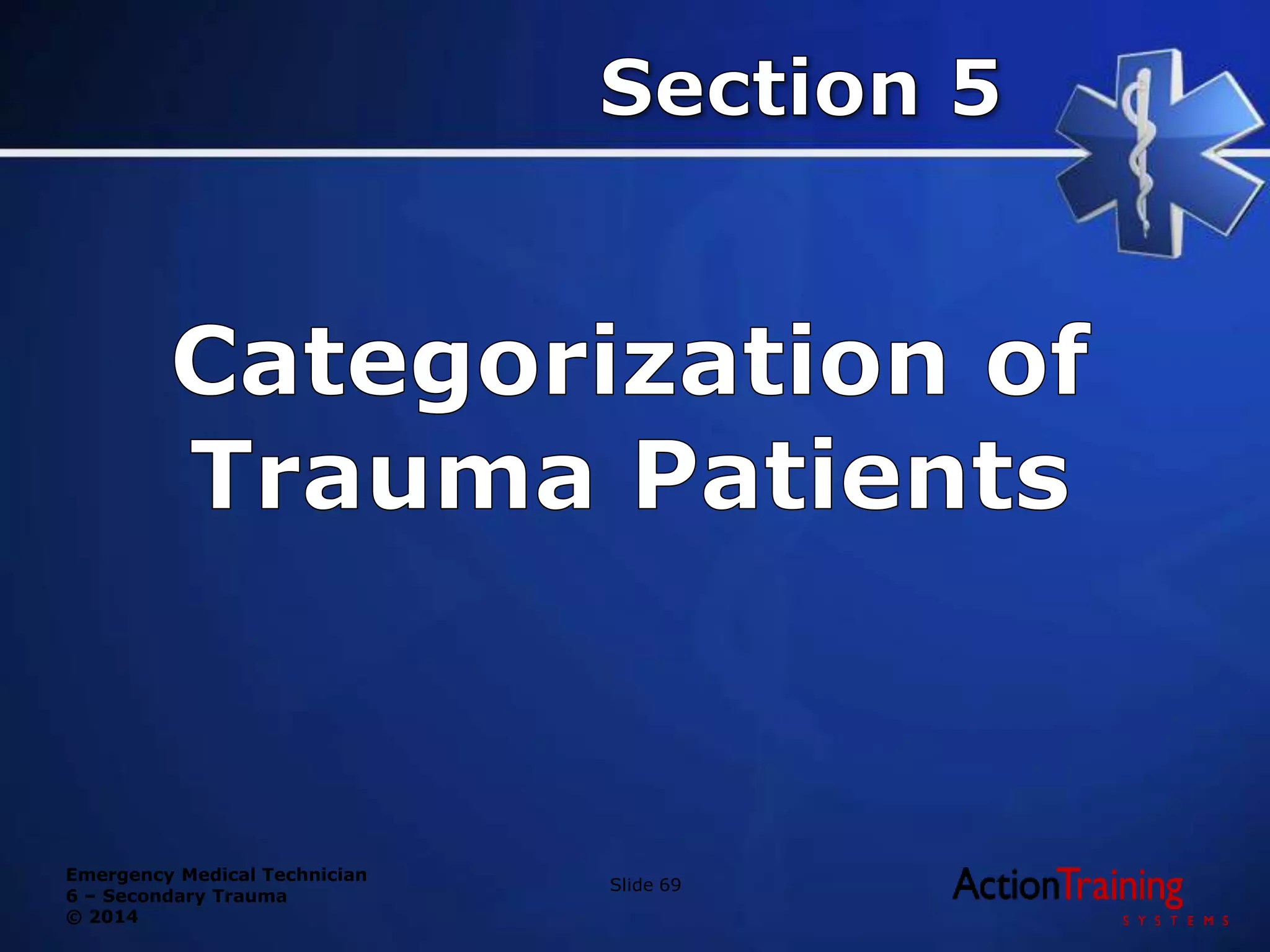
• If time permits, follow
your rapid exam with a
detailed physical exam
• Evaluate the patient for
additional injuries or
changes to his condition
Emergency Medical Technician
6 – Secondary Trauma
© 2014
• Instead of the rapid secondary assessment,
you can adapt your exam and take more
time
• You will perform a modified secondary
assessment if:
− No significant MOI or multiple injuries
− No altered mental status or other critical
findings
• This assessment focuses in on the patient’s
chief complaint
Slide 65
Emergency Medical Technician
6 – Secondary Trauma
© 2014
• To perform a modified secondary
assessment:
– Determine the chief complaint
– Obtain a history of the present
condition
– Perform a physical exam focused on
the chief complaint and MOI
– Obtain a past medical history
Slide 66
Emergency Medical Technician
6 – Secondary Trauma
© 2014
• A trauma patient who
does not have a
significant MOI will
typically be alert and
oriented and have only
a minor or isolated
injury:
– You should consider
the potential for
injuries the patient
might not be aware of
Slide 67
Emergency Medical Technician
6 – Secondary Trauma
© 2014
Slide 68
• Focus on the areas that:
– The patient indicates
are injured or painful
– You suspect could be
injured based on the
MOI
– You discovered during
your primary
assessment
• Perform a head-to-toe
secondary assessment
if the circumstances
warrant
Emergency Medical Technician
6 – Secondary Trauma
© 2014
Slide 69
Emergency Medical Technician
6 – Secondary Trauma
© 2014
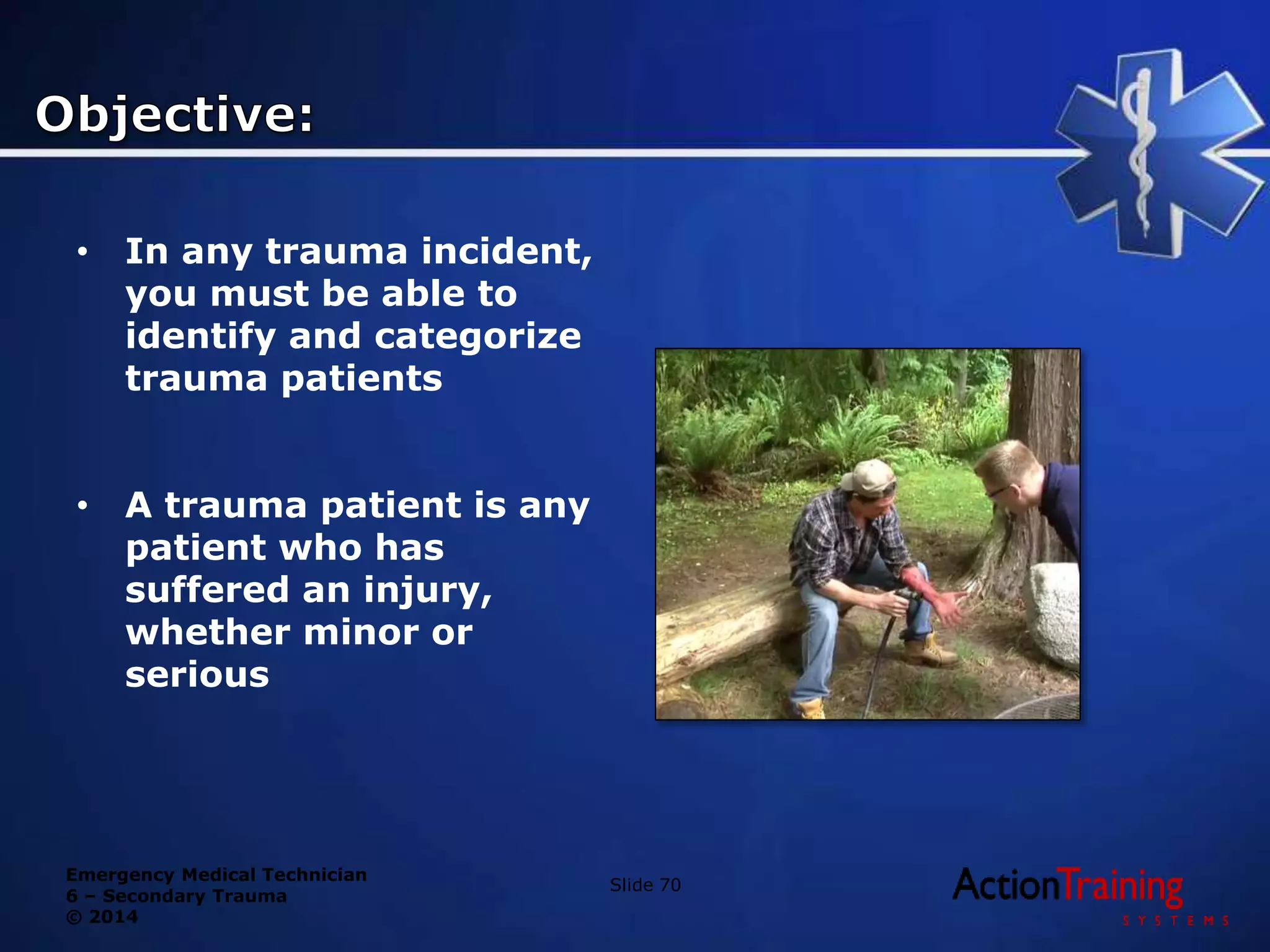
• In any trauma incident,
you must be able to
identify and categorize
trauma patients
• A trauma patient is any
patient who has
suffered an injury,
whether minor or
serious
Slide 70
Emergency Medical Technician
6 – Secondary Trauma
© 2014
• To categorize a trauma patient, you should
understand and follow the Field Triage
Decision Scheme National Trauma Triage
Protocol:
– Developed by the Centers for Disease Control
and Prevention
Slide 71
Emergency Medical Technician
6 – Secondary Trauma
© 2014
• The Decision Scheme
establishes 4 decision-
making stages for the
triage and transport
decisions of trauma
patients
• The stages call for
assessment of the
trauma event at the
following levels:
– Physiological
– Anatomical
– Mechanism of injury
– Special considerations
Slide 72
Emergency Medical Technician
6 – Secondary Trauma
© 2014
• In the first 2 steps of
this decision scheme,
your goal is to:
– Identify patients that
should be transported
to the highest level of
care within your
trauma system
Slide 73
Emergency Medical Technician
6 – Secondary Trauma
© 2014
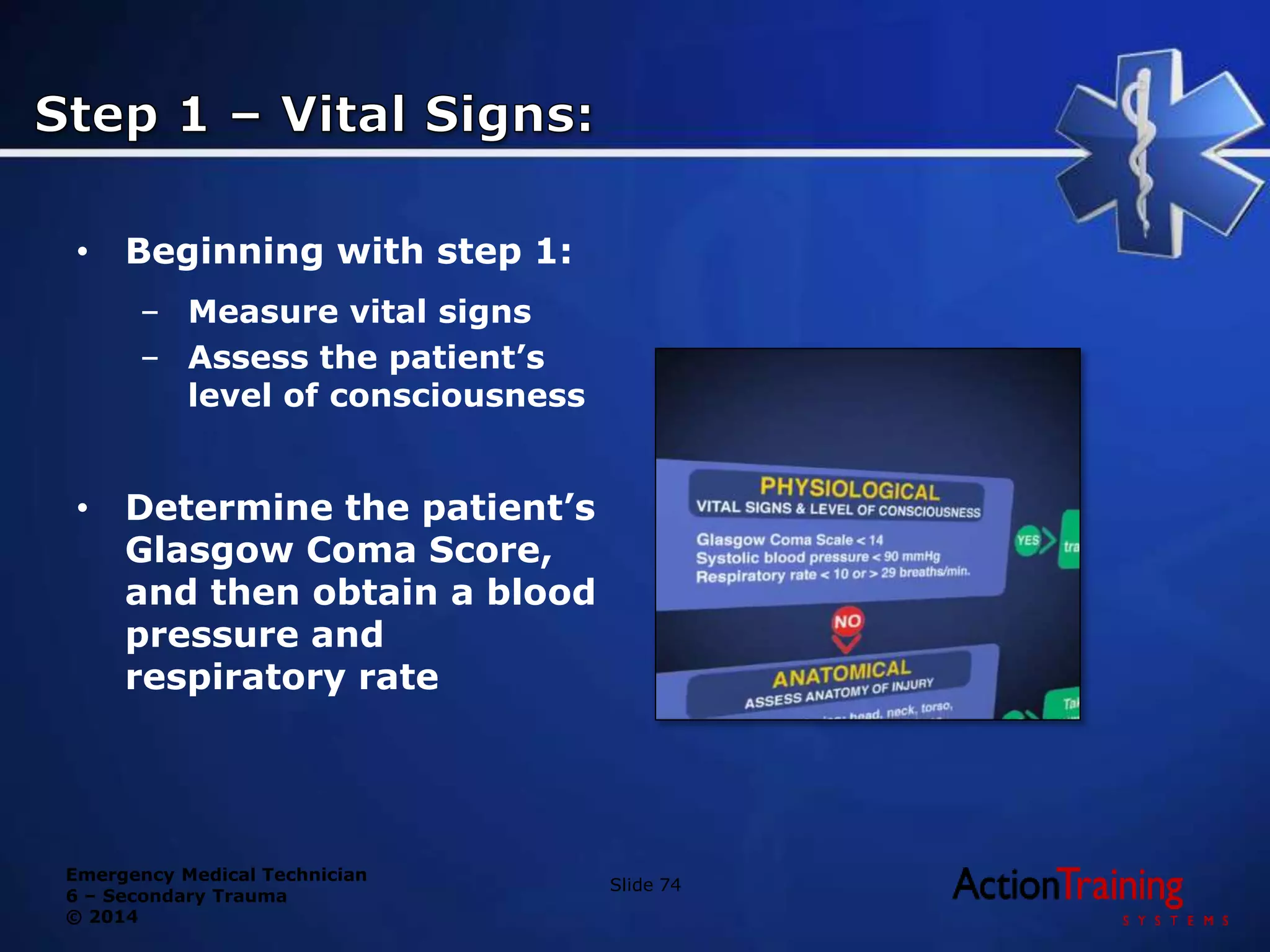
• Beginning with step 1:
– Measure vital signs
– Assess the patient’s
level of consciousness
• Determine the patient’s
Glasgow Coma Score,
and then obtain a blood
pressure and
respiratory rate
Slide 74
Emergency Medical Technician
6 – Secondary Trauma
© 2014
• Your findings, such as a low GCS or unstable
vital signs will determine the need for
immediate transport to the highest level of
care within your trauma system
• If vital signs at this point appear stable,
continue to step 2 and assess further for the
anatomy of injury
Slide 75
Emergency Medical Technician
6 – Secondary Trauma
© 2014
• Assess for:
– Penetrating injuries to the
head, neck, torso and
extremities proximal to
the elbow and knee
– A flail chest
– 2 or more proximal long-
bone fractures
– A crushed, degloved or
mangled extremity
– An amputation proximal
to the wrist and ankle
– Pelvic fractures
– Open or depressed skull
fracture
– Paralysis
Slide 76
Emergency Medical Technician
6 – Secondary Trauma
© 2014
• Patients who have
sustained any of the
listed injuries should
be transported to the
highest level of care
within your trauma
system
Slide 77
Emergency Medical Technician
6 – Secondary Trauma
© 2014
• If the injuries do NOT fall within the
criteria, continue to step 3
• At this point you will assess the
mechanism of injury and look for
evidence of high-energy impact
Slide 78
Emergency Medical Technician
6 – Secondary Trauma
© 2014
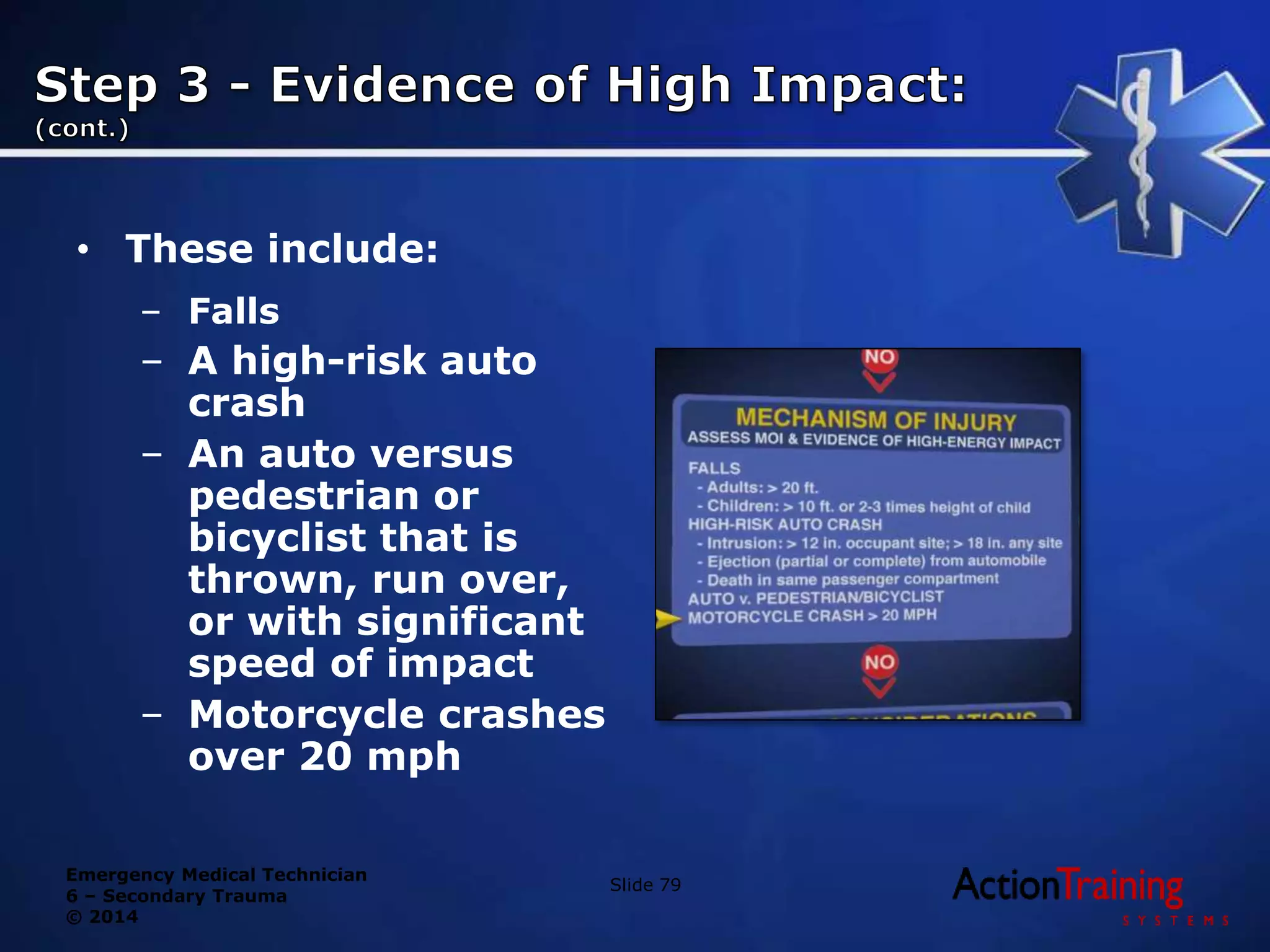
• These include:
– Falls
– A high-risk auto
crash
– An auto versus
pedestrian or
bicyclist that is
thrown, run over,
or with significant
speed of impact
– Motorcycle crashes
over 20 mph
Slide 79
Emergency Medical Technician
6 – Secondary Trauma
© 2014
• If any of these listed
factors were involved,
transport should be to
the closest appropriate
trauma center
according to protocols
• This may or may not be
your highest level of
trauma care
• If any of these MOI’s
are NOT evident,
continue to step 4
Slide 80
Emergency Medical Technician
6 – Secondary Trauma
© 2014
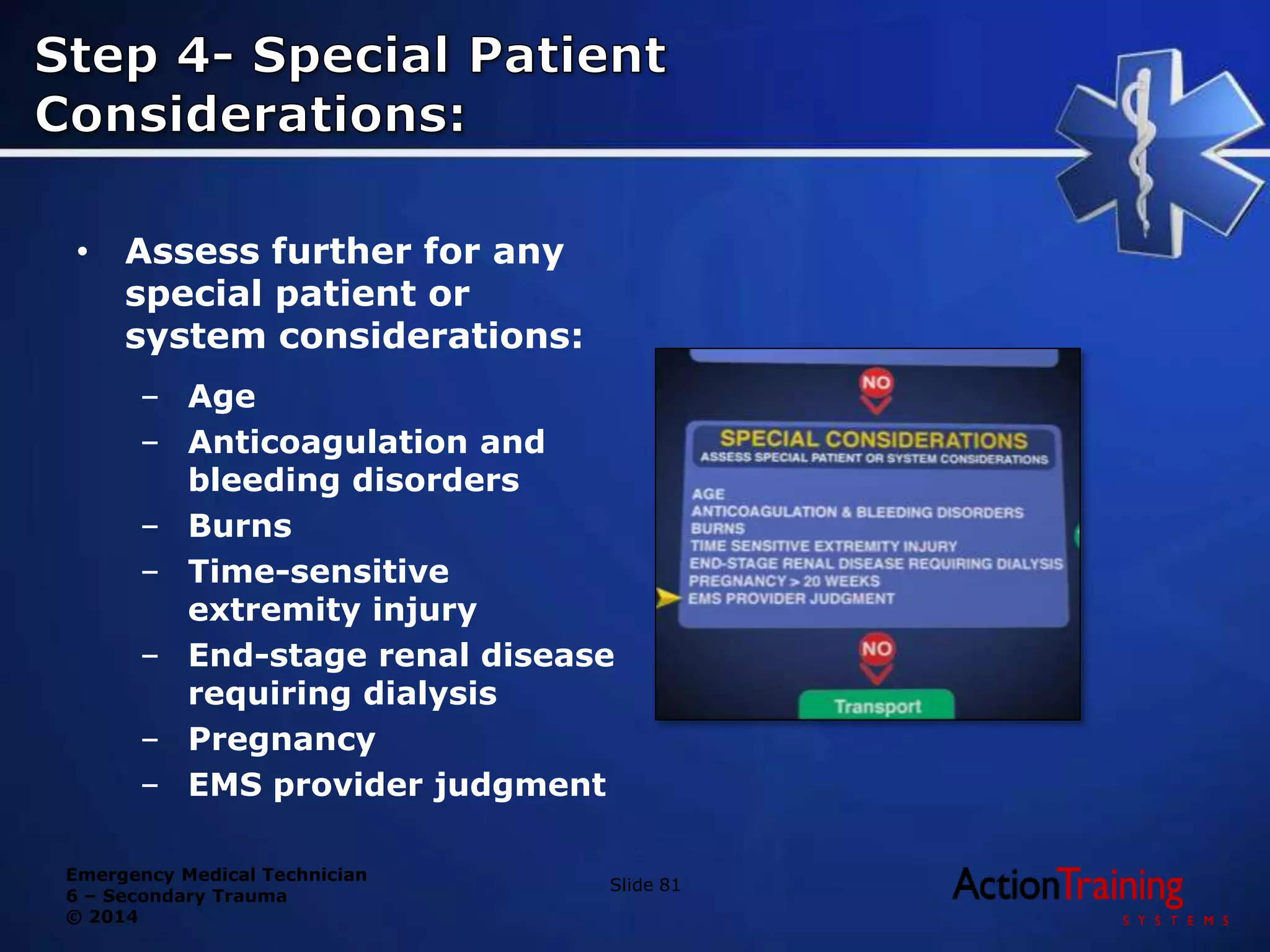
• Assess further for any
special patient or
system considerations:
– Age
– Anticoagulation and
bleeding disorders
– Burns
– Time-sensitive
extremity injury
– End-stage renal disease
requiring dialysis
– Pregnancy
– EMS provider judgment
Slide 81
Emergency Medical Technician
6 – Secondary Trauma
© 2014
• If any of these factors
are present, transport
to a trauma center or a
hospital with
specialized resources
may be warranted
• Contact medical control
for guidance, or make
transport decisions
based on your protocols
Slide 82
Emergency Medical Technician
6 – Secondary Trauma
© 2014
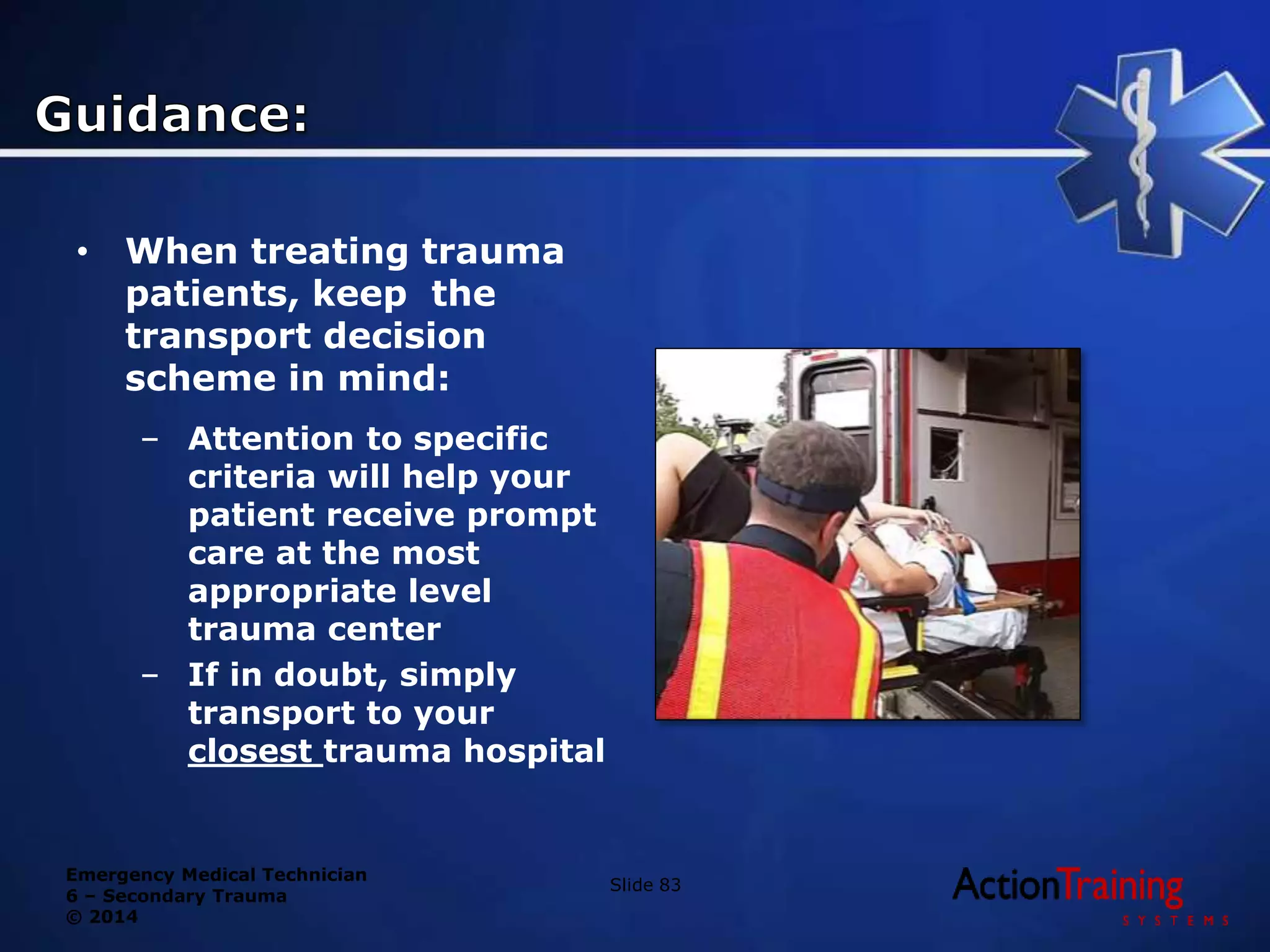
• When treating trauma
patients, keep the
transport decision
scheme in mind:
– Attention to specific
criteria will help your
patient receive prompt
care at the most
appropriate level
trauma center
– If in doubt, simply
transport to your
closest trauma hospital
Slide 83
Emergency Medical Technician
6 – Secondary Trauma
© 2014
Slide 84
Emergency Medical Technician
6 – Secondary Trauma
© 2014
• Mechanisms of Injury
• Level of Consciousness
• Assessing a Trauma Patient
• Categorization of Trauma Patients
Slide 85
Emergency Medical Technician
6 – Secondary Trauma
© 2014
• Trauma incidents are often very serious
and require rapid assessment, care and
transport
• Your ability to recognize and manage
serious trauma, as well as identifying
significant mechanisms of injury is critical
• These skills will help to expedite your
patient’s transport to the most
appropriate trauma center and give them
the best chance of survival
Slide 86
Emergency Medical Technician
6 – Secondary Trauma
© 2014
Slide 87

ATS - secondary trauma

  • 2.
    Emergency Medical Technician 6– Secondary Trauma © 2014 Slide 2
  • 3.
    Emergency Medical Technician 6– Secondary Trauma © 2014 • When assessing a trauma patient is often difficult to determine how many injuries are involved and their severity • Recognizing causes of serious injuries and how to provide immediate care is critical Slide 3
  • 4.
    Emergency Medical Technician 6– Secondary Trauma © 2014 1. Mechanisms of Injury 2. Level of Consciousness 3. Assessing a Trauma Patient 4. Categorization of Trauma Patients Slide 4
  • 5.
    Emergency Medical Technician 6– Secondary Trauma © 2014 Slide 5
  • 6.
    Emergency Medical Technician 6– Secondary Trauma © 2014 • A mechanism of injury, (MOI) refers to the forces that cause an injury • In some cases there may be more than one mechanism of injury involved for the same patient Slide 6
  • 7.
    Emergency Medical Technician 6– Secondary Trauma © 2014 • If injuries are not readily apparent, or you are unable to determine the seriousness, evaluate the MOI as you begin your assessments Slide 7
  • 8.
    Emergency Medical Technician 6– Secondary Trauma © 2014 • Understanding what types of injuries you can expect from various MOI’s will help you anticipate the kind of trauma you might encounter Slide 8
  • 9.
    Emergency Medical Technician 6– Secondary Trauma © 2014 • Trauma patients fall into two categories: – Significant MOI – Not significant MOI • Significant mechanisms of injury have a high incidence of producing life-threatening trauma Slide 9
  • 10.
    Emergency Medical Technician 6– Secondary Trauma © 2014 • Significant MOI in adults involves vehicle collisions, including: – High-speed and rollover collisions – Vehicle-pedestrian and vehicle-bicycle collisions – Motorcycle crashes – Any vehicular crash that involves ejection, or the death of a person in the same passenger compartment as the patient Slide 10
  • 11.
    Emergency Medical Technician 6– Secondary Trauma © 2014 Slide 11 – A seat belt injury or the failure to use a seat belt, including deployed airbags – Any impact that causes deformity to the steering wheel or a prolonged extrication – Intrusion into the passenger compartment of 12’’ (30cm) – Intrusion into any part of vehicle of 18’’ (46cm)
  • 12.
    Emergency Medical Technician 6– Secondary Trauma © 2014 • Blast injuries • Penetration of the: – Head – Neck – Chest – Abdomen – Penetration above the knee or elbow Slide 12
  • 13.
    Emergency Medical Technician 6– Secondary Trauma © 2014 • Blunt or penetrating trauma resulting in an altered mental status • Falls greater than 20 ft. (6m) Slide 13
  • 14.
    Emergency Medical Technician 6– Secondary Trauma © 2014 • Bicycle collisions with vehicles • Medium-speed vehicle collisions involving a child: – Pedestrian – Occupant • Vehicle collision in which a child passenger was not restrained • Falls of either: – More than 10 ft (3m) – 2 to 3 times the height of the child Slide 14
  • 15.
    Emergency Medical Technician 6– Secondary Trauma © 2014 Slide 15
  • 16.
    Emergency Medical Technician 6– Secondary Trauma © 2014 • One of the first things you noted in the primary assessment was the patient’s level of consciousness (LOC) • In the secondary assessment reassess the level of consciousness • Improvement or deterioration of the patient’s condition, can be apparent from changes in the LOC Slide 16
  • 17.
    Emergency Medical Technician 6– Secondary Trauma © 2014 • When you assess for AVPU designate a score for the patient’s neurological status using the Glasgow Coma Scale (GCS) • The GCS uses a point system of 3 to 15 that evaluates LOC Slide 17
  • 18.
    Emergency Medical Technician 6– Secondary Trauma © 2014 • The patient is evaluated for: – Eye-opening activity – Verbal response – Motor response • Each is scored on the level of responsiveness from the patient Slide 18
  • 19.
    Emergency Medical Technician 6– Secondary Trauma © 2014 • Scores for each response are noted and combined to determine the patient’s total GSC: – High score indicates a high level of responsiveness – Low score indicates poor or no responsiveness Slide 19
  • 20.
    Emergency Medical Technician 6– Secondary Trauma © 2014 Slide 20 • If the eye-opening response is spontaneous, apply a score of 4 • If eye opening is NOT spontaneous: – Verbally direct the patient in a normal tone of voice to open his eyes • If the eyes remain closed, shout the command: – If the patient is able to comply to either command, apply a score of 3
  • 21.
    Emergency Medical Technician 6– Secondary Trauma © 2014 • If the patient does NOT open his eyes when prompted verbally: – Apply a pain stimulus • If this causes the patient to open his eyes, apply a score of 2 • If the eyes do not open at all, apply a score of 1 Slide 21
  • 22.
    Emergency Medical Technician 6– Secondary Trauma © 2014 • Determine if the patient is alert and oriented • Ask she can correctly answer questions about: – Time – Place – Person – Event Slide 22
  • 23.
    Emergency Medical Technician 6– Secondary Trauma © 2014 Slide 23 • If the patient is oriented, apply a score of 5 • If the patient is confused, apply a score of 4: – Patient can speak in phrases and sentences – But patient is unable to answer questions correctly
  • 24.
    Emergency Medical Technician 6– Secondary Trauma © 2014 Slide 24 • If the patient uses inappropriate words that do not match a particular question: – Apply a score of 3 • If the patient makes incomprehensible sounds: – Apply a score of 2:  Mumbling  Moaning  Groaning
  • 25.
    Emergency Medical Technician 6– Secondary Trauma © 2014 • If after repeated stimulation the patient makes no sound: – Apply a score of 1 Slide 25
  • 26.
    Emergency Medical Technician 6– Secondary Trauma © 2014 • Evaluate a patient’s motor response: – Assess his or her ability to obey commands • Apply a score of 6 if the patient is able to respond to instruction, such as: – Wiggling his or her fingers Slide 26
  • 27.
    Emergency Medical Technician 6– Secondary Trauma © 2014 • Apply a score of 5 if the patient: – Localizes pain:  Identifies the level of brain function the patient has – Is able to react when pain stimulus is applied by pushing it away Slide 27
  • 28.
    Emergency Medical Technician 6– Secondary Trauma © 2014 • Apply a score of 4 if the patient: – Purposefully withdraws from painful stimulation:  Purposeful withdrawal is signaled in the brain  Indicates that brain function is present Slide 28
  • 29.
    Emergency Medical Technician 6– Secondary Trauma © 2014 • NOTE: Joint flexion in the limb where pain is applied could be caused by mere brain stem reflex activity, which does NOT indicate purposeful withdrawal from pain Slide 29
  • 30.
    Emergency Medical Technician 6– Secondary Trauma © 2014 • Apply a score of 3 if the patient displays abnormal flexion or decorticate posturing, in response to pain, – Sign of severe brain or brain stem damage Slide 30
  • 31.
    Emergency Medical Technician 6– Secondary Trauma © 2014 Slide 31 • Posture includes: – Arms:  Bent at the elbows  Clenched fists on the upper chest – Legs  Extended  Toes turned toward each other
  • 32.
    Emergency Medical Technician 6– Secondary Trauma © 2014 • Apply a score of 2 if the patient displays extension or decerebrate posturing in response to pain • Decerebrate posturing or abnormal extension is a sign of severe brain injury or brain stem damage Slide 32
  • 33.
    Emergency Medical Technician 6– Secondary Trauma © 2014 Slide 33 • Abnormal extension is more serious than the flexion position: – Patient is rigid – Arms extended along the sides of the body – Back of the hands alongside the hips – Wrists clenched – Shoulders rotated inward toward the front of the chest – Head arched back – Teeth clenched – Legs extended
  • 34.
    Emergency Medical Technician 6– Secondary Trauma © 2014 • Apply a score of one if after repeated pain stimulation the patient: – Does not grimace – Does not move Slide 34
  • 35.
    Emergency Medical Technician 6– Secondary Trauma © 2014 • Notify transporting personnel of the results of your findings so they can make the appropriate trauma transport decision • The lower the score, the more likely is the need for transport to a trauma center Slide 35
  • 36.
    Emergency Medical Technician 6– Secondary Trauma © 2014 Slide 36
  • 37.
    Emergency Medical Technician 6– Secondary Trauma © 2014 • The kind of secondary assessment you perform on a trauma patient, and the order of the steps you take in performing it, will vary, depending on the circumstances Slide 37
  • 38.
    Emergency Medical Technician 6– Secondary Trauma © 2014 • Indications: • Significant MOI • Altered Mental Status • Multiple Injuries • Critical Findings Slide 38
  • 39.
    Emergency Medical Technician 6– Secondary Trauma © 2014 • Obtain a history of the present condition • Continue manual stabilization • Request ALS if indicated • Perform a rapid physical exam • Assess baseline vital signs • Obtain a past medical history Slide 39
  • 40.
    Emergency Medical Technician 6– Secondary Trauma © 2014 • If you are unsure if there was a significant MOI , perform your assessment as though there was • Continue to manually stabilize the head until the immobilization process is complete Slide 40
  • 41.
    Emergency Medical Technician 6– Secondary Trauma © 2014 • If indicated, contact medical direction and request ALS support • If immediate transport was not indicated initially Reassess your transport decision Slide 41
  • 42.
    Emergency Medical Technician 6– Secondary Trauma © 2014 • Perform a rapid physical exam: – Quickly find and manage potential life threats • You will inspect, palpate, and listen for evidence of injuries based on the MOI: – This should take no more than 90 seconds Slide 42
  • 43.
    Emergency Medical Technician 6– Secondary Trauma © 2014 • The mnemonic DCAP-BTLS can be a useful memory aid when performing a physical assessment of a trauma patient at each stage of the physical exam • DCAP-BTLS stands for:  Deformities  Contusions  Abrasions  Punctures & Penetrations  Burns  Tenderness  Lacerations  Swelling Slide 43
  • 44.
    Emergency Medical Technician 6– Secondary Trauma © 2014 • Check the scalp and skull for wounds, swelling and blood • Gently palpate the back of the neck for tenderness and deformity Slide 44
  • 45.
    Emergency Medical Technician 6– Secondary Trauma © 2014 • Examine the eyes, observing the pupils for size, equality and reaction to light: – Check whether the inner surface of the eyelids are pink and moist Slide 45
  • 46.
    Emergency Medical Technician 6– Secondary Trauma © 2014 Slide 46 • Check the nose and ears for drainage • Inspect the mouth for foreign matter, bleeding and injury • Check the front of the neck for jugular vein distention
  • 47.
    Emergency Medical Technician 6– Secondary Trauma © 2014 Slide 47 • Any suspicion of injury to the spine based on MOI, history or signs and symptoms: – Apply a cervical collar • Remove any necklaces or large earrings before applying the collar • Thoroughly assess the neck and clavicles before applying the collar
  • 48.
    Emergency Medical Technician 6– Secondary Trauma © 2014 Slide 48 • Use the correct collar size to prevent compromising the airway or breathing • To size the collar: – Hold your palm next to the side of the patient’s neck to estimate the distance, in number of fingers, between the top of the shoulder and the bottom of the chin
  • 49.
    Emergency Medical Technician 6– Secondary Trauma © 2014 Slide 49 • Next, hold your fingers on the side of the collar between the appropriate measurement hole and the bottom edge of the collar that rests on the shoulder – The number of fingers that fit should be the same • Adjust the collar to that size
  • 50.
    Emergency Medical Technician 6– Secondary Trauma © 2014 • The collar size depends on the length of the neck rather than the width: – It should not lift the patient’s chin or hyperextend the neck Slide 50
  • 51.
    Emergency Medical Technician 6– Secondary Trauma © 2014 Slide 51 • To apply the collar to a supine patient: – One EMT will be at the patient’s head holding manual stabilization – Another will position the collar at the front and back of the neck according to manufacture’s instructions – Secure the collar in place – Make sure it is not too tight
  • 52.
    Emergency Medical Technician 6– Secondary Trauma © 2014 Slide 52 • If the patient is seated, follow these steps: – One EMT will stabilize the head and neck from behind – Another EMT holds the open collar in front of the clavicles and angles it for placement – Once angled, position the collar at the front of the neck and under the chin
  • 53.
    Emergency Medical Technician 6– Secondary Trauma © 2014 • Secure the collar in place, making sure it is not too tight • Whenever you use a collar, continue to maintain manual stabilization of the head and neck until the patient is immobilized on a backboard Slide 53
  • 54.
    Emergency Medical Technician 6– Secondary Trauma © 2014 • Inspect the clavicles, sternum and ribs • Palpate the entire rib cage for deformities and crepitus • Feel and look for equal expansion of both sides of the chest Slide 54
  • 55.
    Emergency Medical Technician 6– Secondary Trauma © 2014 Slide 55 • Observe the chest for paradoxical motion: – One part of the chest moves in the opposite direction from the rest of the chest • Examine all four abdominal quadrants for: – Distension – Tenderness – Rigidity
  • 56.
    Emergency Medical Technician 6– Secondary Trauma © 2014 Slide 56 • Inspect the pelvis and groin: – Note presence of priapism – Incontinence • Examine extremities, comparing one side to the other: – Note any crepitation or feeling of broken bones • Check CSM if the patient is responsive
  • 57.
    Emergency Medical Technician 6– Secondary Trauma © 2014 • Use a trauma scoring system to numerically identify the severity of the trauma for the receiving facility • The Revised Trauma Score system assigns a numerical value of 0 - 4 for 3 parameters: – Respiratory rate – Systolic blood pressure – Glasgow Coma Scale Slide 57
  • 58.
    Emergency Medical Technician 6– Secondary Trauma © 2014 • Adding the numerical values from each parameter provides the trauma score – The highest score possible is 12 – The lowest score possible is 0 • The lower the number, the more serious the trauma Slide 58
  • 59.
    Emergency Medical Technician 6– Secondary Trauma © 2014 Slide 59 • For example, an unresponsive head injured patient might have a GCS score of 3: – You would assign a trauma score of 0 • If the systolic blood pressure is between 1 and 49: – You would assign a trauma score of 1
  • 60.
    Emergency Medical Technician 6– Secondary Trauma © 2014 • If respiratory rate might be between 1 and 5 bpm: – You would assign a trauma score of 1 Slide 60
  • 61.
    Emergency Medical Technician 6– Secondary Trauma © 2014 • Adding the trauma scores of 0, 1 and 1 would result in a revised trauma score of 2: – Because it is a low number on the scale, the trauma is classified as severe Slide 61
  • 62.
    Emergency Medical Technician 6– Secondary Trauma © 2014 Slide 62 • Complete patient immobilization when the rapid assessment is finished • Transfer patient a long back board • If you have not yet assessed the posterior surfaces of the back, buttocks and extremities, do so during transfer
  • 63.
    Emergency Medical Technician 6– Secondary Trauma © 2014 Slide 63 • Secure the patient to the board – Provide padding in any voids between the board and the patient’s head and torso – Immobilize head last • Transfer to a stretcher • Transport to the appropriate trauma facility • Monitor closely
  • 64.
    Emergency Medical Technician 6– Secondary Trauma © 2014 Slide 64 • If time permits, follow your rapid exam with a detailed physical exam • Evaluate the patient for additional injuries or changes to his condition
  • 65.
    Emergency Medical Technician 6– Secondary Trauma © 2014 • Instead of the rapid secondary assessment, you can adapt your exam and take more time • You will perform a modified secondary assessment if: − No significant MOI or multiple injuries − No altered mental status or other critical findings • This assessment focuses in on the patient’s chief complaint Slide 65
  • 66.
    Emergency Medical Technician 6– Secondary Trauma © 2014 • To perform a modified secondary assessment: – Determine the chief complaint – Obtain a history of the present condition – Perform a physical exam focused on the chief complaint and MOI – Obtain a past medical history Slide 66
  • 67.
    Emergency Medical Technician 6– Secondary Trauma © 2014 • A trauma patient who does not have a significant MOI will typically be alert and oriented and have only a minor or isolated injury: – You should consider the potential for injuries the patient might not be aware of Slide 67
  • 68.
    Emergency Medical Technician 6– Secondary Trauma © 2014 Slide 68 • Focus on the areas that: – The patient indicates are injured or painful – You suspect could be injured based on the MOI – You discovered during your primary assessment • Perform a head-to-toe secondary assessment if the circumstances warrant
  • 69.
    Emergency Medical Technician 6– Secondary Trauma © 2014 Slide 69
  • 70.
    Emergency Medical Technician 6– Secondary Trauma © 2014 • In any trauma incident, you must be able to identify and categorize trauma patients • A trauma patient is any patient who has suffered an injury, whether minor or serious Slide 70
  • 71.
    Emergency Medical Technician 6– Secondary Trauma © 2014 • To categorize a trauma patient, you should understand and follow the Field Triage Decision Scheme National Trauma Triage Protocol: – Developed by the Centers for Disease Control and Prevention Slide 71
  • 72.
    Emergency Medical Technician 6– Secondary Trauma © 2014 • The Decision Scheme establishes 4 decision- making stages for the triage and transport decisions of trauma patients • The stages call for assessment of the trauma event at the following levels: – Physiological – Anatomical – Mechanism of injury – Special considerations Slide 72
  • 73.
    Emergency Medical Technician 6– Secondary Trauma © 2014 • In the first 2 steps of this decision scheme, your goal is to: – Identify patients that should be transported to the highest level of care within your trauma system Slide 73
  • 74.
    Emergency Medical Technician 6– Secondary Trauma © 2014 • Beginning with step 1: – Measure vital signs – Assess the patient’s level of consciousness • Determine the patient’s Glasgow Coma Score, and then obtain a blood pressure and respiratory rate Slide 74
  • 75.
    Emergency Medical Technician 6– Secondary Trauma © 2014 • Your findings, such as a low GCS or unstable vital signs will determine the need for immediate transport to the highest level of care within your trauma system • If vital signs at this point appear stable, continue to step 2 and assess further for the anatomy of injury Slide 75
  • 76.
    Emergency Medical Technician 6– Secondary Trauma © 2014 • Assess for: – Penetrating injuries to the head, neck, torso and extremities proximal to the elbow and knee – A flail chest – 2 or more proximal long- bone fractures – A crushed, degloved or mangled extremity – An amputation proximal to the wrist and ankle – Pelvic fractures – Open or depressed skull fracture – Paralysis Slide 76
  • 77.
    Emergency Medical Technician 6– Secondary Trauma © 2014 • Patients who have sustained any of the listed injuries should be transported to the highest level of care within your trauma system Slide 77
  • 78.
    Emergency Medical Technician 6– Secondary Trauma © 2014 • If the injuries do NOT fall within the criteria, continue to step 3 • At this point you will assess the mechanism of injury and look for evidence of high-energy impact Slide 78
  • 79.
    Emergency Medical Technician 6– Secondary Trauma © 2014 • These include: – Falls – A high-risk auto crash – An auto versus pedestrian or bicyclist that is thrown, run over, or with significant speed of impact – Motorcycle crashes over 20 mph Slide 79
  • 80.
    Emergency Medical Technician 6– Secondary Trauma © 2014 • If any of these listed factors were involved, transport should be to the closest appropriate trauma center according to protocols • This may or may not be your highest level of trauma care • If any of these MOI’s are NOT evident, continue to step 4 Slide 80
  • 81.
    Emergency Medical Technician 6– Secondary Trauma © 2014 • Assess further for any special patient or system considerations: – Age – Anticoagulation and bleeding disorders – Burns – Time-sensitive extremity injury – End-stage renal disease requiring dialysis – Pregnancy – EMS provider judgment Slide 81
  • 82.
    Emergency Medical Technician 6– Secondary Trauma © 2014 • If any of these factors are present, transport to a trauma center or a hospital with specialized resources may be warranted • Contact medical control for guidance, or make transport decisions based on your protocols Slide 82
  • 83.
    Emergency Medical Technician 6– Secondary Trauma © 2014 • When treating trauma patients, keep the transport decision scheme in mind: – Attention to specific criteria will help your patient receive prompt care at the most appropriate level trauma center – If in doubt, simply transport to your closest trauma hospital Slide 83
  • 84.
    Emergency Medical Technician 6– Secondary Trauma © 2014 Slide 84
  • 85.
    Emergency Medical Technician 6– Secondary Trauma © 2014 • Mechanisms of Injury • Level of Consciousness • Assessing a Trauma Patient • Categorization of Trauma Patients Slide 85
  • 86.
    Emergency Medical Technician 6– Secondary Trauma © 2014 • Trauma incidents are often very serious and require rapid assessment, care and transport • Your ability to recognize and manage serious trauma, as well as identifying significant mechanisms of injury is critical • These skills will help to expedite your patient’s transport to the most appropriate trauma center and give them the best chance of survival Slide 86
  • 87.
    Emergency Medical Technician 6– Secondary Trauma © 2014 Slide 87

Editor's Notes

  • #4  .
  • #21 Pushing and pulling can also put you at risk for injury.
  • #74  CPR