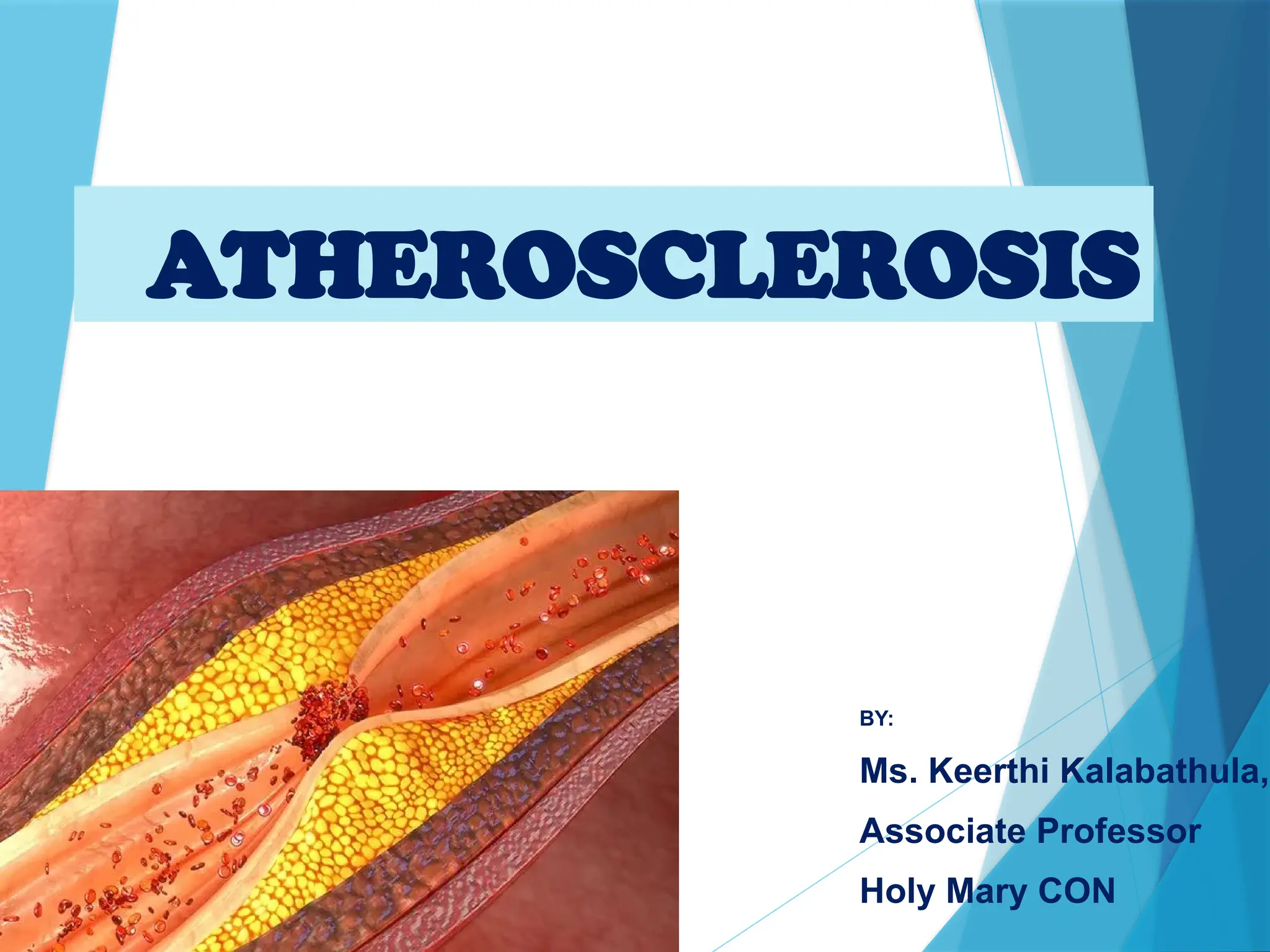
ATHEROSCLEROSIS
BY:
Ms. Keerthi Kalabathula,
Associate Professor
Holy Mary CON
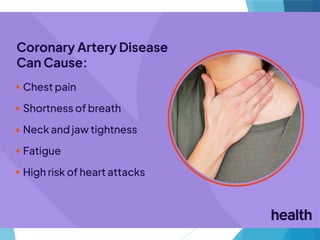
CORONARY ARTERY DISEASE
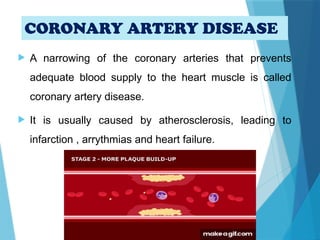
 A narrowing of the coronary arteries that prevents
adequate blood supply to the heart muscle is called
coronary artery disease.
 It is usually caused by atherosclerosis, leading to
infarction , arrythmias and heart failure.
CAD IS ALSO KNOWN AS…….
 Atherosclerotic heart disease
 Coronary atherosclerosis
 Coronary arteriosclerosis
 Coronary heart disease
DEFINITION
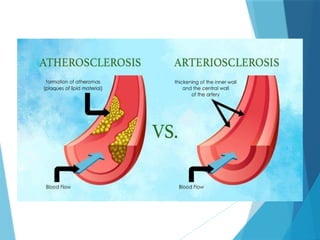
CORONARY ARTERIOSCLEROSIS CORONARY ATHEROSCLEROSIS
• Arteriosclerosis is the most common
disease of the arteries; the term means
“hardening of the arteries”.
• Atherosclerosis is a different
process, affecting the intima of the
large and medium sized arteries.
• It is the diffuse process whereby the
muscle fibers and the endothelial lining of
the walls of small arteries and arterioles
become thickened
• These changes consist of
accumulation of lipids, calcium,
blood components, carbohydrates
and fibrous tissue on the intimal
layer of the artery.
• These accumulation are referred to
as atheroma's or plaques.
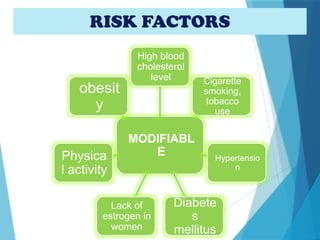
RISK FACTORS
MODIFIABL
E
High blood
cholesterol
level Cigarette
smoking,
tobacco
use
Hypertensio
n
Diabete
s
mellitus
Lack of
estrogen in
women
Physica
l activity
obesit
y
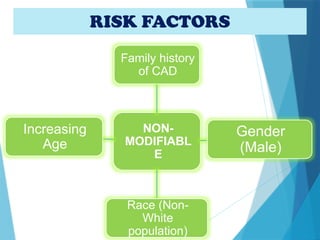
RISK FACTORS
NON-
MODIFIABL
E
Family history
of CAD
Gender
(Male)
Race (Non-
White
population)
Increasing
Age
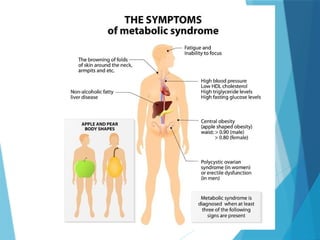
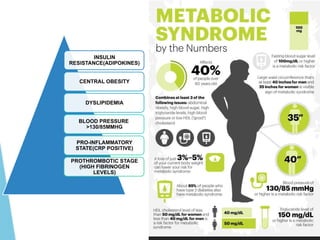
INSULIN
RESISTANCE(ADIPOKINES)
CENTRAL OBESITY
DYSLIPIDEMIA
BLOOD PRESSURE
>130/85MMHG
PRO-INFLAMMATORY
STATE(CRP POSITIVE)
PROTHROMBOTIC STAGE
(HIGH FIBRINOGEN
LEVELS)
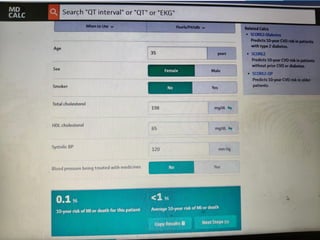
FRAMINGHAM RISK SCORE
CALCULATOR
 The Framingham Risk Score (FRS) estimates a
person's 10-year risk of developing cardiovascular
disease (specifically "hard" coronary heart disease)
based on age, sex, cholesterol, blood pressure, and
smoking status.
 A score <10% indicates low risk, 10–19% is moderate,
and ≥20% indicates high risk.
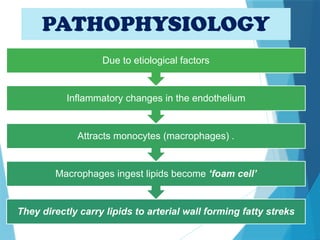
PATHOPHYSIOLOGY
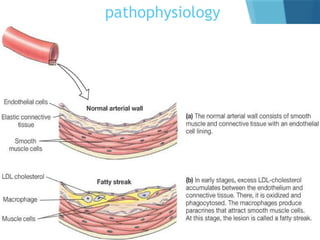
They directly carry lipids to arterial wall forming fatty streks
Macrophages ingest lipids become ‘foam cell’
Attracts monocytes (macrophages) .
Inflammatory changes in the endothelium
Due to etiological factors
PATHOPHYSIOLOGY
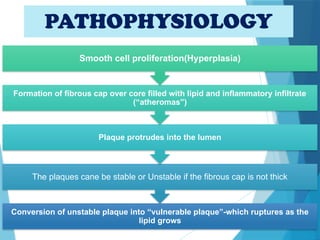
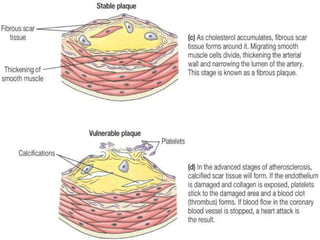
Conversion of unstable plaque into “vulnerable plaque”-which ruptures as the
lipid grows
The plaques cane be stable or Unstable if the fibrous cap is not thick
Plaque protrudes into the lumen
Formation of fibrous cap over core filled with lipid and inflammatory infiltrate
(“atheromas”)
Smooth cell proliferation(Hyperplasia)
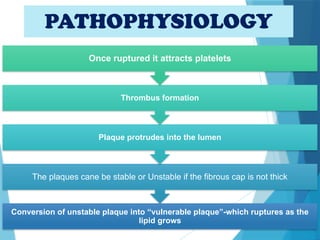
PATHOPHYSIOLOGY
Conversion of unstable plaque into “vulnerable plaque”-which ruptures as the
lipid grows
The plaques cane be stable or Unstable if the fibrous cap is not thick
Plaque protrudes into the lumen
Thrombus formation
Once ruptured it attracts platelets
pathophysiology
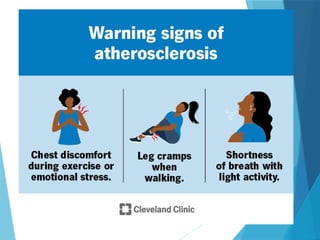
CLINICAL MANIFESTATIONS
 Depends in location ,degree of narrowing of the arterial lumen, thrombus
formation and obstruction of blood flow to the myocardium.
 Angina Pectoris ( due to myocardial ischemia)
 Repeated episodes of ischemia leads to myocardial damage
 Low cardiac output
 Heart failure
 Sudden cardiac death
 Elevated cardiac enzymes
CLINICAL MANIFESTATIONS
 MI
 Diaphoresis
 Palpitation
 Arrythmias
 Difficulty in speaking
DIAGNOSTIC TESTS
History collection
Physical examination
Cardiac enzymes
Electrocardiograms
Echocardiograms
Stress Tests
Nuclear Imaging
Angiography
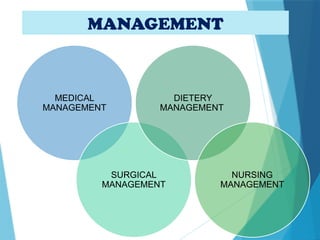
MANAGEMENT
MEDICAL
MANAGEMENT
SURGICAL
MANAGEMENT
DIETERY
MANAGEMENT
NURSING
MANAGEMENT
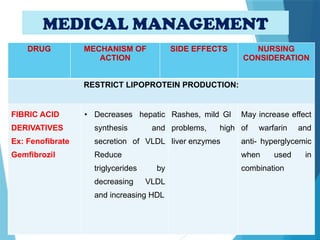
MEDICAL MANAGEMENT
DRUG MECHANISM OF
ACTION
SIDE EFFECTS NURSING
CONSIDERATION
RESTRICT LIPOPROTEIN PRODUCTION:
FIBRIC ACID
DERIVATIVES
Ex: Fenofibrate
Gemfibrozil
• Decreases hepatic
synthesis and
secretion of VLDL
Reduce
triglycerides by
decreasing VLDL
and increasing HDL
Rashes, mild Gl
problems, high
liver enzymes
May increase effect
of warfarin and
anti- hyperglycemic
when used in
combination
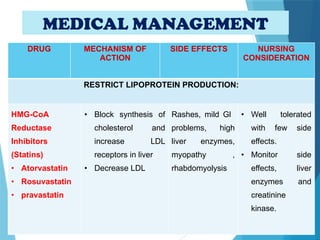
MEDICAL MANAGEMENT
DRUG MECHANISM OF
ACTION
SIDE EFFECTS NURSING
CONSIDERATION
RESTRICT LIPOPROTEIN PRODUCTION:
HMG-CoA
Reductase
Inhibitors
(Statins)
• Atorvastatin
• Rosuvastatin
• pravastatin
• Block synthesis of
cholesterol and
increase LDL
receptors in liver
• Decrease LDL
Rashes, mild Gl
problems, high
liver enzymes,
myopathy ,
rhabdomyolysis
• Well tolerated
with few side
effects.
• Monitor side
effects, liver
enzymes and
creatinine
kinase.
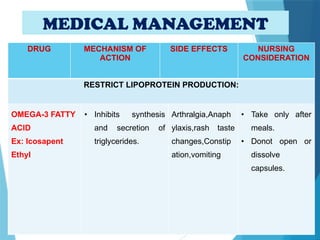
MEDICAL MANAGEMENT
DRUG MECHANISM OF
ACTION
SIDE EFFECTS NURSING
CONSIDERATION
RESTRICT LIPOPROTEIN PRODUCTION:
OMEGA-3 FATTY
ACID
Ex: Icosapent
Ethyl
• Inhibits synthesis
and secretion of
triglycerides.
Arthralgia,Anaph
ylaxis,rash taste
changes,Constip
ation,vomiting
• Take only after
meals.
• Donot open or
dissolve
capsules.
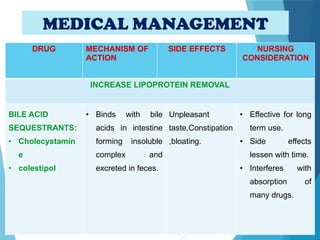
MEDICAL MANAGEMENT
DRUG MECHANISM OF
ACTION
SIDE EFFECTS NURSING
CONSIDERATION
INCREASE LIPOPROTEIN REMOVAL
BILE ACID
SEQUESTRANTS:
• Cholecystamin
e
• colestipol
• Binds with bile
acids in intestine
forming insoluble
complex and
excreted in feces.
Unpleasant
taste,Constipation
,bloating.
• Effective for long
term use.
• Side effects
lessen with time.
• Interferes with
absorption of
many drugs.
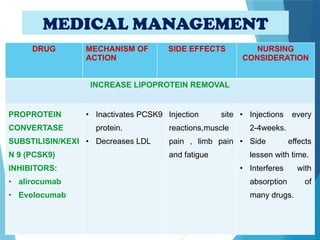
MEDICAL MANAGEMENT
DRUG MECHANISM OF
ACTION
SIDE EFFECTS NURSING
CONSIDERATION
INCREASE LIPOPROTEIN REMOVAL
PROPROTEIN
CONVERTASE
SUBSTILISIN/KEXI
N 9 (PCSK9)
INHIBITORS:
• alirocumab
• Evolocumab
• Inactivates PCSK9
protein.
• Decreases LDL
Injection site
reactions,muscle
pain , limb pain
and fatigue
• Injections every
2-4weeks.
• Side effects
lessen with time.
• Interferes with
absorption of
many drugs.
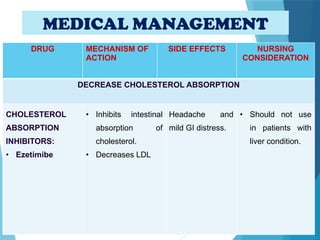
MEDICAL MANAGEMENT
DRUG MECHANISM OF
ACTION
SIDE EFFECTS NURSING
CONSIDERATION
DECREASE CHOLESTEROL ABSORPTION
CHOLESTEROL
ABSORPTION
INHIBITORS:
• Ezetimibe
• Inhibits intestinal
absorption of
cholesterol.
• Decreases LDL
Headache and
mild GI distress.
• Should not use
in patients with
liver condition.
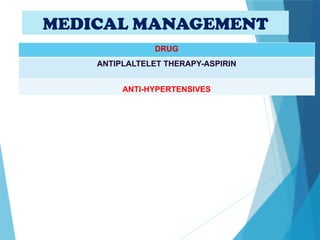
MEDICAL MANAGEMENT
DRUG
ANTIPLALTELET THERAPY-ASPIRIN
ANTI-HYPERTENSIVES
DIETERY MANAGEMENT
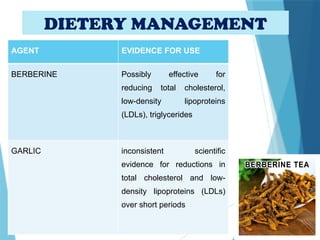
AGENT EVIDENCE FOR USE
BERBERINE Possibly effective for
reducing total cholesterol,
low-density lipoproteins
(LDLs), triglycerides
GARLIC inconsistent scientific
evidence for reductions in
total cholesterol and low-
density lipoproteins (LDLs)
over short periods
DIETERY MANAGEMENT
AGENT EVIDENCE FOR USE
FLAX SEED Some evidence for reducing risk of heart disease,
diabetes, and stroke.
GREEN TEA possibly effective for reducing total cholesterol
OMEGA-3 FATTY
ACIDS
conflicting evidence for reduction of triglyceride levels
Psyllium evidence possibly effective for modest reduction in total
cholesterol and LDLs
Plant sterols Likely effective for reduction of total cholesterol
Red yeast rice Likely effective for reduction of total cholesterol, LDLs, and
triglycerides. Red yeast rice contains a chemical similar to
statins.
Soy Strong scientific evidence for moderate reduction in total
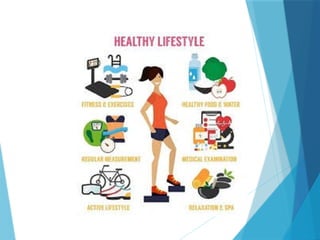
LIFESTYLE MODIFICATIONS
QUIT SMOKING
EXCERSICE MOSTDAYS OF THE WEEK
EAT HEALTHY
DRINK MORE WATER
MANAGE STRESS
MANAGE HIGH OIL AND FAT DIET
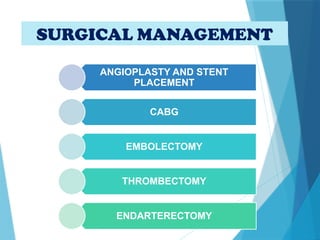
SURGICAL MANAGEMENT
ANGIOPLASTY AND STENT
PLACEMENT
CABG
EMBOLECTOMY
THROMBECTOMY
ENDARTERECTOMY
 Angioplasty and stent placement.
 In this procedure, the doctor inserts a long, thin tube
(catheter) into the blocked or narrowed part of your artery.
 A second catheter with a deflated balloon on its tip is then passed
through the catheter to the narrowed area.
 The balloon is then inflated, compressing the deposits against the
artery walls.
 A mesh tube (stent) is usually left in the artery to help keep the
artery open.
SURGICAL MANAGEMENT
Coronary Artery Bypass Surgery. (CABG)
 The doctor may create a graft bypass using a vessel from
another part of the body or a tube made of synthetic
fabric.
 This allows blood to flow around the blocked or narrowed
artery.
SURGICAL MANAGEMENT
 Embolectomy:
It is the removal of emboli or clot from the artery.
 Thrombectomy:
It is the removal of thrombus from the artery.
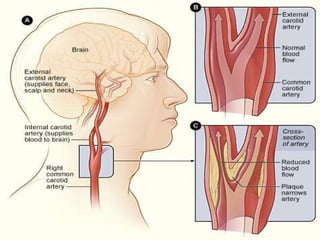
 Endarterectomy.
In some cases, fatty deposits must be surgically removed
from the walls of a narrowed artery. When the procedure is done on
arteries in the neck (the carotid arteries), it's called a carotid
endarterectomy.
SURGICAL MANAGEMENT
Nursing management
 Assess the patient for pain
 Monitor vital signs of patient
 Nurses need to assess patient’s learning needs.
 One way of motivating patients is to modify their
behavior is to help them understand the nature of
atherosclerosis, its prognosis and ways to control
disease progression.
 Nurses need to explain the risk factors related to
atherosclerosis and focus on life style changes.
 Nurses should educate patients about the effect of
smoking on the arterial system.
 Encourage adherence of cholesterol lowering
medications and other medications.
 Recommend follow up of patients on statins to monitor
required lowering cholesterol.
 Accompany any prescription of medication with dietary
control.
ATHEROSCLEROSIS/CAD-III SEMESTER-B.SC NURSING

ATHEROSCLEROSIS/CAD-III SEMESTER-B.SC NURSING

  • 1.
  • 2.
    CORONARY ARTERY DISEASE A narrowing of the coronary arteries that prevents adequate blood supply to the heart muscle is called coronary artery disease.  It is usually caused by atherosclerosis, leading to infarction , arrythmias and heart failure.
  • 3.
    CAD IS ALSOKNOWN AS…….  Atherosclerotic heart disease  Coronary atherosclerosis  Coronary arteriosclerosis  Coronary heart disease
  • 4.
    DEFINITION CORONARY ARTERIOSCLEROSIS CORONARYATHEROSCLEROSIS • Arteriosclerosis is the most common disease of the arteries; the term means “hardening of the arteries”. • Atherosclerosis is a different process, affecting the intima of the large and medium sized arteries. • It is the diffuse process whereby the muscle fibers and the endothelial lining of the walls of small arteries and arterioles become thickened • These changes consist of accumulation of lipids, calcium, blood components, carbohydrates and fibrous tissue on the intimal layer of the artery. • These accumulation are referred to as atheroma's or plaques.
  • 6.
    RISK FACTORS MODIFIABL E High blood cholesterol levelCigarette smoking, tobacco use Hypertensio n Diabete s mellitus Lack of estrogen in women Physica l activity obesit y
  • 7.
    RISK FACTORS NON- MODIFIABL E Family history ofCAD Gender (Male) Race (Non- White population) Increasing Age
  • 9.
  • 10.
    FRAMINGHAM RISK SCORE CALCULATOR The Framingham Risk Score (FRS) estimates a person's 10-year risk of developing cardiovascular disease (specifically "hard" coronary heart disease) based on age, sex, cholesterol, blood pressure, and smoking status.  A score <10% indicates low risk, 10–19% is moderate, and ≥20% indicates high risk.
  • 12.
    PATHOPHYSIOLOGY They directly carrylipids to arterial wall forming fatty streks Macrophages ingest lipids become ‘foam cell’ Attracts monocytes (macrophages) . Inflammatory changes in the endothelium Due to etiological factors
  • 13.
    PATHOPHYSIOLOGY Conversion of unstableplaque into “vulnerable plaque”-which ruptures as the lipid grows The plaques cane be stable or Unstable if the fibrous cap is not thick Plaque protrudes into the lumen Formation of fibrous cap over core filled with lipid and inflammatory infiltrate (“atheromas”) Smooth cell proliferation(Hyperplasia)
  • 14.
    PATHOPHYSIOLOGY Conversion of unstableplaque into “vulnerable plaque”-which ruptures as the lipid grows The plaques cane be stable or Unstable if the fibrous cap is not thick Plaque protrudes into the lumen Thrombus formation Once ruptured it attracts platelets
  • 15.
  • 17.
    CLINICAL MANIFESTATIONS  Dependsin location ,degree of narrowing of the arterial lumen, thrombus formation and obstruction of blood flow to the myocardium.  Angina Pectoris ( due to myocardial ischemia)  Repeated episodes of ischemia leads to myocardial damage  Low cardiac output  Heart failure  Sudden cardiac death  Elevated cardiac enzymes
  • 18.
    CLINICAL MANIFESTATIONS  MI Diaphoresis  Palpitation  Arrythmias  Difficulty in speaking
  • 21.
    DIAGNOSTIC TESTS History collection Physicalexamination Cardiac enzymes Electrocardiograms Echocardiograms Stress Tests Nuclear Imaging Angiography
  • 22.
  • 23.
    MEDICAL MANAGEMENT DRUG MECHANISMOF ACTION SIDE EFFECTS NURSING CONSIDERATION RESTRICT LIPOPROTEIN PRODUCTION: FIBRIC ACID DERIVATIVES Ex: Fenofibrate Gemfibrozil • Decreases hepatic synthesis and secretion of VLDL Reduce triglycerides by decreasing VLDL and increasing HDL Rashes, mild Gl problems, high liver enzymes May increase effect of warfarin and anti- hyperglycemic when used in combination
  • 24.
    MEDICAL MANAGEMENT DRUG MECHANISMOF ACTION SIDE EFFECTS NURSING CONSIDERATION RESTRICT LIPOPROTEIN PRODUCTION: HMG-CoA Reductase Inhibitors (Statins) • Atorvastatin • Rosuvastatin • pravastatin • Block synthesis of cholesterol and increase LDL receptors in liver • Decrease LDL Rashes, mild Gl problems, high liver enzymes, myopathy , rhabdomyolysis • Well tolerated with few side effects. • Monitor side effects, liver enzymes and creatinine kinase.
  • 25.
    MEDICAL MANAGEMENT DRUG MECHANISMOF ACTION SIDE EFFECTS NURSING CONSIDERATION RESTRICT LIPOPROTEIN PRODUCTION: OMEGA-3 FATTY ACID Ex: Icosapent Ethyl • Inhibits synthesis and secretion of triglycerides. Arthralgia,Anaph ylaxis,rash taste changes,Constip ation,vomiting • Take only after meals. • Donot open or dissolve capsules.
  • 26.
    MEDICAL MANAGEMENT DRUG MECHANISMOF ACTION SIDE EFFECTS NURSING CONSIDERATION INCREASE LIPOPROTEIN REMOVAL BILE ACID SEQUESTRANTS: • Cholecystamin e • colestipol • Binds with bile acids in intestine forming insoluble complex and excreted in feces. Unpleasant taste,Constipation ,bloating. • Effective for long term use. • Side effects lessen with time. • Interferes with absorption of many drugs.
  • 27.
    MEDICAL MANAGEMENT DRUG MECHANISMOF ACTION SIDE EFFECTS NURSING CONSIDERATION INCREASE LIPOPROTEIN REMOVAL PROPROTEIN CONVERTASE SUBSTILISIN/KEXI N 9 (PCSK9) INHIBITORS: • alirocumab • Evolocumab • Inactivates PCSK9 protein. • Decreases LDL Injection site reactions,muscle pain , limb pain and fatigue • Injections every 2-4weeks. • Side effects lessen with time. • Interferes with absorption of many drugs.
  • 28.
    MEDICAL MANAGEMENT DRUG MECHANISMOF ACTION SIDE EFFECTS NURSING CONSIDERATION DECREASE CHOLESTEROL ABSORPTION CHOLESTEROL ABSORPTION INHIBITORS: • Ezetimibe • Inhibits intestinal absorption of cholesterol. • Decreases LDL Headache and mild GI distress. • Should not use in patients with liver condition.
  • 29.
  • 30.
    DIETERY MANAGEMENT AGENT EVIDENCEFOR USE BERBERINE Possibly effective for reducing total cholesterol, low-density lipoproteins (LDLs), triglycerides GARLIC inconsistent scientific evidence for reductions in total cholesterol and low- density lipoproteins (LDLs) over short periods
  • 31.
    DIETERY MANAGEMENT AGENT EVIDENCEFOR USE FLAX SEED Some evidence for reducing risk of heart disease, diabetes, and stroke. GREEN TEA possibly effective for reducing total cholesterol OMEGA-3 FATTY ACIDS conflicting evidence for reduction of triglyceride levels Psyllium evidence possibly effective for modest reduction in total cholesterol and LDLs Plant sterols Likely effective for reduction of total cholesterol Red yeast rice Likely effective for reduction of total cholesterol, LDLs, and triglycerides. Red yeast rice contains a chemical similar to statins. Soy Strong scientific evidence for moderate reduction in total
  • 33.
    LIFESTYLE MODIFICATIONS QUIT SMOKING EXCERSICEMOSTDAYS OF THE WEEK EAT HEALTHY DRINK MORE WATER MANAGE STRESS MANAGE HIGH OIL AND FAT DIET
  • 34.
    SURGICAL MANAGEMENT ANGIOPLASTY ANDSTENT PLACEMENT CABG EMBOLECTOMY THROMBECTOMY ENDARTERECTOMY
  • 35.
     Angioplasty andstent placement.  In this procedure, the doctor inserts a long, thin tube (catheter) into the blocked or narrowed part of your artery.  A second catheter with a deflated balloon on its tip is then passed through the catheter to the narrowed area.  The balloon is then inflated, compressing the deposits against the artery walls.  A mesh tube (stent) is usually left in the artery to help keep the artery open. SURGICAL MANAGEMENT
  • 36.
    Coronary Artery BypassSurgery. (CABG)  The doctor may create a graft bypass using a vessel from another part of the body or a tube made of synthetic fabric.  This allows blood to flow around the blocked or narrowed artery. SURGICAL MANAGEMENT
  • 37.
     Embolectomy: It isthe removal of emboli or clot from the artery.  Thrombectomy: It is the removal of thrombus from the artery.  Endarterectomy. In some cases, fatty deposits must be surgically removed from the walls of a narrowed artery. When the procedure is done on arteries in the neck (the carotid arteries), it's called a carotid endarterectomy. SURGICAL MANAGEMENT
  • 39.
    Nursing management  Assessthe patient for pain  Monitor vital signs of patient  Nurses need to assess patient’s learning needs.  One way of motivating patients is to modify their behavior is to help them understand the nature of atherosclerosis, its prognosis and ways to control disease progression.
  • 40.
     Nurses needto explain the risk factors related to atherosclerosis and focus on life style changes.  Nurses should educate patients about the effect of smoking on the arterial system.  Encourage adherence of cholesterol lowering medications and other medications.
  • 41.
     Recommend followup of patients on statins to monitor required lowering cholesterol.  Accompany any prescription of medication with dietary control.