
Asthma phenotypes
Dr. Aditya Jindal
Interventional Pulmonologist & Intensivist
Jindal Clinics, SCO 21, Sec 20D, Chandigarh
DM Pulmonary and Critical Care Medicine (PGI Chandigarh), FCCP
Introduction
• Asthma is a heterogenous disease
• Asthma phenotypes – recognizable clusters of
demographic, clinical and/or pathophysiological
characteristics
• Associated with endotypes - specific pathobiological
mechanisms at the molecular and cellular levels which
might be associated with response to specific
treatments
Asthma
Chronic airway inflammation: History of respiratory symptoms that vary
over time and in intensity, together with variable expiratory airflow
limitation.
Burden: Current prevalence: 7% in the USA, 20%–25% in the UK,
Australia and New Zealand; >2.5% in adults and >5% in children in India
• A heterogeneous multidimensional disease
• Different phenotypes with different underlying molecular mechanisms,
• Major determinants of disease severity:
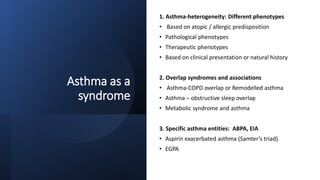
Asthma as a
syndrome
1. Asthma-heterogeneity: Different phenotypes
• Based on atopic / allergic predisposition
• Pathological phenotypes
• Therapeutic phenotypes
• Based on clinical presentation or natural history
2. Overlap syndromes and associations
• Asthma-COPD overlap or Remodelled asthma
• Asthma – obstructive sleep overlap
• Metabolic syndrome and asthma
3. Specific asthma entities: ABPA, EIA
• Aspirin exacerbated asthma (Samter’s triad)
• EGPA
Phenotypes
• Asthma phenotypes – recognizable clusters of demographic, clinical
and/or pathophysiological characteristics
• Also defined as an observable disease characteristic that is the
result of gene–environment interaction
• First proposed in mid 20th century by Rackemann
• Rackemann, F.M. A working classification of asthma. Am. J.
Med. 1947
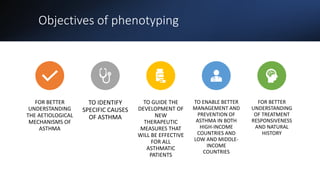
Objectives of phenotyping
FOR BETTER
UNDERSTANDING
THE AETIOLOGICAL
MECHANISMS OF
ASTHMA
TO IDENTIFY
SPECIFIC CAUSES
OF ASTHMA
TO GUIDE THE
DEVELOPMENT OF
NEW
THERAPEUTIC
MEASURES THAT
WILL BE EFFECTIVE
FOR ALL
ASTHMATIC
PATIENTS
TO ENABLE BETTER
MANAGEMENT AND
PREVENTION OF
ASTHMA IN BOTH
HIGH-INCOME
COUNTRIES AND
LOW AND MIDDLE-
INCOME
COUNTRIES
FOR BETTER
UNDERSTANDING
OF TREATMENT
RESPONSIVENESS
AND NATURAL
HISTORY
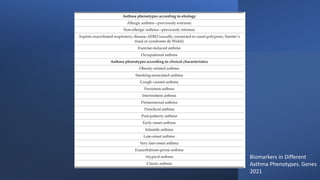
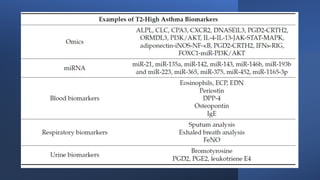
Biomarkers in Different
Asthma Phenotypes. Genes
2021
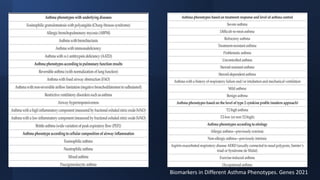
Biomarkers in Different Asthma Phenotypes. Genes 2021
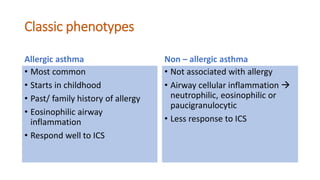
Classic phenotypes
Allergic asthma
• Most common
• Starts in childhood
• Past/ family history of allergy
• Eosinophilic airway
inflammation
• Respond well to ICS
Non – allergic asthma
• Not associated with allergy
• Airway cellular inflammation 
neutrophilic, eosinophilic or
paucigranulocytic
• Less response to ICS
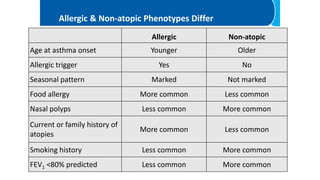
Allergic Non-atopic
Age at asthma onset Younger Older
Allergic trigger Yes No
Seasonal pattern Marked Not marked
Food allergy More common Less common
Nasal polyps Less common More common
Current or family history of
atopies
More common Less common
Smoking history Less common More common
FEV1 <80% predicted Less common More common
Allergic & Non-atopic Phenotypes Differ
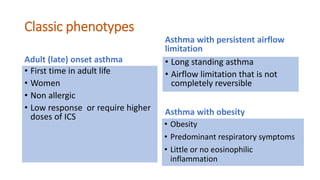
Classic phenotypes
Adult (late) onset asthma
• First time in adult life
• Women
• Non allergic
• Low response or require higher
doses of ICS
Asthma with persistent airflow
limitation
• Long standing asthma
• Airflow limitation that is not
completely reversible
Asthma with obesity
• Obesity
• Predominant respiratory symptoms
• Little or no eosinophilic
inflammation
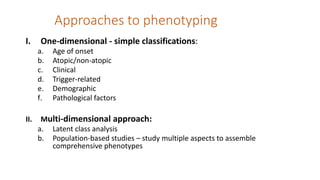
Approaches to phenotyping
I. One-dimensional - simple classifications:
a. Age of onset
b. Atopic/non-atopic
c. Clinical
d. Trigger-related
e. Demographic
f. Pathological factors
II. Multi-dimensional approach:
a. Latent class analysis
b. Population-based studies – study multiple aspects to assemble
comprehensive phenotypes
Multi-dimensional approach
• Focused on combinations of clinical characteristics
• Link biology to phenotype, often through a statistically based process
– cluster analysis
• Ongoing studies to molecularly understand these phenotypes should
enhance our ability to more targeted and personalized approaches to
asthma therapy:
Clinically characterized cohorts of asthma
Large-scale
Molecularly and genetically focused
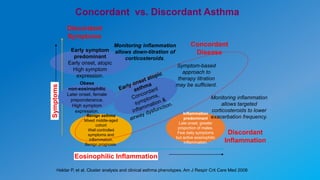
Approach of Cluster analysis
• Asthma phenotypes identified using cluster analysis – group of patients
behaving similarly
• Plotted according to their relative expression of symptoms and
inflammation - the axes represent symptoms and inflammation.
Concordant disease - when symptoms and
inflammation increase in parallel.
Discordant disease- a lot of inflammation but few
symptoms, requiring little bronchodilation; some
patients more symptoms but little inflammation –
require bronchodilation but low ICS doses.
So one size does not fit all!
Early symptom
predominant
Early onset, atopic
High symptom
expression.
Concordant vs. Discordant Asthma
Haldar P, et al. Cluster analysis and clinical asthma phenotypes. Am J Respir Crit Care Med 2008
Discordant
Symptoms
Monitoring inflammation
allows down-titration of
corticosteroids.
Symptoms
Eosinophilic Inflammation
Benign asthma
Mixed middle-aged
cohort
Well controlled
symptoms and
inflammation.
Benign prognosis.
Inflammation
predominant
Late onset, greater
proportion of males.
Few daily symptoms
but active eosinophilic
inflammation.
Monitoring inflammation
allows targeted
corticosteroids to lower
exacerbation frequency.
Concordant
Disease
Discordant
Inflammation
Symptom-based
approach to
therapy titration
may be sufficient.
Obese
non-eosinophilic
Later onset, female
preponderance.
High symptom
expression.
Phenotype to endotype
• Overlapping phenotypes
• Development of endotypes
⁻ Specific pathobiological mechanisms at the molecular and cellular
levels which might be associated with response to specific treatments
• Personalized, individually tailored treatment
• Adjusted to the understanding of the underlying phenotypic
mechanisms
• Yields much better results
From Phenotypes to Personalized
Medicine. J. Pers. Med. 2022
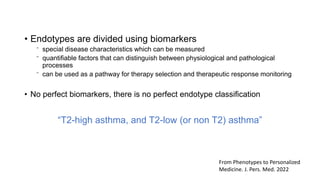
• Endotypes are divided using biomarkers
⁻ special disease characteristics which can be measured
⁻ quantifiable factors that can distinguish between physiological and pathological
processes
⁻ can be used as a pathway for therapy selection and therapeutic response monitoring
• No perfect biomarkers, there is no perfect endotype classification
“T2-high asthma, and T2-low (or non T2) asthma”
From Phenotypes to Personalized
Medicine. J. Pers. Med. 2022
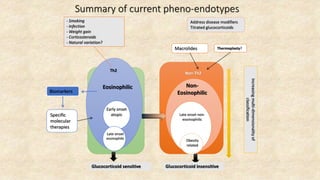
Eosinophilic Non-
Eosinophilic
Th2
Non-Th2
Early onset
atopic
Late onset
eosinophilic
Late onset non-
eosinophilic
Obesity
related
- Smoking
- Infection
- Weight gain
- Corticosteroids
- Natural variation?
Increasing
multi-dimensionality
of
classification
Glucocorticoid sensitive Glucocorticoid insensitive
Address disease modifiers
Titrated glucocorticoids
Macrolides Thermoplasty?
Biomarkers
Specific
molecular
therapies
Summary of current pheno-endotypes
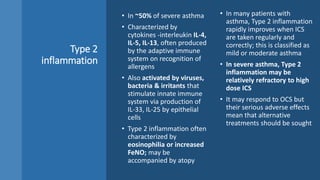
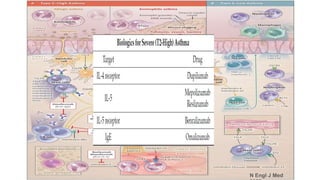
Type 2
inflammation
• In ~50% of severe asthma
• Characterized by
cytokines -interleukin IL-4,
IL-5, IL-13, often produced
by the adaptive immune
system on recognition of
allergens
• Also activated by viruses,
bacteria & irritants that
stimulate innate immune
system via production of
IL-33, IL-25 by epithelial
cells
• Type 2 inflammation often
characterized by
eosinophilia or increased
FeNO; may be
accompanied by atopy
• In many patients with
asthma, Type 2 inflammation
rapidly improves when ICS
are taken regularly and
correctly; this is classified as
mild or moderate asthma
• In severe asthma, Type 2
inflammation may be
relatively refractory to high
dose ICS
• It may respond to OCS but
their serious adverse effects
mean that alternative
treatments should be sought
N Engl J Med
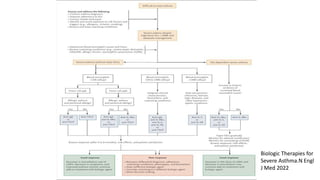
Biologic Therapies for
Severe Asthma.N Engl
J Med 2022
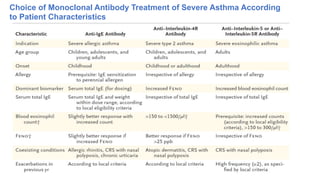
Choice of Monoclonal Antibody Treatment of Severe Asthma According
to Patient Characteristics
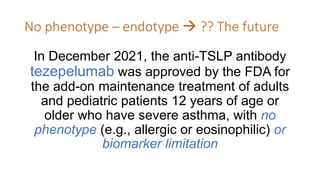
No phenotype – endotype  ?? The future
In December 2021, the anti-TSLP antibody
tezepelumab was approved by the FDA for
the add-on maintenance treatment of adults
and pediatric patients 12 years of age or
older who have severe asthma, with no
phenotype (e.g., allergic or eosinophilic) or
biomarker limitation
Conclusions
1. Asthma is a heterogenous disease with multiple
phenotypes
2. Phenotypic clusters are identified based on clinical and/
or inflammatory parameters: IgE, FeNo, peripheral blood
& sputum eosinophils
3. Phenotype based and Individualized treatment is the
upcoming norm, especially in severe asthma
4. Phenotypes are being complemented and in some cases
being replaced by endotypes
Asthma phenotypes.pptx

Asthma phenotypes.pptx

  • 1.
    Asthma phenotypes Dr. AdityaJindal Interventional Pulmonologist & Intensivist Jindal Clinics, SCO 21, Sec 20D, Chandigarh DM Pulmonary and Critical Care Medicine (PGI Chandigarh), FCCP
  • 2.
    Introduction • Asthma isa heterogenous disease • Asthma phenotypes – recognizable clusters of demographic, clinical and/or pathophysiological characteristics • Associated with endotypes - specific pathobiological mechanisms at the molecular and cellular levels which might be associated with response to specific treatments
  • 3.
    Asthma Chronic airway inflammation:History of respiratory symptoms that vary over time and in intensity, together with variable expiratory airflow limitation. Burden: Current prevalence: 7% in the USA, 20%–25% in the UK, Australia and New Zealand; >2.5% in adults and >5% in children in India • A heterogeneous multidimensional disease • Different phenotypes with different underlying molecular mechanisms, • Major determinants of disease severity:
  • 4.
    Asthma as a syndrome 1.Asthma-heterogeneity: Different phenotypes • Based on atopic / allergic predisposition • Pathological phenotypes • Therapeutic phenotypes • Based on clinical presentation or natural history 2. Overlap syndromes and associations • Asthma-COPD overlap or Remodelled asthma • Asthma – obstructive sleep overlap • Metabolic syndrome and asthma 3. Specific asthma entities: ABPA, EIA • Aspirin exacerbated asthma (Samter’s triad) • EGPA
  • 5.
    Phenotypes • Asthma phenotypes– recognizable clusters of demographic, clinical and/or pathophysiological characteristics • Also defined as an observable disease characteristic that is the result of gene–environment interaction • First proposed in mid 20th century by Rackemann • Rackemann, F.M. A working classification of asthma. Am. J. Med. 1947
  • 6.
    Objectives of phenotyping FORBETTER UNDERSTANDING THE AETIOLOGICAL MECHANISMS OF ASTHMA TO IDENTIFY SPECIFIC CAUSES OF ASTHMA TO GUIDE THE DEVELOPMENT OF NEW THERAPEUTIC MEASURES THAT WILL BE EFFECTIVE FOR ALL ASTHMATIC PATIENTS TO ENABLE BETTER MANAGEMENT AND PREVENTION OF ASTHMA IN BOTH HIGH-INCOME COUNTRIES AND LOW AND MIDDLE- INCOME COUNTRIES FOR BETTER UNDERSTANDING OF TREATMENT RESPONSIVENESS AND NATURAL HISTORY
  • 7.
    Biomarkers in Different AsthmaPhenotypes. Genes 2021
  • 8.
    Biomarkers in DifferentAsthma Phenotypes. Genes 2021
  • 9.
    Classic phenotypes Allergic asthma •Most common • Starts in childhood • Past/ family history of allergy • Eosinophilic airway inflammation • Respond well to ICS Non – allergic asthma • Not associated with allergy • Airway cellular inflammation  neutrophilic, eosinophilic or paucigranulocytic • Less response to ICS
  • 10.
    Allergic Non-atopic Age atasthma onset Younger Older Allergic trigger Yes No Seasonal pattern Marked Not marked Food allergy More common Less common Nasal polyps Less common More common Current or family history of atopies More common Less common Smoking history Less common More common FEV1 <80% predicted Less common More common Allergic & Non-atopic Phenotypes Differ
  • 11.
    Classic phenotypes Adult (late)onset asthma • First time in adult life • Women • Non allergic • Low response or require higher doses of ICS Asthma with persistent airflow limitation • Long standing asthma • Airflow limitation that is not completely reversible Asthma with obesity • Obesity • Predominant respiratory symptoms • Little or no eosinophilic inflammation
  • 12.
    Approaches to phenotyping I.One-dimensional - simple classifications: a. Age of onset b. Atopic/non-atopic c. Clinical d. Trigger-related e. Demographic f. Pathological factors II. Multi-dimensional approach: a. Latent class analysis b. Population-based studies – study multiple aspects to assemble comprehensive phenotypes
  • 13.
    Multi-dimensional approach • Focusedon combinations of clinical characteristics • Link biology to phenotype, often through a statistically based process – cluster analysis • Ongoing studies to molecularly understand these phenotypes should enhance our ability to more targeted and personalized approaches to asthma therapy: Clinically characterized cohorts of asthma Large-scale Molecularly and genetically focused
  • 14.
    Approach of Clusteranalysis • Asthma phenotypes identified using cluster analysis – group of patients behaving similarly • Plotted according to their relative expression of symptoms and inflammation - the axes represent symptoms and inflammation. Concordant disease - when symptoms and inflammation increase in parallel. Discordant disease- a lot of inflammation but few symptoms, requiring little bronchodilation; some patients more symptoms but little inflammation – require bronchodilation but low ICS doses. So one size does not fit all!
  • 15.
    Early symptom predominant Early onset,atopic High symptom expression. Concordant vs. Discordant Asthma Haldar P, et al. Cluster analysis and clinical asthma phenotypes. Am J Respir Crit Care Med 2008 Discordant Symptoms Monitoring inflammation allows down-titration of corticosteroids. Symptoms Eosinophilic Inflammation Benign asthma Mixed middle-aged cohort Well controlled symptoms and inflammation. Benign prognosis. Inflammation predominant Late onset, greater proportion of males. Few daily symptoms but active eosinophilic inflammation. Monitoring inflammation allows targeted corticosteroids to lower exacerbation frequency. Concordant Disease Discordant Inflammation Symptom-based approach to therapy titration may be sufficient. Obese non-eosinophilic Later onset, female preponderance. High symptom expression.
  • 16.
    Phenotype to endotype •Overlapping phenotypes • Development of endotypes ⁻ Specific pathobiological mechanisms at the molecular and cellular levels which might be associated with response to specific treatments • Personalized, individually tailored treatment • Adjusted to the understanding of the underlying phenotypic mechanisms • Yields much better results From Phenotypes to Personalized Medicine. J. Pers. Med. 2022
  • 17.
    • Endotypes aredivided using biomarkers ⁻ special disease characteristics which can be measured ⁻ quantifiable factors that can distinguish between physiological and pathological processes ⁻ can be used as a pathway for therapy selection and therapeutic response monitoring • No perfect biomarkers, there is no perfect endotype classification “T2-high asthma, and T2-low (or non T2) asthma” From Phenotypes to Personalized Medicine. J. Pers. Med. 2022
  • 18.
    Eosinophilic Non- Eosinophilic Th2 Non-Th2 Early onset atopic Lateonset eosinophilic Late onset non- eosinophilic Obesity related - Smoking - Infection - Weight gain - Corticosteroids - Natural variation? Increasing multi-dimensionality of classification Glucocorticoid sensitive Glucocorticoid insensitive Address disease modifiers Titrated glucocorticoids Macrolides Thermoplasty? Biomarkers Specific molecular therapies Summary of current pheno-endotypes
  • 19.
    Type 2 inflammation • In~50% of severe asthma • Characterized by cytokines -interleukin IL-4, IL-5, IL-13, often produced by the adaptive immune system on recognition of allergens • Also activated by viruses, bacteria & irritants that stimulate innate immune system via production of IL-33, IL-25 by epithelial cells • Type 2 inflammation often characterized by eosinophilia or increased FeNO; may be accompanied by atopy • In many patients with asthma, Type 2 inflammation rapidly improves when ICS are taken regularly and correctly; this is classified as mild or moderate asthma • In severe asthma, Type 2 inflammation may be relatively refractory to high dose ICS • It may respond to OCS but their serious adverse effects mean that alternative treatments should be sought
  • 21.
  • 22.
    Biologic Therapies for SevereAsthma.N Engl J Med 2022
  • 23.
    Choice of MonoclonalAntibody Treatment of Severe Asthma According to Patient Characteristics
  • 24.
    No phenotype –endotype  ?? The future In December 2021, the anti-TSLP antibody tezepelumab was approved by the FDA for the add-on maintenance treatment of adults and pediatric patients 12 years of age or older who have severe asthma, with no phenotype (e.g., allergic or eosinophilic) or biomarker limitation
  • 25.
    Conclusions 1. Asthma isa heterogenous disease with multiple phenotypes 2. Phenotypic clusters are identified based on clinical and/ or inflammatory parameters: IgE, FeNo, peripheral blood & sputum eosinophils 3. Phenotype based and Individualized treatment is the upcoming norm, especially in severe asthma 4. Phenotypes are being complemented and in some cases being replaced by endotypes

Editor's Notes

  • #11 Allergic and non-atopic asthma show different phenotypic patterns.1–3 Patients with allergic asthma tend to develop symptoms at a younger age,1,2 and have a clear allergic trigger and usually a seasonal symptom pattern1,2 that reflects the environmental occurrence of the trigger. They are also more likely to have other allergic conditions, such as eczema,1 hay-fever2 or food allergy.3 In contrast, patients with non-atopic asthma are more likely to be male,1,2 be older at asthma onset,1,2 and to have nasal polyps or FEV1 <80% predicted.2 Smoking is more common in patients with non-atopic than allergic asthma.3 References Nieves A, Magnan A, Boniface S, et al. Phenotypes of asthma revisited upon the presence of atopy. Respir Med 2005;99:347–54. Romanet-Manent S, Charpin D, Magnan A, et al. Allergic vs nonallergic asthma: what makes the difference? Allergy 2002;57:607–13. Knudsen TB, Thomsen SF, Nolte H, et al. A population-based clinical study of allergic and non-allergic asthma. J Asthma 2009;46:91–4.
  • #16 Asthma phenotypes identified using cluster analysis plotted according to their relative expression of symptoms and inflammation. The axes represent symptoms and inflammation. The disease is concordant when symptoms and inflammation increase in parallel. However some patients have discordant disease, i.e., a lot of inflammation requiring high doses of ICS but few symptoms, requiring little bronchodilation. And some patients have a lot symptoms but with little inflammation and therefore require bronchodilation but low ICS doses. So one size does not fit all!  REFERENCE: 1. Haldar P, Pavord ID, Shaw DE, et al. Cluster analysis and clinical asthma phenotypes. Am J Respir Crit Care Med 2008; 178:218–224.