Meeting The Needs Of Diverse LearnersAssistive Technology WebQuestBy Tomeka MayoITEC 7530Fall Semester 2010
Inclusive EducationWhat is inclusion?	Inclusion is the practice of educating children with disabilities in classrooms with children without disabilities (about.com)According to the Department of Education,  some 95 percent of students with disabilities were served in regular schools and educated in regular classrooms
Legal MandatesThe Individuals with Disabilities Education Act (IDEA)Maintains the right of all children with disabilities to a free and appropriate public education in the least restrictive environment requires that public schools create an Individualized Education Program (IEP) for each student who is found to be eligible“IDEA defines a "child with a disability" as a "child... with mental retardation, hearing impairments (including deafness), speech or language impairments, visual impairments (including blindness), serious emotional disturbance..., orthopedic impairments, autism, traumatic brain injury, other health impairments, or specific learning disabilities; AND, who... [because of the condition] needs special education and related services” (Wikipedia.com, 2010).
Least Restrictive Environment (LRE)Under IDEA, a child is entitled to a placement through one's Individualized Education Planinto the least restrictive environment (LRE)“The LRE is the environment most like that of other children in which the child can succeed. This refers not only to the physical location of a child's learning, but also to how the child will be taught. The preference is that the child be included in regular education activities as much as possible” (K12academics.com)
What is an IEP?Written plan developed by the student’s parent(s) or guardian(s), the school’s special education team (may include special education teacher, regular classroom teacher, representative from the school district), and other professionals with the appropriate knowledge of the students needsDescribes the academic goals of each individual student with a disability and the methods to meet those goalsTo meet the goals of the IEP, some students may require the use of assistive technology to achieve a Free and Appropriate Public Education (FAPE) as required by the IDEA.
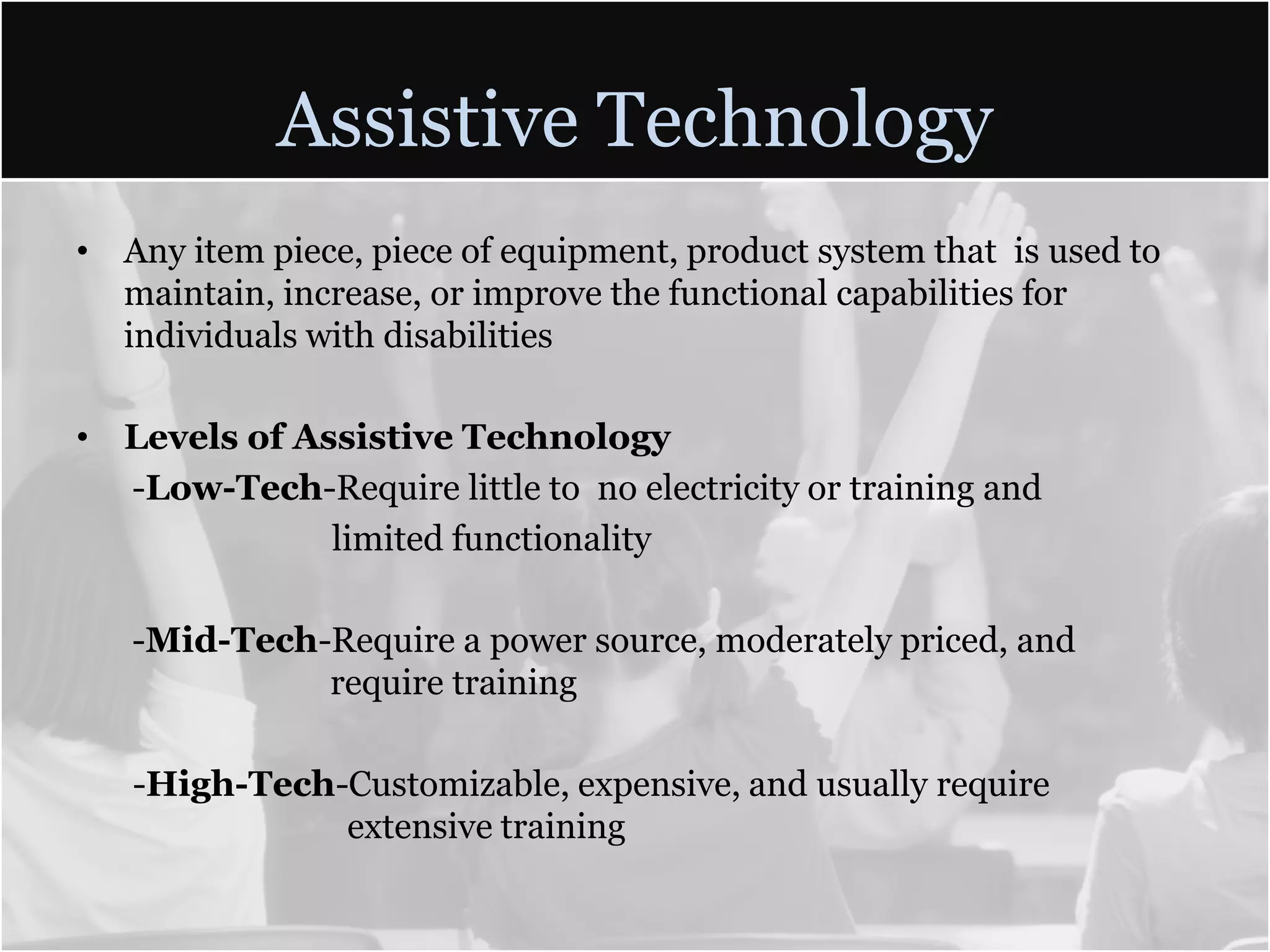
Assistive TechnologyAny item piece, piece of equipment, product system that  is used to maintain, increase, or improve the functional capabilities for individuals with disabilitiesLevels of Assistive Technology -Low-Tech-Require little to  no electricity or training and limited functionality -Mid-Tech-Require a power source, moderately priced, and 			require training-High-Tech-Customizable, expensive, and usually require  			  extensive training
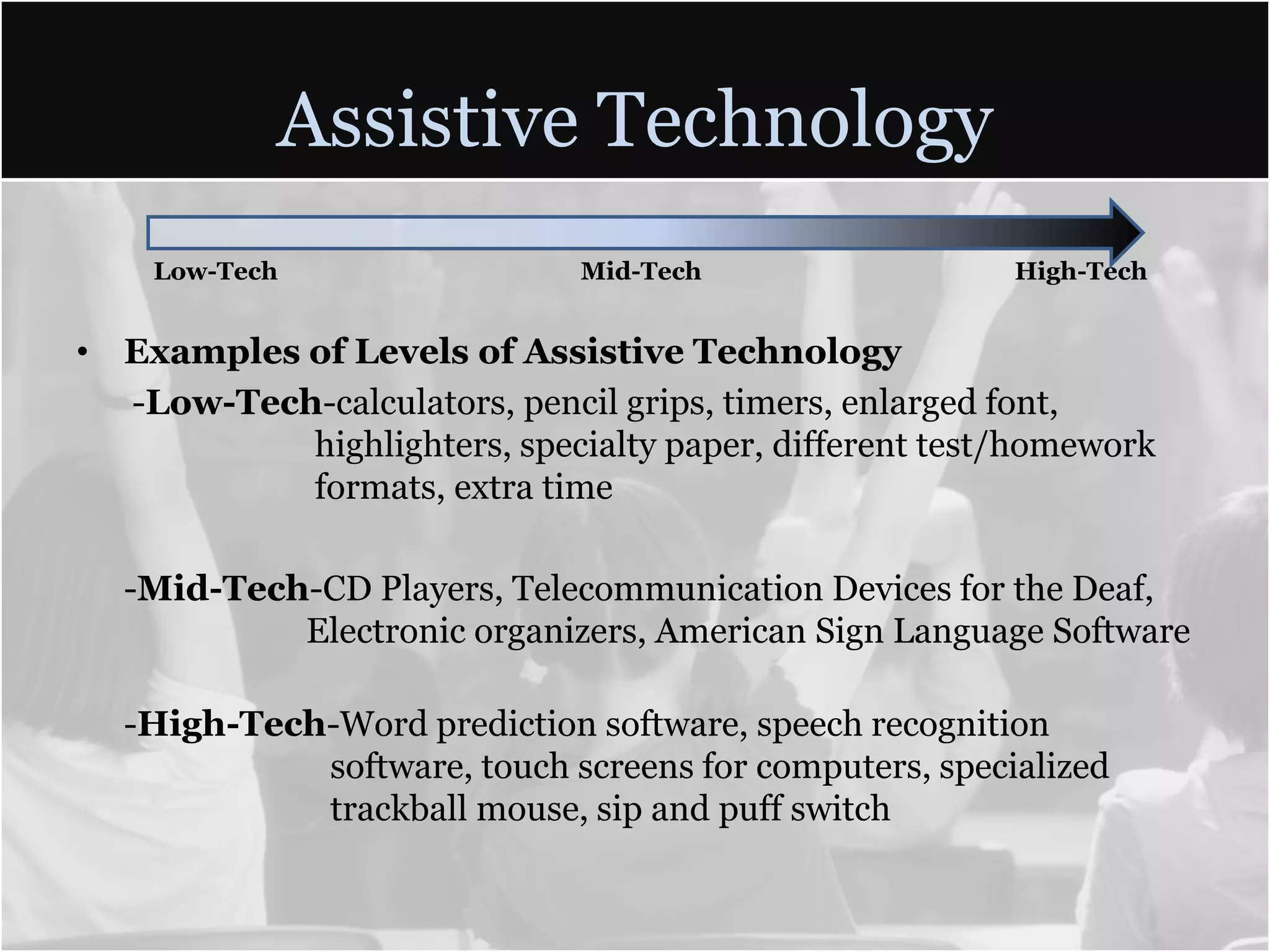
Assistive TechnologyLow-Tech    Mid-Tech   High-TechExamples of Levels of Assistive Technology -Low-Tech-calculators, pencil grips, timers, enlarged font, 	  	             highlighters, specialty paper, different test/homework  	             formats, extra time 	-Mid-Tech-CD Players, Telecommunication Devices for the Deaf, 	            Electronic organizers, American Sign Language Software	            -High-Tech-Word prediction software, speech recognition 			software, touch screens for computers, specialized 		trackball mouse, sip and puff switch
Assistive TechnologyCategories of Assistive TechnologyMobility Aids-help students move within their environmentex. Wheelchair, cane, walker, scootersSensory Tools-assist those who are sensory impaired	ex.  Hearing aids, text to speech softwareDaily Living Aids-Assist students with daily living activitiesex.  Adapted  books, time management aids, pencil holdersEnvironmental Tools-structural changes to remove physical barriers	ex.  Home automation systems, security systems
Assistive TechnologyCategories of Assistive TechnologyInstructional Aids-Tools that assist in instructional developmentex. Audiotape players,  Adapted keyboard, mice, switchesComputer Access- Hardware/Software products that assist students 			with accessing computers at school and home        ex.  Braille display/outlook devices, ergonomic computer equipmentCommunication Aids-Assist students with speech/writing difficulties to 			       communicateex.  Tactile Devices, light pointers, mouth sticks, signal systemsMotivational Tools-Promotes participation of students in recreational 			  events	ex.  Adaptive controls for games, CCTV for movies
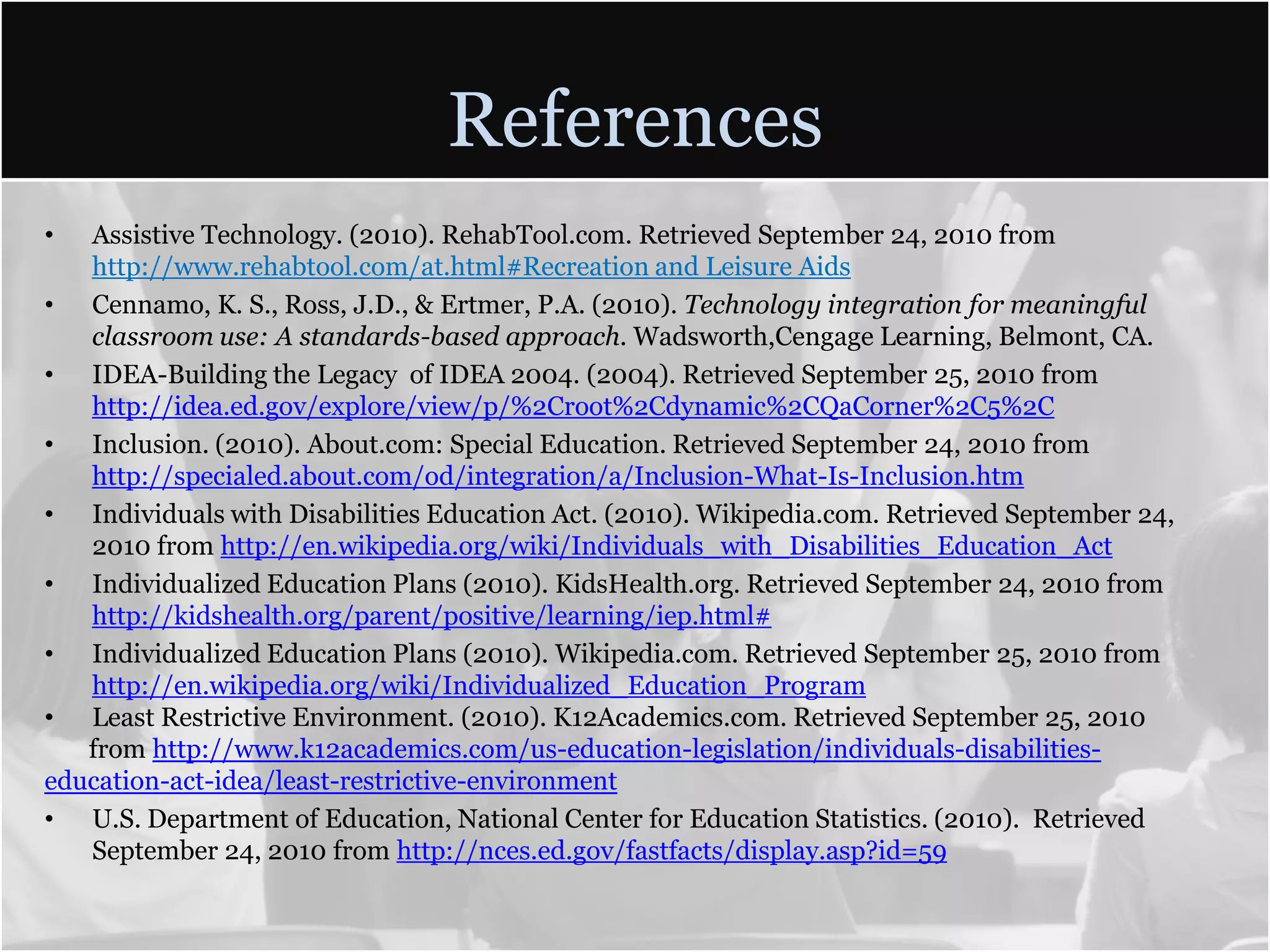
ReferencesAssistive Technology. (2010). RehabTool.com. Retrieved September 24, 2010 from http://www.rehabtool.com/at.html#Recreation and Leisure AidsCennamo, K. S., Ross, J.D., & Ertmer, P.A. (2010). Technology integration for meaningful classroom use: A standards-based approach. Wadsworth,Cengage Learning, Belmont, CA.IDEA-Building the Legacy  of IDEA 2004. (2004). Retrieved September 25, 2010 from http://idea.ed.gov/explore/view/p/%2Croot%2Cdynamic%2CQaCorner%2C5%2CInclusion. (2010). About.com: Special Education. Retrieved September 24, 2010 from http://specialed.about.com/od/integration/a/Inclusion-What-Is-Inclusion.htmIndividuals with Disabilities Education Act. (2010). Wikipedia.com. Retrieved September 24, 2010 from http://en.wikipedia.org/wiki/Individuals_with_Disabilities_Education_ActIndividualized Education Plans (2010). KidsHealth.org. Retrieved September 24, 2010 from http://kidshealth.org/parent/positive/learning/iep.html#Individualized Education Plans (2010). Wikipedia.com. Retrieved September 25, 2010 from http://en.wikipedia.org/wiki/Individualized_Education_ProgramLeast Restrictive Environment. (2010). K12Academics.com. Retrieved September 25, 2010        from http://www.k12academics.com/us-education-legislation/individuals-disabilities- education-act-idea/least-restrictive-environmentU.S. Department of Education, National Center for Education Statistics. (2010).  Retrieved September 24, 2010 from http://nces.ed.gov/fastfacts/display.asp?id=59

Assistive Technology WebQuest-TMayo

  • 1.
    Meeting The NeedsOf Diverse LearnersAssistive Technology WebQuestBy Tomeka MayoITEC 7530Fall Semester 2010
  • 2.
    Inclusive EducationWhat isinclusion? Inclusion is the practice of educating children with disabilities in classrooms with children without disabilities (about.com)According to the Department of Education, some 95 percent of students with disabilities were served in regular schools and educated in regular classrooms
  • 3.
    Legal MandatesThe Individualswith Disabilities Education Act (IDEA)Maintains the right of all children with disabilities to a free and appropriate public education in the least restrictive environment requires that public schools create an Individualized Education Program (IEP) for each student who is found to be eligible“IDEA defines a "child with a disability" as a "child... with mental retardation, hearing impairments (including deafness), speech or language impairments, visual impairments (including blindness), serious emotional disturbance..., orthopedic impairments, autism, traumatic brain injury, other health impairments, or specific learning disabilities; AND, who... [because of the condition] needs special education and related services” (Wikipedia.com, 2010).
  • 4.
    Least Restrictive Environment(LRE)Under IDEA, a child is entitled to a placement through one's Individualized Education Planinto the least restrictive environment (LRE)“The LRE is the environment most like that of other children in which the child can succeed. This refers not only to the physical location of a child's learning, but also to how the child will be taught. The preference is that the child be included in regular education activities as much as possible” (K12academics.com)
  • 5.
    What is anIEP?Written plan developed by the student’s parent(s) or guardian(s), the school’s special education team (may include special education teacher, regular classroom teacher, representative from the school district), and other professionals with the appropriate knowledge of the students needsDescribes the academic goals of each individual student with a disability and the methods to meet those goalsTo meet the goals of the IEP, some students may require the use of assistive technology to achieve a Free and Appropriate Public Education (FAPE) as required by the IDEA.
  • 6.
    Assistive TechnologyAny itempiece, piece of equipment, product system that is used to maintain, increase, or improve the functional capabilities for individuals with disabilitiesLevels of Assistive Technology -Low-Tech-Require little to no electricity or training and limited functionality -Mid-Tech-Require a power source, moderately priced, and require training-High-Tech-Customizable, expensive, and usually require extensive training
  • 7.
    Assistive TechnologyLow-Tech Mid-Tech High-TechExamples of Levels of Assistive Technology -Low-Tech-calculators, pencil grips, timers, enlarged font, highlighters, specialty paper, different test/homework formats, extra time -Mid-Tech-CD Players, Telecommunication Devices for the Deaf, Electronic organizers, American Sign Language Software -High-Tech-Word prediction software, speech recognition software, touch screens for computers, specialized trackball mouse, sip and puff switch
  • 8.
    Assistive TechnologyCategories ofAssistive TechnologyMobility Aids-help students move within their environmentex. Wheelchair, cane, walker, scootersSensory Tools-assist those who are sensory impaired ex. Hearing aids, text to speech softwareDaily Living Aids-Assist students with daily living activitiesex. Adapted books, time management aids, pencil holdersEnvironmental Tools-structural changes to remove physical barriers ex. Home automation systems, security systems
  • 9.
    Assistive TechnologyCategories ofAssistive TechnologyInstructional Aids-Tools that assist in instructional developmentex. Audiotape players, Adapted keyboard, mice, switchesComputer Access- Hardware/Software products that assist students with accessing computers at school and home ex. Braille display/outlook devices, ergonomic computer equipmentCommunication Aids-Assist students with speech/writing difficulties to communicateex. Tactile Devices, light pointers, mouth sticks, signal systemsMotivational Tools-Promotes participation of students in recreational events ex. Adaptive controls for games, CCTV for movies
  • 10.
    ReferencesAssistive Technology. (2010).RehabTool.com. Retrieved September 24, 2010 from http://www.rehabtool.com/at.html#Recreation and Leisure AidsCennamo, K. S., Ross, J.D., & Ertmer, P.A. (2010). Technology integration for meaningful classroom use: A standards-based approach. Wadsworth,Cengage Learning, Belmont, CA.IDEA-Building the Legacy of IDEA 2004. (2004). Retrieved September 25, 2010 from http://idea.ed.gov/explore/view/p/%2Croot%2Cdynamic%2CQaCorner%2C5%2CInclusion. (2010). About.com: Special Education. Retrieved September 24, 2010 from http://specialed.about.com/od/integration/a/Inclusion-What-Is-Inclusion.htmIndividuals with Disabilities Education Act. (2010). Wikipedia.com. Retrieved September 24, 2010 from http://en.wikipedia.org/wiki/Individuals_with_Disabilities_Education_ActIndividualized Education Plans (2010). KidsHealth.org. Retrieved September 24, 2010 from http://kidshealth.org/parent/positive/learning/iep.html#Individualized Education Plans (2010). Wikipedia.com. Retrieved September 25, 2010 from http://en.wikipedia.org/wiki/Individualized_Education_ProgramLeast Restrictive Environment. (2010). K12Academics.com. Retrieved September 25, 2010 from http://www.k12academics.com/us-education-legislation/individuals-disabilities- education-act-idea/least-restrictive-environmentU.S. Department of Education, National Center for Education Statistics. (2010). Retrieved September 24, 2010 from http://nces.ed.gov/fastfacts/display.asp?id=59