Assisting Device for Visually Impaired Person
Alpana Poddar
(A20405112018)
B. Tech. – ECE
Guide: Ms. Pushpa Gothwal
(Assistant Professor)
AMITY UNIVERSITY RAJASTHAN
MAY 2016
Presentation Overview
• Introduction
• Block Diagram
• Design Approach
• Hardware & Software Results
• Conclusion
• Future Work
• References
Introduction
As per the WHO data base 39 million persons are blind and 246 have low vision and
they need constant support to attain their daily activity [2]. The advancement in
technology has not only given comfort to the normal person but the person with
disabilities too. Many advancement in technology has been seen from past years for
the Visually Impaired Person, for example:
(i) Assistive devices (White cane) [6]
(ii) Wearable assisting devices (Bionic Eyes, Finger Reader) [4-5]
(iii) Softwares (Screen Reading) [3]
Figure 1:Wearable Assisting Devices (Adapted from [1])
Aim:
To design an assistive device for visually impaired person using RFID,
Bluetooth and Microcontroller (Arduino Mega2560).
Advantage:
1. To travel the visually impaired person independently up to farther
distance.
2. Blind Person need not to carry money for travelling.
Block Diagram
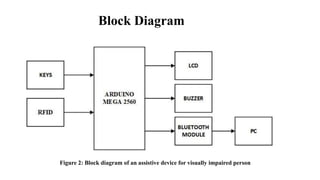
Figure 2: Block diagram of an assistive device for visually impaired person
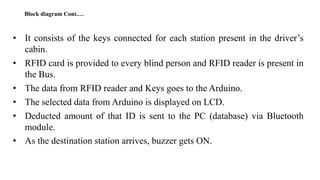
• It consists of the keys connected for each station present in the driver’s
cabin.
• RFID card is provided to every blind person and RFID reader is present in
the Bus.
• The data from RFID reader and Keys goes to the Arduino.
• The selected data from Arduino is displayed on LCD.
• Deducted amount of that ID is sent to the PC (database) via Bluetooth
module.
• As the destination station arrives, buzzer gets ON.
Block diagram Cont.…
Design Approach
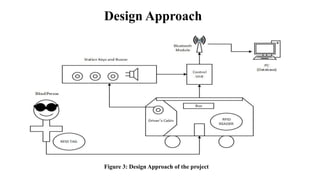
Figure 3: Design Approach of the project
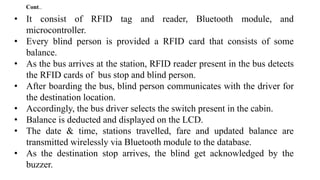
• It consist of RFID tag and reader, Bluetooth module, and
microcontroller.
• Every blind person is provided a RFID card that consists of some
balance.
• As the bus arrives at the station, RFID reader present in the bus detects
the RFID cards of bus stop and blind person.
• After boarding the bus, blind person communicates with the driver for
the destination location.
• Accordingly, the bus driver selects the switch present in the cabin.
• Balance is deducted and displayed on the LCD.
• The date & time, stations travelled, fare and updated balance are
transmitted wirelessly via Bluetooth module to the database.
• As the destination stop arrives, the blind get acknowledged by the
buzzer.
Cont..
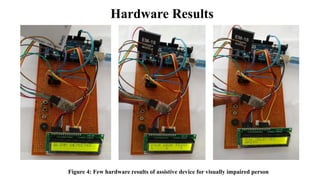
Hardware Results
Figure 4: Few hardware results of assistive device for visually impaired person
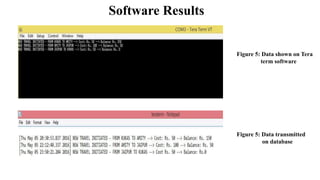
Software Results
Figure 5: Data shown on Tera
term software
Figure 5: Data transmitted
on database
Conclusion
The assistive device for visually impaired person has been designed focusing
upon the ease of travelling for the blind people. They can’t be cheated as
blind is not paying the fare of travelling manually. They don’t need to be in a
constant guidance as they can travel their own path easily with the help of this
project.
• We can replace the Bluetooth Module with Wi-Fi for long distance
communication.
• We need to introduce speech to text converter so the blind person can
verbally instruct the hardware as per the uses.
• Buzzer can also be replaced by audio sound so the blind person could
acknowledge about every station.
• GPS tracker can be added in the card.
• It can also be modified for deaf and dumb person.
Future Work
THANK YOU
References
1. Jones, 2009, March, 11, “Overview of Assistive Technology for families with a visually impaired child”, Available online:
http://www.familyconnect.org/info/assistive Technology/an-overview/15.
2. WHO,2014 August, ”Visual impairment and blindness”, Available online: http://www.who.int/ mediacentre/ factsheets
/fs282/en/
3. MIUSA, 2009, “Assistive Technology for blind or low vision”. Available online: http://www.miusa.org/ resource
/tipsheet/assistivetechnologyforblind.
4. Press, 2015 June, “FDA allows marketing of new devices to help the blind process visual signals via their tongue,
Available online: http://www.fda.gov/NewsEvents/Newsroom/PressAnnuncement /ucm451779.htm
5. Hilary Brueck, 6 Jan 2016, “This Bionic Eye Could Help the Blind See—From the Back of Their Head, Available online:
http://fortune.com/2016/01/06/bionic-eye-monash/.
6. G Prasanthi, P.Tejaswitha, 2015 Jan, “Sensor Assisted stick for the blind people” Available online: www.techscripts.org/
jan_2015/jan201503.pdf.
7. B.Ding, H.Yuan and X.Zang, “The Research on Blind Navigation System Based on RFID”, International Conference on
Wireless Communications, Networking and Mobile Computing, Shanghai, China, 2007.
8. Kumar Yelamarthi, Daniel Haas et.al, “RFID and GPS Integrated Navigation System for the Visually Impaired”, 53rd
IEEE International Midwest Symposium on Circuits and Systems , USA 2010.
9. Romteera Khlaikhayai, Chavana Pavaganun, et al.,”An Intelligent, Walking Stick for Elderly and Blind Safety”, 2nd
International Science, Social Science, Engineering and Energy Conference, Engineering Science and Management, AP,
2010.
10. N.Mayuri, T.Renushapale, “Safety Navigation for the Blind People by using RFID System”, International Journal of
Engineering and Science Research, Chirala,, AP, 2012.

assisting device for visually impaired person

  • 1.
    Assisting Device forVisually Impaired Person Alpana Poddar (A20405112018) B. Tech. – ECE Guide: Ms. Pushpa Gothwal (Assistant Professor) AMITY UNIVERSITY RAJASTHAN MAY 2016
  • 2.
    Presentation Overview • Introduction •Block Diagram • Design Approach • Hardware & Software Results • Conclusion • Future Work • References
  • 3.
    Introduction As per theWHO data base 39 million persons are blind and 246 have low vision and they need constant support to attain their daily activity [2]. The advancement in technology has not only given comfort to the normal person but the person with disabilities too. Many advancement in technology has been seen from past years for the Visually Impaired Person, for example: (i) Assistive devices (White cane) [6] (ii) Wearable assisting devices (Bionic Eyes, Finger Reader) [4-5] (iii) Softwares (Screen Reading) [3]
  • 4.
    Figure 1:Wearable AssistingDevices (Adapted from [1])
  • 5.
    Aim: To design anassistive device for visually impaired person using RFID, Bluetooth and Microcontroller (Arduino Mega2560). Advantage: 1. To travel the visually impaired person independently up to farther distance. 2. Blind Person need not to carry money for travelling.
  • 6.
    Block Diagram Figure 2:Block diagram of an assistive device for visually impaired person
  • 7.
    • It consistsof the keys connected for each station present in the driver’s cabin. • RFID card is provided to every blind person and RFID reader is present in the Bus. • The data from RFID reader and Keys goes to the Arduino. • The selected data from Arduino is displayed on LCD. • Deducted amount of that ID is sent to the PC (database) via Bluetooth module. • As the destination station arrives, buzzer gets ON. Block diagram Cont.…
  • 8.
    Design Approach Figure 3:Design Approach of the project
  • 9.
    • It consistof RFID tag and reader, Bluetooth module, and microcontroller. • Every blind person is provided a RFID card that consists of some balance. • As the bus arrives at the station, RFID reader present in the bus detects the RFID cards of bus stop and blind person. • After boarding the bus, blind person communicates with the driver for the destination location. • Accordingly, the bus driver selects the switch present in the cabin. • Balance is deducted and displayed on the LCD. • The date & time, stations travelled, fare and updated balance are transmitted wirelessly via Bluetooth module to the database. • As the destination stop arrives, the blind get acknowledged by the buzzer. Cont..
  • 10.
    Hardware Results Figure 4:Few hardware results of assistive device for visually impaired person
  • 11.
    Software Results Figure 5:Data shown on Tera term software Figure 5: Data transmitted on database
  • 12.
    Conclusion The assistive devicefor visually impaired person has been designed focusing upon the ease of travelling for the blind people. They can’t be cheated as blind is not paying the fare of travelling manually. They don’t need to be in a constant guidance as they can travel their own path easily with the help of this project.
  • 13.
    • We canreplace the Bluetooth Module with Wi-Fi for long distance communication. • We need to introduce speech to text converter so the blind person can verbally instruct the hardware as per the uses. • Buzzer can also be replaced by audio sound so the blind person could acknowledge about every station. • GPS tracker can be added in the card. • It can also be modified for deaf and dumb person. Future Work
  • 14.
  • 15.
    References 1. Jones, 2009,March, 11, “Overview of Assistive Technology for families with a visually impaired child”, Available online: http://www.familyconnect.org/info/assistive Technology/an-overview/15. 2. WHO,2014 August, ”Visual impairment and blindness”, Available online: http://www.who.int/ mediacentre/ factsheets /fs282/en/ 3. MIUSA, 2009, “Assistive Technology for blind or low vision”. Available online: http://www.miusa.org/ resource /tipsheet/assistivetechnologyforblind. 4. Press, 2015 June, “FDA allows marketing of new devices to help the blind process visual signals via their tongue, Available online: http://www.fda.gov/NewsEvents/Newsroom/PressAnnuncement /ucm451779.htm 5. Hilary Brueck, 6 Jan 2016, “This Bionic Eye Could Help the Blind See—From the Back of Their Head, Available online: http://fortune.com/2016/01/06/bionic-eye-monash/. 6. G Prasanthi, P.Tejaswitha, 2015 Jan, “Sensor Assisted stick for the blind people” Available online: www.techscripts.org/ jan_2015/jan201503.pdf. 7. B.Ding, H.Yuan and X.Zang, “The Research on Blind Navigation System Based on RFID”, International Conference on Wireless Communications, Networking and Mobile Computing, Shanghai, China, 2007. 8. Kumar Yelamarthi, Daniel Haas et.al, “RFID and GPS Integrated Navigation System for the Visually Impaired”, 53rd IEEE International Midwest Symposium on Circuits and Systems , USA 2010. 9. Romteera Khlaikhayai, Chavana Pavaganun, et al.,”An Intelligent, Walking Stick for Elderly and Blind Safety”, 2nd International Science, Social Science, Engineering and Energy Conference, Engineering Science and Management, AP, 2010. 10. N.Mayuri, T.Renushapale, “Safety Navigation for the Blind People by using RFID System”, International Journal of Engineering and Science Research, Chirala,, AP, 2012.