The UNIVERSITY OF JORDAN (UJ)
           FACULTY OF ENGINEERING & TECHNOLOGY (FET)
             COMPUTER ENGINEERING Department (CPE)

                              COURSE OUTLINE

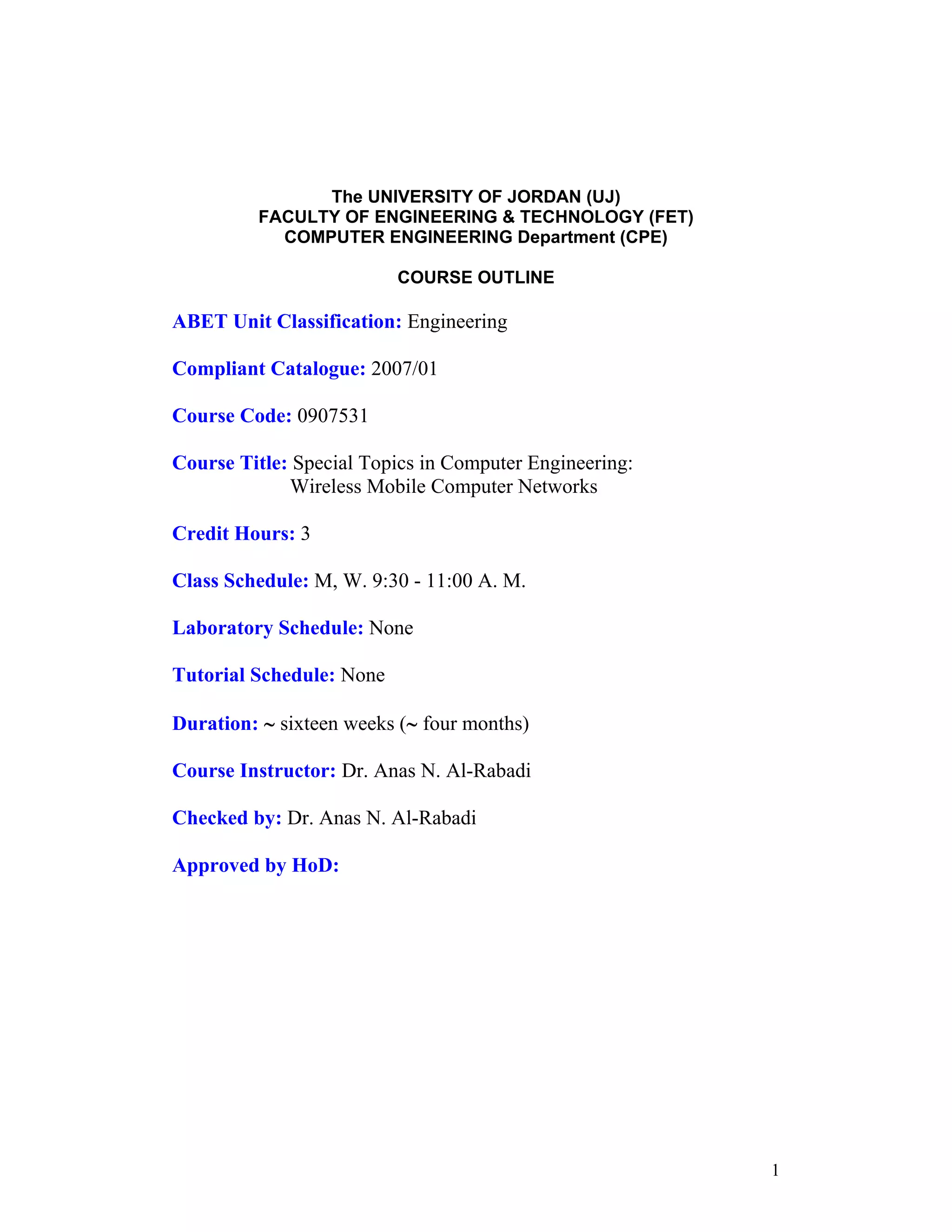
ABET Unit Classification: Engineering

Compliant Catalogue: 2007/01

Course Code: 0907531

Course Title: Special Topics in Computer Engineering:
             Wireless Mobile Computer Networks

Credit Hours: 3

Class Schedule: M, M, T,9:30 - 9:10 - 10:10 A.M.
                 S, W. W, Th. 11:00 A. M.


Laboratory Schedule: None

Tutorial Schedule: None

Duration: ∼ sixteen weeks (∼ four months)
                 Eight Weeks (Two Months)


Course Instructor: Dr. Anas N. Al-Rabadi

Checked by: Dr. Anas N. Al-Rabadi

Approved by HoD:


                                                        1
University of Jordan
                   Computer Engineering Department
                         COURSE OUTLINE

                           I. Course Description
               (0907531) Wireless Mobile Computer Networks
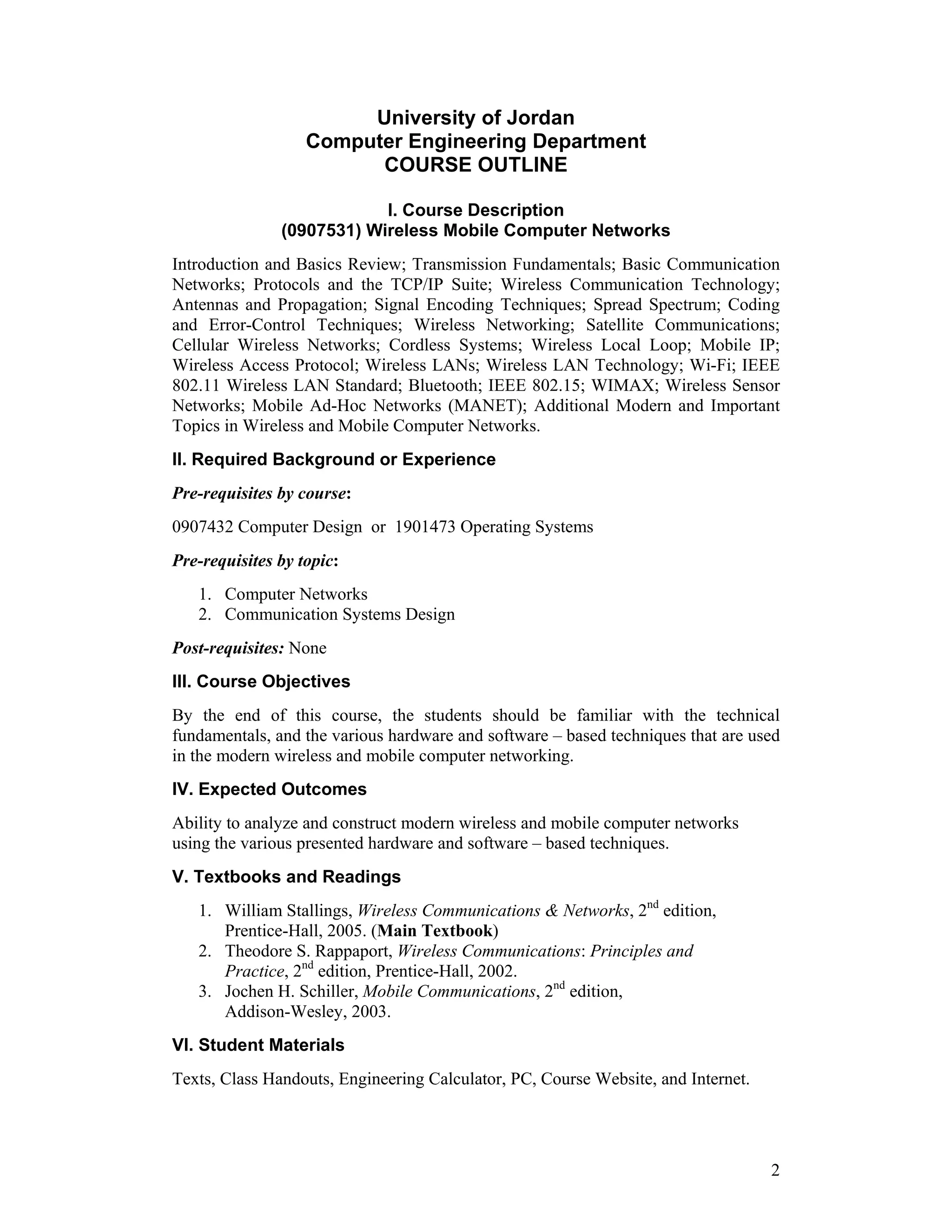
Introduction and Basics Review; Transmission Fundamentals; Basic Communication
Networks; Protocols and the TCP/IP Suite; Wireless Communication Technology;
Antennas and Propagation; Signal Encoding Techniques; Spread Spectrum; Coding
and Error-Control Techniques; Wireless Networking; Satellite Communications;
Cellular Wireless Networks; Cordless Systems; Wireless Local Loop; Mobile IP;
Wireless Access Protocol; Wireless LANs; Wireless LAN Technology; Wi-Fi; IEEE
802.11 Wireless LAN Standard; Bluetooth; IEEE 802.15; WIMAX; Wireless Sensor
Networks; Mobile Ad-Hoc Networks (MANET); Additional Modern and Important
Topics in Wireless and Mobile Computer Networks.
II. Required Background or Experience
Pre-requisites by course:
0907432 Computer Design or 1901473 Operating Systems
Pre-requisites by topic:
   1. Computer Networks
   2. Communication Systems Design
Post-requisites: None
III. Course Objectives
By the end of this course, the students should be familiar with the technical
fundamentals, and the various hardware and software – based techniques that are used
in the modern wireless and mobile computer networking.
IV. Expected Outcomes
Ability to analyze and construct modern wireless and mobile computer networks
using the various presented hardware and software – based techniques.
V. Textbooks and Readings
   1. William Stallings, Wireless Communications & Networks, 2nd edition,
      Prentice-Hall, 2005. (Main Textbook)
   2. Theodore S. Rappaport, Wireless Communications: Principles and
      Practice, 2nd edition, Prentice-Hall, 2002.
   3. Jochen H. Schiller, Mobile Communications, 2nd edition,
      Addison-Wesley, 2003.
VI. Student Materials
Texts, Class Handouts, Engineering Calculator, PC, Course Website, and Internet.


                                                                                   2
VII. College Facilities
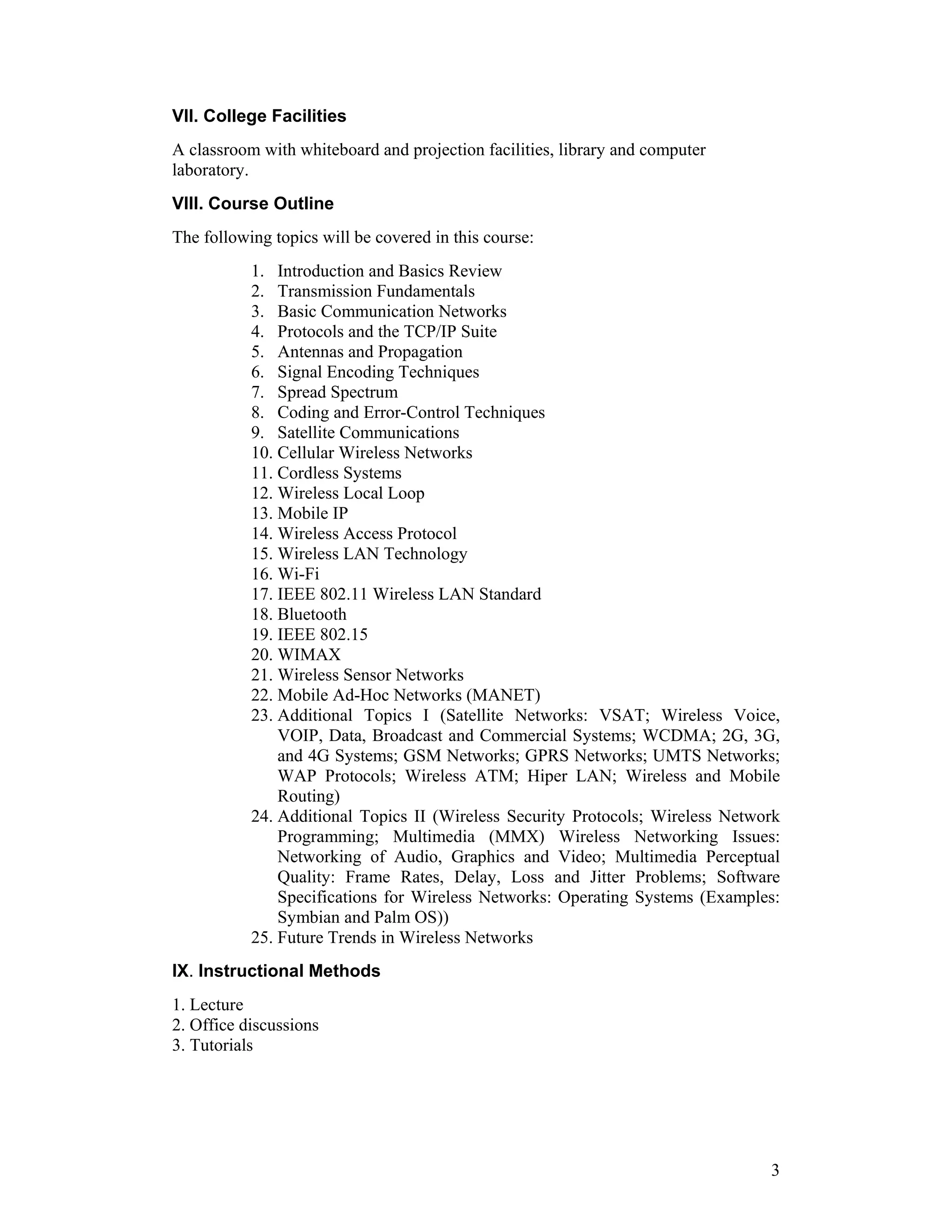
A classroom with whiteboard and projection facilities, library and computer
laboratory.
VIII. Course Outline
The following topics will be covered in this course:
           1. Introduction and Basics Review
           2. Transmission Fundamentals
           3. Basic Communication Networks
           4. Protocols and the TCP/IP Suite
           5. Antennas and Propagation
           6. Signal Encoding Techniques
           7. Spread Spectrum
           8. Coding and Error-Control Techniques
           9. Satellite Communications
           10. Cellular Wireless Networks
           11. Cordless Systems
           12. Wireless Local Loop
           13. Mobile IP
           14. Wireless Access Protocol
           15. Wireless LAN Technology
           16. Wi-Fi
           17. IEEE 802.11 Wireless LAN Standard
           18. Bluetooth
           19. IEEE 802.15
           20. WIMAX
           21. Wireless Sensor Networks
           22. Mobile Ad-Hoc Networks (MANET)
           23. Additional Topics I (Satellite Networks: VSAT; Wireless Voice,
               VOIP, Data, Broadcast and Commercial Systems; WCDMA; 2G, 3G,
               and 4G Systems; GSM Networks; GPRS Networks; UMTS Networks;
               WAP Protocols; Wireless ATM; Hiper LAN; Wireless and Mobile
               Routing)
           24. Additional Topics II (Wireless Security Protocols; Wireless Network
               Programming; Multimedia (MMX) Wireless Networking Issues:
               Networking of Audio, Graphics and Video; Multimedia Perceptual
               Quality: Frame Rates, Delay, Loss and Jitter Problems; Software
               Specifications for Wireless Networks: Operating Systems (Examples:
               Symbian and Palm OS))
           25. Future Trends in Wireless Networks
IX. Instructional Methods
1. Lecture
2. Office discussions
3. Tutorials


                                                                                3
X. Evaluation of Outcomes
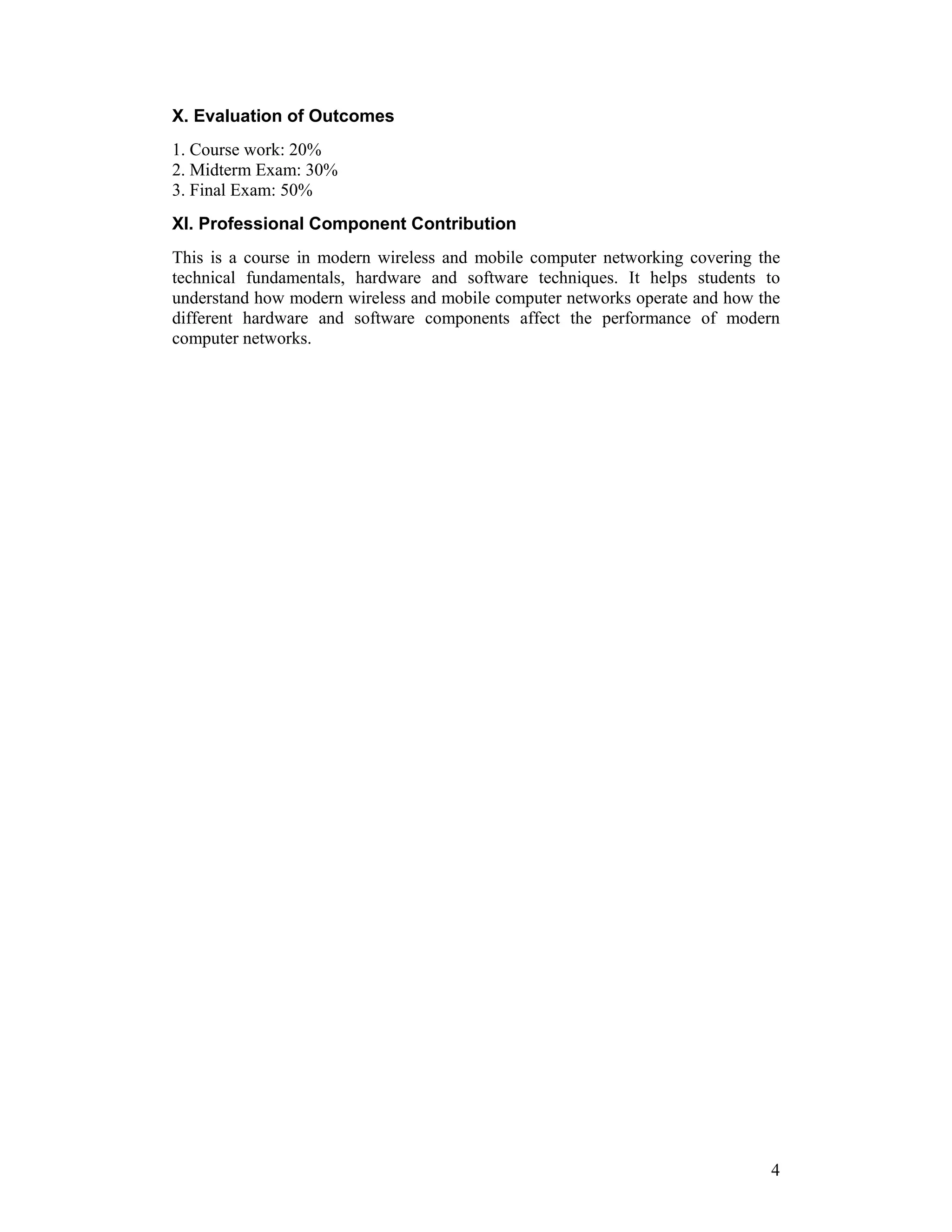
1. Course work: 20%
2. Midterm Exam: 30%
3. Final Exam: 50%
XI. Professional Component Contribution
This is a course in modern wireless and mobile computer networking covering the
technical fundamentals, hardware and software techniques. It helps students to
understand how modern wireless and mobile computer networks operate and how the
different hardware and software components affect the performance of modern
computer networks.


                                                                             4

Wmcn outline summer2011

  • 1.
    The UNIVERSITY OFJORDAN (UJ) FACULTY OF ENGINEERING & TECHNOLOGY (FET) COMPUTER ENGINEERING Department (CPE) COURSE OUTLINE ABET Unit Classification: Engineering Compliant Catalogue: 2007/01 Course Code: 0907531 Course Title: Special Topics in Computer Engineering: Wireless Mobile Computer Networks Credit Hours: 3 Class Schedule: M, M, T,9:30 - 9:10 - 10:10 A.M. S, W. W, Th. 11:00 A. M. Laboratory Schedule: None Tutorial Schedule: None Duration: ∼ sixteen weeks (∼ four months) Eight Weeks (Two Months) Course Instructor: Dr. Anas N. Al-Rabadi Checked by: Dr. Anas N. Al-Rabadi Approved by HoD: 1
  • 2.
    University of Jordan Computer Engineering Department COURSE OUTLINE I. Course Description (0907531) Wireless Mobile Computer Networks Introduction and Basics Review; Transmission Fundamentals; Basic Communication Networks; Protocols and the TCP/IP Suite; Wireless Communication Technology; Antennas and Propagation; Signal Encoding Techniques; Spread Spectrum; Coding and Error-Control Techniques; Wireless Networking; Satellite Communications; Cellular Wireless Networks; Cordless Systems; Wireless Local Loop; Mobile IP; Wireless Access Protocol; Wireless LANs; Wireless LAN Technology; Wi-Fi; IEEE 802.11 Wireless LAN Standard; Bluetooth; IEEE 802.15; WIMAX; Wireless Sensor Networks; Mobile Ad-Hoc Networks (MANET); Additional Modern and Important Topics in Wireless and Mobile Computer Networks. II. Required Background or Experience Pre-requisites by course: 0907432 Computer Design or 1901473 Operating Systems Pre-requisites by topic: 1. Computer Networks 2. Communication Systems Design Post-requisites: None III. Course Objectives By the end of this course, the students should be familiar with the technical fundamentals, and the various hardware and software – based techniques that are used in the modern wireless and mobile computer networking. IV. Expected Outcomes Ability to analyze and construct modern wireless and mobile computer networks using the various presented hardware and software – based techniques. V. Textbooks and Readings 1. William Stallings, Wireless Communications & Networks, 2nd edition, Prentice-Hall, 2005. (Main Textbook) 2. Theodore S. Rappaport, Wireless Communications: Principles and Practice, 2nd edition, Prentice-Hall, 2002. 3. Jochen H. Schiller, Mobile Communications, 2nd edition, Addison-Wesley, 2003. VI. Student Materials Texts, Class Handouts, Engineering Calculator, PC, Course Website, and Internet. 2
  • 3.
    VII. College Facilities Aclassroom with whiteboard and projection facilities, library and computer laboratory. VIII. Course Outline The following topics will be covered in this course: 1. Introduction and Basics Review 2. Transmission Fundamentals 3. Basic Communication Networks 4. Protocols and the TCP/IP Suite 5. Antennas and Propagation 6. Signal Encoding Techniques 7. Spread Spectrum 8. Coding and Error-Control Techniques 9. Satellite Communications 10. Cellular Wireless Networks 11. Cordless Systems 12. Wireless Local Loop 13. Mobile IP 14. Wireless Access Protocol 15. Wireless LAN Technology 16. Wi-Fi 17. IEEE 802.11 Wireless LAN Standard 18. Bluetooth 19. IEEE 802.15 20. WIMAX 21. Wireless Sensor Networks 22. Mobile Ad-Hoc Networks (MANET) 23. Additional Topics I (Satellite Networks: VSAT; Wireless Voice, VOIP, Data, Broadcast and Commercial Systems; WCDMA; 2G, 3G, and 4G Systems; GSM Networks; GPRS Networks; UMTS Networks; WAP Protocols; Wireless ATM; Hiper LAN; Wireless and Mobile Routing) 24. Additional Topics II (Wireless Security Protocols; Wireless Network Programming; Multimedia (MMX) Wireless Networking Issues: Networking of Audio, Graphics and Video; Multimedia Perceptual Quality: Frame Rates, Delay, Loss and Jitter Problems; Software Specifications for Wireless Networks: Operating Systems (Examples: Symbian and Palm OS)) 25. Future Trends in Wireless Networks IX. Instructional Methods 1. Lecture 2. Office discussions 3. Tutorials 3
  • 4.
    X. Evaluation ofOutcomes 1. Course work: 20% 2. Midterm Exam: 30% 3. Final Exam: 50% XI. Professional Component Contribution This is a course in modern wireless and mobile computer networking covering the technical fundamentals, hardware and software techniques. It helps students to understand how modern wireless and mobile computer networks operate and how the different hardware and software components affect the performance of modern computer networks. 4