Intro. to Investing
Diversification
09/05/13
 
• Diversification
• “Most Hated Stock-Market Rally in Years Goes On”
• What do we think
Studies show that somewhere
between 77 and 94% of the
variability in your portfolio's
returns are determined by asset
allocation
What is diversification?
“… we're referring to the attempt by the investor to reduce
exposure to risk by investing in various companies across
different sectors, industries or even countries.”
- Most investment professionals agree that although
diversification is no guarantee against loss, it is a prudent
strategy to adopt toward your long-range financial
objectives.
- to put it simply by spreading your investments across various
sectors or industries with low correlation to each other, you
reduce price volatility.
- Reduction in volatility because of the combination of possible
low or negative correlation investments
Asset allocation
- There is general agreement that asset allocation is the most
difficult part of portfolio management
- Life is always about risk and reward
- It's all about not having all your eggs in one basket
- "But in order to diversify correctly, you need to know what
kinds of investments to buy, how much money to put into
each one, and how to diversify within a particular investment
category."
- Go for Variety, Not Quantity
- Having a lot of investments does not make you diversified.
- To be diversified, you need to have lots of different kinds of
investments. That means you should have some of all of the
following: shares, bonds, property, international securities,
and cash.
The key is having the right mix of
shares, bonds and cash.
This mix of asset classes is known
as your “asset allocation”
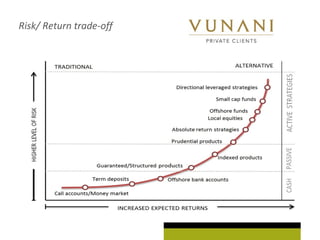
Risk/ Return trade-off
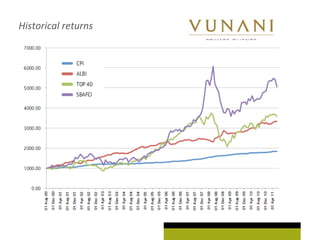
Historical returns
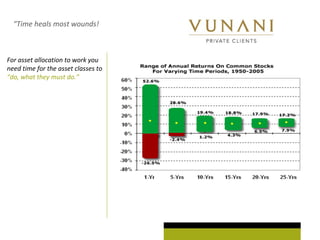
For asset allocation to work you
need time for the asset classes to
“do, what they must do.”
“Time heals most wounds!
Asset Allocation
“Ok, Mark, I understand
splitting up my
investment pie but what
are my options?”
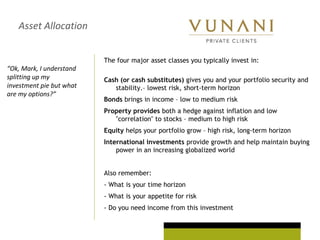
The four major asset classes you typically invest in:
Cash (or cash substitutes) gives you and your portfolio security and
stability.– lowest risk, short-term horizon
Bonds brings in income – low to medium risk
Property provides both a hedge against inflation and low
"correlation" to stocks – medium to high risk
Equity helps your portfolio grow – high risk, long-term horizon
International investments provide growth and help maintain buying
power in an increasing globalized world
Also remember:
- What is your time horizon
- What is your appetite for risk
- Do you need income from this investment
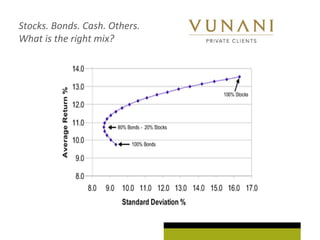
Stocks. Bonds. Cash. Others.
What is the right mix?
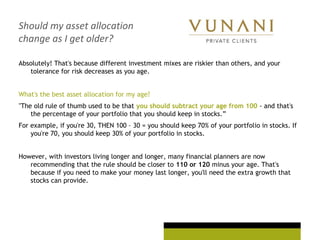
Should my asset allocation
change as I get older?
Absolutely! That's because different investment mixes are riskier than others, and your
tolerance for risk decreases as you age.
What's the best asset allocation for my age?
"The old rule of thumb used to be that you should subtract your age from 100 - and that's
the percentage of your portfolio that you should keep in stocks.”
For example, if you're 30, THEN 100 – 30 = you should keep 70% of your portfolio in stocks. If
you're 70, you should keep 30% of your portfolio in stocks.
However, with investors living longer and longer, many financial planners are now
recommending that the rule should be closer to 110 or 120 minus your age. That's
because if you need to make your money last longer, you'll need the extra growth that
stocks can provide.
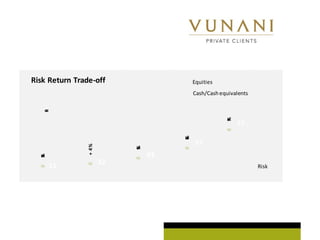
Risk Return Trade-off
CPI+5%
CPI+7%
CPI+4%
CPI+6%
CPI+3%
77
57
43
32
21 Risk
Return
Cash/Cashequivalents
Equities
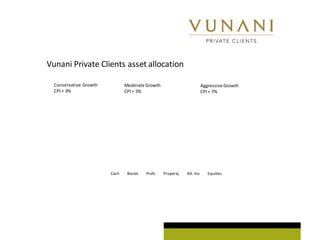
Cash Bonds Prefs Property Alt. Inv Equities
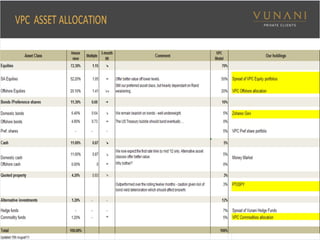
Vunani Private Clients asset allocation
Moderate Growth
CPI + 5%
Aggressive Growth
CPI + 7%
Conservative Growth
CPI + 3%
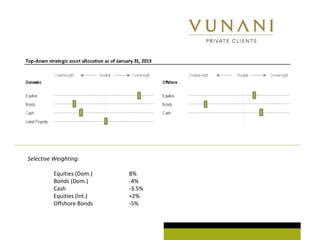
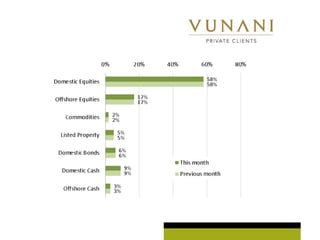
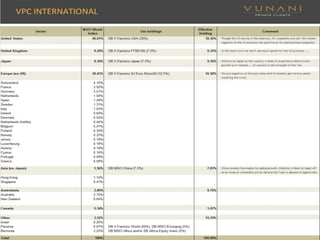
Selective Weighting:
Equities (Dom.) 8%
Bonds (Dom.) -4%
Cash -3.5%
Equities (Int.) +2%
Offshore Bonds -5%
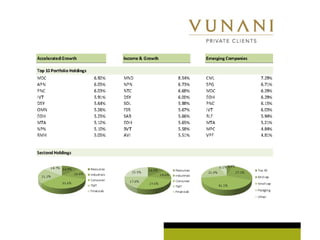
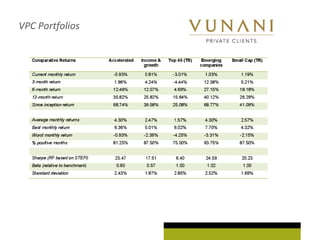
VPC Portfolios
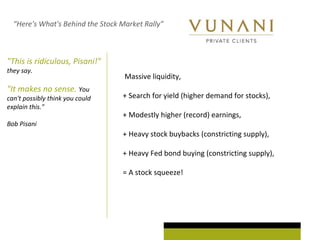
"This is ridiculous, Pisani!"
they say.
"It makes no sense. You
can't possibly think you could
explain this."
Bob Pisani
“Here's What's Behind the Stock Market Rally”
Massive liquidity,
+ Search for yield (higher demand for stocks),
+ Modestly higher (record) earnings,
+ Heavy stock buybacks (constricting supply),
+ Heavy Fed bond buying (constricting supply),
= A stock squeeze!
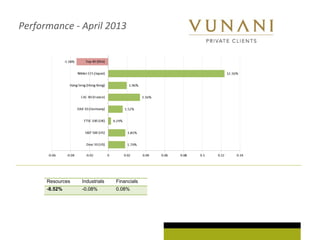
Performance - April 2013
Resources Industrials Financials
-8.52% -0.08% 0.08%
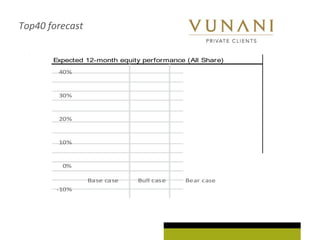
Top40 forecast
Expected 12-month equity performance (All Share)
-10%
0%
10%
20%
30%
40%
Base case Bull case Bear case
VPC Deloitte Presentation

VPC Deloitte Presentation

  • 1.
  • 2.
    • Diversification • “MostHated Stock-Market Rally in Years Goes On” • What do we think
  • 3.
    Studies show thatsomewhere between 77 and 94% of the variability in your portfolio's returns are determined by asset allocation What is diversification? “… we're referring to the attempt by the investor to reduce exposure to risk by investing in various companies across different sectors, industries or even countries.” - Most investment professionals agree that although diversification is no guarantee against loss, it is a prudent strategy to adopt toward your long-range financial objectives. - to put it simply by spreading your investments across various sectors or industries with low correlation to each other, you reduce price volatility. - Reduction in volatility because of the combination of possible low or negative correlation investments
  • 4.
    Asset allocation - Thereis general agreement that asset allocation is the most difficult part of portfolio management - Life is always about risk and reward - It's all about not having all your eggs in one basket - "But in order to diversify correctly, you need to know what kinds of investments to buy, how much money to put into each one, and how to diversify within a particular investment category." - Go for Variety, Not Quantity - Having a lot of investments does not make you diversified. - To be diversified, you need to have lots of different kinds of investments. That means you should have some of all of the following: shares, bonds, property, international securities, and cash. The key is having the right mix of shares, bonds and cash. This mix of asset classes is known as your “asset allocation”
  • 5.
  • 6.
  • 7.
    For asset allocationto work you need time for the asset classes to “do, what they must do.” “Time heals most wounds!
  • 8.
    Asset Allocation “Ok, Mark,I understand splitting up my investment pie but what are my options?” The four major asset classes you typically invest in: Cash (or cash substitutes) gives you and your portfolio security and stability.– lowest risk, short-term horizon Bonds brings in income – low to medium risk Property provides both a hedge against inflation and low "correlation" to stocks – medium to high risk Equity helps your portfolio grow – high risk, long-term horizon International investments provide growth and help maintain buying power in an increasing globalized world Also remember: - What is your time horizon - What is your appetite for risk - Do you need income from this investment
  • 9.
    Stocks. Bonds. Cash.Others. What is the right mix?
  • 10.
    Should my assetallocation change as I get older? Absolutely! That's because different investment mixes are riskier than others, and your tolerance for risk decreases as you age. What's the best asset allocation for my age? "The old rule of thumb used to be that you should subtract your age from 100 - and that's the percentage of your portfolio that you should keep in stocks.” For example, if you're 30, THEN 100 – 30 = you should keep 70% of your portfolio in stocks. If you're 70, you should keep 30% of your portfolio in stocks. However, with investors living longer and longer, many financial planners are now recommending that the rule should be closer to 110 or 120 minus your age. That's because if you need to make your money last longer, you'll need the extra growth that stocks can provide.
  • 11.
  • 12.
    Cash Bonds PrefsProperty Alt. Inv Equities Vunani Private Clients asset allocation Moderate Growth CPI + 5% Aggressive Growth CPI + 7% Conservative Growth CPI + 3%
  • 13.
    Selective Weighting: Equities (Dom.)8% Bonds (Dom.) -4% Cash -3.5% Equities (Int.) +2% Offshore Bonds -5%
  • 19.
  • 20.
    "This is ridiculous,Pisani!" they say. "It makes no sense. You can't possibly think you could explain this." Bob Pisani “Here's What's Behind the Stock Market Rally” Massive liquidity, + Search for yield (higher demand for stocks), + Modestly higher (record) earnings, + Heavy stock buybacks (constricting supply), + Heavy Fed bond buying (constricting supply), = A stock squeeze!
  • 21.
    Performance - April2013 Resources Industrials Financials -8.52% -0.08% 0.08%
  • 22.
    Top40 forecast Expected 12-monthequity performance (All Share) -10% 0% 10% 20% 30% 40% Base case Bull case Bear case